Quadruped Robot Market by Type (Inspection Robots, Rescue Robots, Military/Defense Robots, Logistics & Warehousing Robots, Research & Development Robots), Deployment Model (Owned, Lease/RaaS, Hybrid), End-User (Defense, Oil & Gas, Utilities, Logistics), and Region — Global Forecast to 2032


Quadruped Robot Market 2032: Size, Share & Growth Report
The quadruped robot market is estimated to be USD 3.54 billion in 2026 and is projected to reach USD 10.48 billion by 2032, growing at a CAGR of 18.0% from 2026 to 2032, fueled by enterprises' urgent need to automate inspection, security, and mobility tasks in terrain and hazard conditions that wheeled and tracked platforms cannot reliably handle.
Market Overview
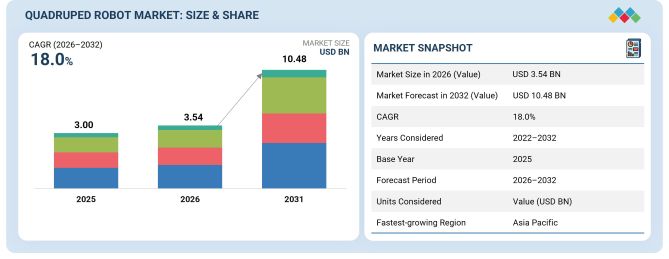
The quadruped robot market marks a shift in which industrial inspection, defense reconnaissance, and warehouse operations increasingly rely on four-legged autonomous platforms to navigate stairs, rubble, and unstructured terrain where wheeled robots and human labor face cost, safety, or mobility limits.
For instance, Boston Dynamics' Orbit fleet-management platform, now powered by Google's Gemini Robotics models, combines inspection planning, autonomous mission execution, and asset-health reporting into a single AI-enabled system built on its Spot and Stretch hardware lines, and the company's USD 100 million facility expansion in Waltham, Massachusetts, announced in June 2026, reflects sustained capital investment behind that platform.
That same enterprise-grade design philosophy is now extending into defense procurement: Skyborne Technologies' contract with U.S. Special Operations Command, covering 14 armed CODiAQ quadruped systems and 28 modular weapon payloads, created a new category of defense-procured quadruped platform and illustrates how quickly military buyers are moving from evaluation to operational fielding.
Enterprises are also under growing pressure from an entirely new source of demand: AI data center and critical-infrastructure security. Rapid growth in compute infrastructure and grid-connected assets is compounding the inspection burden already facing utilities and industrial operators, pushing facility managers to adopt autonomous mobile inspection considerably faster than an industrial-automation-only demand curve would have required on its own.
Top 10 Key Takeaways
- North America has the largest installed platform base, driven by deep defense-sector investment and the concentration of leading vendors including Boston Dynamics and Ghost Robotics.
- Asia Pacific is the fastest-growing region, propelled by China's Unitree-led manufacturing scale, Taiwan's indigenous military development, and India's industrial automation programs.
- Inspection robots lead by type, with military and defense robots growing the fastest as governments expand autonomous reconnaissance procurement.
- Defense and military end-users remain a fast-growing segment, while oil & gas and utilities continue to adopt these platforms for routine infrastructure inspection.
- Lease and Robot-as-a-Service deployment is extending its reach as enterprises gain confidence in vendor-managed fleet economics without large upfront capital outlays.
- AI-enabled autonomy and onboard perception are converging into unified platforms, reducing the number of separate systems an operator must manage during a single inspection round.
- Vendor consolidation is accelerating, with platform providers acquiring specialized sensor and payload companies to build genuinely end-to-end inspection and reconnaissance offerings.
- The largest near-term opportunity is armed and tactical quadruped procurement, which lets militaries field distributed reconnaissance and combat-support capability at a fraction of manned-system cost.
- AI data center and critical-infrastructure growth is creating an entirely new, defense-independent source of demand for autonomous inspection and security platforms.
- The primary near-term restraint is the high cost and complexity of integrating premium platforms with legacy facility, safety, and procurement infrastructure that many enterprises still depend on.
Why the Quadruped Robot Market Matters Now
Facility operators have historically managed inspection and security through a comparatively predictable mix of scheduled human patrols and fixed sensor installations, revisited on a fixed calendar regardless of actual asset condition. Quadruped robots exist because that model has broken down: the number of distributed assets requiring inspection, from power-line corridors to warehouse racking to remote military perimeters, has grown far beyond what manual patrol and fixed cameras can reasonably cover, while labor availability for hazardous or repetitive inspection work continues to tighten.
The market covers the hardware and software platforms used to conduct autonomous inspection, reconnaissance, rescue, and material-handling tasks, spanning inspection robots, rescue robots, military and defense robots, logistics and warehousing robots, and research and development robots. It includes established enterprise robotics majors that combine hardware with integrated autonomy software, and lower-cost manufacturers built specifically for volume deployment in research, education, and price-sensitive industrial settings. The scope excludes wheeled and tracked autonomous mobile robots, fixed sensor and camera installations, and humanoid robots not built on a four-legged locomotion base. The market connects to the broader autonomous mobile robot market, the defense robotics market, the industrial inspection market, and the warehouse automation market.
The market's structure reflects a platform divide. The largest enterprises and militaries build or heavily customize deployments around premium platforms such as Boston Dynamics' Spot and Orbit software, trading a higher per-unit cost for integrated autonomy, support, and government-acceptable procurement credentials. Mid-market and research buyers increasingly deploy lower-cost platforms such as Unitree's Go2 and B2 or DEEP Robotics' X30, trading customization and support depth for dramatically lower acquisition cost. Independent power producers, logistics operators, and defense agencies sit alongside industrial inspection buyers as a growing, distinct segment specifically seeking reconnaissance and material-handling capability for their own operations.
Report Scope
|
Report Metric |
Details |
|
Market Size in 2026 (Value) |
USD 3.54 Billion |
|
Market Forecast in 2032 (Value) |
USD 10.48 Billion |
|
Growth Rate |
CAGR of 18.0% from 2026-2032 |
|
Years Considered |
2022-2032 |
|
Base Year |
2026 |
|
Forecast Period |
2026-2032 |
|
Units Considered |
Value (USD Billion) |
|
Report Coverage |
Revenue forecast, company ranking, competitive landscape, growth factors, and trends |
|
Top Companies |
|
|
Growth Drivers |
|
|
Segments Covered |
|
|
Regional Scope |
North America, Europe, Asia Pacific, Rest of World |
Market Trends Shaping Quadruped Robotics
The key trend is enterprises consolidating inspection, security, and asset-monitoring functions into unified fleet-management platforms rather than operating separate systems for each function. Boston Dynamics' Orbit platform illustrates this directly by combining mission planning, autonomous execution, and asset-health reporting into a single modular system built on Gemini Robotics AI, rather than requiring operators to integrate these functions independently.
Another trend is the scaling of quadruped deployment from pilot programs to genuinely facility-wide operations. As the population of assets requiring inspection across a typical industrial site or utility territory continues to climb, platforms are moving from managing a small demonstration fleet to coordinating dozens of units across an entire operator's footprint, as illustrated by DEEP Robotics' February 2026 commercial rollout of X30 units across Singapore's power cable tunnel network.
A third trend is armed and tactical quadrupeds becoming a core defense procurement category rather than a niche evaluation program. Skyborne Technologies' USD 6.5 million USSOCOM contract for 14 CODiAQ systems with modular weapon payloads demonstrates that armed quadruped procurement has reached a scale that materially affects special-operations planning rather than remaining a small-scale demonstration.
A fourth trend is platform vendors forming direct partnerships with hyperscale AI providers to extend their own perception and autonomy capability. Boston Dynamics' integration of Google's Gemini Robotics models into Orbit reflects how directly robotics vendors pair their hardware expertise with partners' cloud-scale AI infrastructure.
The fifth trend sees AI-driven autonomy extending well beyond inspection alone into reconnaissance and rescue applications. Taiwan's NCSIST unveiled military quadruped prototypes in June 2026 integrating LiDAR, thermal imaging, and electro-optical reconnaissance payloads, illustrating how the same underlying autonomy and sensor infrastructure built for industrial inspection is increasingly repurposed for defense and emergency-response missions.
Market Drivers Accelerating Growth
The first key factor is rising deployment of autonomous mobility in hazardous industrial environments. As oil & gas, utility, and mining operators face mounting pressure to reduce worker exposure to confined-space and height-related hazards, facility managers need considerably more scalable inspection capability than manual patrol was ever designed to provide.
The second factor is the acceleration of AI-enabled autonomy and defense procurement among militaries, specifically because the underlying technology has matured enough to deliver measurable operational value. Platforms like Boston Dynamics' Orbit and Skyborne's CODiAQ demonstrate that AI-enabled autonomy can meaningfully reduce reconnaissance response times and expand mission coverage, giving defense buyers considerably more confidence to invest at scale.
The third factor is e-commerce and warehouse automation demand driving direct software-integrated platform investment from logistics buyers. As large distribution operators increasingly manage growing inventory footprints and tightening labor availability, they require autonomous inspection and material-handling software that is considerably closer to what an industrial inspection buyer would use, extending this market's buyer base well beyond defense and utilities alone.
Market Challenges and Restraints
The key obstacle is high integration cost with legacy facility and safety infrastructure that many enterprises have operated for decades. Modern quadruped platforms have to interoperate with existing SCADA, safety, and procurement systems rather than replacing them outright, and that integration work remains a genuine, often underestimated cost and timeline risk for enterprise robotics projects.
Another hurdle is battery and runtime constraints, which are slowing continuous-duty deployment specifically. Enterprises managing 24/7 inspection or security requirements remain understandably cautious about runtime limitations of 90 minutes to a few hours per charge, and that caution continues to shape how quickly autonomous docking and battery-swap infrastructure can displace human patrol, even where the underlying autonomy capabilities are comparable.
The third challenge involves interoperability across a fragmented vendor and payload landscape. With inspection sensors, autonomy software, fleet management, and defense payloads often supplied by different vendors using different data standards, achieving genuine end-to-end interoperability remains a real technical and commercial challenge that ongoing vendor consolidation is only partially resolving.
Segment Insights
By Type
Inspection robots lead the market by current deployment volume, reflecting their foundational role coordinating the growing population of industrial assets requiring routine monitoring across oil & gas, utility, and manufacturing facilities.
Military and defense robots are the fastest-growing type category, as governments increasingly procure armed and reconnaissance-focused platforms as a coordinated defense-modernization resource rather than treating each evaluation program in isolation.
By End-User
Oil & gas and utilities lead the market in deployment volume, reflecting their direct operational responsibility for infrastructure reliability and their position as the earliest and most committed adopters of this technology.
Defense and military end-users are the fastest-growing segment, as national procurement programs and special-operations evaluation increasingly require reconnaissance and tactical-support capabilities comparable to those an industrial inspection buyer uses.
Key segmentation highlights:
- Inspection robots remain the primary entry point for enterprise adoption, while military and defense robots show the fastest growth in procurement value.
- Lease and RaaS deployment is gaining share fastest, though owned systems remain dominant among the largest enterprises with the deepest existing capital budgets.
- Oil & gas and utilities account for the largest share of spending, while defense buyers represent the fastest-growing customer segment.
- Research and development robots increasingly serve as the innovation pipeline that inspection and defense platforms both draw from.
- Vendor consolidation is compressing the number of distinct point solutions a typical enterprise needs to integrate and maintain.
Quadruped Robot Market by Region
North America
North America holds the largest base, valued at roughly USD 1.37 billion in 2026 and projected to reach about USD 4.05 billion by 2032, growing at a CAGR of 18.2%.
The US leads with key platform vendors including Boston Dynamics and Ghost Robotics, alongside a deep base of defense agencies and utility operators investing in autonomous inspection modernization. Canada also contributes through growing utility interest in distributed asset monitoring and cross-border infrastructure reliability planning.
Europe
Europe is advancing in line with the global pace, valued at approximately USD 0.65 billion in 2026 and forecast to reach around USD 1.92 billion by 2032, at a CAGR of 18.1%.
Switzerland spearheads European robotics innovation through ANYbotics and Swiss-Mile, given its concentration of precision engineering talent and research institutions. The UK contributes through National Grid's ongoing inspection digitalization programs, while Germany continues to anchor industrial-automation-led adoption across its manufacturing base.
Asia Pacific
Asia Pacific is the fastest-growing region, valued at roughly USD 1.18 billion in 2026 and projected to reach about USD 3.48 billion by 2032, growing at a CAGR of 18.1%.
China spearheads manufacturing scale through Unitree's vertically integrated production, driving substantial global demand for low-cost research and industrial platforms. Taiwan accelerates military-grade development through NCSIST and ITRI programs, while Japan and India advance through industrial-automation adoption and growing government inspection modernization initiatives.
Rest of World
The Rest of World market reached an estimated USD 0.34 billion in 2026 and is projected to hit about USD 1.03 billion by 2032, growing at a CAGR of 18.0%.
The Middle East is investing in infrastructure-inspection digitalization as part of broader energy-diversification strategies, with the UAE and Saudi Arabia at the forefront. Latin America contributes through Brazil's growing industrial-inspection market and Chile's mining-sector autonomous monitoring operations.
Key Company Insights
The competitive landscape consists of four tiers: established enterprise robotics majors, quadruped-native specialists, defense-focused platform providers, and component and sensor suppliers. Major players include:
- Boston Dynamics
- Unitree Robotics
- ANYbotics
- Ghost Robotics
- DEEP Robotics
- Skyborne Technologies
- Swiss-Mile
- Agility Robotics
- Clearpath Robotics
- Hyundai Robotics
- OLO Robotics
- MAB Robotics
- Keybotic
- RealMan Robotics
- GENISOM AI
Boston Dynamics leads through the scale and depth of integration of its Orbit fleet-management platform, combining mission planning, autonomous execution, and asset-health reporting into a single AI-enabled system built on its established Spot and Stretch hardware, and extended through a direct partnership with Google's Gemini Robotics models.
Unitree Robotics has become the leading high-volume platform provider through aggressive pricing and vertical integration, combining design, manufacturing, and software into a single company that now holds an estimated 70% share of global unit volume across research, education, and industrial customers worldwide.
DEEP Robotics and Ghost Robotics each continue extending focused hardware expertise into specialized commercial and tactical deployment, competing directly with more software-integrated entrants for large enterprise and defense transformation programs.
Recent Developments
- June 2026: Taiwan's National Chung-Shan Institute of Science and Technology (NCSIST) unveiled three military-specific quadruped robot prototypes designed for surveillance, reconnaissance, and combat-support missions, based on Ghost Robotics' Vision 60 platform and integrating NCSIST-developed LiDAR, thermal-imaging, and remote-controlled weapon systems.
- May 2026: Skyborne Technologies received a U.S. Department of War Limited Safety Release for its CODiAQ armed quadruped robot, clearing a USD 6.5 million firm-fixed-price contract covering 14 systems and 28 modular weapon payloads for U.S. Special Operations Command evaluation, with live-fire training scheduled for October 2026.
- February 2026: DEEP Robotics announced the commercial deployment of its X30 quadruped units to inspect power cable tunnels in Singapore, marking a transition from pilot programs to systematic multi-unit field operations in critical infrastructure.
- September 2025: Climate Investment announced its investment in ANYbotics, a provider of autonomous robotic inspection technologies, to further develop its mobile robot inspection systems and expand its geographic footprint.
Real-World Use Cases
Boston Dynamics' Orbit platform illustrates how a single, modular AI-enabled system can replace the fragmented inspection, security, and asset-management tools many enterprises have historically operated separately. Built on the company's established Spot hardware, the platform lets operators modernize incrementally by adding AI-enabled capabilities such as predictive asset-health scoring without having to overhaul existing facility infrastructure outright. Utilities and oil & gas operators across North America and Europe have adopted the platform to accelerate inspection cycles and improve incident-response documentation during routine and emergency events.
Unitree's high-volume platform strategy shows how quadruped deployment can scale from a specialized research and education offering into infrastructure that supports thousands of institutional buyers across an entire global market. By integrating an open SDK and ROS2 compatibility with aggressive hardware pricing, the company gives research labs and mid-market industrial buyers a single accessible entry point spanning both experimentation and early-stage commercial deployment that a genuinely effective market-expansion strategy requires.
Opportunities and Future Outlook
Through 2032, quadruped robots will continue to reshape how enterprises and militaries plan, operate, and monetize increasingly distributed inspection, security, and reconnaissance requirements. The forces driving the market — rising deployment in hazardous industrial environments, AI-enabled autonomy and defense procurement, and e-commerce-driven warehouse automation — are accelerating simultaneously with a new source of demand: AI data center and critical-infrastructure security, which is straining inspection capacity independent of traditional industrial demand itself. The next phase will be genuinely autonomous multi-robot orchestration, with AI platforms coordinating fleets of quadrupeds in real time while enterprises focus on strategic asset planning rather than manual patrol scheduling.
The competitive landscape will be defined by platform breadth and integration depth. Established enterprise robotics majors compete against increasingly capable independent hardware manufacturers for the same institutional transformation budgets. For Chief Technology Officers, VP Operations leaders, and investors, organizations that deploy unified AI-enabled quadruped platforms will manage inspection backlogs, avoid costly safety incidents, and defer capacity investment more effectively than those relying on fragmented, legacy patrol systems in an increasingly automated operating environment.
Frequently Asked Questions (FAQ)
1. How big is the quadruped robot market?
The quadruped robot market was estimated at roughly USD 3.54 billion in 2026 and is projected to reach about USD 10.48 billion by 2032. North America accounts for the largest share, driven by Boston Dynamics, Ghost Robotics, and deep investment in defense and industrial inspection modernization.
2. What is the quadruped robot market growth rate?
The market is forecast to grow at a CAGR of approximately 18.0% from 2026 to 2032. Asia Pacific is the fastest-growing region at around 18.1%, driven by China's manufacturing scale and Taiwan's military modernization programs.
3. Which segment leads the quadruped robot market?
By type, inspection robots lead the market, while military and defense robots experience the fastest growth. By end-user, oil & gas and utilities lead, though defense and military buyers show the fastest growth.
4. Who are the key players in the quadruped robot market?
Leading players include Boston Dynamics, Unitree Robotics, ANYbotics, Ghost Robotics, DEEP Robotics, Skyborne Technologies, Swiss-Mile, Agility Robotics, Clearpath Robotics, Hyundai Robotics, OLO Robotics, MAB Robotics, Keybotic, RealMan Robotics, and GENISOM AI.
5. What are the factors driving the quadruped robot market?
The primary drivers are rising deployment of autonomous mobility in hazardous industrial environments, AI-enabled autonomy and defense procurement accelerating among militaries, e-commerce and warehouse automation demand, and growing AI data center and critical-infrastructure security needs creating new demand for autonomous inspection platforms.
Speak With Our Analyst
The quadruped robot market is where industrial inspection, defense reconnaissance, and warehouse automation converge into a single autonomous mobility category, and the segment-level detail on type economics, deployment model, end-user dynamics, and competitive platform positioning is where strategic decisions are won or lost. MarketsandMarkets can help you go deeper: request a sample of the full study, speak with our analyst about your specific questions, or customize the scope to your target types, end-users, and geographies. Reach out to explore how this intelligence can inform your robotics strategy, platform selection, or investment thesis.
 Exclusive indicates content/data unique to MarketsandMarkets and not available with any competitors.
TABLE OF CONTENTS
1 Introduction
1.1 Study Objectives
1.2 Market Definition and Scope
1.2.1 Inclusions and Exclusions
1.3 Study Scope
1.3.1 Markets Covered
1.3.2 Geographic Segmentation
1.3.3 Years Considered
1.4 Currency Considered
1.5 Stakeholders
2 Research Methodology
2.1 Research Approach
2.1.1 Secondary Research
2.1.2 Primary Research
2.1.2.1 Breakdown of Primaries
2.2 Market Size Estimation
2.2.1 Bottom-Up Approach
2.2.2 Top-Down Approach
2.3 Data Triangulation
2.4 Research Assumptions
2.5 Limitations and Risk Assessment
3 Executive Summary
4 Premium Insights
4.1 Attractive Opportunities in the Quadruped Robot Market
4.2 Market, By Type
4.3 Market, By Region
4.4 Market, By End-User
5 Market Overview
5.1 Introduction
5.2 Market Dynamics
5.2.1 Drivers
5.2.1.1 Rising Deployment of Autonomous Mobility in Hazardous Industrial Environments
5.2.1.2 AI-Enabled Autonomy and Defense Procurement Accelerating Among Militaries
5.2.1.3 E-Commerce and Warehouse Automation Demand Driving Software-Integrated Platform Investment
5.2.2 Restraints
5.2.2.1 High Integration Cost With Legacy Facility and Safety Infrastructure
5.2.2.2 Battery and Runtime Constraints Slowing Continuous-Duty Deployment
5.2.3 Opportunities
5.2.3.1 Lease and RaaS Models Enabling New Enterprise Revenue Models
5.2.3.2 AI Data Infrastructure Growth Creating New Demand for Autonomous Inspection Software
5.2.4 Challenges
5.2.4.1 Interoperability Across a Fragmented Vendor and Payload Landscape
5.2.4.2 Workforce Shortages in Robotics Field Engineering and Autonomy Data Science
5.3 Value Chain Analysis
5.4 Ecosystem Analysis
5.5 Investment and Funding Scenario
5.6 Pricing Analysis
5.7 Trends and Disruptions Impacting Customer Business
5.8 Technology Analysis
5.8.1 Key Technologies (Autonomous Navigation, AI-Based Perception, Fleet Management Platforms)
5.8.2 Complementary Technologies (LiDAR, Thermal Imaging, Onboard Compute)
5.8.3 Adjacent Technologies (Humanoid Robotics, Wheeled AMRs, Robotic Manipulation)
5.9 Porter's Five Forces Analysis
5.10 Key Stakeholders and Buying Criteria
5.11 Case Study Analysis
5.12 Key Conferences and Events
5.13 Regulatory Landscape
5.13.1 NIST Mobility and Obstacle Test Standards for Ground Robots
5.13.2 US Department of Defense Autonomous Systems Procurement Rules
5.13.3 FCC National Security Determination on Foreign-Produced Robotic Devices
5.14 Impact of AI and Generative AI on the Market
5.15 Impact of 2025 US Tariffs on Supply Chains
6 Industry Trends
6.1 Enterprises Consolidating Inspection, Security, and Asset Monitoring Into Unified Fleet Platforms
6.2 Quadruped Deployment Scaling From Pilots to Facility-Wide Operations
6.3 Armed and Tactical Quadrupeds Becoming a Core Defense Procurement Category
6.4 Platform Vendors Forming Direct Partnerships With Hyperscale AI Providers
6.5 AI-Driven Autonomy Extending Beyond Inspection Into Reconnaissance and Rescue
6.6 Vendor Consolidation Building End-to-End Autonomy Platforms
7 Technology Adoption and Strategic Disruption Landscape
7.1 Enterprise-Grade Platforms vs. Independent Low-Cost Manufacturers
7.2 Centralized Fleet Management vs. Distributed, Edge-Based Autonomy
7.3 Single-Vendor Integrated Platforms vs. Best-of-Breed Payload Solutions
7.4 Build vs. Partner: Enterprise Robotics Sourcing Strategy
8 Customer Landscape and Buyer Behavior
8.1 Decision-Making Process — Chief Technology Officer, VP Operations, VP Defense Procurement
8.2 Build vs. Buy: Large Enterprises Building Proprietary; Mid-Market Using Vendor Platforms
8.3 ROI Framework: Labor Cost Reduction, Incident Avoidance, Inspection Cycle Deferral
8.4 Adoption Barriers: Legacy Infrastructure, Regulatory Approval Cycles, Workforce Readiness
9 Quadruped Robot Market, By Type
9.1 Introduction
9.2 Inspection Robots
9.3 Rescue Robots
9.4 Military and Defense Robots
9.5 Logistics and Warehousing Robots
9.6 Research and Development Robots
10 Quadruped Robot Market, By Deployment Model
10.1 Introduction
10.2 Owned Systems
10.3 Lease / Robot-as-a-Service (RaaS)
10.4 Hybrid Partnerships
11 Quadruped Robot Market, By End-User
11.1 Introduction
11.2 Defense and Military
11.3 Oil and Gas, and Utilities
11.4 Logistics and Warehousing Operators
12 Quadruped Robot Market, By Region
12.1 Introduction
12.2 North America
12.2.1 United States
12.2.2 Canada
12.3 Europe
12.3.1 Germany
12.3.2 United Kingdom
12.3.3 Switzerland
12.3.4 Rest of Europe
12.4 Asia Pacific
12.4.1 China
12.4.2 Taiwan
12.4.3 Japan
12.4.4 India
12.4.5 Rest of Asia Pacific
12.5 Rest of World
12.5.1 Middle East
12.5.2 Latin America
13 Competitive Landscape
13.1 Overview
13.2 Key Player Strategies / Right to Win
13.3 Revenue Analysis
13.4 Market Share Analysis
13.5 Company Evaluation Matrix
13.6 Competitive Benchmarking
13.7 Competitive Scenario
14 Company Profiles
14.1 Boston Dynamics
14.2 Unitree Robotics
14.3 ANYbotics
14.4 Ghost Robotics
14.5 DEEP Robotics
14.6 Skyborne Technologies
14.7 Swiss-Mile
14.8 Agility Robotics
14.9 Clearpath Robotics
14.10 Hyundai Robotics
14.11 OLO Robotics
14.12 MAB Robotics
14.13 Keybotic
14.14 RealMan Robotics
14.15 GENISOM AI
15 Appendix
15.1 Discussion Guide
15.2 KnowledgeStore: MarketsandMarkets' Subscription Portal
15.3 Customization Options
15.4 Related Reports
15.5 Author Details













Growth opportunities and latent adjacency in Quadruped Robot Market