Quantum Data Center Market by Product (Quantum Processor Hosting, Cryogenic Systems, Control Equipment, Networking, Integrated Computing Platforms), Deployment (On-premises, Cloud, Hosted, Hybrid), Technology – Global Forecast to 2032


Quantum Data Center Market Summary
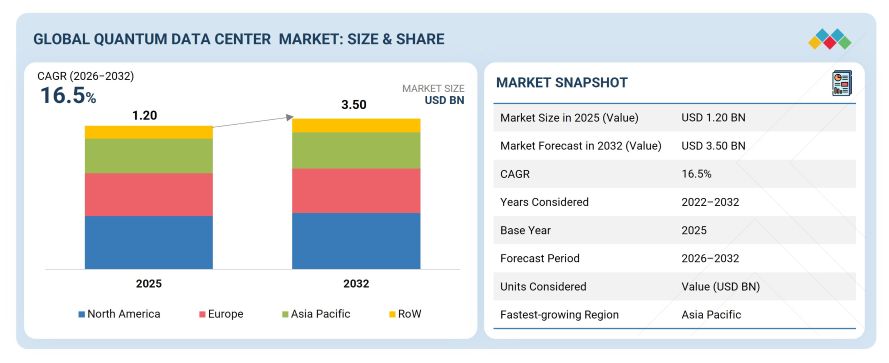
The global Quantum Data Center Market is emerging as a specialised segment of advanced computing infrastructure, driven by the commercial development of quantum processors and the need to connect them with conventional high-performance computing (HPC) environments. The market is estimated at approximately USD 1.2 billion in 2025 and is projected to reach USD 3.5 billion by 2032, registering an estimated CAGR of 16.5% during 2026–2032. Growth is supported by increasing investment in quantum computing, demand for advanced simulation, government research programmes, and the development of fault-tolerant quantum systems. Unlike conventional data centres, quantum computing facilities require specialised infrastructure, including dilution refrigerators, cryogenic cooling, vibration isolation, precision control electronics, advanced networking, and tightly integrated classical computing resources. AI, IoT-based monitoring, automation, and cloud computing are also influencing facility operations by improving system diagnostics, workload coordination, and infrastructure utilisation. As enterprises increasingly access quantum processors through cloud platforms, the Quantum Computing Data Center Market is expected to evolve into an important part of the next generation of digital infrastructure.
Key Market Trends & Insights
- North America is a leading market: The United States benefits from major quantum technology companies, research institutions, government funding, and established cloud infrastructure providers.
- Asia Pacific is a high-growth region: China, Japan, South Korea, India, and Australia are increasing investment in quantum research, national technology programmes, and advanced computing facilities.
- Cryogenic infrastructure represents a critical component: Superconducting quantum processors require extremely low operating temperatures, making dilution refrigerators and specialised cooling systems essential.
- Hybrid quantum-classical computing is gaining importance: Quantum processors are increasingly connected to classical HPC systems and cloud platforms to support practical workloads.
- Cloud access is expanding market reach: Quantum Computing-as-a-Service models allow enterprises and researchers to access quantum hardware without building dedicated facilities.
- AI and automation are improving operations: Predictive maintenance, automated calibration, workload scheduling, and real-time monitoring can improve system availability and operational efficiency.
Market Size & Forecast
- Base year market size (2025): Approximately USD 1.2 billion.
- Forecast market value (2032): Approximately USD 3.5 billion.
- CAGR (2026–2032): Approximately 16.5%.
- Growth factors: Increasing quantum computing investment, demand for specialised cryogenic infrastructure, hybrid HPC integration, cloud-based quantum access, and the development of fault-tolerant quantum processors.
These figures represent an indicative analyst estimate for the specialised infrastructure market, not a separately reported industry-wide market total. The scope includes quantum computing facility infrastructure, dedicated cooling and control systems, networking, integration, and associated infrastructure services. It excludes most standalone quantum software revenue and the wider economic value expected from quantum computing applications.
Quantum Data Center Market Top 10 Key Takeaways
- The Quantum Data Center Market is estimated to reach approximately USD 3.5 billion by 2032.
- The market is projected to grow at an estimated CAGR of 16.5% during 2026–2032.
- North America holds a leading position due to its quantum technology ecosystem and research infrastructure.
- Asia Pacific is expected to experience strong growth through government investment and technology development.
- Cryogenic cooling and precision control systems are essential infrastructure components for superconducting quantum processors.
- Hybrid quantum-classical computing is becoming the preferred deployment approach for many near-term workloads.
- Cloud-based quantum computing platforms are expanding access to specialised processors.
- AI, IoT, and automation are improving facility monitoring, calibration, and infrastructure management.
- Quantum networking and modular processor architectures are expected to influence future facility design.
- Partnerships among quantum hardware companies, data centre operators, cloud providers, universities, and governments will shape market development.
Product Insights
Quantum processor hosting infrastructure represents a central product category in the Quantum Data Center Market. This category includes specialised facilities designed to accommodate quantum processing units (QPUs), supporting electronics, cooling systems, and classical computing resources. Unlike conventional server racks, quantum computing installations require carefully controlled environments to maintain processor stability and reduce interference. Superconducting quantum systems, for example, operate at temperatures close to absolute zero and require dilution refrigeration, shielding, and specialised wiring.
Cryogenic systems represent one of the most important product categories because they maintain the ultra-low temperatures required by superconducting qubits. Dilution refrigerators, cryogenic control systems, vacuum enclosures, thermal shields, and specialised interconnects are essential for reliable operation. As quantum processors scale, providers are developing modular cryogenic architectures that can support multiple interconnected processors and larger system configurations.
Quantum control and measurement equipment is another important category. These products generate and manage the signals required to initialise, manipulate, and measure qubits. High-speed electronics, microwave control equipment, readout systems, and precision timing infrastructure help maintain computational accuracy. The Quantum Computing Hardware Infrastructure Market also includes specialised cabling, vibration isolation, electromagnetic shielding, and power management equipment.
Emerging product categories include modular quantum computing systems, integrated quantum-classical platforms, quantum networking equipment, and specialised data centre environments. Cloud-accessible quantum systems are also increasing demand for secure interfaces, workload orchestration software, and remote infrastructure monitoring.
AI and digital technologies are becoming important supporting features. Intelligent monitoring platforms can analyse temperature, vibration, electrical signals, and system performance to identify abnormal operating conditions. Automated calibration and maintenance workflows may reduce manual intervention as quantum facilities become larger and more complex.
Technology / Component Insights
The Quantum Data Center Infrastructure Market depends on a combination of quantum hardware, cryogenic engineering, precision electronics, networking, and conventional computing infrastructure. The specific component requirements vary according to the underlying qubit technology. Superconducting quantum processors require dilution refrigerators and microwave control systems, while trapped-ion systems rely on ultra-high-vacuum chambers, laser systems, optical components, and precise environmental control. Photonic quantum systems require specialised optical sources, detectors, and photonic interconnects.
Cryogenic cooling is a critical technology for superconducting systems. Dilution refrigerators maintain temperatures in the millikelvin range, allowing quantum processors to operate under highly controlled conditions. Scaling these systems requires improved thermal management, wiring density, vibration control, and modularity. Advanced facilities must also manage heat loads generated by supporting electronics and the surrounding infrastructure.
Classical computing integration is equally important. Quantum processors generally operate alongside classical CPUs, GPUs, storage systems, and HPC clusters. Classical infrastructure handles data preparation, algorithm execution, error-correction processing, and post-processing. This integration is creating demand for Quantum-Classical Computing Infrastructure that can coordinate workloads across different computing architectures.
AI, IoT, and cloud technologies are expected to improve infrastructure management. IoT sensors can collect real-time information on temperature, vibration, pressure, power consumption, and equipment status. AI algorithms can analyse this information to identify patterns, predict equipment failures, and support automated calibration. Cloud orchestration platforms can manage user access, queue workloads, allocate computing resources, and monitor utilisation.
Future innovation is expected to focus on modular cryogenic systems, scalable quantum interconnects, improved control electronics, advanced error-correction infrastructure, and quantum networking. Cybersecurity and post-quantum cryptography will also become increasingly important as quantum facilities connect with enterprise and research networks.
Application Insights
Research and scientific computing represent major application areas for the Quantum Data Center Market. Universities, government laboratories, and corporate research organisations use quantum systems to investigate complex computational problems that are difficult to address using conventional computing alone. Applications include quantum chemistry, materials science, molecular simulation, optimisation, and advanced physics research.
Financial services represent another potential application area. Financial institutions are exploring quantum algorithms for portfolio optimisation, risk analysis, fraud detection research, and complex scenario modelling. However, many applications remain experimental, and commercial benefits will depend on improvements in processor quality, error correction, and algorithm performance.
Pharmaceutical and life sciences companies are investigating quantum computing for molecular modelling, drug discovery research, and simulation of chemical interactions. Advanced materials developers are also evaluating quantum approaches to understand material properties and accelerate research into batteries, catalysts, semiconductors, and other industrial materials.
The defence and aerospace sectors represent additional opportunities because of their interest in secure communications, optimisation, simulation, and advanced sensing. Government research programmes are supporting the development of specialised facilities and national quantum computing infrastructure.
Cloud-based access is expanding the addressable market. Through Quantum Computing-as-a-Service, organisations can access processors remotely without operating dedicated quantum hardware. This model encourages demand for quantum computing hosting, secure data connectivity, workload scheduling, and integrated classical computing resources. As enterprise experimentation increases, quantum facilities may become more closely connected to conventional data centre campuses and HPC environments.
Regional Insights
North America
North America is a leading region in the Quantum Data Center Market, supported by major technology companies, national research programmes, venture investment, and established cloud infrastructure. The United States has a strong ecosystem involving IBM, Google, Microsoft, Amazon Web Services, IonQ, Quantinuum, and research institutions. Government support through the National Quantum Initiative and related research programmes has encouraged investment in quantum hardware, software, and infrastructure. The country's established data centre and HPC ecosystem also provides a foundation for hybrid quantum-classical deployments. Canada has developed a strong quantum research and commercial ecosystem, with companies and institutions working on quantum hardware, photonics, and computing applications. Mexico is at an earlier stage, with opportunities linked to university research, industrial digitalisation, and cross-border technology collaboration.
Europe
Europe is developing a competitive Quantum Technology Data Center Market through coordinated research programmes, national quantum strategies, and industrial partnerships. Germany is an important market due to its engineering base, research institutions, semiconductor ecosystem, and investment in advanced computing. The United Kingdom has a strong quantum technology sector supported by its National Quantum Strategy and research infrastructure. France is investing in quantum computing through its national quantum strategy and partnerships between public research organisations and private companies. Italy and Spain are developing quantum research capabilities, while the Netherlands has a recognised ecosystem for quantum hardware and networking. Nordic countries are contributing through research, photonics, advanced materials, and specialised technology development. EU initiatives, including the Quantum Flagship and EuroHPC-related infrastructure programmes, support research collaboration and the development of advanced computing capabilities.
Asia Pacific
Asia Pacific is expected to be a high-growth region as governments and technology companies invest in quantum research, advanced semiconductor technologies, and specialised computing infrastructure. China is investing in quantum computing, quantum communications, and national research facilities. Japan has a strong technology ecosystem involving universities, electronics companies, and government-backed quantum initiatives. South Korea is developing quantum computing capabilities through research and industrial partnerships, while India is advancing its National Quantum Mission, which supports quantum computing, communication, sensing, and related infrastructure. Australia is attracting attention through quantum technology companies and major facility projects, including the development of large-scale cryogenic infrastructure for PsiQuantum in Brisbane. Singapore is strengthening its position through research institutions and its broader digital infrastructure ecosystem.
Regional Insights Summary
- North America leads through established quantum technology companies, research institutions, and cloud infrastructure.
- Asia Pacific offers significant growth potential through national quantum programmes and advanced technology investment.
- Europe benefits from coordinated research funding, industrial partnerships, and cross-border quantum initiatives.
- Germany, the United Kingdom, Japan, China, and the United States are important quantum technology development centres.
- Regional growth depends on research funding, skilled engineering talent, cryogenic supply chains, and access to advanced computing infrastructure.
Country-Specific Market Trends
The following country-level CAGRs are indicative analyst estimates for 2026–2032, not separately published forecasts. They reflect relative investment momentum, quantum research activity, technology development, government programmes, and demand for specialised computing infrastructure.
China – 18–20% CAGR
China is expected to remain an important market due to government-supported quantum research, investment in quantum communications, and development of domestic quantum computing capabilities. Demand is likely to be supported by research institutions, national laboratories, semiconductor organisations, and technology companies. Investment in specialised facilities and quantum networking could strengthen its infrastructure ecosystem.
Japan – 15–17% CAGR
Japan's market is supported by advanced electronics manufacturing, industrial research, and government-backed quantum initiatives. Technology companies and universities are investing in quantum processors, materials science, and hybrid computing. Demand for precision control systems, cryogenic equipment, and research computing infrastructure is expected to increase.
Canada – 14–16% CAGR
Canada benefits from established quantum research centres and a specialised technology ecosystem. Government-backed research funding and collaboration between universities and companies are supporting the development of quantum hardware, photonics, and quantum software. The country is positioned to attract investment in quantum computing facilities and cloud-accessible research infrastructure.
Mexico – 10–12% CAGR
Mexico's quantum data centre infrastructure market remains at an early stage. Growth opportunities are linked to university research, international technology partnerships, advanced manufacturing, and digital infrastructure development. Adoption is expected to remain smaller than in established quantum technology markets during the forecast period.
United States – 17–19% CAGR
The United States is expected to remain a leading market due to its strong quantum hardware ecosystem, cloud platforms, government funding, and private-sector investment. Major technology companies and specialist quantum firms are developing processors, control systems, cryogenic infrastructure, and cloud-based access platforms. Integration with HPC and AI infrastructure is likely to support demand.
Germany – 15–17% CAGR
Germany's growth is supported by research institutions, industrial engineering capabilities, advanced manufacturing, and government investment in quantum technologies. Automotive, chemicals, pharmaceuticals, and semiconductor companies are potential users of quantum computing research and infrastructure services.
France – 14–16% CAGR
France is developing its quantum ecosystem through national research programmes, technology companies, and public-private partnerships. Demand is expected from aerospace, defence, financial services, materials science, and advanced manufacturing research.
Country-Level Insights Summary
- The United States is positioned as a major commercial and infrastructure development centre.
- China is investing in domestic quantum capabilities and national research infrastructure.
- Japan and Germany benefit from established electronics, engineering, and industrial research ecosystems.
- Canada is supported by a strong quantum research and startup environment.
- France and Mexico offer different stages of opportunity, with France more commercially advanced and Mexico still developing its ecosystem.
Key Quantum Data Center Market Company Insights
The competitive landscape includes quantum computing developers, cloud providers, cryogenic equipment manufacturers, and specialised infrastructure suppliers. Companies are investing in processor scalability, control systems, networking, and hybrid quantum-classical computing environments.
IBM is a major participant in quantum computing infrastructure, offering quantum processors, IBM Quantum System Two, cloud access, and supporting software. Its development of modular cryogenic architecture is intended to support larger, interconnected quantum systems. Google is advancing superconducting quantum processors and error-correction research, supported by specialised hardware and computing infrastructure. Microsoft is developing quantum computing through Azure Quantum, providing cloud-based access to quantum hardware and tools from multiple technology partners.
Amazon Web Services provides quantum computing access through Amazon Braket, which connects users with quantum hardware from different providers. Its cloud infrastructure supports quantum experimentation and hybrid computing workflows. IonQ focuses on trapped-ion quantum computing and cloud-accessible systems, while Quantinuum combines trapped-ion hardware, quantum software, and integrated computing capabilities.
D-Wave Quantum focuses on quantum annealing and hybrid quantum systems, with cloud access through its Leap platform. PsiQuantum is developing large-scale photonic quantum computing infrastructure and has partnered with Linde Engineering for cryogenic plant development in Brisbane. Linde Engineering contributes specialised cryogenic engineering capabilities for large quantum computing facilities.
Company Strategy Summary
- IBM is developing modular cryogenic systems and integrated quantum computing infrastructure.
- Google is focusing on processor performance, error correction, and scalable superconducting systems.
- Microsoft and AWS are expanding cloud-based access to quantum hardware and hybrid computing tools.
- IonQ and Quantinuum are developing trapped-ion platforms and supporting infrastructure.
- PsiQuantum and Linde Engineering are advancing large-scale photonic quantum computing and cryogenic infrastructure.
Recent Developments
Quantum computing infrastructure is moving toward larger, more interconnected systems that require advanced facility engineering. In August 2026, IBM announced that it had successfully connected and operated two modular cryogenic systems, demonstrating a design intended to support future multi-chip quantum processors. The architecture is designed to create more space for wiring and interconnects while allowing individual modules to be upgraded and tested.
In May 2025, Linde Engineering announced an agreement to deliver a large cryogenic cooling plant for PsiQuantum's planned utility-scale quantum computer in Brisbane, Australia. The project demonstrates the growing requirement for industrial-scale cryogenic engineering as quantum computing moves beyond smaller laboratory installations.
Cloud-based quantum access is also expanding. Platforms such as Amazon Braket, IBM Quantum, and Azure Quantum allow researchers and enterprises to access quantum processors remotely. These services support hybrid workflows and reduce the need for organisations to develop their own specialised quantum computing facilities.
Market Segmentation
The Quantum Data Center Market can be segmented by product, technology or component, application, deployment model, and region. By product, the market includes quantum processor hosting systems, cryogenic infrastructure, quantum control and measurement equipment, quantum networking systems, integrated quantum-classical computing platforms, and specialised facility infrastructure. Cryogenic systems represent a critical product category for superconducting quantum processors, while control and measurement equipment supports the operation and readout of qubits.
By technology and component, the market includes superconducting quantum systems, trapped-ion systems, photonic quantum systems, neutral-atom systems, cryogenic refrigerators, vacuum equipment, microwave control electronics, optical components, quantum interconnects, and supporting classical computing infrastructure. Superconducting systems have significant infrastructure requirements because of their dependence on ultra-low temperatures and specialised microwave electronics. Trapped-ion and photonic systems require different combinations of laser, vacuum, optical, and control infrastructure.
By application, the market covers scientific research, quantum chemistry, materials simulation, financial modelling, optimisation, pharmaceutical research, aerospace and defence, advanced manufacturing, and cybersecurity research. Research institutions and government laboratories remain important users, while commercial applications are expected to increase as hardware reliability and software maturity improve.
By deployment model, the market includes on-premises quantum computing facilities, cloud-based quantum access, hosted quantum systems, and hybrid quantum-classical infrastructure. Cloud-based access is attractive to enterprises that want to experiment with quantum hardware without investing in dedicated facilities. By region, the market is divided into North America, Europe, Asia Pacific, Latin America, and the Middle East and Africa.
Segmentation Summary
- By product: Quantum processor hosting, cryogenic systems, control equipment, networking, and integrated computing platforms.
- By technology/component: Superconducting, trapped-ion, photonic, neutral-atom, cooling, vacuum, and control technologies.
- By application: Scientific research, materials science, finance, pharmaceuticals, aerospace, defence, and optimisation.
- By deployment: On-premises, cloud-based, hosted, and hybrid quantum-classical infrastructure.
- By region: North America, Europe, Asia Pacific, Latin America, and the Middle East and Africa.
Conclusion
The Quantum Data Center Market is expected to develop as quantum computing progresses from research-oriented systems toward larger, more integrated commercial infrastructure. The increasing complexity of quantum processors is creating demand for specialised facilities, cryogenic cooling, advanced control electronics, secure networking, and hybrid computing environments. These requirements distinguish quantum facilities from conventional data centres and create opportunities for specialised infrastructure suppliers, engineering companies, cloud providers, and technology developers.
AI, IoT, and automation will support the operational evolution of quantum computing facilities. Predictive maintenance, automated calibration, intelligent workload management, and real-time environmental monitoring can help improve system stability and infrastructure utilisation. The integration of quantum processors with classical CPUs, GPUs, and HPC systems will remain important during the forecast period because many practical workloads require hybrid execution.
By 2032, companies that develop scalable cryogenic systems, modular quantum infrastructure, quantum networking, and cloud-based computing services are expected to benefit from the industry's expansion. However, market growth will depend on hardware performance, error-correction progress, commercial use cases, investment availability, and the ability to operate quantum systems reliably at scale. For data centre operators and technology investors, quantum infrastructure represents a specialised long-term opportunity rather than an immediate replacement for conventional computing.
FAQs
1. What is the Quantum Data Center Market size?
The global Quantum Data Center Market is estimated at approximately USD 1.2 billion in 2025 and is projected to reach around USD 3.5 billion by 2032. These are indicative estimates for specialised quantum computing facility and supporting infrastructure.
2. What is the expected growth rate of the Quantum Data Center Market?
The market is estimated to grow at a CAGR of approximately 16.5% during 2026–2032, driven by quantum technology investment, cryogenic infrastructure development, hybrid computing, and cloud-based access.
3. What are the key drivers of the Quantum Data Center Market?
Key drivers include rising investment in quantum computing, government research programmes, demand for specialised cryogenic systems, integration with high-performance computing, and increasing enterprise access to quantum processors through cloud platforms.
4. Which region is expected to lead the Quantum Data Center Market?
North America is a leading market due to its established quantum computing companies, cloud infrastructure providers, research institutions, and government investment. Asia Pacific is expected to offer strong growth opportunities.
5. Which companies are key participants in the Quantum Data Center Market?
Major participants include IBM, Google, Microsoft, Amazon Web Services, IonQ, Quantinuum, D-Wave Quantum, PsiQuantum, and Linde Engineering. These companies contribute through quantum hardware, cloud access, software, and specialised infrastructure.
Revenue
Revenue in the Quantum Data Center Market is generated through quantum processor hosting, specialised infrastructure sales, cryogenic equipment, facility integration, cloud access, and technical support services. Companies can also generate recurring revenue through quantum computing subscriptions, hosted processor access, infrastructure maintenance, system upgrades, and hybrid computing services. Cloud platforms enable providers to offer access to quantum hardware without requiring customers to own or operate specialised facilities. As quantum systems become more complex, revenue opportunities are expected to expand across cryogenic engineering, networking, control electronics, system integration, and infrastructure management.
Investment & Funding
Investment in the Quantum Data Center Market is being driven by government-backed research programmes, venture capital, strategic technology investment, and corporate partnerships. Funding is directed toward quantum processors, cryogenic systems, control electronics, quantum networking, and the integration of quantum hardware with conventional computing infrastructure. The United States, China, the United Kingdom, Germany, Japan, Canada, and Australia are among the countries supporting quantum research and commercial development. Investment is also flowing into companies developing photonic, superconducting, trapped-ion, and neutral-atom systems. As the industry moves toward fault-tolerant computing, funding requirements are likely to increase for large-scale facilities, specialised cooling systems, and advanced engineering capabilities.
Mergers & Acquisitions (M&A)
Mergers and acquisitions in the Quantum Data Center Market are expected to focus on strengthening quantum hardware portfolios, securing specialised engineering capabilities, and expanding access to cloud-based computing infrastructure. Quantum processor developers may pursue acquisitions or partnerships involving control electronics, photonics, cryogenic engineering, and quantum software companies. Cloud providers and data centre operators may also collaborate with quantum hardware developers to establish hybrid computing environments. Strategic transactions are likely to prioritise intellectual property, specialised technical talent, processor scalability, and commercial access to research and enterprise customers. As the market matures, partnerships between quantum technology companies and established infrastructure suppliers may become increasingly important.
Recent Development
- IBM modular cryogenic architecture: In August 2026, IBM announced that it had connected and operated two modular cryogenic systems, supporting its development of larger, interconnected quantum processors.
- PsiQuantum and Linde Engineering collaboration: In May 2025, Linde Engineering announced an agreement to supply a large cryogenic cooling plant for PsiQuantum's planned utility-scale quantum computing facility in Brisbane, Australia.
- IBM Quantum System Two development: IBM is advancing modular quantum system architecture designed to support processor interconnection, improved scalability, and future fault-tolerant computing.
- Cloud-based quantum access expansion: Amazon Braket, IBM Quantum, and Azure Quantum continue to provide cloud-based access to quantum hardware and development tools, supporting hybrid quantum-classical workflows.
- National quantum infrastructure investment: Government programmes in the United States, Europe, India, Japan, and other technology markets continue to support quantum research, processor development, and specialised computing infrastructure.
 Exclusive indicates content/data unique to MarketsandMarkets and not available with any competitors.











Growth opportunities and latent adjacency in Quantum Data Center Market