Robot Charging Market Size, Share, Growth & Trends by Charging Technology (Robotic Arm, Wireless Inductive, Automated Docking, Battery Swapping), Deployment Model (Owned, CaaS, Hybrid), End-User (Logistics & Warehousing, Robotaxi Fleets, Ports), and Region — Global Forecast to 2032


Robot Charging Market 2032: Size, Share & Growth Report
The robot charging market is estimated to be USD 1.87 billion in 2026 and is projected to reach USD 7.07 billion by 2032, growing at a CAGR of 24.8% from 2026 to 2032, fueled by fleet operators' urgent need to eliminate manual plug-in labor as AMR, AGV, and autonomous vehicle fleets scale into round-the-clock operations.
Market Overview
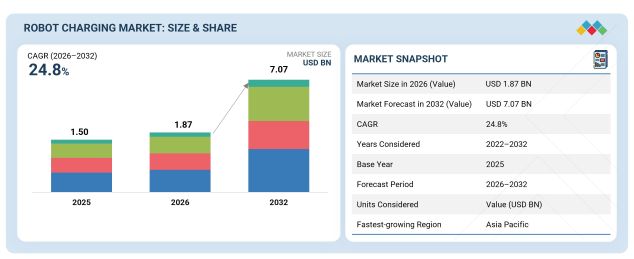
The robot charging market marks a shift in which recharging mobile robots, autonomous vehicles, and robotaxi fleets becomes an autonomous, hands-free process, with logistics operators, port authorities, and fleet operators relying on robotic connectors and wireless inductive systems to keep fleets moving without human intervention at the plug.
For instance, Rocsys unveiled its M1 multi-bay hands-free charging solution for robotaxi fleets in April 2026, an overhead rail-mounted robotic arm system interoperable across mixed EV fleets and connector types, alongside a USD 13 million Series A extension bringing its total funding to USD 56 million. Days later, in May 2026, Rocsys launched the S2, a next-generation hands-free charging system for heavy-duty electric fleets at ports and distribution hubs, with its first unit delivered to a large-scale port customer.
Enterprise robotics majors are pursuing a parallel technical path: KUKA has integrated inductive charging across its AMR product line, reporting 99% fleet availability compared with 65–70% utilization typical of plug-in charging architectures, while Wiferion, now a PULS brand, unveiled a next-generation wireless power product family at LogiMAT 2026 designed to support mixed AGV and AMR fleets from different manufacturers on a single charging platform.
Fleet operators are also under growing pressure from an entirely new source of demand: robotaxi and autonomous heavy-duty fleet scaling. Rapid growth in driverless fleet operations is compounding the charging-infrastructure burden already facing logistics and warehousing operators, pushing depot operators to adopt robotic and wireless charging considerably faster than a warehouse-automation-only demand curve would have required on its own.
Top 10 Key Takeaways
- Asia Pacific has the largest installed base, driven by China's dense AMR and AGV manufacturing ecosystem and concentrated warehouse-automation investment.
- Asia Pacific is also the fastest-growing region, propelled by continued expansion of e-commerce fulfillment infrastructure and government-backed smart-manufacturing programs.
- Wireless inductive charging leads by technology adoption momentum, with contact-based docking still dominant in installed base but losing share as facilities retrofit.
- Logistics and warehousing operators remain the dominant end-user segment, while robotaxi and autonomous fleet operators are adopting fastest as driverless deployments scale.
- Charging-as-a-Service deployment is extending its reach as fleet operators gain confidence in vendor-managed uptime guarantees without large upfront capital outlays.
- Robotic arm and auto-connect charging are converging with fleet energy-management software, reducing the number of separate systems a depot operator must reconcile.
- Vendor consolidation is accelerating, with platform providers expanding from single-technology point solutions into broader depot-automation platforms.
- The largest near-term opportunity is robotaxi depot electrification, which lets charging vendors capture recurring infrastructure contracts as autonomous fleets scale.
- Heavy-duty electric fleet investment at ports and distribution hubs is creating an entirely new, warehouse-independent source of demand for robotic charging infrastructure.
- The primary near-term restraint is the lack of cross-vendor connector and protocol standardization across mixed robot, vehicle, and charger fleets.
Why the Robot Charging Market Matters Now
Fleet operators have historically managed charging through a comparatively simple mix of scheduled plug-in shifts and manual battery swaps, adequate when robot and vehicle fleets numbered in the dozens. Robot charging platforms exist because that model has broken down: AMR and AGV fleets have grown into the thousands per facility, robotaxi fleets are beginning genuine commercial scaling, and heavy-duty electric trucks are entering port and distribution-hub operations, all of which require charging cycles repeated thousands of times daily that manual labor can no longer support without becoming a structural bottleneck on fleet growth.
The market covers the hardware and software platforms used to autonomously recharge mobile robots, autonomous vehicles, and electric fleets, spanning robotic arm and auto-connect charging, wireless inductive charging, contact-based automated docking, and battery swapping systems. It includes established industrial automation majors that extend robot product lines with integrated charging capability, and specialized independent vendors built specifically for hands-free depot charging. The scope excludes standard plug-in EV charging requiring human intervention and fixed consumer charging infrastructure lacking robotic or autonomous positioning capability. The market connects to the broader AMR and AGV market, the EV charging infrastructure market, and the robotaxi market.
The market's structure reflects a technology divide. The largest logistics operators and port authorities deploy robotic arm and wireless inductive systems from specialized vendors such as Rocsys and Wiferion, trading a higher per-bay cost for hands-free automation and uptime guarantees. Mid-market warehouse operators increasingly retrofit existing AMR and AGV fleets with inductive charging pads from vendors such as WiBotic, trading full-depot automation for incremental fleet-utilization gains. Robotaxi operators and heavy-duty fleet operators sit alongside traditional warehousing buyers as a fast-growing, distinct segment specifically seeking multi-bay, mixed-fleet charging infrastructure for their own operations.
Report Scope
|
Report Metric |
Details |
|
Market Size in 2026 (Value) |
USD 1.87 Billion |
|
Market Forecast in 2032 (Value) |
USD 7.07 Billion |
|
Growth Rate |
CAGR of 24.8% from 2026-2032 |
|
Years Considered |
2022-2032 |
|
Base Year |
2026 |
|
Forecast Period |
2026-2032 |
|
Units Considered |
Value (USD Billion) |
|
Report Coverage |
Revenue forecast, company ranking, competitive landscape, growth factors, and trends |
|
Top Companies |
|
|
Growth Drivers |
|
|
Segments Covered |
|
|
Regional Scope |
North America, Europe, Asia Pacific, Rest of World (Middle East, Latin America) |
Market Trends Shaping Robot Charging
The key trend is hands-free robotic charging scaling from port pilot programs into robotaxi depot infrastructure. Rocsys's M1 platform illustrates this directly, extending a system first proven in port and heavy-duty fleet operations into multi-bay robotaxi charging validated by a major fleet deal ahead of large-scale rollout across North America and Europe in 2027.
Another trend is wireless inductive charging becoming the default energy strategy for warehouse AMR fleets rather than a niche upgrade. KUKA's integration of inductive charging across its AMR line, reporting 99% availability against 65-70% for plug-in architectures, demonstrates that wireless charging has moved from pilot to standard specification for new fleet deployments.
A third trend is heavy-duty fleet electrification driving depot-scale charging contracts rather than single-vehicle installations. Rocsys's S2 launch for ports and distribution hubs, with its first delivery to a large-scale port customer in May 2026, signals that depot-wide robotic charging contracts are now commercially proven rather than remaining a small-scale demonstration.
A fourth trend is platform vendors forming direct partnerships with fleet operators and OEMs to extend their own deployment reach. Rocsys's Series A extension, backed by Scania Invest alongside Capricorn Partners, reflects how directly charging-infrastructure vendors pair their technology with strategic vehicle-manufacturer capital and distribution relationships.
The fifth trend sees fleet energy-management software increasingly bundled with charging hardware rather than sold separately. WiBotic's combination of wireless charging hardware with fleet-wide battery-management software illustrates how the same underlying platform investment built for charging is increasingly repurposed for broader fleet-health monitoring and utilization optimization.
Market Drivers Accelerating Growth
The first key factor is rising AMR and AGV fleet density straining manual charging workflows. As warehouse and distribution-center fleets scale into the hundreds or thousands of units, facility operators need considerably more automated charging throughput than manual plug-in shifts were ever designed to provide.
The second factor is robotaxi and autonomous fleet scaling requiring hands-free charging infrastructure, specifically because manual charging has become a structural constraint on fleet growth and profitability. Rocsys's M1 platform demonstrates that hands-free multi-bay charging can meaningfully increase existing-staff productivity by up to 75%, giving robotaxi operators considerably more confidence to invest at scale.
The third factor is heavy-duty electric fleet investment driving depot automation spend from port and logistics-hub operators. As large fleet operators increasingly electrify trucks and yard vehicles, they require charging infrastructure that is considerably more automated than what a single-vehicle consumer charger would provide, extending this market's buyer base well beyond warehousing alone.
Market Challenges and Restraints
The key obstacle is high upfront cost of robotic and inductive charging infrastructure relative to simple plug-in stations. Modern robotic and wireless charging systems require significant capital investment per bay, and that upfront cost remains a genuine, often underestimated barrier for mid-market fleet operators evaluating automation payback periods.
Another hurdle is the lack of cross-vendor connector and protocol standardization, which is slowing adoption specifically among mixed-fleet operators. Facilities managing robots, vehicles, and chargers from different manufacturers remain understandably cautious about vendor lock-in, and that caution continues to shape how quickly robotic charging can displace manual plug-in workflows, even where the underlying automation capability is proven.
The third challenge involves field service and uptime support for distributed charging hardware. With robotic connectors, inductive pads, and docking stations deployed across geographically dispersed facilities, maintaining consistent uptime and rapid repair response remains a real operational and commercial challenge that vendors are only partially resolving through remote monitoring.
Segment Insights
By Charging Technology
Contact-based automated docking leads the market by current installed base, reflecting its foundational role as the first automated charging technology widely deployed across AGV and AMR fleets.
Wireless inductive charging is the fastest-growing technology category, as facility operators increasingly retrofit fleets to eliminate mechanical wear, exposed connectors, and the single-direction docking constraints of contact-based systems.
By End-User
Logistics and warehousing operators lead the market in deployment volume, reflecting their direct operational responsibility for fleet uptime and their position as the earliest and most committed adopters of this technology.
Robotaxi and autonomous fleet operators are the fastest-growing end-user segment, as commercial driverless deployments increasingly require hands-free, multi-bay charging capability comparable to what a warehouse operator uses for AMR fleets.
Key segmentation highlights:
- Contact-based docking remains the primary entry point for fleet automation, while wireless inductive charging shows the fastest growth in retrofit deployments.
- Charging-as-a-Service is gaining share fastest, though owned infrastructure remains dominant among the largest fleet operators with the deepest existing capital budgets.
- Logistics and warehousing operators account for the largest share of spending, while robotaxi operators represent the fastest-growing customer segment.
- Battery swapping systems increasingly serve niche high-utilization applications where charging downtime cannot be tolerated at all.
- Vendor consolidation is compressing the number of distinct point solutions a typical fleet operator needs to integrate and maintain.
Robot Charging Market by Region
North America
North America holds a substantial base, valued at roughly USD 0.65 billion in 2026 and projected to reach about USD 2.40 billion by 2032, growing at a CAGR of 24.3%.
The US leads with key platform vendors including Rocsys's Portland operations and WiBotic, alongside a deep base of logistics operators and port authorities investing in depot charging automation. Canada also contributes through growing interest in cross-border freight electrification and warehouse automation.
Europe
Europe is advancing in line with the global pace, valued at approximately USD 0.32 billion in 2026 and forecast to reach around USD 1.16 billion by 2032, at a CAGR of 24.0%.
The Netherlands spearheads European robotic charging innovation through Rocsys's Rijswijk headquarters and its port-sector deployments. Germany contributes through Wiferion's LogiMAT-launched wireless charging platform and its deep industrial-automation manufacturing base, while the UK advances through logistics-hub electrification programs.
Asia Pacific
Asia Pacific is the largest and fastest-growing region, valued at roughly USD 0.73 billion in 2026 and projected to reach about USD 2.88 billion by 2032, growing at a CAGR of 25.7%.
China spearheads manufacturing scale through its dense AMR and AGV production ecosystem, driving substantial regional demand for both contact-based and wireless charging infrastructure. Japan and South Korea accelerate through advanced robotics manufacturing, while India advances through expanding e-commerce fulfillment infrastructure and warehouse automation investment.
Rest of World
The Rest of World market reached an estimated USD 0.17 billion in 2026 and is projected to hit about USD 0.61 billion by 2032, growing at a CAGR of 23.8%.
The Middle East is investing in port and logistics-hub electrification as part of broader trade-infrastructure modernization, with the UAE at the forefront. Latin America contributes through Brazil's growing e-commerce logistics market and expanding warehouse automation deployment.
Key Company Insights
The competitive landscape consists of four tiers: specialized robotic charging vendors, established industrial automation majors, wireless power specialists, and automotive and fleet technology providers. Major players include:
- Rocsys
- Wiferion (a PULS brand)
- WiBotic
- KUKA
- ABB
- Siemens
- Hyundai Motor Group
- EV Safe Charge
- Volterio
- Mob-Energy
- NaaS Technology
- Continental
- Volkswagen Group
- Stäubli
- ROCKWELL Automation
Rocsys leads through the scale and depth of its hands-free depot platform, combining robotic arm connectors, AI-driven computer vision, and fleet service software into a single system now spanning port operations, heavy-duty fleets, and robotaxi depots, and extended through direct partnerships with Scania Invest and other strategic fleet-technology investors.
Wiferion, operating as a PULS brand, has become a leading wireless charging platform provider following its evolution from standalone inductive charging products into a system-level platform, unveiled at LogiMAT 2026, designed to support mixed AGV and AMR fleets across different manufacturers on shared charging infrastructure.
KUKA and WiBotic each continue extending focused hardware and software expertise into specialized fleet-charging deployment, competing directly with more depot-integrated entrants for large warehouse and logistics transformation programs.
Recent Developments
- May 2026: Rocsys launched the S2, its next-generation hands-free charging system for heavy-duty electric fleets operating in ports and distribution hubs, delivering its first unit to a large-scale port customer and marking the solution's move into active customer deployment.
- April 2026: Rocsys unveiled the M1, the world's first multi-bay hands-free charging solution for robotaxi fleets, an overhead rail-mounted robotic system interoperable across mixed EV fleets and connector types, alongside a USD 13 million Series A extension led by Capricorn Partners bringing total funding to USD 56 million.
- March 2026: Wiferion, now operating as a PULS brand, unveiled its next-generation wireless charging product family at LogiMAT 2026 in Stuttgart, evolving from standalone products into a system-level platform supporting diverse AGV and AMR fleet types from different manufacturers simultaneously.
- January 2025: The US Department of Energy announced USD 68 million in funding for charging sites near ports and distribution hubs, supporting heavy-duty fleet electrification and robotic charging infrastructure investment.
Real-World Use Cases
Rocsys's M1 platform illustrates how a single, hands-free robotic system can replace the fragmented manual charging processes many robotaxi fleet operators have historically depended on. Built on an overhead rail-mounted design with a flexible robotic arm, the platform lets fleet operators scale charging capacity incrementally by adding bays without requiring vehicle or charger modifications. The system's validation by a major robotaxi deal, with large-scale rollout planned across North America and Europe in 2027, demonstrates how quickly hands-free charging is moving from pilot to commercial deployment.
KUKA's inductive charging integration across its AMR product line shows how wireless power delivery can scale from a specialized retrofit offering into standard specification for new fleet deployments. By combining built-in identification technology with adaptive navigation that autonomously optimizes paths while charging during natural pause points, the platform gives warehouse operators a 99% availability rate compared with the 65-70% typical of plug-in architectures, illustrating the utilization gains that a genuinely effective wireless charging strategy can deliver.
Opportunities and Future Outlook
Through 2032, robot charging will continue to reshape how logistics operators, port authorities, and fleet operators plan, operate, and scale increasingly automated depot infrastructure. The forces driving the market — rising AMR and AGV fleet density, robotaxi and autonomous fleet scaling, and heavy-duty electric fleet investment — are accelerating simultaneously with a new source of demand: cross-vendor interoperability standards maturing enough to unlock genuinely mixed-fleet depot infrastructure. The next phase will be fully autonomous depot orchestration, with charging platforms coordinating fleet-wide energy management in real time while operators focus on strategic capacity planning rather than manual charging schedules.
The competitive landscape will be defined by platform breadth and depot-integration depth. Specialized robotic charging vendors compete against increasingly capable industrial automation majors for the same fleet-electrification budgets. For VP Fleet Operations leaders, Facilities Directors, and investors, organizations that deploy unified hands-free charging platforms will manage fleet uptime, avoid costly manual-labor bottlenecks, and scale automated operations more effectively than those relying on fragmented, manual charging workflows in an increasingly autonomous operating environment.
Frequently Asked Questions (FAQ)
1. How big is the robot charging market?
The robot charging market was estimated at roughly USD 1.87 billion in 2026 and is projected to reach about USD 7.07 billion by 2032. Asia Pacific accounts for the largest share, driven by China's dense AMR and AGV manufacturing ecosystem and concentrated warehouse-automation investment.
2. What is the robot charging market growth rate?
The market is forecast to grow at a CAGR of approximately 24.8% from 2026 to 2032. Asia Pacific is the fastest-growing region at around 25.7%, driven by continued e-commerce fulfillment expansion and government-backed smart-manufacturing programs.
3. Which segment leads the robot charging market?
By charging technology, contact-based automated docking leads the market, while wireless inductive charging experiences the fastest growth. By end-user, logistics and warehousing operators lead, though robotaxi and autonomous fleet operators show the fastest growth.
4. Who are the key players in the robot charging market?
Leading players include Rocsys, Wiferion (a PULS brand), WiBotic, KUKA, ABB, Siemens, Hyundai Motor Group, EV Safe Charge, Volterio, Mob-Energy, NaaS Technology, Continental, Volkswagen Group, Stäubli, and ROCKWELL Automation.
5. What are the factors driving the robot charging market?
The primary drivers are rising AMR and AGV fleet density straining manual charging workflows, robotaxi and autonomous fleet scaling requiring hands-free charging infrastructure, heavy-duty electric fleet investment driving depot automation spend, and growing port and logistics-hub electrification creating new depot charging demand.
Speak With Our Analyst
The robot charging market is where fleet automation and energy infrastructure converge into a single hands-free charging category, and the segment-level detail on technology economics, deployment model, end-user dynamics, and competitive platform positioning is where strategic decisions are won or lost. MarketsandMarkets can help you go deeper: request a sample of the full study, speak with our analyst about your specific questions, or customize the scope to your target technologies, end-users, and geographies. Reach out to explore how this intelligence can inform your fleet electrification strategy, platform selection, or investment thesis.
 Exclusive indicates content/data unique to MarketsandMarkets and not available with any competitors.
TABLE OF CONTENTS
1 Introduction
1.1 Study Objectives
1.2 Market Definition and Scope
1.2.1 Inclusions and Exclusions
1.3 Study Scope
1.3.1 Markets Covered
1.3.2 Geographic Segmentation
1.3.3 Years Considered
1.4 Currency Considered
1.5 Stakeholders
2 Research Methodology
2.1 Research Approach
2.1.1 Secondary Research
2.1.2 Primary Research
2.1.2.1 Breakdown of Primaries
2.2 Market Size Estimation
2.2.1 Bottom-Up Approach
2.2.2 Top-Down Approach
2.3 Data Triangulation
2.4 Research Assumptions
2.5 Limitations and Risk Assessment
3 Executive Summary
4 Premium Insights
4.1 Attractive Opportunities in the Robot Charging Market
4.2 Market, By Charging Technology
4.3 Market, By Region
4.4 Market, By End-User
5 Market Overview
5.1 Introduction
5.2 Market Dynamics
5.2.1 Drivers
5.2.1.1 Rising AMR and AGV Fleet Density Straining Manual Charging Workflows
5.2.1.2 Robotaxi and Autonomous Fleet Scaling Requiring Hands-Free Charging Infrastructure
5.2.1.3 Heavy-Duty Electric Fleet Investment Driving Depot Automation Spend
5.2.2 Restraints
5.2.2.1 High Upfront Cost of Robotic and Inductive Charging Infrastructure
5.2.2.2 Lack of Cross-Vendor Connector and Protocol Standardization
5.2.3 Opportunities
5.2.3.1 Wireless Inductive Charging Displacing Plug-In Architectures in Warehousing
5.2.3.2 Port and Logistics Hub Electrification Creating New Depot Charging Demand
5.2.4 Challenges
5.2.4.1 Interoperability Across Mixed Robot, Vehicle, and Charger Fleets
5.2.4.2 Field Service and Uptime Support for Distributed Charging Hardware
5.3 Value Chain Analysis
5.4 Ecosystem Analysis
5.5 Investment and Funding Scenario
5.6 Pricing Analysis
5.7 Trends and Disruptions Impacting Customer Business
5.8 Technology Analysis
5.8.1 Key Technologies (Robotic Arm Connectors, Inductive Charging, Fleet Energy Management)
5.8.2 Complementary Technologies (Computer Vision Docking, Battery Management Systems)
5.8.3 Adjacent Technologies (Battery Swapping, Vehicle-to-Grid, Smart Grid Integration)
5.9 Porter's Five Forces Analysis
5.10 Key Stakeholders and Buying Criteria
5.11 Case Study Analysis
5.12 Key Conferences and Events
5.13 Regulatory Landscape
5.13.1 SAE J3400 and Connector Standardization Initiatives
5.13.2 US Department of Energy Charging Infrastructure Funding Programs
5.13.3 EU Alternative Fuels Infrastructure Regulation (AFIR)
5.14 Impact of AI and Generative AI on the Market
5.15 Impact of 2025 US Tariffs on Supply Chains
6 Industry Trends
6.1 Hands-Free Robotic Charging Scaling From Ports to Robotaxi Depots
6.2 Wireless Inductive Charging Becoming Default for Warehouse AMR Fleets
6.3 Heavy-Duty Fleet Electrification Driving Depot-Scale Charging Contracts
6.4 Platform Vendors Forming Direct Partnerships With Fleet Operators and OEMs
6.5 Fleet Energy Management Software Converging With Charging Hardware
6.6 Vendor Consolidation Building End-to-End Depot Automation Platforms
7 Technology Adoption and Strategic Disruption Landscape
7.1 Robotic Arm Connectors vs. Wireless Inductive Charging
7.2 Depot-Based Centralized Charging vs. Distributed Opportunity Charging
7.3 Single-Vendor Integrated Platforms vs. Best-of-Breed Charging Point Solutions
7.4 Build vs. Partner: Fleet Operator Charging Infrastructure Strategy
8 Customer Landscape and Buyer Behavior
8.1 Decision-Making Process — VP Fleet Operations, Facilities Director, Chief Sustainability Officer
8.2 Build vs. Buy: Large Fleet Operators Building Proprietary; Mid-Market Using Vendor Platforms
8.3 ROI Framework: Uptime Gains, Labor Cost Reduction, Fleet Utilization Improvement
8.4 Adoption Barriers: Capital Cost, Facility Retrofit, Standardization Uncertainty
9 Robot Charging Market, By Charging Technology
9.1 Introduction
9.2 Robotic Arm / Auto-Connect Charging
9.3 Wireless Inductive Charging
9.4 Contact-Based Automated Docking
9.5 Battery Swapping Systems
10 Robot Charging Market, By Deployment Model
10.1 Introduction
10.2 Owned Infrastructure
10.3 Charging-as-a-Service (CaaS)
10.4 Hybrid Partnerships
11 Robot Charging Market, By End-User
11.1 Introduction
11.2 Logistics and Warehousing Operators
11.3 Robotaxi and Autonomous Fleet Operators
11.4 Ports and Heavy-Duty Fleet Operators
12 Robot Charging Market, By Region
12.1 Introduction
12.2 North America
12.2.1 United States
12.2.2 Canada
12.3 Europe
12.3.1 Germany
12.3.2 Netherlands
12.3.3 United Kingdom
12.3.4 Rest of Europe
12.4 Asia Pacific
12.4.1 China
12.4.2 Japan
12.4.3 South Korea
12.4.4 India
12.4.5 Rest of Asia Pacific
12.5 Rest of World
12.5.1 Middle East
12.5.2 Latin America
13 Competitive Landscape
13.1 Overview
13.2 Key Player Strategies / Right to Win
13.3 Revenue Analysis
13.4 Market Share Analysis
13.5 Company Evaluation Matrix
13.6 Competitive Benchmarking
13.7 Competitive Scenario
14 Company Profiles
14.1 Rocsys
14.2 Wiferion (a PULS brand)
14.3 WiBotic
14.4 KUKA
14.5 ABB
14.6 Siemens
14.7 Hyundai Motor Group
14.8 EV Safe Charge
14.9 Volterio
14.10 Mob-Energy
14.11 NaaS Technology
14.12 Continental
14.13 Volkswagen Group
14.14 Stäubli
14.15 ROCKWELL Automation
15 Appendix
15.1 Discussion Guide
15.2 KnowledgeStore: MarketsandMarkets' Subscription Portal
15.3 Customization Options
15.4 Related Reports
15.5 Author Details













Growth opportunities and latent adjacency in Robot Charging Market