Robotic Workcell Market by Product (Welding Cells, Assembly, Machine-tending, Handling, Palletizing, Inspection), Technology (Industrial Robots, Collaborative Robots, AI Vision, Controllers, Sensors, End-effectors, Digital Twin) – Global Forecast to 2032


Robotic Workcell Market Report Market Summary
The Robotic Workcell Market is experiencing significant growth as manufacturers increasingly adopt integrated robotic automation to improve production efficiency, product quality, operational flexibility, and workplace safety. A robotic workcell is a complete automated manufacturing environment that combines industrial robots or collaborative robots with controllers, end effectors, sensors, machine vision systems, fixtures, conveyors, safety equipment, and specialised software. These integrated systems perform manufacturing tasks such as welding, assembly, material handling, machine tending, packaging, palletizing, inspection, and precision processing.
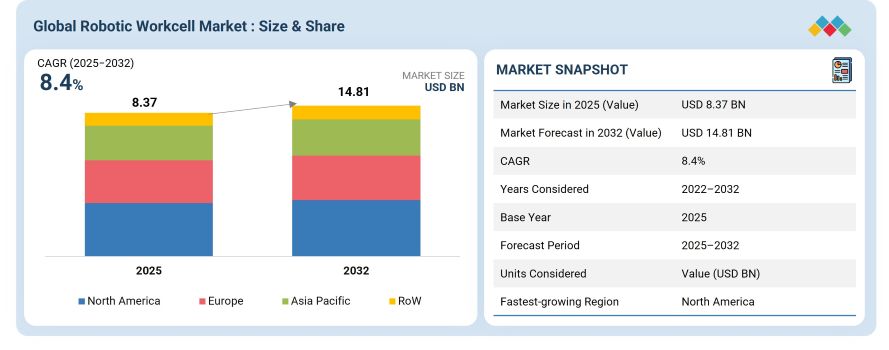
The global Industrial Robotic Workcells Market was valued at approximately USD 8.37 billion in 2025 and is projected to reach USD 14.81 billion by 2032, registering a CAGR of 8.4% during the forecast period. The market is benefiting from rising industrial automation investments, labour shortages, increasing demand for manufacturing flexibility, and the growing integration of artificial intelligence (AI), Industrial Internet of Things (IIoT), and machine vision technologies.
The adoption of robotic workcells is expanding beyond automotive manufacturing into electronics, semiconductors, pharmaceuticals, food and beverages, metal fabrication, logistics, and industrial machinery. Manufacturers are increasingly choosing integrated robotic automation solutions rather than standalone robots because workcells provide a complete, application-ready production environment. AI-enabled inspection, digital twin simulation, automated material handling, and connected manufacturing systems are expected to further strengthen the Robotic Workcell Market through 2032.
Secondary Keywords – Robotic Workcell Market: Industrial Robotic Workcell Market, Robotic Automation Cell Market, Robotic Manufacturing Cell Market, Automated Robotic Workcell Market, Industrial Robot Cell Market, Robotic Production Cell Market, Flexible Robotic Workcell Market, Robotic Assembly Cell Market, Integrated Robotic Systems Market, Automated Manufacturing Workcell Market.
Key Market Trends & Insights
- Leading region: Asia Pacific represents a major market for robotic workcells, supported by large-scale manufacturing operations, industrial automation investments, and strong automotive and electronics production.
- Fastest-growing region: North America is expected to offer attractive growth opportunities as manufacturers invest in reshoring, smart factories, advanced manufacturing, and flexible automation.
- Dominant product segment: Industrial robotic arms and integrated robotic workcell systems account for significant demand because they support multiple applications, including welding, assembly, material handling, and machine tending.
- Emerging technologies: AI-based machine vision, collaborative robots, digital twins, advanced sensors, and autonomous material handling are transforming robotic workcell capabilities.
- AI and automation impact: AI improves object recognition, adaptive motion planning, defect detection, and process optimisation, enabling robotic cells to handle more complex production requirements.
- Flexible manufacturing: Modular and reconfigurable robotic workcells are gaining importance as manufacturers seek to manage changing product designs, shorter production cycles, and customised manufacturing requirements.
Market Size & Forecast
- Base year market size: Approximately USD 8.37 billion in 2025.
- Forecast market value: Approximately USD 14.81 billion by 2032.
- CAGR: 8.4% during 2025–2032.
- Key growth factors: Increasing industrial automation, labour shortages, smart factory investments, AI-enabled machine vision, demand for flexible production, and integration of connected manufacturing technologies.
The Robotic Workcell Market is expected to expand as manufacturers move toward integrated automation systems that combine robotics, software, sensing, safety, and production equipment. Growing demand for consistent manufacturing quality and improved productivity is encouraging companies to invest in application-specific robotic cells across established and emerging industrial sectors.
Robotic Workcell Market Top 10 Key Takeaways
- The global Industrial Robotic Workcells Market was valued at approximately USD 8.37 billion in 2025.
- The market is projected to reach USD 14.81 billion by 2032, growing at a CAGR of 8.4%.
- Asia Pacific remains a major demand center because of its strong automotive, electronics, and industrial manufacturing base.
- Automotive manufacturing is an important application area for robotic welding, assembly, painting, and material handling.
- Collaborative robots are expanding the adoption of robotic workcells among small and medium-sized manufacturers.
- AI-powered machine vision is improving inspection, object recognition, and adaptive robotic operations.
- Digital twins and simulation software are reducing commissioning time and supporting virtual workcell design.
- Flexible and modular robotic cells are gaining traction as manufacturers require faster production changeovers.
- Electronics, semiconductor, pharmaceutical, and food processing industries are creating additional opportunities.
- System integrators and automation specialists are becoming increasingly important for delivering customised, production-ready robotic workcells.
Product Insights
The Robotic Workcell Market includes complete robotic automation systems, industrial robotic arms, collaborative robotic cells, robotic welding cells, assembly cells, machine-tending workcells, palletizing systems, and specialised material handling solutions. Integrated robotic workcell systems represent a significant product category because they combine multiple automation components into a single production-ready solution.
Industrial robotic arms remain essential to workcell configurations because of their ability to perform repetitive, high-speed, and precision-intensive tasks. Articulated robots are widely used in welding, painting, assembly, and material handling, while SCARA and Cartesian robots are suitable for selected precision assembly, packaging, and pick-and-place applications. Collaborative robots are gaining popularity in applications where human operators and robots need to work in shared production environments under appropriately designed safety conditions.
Robotic welding workcells are important in automotive, metal fabrication, heavy equipment, and industrial machinery manufacturing. These systems integrate welding robots, fixtures, positioners, power sources, and safety enclosures to improve consistency and production throughput. Robotic assembly workcells are also gaining importance in electronics, automotive components, and consumer products manufacturing.
Emerging product categories include AI-enabled robotic inspection cells, autonomous machine-tending systems, flexible assembly workcells, and modular robotic palletizing solutions. These systems integrate machine vision, intelligent sensors, and advanced control software to support different products and production requirements. As manufacturers increasingly adopt smart manufacturing strategies, demand for scalable and reconfigurable robotic workcells is expected to grow through 2032.
Technology / Component Insights
Technological developments are reshaping the Industrial Robotic Workcell Market by improving automation accuracy, flexibility, connectivity, and process intelligence. Industrial robots, controllers, end effectors, sensors, machine vision systems, safety equipment, and software form the core technological components of an integrated workcell.
Artificial intelligence is becoming an important technology for advanced robotic automation. AI-powered vision systems help robots identify objects, recognise product variations, inspect components, and adjust movements based on changing production conditions. Machine learning algorithms can analyse production data to identify process variations and support predictive maintenance.
Machine vision is particularly important in robotic assembly, inspection, sorting, and material handling. Advanced cameras and image-processing software enable robots to identify component positions, detect surface defects, and perform precision operations. The integration of three-dimensional vision systems is also improving robotic handling in applications involving irregularly positioned objects.
The Industrial Internet of Things connects robots, controllers, sensors, production equipment, and factory management systems. This connectivity enables manufacturers to monitor workcell performance, track equipment utilisation, analyse downtime, and improve production coordination. Cloud-based platforms can provide centralised monitoring across multiple manufacturing facilities.
Digital twin technology is another important development. Manufacturers can create virtual models of robotic workcells to simulate robot movements, identify potential collisions, optimise layouts, and evaluate cycle times before physical installation. This can reduce engineering costs and improve commissioning efficiency.
Future technology development will focus on AI-driven motion planning, intuitive programming, improved human-robot collaboration, autonomous material handling, edge computing, and interoperable industrial software platforms. These innovations are expected to make robotic workcells more accessible to manufacturers with different production scales and automation requirements.
Application Insights
The automotive industry represents one of the most established application areas for robotic workcells. Automotive manufacturers use integrated robotic systems for spot welding, arc welding, painting, component assembly, material handling, and quality inspection. Increasing electric vehicle production is creating additional opportunities for robotic workcells in battery module assembly, motor manufacturing, component handling, and automated inspection.
The electronics and semiconductor industries are also important application segments. These sectors require precision handling, component placement, assembly, inspection, and testing. Robotic workcells equipped with advanced vision systems can improve production consistency and reduce manual handling in sensitive manufacturing environments.
Metal fabrication and industrial machinery manufacturers use robotic cells for cutting, welding, grinding, polishing, and finishing operations. These applications benefit from repeatable motion, consistent processing, and reduced operator exposure to hazardous environments.
In food and beverage manufacturing, robotic workcells are increasingly used for sorting, packaging, palletizing, product inspection, and material handling. Pharmaceutical manufacturers are adopting robotic automation for packaging, laboratory operations, product handling, and selected assembly processes where accuracy and controlled handling are important.
Logistics and warehousing also offer opportunities for robotic workcells through automated picking, sorting, palletizing, depalletizing, and packaging. As e-commerce and distribution networks expand, manufacturers and logistics operators are investing in integrated robotic automation to improve throughput and reduce manual workloads.
Regional Insights
North America
North America represents an important market for robotic workcells, supported by investments in advanced manufacturing, industrial automation, automotive production, aerospace, electronics, and logistics. The United States is the primary demand center because manufacturers are investing in factory modernisation, domestic production capabilities, and automated assembly systems. Government initiatives supporting domestic semiconductor manufacturing and advanced industrial production are encouraging investments in robotics and smart manufacturing.
Canada is experiencing demand from automotive, aerospace, food processing, and industrial machinery manufacturers. The country's focus on manufacturing productivity and technology adoption is creating opportunities for robotic welding, assembly, and material handling systems. Mexico is becoming an important manufacturing location because of its automotive, electronics, and industrial supply chains. Nearshoring and cross-border manufacturing activities are supporting demand for automated robotic workcells.
Europe
Europe is an established market for robotic automation, supported by advanced automotive manufacturing, industrial machinery, aerospace, electronics, and precision engineering industries. Germany represents a major market because of its automotive ecosystem, engineering capabilities, and Industry 4.0 initiatives. The United Kingdom, France, Italy, and Spain are also investing in manufacturing automation, robotics, and production modernisation.
The Nordic countries offer opportunities in advanced manufacturing, industrial equipment, electronics, and sustainable production technologies. European manufacturers are increasingly focusing on energy-efficient automation, workplace safety, and flexible production systems. Regulatory frameworks, including the EU Machinery Regulation (EU) 2023/1230, applicable from January 2027, are relevant to machinery safety and the design of integrated robotic workcells. Industrial robot installations and system integration are also influenced by workplace safety requirements and applicable harmonised standards.
Asia Pacific
Asia Pacific is a major growth engine for the Robotic Workcell Market because of its large manufacturing base and expanding investment in industrial automation. China has a strong position in automotive, electronics, semiconductor, metal processing, and industrial machinery production. Japan and South Korea are established robotics and automation markets with strong capabilities in precision manufacturing and electronics.
India is emerging as an attractive market because of expanding automotive production, electronics manufacturing, industrial development, and government-supported manufacturing initiatives. Programmes supporting domestic manufacturing and semiconductor development are encouraging automation investment. Australia is adopting robotic workcells across mining equipment, food processing, logistics, and industrial manufacturing. Singapore remains an important regional hub for advanced manufacturing, semiconductor production, and automated logistics.
Regional Insights – Key Points
- Asia Pacific represents a major market because of its extensive industrial manufacturing and robot deployment ecosystem.
- North America benefits from advanced manufacturing investment, reshoring initiatives, and increasing automation adoption.
- Europe has strong demand from automotive, aerospace, machinery, and precision engineering industries.
- China, Japan, India, and South Korea are important markets for robotic workcell adoption.
- Increasing investment in AI, IIoT, and flexible manufacturing is supporting demand across all major regions.
Country-Specific Market Trends
The following country-level CAGRs are indicative analyst estimates for the robotic workcell market during 2026–2032. They are directional estimates rather than independently published country-specific forecasts. Growth reflects differences in manufacturing investment, industrial automation penetration, and demand for integrated robotic systems.
China – Estimated CAGR: 9–11%
China is expected to remain an important market because of its large automotive, electronics, semiconductor, and industrial machinery manufacturing base. Government-supported industrial modernisation, domestic robotics development, and investment in smart factories are supporting demand. Manufacturers are increasingly deploying robotic welding, assembly, machine-tending, and material handling workcells to improve production efficiency.
Japan – Estimated CAGR: 6–8%
Japan has an established industrial robotics ecosystem and strong demand from automotive, electronics, semiconductor, and precision engineering manufacturers. Companies are focusing on collaborative robotics, high-precision assembly, machine vision, and intelligent automation. Labour availability and productivity improvement are also important factors influencing adoption.
United States – Estimated CAGR: 8–10%
The United States is expected to benefit from factory modernisation, reshoring, semiconductor investment, and advanced automotive manufacturing. Robotics adoption is increasing in welding, assembly, packaging, machine tending, and inspection. Demand for flexible robotic workcells is likely to increase as manufacturers seek scalable automation solutions.
Canada – Estimated CAGR: 7–9%
Canada's market is supported by automotive manufacturing, aerospace, food processing, and industrial machinery. Investment in automated production and advanced manufacturing technologies is encouraging demand for robotic assembly and material handling systems.
Mexico – Estimated CAGR: 9–11%
Mexico is becoming an attractive market for robotic workcells because of its expanding automotive, electronics, and industrial manufacturing sectors. Nearshoring and manufacturing supply chain investments are increasing the need for automated welding, assembly, packaging, and quality inspection.
Germany – Estimated CAGR: 7–9%
Germany remains an important European market due to its automotive manufacturing ecosystem, industrial machinery production, and Industry 4.0 capabilities. Manufacturers are adopting flexible robotic workcells, AI-enabled inspection, and digital twin simulation to improve production efficiency.
France – Estimated CAGR: 6–8%
France is witnessing increasing demand for robotic workcells across aerospace, automotive, electronics, pharmaceuticals, and food processing. Industrial modernisation initiatives and investment in advanced manufacturing are supporting automation adoption.
Country-Level Insights – Key Points
- China is supported by large-scale automotive and electronics production and domestic robotics investment.
- Japan is focusing on precision automation, collaborative robotics, and advanced manufacturing.
- The United States benefits from reshoring, semiconductor investment, and smart factory development.
- Canada and Mexico offer opportunities in automotive, aerospace, and industrial manufacturing automation.
- Germany and France are investing in flexible robotics, Industry 4.0, and advanced production systems.
Key Robotic Workcell Company Insights
The Robotic Workcell Market includes industrial robot manufacturers, automation technology providers, and specialised system integrators. Companies compete through robot performance, application engineering, machine vision integration, safety solutions, software capabilities, and customised workcell development.
ABB Ltd. offers industrial robots, collaborative robots, machine automation, and integrated robotic solutions. Its strategy focuses on flexible automation, digital manufacturing, and intelligent robotic applications.
FANUC Corporation is a major industrial robotics supplier with solutions for welding, material handling, machine tending, and assembly. The company focuses on robot reliability, integrated controls, automation software, and production connectivity.
Yaskawa Electric Corporation provides industrial robots and motion control technologies used in welding, handling, painting, and assembly applications. Its product strategy emphasises precision, productivity, and integrated automation.
KUKA AG offers industrial robots, collaborative robotics, and complete automation systems for automotive, electronics, and general manufacturing. Its capabilities include digital manufacturing and flexible production solutions.
Mitsubishi Electric Corporation provides industrial robots, controllers, factory automation systems, and integrated manufacturing technologies. Its focus includes connected factories, automation control, and industrial digitalisation.
Kawasaki Heavy Industries supplies industrial robots for welding, assembly, painting, and material handling. It focuses on expanding automation applications across automotive, electronics, and industrial production.
Comau S.p.A. provides advanced automation solutions, robotic systems, assembly technologies, and industrial production equipment. Its strategy includes flexible manufacturing and integrated automation solutions.
DENSO Corporation develops industrial robots for precision assembly, electronics manufacturing, and material handling. Its focus includes compact automation systems and high-precision production applications.
Company Strategy – Key Points
- ABB is focusing on flexible automation, digital solutions, and collaborative robotics.
- FANUC is strengthening integrated robotics, control systems, and intelligent manufacturing capabilities.
- Yaskawa is emphasising precision motion control and application-specific robotic automation.
- KUKA and Comau are developing integrated production systems for automotive and industrial manufacturing.
- Mitsubishi Electric, Kawasaki, and DENSO are focusing on connected automation, precision robotics, and advanced manufacturing applications.
Recent Developments
The Robotic Workcell Market is evolving through advances in AI-enabled robotics, collaborative automation, digital simulation, and integrated production systems. One important development is the increasing integration of machine vision with industrial robots. Advanced vision systems allow robotic workcells to identify component positions, inspect product quality, and adapt to variations in incoming materials.
Another important development is the growth of modular and pre-engineered robotic workcells. These solutions reduce the engineering effort required for installation and allow manufacturers to deploy automation across multiple production lines. Standardised robotic welding, palletizing, machine-tending, and assembly cells are becoming attractive to manufacturers seeking faster implementation.
AI-based programming and digital twin simulation are also changing robotic workcell development. Manufacturers can simulate robot movements, optimise production layouts, identify potential collisions, and evaluate cycle times before physical commissioning. These technologies can improve project planning and reduce installation-related disruptions.
Market Segmentation
The Robotic Workcell Market can be segmented by product, technology or component, application, end-use industry, and region. By product, the market includes robotic welding cells, robotic assembly cells, machine-tending workcells, material handling systems, palletizing cells, painting and finishing cells, inspection systems, and customised robotic automation solutions. Integrated robotic workcells are an important category because they combine robot arms, fixtures, controllers, safety equipment, and process-specific technologies.
By technology and component, the market includes articulated robots, SCARA robots, Cartesian robots, collaborative robots, controllers, end effectors, machine vision systems, sensors, safety equipment, software, and industrial networking components. AI-enabled machine vision, digital twin simulation, IIoT connectivity, and advanced motion control are increasingly important technology categories.
By application, the market covers welding, assembly, material handling, machine tending, packaging, palletizing, painting, dispensing, cutting, inspection, and testing. By end-use industry, demand comes from automotive, electronics and semiconductors, aerospace, metal fabrication, pharmaceuticals, food and beverages, logistics, and industrial machinery manufacturing. Regionally, the market covers North America, Europe, Asia Pacific, Latin America, and the Middle East and Africa.
Market Segmentation – Key Points
- By Product: Robotic welding cells, assembly cells, machine-tending workcells, material handling cells, palletizing systems, and inspection workcells.
- By Technology: Industrial robots, collaborative robots, AI-based vision systems, controllers, sensors, end effectors, and digital twin software.
- By Application: Welding, assembly, handling, packaging, palletizing, machine tending, painting, and inspection.
- By End-Use Industry: Automotive, electronics, semiconductors, aerospace, pharmaceuticals, food and beverages, and industrial machinery.
- By Region: North America, Europe, Asia Pacific, Latin America, and the Middle East and Africa.
Conclusion
The Robotic Workcell Market is becoming an essential part of modern manufacturing as companies move toward integrated, intelligent, and flexible automation. Complete robotic workcells offer advantages beyond standalone robot deployment by combining industrial robots, vision systems, controllers, safety equipment, and process-specific technologies into production-ready solutions.
The market is projected to grow from approximately USD 8.37 billion in 2025 to USD 14.81 billion by 2032, registering a CAGR of 8.4%. AI-powered machine vision, collaborative robotics, IIoT connectivity, digital twins, and automated material handling are expected to create new opportunities across manufacturing industries.
Through 2032, manufacturers are likely to prioritise modular robotic systems that can support multiple production requirements and reduce engineering complexity. Companies offering application-specific automation, integrated software, predictive maintenance, and comprehensive system integration are expected to strengthen their competitive positions. As smart manufacturing adoption accelerates, robotic workcells will play a strategic role in improving industrial productivity, quality, safety, and production flexibility.
FAQs
1. What is the Robotic Workcell Market size?
The global Industrial Robotic Workcells Market was valued at approximately USD 8.37 billion in 2025 and is projected to reach USD 14.81 billion by 2032.
2. What is the growth rate of the Robotic Workcell Market?
The market is expected to register a CAGR of approximately 8.4% during the 2025–2032 forecast period.
3. What are the key drivers of the Robotic Workcell Market?
Major growth drivers include increasing industrial automation, labour shortages, demand for manufacturing flexibility, AI-enabled machine vision, smart factory investments, and the need for improved production efficiency.
4. Which region leads the Robotic Workcell Market?
Asia Pacific is a major regional market, supported by strong automotive, electronics, semiconductor, and industrial manufacturing industries.
5. Who are the key companies in the Robotic Workcell Market?
Major companies include ABB, FANUC, Yaskawa, KUKA, Mitsubishi Electric, Kawasaki Heavy Industries, Comau, and DENSO.
Revenue
Revenue in the Robotic Workcell Market is generated through the sale of integrated robotic automation systems, industrial robot arms, collaborative robotic cells, controllers, end effectors, fixtures, safety equipment, machine vision systems, and application-specific production modules. System integration, engineering, installation, programming, maintenance, and aftermarket support also contribute to industry revenue. As manufacturers increasingly invest in complete automation solutions rather than individual robotic components, suppliers offering turnkey robotic workcells can capture additional value through customised engineering and lifecycle services.
Investment & Funding
Investment in the Robotic Workcell Market is increasing as manufacturers seek to improve production efficiency, reduce labour dependency, and modernise industrial facilities. Capital expenditure is directed toward robotic arms, collaborative robots, machine vision, AI-based inspection, automated material handling, and digital manufacturing software. Venture capital and strategic investment opportunities are also emerging in robotics software, autonomous manipulation, AI-based programming, and flexible automation platforms. Industrial technology companies are expected to prioritise solutions that reduce workcell deployment time, improve return on investment, and make automation accessible to small and medium-sized manufacturers.
Mergers & Acquisitions (M&A)
Mergers and acquisitions in the Robotic Workcell Market are driven by the need to expand automation portfolios, strengthen system integration capabilities, and acquire specialised technologies. Industrial robot manufacturers and automation providers may pursue acquisitions involving machine vision developers, robotics software companies, end-effector manufacturers, and application-specific system integrators. Strategic consolidation can help companies deliver complete robotic workcells rather than standalone robot products. Acquisitions involving AI-based inspection, autonomous material handling, digital twin simulation, and collaborative robotics are likely to remain relevant as manufacturers seek more intelligent and flexible automation solutions.
Recent Development
- AI-enabled robotic inspection: Machine vision and AI-based image processing are improving automated defect detection, component recognition, and quality inspection within robotic workcells.
- Collaborative robotic workcells: Growing availability of collaborative robots is expanding automation opportunities in assembly, machine tending, packaging, and material handling.
- Digital twin integration: Virtual simulation technologies are helping manufacturers optimise robotic cell layouts, reduce collision risks, and improve commissioning processes.
- Flexible robotic automation: Modular and pre-engineered workcells are gaining attention because they can be adapted to different products, production lines, and manufacturing requirements.
- Connected manufacturing systems: Integration of IIoT sensors, controllers, and factory software is enabling real-time workcell monitoring, predictive maintenance, and improved production visibility.
 Exclusive indicates content/data unique to MarketsandMarkets and not available with any competitors.











Growth opportunities and latent adjacency in Robotic Workcell Market