Single Cell Multi-Omics Market - Global Forecast 2029


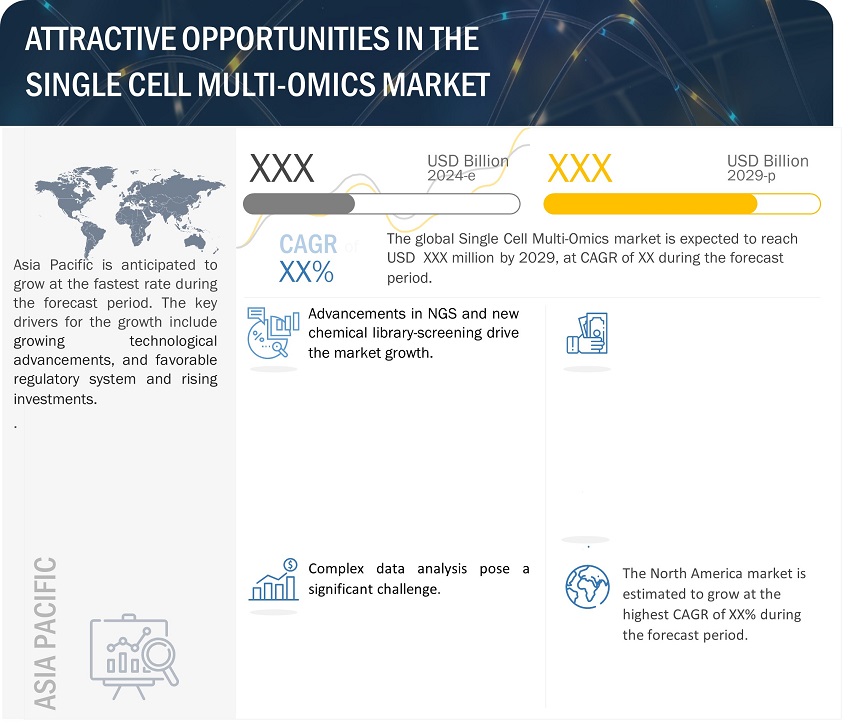
The global single cell multi-omics market, valued at US$XX billion in 2023, is forecasted to grow at a robust CAGR of XX%, reaching US$XX billion in 2024 and an impressive US$XX billion by 2029. The major factors driving the growth of this market are technological advancements in the sequencing technology and multi-omics analysis. Significant developments have been made in the arena of single cell multi-omics in the past few years. For instance, simultaneous detection of chromatin accessibility and transcriptome in a single cell sample provides a direct link between chromatin state and the level of the corresponding transcripts. Such technological advancements are set to propel the market growth.
SINGLE CELL MULTI-OMICS MARKET- GLOBAL FORECAST TO 2029
GLOBAL SINGLE CELL MULTI-OMICS MARKET DYNAMICS
Driver : Rising technological advancements in multi-omics
Increasing advancements in multi-omics, particularly in the realm of sequencing is set to drive the market growth. Advancement's in NGS and new chemical library-screening approaches have enabled mapping of genome-wide interactions between small molecules with chromatin could provide new insights into the mechanisms. Emerging technologies have focused on enabling the detection of the drug-DNA interaction in the past few years. For instance, Chem-seq technology makes use of affinity tags reacting with the functionalized drugs, which further make it possible to identify global interactions of small molecules in bulk samples. Single cell multi-omics offers a multi-molecular readout which helps in comprehensive dissection of complex molecular mechanisms in gene regulation, depicting individual cell states to utmost accuracy. These technologies are well-suited for end-uses involving rare cell types, as it maximizes the information obtained from each individual cell. Such approaches have immense potential applications in a wide range of research fields, from developmental biology to cancer biology and precision medicine related to drug research and development.
Challenge : Complexities associated with data analysis
Single cell multi-omics is a complex technology, which yields an array of datasets based on the analysis of genome, proteome, and transcriptome – all in one sample. Joint analyses of data is challenges with both the cross-modality variations and cross-cell correlations. The challenges in developing such integrative methods for scMulti-omics data include unifying different modalities, batch effects between experiments (especially for unmatched data), low sequencing depth, and high-modality interactions. Recently emerged methods for integrating single cell multi-omics data provide new opportunities to jointly analyze different types of single-cell data, there remain several challenges and issues to address for the future of scMulti-omics studies and integrative methods. One challenge is related to the computational issues in dealing with large data. Analyzing massive amounts of data from technologies such as RNA-seq, whole-genome sequencing, and ChIP-seq is an established problem due to their sheer size. Furthermore, single-cell methods have the computational burden of including information from hundreds or thousands of cells.
Key Market Players
- OXFORD NANOPORE TECHNOLOGIES PLC.
- ILLUMINA, INC.
- BD
- MERCK KGAA
- AGILENT TECHNOLOGIES, INC.
- THERMO FISHER SCIENTIFIC
- BRUKER
- DANAHER CORPORATION
- QIAGEN
- PACBIO
- BIO-TECHNE
- STANDARD BIOTOOLS
- BIO-RAD LABORATORIES, INC .
Recent Developments:
- In January 2025, Illumina, Inc. a global leader in DNA sequencing and array-based technologies, today announced a series of updates to its NovaSeq X Series, delivering the NovaSeq X single-flow-cell system alongside a cutting-edge software upgrade and new kits.
- In July 2024, MedGenome, a leading provider of multiomics solutions, today announced the acquisition of a PacBio Revio sequencing system. This latest addition to MedGenome's technology portfolio will significantly bolster their long-read sequencing capabilities.
- In January 2024, BD (Becton, Dickinson and Company) a leading global medical technology company, announced a collaboration agreement with Hamilton, a leading global manufacturer of laboratory automation technology, to develop automated applications together with robotics-compatible reagent kits to enable greater standardization and reduced human error when conducting large-scale single-cell multiomics experiments.
To speak to our analyst for a discussion on the above findings, click Speak to Analyst
 Exclusive indicates content/data unique to MarketsandMarkets and not available with any competitors.
















Growth opportunities and latent adjacency in Single Cell Multi-Omics Market