Software-defined commercial vehicles are seeing significant development as OEMs transition to centralized E/E architectures and software-first development models. The global SDV revenue pool for commercial vehicles is expected to reach USD 7.29 billion by 2035 in the realistic scenario, representing approximately 19x growth from 2030. Market growth is expected to accelerate sharply after 2031 as SDV adoption and monetization scale. The transition is being driven by electrification, autonomous freight, connectivity, regulatory requirements, centralized computing, and recurring software revenue opportunities.
The SDCV ecosystem spans medium-duty trucks (Class 4–6) and heavy-duty trucks (Class 7–8) across hardware and software, with the report focusing on North America and Europe. SDV technologies include E/E architecture, software, high-performance SoC/HPC, OTA, security, AI, data utilization, and cloud services. Strategic alliances among OEMs, hardware and software partners, and cloud providers are increasingly important for developing complete SDV ecosystems that support connectivity, ADAS, and autonomous functions.
The transition toward SDV trucks is being shaped by electrification, autonomous freight, connectivity, and software monetization. Electrification increases software content and vehicle connectivity, while autonomous freight is driving the maturation of L4 trucking pilots. Always-on telematics enables real-time fleet intelligence, and Feature-on-Demand and subscription revenue are emerging as alternatives to traditional one-time vehicle sales.
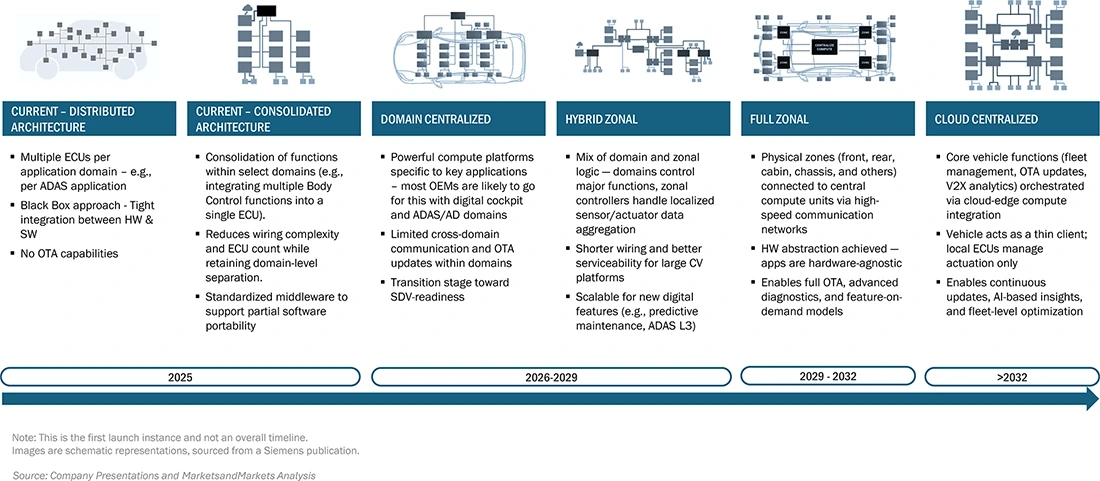
Centralized computing is emerging as a critical enabler for SDVs, as OEMs migrate from distributed ECUs to HPC and zonal architectures. Cloud platforms convert vehicle data into operational insights through predictive maintenance and routing optimization, while centralized computing enables hardware–software decoupling and faster software deployment. By 2035, the report expects centralized architectures to support autonomous functions, virtualization, OTA updates, and continuous vehicle evolution.
Centralized architecture and software platforms are reshaping commercial vehicles
The commercial vehicle industry is shifting from hardware-centric platforms to software-orchestrated architectures. High-performance computing nodes are replacing the proliferation of ECUs, while Ethernet TSN is emerging as the backbone for real-time, deterministic data transport. The report highlights Daimler Truck's and Volvo’s Coretura JV as benchmarks for centralized computing in Class 8 vehicles.
OTA and continuous software delivery are also becoming increasingly important. Full-stack OTA, covering firmware, calibration, and feature unlocks, is identified as a baseline OEM requirement following R156, while Feature-on-Demand enables premium ADAS and fuel-optimization features to be sold after vehicle delivery. OTA governance is also emerging as a differentiator in fleet procurement decisions.
Software platform consolidation is advancing through initiatives such as TRATON ONE OS, which aims to unify software across MAN, Scania, and Volkswagen Truck, and the Daimler Truck–Volvo Coretura JV, which is developing shared middleware to reduce duplicate R&D spending. PACCAR is building a proprietary data and machine-learning platform, with Kenworth and Peterbilt identified as the initial deployment fleets.
Regulatory frameworks are enabling the transition toward SDV trucks
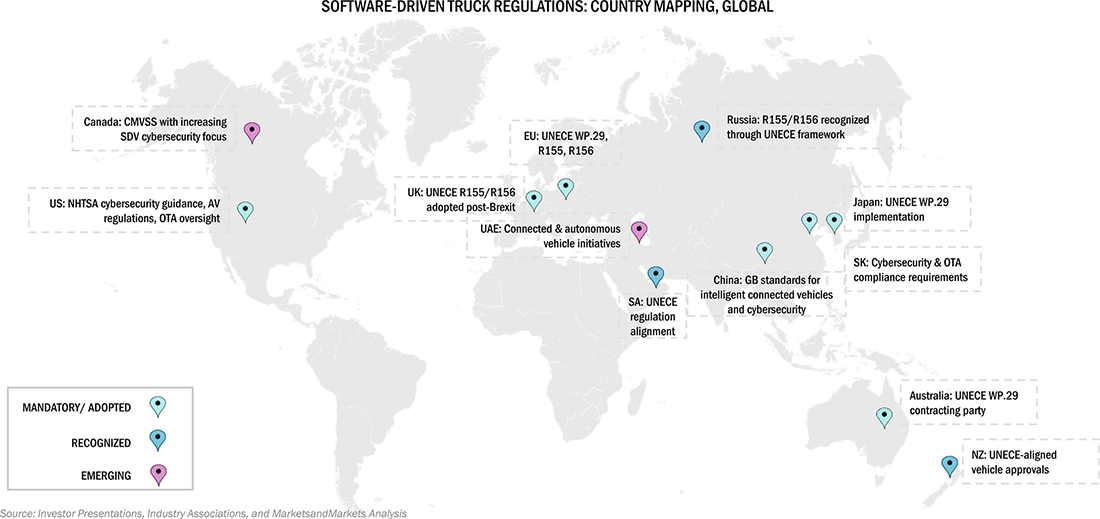
Regulatory requirements are increasingly focused on cybersecurity, software updates, OTA governance, autonomous driving, and vehicle data management. In Europe, UNECE R155 mandates cybersecurity management systems, and UNECE R156 mandates Software Update Management Systems and secure OTA governance. The EU General Safety Regulation mandates ADAS functions that require centralized compute and software-defined architectures, while the EU Data Act governs access to, sharing of, and cloud data management for vehicle-generated data.
North American regulations and initiatives include NHTSA cybersecurity guidance, FMVSS modernization, FMCSA autonomous trucking frameworks, EPA emission compliance digitization, and data and fleet telematics regulations. Together, these provide the operational, data, and security foundations for SDV trucks to scale.
In Asia Pacific, China’s MIIT intelligent connected vehicle standards address OTA updates, connected vehicle software, and cloud architecture, while China's data-security and cybersecurity laws require secure handling and localization of vehicle-generated data. Japan was the first market identified in the report to mandate R155/R156 for new types in January 2021, setting a high compliance bar for the Asia Pacific supplier chain.
OEMs are adopting different SDV development strategies
The report identifies three major approaches to SDV development: in-house development, co-development, and white-label or platform approaches. In-house development offers the greatest control and differentiation but requires the highest investment. Co-development balances speed and control through partnerships and shared R&D, while white-label or platform approaches enable faster deployment with the lowest upfront engineering burden.
Daimler Truck and Volvo Group are pursuing a co-development approach through Coretura, which focuses on a common software stack, middleware, a centralized compute architecture, standardized APIs, a developer environment, cross-brand scalability, and OTA and connected vehicle capabilities. The first Coretura-enabled vehicle products are targeted for the approximately 2028–2030 timeframe.
TRATON is pursuing an in-house development approach through TRATON ONE OS to own the SDV software stack across its brands. The report highlights this strategy as a means of turning software scalability into a durable competitive advantage.
Software monetization is creating a new revenue opportunity
The SDCV transition is creating opportunities for new revenue models as OEMs move beyond traditional vehicle sales. The report identifies Fleet SaaS, Data-as-a-Service, ecosystem partnerships, Feature-on-Demand, OTA subscription tiers, data monetization, and outcome-based maintenance SLAs as emerging software revenue models.
Fleet SaaS can generate recurring revenue through fleet management platforms, while Data-as-a-Service enables monetization of anonymized telematics data. Ecosystem partnerships can generate revenue through third-party developer marketplaces and co-developed applications, and software-driven maintenance contracts can shift traditional service models toward outcome-based SLAs.
The report also identifies several near-term restraints, including high development and integration costs, cybersecurity and data risks, stringent validation and compliance requirements, and software complexity and talent gaps. These barriers are expected to become more manageable as platforms mature, architectures standardize, automated compliance tools improve, and industry partnerships reduce integration challenges.
Conclusion
Software-defined commercial vehicles are undergoing a structural shift from hardware-centric platforms to software-orchestrated, connected, and continuously evolving vehicles. Electrification, autonomous freight, connectivity, regulatory pressure, centralized computing, and software monetization are collectively driving this shift.
In the realistic scenario, the global SDV revenue pool for commercial vehicles is expected to reach USD 8.9 billion by 2035, with market growth accelerating after 2031. The report identifies consolidation through JVs, regulatory compliance, the shift toward zonal HPC architectures, and the transition to software-based revenue models as key factors shaping the market through 2035.
OEMs that successfully develop scalable software platforms, centralized compute architectures, OTA capabilities, and recurring software revenue models are well positioned to capture the emerging SDV value pool. The report highlights Coretura and TRATON ONE OS as examples of the growing importance of shared software development and platform scalability in the commercial vehicle industry.
Personalize This Research
- Triangulate with your Own Data
- Get Data as per your Format and Definition
- Gain a Deeper Dive on a Specific Application, Geography, Customer or Competitor
- Any level of Personalization
Request A Free Customisation
Let Us Help You
- What are the Known and Unknown Adjacencies Impacting the Software Defined Commercial Vehicle Market
- What will your New Revenue Sources be?
- Who will be your Top Customer; what will make them switch?
- Defend your Market Share or Win Competitors
- Get a Scorecard for Target Partners
Customized Workshop Request













Growth opportunities and latent adjacency in Software Defined Commercial Vehicle Market