Solar Cables Market by Product (DC Cables, AC Cables, Module Cables, Connector Cables, Cable Harnesses), Conductor (Copper, Aluminum), Insulation (XLPE, Other Cross-linked Polymer Materials) – Global Forecast to 2032


Solar Cables Market Summary
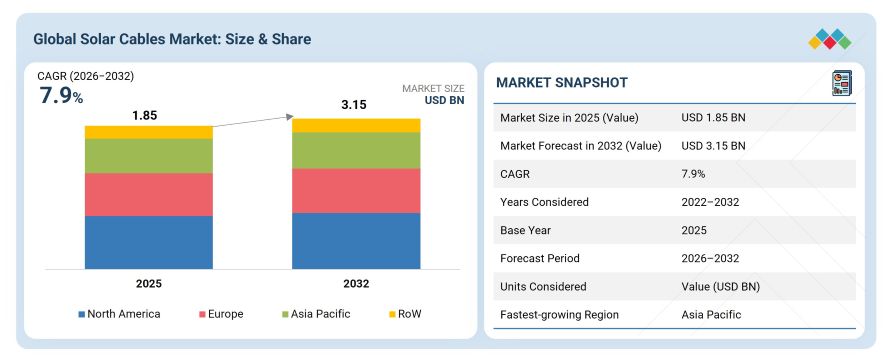
The global Solar Cables Market is experiencing steady growth as solar photovoltaic installations expand across utility-scale, commercial, industrial, and residential applications. The market is estimated to reach approximately USD 1.85 billion in 2025 and is projected to grow to USD 3.15 billion by 2032, registering a compound annual growth rate (CAGR) of approximately 7.9% during 2026–2032. Increasing investments in renewable energy infrastructure, government decarbonization targets, rising electricity demand, and the expansion of distributed solar generation are supporting market growth. The growing deployment of AI-powered energy management, Internet of Things (IoT)-enabled monitoring, automated solar manufacturing, and digital grid infrastructure is further increasing demand for reliable Solar Power Cables Market solutions.
Solar cables are essential components of photovoltaic installations because they connect solar modules, inverters, junction boxes, battery storage systems, and electrical distribution networks. The Photovoltaic (PV) Cables Market is benefiting from increasing demand for durable, weather-resistant, and high-performance electrical connections that can operate under challenging outdoor conditions. Solar DC Cables Market products are widely used to transfer electricity generated by solar modules, while Solar AC Cables Market solutions support power transmission between inverters and electrical distribution systems. Growing investments in large-scale solar farms, rooftop installations, floating solar projects, and hybrid renewable energy facilities are creating opportunities for manufacturers of Solar Cable Systems Market products.
Key Market Trends & Insights
The Solar Cables Market is witnessing significant technological and geographical developments as solar energy becomes an increasingly important component of global electricity generation.
- Leading region: Asia Pacific dominates the Solar Cables Market, supported by extensive solar installations, manufacturing capabilities, and renewable energy investments in China and India.
- Fastest-growing region: Asia Pacific is also expected to remain among the fastest-growing regional markets, driven by solar capacity expansion, electrification, and government-supported clean energy programs.
- Dominant product segment: Solar DC cables represent a major product category because they connect photovoltaic modules and strings to inverters across solar installations.
- Emerging technology trends: High-voltage solar cables, advanced insulation materials, UV-resistant designs, and improved conductor technologies are gaining importance in modern photovoltaic installations.
- AI and IoT integration: AI-powered monitoring platforms and IoT-enabled sensors are improving fault detection, cable temperature monitoring, predictive maintenance, and solar plant performance.
- Automation impact: Automated cable manufacturing, robotic inspection, and digital quality-control systems are helping manufacturers improve production efficiency, consistency, and product reliability.
Market Size & Forecast
- Base year (2025) market size: Approximately USD 1.85 billion.
- Forecast market size (2032): Approximately USD 3.15 billion.
- CAGR (2026–2032): Approximately 7.9%.
- Growth factors: Increasing photovoltaic installations, utility-scale solar projects, rooftop solar adoption, renewable energy investments, and demand for advanced electrical infrastructure are supporting market expansion.
The market is expected to benefit from increasing investments in solar power generation and the modernization of electricity distribution infrastructure. The expansion of high-capacity photovoltaic projects is also increasing demand for cables with improved thermal stability, mechanical strength, electrical conductivity, and environmental resistance. Furthermore, the integration of battery energy storage systems with solar installations is creating additional opportunities for specialized cable solutions.
Solar Cables Market Top 10 Key Takeaways
- The global Solar Cables Market is estimated to reach approximately USD 1.85 billion in 2025.
- The market is projected to reach approximately USD 3.15 billion by 2032.
- The market is expected to register a CAGR of approximately 7.9% during 2026–2032.
- Asia Pacific holds a leading position due to strong solar manufacturing and installation activity.
- Solar DC cables account for a significant share of demand because of their extensive use in photovoltaic module connections.
- Utility-scale solar installations remain a major application area for solar cable products.
- UV-resistant, heat-resistant, and weatherproof cable designs are gaining importance.
- AI and IoT technologies are improving cable monitoring, fault detection, and preventive maintenance.
- Battery energy storage integration is creating demand for advanced solar cable and connection systems.
- Manufacturers are increasingly focusing on high-voltage products, sustainable materials, automated production, and international certification standards.
Product Insights
The Solar DC Cables Market represents a major product category because direct-current cables are essential for connecting photovoltaic modules, strings, combiner boxes, and inverters. These cables must withstand continuous outdoor exposure, temperature fluctuations, ultraviolet radiation, moisture, and mechanical stress. Their ability to maintain electrical performance under demanding environmental conditions makes them critical to the long-term reliability of solar installations. Solar DC cables are generally manufactured with copper or aluminum conductors and specialized insulation and sheathing materials designed for photovoltaic applications.
Solar AC cables are another important product category, connecting inverters with transformers, distribution panels, and electrical grids. Demand for Solar AC Cables Market products is increasing alongside the installation of larger solar power plants and commercial rooftop systems. Higher-capacity installations require reliable electrical connections capable of handling increased power loads while minimizing transmission losses and operational risks.
The Solar Panel Cables Market is also expanding as residential and commercial photovoltaic installations become more widespread. Flexible Solar Cables Market products are gaining attention because they simplify installation, routing, and maintenance in complex rooftop and modular solar configurations. Similarly, UV-Resistant Solar Cables Market products are increasingly preferred in regions with high solar radiation and extreme outdoor temperatures.
Emerging product categories include high-voltage photovoltaic cables, advanced Solar Connector Cables Market products, Solar Module Cables Market solutions, and integrated Solar Cable Harness Market assemblies. Manufacturers are developing products with improved flame resistance, insulation performance, moisture protection, and mechanical durability. Automated manufacturing and AI-assisted quality inspection are helping producers detect insulation defects, dimensional variations, and conductor inconsistencies before products reach customers.
Technology / Component Insights
Technology innovation is an important factor shaping the Solar Cables Market. Modern photovoltaic cables incorporate advanced insulation compounds, protective outer sheaths, high-conductivity conductors, and specialized connector systems. Cross-linked polyethylene (XLPE) and other cross-linked polymer materials are used in applications requiring improved thermal and mechanical performance. Electron-beam cross-linking and advanced polymer processing can further improve material properties, depending on cable design and manufacturing requirements.
The Solar Wiring Cables Market is also benefiting from improvements in conductor design and electrical connection technologies. Copper conductors offer high electrical conductivity and are widely used in photovoltaic connections, while aluminum conductors can provide cost and weight advantages in selected larger-scale installations. Cable selection depends on current-carrying capacity, installation conditions, voltage ratings, temperature limits, and applicable standards.
Digitalization is creating new opportunities in cable monitoring and maintenance. IoT-enabled sensors can measure temperature, current, voltage, and other operating parameters at selected points within solar installations. These measurements can be analyzed through cloud-based monitoring platforms to identify abnormal operating conditions and support predictive maintenance.
AI-based analytics can help operators identify unusual temperature patterns, potential connection failures, and performance variations. Automated inspection technologies, including machine vision and robotic testing systems, are also improving manufacturing quality. Future innovation is expected to focus on improved insulation materials, enhanced fire safety, high-voltage compatibility, recyclable cable materials, and smart monitoring solutions.
Application Insights
Utility-scale solar power plants represent a major application segment of the Solar Cables Market because these facilities require extensive electrical connections across photovoltaic modules, inverter stations, transformers, and grid interconnection infrastructure. Large solar installations require substantial volumes of DC and AC cables, creating consistent demand for high-performance products capable of operating reliably over long service periods.
Commercial and industrial rooftop installations are another important application area. Businesses are increasingly adopting solar energy to reduce electricity expenses, improve energy security, and meet sustainability objectives. Manufacturing facilities, warehouses, logistics centers, shopping complexes, and data centers are investing in rooftop photovoltaic systems, supporting demand for Solar Installation Cables Market products.
Residential solar installations are also contributing to market expansion, particularly in countries offering rooftop solar incentives and net-metering arrangements. The growth of distributed generation is increasing demand for flexible, durable, and easy-to-install solar cable products.
Emerging applications include floating solar projects, solar-plus-storage facilities, agrivoltaics, and hybrid renewable energy installations. The integration of battery energy storage systems requires additional electrical connections between photovoltaic arrays, inverters, battery units, and power conversion equipment. These developments are expected to create opportunities for manufacturers offering specialized Renewable Energy Cables Market solutions and Solar Power Transmission Cables Market products.
Regional Insights
North America
North America represents an important market for solar cable manufacturers, supported by renewable energy investments, utility-scale photovoltaic installations, and growing commercial solar adoption. The United States is the primary demand center, driven by federal clean energy incentives, state-level renewable portfolio standards, and investments in domestic solar manufacturing. Expansion of solar farms and distributed energy systems is increasing demand for Solar DC Cables Market and Solar AC Cables Market products. Canada is experiencing growing demand through utility-scale solar projects, distributed generation, and renewable electricity investments. Mexico is also creating opportunities through industrial solar installations, commercial rooftop projects, and cross-border renewable energy supply chains. Demand for high-voltage, weather-resistant, and certified cable products is particularly important across large installations.
Europe
Europe is an established market for solar cables, supported by renewable energy targets, electricity decarbonization initiatives, and investments in distributed photovoltaic generation. Germany remains a major solar installation market, while the United Kingdom, France, Italy, and Spain are expanding utility-scale and rooftop solar capacity. Nordic countries are investing in renewable electricity infrastructure, although climatic conditions create specific requirements for cable insulation and environmental durability. The European Union's Renewable Energy Directive and broader climate policy framework are supporting solar deployment. Manufacturers are increasingly focusing on product traceability, material sustainability, fire performance, and compliance with applicable European standards. The expansion of commercial solar installations and solar-plus-storage projects is strengthening demand for advanced Solar Cable Systems Market products.
Asia Pacific
Asia Pacific dominates the global Solar Cables Market because of its large photovoltaic manufacturing ecosystem, extensive solar installations, and strong government support for renewable energy. China is a major center for solar module manufacturing and photovoltaic deployment, generating substantial demand for Solar Panel Cables Market and Photovoltaic Power Cables Market products. India is experiencing rapid solar capacity expansion through utility-scale projects, rooftop solar programs, and industrial renewable energy investments. Japan and South Korea are focusing on advanced solar technologies, energy storage integration, and high-efficiency installations. Australia is benefiting from residential rooftop solar adoption and large-scale renewable energy projects, while Singapore is investing in rooftop and floating solar installations. Digitalization, automated manufacturing, and smart energy management are further supporting regional market development.
Regional Insights Summary
- Asia Pacific leads the market due to strong photovoltaic manufacturing and installation capacity.
- North America benefits from clean energy incentives and domestic solar supply chain investments.
- Europe is supported by renewable energy regulations and distributed solar generation.
- China and India are major sources of regional solar cable demand.
- Solar-plus-storage projects and high-voltage installations are creating opportunities across all major regions.
Country-Specific Market Trends
China: China is expected to remain one of the largest country-level markets for solar cables. Its extensive solar manufacturing ecosystem, large utility-scale photovoltaic installations, and renewable energy investment are supporting demand. The country's focus on grid modernization, ultra-high-voltage transmission, and distributed solar generation is creating opportunities for advanced Solar Power Cables Market products. Indicative country-level CAGR: 8–10% during 2026–2032.
Japan: Japan's solar cable demand is supported by rooftop photovoltaic installations, commercial solar projects, and investments in energy storage. Limited land availability is encouraging the development of rooftop, floating, and other space-efficient solar installations. Demand for durable and compact Solar Installation Cables Market products is expected to increase. Indicative CAGR: 6–8%.
United States: The United States is expected to remain the leading North American demand center. Utility-scale solar farms, commercial installations, domestic manufacturing investments, and battery storage integration are supporting demand for photovoltaic cables. Indicative CAGR: 7–9%.
Canada: Canada's market is developing through provincial clean electricity initiatives, utility-scale renewable energy projects, and growing commercial solar installations. Cable products designed for cold temperatures and challenging outdoor conditions are important. Indicative CAGR: 6–8%.
Mexico: Mexico offers opportunities through industrial rooftop solar installations, commercial photovoltaic systems, and renewable energy infrastructure development. Demand is expected to benefit from manufacturing-sector electricity requirements and distributed generation. Indicative CAGR: 6–8%.
Germany: Germany remains an important European market due to its established solar industry, rooftop photovoltaic installations, and renewable energy transition. Demand for certified, durable, and high-performance solar cables is expected to increase. Indicative CAGR: 6–8%.
France: France is expanding its solar generation capacity through utility-scale projects, commercial installations, and renewable energy development programs. Solar cable demand is expected to benefit from new photovoltaic capacity and grid integration investments. Indicative CAGR: 7–9%.
Note: Country-level CAGR ranges are indicative analytical estimates, not independently verified country forecasts. They should be validated against the selected market research dataset before publication.
Country-Level Insights
- China benefits from large-scale solar manufacturing and photovoltaic deployment.
- Japan is creating opportunities through rooftop and floating solar installations.
- The United States is supported by utility-scale projects and clean energy investments.
- Canada and Mexico offer opportunities in commercial, industrial, and distributed solar systems.
- Germany and France are driving European demand through renewable energy expansion and regulatory support.
Key Solar Cables Company Insights
The competitive landscape of the Solar Cables Market includes global cable manufacturers, specialized photovoltaic cable producers, and electrical infrastructure companies. Leading participants are focusing on advanced insulation materials, high-voltage cable technologies, product certification, manufacturing automation, and expanded distribution networks.
Prysmian Group is a major global cable manufacturer with capabilities across energy and infrastructure applications. Its strategy includes advanced cable technologies, renewable energy infrastructure, manufacturing efficiency, and sustainable materials.
Nexans focuses on electrification and renewable energy infrastructure. Its product development strategy emphasizes cable reliability, energy transition applications, digital monitoring, and improved lifecycle performance.
NKT specializes in power cable solutions and electrical infrastructure. Its broader capabilities in renewable energy transmission and grid connectivity position it within the expanding clean energy supply chain.
LAPP Group offers industrial connectivity and cable solutions, including products for photovoltaic applications. Its strategy emphasizes application-specific cable designs, connectivity systems, and international standards compliance.
HELUKABEL provides industrial cables and specialized electrical connectivity products. Its solar-related strategy focuses on durable photovoltaic cables, technical performance, and application-specific product development.
LEONI operates in cable and wiring systems, with capabilities relevant to industrial and energy applications. Its focus includes product engineering, advanced manufacturing, and specialized connectivity solutions.
TKD KABEL offers industrial and specialized cable products, including solutions for renewable energy applications. Product durability and compliance with relevant technical requirements are important elements of its strategy.
Havells India participates in the Indian electrical cable industry and benefits from increasing demand for solar and renewable energy infrastructure. Its strategy includes expanding electrical product offerings and strengthening its presence in India's growing renewable energy ecosystem.
Company Strategy Insights
- Manufacturers are investing in advanced insulation and UV-resistant cable technologies.
- Product certification and compliance are important competitive differentiators.
- Automation and digital quality inspection are improving manufacturing consistency.
- Companies are expanding their renewable energy product portfolios and distribution networks.
- Sustainable materials, improved product lifecycles, and high-voltage solutions are becoming strategic priorities.
Recent Developments
The Solar Cables Market is experiencing ongoing product innovation and manufacturing improvements as solar installations become larger and more technologically advanced.
Manufacturers are expanding photovoltaic cable portfolios with improved insulation materials, enhanced UV resistance, better thermal performance, and greater mechanical durability. These developments are intended to improve reliability in utility-scale solar farms and rooftop installations.
Another important development is the growing adoption of automated manufacturing and digital inspection technologies. Machine vision, automated electrical testing, and AI-supported quality analytics are helping manufacturers improve production consistency and identify defects.
Partnerships between cable manufacturers, solar EPC companies, inverter suppliers, and energy storage integrators are also becoming increasingly important. These collaborations support the development of compatible cable and connection solutions for integrated solar-plus-storage installations.
Market Segmentation
The Solar Cables Market can be segmented by product, technology or component, application, and region. By product, the market includes Solar DC Cables Market, Solar AC Cables Market, photovoltaic module cables, connector cables, and specialized cable harnesses. DC cables represent a significant category because they connect photovoltaic modules and strings with inverters, while AC cables support electricity distribution from inverters to transformers and grid infrastructure.
By technology and component, the market includes copper conductor cables, aluminum conductor cables, XLPE-insulated cables, cross-linked polymer cables, flexible cables, and high-voltage cable systems. Advanced insulation materials and protective sheathing technologies are important for ensuring electrical safety, thermal stability, and environmental durability. TUV-Certified Solar Cables Market products are particularly relevant to buyers seeking compliance with applicable photovoltaic cable standards and installation requirements.
By application, the market covers utility-scale solar power plants, commercial and industrial rooftop installations, residential photovoltaic systems, floating solar facilities, and solar-plus-storage projects. Utility-scale installations account for a substantial portion of cable demand because of their extensive electrical connectivity requirements. Commercial and industrial installations are also becoming important as businesses increase their adoption of renewable energy.
By region, the market is categorized into North America, Europe, Asia Pacific, and the Rest of the World, including Latin America and the Middle East and Africa. Asia Pacific is the leading regional market, while North America and Europe benefit from renewable energy investment, grid modernization, and increasing solar deployment.
Market Segmentation Highlights
- By product: DC cables, AC cables, module cables, connector cables, and cable harnesses.
- By conductor: Copper and aluminum.
- By insulation: XLPE and other cross-linked polymer materials.
- By application: Utility-scale, commercial, industrial, and residential solar installations.
- By region: North America, Europe, Asia Pacific, Latin America, and the Middle East and Africa.
Conclusion
The Solar Cables Market is positioned for sustained expansion through 2032 as solar power becomes increasingly important to global electricity generation and decarbonization strategies. Rising photovoltaic installations, growing rooftop solar adoption, utility-scale renewable energy investments, and the integration of battery energy storage systems will remain major growth drivers.
Technological advancements in cable insulation, conductor materials, high-voltage connectivity, and environmental protection are expected to improve product performance and reliability. AI, IoT, cloud-based monitoring, and automated manufacturing will further support the development of intelligent and efficient solar cable production and maintenance ecosystems.
Asia Pacific is expected to maintain its leading position, supported by large-scale solar deployment and manufacturing capacity in China and India. Meanwhile, North America and Europe will offer attractive opportunities through renewable energy investments, infrastructure modernization, and stricter technical requirements.
For manufacturers, suppliers, distributors, and solar EPC companies, investment in advanced photovoltaic cable technologies, international certification, sustainable materials, and strategic partnerships will be essential to capturing future opportunities. The Solar Cables Market is therefore expected to remain an important part of the broader renewable energy and electrical infrastructure ecosystem through 2032.
FAQs
1. What is the global Solar Cables Market size?
The global Solar Cables Market is estimated to be valued at approximately USD 1.85 billion in 2025 and is projected to reach USD 3.15 billion by 2032, based on indicative market estimates.
2. What is the expected CAGR of the Solar Cables Market?
The Solar Cables Market is projected to register a CAGR of approximately 7.9% during the 2026–2032 forecast period, driven by increasing solar installations and renewable energy investments.
3. What are the major growth drivers of the Solar Cables Market?
Major growth drivers include increasing photovoltaic installations, government renewable energy incentives, utility-scale solar projects, rooftop solar adoption, battery energy storage integration, and demand for advanced electrical connectivity solutions.
4. Which region dominates the Solar Cables Market?
Asia Pacific is the leading regional market, supported by large-scale solar installations, strong photovoltaic manufacturing capabilities, and renewable energy investments in China, India, Japan, and other regional economies.
5. Who are the key companies operating in the Solar Cables Market?
Major companies include Prysmian Group, Nexans, NKT, LAPP Group, HELUKABEL, LEONI, TKD KABEL, and Havells India. These companies focus on product innovation, advanced cable materials, manufacturing efficiency, and renewable energy applications.
Revenue
Revenue generation in the Solar Cables Market is primarily driven by the sale of photovoltaic DC cables, AC cables, solar module connections, cable assemblies, and specialized electrical connectivity products. Utility-scale solar developers, EPC contractors, electrical equipment manufacturers, and commercial solar installers represent important customer groups. Manufacturers generate revenue through direct project supply contracts, distributor networks, OEM partnerships, and long-term infrastructure procurement agreements. Demand for high-voltage cables, certified photovoltaic products, and specialized cable assemblies is creating opportunities for higher-value product offerings. Revenue growth is also supported by increasing solar installation capacity and the integration of battery energy storage systems.
Investment & Funding
Investment in the Solar Cables Market is increasing alongside global renewable energy infrastructure development and photovoltaic manufacturing expansion. Cable manufacturers are allocating capital toward production capacity expansion, advanced insulation technologies, automated manufacturing equipment, and quality testing infrastructure. Investments in copper and aluminum processing, polymer materials, and high-performance cable components are also important to supply chain development. Emerging opportunities include specialized cables for floating solar projects, high-density solar installations, and integrated solar-plus-storage systems. Government-backed renewable energy programs and private infrastructure investments are expected to support further capital allocation toward solar cable manufacturing and distribution.
Mergers & Acquisitions (M&A)
Mergers and acquisitions in the Solar Cables Market are driven by manufacturers seeking to strengthen their geographical presence, expand renewable energy product portfolios, and improve manufacturing capabilities. Established cable manufacturers are increasingly interested in acquiring specialized cable technology businesses, electrical connectivity providers, and regional manufacturing companies. Strategic acquisitions can provide access to advanced insulation technologies, specialized photovoltaic cable designs, distribution networks, and new customer segments. Partnerships between cable manufacturers, solar EPC companies, and electrical equipment suppliers are also supporting integrated product development. Consolidation is expected to remain a strategic approach for companies seeking to strengthen their positions in the global renewable energy infrastructure industry.
Recent Development
- Advanced photovoltaic cable development: Manufacturers are expanding product portfolios with improved UV resistance, thermal stability, insulation performance, and mechanical durability for demanding solar installations.
- Automated cable manufacturing: Increasing adoption of robotics, automated extrusion processes, and machine vision inspection is improving production efficiency and product consistency.
- Smart monitoring integration: IoT-enabled monitoring and AI-supported analytics are creating opportunities for improved cable fault detection, temperature monitoring, and predictive maintenance.
- Solar-plus-storage connectivity: Growing integration of battery energy storage systems with photovoltaic installations is increasing demand for specialized cable assemblies and electrical connection solutions.
- Sustainable cable materials: Manufacturers are exploring recyclable materials, improved insulation compounds, and environmentally responsible production processes to support sustainability objectives.
 Exclusive indicates content/data unique to MarketsandMarkets and not available with any competitors.











Growth opportunities and latent adjacency in Solar Cables Market