Sovereign AI Market Size, Share & Growth by Deployment Model (On-Premises, Sovereign Cloud, Hybrid Deployment), Hardware, Software, Services, LLMs and Foundation Models, Computer Vision, Government & Public Sector, Defense & Intelligence - Global Forecast to 2032


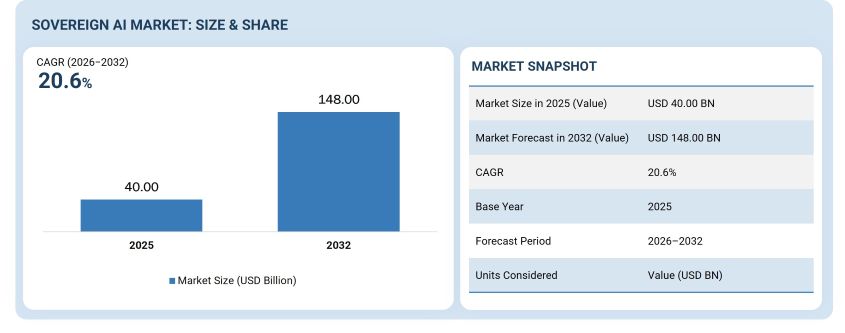
The global sovereign AI market was valued at approximately USD 40.0 billion in 2025 and is projected to reach USD 148.0 billion by 2032, registering a compound annual growth rate (CAGR) of 20.6% from 2026 to 2032. This accelerating momentum is driven by a fundamental reorientation in how governments and enterprises think about artificial intelligence — not merely as a productivity tool, but as a strategic national asset requiring domestic control over data, models, infrastructure, and governance. From the European Union's push for AI sovereignty under its AI Act to India's National AI Mission and the Gulf states' multi-billion-dollar sovereign AI investments, the imperative to own rather than simply consume AI is reshaping procurement, infrastructure build-out, and geopolitical strategy on every continent.
Asia Pacific is the fastest-growing region, propelled by China's domestic AI model ecosystem, India's ambitious national AI Mission, and aggressive sovereign AI build-outs across Southeast Asia and the Gulf. North America holds the largest base, anchored by hyperscale AI infrastructure, extensive federal AI programs, and the concentration of leading foundation-model providers in the United States. Europe occupies the second position by value, shaped by regulation-driven sovereign cloud adoption and robust enterprise AI digitalization across Germany, France, and the UK.
Top 10 Key Takeaways
- North America is the largest regional market, underpinned by the United States' dominant AI infrastructure footprint, hyperscale data center concentration, and the world's most dense ecosystem of foundation-model providers.
- Asia Pacific is the fastest-growing region, led by China's state-directed AI ecosystem, India's National AI Mission, and sovereign AI infrastructure investments across the UAE, Saudi Arabia, and Southeast Asia.
- The hardware segment — encompassing AI accelerators, GPUs, and sovereign data center infrastructure — holds the dominant share within the component segmentation, reflecting the capital-intensive nature of building nationally sovereign AI compute capacity.
- Large Language Models and Generative AI are the leading and fastest-growing technology sub-segments, as governments race to develop domestically trained foundation models that reflect national languages, culture, and regulatory requirements.
- The government and public sector is the leading end-user vertical, as national administrations prioritize AI-enabled services, defense intelligence, and digital public infrastructure under sovereign control.
- The EU AI Act, US AI executive orders, chip export controls, and data localization mandates across APAC are the primary regulatory forces reshaping procurement and deployment strategies for sovereign AI solutions.
- NVIDIA, Microsoft, AWS, Google, IBM, Oracle, Huawei, Alibaba Cloud, G42, and Mistral AI are among the leading players, each pursuing distinct strategies that range from hardware dominance to sovereign cloud partnerships and open-weight model licensing.
- The shift from hyperscale dependence to hybrid sovereign cloud models — combining domestic compute with regulated, auditable cloud environments — represents the near-term structural opportunity for infrastructure vendors and managed service providers.
- Talent scarcity, elevated capital expenditure for national AI data centers, and geopolitical fragmentation of the semiconductor supply chain are the most significant near-term risks to the market's growth trajectory.
- For enterprises, the strategic implication is unambiguous: procurement and deployment of AI solutions must increasingly account for data residency, model provenance, and regulatory compliance requirements that vary by jurisdiction and will intensify through 2032.
Why Sovereign AI Is the Defining Technology Story of This Decade
For much of the last decade, AI has been discussed primarily through the lens of corporate efficiency, consumer applications, and research breakthroughs. That frame has now shifted decisively. Governments across every major economy have come to regard AI capabilities — the ability to train, deploy, and govern advanced AI systems on domestically controlled infrastructure — as a dimension of national competitiveness as fundamental as energy security or semiconductor manufacturing. The term "sovereign AI" has moved from think-tank vocabulary into the language of heads of state, defense ministries, and central bank governors.
The macro context accelerating this shift is threefold. First, the generative AI revolution catalyzed by the release of ChatGPT in late 2022 demonstrated with startling clarity how quickly AI systems could achieve strategic influence — and how much of that capability resided in the hands of a handful of US-headquartered hyperscalers. Second, geopolitical tensions, particularly US-China chip export controls and the broader technological decoupling narrative, have underscored the fragility of global AI supply chains. Third, sweeping regulatory developments — from the EU AI Act to India's Digital Personal Data Protection Act — are mandating data residency, model auditability, and algorithmic accountability in ways that make reliance on foreign AI platforms operationally and legally untenable for an expanding range of use cases.
Together, these forces have created a structural and growing market for AI systems, platforms, and infrastructure that operate under national or regional sovereign control. This is not a niche or transitional market; it is the architecture of how AI will be deployed in government, defense, critical national infrastructure, healthcare, and financial services through the remainder of this decade and well beyond.
Sovereign AI Market Trends
The most consequential trend shaping the sovereign AI market is the rapid multiplication of national AI strategies that explicitly mandate domestic capability development. By mid-2025, more than 60 countries have published formal national AI strategies, and a growing subset — including France, India, the UAE, Saudi Arabia, Japan, and South Korea — have backed these strategies with dedicated sovereign AI compute investments, state-funded model development initiatives, and preferential procurement policies for domestically produced AI solutions.
Closely related is the emergence of sovereign foundation models — large-scale AI models trained on domestically curated datasets, in national languages, and on nationally controlled infrastructure. France's Mistral AI, the UAE's Falcon series from the Technology Innovation Institute, and India's BharatGen initiative represent different models of sovereign foundation-model development, whether through private venture-backed companies, state research institutions, or public-private partnerships. The common thread is the desire to move the locus of AI training, fine-tuning, and inference from foreign hyperscaler platforms to domestically accountable entities.
AI data center infrastructure is experiencing a parallel sovereign build-out wave. Governments that previously relied on hyperscale cloud providers to host sensitive workloads are now either mandating sovereign cloud environments — certified, audited infrastructure operated by domestic entities — or investing directly in national AI compute clusters. NVIDIA's role in sovereign AI is illustrative: the company has announced dedicated sovereign AI hardware programs with multiple national governments, providing GPU cluster infrastructure for state-owned or state-affiliated AI build-outs in countries from France to Indonesia to Saudi Arabia.
On the software and platform side, the rise of managed sovereign AI platforms — delivered by both domestic providers and the international hyperscalers through localized sovereign cloud variants — is enabling a faster on-ramp for government and enterprise adoption. Microsoft's Azure Government, AWS GovCloud, Oracle Cloud for Government, and equivalent offerings from national providers represent a growing portfolio of compliant, regulated AI environments. The trend toward open-weight models — including Meta's Llama series and Mistral's open models — is also significant, as it enables countries with domestic compute capacity to fine-tune and deploy powerful foundation models without ongoing dependency on foreign APIs.
Sovereign AI Market Drivers
The most powerful driver of the sovereign AI market is the convergence of data sovereignty legislation and AI deployment requirements at the enterprise and government levels. Regulations such as the EU AI Act, India's Digital Personal Data Protection Act, Saudi Arabia's Personal Data Protection Law, and the US Executive Order on Safe, Secure, and Trustworthy AI are creating compliance imperatives that make domestically controlled AI deployment not merely preferable but legally required for an expanding set of use cases. Each new regulatory requirement creates a quantifiable procurement event — a decision by a government ministry, a financial institution, or a healthcare provider to replace or augment foreign AI services with sovereign-compliant alternatives.
Geopolitical tensions and the associated risk of supply chain disruption are a second structural driver. The US Commerce Department's progressive tightening of semiconductor export controls — restricting access to advanced AI chips for certain countries — has accelerated domestic AI chip development programs in China and incentivized other nations to reduce their exposure to any single supplier. This has triggered new investment in domestic semiconductor fabrication, alternative AI accelerator architectures, and edge AI hardware platforms. The strategic logic is clear: a country whose AI capability depends entirely on imported hardware and foreign software is strategically vulnerable in a world of intensifying technological nationalism.
Defense and national security applications represent a third and increasingly prominent driver. Military intelligence, autonomous systems, surveillance and reconnaissance, cyber defense, and logistics optimization all depend on AI capabilities that cannot practically run on infrastructure operated by a foreign commercial entity. The defense imperative is driving dedicated sovereign AI investment in NATO member states, in the Indo-Pacific security architecture, and in Gulf state military modernization programs. This is a high-value, low-elasticity demand driver that underpins a growing share of sovereign AI hardware and software procurement.
Finally, the economic competitiveness argument is gaining political salience. Leaders in the EU, India, and Southeast Asia have argued persuasively that allowing all AI value to accrue to a handful of US and Chinese hyperscalers represents a long-term economic loss — a digital dependency analogous to energy dependency. Building domestic AI capability, from data annotation and training infrastructure to model development and AI-native applications, is increasingly framed as industrial policy. This framing unlocks government budget flows that have historically been unavailable to technology infrastructure investment.
Sovereign AI Market Challenges and Restraints
The sovereign AI market faces a fundamental tension between the ambition of national AI independence and the practical realities of building AI capability at scale. Training frontier AI models requires vast quantities of high-quality data, enormous compute capacity, and rare AI engineering talent — resources that are distributed unevenly across geographies. For smaller economies, the cost of achieving genuine AI sovereignty at the frontier is prohibitive, forcing a choice between purchasing foreign AI capabilities under localization constraints or accepting a significant capability gap relative to leading AI nations.
Capital expenditure intensity is among the most significant restraints. A sovereign AI data center capable of training and deploying frontier-scale models requires investment measured in hundreds of millions to billions of dollars — in infrastructure, power, cooling, networking, and specialized hardware. For many emerging market governments with competing fiscal priorities, this creates a structural affordability barrier. Even where funding is available through sovereign wealth funds or development finance, the lead time for AI infrastructure build-out — typically 18 to 36 months from planning to commissioning — mean that sovereign AI capabilities lag the global frontier throughout the deployment cycle.
Talent scarcity is a persistent and deepening constraint. The global pool of engineers capable of training large-scale AI models, building AI infrastructure, and integrating sovereign AI platforms into government workflows is small and heavily concentrated in the United States, the UK, and China. Countries seeking to build domestic AI capability face intense competition for this talent against hyperscaler and technology firm compensation packages that most public-sector and domestic enterprise employers cannot match. Brain drain from high-ambition sovereign AI programs to foreign employers remains a structural risk.
Interoperability and standards fragmentation represent a longer-term challenge. As multiple sovereign AI ecosystems develop — each with distinct data formats, model architectures, API standards, and compliance frameworks — the cost of cross-border AI collaboration and procurement increases. For global enterprises operating across multiple regulated jurisdictions, managing a portfolio of sovereign-compliant AI deployments adds operational complexity and cost that may dampen adoption rates outside the core government and defense verticals.
Sovereign AI Market — Industry and Application Growth
The government and public sector is the primary demand engine for sovereign AI, and the breadth of government AI applications is expanding rapidly. E-government services — AI-powered citizen interactions, document processing, regulatory compliance, and benefits administration — represent the high-volume, immediate adoption opportunity. At the more strategically sensitive end, AI applications in tax administration, border security, judicial decision support, and public health surveillance are driving procurement of sovereign AI platforms that meet stringent auditability and data residency requirements. Countries including Estonia, Singapore, and the UAE have become reference implementations for government-scale sovereign AI deployment, informing procurement decisions globally.
The defense and intelligence vertical is growing fastest in absolute value terms, reflecting both the strategic priority assigned to defense AI programs and the fundamental incompatibility of defense workloads with foreign-hosted cloud infrastructure. Programs spanning autonomous systems, signals intelligence, battlefield logistics, cyber offense and defense, and predictive maintenance of military assets are being funded at pace across NATO members and Indo-Pacific partners. The US Department of Defense's AI initiatives, the UK's AI for Defence program, France's AI defense strategy, and equivalent programs in India, Australia, and Japan represent a structural and durable demand base.
Financial services and banking represent a commercially significant and rapidly growing vertical. Central banks and sovereign wealth funds — by definition nationally operated entities — are among the earliest and most sophisticated adopters of sovereign AI platforms for risk modeling, fraud detection, portfolio analytics, and regulatory reporting. Commercial banks in heavily regulated markets such as the EU, India, and the Gulf are subject to data residency requirements and financial services regulations that effectively mandate sovereign AI deployment for core analytics workloads.
Healthcare and life sciences present a compelling sovereign AI use case driven by the sensitivity of patient data, the complexity of health system regulation, and the strategic importance of domestic pharmaceutical and biomedical research capability. National genomics programs, AI-assisted diagnostic platforms, drug discovery compute, and health system optimization tools all require AI infrastructure that meets national data protection standards. The COVID-19 pandemic demonstrated both the strategic value of domestically controlled health AI and the risks of data dependency on foreign platforms, accelerating investment across Europe, Asia Pacific, and the Gulf.
The telecommunications sector occupies a distinctive position in the sovereign AI market. Network operators — most of which are either state-owned or subject to national security obligations — are deploying AI for network optimization, predictive maintenance, 5G/6G automation, and cybersecurity. More strategically, telecom infrastructure is increasingly regarded as AI infrastructure, with AI processing pushed to the network edge. Countries with domestic telecom champions, particularly China, South Korea, and several Gulf states, are leveraging their network operators as anchors for sovereign AI deployment at national scale.
Sovereign AI Market Segment Insights
By Component
Hardware commands the leading share of sovereign AI spending, reflecting the capital-intensive nature of building nationally sovereign AI compute infrastructure. The demand for AI accelerators — principally high-performance GPUs and, increasingly, purpose-built AI chips from domestic or allied suppliers — is the largest single line item in sovereign AI infrastructure budgets. Sovereign AI data center construction, encompassing power systems, cooling infrastructure, high-speed networking, and storage, adds further hardware expenditure. The concentration of hardware spend is expected to moderate slightly as software and services scale up, but hardware will retain the largest component share throughout the forecast period.
Within components, professional and managed services are emerging as the fastest-growing segment. Governments and enterprises building sovereign AI capability lack in-house expertise across the full stack — from data center operations and GPU cluster management to AI platform configuration, model fine-tuning, and AI application development. This skills gap is creating durable demand for system integration, consulting, training, and ongoing managed services. The services segment also benefits from the recurring revenue dynamic: once a government or enterprise sovereign AI platform is deployed, ongoing management, optimization, and evolution generate multi-year service engagements.
By Deployment Mode
Sovereign cloud deployment — regulated, auditable cloud environments operated by domestic entities or by international hyperscalers under nationally certified frameworks — leads the deployment mode segmentation. Sovereign cloud has emerged as the pragmatic bridge between the aspiration for AI autonomy and the operational reality that most governments and enterprises lack the capability to operate national AI infrastructure independently. International providers including Microsoft, AWS, Oracle, and Google have each developed dedicated sovereign cloud offerings for European, Middle Eastern, and Asia Pacific markets, competing with domestic alternatives from national providers.
On-premises national AI infrastructure is the fastest-growing deployment mode in absolute terms, driven by defense applications, critical national infrastructure requirements, and the most sensitive government workloads where any cloud dependency — even a sovereign-certified cloud — is deemed unacceptable. State-funded national AI supercomputer programs in France, Germany, India, Japan, and Saudi Arabia are emblematic of this trend. These facilities represent a commitment to genuine, deep AI sovereignty — training, inference, and data storage under complete national control — and are driving significant procurement of GPU clusters and associated infrastructure.
By Technology
Large Language Models and Generative AI are the dominant technology focus of sovereign AI investment. The transformative capability of LLMs — for language translation, document processing, code generation, question-answering, and decision support — makes them the most strategically relevant AI technology for government applications. The proliferation of open-weight LLMs has significantly lowered the barrier to sovereign deployment, as countries with domestic compute capacity can now fine-tune capable foundation models on national datasets without training from scratch.
Edge AI and Embedded AI are the fastest-growing technology sub-segments within the sovereign AI market, reflecting the push to deploy AI capabilities at the periphery of national digital infrastructure — in smart city sensors, border control systems, defense platforms, and industrial automation. Edge AI eliminates the latency, bandwidth, and data sovereignty challenges associated with cloud-dependent AI inference, and is particularly critical for defense and critical infrastructure applications where real-time response is required and network connectivity cannot be assumed.
By End-User Industry
The government and public sector is the largest end-user, encompassing national AI strategy implementation, digital public services, regulatory AI, tax and customs automation, and defense intelligence. The sheer breadth of government AI use cases — combined with the non-negotiable data sovereignty requirements of government workloads — makes this vertical the structural anchor of the sovereign AI market.
Defense and intelligence applications are growing fastest among end-users, driven by the combination of large and growing defense budgets, the high strategic value of AI capability in military contexts, and the absolute incompatibility of defense AI workloads with foreign-operated cloud infrastructure. Every major military power is investing in domestic sovereign AI capability for defense applications, and a growing number of middle-power militaries are following suit.
Segment Insights: Key Summary
- Hardware (AI accelerators, GPU clusters, sovereign data center infrastructure) holds the leading component share, driven by capital-intensive national AI compute build-outs.
- Professional and managed services are the fastest-growing component segment as governments and enterprises outsource AI platform management and integration expertise.
- Sovereign cloud is the most widely adopted deployment mode, serving as the practical bridge between AI autonomy ambitions and operational capability gaps.
- LLMs and Generative AI are the dominant technology focus, underpinned by the proliferation of open-weight models that enable sovereign fine-tuning on national datasets.
- Government and public sector leads end-user demand; defense and intelligence is the fastest-growing vertical, sustained by expanding military AI programs across NATO and Indo-Pacific partners.
Sovereign AI Market — Regional Analysis
North America
North America is the largest sovereign AI market globally, anchored by the United States, which hosts the world's highest concentration of foundation-model providers, AI infrastructure hyperscalers, and federal AI programs. The region was valued at approximately USD 14.8 billion in 2025 and is projected to reach USD 52.1 billion by 2032, growing at a CAGR of 19.7%. US federal AI spending is being channeled through agencies including the Department of Defense, the National Security Agency, the Department of Homeland Security, and the newly consolidated AI safety and oversight bodies mandated by the Biden-era AI Executive Order — a framework that the subsequent administration has maintained in substance even while adjusting certain provisions. The National AI Initiative Act and associated appropriations have created sustained budget flows for sovereign AI R&D, AI infrastructure, and AI talent development.
Canada's sovereign AI position is underpinned by its national AI strategy, the Pan-Canadian Artificial Intelligence Strategy, and its three world-class AI research institutes — the Vector Institute in Toronto, Mila in Montreal, and the Alberta Machine Intelligence Institute. Federal investment in sovereign AI infrastructure, including the AI Compute Access Fund, is ensuring that Canada's research excellence translates into domestic deployment capability. Mexico is at an earlier stage of sovereign AI development but is benefiting from proximity to US AI investment flows and is building domestic AI capability in manufacturing automation, financial inclusion, and agricultural AI.
Europe
Europe's sovereign AI market, valued at approximately USD 9.3 billion in 2025 and projected to reach USD 32.6 billion by 2032 at a CAGR of 19.6%, is distinctively shaped by regulatory intensity. The EU AI Act — the world's first comprehensive legal framework for AI — is the single most consequential regulatory development in the global sovereign AI market, creating compliance requirements that make sovereign AI deployment mandatory for high-risk applications in biometrics, critical infrastructure, education, employment, and law enforcement across the 27-member bloc. Germany, France, the UK, Italy, and Spain are the five largest European sovereign AI markets.
Germany's sovereign AI positioning is anchored in its industrial AI programs — the national AI strategy, the AI-Innovation-Competitions, and Gaia-X, the European data infrastructure initiative that aims to give European enterprises sovereignty over their data and the AI systems that process it. France has emerged as the most prominent European sovereign AI nation, with President Macron's explicit commitment to making France an AI leader and the global success of Mistral AI as a European open-weight foundation model provider. The UK, while post-Brexit and therefore outside the EU AI Act, is developing its own sovereign AI framework through the AI Safety Institute and significant National Cyber Security Centre AI investment.
Asia Pacific
Asia Pacific is the fastest-growing sovereign AI region globally, valued at approximately USD 11.2 billion in 2025 and forecast to reach USD 46.5 billion by 2032, representing a CAGR of 22.6%. China leads the region in AI capability and investment volume, with its New Generation Artificial Intelligence Development Plan driving the build-out of domestic AI infrastructure, the development of Chinese-language foundation models including Baidu's ERNIE series and Alibaba's Tongyi Qianwen, and the creation of a regulatory framework that explicitly mandates data localization and algorithmic accountability for AI systems deployed in China.
India's sovereign AI ambitions are crystallized in the IndiaAI Mission, launched in 2024 with a government commitment exceeding USD 1 billion over five years, covering AI compute infrastructure, domestic model development, AI application in government services, and AI skilling. Japan's AI strategy positions the country as a global hub for AI research and deployment, leveraging its robotics heritage and semiconductor supply chain position. South Korea's AI semiconductor programs — including domestic AI chip development by Samsung and SK Hynix — represent an attempt to build hardware sovereignty at the component level. Singapore and Australia are building smaller but highly capable sovereign AI ecosystems, serving as regional reference models for smaller economies.
Rest of World
The Rest of World region, valued at approximately USD 4.7 billion in 2025 and projected to reach USD 16.8 billion by 2032 at a CAGR of 19.9%, is primarily driven by the Gulf states, particularly the UAE and Saudi Arabia, where sovereign AI has become a central pillar of economic diversification strategy. The UAE's AI Strategy 2031, G42's national AI infrastructure program, and Abu Dhabi's Technology Innovation Institute — which developed the Falcon LLM series — collectively represent one of the most sophisticated and well-funded sovereign AI ecosystems outside the major powers. Saudi Arabia's NEOM and Vision 2030 programs are driving multi-billion-dollar sovereign AI infrastructure investment.
South America's sovereign AI market is anchored by Brazil, which has published a national AI strategy and is investing in AI infrastructure as part of its digital transformation agenda. Colombia, Chile, and Argentina are at earlier stages of sovereign AI capability development, primarily focused on AI governance frameworks and digital public service AI applications. Africa's sovereign AI market is nascent but strategically significant — South Africa, Kenya, Nigeria, and Egypt are developing national AI strategies and engaging with international partners to build AI capability without creating new forms of technological dependency.
Regional Outlook: Key Summary
- North America holds the largest regional market share, sustained by the US federal AI investment ecosystem, the concentration of leading AI companies, and defense AI programs.
- Asia Pacific is the fastest-growing region, with China's domestic AI ecosystem and India's National AI Mission providing the primary growth momentum alongside Gulf state investments.
- Europe's growth is regulation-led, with EU AI Act compliance requirements and the Gaia-X initiative driving structured demand for sovereign AI platforms across the bloc.
- The Gulf states — particularly UAE and Saudi Arabia — are the most significant sovereign AI investors in the Rest of World region, with state-backed sovereign AI programs at national scale.
- Latin America and Africa represent emerging market opportunities with longer-horizon growth potential, primarily in public sector AI and digital public infrastructure applications.
Sovereign AI Market — Country-Specific Insights
The United States remains the global epicenter of sovereign AI capability, hosting not only the leading commercial AI providers — OpenAI, Anthropic, Google DeepMind, Meta AI — but also the most extensive federal AI procurement ecosystem. US government AI spending spans defense (DARPA AI Next, DoD JADC2), intelligence community AI programs, civilian agency AI modernization, and the National AI Research Resource (NAIRR) pilot, which provides AI compute access to researchers and institutions to build the human capital pipeline for sovereign AI. The US approach to sovereignty is distinctive: rather than state ownership of AI capability, it relies on a combination of national security mandates, export controls, and procurement requirements to shape how AI is developed and deployed.
China's approach to sovereign AI is state-directed and comprehensive. The country has invested across the full AI stack — from domestic AI chip development by companies including Cambricon, Huawei HiSilicon, and Moore Threads, through foundation model development, AI application deployment, and AI governance regulation. China's AI governance framework — including regulations on generative AI services, algorithm recommendations, and deepfakes — creates a sovereign AI regulatory perimeter that shapes all AI deployment within China and increasingly influences other countries' regulatory approaches.
India's sovereign AI story is one of rapid acceleration from aspiration to implementation. The IndiaAI Mission's compute infrastructure pillar is creating a shared national AI compute cluster available to Indian startups, researchers, and government agencies, addressing the capital cost barrier that has historically limited domestic AI training capability. India's linguistic diversity — with 22 officially recognized languages and hundreds of regional languages — creates a compelling use case for domestic LLM development, as English-trained foreign models are inadequate for the full range of Indian government and enterprise AI applications.
The UAE's position in the sovereign AI landscape is disproportionate to its size. G42's global AI infrastructure investments, TII's open-weight Falcon models, and the UAE's hosting of the UN Secretary-General's AI advisory body and EXPO-linked AI initiatives give it substantial influence over sovereign AI norms and practices. Abu Dhabi's Masdar City is being developed as an AI and sustainability research hub with sovereign AI infrastructure at its core. The UAE's AI talent recruitment — drawing experts from across Europe, Asia, and North America with competitive compensation packages — represents a distinctive approach to building sovereign AI human capital.
Country-Level Conclusions: Key Summary
- The US federal AI ecosystem — spanning defense, intelligence, and civilian agency AI programs — is the largest single sovereign AI demand pool globally, with procurement requirements that shape global AI vendor strategies.
- China's state-directed sovereign AI approach, encompassing domestic chips, domestic models, and comprehensive AI regulation, sets the template for AI decoupling and is accelerating sovereign AI investment globally as other nations respond.
- India's IndiaAI Mission represents the most ambitious developing-economy sovereign AI program, combining compute investment, domestic model development, and AI skill-building at a scale that will generate significant market activity through 2032.
- The UAE has established itself as a disproportionate sovereign AI influence center through open-weight model development, global AI governance engagement, and state-backed AI infrastructure investment.
- European countries, especially France and Germany, are navigating the tension between EU AI Act compliance obligations and the ambition to develop domestically competitive AI champions, creating a complex but high-value procurement environment for sovereign AI vendors.
Sovereign AI Market — Key Company Insights
The sovereign AI market features a diverse competitive landscape, spanning global technology giants that have developed sovereign-specific products and partnerships, domestic AI champions in major markets, and specialist AI infrastructure and foundation-model companies. The leading players include NVIDIA Corporation, Microsoft Corporation, Amazon Web Services, Google (Alphabet), IBM Corporation, Oracle Corporation, Alibaba Cloud, Huawei Technologies, SAP SE, Atos SE, G42, Mistral AI, SambaNova Systems, Cerebras Systems, and Hewlett Packard Enterprise.
- NVIDIA Corporation
- Microsoft Corporation
- Amazon Web Services (AWS)
- Google (Alphabet Inc.)
- IBM Corporation
- Oracle Corporation
- Alibaba Cloud
- Huawei Technologies
- SAP SE
- Atos SE
- G42 (Technology Holding LLC)
- Mistral AI
- SambaNova Systems
- Cerebras Systems
- Hewlett Packard Enterprise (HPE)
NVIDIA's sovereign AI strategy is arguably the most explicit and commercially impactful in the market. The company has entered into dedicated sovereign AI programs with national governments — providing GPU cluster infrastructure for national AI compute facilities — and has positioned its DGX SuperPOD and Grace Blackwell platform as the reference architecture for sovereign AI supercomputers. CEO Jensen Huang has articulated the sovereign AI concept in public forums, effectively creating a market category that NVIDIA hardware anchors.
Microsoft's sovereign AI positioning centers on its Azure Government and Azure Sovereign Cloud offerings, which provide dedicated, physically isolated cloud infrastructure meeting national compliance requirements. Microsoft's partnership with Mistral AI, its investment in OpenAI, and its CoPilot for Government products give it a comprehensive sovereign AI software portfolio to complement its infrastructure. AWS competes directly through GovCloud regions in the US and equivalent sovereign-certified regions in Europe and the Middle East, and is investing in sovereign AI partnerships with national telecoms and system integrators globally.
Mistral AI, the Paris-headquartered open-weight LLM company, has emerged as a distinctively European sovereign AI champion. Its open-weight models — including Mistral 7B, Mixtral, and the Mistral Large series — are being used by governments and enterprises across Europe and beyond for sovereign AI deployments where data cannot leave national infrastructure. G42, the Abu Dhabi-based AI holding company, is the most prominent sovereign AI company outside the traditional tech powers, combining national AI infrastructure, sovereign data services, and a global partnership portfolio that includes Microsoft (a direct investment partner).
Key Company Strategies: Summary
- NVIDIA is building sovereign AI as a hardware category, anchoring national AI compute programs with dedicated GPU cluster infrastructure and positioning itself as the indispensable partner for any country building national AI capability at scale.
- Hyperscalers (Microsoft, AWS, Google, Oracle) are competing for sovereign AI workloads through dedicated sovereign cloud products — physically isolated, nationally certified cloud environments that meet data residency and compliance requirements without requiring fully on-premises deployment.
- Open-weight model providers, led by Mistral AI and Meta (Llama), are enabling sovereign AI deployments in countries with domestic compute capacity, offering a licensing model that eliminates API dependency on foreign AI providers.
- Gulf state AI companies, particularly G42, are pursuing an aggressive global partnership and investment strategy to position themselves as sovereign AI platform providers for emerging market governments seeking a non-US, non-Chinese AI partner.
- Specialist AI hardware companies including SambaNova Systems and Cerebras Systems are competing with NVIDIA at the sovereign AI infrastructure layer, offering alternative AI accelerator architectures that reduce single-vendor dependency for sovereign AI compute.
Sovereign AI Market — Recent Developments
- In January 2025, NVIDIA CEO Jensen Huang announced expanded sovereign AI partnerships with France, Germany, India, Japan, and Singapore, committing GPU infrastructure for national AI supercomputer programs in each country as part of NVIDIA's dedicated sovereign AI initiative.
- In March 2025, the UAE's G42 and Microsoft deepened their partnership through a USD 1.5 billion Microsoft investment in G42, with explicit commitments to develop sovereign AI infrastructure in the UAE and expand jointly developed AI services across the Middle East and Africa.
- In February 2025, the Indian government officially launched the AI compute infrastructure component of the IndiaAI Mission, approving ten thousand GPUs for a shared national AI compute facility accessible to Indian startups, academic institutions, and government agencies.
- In October 2024, Mistral AI released Mistral Large 2, a frontier-class open-weight model, and signed agreements with multiple European government agencies to provide sovereign AI deployment packages compliant with the EU AI Act's requirements for high-risk AI systems.
- In December 2024, Saudi Arabia's NEOM project announced a dedicated sovereign AI data center campus with a planned compute capacity designed to support the country's Vision 2030 AI ambitions and the development of Arabic-language foundation models.
Sovereign AI — Real-World Use Cases
In 2024, France's Ministry of the Interior deployed a sovereign AI platform built on Mistral AI's open-weight models and hosted on OVHcloud's sovereign infrastructure to process and analyze immigration documentation, legal correspondence, and administrative workflows. The deployment was specifically designed to comply with the EU AI Act's high-risk AI system requirements, including full auditability, human oversight mechanisms, and data residency within French national borders. The Ministry cited both regulatory compliance and processing efficiency improvements as key outcomes of the deployment.
In 2023 and continuing through 2025, the Abu Dhabi government deployed G42's sovereign AI platform across multiple government ministries for services including citizen inquiry management, document classification, and predictive analytics for public service demand planning. The platform runs on G42-operated infrastructure within Abu Dhabi, meeting the UAE's data sovereignty requirements, and incorporates the Falcon foundation model — developed by the Technology Innovation Institute — as its core language AI engine. The deployment has been cited by UAE officials as a demonstration that an Arabic-language sovereign AI platform can match the performance of English-language commercial AI services for government applications.
Sovereign AI Market Segmentation
The sovereign AI market is segmented along five primary axes: component, deployment mode, technology, end-user industry, and geography. The component dimension distinguishes between the hardware layer — AI accelerators, GPU clusters, and the physical infrastructure of sovereign AI data centers — the software layer, encompassing AI platforms, MLOps tools, and foundation model frameworks, and the services layer, which covers professional services, system integration, managed services, and training and support. Hardware currently dominates component spending, but software and services are growing at a faster pace as the market matures and countries shift from infrastructure build-out to operational deployment and optimization.
The deployment mode segmentation reflects the spectrum of sovereignty intensity: fully on-premises national AI infrastructure at one end, sovereign cloud environments (certified, audited, domestically operated or operationally isolated) in the middle, and hybrid deployments combining both for different workload sensitivity levels. The technology segmentation maps to the AI capability stack: LLMs and Generative AI, Computer Vision, NLP, Edge AI, and Embedded AI. The end-user industry segmentation spans government and public sector, defense and intelligence, healthcare and life sciences, financial services and banking, energy and utilities, telecommunications, and manufacturing and industrial. Each vertical presents distinct regulatory profiles, data sensitivity requirements, and adoption maturity levels that shape sovereign AI procurement and deployment patterns.
The regional segmentation, covered in depth in the Regional Analysis section, distinguishes between North America, Europe, Asia Pacific, and Rest of World. Within each region, country-level variation is significant — the approach to sovereign AI in Germany differs structurally from France's within Europe, just as India's model differs from China's within Asia Pacific. Understanding this sub-regional heterogeneity is essential for vendors, investors, and policymakers seeking to navigate the sovereign AI market effectively.
Market Segmentation: Key Summary
- Hardware leads component spending but will face a rising share from services as sovereign AI deployments shift from build-out to managed operation and continuous optimization.
- Sovereign cloud is the dominant deployment mode by adoption rate; on-premises national AI infrastructure is the fastest-growing by investment value.
- LLMs and Generative AI dominate technology investment; Edge AI is the fastest-growing technology sub-segment driven by defense and critical infrastructure applications.
- Government and public sector is the largest end-user vertical by spend; defense and intelligence is the fastest-growing vertical driven by military AI program escalation.
- Regional heterogeneity is high — sovereign AI strategy, regulatory environment, and procurement model differ substantially between and within regions, requiring tailored market entry and partnership strategies.
Conclusion and Future Outlook
The sovereign AI market is transitioning from a largely aspirational policy construct into a substantial and structurally distinct commercial market. By the end of the forecast period, the combination of AI regulatory enforcement, defense AI program scale-up, and enterprise AI compliance requirements will have made sovereign AI deployment the default mode — rather than the exception — for AI applications in government, defense, critical infrastructure, financial services, and healthcare across the major global economies. The market's growth will be amplified by the continued proliferation of open-weight foundation models, which are progressively closing the capability gap between sovereign deployments and hyperscaler-dependent AI services.
The role of AI itself in shaping the sovereign AI market through 2032 is recursive and accelerating. Advances in AI efficiency — smaller models with comparable capability, more energy-efficient AI accelerator architectures, and improved fine-tuning techniques — are progressively reducing the capital and talent thresholds required to build effective sovereign AI capability. This democratization of AI is expanding the addressable sovereign AI market beyond the major powers to include a much wider range of emerging market governments and enterprises. At the same time, advances in Generative AI are driving new use cases in government services, healthcare, and industrial applications that will create fresh procurement waves throughout the forecast period. For businesses, investors, and governments assessing their strategic position in this market, the imperative is clear: sovereign AI is not a passing geopolitical trend — it is the structural architecture of AI for the balance of this decade.
FAQ: Sovereign AI Market
1. How big is the sovereign AI market?
The global sovereign AI market was valued at approximately USD 40.0 billion in 2025 and is projected to reach USD 148.0 billion by 2032. This represents one of the fastest-growing segments within the broader artificial intelligence market, reflecting the escalating strategic priority that governments and enterprises are assigning to domestically controlled AI capabilities.
2. What is the sovereign AI market growth rate?
The sovereign AI market is projected to grow at a CAGR of 20.6% from 2026 to 2032. Asia Pacific is the fastest-growing regional market, registering a CAGR of 22.6% over the same period, driven by China's domestic AI ecosystem build-out, India's National AI Mission, and Gulf state sovereign AI infrastructure investments.
3. Which segment leads the sovereign AI market?
The government and public sector is the leading end-user segment, reflecting the non-negotiable data sovereignty requirements of government workloads and the breadth of public-sector AI application across digital services, regulatory compliance, and defense intelligence. Within the component dimension, hardware — particularly AI accelerators and sovereign data center infrastructure — commands the largest share.
4. Who are the key players in the sovereign AI market?
The leading players in the sovereign AI market include NVIDIA Corporation, Microsoft Corporation, Amazon Web Services, Google (Alphabet Inc.), IBM Corporation, Oracle Corporation, Alibaba Cloud, Huawei Technologies, SAP SE, Atos SE, G42, Mistral AI, SambaNova Systems, Cerebras Systems, and Hewlett Packard Enterprise. These companies collectively span the full sovereign AI stack from hardware infrastructure to foundation models and managed services.
5. What are the key drivers of the sovereign AI market?
The primary drivers of the sovereign AI market are: (1) data sovereignty legislation and AI compliance mandates creating procurement requirements for domestically controlled AI platforms; (2) geopolitical tensions and semiconductor export controls accelerating domestic AI capability development; (3) defense and national security AI programs requiring infrastructure independence from foreign platforms; and (4) the economic competitiveness imperative driving industrial policy investment in national AI capability.
Speak with a MarketsandMarkets Analyst
MarketsandMarkets provides in-depth, segment-level intelligence on the sovereign AI market — covering granular country-level sizing, competitive benchmarking, vendor right-to-win analysis, and regulatory impact assessment across all major geographies. Whether you are a technology vendor developing your sovereign AI go-to-market strategy, an investor assessing the competitive landscape, or a government agency benchmarking international sovereign AI approaches, our analysts can help you navigate the complexity. Request a sample report, customize the research scope to your specific geographies or verticals, or speak directly with our sovereign AI practice lead to explore how our intelligence can inform your strategic decisions.
 Exclusive indicates content/data unique to MarketsandMarkets and not available with any competitors.
TABLE OF CONTENTS
1 Introduction
1.1 Study Objectives
1.2 Market Definition and Scope
1.3 Inclusions and Exclusions
1.4 Study Scope
1.4.1 Markets Covered
1.4.2 Geographic Segmentation
1.4.3 Years Considered
1.5 Currency Considered
1.6 Stakeholders
2 Research Methodology
2.1 Research Approach
2.2 Secondary Research
2.3 Primary Research
2.4 Market Size Estimation
2.4.1 Bottom-Up Approach
2.4.2 Top-Down Approach
2.5 Data Triangulation
2.6 Assumptions
3 Executive Summary
4 Premium Insights
5 Market Overview
5.1 Introduction
5.2 Market Dynamics
5.2.1 Drivers
5.2.2 Restraints
5.2.3 Opportunities
5.2.4 Challenges
5.3 Value Chain Analysis
5.4 Ecosystem Analysis
5.5 Investment & Funding Scenario
5.6 Pricing Analysis
5.7 Trends/Disruptions Impacting Customer Business
5.8 Technology Analysis
5.8.1 Key Technologies
5.8.2 Complementary Technologies
5.8.3 Adjacent Technologies
5.9 Porter's Five Forces Analysis
5.10 Key Stakeholders & Buying Criteria
5.11 Case Study Analysis
5.12 Patent Analysis
5.13 Key Conferences & Events
5.14 Regulatory Landscape
5.15 Impact of AI/Gen AI on the Sovereign AI Market
5.16 Impact of 2025 US Tariff Policies on the Sovereign AI Market
6 Industry Trends
6.1 Emergence of National AI Strategies and Sovereign AI Policies
6.2 Proliferation of Domestic AI Model Development
6.3 Sovereign AI Infrastructure Build-Out (GPU Clusters, AI Data Centers)
6.4 Data Localization and AI Sovereignty Regulations
6.5 Rise of Sovereign AI Clouds and Managed AI Platforms
6.6 Federated Learning and Privacy-Preserving AI Techniques
7 Strategic Disruption & Regulatory Landscape
7.1 Overview
7.2 National AI Legislation and Regulatory Frameworks
7.3 EU AI Act and Extraterritorial Impact on Sovereign AI
7.4 US Executive Orders on AI and Chip Export Controls
7.5 APAC Sovereign AI Regulations (India, China, Japan, UAE)
7.6 Cybersecurity, Data Residency, and Compliance Requirements
7.7 Strategic Implications for Enterprises and Governments
8 Customer Landscape & Buyer Behavior
8.1 Decision-Making Process for Sovereign AI Procurement
8.2 Buyer Stakeholders: Government, Enterprise, and Defense
8.3 Adoption Barriers
8.4 Vendor Evaluation Criteria
9 Sovereign AI Market, By Component
9.1 Introduction
9.2 Hardware (AI Accelerators, GPUs, Data Center Infrastructure)
9.3 Software (AI Platforms, Frameworks, MLOps Tools)
9.4 Services (Professional Services, Managed Services, Training & Support)
10 Sovereign AI Market, By Deployment Mode
10.1 Introduction
10.2 On-Premises (National AI Infrastructure)
10.3 Sovereign Cloud (Regulated Cloud Environments)
10.4 Hybrid Deployment
11 Sovereign AI Market, By Technology
11.1 Introduction
11.2 Large Language Models (LLMs) and Foundation Models
11.3 Computer Vision
11.4 Natural Language Processing (NLP)
11.5 Edge AI and Embedded AI
11.6 Generative AI
12 Sovereign AI Market, By End-User Industry
12.1 Introduction
12.2 Government and Public Sector
12.3 Defense and Intelligence
12.4 Healthcare and Life Sciences
12.5 Financial Services and Banking
12.6 Energy and Utilities
12.7 Telecommunications
12.8 Manufacturing and Industrial
13 Sovereign AI Market, By Region
13.1 Introduction
13.2 North America
13.2.1 United States
13.2.2 Canada
13.2.3 Mexico
13.3 Europe
13.3.1 Germany
13.3.2 United Kingdom
13.3.3 France
13.3.4 Italy
13.3.5 Spain
13.3.6 Nordics
13.3.7 Rest of Europe
13.4 Asia Pacific
13.4.1 China
13.4.2 Japan
13.4.3 India
13.4.4 South Korea
13.4.5 Australia
13.4.6 Singapore
13.4.7 Rest of Asia Pacific
13.5 Rest of World
13.5.1 Middle East (UAE, Saudi Arabia)
13.5.2 Latin America (Brazil, Others)
13.5.3 Africa (South Africa, Others)
14 Competitive Landscape
14.1 Overview
14.2 Key Player Strategies and Right to Win
14.3 Revenue Analysis of Key Players
14.4 Market Share Analysis
14.5 Company Evaluation Matrix – Key Players
14.5.1 Stars
14.5.2 Emerging Leaders
14.5.3 Pervasive Players
14.5.4 Participants
14.6 Company Evaluation Matrix – Startups/SMEs
14.6.1 Progressive Companies
14.6.2 Responsive Companies
14.6.3 Dynamic Companies
14.6.4 Starting Blocks
14.7 Competitive Benchmarking
14.8 Competitive Scenario
14.8.1 Product Launches (2023–2025)
14.8.2 Deals, Partnerships & Collaborations
14.8.3 Expansions & Investments
15 Company Profiles
15.1 NVIDIA Corporation
15.2 Microsoft Corporation
15.3 Amazon Web Services (AWS)
15.4 Google (Alphabet Inc.)
15.5 IBM Corporation
15.6 Oracle Corporation
15.7 Alibaba Cloud (Alibaba Group)
15.8 Huawei Technologies
15.9 SAP SE
15.10 Atos SE
15.11 G42 (Technology Holding LLC)
15.12 Mistral AI
15.13 SambaNova Systems
15.14 Cerebras Systems
15.15 Hewlett Packard Enterprise (HPE)
16 Appendix
16.1 Discussion Guide
16.2 KnowledgeStore
16.3 Customization Options
16.4 Related Reports
16.5 Author Details













Growth opportunities and latent adjacency in Sovereign AI Market