Uninterruptible Power Systems (UPS) Market by Type (Online/Double-Conversion, Line-Interactive, Offline/Standby, Modular/Scalable), Application, End User - Global Forecast to 2032


Uninterruptible Power Systems (UPS) Market to 2032: Size, Share & Growth Report
The global Uninterruptible Power Systems (UPS) market is projected to grow from USD 14.5 billion in 2026 to USD 24.5 billion by 2032, at a CAGR of approximately 9% during 2026–2032. Growth is driven by a concentrated wave of AI-specific UPS product launches from every leading vendor in 2025, accelerating lithium-ion battery adoption in higher-capacity systems, and vendor acquisitions and partnerships aimed at improving power density and efficiency for AI data centers.
- North America holds the largest market share, driven by the concentration of hyperscale AI data center campuses and the leading UPS vendors — Vertiv, Eaton, and Schneider Electric — with significant operations in the region.
- Asia Pacific is the fastest-growing region, propelled by rapid data center and digital infrastructure expansion, with mature hubs such as Singapore, Japan, and South Korea advancing modular and lithium-ion UPS integration.
- Online/double-conversion UPS leads by type revenue, providing the highest level of power protection for mission-critical data center loads; modular and scalable UPS is the fastest-growing type as operators favor flexible capacity expansion over fixed installations.
- Data centers (hyperscale, colocation, and cloud) dominate by application; edge computing and distributed IT are the fastest-growing application as compute moves closer to end users.
- IT and telecommunications lead end users; healthcare is the fastest-growing end-user category as digital health infrastructure and always-on clinical systems expand.
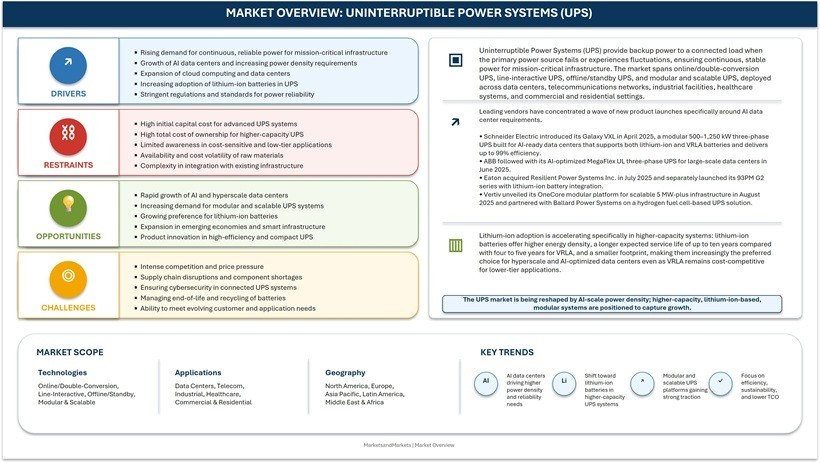
- Schneider Electric, ABB, Eaton, and Vertiv each launched AI data center-specific UPS products between April and August 2025, reflecting how quickly the leading vendors are re-engineering their platforms around AI-scale power density.
- Lithium-ion batteries are increasingly preferred over VRLA in higher-capacity UPS systems for their higher energy density, longer service life of up to ten years compared with four to five years for VRLA, and smaller footprint.
- Eaton's July 2025 acquisition of Resilient Power Systems Inc. and integration of solid-state transformer technology illustrates how UPS vendors are pursuing acquisitions to strengthen power density and efficiency roadmaps.
- Vertiv's August 2025 partnership with Ballard Power Systems to develop a hydrogen fuel cell-based UPS solution signals early vendor experimentation with alternative energy sources for next-generation backup power.
- The near-term risk is that transformer and grid equipment lead times, extended by the same AI-driven demand surge affecting UPS vendors, remain a structural constraint on how quickly new data center capacity can be fully energized.
Why the Uninterruptible Power Systems (UPS) Market Matters Now
UPS systems have quietly moved from a background facilities utility to a strategic AI infrastructure component. Within a single five-month window in 2025, every major UPS vendor brought a new AI data center-specific platform to market: Schneider Electric's Galaxy VXL in April, ABB's MegaFlex UL in June, and Eaton's 93PM G2 and Vertiv's OneCore platform, both introduced within weeks of each other in mid-2025. That concentrated wave of product launches is itself evidence that AI-driven rack density has become the central design constraint the industry is now building around, rather than a niche use case layered onto legacy product lines.
This matters commercially because vendors are not simply scaling existing designs — they are re-architecting around new battery chemistry, power density, and even alternative energy sources. Lithium-ion batteries are increasingly preferred over VRLA in higher-capacity systems because of their higher energy density, longer service life, and smaller footprint, prompting Eaton to acquire Resilient Power Systems Inc. in July 2025 specifically to integrate solid-state transformer technology into its UPS roadmap, while Vertiv's August 2025 partnership with Ballard Power Systems to develop a hydrogen fuel cell-based UPS solution shows vendors are willing to explore power sources well beyond conventional battery chemistry to meet AI data center reliability and density requirements.
The market covers online/double-conversion UPS, line-interactive UPS, offline/standby UPS, and modular and scalable UPS. Out of scope are on-site generation and behind-the-meter power generation technologies such as gas turbines, fuel cells sold independently of a UPS platform, and small modular reactors, general power distribution equipment without battery backup, and HVDC power distribution systems evaluated independently of a UPS deployment.
The market connects to the
Generator Sales Market — https://www.marketsandmarkets.com/Market-Reports/generator-sales-market-47544335.html,
Power Monitoring Market — https://www.marketsandmarkets.com/Market-Reports/power-monitoring-market-197503460.html,
DERMS Architecture and Edge Control Market — https://www.marketsandmarkets.com/Market-Reports/derms-architecture-and-edge-control-market-206649623.html,
Circuit Breaker Monitoring Systems Market — https://www.marketsandmarkets.com/Market-Reports/circuit-breaker-monitoring-systems-market-133358428.html,
Power Device Analyzer Market — https://www.marketsandmarkets.com/Market-Reports/power-device-analyzer-market-259267665.html
Report Scope
|
Report Metric |
Details |
|
Market Size in 2026 (Value) |
USD 14.5 Billion |
|
Market Forecast in 2032 (Value) |
USD 24.5 Billion |
|
Growth Rate |
CAGR of 9% from 2026–2032 |
|
Years Considered |
2022–2032 |
|
Base Year |
2025 |
|
Forecast Period |
2026–2032 |
|
Units Considered |
Value (USD Billion) |
|
Report Coverage |
Revenue forecast, company ranking, competitive landscape, growth factors, and trends |
|
Top Companies |
• Schneider Electric |
|
Growth Drivers |
• Concentrated wave of AI-specific UPS product launches from every leading vendor in 2025 |
|
Segments Covered |
• By Type: Online/Double-Conversion, Line-Interactive, Offline/Standby, Modular/Scalable |
|
Regional Scope |
North America, Europe, Asia Pacific, Rest of World |
Market Trends Shaping Uninterruptible Power Systems
The defining trend is a concentrated wave of AI-specific product launches from every major vendor within a single year. Schneider Electric's Galaxy VXL (April 2025), ABB's MegaFlex UL (June 2025), Eaton's 93PM G2 (July 2025), and Vertiv's OneCore platform (August 2025) all arrived within a five-month window, each purpose-built for AI-ready data center power density rather than adapted from prior-generation enterprise IT designs.
A second trend is lithium-ion batteries becoming the preferred chemistry for higher-capacity systems. Lithium-ion batteries offer higher energy density than VRLA, a longer expected service life of up to ten years compared with four to five years for VRLA, and a smaller footprint — advantages reflected directly in new platforms such as Schneider Electric's Galaxy VXL, which supports both lithium-ion and VRLA batteries to give operators flexibility as they transition.
A third trend is modular, scalable UPS architecture replacing fixed-capacity installations. Vertiv's OneCore platform, designed for scalable 5 MW-plus infrastructure, and Schneider Electric's modular Galaxy VXL both illustrate how vendors are engineering for incremental capacity expansion rather than requiring operators to size installations for peak future load from day one.
A fourth trend is vendors pursuing acquisitions and partnerships to accelerate power density and efficiency roadmaps. Eaton's July 2025 acquisition of Resilient Power Systems Inc. integrated solid-state transformer technology directly into its UPS platform strategy, illustrating how established vendors are acquiring specialized capability rather than building every component internally.
A fifth trend is early experimentation with alternative energy sources beyond conventional battery chemistry. Vertiv's August 2025 partnership with Ballard Power Systems to develop a hydrogen fuel cell-based UPS solution signals that at least some vendors are exploring power sources beyond lithium-ion and VRLA batteries for next-generation, high-reliability AI data center backup power.
Market Drivers Accelerating Growth
The first driver is AI data center buildout demanding purpose-built UPS platforms: Schneider Electric, ABB, Eaton, and Vertiv each launched AI-specific UPS products within a five-month window in 2025, evidence that AI-driven rack density has become a primary design constraint driving new product development across the industry rather than an edge case handled by minor configuration changes.
The second driver is lithium-ion battery adoption improving the economics of high-density deployments: lithium-ion's longer service life of up to ten years, smaller footprint, and higher energy density compared with VRLA are directly reducing total cost of ownership for hyperscale and AI-optimized data centers, reinforcing vendor investment in lithium-ion-compatible platforms such as Schneider Electric's Galaxy VXL.
The third driver is vendor capability expansion through acquisition and partnership, exemplified by Eaton's July 2025 acquisition of Resilient Power Systems Inc. to integrate solid-state transformer technology and Vertiv's parallel partnership with Ballard Power Systems on hydrogen fuel cell-based UPS — both signaling that established vendors are investing aggressively to stay ahead of AI-driven specification requirements.
Market Challenges and Restraints
The most significant restraint is legacy power infrastructure limiting how quickly new UPS technology can be deployed. Many data centers operate proprietary, closed-loop power systems that hinder integration with newer modular, lithium-ion-based, or grid-interactive UPS platforms, meaning operators often cannot fully capture the efficiency and density gains of the latest product generations without broader facility upgrades.
A second restraint is the mature, consolidated structure of the market limiting price competition. With Schneider Electric, Vertiv, Huawei, Eaton, and ABB dominating the largest data center UPS deployments, smaller vendors face a structurally difficult path to scale, and price competition in the standard product segment remains muted compared with more fragmented, emerging technology categories.
A third challenge is balancing lithium-ion cost premiums against long-term total cost of ownership, since lithium-ion batteries typically carry a higher upfront cost than VRLA even though their longer service life and smaller footprint can lower total cost of ownership over a system's operating life — a calculation that varies by facility type and is not always straightforward for operators managing capital budgets separately from operating budgets. A related challenge is that emerging alternative technologies, such as Vertiv's hydrogen fuel cell UPS collaboration with Ballard Power Systems, remain early-stage and unproven at scale relative to established battery-based systems.
Segment Insights
By Type
Online/double-conversion UPS leads by type revenue, providing the highest level of power protection through continuous power conditioning — the standard specification for mission-critical data center and hyperscale loads that cannot tolerate any transfer-time gap during a power event.
Modular and scalable UPS is the fastest-growing type, propelled directly by hyperscale operators' preference for incremental capacity expansion over fixed-capacity installations sized for peak future load from day one, reducing both upfront capital commitment and stranded-capacity risk.
By Application
Data centers (hyperscale, colocation, and cloud) dominate by application, anchored by the largest, highest-capacity UPS deployments needed to protect mission-critical AI training and inference infrastructure.
Edge computing and distributed IT is the fastest-growing application, as compute moves closer to end users across a much larger number of smaller sites, each requiring right-sized, often modular UPS protection distinct from centralized hyperscale deployment patterns.
Key segmentation insights:
- Online/double-conversion UPS leads type revenue; modular/scalable UPS grows fastest on incremental capacity expansion preference.
- Data centers dominate by application; edge computing/distributed IT grows fastest as compute moves closer to end users.
- IT/telecommunications lead end users; healthcare grows fastest as digital health infrastructure expands.
- The consolidated top-five-vendor model and the specialized regional/niche vendor model represent two competing routes to market.
- Hyperscale AI capacity growth and lithium-ion adoption are the structural drivers converting UPS investment into recurring, production-scale revenue.
Regional Analysis: Uninterruptible Power Systems (UPS) Market by Region
North America
North America holds the largest share, valued at roughly USD 5.51 billion in 2026 and projected to reach about USD 8.75 billion by 2032, growing at a CAGR of approximately 8.0%. The United States dominates through the concentration of hyperscale AI data center campuses — particularly the Northern Virginia cluster — and the leading UPS vendors, Vertiv, Eaton, and Schneider Electric, with significant regional operations. Canada contributes through growing hyperscale and enterprise data center investment.
Europe
Europe is valued at approximately USD 3.77 billion in 2026 and forecast to reach around USD 6.32 billion by 2032, expanding at a CAGR of approximately 9.0%. Germany anchors the region through the Frankfurt hyperscale data center cluster, one of the largest concentrations of large-system UPS demand globally; the United Kingdom and France contribute through growing enterprise and colocation data center investment.
Asia Pacific
Asia Pacific is the fastest-growing region, valued at roughly USD 4.35 billion in 2026 and projected to reach about USD 8.13 billion by 2032, growing at a CAGR of approximately 11.0%. China continues to expand hyperscale and enterprise data center capacity; mature hubs including Singapore, Japan, and South Korea are advancing modular and lithium-ion UPS integration, positioning Asia Pacific as a focal point for next-generation power resilience; and India adds fast-growing enterprise and colocation data center investment.
Rest of World
The Rest of World market is valued at USD 0.87 billion in 2026 and is projected to reach about USD 1.30 billion by 2032, growing at a CAGR of approximately 6.9%. The Middle East contributes through growing sovereign AI infrastructure investment, while Latin America adds expanding regional data center and industrial UPS demand.
Key Company Insights
The competitive landscape is mature and consolidated, spanning global diversified electrical equipment conglomerates and specialized UPS manufacturers, with Schneider Electric, Vertiv, Huawei, Eaton, and ABB recognized as the dominant vendors in the data center UPS segment specifically. Leading players include Schneider Electric, Eaton Corporation, ABB Ltd., Huawei, Vertiv, Socomec Group, Riello UPS, Delta Electronics, Legrand/Chloride Systems, Hitachi Industrial Equipment Systems, LG Electronics, Toshiba International Corporation, Fuji Electric, Mersen, and CyberPower Systems.
- Schneider Electric (Galaxy series UPS)
- Eaton Corporation (93PM lithium-ion UPS)
- ABB Ltd. (UPS systems)
- Huawei (data center power and UPS systems)
- Vertiv (Liebert UPS series)
- Socomec Group (UPS systems)
- Riello UPS (UPS systems)
- Delta Electronics (UPS and power systems)
- Legrand / Chloride Systems (UPS systems)
- Hitachi Industrial Equipment Systems (UPS systems)
- LG Electronics (UPS systems)
- Toshiba International Corporation (UPS systems)
- Fuji Electric (UPS systems)
- Mersen (power electronics components for UPS)
- CyberPower Systems (commercial and enterprise UPS)
Schneider Electric, ABB, Eaton, and Vertiv have each moved decisively to defend and extend their positions through AI-specific product launches within the same 2025 window. Schneider Electric's Galaxy VXL, launched in April 2025, is a modular 500–1,250 kW three-phase UPS supporting both lithium-ion and VRLA batteries at up to 99% efficiency. ABB followed with its AI-optimized MegaFlex UL in June 2025 and separately collaborated with Applied Digital in July 2025 to introduce the HiPerGuard medium-voltage static UPS for AI-ready facilities. Eaton strengthened its position through the July 2025 acquisition of Resilient Power Systems Inc., integrating solid-state transformer technology, alongside its own 93PM G2 lithium-ion launch the same month. Vertiv unveiled its OneCore modular platform for scalable 5 MW-plus infrastructure in August 2025 and partnered with Ballard Power Systems on a hydrogen fuel cell-based UPS solution.
Socomec, Riello UPS, and Delta Electronics compete as specialized UPS manufacturers with particular strength in the European and Asian mid-market and industrial segments, while Legrand/Chloride Systems, Hitachi Industrial Equipment Systems, LG Electronics, Toshiba International, and Fuji Electric extend regional electrical equipment manufacturing scale into UPS product lines. Mersen supplies critical power electronics components across multiple UPS vendors' platforms, while CyberPower Systems anchors the commercial and small-enterprise segment with cost-competitive standby and line-interactive products distinct from the hyperscale-focused top tier.
Key company strategy insights:
- Schneider Electric's Galaxy VXL launch positions it at the front of the modular, dual-chemistry (lithium-ion and VRLA) UPS trend for AI-ready data centers.
- Eaton's acquisition of Resilient Power Systems Inc. and its 93PM G2 lithium-ion launch give it a structural advantage combining solid-state transformer technology with next-generation battery chemistry.
- ABB's MegaFlex UL and HiPerGuard launches, the latter developed with Applied Digital, position it directly at AI-ready facility requirements across both standard and medium-voltage static UPS categories.
- Vertiv's OneCore modular platform and Ballard Power Systems hydrogen fuel cell partnership give it the most diversified next-generation technology roadmap among the top vendors.
- Socomec, Riello UPS, and Delta Electronics compete on regional specialization and mid-market/industrial segment depth outside the hyperscale tier.
Recent Developments
- August 2025: Vertiv unveiled its OneCore modular platform for scalable 5 MW-plus infrastructure and partnered with Ballard Power Systems to develop a zero-emission, hydrogen fuel cell-based UPS solution.
- July 2025: Eaton acquired Resilient Power Systems Inc. to integrate solid-state transformer technology into its UPS platforms and separately launched its 93PM G2 series with enhanced lithium-ion battery integration.
- June 2025: ABB introduced its AI-optimized three-phase MegaFlex UL UPS for large-scale data centers, offering high efficiency, scalability, and reliability for AI-ready facilities.
- April 2025: Schneider Electric launched the Galaxy VXL, a compact, high-density, modular 500–1,250 kW three-phase UPS designed for AI-ready data centers, delivering up to 99% efficiency and supporting both lithium-ion and VRLA batteries.
Real-World Use Cases
- Schneider Electric's Galaxy VXL, launched in April 2025, illustrates how vendors are engineering specifically for AI-ready data centers: the modular 500–1,250 kW three-phase UPS delivers up to 99% efficiency and a power density of 1,042 kW per square meter, supports both lithium-ion and VRLA batteries to give operators chemistry flexibility, and features Live Swap technology that allows modules to be added or serviced without powering down the system — directly addressing the uptime and scalability requirements of hyperscale AI facilities.
- Eaton's July 2025 acquisition of Resilient Power Systems Inc., paired with the same-month launch of its 93PM G2 lithium-ion series, shows how an established UPS vendor is combining acquired solid-state transformer technology with next-generation battery chemistry to improve power density and service life for AI data center customers — illustrating how the leading vendors are pursuing both organic product development and targeted acquisitions simultaneously to keep pace with AI-driven specification requirements.
Market Segmentation
The Uninterruptible Power Systems market segments across three interlocking axes. By type, it spans online/double-conversion, line-interactive, offline/standby, and modular/scalable UPS — four categories reflecting different levels of power protection and architectural flexibility. By application, it covers data centers, telecommunications/5G networks, industrial/manufacturing, healthcare, and edge computing/distributed IT. By end user, it serves IT/telecommunications, BFSI, healthcare, manufacturing/industrial, and government/public sector.
These axes interlock: a hyperscale cloud provider (end user) deploys Eaton's 93PM lithium-ion modular UPS (type: modular/scalable) to protect an AI training campus (application: data centers) — three axes converging in a single, high-capacity power protection deployment.
Key segmentation insights:
- Online/double-conversion UPS leads type revenue; modular/scalable UPS grows fastest on incremental capacity expansion preference.
- Data centers dominate by application; edge computing/distributed IT grows fastest as compute moves closer to end users.
- IT/telecommunications lead end users; healthcare grows fastest as digital health infrastructure expands.
- The consolidated top-five-vendor model and the specialized regional/niche vendor model represent two competing routes to market.
- Hyperscale AI capacity growth and lithium-ion adoption are the structural drivers of market growth through 2032.
Opportunities and Future Outlook
Through 2032, uninterruptible power systems will mature from a largely undifferentiated backup-power category into a bifurcated market with a steady, low-single-digit-growth base and a fast-growing, hyperscale-specific tier defined by lithium-ion batteries, modular architecture, and vendor-driven innovation. The forces driving the market — the concentrated 2025 wave of AI-specific product launches from Schneider Electric, ABB, Eaton, and Vertiv, accelerating lithium-ion adoption in high-capacity systems, and vendor acquisitions expanding technology roadmaps — are structural and mutually reinforcing, even as legacy facility infrastructure and lithium-ion cost premiums introduce near-term adoption friction. Continued experimentation with alternative technologies, such as Vertiv's hydrogen fuel cell UPS collaboration with Ballard Power Systems, will be the next catalyst testing whether power sources beyond conventional batteries can reach commercial scale.
For data center facilities directors, power engineers, and investors, the Uninterruptible Power Systems market is where a century-old backup-power category is being reshaped by AI-scale power density in real time, and the vendors that can deliver higher capacity, lithium-ion-based, modular systems at hyperscale will determine how reliably the next generation of AI infrastructure can keep running through every power event.
Frequently Asked Questions (FAQ)
1. How big is the Uninterruptible Power Systems (UPS) market?
The Uninterruptible Power Systems market is projected to grow from USD 14.5 billion in 2026 to about USD 24.5 billion by 2032. North America accounts for the largest share, driven by the concentration of hyperscale AI data center campuses.
2. What is the Uninterruptible Power Systems market growth rate?
The market is forecast to grow at a CAGR of approximately 9% from 2026 to 2032. Asia Pacific is the fastest-growing region at around 11.0%, driven by rapid data center expansion across China and India.
3. Which segment leads the Uninterruptible Power Systems market?
By type, online/double-conversion UPS leads; modular/scalable UPS grows fastest. By application, data centers lead; edge computing/distributed IT grows fastest.
4. Who are the key players in the Uninterruptible Power Systems market?
Leading players include Schneider Electric, Eaton Corporation, ABB Ltd., Huawei, Vertiv, Socomec Group, Riello UPS, Delta Electronics, Legrand/Chloride Systems, Hitachi Industrial Equipment Systems, LG Electronics, Toshiba International, Fuji Electric, Mersen, and CyberPower Systems.
5. What are the factors driving the Uninterruptible Power Systems market?
The primary drivers are the concentrated wave of AI-specific UPS product launches from every leading vendor in 2025, accelerating lithium-ion battery adoption in higher-capacity systems, and vendor acquisitions and partnerships accelerating power density and efficiency roadmaps.
Speak With Our Analyst
The Uninterruptible Power Systems market is where a mature backup-power category is being reshaped by AI-scale power density, and vendor-level detail on lithium-ion adoption, modular architecture, and application-specific requirements is where strategic decisions are won or lost. MarketsandMarkets can help you go deeper: request a sample of the full study, speak with our analyst about your specific questions, or customize the scope to your target types, applications, and geographies. Reach out to explore how this intelligence can inform your power protection strategy, vendor selection, or investment thesis.
 Exclusive indicates content/data unique to MarketsandMarkets and not available with any competitors.
TABLE OF CONTENTS
1 Introduction
1.1 Study Objectives
1.2 Market Definition and Scope
1.2.1 Inclusions and Exclusions
1.3 Study Scope
1.3.1 Markets Covered
1.3.2 Geographic Segmentation
1.3.3 Years Considered
1.4 Currency Considered
1.5 Stakeholders
2 Research Methodology
2.1 Research Approach
2.1.1 Secondary Research
2.1.2 Primary Research
2.1.2.1 Breakdown of Primaries
2.2 Market Size Estimation
2.2.1 Bottom-Up Approach
2.2.2 Top-Down Approach
2.3 Data Triangulation
2.4 Research Assumptions
2.5 Limitations and Risk Assessment
3 Executive Summary
4 Premium Insights
4.1 Attractive Opportunities in the Uninterruptible Power Systems (UPS) Market
4.2 Market, By Type
4.3 Market, By Region
4.4 Market, By Application
5 Market Overview
5.1 Introduction
5.2 Market Dynamics
5.2.1 Drivers
5.2.1.1 Hyperscale AI Data Center Buildout Driving Demand for Higher-Capacity UPS Systems
5.2.1.2 Battery-as-a-Service Contracts Converting UPS CapEx Into Operating Expense
5.2.1.3 Rising Power Outages and Grid Instability Increasing Baseline Backup Power Demand
5.2.2 Restraints
5.2.2.1 Regional Supply Chain Stress for Large-Capacity (Above 1 MW) UPS Modules
5.2.2.2 Mature, Consolidated Market Structure Limiting Price Competition
5.2.3 Opportunities
5.2.3.1 Lithium-Ion Battery Transition Creating a Premium Upgrade Cycle
5.2.3.2 Coordinated UPS-HVDC Power Architecture Opening New Design Opportunities
5.2.4 Challenges
5.2.4.1 Balancing Reliability, Efficiency, and Cost Trade-Offs Across Power Architectures
5.2.4.2 Lithium-Ion Battery Component Sourcing Constraints Amid Competing EV and Grid Demand
5.3 Value Chain Analysis
5.4 Ecosystem Analysis
5.5 Investment and Funding Scenario
5.6 Pricing Analysis
5.7 Trends and Disruptions Impacting Customer Business
5.8 Technology Analysis
5.8.1 Key Technologies (Online/Double-Conversion, Line-Interactive, Modular/Scalable UPS)
5.8.2 Complementary Technologies (Lithium-Ion Battery Systems, Flywheel Energy Storage, Monitoring Software)
5.8.3 Adjacent Technologies (HVDC Power Distribution, Battery-as-a-Service, Grid-Interactive UPS)
5.9 Porter's Five Forces Analysis
5.10 Key Stakeholders and Buying Criteria
5.11 Case Study Analysis
5.12 Key Conferences and Events
5.13 Regulatory Landscape
5.13.1 Energy Efficiency Standards for UPS Systems (ENERGY STAR, EU Ecodesign)
5.13.2 Data Center Uptime and Reliability Certification Standards
5.13.3 Battery Safety and Transport Regulations for Lithium-Ion UPS Systems
5.13.4 Regional Grid Interconnection and Power Quality Standards
5.14 Impact of AI on the Market
5.15 Impact of 2025 US Tariffs on Supply Chains
6 Industry Trends
6.1 From Standby Backup Utility to Strategic AI Infrastructure Component
6.2 Lithium-Ion Adoption Accelerating in Systems Above 100 kVA
6.3 Modular, Scalable UPS Architecture Replacing Fixed-Capacity Installations
6.4 Battery-as-a-Service Models Lowering Adoption Barriers for Capacity Expansion
6.5 Regional Hyperscale Clusters Concentrating Large-System Demand and Supply Chain Stress
6.6 UPS-HVDC Coordinated Power Architecture Emerging for Next-Generation AI Data Centers
7 Technology Adoption and Strategic Disruption Landscape
7.1 Online/Double-Conversion UPS vs. Line-Interactive and Offline/Standby UPS
7.2 VRLA Battery Systems vs. Lithium-Ion Battery Systems
7.3 Fixed-Capacity UPS Installations vs. Modular, Scalable UPS Architecture
7.4 Traditional Capital Purchase vs. Battery-as-a-Service Financing Models
8 Customer Landscape and Buyer Behavior
8.1 Decision-Making Process — Data Center Facilities Director, Power Engineer, Procurement Lead
8.2 Capacity Planning and Redundancy Requirements Before System Specification
8.3 ROI Framework: Uptime Reliability, Total Cost of Ownership, Efficiency, Footprint
8.4 Build vs. Buy: Capital Purchase vs. Battery-as-a-Service and Managed Power Contracts
9 Uninterruptible Power Systems (UPS) Market, By Type
9.1 Introduction
9.2 Online/Double-Conversion UPS
9.3 Line-Interactive UPS
9.4 Offline/Standby UPS
9.5 Modular and Scalable UPS
10 Uninterruptible Power Systems (UPS) Market, By Application
10.1 Introduction
10.2 Data Centers (Hyperscale, Colocation, and Cloud)
10.3 Telecommunications and 5G Networks
10.4 Industrial and Manufacturing
10.5 Healthcare and Life Sciences
10.6 Edge Computing and Distributed IT
11 Uninterruptible Power Systems (UPS) Market, By End User
11.1 Introduction
11.2 IT and Telecommunications
11.3 BFSI
11.4 Healthcare
11.5 Manufacturing and Industrial
11.6 Government and Public Sector
12 Uninterruptible Power Systems (UPS) Market, By Region
12.1 Introduction
12.2 North America
12.2.1 United States
12.2.2 Canada
12.3 Europe
12.3.1 Germany
12.3.2 United Kingdom
12.3.3 France
12.3.4 Rest of Europe
12.4 Asia Pacific
12.4.1 China
12.4.2 India
12.4.3 Japan
12.4.4 Rest of Asia Pacific
12.5 Rest of World
12.5.1 Middle East
12.5.2 Latin America
13 Competitive Landscape
13.1 Overview
13.2 Key Player Strategies / Right to Win
13.3 Revenue Analysis
13.4 Market Share Analysis
13.5 Company Evaluation Matrix
13.6 Competitive Benchmarking
13.7 Competitive Scenario
14 Company Profiles
14.1 Schneider Electric (Galaxy Series UPS)
14.2 Eaton Corporation (93PM Lithium-Ion UPS)
14.3 ABB Ltd. (UPS Systems)
14.4 Huawei (Data Center Power and UPS Systems)
14.5 Vertiv (Liebert UPS Series)
14.6 Socomec Group (UPS Systems)
14.7 Riello UPS (UPS Systems)
14.8 Delta Electronics (UPS and Power Systems)
14.9 Legrand / Chloride Systems (UPS Systems)
14.10 Hitachi Industrial Equipment Systems (UPS Systems)
14.11 LG Electronics (UPS Systems)
14.12 Toshiba International Corporation (UPS Systems)
14.13 Fuji Electric (UPS Systems)
14.14 Mersen (Power Electronics Components for UPS)
14.15 CyberPower Systems (Commercial and Enterprise UPS)
15 Appendix
15.1 Discussion Guide
15.2 KnowledgeStore: Subscription Portal
15.3 Customization Options
15.4 Related Reports
15.5 Author Details

















Growth opportunities and latent adjacency in Uninterruptible Power Systems (UPS) Market