Account Intelligence The Secret to Enterprise Sales Success
August 25, 2025
The best enterprise sellers don’t guess which accounts to pursue, who to call, or what to say. They know. Account intelligence is why — and SalesPlay is how it works in practice.
Enterprise selling has a research problem. Sellers spend hours across CRM tabs, LinkedIn, earnings reports, and Slack threads trying to understand a single account. By the time they feel ready to engage, something has changed — a contact moved, a budget shifted, a competitor got there first.
Account intelligence solves this. Not in theory, but in the specific, operational sense: you open an account and everything you need to understand it and act on it is already there. Updated. Organized. Connected to your opportunity.
This guide explains what account intelligence actually is, how it works inside SalesPlay, and why it changes the trajectory of enterprise deals in 2026.
Account intelligence is the structured, continuously updated understanding of what is happening inside a target account — and why it matters for a sale.
It is not a data export. It is not a dashboard. It is not a score on a lead record.
Real account intelligence answers the four questions sellers ask before every engagement:
Traditional tools answer none of these completely. A CRM holds records, but they decay. A data vendor gives you contact lists, but no context. A news aggregator surfaces headlines, but doesn’t connect them to your pipeline.
SalesPlay is built to answer all four questions — continuously, per account, per seller.
The problem isn’t effort. Enterprise sellers work hard. The problem is where that effort goes.
A typical seller preparing outreach on a target account in 2026 still does this: opens the CRM, checks months-old notes, searches LinkedIn, hunts for recent news, checks for an active opportunity, tries to remember who they spoke to last, looks for the right contact, then writes something generic because they ran out of time.
This costs two to four hours per account, per engagement. For a team managing 30 accounts, that is hundreds of hours of research that yields incomplete context and inconsistent outreach.
| Problem | What it looks like in practice | What it costs |
|---|---|---|
| Stale account data | Seller contacts someone who left the company months ago | Lost credibility |
| Missed signals | Account expanded its tech budget; seller didn’t know | Missed pipeline |
| Wrong contacts | Engaging IT when procurement controls the decision | Stalled deals |
| Context loss | New rep inherits account with no institutional knowledge | Slow ramp |
| Timing mistakes | Outreach lands when the budget cycle just closed | No response |
Account intelligence eliminates each of these failure modes — not by adding more tools, but by replacing the fragmented process with a single, structured view of what matters and when to act.
See how enterprise teams use account signals to build pipeline without relying on guesswork or manual monitoring.
SalesPlay is built around agents — each handling a specific part of the intelligence and execution workflow. Together they replace the fragmented process most enterprise sellers still live with in 2026.
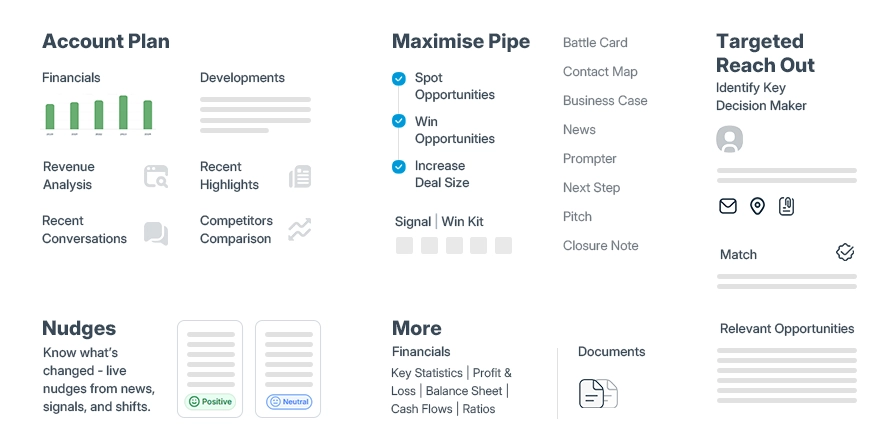
When a seller opens a target account in SalesPlay, the Account Intelligence Agent has already done the research. It continuously watches CRM-connected accounts and consolidates changes across sources into a single view.
What the seller sees:
This is not a static profile. It updates as the account moves. A new hire, a board announcement, a regulatory change — each is captured and connected to context that helps sellers decide what to do next. New sellers inherit full account context immediately. There is no ramp period for understanding an account.
The Signals Agent filters noise. Enterprise accounts generate a constant stream of news, filings, announcements, and activity. Most of it is irrelevant to your sale. The Signals Agent surfaces only what creates a reason to engage — a budget signal, a leadership change, a competitor exit, a relevant initiative announcement.
Sellers stop monitoring accounts manually. SalesPlay tells them when something worth acting on has happened. Related: How account signals drive modern pipeline creation.
Account intelligence is not useful on its own. The value comes from what sellers do with it. SalesPlay connects account context directly to opportunity identification and execution.
Identifies opportunities inside accounts tied to your offerings. Each one shows the signal that triggered it, supporting context, and the relevant buying center.
Converts selected opportunities into execution-ready deals with battle cards, talking points, email drafts, and next-step guidance pre-built.
Start from a person you know. See which opportunities are relevant to them, why each one matters to their role, and what angle makes sense for outreach.
Generates a one-page prep document for any scheduled meeting — opportunity summary, attendee context, smart questions, and suggested next steps.
Selects contacts and opportunities, drafts every campaign email, personalizes each message by individual, and runs the sequence after approval.
Filters account noise. Surfaces only the developments that create a relevant reason to engage — tied to accounts in your territory, not generic market news.
Each agent works independently. Together they cover the full arc from account understanding to deal execution without sellers jumping between tools.
Account intelligence is not a single workflow. It changes how enterprise teams operate across every stage of the sale. Here are the five that matter most.
A seller assigned to a new account opens SalesPlay. In one tab they see financial history, business changes, relevant signals, and what they should pay attention to. No searching. No assembly required. The account is understood. New sellers get full context on inherited accounts from day one.
Related: Account intelligence tools for B2B teams.
SalesPlay surfaces opportunities inside target accounts before sellers know to look for them. A budget signal, a new initiative, a leadership change — each one connects to a specific product offering and buying center. Pipeline gets built on evidence, not activity quotas.
Related: How to generate pipeline from existing accounts and finding opportunities inside dormant accounts.
SalesPlay connects contacts to opportunities. Sellers see who is relevant to a specific deal, why that person is involved, what angle makes sense, and what to say. No guessing based on org charts. No spray-and-pray outreach. Related: Lead and contact enrichment.
Once an opportunity moves to Win, SalesPlay keeps it current. Account changes update deal context automatically. Sellers see what has shifted, which stakeholders matter most now, and what the next step should be. Deals don’t stall because the seller lost the thread. Related: AI sales pipeline management.
For any scheduled meeting, the Meeting Prep Agent generates a one-page document. Opportunity summary, attendee background, smart questions, and next steps — ready before the seller starts their prep. They walk in focused, not scrambling. Related: Sales enablement with SalesPlay.
Most vendors claim intelligence. Few deliver it in a way that changes how sellers actually work. Here is what separates platforms that create value from tools that create more noise.
SalesPlay connects directly to your CRM-tracked accounts. It watches those accounts continuously. You don’t build target lists from scratch or upload CSVs. The platform already knows which accounts matter and monitors them automatically.
A signal without context is just noise. What matters is whether the platform tells sellers why a signal matters — which product it connects to, which buying center is affected, which contacts are relevant. SalesPlay does this for every opportunity it surfaces.
Intel that lives in a dashboard doesn’t close deals. SalesPlay connects account understanding to email drafts, battle cards, meeting prep, and nurture campaigns. A seller can go from signal to sent email without leaving the platform.
SalesPlay is built to replace the fragmented workflow, not extend it. One tab covers research, opportunity identification, contact mapping, and outreach preparation. If a platform adds another browser window to the seller’s day, it hasn’t solved the problem.
For a direct comparison, see: SalesPlay vs 6sense, SalesPlay vs Gong, or the best AI sales platform tools comparison.
The difference is not dramatic in the abstract. It shows up in specifics:
Selling feels different. Focused. Guided. Controlled. Less reactive, more deliberate.
See also: Operationalizing account intelligence and how sales leaders use revenue intelligence to build pipeline.
Account intelligence is the structured, continuously updated understanding of what is happening inside a target account — including business changes, financial context, stakeholder shifts, and signals that connect to your product or service. In enterprise sales, it replaces manual research with a single, always-current view of each account so sellers know what to act on and when.
A CRM stores records. SalesPlay watches accounts and tells sellers what is changing. It connects CRM data to live signals, identifies opportunities inside those accounts, maps the right contacts, and generates execution materials — all in one place. It does not replace your CRM; it works on top of it to fill the gap between data and action.
SalesPlay tracks business developments relevant to your accounts: leadership changes, expansion announcements, financial results, technology shifts, initiative signals, and other movements that create timing for a sale. The Signals Agent filters noise and surfaces only what matters for your specific product offerings and target accounts.
With SalesPlay, a new seller can understand an inherited account in minutes. The Account Intelligence Agent provides financial history, key developments, relevant signals, and contact context — all consolidated and current. There is no dependence on notes from the previous rep or memory from a manager.
Yes. SalesPlay connects directly to CRM and watches the accounts tracked there. It enriches those accounts with external signals and business intelligence and feeds opportunity context back into the CRM workflow. Sellers do not need to leave their existing tools to benefit from SalesPlay’s intelligence.
Sales intelligence typically refers to contact and company data — who works where, what their title is, how to reach them. Account intelligence goes deeper: it tracks what is happening inside the company over time, connects those changes to sales opportunities, and tells sellers why a specific moment matters. SalesPlay provides both, but the differentiation is in the ongoing account monitoring and the connection between signals and action.
Yes. Once an opportunity moves into the Win stage in SalesPlay, the platform keeps deal context current automatically. When something changes inside the account, the deal brief updates. Sellers see which stakeholders matter now, what has shifted, and what the logical next step is — so momentum never stalls because context was lost.
The Meeting Prep Agent in SalesPlay generates a one-page document for any scheduled meeting. It includes an opportunity summary, attendee-specific background, smart questions to guide the conversation, and suggested next steps. Sellers walk in prepared without last-minute research.


Category: Uncategorized Tags: ai, AIOps, Artificial Intelligence, cloud, cloud platform, Cybersecurity, Information and Communications Technology , VR