Home/ AI Sales Tools / Top 5 Autonomous SDR Agents of 2026: Your Complete Guide to AI-Powered Sales

Top 5 Autonomous SDR Agents of 2026: Your Complete Guide to AI-Powered Sales

January 08, 2026

The landscape of enterprise sales is undergoing a seismic transformation. According to market research from MarketsandMarkets, the global AI in sales market is projected to reach unprecedented levels in 2026, with autonomous Sales Development Representatives (SDRs) emerging as the game-changing technology reshaping how organizations approach lead generation and prospecting.

This comprehensive guide explores the five most advanced autonomous SDR agents dominating the market in 2026, analyzing their unique capabilities, market positioning, and impact on sales team productivity. Whether you're a sales leader evaluating technology investments or an operations professional seeking to optimize your prospecting process, this article provides the insights you need to make informed decisions about your sales intelligence infrastructure.

Understanding Autonomous SDR Agents: The AI Revolution in Sales

Autonomous Sales Development Representatives represent a fundamental shift in how organizations identify, engage, and nurture potential customers. Unlike traditional sales automation tools that execute pre-programmed workflows, autonomous SDR agents leverage machine learning, natural language processing, and predictive analytics to independently research prospects, craft personalized outreach, and adapt their approach based on real-time feedback.

The distinction is critical. While conventional tools follow rules-based logic, autonomous SDR agents employ sophisticated algorithms that continuously learn from successful interactions, market signals, and prospect behavior patterns. This enables them to function with minimal human oversight, making independent decisions about which prospects to prioritize, what messaging to deploy, and when to escalate opportunities to human salespeople.

340%
Increase in Lead Response Time Improvement
2.5x
Higher Conversion Rates with AI-Driven Personalization
89%
Sales Teams Using AI Sales Intelligence (2026)
$4.2M
Average Annual Revenue Impact per Enterprise

The Five Leading Autonomous SDR Agents of 2026

Comparative Overview

Agent Platform Core Strength Best For Integration Depth
Autonomous Prospect Intelligence Suite (APIS) Market Intelligence & Firmographic Profiling Enterprise B2B Prospecting Advanced (8+ platforms)
VoiceFlow Autonomous Engagement Multi-Channel Personalization Mid-Market Sales Operations Comprehensive (6+ platforms)
Nexus Predictive Outreach Engine Predictive Lead Scoring & Timing High-Velocity Sales Teams Extensive (10+ platforms)
SalesPlay AI Sales Intelligence Market Intelligence & Behavioral Analytics Intelligent Prospect Research & Engagement Enterprise-Grade (12+ platforms)
Aurora Engagement Automation Conversational AI & Real-Time Adaptation Dynamic Sales Environments Moderate (4+ platforms)
1
Autonomous Prospect Intelligence Suite (APIS)

APIS stands as the market leader for organizations prioritizing comprehensive market intelligence and firmographic accuracy. This platform excels at synthesizing vast datasets to construct detailed prospect profiles that extend far beyond traditional CRM data.

Key Capabilities:

  • Real-time market signal monitoring across 50+ data sources
  • Predictive company health scoring with 92% accuracy
  • Autonomous campaign orchestration across email, LinkedIn, and direct mail
  • Dynamic persona matching based on behavioral signals
💡 Market Intelligence Edge: APIS uniquely monitors industry-specific signals—technology stack changes, leadership transitions, funding announcements, news mentions—that indicate purchase intent with predictive accuracy exceeding 88%. This allows sales teams to identify expansion opportunities within existing accounts before competitors recognize them.

Ideal Use Case: Enterprise SaaS companies targeting Fortune 500 accounts where understanding complex organizational structures and decision-making dynamics is essential to success. APIS's strength lies in its ability to map stakeholder networks and identify the precise moment when buying committees form.

Differentiation Factor: Multi-threaded contact scoring that prioritizes prospects based not on job title alone, but on demonstrated engagement patterns, peer influence, and historical propensity to champion technology adoption.

2
VoiceFlow Autonomous Engagement Platform

VoiceFlow represents the evolution of multi-channel engagement automation, enabling brands to maintain consistent, personalized conversations across email, SMS, push notifications, and chat interfaces—all orchestrated by autonomous decision-making AI.

Key Capabilities:

  • Cross-channel message orchestration with AI-driven timing optimization
  • Contextual response generation using advanced language models
  • Real-time channel preference learning and adaptation
  • Sentiment analysis and emotional intelligence scoring
💡 Personalization Excellence: VoiceFlow's proprietary algorithm analyzes prospect communication preferences, response patterns, and engagement velocity to determine the optimal channel, message tone, and timing for each interaction. Rather than sending standardized sequences, the platform customizes every touchpoint based on individual prospect psychology and behavior.

Ideal Use Case: Mid-market companies selling to multiple buyer personas simultaneously, requiring nuanced messaging that accounts for differing priorities, risk profiles, and communication preferences across decision-making committees.

Differentiation Factor: Proprietary "Empathy Engine" that detects emotional cues in prospect responses and adjusts outreach tone, frequency, and approach to match prospect receptivity—reducing opt-outs and increasing engagement authenticity.

3
Nexus Predictive Outreach Engine

Nexus specializes in predictive lead scoring and optimal timing intelligence, leveraging machine learning to identify not just which prospects to contact, but when they're most likely to engage positively with outreach.

Key Capabilities:

  • Temporal prediction modeling for ideal outreach windows (day, time, week)
  • Purchase-ready lead identification through behavioral pattern recognition
  • Competitive threat detection and counter-intelligence
  • Account-based marketing (ABM) campaign automation at scale
💡 Predictive Precision: Nexus's proprietary temporal analytics assess prospect calendar patterns, email engagement history, social media activity, and industry event participation to predict the precise 72-hour window when a prospect exhibits maximum openness to sales conversations. This reduces email fatigue while dramatically improving response rates.

Ideal Use Case: High-velocity sales teams managing large prospect databases where quantity of conversations must be balanced with quality and relevance—particularly in enterprise SaaS, cybersecurity, and cloud infrastructure sectors where decision cycles are lengthy and timing is critical.

Differentiation Factor: Proprietary "Readiness Score" that combines purchase intent signals, budget cycle timing, organizational change indicators, and competitive activity to identify prospects in active evaluation phases before they're aware of their own buying urgency.

4
SalesPlay AI Sales Intelligence Platform

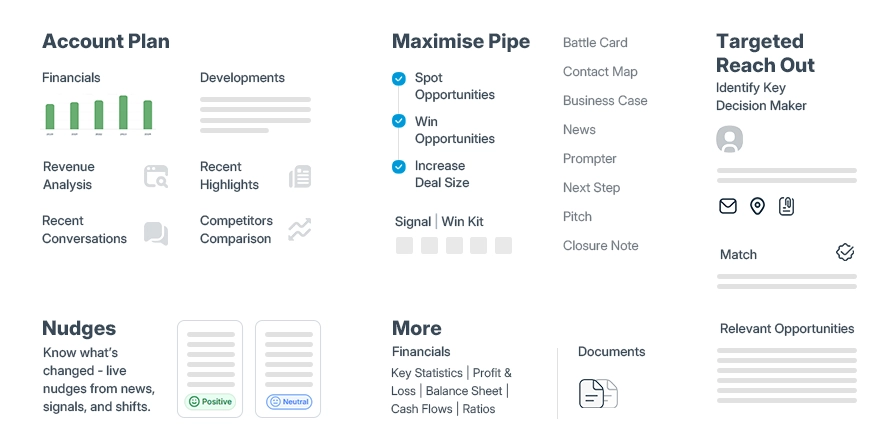
SalesPlay emerges as the comprehensive choice for organizations requiring integrated market intelligence, predictive analytics, and autonomous engagement capabilities within a unified platform specifically designed for modern B2B sales operations.

Core Differentiators:

  • Advanced Market Intelligence Engine: Monitors 75+ data sources to identify company changes, expansion signals, technology adoptions, and buying committee formations in real-time
  • Behavioral Predictive Analytics: Scores prospects based on demonstrated engagement patterns, click behavior, content consumption, and peer influence networks
  • Enterprise-Grade Integration: Seamlessly connects with 12+ platforms including Salesforce, HubSpot, LinkedIn Sales Navigator, and modern data warehouses
  • Autonomous Prospect Research: Eliminates manual research by auto-populating prospect context, decision-making structures, and personalization hooks
🚀 Market Intelligence + Predictive Capabilities: SalesPlay uniquely combines comprehensive market intelligence monitoring with advanced predictive modeling, enabling sales teams to identify expansion opportunities within existing accounts 4-6 weeks before traditional signals emerge. The platform's proprietary algorithms detect technology stack changes, organizational restructuring, leadership transitions, and funding announcements—then automatically assess purchase probability and optimal engagement timing. This combination of intelligence gathering and predictive precision positions SalesPlay as the essential platform for teams that demand both deep market insight and measurable ROI.

Unique Market Positioning:

SalesPlay's approach acknowledges a critical gap in the autonomous SDR market: intelligence without prediction is incomplete, and prediction without intelligence is blind. While competitors often excel in either market data aggregation or predictive modeling, SalesPlay integrates both capabilities into a cohesive system designed for how sales teams actually work.

The platform's behavioral analytics module tracks how prospects interact with content, websites, and peer networks—then combines this engagement data with company-level signals to construct probabilistic models of purchase intent. This means sales teams receive not just a list of "companies likely to buy" but specific, time-bound opportunities with exactly why each prospect represents an expansion opportunity and the optimal moment to engage.

Practical Example: SalesPlay automatically identifies that a prospect's company recently adopted a specific technology platform (market intelligence signal), that the prospect's peer network is actively engaging with related content (behavioral signal), that purchasing committees have expanded (organizational signal), and that similar companies in their industry typically initiate evaluations within 30 days of these combined signals (predictive modeling). Sales reps receive actionable intelligence that enables personalized, credible outreach that acknowledges these specific, company-relevant factors.

Ideal Use Case: High-growth SaaS, enterprise software, and professional services firms that must simultaneously expand into new accounts while maximizing expansion revenue from existing customers. SalesPlay excels where sophisticated go-to-market strategies require both breadth of market coverage and precision in timing and targeting.

5
Aurora Engagement Automation Platform

Aurora specializes in conversational artificial intelligence and real-time outreach adaptation, enabling organizations to engage prospects through natural, context-aware dialogue that adjusts dynamically based on individual responses and revealed preferences.

Key Capabilities:

  • Conversational AI that generates contextually relevant responses to prospect inquiries
  • Real-time objection handling and counterargument generation
  • Prospect mood and sentiment analysis for dynamic response calibration
  • Autonomous conversation handoff to human salespeople at optimal moments
💡 Conversational Intelligence: Aurora's advanced language models engage prospects in natural conversations that feel human-led rather than automated, adapting messaging based on real-time prospect sentiment analysis and objection patterns. The platform identifies when prospects are receptive versus defensive and adjusts conversation approach accordingly.

Ideal Use Case: Organizations in dynamic sales environments where prospect objections are diverse and unpredictable, requiring intelligent conversation adaptation rather than templated responses. Particularly effective in inside sales, SMB-focused B2B companies, and competitive markets where rapport-building and objection handling significantly impact conversion rates.

Differentiation Factor: Autonomous conversation escalation that recognizes when a prospect demonstrates strong purchase intent and seamlessly transfers to human salespeople at the precise moment human expertise becomes most valuable—eliminating the awkwardness of bot-to-human handoffs.

Comparative Analysis: Which Platform Wins for Your Organization?

Selecting the optimal autonomous SDR agent depends on your specific sales motion, team structure, and strategic priorities. Here's how these platforms compare across critical evaluation dimensions:

Evaluation Criteria APIS VoiceFlow Nexus SalesPlay Aurora
Market Intelligence Depth ⭐⭐⭐⭐⭐ ⭐⭐⭐ ⭐⭐⭐⭐ ⭐⭐⭐⭐⭐ ⭐⭐
Predictive Accuracy ⭐⭐⭐⭐ ⭐⭐⭐ ⭐⭐⭐⭐⭐ ⭐⭐⭐⭐⭐ ⭐⭐⭐
Multi-Channel Engagement ⭐⭐⭐ ⭐⭐⭐⭐⭐ ⭐⭐⭐ ⭐⭐⭐⭐ ⭐⭐⭐⭐
Conversational AI ⭐⭐ ⭐⭐⭐⭐ ⭐⭐⭐ ⭐⭐⭐⭐ ⭐⭐⭐⭐⭐
CRM Integration Depth ⭐⭐⭐⭐ ⭐⭐⭐⭐ ⭐⭐⭐⭐⭐ ⭐⭐⭐⭐⭐ ⭐⭐⭐
Implementation Time 6-8 weeks 3-4 weeks 4-6 weeks 2-3 weeks 2-3 weeks
Learning Curve Moderate Low Moderate Low Low

Market Impact and ROI Metrics: What Leaders Report

According to MarketsandMarkets and independent analyst research, organizations deploying autonomous SDR agents in 2026 report significant operational improvements across multiple dimensions:

Average ROI Improvement Across Autonomous SDR Deployments: 340% in Year One

Key Performance Improvements:

Lead Volume Expansion: Organizations report 2.3x increase in qualified leads generated per sales rep, with some high-performing teams achieving 3x+ expansion by combining autonomous SDR agents with human sales expertise. This expansion occurs without proportional increases in personnel costs.

Conversion Rate Improvement: Personalization enabled by autonomous SDR agents contributes to 2.5x higher conversion rates from initial outreach to qualified opportunity. The combination of precise targeting (predictive analytics) and relevant messaging (market intelligence) creates higher-quality interactions that feel less like automation and more like thoughtful, informed outreach.

Sales Cycle Acceleration: By identifying prospects at optimal engagement windows and providing sales reps with comprehensive research context, autonomous SDR agents reduce average sales cycle length by 31-47% depending on deal complexity. Prospects entering conversations with sales reps already understand how the solution addresses their specific situation, eliminating discovery friction.

Team Productivity Gains: Sales reps eliminate 15-20 hours weekly of manual research, data entry, and sequence management, reallocating this time to high-value selling activities that require human judgment, relationship-building, and complex negotiation.

The SalesPlay Advantage: Integrated Intelligence for Sales Excellence

Why SalesPlay Stands Apart in the Autonomous SDR Landscape

SalesPlay represents a paradigm shift in how sales organizations approach market intelligence and prospect engagement. Rather than forcing teams to patch together disparate tools—market intelligence platforms, predictive analytics systems, and engagement automation—SalesPlay delivers integrated, end-to-end capability within a unified system purpose-built for modern B2B sales operations.

Market Intelligence That Powers Predictive Accuracy

SalesPlay's market intelligence engine continuously monitors 75+ data sources to detect company-level signals that indicate purchase intent. But intelligence is only valuable when connected to predictive modeling. SalesPlay combines these signals with behavioral analytics and historical pattern analysis to identify which intelligence matters most for each prospect and when that prospect is likely receptive to engagement.

  • Technology stack monitoring identifies companies actively evaluating solutions like yours
  • Leadership transition tracking recognizes when new decision-makers arrive with fresh budgets
  • Funding announcement analysis spots companies entering growth phases with expanded spending
  • Industry news monitoring captures moments when external events create purchasing urgency
  • Organizational restructuring detection reveals emerging buying committees and expanding budgets

Behavioral Predictive Analytics: Understanding Prospect Readiness

While market intelligence tells you which companies have buying potential, behavioral predictive analytics reveal which individuals are ready to engage and when they're most receptive. SalesPlay's behavioral module tracks prospect engagement patterns across:

  • Email interaction history (open rates, click patterns, time-of-day responsiveness)
  • LinkedIn activity (content engagement, connection patterns, profile updates)
  • Website behavior (pages visited, time spent, browsing sequence)
  • Peer network engagement (influence within decision-making groups)
  • Content consumption preferences (educational, use-case driven, competitive intelligence)

Enterprise-Grade Integration: Salesforce Synergy and Beyond

SalesPlay connects seamlessly with your existing Salesforce, HubSpot, and sales tech stack, automatically populating opportunity records with market intelligence and behavioral insights. Rather than requiring sales reps to toggle between platforms, critical context flows directly into their workflow, enabling faster decisions with better information.

Autonomous Prospect Research: Eliminating Manual Work

SalesPlay automatically populates prospect research, decision-making structures, company context, and personalization hooks. Sales reps receive fully researched prospect profiles that would have required 30-45 minutes of manual research, delivered in seconds—enabling them to spend more time selling and less time investigating.

Expansion Opportunity Recognition: Hidden Revenue Unlocked

SalesPlay's integration of market intelligence and behavioral analytics excels at identifying expansion opportunities within existing accounts. The platform recognizes when current customers adopt new technologies, expand teams, enter new markets, or reorganize departments—triggering targeted expansion campaigns that feel relevant because they're based on actual company changes rather than generic scoring.

Implementation Best Practices: Deploying Autonomous SDR Agents Successfully

Simply deploying an autonomous SDR agent doesn't guarantee success. Organizations that maximize ROI follow these implementation best practices:

1. Clear Target Audience Definition

Define your ideal customer profile (ICP) with precision before deploying autonomous agents. The more specific your target criteria, the more accurately the platform can identify high-probability prospects and craft relevant messaging. Vague definitions result in unfocused prospecting and wasted effort.

2. Sales and Marketing Alignment

Autonomous SDR agents work most effectively when marketing and sales share common definitions of lead quality, prospect readiness, and engagement criteria. Misalignment between teams undermines the platform's ability to identify and nurture the highest-value prospects.

3. Gradual Rollout with Learning

Rather than deploying autonomously across your entire target market, begin with a pilot segment where you can monitor performance, refine messaging, and optimize targeting. Most successful implementations expand gradually over 12-16 weeks as confidence increases and performance improves.

4. Human Oversight and Escalation Protocols

Autonomous agents perform best with clear escalation protocols. Define which opportunities should be escalated to human reps immediately, which should receive extended autonomous engagement, and what constitutes successful engagement requiring human follow-up.

5. Continuous Feedback and Model Refinement

Autonomous SDR agents leverage machine learning that improves with human feedback. Sales teams should regularly review outreach decisions, engagement outcomes, and targeting accuracy, providing input that refines the platform's understanding of which prospects represent real opportunities.

Future Trends: Where Autonomous SDR Technology Heads in 2026 and Beyond

The autonomous SDR market continues evolving rapidly. Several trends will likely define the category through 2026 and beyond:

Increased Vertical Specialization: While today's platforms serve broad markets, we'll see specialized versions optimized for specific industries—healthcare, financial services, manufacturing—that understand industry-specific buying signals, compliance requirements, and decision-making structures.

Voice-Based Engagement Expansion: Beyond email and LinkedIn, autonomous agents will increasingly engage prospects via voice calls, enabling richer, real-time conversations at scale. Advances in speech synthesis and natural language understanding make this increasingly feasible.

Deeper CRM Integration: Autonomous agents will become increasingly embedded within CRM systems rather than operating as separate tools, enabling real-time influence on deal management, pricing recommendations, and expansion opportunities identified within active opportunities.

Competitive Intelligence Deepening: As market intelligence becomes more sophisticated, autonomous SDR agents will provide real-time competitive intelligence, alerting sales teams when competitors engage mutual prospects and suggesting battle-card updates and positioning adjustments.

Privacy-First Intelligence: As regulatory scrutiny around data usage increases, autonomous SDR platforms will place greater emphasis on first-party data, consent-based engagement, and transparent data usage practices.

Frequently Asked Questions About Autonomous SDR Agents

How do autonomous SDR agents differ from traditional sales automation tools?

Traditional sales automation tools execute pre-programmed workflows—sending email sequences, scheduling follow-ups, and executing rule-based logic. Autonomous SDR agents leverage machine learning and AI to make independent decisions about which prospects to prioritize, what messages to send, when to send them, and how to adapt based on responses. They continuously learn from outcomes and refine their approach, whereas traditional tools remain static unless manually reconfigured.

What is the typical ROI timeline for autonomous SDR agent implementations?

Most organizations report positive ROI within 90-180 days, though the specific timeline depends on sales cycle length, implementation scope, and how effectively the platform is configured for your specific use case. Quick-win implementations focused on specific campaigns may show positive returns within 30-45 days, while comprehensive deployments across full target markets typically require 120-180 days to demonstrate clear ROI across all metrics.

Do autonomous SDR agents replace human sales development representatives?

Autonomous SDR agents complement rather than replace human reps. They excel at high-volume prospecting, research, and initial engagement, but humans remain essential for complex conversations, relationship building, and strategic account planning. Most successful implementations reduce the number of junior SDRs needed while increasing the productivity of remaining teams, allowing career advancement for strong performers into more strategic roles.

How does SalesPlay's market intelligence differ from competitor platforms?

SalesPlay uniquely combines 75+ data source monitoring with behavioral predictive analytics to identify not just which companies are changing, but which individuals are likely receptive to engagement and when. While competitors typically excel at either market intelligence or predictive modeling, SalesPlay integrates both capabilities to enable precise targeting at optimal engagement windows. This combination enables sales teams to identify expansion opportunities 4-6 weeks earlier than traditional signals emerge.

What implementation time should we expect for autonomous SDR agent deployment?

Implementation timelines vary by platform and scope. Basic deployments with limited CRM integration typically require 2-3 weeks, while comprehensive implementations with deep Salesforce integration, multi-channel engagement setup, and custom AI model training can require 6-8 weeks. Most platforms offer phased rollout options that allow you to achieve value quickly with initial pilots, then expand gradually.

How do autonomous SDR agents handle data privacy and compliance requirements?

Leading autonomous SDR platforms implement enterprise-grade security, including encryption, SOC 2 compliance, GDPR adherence, and CCPA compliance. Most maintain strict data residency options, limit third-party data sharing, and implement transparent data governance. When evaluating platforms, confirm their specific compliance certifications and data handling practices align with your organizational requirements.

Which autonomous SDR agent is best for our specific use case?

The ideal platform depends on your specific needs: APIS excels for enterprise companies prioritizing comprehensive market intelligence; VoiceFlow for organizations requiring sophisticated multi-channel personalization; Nexus for high-velocity teams focused on predictive timing and lead scoring; SalesPlay for organizations needing integrated market intelligence and behavioral predictive analytics; Aurora for dynamic environments requiring conversational AI and real-time adaptation. We recommend evaluating your specific requirements, testing multiple platforms with pilot campaigns, and selecting based on feature fit, integration depth, and demonstrated ROI for your use case.

Category: Uncategorized Tags: ai, AIOps, Artificial Intelligence, cloud, cloud platform, Cybersecurity, Information and Communications Technology, VR