AI Sales Tools Convergence: Integrated Platform Benefits
September 09, 2025

AI Sales Tool fatigue is real! I've spent countless hours jumping between different sales platforms, copying data from one system to another, and still missing key insights that fell through the cracks. Sound familiar?


The modern sales stack has exploded with specialized tools, each solving a piece of the puzzle. However, this fragmentation creates more problems than it solves. Fortunately, a new approach is gaining momentum – integrated AI sales platforms. These sales ai tools combine multiple functions into unified systems, eliminating the headaches of disconnected workflows. Artificial intelligence sales enablement now works best when all components talk to each other, creating a seamless experience for both sales teams and customers.
Throughout this article, I'll show you why this convergence matters, what components make up an effective integrated platform, and specifically how your team can achieve better results with less frustration. The days of cobbling together a dozen different tools are coming to an end – and that's something worth getting excited about!
An integrated AI sales platform serves as a unified command center that brings together multiple AI-powered sales functions into a single cohesive system. Unlike the fragmented approach of using separate tools for each sales activity, these platforms combine lead generation, customer management, data analysis, and automation capabilities under one roof. More than 80% of businesses already use AI in some capacity, with sales and marketing being prime areas for implementation.
These platforms seamlessly connect with your existing CRM systems, ensuring all sales activities and data remain synchronized and easily accessible throughout your organization. By centralizing all sales operations, they eliminate the inefficiencies of disconnected workflows while providing a comprehensive view of your entire sales ecosystem.
The distinction between integrated platforms and standalone tools lies primarily in their scope and connectivity. Standalone AI sales agents typically handle one specific task—like writing emails, scheduling meetings, or qualifying leads. Although these single-purpose tools are often more affordable and quicker to implement, they create significant challenges for sales teams.
For instance, when using standalone AI chatbots, sales representatives must constantly switch between applications, copying and pasting content back and forth. This not only disrupts concentration but wastes valuable time that could be spent engaging with prospects and closing deals.
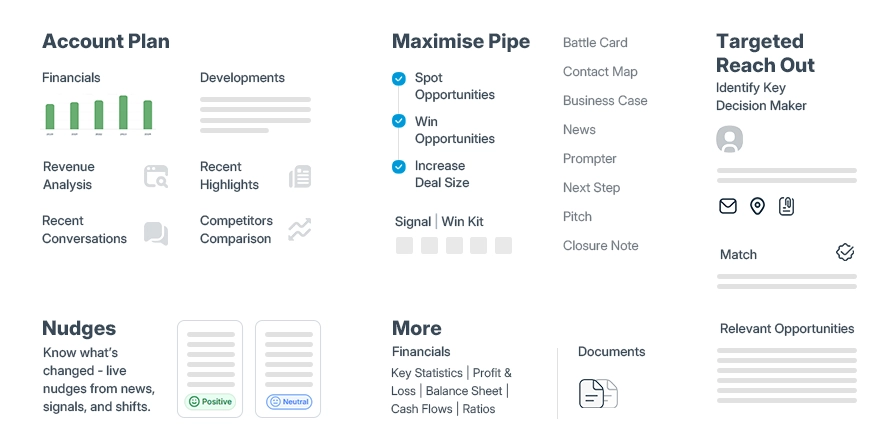
In contrast, integrated platforms function as complete ecosystems that bring multiple sales capabilities together under one unified system. They represent the evolution from basic data providers to sophisticated intelligence hubs that power entire go-to-market strategies. Their architecture includes several interconnected modules:
Data enrichment that automatically updates contact information
Prospecting tools that discover high-intent leads
Intent signal monitoring that identifies real-time buying patterns
Workflow automation that streamlines outreach sequences
Analytics dashboards that provide customized performance metrics
Additionally, integrated platforms eliminate the friction from your team's workflows by placing AI functionality right where you need it, without requiring navigation away from your primary task. Since the AI is built directly into your CRM, it can analyze patterns in your data almost instantaneously, helping you identify high-value deals and those likely to close.
Integration has become essential in modern sales for several compelling reasons. First, sales representatives spend over one-third of their time updating CRMs and handling administrative tasks—19% on each. By integrating AI directly into your sales systems, these routine tasks become automated, freeing your team to focus on what they do best: selling.
Furthermore, integration addresses the critical problem of "Shadow IT"—when employees resort to external AI solutions because official platforms lack necessary tools. This practice poses significant risks to data security and compliance efforts, especially when dealing with sensitive information. By bringing AI capabilities in-house through integrated platforms, organizations maintain full control over data handling and processing.
Modern buyers now conduct extensive online research before engaging with sales teams. Companies with fragmented approaches to sales and marketing risk losing to those with unified teams that leverage the advantages of both skillsets. Integrated platforms facilitate this alignment by allowing teams to inform each other rather than disagree, creating visible goals that everyone works toward collectively.
Moreover, integration creates a single source of truth for your entire go-to-market team. This unified data environment ensures marketing brings in better-qualified leads and sales follows up more effectively, reducing friction between departments and maximizing return on investment from both teams.
The benefits extend beyond efficiency—integrated platforms deliver consistent experiences across your organization. Every user receives content generated using the same logic and tone, ensuring a uniform approach that creates a cohesive and professional impression. This consistency becomes increasingly important as sales teams grow and scale their operations.
As sales technology continues advancing, the integrated platform approach provides a foundation for ongoing innovation while maintaining the operational stability that sales teams require for success.
Modern unified AI sales systems consist of several powerful components working together. Each element addresses specific challenges in the sales process, creating a cohesive system far more effective than standalone tools. Let's examine the essential building blocks that form the foundation of these integrated platforms.
Ready to turn your Rep
INTO BEST PERFORMER ?
At the core of any effective AI sales tool is intelligent lead scoring and qualification. Traditional lead scoring relied on manual point assignments based on intuition and experience—often resulting in subjective assessments and missed opportunities. In contrast, AI-powered predictive lead scoring analyzes hundreds of data points simultaneously to determine which leads are most likely to convert.
According to Salesforce's State of Sales Report, 98% of sales teams using AI believe it improves lead prioritization. These systems examine various data sources including:
Firmographic data (company size, industry, revenue)
Digital engagement metrics (website visits, content downloads)
Behavioral patterns (email engagement, response rates)
Demographic information (job titles, locations)
The AI continuously learns from past successful conversions, automatically adjusting its scoring models to improve accuracy over time. This data-driven approach enables sales teams to focus their efforts on high-value prospects, resulting in 9-20% increases in marketing conversions.
Conversation intelligence transforms sales interactions into actionable insights through AI-powered analysis of calls, emails, and meetings. This technology transcribes and analyzes conversations in real-time, identifying patterns that improve coaching and deal management.
These systems flag critical moments like competitor mentions, objections, and pricing discussions automatically. For sales managers, this creates unprecedented visibility into team performance, with insights into conversational styles, customer sentiment, and best practices from top performers.
The impact can be substantial—teams using conversation intelligence shorten sales cycles by 19%. Instead of relying solely on what reps manually log in CRM systems, managers gain access to what buyers are actually saying, enabling more accurate forecasting and coaching.
AI-powered forecasting represents a major upgrade from traditional methods. According to Gartner, 67% of sales operations leaders agree that creating accurate sales forecasts is harder today than three years ago. Consequently, organizations are turning to AI solutions that analyze vast datasets to predict outcomes with remarkable precision.
These systems continuously monitor pipeline activity and market conditions, delivering instant updates on pipeline health. This enables sales managers to proactively adjust strategies, address potential risks, and capitalize on emerging opportunities.
Furthermore, AI identifies which deals need attention and suggests specific actions. Deal health monitoring watches every opportunity for warning signs humans might miss, flagging issues before they become obvious.
Sales workflow automation eliminates repetitive tasks across the entire sales process. AI agents handle routine activities like lead qualification, CRM updates, and post-sale follow-ups.
These systems can trigger intelligent workflows based on sales signals like no-shows, inactivity, or deal stage changes. They also integrate seamlessly with communication platforms like Slack and Microsoft Teams to deliver notifications, alerts, and tasks directly where sales teams actually work.
This automation saves valuable time—sales representatives typically spend over one-third of their time updating CRMs and handling administrative tasks. By automating these processes, teams can redirect their focus toward high-value activities like building relationships and closing deals.
Customer success AI analyzes data to predict customer needs, streamline experiences, and boost engagement. Above all, it helps identify patterns in customer behavior that indicate potential churn risk before it's too late.
Through natural language processing, these systems analyze sentiment in communications across all channels—emails, chat logs, and support tickets. They provide real-time insights and visual dashboards that help businesses proactively address concerns.
The technology also creates personalized customer experiences at scale by analyzing behavior, preferences, and historical data. This personalization makes each customer feel uniquely understood and valued, subsequently improving satisfaction and loyalty.

Time saved is money earned in today's competitive sales environment. The shift toward integrated AI sales platforms delivers tangible efficiency improvements that directly impact your bottom line. Teams using integrated systems report consistent efficiency upticks of 10 to 15 percent, along with sales uplift potential of up to 10 percent. Let's examine exactly how these platforms boost productivity across your sales operation.
Sales representatives typically spend only about 25% of their time actually selling to customers. The remaining hours get consumed by administrative tasks, data entry, and jumping between different applications. This constant context switching destroys productivity—studies show people switch activities every three to five seconds, resulting in hours of lost time.
Integrated AI sales tools eliminate this productivity drain by automating routine tasks. For instance:
Automated data capture: Systems automatically log emails, calls, and calendar events into your CRM without manual entry
Voice command updates: Simply ask the AI to update any lead or opportunity record
Intelligent workflows: Trigger actions based on specific sales signals like no-shows or deal stage changes
By automating these repetitive processes, sales teams redirect their focus toward high-value activities like building customer relationships and closing deals. Companies that have implemented sales automation consistently report increases in customer-facing time and higher satisfaction rates.
Traditional batch processing of sales data creates dangerous blind spots. In contrast, real-time data integration ensures your team always works with current, accurate information across all platforms. This continuous synchronization enables:
Instant insight access: Teams using real-time data integration report a 25% boost in lead generation, 15% shorter deal cycles, and up to 50% more qualified leads.
Unified customer views: Platforms like Salesforce capture customer interactions and transaction histories instantly, sending this data directly to their Data Cloud. Meanwhile, Momentum's AI Data Pipeline automatically processes communication data, extracting critical insights and immediately updating records.
Cross-platform consistency: Solutions like Attio can process large data volumes in under 50 milliseconds, ensuring that product data, billing details, and customer interactions remain perfectly synchronized.
This real-time approach prevents the errors and outdated information that led to missed forecasts for 80% of sales leaders last year. With accurate, up-to-the-minute data, your team makes decisions based on current reality rather than outdated snapshots.
Integrated AI platforms function as your personal data analyst, uncovering patterns and relationships in your sales data almost instantaneously. This unified intelligence environment delivers:
Proactive risk identification: AI continuously monitors your sales pipeline to spot deal risks and opportunities, allowing you to take action before problems develop. For example, Momentum uses AI to identify potential churn and predict challenges, enabling teams to respond quickly.
Resource optimization: AI-powered systems increase the precision with which companies anticipate future customer demand, helping sellers better allocate resources to opportunities with the highest ROI.
Accelerated response times: Customer support teams using AI respond to inquiries 68% faster, providing a competitive edge in time-sensitive situations.
Enhanced forecast accuracy: AI-driven forecasting addresses a widespread challenge—67% of sales operations leaders agree that creating accurate forecasts is harder today than three years ago.
The practical impact extends throughout your organization. With unified insights, sales teams spend less time searching for information and more time selling. Companies leveraging these integrated artificial intelligence sales enablement tools are 2.5 times more likely to exceed their sales targets, proving that consolidated data environments create measurable business advantages.


Data fragmentation is the hidden enemy of sales performance. When your sales information exists in multiple disconnected systems, your team operates with partial views of reality. A single source of truth (SSOT) solves this fundamental problem by creating one unified, reliable data environment that everyone in your organization can access and trust.
Data silos occur when different departments collect and store valuable information without sharing it with others. This separation prevents systems and teams from working together efficiently. Large companies typically use more than 360 software tools across their teams, each producing and storing its own set of data. In fact, 80% of decision-makers report that breaking down these data silos is a top priority for their businesses.
The costs of maintaining these silos are substantial:
Teams work with different versions of truth, never seeing the complete picture
Employees waste valuable time searching for information across multiple platforms
Opportunities for errors increase when data must be manually reconciled
Decision-making slows as teams debate whose data is correct
By establishing a single source of truth, your AI sales tool creates a unified data ecosystem that eliminates these inefficiencies. This consolidation reduces redundant software investments and storage costs, directing those savings toward more critical initiatives.
When data flows freely across departments, collaboration flourishes. Teams that share a unified data environment experience several powerful benefits:
First, cross-functional alignment improves dramatically. With everyone looking at the same numbers, debates shift from "whose data is right?" to "what does this data tell us?". This fosters a culture where teams inform each other rather than disagree, creating visible goals everyone works toward collectively.
Second, decision-making becomes faster and more confident. Teams no longer need to second-guess the numbers or wait for data analysts to reconcile multiple reports—particularly valuable in fast-moving markets. This shared understanding enables more informed decisions that align with overall objectives.
Third, artificial intelligence sales enablement becomes more effective as AI tools process consistent, high-quality data. Microsoft's integration tools, particularly Teams and SharePoint, create unified workspaces where latest documents and data can be accessed by all team members. This integration minimizes duplication and confusion while streamlining workflows.
Today's B2B customer journey touches nearly every department: marketing, sales, support, and billing. Business buyers increasingly prioritize strong customer experiences just as much as the products they're evaluating. A single source of truth ensures every team interaction builds on previous customer touchpoints.
With comprehensive customer data, sales teams can create more targeted marketing campaigns and personalized experiences, leading to higher engagement and conversion rates. This consistency becomes essential as buyers typically conduct extensive research before engaging with sales teams.
Unified customer data enables several key improvements:
More personalized and responsive service that enhances the overall customer journey
Seamless experiences across all channels, regardless of whether customers engage via mobile, web, or in-person
Ability to anticipate customer needs and pain points before they arise
When every department works from the same dataset, you create a cohesive environment where sales teams can tailor their approach based on complete customer information, ultimately leading to increased satisfaction and loyalty.
In essence, a single source of truth provides the foundation for a truly data-driven sales organization—the connective tissue linking disparate teams and ensuring everyone moves forward with a shared understanding of customers and business performance.
STOP GUESSING YOUR PIPELINE
START GROWING IT WITH AI SALES!!
Personalization has evolved from a nice-to-have feature to a critical necessity in sales. Today's AI sales tools have transformed what's possible in creating individualized experiences at scale. In 2024, 73% of customers reported feeling treated as individuals, up dramatically from just 39% in 2023. This remarkable improvement stems directly from AI's growing capabilities to tailor interactions precisely to each prospect's needs.
The effectiveness of sales outreach depends largely on delivering the right message at the perfect moment. Modern AI systems analyze vast streams of data to determine optimal timing for engagement, ensuring messages reach prospects when they're most receptive.
These AI-powered platforms adjust content in real-time based on multiple factors:
Weather conditions and location
Current inventory levels
Recent browsing patterns
Previous purchase history
For instance, an online retailer's AI can detect a sudden temperature drop and immediately adjust its website to highlight winter products, suggesting items based on the user's location and historical purchases. This level of dynamic personalization creates experiences that feel almost intuitive to customers.
Traditional mass emails are rapidly losing effectiveness, with average cold email open rates dropping from 36% in 2023 to just 27.7% in 2024. Clearly, generic messaging no longer resonates with today's savvy buyers.
AI now analyzes behavioral signals across multiple channels to create deeply personalized outreach:
Website visits and page engagement
Email interaction patterns
Social media activity
Product usage metrics
Through analyzing these signals, AI builds detailed prospect profiles that identify exactly where individuals are in their buying journey. Modern platforms like Outreach capture these behavioral signals to identify clear buying intent, such as repeated visits to pricing pages or resource downloads.
This approach extends beyond initial contact. AI provides continuous support throughout the entire sales process by analyzing customer behavior, preferences, and demographics to generate personalized content at each stage—from prospecting through closing and customer success.
Today's AI tools adapt messaging based on prospects' unique characteristics and contexts. They evaluate specific data points to create communications that resonate on a personal level:
First, AI analyzes role-specific needs. A business development representative receives content optimized for prospecting, whereas an account executive gets case studies tailored for closing deals.
Next, AI considers industry and persona details. Healthcare CIOs see compliance-focused messaging while retail VPs receive insights on consumer trends. This contextual relevance ensures messages address the specific challenges facing each recipient.
Finally, AI examines past interactions. If a prospect has engaged with pricing content or watched a product demo, the system might automatically suggest sending an ROI calculator or competitive comparison guide.
The impact of this adaptive approach is substantial—companies using AI-driven personalization experience 2.5x higher engagement rates. As decision-making in sales accelerates, this capability to provide real-time, reflexive interactions driven by contextual insights becomes increasingly valuable.
By incorporating AI-driven personalization at scale, your sales team can move beyond generic approaches to create uniquely tailored experiences for each prospect, significantly improving response rates and strengthening customer relationships without requiring more time from your team.
Make Every Rep Speak
Like Your Top 1%
Measuring the real impact of AI sales tools demands clear metrics and consistent tracking. Companies adopting these technologies need solid numbers to justify their investments and optimize performance over time. The data speaks volumes—businesses implementing AI sales tools see measurable improvements across multiple performance indicators.
The impact of AI on revenue metrics is substantial and measurable. Companies that adopt AI in their sales processes experience an average increase of 15% in sales revenue. Even more impressive, organizations leveraging sales ai tools report revenue growth 1.3 times higher than those without—83% of AI-enabled teams achieved revenue growth versus only 66% of teams not using AI.
Looking at sales cycle efficiency, AI tools cut sales cycle times by an impressive 25% through automated opportunity management and real-time insights. This acceleration occurs primarily because AI identifies bottlenecks and engagement gaps that would otherwise remain hidden in traditional processes. In fact, one study revealed an extraordinary 38% reduction in average sales cycle length.
Beyond pure revenue figures, AI-powered tools boost win rates substantially:
44% average increase in win rates overall
50% higher win rates when sales teams complete all AI-recommended activities
26% increase when using AI to inform deals
Automating routine sales tasks generates significant cost reductions. According to McKinsey, companies adopting AI automation reduce operational costs by 20-30% and improve efficiency by over 40%. Likewise, businesses implementing sales automation typically report cost savings of 10-15% in their operations.
The savings extend across multiple areas. AI ensures 99.99% accuracy in financial processes like invoice processing, procurement, and payroll, minimizing losses due to errors. For instance, companies using AI-powered automation see up to a 25% reduction in customer acquisition costs.
These cost reductions stem from eliminating labor-intensive processes. Initially, AI handles repetitive tasks like data entry, CRM updates, and routine follow-ups that previously required human input. In fact, 44% of companies save money after implementing AI solutions, with top performers cutting expenses by at least 10%.
Traditional forecasting methods have long struggled with precision—75% of companies using them experience significant errors, resulting in lost revenue and missed opportunities. In contrast, AI forecasting delivers remarkable improvements in accuracy and reliability.
AI-powered forecasting can push accuracy to 90%+ across segments and teams. This improvement stems from AI's ability to analyze patterns across all customer interactions rather than relying on lagging indicators. Undoubtedly, this represents a dramatic improvement—traditional forecasting methods typically achieve a median accuracy between 70% and 79%, whereas AI can increase accuracy by up to 20%.
The benefits extend beyond mere numbers. Companies that implement AI in their forecasting processes see a reduction in forecast errors by an average of 15-20% compared to traditional methods. Not to mention, tools like Gong Forecast have enabled companies like Upwork to achieve an extraordinary 95% forecast accuracy.
Most importantly, these accuracy improvements translate directly to better business outcomes. With more reliable forecasts, companies can make confident resource allocation decisions while helping sales leaders set realistic targets backed by data rather than intuition.
Successful implementation of an integrated AI sales platform requires strategic planning and execution. Companies that approach implementation strategically achieve measurable results 25%-40% faster than those focusing solely on technology deployment. Let's examine how to effectively transition to a unified AI sales environment.
The typical organization today uses around 110 different SaaS platforms, creating significant integration challenges. Before adding new AI tools, conduct a thorough audit of your existing sales technology landscape:
Document all current sales tools, their functions, costs, and usage rates
Categorize tools by function to identify redundancies and gaps
Evaluate tool performance and ROI to determine which ones provide the most value
This assessment helps identify "chokepoints" where your sales process lags. McKinsey research shows that organizations are increasingly reshaping their workflows as they deploy AI, with 21% of companies reporting they've fundamentally redesigned at least some workflows.
Rather than attempting a complete overhaul, successful organizations implement AI gradually. Begin with one or two high-impact use cases that deliver immediate value. This approach builds confidence while minimizing disruption.
Start with AI capabilities that require minimal change management—conversation intelligence tools are excellent candidates as they can be incorporated immediately with little risk mitigation. Next, develop a middleware plan for smooth growth by mapping system connections, checking API compatibility, and planning data flows carefully.
Only 1% of company executives describe their AI rollouts as "mature," indicating most organizations are still early in their journey. A phased implementation strategy gives teams time to adapt while delivering early wins.
Technology alone won't transform sales without proper adoption. The most successful companies focus on developing specialized learning programs for non-technical teams. Effective training approaches include:
Practical over theoretical—teams learn prompt patterns they can use immediately
Role-specific modules tailored to different departments' needs
Continuous learning support rather than one-time workshops
Critically, managers play a vital role in developing AI skills, with 66% answering AI questions from their team weekly. IBM's implementation strategy emphasizes identifying and empowering change champions within sales teams to drive adoption.
Remember that successful AI integration in sales isn't just about technology—it's about people. Companies with formal change management programs achieve 35% higher adoption rates, proving that preparing your team is just as important as preparing your systems.
STOP GUESSING YOUR PIPELINE
START GROWING IT WITH AI SALES!!
The AI sales landscape is rapidly evolving beyond current capabilities. By 2025, the global AI market is projected to reach $391 billion, growing at a remarkable 33.8% annual rate. This explosive growth is reshaping how sales platforms will function in coming years.
As AI technology matures, generic sales tools are giving way to specialized solutions tailored for specific industries. AI systems in healthcare now predict diseases earlier and analyze medical images with exceptional accuracy. Equally, retail businesses utilize AI-powered systems to forecast demand precisely, optimize inventory, and create personalized customer experiences. These customized approaches deliver more relevant insights than one-size-fits-all solutions.
Cross-functional collaboration represents the next frontier in sales AI evolution. By 2028, at least 15% of day-to-day work decisions will be made autonomously through agentic AI. Organizations increasingly deploy "Joule Agents" that work seamlessly across departments—connecting sales, service, and marketing functions without requiring human intervention. This integration breaks down traditional barriers, enabling truly unified customer journeys.
AI is progressing from predictive to generative to fully agentic capabilities. Autonomous AI agents now work around the clock, handling complex prospecting tasks without supervision. Most importantly, these systems don't just analyze data—they take independent action. By 2030, 80% of sales leaders will consider AI integration in sales workflows critical for competitive advantage.
Your SDRs work 9–5
AI Sales works 24/7!!
AI sales tools have undergone a remarkable transformation. Standalone solutions once dominated the market, yet businesses now recognize the clear advantages of integrated platforms. This shift represents more than a simple tech upgrade—it fundamentally changes how sales teams operate and succeed.
The benefits speak for themselves. Teams using integrated AI platforms report 10-15% efficiency improvements alongside potential sales uplift of up to 10%. Additionally, businesses leveraging these tools achieve 2.5 times higher likelihood of exceeding sales targets. Certainly, the numbers make a compelling case for adoption.
The fragmented approach created unnecessary friction, wasted valuable selling time, and left critical insights buried in disconnected systems. Conversely, unified platforms eliminate these pain points through seamless data synchronization, automated workflows, and powerful analytics capabilities. Though implementation requires thoughtful planning, the payoff justifies the effort.
Therefore, as you evaluate your current sales stack, consider how an integrated AI approach might transform your team's effectiveness. The future belongs to sales organizations that break down data silos, enable cross-functional collaboration, and deliver personalized experiences at scale.
Your sales team deserves tools that work together rather than against each other. After all, sales excellence comes not just from adopting AI but from implementing it strategically within a cohesive ecosystem where every component enhances the others. This convergence of AI sales tools doesn't just boost productivity—it creates the foundation for sustainable competitive advantage in an increasingly AI-driven world.
Integrated AI sales platforms offer several key benefits, including improved efficiency (10-15% increase), potential sales uplift (up to 10%), elimination of data silos, enhanced cross-team collaboration, and more personalized customer experiences. They also provide a single source of truth for sales data, leading to faster and more confident decision-making.
AI-driven personalization significantly improves sales performance by enabling dynamic content and timing, behavior-based outreach, and adaptive messaging. Companies using AI-driven personalization experience 2.5x higher engagement rates and see measurable improvements in response rates and customer relationships.
Important metrics to track include revenue growth (average 15% increase), sales cycle velocity (25% reduction in cycle times), win rates (44% average increase), cost savings from automation (20-30% reduction in operational costs), and forecast accuracy improvements (up to 90%+ accuracy across segments and teams).
Companies should start by assessing their current tech stack, planning a phased integration approach, and focusing on driving team adoption and training. It's recommended to begin with one or two high-impact use cases, develop a middleware plan for smooth growth, and create specialized learning programs for non-technical teams.
Future trends in AI sales platforms include more industry-specific AI solutions, deeper cross-department integration, and advancements in predictive and generative AI capabilities. By 2030, 80% of sales leaders are expected to consider AI integration in sales workflows critical for competitive advantage.
STOP GUESSING YOUR PIPELINE
START GROWING IT WITH AI SALES!!

Category: Uncategorized Tags: ai, AIOps, Artificial Intelligence, cloud, cloud platform, Cybersecurity, Information and Communications Technology , VR