Situational Awareness Market Size, Share and Industry Growth Analysis Report by Component (Sensors, GPS, Gyroscopes), Products (Fire & Flood Alarm Systems, HMI, RFID Solutions), Applications (Robots, Smart Infrastructure Management, CBRN Systems), Industry, and Geography - Global Growth Driver and Industry Forecast to 2035


Situational Awareness Market
Situational Awareness Market and Top Companies
- General Electric (US) −The company is a technology and financial services company involved in the development and manufacture of products that are used in the generation, transmission, distribution, control, and utilization of electricity. The company operates in Power, Renewable Energy, Oil & Gas, Aviation, Healthcare, Transportation, Capital, and Lighting segments.
- Lockheed Martin Corp (US) −The company is a security and aerospace company. It is principally engaged in the research, design, development, manufacture, integration, and sustainment of advanced technology systems, products, and services. It also provides a broad range of management, engineering, technical, scientific, logistics, and information services. The company’s products and services have applications in the defense, civil, and commercial sectors.
- Honeywell (US) − The Company offers automation and control solutions; aerospace products and services; control, sensing, and security technologies for buildings; turbochargers; automotive products; specialty chemicals; electronic & advanced materials; process technology for refining and petrochemicals; and energy-efficient products and solutions for homes. The company operates in various business segments: Aerospace, Performance Materials and Technologies, Honeywell Building Solutions, and Safety and Productivity Solutions. Through the Honeywell Building Solutions segment, the company offers software, solutions, and technologies for homes and industries. Honeywell provides situational awareness products, solutions, and services such as continuous monitoring and alerting, compliance and reporting, security information and event management, security awareness training, and managed services.
- Denso (Japan) − The Company is a Japan-based automotive manufacturer that specializes in automotive electronics, electrification, thermal, and powertrain technologies. The company operates through six business segments—Thermal Systems, Powertrain Systems, Electronic Systems, Electrification Systems, Mobility Systems, and Non-Automotive Business. DENSO's interactive cockpit uses active safety "sensing" and vehicle-to-vehicle and vehicle-to-infrastructure (V2X) communication technologies that provide the vehicles a 360-degree situational awareness of the roads and help drivers and occupants to gain information about traffic congestion and avoid a potential collision with another vehicles or pedestrians.
- BAE Systems (US) – The Company is a leading manufacturer and supplier of products related to defense, security, and aerospace applications and a leading provider of the related services. The core offerings of the company include different types of services and platforms related to defense and security. The company works with global customers and local partners to develop, engineer, manufacture, and support products and systems for its clients. BAE Systems, Inc. operates as a subsidiary of BAE Systems, Plc.
- United Technologies Corp.(US) – The Company provides high-technology products and services to the aerospace and commercial building industries worldwide. In November 2018, UTC acquired Rockwell Collins for USD 30 billion. With this acquisition, Rockwell Collins will become Collins Aerospace in a combined re-structuring with UTC Aerospace Systems. UTC will remain the parent company of Collins Aerospace. The company operates in Otis, Carrier (formerly referred to as UTC Climate, Controls & Security), Pratt & Whitney, and Collins Aerospace Systems (a combination of the segment formerly referred to as UTC Aerospace Systems and Rockwell Collins) segments.
- BARCO (Belgium) – The Company is a global technology company engaged in designing and developing networked visualization products for enterprise, entertainment, and healthcare markets across the world, provides display, projection and collaboration technology for large format displays and image processing. The company engages in designing and developing visualizations solutions. Barco operates through 3 divisions — Entertainment, Enterprise, and Healthcare. The company segments its operations into 3 geographic areas—Europe, the Americas, and APAC.
Situational Awareness Market and Top End-user Industries
- Military & Defense− Situational awareness systems are widely used in the military & defense industry for safety and security purposes. Situational awareness solutions provide crucial information to military forces, which will help them to monitor and access the surrounding conditions in a fast and efficient manner. They use advanced transport technologies, which help military forces to respond quickly to emergency situations in distant locations.
- Aviation − Situational awareness systems are one of the critical and challenging systems for achieving positive performance in the aviation industry. Situational awareness systems monitor the state of an aircraft, its systems, and its environment to make decisions, revise plans, and manage aircraft. Runway situation awareness tools provide a combination of solutions, which can reduce runway excursions. Several companies are developing situational awareness systems for fulfilling the requirements in the aviation industry. There are two primary applications of situational awareness solutions in the aviation industry: in-flight situational awareness and air traffic control.
- Homeland Security− The scope of homeland security includes the protection of a nation from terrorism and critical infrastructure, the establishment of emergency management systems, and the provision of tools for emergency management. Situation awareness systems provide timely detection of cyber incidents, real-time awareness of current threats, vulnerabilities specific to organizations, and foresight on the associated business impacts. This approach has been a longstanding practice for government agencies worldwide to protect their respective countries.
- Maritime Security− Maritime situational awareness is used in detecting threats in the sea by extracting useful information from a variety of data sources using automated techniques and advanced algorithms. Situation awareness in maritime security is still in the development stage. The main goal of situational awareness in maritime security is to identify unusual events, which include the information of unexpected stopping of ships or changes in course. However, maritime surveillance systems require more developments in detecting inconsistency in natural calamities in the sea and other threats and can provide improved sensor performance and data fusion of the data, which is gathered from various sensors.
- Industrial − Situational awareness helps industries achieve their business goals. Several industrial plants monitor their underlying operations with the help of control systems such as SCADA, DCS, and EMS. Situational awareness solutions provide a high level of visibility into the control systems. They also enable system operators to effectively manage the changes in the assets such as computers, robots, and displays reducing cyber risks across their infrastructure and ensuring maximum uptime of the machines.
Situational Awareness Market and Top Products
- Command and Control Systems− A command and control system is an automated information system, which is designed to support crisis planning with the help of an integrated set of analytical tools and flexible data transfer capabilities. These types of systems are integrated with situational awareness solutions and surveillance sensors, both ground-based and airborne; they help in transmitting secure information to each level of the command chain. Command and control systems provide situational awareness for force planning, readiness assessment, and deployment applications on a battlefield.
- RFID Solutions− RFID solutions are mainly used for situational awareness in healthcare, public safety, defense, and aviation. Zebra is one of the major players offering situational awareness for military asset tracking that uses RFID solutions and barcode technologies in asset tracking. In healthcare, RFID solutions are used to provide real-time staff safety systems; one such product is offered by GuardRFID.
- CBRN Systems− CBRN are weaponized or non-weaponized chemicals, biological, radiological, and nuclear materials that are used in warfare or terror attacks and are extremely harmful. CBRN systems are mostly used in armed forces and homeland security. North America and Europe have well-developed domestic CBRN industries, which make them self-reliant. Sensors, GPS, displays and notification devices are different components used in CBRN systems for situational awareness.
Updated on : April 04, 2024
Situational Awareness Market Summary
The Situational Awareness Market is experiencing robust growth, driven by increasing demand for real-time data analytics, enhanced decision-making capabilities, and the rapid adoption of AI, IoT, and automation technologies. The market was valued at approximately USD 18.7-20.7 billion in 2024 and is projected to reach USD 42.5-44.5 billion by 2035, expanding at a CAGR of 7.8%-8.0% during the forecast period (2025–2035). The surge in digital transformation across defense, transportation, industrial, and smart city applications is a primary catalyst for market expansion. Organizations are increasingly investing in advanced situational awareness systems to improve operational efficiency, ensure safety, and enable predictive decision-making through AI-powered insights and connected IoT ecosystems.
Key Market Trends & Insights
The North American region currently dominates the situational awareness market due to strong defense spending, advanced infrastructure, and early adoption of AI-based technologies. Asia Pacific is emerging as the fastest-growing region, fueled by smart city initiatives and rapid industrialization. Among segments, command and control systems hold a dominant share owing to their critical role in defense and emergency response operations. A major trend shaping the market is the integration of AI and machine learning algorithms to enable predictive analytics and real-time threat detection. Additionally, the increasing deployment of IoT sensors and edge computing is transforming how data is collected and processed, significantly enhancing situational visibility. Automation and cloud-based platforms are also reducing operational complexity while improving scalability.
Market Size & Forecast
Base Year Market Size (2024): USD 18.7 Billion
Forecast Market Size (2035): USD 42.5 Billion
CAGR (2025–2035): 7.8%
Growth Factors: Rising adoption of AI-driven analytics, increasing demand for real-time monitoring systems, expansion of smart infrastructure, and growing security concerns across defense and commercial sectors
Situational Awareness Market Top 10 key takeaway
- The market is expected to more than double by 2035, driven by AI and IoT integration.
- Defense and homeland security remain the largest contributors to market revenue.
- Cloud-based situational awareness platforms are gaining rapid traction.
- Asia Pacific is projected to witness the highest CAGR during the forecast period.
- Real-time data analytics is becoming a core requirement across industries.
- Smart cities are significantly boosting demand for situational awareness solutions.
- Increasing cybersecurity threats are pushing adoption in enterprise environments.
- Automation is improving response times and operational efficiency.
- Integration of edge computing is enabling faster decision-making.
- Partnerships between tech firms and government agencies are accelerating innovation.
Product Insights
The situational awareness market is largely dominated by command and control systems, which serve as the backbone for data integration, visualization, and decision-making processes. These systems are widely used in defense, aviation, and emergency management due to their ability to consolidate data from multiple sources into a unified operational picture. Their dominance is attributed to the increasing need for centralized monitoring and rapid response mechanisms.
Emerging product categories include wearable situational awareness devices and augmented reality (AR)-based visualization tools. These innovations are particularly gaining traction in defense and industrial safety applications, where real-time insights and hands-free operation are critical. AI integration is enhancing these products by enabling predictive alerts, anomaly detection, and adaptive learning capabilities, making them more intelligent and efficient over time.
Technology / Component Insights
The market is being transformed by a combination of advanced technologies, including artificial intelligence, machine learning, IoT, cloud computing, and edge analytics. AI plays a pivotal role by enabling predictive modeling, threat detection, and automated decision-making. Machine learning algorithms continuously improve system accuracy by analyzing historical and real-time data.
IoT devices and sensors are critical components, providing continuous data streams from physical environments. These sensors are widely used in applications such as traffic monitoring, surveillance, and industrial operations. Cloud computing enables scalable data storage and processing, while edge computing reduces latency by processing data closer to the source.
Automation is further enhancing system efficiency by reducing manual intervention and enabling faster response times. Future innovation trends include the integration of digital twins, 5G connectivity, and advanced data fusion technologies, which will significantly improve situational awareness capabilities.
Application Insights
Defense and homeland security represent the leading application segment, driven by the need for enhanced surveillance, threat detection, and mission-critical decision-making. Governments worldwide are investing heavily in situational awareness systems to strengthen national security and disaster response capabilities.
Transportation is another key application area, where situational awareness solutions are used for traffic management, accident prevention, and infrastructure monitoring. The rise of smart cities is creating new opportunities in urban planning and public safety. Industrial applications are also expanding, particularly in sectors such as oil & gas, manufacturing, and mining, where real-time monitoring is essential for operational safety and efficiency.
Regional Insights
North America holds the largest share of the situational awareness market, supported by high defense budgets, advanced technological infrastructure, and early adoption of AI-driven solutions. Europe follows closely, with strong investments in public safety and smart transportation systems. Asia Pacific is the fastest-growing region, driven by rapid urbanization, government-led smart city initiatives, and increasing industrial automation. Countries in this region are actively adopting IoT and AI technologies to enhance operational efficiency and public safety.
- North America leads due to strong defense and technology investments
- Europe benefits from advanced infrastructure and regulatory support
- Asia Pacific shows highest growth driven by smart city projects
- Increasing urbanization boosts demand across developing regions
- Government initiatives play a crucial role in market expansion
Country-Specific Market Trends
In Asia Pacific, China and Japan are leading the adoption of situational awareness technologies, with China focusing heavily on smart surveillance systems and Japan investing in disaster management solutions. North America remains dominated by the United States, which accounts for the largest share due to its advanced defense systems, while Canada and Mexico are gradually increasing investments in public safety technologies. In Europe, Germany and France are at the forefront, driven by strong industrial bases and government-backed digital transformation initiatives.
- China leads in surveillance and smart city deployments
- Japan focuses on disaster preparedness and automation
- United States dominates due to defense and AI innovation
- Germany emphasizes industrial and manufacturing applications
- France invests in smart transportation and urban safety systems
Key Situational Awareness Company Insights
The competitive landscape of the situational awareness market is characterized by the presence of major technology and defense companies focusing on innovation and strategic partnerships. Key players such as Lockheed Martin, Raytheon Technologies, Thales Group, Honeywell International, and Northrop Grumman are investing heavily in AI-driven solutions and advanced analytics platforms. These companies are leveraging cloud computing, IoT integration, and automation to enhance their product offerings.
Emerging players and tech firms are also entering the market, focusing on niche applications and innovative solutions such as AR-based visualization and real-time analytics platforms. Strategic collaborations with government agencies and private organizations are helping companies expand their market presence and accelerate product development.
- Companies are heavily investing in AI and machine learning capabilities
- Strategic partnerships are driving innovation and market expansion
- Focus on cloud-based platforms is increasing scalability
- Product differentiation is centered around real-time analytics
- Mergers and acquisitions are strengthening market positions
Recent Developments
Recent developments in the situational awareness market highlight the growing importance of AI and automation. In 2025, a leading defense contractor launched an AI-powered situational awareness platform capable of real-time threat prediction. Another major player introduced a cloud-based command and control system designed for smart city applications. Additionally, several partnerships between technology firms and government agencies have been announced to develop next-generation surveillance and monitoring systems.
Market Segmentation
The situational awareness market is segmented based on product, technology/component, application, and region. By product, the market includes command and control systems, wearable devices, and visualization tools. In terms of technology, it encompasses AI, IoT, cloud computing, and edge analytics. Applications range from defense and homeland security to transportation, industrial, and healthcare sectors. Regionally, the market is divided into North America, Europe, Asia Pacific, and the rest of the world, each exhibiting unique growth patterns based on technological adoption and infrastructure development.
- Product segmentation includes command systems and wearable technologies
- Technology segmentation highlights AI, IoT, and cloud platforms
- Applications span defense, transportation, and industrial sectors
- Regional segmentation shows varied adoption across geographies
- Integration across segments is driving overall market growth
Conclusion
The situational awareness market is poised for significant growth through 2035, driven by advancements in AI, IoT, and automation technologies. As organizations increasingly prioritize real-time data and predictive insights, the demand for sophisticated situational awareness solutions will continue to rise. The integration of emerging technologies such as edge computing and digital twins will further enhance system capabilities, making them indispensable across industries. For businesses, investing in situational awareness is becoming a strategic necessity to improve operational efficiency, ensure safety, and maintain a competitive edge in an increasingly data-driven world.
FAQs
What is the current size of the Situational Awareness Market?
The market was valued at approximately USD 18.7 billion in 2024.
What is the expected growth rate of the market?
The market is expected to grow at a CAGR of 7.8% from 2025 to 2035.
What are the key drivers of the market?
Key drivers include AI integration, IoT adoption, automation, and increasing demand for real-time data analytics.
Which region leads the market?
North America currently holds the largest market share.
Who are the key players in the market?
Major companies include Lockheed Martin, Raytheon Technologies, Thales Group, Honeywell International, and Northrop Grumman.
To speak to our analyst for a discussion on the above findings, click Speak to Analyst
 Exclusive indicates content/data unique to MarketsandMarkets and not available with any competitors.
Table of Contents
1 Introduction (Page No. - 19)
1.1 Study Objectives
1.2 Market Definition and Scope
1.2.1 Inclusions and Exclusions
1.3 Study Scope
1.3.1 Geographic Scope
1.3.2 Years Considered
1.4 Currency
1.5 Stakeholders
2 Research Methodology (Page No. - 24)
2.1 Research Data
2.1.1 Secondary Data
2.1.1.1 Key Data From Secondary Sources
2.1.2 Primary Data
2.1.2.1 Key Data From Primary Sources
2.1.2.2 Breakdown of Primary Sources
2.2 Market Size Estimation
2.2.1 Limitations/Assumptions
2.2.2 Bottom-Up Approach
2.2.2.1 Approach to Arrive at Market Size Using Bottom-Up Approach (Demand Side)
2.2.3 Top-Down Approach
2.2.3.1 Approach to Arrive at Market Size Using Top-Down Approach (Supply Side)
2.3 Research Assumptions and Limitations
3 Executive Summary (Page No. - 35)
4 Premium Insights (Page No. - 38)
4.1 Attractive Opportunities in Situational Awareness Market
4.2 Situational Awareness Market, By Application and Country
4.3 Country-Wise Situational Awareness Market
5 Market Overview (Page No. - 41)
5.1 Introduction
5.2 Market Dynamics
5.2.1 Drivers
5.2.1.1 Growing Demand for Situational Awareness in Aviation and Military
5.2.1.2 Use of Mobility Solutions Transforming Military Tactical Operations
5.2.1.3 Growing Importance of Situational Awareness in Cybersecurity
5.2.2 Restraints
5.2.2.1 Errors in Situational Awareness
5.2.3 Opportunities
5.2.3.1 Rising Digitization in Infrastructure to Provide Significant Opportunities for Situational Awareness
5.2.3.2 Significance of Situational Awareness in Energy Sector to Provide Opportunities
5.2.3.3 Implementation of Situational Awareness in Space Projects
5.2.4 Challenges
5.2.4.1 Complexity in System Design
6 Situational Awareness Market, By Component (Page No. - 50)
6.1 Introduction
6.2 Sensors
6.2.1 Network Sensors
6.2.1.1 Network Sensors Play Important Role in Monitoring and Controlling Physical Environments From Remote Locations
6.2.2 Electro-Optical/Infrared
6.2.2.1 Mainly Used for Situational Awareness in Aircraft and Military Applications
6.2.3 Proximity Sensors
6.2.3.1 Find Application in Unmanned Vehicles
6.2.4 Temperature Sensors
6.2.4.1 Provide Situational Awareness in Automotive, Power & Energy, and Defense Applications
6.3 Global Positioning Systems
6.3.1 Provides Enhanced Geospatial View of Resources and Assets
6.4 Cameras
6.4.1 Rising Importance in Surveillance Applications
6.5 Gyroscopes
6.5.1 Used for Situational Awareness in Automotive, Aerospace, and Industrial Sectors
6.6 Display & Notification Devices
6.6.1 Used in Defence and Automotive Applications
6.7 NVRS & DVRS
6.7.1 Widely Adopted in Surveillance Applications
6.8 Other Components
7 Situational Awareness Market, By Product (Page No. - 60)
7.1 Introduction
7.2 Fire and Flood Alarm Systems
7.2.1 Fire and Flood Alarm Systems are Used to Provide Situational Awareness to Notify Fire Or Flood Instances
7.3 Human–Machine Interfaces
7.3.1 Helmet-Mounted Displays
7.3.1.1 Helmet-Mounted Displays Find Wide Applications in Combat Aircraft
7.3.2 Multifunction Displays
7.3.2.1 Multifunction Displays are Significantly Adopted in Aircraft
7.4 Radio Frequency Identification Solutions
7.4.1 RFID-Based Situational Awareness is Used Widely in Healthcare, Safety, and Defence Applications
7.5 Access Control Solutions
7.5.1 Access Control Systems are Widely Adopted in Various Products Used for Security Purposes
7.6 Radar Systems
7.6.1 Radar Systems are Widely Adopted in Detection of Aircraft, Spacecraft, and Ships
7.7 Chemical Biological Radiological Nuclear Systems
7.7.1 CBRN is Mostly Used in Armed Forces and Homeland Security
7.8 Command & Control Systems
7.8.1 Command & Control Systems are Widely Used in CRISIS Planning
7.9 Sonar Systems
7.9.1 Sonar Systems are Used to Achieve Enhanced Situational Awareness About Ocean Environment
7.1 Physical Security Information Management Solutions
7.10.1 PSIM Solutions Organize, Analyze, and Manage Information That is Produced By Security Systems and Sensors
8 Situational Awareness Market, By Application (Page No. - 76)
8.1 Introduction
8.2 Robots
8.2.1 Robots Can Be Used in Multiple Missions for Military Troops and Public Safety
8.3 Driving & Connected Cars
8.3.1 Rising Adoption of Connected and Autonomous Cars to Propel Market Growth
8.4 Business Intelligence
8.4.1 Situational Awareness Can Help in Analyzing, Interpreting, and Sharing Information for Businesses, Which Would Help in Decision Making
8.5 Disaster Response
8.5.1 Situational Awareness Helps in Providing Immediate Assistance in Case of Disasters
8.6 Security & Surveillance
8.6.1 Situational Awareness in Security & Surveillance is Important for Homeland Security and Maritime Security
8.7 Environmental Impact Tracking
8.7.1 Situational Awareness Systems Enable Environmental Impact Tracking
8.8 Logistics
8.8.1 Situational Awareness Helps in Providing Advanced Systems to Protect, Enhance, and Ensure Flexibility in Entire Supply Chain Across Various Industries
8.9 Natural and Cultural Resources
8.9.1 Situational Awareness Helps in Preserving and Protecting Resources
8.10 Smart Infrastructure Management
8.10.1 Situational Awareness Helps in Infrastructure Management By Providing Real Time Data and Conditions
8.11 CRISIS Management
8.11.1 Situational Awareness Helps in CRISIS Management By Providing Actionable Insights During CRISIS
9 Other Applications of Situational Awareness (Page No. - 87)
9.1 Introduction
9.2 Integration Solutions
9.3 Risk Management
9.4 Dynamic Mapping
9.5 Data Analysis and Visualization
10 Situational Awareness Market, By Industry (Page No. - 89)
10.1 Introduction
10.2 Military & Defense
10.2.1 Situational Awareness Allows Military Troops to Better Plan and Make Decisions
10.3 Aviation
10.3.1 Situational Awareness Monitors State of Aircraft, Its Systems, and Its Environment to Make Decisions, Revise Plans, and Manage Aircraft
10.4 Maritime Security
10.4.1 Maritime Situational Awareness is Used in Detecting Threats in Sea By Extracting Useful Information From Variety of Data Sources Using Automated Techniques and Advanced Algorithms
10.5 Cybersecurity
10.5.1 Situational Awareness Solutions are Used to Predict and Respond to Potential Problems in Cyberspace
10.6 Automotive
10.6.1 Increasing Demand for Safety Measures in Automotive Industry to Spur Growth of Situational Awareness Market
10.7 Healthcare
10.7.1 Situational Awareness Solutions are Used in Healthcare Industry to Analyse Patient Safety and Healthcare Quality Issues
10.8 Construction
10.8.1 Situational Awareness Systems are Deployed in Construction Sites to Increase Safety and Productivity
10.9 Industrial
10.9.1 Situational Awareness Solutions Provide High Level of Visibility Into Control Systems
10.10 Homeland Security
10.10.1 Situational Awareness Solutions Provide Timely Detection of Cyber Incidents and Real-Time Awareness of Current Threats
11 Situational Awareness Market, By Geography (Page No. - 111)
11.1 Introduction
11.2 North America
11.2.1 US
11.2.1.1 Largest Defense Budget has Fueled the Growth of Situational Awareness Market
11.2.2 Canada
11.2.2.1 Government Initiatives Such as Masas Will Propel Growth of Situational Awareness
11.2.3 Mexico
11.2.3.1 Underdeveloped Situational Awareness Market Will Provide Significant Opportunities
11.3 Europe
11.3.1 Germany
11.3.1.1 Significant Developments in Situational Awareness Expected for Automotive Applications
11.3.2 UK
11.3.2.1 Significant Investments in Defense Sector to Propel Situational Awareness Market Growth
11.3.3 France
11.3.3.1 Aerospace Sector Plays Important Role in Driving Growth of Situational Awareness Market
11.3.4 Italy
11.3.4.1 Collaborations and Partnerships in the Aerospace Industry to Fuel Market Growth
11.3.5 Russia
11.3.5.1 Focus on Space Situational Awareness
11.3.6 Rest of Europe
11.4 APAC
11.4.1 China
11.4.1.1 Growing Military Investments to Propel the Growth of Situational Awareness Market
11.4.2 Japan
11.4.2.1 Strong Disaster Management Policies to Promote the Use of Situational Awareness Systems
11.4.3 India
11.4.3.1 Industrial and Infrastructure Domains to Lead the Situational Awareness Market
11.4.4 South Korea
11.4.4.1 Military & Defense and Aviation Sectors to Drive Situational Awareness Market
11.4.5 Rest of APAC
11.5 RoW
11.5.1 Middle East & Africa
11.5.2 South America
12 Competitive Landscape (Page No. - 131)
12.1 Overview
12.2 Market Ranking Analysis
12.2.1 Product Launches
12.2.2 Agreements/Collaborations/Partnerships/Contracts
12.2.3 Mergers & Acquisitions
12.2.4 Expansions
12.3 Competitive Leadership Mapping
12.3.1 Visionary Leaders
12.3.2 Innovators
12.3.3 Dynamic Differentiators
12.3.4 Emerging Players
13 Company Profiles (Page No. - 137)
(Business Overview, Products and Solutions Offered, Recent Developments, SWOT Analysis, MnM View)*
13.1 Key Players
13.1.1 General Electric
13.1.2 Lockheed Martin
13.1.3 Honeywell
13.1.4 Denso
13.1.5 BAE Systems
13.1.6 United Technologies Corp (UTC)
13.1.7 Microsoft Corporation
13.1.8 Barco
13.1.9 Advanced Micro Devices (AMD)
13.1.10 L3harris Technologies
13.2 Right-To-Win
13.3 Other Key Players
13.3.1 General Dynamics
13.3.2 Xilinx
13.3.3 Qualcomm
13.3.4 Robert Bosch
13.3.5 Pleora Technologies
13.3.6 Nexvision
13.3.7 Bertin Instruments
13.3.8 Axis Communications
13.3.9 Johnson Controls
13.3.10 Boeing
13.3.11 Airbus
13.3.12 Sensara
*Details on Business Overview, Products Offered, Recent Developments, SWOT Analysis, MnM View Might Not Be Captured in Case of Unlisted Companies.
14 Appendix (Page No. - 173)
14.1 Discussion Guide
14.2 Knowledge Store: Marketsandmarkets’ Subscription Portal
14.3 Available Customizations
14.4 Related Reports
14.5 Author Details
List of Tables (109 Tables)
Table 1 Situational Awareness Market, By Component, 2017–2025 (USD Million)
Table 2 Situational Awareness Market for Sensors, By Product, 2017–2025 (USD Million)
Table 3 Situational Awareness Market for GPS, By Product, 2017–2025 (USD Million)
Table 4 Situational Awareness Market for Cameras, By Product, 2017–2025 (USD Million)
Table 5 Situational Awareness Market for Gyroscopes, By Product, 2017–2025 (USD Million)
Table 6 Situational Awareness Market for Display & Notification Devices, By Product, 2017–2025 (USD Million)
Table 7 Situational Awareness Market, for NVRS & DVRS, By Product, 2017–2025 (USD Million)
Table 8 Situational Awareness Market for Other Components, By Product, 2017–2025 (USD Million)
Table 9 Situational Awareness Market, By Product, 2017–2025 (USD Million)
Table 10 Situational Awareness Market for Fire & Flood Alarm Systems, By Component, 2017–2025 (USD Million)
Table 11 Situational Awareness Market for Fire & Flood Alarm Systems, By Region, 2017–2025 (USD Million)
Table 12 Situational Awareness Market for HMI, By Component, 2017–2025 (USD Million)
Table 13 Situational Awareness Market for HMI, By Region, 2017–2025 (USD Million)
Table 14 Situational Awareness Market for HMI, By Type, 2017–2025 (USD Million)
Table 15 Situational Awareness Market for HMD, By Region, 2017–2025 (USD Million)
Table 16 Situational Awareness Market for MFD, By Region, 2017–2025 (USD Million)
Table 17 Situational Awareness Market for RFID Solutions, By Component, 2017–2025 (USD Million)
Table 18 Situational Awareness Market for RFID Solutions, By Region, 2017–2025 (USD Million)
Table 19 Situational Awareness Market for Access Control Solutions, By Component, 2017–2025 (USD Million)
Table 20 Situational Awareness Market for Access Control Solutions, By Region, 2017–2025 (USD Million)
Table 21 Situational Awareness Market for Radar Systems, By Component, 2017–2025 (USD Million)
Table 22 Situational Awareness Market for Radar Systems, By Region, 2017–2025 (USD Million)
Table 23 Situational Awareness Market for CBRN Systems, By Component, 2017–2025 (USD Million)
Table 24 Situational Awareness Market for CBRN Systems, By Region, 2017–2025 (USD Million)
Table 25 Situational Awareness Market for Command & Control Systems, By Component, 2017–2025 (USD Million)
Table 26 Situational Awareness Market for Command & Control Systems, By Region, 2017–2025 (USD Million)
Table 27 Situational Awareness Market for Sonar Systems, By Component, 2017–2025 (USD Million)
Table 28 Situational Awareness Market for Sonar Systems, By Sonar Type, 2017–2025 (USD Million)
Table 29 Situational Awareness Market for Sonar Systems, By Region, 2017–2025 (USD Million)
Table 30 Situational Awareness Market for PSIM Solutions, By Component, 2017–2025 (USD Million)
Table 31 Situational Awareness Market for PSIM Solutions, By Region, 2017–2025 (USD Million)
Table 32 Situational Awareness Market, By Application, 2017–2025 (USD Million)
Table 33 Situational Awareness Market for Robots, By Region, 2017–2025 (USD Million)
Table 34 Situational Awareness Market for Driving & Connected Cars Application, By Region, 2017–2025 (USD Million)
Table 35 Situational Awareness Market for Business Intelligence Application, By Region, 2017–2025 (USD Million)
Table 36 Situational Awareness Market for Disaster Response Application, By Region, 2017–2025 (USD Million)
Table 37 Situational Awareness Market for Security & Surveillance Application, By Region, 2017–2025 (USD Million)
Table 38 Situational Awareness Market for Environmental Impact Tracking Application, By Region, 2017–2025 (USD Million)
Table 39 Situational Awareness Market for Logistics Application, By Region, 2017–2025 (USD Million)
Table 40 Situational Awareness Market for Natural & Cultural Resources Application, By Region, 2017–2025 (USD Million)
Table 41 Situational Awareness Market for Smart Infrastructure Management Application, By Region, 2017–2025 (USD Million)
Table 42 Situational Awareness Market for CRISIS Management Application, By Region, 2017–2025 (USD Million)
Table 43 Situational Awareness Market, By Industry, 2017–2025 (USD Million)
Table 44 Situational Awareness Market for Military & Defense Industry, By Region, 2017–2025 (USD Million)
Table 45 Situational Awareness Market for Military & Defense Industry in North America, By Country, 2017–2025 (USD Million)
Table 46 Situational Awareness Market for Military & Defense Industry in Europe, By Country, 2017–2025 (USD Million)
Table 47 Situational Awareness Market for Military & Defense Industry in APAC, By Country, 2017–2025 (USD Million)
Table 48 Situational Awareness Market for Military & Defense Industry in RoW, By Region, 2017–2025 (USD Million)
Table 49 Situational Awareness Market for Aviation Industry, By Region, 2017–2025 (USD Million)
Table 50 Situational Awareness Market for Aviation Industry in North America, By Country, 2017–2025 (USD Million)
Table 51 Situational Awareness Market for Aviation Industry in Europe, By Country, 2017–2025 (USD Million)
Table 52 Situational Awareness Market for Aviation Industry in APAC, By Country, 2017–2025 (USD Million)
Table 53 Situational Awareness Market for Aviation Industry in RoW, By Region, 2017–2025 (USD Million)
Table 54 Situational Awareness Market for Maritime Security Industry, By Region, 2017–2025 (USD Million)
Table 55 Situational Awareness Market for Maritime Security Industry in North America, By Country, 2017–2025 (USD Million)
Table 56 Situational Awareness Market for Maritime Security Industry in Europe, By Country, 2017–2025 (USD Million)
Table 57 Situational Awareness Market for Maritime Security Industry in APAC, By Country, 2017–2025 (USD Million)
Table 58 Situational Awareness Market for Maritime Security Industry in RoW, By Region, 2017–2025 (USD Million)
Table 59 Situational Awareness Market for Cybersecurity Industry, By Region, 2017–2025 (USD Million)
Table 60 Situational Awareness Market for Cybersecurity Industry in North America, By Country, 2017–2025 (USD Million)
Table 61 Situational Awareness Market for Cybersecurity Industry in Europe, By Country, 2017–2025 (USD Million)
Table 62 Situational Awareness Market for Cybersecurity Industry in APAC, By Country, 2017–2025 (USD Million)
Table 63 Situational Awareness Market for Cybersecurity Industry in RoW, By Region, 2017–2025 (USD Million)
Table 64 Situational Awareness Market for Automotive Industry, By Region, 2017–2025 (USD Million)
Table 65 Situational Awareness Market for Automotive Industry in North America, By Country, 2017–2025 (USD Million)
Table 66 Situational Awareness Market for Automotive Industry in Europe, By Country, 2017–2025 (USD Million)
Table 67 Situational Awareness Market for Automotive Industry in APAC, By Country, 2017–2025 (USD Million)
Table 68 Situational Awareness Market for Automotive Industry in RoW, By Region, 2017–2025 (USD Million)
Table 69 Situational Awareness Market for Healthcare Industry, By Region, 2017–2025 (USD Million)
Table 70 Situational Awareness Market for Healthcare Industry in North America, By Country, 2017–2025 (USD Million)
Table 71 Situational Awareness Market for Healthcare Industry in Europe, By Country, 2017–2025 (USD Million)
Table 72 Situational Awareness Market for Healthcare Industry in APAC, By Country, 2017–2025 (USD Million)
Table 73 Situational Awareness Market for Healthcare Industry in RoW, By Region, 2017–2025 (USD Million)
Table 74 Situational Awareness Market for Construction Industry, By Region, 2017–2025 (USD Million)
Table 75 Situational Awareness Market for Construction Industry in North America, By Country, 2017–2025 (USD Million)
Table 76 Situational Awareness Market for Construction Industry in Europe, By Country, 2017–2025 (USD Million)
Table 77 Situational Awareness Market for Construction Industry in APAC, By Country, 2017–2025 (USD Million)
Table 78 Situational Awareness Market for Construction Industry in RoW, By Region, 2017–2025 (USD Million)
Table 79 Situational Awareness Market for Industrial, By Region, 2017–2025 (USD Million)
Table 80 Situational Awareness Market for Industrial in North America, By Country, 2017–2025 (USD Million)
Table 81 Situational Awareness Market for Industrial in Europe, By Country, 2017–2025 (USD Million)
Table 82 Situational Awareness Market for Industrial in APAC, By Country, 2017–2025 (USD Million)
Table 83 Situational Awareness Market for Industrial in RoW, By Region, 2017–2025 (USD Million)
Table 84 Situational Awareness Market for Homeland Security, By Region, 2017–2025 (USD Million)
Table 85 Situational Awareness Market for Homeland Security in North America, By Country, 2017–2025 (USD Million)
Table 86 Situational Awareness Market for Homeland Security in Europe, By Country, 2017–2025 (USD Million)
Table 87 Situational Awareness Market for Homeland Security in APAC, By Country, 2017–2025 (USD Million)
Table 88 Situational Awareness Market for Homeland Security in RoW, By Region, 2017–2025 (USD Million)
Table 89 Situational Awareness Market, By Region, 2017–2025 (USD Million)
Table 90 Situational Awareness Market in North America, By Country, 2017–2025 (USD Million)
Table 91 Situational Awareness Market in North America, By Product, 2017–2025 (USD Million)
Table 92 Situational Awareness Market in North America, By Application Type, 2017–2025 (USD Million)
Table 93 Situational Awareness Market in North America, By Industry, 2017–2025 (USD Million)
Table 94 Situational Awareness Market in Europe, By Country, 2017–2025 (USD Million)
Table 95 Situational Awareness Market in Europe, By Product, 2017–2025 (USD Million)
Table 96 Situational Awareness Market in Europe, By Application Type, 2017–2025 (USD Million)
Table 97 Situational Awareness Market in Europe, By Industry, 2017–2025 (USD Million)
Table 98 Situational Awareness Market in APAC, By Country, 2017–2025 (USD Million)
Table 99 Situational Awareness Market in APAC, By Product, 2017–2025 (USD Million)
Table 100 Situational Awareness Market in APAC, By Application Type, 2017–2025 (USD Million)
Table 101 Situational Awareness Market in APAC, By Industry, 2017–2025 (USD Million)
Table 102 Automotive Sensors Market in RoW, By Region, 2017–2025 (USD Million)
Table 103 Situational Awareness Market in RoW, By Product, 2017–2025 (USD Million)
Table 104 Situational Awareness Market in RoW, By Application Type, 2017–2025 (USD Million)
Table 105 Situational Awareness Market in RoW, By Industry, 2017–2025 (USD Million)
Table 106 Product Launches, 2019
Table 107 Agreements/Collaborations/Partnerships/Contracts, 2019
Table 108 Mergers & Acquisitions, 2019
Table 109 Expansions, 2019
List of Figures (57 Figures)
Figure 1 Segmentation of Situational Awareness Market
Figure 2 Situational Awareness Market: Process Flow of Market Size Segmentation
Figure 3 Situational Awareness Market: Research Design
Figure 4 Data Triangulation
Figure 5 Market Size Estimation Methodology: Supply Side Analysis
Figure 6 Market Size Estimation Methodology: Approach 1 (Supply Side): Revenue of Products of Situational Awareness Market
Figure 7 Market Size Estimation Methodology: Approach 1 (Demand Side): Revenue of Products of Situational Awareness Market
Figure 8 Situational Awareness Market: Bottom-Up Approach
Figure 9 Situational Awareness Market: Top-Down Approach
Figure 10 Assumptions for Research Study
Figure 11 Situational Awareness Market for Sensors to Grow at Highest CAGR During Forecast Period
Figure 12 Security & Surveillance Application to Dominate Situational Awareness Market in 2025
Figure 13 Command and Control Systems to Hold Largest Size of Situational Awareness Market in 2025
Figure 14 North America to Hold Largest Share of Situational Awareness Market in 2025
Figure 15 Growing Demand for Situational Awareness Solutions in Aviation and Military Industries to Drive Market Growth
Figure 16 Security & Surveillance and US to Be Largest Shareholders of Situational Awareness Market in 2025
Figure 17 Situational Awareness Market in China to Grow at Highest CAGR During Forecast Period
Figure 18 Situational Awareness Market Dynamics
Figure 19 Situational Awareness Market Drivers and Their Impact
Figure 20 US Defence Spending, 2010–2020
Figure 21 Malware Infection in US, 2009–2018
Figure 22 Situational Awareness Market Opportunities and Its Impact
Figure 23 Regional Infrastructure Investment Needs, 2016–2040
Figure 24 Solar PV Power Generation in Sustainable Development Scenario, 2010–2024
Figure 25 Situational Awareness Market Restraints and Challenges, and Their Impact
Figure 26 Situational Awareness Market, By Component
Figure 27 Sensors to Lead Situational Awareness Component Market in 2025
Figure 28 Situational Awareness Market, By Product
Figure 29 Command and Control Systems to Lead Situational Awareness Product Market in 2025
Figure 30 Sensors to Lead Situational Awareness Market for Fire & Flood Alarm Systems in 2025
Figure 31 Three Levels of Situational Awareness
Figure 32 Sensors to Lead Situational Awareness Component Market for Command and Control Systems in 2025
Figure 33 Situational Awareness Market, By Application
Figure 34 Security and Surveillance to Hold Largest Size of Situational Awareness Market, By Application in 2025
Figure 35 Economic Losses From Natural Disaster Globally
Figure 36 Situational Awareness Market, By Industry
Figure 37 Military & Defence to Dominate Situational Awareness Market, By Industry in 2025
Figure 38 APAC to Dominate Automotive Sensors Market During Forecast Period
Figure 39 North America: Situational Awareness Market Snapshot
Figure 40 US to Lead Situational Awareness Market in North America
Figure 41 Europe: Situational Awareness Market Snapshot
Figure 42 Germany to Lead Situational Awareness Market in Europe During Forecast Period
Figure 43 APAC: Situational Awareness Market Snapshot
Figure 44 China to Lead Situational Awareness Market in APAC During Forecast Period
Figure 45 Middle East & Africa to Lead Situational Awareness Market in RoW During Forecast Period
Figure 46 Organic and Inorganic Strategies Adopted By Companies Operating in the Situational Awareness Market
Figure 47 Market Player Ranking, 2019
Figure 48 Situational Awareness (Global) Competitive Leadership Mapping, 2019
Figure 49 General Electric: Company Snapshot
Figure 50 Lockheed Martin: Company Snapshot
Figure 51 Honeywell: Company Snapshot
Figure 52 Denso: Company Snapshot
Figure 53 BAE Systems: Company Snapshot
Figure 54 UTC: Company Snapshot
Figure 55 Microsoft Corporation: Company Snapshot
Figure 56 Barco: Company Snapshot
Figure 57 Advanced Micro Devices: Company Snapshot
The study has involved four major activities in estimating the size of the situational awareness market. Exhaustive secondary research has been carried out to collect information on the market, the peer markets, and the parent market. Both top-down and bottom-up approaches have been employed to estimate the total market size. Market breakdown and data triangulation methods have also been used to estimate the market for segments and subsegments.
Secondary Research
In the secondary research process, various secondary sources such as Hoovers, Bloomberg BusinessWeek, and Factiva have been referred to identify and collect information for this study. These secondary sources included annual reports, press releases and investor presentations of companies, white papers, certified publications, articles by recognized authors, gold-standard and silver-standard websites, regulatory bodies, trade directories, and databases.
Primary Research
The situational awareness market comprises several stakeholders, such as product manufacturers and the system integrators of the supply chain. The demand side of this market includes product manufacturers and end-use applications, such as military & defense, aviation, maritime security, cybersecurity, automotive, healthcare, homeland security, among others.
Various primary sources from both the supply and demand sides of the market have been interviewed to obtain qualitative and quantitative information. The breakdown of primary respondents is as follows
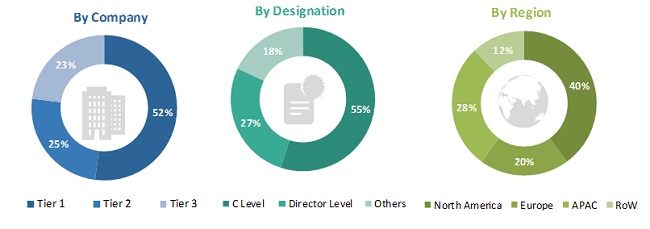
To know about the assumptions considered for the study, download the pdf brochure
Market Size Estimation
Both top-down and bottom-up approaches have been used to estimate and validate the total size of the situational awareness market. These approaches have also been used to determine the size of various subsegments of the market. The research methodology used to estimate the market size is as follows:
- Key players in the industry and markets have been identified through extensive secondary research.
- The industry’s supply chain and market size, in terms of value, have been determined through primary and secondary research processes.
- Players offering various types of situational awareness products are considered, their revenue for sensors has been analyzed to arrive at the global numbers.
- All percentage shares, splits, and breakdowns have been determined using secondary sources and verified through primary sources.
Data Triangulation
After arriving at the overall market size—using the market size estimation processes as explained above—the market has been split into several segments and subsegments. To complete the entire market engineering process and arrive at the exact statistics of each market segment and subsegment, the data triangulation, and market breakdown procedures have been employed, wherever applicable. The data has been triangulated by studying various factors and trends from both the demand and supply sides in the gas sensors market.
Report Objectives
- To estimate and forecast the size of the situational awareness market based on component, product, industry, application, and region, in terms of value
- To determine and forecast the size of the market in North America, Europe, Asia Pacific (APAC), and the Rest of the World (RoW), in terms of value
- To provide detailed information regarding drivers, restraints, opportunities, and challenges influencing the growth of the situational awareness market
- To strategically analyze micromarkets1 with respect to individual growth trends, prospects, and contribution to the total market
- To strategically profile key players and comprehensively analyze their market ranking in 2018 according to their revenue and core competencies2, along with a detailed competitive landscape of market leaders
- To analyze competitive developments, such as product launches, partnerships, acquisitions, and expansions, in the situational awareness market
- To benchmark players within the market using proprietary "Competitive Leadership Mapping" framework, which analyzes market players on various parameters within the broad categories of business and product strategy
1. Micro markets are defined as the further segments and subsegments of the situational awareness market included in the report.
2. The core competencies of the companies are captured in terms of their key developments and key strategies adopted by them to sustain their position in the situational awareness market.
Available Customizations:
With the given market data, MarketsandMarkets offers customizations according to a company’s specific needs. The following customization options are available for the report:
Company Information:
- Detailed analysis and profiling of additional market players













Growth opportunities and latent adjacency in Situational Awareness Market