Command and Control (C2) Systems Market Size, Share & Trends

Command and Control (C2) Systems Market by Offering (Hardware, Software), Operating Domain (Land, Air, Space, Cyber, Joint & Multi Domain), By Technology (conventional, Next-generation), End User, Deployment, Installation & Region -Global Forecast to 2031




COMMAND AND CONTROL (C2) SYSTEMS SIZE, SHARE & TRENDS
According to Marketsandmarkets, The global command and control (C2) systems market size was valued at USD 40.83 billion in 2026 and is projected to reach USD 54.34 billion by 2031 growing at a CAGR of 5.9% from 2026 to 2031. This growth is driven by the need to improve real-time information sharing, coordinate operations across multiple domains and strengthen decision-making in complex threat environments. Additionally, increasing defense modernization, interoperability requirements among allied forces and the need for resilient command networks are supporting demand for command and control systems across land, air, maritime, space, and cyber operations.
MARKET SNAPSHOT TABLE
| REPORT METRIC | DETAILS |
|---|---|
| Market Size in 2025 (Value) | USD 38.40 Billion |
| Market Size in 2026 (Value) | USD 40.83 Billion |
| Market Forecast in 2031 (Value) | USD 54.34 Billion |
| Growth Rate | CAGR of 5.9% |
| Years Considered | 2021–2031 |
| Base Year | 2025 |
| Forecast Period | 2026–2031 |
| Units Considered | USD Billion |
| Report Coverage | Revenue Forecast, Company Ranking, Competitive Landscape, Growth Factors, and Trends |
| Segments Covered |
|
| Regions Covered | North America, Europe, Asia Pacific, Middle East & Africa, and Latin America |
KEY TAKEAWAYS
-
By RegionThe Asia Pacific region is expected to register the highest CAGR of 6.9% during the forecast period.
-
By OfferingBy offering, software is expected to record the highest CAGR from 2026 to 2031.
-
By Operating DomainThe joint and multi-domain C2 segment is likely to be the fastest-growing operating domain from 2026 to 2031.
-
By Command LevelBy command level, the tactical segments is likely to hold a dominant market position throughout the forecast period.
-
By TechnologyBy technology, the conventional segment is likely to hold the largest market share in 2026.
-
By DeploymentBy deployment, the platform-integrated segment is expected to witness a CAGR of 6.8% during the forecast period.
-
By InstallationBy installation, the new installation segment is likely to experience the highest CAGR of 6.2% during the forecast period.
-
By End UserBy end user, the military & defense segment is likely to account for the largest market share in 2026.
-
Competitive Landscape - Key PlayersLockheed Martin Corporation (US), RTX (US), and Northrop Grumman Corporation (US) were identified as some of the star players in the command and control systems market, given their strong market share and product footprint.
-
Competitive Landscape - Startups/SMEsSystematic A/S has identified itself among SMEs by securing strong footholds in specialized niche areas, underscoring its potential as an emerging leader in the command and control market.
Growth in the Command and Control (C2) Systems Industry is supported by defense forces modernizing legacy C2 systems, improving interoperability, and integrating data from multiple operational domains. Demand is driven by the need for real-time situational awareness; faster information sharing; secure communications; and coordinated decision-making across land, air, maritime, space, and cyber operations.
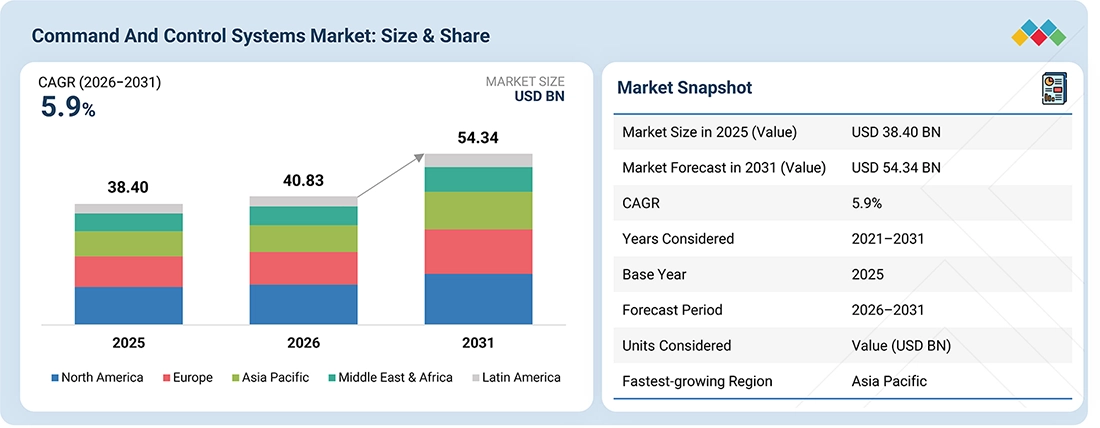
Source: Secondary Research, Interviews with Experts, MarketsandMarkets Analysis
TRENDS & DISRUPTIONS IMPACTING CUSTOMERS' CUSTOMERS
The command and control systems market is primarily influenced by the need for defense forces and security organizations to coordinate operations, process information, and support timely decisions across increasingly complex operational environments. Historically, command and control (C2) systems have relied on platform-specific architectures, on-premise command centers, hardware-centric operator consoles, standalone tactical communication systems, and service-specific operational networks. However, the market is shifting toward AI-enabled decision support, multi-domain data fusion, data-centric C2 architectures, and cloud-native command platforms that allow information from different operational domains to be integrated more effectively. This transition is further supported by the adoption of open architecture systems, Joint All-Domain Command and Control (JADC2), edge computing and tactical cloud capabilities, zero-trust cybersecurity, autonomous system integration, and continuous software modernization. These developments are changing how command centers and tactical units access, process, and share operational information with increasing relevance for defense ministries and armed forces, homeland and border security agencies, government and national security agencies, public safety and emergency response organizations, critical infrastructure operators, and civil aviation and maritime authorities. At the operational level, the changes directly affect joint force commanders, operational command centers, tactical field units, air and missile defense operators, emergency response commanders, and border security and coast guard operators. Customers across defense organizations are prioritizing faster decision-making, real-time situational awareness, multi-domain interoperability, AI-enabled data fusion, resilient communications, and open architectures. These requirements are translating into outputs such as shorter sensor-to-decision-to-action cycles, improved mission planning, coordinated cross-domain effects, reduced operator workload, and greater operational resilience. Recent NATO initiatives further emphasize AI-enabled decision superiority, trusted data sharing, interoperability, and human-machine collaboration as key requirements for future C2 capabilities.
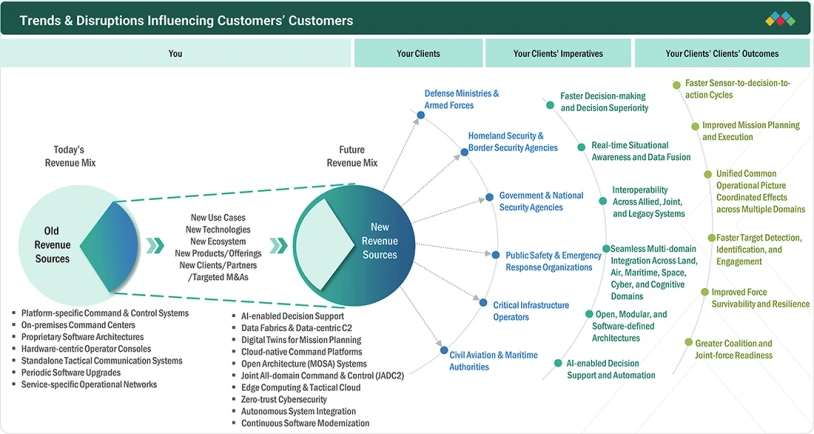
Source: Secondary Research, Interviews with Experts, MarketsandMarkets Analysis
MARKET DYNAMICS

Level
-
Modernization of legacy command-and-control infrastructure

-
Growing requirement for multi-domain operational coordination


Level
-
System fragmentation and interoperability constraints

-
High acquisition and lifecycle costs


Level
-
Emergence of AI-enabled decision-support applications

-
Integration of unmanned system command applications


Level
-
Protection–mobility trade-offs in tactical operations

-
Cybersecurity risks to mission-critical C2 networks

Source: Secondary Research, Interviews with Experts, MarketsandMarkets Analysis
Driver: Modernization of legacy command-and-control infrastructure
Defense organizations are replacing or upgrading legacy, platform-specific C2 systems with data-centric, open and interoperable architectures. The shift is driven by the need to connect information across operational domains, improve the speed of decision-making and reduce dependence on isolated systems. The US Army’s Next Generation Command and Control initiative is moving toward a unified data-centric architecture while NATO continues to test interoperability across C2 and information technology capabilities.
Restraint: System fragmentation and interoperability constraints
Current Command and Control (C2) environments frequently consist of disparate systems developed independently for specific services, platforms, or missions. This fragmentation hampers data interoperability and disrupts the ability to function as an integrated network. The prevalence of proprietary architectures, siloed data structures, and varying technical standards exacerbates the challenges associated with integrating new C2 capabilities. The US Government Accountability Office has characterized the issues surrounding system interoperability and data sharing as ongoing challenges. Concurrently, the U.S. Army has emphasized the necessity to transition from isolated systems to a more open, data-centric architecture. These constraints can impede modernization efforts and complicate the integration of emerging technologies with the legacy C2 infrastructure.
Opportunity: Emergence of AI-enabled decision-support applications
The increasing volume of operational data creates opportunities for AI-enabled decision support applications within C2 systems. AI can help commanders process large data volumes, identify relevant data, and support faster and more informed decisions. The US Department of Defense is integrating data, AI, and decision-support capabilities into its Combined Joint All-Domain Command and Control approach, while the US Army is incorporating AI tools into its next-generation C2 modernization efforts. This creates opportunities for C2 providers to develop decision-support functions that operate with data from multiple sensors, systems, and operational domains.
Challenge: Protection–mobility trade-offs in tactical operations
The primary technical obstacle is maximizing threat mitigation without increasing the physical load on personnel. Heavy tactical armor configurations cause rapid fatigue and long-term musculoskeletal strain, directly reducing individual movement speed, operational flexibility, and overall mission performance in the field.
COMMAND AND CONTROL (C2) SYSTEMS MARKET: COMMERCIAL USE CASES ACROSS INDUSTRIES
| COMPANY | USE CASE DESCRIPTION | BENEFITS |
|---|---|---|
 |
Lockheed Martin provides C2 systems that connect commanders, sensors, platforms, and weapons to support operational planning, situational awareness, and coordinated decision-making across defense operations. | Improves situational awareness | Supports faster decision-making | Enables coordination between sensors and forces | Provides a common operational view |
 |
Saab provides C2 systems for land and airborne operations that support the exchange of operational information, mission planning, situational awareness, and coordination between commanders and deployed forces. | Improves battlefield coordination | Supports real-time information sharing | Enables mission planning | Improves operational control |
 |
Northrop Grumman provides battle management and C2 systems that integrate information from sensors and operational assets to support command decisions, threat assessment, and coordinated responses across defense operations. | Integrates operational information | Supports threat assessment | Improves decision-making | Enables coordinated command and response |
Logos and trademarks shown above are the property of their respective owners. Their use here is for informational and illustrative purposes only.
MARKET ECOSYSTEM
The command and control systems ecosystem consists of prominent companies, small and medium-sized enterprises (SMEs), and end users that contribute to the development, integration, procurement, and deployment of C2 capabilities. Prominent companies such as Saab, Lockheed Martin, Northrop Grumman, RTX, Thales, General Dynamics, BAE Systems, Leonardo, L3Harris Technologies, Kongsberg Gruppen, Elbit Systems, Airbus Defence and Space, Rheinmetall, ASELSAN, CACI International, Palantir Technologies, Indra Sistemas, and Systematic provide C2 software, command centers, battle management systems, secure communications, mission planning and related command infrastructure. SMEs such as Helsing, Blackned, Rebellion Defense, 4C Strategies, Caryne, Searidge Technologies, CriticalArc, Adacel Technologies, and Carmenta contribute specialized software, data integration, decision-support, simulation and operational management capabilities. End users, including military and defense organizations, government, homeland security and public safety agencies, and civil and commercial organizations, generate demand through C2 modernization, interoperability requirements, and the need for faster information sharing and coordinated decision-making. This ecosystem supports the continued development and adoption of interoperable, data-centric, software-enabled and multi-domain C2 systems, and long-term capability upgrades, supporting the continued evolution of C2 systems across defense and critical infrastructure applications.
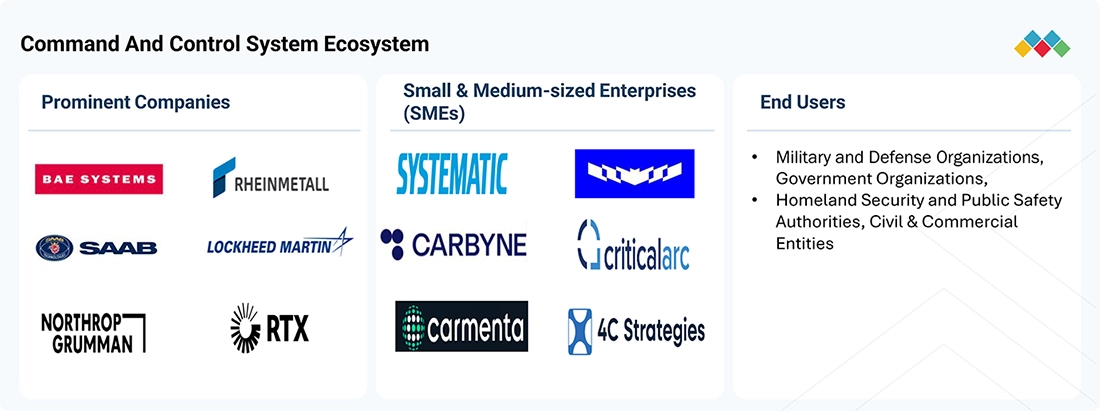
Logos and trademarks shown above are the property of their respective owners. Their use here is for informational and illustrative purposes only.
MARKET SEGMENTS
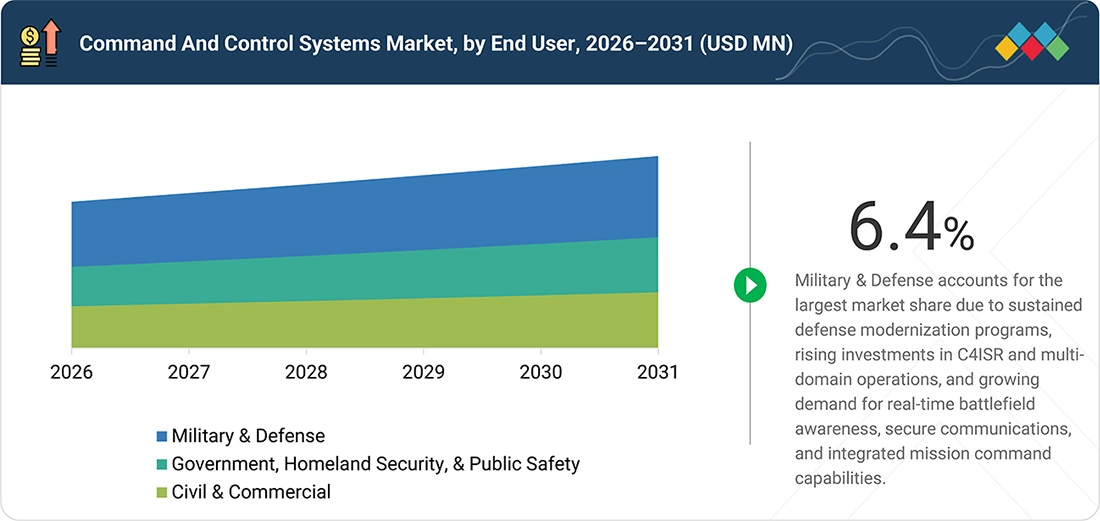
Source: Secondary Research, Interviews with Experts, MarketsandMarkets Analysis
Command and Control Systems Market, By Offering
The hardware segment is expected to account for the largest share of the command and control systems market during the forecast period. This position is supported by continued modernization of legacy command posts, tactical networks, computing systems, operator consoles, secure communications equipment, and other physical C2 infrastructure. Defense forces require deployable and survivable hardware to support command and decision-making in mobile and contested operating environments. Also, the expansion of multi-domain operations and interoperability requirements is increasing the need for networking and computing infrastructure capable of connecting systems and exchanging operational data. The replacement of aging equipment and continued upgrades to command posts and operational networks are, therefore, expected to sustain demand for C2 hardware.
Command and Control Systems Market, By Operating Domain
The Land C2 segment is expected to hold the largest market share in the forecast year due to continued modernization of army command posts, tactical networks, and land-force C2 systems. Demand is supported by the need for mobile, survivable and interoperable C2 capabilities, real-time ground situational awareness and coordination across divisions, brigades, and tactical units.
Command and Control Systems Market, By Command Level
The tactical segment is expected to record the highest CAGR during the forecast period due to increasing demand for mobile, deployable, and interoperable command capabilities at lower echelons. Modernization programs are improving tactical common operating pictures, real-time data sharing, and on-the-move decision-making while multi-domain operations are increasing the need for faster information exchange at the tactical edge.
command and control Systems Market, By Technology
The next-generation segment is expected to register the highest CAGR during the forecast period due to increasing adoption of data-centric, open, and software-based C2 architectures. Defense forces are moving away from isolated legacy systems toward integrated platforms using cloud technologies, AI, common data layers, and modular architectures to improve interoperability and accelerate battlefield decision-making.
command and control Systems Market, By Deployment
The fixed segment is expected to hold the largest market share throughout the forecast period due to continued investment in permanent command centers, data centers, headquarters, and supporting network infrastructure. These facilities provide the core infrastructure for sustained C2 operations, while modernization programs are improving their connectivity, resilience, processing capacity and interoperability across multiple operational domains.
Command and Control Systems Market, By Installation
The upgrade & modernization segment is set to hold a dominant market share over the forecast period as defense organizations continue to replace legacy C2 infrastructure while reusing usable systems. Modernization programs focus on improving interoperability, cybersecurity, mobility, and data sharing without requiring complete system replacement, supporting sustained investment in existing C2 installations.
Command and Control Systems Market, By End User
Military & defense holds the largest share of the command and control systems market due to the continuous modernization of armed forces and the critical need for real-time battlefield coordination across land, air, naval, space, and cyber domains. Defense organizations invest heavily in integrated command and control platforms to enhance situational awareness, intelligence sharing, sensor fusion, secure communications, and AI-enabled decision support, enabling faster and more effective mission execution in increasingly complex operational environments. Ongoing initiatives such as Joint and Combined All-Domain Command and Control further accelerate investments in interoperable and resilient C2 architectures, reinforcing the segment's dominant market position.
REGION
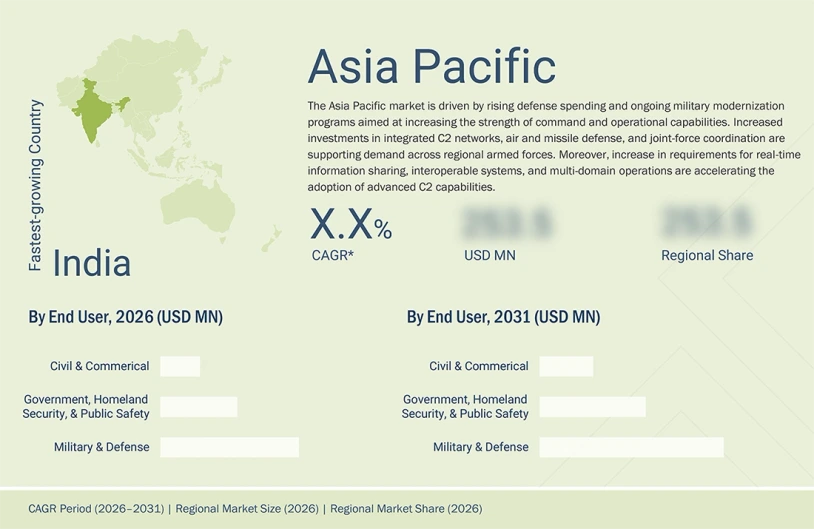
Asia Pacific to be fastest-growing region in command and control systems market during forecast period
The Asia Pacific region is expected to register the highest CAGR in the command and control systems market during the forecast period. Growth is supported by defense modernization, development of next-generation C2 capabilities, and increasing investment in integrated air and missile defense, joint operations, and resilient communications across countries.
COMMAND AND CONTROL (C2) SYSTEMS MARKET: COMPANY EVALUATION MATRIX
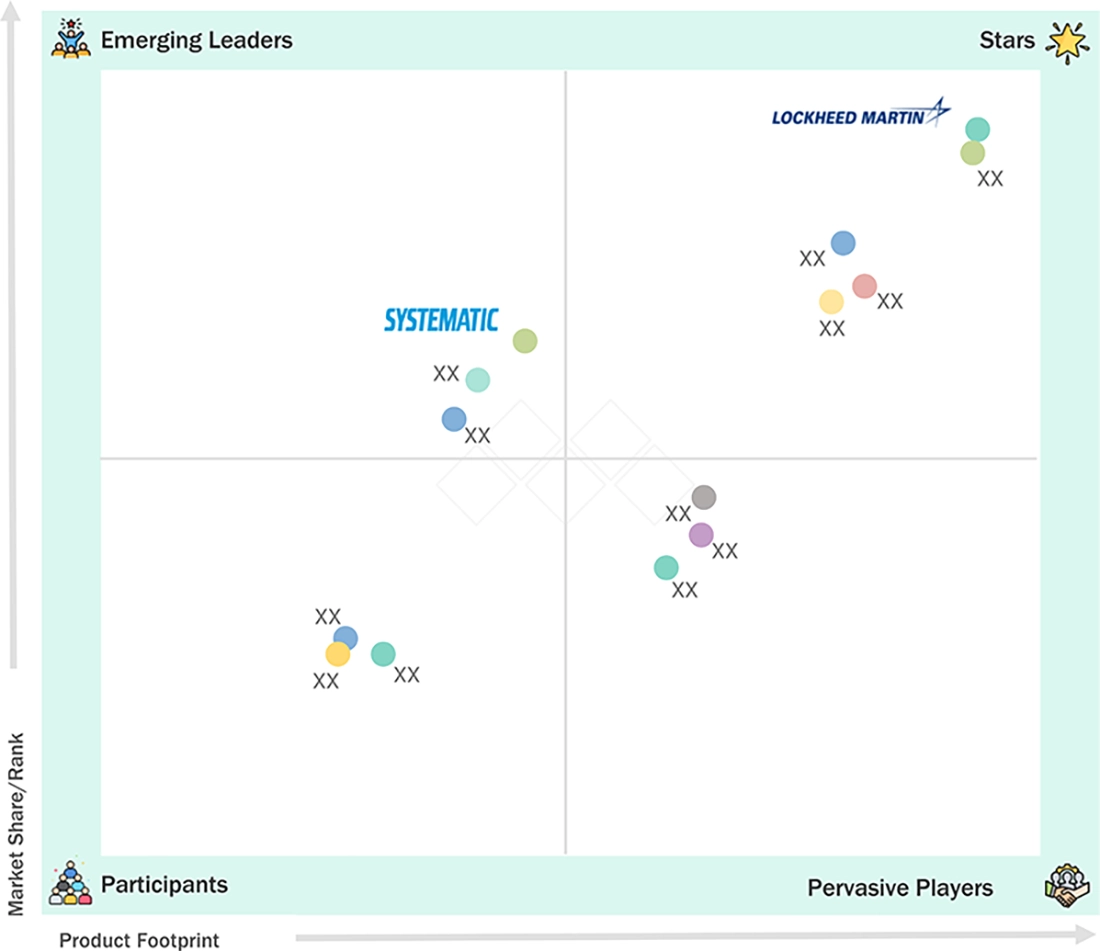
In the command and control systems market matrix, Lockheed Martin Corporation is categorized as a “Star” players because of its huge C2 portfolio, established position across defense programs and capabilities spanning battle management, multi-domain C2, air and missile defense, naval systems and next-generation command architectures. Its C2 portfolio includes Aegis, C2BMC, and next-generation software-defined C2 solutions, supported by extensive integration capabilities across sensors, weapons, and operational domains. Systematic A/S, on the other hand, is classified as an “Emerging Leader” because of its focused position in C2 software and battle management solutions, particularly through the SitaWare product family. Its software has been selected by NATO for Future Land C2 and is used across more than 50 countries, demonstrating strong interoperability and growing adoption. However, its portfolio is more focused on C2 software than the broader defense-system integration and multi-domain hardware capabilities offered by Lockheed Martin Corporation .
Source: Secondary Research, Interviews with Experts, MarketsandMarkets Analysis
KEY MARKET PLAYERS
List of Top Command and Control (C2) Systems Companies
- Lockheed Martin Corporation (US)
- RTX (US)
- Northrop Grumman (US)
- General Dynamics Corporation (US)
- Thales (France)
- BAE System (UK)
- L3Harris Technologies, Inc. (US)
- Saab AB (Sweden)
- Leonardo S.p.A. (Italy)
- Kongsberg (Norway)
- Elbit Systems Ltd. (Israel)
- Airbus (Germany)
- Rheinmetall AG (Germany)
- ASELSAN A.S. (Türkiye)
- CACI International Inc. (US)
- Palantir Technologies Inc. (US)
- Indra (Spain)
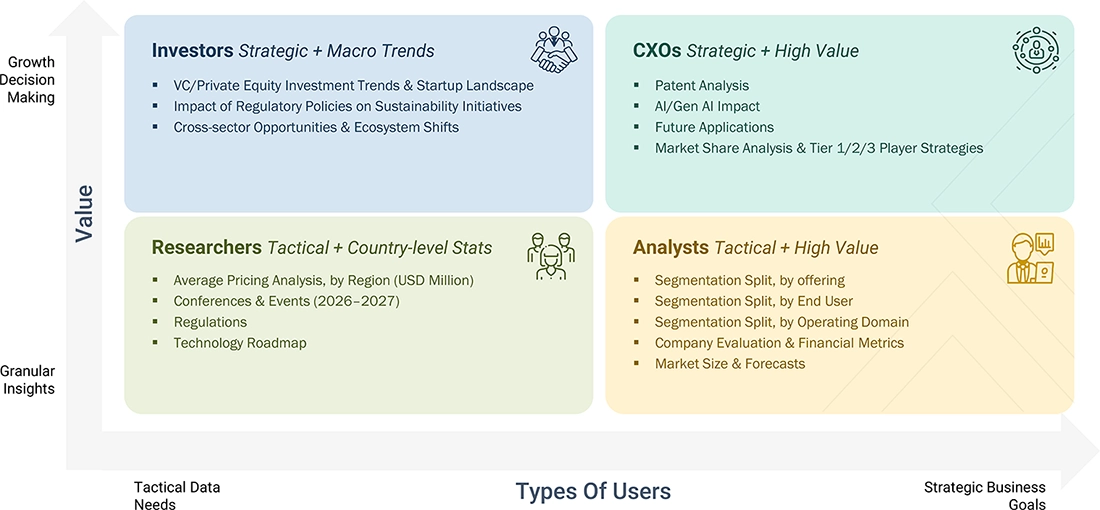
WHAT IS IN IT FOR YOU: COMMAND AND CONTROL (C2) SYSTEMS MARKET REPORT CONTENT GUIDE
DELIVERED CUSTOMIZATIONS
We have successfully delivered the following deep-dive customizations:
| CLIENT REQUEST | CUSTOMIZATION DELIVERED | VALUE ADDS |
|---|---|---|
| Leading Manufacturer | Additional segment breakdown for countries | Additional country-level market sizing tables for segments/subsegments covered at the regional/global level to gain an understanding of market potential by each country |
| Emerging Leader | Additional company profiles | Competitive information on targeted players to gain granular insights on direct competition |
| Regional Market Leader | Additional country market estimates | Additional country-level deep dive for a more targeted understanding of the total addressable market |
RECENT DEVELOPMENTS
- August 2026 : U.S. Marine Corps hosted the Maven Smart System Summit to accelerate service-wide integration of AI-enabled command-and-control capabilities, bringing together stakeholders across Headquarters Marine Corps, Marine Forces components, the Fleet Marine Force, and supporting organizations. The summit focused on scaling Maven Smart System (MSS) through stronger governance, sustainment, training, and operational frameworks, while informing the Marine Corps’ 2027 MSS Implementation Plan. With approximately 5,500 Marines using MSS on SIPR in the previous month, the event highlighted rapidly growing demand for data-centric and software-defined capabilities across the force.
- August 2026 : Kratos Defense & Security Solutions demonstrated beyond-line-of-sight command and control of a missionized Valkyrie Collaborative Combat Aircraft during a U.S. Marine Corps flight test. The Valkyrie transitioned control from a Kratos ground station to an Autonodyne-developed human-machine interface, enabling a Marine operator to control the aircraft over a BLOS link. The aircraft simultaneously conducted electronic warfare testing alongside F-35s and an F/A-18 before autonomously returning to its recovery point. The test marks the fourth new mission-system configuration flown on Marine Corps Valkyrie platforms in less than three years. The demonstration advances Kratos’ Valkyrie toward flexible, networked unmanned operations for contested military environments.
- July 2026 : HarTech Technologies won a major Southeast Asian naval project to develop and deploy a large tactical trainer built around Command and Control (C2) and Live-Virtual-Constructive (LVC) capabilities. The solution connects platforms, operators, and systems within a unified operational and training environment. HarTech Technologies is also developing C2 systems that integrate multiple air-defense, interception, jamming, and disruption systems. The technology supports applications ranging from naval operations and coastal defense to counter-drone and strategic-site protection.
- August 2025 : Northrop Grumman Corporation received a USD 99.13-million cost-plus-fixed-fee delivery order from Naval Air Systems Command to deliver Providence Distributed Battle Management Command and Control System Minimum Viable Products in support of the Combined Joint All-Domain Command and Control (CJADC2) architecture.
- September 2025 : Lockheed Martin Corporation was awarded a USD 26-million prototype agreement by the US Army to lead development on the data-centric Next Generation Command and Control (NGC2) system for the 25th Infantry Division, using a Modular Open Systems Architecture to streamline multi-domain battle management.
Table of Contents
 Exclusive indicates content/data unique to MarketsandMarkets and not available with any competitors.
Methodology
The study involved four major activities to estimate the current size of the command and control systems market. Exhaustive secondary research was conducted to gather information on the command and control systems market, its adjacent markets, and its parent market. The next step was to validate these findings, assumptions, and sizing with industry experts across the value chain through primary research. Demand-side analysis was conducted to estimate the overall market size. Thereafter, data triangulation procedures were employed to estimate the sizes of various segments and subsegments within the command and control systems market.
Secondary Research
During the secondary research process, various sources were consulted to identify and collect information for this study. The secondary sources included government sources, such as SIPRI; corporate filings, including annual reports, press releases, and investor presentations; white papers, journals, and certified publications; and articles from recognized authors, directories, and databases.
Primary Research
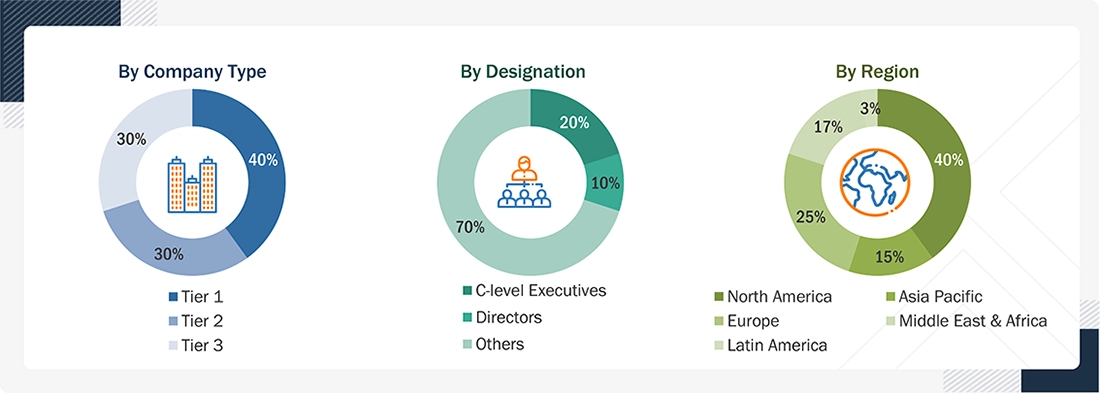
Extensive primary research was conducted after acquiring information on the command and control systems market through secondary research. Several primary interviews were conducted with market experts from the demand and supply sides across major countries of North America, Europe, the Asia Pacific, the Middle East and Africa, and Latin America. Primary data was collected through questionnaires, emails, and telephonic interviews.
To know about the assumptions considered for the study, download the pdf brochure
Market Size Estimation
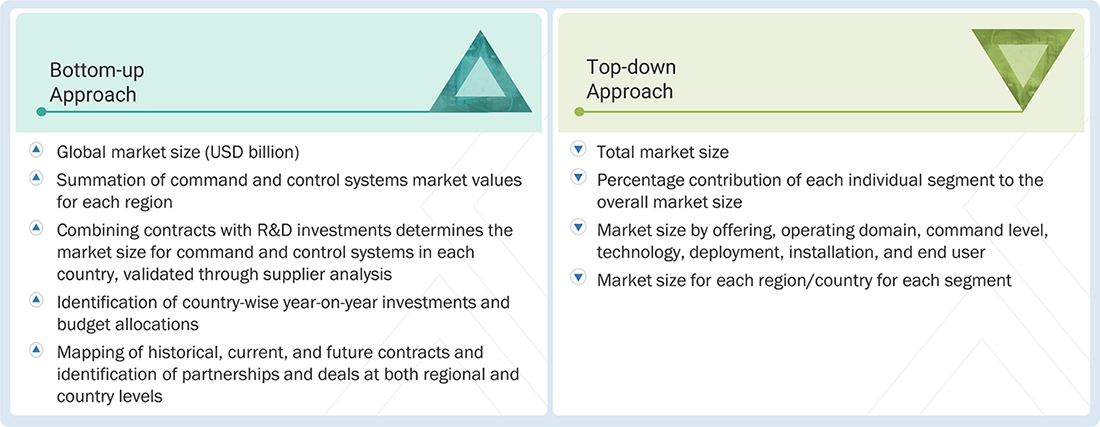
Top-down and bottom-up approaches were used to estimate and validate the size of the command and control systems market. The research methodology used to estimate the size of the market included the following details:
- Key players in the command and control systems market were identified through secondary research, and their market shares were determined through a combination of primary and secondary research. This included a study of the annual and financial reports of the top market players, as well as extensive interviews with leaders, including directors, engineers, marketing executives, and other key stakeholders of leading companies operating in the market.
- All percentage shares, splits, and breakdowns were determined using secondary sources and verified through primary sources.
- All possible parameters that affect the markets covered in this research study were accounted for, viewed in extensive detail, verified through primary research, and analyzed to obtain the final quantitative and qualitative data on the command and control systems market. This data was consolidated, enhanced with detailed input, analyzed by MarketsandMarkets, and presented in this report.
Command and Control (C2) Systems Market : Top-Down and Bottom-Up Approach
Data Triangulation
After determining the overall market size, the total market was classified into several segments and subsegments. The data triangulation and market breakdown procedures explained below were implemented, wherever applicable, to complete the overall market engineering process and arrive at the estimated market numbers for the market segments and subsegments. The data was triangulated by examining various factors and trends on both the demand and supply sides. Additionally, the market size was validated using top-down and bottom-up approaches.
Market Definition
The command and control systems market includes software, dedicated hardware, and associated services that enable authorized personnel to plan, direct, coordinate, task, monitor, and control military missions, public-safety incidents, transportation operations, and critical-infrastructure operations.
Key Stakeholders
- Prominent companies
- Small & medium-sized enterprises (SMEs)
- End users
- Regulatory and defense standards bodies
- Maintenance and support providers
- Technology and component suppliers
Report Objectives
- To define, describe, and forecast the command and control systems market based on offering, operating domain, command level, technology, deployment, installation, end user, and region in terms of value
- To forecast the size of various segments of the market across North America, Europe, Asia Pacific, the Middle East & Africa, and Latin America, in terms of value
- To identify and analyze the drivers, restraints, opportunities, and challenges influencing the growth of the market
- To identify industry trends, market trends, and technology trends currently prevailing in the market
- To analyze micromarkets with respect to growth trends, prospects, and their contribution to the overall market
- To analyze opportunities in the market for stakeholders by identifying key market trends
- To profile key market players and comprehensively analyze their market share and core competencies
- To evaluate the degree of competition in the market by analyzing recent developments, such as contracts, agreements, and acquisitions adopted by leading market players
- To identify detailed financial positions, key products, and unique selling points of leading companies in the market
- To provide a detailed competitive landscape of the market, along with market share analysis and revenue analysis of key players
Available customizations:
MarketsandMarkets offers the following customizations for this market report:
- Additional country-level analysis of the command and control systems market
- Profiling of other market players (up to five)
Product Analysis
-
Product matrix, which provides a detailed comparison of the product portfolios of each company in the command and control systems market


Personalize This Research
- Triangulate with your Own Data
- Get Data as per your Format and Definition
- Gain a Deeper Dive on a Specific Application, Geography, Customer or Competitor
- Any level of Personalization
Let Us Help You
- What are the Known and Unknown Adjacencies Impacting the Command and Control (C2) Systems Market
- What will your New Revenue Sources be?
- Who will be your Top Customer; what will make them switch?
- Defend your Market Share or Win Competitors
- Get a Scorecard for Target Partners

Custom Market Research Services
We Will Customise The Research For You, In Case The Report Listed Above Does Not Meet With Your Requirements
Get 10% Free CustomisationTESTIMONIALS
- Canada Command and Control Systems Market
- US Command and Control Systems Market
- UK Command and Control Systems Market
- Germany Command and Control Systems Market
- France Command and Control Systems Market
- Italy Command and Control Systems Market
- India Command and Control Systems Market
- Japan Command and Control Systems Market
- Singapore Command and Control Systems Market
- Australia Command and Control Systems Market
- Saudi Arabia Command and Control Systems Market
- UAE Command and Control Systems Market
- Israel Command and Control Systems Market
- South Africa Command and Control Systems Market
- Brazil Command and Control Systems Market
- Mexico Command and Control Systems Market
- Rest Of Europe Command and Control Systems Market
- Rest Of Asia Pacific Command and Control Systems Market
Growth opportunities and latent adjacency in Command and Control (C2) Systems Market




Hong
Oct, 2019
To build a business strategy for C2 systems, in APAC and Singapore, with a focus on the Singapore Government..