Data Center Fingerprint Sensor Market Size, Share, Trends and Growth Report by Technology (Capacitive, Optical, Ultrasonic, Thermal, Pressure-based), Deployment Mode (On-premises, Hybrid, Cloud-integrated), and End Users (Energy & Utilities, Healthcare, IT & Telecom) - Global Forecast to 2032


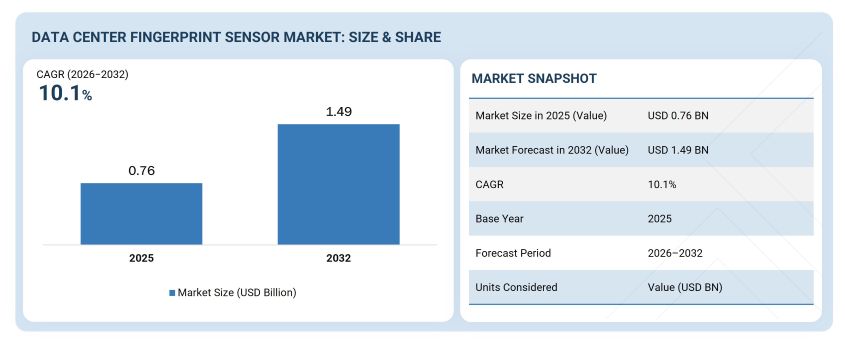
The global data center fingerprint sensor market was valued at approximately USD 760 million in 2025 and is projected to reach USD 1,490 million by 2032, expanding at a compound annual growth rate (CAGR) of 10.1% during the forecast period 2026 to 2032. This sustained double-digit trajectory is fuelled by an accelerating convergence of hyperscale data center buildout, zero-trust security mandates, and AI-driven identity verification that is making biometric-grade physical access control a non-negotiable infrastructure investment rather than a discretionary upgrade.
Asia Pacific is the fastest-growing region, driven by rapid hyperscale and colocation data center construction in China, India, Singapore, and South Korea, combined with government mandates for critical infrastructure security and surging demand from IT and financial services sectors. North America holds the largest revenue base, underpinned by the world's highest concentration of hyperscale operators — including AWS, Microsoft Azure, Google, and Meta — and mature enterprise compliance frameworks such as NIST, SOX, and HIPAA that mandate physical access controls. Europe maintains a strong and regulation-anchored position, with the EU's GDPR and NIS2 Directive creating sustained demand for auditable biometric access systems.
Top 10 Key Takeaways
- North America is the largest regional market, anchored by the world's densest concentration of hyperscale and colocation facilities combined with stringent federal and sector-specific compliance requirements.
- Asia Pacific is the fastest-growing region, with China, India, Singapore, and South Korea driving aggressive data center investment that directly lifts demand for advanced physical security technologies.
- Optical fingerprint sensors are the fastest-growing technology segment, gaining ground on legacy capacitive systems because they support contactless or low-touch form factors — a preference that hardened during the COVID-19 era and has persisted.
- Ultrasonic fingerprint sensors represent the premium performance tier, offering superior spoofing resistance and under-glass reliability that is increasingly demanded in high-security data center environments.
- BFSI and government/defense remain the dominant end-user verticals, driven by regulatory mandates and the severe consequences of unauthorized physical access to financial and classified computing infrastructure.
- Edge data centers are emerging as a high-growth deployment context, as distributed computing at the network edge multiplies the number of physical facilities requiring access management.
- AI integration — including on-chip AI inference for liveness detection and behavioral analytics — is the most transformative technology shift reshaping the fingerprint sensor product roadmap.
- Regulatory pressure from GDPR (Europe), NIST frameworks (North America), and emerging national biometric data laws is functioning as a sustained demand accelerator rather than a constraint.
- Vendor consolidation is reshaping the competitive landscape, with identity platform players acquiring or partnering with specialist sensor manufacturers to deliver integrated physical-digital security stacks.
- The primary near-term risk is supply chain exposure in semiconductor components used in advanced optical and ultrasonic sensors, which remains vulnerable to geopolitical disruption affecting APAC-based fabs.
Why the Data Center Fingerprint Sensor Market Demands Attention Now
Data centers are the load-bearing infrastructure of the digital economy. Every cloud workload, financial transaction, AI model inference, and streaming video request passes through a physical facility housing racks of servers, networking equipment, and storage arrays — all of which must be protected from unauthorized physical access with the same intensity as their cyber perimeter. The rapid expansion of hyperscale campuses, particularly in the United States, Europe, and across Southeast Asia, has massively increased the physical attack surface that security teams must defend. Fingerprint sensors, embedded in access control readers at cage doors, server room entrances, and colocation suites, provide the highest-assurance form of individual authentication available at scale — a biometric credential that cannot be shared, stolen from a forgotten password database, or cloned with a lost keycard.
The macro forces reinforcing this market are well-documented and persistent. Global data center capital expenditure reached record levels in 2024 and shows no sign of retreating, with hyperscalers committing multi-billion-dollar construction programs across North America, Europe, and the Asia Pacific to meet AI compute demand. Every new facility added to the global inventory is a potential deployment site for fingerprint-based access control. At the same time, the regulatory environment has moved from soft guidance to hard obligation. Europe's NIS2 Directive, which came into force for member states in late 2024, mandates physical security measures for critical digital infrastructure operators and explicitly names access controls as a compliance requirement. In North America, federal frameworks such as the NIST Cybersecurity Framework and FedRAMP incorporate physical security controls for facilities handling government data. These mandates create floor-level demand that persists through economic cycles.
The technology conversation inside the sector has also fundamentally shifted. Three years ago, the dominant question was whether biometrics were preferable to smart cards. Today, the question is which generation of biometric sensor — and which AI model — best satisfies liveness-detection requirements, spoofing resistance thresholds, and integration depth with cloud-native IAM platforms. That shift in conversation reflects a maturation from early adoption to at-scale deployment, and it is bringing a broader and more sophisticated buyer into the market.
Data Center Fingerprint Sensor Market Trends
The most consequential trend reshaping the data center fingerprint sensor market is the fusion of on-chip AI with the sensor itself. Traditional fingerprint sensors captured an image and forwarded it to a separate processor for matching. Contemporary edge-AI sensor modules execute feature extraction, liveness detection, and matching entirely within the sensor's own microcontroller or dedicated neural processing unit, eliminating network latency and reducing the risk of template interception in transit. Vendors, including Synaptics and Goodix Technology, have deployed this architecture in consumer electronics; the migration into enterprise and data center form factors is well underway, with several suppliers announcing ruggedized, high-throughput versions of on-chip AI sensors purpose-built for access control readers.
A parallel trend is the rise of multi-modal biometric systems that combine fingerprint recognition with other modalities — iris scan, facial recognition, or palm vein — at a single reader. This approach addresses two pain points simultaneously: it raises the assurance level for ultra-high-security zones such as hot aisle containment systems or network core rooms, and it provides a fallback modality when a gloved technician or a sensor surface contaminated by cooling fluid prevents reliable fingerprint capture. The data center environment, with its mixed population of IT staff, mechanical and electrical contractors, and security personnel, creates genuine operational demand for multi-modal flexibility.
Contactless optical fingerprint sensors have experienced rapid commercial momentum following the COVID-19 pandemic, and this preference has proven durable rather than transient. Touchless sensors reduce hygiene concerns and decrease sensor-surface wear in high-traffic data center entrances where hundreds of access attempts per day are common. Leading optical sensor suppliers have invested substantially in improving the angular capture range and resistance to ambient light interference that previously limited touchless performance in industrial lighting environments — issues now largely resolved in third-generation products.
Zero-trust security architecture adoption is another structural trend with direct implications for fingerprint sensor demand. Zero trust eliminates implicit trust based on network location and requires continuous verification of identity at every access layer — physical as well as logical. When a zero-trust policy engine governs both a user's network authentication and their physical building access, the fingerprint sensor at the data hall door becomes a node in an enterprise-wide identity fabric. This integration has driven demand for fingerprint readers with OSDP (Open Supervised Device Protocol) or REST API connectivity, capable of reporting access events in real time to SIEM and IAM platforms.
Key Drivers Accelerating the Data Center Fingerprint Sensor Market
The single most powerful driver of this market is the global data center construction boom, which shows every sign of sustaining its momentum through the forecast period. Hyperscale cloud providers — AWS, Microsoft Azure, Google Cloud, Meta, and their global peers — have announced aggregate capital expenditure plans exceeding USD 300 billion for 2025 alone, with physical infrastructure accounting for a substantial portion. Every new building requires access control, and the industry has broadly converged on biometric authentication as the standard for high-security zones. The sheer volume of new square footage coming online translates directly into sensor unit demand across hardware, software, and services.
Regulatory compliance functions as a durable structural driver that insulates the market from demand cycles. The EU's NIS2 Directive, effective since October 2024, imposes binding physical security requirements on operators of essential digital services — a category that includes most major colocation and hyperscale data center operators in Europe. GDPR simultaneously requires that any biometric data collected be processed with proportionate safeguards, which has accelerated demand for on-premises, encrypted-template sensor systems that minimize data transfer. In the United States, the Payment Card Industry Data Security Standard (PCI DSS) requires data centers handling payment card data to restrict and monitor physical access using methods that generate verifiable logs — a requirement fingerprint systems fulfill natively.
The escalating sophistication of insider threat scenarios is a third driver that security architects increasingly cite as a justification for investment. Shared PINs, borrowed keycards, and social engineering of reception staff remain the most common vectors for physical intrusion in corporate environments. Fingerprint authentication is inherently non-transferable — a person cannot hand their fingerprint to a colleague. For data center operators who must demonstrate that access logs constitute legally defensible audit trails for customers, regulators, and insurers, non-repudiation property is indispensable. The shift of cyber insurance underwriters toward requiring evidence of multi-factor physical access controls has added a financial incentive to the compliance imperative.
The proliferation of edge data centers — small-footprint compute nodes deployed in telecommunications exchange points, retail backrooms, and industrial facilities — is creating a new demand tier that did not exist five years ago. These facilities frequently operate with minimal on-site staff and no dedicated physical security personnel, making automated biometric access control not just preferable but operationally essential. The total addressable unit count for edge deployments is a multiple of the hyperscale count, and although per-unit revenue is lower, the aggregate market potential is substantial.
Data Center Fingerprint Sensor Market — Challenges and Restraints
Privacy regulation creates a genuine tension for the data center fingerprint sensor market, and it is worth examining honestly. While GDPR and its equivalents drive demand by mandating access controls, they simultaneously impose constraints on how biometric data may be collected, stored, and retained. In several European jurisdictions — including Germany's state-level data protection implementations — collecting biometric data from contractors and third-party visitors has been challenged by works councils and privacy regulators, forcing operators to deploy alternative authentication methods for non-employees. The regulatory environment is therefore simultaneously a driver and a headwind, with the balance depending on the specific jurisdiction and facility type.
The semiconductor supply chain represents the most acute operational risk. Advanced optical and ultrasonic fingerprint sensors depend on specialized CMOS image sensors and ultrasonic transducer arrays manufactured in a small number of fabs — predominantly in Taiwan and South Korea. The geopolitical risk concentration in the Taiwan Strait has prompted procurement diversification efforts, but alternative supply has not yet scaled to match demand growth. Extended lead times for sensor components have delayed data center security upgrade programs and forced some operators to maintain legacy card-reader infrastructure longer than intended.
High initial deployment costs remain a barrier for smaller colocation operators and enterprise data center owners who lack the capital planning cycles of hyperscale buyers. A fully integrated biometric access control system — covering sensors, embedded processors, IAM software, and professional services for enrollment and integration — carries a per-door cost that is meaningfully higher than a comparable smart card installation. The lifecycle cost argument in favor of biometrics (elimination of card issuance, replacement, and management overhead) is compelling over a five-year horizon but requires budget holders to think beyond a one-year capital appropriation, which is not universal in enterprise procurement.
Spoofing risk, while substantially reduced by liveness detection technology, remains a concern that informs buyer skepticism in some market segments. Artificial fingerprint spoofs made from gelatin or silicone remain a topic of active academic research, and while enterprise-grade sensors with ISO 30107-3 PAD (Presentation Attack Detection) certification have demonstrably higher resistance than consumer-grade equivalents, the perception gap between actual security performance and buyer confidence is real. Overcoming this perception gap requires education as much as product improvement.
Industry and Application Growth in the Data Center Fingerprint Sensor Market
The BFSI sector — banking, financial services, and insurance — stands as the dominant and most demanding end-user vertical for data center fingerprint sensor technology. Financial institutions operate private and leased data center space that processes transaction records, customer data, and algorithmic trading infrastructure, all of which carry catastrophic liability exposure in the event of a physical breach. Regulatory frameworks, including PCI DSS, SOX, and Basel III operational risk requirements, mandate verifiable physical access controls, and regulators routinely audit access logs during compliance examinations. This creates a recurring procurement cycle driven not by discretionary security investment but by the annual cost of non-compliance. Global banks, including JPMorgan Chase, HSBC, and Deutsche Bank, have reported multi-year physical security modernization programs that include biometric access control as a central component.
Government and defense represent the second anchor vertical. National security agencies, military cloud facilities, and government-leased colocation space operate under classified security protocols that frequently mandate biometric verification at every access layer. The US Department of Defense's cloud strategy, concentrated on classified workloads in facilities certified under the DoD Impact Level 4, 5, and 6 framework, drives consistent demand for high-assurance fingerprint systems that meet FBI CJIS and DoD-specific certification requirements. Similar dynamics apply to defence ministries in the United Kingdom, France, Germany, and Australia.
The IT and telecom sector is the broadest addressable market by facility count, encompassing hyperscale cloud campuses, network exchange points, and the expanding edge node estate of major telecommunications carriers. Operators such as AT&T, Deutsche Telekom, and NTT Global Data Centers are actively standardizing biometric access across their global data center portfolios as part of ISO 27001 certification maintenance programs. Telecom network core facilities — housing routing infrastructure critical to national communications continuity — are increasingly treated as critical national infrastructure with correspondingly elevated physical security requirements.
Healthcare data centers, which host electronic health records, medical imaging archives, and increasingly AI-driven clinical decision support systems, face a distinct regulatory driver in HIPAA's physical safeguard requirements in the United States and equivalent frameworks across the EU and Asia Pacific. The sensitivity of patient data and the headline risk of a breach combine to make healthcare data center operators unusually willing to invest in premium security infrastructure. The accelerating digitization of healthcare — accelerated by telemedicine adoption and AI diagnostics — means healthcare data center capacity is growing at rates that rival financial services.
Retail and e-commerce operators have emerged as a growing demand segment as they build owned data center capacity to support real-time inventory management, personalization engines, and payment processing. Retailers handling large volumes of PCI-scoped transaction data face the same compliance drivers as financial institutions and are increasingly applying enterprise-grade physical security standards to their computing facilities. The energy and utilities sector represents a smaller but strategically significant vertical, where operational technology data centers supporting grid management, SCADA systems, and smart metering infrastructure are increasingly classified as critical national infrastructure subject to mandatory cybersecurity and physical security frameworks.
Data Center Fingerprint Sensor Market Segment Insights
By Technology
Capacitive fingerprint sensors hold the leading position in the market by installed base, reflecting their long commercial history and proven reliability in enterprise access control applications. The technology's strength lies in its mature manufacturing ecosystem, well-understood environmental performance characteristics, and wide compatibility with existing access control infrastructure. Capacitive sensors require physical contact, which enhances image quality and reduces ambient-light sensitivity — important considerations in data center environments where entrance lighting conditions vary significantly between exterior checkpoints and interior server hall access points.
Optical fingerprint sensors are advancing most rapidly, fuelled by touchless variants that address hygiene preferences and high-throughput entry points where contact fatigue is a genuine operational issue. Third-generation optical sensors have substantially closed the performance gap with capacitive technology in terms of false acceptance rate and resistance to artificial spoofs, and their ability to operate without direct skin contact makes them the technology of choice for new installations at major colocation facilities. Ultrasonic sensors occupy the premium tier, with superior performance on wet, dirty, or damaged fingerprint surfaces — conditions encountered when data center technicians work with cooling fluids and cabling — and are the standard specification for the most demanding classified government and financial sector deployments.
By Component
Hardware dominates the market by revenue contribution, encompassing the sensor module itself, embedded processing units, and the access control panels that integrate biometric readers into facility management systems. The hardware segment benefits from the expanding unit economics of new data center construction — each new facility requires a defined number of readers per tier of access, creating predictable hardware demand that scales with construction activity. Within hardware, sensor modules with integrated AI processing — removing the need for a separate embedded controller — are gaining share rapidly as they reduce installation complexity and total bill of materials.
Software is the fastest-growing component segment, driven by the increasing value of the analytics, IAM integration, and compliance reporting capabilities that transform raw biometric authentication events into actionable operational intelligence. Biometric middleware that federates identity across physical and logical access layers — so that a data center technician's fingerprint enrollment in the physical access system also governs their virtual machine console access — represents a rapidly expanding software opportunity that did not exist as a distinct commercial product category five years ago. Service revenues for integration, enrollment, and maintenance grow in direct proportion to hardware deployment volumes and benefit from recurring revenue dynamics.
By Deployment Mode
On-premises deployment remains the dominant mode, reflecting both the security sensitivity of biometric template storage and the preference of heavily regulated operators to maintain complete control over identity data. Many financial and government data center operators are contractually or legally prohibited from storing biometric templates in shared cloud environments, which makes on-device or on-premises template storage a compliance requirement rather than a preference. This creates a stable, high-margin market for on-premises sensor and software solutions that deliver enterprise-grade performance within air-gapped or highly restricted network environments.
Cloud-integrated and hybrid deployment modes are the fastest-growing, reflecting the broader industry shift toward cloud-native IAM platforms that unify physical and digital identity management. Operators running multi-site data center portfolios increasingly prefer a hybrid model where the fingerprint template is processed and stored locally at each facility, but audit logs and policy management are consolidated in a cloud-based identity governance platform. This architecture satisfies compliance requirements for data locality while enabling the operational efficiency of centralized identity lifecycle management.
By Data Center Type
Hyperscale data centers generate the highest per-facility revenue for fingerprint sensor vendors because of their scale and security architecture sophistication. A typical hyperscale campus may require hundreds of biometric readers covering external perimeter access points, internal zone transitions, server room entrances, power and cooling infrastructure access, and network operations center entry — each requiring both a reader and integration with the campus's physical security management system. The concentration of the hyperscale buildout in specific markets — Northern Virginia, Dublin, Singapore, and the Greater Tokyo Area — creates geographically concentrated demand that regional system integrators service intensively.
Edge data centers are the fastest-growing deployment context by facility count, though average revenue per site is lower than hyperscale. The defining operational characteristic of edge nodes — minimal or zero on-site security personnel — makes biometric access control not a premium addition but a baseline operational requirement. The growth of mobile edge computing (MEC) deployments by major telecommunications carriers, combined with the expansion of retail edge facilities by hyperscale operators, is adding thousands of edge sites per year to the global addressable market.
By End-User Industry
BFSI commands the leading share of the market by vertical, combining a high willingness to pay for security assurance with an exceptionally dense regulatory compliance mandate. The sector's sensitivity to reputational damage from physical security incidents — and the direct financial liability associated with unauthorized access to payment processing or trading infrastructure — sustains premium product adoption and accelerates upgrade cycles relative to other verticals.
Healthcare is the fastest-growing end-user vertical for data center fingerprint sensors, driven by the rapid expansion of digital health infrastructure and the increasingly rigorous application of physical safeguard requirements under HIPAA and equivalent frameworks. AI diagnostics platforms, genomic data repositories, and federated clinical trial databases all require data center infrastructure with physical access controls that can withstand regulatory audit — a profile perfectly suited to advanced biometric authentication systems.
Segment Insights — Key Conclusions
- Optical and ultrasonic fingerprint technologies are gaining share against the legacy capacitive base, with contactless optical systems leading in new installations and ultrasonic commanding the premium government and financial sector specification.
- The software and services components are growing faster than hardware as the analytics, IAM integration, and compliance reporting layer becomes commercially differentiated and margin-accretive.
- On-premises deployment dominates in regulated verticals, while hybrid deployment is the fastest-growing mode as multi-site operators seek centralized policy management without compromising data locality compliance.
- Edge data centers represent a structurally different and rapidly expanding addressable market where the unit economics per site are lower, but the total facility count is orders of magnitude larger than hyperscale.
- BFSI leads by vertical spend, but healthcare is emerging as the fastest-growing demand source, driven by the digitization of health infrastructure and escalating physical safeguard compliance requirements.
Data Center Fingerprint Sensor Market — Regional Analysis
North America
North America holds the largest share of the data center fingerprint sensor market globally, reflecting the region's preeminent position in global data center infrastructure and its mature regulatory compliance culture. The United States is home to the world's most concentrated cluster of hyperscale campuses — Northern Virginia alone hosts the highest density of data center power capacity anywhere on earth — alongside a vast installed base of enterprise and colocation facilities serving financial services, healthcare, and federal government workloads. The North American market was valued at approximately USD 320 million in 2025 and is projected to reach approximately USD 610 million by 2032, and is expected to expand at a CAGR of 9.7% during the forecast period. Canada contributes a growing share through its hyperscale-attractive markets in Toronto, Montreal, and Vancouver, where government-backed digital infrastructure initiatives have attracted significant investment from US hyperscalers seeking data sovereignty-compliant capacity. Mexico's contribution remains modest but is growing as nearshoring trends bring light industrial edge computing requirements into the addressable market.
Europe
Europe is a regulation-driven market where demand for data center fingerprint sensors is structurally supported by the convergence of NIS2, GDPR, and national-level critical infrastructure protection frameworks. Germany and the United Kingdom are the largest individual markets, with Germany's industrial data center infrastructure serving the manufacturing sector's operational technology requirements and the UK's financial services concentration driving the BFSI sector demand. France, the Nordics — particularly Amsterdam and the Stockholm-Helsinki corridor — and Ireland each host significant colocation capacity serving pan-European cloud demand. The European market was valued at approximately USD 195 million in 2025 and is projected to reach approximately USD 370 million by 2032, reflecting a CAGR of 9.6% — slightly below the global average due to the slower new-build pace relative to APAC, offset by regulatory-driven upgrade programs in existing facilities. Italy and Spain represent emerging growth pockets as southern European data center investment has accelerated following improved renewable energy availability.
Asia Pacific
Asia Pacific is the fastest-growing region in the data center fingerprint sensor market and is expected to maintain that leadership through 2032. The region's growth reflects the simultaneous scale-up of hyperscale infrastructure in China and India, the maturation of Singapore as a global data center hub, and the emergence of South Korea and Japan as significant enterprise and government cloud deployment markets. Valued at approximately USD 185 million in 2025, the Asia Pacific market is projected to reach approximately USD 395 million by 2032, expanding at a CAGR of 11.5% — the highest among all regions. China's government-driven push for data localization, combined with the country's own hyperscale operators building facilities at exceptional scale, creates compound demand: new facilities requiring access control, combined with regulatory requirements for Chinese citizen data to be stored in domestically managed infrastructure with verifiable physical security. India's National Data Center Policy and the expansion of cloud regions by AWS, Microsoft, and Google across Mumbai, Hyderabad, and Pune add further momentum. Singapore's role as APAC's premier colocation hub for multinational corporations sustains premium demand for enterprise-grade biometric systems. Australia and South Korea are mature markets with high compliance intensity — Australian operators increasingly reference APRA CPS 234 standards for physical security, and South Korean chaebols with large private data center estates are systematic adopters of advanced access control.
Rest of World
The Rest of World region — encompassing Latin America, the Middle East, and Africa — represents the smallest absolute revenue base but is undergoing a genuine structural expansion of data center investment that is beginning to translate into meaningful fingerprint sensor demand. The Middle East, led by the UAE and Saudi Arabia, is the most dynamic subregion: both countries have committed to national cloud strategies that involve building hyperscale-class government cloud facilities and attracting global operators through free zone incentives and guaranteed power supply. The Rest of the world market was valued at approximately USD 60 million in 2025 and is projected to reach approximately USD 115 million by 2032, at a CAGR of 9.7%. Brazil is the leading Latin American market, with São Paulo-centric data center expansion driven by Brazil's growing fintech sector and digital government service modernization. South Africa hosts the continent's most sophisticated data center market, with Johannesburg and Cape Town clusters serving multinational corporate and telecommunications demand.
Regional Outlook — Key Conclusions
- North America maintains global market leadership by absolute revenue, anchored by hyperscale density in Northern Virginia and Silicon Valley, combined with a compliance culture that drives systematic physical security investment.
- Asia Pacific is the fastest-growing region by CAGR, with China, India, and Singapore as the primary growth engines and a regulatory environment increasingly aligned with strict data localization and physical security mandates.
- Europe's growth is regulation-anchored and upgrade-cycle-driven — NIS2 and GDPR create durable demand for biometric access control in existing and new facilities with relatively predictable procurement timelines.
- The Middle East — particularly the UAE and Saudi Arabia — is the fastest-growing subregion within Rest of World, driven by Vision 2030-aligned data sovereignty strategies and aggressive hyperscale attraction programs.
- Edge data center proliferation is expanding the addressable market in all regions, with particularly rapid edge growth in APAC telecommunications deployments and in Latin American retail and fintech infrastructure.
Country-Specific Insights
The United States is the market's most sophisticated buyer environment, characterized by a mature procurement framework for physical security technology, a large and well-funded system integrator ecosystem, and regulatory requirements — federal, state, and sector-specific — that create differentiated demand across government, financial, healthcare, and commercial data center segments. Northern Virginia's unprecedented data center density, combined with the concentration of federal government cloud (FedRAMP-authorized) facilities in the Washington DC corridor, makes the mid-Atlantic region the world's most commercially intense market for enterprise fingerprint sensor solutions. The CHIPS and Science Act and associated federal investment in domestic semiconductor manufacturing have a secondary benefit for domestic fingerprint sensor vendors, as improved domestic component supply reduces exposure to APAC supply chain disruptions.
China presents a paradox: it is both the world's most rapidly expanding data center construction market and one of the most difficult for non-Chinese vendors to address due to technology sovereignty policies. The domestic supply chain — including sensor IC manufacturers and access control system integrators — is well-developed, and Chinese hyperscale operators such as Alibaba Cloud, Tencent Cloud, and Huawei Cloud typically procure from domestic or China-certified suppliers. The market opportunity is therefore most accessible to vendors with established China-based manufacturing, joint ventures, or technology licensing arrangements.
India is the most open and accessible of the major APAC growth markets for global fingerprint sensor vendors. The government's push to establish data centers as infrastructure assets under the National Infrastructure Pipeline, combined with a rapidly professionalizing colocation sector led by operators such as CtrlS, Nxtra Data, and STT GDC India, creates procurement environments where global vendor relationships are actively welcomed. The dense concentration of major IT services firms in Bangalore, Hyderabad, and Chennai also drives enterprise data center demand with a strong preference for internationally certified security products.
Germany's data center market operates under the most complex regulatory overlay in Europe — combining GDPR implementation through the BDSG, state-level data protection enforcement, and works council requirements that affect biometric enrollment programs. Despite this complexity, Germany remains the largest European data center market by power capacity, and its strong industrial customer base — including automotive OEMs and chemicals companies running significant private cloud and on-premises data center estates — creates sustained enterprise demand for physical security systems that meet both security and privacy compliance requirements simultaneously.
Singapore, despite its small geography, is a disproportionately important market because of its role as the preferred APAC base for multinational cloud infrastructure. Global hyperscalers, financial services firms, and government cloud programs across Southeast Asia terminate or transit through Singapore's colocation fabric. The government's regulatory framework — including the Personal Data Protection Act (PDPA) and the Critical Information Infrastructure (CII) designation for data centers — creates a well-defined compliance environment that favors investment in proven, certified biometric access control products from established vendors.
Country Insights — Key Conclusions
- The United States remains the world's largest single-country addressable market, with government cloud facilities, financial sector data centers, and hyperscale campuses driving differentiated demand across multiple regulatory frameworks.
- China's market is growing at an exceptional pace but is dominated by domestic suppliers, making it most accessible to vendors with local manufacturing or certified technology partnerships rather than direct import-based sales.
- India represents the most accessible high-growth emerging market for global fingerprint sensor vendors, with a professionalized colocation sector and IT services demand base actively seeking international certification-grade products.
- Germany's regulatory complexity — combining GDPR, BDSG, and works council requirements — does not suppress demand but does shape procurement timelines and product specifications, favoring vendors with deep regional regulatory expertise.
- Singapore's outsized strategic importance as APAC's multinational cloud hub sustains premium demand for internationally certified fingerprint sensor systems that satisfy both security performance and data privacy compliance requirements.
Key Companies in the Data Center Fingerprint Sensor Market
The competitive landscape of the data center fingerprint sensor market spans dedicated biometric hardware vendors, integrated physical security platform providers, and technology conglomerates with broad security portfolios. The following companies represent the primary players whose products and platforms are actively deployed or specified in data center access control programs globally:
- Suprema Inc.
- HID Global Corporation (Assa Abloy)
- Identiv, Inc.
- Synaptics Incorporated
- Egis Technology Inc.
- Fingerprint Cards AB (FPC)
- IDEMIA Group
- Goodix Technology Co., Ltd.
- NEC Corporation
- Lenel S2 (Carrier Global)
- Bosch Security Systems
- Anviz Global Inc.
- SecuGen Corporation
- ZKTeco Co., Ltd.
Suprema Inc. remains one of the most referenced brands in high-security access control environments globally, with its BioEntry and BioStation product lines widely deployed in enterprise and government data centers. The company has invested significantly in multi-modal biometric readers that combine fingerprint with facial recognition — a dual-modality approach increasingly specified for high-throughput data center entry points. HID Global, operating within the Assa Abloy security ecosystem, brings a scale and channel advantage that few pure-play biometric vendors can match: its ability to bundle fingerprint readers with its established credential management and physical access control software provides a compelling total-solution proposition for large enterprises and colocation operators seeking a single-vendor relationship.
IDEMIA Group, a Paris-headquartered identity technology leader, focuses on the highest-assurance segment of the market — including government and classified defense facilities — where its certification credentials under national biometric standards carry significant procurement weight. Its partnership with hyperscale cloud providers on physical identity programs has positioned it at the intersection of physical and logical access convergence. Synaptics and Goodix Technology, primarily known as silicon-layer fingerprint sensor IC suppliers, are increasingly relevant to the data center market as their on-chip AI architectures migrate into enterprise hardware platforms. Their technology underlies the sensor modules of numerous branded access control products, making them influential in the supply chain even when not visible as an end-market brand.
ZKTeco and Anviz Global represent the value-tier competitive dynamic — Chinese-origin vendors that have built competitive product lines at meaningfully lower price points than Western incumbents, and have gained traction in cost-sensitive markets across Southeast Asia, Latin America, and parts of the Middle East. Their increasing certification compliance with international standards (FIDO2, ISO 30107-3 PAD) is closing the specification gap with premium vendors in segments outside the most highly regulated government and financial deployments.
Key Company Strategies — Summary
- Leading vendors are converging on multi-modal biometric reader platforms that combine fingerprint with facial recognition, addressing both the highest-security zones that demand dual modality and the high-throughput entrances where facial recognition alone provides operational speed advantages.
- On-chip AI for liveness detection and anti-spoofing is emerging as the primary product differentiation axis, with sensor silicon suppliers such as Synaptics and Goodix driving architectural innovation that branded access control vendors are incorporating into their product roadmaps.
- Integration depth with major IAM platforms — Microsoft Azure Active Directory, CyberArk, and Okta — is becoming a procurement criterion as enterprise buyers seek to unify physical and logical identity management rather than operate parallel systems.
- Value-tier Chinese vendors are closing the certification gap with international standards compliance, creating competitive pressure in price-sensitive emerging markets and forcing premium vendors to articulate clearer performance and support differentiation.
- Vendor consolidation is accelerating as physical security platform providers acquire specialist biometric companies to expand their technology portfolio depth and reduce customer dependency on multi-vendor integration.
Recent Developments
- In January 2025, Suprema Inc. announced the BioEntry W3 fingerprint reader with integrated OSDP v2 support and an expanded operating temperature range, specifically positioning the product for industrial and edge data center environments where ambient conditions fall outside the tolerance of previous generation sensors.
- In October 2024, HID Global released an updated version of its biometric access control platform, integrating with Microsoft Entra ID (formerly Azure AD), enabling organizations to enforce conditional access policies that span both physical building entry and cloud application authentication from a unified identity governance console.
- In September 2024, IDEMIA announced a multi-year contract with a European government cloud operator to deploy its MorphoWave Compact contactless fingerprint readers across secure government data center facilities in multiple EU member states, citing the NIS2 Directive's physical security requirements as the procurement trigger.
- In March 2025, Fingerprint Cards AB (FPC) published validation results for its T-Shape sensor module meeting ISO 30107-3 Level B presentation attack detection requirements, providing independent certification evidence for enterprise access control hardware suppliers incorporating its sensor silicon.
Real-World Use Cases
In 2023, Equinix — the world's largest colocation data center operator by revenue — expanded its deployment of multi-modal biometric access control across its IBX data centers in key markets including Frankfurt, Singapore, and Silicon Valley. The company integrated Suprema fingerprint and facial recognition readers with its proprietary Physical Security Information Management (PSIM) system to create unified access audit trails satisfying ISO 27001 compliance requirements and supporting the audit rights embedded in its customer colocation agreements. The deployment replaced legacy magnetic stripe and smart card systems at high-traffic customer access zones, reducing security incident response time and eliminating the keycard loss workflow that had historically added operational overhead to its global security operations center.
In 2024, a major US federal government cloud facility operator — operating facilities under FedRAMP High authorization — deployed Identiv's biometric access control systems across a new campus in Northern Virginia. The implementation was driven by a DoD contract requirement specifying fingerprint-verified access logging for all personnel entering server halls hosting IL4 and IL5 classified workloads. The project required integration with the facility's existing PACS (Physical Access Control System) using OSDP protocol, non-networked biometric template storage on each reader to satisfy air-gap requirements, and enrollment of cleared contractors as well as permanent staff — a multi-phase deployment managed by a GSA-schedule-approved system integrator partner.
Market Segmentation Overview
The data center fingerprint sensor market is segmented across five primary commercial dimensions that collectively define the product, deployment, and demand structure of the industry. By technology, the market spans capacitive, optical, ultrasonic, thermal, and pressure-based sensor types, with the commercial center of gravity transitioning from capacitive — the long-dominant installed base — toward optical and ultrasonic technologies that better address the hygiene, performance, and anti-spoofing requirements of modern high-security access control programs. By component, the market covers hardware (sensor modules, embedded processors, and access control panels), software (biometric middleware, IAM integration, and audit analytics), and professional services — with the software and services layers growing in relative importance as integration complexity and compliance reporting demands increase.
By deployment mode, on-premises solutions remain dominant in regulated verticals requiring strict data sovereignty, while hybrid and cloud-integrated deployments are growing fastest among multi-site colocation and enterprise operators seeking centralized policy management. By data center type, hyperscale facilities generate the highest revenue per deployment, but edge data centers are expanding the total addressable unit count most rapidly. By end-user industry, BFSI and government/defense anchor demand through regulatory compliance requirements, while healthcare represents the fastest-growing vertical, driven by digital health infrastructure expansion. The regional dimension adds a sixth segmentation lens, with North America leading by revenue base, Asia Pacific leading by growth rate, Europe anchored by regulatory demand, and the Rest of World emerging through Middle Eastern sovereign cloud investment and Latin American fintech infrastructure development.
Segmentation — Key Conclusions
- Technology segmentation is in transition — the capacitive installed base dominates current revenue, but optical contactless and ultrasonic sensors are capturing the majority of new specification wins.
- Component segmentation reveals a structural shift toward software and services revenue as the biometric analytics and IAM integration layer commands an increasing share of total system value.
- Deployment mode segmentation reflects a regulatory bifurcation: on-premises for the most compliance-intensive verticals, hybrid for multi-site enterprise operators seeking operational efficiency without data locality compromise.
- Data center type segmentation highlights the dual-engine growth dynamic: hyperscale driving high per-site revenue and edge driving high unit volume, creating complementary demand profiles for vendors with broad product portfolios.
- Vertical segmentation underscores that BFSI and government/defense are structurally committed buyers while healthcare and retail represent the highest growth optionality as their data center footprints expand and compliance requirements intensify.
Conclusion and Future Outlook
The data center fingerprint sensor market is entering a phase of sustained, structurally supported expansion that extends well beyond the forecast period to 2032. The convergence of AI-native sensor architectures, zero-trust physical security frameworks, and the largest sustained data center construction cycle in the industry's history has created a market where the growth drivers are cumulative rather than independent — each reinforcing the others in ways that are difficult to interrupt. AI is particularly transformative: as large language model inference workloads concentrate in dedicated AI training and inference clusters with their own physical perimeter requirements, and as AI-enhanced liveness detection makes biometric sensors more secure and harder to spoof, the technology functions simultaneously as a demand driver (more facilities requiring access control) and a product capability amplifier (better products justifying broader deployment). Sustainability and ESG considerations are emerging as an additional dimension — biometric systems that replace plastic card consumables and reduce the energy footprint of access management infrastructure are being cited in corporate sustainability reports as a measurable contribution to reducing operational waste.
For organizations considering this market — as technology buyers, investors, or solution providers — the strategic imperative is clear. The expansion of data center physical infrastructure shows no sign of plateauing; the regulatory environment is tightening in every major jurisdiction; and the technical performance of fingerprint sensors has reached a threshold where the risk-adjusted case for deployment is unambiguous across virtually every data center type and operator scale. The decade ahead will be defined by three competitive battlegrounds: the race to deliver on-chip AI anti-spoofing at enterprise-grade reliability, the competition to achieve the deepest integration with cloud-native IAM platforms, and the geographic contest to establish market-leading positions in the APAC high-growth markets before incumbent positions consolidate.
Frequently Asked Questions — Data Center Fingerprint Sensor Market
Q1. How big is the data center fingerprint sensor market?
The global data center fingerprint sensor market was valued at approximately USD 760 million in 2025. It is projected to reach approximately USD 1,490 million by 2032, nearly doubling in size over the forecast period as hyperscale data center construction and regulatory compliance mandates sustain consistent demand growth across all major regions.
Q2. What is the data center fingerprint sensor market growth rate?
The market is expected to grow at a compound annual growth rate (CAGR) of 10.1% during the forecast period from 2026 to 2032. Asia Pacific is the fastest-growing region, projected to expand at a CAGR of 11.5%, driven by hyperscale data center investment in China, India, and Singapore, combined with increasingly stringent data sovereignty and physical security regulations.
Q3. Which segment leads the data center fingerprint sensor market?
In the technology dimension, capacitive fingerprint sensors hold the largest installed base given their long commercial history in enterprise access control. In the component dimension, hardware (sensor modules, embedded processors, and access control panels) accounts for the largest share by revenue. In the vertical dimension, BFSI represents the leading demand segment, driven by rigorous regulatory compliance requirements and high sensitivity to physical security incidents. North America leads geographically by revenue.
Q4. Who are the key players in the data center fingerprint sensor market?
The primary vendors active in this market include Suprema Inc., HID Global (Assa Abloy), IDEMIA Group, Identiv Inc., Synaptics Incorporated, Goodix Technology, Fingerprint Cards AB (FPC), Egis Technology, NEC Corporation, Lenel S2 (Carrier Global), Bosch Security Systems, ZKTeco, Anviz Global, and SecuGen Corporation. These companies compete across sensor technology, IAM integration depth, geographic coverage, and regulatory certification breadth.
Q5. What are the primary factors driving the data center fingerprint sensor market?
The market is driven by four converging forces: the global data center construction boom driven by AI compute demand, which multiplies the number of physical facilities requiring access control; escalating regulatory compliance requirements — including NIS2 in Europe, NIST frameworks in North America, and data localization mandates across Asia Pacific — that mandate verifiable biometric access controls; the shift to zero-trust security architecture that elevates physical identity verification into the enterprise-wide security posture; and the advancement of on-chip AI technologies that have meaningfully improved liveness detection, anti-spoofing performance, and overall reliability while reducing total deployment cost.
 Exclusive indicates content/data unique to MarketsandMarkets and not available with any competitors.
TABLE OF CONTENTS
1 Introduction
1.1 Study Objectives
1.2 Market Definition and Scope
1.3 Inclusions and Exclusions
1.4 Study Scope
1.4.1 Markets Covered
1.4.2 Geographic Segmentation
1.4.3 Years Considered
1.5 Currency Considered
1.6 Stakeholders
2 Research Methodology
2.1 Research Approach
2.2 Secondary Research
2.3 Primary Research
2.4 Market Size Estimation
2.4.1 Bottom-Up Approach
2.4.2 Top-Down Approach
2.5 Data Triangulation
2.6 Assumptions
3 Executive Summary
4 Premium Insights
5 Market Overview
5.1 Introduction
5.2 Market Dynamics
5.2.1 Drivers
5.2.2 Restraints
5.2.3 Opportunities
5.2.4 Challenges
5.3 Value Chain Analysis
5.4 Ecosystem Analysis
5.5 Investment and Funding Scenario
5.6 Pricing Analysis
5.7 Trends and Disruptions Impacting Customer Business
5.8 Technology Analysis
5.8.1 Key Technologies
5.8.2 Complementary Technologies
5.8.3 Adjacent Technologies
5.9 Porter's Five Forces Analysis
5.10 Key Stakeholders and Buying Criteria
5.11 Case Study Analysis
5.12 Trade Analysis
5.13 Patent Analysis
5.14 Key Conferences and Events
5.15 Regulatory Landscape
5.16 Impact of AI and Generative AI on the Market
5.17 Impact of 2025 US Tariffs on the Market
6 Industry Trends
6.1 AI-Integrated Biometric Authentication Trends
6.2 Multi-Modal Biometric Fusion Trends
6.3 Edge Processing and On-Chip AI Trends
6.4 Contactless and Optical Fingerprint Sensor Trends
6.5 Zero-Trust Security Architecture Adoption Trends
7 Regulatory and Compliance Landscape
7.1 Overview of Data Center Security Regulatory Frameworks
7.2 GDPR and Biometric Data Compliance (Europe)
7.3 NIST Cybersecurity Framework and Physical Access Standards (North America)
7.4 ISO/IEC 27001 and Data Center Physical Security Standards
7.5 Emerging Biometric Data Laws — State and Country Level
7.6 Certification Standards for Fingerprint Sensors (FBI CJIS, FIDO2, STQC)
8 Customer Landscape and Buyer Behavior
8.1 Decision-Making Process
8.2 Key Buyer Stakeholders
8.3 Adoption Barriers
8.4 Preferred Procurement Channels
9 Data Center Fingerprint Sensor Market, By Technology
9.1 Introduction
9.2 Capacitive Fingerprint Sensors
9.3 Optical Fingerprint Sensors
9.4 Ultrasonic Fingerprint Sensors
9.5 Thermal Fingerprint Sensors
9.6 Pressure-Based Fingerprint Sensors
10 Data Center Fingerprint Sensor Market, By Component
10.1 Introduction
10.2 Hardware
10.2.1 Sensor Modules
10.2.2 Embedded Processors
10.2.3 Access Control Panels
10.3 Software
10.3.1 Biometric Middleware
10.3.2 Identity and Access Management (IAM) Software
10.3.3 Analytics and Audit Software
10.4 Services
10.4.1 Integration and Deployment Services
10.4.2 Maintenance and Support Services
11 Data Center Fingerprint Sensor Market, By Deployment Mode
11.1 Introduction
11.2 On-Premises Deployment
11.3 Cloud-Integrated Deployment
11.4 Hybrid Deployment
12 Data Center Fingerprint Sensor Market, By Data Center Type
12.1 Introduction
12.2 Hyperscale Data Centers
12.3 Colocation Data Centers
12.4 Enterprise Data Centers
12.5 Edge Data Centers
13 Data Center Fingerprint Sensor Market, By End-User Industry
13.1 Introduction
13.2 BFSI (Banking, Financial Services, and Insurance)
13.3 Government and Defense
13.4 IT and Telecom
13.5 Healthcare
13.6 Retail and E-Commerce
13.7 Energy and Utilities
13.8 Others
14 Data Center Fingerprint Sensor Market, By Region
14.1 Introduction
14.2 North America
14.2.1 United States
14.2.2 Canada
14.2.3 Mexico
14.3 Europe
14.3.1 Germany
14.3.2 United Kingdom
14.3.3 France
14.3.4 Italy
14.3.5 Spain
14.3.6 Nordics
14.3.7 Rest of Europe
14.4 Asia Pacific
14.4.1 China
14.4.2 Japan
14.4.3 India
14.4.4 South Korea
14.4.5 Australia
14.4.6 Singapore
14.4.7 Rest of Asia Pacific
14.5 Rest of World
14.5.1 Brazil
14.5.2 United Arab Emirates
14.5.3 Saudi Arabia
14.5.4 South Africa
14.5.5 Rest of the World
15 Competitive Landscape
15.1 Overview
15.2 Key Player Strategies and Right to Win
15.3 Revenue Analysis
15.4 Market Share Analysis
15.5 Company Evaluation Matrix — Key Players
15.5.1 Stars
15.5.2 Emerging Leaders
15.5.3 Pervasive Players
15.5.4 Participants
15.6 Company Evaluation Matrix — Startups and SMEs
15.6.1 Progressive Companies
15.6.2 Responsive Companies
15.6.3 Dynamic Companies
15.6.4 Starting Blocks
15.7 Competitive Benchmarking
15.8 Competitive Scenario
15.8.1 Product Launches
15.8.2 Deals — Partnerships, Collaborations, Acquisitions
16 Company Profiles
16.1 Suprema Inc.
16.2 HID Global Corporation (Assa Abloy)
16.3 Identiv, Inc.
16.4 Synaptics Incorporated
16.5 Egis Technology Inc.
16.6 Fingerprint Cards AB (FPC)
16.7 IDEMIA Group
16.8 Goodix Technology Co., Ltd.
16.9 NEC Corporation
16.10 Lenel S2 (Carrier Global)
16.11 Bosch Security Systems
16.12 Anviz Global Inc.
16.13 SecuGen Corporation
16.14 ZKTeco Co., Ltd.
17 Appendix
17.1 Discussion Guide
17.2 KnowledgeStore — MnM's Subscription Portal
17.3 Customization Options
17.4 Related Reports
17.5 Author Details













Growth opportunities and latent adjacency in Data Center Fingerprint Sensor Market