Data Center Noise & Vibration Control Market Size, Share & Growth Report by Product Type (Acoustic Insulation, Soundproof Enclosures, Vibration Isolation), Component (Mounts, Isolators, Acoustic Materials, Sensors), Data Center Type, Application, and Region – Global Forecast to 2032


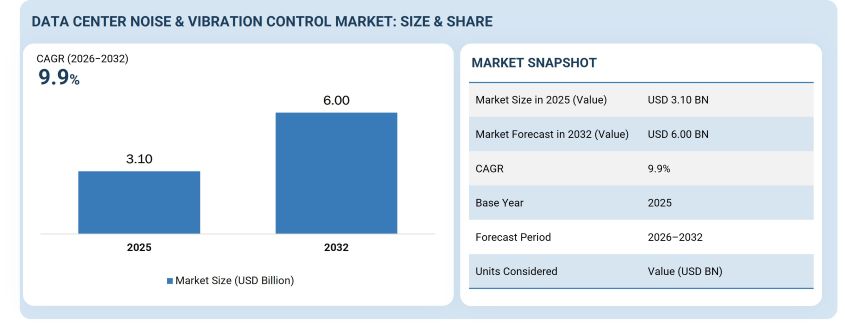
The global data center noise & vibration control market was valued at USD 3.10 billion in 2025 and is projected to reach USD 6.00 billion by 2032, expanding at a compound annual growth rate (CAGR) of 9.9% during the forecast period 2026–2032. This growth is principally driven by the relentless global expansion of hyperscale and colocation data centers, tightening occupational noise regulations, and the growing acoustic challenges posed by next-generation AI compute infrastructure, including high-density GPU clusters and immersion-cooled server racks that introduce novel vibration profiles previously absent from traditional IT environments.
Asia Pacific is the fastest-growing region, driven by China's aggressive hyperscale data center expansion, India's digital infrastructure push under the National Digital Mission, and Southeast Asia's emergence as a new colocation hub. North America retains the largest market share, anchored by the United States' dominant hyperscaler presence — AWS, Microsoft Azure, and Google Cloud, and increasingly stringent occupational noise regulations enforced by OSHA.
Top 10 Key Takeaways
- North America is the largest regional market, anchored by the United States' hyperscaler ecosystem and OSHA-enforced workplace noise standards.
- Asia Pacific is the fastest-growing region, led by China's data center construction boom, India's government-backed digital infrastructure programs, and Singapore's emergence as a regional colocation hub.
- Passive noise and vibration control solutions — acoustic enclosures, anti-vibration mounts, and sound barriers, currently dominate the product landscape, though active and hybrid systems are gaining rapid traction.
- Hyperscale data centers represent the leading end-user segment, with cloud providers such as AWS, Microsoft Azure, and Google Cloud prioritizing acoustic performance in new facility designs.
- The integration of AI-driven predictive acoustic management is emerging as a key technology differentiator, enabling real-time adaptation of noise and vibration control parameters.
- The transition to liquid and immersion cooling, while reducing traditional CRAC/CRAH fan noise, introduces new vibration sources from coolant pumps and heat exchangers, reshaping the solution requirement profile.
- EU regulatory pressures, including the Environmental Noise Directive and EN 50600 data center standards, are accelerating acoustic compliance investments among European operators.
- Kinetics Noise Control, Mason Industries, IAC Acoustics, and Vibro-Acoustics are among the established players; the competitive landscape is consolidating through partnerships with MEP engineering firms.
- The shift toward modular and edge data centers is creating a distinct near-term opportunity for compact, deployable noise and vibration control solutions.
- Key strategic risk lies in supply chain concentration for specialist acoustic materials; many high-performance mineral wool and elastomer compounds are sourced from a limited number of European and Asian suppliers.
Why the Data Center Noise & Vibration Control Market Matters Now
Data centers have always been loud environments. The mechanical hum of thousands of cooling fans, the vibration signatures of uninterruptible power supplies, and the structural resonance transmitted through raised floors have been engineering challenges since the earliest mainframe installations. But what is happening in 2025 is categorically different. The AI infrastructure buildout, marked by the deployment of massive GPU clusters for model training and inference, has compressed compute density to levels that demand fundamentally innovative approaches to thermal management and, consequently, acoustic control. When a single rack can now draw 100 kilowatts or more, the cooling apparatus required to manage that heat load generates acoustic energy orders of magnitude beyond what legacy noise control designs anticipated.
Beyond the technology shift, the regulatory environment is tightening on multiple fronts. OSHA's permissible noise exposure limits are being more rigorously enforced in the United States as data center workforces grow. Across Europe, the Environmental Noise Directive requires operators in urban or peri-urban locations to submit noise mapping reports and action plans. In the UK, post-Brexit planning frameworks have retained stringent acoustic impact assessment requirements for new data center developments, a particularly relevant issue as the London and Dublin data center clusters continue to expand into residential-adjacent zones.
The sustainability agenda adds another layer of complexity. Green building certifications such as LEED and BREEAM increasingly weigh acoustic performance as part of site wellbeing scoring, and the EN 50600 European data center standard explicitly addresses sound power levels. For operators pursuing co-location in urban mixed-use zones, acoustic compliance is no longer a construction afterthought, it is a planning and permitting prerequisite. This convergence of technology pressure, regulatory obligation, and sustainability ambition is why the noise and vibration control market for data centers is growing faster than the broader data center construction market itself.
Data Center Noise & Vibration Control Market Trends
The most consequential near-term trend is the acoustic rethinking forced by liquid and immersion cooling adoption. As air cooling reaches its density limits, data center operators are increasingly deploying direct liquid cooling (DLC), rear-door heat exchangers, and full immersion tanks. While these technologies dramatically reduce airflow-related noise by eliminating or downsizing traditional CRAC and CRAH units, they introduce new vibration sources, coolant pumps, manifolds, and heat exchange infrastructure, that require a different class of isolation and damping solutions. Vendors that have historically focused on air handling equipment isolation are rapidly expanding their liquid-cooling-compatible product portfolios.
Active Noise Cancellation (ANC) technology, long established in aerospace and automotive applications, is making meaningful inroads into data center environments. Unlike passive solutions that rely on mass and absorption, ANC systems use microphones and speakers to generate anti-phase sound waves, effectively canceling noise at specific frequencies. Technology is particularly well-suited to low-frequency noise generated by large uninterruptible power systems and diesel generators, frequency ranges where passive materials are least effective. Several specialist vendors are now packaging ANC modules for generator enclosures and substation rooms within hyperscale campuses.
AI-enabled predictive acoustic management represents the frontier of the market. Deploying sensor arrays across a facility and applying machine learning models to acoustic data, operators can anticipate equipment degradation, a bearing showing early wear will change its vibration signature well before it causes a failure and dynamically adjust noise control parameters. This positions vibration monitoring as both a facility management tool and an early-warning maintenance system, broadening the value proposition beyond simple regulatory compliance.
Modular and edge data center deployments are creating a parallel trend line. Edge nodes, deployed at cell towers, in traffic infrastructure, or within commercial buildings, face acute acoustic challenges because they are co-located with human occupants in noise-sensitive environments. The engineering response has been a new generation of compact, self-contained acoustic enclosures specifically designed for edge deployments, prefabricated units with integrated anti-vibration flooring, lined equipment compartments, and sealed cable penetrations.
Also Read: Data Center Busways Market Report
Data Center Noise & Vibration Control Market Drivers
The single most powerful demand driver is the global hyperscale data center construction wave. Amazon, Microsoft, Google, and Meta collectively announced or broke ground on dozens of new campuses between 2023 and 2025, with capital expenditure on data center infrastructure reaching record levels. Each new hyperscale campus represents a substantial acoustic engineering project, noise mapping, equipment isolation specification, structural vibration analysis, and compliance documentation, creating a predictable pipeline of demand for noise and vibration control products and services.
Regulatory enforcement is the second major driver, and its impact is often underappreciated relative to technology factors. In the US, OSHA's enforcement of 29 CFR 1910.95 noise standards is increasingly applied to data center maintenance and operations staff who spend extended periods in server halls and mechanical plant rooms. Employers are legally obligated to implement engineering controls, noise reduction at source, before relying on personal protective equipment, which creates a direct compliance mandate for acoustic enclosures, mufflers, and isolation systems. In Europe, the EU Occupational Noise Directive 2003/10/EC and the Environmental Noise Directive 2002/49/EC operate in tandem, with national regulators in Germany, France, and the Netherlands applying both to data center campuses.
Urbanization of data center locations is a third, structurally important driver. The dual pressures of land scarcity and latency requirements are pushing new data center developments into urban and suburban locations, placing them in proximity to residential communities, schools, and healthcare facilities. This fundamentally changes the acoustic compliance calculus: a rural hyperscale campus may only need to meet occupational noise standards, whereas an urban colocation facility must also satisfy environmental noise limits that are typically set at much lower absolute levels. The result is a significant uplift in acoustic investment per square meter of data hall.
Data Center Noise & Vibration Control Market Challenges
The primary challenge facing the market is the pace of technology change in the data center itself. Acoustic and vibration control systems are, by their nature, specified and engineered for a defined equipment profile. As cooling architectures shift rapidly, from traditional raised-floor air cooling to hot/cold aisle containment, to rear-door liquid cooling, to full immersion, the acoustic requirements evolve in ways that can outpace the installed control infrastructure. Operators who locked in passive isolation solutions designed around CRAC unit noise profiles may find those solutions inadequate or misapplied as they transition to liquid-cooled racks. This creates both a challenge for vendors, whose product specifications must remain aligned with a moving target, and for operators, who face potential retrofit costs.
High upfront installation cost remains a meaningful adoption barrier, particularly for smaller enterprise data centers and edge deployments where capital budgets are constrained. Specialist acoustic enclosures for large diesel generators or UPS systems can represent a significant line item in construction budgets, and the return on investment is often framed in compliance risk avoidance rather than direct revenue generation, a harder internal justification than, for example, energy efficiency investments that generate measurable operating cost reductions.
Skills scarcity in acoustic engineering represents a structural constraint on market growth. Discipline requires a blend of mechanical engineering, materials science, and regulatory knowledge that is not broadly taught in standard civil or electrical engineering curricula. As data center construction volumes surge, the pool of qualified acoustic consultants and engineers is being stretched thin, leading to longer project timelines and upward pressure on engineering service fees. Several vendors are responding by investing in digital tools, acoustic modeling software, and AI-assisted design platforms, to reduce their dependence on scarce human expertise.
Industry & Application Growth in the Data Center Noise & Vibration Control Market
Hyperscale cloud data centers represent the largest and most immediately addressable application segment. The scale of these facilities, individual campuses now commonly exceed 100 megawatts of IT load, means that acoustic engineering is addressed as a resolute workstream within the construction program, not an afterthought. Major cloud providers have developed internal acoustic standards that go beyond minimum regulatory requirements, specifying noise limits for different zones within the facility to protect worker wellbeing and reduce interference with sensitive equipment such as storage arrays and precision cooling sensors.
Colocation data centers occupy a distinct position in the demand landscape. Colocation operators, who lease space to multiple enterprise tenants within shared facilities, face the acoustic management challenge of multiple, heterogeneous equipment environments operating in close proximity. Tenant-imposed SLA requirements around vibration isolation particularly relevant for financial services firms operating high-frequency trading infrastructure are increasingly written into colocation contracts, driving operators to invest in floor-level anti-vibration systems and rack isolation mounts as standard fit-out elements.
The telecommunications sector is growing vertically as 5G network densification places data processing equipment in street-level cabinets and building rooftops environments where noise emission is directly regulated under telecommunications equipment planning rules. Healthcare data centers are a specialist segment where vibration isolation requirements extend beyond occupational comfort: MRI suites and other sensitive diagnostic equipment located in clinical buildings that co-house IT infrastructure require isolation performance to nanometer-level precision, a technically demanding specification that commands premium pricing.
Data Center Noise & Vibration Control Market, By Product Type
Acoustic enclosures and panels represent the dominant product category, accounting for the largest revenue share within the market. Enclosures are the most direct engineering response to high-noise equipment generators, cooling towers, and large UPS systems and benefit from a well-established supply chain of high-performance acoustic mineral wool, mass-loaded vinyl, and composite panels. The leading segment is driven by the generator enclosure application, which is both technically mature and a mandatory compliance requirement in all markets.
Anti-vibration mounts and isolators are the fastest-growing product category, reflecting the dual expansion of high-density compute infrastructure and liquid cooling systems. As rack densities increase, the vibration energy transmitted to raised floors and structural elements grows proportionally, requiring more sophisticated isolation between equipment and building fabric. Spring-type and elastomeric anti-vibration mounts are increasingly specified at the rack level — not just at the building mechanical plant level — creating a new, higher-volume demand vector.
Data Center Noise & Vibration Control Market, By Technology
Passive noise and vibration control technology currently holds the dominant share of the market. Its advantages, reliability, power consumption, minimal maintenance requirements, and well-understood performance characteristics, make it the default specification for most acoustic engineering projects. Mass-loaded barriers, porous absorbers, and spring isolators form the core toolkit of passive control. The category is mature but not static: ongoing materials innovation, particularly in aerogel-based composites and micro-perforated panel absorbers, is extending performance at reduced mass and thickness.
Hybrid active-passive systems are the fastest-growing technology segment. The hybrid approach addresses the frequency gap inherent in purely passive solutions: passive materials are highly effective at mid-to-high frequencies but lose effectiveness below approximately 200 Hz, whereas active systems are most effective precisely in the low-frequency range. By combining a passive enclosure or barrier with an embedded ANC module, hybrid systems deliver broadband noise reduction that technology can achieve independently. The reducing cost of digital signal processing hardware is making hybrid systems economically viable beyond the aerospace and premium automotive applications where they were first deployed.
Data Center Noise & Vibration Control Market, By Data Center Type
Hyperscale data centers dominate demand, a reflection of their scale, the intensity of their acoustic engineering requirements, and the financial capacity of their operators to invest in best-in-class solutions. The hyperscale segment is also a key driver of product innovation, as operators such as Microsoft and Google have the resources to pilot novel acoustic technologies active cancellation, smart vibration monitoring at scale, de-risking innovative approaches for the broader market.
Edge data centers are the fastest-growing segment by data center type, driven by the global rollout of 5G infrastructure and the increasing deployment of AI inference at the network edge. Edge nodes pose a unique acoustic design challenge: they must be highly compact, thermally efficient, and acoustically silent enough to operate in noise-sensitive environments including office buildings, retail premises, and street-level enclosures. This requirement profile small footprint, high performance, minimal maintenance is spurring a distinct product innovation track separate from the large-format enclosure market.
Data Center Noise & Vibration Control Market, By End User
Cloud service providers and hyperscalers are the leading end-user segment, driven by their outsized share of new data center construction globally and their adoption of internal acoustic standards that exceed minimum regulatory requirements. The big three hyperscalers — Amazon Web Services, Microsoft Azure, and Google Cloud — each maintain dedicated facility engineering teams that specify and procure noise and vibration control systems as standard elements of new builds.
BFSI (Banking, Financial Services & Insurance) is an important specialist segment characterized by particularly stringent vibration isolation requirements. High-frequency trading platforms are sensitive to vibration-induced clock jitter — a phenomenon where mechanical vibration perturbs the timing crystals in servers, introducing latency variance that can translate into trading losses. This creates a technically demanding and price-inelastic demand profile, supporting premium pricing for specialist isolation products in this vertical.
Key Segmentation Conclusions
- Acoustic enclosures and anti-vibration mounts form the revenue core of the product landscape, with ANC and hybrid systems the fastest-growing product innovation categories.
- Passive technology dominates installed base; hybrid active-passive systems are gaining ground driven by the low-frequency control gap passive solutions cannot address.
- Hyperscale data centers generate the largest demand volume; edge data centers represent the most dynamic near-term growth opportunity.
- Cloud service providers drive market standards and product innovation adoption; BFSI requires the most technically sophisticated vibration isolation specifications.
- Services — particularly design engineering and commissioning — are a growing revenue component as acoustic complexity increases with rack density and cooling technology transitions.
Regional Analysis: Data Center Noise & Vibration Control Market
North America
North America is the largest regional market, valued at USD 1.32 billion in 2025, projected to reach USD 2.51 billion by 2032 at a CAGR of 9.6%. The United States accounts for the overwhelming majority of regional demand, underpinned by the world's largest concentration of hyperscale data center campuses — in Northern Virginia (Loudoun County), Dallas-Fort Worth, Phoenix, and the Pacific Northwest. OSHA enforcement of workplace noise standards is a consistent baseline demand driver, augmented by state-level environmental regulations in California and Washington that impose community noise limits on industrial facilities. Canada contributes a growing share of regional demand as hyperscaler investment flows into Ontario and Quebec, attracted by hydroelectric power availability and the country's political stability. Mexico represents an emerging market, with nearshore manufacturing and technology investment driving a nascent colocation sector in Monterrey and Mexico City.
Europe
Europe's data center noise and vibration control market was valued at USD 0.84 billion in 2025 and is expected to grow to USD 1.47 billion by 2032, at a CAGR of 8.3%, a moderate growth rate reflecting the region's mature data center base and the stabilizing effect of planning constraints that limit greenfield development in primary markets. Germany is the largest national market, hosting Europe's most significant data center cluster in Frankfurt, a location that has faced sustained acoustic scrutiny due to its urban setting and proximity to residential zones. The United Kingdom, with its London data center hub, faces similar pressures, with acoustic impact assessments now a standard component of planning applications in the outer London boroughs. The Nordics, Sweden, Finland, and Norway, are experiencing disproportionate growth as hyperscalers exploit renewable energy availability and cool ambient temperatures; acoustic performance in these facilities is particularly focused on HVAC and cooling infrastructure, which can be unusually large relative to IT load due to the use of free-air cooling. The EU's Environmental Noise Directive and Occupational Noise Directive together create a harmonized baseline compliance requirement across all member states.
Asia Pacific
Asia Pacific is the fastest-growing regional market, valued at USD 0.71 billion in 2025, expected to reach USD 1.58 billion by 2032, at an impressive CAGR of 12.1%. China is the primary volume driver, with state-backed programs such as the 'Eastern Data Western Computing' initiative redirecting hyperscale construction to western provinces, creating tens of gigawatts of new data center capacity over the forecast period. India is the market's highest-trajectory emerging economy, with the Digital India initiative, Tier II city expansion, and the entry of global hyperscalers triggering a wave of new builds in Mumbai, Chennai, and Pune. Singapore remains Asia's most acoustically demanding market due to its urban density and strict environmental noise limits enforced by the National Environment Agency (NEA). South Korea and Japan are mature but continuously expanding markets, with both countries hosting globally significant submarine cable landing stations that drive edge and carrier-neutral data center development. Australia is growing rapidly as hyperscalers designate it as a regional sovereignty-compliant hub.
Rest of World
The Rest of World segment, valued at USD 0.23 billion in 2025 and projected to reach USD 0.44 billion by 2032 at a CAGR of 9.8%, is primarily driven by Middle Eastern and Latin American markets. The UAE — specifically Dubai and Abu Dhabi — has emerged as a regional data center hub with major investments from Equinix, Khazna, and local sovereign wealth-backed initiatives. Saudi Arabia's NEOM project and Vision 2030 digital infrastructure programs are creating a substantial pipeline of new data center construction that will require acoustic engineering services aligned with increasingly specific Saudi Building Code noise provisions. Brazil is Latin America's dominant market, with São Paulo hosting the region's highest concentration of hyperscale and colocation facilities; acoustic compliance requirements are governed by ABNT standards and municipal noise ordinances. South Africa is Sub-Saharan Africa's most developed data center market, with Johannesburg and Cape Town attracting hyperscaler investments from AWS and Microsoft.
Regional Outlook: Key Conclusions
- North America leads by market value, driven by hyperscaler concentration in Northern Virginia, Phoenix, and Dallas and consistently enforced OSHA noise standards.
- Asia Pacific will post the fastest growth through 2032, with China, India, and Singapore collectively accounting for the majority of incremental demand.
- Europe's growth is moderate but regulation-dense; planning and environmental compliance requirements are raising acoustic investment per project above global averages.
- The Middle East — particularly the UAE and Saudi Arabia — is the most strategically interesting emerging market, combining rapid data center construction with growing acoustic regulatory frameworks.
- Latin America and Africa are early stage but directionally positive, with Brazil and South Africa anchoring regional demand in their respective sub-regions.
Country-Specific Insights
United States
The US market is distinguished by the maturity of its regulatory framework and the scale of its hyperscaler investment pipeline. Loudoun County, Virginia — the world's largest data center cluster — has seen acoustic disputes become a genuine planning bottleneck, with county supervisors imposing increasingly specific noise conditions on new construction permits. Phoenix and Dallas-Fort Worth, the next-largest clusters, operate in suburban and peri-urban contexts where community noise impacts are a rising concern. The US market is also notable for the sophistication of its acoustic consulting ecosystem, with specialist firms capable of delivering end-to-end acoustic design, compliance documentation, and post-installation verification services.
Germany
Germany's rigorous implementation of EU noise directives, combined with the Frankfurt cluster's urban setting, makes it the most regulation-intensive major European data center market. The TA Lärm technical instruction on noise abatement sets night-time exterior noise limits as low as 45 dB(A) in mixed-use zones a specification that requires substantial acoustic investment for large cooling towers and generator sets. German engineering culture also favors documented, standards-compliant solutions, supporting premium pricing for certified acoustic products.
China
China's market is characterized by scale and speed. The Eastern Data Western Computing strategy is repositioning hyperscale construction to provinces including Guizhou, Inner Mongolia, and Ningxia, where land, power, and cooling resources are more abundant. Environmental Impact Assessment (EIA) requirements under Chinese environmental law include noise assessments for large industrial facilities, creating a formal compliance demand driver. Chinese domestic vendors alongside international players are actively developing acoustic products calibrated to China's specific regulatory standards and construction practices.
India
India represents the market's most exciting emerging growth story. The country's data center capacity is projected to more than double over the forecast period, driven by the Digital India initiative, growing domestic cloud consumption, and hyperscaler confidence in India as a strategic geography. Noise regulation at data center sites is governed by the Environment Protection Act and CPCB guidelines, which set ambient noise standards by zone classification. As Indian data centers increasingly co-locate with urban commercial developments, acoustic compliance is becoming a standard element of the building permission process.
Singapore
Singapore's data center market occupies a uniquely constrained position: extraordinary demand from hyperscalers seeking APAC sovereignty-compliant infrastructure, set against one of the world's most stringent acoustic and environmental regulatory frameworks. The NEA's Environmental Protection and Management Act sets community noise limits that are effectively the tightest in Southeast Asia, requiring precision acoustic engineering for any facility operating cooling equipment audible beyond the site boundary. Singapore's 2023 resumption of data center development approvals — after a three-year moratorium — has released a pipeline of projects, each of which requires full acoustic impact assessment as a condition of planning approval.
Country-Level Conclusions
- The United States and Germany are the most acoustically demanding established markets, combining high data center density with mature and enforced noise regulatory frameworks.
- China's scale and construction velocity make it the single largest volume growth opportunity over the forecast period, though domestic vendor competition is significant.
- India is the market's most compelling emerging growth story, combining a massive data center construction pipeline with a formalizing regulatory environment.
- Singapore, despite its small physical scale, commands disproportionate acoustic engineering investment due to the combination of extreme urban density and one of Asia's strictest environmental noise frameworks.
- The UAE is the most strategically important Middle Eastern market, with sovereign wealth-backed hyperscale investment creating near-term opportunities for international acoustic solution providers.
Key Company Insights: Data Center Noise & Vibration Control Market
The competitive landscape of the data center noise and vibration control market is populated by a mix of specialist acoustic engineering firms, large diversified industrial materials groups, and a growing cohort of technology-focused startups applying digital and AI tools to acoustic management. The following companies are among the most active participants in this market:
- Kinetics Noise Control
- Mason Industries
- IAC Acoustics
- Acoustical Solutions
- Vibro-Acoustics (Swegon Group)
- Trelleborg AB
- LORD Corporation (Parker Hannifin)
- Fabreeka International
- Enoise Control
- Noise Barriers LLC
- RPG Diffusor Systems
- Saint-Gobain Ecophon
- Rockwool Group
- Knauf Insulation
- Armacell International
Kinetics Noise Control and Mason Industries are among the longest-established specialists in the market, with extensive portfolios spanning vibration isolation mounts, inertia bases, and acoustical enclosures specifically designed for mechanical plant environments. Both companies have been expanding their data-center-specific product lines in response to the density and cooling technology changes in reshaping the market. IAC Acoustics, historically focused on industrial and aerospace noise control, has positioned its modular acoustic enclosure systems as a fit-for-purpose solution for generator and cooling plant applications at hyperscale campuses. Trelleborg AB and LORD Corporation (now part of Parker Hannifin) bring advanced elastomer and composite material science to vibration isolation, with product portfolios that extend from rack-level mounts to building structural isolation systems. Saint-Gobain Ecophon, Rockwool Group, and Knauf Insulation contribute high-performance acoustic insulation materials — mineral wool, glass wool, and composite panels — that form the core of passive enclosure construction. Armacell International is increasingly relevant as data centers adopt flexible acoustic-thermal insulation systems for pipe and duct work associated with liquid cooling infrastructure.
Key Company Strategy Conclusions
- Specialist vibration isolation and acoustic enclosure vendors are expanding data-center-specific product lines to capture the AI infrastructure investment wave.
- Large materials groups (Saint-Gobain, Rockwool, Knauf) compete on material performance and supply chain scale, while specialists compete on application engineering expertise.
- Partnership with MEP (mechanical, electrical, plumbing) engineering consultants is an increasingly important go-to-market strategy, as acoustic specifications are typically embedded in the broader facility engineering scope.
- Digital tools — acoustic modeling software, AI-assisted design platforms, IoT-based vibration monitoring — are emerging as competitive differentiators for vendors seeking to move up the value chain from product supply to solution provision.
- Consolidation is a background trend: large diversified industrial groups are acquiring specialist acoustic firms to bundle acoustic solutions with broader facility engineering offerings.
Recent Developments
- In early 2025, Rockwool Group announced expansion of its high-temperature industrial insulation product range, with explicit positioning for data center cooling infrastructure applications including liquid cooling pipe insulation and mechanical plant enclosures.
- In 2024, Trelleborg AB's vibration solutions division reported increased engagement with hyperscale data center operators in North America and Europe, reflecting growing demand for precision anti-vibration mounts for high-density AI compute deployments.
- In 2024, IAC Acoustics expanded its portfolio of generator acoustic enclosure systems with modular configurations designed for rapid deployment at edge data center sites, targeting the 5G infrastructure rollout as a key demand driver.
- In late 2023, Parker Hannifin (LORD Corporation integration) reinforced its position in data center vibration control by launching updated elastomeric mount specifications aligned with ASHRAE thermal envelope standards for high-density rack environments.
- In 2024, Saint-Gobain Ecophon introduced acoustic ceiling and wall panel systems specifically evaluated and certified to the EN 50600 data center standard, enabling operators to document compliance within their facility management systems.
Real-World Use Cases
In 2023, Equinix deployed a comprehensive vibration isolation upgrade program across its SG series data centers in Singapore, responding to tightened NEA community noise requirements triggered by new residential development adjacent to one of its Jurong campus buildings. The program involved the replacement of legacy spring mounts on cooling tower fan assemblies with high-performance neoprene-spring combination isolators and the installation of acoustic barriers on the facility perimeter. The project enabled Equinix to achieve the revised NEA noise limits without curtailing cooling capacity, preserving SLA commitments to co-location tenants during the upgrade.
In 2024, a major European colocation operator — implementing a new 40 MW campus in the Frankfurt metropolitan area — integrated acoustic design as a primary workstream within the construction program from the concept stage, rather than as a compliance retrofit. Collaborating with a specialist acoustic engineering consultancy and Kinetics Noise Control as the primary isolation product supplier, the project achieved TA Lärm night-time exterior noise compliance while operating all cooling infrastructure at full capacity. The project established a design reference for urban European colocation facilities facing similar planning conditions and is expected to influence forthcoming updates to the EN 50600 acoustic guidance annex.
Market Segmentation Summary
The data center noise and vibration control market is segmented across five primary axes: product type, component, technology, data center type, and end user. By product type, the market spans acoustic enclosures and panels, anti-vibration mounts and isolators, vibration dampers and pads, acoustic blankets and curtains, active noise control systems, and noise barriers. The component breakdown encompasses hardware (passive, active, and structural damping components), software and control systems, and services including design engineering, installation, and maintenance. Technology segmentation runs from established passive solutions through active and hybrid approaches to the emerging category of AI-enabled acoustic management. Data center type segmentation covers the full spectrum from hyperscale campuses through colocation and enterprise on-premises facilities to the fast-growing edge segment. End-user segmentation reflects the diverse operator base, from cloud hyperscalers and colocation providers to telecommunications, BFSI, healthcare, government, and IT companies.
- Product innovation is concentrated in anti-vibration mounts (driven by liquid cooling adoption) and active/hybrid noise control (driven by the low-frequency gap in passive solutions).
- Services are the fastest-growing component segment, as acoustic complexity drives demand for specialized design engineering and commissioning expertise.
- The technology axis is shifting from purely passive solutions toward hybrid active-passive systems, with AI-enabled management emerging as the next-generation platform.
- Hyperscale and edge are the data center type segments with the most distinct and dynamically evolving acoustic requirement profiles.
- End-user segmentation is important for pricing and specification: hyperscalers drive volume and innovation, while BFSI and healthcare command the highest per-unit value for specialist isolation products.
Conclusion & Future Outlook
The data center noise and vibration control market is entering a sustained growth phase underpinned by structural forces that are unlikely to reverse within the forecast horizon. The AI infrastructure investment cycle has years to run — model training requirements are scaling faster than efficiency improvements in hardware, and every incremental kilowatt of AI compute added to a data center campus adds proportionally to the acoustic engineering load. The simultaneous transition to liquid and immersion cooling, while reducing fan noise, is reshaping the vibration landscape in ways that require new product solutions and new engineering expertise. Regulatory pressure — from occupational noise frameworks in North America, environmental noise directives in Europe, and urban planning requirements globally — is intensifying rather than relaxing as data centers move deeper into urban geographies.
Looking forward to 2032 and beyond, the market's most significant technology shift will be the normalization of AI-enabled acoustic management. Vibration sensors, acoustic monitoring arrays, and digital twin models of data center acoustic environments will increasingly be standard elements of the facility management platform, enabling real-time optimization and predictive maintenance. For solution providers, this represents a transition from product supply to managed service — a higher-value, longer-duration revenue model that mirrors the broader 'X-as-a-service' trend across facility management. Businesses positioning themselves in this market today, whether as operators, vendors, or investors, are entering at a point where the demand trajectory is clear, the regulatory tailwinds are consistent, and the technology differentiation opportunity is substantial.
Frequently Asked Questions (FAQ)
Q1. How big is the data center noise & vibration control market?
The global data center noise & vibration control market was valued at approximately USD 3.10 billion in 2025. It is projected to reach approximately USD 6.00 billion by 2032, reflecting strong and consistent demand driven by hyperscale data center construction, AI infrastructure deployment, and increasingly stringent noise compliance requirements globally.
Q2. What is the data center noise & vibration control market growth rate?
The market is projected to grow at a CAGR of 9.9% during the 2026–2032 forecast period. Asia Pacific is the fastest-growing region at approximately 12.1% CAGR, while North America, the largest market, is growing at approximately 9.6% CAGR.
Q3. Which segment leads the data center noise & vibration control market?
Acoustic enclosures and panels lead the product type segment due to their established role in generator and cooling plant noise management. By end user, cloud service providers and hyperscalers represent the dominant demand category, driven by their scale of new construction and adoption of facility-wide acoustic standards.
Q4. Who are the key players in the data center noise & vibration control market?
Leading players include Kinetics Noise Control, Mason Industries, IAC Acoustics, Acoustical Solutions, Vibro-Acoustics (Swegon Group), Trelleborg AB, LORD Corporation (Parker Hannifin), Saint-Gobain Ecophon, Rockwool Group, and Armacell International. The market includes both specialist acoustic engineering firms and large diversified industrial materials groups.
Q5. What are the factors driving the data center noise & vibration control market?
The primary drivers are the global hyperscale data center construction wave, increasing rack density and AI compute deployment creating new acoustic and vibration challenges, tightening occupational and environmental noise regulations globally, the urbanization of data center locations placing facilities in noise-sensitive proximity to residential communities, and the transition to liquid cooling architectures introducing new vibration sources from pump and heat exchange infrastructure.
 Exclusive indicates content/data unique to MarketsandMarkets and not available with any competitors.
TABLE OF CONTENTS
1 Introduction
1.1 Study Objectives
1.2 Market Definition and Scope
1.3 Inclusions and Exclusions
1.4 Study Scope
1.4.1 Markets Covered
1.4.2 Geographic Segmentation
1.4.3 Years Considered
1.5 Currency Considered
1.6 Stakeholders
2 Research Methodology
2.1 Research Approach
2.2 Secondary Research
2.3 Primary Research
2.4 Market Size Estimation
2.4.1 Bottom-Up Approach
2.4.2 Top-Down Approach
2.5 Data Triangulation
2.6 Assumptions
3 Executive Summary
4 Premium Insights
5 Market Overview
5.1 Introduction
5.2 Market Dynamics
5.2.1 Drivers
5.2.2 Restraints
5.2.3 Opportunities
5.2.4 Challenges
5.3 Value Chain Analysis
5.4 Ecosystem Analysis
5.5 Investment & Funding Scenario
5.6 Pricing Analysis
5.7 Trends/Disruptions Impacting Customer Business
5.8 Technology Analysis
5.8.1 Key Technologies
5.8.2 Complementary Technologies
5.8.3 Adjacent Technologies
5.9 Porter's Five Forces Analysis
5.10 Key Stakeholders & Buying Criteria
5.11 Case Study Analysis
5.12 Trade Analysis
5.13 Patent Analysis
5.14 Key Conferences & Events
5.15 Regulatory Landscape
5.16 Impact of AI/Gen AI on the Market
5.17 Impact of 2025 US Tariffs on the Market
6 Industry Trends
6.1 Emerging Noise & Vibration Control Technologies
6.2 Integration of Acoustic Design in Data Center Architecture
6.3 Active Noise Cancellation (ANC) Adoption
6.4 Liquid Cooling and Its Acoustic Implications
6.5 Sustainability and Green Building Standards
6.6 AI-Driven Predictive Acoustic and Vibration Management
7 Regulatory & Compliance Landscape
7.1 Global Standards and Certifications (ISO, IEC, ASHRAE)
7.2 OSHA and Occupational Noise Regulations
7.3 EU Noise Directive and Environmental Noise Regulations
7.4 Local Building Codes and Planning Requirements
7.5 Data Center Sustainability Frameworks (EN 50600, LEED, BREEAM)
8 Customer Landscape & Buyer Behavior
8.1 Decision-Making Process
8.2 Buyer Stakeholder Mapping
8.3 Adoption Barriers
8.4 Procurement Trends and Vendor Selection Criteria
9 Data Center Noise & Vibration Control Market, By Product Type
9.1 Introduction
9.2 Acoustic Enclosures & Panels
9.3 Anti-Vibration Mounts & Isolators
9.4 Vibration Dampers & Pads
9.5 Acoustic Blankets & Curtains
9.6 Active Noise Control (ANC) Systems
9.7 Noise Barriers & Partitions
10 Data Center Noise & Vibration Control Market, By Component
10.1 Introduction
10.2 Hardware
10.2.1 Passive Isolation Components
10.2.2 Active Control Components
10.2.3 Structural Damping Components
10.3 Software & Control Systems
10.4 Services
10.4.1 Design & Engineering Services
10.4.2 Installation & Commissioning
10.4.3 Maintenance & Support
11 Data Center Noise & Vibration Control Market, By Technology
11.1 Introduction
11.2 Passive Noise & Vibration Control
11.3 Active Noise & Vibration Control
11.4 Hybrid (Active + Passive) Solutions
11.5 AI-Enabled Acoustic Management
12 Data Center Noise & Vibration Control Market, By Data Center Type
12.1 Introduction
12.2 Hyperscale Data Centers
12.3 Colocation Data Centers
12.4 Edge Data Centers
12.5 Enterprise Data Centers (On-Premises)
12.6 Modular/Containerized Data Centers
13 Data Center Noise & Vibration Control Market, By End User
13.1 Introduction
13.2 Cloud Service Providers & Hyperscalers
13.3 Colocation Providers
13.4 Telecommunications
13.5 Banking, Financial Services & Insurance (BFSI)
13.6 Healthcare
13.7 Government & Defense
13.8 IT & Technology Companies
14 Data Center Noise & Vibration Control Market, By Region
14.1 Introduction
14.2 North America
14.2.1 United States
14.2.2 Canada
14.2.3 Mexico
14.3 Europe
14.3.1 Germany
14.3.2 United Kingdom
14.3.3 France
14.3.4 Italy
14.3.5 Spain
14.3.6 Nordics (Sweden, Finland, Norway, Denmark)
14.3.7 Rest of Europe
14.4 Asia Pacific
14.4.1 China
14.4.2 Japan
14.4.3 India
14.4.4 South Korea
14.4.5 Australia
14.4.6 Singapore
14.4.7 Rest of Asia Pacific
14.5 Rest of World
14.5.1 Middle East (UAE, Saudi Arabia)
14.5.2 Latin America (Brazil)
14.5.3 Africa (South Africa)
15 Competitive Landscape
15.1 Overview
15.2 Key Player Strategies / Right to Win
15.3 Revenue Analysis
15.4 Market Share Analysis
15.5 Company Evaluation Matrix — Key Players
15.5.1 Stars
15.5.2 Emerging Leaders
15.5.3 Pervasive Players
15.5.4 Participants
15.6 Company Evaluation Matrix — Startups/SMEs
15.6.1 Progressive
15.6.2 Responsive
15.6.3 Dynamic
15.6.4 Starting Blocks
15.7 Competitive Benchmarking
15.8 Competitive Scenario
15.8.1 Product Launches
15.8.2 Deals (Partnerships, Acquisitions, Collaborations)
16 Company Profiles
16.1 Kinetics Noise Control
16.2 Mason Industries
16.3 IAC Acoustics
16.4 Acoustical Solutions
16.5 Vibro-Acoustics (Swegon Group)
16.6 Trelleborg AB
16.7 LORD Corporation (Parker Hannifin)
16.8 Fabreeka International
16.9 Enoise Control
16.10 Noise Barriers LLC
16.11 RPG Diffusor Systems
16.12 Saint-Gobain Ecophon
16.13 Rockwool Group
16.14 Knauf Insulation
16.15 Armacell International
17 Appendix
17.1 Discussion Guide
17.2 KnowledgeStore — MnM's Subscription Portal
17.3 Customization Options
17.4 Related Reports
17.5 Author Details













Growth opportunities and latent adjacency in Data Center Noise & Vibration Control Market