E-Compass Market by Technology (Fluxgate, Hall Effect, Magnetoresistive), Type (1&2 Axis, 3 Axis, 6 Axis, 9 Axis), Application (Consumer Electronics, Aerospace & Defense, Automotive, Surveying, Marine) and Geography - Global Forecast to 2035


E-Compass Market Summary
The global E-Compass Market is gaining momentum as electronic orientation and magnetic sensing become increasingly important across smartphones, wearables, automotive navigation systems, drones, robotics, industrial equipment, marine systems, and aerospace applications. The market is estimated at approximately USD 3–4 billion in 2025 and is projected to reach USD 11–12 billion by 2035, registering a CAGR of 14%–15% during the forecast period. A detailed industry estimate places the 2025 market at USD 3.1 billion and the 2035 market at USD 11.6 billion, corresponding to a 14.2% CAGR.
An e-compass combines magnetic sensing with motion and orientation information to determine heading, typically using magnetometers together with accelerometers and, in more advanced implementations, gyroscopes. Growing adoption of location-aware consumer electronics, autonomous systems, connected vehicles, drones, robotics, and IoT devices is creating a broader addressable market. AI and machine-learning algorithms are also improving sensor fusion, calibration, anomaly detection, and orientation estimation, while automation and digital transformation are expanding the use of electronic orientation technologies in industrial and mobility applications. The increasing integration of compact sensors into semiconductor packages is further supporting demand for low-power, high-accuracy e-compass solutions.
Key Market Trends & Insights
The North American market represents a major high-value market for e-compass technologies because of strong demand from aerospace and defense, automotive electronics, robotics, industrial automation, and advanced navigation applications. The region benefits from sophisticated sensor ecosystems and high investment in autonomous and connected systems.
Asia Pacific is expected to register the fastest growth over the forecast period. High-volume consumer electronics manufacturing in China, expanding automotive electronics production, increasing smartphone penetration, and growing investments in robotics and industrial automation are creating significant opportunities. Japan and South Korea are also important technology hubs for advanced sensing and semiconductor integration.
The 3-axis e-compass segment is a dominant product category because it provides comprehensive magnetic-field measurements across three spatial axes and can be integrated with accelerometers for tilt-compensated heading estimation. One industry estimate identifies 3-axis products as the leading segment, accounting for 40.7% of the market in 2025.
Sensor fusion is emerging as one of the most important technology trends. Combining magnetometer, accelerometer, gyroscope, GNSS, and other sensor inputs enables more accurate orientation information in environments where individual sensors can be affected by interference or movement. NXP, for example, describes e-compass software based on accelerometer and magnetometer fusion with magnetic calibration and tilt compensation.
AI is adding another layer of intelligence to electronic sensing. AI-assisted calibration, adaptive filtering, contextual sensor fusion, and edge processing can improve heading estimation and reduce the impact of magnetic interference. These capabilities are particularly relevant to autonomous vehicles, drones, robotics, wearables, and smart industrial equipment.
Market Size & Forecast
-
Base year market size: USD 3–4 billion in 2025
-
Forecast value by 2035: USD 11–12 billion
-
CAGR: 14%–15% during 2025–2035
-
Growth factors: Increasing smartphone and wearable adoption, automotive navigation, autonomous systems, IoT, robotics, MEMS sensor integration, AI-based sensor fusion, and industrial automation.
-
Market outlook: The combination of high-volume consumer electronics and higher-value automotive, aerospace, defense, and industrial applications is expected to support sustained market expansion through 2035.
E-Compass Market Market Top 10 key takeaway
-
The global E-Compass Market is estimated at USD 3–4 billion in 2025.
-
The market is projected to reach approximately USD 11–12 billion by 2035.
-
The market is expected to expand at a CAGR of 14%–15%.
-
North America remains a major high-value market for advanced electronic orientation technologies.
-
Asia Pacific is expected to record the fastest growth through 2035.
-
3-axis e-compass solutions represent a leading product configuration.
-
MEMS, magnetoresistive sensing, sensor fusion, and low-power semiconductor integration are major technology trends.
-
Consumer electronics remain an important application base, while automotive, robotics, drones, and industrial automation are expanding the opportunity landscape.
-
AI is improving calibration, sensor fusion, interference compensation, and orientation estimation.
-
Future e-compass development will increasingly focus on smaller form factors, lower power consumption, higher accuracy, and intelligent edge processing.
Product Insights
The 3-axis e-compass segment represents one of the most important product categories in the market because it provides magnetic-field measurements along three perpendicular axes. This configuration enables electronic devices to determine directional orientation while supporting tilt compensation when combined with accelerometer data. The combination of compact size, low energy consumption, and integration capability makes 3-axis devices particularly suitable for smartphones, tablets, wearables, navigation systems, and embedded electronics. Market estimates indicate that 3-axis e-compass products represented the leading segment in 2025.
The product landscape extends beyond standalone magnetic sensors. Integrated sensor combinations that combine accelerometers, magnetometers, gyroscopes, and processing capabilities are gaining importance because manufacturers want to reduce board space and simplify system design. Six-axis and nine-axis sensor-fusion configurations are particularly valuable in applications requiring comprehensive orientation and motion information.
Automotive systems are creating opportunities for ruggedized and high-reliability sensing products, while drones and robotics require lightweight components with fast response times. Aerospace and defense applications create demand for higher-performance magnetic sensing technologies that can operate under challenging environmental conditions.
The next generation of e-compass products is expected to incorporate greater intelligence at the edge. AI-supported calibration and sensor-fusion algorithms can compensate for changing magnetic environments and device-specific disturbances. Bosch Sensortec's sensor software ecosystem, for example, supports sensor-fusion capabilities including 6- and 9-axis orientation tracking and eCompass functionality.
Technology / Component Insights
The technology landscape of the E-Compass Market includes magnetoresistive sensors, Hall-effect sensors, fluxgate technologies, magneto-inductive sensors, and emerging quantum sensing approaches. Current commercial systems are dominated by compact semiconductor-based magnetic sensors because they provide an effective combination of accuracy, cost, power efficiency, and miniaturization.
Magnetoresistive technologies are particularly important for compact electronic systems because they can provide high sensitivity while occupying limited board space. Fluxgate technologies remain relevant for applications requiring high magnetic sensitivity and accuracy, particularly in industrial, scientific, marine, and aerospace environments. Emerging quantum technologies may create opportunities in specialized high-precision applications over the longer term. Recent market segmentation studies identify Hall-effect, AMR/GMR/TMR, fluxgate, magneto-inductive, and quantum technologies as key categories.
Sensor fusion is central to modern e-compass technology. A magnetometer alone can provide magnetic-field information, but combining it with an accelerometer enables tilt compensation. Adding a gyroscope improves dynamic orientation tracking, while GNSS can provide complementary positioning information. NXP's e-compass software demonstrates how accelerometer and magnetometer data can be combined to calculate an orientation-corrected magnetic heading.
AI and machine learning are expected to become increasingly important in this technology layer. Algorithms can identify sensor anomalies, learn device-specific magnetic characteristics, optimize calibration, and improve orientation estimates. Edge AI can perform these functions locally, reducing dependence on cloud connectivity and improving response times for autonomous and mobile applications.
Future innovation will focus on ultra-low-power architectures, integrated sensor hubs, AI-enabled sensor fusion, advanced magnetic compensation, improved temperature stability, and increasingly sophisticated multi-sensor systems.
Application Insights
Consumer electronics represents a major application segment for the E-Compass Market because smartphones, tablets, smartwatches, fitness trackers, gaming devices, and other portable products increasingly require orientation information. E-compass functionality enables directional navigation, augmented-reality experiences, location-aware applications, gaming, and user-interface features.
The automotive industry represents a growing opportunity. Electronic compass technologies can complement navigation and positioning systems in vehicles while supporting orientation information for infotainment, telematics, advanced driver-assistance systems, and autonomous driving architectures. As vehicles incorporate more electronic control systems and sensors, demand for compact and reliable magnetic sensing is expected to increase.
Aerospace and defense applications typically demand higher accuracy and robustness. Drones and unmanned systems can use magnetic orientation information as part of their navigation and stabilization architecture. Industrial robotics similarly requires accurate orientation information to perform automated movement, positioning, and object handling.
Wearables and healthcare devices are creating another emerging opportunity. Smartwatches and fitness devices can combine magnetic orientation with motion sensing to deliver more accurate activity tracking and navigation. Meanwhile, industrial IoT devices can use electronic orientation sensors for equipment monitoring, asset tracking, and automated positioning.
Regional Insights
North America is a leading high-value region for the E-Compass Market, supported by strong aerospace and defense capabilities, advanced automotive electronics, robotics, industrial automation, and high adoption of connected consumer devices. The presence of major technology companies and sensor manufacturers also strengthens the regional innovation ecosystem. North American demand is increasingly shifting toward high-performance sensing for autonomous systems, drones, smart mobility, and industrial applications.
Europe represents an important market because of its established automotive industry, industrial automation capabilities, aerospace expertise, and emphasis on advanced electronics. Germany, France, and other European economies are investing in connected vehicles, robotics, Industry 4.0, and smart manufacturing, creating opportunities for orientation and motion sensors.
Asia Pacific is expected to achieve the fastest growth during the forecast period. China has a major position in electronics manufacturing, while Japan and South Korea have strong capabilities in sensors, semiconductors, automotive electronics, and robotics. Increasing smartphone production, EV adoption, autonomous mobility, and industrial automation are strengthening regional demand.
-
North America: Strong aerospace, defense, automotive, robotics, and industrial demand.
-
Europe: Automotive electronics and Industry 4.0 support steady adoption.
-
Asia Pacific: Fastest growth supported by electronics manufacturing and automation.
-
China: Large-scale electronics production and smart mobility create substantial opportunities.
-
Japan: Robotics, automotive technologies, and advanced sensors support market development.
Country-Specific Market Trends
In China, the E-Compass Market is expected to expand at approximately 16%–17% CAGR through 2035. Demand is supported by consumer electronics production, electric vehicles, drones, robotics, and industrial automation. Government-backed initiatives focused on advanced manufacturing and intelligent mobility are also encouraging domestic development of sensors and semiconductor technologies.
Japan is expected to register approximately 13%–14% CAGR, supported by its strong automotive, robotics, consumer electronics, and industrial automation sectors. Japanese manufacturers are increasingly integrating compact sensor modules into sophisticated mobility and robotic systems.
In North America, the United States is projected to record approximately 13%–14% CAGR, supported by aerospace and defense, autonomous vehicles, robotics, drones, wearables, and advanced industrial systems. Canada is expected to grow at around 11%–12% CAGR, with opportunities in aerospace, industrial technology, mining equipment, and autonomous systems. Mexico could register approximately 12%–13% CAGR as automotive manufacturing and electronics production expand.
Within Europe, Germany is expected to grow at approximately 12%–13% CAGR, driven by automotive electronics, industrial automation, robotics, and smart manufacturing. France is projected to record approximately 11%–12% CAGR, supported by aerospace, defense, automotive, and industrial technology demand.
-
China: Consumer electronics, EVs, drones, and robotics are major growth engines.
-
Japan: Advanced robotics and automotive electronics support high-value applications.
-
United States: Autonomous systems and aerospace/defense drive sophisticated sensor demand.
-
Germany: Industry 4.0 and automotive technology remain central opportunities.
-
France: Aerospace, defense, and smart mobility applications support adoption.
Key E-Compass Market Company Insights
The E-Compass Market is characterized by competition among semiconductor manufacturers, sensor specialists, automotive technology suppliers, and high-precision instrumentation companies. Major participants include STMicroelectronics, Honeywell, Bosch Sensortec, Asahi Kasei Microdevices, NXP Semiconductors, TDK, Infineon Technologies, Analog Devices, Alps Alpine, and TE Connectivity. Recent market assessments identify many of these companies among the prominent participants in the global e-compass ecosystem.
STMicroelectronics has a broad portfolio of e-compass and magnetic sensors, including 3-axis magnetometers and integrated accelerometer-magnetometer modules. Its portfolio emphasizes low power, compact form factors, automotive and industrial applications, and compatibility with its STM32 ecosystem.
Bosch Sensortec focuses on MEMS sensing, sensor hubs, algorithms, and software-enabled sensor fusion. Its technology strategy increasingly connects hardware with intelligent software capabilities for orientation, activity recognition, and motion tracking.
NXP Semiconductors emphasizes sensor-fusion software and magnetic calibration, targeting mobile, consumer, and IoT applications. Honeywell has a strong position in high-precision sensing for aerospace, defense, and industrial applications, while Asahi Kasei Microdevices focuses extensively on magnetic sensing technologies. Other participants such as TDK, Infineon, Analog Devices, Alps Alpine, and TE Connectivity broaden the competitive landscape across automotive, industrial, consumer, and high-performance sensing markets.
-
Companies are emphasizing smaller, lower-power, high-accuracy sensor architectures.
-
Sensor-fusion software is becoming an important competitive differentiator.
-
AI and intelligent algorithms are increasingly integrated with sensing platforms.
-
Automotive and industrial applications are receiving greater strategic attention.
-
Portfolio expansion through integrated accelerometer, gyroscope, and magnetometer solutions is increasing.
Recent Developments
A major industry development is the expansion of integrated e-compass portfolios combining magnetometers with accelerometers and sensor-fusion software. STMicroelectronics currently offers integrated solutions such as the ISM303DAC, which combines a 3D digital linear accelerometer with a 3D digital magnetometer, alongside standalone high-accuracy magnetometers.
Another development is the increasing integration of sensor-fusion software and intelligent algorithms. Bosch Sensortec's software ecosystem supports orientation tracking and eCompass functionality, while its software strategy increasingly provides a foundation for AI-enabled sensing applications.
The market is also moving toward broader integration of e-compass functions into automotive, IoT, robotics, and wearable platforms. NXP continues to offer e-compass sensor-fusion software with tilt compensation and magnetic calibration for mobile and IoT products.
Market Segmentation
The E-Compass Market can be segmented by Product, Technology/Component, Application, and Region. By product, the market includes 1- and 2-axis, 3-axis, 6-axis, and 9-axis configurations, with 3-axis solutions representing an important mainstream category and 6-axis and 9-axis systems gaining traction in applications requiring broader motion and orientation information. By technology, the market includes Hall-effect, magnetoresistive technologies such as AMR, GMR, and TMR, fluxgate, magneto-inductive, and emerging quantum sensing technologies.
By application, consumer electronics remains an important demand center, encompassing smartphones, tablets, wearables, gaming products, and navigation devices. Automotive applications include navigation, ADAS, connected vehicles, and autonomous driving. Aerospace and defense applications include avionics and UAVs, while industrial applications include robotics, automation, positioning, and equipment monitoring. Marine, subsea, healthcare, and other specialized applications provide additional opportunities. By region, the market covers North America, Europe, Asia Pacific, Latin America, and the Middle East & Africa.
-
By Product: 3-axis solutions are a leading configuration, while multi-axis systems are expanding.
-
By Technology: Magnetoresistive and semiconductor-based technologies remain important.
-
By Application: Consumer electronics, automotive, aerospace, robotics, and industrial automation are key markets.
-
By Region: North America is a major high-value market, while Asia Pacific offers rapid growth.
-
By integration: Sensor-fusion and embedded intelligent sensing are becoming increasingly important.
The global E-Compass Market is positioned for substantial expansion through 2035 as electronic orientation becomes a foundational capability across connected and autonomous devices. With an estimated market size of USD 3–4 billion in 2025, the market is projected to reach approximately USD 11–12 billion by 2035, representing a CAGR of 14%–15%. The combination of consumer electronics, automotive electronics, robotics, drones, industrial automation, IoT, and advanced mobility will continue to expand the addressable opportunity.
AI will increasingly influence the market by improving sensor calibration, magnetic-interference compensation, sensor fusion, and orientation estimation. Instead of relying exclusively on fixed calibration models, intelligent algorithms can adapt to changing operating environments and device-specific characteristics. This is particularly valuable for autonomous systems where accurate orientation can directly influence navigation and operational reliability.
The convergence of e-compass technology with MEMS, edge AI, IoT, cloud-connected systems, and automation will also encourage new applications. In smart factories, orientation sensors can support robotic movement and equipment monitoring. In automotive systems, they can complement navigation and motion sensing. In drones, e-compass technology can contribute to stabilization and directional awareness. In wearables, it can enhance location-aware and activity-related functionality.
Through 2035, strategic opportunities will increasingly center on miniaturization, low power consumption, high sensitivity, multi-sensor integration, intelligent calibration, and application-specific sensor fusion. Companies capable of combining sensing hardware with advanced algorithms and embedded intelligence will be well positioned to capture the next phase of E-Compass Market growth.
FAQs - E-Compass Market
1. What is the estimated size of the E-Compass Market?
The global E-Compass Market is estimated at approximately USD 3–4 billion in 2025. One recent industry forecast estimates the market at USD 3.1 billion in 2025 and projects it to reach USD 11.6 billion by 2035.
2. What is the growth rate of the E-Compass Market?
The E-Compass Market is projected to grow at a CAGR of 14%–15% from 2025 to 2035, with the cited forecast estimating a 14.2% CAGR.
3. What are the key drivers of the E-Compass Market?
Key growth drivers include increasing adoption of smartphones and wearables, automotive navigation, autonomous vehicles, drones, robotics, IoT, industrial automation, MEMS miniaturization, and AI-enabled sensor fusion.
4. Which region is leading the E-Compass Market?
North America is a major high-value market because of its advanced aerospace, defense, automotive, robotics, and industrial technology ecosystem. Asia Pacific is expected to experience the fastest growth, supported by electronics manufacturing, automotive production, robotics, and digital transformation.
5. Who are the key companies in the E-Compass Market?
Major companies include STMicroelectronics, Honeywell, Bosch Sensortec, Asahi Kasei Microdevices, NXP Semiconductors, TDK, Infineon Technologies, Analog Devices, Alps Alpine, and TE Connectivity.
 Exclusive indicates content/data unique to MarketsandMarkets and not available with any competitors.
Table of Contents
1 Introduction (Page No. - 13)
1.1 Objectives of the Study
1.2 Market Definition
1.3 Scope of the Study
1.3.1 Markets Covered
1.3.2 Years Considered in the Study
1.4 Currency
1.5 Package Size
1.6 Limitations
1.7 Market Stakeholders
2 Research Methodology (Page No. - 17)
2.1 Research Data
2.1.1 Secondary Data
2.1.1.1 Key Data From Secondary Sources
2.1.2 Primary Data
2.1.2.1 Key Data From Primary Sources
2.1.2.2 Key Industry Insights
2.1.2.3 Breakdown of Primaries
2.2 Market Size Estimation
2.3 Market Breakdown & Data Triangulation
2.4 Research Assumption
3 Executive Summary (Page No. - 25)
4 Premium Insights (Page No. - 30)
4.1 Attractive Opportunities in the Global Market
4.2 Regional and Application Wise Snapshot of Market
4.3 Market, By Application
4.4 Market, By Technology
4.5 Market, By Sensor Type
4.6 Market, By Geography
5 Market Overview (Page No. - 33)
5.1 Introduction
5.2 Market Segmentation
5.2.1 Market Market, By Technology
5.2.2 Market, By Application
5.2.3 Market, By Sensor Type
5.2.4 Market Market By Geography
5.3 Recent Trends
5.4 Market Dynamics
5.4.1 Drivers
5.4.1.1 Adoption of E-Compass Sensors in Consumer Electronics
5.4.1.2 Growth of the Wearable Devices Market
5.4.1.3 Use of E-Compasses in Uavs and Auvs
5.4.2 Restraints
5.4.2.1 Widespread Usage of GPS Technology
5.4.2.2 Changing Geomagnetic Maps
5.4.3 Opportunities
5.4.3.1 Upcoming Autonomous Cars Market
5.4.3.2 Potential Use in Augmented Reality and Gaming Applications
5.4.4 Challenges
5.4.4.1 Data Accuracy and Calibration Issues
6 Industry Trends (Page No. - 40)
6.1 Introduction
6.2 Value Chain Analysis
6.3 Porter’s Five Forces Analysis
6.3.1 Bargaining Power of Suppliers
6.3.2 Bargaining Power of Buyers
6.3.3 Threat of New Entrants
6.3.4 Threat of Substitutes
6.3.5 Degree of Competition
7 Market, By Technology (Page No. - 48)
7.1 Introduction
7.2 Fluxgate
7.3 Hall Effect
7.4 Magnetoresistive
7.5 Others
8 Market, By Application (Page No. - 58)
8.1 Introduction
8.2 Consumer Electronics
8.3 Aerospace & Defense
8.4 Automotive
8.5 Marine
8.6 Surveying
8.7 Other Applications
9 Market, By Sensor Type (Page No. - 82)
9.1 Introduction
9.2 1-Axis and 2-Axis Sensors
9.3 3-Axis Sensors
9.4 6-Axis Sensors
9.5 9-Axis Sensors
10 Geographic Analysis (Page No. - 88)
10.1 Introduction
10.2 North America
10.2.1 U.S.
10.2.2 Canada
10.3 Europe
10.3.1 Germany
10.3.2 France
10.3.3 U.K.
10.3.4 Rest of Europe
10.4 Asia-Pacific
10.4.1 China
10.4.2 Japan
10.4.3 South Korea
10.4.4 Rest of APAC
10.5 Rest of the World
10.5.1 Middle East & Africa
10.5.2 Latin America
11 Competitive Landscape (Page No. - 102)
11.1 Introduction
11.2 Ranking of Market Players, 2015
11.3 Competitive Scenario & Trends
11.3.1 New Product Launches & Contracts
11.3.2 Alliances and Business Expansions
11.3.3 Mergers & Acquisitions
12 Company Profiles (Page No. - 108)
(Company at A Glance, Recent Financials, Products & Services, Strategies & Insights, & Recent Developments)*
12.1 Introduction
12.2 Aichi Steel Corporation
12.3 Honeywell International Inc.
12.4 NXP Semiconductors N.V.
12.5 Asahi Kasei Microdevices Corporation
12.6 Bosch Sensortec GmbH
12.7 ST Microelectronics N.V.
12.8 Magnachip Semiconductor
12.9 Invensense Inc.
12.10 Memsic Inc.
12.11 Oceanserver Technologies Inc.
12.12 PNI Sensors Corporation
12.13 Truenorth Technologies Ltd.
12.14 Mcube Inc.
*Details on Company at A Glance, Recent Financials, Products & Services, Strategies & Insights, & Recent Developments Might Not Be Captured in Case of Unlisted Companies.
13 Appendix (Page No. - 135)
13.1 Insights of Industry Experts
13.2 Discussion Guide
13.3 Knowledge Store: Marketsandmarkets’ Subscription Portal
13.4 Introducing RT: Real-Time Market Intelligence
13.5 Available Customizations
13.6 Related Reports
13.7 Author Details
List of Tables (67 Tables)
Table 1 E-Compass Market, By Technology, 2013–2022 (USD Million)
Table 2 Market, By Technology, 2013–2022 (Million Units)
Table 3 Market for Fluxgate Technology, By Application, 2013–2022 (USD Million)
Table 4 Market for Fluxgate Technology, By Application, 2013–2022 (Thousand Units)
Table 5 Market Market for Hall Effect Technology, By Application, 2013–2022 (USD Million)
Table 6 Market for Hall Effect Technology, By Application, 2013–2022 (Thousand Units)
Table 7 Market Market for Magnetoresistive Technology, By Application, 2013–2022 (USD Million)
Table 8 Market for Magnetoresistive Technology, By Application, 2013–2022 (Thousand Units)
Table 9 Market for Other Technologies, By Application, 2013–2022 (USD Million)
Table 10 Market for Other Technologies, By Application, 2013–2022 (Thousand Units)
Table 11 Market Market, By Application, 2013–2022 (USD Million)
Table 12 Market, By Application, 2013–2022 (Million Units)
Table 13 Market for Consumer Electronics Application, By Product Type, 2013–2022 (USD Million)
Table 14 Market for Consumer Electronics, By Product Type, 2013–2022 (Million Units)
Table 15 Market for Consumer Electronics Application, By Technology 2013–2022 (USD Million)
Table 16 Market for Consumer Electronics Application, By Technology 2013–2022 (Million Units)
Table 17 Market for Consumer Electronics Application, By Sensor Type, 2013–2022 (USD Million)
Table 18 Market for Consumer Electronics Application, By Region, 2013–2022 (USD Million)
Table 19 Market for Consumer Electronics Application, By Region, 2013–2022 (Million Units)
Table 20 Market for Aerospace & Defense Application, By Technology 2013–2022 (USD Million)
Table 21 Market for Aerospace & Defense Industry, By Technology 2013–2022 (Thousand Units)
Table 22 Market for Aerospace & Defense Application, By Sensor Type, 2013–2022 (USD Million)
Table 23 Market for Aerospace & Defense Application, By Region, 2013–2022 (USD Million)
Table 24 Market for Aerospace & Defense Application, By Region, 2013–2022 (Thousand Units)
Table 25 Market Market for Automotive Application, By Technology 2013–2022 (USD Million)
Table 26 Market for Automotive Application, By Technology 2013–2022 (Million Units)
Table 27 Market for Automotive Application, By Sensor Type, 2013–2022 (USD Million)
Table 28 Market for Automotive Application, By Region, 2013–2022 (USD Million)
Table 29 Market for Automotive Application, By Region, 2013–2022 (Million Units)
Table 30 Market for Marine Application, By Technology, 2013–2022 (USD Million)
Table 31 Market for Marine Application, By Technology, 2013–2022 (Thousand Units)
Table 32 Market for Marine Application, By Sensor Type, 2013–2022 (USD Million)
Table 33 Market for Marine Application, By Region, 2013–2022 (USD Million)
Table 34 Market for Marine Application, By Region, 2013–2022 (Thousand Units)
Table 35 Market Market for Surveying Application, By Technology, 2013–2022 (USD Million)
Table 36 Market for Surveying Application, By Technology, 2013–2022 (Thousand Units)
Table 37 Market for Surveying Application, By Sensor Type, 2013–2022 (USD Million)
Table 38 Market for Surveying Application, By Region, 2013–2022 (USD Million)
Table 39 Market for Surveying Application, By Region, 2013–2022 (Thousand Units)
Table 40 Market for Other Applications, By Technology, 2013–2022 (USD Thousand)
Table 41 Market for Other Application, By Technology, 2013–2022 (Thousand Units)
Table 42 Market for Other Applications, By Sensor Type, 2013–2022 (USD Thousand)
Table 43 Market for Other Applications, By Region, 2013–2022 (USD Thousand)
Table 44 Market for Other Applications, By Region, 2013–2022 (Thousand Units)
Table 45 Market, By Sensor Type, 2013–2022 (USD Million)
Table 46 Market for 1-& 2-Axis Sensor, By Application, 2013–2022, (USD Million)
Table 47 Market for 3-Axis Sensors, By Application, 2013–2022, (USD Million)
Table 48 Market for 6-Axis Sensors, By Application, 2013–2022, (USD Million)
Table 49 Market for 9-Axis Sensors, By Application, 2013–2022, (USD Million)
Table 50 Market, By Region, 2013–2022 (USD Million)
Table 51 Market, By Region, 2013–2022 (Million Units)
Table 52 Market in North America, By Application, 2013–2022 (USD Million)
Table 53 Market in North America, By Application, 2013–2022 (Thousand Units)
Table 54 Market in North America, By Country, 2013–2022 (USD Million)
Table 55 Market in Europe, By Application, 2013–2022 (USD Million)
Table 56 Market in Europe, By Application, 2013–2022 (Thousand Units)
Table 57 Market in Europe, By Country, 2013–2022 (USD Million)
Table 58 Market in APAC, By Application, 2013–2022 (USD Million)
Table 59 Market in APAC, By Application, 2013–2022 (Thousand Units)
Table 60 Market in APAC, By Country, 2013–2022 (USD Million)
Table 61 Market in RoW, By Application, 2013–2022 (USD Million)
Table 62 Market in RoW, By Application, 2013–2022 (Thousand Units)
Table 63 Market in RoW, By Region, 2013–2022 (USD Million)
Table 64 Ranking in the Market, 2015
Table 65 New Product Launches & Contracts in Market, 2016
Table 66 Alliances and Business Expansions in the Market 2016
Table 67 Merger & Acquisition in the Market 2015
List of Figures (58 Figures)
Figure 1 Market Segmentation
Figure 2 Market: Research Design
Figure 3 Market Size Estimation Methodology: Bottom-Up Approach
Figure 4 Market Size Estimation Methodology: Top-Down Approach
Figure 5 Data Triangulation
Figure 6 Market By, Value and Volume, 2016–2022
Figure 7 Automotive Application Expected to Grow at the Highest Rate in the Market During the Forecast Period
Figure 8 Hall Effect-Based Market, in Terms of Value and Volume, 2016 vs 2022
Figure 9 6-Axis Market Expected to Hold the Largest Size By 2022
Figure 10 Asia-Pacific Held the Largest Market Share of Market in 2015
Figure 11 Lucrative Opportunities in the Global Market Owing to the Applications in Consumer Electronics and Automotive Sector During the Forecast Period
Figure 12 APAC Region is the Dominant Market in 2015 and Expected to Grow at the Fastest Rate During the Forecast Period
Figure 13 Consumer Electronics to Remain the Largest Market During the Forecast Period
Figure 14 Magnetoresistive Technology Expected to Exhibit the Highest Growth During the Forecast Period
Figure 15 6-Axis E-Compass to Hold the Largest Size of the Market During the Forecast Period
Figure 16 Asia-Pacific to Dominate the Market During the Forecast Period
Figure 17 Drivers, Restraints, Opportunities, and Challenges of the Market
Figure 18 Expected Growth in the Number of Wearable Units Shipments
Figure 19 Value Chain Analysis of Market : Major Value Added By Component Manufacturers and System Integrators
Figure 20 Porter’s Five Forces Analysis for Market (2015)
Figure 21 Porter’s Five Forces Impact Analysis for Market (2015)
Figure 22 Bargaining Power of Suppliers Impact on Market (2015)
Figure 23 Bargaining Power of Buyers, Impact on Market (2015)
Figure 24 Threat of New Entrants Impact on Market (2015)
Figure 25 Threat of Substitutes Impact on Market (2015)
Figure 26 Degree of Competition, Impact on Market (2015)
Figure 27 Market, By Technology
Figure 28 Magnetoresistive Technology Based E-Compass Shipments Expected to Grow at the Highest Rate During the Forecast Period
Figure 29 Aerospace & Defense Application Expected to Grow at the Highest Rate in the E-Compass Sensors Market for Hall Effect Technology During the Forecast Period
Figure 30 Automotive Application to Grow at the Highest Rate in the Market for Magnetoresistive Technology During the Forecast Period
Figure 31 Market By Industry Verticals
Figure 32 Automotive Application to Grow at the Highest Rate in the Market During the Forecast Period
Figure 33 Wearable Devices Segment of Consumer Electronics Application Expected to Grow at the Highest Rate During the Forecast Period
Figure 34 APAC Region to Dominate the Market for Consumer Electronics in 2016
Figure 35 9-Axis Sensor Market for Aerospace & Defense Application to Grow at the Highest Rate During the Forecast Period
Figure 36 Fluxgate Technology Expected to Grow at the Highest Rate in the Market for Automotive Application Between 2016 and 2022
Figure 37 Magnetoresistive Technology to Grow at the Highest Rate in the Market for Marine Applications During the Forecast Period
Figure 38 APAC to Grow at the Highest Rate in the Market for Marine Application During the Forecast Period
Figure 39 9-Axis Sensors Market for Surveying Application Expected to Grow at the Highest Rate During the Forecast Period
Figure 40 Magnetoresistive Technology of the Market for Other Applications to Grow at the Highest Rate During the Forecast Period
Figure 41 Market, By Sensor Type
Figure 42 1-& 2-Axis Sensors to Grow at the Highest Rate in the Market for Sensor Type During the Forecast Period
Figure 43 Asia-Pacific Region Expected to Dominate the Market Between 2016 and 2022.
Figure 44 APAC to Dominate the Market During the Forecast Period
Figure 45 North America: Geographic Snapshot
Figure 46 Europe: Geographic Snapshot
Figure 47 APAC; Geographic Snapshot
Figure 48 Rest of the World: Geographic Snapshot
Figure 49 Companies Adopted Product Innovation as the Key Growth Strategy
Figure 50 Market Evolution Framework : New Product Launches Dominated the Growth Between 2013 and 2015
Figure 51 Battle for Market Share: New Product Launch Was the Key Strategy Adopted Between 2013 and 2015
Figure 52 Geographic Revenue Mix of Major Market Players
Figure 53 Aichi Steel Corporation: Company Snapshot
Figure 54 Honeywell International Inc: Company Snapshot
Figure 55 NXP Semiconductors: Company Snapshot
Figure 56 ST Microelectronics: Company Snapshot
Figure 57 Magnachip Semiconductors: Company Snapshot
Figure 58 Invensense Inc: Company Snapshot
This research study involves the extensive use of secondary sources, directories, and databases (such as Hoovers, Bloomberg Business, Factiva, and OneSource) to identify and collect information useful for this study. The research methodology followed in this report is explained below.
- Analysis of all the applications of e-compass sensors worldwide
- Analysis of various e-compass sensors sold to various end users
- Analysis of the penetration of e-compass sensors in various applications
- Estimation of the market size in terms of volume
- Estimation of the market size of the e-compass sensors in terms of applications across various industry verticals
- Overall market size along with data triangulation with supply-side data including product developments, supply chain, and estimated sales of products using e-compass sensors
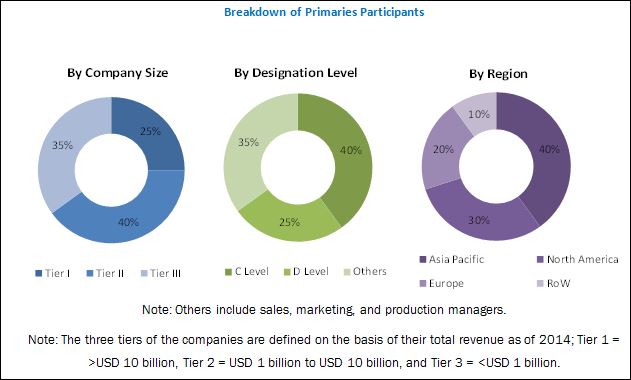
After arriving at the overall market size, the total e-compass market has been split into several segments and subsegments and confirmed with the key industry experts. The figure below shows the breakdown of primaries on the basis of company type, designation, and region.
To know about the assumptions considered for the study, download the pdf brochure
The e-compass ecosystem comprises of chip designers such as STMicroelectronics (France), mCube (U.S.), MEMSIC (U.S.) and MagnaChip (South Korea) among others; component manufacturers such as NXP Semiconductors N.V. (Netherlands), Bosch Sensortec (Germany), Asahi Kasei Microdevices (Japan), Honeywell (U.S.) among others; technology providers such as InvenSense, Inc. (U.S.), Honeywell (U.S.), and Bosch Sensortec (Germany), among others; and system integrators such as TrueNorth Technologies (U.S.), Aichi Steel (Japan), among others who integrate these e-compass sensors and sell them to end users to cater to their unique business requirements.
Key Target Audience:
- Sensor manufacturers
- Consumer electronics companies
- Aerial and marine navigators
- Surveying industry
- Distributers
- Research organizations
- Technology investors
- Organizations, alliances, and associations related to technology standards
Scope of the Report:
The research report segments the e-compass market into following submarkets:
By Technology
- Fluxgate
- Hall-Effect
- Magneto resistive
- Others
By Application
- Consumer Electronics
- Aerospace & Defense
- Automotive
- Marine
- Surveying
- Others
By Sensor Type
- 1 & 2-axis
- 3-axis
- 6-axis
- 9-axis
By Region
-
North America
- U.S.
- Canada
-
Europe
- Germany
- France
- U.K.
- Rest of Europe
-
Asia-Pacific
- China
- Japan
- South Korea
- Rest of APAC
-
Rest of the World
- Middle East & Africa
- Latin America
Available Customizations:
With the given market data, MarketsandMarkets offers customizations according to the company’s specific needs. The following customization options are available for the report:
- Company Information: Detailed analysis and profiling of additional market players (up to five)













Growth opportunities and latent adjacency in E-Compass Market
I am interested in the mobile application section for this report. And could you mention the price & cost depending on each market?