Europe Gesture Recognition & Touchless Sensing Market

Europe Gesture Recognition and Touchless Sensing Market by Technology (Touch-based, Touchless), Touchless Sensing Product (Touchless Biometric Equipment, Touchless Sanitary Equipment), Gesture Recognition, Industry, and Region - Forecast to 2032




OVERVIEW
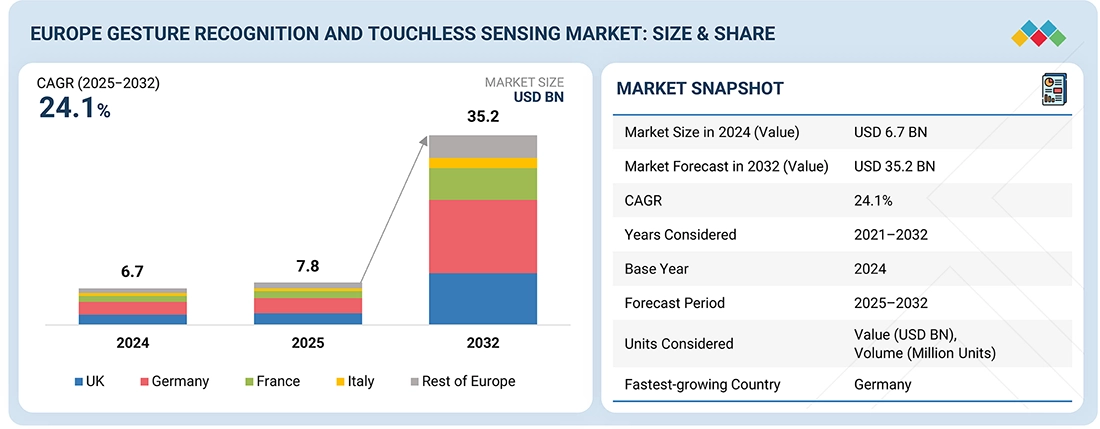
Source: Secondary Research, Interviews with Experts, MarketsandMarkets Analysis
The Europe gesture recognition and touchless sensing market is projected to reach USD 35.2 billion by 2032 from USD 7.8 billion in 2025, at a CAGR of 24.1%. The market growth is driven by the rising adoption of touchless and gesture-based interfaces across automotive, healthcare, smart infrastructure, and industrial automation applications. Europe’s strong automotive base, led by premium OEMs, is accelerating the integration of gesture-controlled infotainment and advanced driver assistance systems to enhance safety and user experience. The increasing focus on hygiene, patient safety, and contactless workflows is supporting the adoption of these practices in hospitals, diagnostic centers, and public facilities.
The France gesture recognition market is witnessing strong growth as industries increasingly adopt touchless and AI-powered interaction technologies across sectors such as automotive, consumer electronics, healthcare, and smart home systems.Advancements in artificial intelligence, sensor technologies, and computer vision are improving the accuracy and responsiveness of gesture-based interfaces, enabling more intuitive human–machine interaction. In addition, France’s strong focus on digital transformation, rising demand for contactless technologies, and increasing integration of gesture control in smart devices, vehicles, and interactive displays are accelerating the expansion of the gesture recognition market across the country.
The Germany gesture recognition market is witnessing strong growth as industries increasingly adopt touchless and AI-based human–machine interaction technologies.The growth is largely driven by Germany’s strong automotive and industrial sectors, where gesture-controlled infotainment systems, driver monitoring technologies, and smart factory automation solutions are gaining traction. In addition, the country’s focus on Industry 4.0, advanced manufacturing, and smart infrastructure is accelerating the integration of gesture recognition in consumer electronics, healthcare devices, and interactive digital platforms, further supporting the expansion of the market across Germany.
The Spain gesture recognition market is experiencing steady growth as industries increasingly adopt touchless and AI-based human–machine interaction technologies.Rising demand for hands-free interfaces in consumer electronics, automotive systems, healthcare equipment, and smart home devices is driving market expansion across the country. In addition, Spain’s growing focus on digital innovation, smart city initiatives, and advancements in sensor technology and AI-based gesture detection are further accelerating the adoption of gesture recognition solutions in various industries.
KEY TAKEAWAYS
-
BY COUNTRYBy country, Germany is expected to dominate the market. The market in the country is projected to register a CAGR of 25.5% during the forecast period.
-
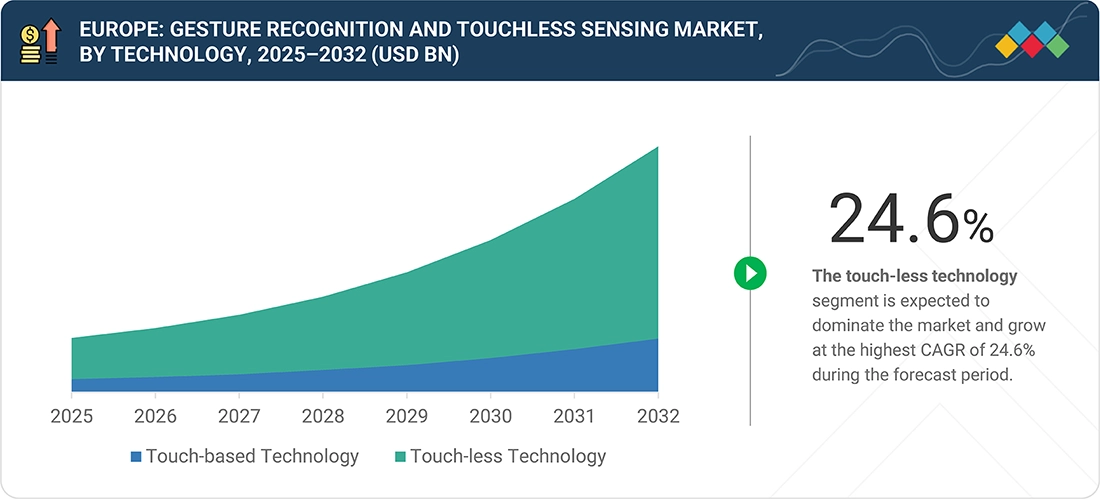
BY TECHNOLOGYBy technology, the touch-less technology segment is expected to dominate the market during the forecast period.
-
GESTURE RECOGNITION TYPEBy gesture recognition type, the online segment is expected to grow at the fastest CAGR during the forecast period.
-
GESTURE RECOGNITION INDUSTRYBy gesture recognition industry, the consumer electronics segment is expected to dominate the market.
-
TOUCHLESS SENSING PRODUCTBy touchless sensing product, the touchless biometric segment is expected to dominate the market during the forecast period.
-
TOUCHLESS SENSING INDUSTRYBy touchless sensing industry, the automotive segment is expected to register the highest CAGR during the forecast period.
-
COMPETITIVE LANDSCAPE - KEY PLAYERSSony Depthsensing Solutions (Belgium), Infineon Technologies (Germany), Cognitec Systems GmbH (Germany), IrisGuard (UK), and Valeo (France) were identified as some of the star players in the Europe gesture recognition and touchless sensing market, given their strong market share and product footprint.
-
COMPETITIVE LANDSCAPE - STARTUPS/SMESIDEMIA (France), among others, has distinguished itself among SMEs by securing strong footholds in specialized niche areas, underscoring its potential as an emerging market leader. These vendors have been marking their market presence by offering solutions as per end-user requirements and adopting growth strategies to achieve their targets.
The Europe gesture recognition and touchless sensing industry is driven by strong regulatory emphasis on workplace safety, data privacy, and human-centric system design across industries. The widespread deployment of gesture-based controls in premium vehicles, smart manufacturing facilities, and public transportation systems is supporting adoption as enterprises focus on reducing physical interaction with control interfaces. Growing investments in smart cities, digital public services, and automated building management systems are increasing demand for touchless access control and interaction technologies.
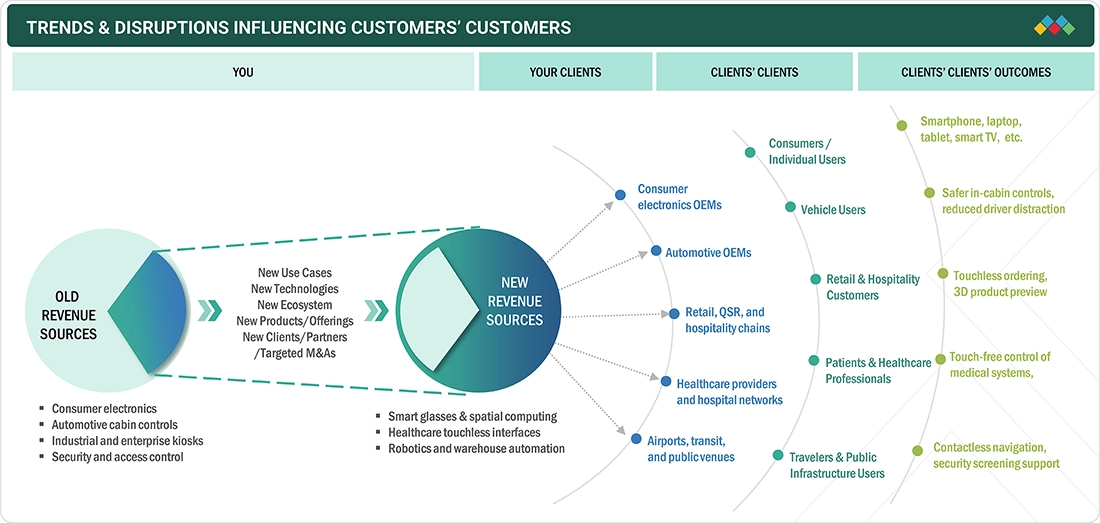
TRENDS & DISRUPTIONS IMPACTING CUSTOMERS' CUSTOMERS
The Europe gesture recognition and touchless sensing market is witnessing a shift toward touchless and intuitive interaction across automotive, healthcare, public infrastructure, and industrial environments. Automotive OEMs are adopting gesture-based in-cabin controls to enhance safety and user experience. The retail, transportation, and hospitality sectors are deploying touchless ordering, navigation, and access systems to enhance efficiency. Advancements in AI vision, 3D sensing, and spatial computing are enabling new use cases and supporting wider adoption across the region.
Source: Secondary Research, Interviews with Experts, MarketsandMarkets Analysis
MARKET DYNAMICS

Level
-
Strong adoption of touchless and gesture-based interfaces across automotive HMI systems, driven by the presence of premium OEMs

-
Rising deployment of touchless access control systems in public transport, airports, and government infrastructure


Level
-
Strict data protection and privacy regulations (GDPR) increasing compliance complexity for gesture recognition and biometric solutions

-
Integration challenges with legacy infrastructure across public sector and industrial facilities in Europe


Level
-
Growing investments in smart mobility, smart cities, and intelligent transportation systems across Western and Northern Europe

-
Increasing use of gesture recognition in automotive infotainment, driver monitoring, and in-cabin controls


Level
-
High development and deployment costs of advanced gesture recognition systems

Source: Secondary Research, Interviews with Experts, MarketsandMarkets Analysis
Driver: Strong adoption of touchless and gesture-based interfaces across automotive HMI systems, driven by the presence of premium OEMs
The strong adoption of touchless and gesture-based interfaces in Europe is supported by the presence of premium automotive OEMs and Tier-1 suppliers. Gesture recognition is increasingly used in in-cabin controls, infotainment systems, and driver monitoring to improve safety, usability, and compliance with distraction regulations.
Restraint: Strict data protection and privacy regulations (GDPR) increasing compliance complexity for gesture recognition and biometric solutions
Strict data protection and privacy regulations, particularly GDPR, increase compliance requirements for gesture recognition and biometric solutions. These regulations add complexity to data handling, storage, and processing, slowing deployment timelines and increasing implementation costs across European markets.
Opportunity: Growing investments in smart mobility, smart cities, and intelligent transportation systems across Western and Northern Europe
Rising investments in smart mobility, smart cities, and intelligent transportation systems across Western and Northern Europe are creating new demand for touchless interaction technologies. Gesture recognition is being integrated into public transport, traffic management, and urban infrastructure to improve efficiency and user experience.
Challenge: High development and deployment costs of advanced gesture recognition systems
High development and deployment costs of advanced gesture recognition systems limit adoption, especially for small and mid-scale enterprises. Achieving high accuracy, low latency, and system reliability while controlling costs remains a key challenge for vendors operating in Europe.
EUROPE GESTURE RECOGNITION & TOUCHLESS SENSING MARKET: COMMERCIAL USE CASES ACROSS INDUSTRIES
| COMPANY | USE CASE DESCRIPTION | BENEFITS |
|---|---|---|
 |
Sony Depthsensing Solutions deployed 3D Time-of-Flight sensors and gesture recognition technology in automotive cabin monitoring, AR/VR headsets, gaming consoles, and robotics applications for touchless human-machine interfaces and spatial computing experiences. | The technology enabled enhanced automotive safety through driver attention monitoring and occupant detection, improved user experience with intuitive gesture-based controls, reducing physical contact, and created immersive AR/VR experiences with accurate depth sensing and spatial awareness for natural interaction. |
 |
Infineon Technologies implemented 60GHz radar sensors for gesture recognition and touchless sensing in automotive cabin monitoring, smart home devices, and IoT applications, enabling child presence detection, vital signs monitoring, and contactless gesture controls for infotainment and climate systems. | The deployment improved automotive safety through child presence detection and preventing hot car deaths. It enhanced convenience with intuitive gesture controls, eliminating physical contact and provided reliable performance in challenging conditions with low-power radar technology suitable for battery-powered devices. |
 |
Cognitec Systems deployed touchless facial recognition through its FaceVACS platform for border control, law enforcement, and access control applications, including automated passport verification for the European Entry-Exit System and real-time identity verification in video surveillance for security analytics. | The technology enabled frictionless touchless biometric authentication, eliminating physical contact. It improved border security and efficiency through automated passport verification, reducing processing time and enhancing access control with hands-free facial recognition and presentation attack detection, ensuring live person authentication. |
 |
IrisGuard implemented contactless iris recognition for digital identity verification, humanitarian aid distribution, and financial inclusion, enabling cardless ATM withdrawals and secure payment authentication. The technology supports UNHCR and WFP for verified aid distribution and provides financial services access for unbanked populations. | The deployment provided financial inclusion for unbanked populations with secure card-less banking access, ensured the highest accuracy contactless biometric authentication with one-in-millions verification preventing fraud in aid distribution, and enabled dignified identity verification in humanitarian contexts, adapting to cultural requirements including veils and headdresses. |
 |
Valeo deployed gesture recognition and touchless sensing through AI-based software and 3D cameras for automotive interior monitoring systems, enabling drivers to control infotainment, climate, and vehicle functions using natural hand gestures, while also supporting behavioral tracking for automated driving development. | The technology enhanced driving safety by enabling hands-free vehicle control, reducing driver distraction, improving passenger comfort through adaptive climate control and seating adjustments based on occupant detection, and enabling advanced safety features, including optimized airbag deployment based on passenger position and driver attention monitoring for autonomous vehicles. |
Logos and trademarks shown above are the property of their respective owners. Their use here is for informational and illustrative purposes only.
MARKET ECOSYSTEM
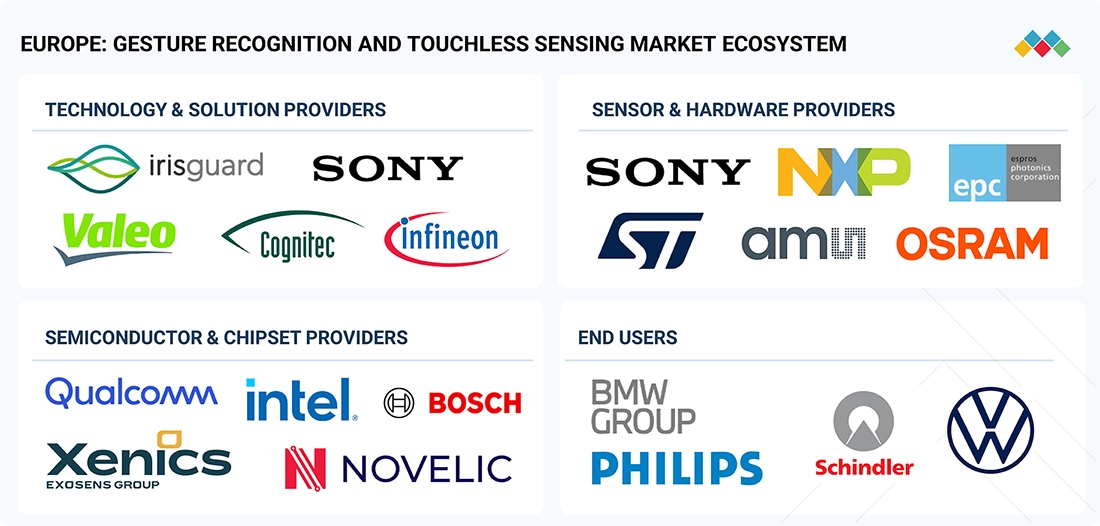
The Europe gesture recognition and touchless sensing market ecosystem includes technology and solution providers, sensor and hardware manufacturers, semiconductor companies, and end users. Technology providers develop AI-based software and integrated systems to enable touchless and gesture-based interaction. Sensor and hardware players supply cameras, optical sensors, and proximity technologies for accurate detection. Semiconductor companies support high-performance processing and edge intelligence. End users across the automotive, healthcare, building, and industrial sectors are driving adoption and commercialization in Europe.
Logos and trademarks shown above are the property of their respective owners. Their use here is for informational and illustrative purposes only.
MARKET SEGMENTS
Source: Secondary Research, Interviews with Experts, MarketsandMarkets Analysis
Europe Gesture Recognition and Touchless Sensing Market, By Technology
Touchless technology is expected to dominate the Europe market, driven by stringent regulatory standards, growing smart infrastructure projects, and widespread adoption in public facilities. Compliance with safety and accessibility norms is accelerating deployment across transport hubs, offices, and healthcare environments. Integration with smart building systems supports steady market growth.
Europe Gesture Recognition Market, By Type
Online gesture recognition is expected to grow at the highest CAGR in Europe, supported by increasing deployment of connected industrial systems and automotive interfaces requiring real-time interaction. Growth is enabled by improved sensor fusion and AI optimization. Strong regional digital frameworks support scalable deployment.
Europe Gesture Recognition Market, By Industry
The automotive industry is expected to dominate the market in Europe, supported by the presence of premium vehicle manufacturers and advanced human–machine interface development. Gesture-based controls are being integrated to improve in-cabin usability and safety. The shift toward electric and software-defined vehicles further supports demand.
Europe Touchless Sensing Market, By Product
Touchless biometric solutions are expected to dominate the market during the forecast period, driven by rising adoption in border control, smart access systems, and regulated facilities. Secure identity verification and access management are key focus areas. Deployment is expanding across public and enterprise infrastructure.
Europe Touchless Sensing Market, By Industry
The public infrastructure segment is expected to register strong growth in Europe, supported by investments in smart transportation systems, airports, and urban facilities. Touchless systems are deployed to improve operational efficiency and user safety. Government-led digital infrastructure initiatives support adoption.
REGION
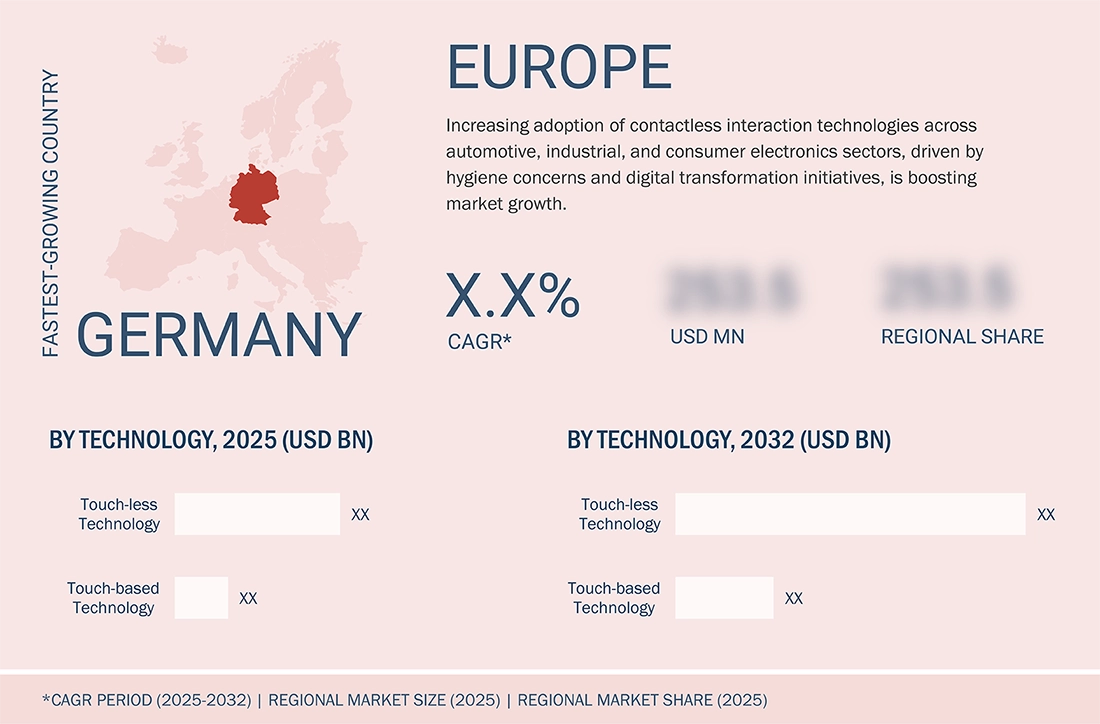
Germany is expected to be the fastest-growing country in the Europe gesture recognition and touchless sensing market during the forecast period
Germany is projected to register the highest CAGR in the Europe gesture recognition and touchless sensing market due to strong investments in industrial automation, smart manufacturing, and digital mobility solutions. The presence of key technology providers, such as Infineon Technologies (Germany) and Cognitec Systems GmbH (Germany), supports continuous innovation in sensing hardware and AI-based vision software. In addition, Germany’s strong automotive ecosystem, led by major OEMs, is accelerating the integration of gesture-based and touchless interfaces in vehicles. Government support for Industry 4.0 and smart infrastructure further strengthens market growth during the forecast period.
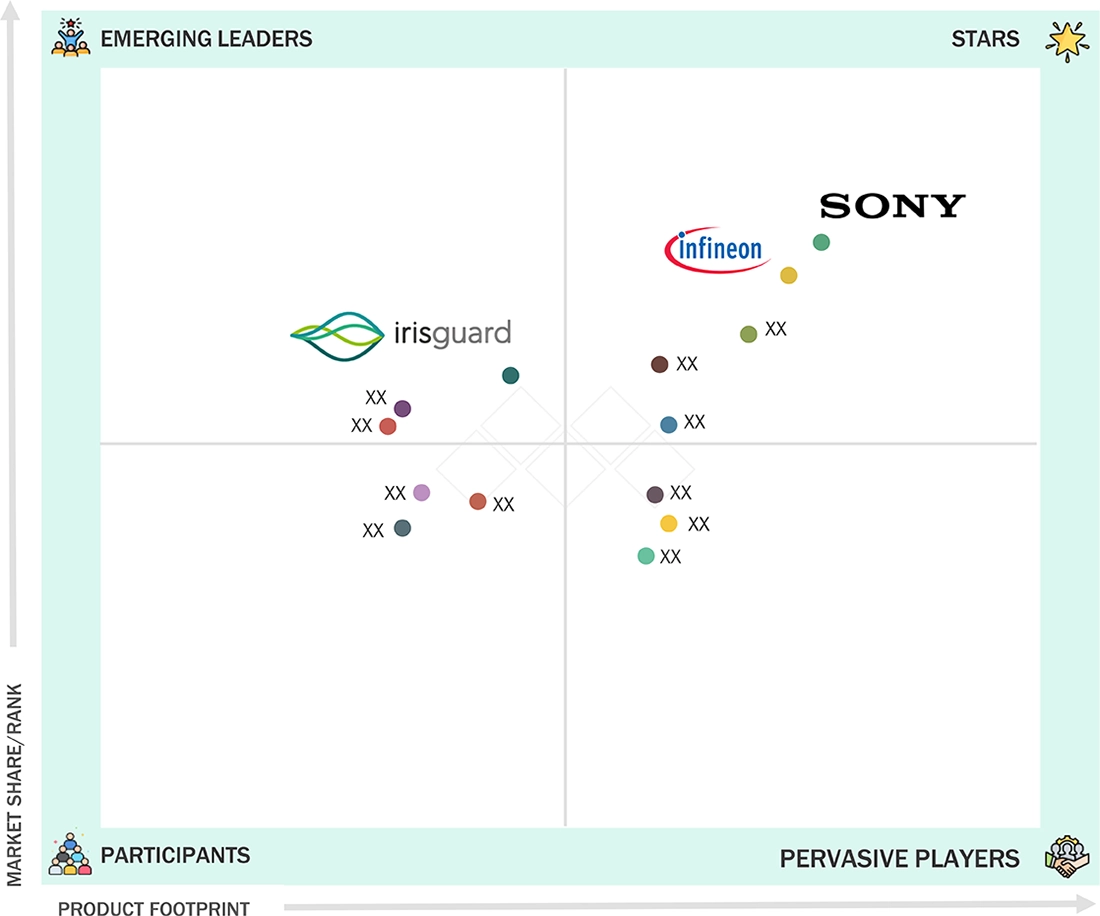
EUROPE GESTURE RECOGNITION & TOUCHLESS SENSING MARKET: COMPANY EVALUATION MATRIX
In the Europe gesture recognition and touchless sensing market matrix, Sony Depthsensing Solutions and Infineon Technologies (Star) lead with a strong market presence and broad technology portfolios, enabling large-scale adoption across automotive, consumer electronics, and industrial applications. IrisGuard (Emerging Leader) is strengthening its position through specialized iris-based biometric and touchless authentication solutions for secure access, border control, and regulated environments.
Source: Secondary Research, Interviews with Experts, MarketsandMarkets Analysis
KEY MARKET PLAYERS
List of Top Europe gesture recognition and touchless sensing market Companies
MARKET SCOPE
| REPORT METRIC | DETAILS |
|---|---|
| Market Size in 2024 (Value) | USD 6.7 Billion |
| Market Forecast in 2032 (Value) | USD 35.2 Billion |
| Growth Rate | CAGR of 24.1% from 2025–2030 |
| Years Considered | 2021–2032 |
| Base Year | 2024 |
| Forecast Period | 2025–2032 |
| Units Considered | Value (USD BN), Volume (Million Units) |
| Report Coverage | Revenue forecast, company ranking, competitive landscape, growth factors, and trends |
| Segments Covered |
|
| Regional Scope | Europe |
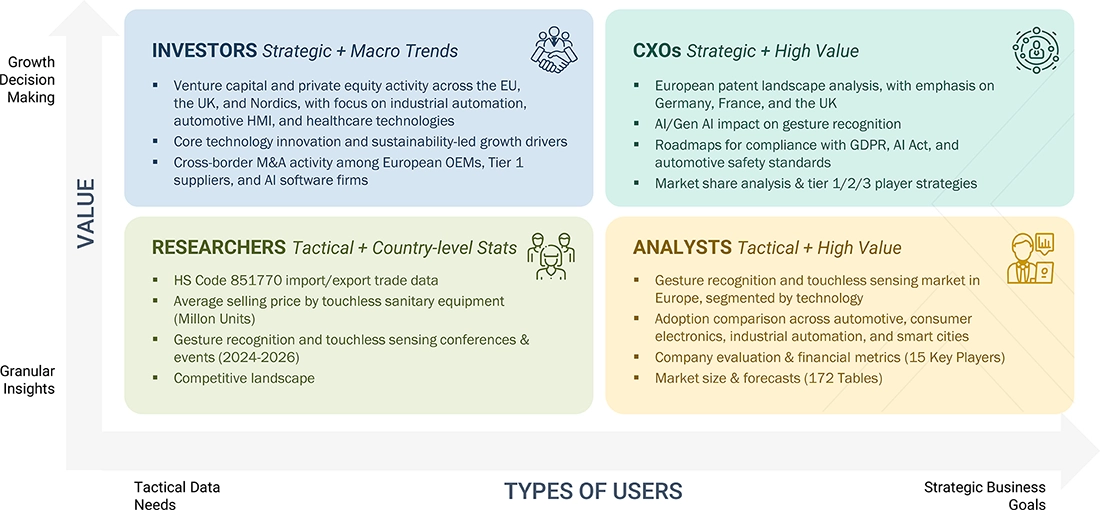
WHAT IS IN IT FOR YOU: EUROPE GESTURE RECOGNITION & TOUCHLESS SENSING MARKET REPORT CONTENT GUIDE
DELIVERED CUSTOMIZATIONS
We have successfully delivered the following deep-dive customizations:
| CLIENT REQUEST | CUSTOMIZATION DELIVERED | VALUE ADDS |
|---|---|---|
| European Retail & Hospitality Chain Operator |
|
|
| German Automotive OEM & Tier-1 Supplier |
|
|
| French Smart Building & IoT Solutions Provider |
|
|
RECENT DEVELOPMENTS
- October 2025 : Infineon Technologies AG launched its next-generation XENSIV 60 GHz CMOS radar sensor, BGT60CUTR13AIP, designed for ultra-low power IoT and smart home applications. The sensor features on-chip radar processing with a hardware accelerator, enabling access to raw or pre-processed data while reducing host processor load and system cost.
- June 2023 : IrisGuard Ltd. and Elm Saudi Arabia signed a Memorandum of Understanding at GITEX Africa in Morocco on June 1, 2023, to explore collaboration across various projects, including the distribution of humanitarian aid and citizen social protection payments, incorporating iris recognition.
- March 2023 : Infineon Technologies AG acquired the Stockholm-based startup Imagimob AB, a leading platform provider for machine learning solutions for edge devices. Through this acquisition, Infineon strengthened its position as a machine learning (ML) solutions provider and enhanced its AI portfolio.
- January 2023 : Cognitec Systems GmbH upgraded its FaceVACS-Entry technology to enable comparison of facial images retrieved from ID documents or databases. The update also incorporated presentation attack detection to ensure live user interaction with the device.
Table of Contents
 Exclusive indicates content/data unique to MarketsandMarkets and not available with any competitors.
Key Questions Addressed by the Report
What is the market size and growth outlook of the Europe gesture recognition and touchless sensing market
The Europe gesture recognition and touchless sensing market is projected to grow from USD 7.8 billion in 2025 to USD 35.2 billion by 2032 at a CAGR of 24.1%, driven by increasing adoption of touchless interfaces across multiple industries.
Which regions or countries are leading the growth in this market
Germany is expected to dominate the market due to its strong automotive and industrial sectors, while countries such as France and Spain are also witnessing steady growth supported by digital transformation and smart technology adoption.
Which segments are driving the market growth in terms of technology and industry
The touchless technology segment is expected to dominate, with consumer electronics leading among industries and automotive showing the highest growth rate, while touchless biometric products also hold a major share.
What are the key applications supporting the demand for gesture recognition and touchless sensing in Europe
The market demand is supported by applications in automotive infotainment and driver monitoring, healthcare systems, smart infrastructure, industrial automation, and public facilities focusing on hygiene and contactless interaction.
Who are the key players operating in the Europe gesture recognition and touchless sensing market
Key players in the market include Sony Depthsensing Solutions, Infineon Technologies, Cognitec Systems GmbH, IrisGuard, Valeo, and IDEMIA, which are contributing through strong product portfolios and innovation strategies.


Personalize This Research
- Triangulate with your Own Data
- Get Data as per your Format and Definition
- Gain a Deeper Dive on a Specific Application, Geography, Customer or Competitor
- Any level of Personalization
Let Us Help You
- What are the Known and Unknown Adjacencies Impacting the Europe Gesture Recognition and Touchless Sensing Market
- What will your New Revenue Sources be?
- Who will be your Top Customer; what will make them switch?
- Defend your Market Share or Win Competitors
- Get a Scorecard for Target Partners

Custom Market Research Services
We Will Customise The Research For You, In Case The Report Listed Above Does Not Meet With Your Requirements
Get 10% Free CustomisationTESTIMONIALS

Tetsuya Ohhira
Business Development Manager-Technology Business
Nikon Corporation,
Leading Japanese MNC specializing in optics and imaging productswww.nikon.com
MarketsandMarkets™ response
is quick. Their attitude is flexible and positive. Analyst Insights are globally considered and
significant. Client Services quickly respond to our inquiry and demand. Their wide range of global
surveys help us make our strategic plan.
We hope Knowledge Store will be easier to search
for a report.
VP - Marketing & Business Development
Leading Provider of Process Control Solutions
We engaged with MarketsandMarkets on a study to perform an analysis and recommend a Go-To-Market strategy for metrology and process control in the semiconductor market. The study was tailored to our targets and needs with well-defined milestones. Our overall experience with the MarketsandMarkets team was very good throughout the project in all aspects including the analysis methodologies used, the quality and depth of primary and secondary data sets, the professionalism and flexibility of the team and the ability to meet the target schedule and milestones. We want to thank MarketsandMarkets team for a job well done.






Growth opportunities and latent adjacency in Europe Gesture Recognition and Touchless Sensing Market