



Gesture Recognition and Touchless Sensing Market Size, Share & Growth
Report Code
SE 3453
Published in
Jan, 2026, By MarketsandMarkets™
Gesture Recognition and Touchless Sensing Market by Technology (Touch-based, Touchless), Touchless Sensing Product (Touchless Biometric Equipment, Touchless Sanitary Equipment), Gesture Recognition, Industry, and Region - Global Forecast to 2032

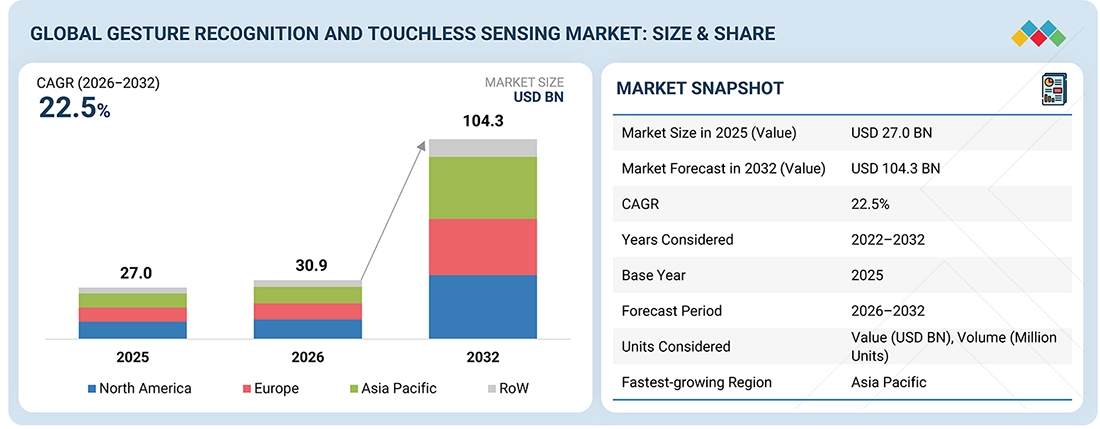
USD 104.3 BN
MARKET SIZE, 2032

CAGR 22.5%
(2026-2032)

243
REPORT PAGES

195
MARKET TABLES
OVERVIEW
According to Marketsandmarkets, the global gesture recognition and touchless sensing market is projected to reach USD 104.3 billion by 2032 from USD 30.9 billion in 2026, at a CAGR of 22.5% from 2026 to 2032. Growth in digitalization, technological advancements across industries, and an increase in the use of touchless sensing in the automotive and healthcare industries are major factors driving market growth. Further, increasing use of gesture recognition in VR and video games is likely to create new growth opportunities during the forecast period.
KEY TAKEAWAYS
-
GESTURE RECOGNITION AND TOUCHLESS SENSING MARKET, BY REGIONBy region, North America is expected to dominate the market and is projected to grow at a CAGR of 21.6% during the forecast period.
-
GESTURE RECOGNITION AND TOUCHLESS SENSING MARKET, BY TECHNOLOGYBy technology, the touch-less technology segment is expected to dominate the market during the forecast period.
-
GESTURE RECOGNITION MARKET, BY TYPEBy gesture recognition type, the online segment is expected to grow at the fastest CAGR during the forecast period.
-
GESTURE RECOGNITION MARKET, BY INDUSTRYBy gesture recognition, the consumer electronics segment is expected to dominate the market.
-
TOUCHLESS SENSING MARKET, BY PRODUCTBy touchless sensing product, the touchless sanitary equipment is expected to register the fastest CAGR during the forecast period.
-
TOUCHLESS SENSING MARKET, BY INDUSTRYBy touchless sensing industry, the automotive segment is expected to register the highest CAGR during the forecast period.
-
COMPETITIVE LANDSCAPE - KEY PLAYERSApple Inc. (US), Microsoft Corporation (US), Microchip Technology Inc. (US), Google LLC (US), and Infineon Technologies (Germany) were identified as some of the star players in the global gesture recognition and touchless sensing market, given their strong market share and product footprint.
-
COMPETITIVE LANDSCAPE - STARTUPS/SMESHID Global Corporation (US), OMRON Corporation (Japan), and ESPROS, among others, have distinguished themselves among SMEs by securing strong footholds in specialized niche areas, underscoring their potential as emerging market leaders. These vendors have been marking their market presence by offering solutions as per end-user requirements and adopting growth strategies to achieve their targets.
Major automobile manufacturers, including Volkswagen AG (Germany), BMW AG (Germany), and Mercedes-Benz, a division of Daimler AG (Germany), have integrated gesture control technology into their vehicles, creating a platform for gesture recognition technology to enhance control interfaces. In 2024, Harman launched Ready Connect 5G Telematics Control Unit (TCU), which uses new Snapdragon Digital Chassis connected car technologies from Qualcomm Technologies, Inc., to push connectivity boundaries and democratize the automotive connectivity landscape.
Source: Secondary Research, Interviews with Experts, MarketsandMarkets Analysis
TRENDS & DISRUPTIONS IMPACTING CUSTOMERS' CUSTOMERS
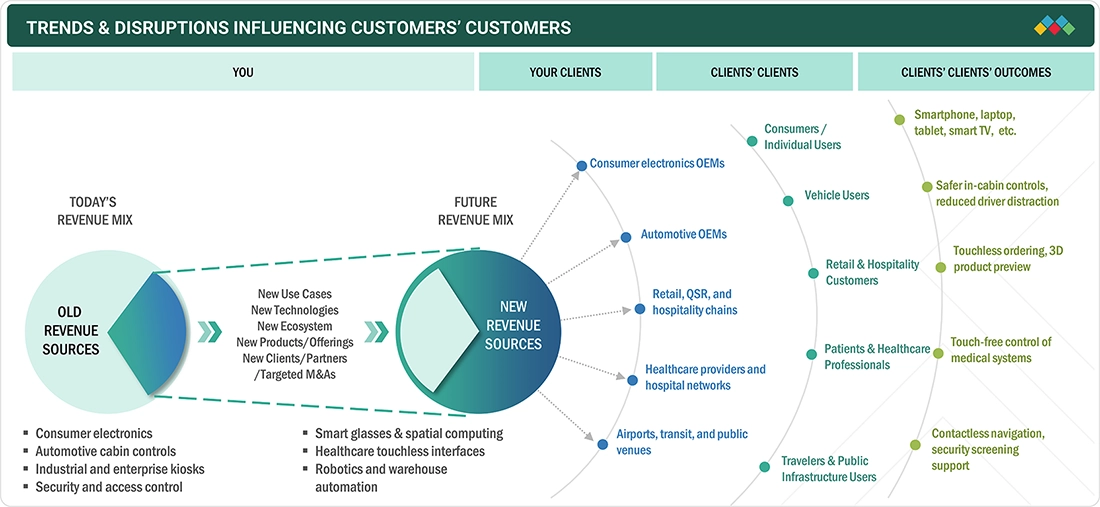
The gesture recognition and touchless sensing industry is shifting toward AI-driven, sensor-based interfaces across multiple industries. Adoption is expanding from consumer electronics into automotive, healthcare, retail, and public infrastructure. Touchless systems are improving safety, hygiene, and user convenience through accurate, context-aware interactions. These trends are creating new revenue opportunities and reshaping traditional interface models.
Source: Secondary Research, Interviews with Experts, MarketsandMarkets Analysis
MARKET DYNAMICS

Drivers
Impact
Level
Level
-
Growth in digitalization and rise in technological advancements across industries

-
Increasing demand for connectivity in automotive industry


RESTRAINTS
Impact
Level
Level
-
High replacement expenses and user resistance to new products

-
Integration challenges with existing systems


OPPORTUNITIES
Impact
Level
Level
-
Tracking and controlling functionality upgrades in touchless biometric solutions

-
Higher use of gesture recognition in VR and video games


CHALLENGES
Impact
Level
Level
-
High costs and complex framework of product technologies

Source: Secondary Research, Interviews with Experts, MarketsandMarkets Analysis
Driver: Growth in digitalization and rise in technological advancements across industries
Growth in digitalization and rapid technological advancements across industries is increasing the adoption of gesture recognition and touchless sensing solutions. These technologies enable enhanced user interaction, automation, and hygiene-focused operations across the automotive, consumer electronics, healthcare, and smart infrastructure sectors.
Restraint: High replacement expenses and user resistance to new products
High replacement expenses and user resistance to adopting new technologies continue to limit market penetration. Concerns related to integration complexity, compatibility with existing systems, and cost justification slow large-scale deployment.
Opportunity: Tracking and controlling functionality upgrades in touchless biometric solutions
Advancements in tracking and controlling functionalities within touchless biometric solutions are creating new growth opportunities. Enhanced accuracy and real-time responsiveness are expanding use cases in security systems, smart homes, and immersive digital environments.
Challenge: High costs and complex framework of product technologies
High development costs and the complex technological framework required for gesture recognition and touchless sensing solutions remain key challenges. Ensuring reliability, precision, and scalability while managing costs impacts adoption, particularly among small and mid-sized enterprises.
GESTURE RECOGNITION AND TOUCHLESS SENSING MARKET SIZE, SHARE & GROWTH: COMMERCIAL USE CASES ACROSS INDUSTRIES
| COMPANY | USE CASE DESCRIPTION | BENEFITS |
|---|---|---|
 |
Apple deployed gesture recognition and touchless sensing in its consumer electronics ecosystem, including Face ID facial recognition for iPhone and iPad devices, touchless gesture controls in watchOS, and spatial computing interactions in Vision Pro headset for immersive AR/VR experiences. | The technology enabled seamless biometric authentication, improved user privacy and security, enhanced accessibility for users with mobility limitations, reduced physical contact with devices, and created intuitive spatial computing experiences with natural hand tracking and eye-gaze interactions. |
 |
Microsoft implemented gesture recognition and touchless sensing through Azure Kinect DK and HoloLens mixed reality platform for enterprise applications, including hands-free surgical guidance in healthcare, touchless industrial equipment control in manufacturing, and gesture-based collaboration tools in corporate environments. | The deployment improved workplace hygiene and safety by eliminating physical touch requirements, enhanced productivity through natural gesture-based interactions, enabled innovative mixed reality training and simulation programs, and supported social distancing requirements in healthcare and manufacturing facilities. |
 |
Microchip Technology deployed GestIC 3D gesture recognition controllers and touchless sensor solutions for automotive human-machine interfaces, smart home devices, and consumer electronics, enabling mid-air gesture control for infotainment systems, touchless light switches, and proximity sensing for appliances. | The technology reduced driver distraction through intuitive gesture controls in vehicles, improved hygiene in public spaces and high-traffic environments, extended product lifespan by minimizing mechanical wear from physical buttons, and enhanced user convenience with contactless operation of everyday devices. |
 |
Google implemented gesture recognition and touchless sensing through Project Soli, a radar-based motion sensing technology, in Pixel smartphones and Nest smart home devices. This enabled touchless music control, call management, alarm snoozing, and presence detection for automated lighting and security systems. | The system enabled hands-free device control for improved accessibility and convenience, reduced unnecessary device interactions to extend battery life, enhanced privacy through on-device processing without cameras, and created more intuitive smart home automation with presence and motion-based triggers. |
 |
Infineon Technologies deployed 60GHz radar sensors and Time-of-Flight (ToF) solutions for gesture recognition and touchless sensing in automotive cabin monitoring systems, smart retail displays with gesture-based navigation, and industrial robotics with touchless human-machine collaboration interfaces. | The deployment improved automotive safety through driver attention monitoring and child presence detection. It enhanced retail customer engagement with interactive touchless displays, enabled safer human-robot collaboration in industrial settings, and provided reliable performance in challenging environmental conditions, including varying lighting and temperature ranges. |
Logos and trademarks shown above are the property of their respective owners. Their use here is for informational and illustrative purposes only.
MARKET ECOSYSTEM
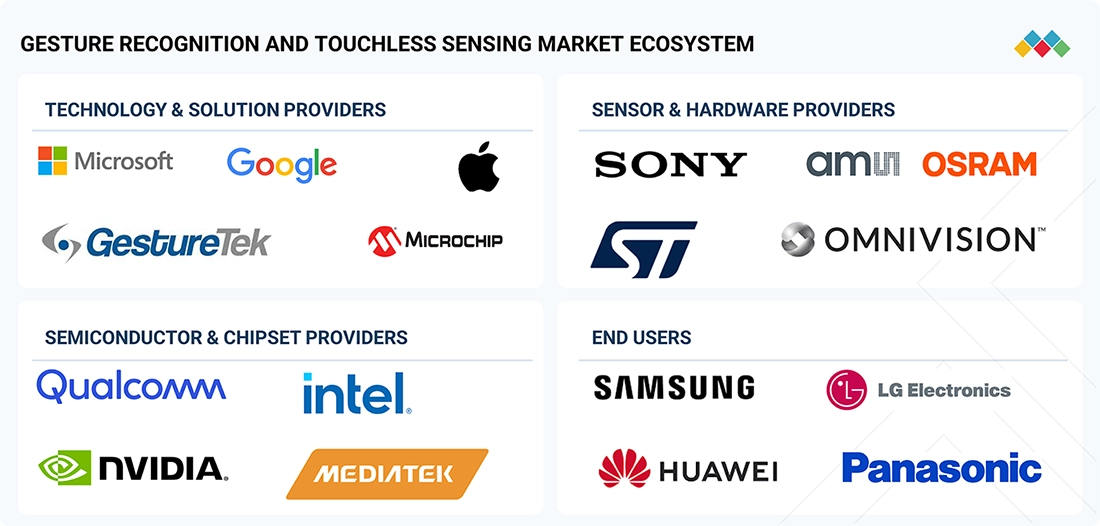
The gesture recognition and touchless sensing ecosystem comprises technology developers, sensor and hardware suppliers, and semiconductor providers collaborating to enable reliable contactless interaction solutions. The ecosystem supports the development of integrated systems that combine software intelligence with advanced sensing and processing capabilities. Growing demand from consumer electronics, automotive, and smart infrastructure applications is driving investments in performance optimization, scalability, and system-level integration.
Logos and trademarks shown above are the property of their respective owners. Their use here is for informational and illustrative purposes only.
MARKET SEGMENTS
Source: Secondary Research, Interviews with Experts, MarketsandMarkets Analysis
Gesture Recognition and Touchless Sensing Market, By Technology
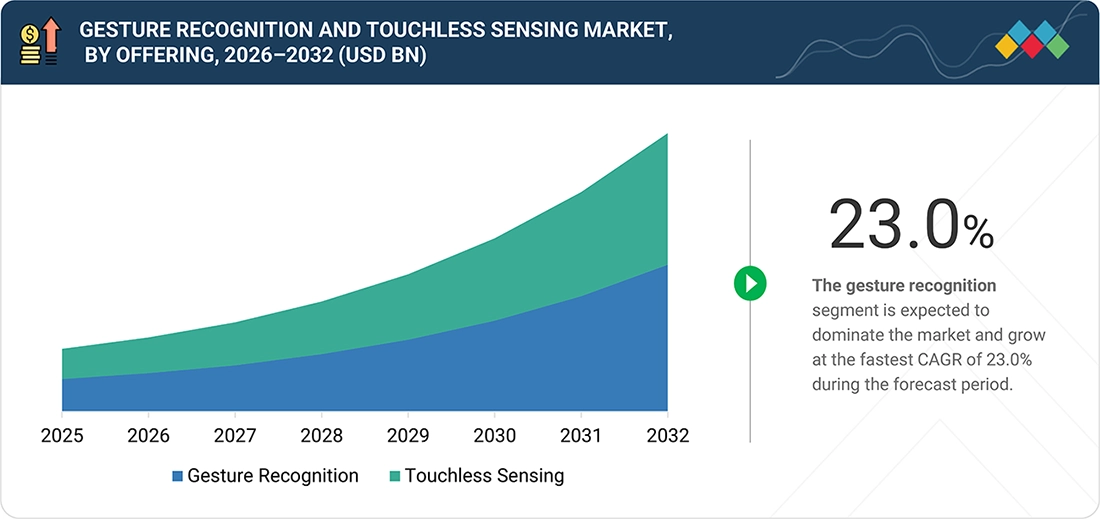
The touchless technology segment is expected to dominate the market during the forecast period. Increasing preference for contact-free interfaces in public and private environments is driving adoption. Advancements in sensor accuracy and system integration are improving performance and reliability.
Gesture Recognition Market, By Type
The online gesture recognition segment is expected to grow at the fastest CAGR during the forecast period. Real-time data processing enables faster response and improved interaction accuracy. This capability supports adoption in applications requiring immediate and dynamic user control.
Gesture Recognition Market, By Industry
The consumer electronics segment is expected to dominate the gesture recognition market. High usage in smartphones, wearables, gaming devices, and smart home systems continues to drive demand. Manufacturers are focusing on intuitive user experiences to maintain market growth.
Touchless Sensing Market, By Product
The touchless sanitary equipment segment is expected to register the fastest CAGR during the forecast period. Rising awareness of hygiene and safety is driving the deployment of solutions in commercial buildings and public infrastructure. Regulatory focus on cleanliness standards further supports adoption.
Touchless Sensing Market, By Industry
The automotive segment is expected to register the fastest CAGR in the touchless sensing market. The integration of gesture-based controls in vehicle cabins is enhancing safety and driver convenience. The growing demand for smart and connected vehicles is accelerating market expansion.
REGION
North America to be largest market for gesture recognition and touchless sensing during forecast period
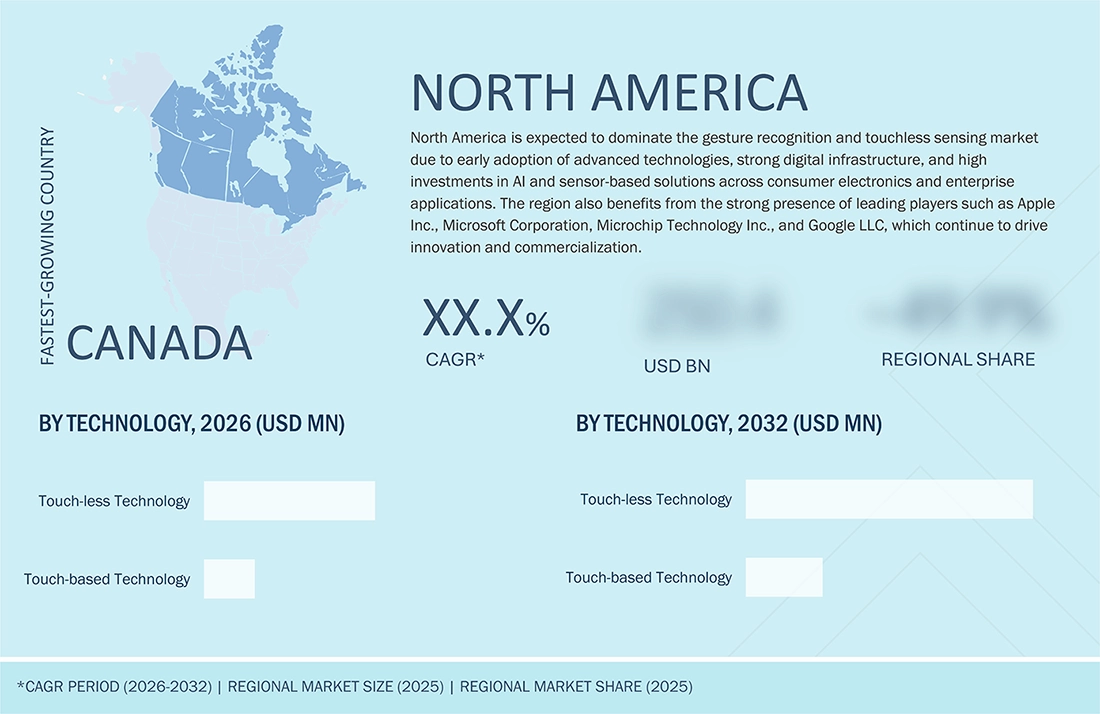
North America is expected to dominate the gesture recognition and touchless sensing market during the forecast period. The region benefits from early adoption of advanced technologies and strong demand across consumer electronics, automotive, and healthcare applications. Continuous investments in AI, sensor technologies, and smart infrastructure are supporting market growth. The presence of key players such as Apple Inc. (US), Microsoft Corporation (US), Microchip Technology Inc. (US), Google LLC (US), OMNIVISION (US), and GestureTek (Canada) further strengthens the regional ecosystem. Strong innovation capabilities and a mature technology landscape position North America as a leading market.
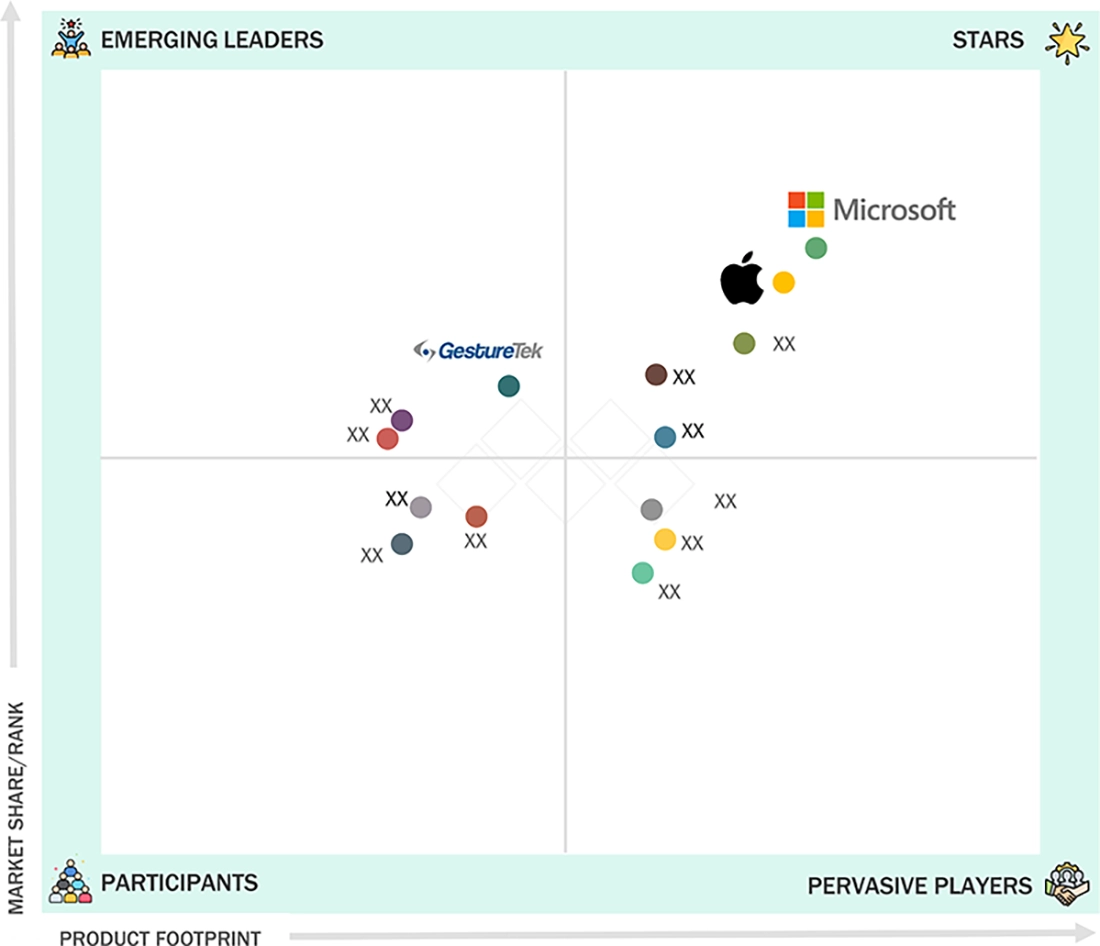
GESTURE RECOGNITION AND TOUCHLESS SENSING MARKET SIZE, SHARE & GROWTH: COMPANY EVALUATION MATRIX
In the global gesture recognition and touchless sensing companies matrix, Apple Inc. and Microsoft Corporation (Star) lead with a strong market presence and a wide product portfolio, driving large-scale adoption across various verticals, including consumer electronics, healthcare, and automotive. GestureTek (Emerging Leader) is strengthening its position by offering specialized gesture-based interaction solutions for smart spaces, healthcare environments, and interactive installations, supporting growing adoption in targeted applications.
Source: Secondary Research, Interviews with Experts, MarketsandMarkets Analysis
KEY MARKET PLAYERS
MARKET SCOPE
| REPORT METRIC | DETAILS |
|---|---|
| Market Size in 2025 (Value) | USD 27.0 Billion |
| Market Size in 2026 (Value) | USD 30.9 Billion |
| Market Forecast in 2032 (Value) | USD 104.3 Billion |
| Growth Rate | CAGR of 22.5% from 2026–2032 |
| Years Considered | 2022–2032 |
| Base Year | 2025 |
| Forecast Period | 2026–2032 |
| Units Considered | Value (USD BN), Volume (Million Units) |
| Report Coverage | Revenue forecast, company ranking, competitive landscape, growth factors, and trends |
| Segments Covered |
|
| Regional Scope | North America, Europe, Asia Pacific, and RoW |
WHAT IS IN IT FOR YOU: GESTURE RECOGNITION AND TOUCHLESS SENSING MARKET SIZE, SHARE & GROWTH REPORT CONTENT GUIDE
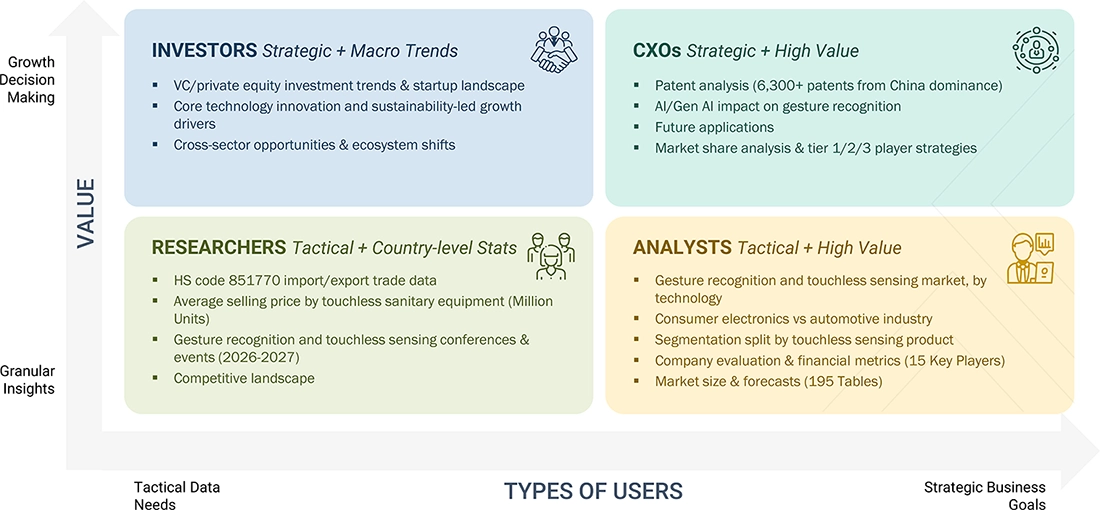
DELIVERED CUSTOMIZATIONS
We have successfully delivered the following deep-dive customizations:
| CLIENT REQUEST | CUSTOMIZATION DELIVERED | VALUE ADDS |
|---|---|---|
| Automotive Gesture Control Manufacturer |
|
|
| Healthcare Touchless Interface Provider |
|
|
| Smart Building Technology Integrator |
|
|
| Retail Touchless Payment System Vendor |
|
|
| Consumer Electronics Gesture Interface Developer |
|
|
RECENT DEVELOPMENTS
- July 2026 : Google LLC announced that its upcoming intelligent eyewear, developed with Samsung and eyewear partners Gentle Monster and Warby Parker, will support hands-free control through hand gestures. Google specifically demonstrated that users wearing a compatible Wear OS watch will be able to control the glasses using hand gestures, providing a touch-free interaction method for the eyewear. The development directly relates to gesture recognition and touchless sensing by enabling gesture-based control of wearable devices without physical interaction.
- August 2026 : Infineon Technologies expanded its Edge AI offering with its DEEPCRAFT Ready Model for Gesture Classification, a production-ready model that uses radar input to recognize five hand gestures: swipe left, swipe right, swipe up, swipe down and push. The model operates at distances of up to one meter and is designed for smart-home and lifestyle products, allowing manufacturers to integrate gesture recognition without developing their own machine-learning model. The development directly supports touchless human-machine interaction through radar-based gesture sensing.
- February 2026 : Microchip Technology Inc. updated its Touch Modular Library with a Gestures Module providing gesture-recognition capabilities for 2D touch surfaces. The module detects gestures including taps, swipes, wheel movements, pinch and zoom, supporting both single- and dual-finger operation. The update directly concerns gesture recognition technology and provides developers with software functionality for implementing gesture-based human-machine interfaces.
- January 2026 : Microsoft Corporation updated its HoloLens 2 platform documentation and release support for gesture-based interaction, including administrator controls for Start Menu gesture settings. The January 2026 HoloLens documentation describes hand tracking, air-tap, hand rays and gaze-based interaction for navigating holographic interfaces. The development directly concerns gesture recognition and touchless interaction with mixed-reality interfaces, although the update is primarily a software/platform maintenance development rather than a new sensing product.
- April 2024 : Microchip Technology Inc. acquired Seoul-based VSI Co. Ltd., a provider of high-speed asymmetric camera, sensor, and display connectivity technologies. The acquisition strengthens Microchip’s portfolio in Automotive SerDes Alliance (ASA)–based products, supporting advanced in-vehicle networking (IVN) applications.
Table of Contents
 Exclusive indicates content/data unique to MarketsandMarkets and not available with any competitors.
TITLE
PAGE NO
1
INTRODUCTION
29
2
EXECUTIVE SUMMARY
36
3
PREMIUM INSIGHTS
41
4
MARKET OVERVIEW
Digital transformation and touchless tech drive market growth amid connectivity surge and strategic investments.
44
4.1
INTRODUCTION
4.2
MARKET DYNAMICS
4.2.1
DRIVERS
4.2.1.1
TECHNOLOGICAL ADVANCEMENTS AND DIGITAL TRANSFORMATION ACROSS INDUSTRIES
4.2.1.2
RISING CONNECTIVITY DEMAND IN AUTOMOTIVE INDUSTRY
4.2.1.3
INCREASING INVESTMENTS BY INDUSTRY PLAYERS IN HMD TECHNOLOGY
4.2.1.4
GROWING HYGIENE AWARENESS
4.2.1.5
GOVERNMENT-LED DIGITALIZATION INITIATIVES PRIORITIZING IDENTITY AND SECURITY MANAGEMENT
4.2.2
RESTRAINTS
4.2.2.1
TRADE WAR BETWEEN US AND CHINA
4.2.2.2
HIGH REPLACEMENT EXPENSES AND HESITANCE TO ADOPT NEW PRODUCTS
4.2.3
OPPORTUNITIES
4.2.3.1
TOUCHLESS BIOMETRICS UNLOCKING NEW GROWTH OPPORTUNITIES
4.2.3.2
RISE OF VR AND IMMERSIVE GAMING
4.2.3.3
INCREASING POPULARITY OF SMART HOMES
4.2.4
CHALLENGES
4.2.4.1
HIGH COSTS AND COMPLEX FRAMEWORK OF GESTURE RECOGNITION AND TOUCHLESS SENSING TECHNOLOGY-BASED PRODUCTS
4.3
UNMET NEEDS AND WHITE SPACES
4.3.1
UNMET NEEDS IN GESTURE RECOGNITION AND TOUCHLESS SENSING MARKET
4.3.2
WHITE SPACE OPPORTUNITIES
4.4
INTERCONNECTED MARKETS AND CROSS-SECTOR OPPORTUNITIES
4.4.1
INTERCONNECTED MARKETS
4.4.2
CROSS-SECTOR OPPORTUNITIES
4.5
STRATEGIC MOVES BY TIER 1/2/3 PLAYERS
5
INDUSTRY TRENDS
Navigate emerging market dynamics with strategic insights into competitive forces and innovative tech deployments.
54
5.1
INTRODUCTION
5.2
PORTER’S FIVE FORCES ANALYSIS
5.2.1
THREAT OF NEW ENTRANTS
5.2.2
THREAT OF SUBSTITUTES
5.2.3
BARGAINING POWER OF SUPPLIERS
5.2.4
BARGAINING POWER OF BUYERS
5.2.5
INTENSITY OF COMPETITIVE RIVALRY
5.3
MACROECONOMIC OUTLOOK
5.3.1
INTRODUCTION
5.3.2
GDP TRENDS AND FORECAST
5.3.3
TRENDS IN GLOBAL AUTOMOTIVE VERTICAL
5.3.4
TRENDS IN SMART INFRASTRUCTURE, ENTERPRISE, AND PUBLIC SECTOR DEPLOYMENTS
5.4
VALUE CHAIN ANALYSIS
5.5
ECOSYSTEM ANALYSIS
5.6
PRICING ANALYSIS
5.6.1
AVERAGE SELLING PRICE TREND OF TOUCHLESS SANITARY EQUIPMENT, BY TYPE, 2022–2025
5.6.2
AVERAGE SELLING PRICE TREND OF TOUCHLESS FAUCETS, BY REGION, 2022–2025
5.7
TRADE ANALYSIS
5.7.1
IMPORT SCENARIO (HS CODE 851770)
5.7.2
EXPORT SCENARIO (HS CODE 851770)
5.8
KEY CONFERENCES AND EVENTS, 2026–2027
5.9
TRENDS/DISRUPTIONS IMPACTING CUSTOMER BUSINESS
5.10
INVESTMENT AND FUNDING SCENARIO, 2023 TO 2025
5.11
CASE STUDY ANALYSIS
5.11.1
LEGO COLLABORATES WITH ULTRALEAP TO LEVERAGE TOUCHLESS GESTURE RECOGNITION TECHNOLOGY FOR INTERACTIVE ADVERTISING
5.11.2
DS AUTOMOBILES PARTNERS WITH ULTRALEAP TO ENHANCE IN-VEHICLE HMI THROUGH GESTURE RECOGNITION
5.11.3
VERIZON LEVERAGES STRIVR'S VR PLATFORM TO ENHANCE EMPLOYEE PERFORMANCE
5.12
IMPACT OF US TARIFFS – GESTURE RECOGNITION AND TOUCHLESS SENSING MARKET
5.12.1
INTRODUCTION
5.12.2
KEY TARIFF RATES
5.12.3
PRICE IMPACT ANALYSIS
5.12.4
IMPACT ON VARIOUS COUNTRIES/REGIONS
5.12.4.1
US
5.12.4.2
EUROPE
5.12.4.3
ASIA PACIFIC
5.12.5
IMPACT ON VERTICALS
6
TECHNOLOGICAL ADVANCEMENTS, AI-DRIVEN IMPACT, PATENTS, AND INNOVATIONS
AI-driven innovations redefine gesture recognition, unlocking vast market potential and transformative use cases.
76
6.1
KEY TECHNOLOGIES
6.1.1
AI IN COMPUTER VISION
6.1.2
HAPTIC TECHNOLOGY
6.2
COMPLEMENTARY TECHNOLOGIES
6.2.1
STEREOSCOPIC VISION
6.2.2
DIGITAL SCENT TECHNOLOGY
6.3
ADJACENT TECHNOLOGIES
6.3.1
SPEECH & VOICE RECOGNITION
6.4
TECHNOLOGY ROADMAP
6.5
PATENT ANALYSIS
6.6
IMPACT OF AI ON GESTURE RECOGNITION AND TOUCHLESS SENSING MARKET
6.6.1
TOP USE CASES AND MARKET POTENTIAL
6.6.2
BEST PRACTICES FOLLOWED BY PLAYERS IN GESTURE RECOGNITION AND TOUCHLESS SENSING MARKET
6.6.3
CASE STUDIES RELATED TO AI IMPLEMENTATION IN GESTURE RECOGNITION AND TOUCHLESS SENSING MARKET
6.6.4
INTERCONNECTED/ADJACENT ECOSYSTEM AND IMPACT ON MARKET PLAYERS
6.6.5
CLIENTS’ READINESS TO ADOPT AI IN GESTURE RECOGNITION AND TOUCHLESS SENSING MARKET
7
REGULATORY LANDSCAPE
Navigate complex compliance with comprehensive insights into global regulatory standards and key regional bodies.
86
7.1
REGIONAL REGULATIONS AND COMPLIANCE
7.1.1
REGULATORY BODIES, GOVERNMENT AGENCIES, AND OTHER ORGANIZATIONS
7.1.2
INDUSTRY STANDARDS
7.1.2.1
ISO 9241-960
7.1.2.2
ISO/IEC 19794 SERIES
7.1.2.3
ISO/IEC 30107
7.1.2.4
IEEE 2700
8
CUSTOMER LANDSCAPE AND BUYER BEHAVIOR
Uncover critical buying criteria and unmet needs shaping stakeholder decisions in emerging tech markets.
89
8.1
DECISION-MAKING PROCESS
8.2
KEY STAKEHOLDERS INVOLVED IN BUYING PROCESS AND THEIR EVALUATION CRITERIA
8.2.1
KEY STAKEHOLDERS IN BUYING PROCESS
8.2.2
BUYING CRITERIA
8.3
ADOPTION BARRIERS AND INTERNAL CHALLENGES
8.4
UNMET NEEDS OF VARIOUS VERTICALS
9
GESTURE RECOGNITION AND TOUCHLESS SENSING MARKET, BY TECHNOLOGY
Market Size & Growth Rate Forecast Analysis to 2032 in USD Million | 22 Data Tables
96
9.1
INTRODUCTION
9.2
TOUCH-BASED TECHNOLOGY
9.2.1
MULTI-TOUCH
9.2.1.1
HIGH PENETRATION OF LAPTOPS AND SMARTPHONES TO BOOST DEMAND
9.2.1.2
RESISTIVE
9.2.1.3
CAPACITIVE
9.2.1.4
OPTICAL CAMERA-BASED
9.2.2
MOTION GESTURE
9.2.2.1
RISING ADOPTION OF GESTURE-CONTROLLED GAMING PLATFORMS TO SUSTAIN DOMINANCE OF MOTION GESTURE TECHNOLOGY
9.3
TOUCHLESS TECHNOLOGY
9.3.1
RFID
9.3.1.1
RISING USE OF RFID IN ADVERTISING AND COMMUNICATION APPLICATIONS TO DRIVE MARKET
9.3.2
CAMERA-BASED
9.3.2.1
2D
9.3.2.1.1
DEPLOYMENT OF 2D CAMERA TECHNOLOGY IN CONSUMER ELECTRONICS TO SUPPORT MARKET GROWTH
9.3.2.2
3D
9.3.2.2.1
ABILITY TO MANIPULATE DIGITAL CONTENT IN AUGMENTED ENVIRONMENTS TO ACCELERATE DEMAND
9.3.2.2.2
STEREOSCOPIC SYSTEMS
9.3.2.2.3
STRUCTURED LIGHTING
9.3.2.2.4
TIME-OF-FLIGHT SYSTEMS
9.3.2.2.5
LASER TRIANGULATION
9.3.3
PROXIMITY SENSORS
9.3.3.1
CAPACITIVE
9.3.3.1.1
INCREASING USE OF ELECTRIC FIELD-SENSING TECHNOLOGY FOR HAND POSITION DETECTION IN SMARTPHONES AND TABLETS TO FUEL SEGMENTAL GROWTH
9.3.3.2
INFRARED
9.3.3.2.1
RISING ADOPTION BY LARGE SMARTPHONE MANUFACTURERS TO SUPPORT SEGMENTAL GROWTH
9.3.3.3
ULTRASONIC
9.3.3.3.1
PROFICIENCY IN ENABLING TOUCHLESS GESTURE INTERACTION IN SMART DEVICES TO FOSTER SEGMENTAL GROWTH
9.3.4
VOICE ASSISTANCE
9.3.4.1
COMPETENCY IN ENABLING HANDS-FREE CONTROL ACROSS SMART DEVICES TO STIMULATE SEGMENTAL GROWTH
9.3.5
OTHER TOUCHLESS TECHNOLOGIES
10
GESTURE RECOGNITION MARKET, BY TYPE
Market Size & Growth Rate Forecast Analysis to 2032 in USD Million | 6 Data Tables
113
10.1
INTRODUCTION
10.2
ONLINE
10.2.1
ABILITY TO RECOGNIZE AND RESPOND TO GESTURES IN REAL TIME TO ACCELERATE DEMAND
10.3
OFFLINE
10.3.1
PRECISION-DRIVEN POST-CAPTURE GESTURE ANALYSIS TO CONTRIBUTE TO SEGMENTAL GROWTH
11
GESTURE RECOGNITION MARKET, BY VERTICAL
Market Size & Growth Rate Forecast Analysis to 2032 in USD Million | 26 Data Tables
118
11.1
INTRODUCTION
11.2
CONSUMER ELECTRONICS
11.2.1
ELEVATING USE OF 3D SENSING TECHNOLOGY IN VIRTUAL REALITY GAMES TO EXPEDITE MARKET GROWTH
11.2.2
SMARTPHONES
11.2.3
LAPTOPS
11.2.4
TABLETS
11.2.5
GAMING CONSOLES
11.2.6
SMART TVS
11.2.7
SET-TOP BOXES
11.2.8
HEAD-MOUNTED DISPLAYS
11.2.9
OTHER CONSUMER ELECTRONIC DEVICES
11.3
HEALTHCARE
11.3.1
NEED TO MAINTAIN HYGIENE AND MEET SANITIZATION REQUIREMENTS TO BOOST ADOPTION
11.4
AUTOMOTIVE
11.4.1
RISING FOCUS OF AUTOMAKERS ON ENHANCING VEHICLE SAFETY AND PASSENGER COMFORT TO FUEL MARKET GROWTH
11.5
ADVERTISEMENT & COMMUNICATIONS
11.5.1
EMPHASIS ON OFFERING IMMERSIVE VIRTUAL ADVERTISING EXPERIENCES TO CUSTOMERS TO DRIVE MARKET
11.6
DEFENSE
11.6.1
ELEVATING USE OF GESTURE-CONTROLLED ROBOTS AND DRONES IN DEFENSE TO CREATE GROWTH OPPORTUNITIES
11.7
OTHER VERTICALS
12
TOUCHLESS SENSING MARKET, BY PRODUCT
Market Size & Growth Rate Forecast Analysis to 2032 in USD Million and Units | 34 Data Tables
133
12.1
INTRODUCTION
12.2
TOUCHLESS SANITARY EQUIPMENT
12.2.1
TOUCHLESS FAUCETS
12.2.1.1
HIGH EMPHASIS ON WATER CONSERVATION TO BOOST DEMAND
12.2.2
TOUCHLESS SOAP DISPENSERS
12.2.2.1
GREATER FOCUS ON INFECTION PREVENTION AND HYGIENE MANAGEMENT TO DRIVE IMPLEMENTATION
12.2.3
TOUCHLESS PAPER TOWEL DISPENSERS
12.2.3.1
PRESSING NEED TO ENHANCE SANITATION STANDARDS AND REDUCE CONTAMINATION RISKS IN HIGH-TRAFFIC PUBLIC FACILITIES TO PROPEL MARKET
12.2.4
TOUCHLESS TRASH CANS
12.2.4.1
DEPLOYMENT OF MODERN SANITATION AND WASTE MANAGEMENT PRACTICES IN PUBLIC PLACES TO DRIVE MARKET
12.2.5
TOUCHLESS HAND DRYERS
12.2.5.1
ADOPTION OF ECO-FRIENDLY STRATEGIES TO REDUCE RELIANCE ON PAPER TOWELS AND LOWER WASTE GENERATION TO PROPEL MARKET
12.3
TOUCHLESS BIOMETRIC EQUIPMENT
12.3.1
FINGERPRINT RECOGNITION SYSTEMS
12.3.1.1
RISING USE IN TRAVEL & IMMIGRATION AND CONSUMER ELECTRONICS VERTICALS TO SUPPORT SEGMENTAL GROWTH
12.3.2
IRIS RECOGNITION SYSTEMS
12.3.2.1
ELEVATING USE BY GOVERNMENT ORGANIZATIONS FOR IDENTIFICATION AND AUTHENTICATION APPLICATIONS TO EXPEDITE MARKET EXPANSION
12.3.3
FACE RECOGNITION SYSTEMS
12.3.3.1
SECURITY, IDENTITY VERIFICATION, PUBLIC HEALTH APPLICATIONS TO CONTRIBUTE TO MARKET GROWTH
12.3.4
VOICE RECOGNITION SYSTEMS
12.3.4.1
ESCALATING ADOPTION IN BFSI, GOVERNMENT, AND ENTERPRISE SECTORS FOR SECURITY PURPOSE TO CREATE GROWTH OPPORTUNITIES
12.4
OTHER TOUCHLESS SENSING PRODUCTS
13
TOUCHLESS SENSING MARKET, BY VERTICAL
Market Size & Growth Rate Forecast Analysis to 2032 in USD Million | 14 Data Tables
154
13.1
INTRODUCTION
13.2
CONSUMER ELECTRONICS
13.2.1
DEVELOPMENT OF MORE INTUITIVE HUMAN–MACHINE INTERFACES IN LAPTOPS AND SMARTPHONES TO AUGMENT MARKET GROWTH
13.3
GOVERNMENT
13.3.1
ELECTION ADMINISTRATION AND LAW ENFORCEMENT APPLICATIONS TO CONTRIBUTE TO SEGMENTAL GROWTH
13.4
FINANCE & BANKING
13.4.1
ABILITY OF TOUCHLESS BIOMETRICS TO REINFORCE E-TRANSACTION SECURITY IN FINANCE & BANKING TO SPIKE DEMAND
13.5
HEALTHCARE
13.5.1
ESCALATING USE OF CONTACTLESS EQUIPMENT IN HEALTHCARE FACILITIES DUE TO HYGIENE CONCERNS TO DRIVE MARKET
13.6
AUTOMOTIVE
13.6.1
RISING FOCUS OF AUTOMAKERS ON ROAD SAFETY AND DRIVER CONVENIENCE TO STRENGTHEN GROWTH POTENTIAL
13.7
OTHER VERTICALS
14
GESTURE RECOGNITION AND TOUCHLESS SENSING MARKET, BY REGION
Comprehensive coverage of 10 Regions with country-level deep-dive of 11 Countries | 48 Data Tables.
164
14.1
INTRODUCTION
14.2
NORTH AMERICA
14.2.1
US
14.2.1.1
INCREASING INVESTMENT AND R&D EFFORTS IN GESTURE CONTROL AND TOUCHLESS TECHNOLOGIES TO EXPEDITE MARKET GROWTH
14.2.2
CANADA
14.2.2.1
ELEVATING USE OF GESTURE RECOGNITION IN GAMING CONSOLES TO FACILITATE MARKET GROWTH
14.2.3
MEXICO
14.2.3.1
GROWING FOCUS ON RESOLVING NATIONAL SECURITY CONCERNS TO OPEN NEW OPPORTUNITIES
14.3
EUROPE
14.3.1
GERMANY
14.3.1.1
FOCUS OF AUTOMAKERS ON INTEGRATING GESTURE CONTROL FEATURES IN VEHICLES TO UNLOCK GROWTH OPPORTUNITIES
14.3.2
FRANCE
14.3.2.1
PRESSING NEED TO STRENGTHEN END-TO-END SECURITY INFRASTRUCTURE IN COUNTRY TO BOOST DEMAND
14.3.3
UK
14.3.3.1
INTEGRATION OF BIOMETRIC TECHNOLOGY IN RAILWAY NETWORK TO FOSTER MARKET GROWTH
14.3.4
ITALY
14.3.4.1
SHIFTING FOCUS OF AUTOMOTIVE SECTOR TOWARD ELECTRIC MOBILITY TO EXPAND GROWTH OPPORTUNITIES
14.3.5
REST OF EUROPE
14.4
ASIA PACIFIC
14.4.1
CHINA
14.4.1.1
INCREASING USE OF AR- AND VR-INTEGRATED HMDS IN EDUCATION, MANUFACTURING, AND HEALTHCARE APPLICATIONS TO DRIVE MARKET
14.4.2
JAPAN
14.4.2.1
RAPID ADOPTION OF GESTURE RECOGNITION TECHNOLOGY IN ELECTRONICS, SECURITY, AND ENTERTAINMENT APPLICATIONS TO FUEL MARKET
14.4.3
INDIA
14.4.3.1
RISING FOCUS ON STRENGTHENING AADHAAR AUTHENTICATION ECOSYSTEM TO SUPPORT MARKET GROWTH
14.4.4
SOUTH KOREA
14.4.4.1
GOVERNMENT INVESTMENT INITIATIVES UNDER DIGITAL NEW DEAL PROGRAM TO FACILITATE MARKET GROWTH
14.4.5
REST OF ASIA PACIFIC
14.5
ROW
14.5.1
SOUTH AMERICA
14.5.1.1
RISING 5G DEPLOYMENTS TO ENCOURAGE ADOPTION OF GESTURE RECOGNITION AND TOUCHLESS SENSING TECHNOLOGIES
14.5.2
MIDDLE EAST & AFRICA
14.5.2.1
INCREASING ADOPTION OF BIOMETRIC AND SMART SURVEILLANCE TECHNOLOGIES TO DRIVE MARKET
14.5.2.2
GCC
14.5.2.3
REST OF MIDDLE EAST & AFRICA
15
COMPETITIVE LANDSCAPE
Discover strategic advantages of tech giants and emerging players shaping market dominance by 2025.
194
15.1
OVERVIEW
15.2
KEY PLAYER COMPETITIVE STRATEGIES/RIGHT TO WIN, 2021–2026
15.3
MARKET SHARE ANALYSIS, 2025
15.4
REVENUE ANALYSIS, 2021–2025
15.5
COMPANY VALUATION AND FINANCIAL METRICS
15.6
BRAND COMPARISON
15.6.1
MICROSOFT (US)
15.6.2
MICROCHIP TECHNOLOGY INC. (US)
15.6.3
APPLE INC. (US)
15.6.4
GOOGLE LLC (US)
15.6.5
INFINEON TECHNOLOGIES AG (GERMANY)
15.7
COMPANY EVALUATION MATRIX (KEY PLAYERS), 2025
15.7.1
STARS
15.7.2
EMERGING LEADERS
15.7.3
PERVASIVE PLAYERS
15.7.4
PARTICIPANTS
15.7.5
COMPANY FOOTPRINT: KEY PLAYERS, 2025
15.7.5.1
COMPANY FOOTPRINT
15.7.5.2
REGION FOOTPRINT
15.7.5.3
TECHNOLOGY FOOTPRINT
15.7.5.4
VERTICAL FOOTPRINT (GESTURE RECOGNITION MARKET)
15.7.5.5
VERTICAL FOOTPRINT (TOUCHLESS SENSING MARKET)
15.8
COMPANY EVALUATION MATRIX (STARTUPS/SMES), 2025
15.8.1
PROGRESSIVE COMPANIES
15.8.2
RESPONSIVE COMPANIES
15.8.3
DYNAMIC COMPANIES
15.8.4
STARTING BLOCKS
15.8.5
COMPETITIVE BENCHMARKING: STARTUPS/SMES, 2025
15.8.5.1
DETAILED LIST OF KEY STARTUPS/SMES
15.8.5.2
COMPETITIVE BENCHMARKING OF KEY STARTUPS/SMES
15.9
COMPETITIVE SCENARIO
15.9.1
PRODUCT LAUNCHES/UPGRADES
15.9.2
DEALS
15.9.3
EXPANSIONS
16
COMPANY PROFILES
In-depth Company Profiles of Leading Market Players with detailed Business Overview, Product and Service Portfolio, Recent Developments, and Unique Analyst Perspective (MnM View)
217
16.1
KEY PLAYERS
16.1.1
MICROSOFT
16.1.1.1
BUSINESS OVERVIEW
16.1.1.2
PRODUCTS/SOLUTIONS/SERVICES OFFERED
16.1.1.3
RECENT DEVELOPMENTS
16.1.1.3.1
PRODUCT LAUNCHES/UPGRADES
16.1.1.3.2
DEALS
16.1.1.3.3
EXPANSIONS
16.1.1.4
MNM VIEW
16.1.1.4.1
KEY STRENGTHS/RIGHT TO WIN
16.1.1.4.2
STRATEGIC CHOICES
16.1.1.4.3
WEAKNESSES/COMPETITIVE THREATS
16.1.2
MICROCHIP TECHNOLOGY INC.
16.1.3
APPLE INC.
16.1.4
GOOGLE
16.1.5
INFINEON TECHNOLOGIES AG
16.1.6
SONY DEPTHSENSING SOLUTIONS
16.1.7
COGNITEC SYSTEMS GMBH
16.1.8
GESTURETEK
16.1.9
OMNIVISION
16.1.10
IRISGUARD LTD
16.2
OTHER PLAYERS
16.2.1
SISEON AI CO., LTD.
16.2.2
ELLIPTIC LABORATORIES ASA
16.2.3
XYZ INTERACTIVE TECHNOLOGIES INC.
16.2.4
PMDTECHNOLOGIES GMBH
16.2.5
GESTURE RESEARCH
16.2.6
POINTGRAB
16.2.7
ESPROS
16.2.8
OMRON CORPORATION
16.2.9
ULTRALEAP
16.2.10
GERMAN AUTOLABS
16.2.11
IPROOV
16.2.12
QUALCOMM TECHNOLOGIES, INC.
16.2.13
HID GLOBAL CORPORATION
16.2.14
PISON TECHNOLOGIES, INC.
16.2.15
MOTION GESTURES
17
RESEARCH METHODOLOGY
266
17.1
RESEARCH DATA
17.1.1
SECONDARY DATA
17.1.1.1
LIST OF KEY SECONDARY SOURCES
17.1.1.2
KEY DATA FROM SECONDARY SOURCES
17.1.2
PRIMARY DATA
17.1.2.1
LIST OF PRIMARY INTERVIEW PARTICIPANTS
17.1.2.2
BREAKDOWN OF PRIMARIES
17.1.2.3
KEY INDUSTRY INSIGHTS
17.1.3
SECONDARY AND PRIMARY RESEARCH
17.2
MARKET SIZE ESTIMATION
17.2.1
BOTTOM-UP APPROACH
17.2.1.1
APPROACH TO ESTIMATE MARKET SIZE USING BOTTOM-UP ANALYSIS
17.2.2
TOP-DOWN APPROACH
17.2.2.1
APPROACH TO ESTIMATE MARKET SIZE USING TOP-DOWN ANALYSIS
17.3
DATA TRIANGULATION
17.4
RESEARCH ASSUMPTIONS
17.5
RESEARCH LIMITATIONS
17.6
RISK ASSESSMENT
18
APPENDIX
278
18.1
DISCUSSION GUIDE
18.2
KNOWLEDGESTORE: MARKETSANDMARKETS’ SUBSCRIPTION PORTAL
18.3
CUSTOMIZATION OPTIONS
18.4
RELATED REPORTS
18.5
AUTHOR DETAILS
LIST OF TABLES
TABLE 1
GESTURE RECOGNITION AND TOUCHLESS SENSING MARKET: INCLUSIONS AND EXCLUSIONS
TABLE 2
TOUCHLESS SENSING MARKET: INCLUSIONS AND EXCLUSIONS FOR PRODUCT SEGMENT
TABLE 3
GESTURE RECOGNITION AND TOUCHLESS SENSING MARKET: INCLUSIONS AND EXCLUSIONS FOR TECHNOLOGY SEGMENT
TABLE 4
PREVIOUS REPORT VERSION VS. LATEST REPORT VERSION
TABLE 5
KEY MOVES AND STRATEGIC FOCUS OF MAJOR MARKET PLAYERS
TABLE 6
GESTURE RECOGNITION AND TOUCHLESS SENSING MARKET: PORTER’S FIVE FORCES ANALYSIS (2025)
TABLE 7
GDP PERCENTAGE CHANGE, BY KEY COUNTRY, 2021–2030
TABLE 8
KEY STAKEHOLDERS IN GESTURE RECOGNITION AND TOUCHLESS SENSING ECOSYSTEM
TABLE 9
AVERAGE SELLING PRICE TREND OF TOUCHLESS SANITARY EQUIPMENT TYPES, 2022–2025 (USD)
TABLE 10
REGION-WISE AVERAGE SELLING PRICE OF TOUCHLESS FAUCETS, 2022–2025 (USD)
TABLE 11
IMPORT DATA FOR HS CODE 851770-COMPLIANT PRODUCTS, BY COUNTRY, 2021–2024 (USD THOUSAND)
TABLE 12
EXPORT DATA FOR HS CODE 851770-COMPLIANT PRODUCTS, BY COUNTRY, 2021–2024 (USD THOUSAND)
TABLE 13
GESTURE RECOGNITION AND TOUCHLESS MARKET: KEY CONFERENCES AND EVENTS, 2026–2027
TABLE 14
INTEGRATING GESTURE RECOGNITION IN MARKETING CAMPAIGNS: LEGO’S ULTRALEAP-POWERED INTERACTIVE EXPERIENCE
TABLE 15
IMPLEMENTING GESTURE-BASED HMI IN CONCEPT VEHICLES: ULTRALEAP’S TECHNOLOGY FOR DS AUTOMOBILES
TABLE 16
DEPLOYING VR TRAINING SOLUTION FOR IMMERSIVE EMPLOYEE TRAINING: STRIVR'S VR TECHNOLOGY FOR VERIZON STAFF UPSKILLING
TABLE 17
US-ADJUSTED RECIPROCAL TARIFF RATES
TABLE 18
EVOLUTION OF GESTURE RECOGNITION AND TOUCHLESS SENSING TECHNOLOGIES
TABLE 19
LIST OF KEY PATENTS RELATED TO GESTURE RECOGNITION AND TOUCHLESS SENSING TECHNOLOGIES, 2021–2026
TABLE 20
KEY USE CASES AND MARKET POTENTIAL
TABLE 21
AI-BASED USE CASES, BY COMPANY
TABLE 22
GESTURE RECOGNITION AND TOUCHLESS SENSING MARKET: CASE STUDIES RELATED TO AI INTEGRATION
TABLE 23
INTERCONNECTED/ADJACENT ECOSYSTEM AND ITS IMPACT ON MARKET PLAYERS
TABLE 24
NORTH AMERICA: LIST OF REGULATORY BODIES, GOVERNMENT AGENCIES, AND OTHER ORGANIZATIONS
TABLE 25
EUROPE: LIST OF REGULATORY BODIES, GOVERNMENT AGENCIES, AND OTHER ORGANIZATIONS
TABLE 26
ASIA PACIFIC: LIST OF REGULATORY BODIES, GOVERNMENT AGENCIES, AND OTHER ORGANIZATIONS
TABLE 27
ROW: LIST OF REGULATORY BODIES, GOVERNMENT AGENCIES, AND OTHER ORGANIZATIONS
TABLE 28
INFLUENCE OF STAKEHOLDERS FROM TOP 3 VERTICALS ON BUYING PROCESS FOR GESTURE RECOGNITION PRODUCTS
TABLE 29
INFLUENCE OF STAKEHOLDERS FROM TOP 3 VERTICALS ON BUYING PROCESS FOR TOUCHLESS SENSING PRODUCTS
TABLE 30
KEY CRITERIA OF STAKEHOLDERS FROM TOP 3 VERTICALS FOR BUYING GESTURE RECOGNITION PRODUCTS
TABLE 31
KEY CRITERIA OF STAKEHOLDERS FROM TOP 3 VERTICALS FOR BUYING TOUCHLESS SENSING PRODUCTS
TABLE 32
UNMET NEEDS OF END USERS FROM DIFFERENT VERTICALS IN GESTURE RECOGNITION AND TOUCHLESS SENSING MARKET
TABLE 33
GESTURE RECOGNITION AND TOUCHLESS SENSING MARKET SPLIT, 2022–2025 (USD MILLION)
TABLE 34
GESTURE RECOGNITION AND TOUCHLESS SENSING MARKET SPLIT, 2026–2032 (USD MILLION)
TABLE 35
GESTURE RECOGNITION AND TOUCHLESS SENSING MARKET, BY TECHNOLOGY, 2022–2025 (USD MILLION)
TABLE 36
GESTURE RECOGNITION AND TOUCHLESS SENSING MARKET, BY TECHNOLOGY, 2026–2032 (USD MILLION)
TABLE 37
GESTURE RECOGNITION AND TOUCHLESS SENSING MARKET, BY TOUCH-BASED TECHNOLOGY TYPE, 2022–2025 (USD MILLION)
TABLE 38
GESTURE RECOGNITION AND TOUCHLESS SENSING MARKET, BY TOUCH-BASED TECHNOLOGY TYPE, 2026–2032 (USD MILLION)
TABLE 39
TOUCH-BASED TECHNOLOGY: GESTURE RECOGNITION AND TOUCHLESS SENSING MARKET, BY REGION, 2022–2025 (USD MILLION)
TABLE 40
TOUCH-BASED TECHNOLOGY: GESTURE RECOGNITION AND TOUCHLESS SENSING MARKET, BY REGION, 2026–2032 (USD MILLION)
TABLE 41
GESTURE RECOGNITION AND TOUCHLESS SENSING MARKET, BY TOUCHLESS TECHNOLOGY TYPE, 2022–2025 (USD MILLION)
TABLE 42
GESTURE RECOGNITION AND TOUCHLESS SENSING MARKET, BY TOUCHLESS TECHNOLOGY TYPE, 2026–2032 (USD MILLION)
TABLE 43
TOUCHLESS TECHNOLOGY: GESTURE RECOGNITION AND TOUCHLESS SENSING MARKET, BY REGION, 2022–2025 (USD MILLION)
TABLE 44
TOUCHLESS TECHNOLOGY: GESTURE RECOGNITION AND TOUCHLESS SENSING MARKET, BY REGION, 2026–2032 (USD MILLION)
TABLE 45
TOUCHLESS TECHNOLOGY MARKET SPLIT: GESTURE RECOGNITION VS. TOUCHLESS SENSING, 2022–2025 (USD MILLION)
TABLE 46
TOUCHLESS TECHNOLOGY MARKET SPLIT: GESTURE RECOGNITION VS. TOUCHLESS SENSING, 2026–2032 (USD MILLION)
TABLE 47
TOUCHLESS SENSING MARKET, BY TOUCHLESS TECHNOLOGY TYPE, 2022–2025 (USD MILLION)
TABLE 48
TOUCHLESS SENSING MARKET, BY TOUCHLESS TECHNOLOGY TYPE, 2026–2032 (USD MILLION)
TABLE 49
GESTURE RECOGNITION MARKET, BY TOUCHLESS TECHNOLOGY TYPE, 2022–2025 (USD MILLION)
TABLE 50
GESTURE RECOGNITION MARKET, BY TOUCHLESS TECHNOLOGY TYPE, 2026–2032 (USD MILLION)
TABLE 51
TOUCHLESS TECHNOLOGY: GESTURE RECOGNITION AND TOUCHLESS SENSING MARKET FOR CAMERA-BASED, BY CAMERA TYPE, 2022–2025 (USD MILLION)
TABLE 52
TOUCHLESS TECHNOLOGY: GESTURE RECOGNITION AND TOUCHLESS SENSING MARKET FOR CAMERA-BASED, BY CAMERA TYPE, 2026–2032 (USD MILLION)
TABLE 53
TOUCHLESS TECHNOLOGY: GESTURE RECOGNITION AND TOUCHLESS SENSING MARKET, BY PROXIMITY SENSOR TYPE, 2022–2025 (USD MILLION)
TABLE 54
TOUCHLESS TECHNOLOGY: GESTURE RECOGNITION AND TOUCHLESS SENSING MARKET, BY PROXIMITY SENSOR TYPE, 2026–2032 (USD MILLION)
TABLE 55
GESTURE RECOGNITION MARKET, BY TYPE, 2022–2025 (USD MILLION)
TABLE 56
GESTURE RECOGNITION MARKET, BY TYPE, 2026–2032 (USD MILLION)
TABLE 57
ONLINE: GESTURE RECOGNITION MARKET, BY VERTICAL, 2022–2025 (USD MILLION)
TABLE 58
ONLINE: GESTURE RECOGNITION MARKET, BY VERTICAL, 2026–2032 (USD MILLION)
TABLE 59
OFFLINE: GESTURE RECOGNITION MARKET, BY VERTICAL, 2022–2025 (USD MILLION)
TABLE 60
OFFLINE: GESTURE RECOGNITION MARKET, BY VERTICAL, 2026–2032 (USD MILLION)
TABLE 61
GESTURE RECOGNITION MARKET, BY VERTICAL, 2022–2025 (USD MILLION)
TABLE 62
GESTURE RECOGNITION MARKET, BY VERTICAL, 2026–2032 (USD MILLION)
TABLE 63
CONSUMER ELECTRONICS: GESTURE RECOGNITION MARKET, BY TYPE, 2022–2025 (USD MILLION)
TABLE 64
CONSUMER ELECTRONICS: GESTURE RECOGNITION MARKET, BY TYPE, 2026–2032 (USD MILLION)
TABLE 65
CONSUMER ELECTRONICS: GESTURE RECOGNITION MARKET, BY REGION, 2022–2025 (USD MILLION)
TABLE 66
CONSUMER ELECTRONICS: GESTURE RECOGNITION MARKET, BY REGION, 2026–2032 (USD MILLION)
TABLE 67
HEALTHCARE: GESTURE RECOGNITION MARKET, BY TYPE, 2022–2025 (USD MILLION)
TABLE 68
HEALTHCARE: GESTURE RECOGNITION MARKET, BY TYPE, 2026–2032 (USD MILLION)
TABLE 69
HEALTHCARE: GESTURE RECOGNITION MARKET, BY REGION, 2022–2025 (USD MILLION)
TABLE 70
HEALTHCARE: GESTURE RECOGNITION MARKET, BY REGION, 2026–2032 (USD MILLION)
TABLE 71
AUTOMOTIVE: GESTURE RECOGNITION MARKET, BY TYPE, 2022–2025 (USD MILLION)
TABLE 72
AUTOMOTIVE: GESTURE RECOGNITION MARKET, BY TYPE, 2026–2032 (USD MILLION)
TABLE 73
AUTOMOTIVE: GESTURE RECOGNITION MARKET, BY REGION, 2022–2025 (USD MILLION)
TABLE 74
AUTOMOTIVE: GESTURE RECOGNITION MARKET, BY REGION, 2026–2032 (USD MILLION)
TABLE 75
ADVERTISEMENT & COMMUNICATIONS: GESTURE RECOGNITION MARKET, BY TYPE, 2022–2025 (USD MILLION)
TABLE 76
ADVERTISEMENT & COMMUNICATIONS: GESTURE RECOGNITION MARKET, BY TYPE, 2026–2032 (USD MILLION)
TABLE 77
ADVERTISEMENT & COMMUNICATIONS: GESTURE RECOGNITION MARKET, BY REGION, 2022–2025 (USD MILLION)
TABLE 78
ADVERTISEMENT & COMMUNICATIONS: GESTURE RECOGNITION MARKET, BY REGION, 2026–2032 (USD MILLION)
TABLE 79
DEFENSE: GESTURE RECOGNITION MARKET, BY TYPE, 2022–2025 (USD MILLION)
TABLE 80
DEFENSE: GESTURE RECOGNITION MARKET, BY TYPE, 2026–2032 (USD MILLION)
TABLE 81
DEFENSE: GESTURE RECOGNITION MARKET, BY REGION, 2022–2025 (USD MILLION)
TABLE 82
DEFENSE: GESTURE RECOGNITION MARKET, BY REGION, 2026–2032 (USD MILLION)
TABLE 83
OTHER VERTICALS: GESTURE RECOGNITION, BY TYPE, 2022–2025 (USD MILLION)
TABLE 84
OTHER VERTICALS: GESTURE RECOGNITION, BY TYPE, 2026–2032 (USD MILLION)
TABLE 85
OTHER VERTICALS: GESTURE RECOGNITION, BY REGION, 2022–2025 (USD MILLION)
TABLE 86
OTHER VERTICALS: GESTURE RECOGNITION, BY REGION, 2026–2032 (USD MILLION)
TABLE 87
TOUCHLESS SENSING MARKET, BY PRODUCT, 2022–2025 (USD MILLION)
TABLE 88
TOUCHLESS SENSING MARKET, BY PRODUCT, 2026–2032 (USD MILLION)
TABLE 89
TOUCHLESS SANITARY EQUIPMENT: TOUCHLESS SENSING MARKET, BY VERTICAL, 2022–2025 (USD MILLION)
TABLE 90
TOUCHLESS SANITARY EQUIPMENT: TOUCHLESS SENSING MARKET, BY VERTICAL, 2026–2032 (USD MILLION)
TABLE 91
TOUCHLESS SANITARY EQUIPMENT: TOUCHLESS SENSING MARKET, BY REGION, 2022–2025 (USD MILLION)
TABLE 92
TOUCHLESS SANITARY EQUIPMENT: TOUCHLESS SENSING MARKET, BY REGION, 2026–2032 (USD MILLION)
TABLE 93
TOUCHLESS SENSING MARKET, BY TOUCHLESS SANITARY EQUIPMENT TYPE, 2022–2025 (USD MILLION)
TABLE 94
TOUCHLESS SENSING MARKET, BY TOUCHLESS SANITARY EQUIPMENT TYPE, 2026–2032 (USD MILLION)
TABLE 95
TOUCHLESS SENSING MARKET, BY TOUCHLESS SANITARY EQUIPMENT TYPE, 2022–2025 (MILLION UNITS)
TABLE 96
TOUCHLESS SENSING MARKET, BY TOUCHLESS SANITARY EQUIPMENT TYPE, 2026–2032 (MILLION UNITS)
TABLE 97
TOUCHLESS SANITARY EQUIPMENT: TOUCHLESS SENSING MARKET FOR TOUCHLESS FAUCETS, BY REGION, 2022–2025 (USD MILLION)
TABLE 98
TOUCHLESS SANITARY EQUIPMENT: TOUCHLESS SENSING MARKET FOR TOUCHLESS FAUCETS, BY REGION, 2026–2032 (USD MILLION)
TABLE 99
TOUCHLESS SANITARY EQUIPMENT: TOUCHLESS SENSING MARKET FOR TOUCHLESS SOAP DISPENSERS, BY REGION, 2022–2025 (USD MILLION)
TABLE 100
TOUCHLESS SANITARY EQUIPMENT: TOUCHLESS SENSING MARKET FOR TOUCHLESS SOAP DISPENSERS, BY REGION, 2026–2032 (USD MILLION)
TABLE 101
TOUCHLESS SANITARY EQUIPMENT: TOUCHLESS SENSING MARKET FOR TOUCHLESS PAPER TOWEL DISPENSERS, BY REGION, 2022–2025 (USD MILLION)
TABLE 102
TOUCHLESS SANITARY EQUIPMENT: TOUCHLESS SENSING MARKET FOR TOUCHLESS PAPER TOWEL DISPENSERS, BY REGION, 2026–2032 (USD MILLION)
TABLE 103
TOUCHLESS SANITARY EQUIPMENT: TOUCHLESS SENSING MARKET FOR TOUCHLESS TRASH CANS, BY REGION, 2022–2025 (USD MILLION)
TABLE 104
TOUCHLESS SANITARY EQUIPMENT: TOUCHLESS SENSING MARKET FOR TOUCHLESS TRASH CANS, BY REGION, 2026–2032 (USD MILLION)
TABLE 105
TOUCHLESS SANITARY EQUIPMENT: TOUCHLESS SENSING MARKET FOR TOUCHLESS HAND DRYERS, BY REGION, 2022–2025 (USD MILLION)
TABLE 106
TOUCHLESS SANITARY EQUIPMENT: TOUCHLESS SENSING MARKET FOR TOUCHLESS HAND DRYERS, BY REGION, 2026–2032 (USD MILLION)
TABLE 107
TOUCHLESS BIOMETRIC EQUIPMENT: TOUCHLESS SENSING MARKET, BY REGION, 2022–2025 (USD MILLION)
TABLE 108
TOUCHLESS BIOMETRIC EQUIPMENT: TOUCHLESS SENSING MARKET, BY REGION, 2026–2032(USD MILLION)
TABLE 109
TOUCHLESS SENSING MARKET, BY TOUCHLESS BIOMETRIC EQUIPMENT TYPE, 2022–2025 (USD MILLION)
TABLE 110
TOUCHLESS SENSING MARKET, BY TOUCHLESS BIOMETRIC EQUIPMENT TYPE, 2026–2032 (USD MILLION)
TABLE 111
TOUCHLESS BIOMETRIC EQUIPMENT: TOUCHLESS SENSING MARKET FOR FINGERPRINT RECOGNITION SYSTEMS, BY REGION, 2022–2025 (USD MILLION)
TABLE 112
TOUCHLESS BIOMETRIC EQUIPMENT: TOUCHLESS SENSING MARKET FOR FINGERPRINT RECOGNITION SYSTEMS, BY REGION, 2026–2032 (USD MILLION)
TABLE 113
TOUCHLESS BIOMETRIC EQUIPMENT: TOUCHLESS SENSING MARKET FOR IRIS RECOGNITION SYSTEMS, BY REGION, 2022–2025 (USD MILLION)
TABLE 114
TOUCHLESS BIOMETRIC EQUIPMENT: TOUCHLESS SENSING MARKET FOR IRIS RECOGNITION SYSTEMS, BY REGION, 2026–2032 (USD MILLION)
TABLE 115
TOUCHLESS BIOMETRIC EQUIPMENT: TOUCHLESS SENSING MARKET FOR FACE RECOGNITION SYSTEMS, BY REGION, 2022–2025 (USD MILLION)
TABLE 116
TOUCHLESS BIOMETRIC EQUIPMENT: TOUCHLESS SENSING MARKET FOR FACE RECOGNITION SYSTEMS, BY REGION, 2026–2032 (USD MILLION)
TABLE 117
TOUCHLESS BIOMETRIC EQUIPMENT: TOUCHLESS SENSING MARKET FOR VOICE RECOGNITION SYSTEMS, BY REGION, 2022–2025 (USD MILLION)
TABLE 118
TOUCHLESS BIOMETRIC EQUIPMENT: TOUCHLESS SENSING MARKET FOR VOICE RECOGNITION SYSTEMS, BY REGION, 2026–2032 (USD MILLION)
TABLE 119
OTHER TOUCHLESS SENSING PRODUCTS: TOUCHLESS SENSING MARKET, BY REGION, 2022–2025 (USD MILLION)
TABLE 120
OTHER TOUCHLESS SENSING PRODUCTS: TOUCHLESS SENSING MARKET, BY REGION, 2026–2032 (USD MILLION)
TABLE 121
TOUCHLESS SENSING MARKET, BY VERTICAL, 2022–2025 (USD MILLION)
TABLE 122
TOUCHLESS SENSING MARKET, BY VERTICAL, 2026–2032 (USD MILLION)
TABLE 123
CONSUMER ELECTRONICS: TOUCHLESS SENSING MARKET, BY PRODUCT, 2022–2025 (USD MILLION)
TABLE 124
CONSUMER ELECTRONICS: TOUCHLESS SENSING MARKET, BY PRODUCT, 2026–2032 (USD MILLION)
TABLE 125
GOVERNMENT: TOUCHLESS SENSING MARKET, BY PRODUCT, 2022–2025 (USD MILLION)
TABLE 126
GOVERNMENT: TOUCHLESS SENSING MARKET, BY PRODUCT, 2026–2032 (USD MILLION)
TABLE 127
FINANCE & BANKING: TOUCHLESS SENSING MARKET, BY PRODUCT, 2022–2025 (USD MILLION)
TABLE 128
FINANCE & BANKING: TOUCHLESS SENSING MARKET, BY PRODUCT, 2026–2032 (USD MILLION)
TABLE 129
HEALTHCARE: TOUCHLESS SENSING MARKET, BY PRODUCT, 2022–2025 (USD MILLION)
TABLE 130
HEALTHCARE: TOUCHLESS SENSING MARKET, BY PRODUCT, 2026–2032 (USD MILLION)
TABLE 131
AUTOMOTIVE: TOUCHLESS SENSING MARKET, BY PRODUCT, 2022–2025 (USD MILLION)
TABLE 132
AUTOMOTIVE: TOUCHLESS SENSING MARKET, BY PRODUCT, 2026–2032 (USD MILLION)
TABLE 133
OTHER VERTICALS: TOUCHLESS SENSING MARKET, BY PRODUCT, 2022–2025 (USD MILLION)
TABLE 134
OTHER VERTICALS: TOUCHLESS SENSING MARKET, BY PRODUCT, 2026–2032 (USD MILLION)
TABLE 135
GESTURE RECOGNITION AND TOUCHLESS SENSING MARKET, BY REGION, 2022–2025 (USD MILLION)
TABLE 136
GESTURE RECOGNITION AND TOUCHLESS SENSING MARKET, BY REGION, 2026–2032 (USD MILLION)
TABLE 137
NORTH AMERICA: GESTURE RECOGNITION AND TOUCHLESS SENSING MARKET SPLIT, 2022–2025 (USD MILLION)
TABLE 138
NORTH AMERICA: GESTURE RECOGNITION AND TOUCHLESS SENSING MARKET SPLIT, 2026–2032 (USD MILLION)
TABLE 139
NORTH AMERICA: GESTURE RECOGNITION AND TOUCHLESS SENSING MARKET, BY COUNTRY, 2022–2025 (USD MILLION)
TABLE 140
NORTH AMERICA: GESTURE RECOGNITION AND TOUCHLESS SENSING MARKET, BY COUNTRY, 2026–2032 (USD MILLION)
TABLE 141
NORTH AMERICA: GESTURE RECOGNITION AND TOUCHLESS SENSING MARKET, BY TECHNOLOGY, 2022–2025 (USD MILLION)
TABLE 142
NORTH AMERICA: GESTURE RECOGNITION AND TOUCHLESS SENSING MARKET, BY TECHNOLOGY, 2026–2032 (USD MILLION)
TABLE 143
NORTH AMERICA: GESTURE RECOGNITION MARKET, BY VERTICAL, 2022–2025 (USD MILLION)
TABLE 144
NORTH AMERICA: GESTURE RECOGNITION MARKET, BY VERTICAL, 2026–2032 (USD MILLION)
TABLE 145
NORTH AMERICA: TOUCHLESS SENSING MARKET, BY PRODUCT, 2022–2025 (USD MILLION)
TABLE 146
NORTH AMERICA: TOUCHLESS SENSING MARKET, BY PRODUCT, 2026–2032 (USD MILLION)
TABLE 147
EUROPE: GESTURE RECOGNITION AND TOUCHLESS SENSING MARKET SPLIT, 2022–2025 (USD MILLION)
TABLE 148
EUROPE: GESTURE RECOGNITION AND TOUCHLESS SENSING MARKET SPLIT, 2026–2032 (USD MILLION)
TABLE 149
EUROPE: GESTURE RECOGNITION AND TOUCHLESS SENSING MARKET, BY COUNTRY, 2022–2025 (USD MILLION)
TABLE 150
EUROPE: GESTURE RECOGNITION AND TOUCHLESS SENSING MARKET, BY COUNTRY, 2026–2032 (USD MILLION)
TABLE 151
EUROPE: GESTURE RECOGNITION AND TOUCHLESS SENSING MARKET, BY TECHNOLOGY, 2022–2025 (USD MILLION)
TABLE 152
EUROPE: GESTURE RECOGNITION AND TOUCHLESS SENSING MARKET, BY TECHNOLOGY, 2026–2032 (USD MILLION)
TABLE 153
EUROPE: GESTURE RECOGNITION MARKET, BY VERTICAL, 2022–2025 (USD MILLION)
TABLE 154
EUROPE: GESTURE RECOGNITION MARKET, BY VERTICAL, 2026–2032 (USD MILLION)
TABLE 155
EUROPE: TOUCHLESS SENSING MARKET, BY PRODUCT, 2022–2025 (USD MILLION)
TABLE 156
EUROPE: TOUCHLESS SENSING MARKET, BY PRODUCT, 2026–2032 (USD MILLION)
TABLE 157
ASIA PACIFIC: GESTURE RECOGNITION AND TOUCHLESS SENSING MARKET SPLIT, 2022–2025 (USD MILLION)
TABLE 158
ASIA PACIFIC: GESTURE RECOGNITION AND TOUCHLESS SENSING MARKET SPLIT, 2026–2032 (USD MILLION)
TABLE 159
ASIA PACIFIC: GESTURE RECOGNITION AND TOUCHLESS SENSING MARKET, BY COUNTRY, 2022–2025 (USD MILLION)
TABLE 160
ASIA PACIFIC: GESTURE RECOGNITION AND TOUCHLESS SENSING MARKET, BY COUNTRY, 2026–2032 (USD MILLION)
TABLE 161
ASIA PACIFIC: GESTURE RECOGNITION AND TOUCHLESS SENSING MARKET, BY TECHNOLOGY, 2022–2025 (USD MILLION)
TABLE 162
ASIA PACIFIC: GESTURE RECOGNITION AND TOUCHLESS SENSING MARKET, BY TECHNOLOGY, 2026–2032 (USD MILLION)
TABLE 163
ASIA PACIFIC: GESTURE RECOGNITION MARKET, BY VERTICAL, 2022–2025 (USD MILLION)
TABLE 164
ASIA PACIFIC: GESTURE RECOGNITION MARKET, BY VERTICAL, 2026–2032 (USD MILLION)
TABLE 165
ASIA PACIFIC: TOUCHLESS SENSING MARKET, BY PRODUCT, 2022–2025 (USD MILLION)
TABLE 166
ASIA PACIFIC: TOUCHLESS SENSING MARKET, BY PRODUCT, 2026–2032 (USD MILLION)
TABLE 167
ROW: GESTURE RECOGNITION AND TOUCHLESS SENSING MARKET SPLIT, 2022–2025 (USD MILLION)
TABLE 168
ROW: GESTURE RECOGNITION AND TOUCHLESS SENSING MARKET SPLIT, 2026–2032 (USD MILLION)
TABLE 169
ROW: GESTURE RECOGNITION AND TOUCHLESS SENSING MARKET, BY REGION, 2022–2025 (USD MILLION)
TABLE 170
ROW: GESTURE RECOGNITION AND TOUCHLESS SENSING MARKET, BY REGION, 2026–2032 (USD MILLION)
TABLE 171
MIDDLE EAST & AFRICA: GESTURE RECOGNITION AND TOUCHLESS SENSING MARKET, BY COUNTRY, 2022–2025 (USD MILLION)
TABLE 172
MIDDLE EAST & AFRICA: GESTURE RECOGNITION AND TOUCHLESS SENSING MARKET, BY COUNTRY, 2026–2032 (USD MILLION)
TABLE 173
ROW: GESTURE RECOGNITION AND TOUCHLESS SENSING MARKET, BY TECHNOLOGY, 2022–2025 (USD MILLION)
TABLE 174
ROW: GESTURE RECOGNITION AND TOUCHLESS SENSING MARKET, BY TECHNOLOGY, 2026–2032 (USD MILLION)
TABLE 175
ROW: GESTURE RECOGNITION MARKET, BY VERTICAL, 2022–2025 (USD MILLION)
TABLE 176
ROW: GESTURE RECOGNITION MARKET, BY VERTICAL, 2026–2032 (USD MILLION)
TABLE 177
ROW: TOUCHLESS SENSING MARKET, BY PRODUCT, 2022–2025 (USD MILLION)
TABLE 178
ROW: TOUCHLESS SENSING MARKET, BY PRODUCT, 2026–2032 (USD MILLION)
TABLE 179
GCC: GESTURE RECOGNITION AND TOUCHLESS SENSING MARKET, BY COUNTRY, 2022–2025 (USD MILLION)
TABLE 180
GCC: GESTURE RECOGNITION AND TOUCHLESS SENSING MARKET, BY COUNTRY, 2026–2032 (USD MILLION)
TABLE 181
REST OF MIDDLE EAST & AFRICA: GESTURE RECOGNITION AND TOUCHLESS SENSING MARKET, BY COUNTRY, 2022–2025 (USD MILLION)
TABLE 182
REST OF MIDDLE EAST & AFRICA: GESTURE RECOGNITION AND TOUCHLESS SENSING MARKET, BY COUNTRY, 2026–2032 (USD MILLION)
TABLE 183
GESTURE RECOGNITION AND TOUCHLESS SENSING MARKET: OVERVIEW OF STRATEGIES ADOPTED BY KEY PLAYERS, JANUARY 2021–MARCH 2026
TABLE 184
GESTURE RECOGNITION AND TOUCHLESS SENSING MARKET: DEGREE OF COMPETITION, 2025
TABLE 185
GESTURE RECOGNITION AND TOUCHLESS SENSING MARKET: REGION FOOTPRINT
TABLE 186
GESTURE RECOGNITION AND TOUCHLESS SENSING MARKET: TECHNOLOGY FOOTPRINT
TABLE 187
GESTURE RECOGNITION MARKET: VERTICAL FOOTPRINT
TABLE 188
TOUCHLESS SENSING MARKET: VERTICAL FOOTPRINT
TABLE 189
GESTURE RECOGNITION AND TOUCHLESS SENSING MARKET: DETAILED LIST OF KEY STARTUPS/SMES
TABLE 190
GESTURE RECOGNITION AND TOUCHLESS SENSING MARKET: COMPETITIVE BENCHMARKING OF KEY STARTUPS/SMES
TABLE 191
GESTURE RECOGNITION AND TOUCHLESS SENSING MARKET: PRODUCT LAUNCHES/UPGRADES, JANUARY 2021–MARCH 2026
TABLE 192
GESTURE RECOGNITION AND TOUCHLESS SENSING MARKET: DEALS, JANUARY 2021–MARCH 2026
TABLE 193
GESTURE RECOGNITION AND TOUCHLESS SENSING MARKET: EXPANSIONS, JANUARY 2021–MARCH 2026
TABLE 194
MICROSOFT: COMPANY OVERVIEW
TABLE 195
MICROSOFT: PRODUCTS/SOLUTIONS/SERVICES OFFERED
TABLE 196
MICROSOFT: PRODUCT LAUNCHES/UPGRADES
TABLE 197
MICROSOFT: DEALS
TABLE 198
MICROSOFT: EXPANSIONS
TABLE 199
MICROCHIP TECHNOLOGY INC.: COMPANY OVERVIEW
TABLE 200
MICROCHIP TECHNOLOGY INC.: PRODUCTS/SOLUTIONS/SERVICES OFFERED
TABLE 201
MICROCHIP TECHNOLOGY INC.: DEALS
TABLE 202
APPLE INC.: COMPANY OVERVIEW
TABLE 203
APPLE INC.: PRODUCTS/SOLUTIONS/SERVICES OFFERED
TABLE 204
APPLE INC.: PRODUCT LAUNCHES/UPGRADES
TABLE 205
GOOGLE: COMPANY OVERVIEW
TABLE 206
GOOGLE: PRODUCTS/SOLUTIONS/SERVICES OFFERED
TABLE 207
INFINEON TECHNOLOGIES AG: COMPANY OVERVIEW
TABLE 208
INFINEON TECHNOLOGIES AG: PRODUCTS/SOLUTIONS/SERVICES OFFERED
TABLE 209
INFINEON TECHNOLOGIES AG: PRODUCT LAUNCHES/UPGRADES
TABLE 210
INFINEON TECHNOLOGIES AG: DEALS
TABLE 211
SONY DEPTHSENSING SOLUTIONS: COMPANY OVERVIEW
TABLE 212
SONY DEPTHSENSING SOLUTIONS: PRODUCTS/SOLUTIONS/SERVICES OFFERED
TABLE 213
SONY DEPTHSENSING SOLUTIONS: PRODUCT LAUNCHES/UPGRADES
TABLE 214
COGNITEC SYSTEMS GMBH: COMPANY OVERVIEW
TABLE 215
COGNITEC SYSTEMS GMBH: PRODUCTS/SOLUTIONS/SERVICES OFFERED
TABLE 216
COGNITEC SYSTEMS GMBH: PRODUCT LAUNCHES/UPGRADES
TABLE 217
COGNITEC SYSTEMS GMBH: DEALS
TABLE 218
GESTURETEK: COMPANY OVERVIEW
TABLE 219
GESTURETEK: PRODUCT/SERVICE/SOLUTION OFFERED
TABLE 220
OMNIVISION: COMPANY OVERVIEW
TABLE 221
OMNIVISION: PRODUCTS/SOLUTIONS/SERVICES OFFERED
TABLE 222
OMNIVISION: PRODUCT LAUNCHES/UPGRADES
TABLE 223
OMNIVISION: DEALS
TABLE 224
IRISGUARD LTD: COMPANY OVERVIEW
TABLE 225
IRISGUARD LTD: PRODUCTS/SOLUTIONS/SERVICES OFFERED
TABLE 226
IRISGUARD LTD: PRODUCT LAUNCHES/UPGRADES
TABLE 227
IRISGUARD LTD: DEALS
TABLE 228
SISEON AI CO., LTD.: COMPANY OVERVIEW
TABLE 229
ELLIPTIC LABORATORIES ASA: COMPANY OVERVIEW
TABLE 230
XYZ INTERACTIVE TECHNOLOGIES INC.: COMPANY OVERVIEW
TABLE 231
PMDTECHNOLOGIES GMBH: COMPANY OVERVIEW
TABLE 232
GESTURE RESEARCH: COMPANY OVERVIEW
TABLE 233
POINTGRAB: COMPANY OVERVIEW
TABLE 234
ESPROS: COMPANY OVERVIEW
TABLE 235
OMRON CORPORATION: COMPANY OVERVIEW
TABLE 236
ULTRALEAP: COMPANY OVERVIEW
TABLE 237
GERMAN AUTOLABS: COMPANY OVERVIEW
TABLE 238
IPROOV: COMPANY OVERVIEW
TABLE 239
QUALCOMM TECHNOLOGIES, INC.: COMPANY OVERVIEW
TABLE 240
HID GLOBAL CORPORATION: COMPANY OVERVIEW
TABLE 241
PISON TECHNOLOGIES, INC.: COMPANY OVERVIEW
TABLE 242
MOTION GESTURES: COMPANY OVERVIEW
TABLE 243
KEY SECONDARY SOURCES
TABLE 244
KEY PRIMARY INTERVIEW PARTICIPANTS
TABLE 245
ASSESSMENT OF RISK PARAMETERS
LIST OF FIGURES
FIGURE 1
MARKET SEGMENTATION AND REGIONAL SCOPE
FIGURE 2
DURATION COVERED
FIGURE 3
MARKET SCENARIO
FIGURE 4
GLOBAL GESTURE RECOGNITION AND TOUCHLESS SENSING MARKET SIZE, IN TERMS OF VALUE, 2022–2032
FIGURE 5
MAJOR STRATEGIES ADOPTED BY KEY PLAYERS IN GESTURE RECOGNITION AND TOUCHLESS SENSING MARKET, JANUARY 2021–MARCH 2026
FIGURE 6
DISRUPTIONS INFLUENCING GESTURE RECOGNITION AND TOUCHLESS SENSING TECHNOLOGY DEMAND
FIGURE 7
HIGH-GROWTH SEGMENTS IN GESTURE RECOGNITION AND TOUCHLESS SENSING MARKET, 2026–2032
FIGURE 8
ASIA PACIFIC TO BE FASTEST-GROWING MARKET DURING FORECAST PERIOD
FIGURE 9
RISING DEMAND FOR CONTACTLESS INTERFACES AND AI-DRIVEN GESTURE TECHNOLOGIES TO FUEL MARKET GROWTH
FIGURE 10
CONSUMER ELECTRONICS VERTICAL TO CAPTURE PROMINENT SHARE OF GESTURE RECOGNITION MARKET IN 2032
FIGURE 11
GOVERNMENT VERTICAL TO LEAD TOUCHLESS SENSING MARKET IN 2032
FIGURE 12
TOUCHLESS TECHNOLOGY TO ACCOUNT FOR MAJORITY OF MARKET SHARE IN 2032
FIGURE 13
INDIA TO REGISTER HIGHEST CAGR IN GLOBAL GESTURE RECOGNITION AND TOUCHLESS SENSING MARKET BETWEEN 2026 AND 2032
FIGURE 14
GESTURE RECOGNITION AND TOUCHLESS SENSING MARKET: DRIVERS, RESTRAINTS, OPPORTUNITIES, AND CHALLENGES
FIGURE 15
GESTURE RECOGNITION AND TOUCHLESS SENSING MARKET: IMPACT ANALYSIS OF DRIVERS
FIGURE 16
GESTURE RECOGNITION AND TOUCHLESS SENSING MARKET: IMPACT ANALYSIS OF RESTRAINTS
FIGURE 17
GESTURE RECOGNITION AND TOUCHLESS SENSING MARKET: IMPACT ANALYSIS OF OPPORTUNITIES
FIGURE 18
GESTURE RECOGNITION AND TOUCHLESS SENSING MARKET: IMPACT ANALYSIS OF CHALLENGES
FIGURE 19
GESTURE RECOGNITION AND TOUCHLESS SENSING MARKET: PORTER’S FIVE FORCES ANALYSIS
FIGURE 20
GESTURE RECOGNITION AND TOUCHLESS SENSING MARKET: VALUE CHAIN ANALYSIS
FIGURE 21
GESTURE RECOGNITION AND TOUCHLESS SENSING ECOSYSTEM ANALYSIS
FIGURE 22
AVERAGE SELLING PRICE TREND OF DIFFERENT TYPES OF TOUCHLESS SANITARY EQUIPMENT, 2022–2025
FIGURE 23
AVERAGE SELLING PRICE TREND OF TOUCHLESS FAUCETS, BY REGION, 2022–2025
FIGURE 24
IMPORT SCENARIO FOR HS CODE 851770-COMPLIANT PRODUCTS IN TOP 5 COUNTRIES, 2021−2024
FIGURE 25
EXPORT SCENARIO FOR HS CODE 851770-COMPLIANT PRODUCTS IN TOP 5 COUNTRIES, 2021−2024
FIGURE 26
TRENDS AND DISRUPTIONS INFLUENCING CUSTOMER BUSINESS
FIGURE 27
INVESTMENT AND FUNDING SCENARIO, 2023 TO 2025
FIGURE 28
GESTURE RECOGNITION AND TOUCHLESS SENSING MARKET: PATENT ANALYSIS, 2015–2025
FIGURE 29
DECISION-MAKING FACTORS IN GESTURE RECOGNITION AND TOUCHLESS SENSING MARKET
FIGURE 30
INFLUENCE OF STAKEHOLDERS ON BUYING PROCESS FOR GESTURE RECOGNITION PRODUCTS, BY VERTICAL
FIGURE 31
INFLUENCE OF STAKEHOLDERS ON BUYING PROCESS FOR TOUCHLESS SENSING PRODUCTS, BY VERTICAL
FIGURE 32
KEY BUYING CRITERIA FOR GESTURE RECOGNITION PRODUCTS, BY VERTICAL
FIGURE 33
KEY BUYING CRITERIA FOR TOUCHLESS SENSING PRODUCTS, BY VERTICAL
FIGURE 34
ADOPTION BARRIERS AND INTERNAL CHALLENGES
FIGURE 35
GESTURE RECOGNITION AND TOUCHLESS SENSING MARKET, BY TECHNOLOGY
FIGURE 36
TOUCHLESS TECHNOLOGY TO RECORD HIGHER CAGR THAN TOUCH-BASED TECHNOLOGY DURING FORECAST PERIOD
FIGURE 37
GESTURE RECOGNITION MARKET SEGMENTATION, BY TYPE
FIGURE 38
ONLINE SEGMENT TO ACCOUNT FOR PROMINENT SHARE OF GESTURE RECOGNITION MARKET IN 2032
FIGURE 39
GESTURE RECOGNITION MARKET SEGMENTATION, BY VERTICAL
FIGURE 40
CONSUMER ELECTRONICS VERTICAL TO CAPTURE LARGEST SHARE OF GESTURE RECOGNITION MARKET IN 2032
FIGURE 41
TOUCHLESS SENSING MARKET SEGMENTATION, BY PRODUCT
FIGURE 42
TOUCHLESS BIOMETRIC EQUIPMENT TO ACCOUNT FOR LARGEST SHARE OF TOUCHLESS SENSING MARKET IN 2032
FIGURE 43
TYPES OF TOUCHLESS SANITARY EQUIPMENT
FIGURE 44
TYPES OF TOUCHLESS BIOMETRIC EQUIPMENT
FIGURE 45
TOUCHLESS SENSING MARKET SEGMENTATION, BY VERTICAL
FIGURE 46
GOVERNMENT VERTICAL TO HOLD LEADING POSITION IN TOUCHLESS SENSING MARKET IN 2032
FIGURE 47
ASIA PACIFIC TO REGISTER HIGHEST CAGR IN GESTURE RECOGNITION AND TOUCHLESS SENSING MARKET DURING FORECAST PERIOD
FIGURE 48
NORTH AMERICA: GESTURE RECOGNITION AND TOUCHLESS SENSING MARKET SNAPSHOT
FIGURE 49
EUROPE: GESTURE RECOGNITION AND TOUCHLESS SENSING MARKET SNAPSHOT
FIGURE 50
ASIA PACIFIC: GESTURE RECOGNITION AND TOUCHLESS SENSING MARKET SNAPSHOT
FIGURE 51
MARKET SHARE ANALYSIS OF COMPANIES OFFERING GESTURE RECOGNITION AND TOUCHLESS SENSING SOLUTIONS, 2025
FIGURE 52
GESTURE RECOGNITION AND TOUCHLESS SENSING MARKET: REVENUE ANALYSIS OF TOP 3 PLAYERS, 2021–2025
FIGURE 53
COMPANY VALUATION
FIGURE 54
FINANCIAL METRICS (EV/EBITDA)
FIGURE 55
BRAND COMPARISON BASED ON DIFFERENT PARAMETERS
FIGURE 56
GESTURE RECOGNITION AND TOUCHLESS SENSING MARKET: COMPANY EVALUATION MATRIX (KEY PLAYERS), 2025
FIGURE 57
GESTURE RECOGNITION AND TOUCHLESS SENSING MARKET: COMPANY FOOTPRINT
FIGURE 58
GESTURE RECOGNITION AND TOUCHLESS SENSING MARKET: COMPANY EVALUATION MATRIX (STARTUPS/SMES), 2025
FIGURE 59
MICROSOFT: COMPANY SNAPSHOT
FIGURE 60
MICROCHIP TECHNOLOGY INC.: COMPANY SNAPSHOT
FIGURE 61
APPLE INC.: COMPANY SNAPSHOT
FIGURE 62
GOOGLE: COMPANY SNAPSHOT
FIGURE 63
INFINEON TECHNOLOGIES AG: COMPANY SNAPSHOT
FIGURE 64
GESTURE RECOGNITION AND TOUCHLESS SENSING MARKET: RESEARCH DESIGN
FIGURE 65
DATA OBTAINED FROM SECONDARY SOURCES
FIGURE 66
BREAKDOWN OF PRIMARIES: BY COMPANY TYPE, DESIGNATION, AND REGION
FIGURE 67
INSIGHTS GATHERED FROM INDUSTRY EXPERTS
FIGURE 68
PROCESS OF OBTAINING DATA USING SECONDARY AND PRIMARY SOURCES
FIGURE 69
MARKET SIZE ESTIMATION METHODOLOGY: BOTTOM-UP APPROACH
FIGURE 70
MARKET SIZE ESTIMATION METHODOLOGY: TOP-DOWN APPROACH
FIGURE 71
INSIGHT INTO TOP-DOWN METHODOLOGY
FIGURE 72
GESTURE RECOGNITION AND TOUCHLESS SENSING MARKET: DATA TRIANGULATION
FIGURE 73
ASSUMPTIONS CONSIDERED DURING RESEARCH
Methodology
The research process for this technical, market-oriented, and commercial study of the gesture recognition & touchless sensing market included systematic gathering, recording, and analysis of data about companies operating in the market. It involved the extensive use of secondary sources, directories, and databases (Factiva, Oanda) to identify and collect relevant information. In-depth interviews were conducted with various primary respondents, including experts from core and related industries and preferred manufacturers, to obtain and verify critical qualitative and quantitative information as well as to assess the growth prospects of the market. Key players in the gesture recognition & touchless sensing market were identified through secondary research, and their market rankings were determined through primary and secondary research. This included studying annual reports of top players and interviewing key industry experts, such as CEOs, directors, and marketing executives.
Secondary Research
In the secondary research process, various secondary sources have been referred to for identifying and collecting information relevant to this study. Secondary sources include annual reports, press releases, and investor presentations of companies; white papers, certified publications, and articles from recognized authors; directories; and databases. Secondary research has been mainly conducted to obtain key information about the supply of the industry; a total pool of key players; segmentation of the market according to industry trends, geographic markets, and key developments from market- and technology-oriented perspectives.
Primary Research
In the primary research process, primary sources from the supply and demand sides have been interviewed to obtain qualitative and quantitative information for this report. Primary sources from the supply side include experts, such as CEOs, vice presidents, marketing directors, technology and innovation directors, subject-matter experts, consultants, and related key executives from major companies and organizations operating in the gesture recognition & touchless sensing market.
After the complete market engineering process (market statistics calculations, market breakdown, market size estimations, market forecasting, and data triangulation), extensive primary research has been conducted to gather information and verify and validate the critical market numbers.
Several primary interviews have been conducted with experts from the demand and supply sides across four major regions—North America, Europe, Asia Pacific, and RoW. Approximately 25% of the primary interviews were conducted with the demand side and 75% with the supply side. This primary data has been collected through questionnaires, emails, and telephonic interviews.
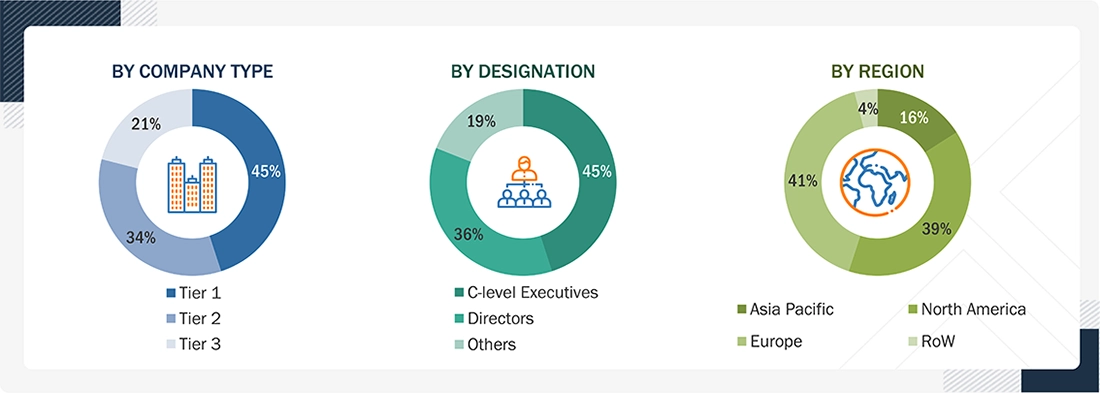
Notes: Tier 1 companies include market players with revenues above USD 500 million; tier 2 companies earn revenues between USD 100 million and USD 500 million; and tier 3 companies earn revenues up to USD 100 million.
To know about the assumptions considered for the study, download the pdf brochure
Market Size Estimation
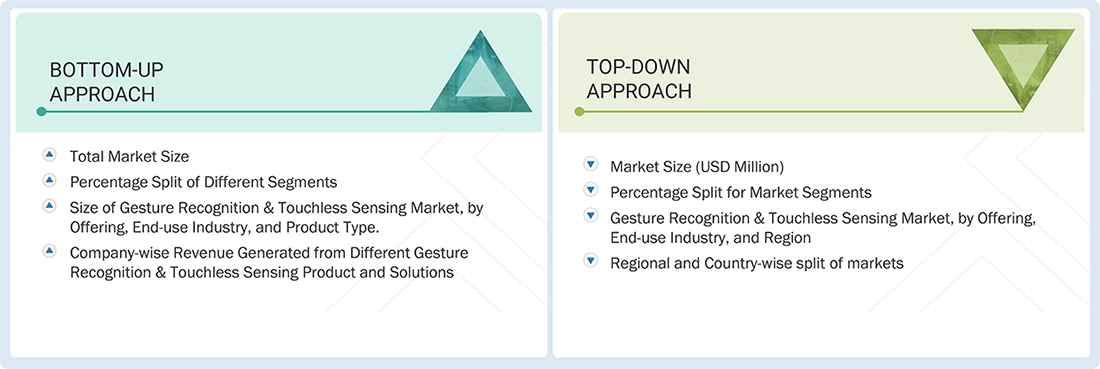
In the complete market engineering process, both top-down and bottom-up approaches were used, along with several data triangulation methods, to estimate and forecast the size of the market and its segments and subsegments listed in the report. Extensive qualitative and quantitative analyses were carried out on the complete market engineering process to list the key information/insights pertaining to the gesture recognition and touchless sensing market.
The key players in the market were identified through secondary research, and their rankings in the respective regions were determined through primary and secondary research. This entire procedure involved the study of the annual and financial reports of top players, as well as interviews with industry experts such as chief executive officers, vice presidents, directors, and marketing executives for quantitative and qualitative key insights. All percentage shares, splits, and breakdowns were determined using secondary sources and verified through primary sources. All parameters that affect the markets covered in this research study were accounted for, viewed in extensive detail, verified through primary research, and analyzed to obtain the final quantitative and qualitative data. This data was consolidated and enhanced with detailed inputs and analysis from MarketsandMarkets and presented in this report.
BOTTOM-UP APPROACH
- Identifying various verticals using or are expected to use gesture recognition and touchless sensing products and components
- Analyzing each vertical and application, along with related major companies and gesture recognition and touchless sensing providers, and identifying service providers for gesture recognition and touchless sensing products
- Understanding the demand generated by companies operating across different verticals
- Tracking the ongoing and upcoming implementation of gesture recognition and touchless sensing projects by verticals and forecasting the market size based on developments and other critical parameters considered by end users from these verticals
- Carrying out multiple discussions with key opinion leaders to understand the type of technology and products developed by the end-use industries; this information would help analyze the breakdown of the scope of work carried out by each major company in the gesture recognition and touchless sensing market.
- Arriving at the market estimates by analyzing the gesture recognition and touchless sensing companies based in each country; subsequently, these market estimates are combined to arrive at the market estimates by region.
- Verifying and cross-checking the estimates at every level through discussions with key opinion leaders, including CXOs, directors, and operation managers, and finally, with the domain expert at MarketsandMarkets
- Studying various paid and unpaid sources of information, such as annual reports, press releases, white papers, and databases, for this process
TOP-DOWN APPROACH
- Focusing on top-line investments and expenditures being made in the ecosystems of various verticals; additionally, listing key developments, analyzing updated technology and software in the marketplace, as well as evaluating the market by further splitting it into various connectivity technologies
- Building and developing the information related to the market revenue generated by the key gesture recognition and touchless sensing product providers
- Conducting multiple on-field discussions with key opinion leaders involved in the development of gesture recognition and touchless sensing and products in various verticals
- Estimating geographic splits by using secondary sources based on various factors such as the number of players in a specific country and region, type of gesture recognition and touchless sensing, level of services offered, and type of software implemented across various applications in several verticals
Data Triangulation
After arriving at the overall market size from the market size estimation process explained above, the total market has been split into several segments and subsegments. To complete the overall market engineering process and obtain the exact statistics for all segments and subsegments, the market breakdown and data triangulation procedures have been employed where applicable. The data has been triangulated by studying various factors and trends from both the demand and supply sides. In addition, the market size has been validated using both top-down and bottom-up approaches.
Market Definition
Gesture recognition and touchless sensing are two radical technologies that facilitate users by getting rid of physical connections in order to operate any smart device. The idea of gesture recognition and touchless sensing underwent a sea change in the last decade. Intelligence in electronic devices is very technology-oriented, efficient, and assures high HMI. The growth in the market can be attributed to the easy adoption of gesture recognition and touchless sensing due to low technical complexity and increased digitalization. Gesture recognition and touchless sensing use various mathematical algorithms in computing devices to translate human gestures or movements. These systems help humans interact with machines without using any mechanical devices. Gesture recognition and touchless sensing technology use human gestures, such as the movement of the head, fingers, arms, hands, and the entire body. The gesture recognition market is segmented based on technology, type, industry, and geography, whereas the touchless sensing market is segmented by technology, product type, end-use industry, and region.
Key Stakeholders
- Gesture recognition and touchless sensing hardware and software providers
- Analysts and strategic business planners
- Venture capitalists and startups
- Research laboratories and intellectual property (IP) companies
- Technology standards organizations, forums, alliances, and associations
- Government bodies such as regulatory authorities and policymakers
- Raw material suppliers and manufacturers of gesture recognition and touchless sensing products
- Installation & maintenance service providers
- End customers from the consumer electronics, automotive, healthcare, and banking & finance sector
Report Objectives
- To define, describe, segment, and forecast the gesture recognition and touchless sensing market based on vertical, technology, and region
- To describe, segment, and forecast the gesture recognition market by type
- To describe, segment, and forecast the touchless sensing market by product in terms of value and volume
- To forecast the size of various segments with respect to four main regions—North America, Europe, Asia Pacific, and Rest of the World (RoW)
- To provide a detailed analysis of the gesture recognition and touchless sensing supply chain
- To analyze the macroeconomic indicators in the gesture recognition and touchless sensing market
- To strategically analyze the micromarkets with respect to individual growth trends and prospects, and their contributions to the total market
- To analyze competitive developments such as expansions, agreements, partnerships, acquisitions, product developments, and research and development (R&D) in the gesture recognition & touchless sensing market
- To analyze the opportunities for market players and provide details of the competitive landscape of the market
- To benchmark the market players using the proprietary company evaluation matrix framework, which analyzes the market players on various parameters within the broad categories of business strategy excellence and strength of product portfolios
- To strategically profile the key players and comprehensively analyze their market positions in terms of ranking and core competencies, along with a detailed competitive landscape of the market
Available customizations:
With the given market data, MarketsandMarkets offers customizations according to the specific requirements of companies.
Product analysis
- Detailed analysis and profiling of additional market players
The following customization options are available for the report:
- Market sizing and forecast for additional countries
- Additional five companies profiling
Key Questions Addressed by the Report
What is the projected market value of the Touchless Sensing and Gesturing market?
The Touchless Sensing and Gesturing market is projected to reach a significant market value by the forecast period, driven by increasing demand for contactless technologies across various industries.
Which region is expected to dominate the Touchless Sensing and Gesturing market?
North America is expected to dominate the Touchless Sensing and Gesturing market due to early adoption of advanced technologies and strong presence of key players.
What are the key segments of the Touchless Sensing and Gesturing market?
The market is segmented by technology, product, application, and region, with touchless biometric systems, sensors, and consumer electronics and healthcare applications accounting for a major share.
Who are the major key players in the Touchless Sensing and Gesturing market?
Major key players in the Touchless Sensing and Gesturing market include Infineon Technologies AG, Microchip Technology Inc., STMicroelectronics, Cognitec Systems GmbH, and Apple Inc.
What factors are driving the growth of the Touchless Sensing and Gesturing market?
The growth of the Touchless Sensing and Gesturing market is driven by increasing focus on hygiene and safety, rising adoption of gesture recognition technologies, advancements in sensor technologies, and growing demand for smart devices and automation.
Fact checked
Personalize This Research
- Triangulate with your Own Data
- Get Data as per your Format and Definition
- Gain a Deeper Dive on a Specific Application, Geography, Customer or Competitor
- Any level of Personalization
Let Us Help You
- What are the Known and Unknown Adjacencies Impacting the Gesture Recognition and Touchless Sensing Market
- What will your New Revenue Sources be?
- Who will be your Top Customer; what will make them switch?
- Defend your Market Share or Win Competitors
- Get a Scorecard for Target Partners

Custom Market Research Services
We Will Customise The Research For You, In Case The Report Listed Above Does Not Meet With Your Requirements
Get 10% Free CustomisationTESTIMONIALS

Tetsuya Ohhira
Business Development Manager-Technology Business
Nikon Corporation,
Leading Japanese MNC specializing in optics and imaging productswww.nikon.com
MarketsandMarkets™ response
is quick. Their attitude is flexible and positive. Analyst Insights are globally considered and
significant. Client Services quickly respond to our inquiry and demand. Their wide range of global
surveys help us make our strategic plan.
We hope Knowledge Store will be easier to search
for a report.
VP - Marketing & Business Development
Leading Provider of Process Control Solutions
We engaged with MarketsandMarkets on a study to perform an analysis and recommend a Go-To-Market strategy for metrology and process control in the semiconductor market. The study was tailored to our targets and needs with well-defined milestones. Our overall experience with the MarketsandMarkets team was very good throughout the project in all aspects including the analysis methodologies used, the quality and depth of primary and secondary data sets, the professionalism and flexibility of the team and the ability to meet the target schedule and milestones. We want to thank MarketsandMarkets team for a job well done.
- Rest Of Europe Gesture Recognition and Touchless Sensing Market
- China Gesture Recognition and Touchless Sensing Market
- Japan Gesture Recognition and Touchless Sensing Market
- India Gesture Recognition and Touchless Sensing Market
- South Korea Gesture Recognition and Touchless Sensing Market
- Rest Of Asia Pacific Gesture Recognition and Touchless Sensing Market
- GCC Gesture Recognition and Touchless Sensing Market
- Saudi Arabia Gesture Recognition and Touchless Sensing Market
- UAE Gesture Recognition and Touchless Sensing Market
- Rest Of GCC Gesture Recognition and Touchless Sensing Market
- Rest Of Middle East Gesture Recognition and Touchless Sensing Market
- Africa Gesture Recognition and Touchless Sensing Market
- US Gesture Recognition and Touchless Sensing Market
- Canada Gesture Recognition and Touchless Sensing Market
- Mexico Gesture Recognition and Touchless Sensing Market
- Germany Gesture Recognition and Touchless Sensing Market
- UK Gesture Recognition and Touchless Sensing Market
- France Gesture Recognition and Touchless Sensing Market
- Italy Gesture Recognition and Touchless Sensing Market
Growth opportunities and latent adjacency in Gesture Recognition and Touchless Sensing Market






Alex
Apr, 2026
Can I get segmentation insights by hardware, software, and end-use applications before purchasing the report?.
Thomas
Apr, 2026
Can this report help evaluate market opportunities for AI-powered gesture recognition solutions?.