Industrial Access Control Market by Component (Hardware (Card-Based Readers, Biometrics Readers, Electronic Locks, and Controller/Server), and Software), Service (Installation, Maintenance, and ACaaS), Application, and Geography - Global Forecast to 2036


Industrial Access Control Market Summary
The Industrial Access Control Market is rapidly evolving as organizations across manufacturing, energy, utilities, transportation, and critical infrastructure sectors prioritize security, compliance, and operational efficiency. In 2025, the market size is estimated to be in the range of USD 12.0–14.0 billion and is projected to reach approximately USD 28.0–34.0 billion by 2036, growing at a CAGR of around 8%–10% during the forecast period. The increasing frequency of cyber-physical threats, coupled with stringent regulatory requirements, is driving the adoption of advanced access control solutions in industrial environments.
The convergence of artificial intelligence (AI), Internet of Things (IoT), and automation is transforming traditional access control systems into intelligent, integrated security platforms. AI-powered biometric authentication, real-time threat detection, and predictive analytics are enhancing system capabilities. IoT-enabled access control devices allow seamless connectivity and centralized monitoring, while automation ensures efficient access management and compliance reporting. As industries undergo digital transformation and embrace Industry 4.0, the demand for secure and scalable access control solutions is expected to grow significantly.
Key Market Trends & Insights
The Industrial Access Control Market is led by North America, driven by strong adoption of advanced security technologies, robust industrial infrastructure, and stringent regulatory frameworks. Asia Pacific is the fastest-growing region due to rapid industrialization, expanding manufacturing sectors, and increasing investments in smart factories. Europe maintains steady growth, supported by strict data protection laws and increasing adoption of digital security solutions.
Biometric access control systems dominate the market due to their high accuracy, reliability, and ability to prevent unauthorized access. Fingerprint, facial recognition, and iris scanning technologies are widely used in industrial environments. Emerging trends include mobile-based access control and cloud-managed systems, which offer flexibility and scalability.
AI and automation are playing a crucial role in enhancing security and operational efficiency. AI algorithms analyze access patterns to detect anomalies and potential threats, while automated systems streamline access management and compliance processes. The integration of access control with video surveillance and building management systems is further strengthening security infrastructure.
Market Size & Forecast
- Base year market size (2025): USD 12.0–14.0 billion
- Forecast value by 2036: USD 28.0–34.0 billion
- CAGR: 8%–10%
- Growth is driven by increasing security concerns, adoption of smart industrial infrastructure, and integration of AI and IoT technologies
Industrial Access Control Market Top 10 key takeaway
- Rising demand for advanced security solutions in industrial sectors
- Market expected to grow at up to 10% CAGR through 2036
- North America leads due to technological advancement and regulations
- Asia Pacific is the fastest-growing region with rapid industrialization
- Biometric systems dominate due to high accuracy and reliability
- AI enables real-time threat detection and predictive analytics
- IoT integration supports centralized monitoring and control
- Cloud-based access control systems are gaining traction
- Integration with surveillance systems enhances security
- Automation improves efficiency and compliance management
Product Insights
Biometric access control systems represent the leading product segment in the Industrial Access Control Market, driven by their ability to provide high levels of security and eliminate the risks associated with traditional keycards and passwords. Fingerprint recognition systems are widely adopted due to their cost-effectiveness and reliability, while facial recognition and iris scanning technologies are gaining popularity in high-security environments.
Card-based access control systems, including RFID and smart cards, continue to hold a significant share due to their ease of use and widespread adoption in industrial facilities. However, these systems are increasingly being complemented or replaced by biometric and mobile-based solutions.
Emerging product categories include mobile access control systems and multi-factor authentication solutions, which combine biometrics, mobile credentials, and PIN codes for enhanced security. AI integration is enabling advanced features such as behavior analysis, anomaly detection, and real-time decision-making, making access control systems more intelligent and adaptive.
Technology / Component Insights (Rename based on keyword if needed)
The Industrial Access Control Market is driven by a combination of hardware, software, and connectivity technologies. Key components include access control panels, readers, controllers, and software platforms. Advanced technologies such as biometrics, RFID, and near-field communication (NFC) are widely used to enable secure authentication.
Artificial intelligence is transforming access control systems by enabling predictive analytics, facial recognition, and behavior-based authentication. AI-powered systems can analyze user behavior patterns to identify potential security threats and prevent unauthorized access.
IoT integration allows access control devices to be connected to centralized platforms, enabling real-time monitoring and remote management. Cloud-based solutions are becoming increasingly popular, offering scalability, flexibility, and cost efficiency.
Automation is streamlining access control processes, reducing manual intervention, and improving operational efficiency. Future innovation trends include the integration of blockchain for secure identity management, advanced encryption technologies, and the use of edge computing for faster processing and reduced latency.
Application Insights
The manufacturing sector represents the leading application segment in the Industrial Access Control Market, driven by the need to protect critical assets, ensure employee safety, and maintain operational efficiency. Access control systems are used to restrict entry to sensitive areas, monitor employee movement, and prevent unauthorized access.
The energy and utilities sector is another major application area, where access control systems are critical for securing power plants, oil and gas facilities, and other critical infrastructure. The increasing focus on cybersecurity and physical security is driving demand in this sector.
Transportation and logistics, as well as healthcare and data centers, are also significant application areas. These sectors require robust access control systems to ensure security, compliance, and efficient operations. Future opportunities lie in smart factories and smart cities, where access control systems are integrated with other technologies to create connected and secure environments.
Regional Insights
North America leads the Industrial Access Control Market, supported by advanced technological infrastructure, high adoption of smart security solutions, and stringent regulatory requirements. The region is at the forefront of AI and IoT integration in access control systems.
Europe follows with steady growth, driven by strong data protection regulations and increasing adoption of digital security solutions across industrial sectors. The region’s focus on sustainability and compliance is also contributing to market growth.
Asia Pacific is the fastest-growing region, fueled by rapid industrialization, expanding manufacturing activities, and increasing investments in smart infrastructure. Countries such as China, India, and Japan are driving demand for advanced access control systems.
- North America dominates due to advanced security infrastructure
- Europe shows steady growth with strong regulatory frameworks
- Asia Pacific is the fastest-growing region with industrial expansion
- Government initiatives support smart infrastructure development
- Rising security concerns drive regional demand
Country-Specific Market Trends
In Asia Pacific, China leads the market with a CAGR of approximately 10%–12%, driven by large-scale industrialization and smart factory initiatives. Japan follows with a CAGR of around 8%–10%, focusing on advanced technologies and automation in industrial security.
In North America, the United States dominates with a CAGR of 9%–11%, supported by strong R&D capabilities and adoption of advanced security solutions. Canada and Mexico are experiencing steady growth due to increasing industrial activities and infrastructure development.
In Europe, Germany and France are key markets, with CAGR ranging between 7%–9%. These countries are leveraging strong industrial bases and regulatory frameworks to drive adoption of advanced access control technologies.
- China leads in industrial and smart infrastructure development
- Japan focuses on innovation and automation in security systems
- United States drives technological advancement and AI adoption
- Germany and France lead industrial security adoption in Europe
- Government policies support market growth and innovation
Key Industrial Access Control Market Company Insights
The Industrial Access Control Market is highly competitive, with leading companies focusing on innovation, integration, and scalability. Major players include Honeywell International Inc., Johnson Controls, Siemens AG, Bosch Security Systems, Schneider Electric, ASSA ABLOY, HID Global, and Thales Group.
These companies are investing heavily in research and development to enhance system capabilities and integrate AI and IoT technologies. Smart access control platforms and cloud-based solutions are becoming key differentiators, enabling companies to offer advanced features such as real-time monitoring and predictive analytics.
Strategic partnerships and acquisitions are driving market expansion, allowing companies to expand their product portfolios and enter new markets. The focus on cybersecurity and data protection is also shaping product development strategies.
- Strong focus on R&D and technological innovation
- AI and IoT integration enhance system capabilities
- Strategic partnerships drive market expansion
- Companies targeting industrial and critical infrastructure sectors
- Cybersecurity and data protection are key priorities
Recent Developments
The Industrial Access Control Market has witnessed several significant developments in recent years. Companies have introduced AI-powered access control systems with advanced biometric capabilities, enabling real-time threat detection and enhanced security.
Additionally, partnerships between access control providers and cloud service companies are enabling the development of scalable and integrated security solutions. Investments in smart factory and smart city projects are further driving adoption of advanced access control technologies.
Market Segmentation
The Industrial Access Control Market is segmented based on product, technology, application, and region. By product, the market includes biometric systems, card-based systems, and mobile-based solutions, with biometric systems dominating due to their high security and reliability.
By technology, the market includes RFID, biometrics, and cloud-based platforms, which enable secure and scalable access control solutions. In terms of application, manufacturing leads the market, followed by energy and utilities, transportation, and healthcare sectors. Regionally, the market is divided into North America, Europe, Asia Pacific, and the Rest of the World, with Asia Pacific expected to witness the highest growth during the forecast period.
- Biometric systems dominate the product segment
- Advanced technologies drive innovation and security
- Manufacturing remains the largest application segment
- Energy and utilities show strong growth potential
- Asia Pacific expected to lead future market expansion
Conclusion
The Industrial Access Control Market is poised for significant growth through 2036, driven by increasing security concerns, digital transformation, and the adoption of advanced technologies. The integration of AI, IoT, and automation is transforming access control systems into intelligent, connected platforms that enhance security and operational efficiency.
As industries continue to embrace smart infrastructure and Industry 4.0, access control systems will play a critical role in ensuring safety, compliance, and efficiency. Companies that invest in advanced technologies and strategic partnerships will be well-positioned to capitalize on the opportunities in this dynamic market.
FAQs
1. What is the current size of the Industrial Access Control Market?
The market size is estimated to be between USD 12.0–14.0 billion in 2025.
2. What is the expected growth rate of the market?
The market is projected to grow at a CAGR of 8%–10% from 2025 to 2036.
3. What are the key drivers of market growth?
Key drivers include increasing security concerns, adoption of smart infrastructure, and integration of AI and IoT technologies.
4. Which region leads the Industrial Access Control Market?
North America currently leads the market due to advanced security infrastructure and technological innovation.
5. Who are the key players in the market?
Major companies include Honeywell International Inc., Johnson Controls, Siemens AG, Bosch Security Systems, Schneider Electric, ASSA ABLOY, HID Global, and Thales Group
 Exclusive indicates content/data unique to MarketsandMarkets and not available with any competitors.
Table of Contents
1 Introduction (Page No. - 14)
1.1 Objectives of the Study
1.2 Market Definition
1.3 Scope
1.3.1 Geographic Scope
1.3.2 Years Considered for the Study
1.4 Currency
1.5 Package Size
1.6 Limitations
1.7 Stakeholders
2 Research Methodology (Page No. - 18)
2.1 Research Data
2.1.1 Secondary Data
2.1.1.1 Secondary Sources
2.1.2 Primary Data
2.1.2.1 Primary Interviews With Experts
2.1.2.2 Primary Sources
2.1.2.3 Key Industry Insights
2.1.2.4 Breakdown of Primaries
2.2 Secondary and Primary Research
2.3 Market Size Estimation
2.3.1 Bottom-Up Approach
2.3.1.1 Approach for Capturing the Market Share By Bottom-Up Analysis (Demand Side)
2.3.2 Top-Down Approach
2.3.2.1 Approach for Capturing the Market Share By Top-Down Analysis (Supply Side)
2.4 Market Breakdown and Data Triangulation
2.5 Research Assumptions
3 Executive Summary (Page No. - 27)
4 Premium Insights (Page No. - 31)
4.1 Industrial Access Control Market, 2017–2023 (USD Million)
4.2 Market, By Component and Service
4.3 Industrial Access Control, By Application
4.4 Market: Utilities and Aerospace Applications (2016)
4.5 Market, By Region
5 Market Overview (Page No. - 35)
5.1 Introduction
5.1.1 Drivers
5.1.1.1 High Adoption of Access Control Solutions Due to Growing Security Concerns
5.1.1.2 Technological Advancements and Deployment of Wireless Technology in Security Systems
5.1.1.3 Adoption of Iot-Based Security Systems
5.1.2 Restraints
5.1.2.1 Lack of Awareness for Advanced Security Solutions at Present
5.1.3 Opportunities
5.1.3.1 Adoption of Access Control as A Service (ACaaS)
5.1.4 Challenges
5.1.4.1 Security Concerns Related to Unauthorized Access in Access Control Environment
6 Industry Trends (Page No. - 39)
6.1 Introduction
6.2 Value Chain Analysis
7 Types of Access Control Systems (Qualitative) (Page No. - 41)
7.1 Introduction
7.2 Physical Access Control
7.3 Electronic Access Control
7.4 Logical Access Control
7.5 Network Access Control
8 Industrial Access Control Market, By Component (Page No. - 43)
8.1 Introduction
8.2 Hardware
8.2.1 Card-Based Readers
8.2.1.1 Magnetic Stripes and Readers
8.2.1.2 Proximity Cards and Readers
8.2.1.3 Smart Cards and Readers
8.2.2 Biometric Readers
8.2.2.1 Fingerprint
8.2.2.2 Hand Geometry
8.2.2.3 IRIS Recognition
8.2.2.4 Facial Recognition
8.2.3 Multi-Technology Readers
8.2.4 Electronic Locks
8.2.4.1 Electromagnetic Locks
8.2.4.2 Electric Strike Locks
8.2.4.3 Wireless Locks
8.2.5 Controllers/Servers
8.3 Software (Management System and Other)
9 Industrial Access Control Market, By Service (Page No. - 56)
9.1 Introduction
9.2 Installation and Integration
9.3 Support and Maintenance Services
9.3.1 Access Control as A Service (ACaaS)
9.3.1.1 Hosted ACaaS
9.3.1.2 Managed ACaaS
9.3.1.3 Hybrid ACaaS
10 Industrial Access Control Market, By Application (Page No. - 64)
10.1 Introduction
10.2 Automotive
10.3 Aerospace
10.4 Utilities
10.5 Machinery and Electronics
10.6 Chemical and Synthetics
10.7 Pulp & Paper
10.8 Steel and Metal
10.9 Pharmaceuticals and Cosmetics
10.10 Others
11 Geographic Analysis (Page No. - 74)
11.1 Introduction
11.2 North America
11.2.1 US
11.2.2 Canada
11.2.3 Mexico
11.3 Europe
11.3.1 UK
11.3.2 Germany
11.3.3 France
11.3.4 Rest of Europe
11.4 APAC
11.4.1 China
11.4.2 Japan
11.4.3 India
11.4.4 South Korea
11.4.5 Rest of APAC
11.5 RoW
11.5.1 Middle East and Africa
11.5.2 South America
12 Competitive Landscape (Page No. - 97)
12.1 Introduction
12.2 Market Ranking Analysis: Industrial Access Control Market
12.3 Competitive Scenario
12.4 Vendor Dive Overview
12.4.1 Vanguards
12.4.2 Dynamic Players
12.4.3 Innovators
12.4.4 Emerging Players
12.5 Business Strategies Adopted By Major Players in the Industrial Access Control Market (25 Companies)
12.6 Analysis of the Product Portfolio of Major Players in the Market (25 Companies)
Top 25 Companies Analyzed for This Study are - Assa Abloy AB, Johnson Controls International PLC, Dorma+Kaba Holding AG, Allegion PLC, Honeywell Security Group, Bosch Security Systems Inc., Siemens Building Technologies, NEC Corporation, 3M Company, Identiv, Inc., Gemalto N.V., Lenel Systems International Inc., Hid Global, Amag Technology Inc., Napco Security Technologies, Inc., Gunnebo Group, Gallagher Group Ltd., Crossmatch Technologies, Inc., Morpho Sa, Avaya Inc., Keyscan Inc., Brivo Inc., Adman Technologies Pvt. Ltd., Vanderbilt Industries, and Access Control Innovation
13 Company Profiles (Page No. - 104)
(Business Overview, Products Offered & Services Strategies, Key Insights, Recent Developments, MnM View)*
13.1 Introduction
13.2 Assa Abloy AB
13.3 Johnson Controls International PLC
13.4 Dorma+Kaba Holding AG
13.5 Allegion PLC
13.6 Honeywell Security Group
13.7 NEC Corporation
13.8 Bosch Security Systems Inc.
13.9 Identiv, Inc.
13.10 Siemens Building Technologies
13.11 3M Company
13.12 Key Innovators
13.12.1 Brivo, Inc.
13.12.2 Adman Technologies Pvt. Ltd
13.12.3 Vanderbilt Industries
13.12.4 Access Control Innovation
*Details on Business Overview, Products Offered & Services Strategies, Key Insights, Recent Developments, MnM View Might Not Be Captured in Case of Unlisted Companies.
14 Appendix (Page No. - 139)
14.1 Insights of Industry Experts
14.2 Discussion Guide
14.3 Knowledge Store: Marketsandmarkets’ Subscription Portal
14.4 Introducing RT: Real-Time Market Intelligence
14.5 Available Customizations
14.6 Related Reports
14.7 Author Details
List of Tables (61 Tables)
Table 1 Industrial Access Control Market, By Component and Service, 2014–2023 (USD Million)
Table 2 Market, By Hardware, 2014–2023 (USD Million)
Table 3 Market for Hardware, By Region, 2014–2023 (USD Million)
Table 4 Market for Card-Based Readers, By Type, 2014–2023 (USD Million)
Table 5 Market for Card-Based Readers, By Type, 2014–2023 (Thousand Units)
Table 6 Market for Card-Based Readers, By Region, 2014–2023 (USD Million)
Table 7 Market for Biometrics Readers, By Type, 2014–2023 (USD Million)
Table 8 Market for Biometrics Readers, By Type, 2014–2023 (Thousand Units)
Table 9 Market for Biometrics Readers, By Region, 2014–2023 (USD Million)
Table 10 Industrial Access Control Market for Multi-Technology Readers, By Region, 2014–2023 (USD Million)
Table 11 Market for Electronic Locks, By Type, 2014–2023 (USD Million)
Table 12 Market for Electronic Locks, By Type, 2014–2023 (Thousand Units)
Table 13 Market for Electronic Locks, By Region, 2014–2023 (USD Million)
Table 14 Market for Controllers/ Servers, By Region, 2014–2023 (USD Million)
Table 15 Market, By Software, 2014–2023 (USD Million)
Table 16 Market for Software, By Region, 2014–2023 (USD Million)
Table 17 Market, By Service, 2014–2023 (USD Million)
Table 18 Market for Service, By Region, 2014–2023 (USD Million)
Table 19 Market for Installation and Integration, By Region, 2014–2023 (USD Million)
Table 20 Industrial Access Control Market for Support and Maintenance Services, By Region, 2014–2023 (USD Million)
Table 21 Market for ACaaS, By Type, 2014–2023 (USD Million)
Table 22 Market for ACaaS, By Region, 2014–2023 (USD Million)
Table 23 Market for Hosted ACaaS, By Region, 2014–2023 (USD Million)
Table 24 Market for Managed ACaaS, By Region, 2014–2023 (USD Million)
Table 25 Market for Hybrid ACaaS, By Region, 2014–2023 (USD Million)
Table 26 Market, By Application, 2014–2023 (USD Million)
Table 27 Industrial Access Control Market for Automotive Application, By Region, 2014–2023 (USD Million)
Table 28 Market for Aerospace Application, By Region, 2014–2023 (USD Million)
Table 29 Market for Utilities Application, By Region, 2014–2023 (USD Million)
Table 30 Market for Machinery & Electronics Application, By Region, 2014–2023 (USD Million)
Table 31 Market for Chemical & Synthetics Application, By Region, 2014–2023 (USD Million)
Table 32 Market for Pulp & Paper Application, By Region, 2014–2023 (USD Million)
Table 33 Market for Steel and Metal Application, By Region, 2014–2023 (USD Million)
Table 34 Market for Pharmaceuticals and Cosmetics Application, By Region, 2014–2023 (USD Million)
Table 35 Market for Other Applications, By Region, 2014–2023 (USD Million)
Table 36 Market, By Region, 2014–2023 (USD Million)
Table 37 Market in North America, By Component and Services, 2014–2023 (USD Million)
Table 38 Industrial Access Control Market in North America, By Hardware, 2014–2023 (USD Million)
Table 39 Market in North America, By Services, 2014–2023 (USD Million)
Table 40 Market in North America, By ACaaS Type, 2014–2023 (USD Million)
Table 41 Market in North America, By Application, 2014–2023 (USD Million)
Table 42 Market in North America, By Country, 2014–2023 (USD Million)
Table 43 Industrial Access Control Market in Europe, By Component and Services, 2014–2023 (USD Million)
Table 44 Market in Europe, By Hardware, 2014–2023 (USD Million)
Table 45 Market in Europe, By Services, 2014–2023 (USD Million)
Table 46 Market in Europe, By ACaaS Type, 2014–2023 (USD Million)
Table 47 Market in Europe, By Application, 2014–2023 (USD Million)
Table 48 Market in Europe, By Country, 2014–2023 (USD Million)
Table 49 Market in APAC, By Component and Services, 2014–2023 (USD Million)
Table 50 Market in APAC, By Hardware, 2014–2023 (USD Million)
Table 51 Market in APAC, By Services, 2014–2023 (USD Million)
Table 52 Industrial Access Control Market in APAC, By ACaaS Type, 2014–2023 (USD Million)
Table 53 Market in APAC, By Application, 2014–2023 (USD Million)
Table 54 Market in APAC, By Country, 2014–2023 (USD Million)
Table 55 Market in RoW, By Component and Services, 2014–2023 (USD Million)
Table 56 Market in RoW, By Hardware, 2014–2023 (USD Million)
Table 57 Market in RoW, By Services, 2014–2023 (USD Million)
Table 58 Market in RoW, By ACaaS Type, 2014–2023 (USD Million)
Table 59 Market in RoW, By Application, 2014–2023 (USD Million)
Table 60 Market in RoW, By Region, 2014–2023 (USD Million)
Table 61 Market Ranking of the Top Five Players in the Industrial Access Control Market
List of Figures (43 Figures)
Figure 1 Overview of the Industrial Access Control Market
Figure 2 Market: Research Design
Figure 3 Market Size Estimation Methodology: Bottom-Up Approach
Figure 4 Market Size Estimation Methodology: Top-Down Approach
Figure 5 Assumptions of the Research Study
Figure 6 Market, 2014–2023 (USD Million)
Figure 7 Market, By Hardware Component (2016 vs 2023)
Figure 8 Market for Hosted ACaaS Held the Major Market Size in 2017
Figure 9 Market for Utilities Application Expected to Grow at the Highest Rate Between 2017 and 2023
Figure 10 APAC Held the Largest Share of the Industrial Access Control Market in 2017
Figure 11 Attractive Opportunities for the Industrial Access Control Market During the Forecast Period
Figure 12 Market for Software Component Expected to Grow at the Highest Rate Between 2017 and 2023
Figure 13 Controllers/Servers to Hold the Largest Share of the Market for Hardware Component By 2023
Figure 14 Aerospace Application Held the Largest Share of the Market in North America in 2016
Figure 15 Market for Aerospace and Utilities Applications in APAC Expected to Grow at the Highest Rate During the Forecast Period
Figure 16 China to Emerge as the Fastest-Growing Market for Industrial Access Control Between 2017 and 2023
Figure 17 Growing Demand for Access Control Systems in Industrial Areas to Drive the Growth of the Industrial Access Control Market During 2017–2023
Figure 18 Value Chain Analysis (2016): Maximum Value Added in the Original Equipment Manufacturing and Phases of Security and Management Software Providers
Figure 19 Market for Software Components Expected to Grow at the Highest Rate Between 2017 and 2023
Figure 20 Market for Electronic Locks Expected to Grow at the Highest Rate Between 2017 and 2023
Figure 21 Market for Wireless Locks Expected to Grow at the Highest Rate Between 2017 and 2023
Figure 22 Industrial Access Control Market for ACaaS to Grow at the Highest Rate Between 2017 and 2023
Figure 23 Market for Managed ACaaS Expected to Grow at the Highest Rate Between 2017 and 2023
Figure 24 Industrial Access Control Market for Utilities Application Expected to Grow at the Highest Rate Between 2017 and 2023
Figure 25 Market for Utilities Application in APAC to Grow at the Highest Rate Between 2017 and 2023
Figure 26 Market for Steel and Metal Application in APAC to Grow at the Highest Rate Between 2017 and 2023
Figure 27 Geographic Snapshot: Market in APAC Expected to Witness the Highest Growth Rate Between 2017 and 2023
Figure 28 Market in China Estimated to Grow at the Highest Rate Between 2017 and 2023
Figure 29 Overview of Market in North America, 2016
Figure 30 Overview of Market in Europe, 2016
Figure 31 Overview of Market in APAC, 2016
Figure 32 Companies Adopted Mergers and Acquisitions as the Key Growth Strategy Between 2014 and 2017
Figure 33 Battle for Market Share: Mergers & Acquisitions Were the Major Strategies Adopted By Key Players in the Market
Figure 34 Dive Chart
Figure 35 Geographic Revenue Mix of Leading Players
Figure 36 Assa Abloy AB: Company Snapshot
Figure 37 Johnson Controls International PLC: Company Snapshot
Figure 38 Dorma+Kaba Holding AG: Company Snapshot
Figure 39 Allegion PLC: Company Snapshot
Figure 40 Honeywell International Inc.: Company Snapshot
Figure 41 NEC Corporation: Company Snapshot
Figure 42 Identiv, Inc.: Company Snapshot
Figure 43 3M Company: Company Snapshot
The study involved 4 major activities in estimating the current size of the industrial access control market. Exhaustive secondary research was done to collect information on the market, peer market, and parent market. The next step was to validate these findings, assumptions, and sizing with industry experts from across the value chain through primary research. Both top-down and bottom-up approaches were employed to estimate the complete market size. After that, market breakdown and data triangulation methods were used to estimate the market sizes of segments and subsegments.
Secondary Research
The research methodology used to estimate and forecast the industrial access control market begins with capturing data on revenues of key vendors in the market through secondary research. This study incorporates using extensive secondary sources, directories, and databases such as Hoovers, Bloomberg Businessweek, Factiva, and OneSource to identify and collect information useful for the technical, market-oriented, and commercial study of the access control market. Vendor offerings have also been taken into consideration to determine the market segmentation. This entire research methodology includes studying annual and financial reports of top players, presentations, press releases, journals, paid databases, trade directories, regulatory bodies, and safety standard organizations.
Primary Research
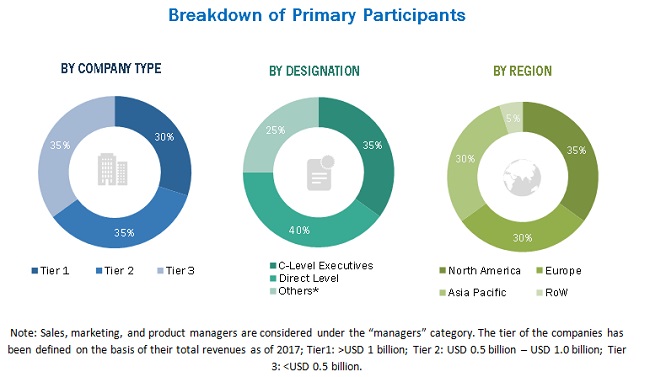
The industrial access control market’s supply chain comprises several stakeholders, such as suppliers of standard components, original equipment manufacturers (OEMs), software providers, solutions providers, and system integrators. The supply side is characterized by advancements in access control products and devices and their diverse applications. Various primary sources from both the supply and demand sides of the market were interviewed to obtain qualitative and quantitative information. Following is the breakdown of primary respondents.
To know about the assumptions considered for the study, download the pdf brochure
Market Size Estimation
Both top-down and bottom-up approaches have been used to estimate and validate the size of the industrial access control market and various market subsegments. The research methodology used to estimate the market sizes includes the following:
- Key players in major applications and markets were identified through extensive secondary research.
- The industry’s supply chain and market size, in terms of value, were determined through primary and secondary research processes.
- All percentage shares, splits, and breakdowns were determined using secondary sources and verified through primary sources.
Data Triangulation
After arriving at the overall market size—using the estimation processes as explained above—the market was split into several segments and subsegments. To complete the overall market engineering process and arrive at the exact statistics of each market segment and subsegment, data triangulation and market breakdown procedures were employed, wherever applicable. The data was triangulated by studying various factors and trends from both the demand and supply sides of card-based readers, biometric readers, multi-technology readers, electronic locks, controllers, and servers.
Research Objective
- To define, describe, and forecast the overall industrial access control market, in terms of value, segmented based on component, services, application, and geography
- To define, describe, and forecast the overall industrial access control market, in terms of volume, segmented based on component
- To define and describe types of access control systems used in the overall industrial access control market
- To forecast the market size for various segments with regard to 4 regions—North America, Europe, Asia Pacific (APAC), and Rest of the World (RoW)
- To provide detailed information regarding the major factors (drivers, restraints, opportunities, and challenges) influencing the growth of the industrial access control market
- To provide a detailed overview of the value chain of the industrial access control market
- To strategically analyze the micromarkets1 with respect to individual growth trends, prospects, and contribution to the overall industrial access control market
- To analyze opportunities in the industrial access control market for stakeholders by identifying the high-growth segments
- To strategically profile key players, comprehensively analyze their market rankings and core competencies2, and detail the competitive landscape for market leaders
- To analyze competitive developments such as contracts, mergers and acquisitions, product launches, and R&D in the overall industrial access control market
Scope of the Report:
|
Report Metric |
Details |
|
Market size available for years |
2014–2023 |
|
Base year |
2016 |
|
Forecast period |
2017–2023 |
|
Units |
Value (USD Million/Billion), Shipment (Thousand/ Million) |
|
Segments covered |
Component, Services, Application, and Region |
|
Geographic regions covered |
North America, APAC, Europe, and RoW |
|
Companies covered |
ASSA ABLOY AB (Sweden), Johnson Controls International PLC (Ireland), dormakaba Holding AG (Switzerland), Allegion PLC (Ireland), Honeywell Security Group (US), NEC Corporation (Japan), Bosch Security Systems Inc. (Germany), Identiv, Inc. (US), Siemens Building Technologies (Switzerland), 3M company (US), NEC Corporation (Japan), IDEMIA (France), Salto Systems (Spain), Axis Communications (Sweden), Lenel Systems International (US), Time and Data Systems International (UK), AMAG Technology (US), Gunnebo (Sweden), Gallagher Group (New Zealand), Napco security Technologies (US), Kisi Inc. (US), Cansec Systems (Canada), Vanderbilt Industries (US), Adman Technologies (India), and Brivo, Inc. (US). |
This report categorizes the access control market based on Component, Services, Application, and Region.
By Component
-
Hardware
- Card-Based Readers
- Biometric Readers
- Multi-Technology Readers
- Electronic Locks
- Controllers/Servers
- Software
By Service
- Installation and Integration
- Maintenance and Support
- Access Control as a Service (ACaaS)
By Application:
- Automotive
- Aerospace
- Utilities
- Machinery & Electronics
- Chemical & Synthetics
- Pulp & Paper
- Steel & Metal
- Pharmaceuticals & Cosmetics
- Others (Jewelry, Food and Beverages processing, and Textile and Apparel)
By Geography
-
North America
- US
- Canada
- Mexico
-
Europe
- Germany
- France
- UK
- Rest of Europe (Greece, Spain, Italy, Russia, Finland, Denmark, Netherlands, and Sweden)
-
Asia Pacific (APAC)
- China
- Japan
- India
- South Korea
- Rest of APAC (Australia, New Zealand, Singapore, Hong Kong, Indonesia, and Taiwan)
-
Rest of the World (RoW)
- Middle East and Africa
- South America
Available Customizations
Along with the market data, MarketsandMarkets offers customizations according to a company’s specific needs. The following customization options are available for the report:
Company Information
- Detailed analysis and profiling of additional market players (Up to 5)
Critical Questions
- What new applications are being explored by industrial access control solution providers?
- Which are the key players in the market and how intense is the competition?













Growth opportunities and latent adjacency in Industrial Access Control Market
We are into card readers space and we expect lesser growth for the same in future. Hence, we would like to identify attractive products (other than card based readers) for better growth of our company. Can you help us with this)