Mission Management Systems Market

Mission Management Systems Market by Application (Defense, Commercial), End-User (Air Based, Naval Based, Land Based and Unmanned Systems Based) and Region (North America, Europe, Asia-Pacific, Rest of the World) - Global Forecast to 2035


Report Code: AS 5014 Jun, 2026, by marketsandmarkets.com

Mission Management Systems Market Summary

The Mission Management Systems Market is a rapidly evolving segment within the aerospace and defense industry, playing a pivotal role in enabling real-time mission planning, execution, and analysis across air, land, naval, and space operations. As of 2025, the market is estimated to be valued at approximately USD 12–15 billion, reflecting increasing investments in advanced defense technologies and digital command architectures. The market is projected to reach USD 25–30 billion by 2035, expanding at a CAGR of 7%–9% over the forecast period.

The growth of the Mission Management Systems Market is being driven by the accelerating adoption of artificial intelligence, IoT-enabled battlefield systems, and automation technologies. These systems are essential for processing large volumes of mission-critical data, enhancing situational awareness, and supporting faster and more accurate decision-making. Additionally, the global shift toward network-centric warfare, integrated defense platforms, and digital transformation initiatives is significantly boosting demand for advanced mission management solutions. Governments and defense organizations are increasingly prioritizing software-defined mission capabilities that can adapt to evolving threats and complex operational environments.

Key Market Trends & Insights

The Mission Management Systems Market is characterized by strong regional leadership from North America, supported by robust defense budgets and early adoption of AI-driven mission systems. Asia Pacific is emerging as the fastest-growing region due to rising geopolitical tensions and increased investments in indigenous defense technologies.

Airborne mission management systems dominate the market, driven by the widespread deployment of advanced fighter jets, unmanned aerial vehicles, and surveillance aircraft. At the same time, naval and space-based mission systems are gaining traction due to their strategic importance in modern warfare.

A significant trend is the integration of artificial intelligence and machine learning algorithms, which enable predictive analytics, automated mission planning, and real-time threat assessment. Automation is reducing human workload while improving mission efficiency and accuracy.

Cloud-based mission management platforms and edge computing are also transforming system architectures by enabling scalable, flexible, and low-latency data processing. Another key insight is the growing emphasis on interoperability, ensuring seamless communication between different platforms and allied forces.

Market Size & Forecast

  • Base year market size (2025): USD 12–15 billion
  • Forecast value by 2035: USD 25–30 billion
  • CAGR (2025–2035): 7%–9%
  • Growth is driven by increasing adoption of AI-enabled systems, rising defense modernization programs, and the need for real-time mission coordination and automation

Mission Management Systems Market Top 10 Key Takeaway

  • The market is expected to double in size by 2035 due to strong defense investments
  • AI and machine learning are transforming mission planning and execution
  • Airborne platforms represent the largest application segment
  • Asia Pacific is the fastest-growing regional market
  • Network-centric warfare is a major driver of demand
  • IoT-enabled systems are enhancing real-time data sharing
  • Automation is reducing operational complexity and human error
  • Cloud and edge computing are enabling scalable mission architectures
  • Interoperability is becoming a critical requirement for modern defense systems
  • Increasing adoption of unmanned systems is fueling market growth

Product Insights

The Mission Management Systems Market is primarily led by mission planning and control systems, which serve as the backbone of operational decision-making. These systems dominate due to their ability to integrate data from multiple sources, including sensors, communication networks, and intelligence platforms, to provide a comprehensive operational picture. Their importance is further amplified in complex mission scenarios where rapid decision-making is critical.

Another key product segment is mission debriefing and analysis systems, which are gaining traction as defense organizations focus on post-mission evaluation and performance optimization. These systems leverage advanced analytics and AI to assess mission outcomes, identify inefficiencies, and improve future operations.

Emerging product categories include autonomous mission management platforms and AI-driven decision support systems. These solutions are designed to operate with minimal human intervention, enabling faster response times and enhanced operational efficiency. The integration of advanced visualization tools, augmented reality interfaces, and real-time data analytics is further enhancing the capabilities of mission management systems.

Technology / Component Insights (Rename based on Mission Management Systems if needed)

The Mission Management Systems Market is driven by a combination of advanced technologies that enable efficient mission execution and coordination. Artificial intelligence is at the forefront, providing capabilities such as predictive analytics, automated mission planning, and intelligent decision support. AI algorithms can analyze vast datasets from multiple sources and generate actionable insights in real time.

The Internet of Things plays a crucial role in connecting various mission assets, including aircraft, ground vehicles, naval vessels, and unmanned systems. IoT-enabled networks facilitate seamless data exchange, improving coordination and situational awareness across different platforms.

Cloud computing and edge computing technologies are transforming mission management architectures by enabling scalable and low-latency data processing. Cloud platforms provide centralized data storage and processing capabilities, while edge computing ensures real-time analysis at the source of data generation.

Automation technologies are also significantly impacting the market by reducing manual intervention and enhancing system efficiency. Autonomous systems, robotic platforms, and unmanned vehicles are increasingly integrated into mission management frameworks, enabling remote operations and reducing risks to human personnel.

Future innovation trends include the adoption of digital twin technology for mission simulation and training, as well as the integration of advanced cybersecurity solutions to protect mission-critical systems from evolving threats.

Application Insights

Airborne applications dominate the Mission Management Systems Market, driven by the increasing deployment of advanced aircraft, drones, and surveillance systems. These platforms require sophisticated mission management solutions to coordinate complex operations, manage real-time data, and ensure mission success.

Naval applications are also experiencing significant growth, particularly with the modernization of naval fleets and the integration of advanced combat systems. Mission management systems in naval operations enable efficient coordination of multiple assets, including ships, submarines, and unmanned vessels.

Land-based applications are expanding steadily, supported by the adoption of network-centric warfare strategies and the integration of ground-based systems. These systems are essential for coordinating operations across multiple units and ensuring effective communication and decision-making.

Future opportunities lie in space-based applications, where mission management systems will play a critical role in satellite operations, space exploration, and defense.

Regional Insights

North America holds the largest share of the Mission Management Systems Market, driven by high defense spending and the presence of leading technology providers. The region is at the forefront of adopting AI, IoT, and automation technologies in mission management systems.

Europe is witnessing steady growth, supported by collaborative defense initiatives and increasing investments in modernization programs. Countries in the region are focusing on enhancing interoperability and adopting advanced mission management solutions.

Asia Pacific is the fastest-growing region, fueled by rising geopolitical tensions and increasing investments in defense infrastructure. Countries such as China and Japan are ??????? investing in advanced mission management technologies to strengthen their defense capabilities.

  • North America leads due to strong defense budgets and technological advancements
  • Europe benefits from collaborative defense programs and modernization efforts
  • Asia Pacific shows the highest growth rate driven by regional security concerns
  • Increasing digitalization is boosting adoption across all regions
  • Government initiatives are accelerating market expansion globally

Country Specific Market Trends

In Asia Pacific, China is rapidly expanding its defense capabilities through investments in AI-driven mission management systems and integrated defense networks. Japan is also focusing on modernization and the adoption of automation technologies to enhance operational efficiency.

In North America, the United States dominates the market with continuous innovation and significant defense expenditure. Canada and Mexico are contributing to regional growth through modernization initiatives and increased adoption of advanced technologies.

In Europe, Germany and France are leading the market with strong investments in defense technologies and collaborative projects aimed at improving interoperability and mission efficiency.

  • China leads APAC growth with strong investments in AI-based systems (CAGR 8%–10%)
  • Japan focuses on automation and advanced mission integration (CAGR 7%–9%)
  • United States remains the largest market globally (CAGR 6%–8%)
  • Germany and France drive European growth through collaboration (CAGR 6%–7%)
  • Increasing government support is boosting adoption across key regions

Key Mission Management Systems Company Insights

The Mission Management Systems Market is highly competitive, with several global defense and technology companies focusing on innovation and advanced system integration. Leading players are investing heavily in research and development to enhance their capabilities and maintain a competitive edge.

Companies are increasingly integrating artificial intelligence and machine learning into their solutions to provide advanced analytics and decision support. Modular and scalable system architectures are becoming a key focus, enabling defense organizations to upgrade their systems without significant infrastructure changes.

Strategic partnerships and collaborations are also playing a crucial role in the market, allowing companies to leverage complementary expertise and expand their technological capabilities. Additionally, there is a growing emphasis on cybersecurity to protect mission-critical systems from potential threats.

Key companies include Lockheed Martin, Northrop Grumman, Raytheon Technologies, BAE Systems, Thales Group, Saab AB, L3Harris Technologies, Elbit Systems, and Leonardo S.p.A.

  • Companies are focusing on AI-driven mission management solutions
  • Modular and scalable architectures are gaining importance
  • Strategic partnerships are enhancing innovation capabilities
  • Investment in R&D is driving competitive advantage
  • Cybersecurity is becoming a critical focus area

Recent Developments

Recent developments in the Mission Management Systems Market highlight the increasing focus on advanced technologies and strategic collaborations. Several companies have launched AI-enabled mission management platforms that enhance real-time decision-making and operational efficiency.

Partnerships between defense contractors and technology firms are becoming more common, aimed at developing next-generation mission systems that integrate AI, IoT, and cloud computing. These collaborations are helping to accelerate innovation and improve system capabilities.

Additionally, new product launches focusing on autonomous mission systems and advanced analytics solutions are gaining traction, reflecting the evolving requirements of modern warfare.

Market Segmentation

The Mission Management Systems Market is segmented based on product, technology or component, application, and region. By product, the market includes mission planning systems, mission control systems, and mission debriefing systems, with mission planning systems holding the largest share.

By technology, the market is categorized into AI-based systems, IoT-enabled systems, cloud and edge computing solutions, and automation technologies. AI-based systems are expected to witness the highest growth due to their ability to enhance decision-making and operational efficiency.

In terms of application, the market is divided into airborne, naval, land-based, and space-based systems. Airborne applications dominate, while naval and land-based segments are also experiencing significant growth.

Regionally, the market is segmented into North America, Europe, Asia Pacific, and the rest of the world, with North America leading and Asia Pacific showing the fastest growth.

  • Mission planning systems dominate product segmentation
  • AI-based technologies are the fastest-growing segment
  • Airborne applications lead due to advanced aircraft deployment
  • Naval and land-based segments show strong growth potential
  • Asia Pacific is the fastest-growing regional segment

Conclusion

The Mission Management Systems Market is poised for substantial growth through 2035, driven by the increasing adoption of AI, IoT, and automation technologies. As defense operations become more complex and data-intensive, the need for advanced mission management systems that can provide real-time insights and support efficient decision-making is becoming critical.

The integration of cutting-edge technologies is transforming mission management capabilities, enabling more effective and coordinated operations across multiple domains. Companies that invest in innovation, modular solutions, and cybersecurity will be well-positioned to capitalize on emerging opportunities.

With continued investments in defense modernization and the growing importance of network-centric warfare, the Mission Management Systems Market will remain a strategic priority for governments and defense organizations worldwide.

FAQs

1. What is the current size of the Mission Management Systems Market?
The market is valued at approximately USD 12–15 billion in 2025.

2. What is the expected growth rate of the market?
The market is projected to grow at a CAGR of 7%–9% from 2025 to 2035.

3. What are the key drivers of market growth?
Key drivers include AI adoption, IoT-enabled systems, automation, and increasing defense modernization programs.

4. Which region leads the market?
North America currently leads the Mission Management Systems Market due to high defense spending and advanced technology adoption.

5. Who are the key companies in the market?
Major players include Lockheed Martin, Northrop Grumman, Raytheon Technologies, BAE Systems, Thales Group, Saab AB, L3Harris Technologies, Elbit Systems, and Leonardo S.p.A.

Exclusive indicates content/data unique to MarketsandMarkets and not available with any competitors.

Table of Contents

1 Introduction (Page No. - 14)
    1.1 Objectives of the Study
    1.2 Market Definition
    1.3 Market Scope
           1.3.1 Markets Covered
           1.3.2 Geographic Scope
           1.3.3 Years Considered for the Study
    1.4 Currency & Pricing
    1.5 Limitations
    1.6 Market Stakeholders

2 Research Methodology (Page No. - 18)
    2.1 Research Data
           2.1.1 Secondary Data
                    2.1.1.1 Key Data From Secondary Sources
           2.1.2 Primary Data
                    2.1.2.1 Key Data From Primary Sources
                    2.1.2.2 Breakdown of Primaries
    2.2 Factor Analysis
           2.2.1 Introduction
           2.2.2 Demand-Side Analysis
                    2.2.2.1 Increased Demand for Integration of UAVs in Mission Management Systems
           2.2.3 Supply-Side Analysis
                    2.2.3.1 Advancements in Sensor Technology
                    2.2.3.2 Miniaturization of Electronics Equipment Used in Defense Systems
    2.3 Market Size Estimation
           2.3.1 Bottom-Up Approach
           2.3.2 Top-Down Approach
    2.4 Market Breakdown & Data Triangulation
    2.5 Research Assumptions

3 Executive Summary (Page No. - 29)

4 Premium Insights (Page No. - 33)
    4.1 Mission Management Systems Market, By Application
    4.2 Market, By End User
    4.3 Market Share and Growth Analysis, By Region
    4.4 Life Cycle Analysis, By Region

5 Market Overview (Page No. - 36)
    5.1 Introduction
    5.2 Market Segmentation
           5.2.1 By Application
           5.2.2 By End User
    5.3 Market Dynamics
           5.3.1 Drivers
                    5.3.1.1 Enhanced Situational Awareness
                    5.3.1.2 Growing Need of Emergency and Search & Rescue Management
                    5.3.1.3 Increased Use of Mission Management Systems for Unmanned Aerial Vehicles
           5.3.2 Restraints
                    5.3.2.1 Declining Defense Budgets
           5.3.3 Opportunities
                    5.3.3.1 Civilian/Commercial Applications
                    5.3.3.2 Increased Border Patrol & Surveillance
           5.3.4 Challenges
                    5.3.4.1 Vulnerability of Sensors
                    5.3.4.2 Cyber Security

6 Industry Trends (Page No. - 42)
    6.1 Introduction
    6.2 Future Trends
    6.3 Technology Trends
           6.3.1 Autonomous Mission Management System for UAV
           6.3.2 Hierarchical Contingency Management System With AMMS for UAV
           6.3.3 Open Architecture
           6.3.4 Human-Machine Interface (HMI)
           6.3.5 Multi-Sensor Data Fusion Used to Enhance Mms
    6.4 Patents

7 Mission Management Systems Market, By Application (Page No. - 47)
    7.1 Introduction
    7.2 Defense
    7.3 Commercial

8 Mission Management Systems Market, By End User (Page No. - 50)
    8.1 Introduction
    8.2 Air
           8.2.1 Combat Aircraft
           8.2.2 Special Mission Aircraft
           8.2.3 Tankers
           8.2.4 Transport Aircraft
           8.2.5 Combat Helicopters
           8.2.6 Training Aircraft & Helicopters
    8.3 Naval
           8.3.1 Large Ships
           8.3.2 Medium Ships
           8.3.3 Small Ships
           8.3.4 Submarines
    8.4 Land
           8.4.1 Mine-Resistant Ambush Protected (MRAP) Vehicles
           8.4.2 Main Battle Tanks
           8.4.3 Armored Personnel Carriers
           8.4.4 Light Protected Vehicles
           8.4.5 Infantry Fighting Vehicles
           8.4.6 Amphibious Armored Vehicles
           8.4.7 Others
    8.5 Unmanned Systems
           8.5.1 Defense Unmanned Systems
           8.5.2 Commercial Unmanned Systems

9 Geographic Analysis (Page No. - 68)
    9.1 Introduction
    9.2 North America
           9.2.1 By Application
           9.2.2 By End User
           9.2.3 By Country
                    9.2.3.1 U.S.
                               9.2.3.1.1 By Application
                               9.2.3.1.2 By End User
                    9.2.3.2 Canada
                               9.2.3.2.1 By Application
                               9.2.3.2.2 By End User
    9.3 Europe
           9.3.1 By Application
           9.3.2 By End User
           9.3.3 By Country
                    9.3.3.1 Russia
                               9.3.3.1.1 By Application
                               9.3.3.1.2 By End User
                    9.3.3.2 France
                               9.3.3.2.1 By Application
                               9.3.3.2.2 By End User
                    9.3.3.3 U.K.
                               9.3.3.3.1 By Application
                               9.3.3.3.2 By End User
                    9.3.3.4 Italy
                               9.3.3.4.1 By Application
                               9.3.3.4.2 By End User
                    9.3.3.5 Germany
                               9.3.3.5.1 By Application
                               9.3.3.5.2 By End User
    9.4 Asia-Pacific
           9.4.1 By Application
           9.4.2 By End User
           9.4.3 By Country
                    9.4.3.1 China
                               9.4.3.1.1 By Application
                               9.4.3.1.2 By End User
                    9.4.3.2 India
                               9.4.3.2.1 By Application
                               9.4.3.2.2 By End User
                    9.4.3.3 Japan
                               9.4.3.3.1 By Application
                               9.4.3.3.2 By End User
                    9.4.3.4 Australia
                               9.4.3.4.1 By Application
                               9.4.3.4.2 By End User
    9.5 Rest of the World
           9.5.1 By Application
           9.5.2 By End User

10 Competitive Landscape (Page No. - 94)
     10.1 Introduction
     10.2 Key Players in the Mission Management Systems Market, By Region, (2015)
     10.3 Product Mapping
     10.4 Market Ranking Analysis
     10.5 Competitive Situations and Trends
             10.5.1 Contracts
             10.5.2 New Product Launches
             10.5.3 Acquisitions, Agreements & Partnerships

11 Company Profiles (Page No. - 104)
(Overview, Products and Services, Financials, Strategy & Development)*
     11.1 Introduction
     11.2 Financial Highlights of Major Players in the Mission Management Systems Market
     11.3 Lockheed Martin Corporation
     11.4 Northrop Grumman Corporation
     11.5 Thales Group
     11.6 Saab Group
     11.7 Honeywell International, Inc.
     11.8 Curtiss-Wright Corporation
     11.9 Quinetiq Group PLC.
     11.10 Neya Systems, LLC.
     11.11 Piaggio Aero Industries S.P.A
     11.12 Aerocomputers, Inc.
     11.13 Bird Aerosystem Ltd
     11.14 Dharma Magna

*Details on Overview, Products and Services, Financials, Strategy & Development Might Not Be Captured in Case of Unlisted Companies

12 Appendix (Page No. - 132)
     12.1 Discussion Guide
     12.2 Knowledge Store: Marketsandmarkets Subscription Portal
     12.3 Introducing RT: Real Time Market Intelligence
     12.4 Available Customizations
     12.5 Related Reports
     12.6 Author Details


List of Tables (68 Tables)

Table 1 Segment Definition, By Application
Table 2 Segment Definition, By End User
Table 3 Innovation & Patent Registrations, 2010-2016
Table 4 Mission Management Systems Market Size, By Application, 2014-2022 (USD Million)
Table 5 Market Size, By End User, 2014-2022(USD Million)
Table 6 Market Size in Air Segment, By Region, 2014-2022(USD Million)
Table 7 Market Size in Air Segment, By Type, 2014–2022 (USD Million)
Table 8 Market Size in Combat Aircraft Subsegment, By Region, 2014-2022 (USD Million)
Table 9 Market Size in Special Mission Aircraft Subsegment, By Region, 2014-2022 (USD Million)
Table 10 Market Size in Tankers Subsegment, By Region, 2014-2022 (USD Million)
Table 11 Market Size in Transport Aircraft Subsegment, By Region, 2014-2022 (USD Million)
Table 12 Market Size in Combat Helicopters Subsegment, By Region, 2014-2022 (USD Million)
Table 13 Mission Management Systems Market Size in Training Aircraft & Helicopters Subsegment, By Region, 2014-2022 (USD Million)
Table 14 Market Size in Naval Segment, By Region, 2014-2022 (USD Million)
Table 15 Market Size in Naval Segment, By Type, 2014–2022 (USD Million)
Table 16 Market Size in Large Ships Subsegment, By Region, 2014-2022 (USD Million)
Table 17 Mission Management Systems Market Size in Medium Ships Subsegment, By Region, 2014-2022 (USD Million)
Table 18 Market Size in Small Ships Subsegment, By Region, 2014-2022 (USD Million)
Table 19 Market Size in Submarines Subsegment, By Region, 2014-2022 (USD Million)
Table 20 Market Size in Land Segment, By Region, 2014-2022 (USD Million)
Table 21 Market Size in Land Segment, By Type, 2014–2022 (USD Million)
Table 22 Mission Management Systems Market Size in Mine-Resistant Ambush Protected Vehicles Subsegment, By Region, 2014-2022 (USD Million)
Table 23 Market Size in Main Battle Tanks Subsegment, By Region, 2014-2022 (USD Million)
Table 24 Market Size in Armored Personnel Carriers Subsegment, By Region, 2014-2022 (USD Million)
Table 25 Market Size in Light Protected Vehicles Subsegment, By Region, 2014-2022 (USD Million)
Table 26 Market Size in Infantry Fighting Vehicles Subsegment, By Region, 2014-2022 (USD Million)
Table 27 Market Size in Amphibious Armored Vehicles Subsegment, By Region, 2014-2022 (USD Million)
Table 28 Market Size in Others Subsegment, By Region, 2014-2022 (USD Million)
Table 29 Market Size in Unmanned Systems Segment, By Region, 2014-2022(USD Million)
Table 30 Market Size in Defense Unmanned Systems Subsegment, By Region, 2014-2022 (USD Million)
Table 31 Market Size in Commercial Unmanned Systems Subsegment, By Region, 2014-2022 (USD Million)
Table 32 Market Size, By Region, 2014-2022 (USD Million)
Table 33 North America Mission Management Systems Market Size, By Application, 2014-2022 (USD Million)
Table 34 North America Market Size, By End User, 2014-2022 (USD Million)
Table 35 North America Market Size, By Country, 2014-2022 (USD Million)
Table 36 U.S. Market Size, By Application, 2014-2022 (USD Million)
Table 37 U.S. Market Size, By End User, 2014-2022 (USD Million)
Table 38 Canada Mission Management Systems Market Size, By Application, 2014-2022 (USD Million)
Table 39 Canada Market Size, By End User, 2014-2022 (USD Million)
Table 40 Europe: Market Size, By Application, 2014-2022 (USD Million)
Table 41 Europe Market Size, By End User, 2014-2022 (USD Million)
Table 42 Europe Market Size, By Country, 2014-2022 (USD Million)
Table 43 Russia Market Size, By Application, 2014-2022 (USD Million)
Table 44 Russia Market Size, By End User, 2014-2022 (USD Million)
Table 45 France Mission Management Systems Market Size, By Application, 2014-2022 (USD Million)
Table 46 France Market Size, By End User, 2014-2022 (USD Million)
Table 47 U.K. Market Size, By Application, 2014-2022 (USD Million)
Table 48 U.K. Market Size, By End User, 2014-2022 (USD Million)
Table 49 Italy : Market Size, By Application, 2014-2022 (USD Million)
Table 50 Italy Market Size, By End User, 2014-2022 (USD Million)
Table 51 Germany Mission Management Systems Market Size, By Application, 2014-2022 (USD Million)
Table 52 Germany Market Size, By End User, 2014-2022 (USD Million)
Table 53 Asia-Pacific : Market Size, By Application, 2014-2022 (USD Million)
Table 54 Asia-Pacific Market Size, By End User, 2014-2022 (USD Million)
Table 55 Asia-Pacific : Market Size, By Country, 2014-2022 (USD Million)
Table 56 China Market Size, By Application, 2014-2022 (USD Million)
Table 57 China : Market Size, By End User, 2014-2022 (USD Million)
Table 58 India Market Size, By Application, 2014-2022 (USD Million)
Table 59 India : Market Size, By End User, 2014-2022 (USD Million)
Table 60 Japan Market Size, By Application, 2014-2022 (USD Million)
Table 61 Japan Mission Management Systems Market Size, By End User, 2014-2022 (USD Million)
Table 62 Australia Market Size, By Application, 2014-2022 (USD Million)
Table 63 Australia Mission Management Systems Market Size, By End User, 2014-2022 (USD Million)
Table 64 RoW : Market Size, By Application, 2014-2022 (USD Million)
Table 65 RoW : Market Size, By End User, 2014-2022 (USD Million)
Table 66 Contracts, March, 2010- December, 2016
Table 67 New Product Launches, March, 2010-December, 2016
Table 68 Partnerships, Agreements & Acquisitions, March, 2010–December, 2016


List of Figures (53 Figures)

Figure 1 Research Process Flow
Figure 2 Mission Management Systems Market: Research Design
Figure 3 Breakdown of Primary Interviews: By Company Type, Designation & Region
Figure 4 Estimated Total Funding for Unmanned Systems of the Department of Defense From 2014-2018, (USD Million)
Figure 5 Market Size Estimation Methodology: Bottom-Up Approach
Figure 6 Market Size Estimation Methodology: Top-Down Approach
Figure 7 Data Triangulation
Figure 8 Assumptions of the Research Study
Figure 9 North America Accounted for the Largest Share of the Mission Management Systems Market in 2016
Figure 10 The Defense Segment is Projected to Be the Larger Segment of the Market By 2022
Figure 11 The Air Segment is Projected to Grow at the Highest CAGR During the Forecast Period
Figure 12 Contracts has Been the Key Growth Strategy Adopted By the Major Players in the Market
Figure 13 Increasing Demand for Mission Management Systems to Drive the Market Growth During the Forecast Period
Figure 14 The Defense Segment is Expected to Lead the Market During the Forecast Period
Figure 15 Air Segment is Projected to Grow at the Highest CAGR During the Forecast Period
Figure 16 Mission Management Systems Market in North America is Projected to Grow at the Highest CAGR During the Forecast Period
Figure 17 North America Region to Witness the Highest Growth During the Forecast Period
Figure 18 Market Segmentation: By Application
Figure 19 Market Segmentation: By End User
Figure 20 Market Dynamics for Market
Figure 21 HMI: Human Problem Solving
Figure 22 Data Processing From Multi-Sensors
Figure 23 Defense is Projected to Be A Larger Segment of the Market By 2022
Figure 24 The Air Segment is Projected to Grow at the Highest CAGR During the Forecast Period
Figure 25 Training Aircraft & Helicopters Subsegment is Projected to Grow at the Highest CAGR During the Forecast Period
Figure 26 The Medium Ships Subsegment is Projected to Grow at the Highest CAGR During the Forecast Period
Figure 27 The Main Battle Tanks Subsegment is Projected to Grow at the Highest CAGR During the Forecast Period
Figure 28 North America Accounted for the Largest Share of the Mission Management System Market in 2016
Figure 29 North America Mission Management System Market Snapshot
Figure 30 The U.S. is Projected to Be Largest Market for Mission Management Systems During the Forecast Period
Figure 31 Europe Mission Management System Market Snapshot
Figure 32 The Market in Germany is Projected to Grow at the Highest CAGR During the Forecast Period
Figure 33 Asia-Pacific Mission Management System Market Snapshot
Figure 34 The Market in China Projected to Grow at the Highest CAGR During the Forecast Period
Figure 35 Companies Adopted Contracts as A Key Growth Strategy From March 2010 to December 2016
Figure 36 Lockheed Martin Corporation is One of the Top Players in the Market
Figure 37 Market Ranking Analysis, By Key Players, 2015
Figure 38 Influencing Factors and Their Impacts on Regional Mission Management Systems Market, 2015
Figure 39 Contracts Have Been the Most Aggressive Strategy Adopted By Key Players in the Market in 2015
Figure 40 Contracts Contributed A Major Share to Overall Developments By Key Players in the Market From March 2010 to December 2016
Figure 41 Regional Revenue Mix of Top 5 Market Players, 2015
Figure 42 Lockheed Martin Corporation: Company Snapshot
Figure 43 Lockheed Martin Corporation: SWOT Analysis
Figure 44 Northrop Grumman Corporation: Company Snapshot
Figure 45 Northrop Grumman Corporation: SWOT Analysis
Figure 46 Thales Group: Company Snapshot
Figure 47 Thales Group: SWOT Analysis
Figure 48 Saab Group: Company Snapshot
Figure 49 Saab AB: SWOT Analysis
Figure 50 Honeywell International Inc. : Company Snapshot
Figure 51 Honeywell International, Inc. : SWOT Analysis
Figure 52 Curtiss-Wright Corporation: Company Snapshot
Figure 53 Quinetiq Group PLC.: Company Snapshot

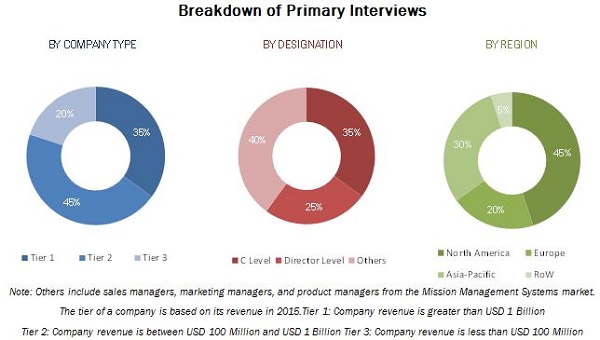
The research methodology used to estimate and forecast the mission management systems market includes study of data and revenues of key market players through secondary resources, such as annual reports, Yahoo Finance, Federal Aviation Administration (FAA), International Civil Aviation Organization (ICAO), International Air Transport Association (IATA), and Stockholm International Peace Research Institute (SIPRI). The bottom-up procedure was employed to arrive at the overall size of the mission management systems market from the revenue of key players in the market. After arriving at the overall market size, the market was split into several segments and sub segments, which were then verified through primary research by conducting extensive interviews with key industry experts, such as CEOs, VPs, directors, executives, and engineers. These data triangulation and market breakdown procedures were employed to complete the overall market engineering process and arrive at the exact statistics for all segments and subsegments. Breakdown of profiles of primaries is shown in the figure given below:
Mission Management Systems Market

To know about the assumptions considered for the study, download the pdf brochure

The ecosystem of the mission management system market comprises space agencies, intelligence communities, service providers, software providers, and end users.

Mission management system Market Insights

The ecosystem of the mission management systems market has been segmented based on application, end user, and region. The key players operating in the mission management systems market includes component suppliers, such as Lockheed Martin Corporation (U.S.), SAAB AB (Sweden), Thales Group (France), and Northrop Grumman Corporation (U.S.), Honeywell International, Inc. (U.S.), among others are some of the manufacturers. Contracts, agreements and acquisitions & partnerships are the major strategies adopted by key players operational in the market.

Key Target Audience:

  • Manufacturers of Mission Management Systems
  • Original Equipment Manufacturers (OEMs)
  • Sub-component Manufacturers
  • Technology Support Providers
  • Government and Certification Bodies
  • Aircraft Manufacturer Associations
  • Naval Manufacturer Associations
  • Land Manufacturer Associations
  • Unmanned Manufacturer Associations

Scope of the Report:

This research report categorizes the mission management system market into the following segments and subsegments:

Mission management system Market, By Application

  • Defense
  • Commercial

Mission management system Market, By End User

  • Air  
  • Land
  • Naval
  • Unmanned Systems    

Mission management system Market, By Region

  • North America
  • Europe
  • Asia Pacific
  • Rest of the World

Customizations Available for the Report:

Along with the market data, MarketsandMarkets offers customizations as per the specific needs of a company. The following customization options are available for the report:

Company Information

  • Detailed analysis and profiling of additional market players (up to five)

Custom Market Research Services

We will customize the research for you, in case the report listed above does not meet with your exact requirements. Our custom research will comprehensively cover the business information you require to help you arrive at strategic and profitable business decisions.

Request Customization

TESTIMONIALS

Report Code
AS 5014
Available for Pre-Book
Choose License Type
BUY NOW
  • SHARE
X
Request Customization
Speak to Analyst
Speak to Analyst
OR FACE-TO-FACE MEETING
PERSONALIZE THIS RESEARCH
  • Triangulate with your Own Data
  • Get Data as per your Format and Definition
  • Gain a Deeper Dive on a Specific Application, Geography, Customer or Competitor
  • Any level of Personalization
REQUEST A FREE CUSTOMIZATION
LET US HELP YOU!
  • What are the Known and Unknown Adjacencies Impacting the Mission Management Systems Market
  • What will your New Revenue Sources be?
  • Who will be your Top Customer; what will make them switch?
  • Defend your Market Share or Win Competitors
  • Get a Scorecard for Target Partners
CUSTOMIZED WORKSHOP REQUEST
knowledgestore logo

Want to explore hidden markets that can drive new revenue in Mission Management Systems Market?

Find Hidden Markets
  • Call Us
  • +1-888-600-6441 (Corporate office hours)
  • +1-888-600-6441 (US/Can toll free)
  • +44-800-368-9399 (UK office hours)
CONNECT WITH US
ABOUT TRUST ONLINE
©2026 MarketsandMarkets Research Private Ltd. All rights reserved
DMCA.com Protection Status
Website Feedback






