



Power Rental Market Size, Share, Trends, Industry, Analysis
Report Code
EP 3534
Published in
Mar, 2026, By MarketsandMarkets™
Power Rental Market by Equipment (Generators, Transformers, Load Banks, Other Equipment), Power Rating (Up to 50 KW, 51–500 KW, 501–2,500 KW, Above 2,500 KW), Application, Fuel Type, Rental Type, End User, and Region – Global Forecast To 2030

USD 15.05 BN
MARKET SIZE, 2030

CAGR 5.6%
(2025-2030)

310
REPORT PAGES

200
MARKET TABLES
OVERVIEW
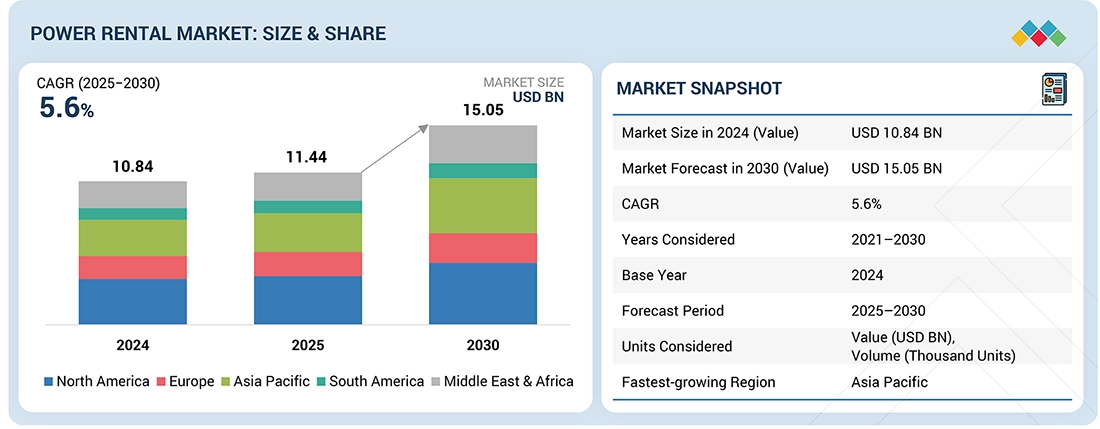
The global power rental market is projected to grow from USD 11.44 billion in 2025 to USD 15.05 billion by 2030, at a CAGR of 5.6%, driven by an increasing demand for temporary power solutions across various industries, such as construction, events, oil and gas, and utilities, where renting equipment provides flexibility and cost-effectiveness. The increasing volume of construction activities necessitates power rental equipment for tasks like lighting up construction sites and running temporary facilities. Additionally, the need for backup power solutions is on the rise due to frequent natural disasters, power outages, and grid instability, leading businesses to invest in standby power solutions offered by rental companies. This factor is also leading to the growth of the market.
Source: Secondary Research, Interviews with Experts, MarketsandMarkets Analysis
Power Rental Market Size and Forecast:
- Market Size (2024): USD 10.84 Billion
- Market Size (2025): USD 11.44 Billion
- Market Forecast (2030): USD 15.05 Billion
- Growth Rate: CAGR of 5.6% from 2025 to 2030
- Base Year: 2024
- Forecast Period: 2025–2030
Key growth drivers
- Increasing demand for reliable and flexible power solutions
- Surging demand for uninterrupted and reliable power supply
- Rapid industrialization in developing economies
- Integration of power rental generators with renewable energy sources
- Technological advancements in power rental equipment for operations enhancement
KEY TAKEAWAYS
-
By RegionAsia Pacific is projected to grow at the highest CAGR (7.1%) during forecast period.
-
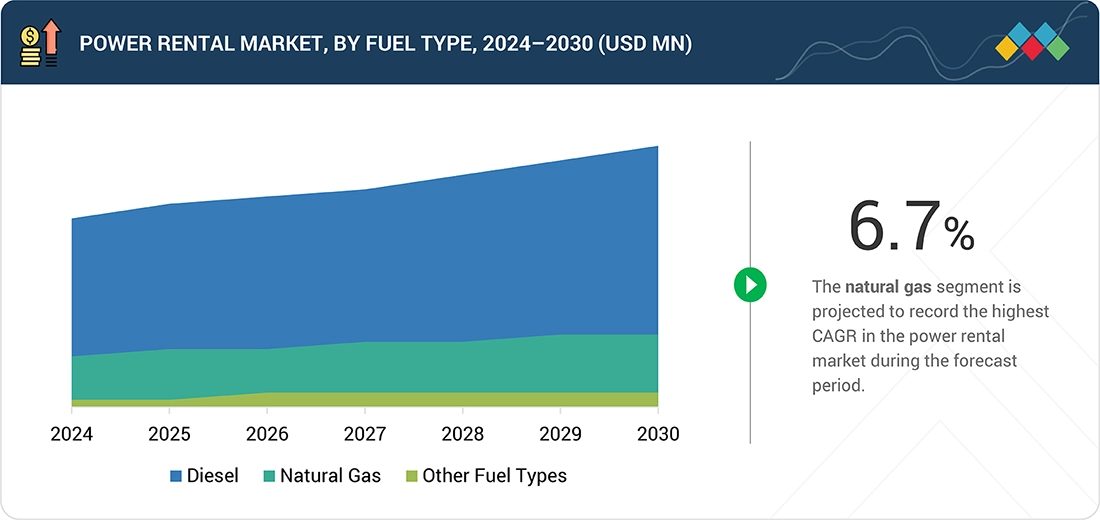
By Fuel TypeBy fuel type, the natural gas segment is projected to grow at the highest rate from 2025 to 2030.
-
By EquipmentBy equipment, the generators segment is projected to dominate the power rental market during the forecast period.
-
By Power RatingBy power rating, the 501–2,500 KW segment is projected to register the highest CAGR of 6.1% during the forecast period.
-
By ApplicationBy application, the peak shaving segment is projected to register the highest CAGR of 7.9% during the forecast period.
-
By End UserBy end user, the utilities segment is projected to dominate the power rental market during the forecast period.
-
By Rental TypeBy rental type, the retail rental segment is projected to account for a larger share than the project rental segment during the forecast period.
-
Competitive Landscape - Key PlayersCompanies such as Aggreco (UK), Ashtead Group (UK), United Rentals, Inc. (US), Herc Rentals Inc. (US), Atlas Copco (Sweden), and Caterpillar (US) were identified as star players in power rental market.
-
Competitive Landscape - Startups/SMEsGenerator Power systems, Inc. (US), ADS SOLUTIONS (India), JC Davis Power (US), and Power Northeast Ltd (UK) have distinguished themselves among SMEs and startups due to their strong product portfolio and sound business strategy.
The power rental market is witnessing steady growth, owing to the increasing demand for reliable and flexible power solutions across the industrial and commercial sectors. Frequent fluctuations in energy supply and the rising need for temporary or backup power prompt businesses to adopt rental solutions over conventional systems. The adaptability of generator fleets plays a critical role, allowing companies to quickly respond to changing operational needs and project timelines. Additionally, ongoing industrial expansion, rapid infrastructure development, and the growing emphasis on uninterrupted power supply for data centers, manufacturing, and oil & gas operations accelerate the regional market growth. Overall, the region’s focus on energy resilience, flexible power delivery, and advanced fleet technologies continues to shape the future of the global power rental market.
TRENDS & DISRUPTIONS IMPACTING CUSTOMERS' CUSTOMERS
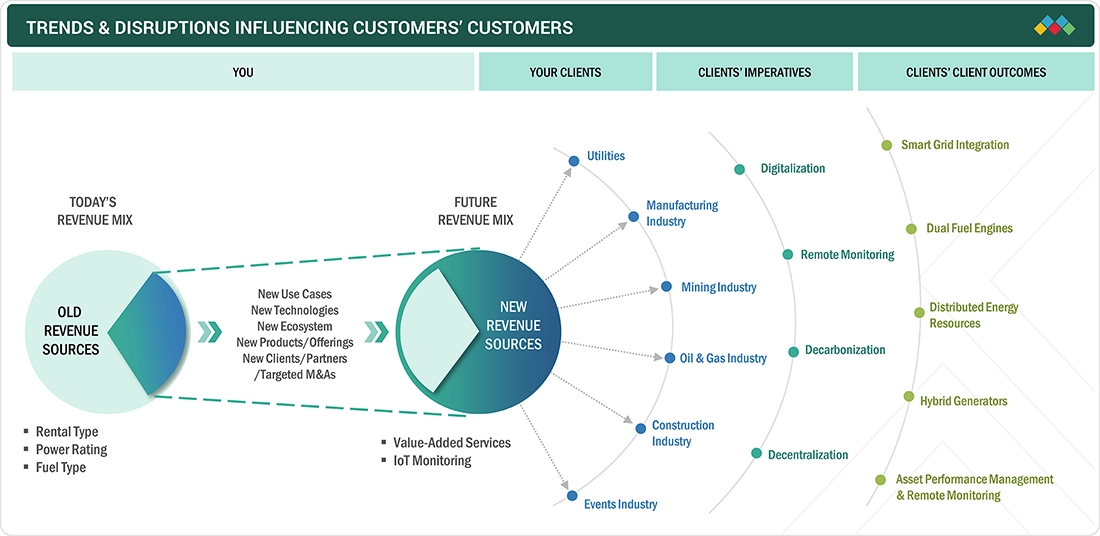
The global power rental market is estimated to record moderate-to-high growth during the forecast period. This growth can be attributed to the digitalization of utilities and increased investments in the renewable and clean energy sectors. The growth of big data analytics enables efficient processing, predictive maintenance, and advanced analysis of large datasets, enhancing reliability and efficiency in power grids and increasing investments in the offshore wind farms sector, which are likely to create lucrative opportunities for the market players.
Source: Secondary Research, Interviews with Experts, MarketsandMarkets Analysis
MARKET DYNAMICS

Drivers
Impact
Level
Level
-
Surging demand for uninterrupted and reliable power supply

-
Rapid industrialization in developing economies


RESTRAINTS
Impact
Level
Level
-
Growing adoption of renewable energy sources and energy storage technologies

-
Stringent government regulations associated with generators


OPPORTUNITIES
Impact
Level
Level
-
Integration of power rental generators with renewable energy sources

-
Technological advancements in power rental equipment for operations enhancement


CHALLENGES
Impact
Level
Level
-
Increased operating expenditure on diesel generators due to high fuel prices

-
Raw material and component shortage and sudden fluctuation in demand for power rental equipment

Source: Secondary Research, Interviews with Experts, MarketsandMarkets Analysis
Driver: Surging demand for uninterrupted and reliable power supply
Surging demand for uninterrupted and reliable power supply is a key driver for the power rental market, as frequent weather-related disruptions, grid congestion, and aging transmission infrastructure increasingly threaten business continuity across the region. Enterprises in sectors such as data centers, healthcare, manufacturing, oil & gas, and construction are prioritizing contingency solutions that can instantly bridge grid failures or planned outages, leading to higher adoption of temporary generators and hybrid rental power systems. At the same time, stricter uptime requirements, especially for mission-critical facilities and remote industrial sites, are pushing companies to complement their permanent installations with flexible rental capacity that can be deployed quickly, scaled with project needs, and financed on an operating-expense basis rather than capex. This combination of reliability concerns, operational risk mitigation, and financial flexibility is steadily reinforcing the role of rental power as an essential buffer against grid instability across the regions.
Restraint: Growing adoption of renewable energy sources and energy storage technologies
Growing adoption of renewable energy sources and advanced energy storage technologies is emerging as a structural restraint for the global power rental market. As utilities, commercial facilities, and large industrial users worldwide increasingly invest in grid-connected solar and wind projects paired with battery storage, their dependence on temporary diesel- and gas-fired rental generators for peak shaving and backup power is gradually declining. In addition, falling levelized costs of renewables and storage, coupled with policy incentives and decarbonization targets in many countries, make permanent clean-energy installations more attractive than short-term rental contracts over the life cycle of a project. This shift reduces the frequency and duration of rental deployments and intensifies regulatory and stakeholder pressure on high-emission rental fleets, forcing power rental providers across regions to reconfigure offerings and accept margin pressures in traditionally high-demand segments.
Opportunity: Technological advancements in power rental equipment for operations enhancement
Technological advancements, such as IoT-enabled telematics, AI-driven predictive maintenance, and hybrid generator–battery systems, are creating a major opportunity for the power rental market by significantly enhancing operational efficiency and service quality. Remote monitoring platforms allow rental providers to track fuel consumption, load profiles, and equipment health in real-time, enabling proactive fault detection, optimized dispatch, and reduced on-site staffing needs for construction, data centers, utilities, and event customers. At the same time, integration of mobile battery energy storage and smart energy management systems with Tier 4-compliant diesel and gas sets reduces fuel use, emissions, and noise, helping customers meet stringent environmental regulations and corporate sustainability targets while lowering total cost of ownership for temporary power. Providers that aggressively digitize their fleets and offer technology-rich solutions, such as hybrid microgrids, remote performance dashboards, and data-backed performance guarantees can differentiate themselves in a competitive market and capture long-term contracts from customers seeking reliable, low-carbon, and intelligently managed rental power solutions.
Challenge: Increased operating expenditure on diesel generators due to high fuel prices
Rising diesel prices have become a significant challenge for the global power rental market, as they directly inflate the operating expenditure of rental generator fleets and erode customer willingness to commit to long-term contracts. The fuel component often accounts for the largest share of total lifecycle cost for rented gensets, so sustained increases in diesel prices sharply raise per-kWh power costs, compressing margins for rental providers unless tariffs are frequently adjusted. At the same time, price-sensitive users in construction, oil & gas, events, mining, and small industrial sites across regions are increasingly reconsidering diesel-based rental solutions, delaying projects, downsizing rental capacities, or seeking alternatives such as gas, hybrid, or grid-based backup where available. This cost pressure complicates demand forecasting, contract structuring, and fleet optimization for rental companies worldwide, and forces them to invest in more fuel-efficient sets, remote monitoring, and hybrid solutions to remain competitive while managing profitability in a volatile fuel-price environment.
POWER RENTAL MARKET: COMMERCIAL USE CASES ACROSS INDUSTRIES
| COMPANY | USE CASE DESCRIPTION | BENEFITS |
|---|---|---|
 |
Temporary standby and backup power deployed at the NHS Nightingale Hospital London to ensure uninterrupted electricity supply for critical care operations during outages | Rapid deployment of temporary rental power by MEMS by supplying 21,850 kVA with generators, cables, and distribution equipment | Enable NHS Nightingale Hospital to operate with reliable electricity for critical care without risking outages |
 |
Off-grid power solutions were required at the La Parrilla tungsten mine in Extremadura to provide a stable and reliable electricity supply in a remote location without grid access | Provided a stable, long-term and environmentally cost-effective power supply | Enabled continuous mining operations at the remote La Parrilla tungsten min |
Logos and trademarks shown above are the property of their respective owners. Their use here is for informational and illustrative purposes only.
MARKET ECOSYSTEM
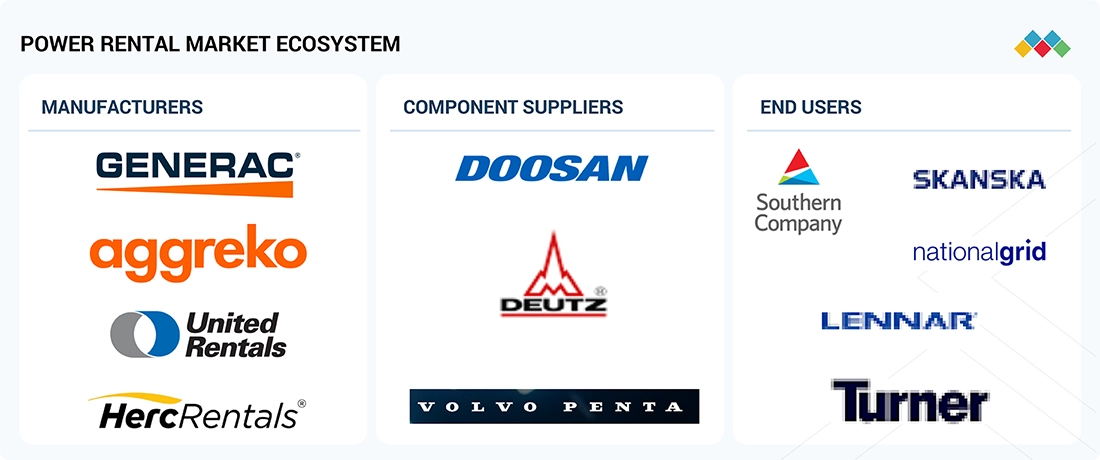
The power rental ecosystem connects generator manufacturers, component suppliers, and rental power companies with a wide spectrum of end users that depend on temporary or backup electricity. These end users include utilities seeking grid support and oil and gas operators in remote fields, mining projects, construction sites, and large commercial or industrial facilities. Data centers, telecom networks, and event organizers also rely on rented power solutions to ensure uninterrupted operations during outages, peak demand, commissioning, or short-term projects.
Logos and trademarks shown above are the property of their respective owners. Their use here is for informational and illustrative purposes only.
MARKET SEGMENTS
Source: Secondary Research, Interviews with Experts, MarketsandMarkets Analysis
Power Rental Market, By Fuel Type
The power rental market is categorized, based on fuel type, into diesel, natural gas, and other fuel types, such as gasoline, hybrid, and heavy fuel oil (HFO). The diesel segment is estimated to dominate the market due to the high reliability, easy availability, and suitability of diesel generators for heavy-duty applications. Natural gas-powered units are also gaining popularity as cleaner and more cost-effective alternatives, driven by increasing environmental regulations and the growing availability of gas infrastructure. Other fuel types, such as gasoline, hybrid systems, and HFO-based units, serve specific niche applications where flexibility, mobility, or localized fuel availability are key factors influencing equipment selection.
Power Rental Market, By Equipment
Based on equipment, the power rental market has been segmented into generators, load banks, transformers, and other equipment (wires, clamps, transfer boxes, and fuel tanks). The generators segment is projected to lead the market during the forecast period due to increasing use of natural gas generators. Power rental solutions offered by most companies consist of a complete end-to-end solution, providing ready-to-use solutions for peak sharing, standby power, and baseload & continuous power applications. These solutions are designed to meet the specific demands of different end-use customers.
Power Rental Market, By Power Rating
The power rental market, by power rating, has been segmented into up to 50 kW, 51–500 kW, 501–2,500 kW, and above 2,500 kW. The 501–2,500 kW segment is projected to lead the market during the forecast period due to the use of diesel- and natural gas-fired power rental solutions. These generators are used in the mining, oil & gas, and construction industries, depending on the type/nature of the job.
Power Rental Market, By Application
The power rental market, by application, has been segmented into peak shaving, base load/continuous power, and standby power. Rental generators can sometimes be used during peak hours to accommodate extra demand, ensuring grid stability. Since these generators share the peak load, the application is called peak shaving. The peak shaving segment is projected to grow at the highest rate during the forecast period due to the rising use of these generators during the peak load. Power rental units that are used to meet the base load/continuous power requirements within different industries are essentially termed base load/continuous power generators. These generators and related equipment are used during mining operations at remote places where supply from the grid is unavailable. Additionally, standby load generators find applications during contingencies or planned outages by utilities or during emergencies where critical operations such as telecom and data centers require backup power.
Power Rental Market, By End User
Based on end user, the power rental market is segmented into utilities, oil & gas, metals & mining, construction, manufacturing, events, corporate & retail, IT & data centers, and others. The utilities segment is projected to dominate the market during the forecast period, as utilities increasingly depend on rental power to manage peak loads, grid maintenance, and emergency backup requirements across diverse industrial applications. Additionally, the growing demand for power from IT and data centers further fuels the growth of the segment.
Power Rental Market, By Rental Type
Based on rental type, the power rental market has been classified into retail rental and project rental. The retail rental segment is projected to grow at a higher CAGR than the project rental segment as customers prefer short-term and flexible access to generators. Besides, retail rental offers flexibility and come in handy for temporary purposes. Additionally, retail users can use power rental solutions for shorter turnaround times without worrying about the cost of owning them.
REGION
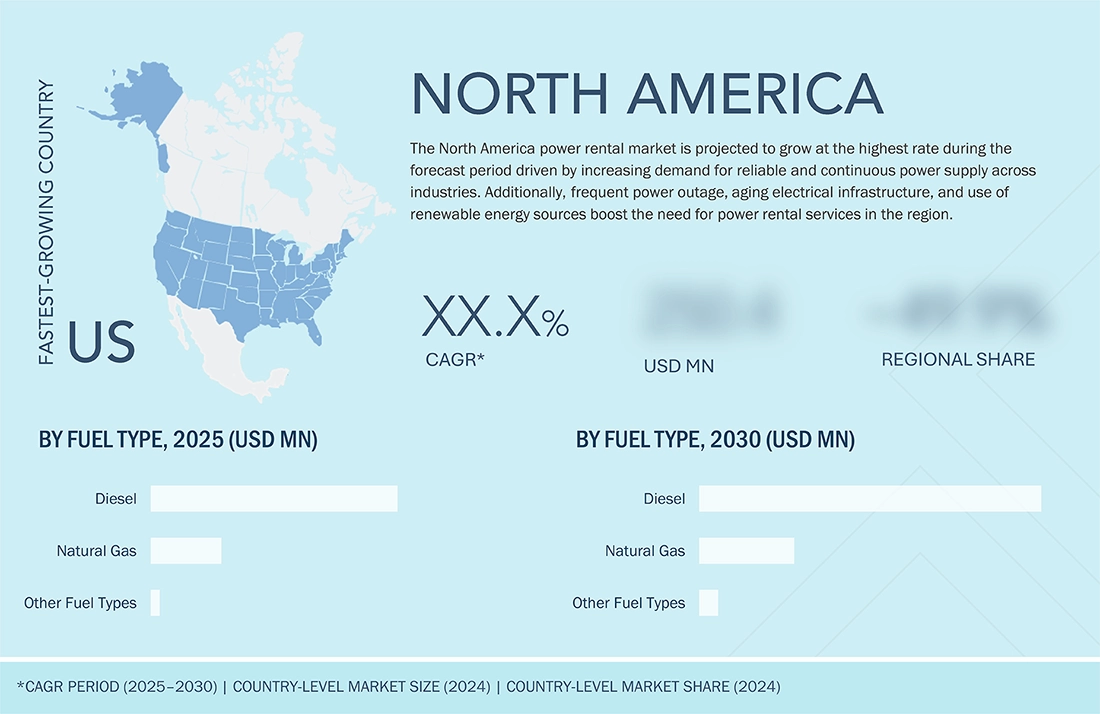
North America is projected to be the largest market for power rental during the forecast period
North America is projected to be the largest regional market during the forecast period. The region has a mature and well-established economy with a high level of industrialization, urbanization, and infrastructure development. This drives demand for temporary power solutions in various sectors, including construction, manufacturing, oil and gas, utilities, events, and entertainment. As a result, the region has a large and diverse customer base for power rental services, contributing to market growth. Moreover, North America has a robust regulatory framework and reliable power infrastructure, which makes it conducive to the adoption of power rental solutions.
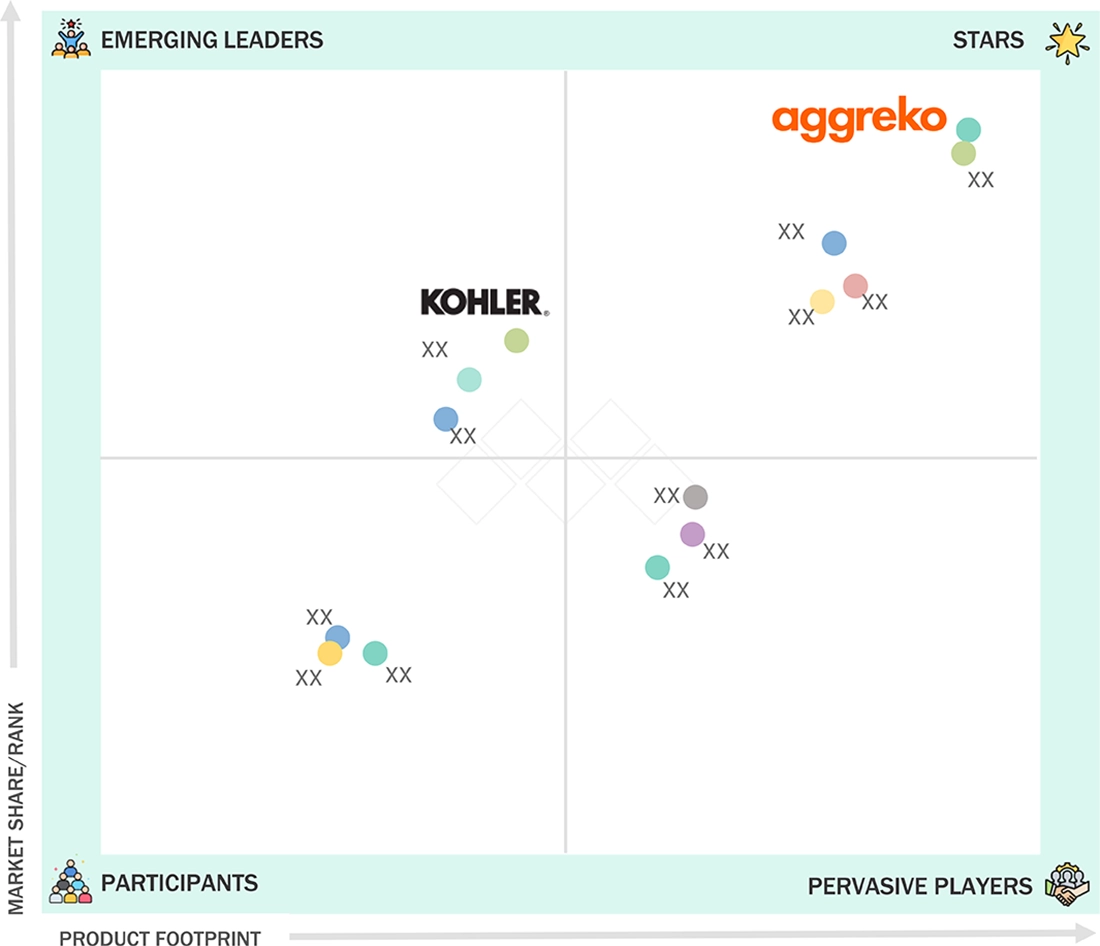
POWER RENTAL MARKET: COMPANY EVALUATION MATRIX
Aggreko (STAR) differentiates itself through an extensive fleet portfolio, integrated digital and monitoring platforms, and strong reach across industries, such as manufacturing, oil and gas, and utilities. On the other hand, Kohler Co. (Emerging Leader) is steadily becoming a go-to power rental brand. Its rental power solutions are compact, energy-efficient and easy to deploy. It offers OEMs and users a practical alternative to traditional giants, especially in everyday applications like temporary HVAC systems, pumps, fans and small industrial machines.
Source: Secondary Research, Interviews with Experts, MarketsandMarkets Analysis
KEY MARKET PLAYERS
- Aggreco (UK)
- Ashtead Group plc (UK)
- United Rentals, Inc. (US)
- Herc Rentals Inc. (US)
- Generac Power Systems, Inc. (US)
- Caterpillar Inc. (US)
- Cummins Inc (US)
- Atlas Copco Group (Sweden)
- Wacker Neuson SE (Germany)
- Kohler Co. (US)
- Allmand Bros., Inc. (US)
- Perennial Technologies (India)
- Carrier (US)
- Multiquip Inc. (US)
- Trinity Power Rentals (US)
- Clifford Power Systems (US)
MARKET SCOPE
| REPORT METRIC | DETAILS |
|---|---|
| Market Size in 2024 (Value) | USD 10.84 BN |
| Market Forecast in 2030 (Value) | USD 15.05 BN |
| Growth Rate | 5.6% |
| Years Considered | 2021–2030 |
| Base Year | 2024 |
| Forecast Period | 2025–2030 |
| Units Considered | Value (USD BN) |
| Report Coverage | Revenue forecast, company ranking, competitive landscape, growth factors, and trends |
| Segments Covered |
|
| Regions Covered | North America, Asia Pacific, Europe, Middle East & Africa, South America |
WHAT IS IN IT FOR YOU: POWER RENTAL MARKET REPORT CONTENT GUIDE
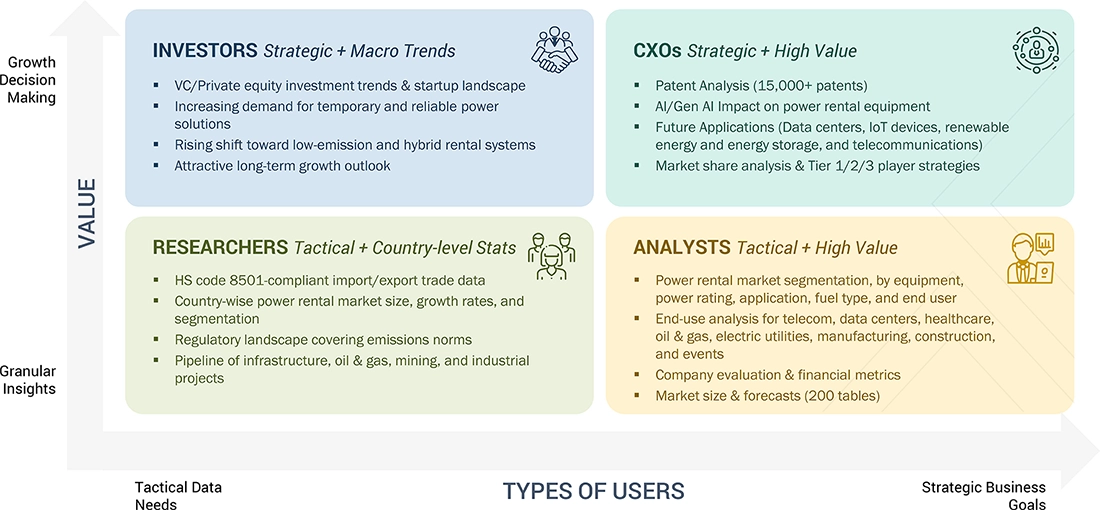
DELIVERED CUSTOMIZATIONS
We have successfully delivered the following deep-dive customizations:
| CLIENT REQUEST | CUSTOMIZATION DELIVERED | VALUE ADDS |
|---|---|---|
| Major Industrial EPC/Utility Provider |
|
|
| Oil & Gas/Mining Operator |
|
|
| Building/HVAC System Integrator |
|
|
RECENT DEVELOPMENTS
- September 2024 : Atlas Copco acquired Integrated Pump Rental (IPR), a South African enterprise that is focused on dewatering pump rentals. IPR became part of Atlas Copco’s Specialty Rental Division within Power Technique; in this way, the rental business of IPR was enhanced by adding additional dewatering pumps and complementary products like air compressors, generators, and power supplies used by customers involved in mining, construction, and wastewater.
- August 2022 : Caterpillar signed a strategic partnership with Aggreko, a global leader in temporary power and utilities rental, for joint marketing and technology collaboration. This partnership is significant in the power rental industry, which is projected to grow to USD 26.9 billion worldwide by 2027. The partnership is part of Caterpillar’s efforts to strengthen its position in the market and enhance its offerings through collaborative innovation and marketing efforts.
- July 2021 : Aggreko partnered with R&A to deliver a renewable power solution at the 149th Open Championship at Royal St George’s Golf Club in Sandwich, England, conducted between July 15 and 18. Aggreko delivered two renewable microgrids that supplied 100% reliable power without connection to the grid. The system has already generated approximately 21,000 kWh of solar power and saved 25 tons CO2 before the event since the solution was installed in March 2021 for the event.
- May 2021 : United Rentals completed the previously announced acquisition of General Finance Corporation. This is an acquisition with strong strategic and financial merits, timed to serve the increasing demand in end markets. It expands the company’s capacity for growth due to the addition of leading mobile storage and modular office solutions, including over 900 employees with complementary expertise.
Table of Contents
 Exclusive indicates content/data unique to MarketsandMarkets and not available with any competitors.
TITLE
PAGE NO
1
INTRODUCTION
28
2
EXECUTIVE SUMMARY
34
3
PREMIUM INSIGHTS
39
4
MARKET OVERVIEW
Asia Pacific's industrialization and renewable integration reshape power rental market dynamics and opportunities.
44
4.1
INTRODUCTION
4.2
MARKET DYNAMICS
4.2.1
DRIVERS
4.2.1.1
RAPID INDUSTRIALIZATION IN EMERGING ECONOMIES OF ASIA PACIFIC
4.2.1.2
SURGING DEMAND FOR UNINTERRUPTED AND RELIABLE POWER SUPPLY
4.2.2
RESTRAINTS
4.2.2.1
GROWING ADOPTION OF RENEWABLE ENERGY SOURCES AND STORAGE TECHNOLOGIES
4.2.2.2
STRINGENT GOVERNMENT REGULATIONS TO REDUCE AIR AND NOISE POLLUTION BY GENERATORS
4.2.3
OPPORTUNITIES
4.2.3.1
INTEGRATION OF POWER RENTAL EQUIPMENT WITH RENEWABLE ENERGY SOURCES
4.2.3.2
TECHNOLOGICAL ADVANCEMENTS IN POWER RENTAL EQUIPMENT FOR OPERATIONAL ENHANCEMENT
4.2.4
CHALLENGES
4.2.4.1
INCREASED OPERATING EXPENDITURE OF DIESEL GENERATORS
4.2.4.2
RAW MATERIAL AND COMPONENT SHORTAGE AND SUDDEN FLUCTUATION IN POWER RENTAL EQUIPMENT DEMAND
4.3
UNMET NEEDS & WHITE SPACES
4.3.1
UNMET NEEDS
4.3.2
WHITE SPACE OPPORTUNITIES
4.4
INTERCONNECTED MARKETS AND CROSS-SECTOR OPPORTUNITIES
4.4.1
CROSS-SECTOR OPPORTUNITIES
4.5
STRATEGIC MOVES BY TIER-1/2/3 PLAYERS
5
INDUSTRY TRENDS
Navigate emerging threats and opportunities in global power rental with strategic insights and pricing trends.
53
5.1
PORTER’S FIVE FORCES ANALYSIS
5.1.1
THREAT OF NEW ENTRANTS
5.1.2
BARGAINING POWER OF SUPPLIERS
5.1.3
BARGAINING POWER OF BUYERS
5.1.4
THREAT OF SUBSTITUTES
5.1.5
INTENSITY OF COMPETITIVE RIVALRY
5.2
MACROECONOMIC OUTLOOK
5.2.1
GDP TRENDS AND FORECAST
5.2.2
TRENDS IN GLOBAL POWER RENTAL INDUSTRY
5.3
VALUE CHAIN ANALYSIS
5.4
ECOSYSTEM ANALYSIS
5.4.1
ROLE IN ECOSYSTEM
5.5
PRICING ANALYSIS
5.5.1
AVERAGE 24-HOUR RENTAL PRICE OF GENERATORS, BY GENERATOR POWER RATING, 2022, 2023, 2024, AND 2030
5.5.2
AVERAGE 24-HOUR RENTAL PRICE OF GENERATORS, BY REGION, 2022, 2023, 2024, AND 2030
5.6
TRADE ANALYSIS
5.6.1
IMPORT SCENARIO FOR HS CODE 8501, 2021–2024
5.6.2
EXPORT SCENARIO FOR HS CODE 8501, 2021–2024
5.7
KEY CONFERENCES AND EVENTS, 2026
5.8
TRENDS/DISRUPTIONS IMPACTING CUSTOMER’S BUSINESS
5.9
INVESTMENT AND FUNDING SCENARIO
5.10
CASE STUDY ANALYSIS
5.10.1
COMMERCIAL FACILITY POWER
5.10.2
COAL MINE POWER RELIABILITY
5.11
IMPACT OF 2025 US TARIFF ON POWER RENTAL MARKET
5.11.1
KEY TARIFF RATES
5.11.2
PRICE IMPACT ANALYSIS
5.11.3
IMPACT ON COUNTRIES/REGIONS
5.11.3.1
NORTH AMERICA
5.11.3.2
EUROPE
5.11.3.3
ASIA PACIFIC
5.11.3.4
SOUTH AMERICA
5.11.3.5
MIDDLE EAST & AFRICA
5.11.4
IMPACT ON END-USE INDUSTRIES
6
TECHNOLOGICAL ADVANCEMENTS, AI-DRIVEN IMPACTS, PATENTS, INNOVATIONS, AND FUTURE APPLICATIONS
AI-driven innovations and hybrid systems revolutionize power rentals with sustainable, efficient, and resilient solutions.
74
6.1
KEY EMERGING TECHNOLOGIES
6.1.1
HYBRID POWER RENTAL SYSTEMS
6.1.2
IOT AND TELEMATICS
6.2
COMPLEMENTARY TECHNOLOGIES
6.2.1
ENERGY STORAGE SYSTEMS (ESS)
6.3
TECHNOLOGY/PRODUCT ROADMAP
6.4
PATENT ANALYSIS
6.5
FUTURE APPLICATIONS
6.6
IMPACT OF AI/GEN AI ON POWER RENTAL MARKET
6.6.1
TOP USE CASES AND MARKET POTENTIAL
6.6.2
BEST PRACTICES IN POWER RENTAL MARKET
6.6.3
CASE STUDIES OF AI/GEN AI IMPLEMENTATION IN POWER RENTAL MARKET
6.6.4
INTERCONNECTED ADJACENT ECOSYSTEM AND IMPACT ON MARKET PLAYERS
6.6.5
CLIENTS’ READINESS TO ADOPT AI/GEN AI
7
SUSTAINABILITY AND REGULATORY LANDSCAPE
Navigate evolving eco-standards and regulations to optimize sustainable power rental operations globally.
83
7.1
SUSTAINABILITY INITIATIVES
7.1.1
CARBON IMPACT AND ECO-APPLICATIONS OF POWER RENTAL EQUIPMENT
7.2
SUSTAINABILITY IMPACT AND REGULATORY POLICY INITIATIVES
7.3
CERTIFICATIONS, LABELING, AND ECO-STANDARDS
7.4
REGIONAL REGULATIONS AND COMPLIANCE
7.4.1
REGULATORY BODIES, GOVERNMENT AGENCIES, AND OTHER ORGANIZATIONS
7.4.2
INDUSTRY STANDARDS
8
CUSTOMER LANDSCAPE AND BUYER BEHAVIOR
Understand the pivotal influence of stakeholders and unmet needs shaping buyer decisions.
92
8.1
DECISION-MAKING PROCESS
8.2
BUYER STAKEHOLDERS AND BUYING EVALUATION CRITERIA
8.2.1
KEY STAKEHOLDERS IN BUYING PROCESS
8.2.2
BUYING CRITERIA
8.3
ADOPTION BARRIERS & INTERNAL CHALLENGES
8.4
UNMET NEEDS FROM VARIOUS END USERS
8.5
MARKET PROFITABILITY
9
POWER RENTAL MARKET, BY GENERATOR FUEL TYPE
Market Size & Growth Rate Forecast Analysis to 2030 in USD Million | 8 Data Tables
99
9.1
INTRODUCTION
9.2
DIESEL
9.2.1
EASY AVAILABILITY AND STORAGE TO DRIVE MARKET
9.3
NATURAL GAS
9.3.1
EXPANDING GAS DISTRIBUTION NETWORK TO PROPEL MARKET GROWTH
9.4
OTHER GENERATOR FUEL TYPES
10
POWER RENTAL MARKET, BY EQUIPMENT
Market Size & Growth Rate Forecast Analysis to 2030 in USD Million | 10 Data Tables
105
10.1
INTRODUCTION
10.2
GENERATORS
10.2.1
RISING USE OF GENERATORS FOR STANDBY POWER APPLICATIONS IN TELECOMMUNICATIONS AND DATA CENTERS TO DRIVE MARKET
10.3
TRANSFORMERS
10.3.1
AGING T&D NETWORK TO AUGMENT MARKET ADOPTION
10.4
LOAD BANKS
10.4.1
RISING POWER PLANT INSTALLATIONS GLOBALLY TO FUEL DEMAND
10.5
OTHER EQUIPMENT
11
POWER RENTAL MARKET, BY GENERATOR POWER RATING
Market Size & Growth Rate Forecast Analysis to 2030 in USD Million | 10 Data Tables
112
11.1
INTRODUCTION
11.2
UP TO 50 KW
11.2.1
PORTABILITY AND EASE IN TRANSPORTATION TO BOOST MARKET DEMAND
11.3
51–500 KW
11.3.1
HIGH INVESTMENTS IN OIL & GAS AND CONSTRUCTION INDUSTRIES TO FUEL MARKET GROWTH
11.4
501–2,500 KW
11.4.1
RISING USE TO PROVIDE STANDBY AND BASE LOAD/CONTINUOUS POWER SUPPLY DURING POWER OUTAGES TO DRIVE MARKET
11.5
ABOVE 2500 KW
11.5.1
REQUIREMENT FOR UNINTERRUPTED POWER SUPPLY IN MINING AND OFFSHORE OIL & GAS OPERATIONS TO PROPEL MARKET GROWTH
12
POWER RENTAL MARKET, BY APPLICATION
Market Size & Growth Rate Forecast Analysis
119
12.1
INTRODUCTION
12.2
PEAK SHAVING
12.2.1
NEED TO REDUCE UTILITY COSTS TO DRIVE DEMAND
12.3
STANDBY POWER
12.3.1
REQUIREMENT FOR POWER DURING GRID OUTAGES TO AID MARKET GROWTH
12.4
BASE LOAD/CONTINUOUS POWER
12.4.1
INCREASING DEMAND IN UTILITIES AND MINING INDUSTRY TO FUEL MARKET GROWTH
13
POWER RENTAL MARKET, BY RENTAL TYPE
Market Size & Growth Rate Forecast Analysis to 2030 in USD Million | 6 Data Tables
125
13.1
INTRODUCTION
13.2
SHORT-TERM RETAIL RENTAL
13.2.1
REQUIREMENT FOR CONTINUOUS POWER SUPPLY DURING PEAK HOURS AND POWER OUTAGES TO DRIVE MARKET
13.3
LONG-TERM PROJECT RENTAL
13.3.1
GROWING DEMAND FOR RENTAL POWER IN UTILITIES AND LONG-DURATION PROJECTS TO DRIVE MARKET
14
POWER RENTAL MARKET, BY END USER
Market Size & Growth Rate Forecast Analysis to 2030 in USD Million | 20 Data Tables
130
14.1
INTRODUCTION
14.2
UTILITIES
14.2.1
INCREASING REQUIREMENT FOR CONTINUOUS POWER TO DRIVE DEMAND
14.3
OIL & GAS
14.3.1
INCREASING OIL & GAS EXPLORATION TO FUEL MARKET DEMAND
14.4
METALS & MINING
14.4.1
EXPLORATION OF METALS & MINERALS TO FUEL DEMAND FOR POWER RENTALS IN REMOTE AND ENERGY-SENSITIVE LOCATIONS
14.5
MANUFACTURING
14.5.1
EXPANDING ENERGY-INTENSIVE MANUFACTURING FACILITIES TO INCREASE NEED FOR RELIABLE TEMPORARY POWER
14.6
CONSTRUCTION
14.6.1
RISE IN INFRASTRUCTURE DEVELOPMENT ACROSS SOUTHEAST ASIA TO DRIVE MARKET GROWTH
14.7
IT & DATA CENTERS
14.7.1
INCREASE IN NUMBER OF DATA CENTERS AND RAPID DIGITAL TRANSFORMATION TO FUEL MARKET GROWTH
14.8
CORPORATE & RETAIL
14.8.1
HIGH INVESTMENTS IN CORPORATE SECTOR BY PUBLIC AND PRIVATE ENTERPRISES TO DRIVE MARKET
14.9
EVENTS
14.9.1
RISING NUMBER OF PUBLIC EVENTS TO FUEL DEMAND
14.10
OTHER END USERS
15
POWER RENTAL MARKET, BY REGION
Comprehensive coverage of 8 Regions with country-level deep-dive of 21 Countries | 128 Data Tables.
143
15.1
INTRODUCTION
15.2
EUROPE
15.2.1
GERMANY
15.2.1.1
NEED FOR RELIABLE BACKUP POWER IN MANUFACTURING, DATA CENTER, AND CONSTRUCTION SECTORS TO BOOST MARKET GROWTH
15.2.2
UK
15.2.2.1
RAPID INDUSTRIALIZATION TO DRIVE MARKET
15.2.3
RUSSIA
15.2.3.1
STEADY GROWTH IN RENEWABLE POWER GENERATION TO FUEL MARKET GROWTH
15.2.4
FRANCE
15.2.4.1
INDUSTRIAL EXPANSION AND GRID MODERNIZATION EFFORTS TO ACCELERATE TEMPORARY POWER DEMAND
15.2.5
ITALY
15.2.5.1
NEED FOR RELIABLE BACKUP POWER IN DATA CENTERS AND CONSTRUCTION SECTORS TO DRIVE MARKET
15.2.6
REST OF EUROPE
15.3
NORTH AMERICA
15.3.1
US
15.3.1.1
US TO DOMINATE NORTH AMERICAN POWER RENTAL MARKET DURING STUDY PERIOD
15.3.2
CANADA
15.3.2.1
RISING INITIATION OF NEW MINING AND CONSTRUCTION PROJECTS TO BOOST MARKET GROWTH
15.3.3
MEXICO
15.3.3.1
INCREASING INVESTMENTS IN OIL & GAS SECTOR TO FUEL MARKET GROWTH
15.4
ASIA PACIFIC
15.4.1
CHINA
15.4.1.1
RAPID URBANIZATION AND INDUSTRIALIZATION TO DRIVE ENERGY DEMAND
15.4.2
INDIA
15.4.2.1
INCREASED NEED FOR RELIABLE ELECTRICITY AND RAPID ECONOMIC GROWTH TO PROPEL MARKET GROWTH
15.4.3
AUSTRALIA
15.4.3.1
INCREASED CONSTRUCTION AND MINING ACTIVITIES TO ACCELERATE MARKET GROWTH
15.4.4
JAPAN
15.4.4.1
RENOVATION OF GRID INFRASTRUCTURE TO AID DEMAND FOR UTILITIES
15.4.5
SOUTH KOREA
15.4.5.1
FOCUS ON INFRASTRUCTURAL DEVELOPMENT TO PROPEL MARKET GROWTH
15.4.6
INDONESIA
15.4.6.1
GROWING INFRASTRUCTURE AND GRID TRANSFORMATION NEEDS TO INCREASE RELIANCE ON TEMPORARY POWER RENTAL SOLUTIONS
15.4.6.2
REST OF ASIA PACIFIC
15.5
SOUTH AMERICA
15.5.1
BRAZIL
15.5.1.1
INCREASING INVESTMENTS IN DATA CENTERS TO PROPEL POWER RENTAL DEMAND
15.5.2
ARGENTINA
15.5.2.1
INVESTMENTS IN OIL & GAS AND MINING INDUSTRIES AND MANUFACTURING SECTORS TO FUEL DEMAND
15.5.3
CHILE
15.5.3.1
FREQUENT OUTAGES AND EXPANDING ENERGY NEEDS IN MINING TO BOOST POWER RENTAL DEMAND.
15.5.4
REST OF SOUTH AMERICA
15.6
MIDDLE EAST & AFRICA
15.6.1
GCC COUNTRIES
15.6.1.1
RAPID INFRASTRUCTURE, ENERGY DIVERSIFICATION, AND INDUSTRIAL EXPANSION TO BOOST DEMAND FOR FUEL POWER RENTAL
15.6.1.2
KINGDOM OF SAUDI ARABIA
15.6.1.2.1
ENERGY INFRASTRUCTURE EXPANSION AND GRID DIVERSIFICATION TO AUGMENT MARKET GROWTH
15.6.1.3
UAE
15.6.1.3.1
RAPID DIGITAL INFRASTRUCTURE EXPANSION AND ENERGY TRANSITION INITIATIVES TO ACCELERATE MARKET GROWTH
15.6.1.4
QATAR
15.6.1.4.1
INFRASTRUCTURE GROWTH AND ENERGY SECTOR DEVELOPMENTS TO PROPEL POWER RENTAL SOLUTION DEMAND
15.6.1.5
REST OF GCC COUNTRIES
15.6.2
NIGERIA
15.6.2.1
PERSISTENT GRID UNRELIABILITY AND FREQUENT OUTAGES TO FOCUS ON GREATER RELIANCE ON TEMPORARY POWER SOLUTIONS
15.6.3
SOUTH AFRICA
15.6.3.1
ONGOING GRID RELIABILITY CHALLENGES AND INFRASTRUCTURE CONSTRAINTS TO INCREASE POWER RENTAL DEMAND
15.6.4
REST OF MIDDLE EAST & AFRICA
16
COMPETITIVE LANDSCAPE
Uncover strategic insights from key players and startups reshaping market dynamics and valuations.
206
16.1
INTRODUCTION
16.2
KEY PLAYER STRATEGIES/RIGHT TO WIN, 2021–2025
16.3
REVENUE ANALYSIS, 2020–2024
16.4
MARKET SHARE ANALYSIS, 2024
16.5
COMPANY VALUATION & FINANCIAL METRICS
16.5.1
COMPANY VALUATION
16.5.2
FINANCIAL METRICS
16.6
PRODUCT COMPARISON
16.7
COMPANY EVALUATION MATRIX: KEY PLAYERS, 2024
16.7.1
STARS
16.7.2
EMERGING LEADERS
16.7.3
PERVASIVE PLAYERS
16.7.4
PARTICIPANTS
16.7.5
COMPANY FOOTPRINT: KEY PLAYERS, 2024
16.7.5.1
COMPANY FOOTPRINT
16.7.5.2
REGION FOOTPRINT
16.7.5.3
GENERATOR FUEL TYPE FOOTPRINT
16.7.5.4
EQUIPMENT FOOTPRINT
16.7.5.5
GENERATOR POWER RATING FOOTPRINT
16.7.5.6
APPLICATION FOOTPRINT
16.7.5.7
RENTAL TYPE FOOTPRINT
16.7.5.8
END-USER FOOTPRINT
16.8
COMPANY EVALUATION MATRIX: STARTUPS/SMES, 2024
16.8.1
PROGRESSIVE COMPANIES
16.8.2
RESPONSIVE COMPANIES
16.8.3
DYNAMIC COMPANIES
16.8.4
STARTING BLOCKS
16.8.5
COMPETITIVE BENCHMARKING: STARTUPS/SMES, 2024
16.8.5.1
DETAILED LIST OF KEY STARTUPS/SMES
16.8.5.2
COMPETITIVE BENCHMARKING OF STARTUPS/SMES
16.9
COMPETITIVE SCENARIO
16.9.1
PRODUCT LAUNCHES
16.9.2
DEALS
16.9.3
EXPANSIONS
16.9.4
CONTRACTS
17
COMPANY PROFILES
In-depth Company Profiles of Leading Market Players with detailed Business Overview, Product and Service Portfolio, Recent Developments, and Unique Analyst Perspective (MnM View)
233
17.1
KEY PLAYERS
17.1.1
AGGREKO
17.1.1.1
BUSINESS OVERVIEW
17.1.1.2
PRODUCTS/SOLUTIONS/SERVICES OFFERED
17.1.1.3
RECENT DEVELOPMENTS
17.1.1.3.1
PRODUCT LAUNCHES
17.1.1.3.2
DEALS
17.1.1.3.3
CONTRACTS
17.1.1.4
MNM VIEW
17.1.1.4.1
RIGHT TO WIN
17.1.1.4.2
STRATEGIC CHOICES
17.1.1.4.3
WEAKNESSES & COMPETITIVE THREATS
17.1.2
ASHTEAD GROUP PLC
17.1.3
UNITED RENTALS, INC.
17.1.4
ATLAS COPCO AB
17.1.5
CATERPILLAR
17.1.6
CUMMINS INC.
17.1.7
HERC RENTALS INC.
17.1.8
GENERAC POWER SYSTEMS, INC.
17.1.9
WACKER NEUSON SE
17.1.10
REHLKO
17.1.11
AKSA POWER GENERATION
17.1.12
BREDENOORD
17.1.13
ALLMAND BROS
17.1.14
MODERN ENERGY RENTAL PVT. LTD.
17.1.15
PERENNIAL TECHNOLOGIES
17.1.16
CARRIER
17.1.17
FUEL GARD FUEL SUPPLY SYSTEMS
17.1.18
SAINI DIESEL POWER SERVICE PVT. LTD.
17.1.19
MULTIQUIP INC.
17.2
OTHER PLAYERS
17.2.1
TRINITY POWER
17.2.2
ALFARIS
17.2.3
L.M. GENERATING POWER CO., LTD.
17.2.4
T&T POWER GROUP
17.2.5
CRESTCHIC (UK) LIMITED
17.2.6
SHENTON GROUP
18
RESEARCH METHODOLOGY
288
18.1
RESEARCH DATA
18.2
SECONDARY AND PRIMARY RESEARCH
18.2.1
SECONDARY DATA
18.2.1.1
LIST OF KEY SECONDARY SOURCES
18.2.1.2
KEY DATA FROM SECONDARY SOURCES
18.2.2
PRIMARY DATA
18.2.2.1
LIST OF PRIMARY INTERVIEW PARTICIPANTS
18.2.2.2
KEY INDUSTRY INSIGHTS
18.2.2.3
BREAKDOWN OF PRIMARIES
18.2.2.4
KEY DATA FROM PRIMARY SOURCES
18.3
MARKET SIZE ESTIMATION METHODOLOGY
18.3.1
BOTTOM-UP APPROACH
18.3.2
TOP-DOWN APPROACH
18.3.3
DEMAND-SIDE ANALYSIS
18.3.3.1
DEMAND-SIDE ASSUMPTIONS
18.3.3.2
DEMAND-SIDE CALCULATIONS
18.3.4
SUPPLY-SIDE ANALYSIS
18.3.4.1
SUPPLY-SIDE ASSUMPTIONS
18.3.4.2
SUPPLY-SIDE CALCULATIONS
18.4
GROWTH FORECAST
18.5
DATA TRIANGULATION
18.6
RESEARCH LIMITATIONS
18.7
RISK ANALYSIS
18.8
RESEARCH LIMITATIONS
19
APPENDIX
301
19.1
INSIGHTS FROM INDUSTRY EXPERTS
19.2
DISCUSSION GUIDE
19.3
KNOWLEDGESTORE: MARKETSANDMARKETS’ SUBSCRIPTION PORTAL
19.4
CUSTOMIZATION OPTIONS
19.5
RELATED REPORTS
19.6
AUTHOR DETAILS
LIST OF TABLES
TABLE 1
INTERCONNECTED MARKETS
TABLE 2
KEY MOVES AND STRATEGIC FOCUS BY KEY PLAYERS IN POWER RENTAL MARKET
TABLE 3
IMPACT OF PORTER’S FIVE FORCES ON POWER RENTAL MARKET
TABLE 4
GDP PERCENTAGE CHANGE, BY COUNTRY, 2021–2029
TABLE 5
ROLES OF COMPANIES IN POWER RENTAL MARKET ECOSYSTEM
TABLE 6
AVERAGE 24-HOUR RENTAL PRICE OF GENERATORS, BY GENERATOR POWER RATING, 2022, 2023, 2024, AND 2030 (USD)
TABLE 7
AVERAGE 24-HOUR RENTAL PRICE OF GENERATORS, BY REGION, 2021, 2022, 2023, AND 2029 (USD)
TABLE 8
IMPORT DATA FOR HS CODE 8501-COMPLIANT PRODUCTS, BY COUNTRY, 2021–2024 (USD THOUSAND)
TABLE 9
EXPORT DATA FOR HS CODE 8501-COMPLIANT PRODUCTS, BY COUNTRY, 2021–2024 (USD THOUSAND)
TABLE 10
LIST OF KEY CONFERENCES AND EVENTS IN POWER RENTAL MARKET, JANUARY 2026–DECEMBER 2026
TABLE 11
CASE STUDY 1: COMMERCIAL FACILITY POWER
TABLE 12
CASE STUDY 2: COAL MINE POWER RELIABILITY
TABLE 13
US-ADJUSTED RECIPROCAL TARIFF RATES
TABLE 14
EXPECTED CHANGE IN PRICES AND IMPACT ON END-USE MARKETS DUE TO TARIFFS
TABLE 15
LIST OF KEY PATENTS IN POWER RENTAL MARKET, 2021–2025
TABLE 16
DATA CENTER AND AI: RELIANCE ON POWER RENTALS FOR RELIABLE BACKUP
TABLE 17
RENEWABLE BALANCING: HYBRID RENTALS INTEGRATE BATTERIES/SOLAR/WIND FOR CUTTING EMISSIONS WITH EFFICIENT PEAK BALANCING
TABLE 18
INFRASTRUCTURE PROJECTS: RENTALS POWER MEGA INFRA SUCH AS METROS/AIRPORTS, BRIDGING REMOTE SITE GAPS AMID URBANIZATION
TABLE 19
DISASTER RECOVERY: RAPID-RESPONSE GENERATORS ENSURE POST-DISASTER CONTINUITY FOR RESPONDERS AND CRITICAL OPERATIONS
TABLE 20
EVENTS AND UTILITIES: TELEMATICS-ENABLED RENTALS SUPPORT EVENTS/PEAK SHAVING WITH LOW-EMISSION, RELIABLE GRID AUGMENTATION.
TABLE 21
TOP USE CASES AND MARKET POTENTIAL
TABLE 22
BEST PRACTICES OF POWER RENTAL, BY COMPANY
TABLE 23
CASE STUDIES RELATED TO GEN AI IMPLEMENTATION
TABLE 24
INTERCONNECTED ADJACENT ECOSYSTEM AND IMPACT ON MARKET PLAYERS
TABLE 25
CERTIFICATIONS, LABELING, AND ECO-STANDARDS RELEVANT TO POWER RENTAL MARKET
TABLE 26
NORTH AMERICA: REGULATORY BODIES, GOVERNMENT AGENCIES, AND OTHER ORGANIZATIONS
TABLE 27
EUROPE: REGULATORY BODIES, GOVERNMENT AGENCIES, AND OTHER ORGANIZATIONS
TABLE 28
ASIA PACIFIC: REGULATORY BODIES, GOVERNMENT AGENCIES, AND OTHER ORGANIZATIONS
TABLE 29
REST OF THE WORLD: REGULATORY BODIES, GOVERNMENT AGENCIES, AND OTHER ORGANIZATIONS
TABLE 30
GLOBAL: REGULATORY BODIES, GOVERNMENT AGENCIES, AND OTHER ORGANIZATIONS
TABLE 31
GLOBAL INDUSTRY STANDARDS
TABLE 32
INFLUENCE OF STAKEHOLDERS ON BUYING PROCESS FOR MAJOR END USERS (%)
TABLE 33
KEY BUYING CRITERIA FOR MAJOR END USERS
TABLE 34
UNMET NEEDS IN POWER RENTAL MARKET, BY END USER
TABLE 35
POWER RENTAL MARKET, BY GENERATOR FUEL TYPE, 2021–2024 (USD MILLION)
TABLE 36
POWER RENTAL MARKET, BY GENERATOR FUEL TYPE, 2025–2030 (USD MILLION)
TABLE 37
DIESEL: POWER RENTAL MARKET, BY REGION, 2021–2024 (USD MILLION)
TABLE 38
DIESEL: POWER RENTAL MARKET, BY REGION, 2025–2030 (USD MILLION)
TABLE 39
NATURAL GAS: POWER RENTAL MARKET, BY REGION, 2021–2024 (USD MILLION)
TABLE 40
NATURAL GAS: POWER RENTAL MARKET, BY REGION, 2025–2030 (USD MILLION)
TABLE 41
OTHER GENERATOR FUEL TYPES: POWER RENTAL MARKET, BY REGION, 2021–2024 (USD MILLION)
TABLE 42
OTHER GENERATOR FUEL TYPES: POWER RENTAL MARKET, BY REGION, 2025–2030 (USD MILLION)
TABLE 43
POWER RENTAL MARKET, BY EQUIPMENT, 2021–2024 (USD MILLION)
TABLE 44
POWER RENTAL MARKET, BY EQUIPMENT, 2025–2030 (USD MILLION)
TABLE 45
GENERATORS: POWER RENTAL MARKET, BY REGION, 2021–2024 (USD MILLION)
TABLE 46
GENERATORS: POWER RENTAL MARKET, BY REGION, 2025–2030 (USD MILLION)
TABLE 47
TRANSFORMERS: POWER RENTAL MARKET, BY REGION, 2021–2024 (USD MILLION)
TABLE 48
TRANSFORMERS: POWER RENTAL MARKET, BY REGION, 2025–2030 (USD MILLION)
TABLE 49
LOAD BANKS: POWER RENTAL MARKET, BY REGION, 2021–2024 (USD MILLION)
TABLE 50
LOAD BANKS: POWER RENTAL MARKET, BY REGION, 2025–2030 (USD MILLION)
TABLE 51
OTHER EQUIPMENT: POWER RENTAL MARKET, BY REGION, 2021–2024 (USD MILLION)
TABLE 52
OTHER EQUIPMENT: POWER RENTAL MARKET, BY REGION, 2025–2030 (USD MILLION)
TABLE 53
POWER RENTAL MARKET, BY GENERATOR POWER RATING, 2021–2024 (USD MILLION)
TABLE 54
POWER RENTAL MARKET, BY GENERATOR POWER RATING, 2025–2030 (USD MILLION)
TABLE 55
UP TO 50 KW: POWER RENTAL MARKET, BY REGION, 2021–2024 (USD MILLION)
TABLE 56
UP TO 50 KW: POWER RENTAL MARKET, BY REGION, 2025–2030 (USD MILLION)
TABLE 57
51–500 KW: POWER RENTAL MARKET, BY REGION, 2021–2024 (USD MILLION)
TABLE 58
51–500 KW: POWER RENTAL MARKET, BY REGION, 2025–2030 (USD MILLION)
TABLE 59
501–2500 KW: POWER RENTAL MARKET, BY REGION, 2021–2024 (USD MILLION)
TABLE 60
501–2500 KW: POWER RENTAL MARKET, BY REGION, 2025–2030 (USD MILLION)
TABLE 61
ABOVE 2500 KW: POWER RENTAL MARKET, BY REGION, 2021–2024 (USD MILLION)
TABLE 62
ABOVE 2500 KW: POWER RENTAL MARKET, BY REGION, 2025–2030 (USD MILLION)
TABLE 71
POWER RENTAL MARKET, BY RENTAL TYPE, 2021–2024 (USD MILLION)
TABLE 72
POWER RENTAL MARKET, BY RENTAL TYPE, 2025–2030 (USD MILLION)
TABLE 73
SHORT-TERM RETAIL RENTAL: POWER RENTAL MARKET, BY REGION, 2021–2024 (USD MILLION)
TABLE 74
SHORT-TERM RETAIL RENTAL: POWER RENTAL MARKET, BY REGION, 2025–2030 (USD MILLION)
TABLE 75
LONG-TERM PROJECT RENTAL: POWER RENTAL MARKET, BY REGION, 2021–2024 (USD MILLION)
TABLE 76
LONG-TERM PROJECT RENTAL: POWER RENTAL MARKET, BY REGION, 2025–2030 (USD MILLION)
TABLE 77
POWER RENTAL MARKET, BY END USER, 2021–2024 (USD MILLION)
TABLE 78
POWER RENTAL MARKET, BY END USER, 2025–2030 (USD MILLION)
TABLE 79
UTILITIES: POWER RENTAL MARKET, BY REGION, 2021–2024 (USD MILLION)
TABLE 80
UTILITIES: POWER RENTAL MARKET, BY REGION, 2025–2030 (USD MILLION)
TABLE 81
OIL & GAS: POWER RENTAL MARKET, BY REGION, 2021–2024 (USD MILLION)
TABLE 82
OIL & GAS: POWER RENTAL MARKET, BY REGION, 2025–2030 (USD MILLION)
TABLE 83
METALS & MINING: POWER RENTAL MARKET, BY REGION, 2021–2024 (USD MILLION)
TABLE 84
METALS & MINING: POWER RENTAL MARKET, BY REGION, 2025–2030 (USD MILLION)
TABLE 85
MANUFACTURING: POWER RENTAL MARKET, BY REGION, 2021–2024 (USD MILLION)
TABLE 86
MANUFACTURING: POWER RENTAL MARKET, BY REGION, 2025–2030 (USD MILLION)
TABLE 87
CONSTRUCTION: POWER RENTAL MARKET, BY REGION, 2021–2024 (USD MILLION)
TABLE 88
CONSTRUCTION: POWER RENTAL MARKET, BY REGION, 2025–2030 (USD MILLION)
TABLE 89
IT & DATA CENTERS: POWER RENTAL MARKET, BY REGION, 2021–2024 (USD MILLION)
TABLE 90
IT & DATA CENTERS: POWER RENTAL MARKET, BY REGION, 2025–2030 (USD MILLION)
TABLE 91
CORPORATE & RETAIL: POWER RENTAL MARKET, BY REGION, 2021–2024 (USD MILLION)
TABLE 92
CORPORATE & RETAIL: POWER RENTAL MARKET, BY REGION, 2025–2030 (USD MILLION)
TABLE 93
EVENTS: POWER RENTAL MARKET, BY REGION, 2021–2024 (USD MILLION)
TABLE 94
EVENTS: POWER RENTAL MARKET, BY REGION, 2025–2030 (USD MILLION)
TABLE 95
OTHER END USERS: POWER RENTAL MARKET, BY REGION, 2021–2024 (USD MILLION)
TABLE 96
OTHER END USERS: POWER RENTAL MARKET, BY REGION, 2025–2030 (USD MILLION)
TABLE 97
POWER RENTAL MARKET, BY REGION, 2021–2024 (USD MILLION)
TABLE 98
POWER RENTAL MARKET, BY REGION, 2025–2030 (USD MILLION)
TABLE 99
EUROPE: POWER RENTAL MARKET, BY GENERATOR FUEL TYPE, 2021–2024 (USD MILLION)
TABLE 100
EUROPE: POWER RENTAL MARKET, BY GENERATOR FUEL TYPE, 2025–2030 (USD MILLION)
TABLE 101
EUROPE: POWER RENTAL MARKET, BY EQUIPMENT, 2021–2024 (USD MILLION)
TABLE 102
EUROPE: POWER RENTAL MARKET, BY EQUIPMENT, 2025–2030 (USD MILLION)
TABLE 103
EUROPE: POWER RENTAL MARKET, BY GENERATOR POWER RATING, 2021–2024 (USD MILLION)
TABLE 104
EUROPE: POWER RENTAL MARKET, BY GENERATOR POWER RATING, 2025–2030 (USD MILLION)
TABLE 105
EUROPE: POWER RENTAL MARKET, BY APPLICATION, 2021–2024 (USD MILLION)
TABLE 106
EUROPE: POWER RENTAL MARKET, BY APPLICATION, 2025–2030 (USD MILLION)
TABLE 107
EUROPE: POWER RENTAL MARKET, BY RENTAL TYPE, 2021–2024 (USD MILLION)
TABLE 108
EUROPE: POWER RENTAL MARKET, BY RENTAL TYPE, 2025–2030 (USD MILLION)
TABLE 109
EUROPE: POWER RENTAL MARKET, BY END USER, 2021–2024 (USD MILLION)
TABLE 110
EUROPE: POWER RENTAL MARKET, BY END USER, 2025–2030 (USD MILLION)
TABLE 111
EUROPE: POWER RENTAL MARKET, BY COUNTRY, 2021–2024 (USD MILLION)
TABLE 112
EUROPE: POWER RENTAL MARKET, BY COUNTRY, 2025–2030 (USD MILLION)
TABLE 113
GERMANY: POWER RENTAL MARKET, BY END USER, 2021–2024 (USD MILLION)
TABLE 114
GERMANY: POWER RENTAL MARKET, BY END USER, 2025–2030 (USD MILLION)
TABLE 115
UK: POWER RENTAL MARKET, BY END USER, 2021–2024 (USD MILLION)
TABLE 116
UK: POWER RENTAL MARKET, BY END USER, 2025–2030 (USD MILLION)
TABLE 117
RUSSIA: POWER RENTAL MARKET, BY END USER, 2021–2024 (USD MILLION)
TABLE 118
RUSSIA: POWER RENTAL MARKET, BY END USER, 2025–2030 (USD MILLION)
TABLE 119
FRANCE: POWER RENTAL MARKET, BY END USER, 2021–2024 (USD MILLION)
TABLE 120
FRANCE: POWER RENTAL MARKET, BY END USER, 2025–2030 (USD MILLION)
TABLE 121
ITALY: POWER RENTAL MARKET, BY END USER, 2021–2024 (USD MILLION)
TABLE 122
ITALY: POWER RENTAL MARKET, BY END USER, 2025–2030 (USD MILLION)
TABLE 123
REST OF EUROPE: POWER RENTAL MARKET, BY END USER, 2021–2024 (USD MILLION)
TABLE 124
REST OF EUROPE: POWER RENTAL MARKET, BY END USER, 2025–2030 (USD MILLION)
TABLE 125
NORTH AMERICA: POWER RENTAL MARKET, BY GENERATOR FUEL TYPE, 2021–2024 (USD MILLION)
TABLE 126
NORTH AMERICA: POWER RENTAL MARKET, BY GENERATOR FUEL TYPE, 2025–2030 (USD MILLION)
TABLE 127
NORTH AMERICA: POWER RENTAL MARKET, BY EQUIPMENT, 2021–2024 (USD MILLION)
TABLE 128
NORTH AMERICA: POWER RENTAL MARKET, BY EQUIPMENT, 2025–2030 (USD MILLION)
TABLE 129
NORTH AMERICA: POWER RENTAL MARKET, BY GENERATOR POWER RATING, 2021–2024 (USD MILLION)
TABLE 130
NORTH AMERICA: POWER RENTAL MARKET, BY GENERATOR POWER RATING, 2025–2030 (USD MILLION)
TABLE 131
NORTH AMERICA: POWER RENTAL MARKET, BY APPLICATION, 2021–2024 (USD MILLION)
TABLE 132
NORTH AMERICA: POWER RENTAL MARKET, BY APPLICATION, 2025–2030 (USD MILLION)
TABLE 133
NORTH AMERICA: POWER RENTAL MARKET, BY RENTAL TYPE, 2021–2024 (USD MILLION)
TABLE 134
NORTH AMERICA: POWER RENTAL MARKET, BY RENTAL TYPE, 2025–2030 (USD MILLION)
TABLE 135
NORTH AMERICA: POWER RENTAL MARKET, BY END USER, 2021–2024 (USD MILLION)
TABLE 136
NORTH AMERICA: POWER RENTAL MARKET, BY END USER, 2025–2030 (USD MILLION)
TABLE 137
NORTH AMERICA: POWER RENTAL MARKET, BY COUNTRY, 2021–2024 (USD MILLION)
TABLE 138
NORTH AMERICA: POWER RENTAL MARKET, BY COUNTRY, 2025–2030 (USD MILLION)
TABLE 139
US: POWER RENTAL MARKET, BY END USER, 2021–2024 (USD MILLION)
TABLE 140
US: POWER RENTAL MARKET, BY END USER, 2025–2030 (USD MILLION)
TABLE 141
CANADA: POWER RENTAL MARKET, BY END USER, 2021–2024 (USD MILLION)
TABLE 142
CANADA: POWER RENTAL MARKET, BY END USER, 2025–2030 (USD MILLION)
TABLE 143
MEXICO: POWER RENTAL MARKET, BY END USER, 2021–2024 (USD MILLION)
TABLE 144
MEXICO: POWER RENTAL MARKET, BY END USER, 2025–2030 (USD MILLION)
TABLE 145
ASIA PACIFIC: POWER RENTAL MARKET, BY GENERATOR FUEL TYPE, 2021–2024 (USD MILLION)
TABLE 146
ASIA PACIFIC: POWER RENTAL MARKET, BY GENERATOR FUEL TYPE, 2025–2030 (USD MILLION)
TABLE 147
ASIA PACIFIC: POWER RENTAL MARKET, BY EQUIPMENT, 2021–2024 (USD MILLION)
TABLE 148
ASIA PACIFIC: POWER RENTAL MARKET, BY EQUIPMENT, 2025–2030 (USD MILLION)
TABLE 149
ASIA PACIFIC: POWER RENTAL MARKET, BY GENERATOR POWER RATING, 2021–2024 (USD MILLION)
TABLE 150
ASIA PACIFIC: POWER RENTAL MARKET, BY GENERATOR POWER RATING, 2025–2030 (USD MILLION)
TABLE 151
ASIA PACIFIC: POWER RENTAL MARKET, BY APPLICATION, 2021–2024 (USD MILLION)
TABLE 152
ASIA PACIFIC: POWER RENTAL MARKET, BY APPLICATION, 2025–2030 (USD MILLION)
TABLE 153
ASIA PACIFIC: POWER RENTAL MARKET, BY RENTAL TYPE, 2021–2024 (USD MILLION)
TABLE 154
ASIA PACIFIC: POWER RENTAL MARKET, BY RENTAL TYPE, 2025–2030 (USD MILLION)
TABLE 155
ASIA PACIFIC: POWER RENTAL MARKET, BY END USER, 2021–2024 (USD MILLION)
TABLE 156
ASIA PACIFIC: POWER RENTAL MARKET, BY END USER, 2025–2030 (USD MILLION)
TABLE 157
ASIA PACIFIC: POWER RENTAL MARKET, BY COUNTRY, 2021–2024 (USD MILLION)
TABLE 158
ASIA PACIFIC: POWER RENTAL MARKET, BY COUNTRY, 2025–2030 (USD MILLION)
TABLE 159
CHINA: POWER RENTAL MARKET, BY END USER, 2021–2024 (USD MILLION)
TABLE 160
CHINA: POWER RENTAL MARKET, BY END USER, 2025–2030 (USD MILLION)
TABLE 161
INDIA: POWER RENTAL MARKET, BY END USER, 2021–2024 (USD MILLION)
TABLE 162
INDIA: POWER RENTAL MARKET, BY END USER, 2025–2030 (USD MILLION)
TABLE 163
AUSTRALIA: POWER RENTAL MARKET, BY END USER, 2021–2024 (USD MILLION)
TABLE 164
AUSTRALIA: POWER RENTAL MARKET, BY END USER, 2025–2030 (USD MILLION)
TABLE 165
JAPAN: POWER RENTAL MARKET, BY END USER, 2021–2024 (USD MILLION)
TABLE 166
JAPAN: POWER RENTAL MARKET, BY END USER, 2025–2030 (USD MILLION)
TABLE 167
SOUTH KOREA: POWER RENTAL MARKET, BY END USER, 2021–2024 (USD MILLION)
TABLE 168
SOUTH KOREA: POWER RENTAL MARKET, BY END USER, 2025–2030 (USD MILLION)
TABLE 169
INDONESIA: POWER RENTAL MARKET, BY END USER, 2021–2024 (USD MILLION)
TABLE 170
INDONESIA: POWER RENTAL MARKET, BY END USER, 2025–2030 (USD MILLION)
TABLE 171
REST OF ASIA PACIFIC: POWER RENTAL MARKET, BY END USER, 2021–2024 (USD MILLION)
TABLE 172
REST OF ASIA PACIFIC: POWER RENTAL MARKET, BY END USER, 2025–2030 (USD MILLION)
TABLE 173
SOUTH AMERICA: POWER RENTAL MARKET, BY GENERATOR FUEL TYPE, 2021–2024 (USD MILLION)
TABLE 174
SOUTH AMERICA: POWER RENTAL MARKET, BY GENERATOR FUEL TYPE, 2025–2030 (USD MILLION)
TABLE 175
SOUTH AMERICA: POWER RENTAL MARKET, BY EQUIPMENT, 2021–2024 (USD MILLION)
TABLE 176
SOUTH AMERICA: POWER RENTAL MARKET, BY EQUIPMENT, 2025–2030 (USD MILLION)
TABLE 177
SOUTH AMERICA: POWER RENTAL MARKET, BY GENERATOR POWER RATING, 2021–2024 (USD MILLION)
TABLE 178
SOUTH AMERICA: POWER RENTAL MARKET, BY GENERATOR POWER RATING, 2025–2030 (USD MILLION)
TABLE 179
SOUTH AMERICA: POWER RENTAL MARKET, BY APPLICATION, 2021–2024 (USD MILLION)
TABLE 180
SOUTH AMERICA: POWER RENTAL MARKET, BY APPLICATION, 2025–2030 (USD MILLION)
TABLE 181
SOUTH AMERICA: POWER RENTAL MARKET, BY RENTAL TYPE, 2021–2024 (USD MILLION)
TABLE 182
SOUTH AMERICA: POWER RENTAL MARKET, BY RENTAL TYPE, 2025–2030 (USD MILLION)
TABLE 183
SOUTH AMERICA: POWER RENTAL MARKET, BY END USER, 2021–2024 (USD MILLION)
TABLE 184
SOUTH AMERICA: POWER RENTAL MARKET, BY END USER, 2025–2030 (USD MILLION)
TABLE 185
SOUTH AMERICA: POWER RENTAL MARKET, BY COUNTRY, 2021–2024 (USD MILLION)
TABLE 186
SOUTH AMERICA: POWER RENTAL MARKET, BY COUNTRY, 2025–2030 (USD MILLION)
TABLE 187
BRAZIL: POWER RENTAL MARKET, BY END USER, 2021–2024 (USD MILLION)
TABLE 188
BRAZIL: POWER RENTAL MARKET, BY END USER, 2025–2030 (USD MILLION)
TABLE 189
ARGENTINA: POWER RENTAL MARKET, BY END USER, 2021–2024 (USD MILLION)
TABLE 190
ARGENTINA: POWER RENTAL MARKET, BY END USER, 2025–2030 (USD MILLION)
TABLE 191
CHILE: POWER RENTAL MARKET, BY END USER, 2021–2024 (USD MILLION)
TABLE 192
CHILE: POWER RENTAL MARKET, BY END USER, 2025–2030 (USD MILLION)
TABLE 193
REST OF SOUTH AMERICA: POWER RENTAL MARKET, BY END USER, 2021–2024 (USD MILLION)
TABLE 194
REST OF SOUTH AMERICA: POWER RENTAL MARKET, BY END USER, 2025–2030 (USD MILLION)
TABLE 195
MIDDLE EAST & AFRICA: POWER RENTAL MARKET, BY GENERATOR FUEL TYPE, 2021–2024 (USD MILLION)
TABLE 196
MIDDLE EAST & AFRICA: POWER RENTAL MARKET, BY GENERATOR FUEL TYPE, 2025–2030 (USD MILLION)
TABLE 197
MIDDLE EAST & AFRICA: POWER RENTAL MARKET, BY EQUIPMENT, 2021–2024 (USD MILLION)
TABLE 198
MIDDLE EAST & AFRICA: POWER RENTAL MARKET, BY EQUIPMENT, 2025–2030 (USD MILLION)
TABLE 199
MIDDLE EAST & AFRICA: POWER RENTAL MARKET, BY GENERATOR POWER RATING, 2021–2024 (USD MILLION)
TABLE 200
MIDDLE EAST & AFRICA: POWER RENTAL MARKET, BY GENERATOR POWER RATING, 2025–2030 (USD MILLION)
TABLE 201
MIDDLE EAST & AFRICA: POWER RENTAL MARKET, BY APPLICATION, 2021–2024 (USD MILLION)
TABLE 202
MIDDLE EAST & AFRICA: POWER RENTAL MARKET, BY APPLICATION, 2025–2030 (USD MILLION)
TABLE 203
MIDDLE EAST & AFRICA: POWER RENTAL MARKET, BY RENTAL TYPE, 2021–2024 (USD MILLION)
TABLE 204
MIDDLE EAST & AFRICA: POWER RENTAL MARKET, BY RENTAL TYPE, 2025–2030 (USD MILLION)
TABLE 205
MIDDLE EAST & AFRICA: POWER RENTAL MARKET, BY END USER, 2021–2024 (USD MILLION)
TABLE 206
MIDDLE EAST & AFRICA: POWER RENTAL MARKET, BY END USER, 2025–2030 (USD MILLION)
TABLE 207
MIDDLE EAST & AFRICA: POWER RENTAL MARKET, BY COUNTRY, 2021–2024 (USD MILLION)
TABLE 208
MIDDLE EAST & AFRICA: POWER RENTAL MARKET, BY COUNTRY, 2025–2030 (USD MILLION)
TABLE 209
MIDDLE EAST & AFRICA: POWER RENTAL MARKET, BY GCC COUNTRY, 2021–2024 (USD MILLION)
TABLE 210
MIDDLE EAST & AFRICA: POWER RENTAL MARKET, BY GCC COUNTRY, 2025–2030 (USD MILLION)
TABLE 211
KINGDOM OF SAUDI ARABIA: POWER RENTAL MARKET, BY END USER, 2021–2024 (USD MILLION)
TABLE 212
KINGDOM OF SAUDI ARABIA: POWER RENTAL MARKET, BY END USER, 2025–2030 (USD MILLION)
TABLE 213
UAE: POWER RENTAL MARKET, BY END USER, 2021–2024 (USD MILLION)
TABLE 214
UAE: POWER RENTAL MARKET, BY END USER, 2025–2030 (USD MILLION)
TABLE 215
QATAR: POWER RENTAL MARKET, BY END USER, 2021–2024 (USD MILLION)
TABLE 216
QATAR: POWER RENTAL MARKET, BY END USER, 2025–2030 (USD MILLION)
TABLE 217
REST OF GCC COUNTRIES: POWER RENTAL MARKET, BY END USER, 2021–2024 (USD MILLION)
TABLE 218
REST OF GCC COUNTRIES: POWER RENTAL MARKET, BY END USER, 2025–2030 (USD MILLION)
TABLE 219
NIGERIA: POWER RENTAL MARKET, BY END USER, 2021–2024 (USD MILLION)
TABLE 220
NIGERIA: POWER RENTAL MARKET, BY END USER, 2025–2030 (USD MILLION)
TABLE 221
SOUTH AFRICA: POWER RENTAL MARKET, BY END USER, 2021–2024 (USD MILLION)
TABLE 222
SOUTH AFRICA: POWER RENTAL MARKET, BY END USER, 2025–2030 (USD MILLION)
TABLE 223
REST OF MIDDLE EAST & AFRICA: POWER RENTAL MARKET, BY END USER, 2021–2024 (USD MILLION)
TABLE 224
REST OF MIDDLE EAST & AFRICA: POWER RENTAL MARKET, BY END USER, 2025–2030 (USD MILLION)
TABLE 225
OVERVIEW OF STRATEGIES ADOPTED BY KEY PLAYERS IN POWER RENTAL MARKET, JANUARY 2021–DECEMBER 2025
TABLE 226
POWER RENTAL MARKET: DEGREE OF COMPETITION, 2024
TABLE 227
POWER RENTAL MARKET: REGION FOOTPRINT
TABLE 228
POWER RENTAL MARKET: GENERATOR FUEL TYPE FOOTPRINT
TABLE 229
POWER RENTAL MARKET: EQUIPMENT FOOTPRINT
TABLE 230
POWER RENTAL MARKET: GENERATOR POWER RATING FOOTPRINT
TABLE 231
POWER RENTAL MARKET: APPLICATION FOOTPRINT
TABLE 232
POWER RENTAL MARKET: RENTAL TYPE FOOTPRINT
TABLE 233
POWER RENTAL MARKET: END-USER FOOTPRINT
TABLE 234
POWER RENTAL MARKET: LIST OF KEY STARTUPS/SME PLAYERS
TABLE 235
POWER RENTAL MARKET: COMPETITIVE BENCHMARKING OF STARTUPS/SME PLAYERS, BY FUEL TYPE, EQUIPMENT, RENTAL TYPE, AND REGION
TABLE 236
POWER RENTAL MARKET: PRODUCT LAUNCHES, JANUARY 2021– DECEMBER 2025
TABLE 237
POWER RENTAL MARKET: DEALS, JANUARY 2021–DECEMBER 2025
TABLE 238
POWER RENTAL MARKET: EXPANSIONS, JANUARY 2021–DECEMBER 2025
TABLE 239
POWER RENTAL MARKET: CONTRACTS, JANUARY 2021–DECEMBER 2025
TABLE 240
AGGREKO: COMPANY OVERVIEW
TABLE 241
AGGREKO: PRODUCTS/SOLUTIONS/SERVICES OFFERED
TABLE 242
AGGREKO: PRODUCT LAUNCHES
TABLE 243
AGGREKO: DEALS
TABLE 244
AGGREKO: CONTRACTS
TABLE 245
ASHTEAD GROUP PLC: COMPANY OVERVIEW
TABLE 246
ASHTEAD GROUP PLC: PRODUCTS/SOLUTIONS/SERVICES OFFERED
TABLE 247
UNITED RENTALS, INC.: COMPANY OVERVIEW
TABLE 248
UNITED RENTALS, INC.: PRODUCTS/SOLUTIONS/SERVICES OFFERED
TABLE 249
UNITED RENTALS, INC.: DEALS
TABLE 250
UNITED RENTALS, INC.: EXPANSIONS
TABLE 251
ATLAS COPCO AB: COMPANY OVERVIEW
TABLE 252
ATLAS COPCO AB: PRODUCTS/SOLUTIONS/SERVICES OFFERED
TABLE 253
ATLAS COPCO AB: PRODUCT LAUNCHES
TABLE 254
ATLAS COPCO AB: DEALS
TABLE 255
ATLAS COPCO AB: CONTRACTS
TABLE 256
CATERPILLAR: COMPANY OVERVIEW
TABLE 257
CATERPILLAR: PRODUCTS/SOLUTIONS/SERVICES OFFERED
TABLE 258
CATERPILLAR: PRODUCT LAUNCHES
TABLE 259
CATERPILLAR: DEALS
TABLE 260
CUMMINS INC.: COMPANY OVERVIEW
TABLE 261
CUMMINS INC.: PRODUCTS/SOLUTIONS/SERVICES OFFERED
TABLE 262
CUMMINS INC.: PRODUCT LAUNCHES
TABLE 263
HERC RENTALS INC.: COMPANY OVERVIEW
TABLE 264
HERC RENTALS INC.: PRODUCTS/SOLUTIONS/SERVICES OFFERED
TABLE 265
HERC RENTALS INC.: DEALS
TABLE 266
GENERAC POWER SYSTEMS, INC.: COMPANY OVERVIEW
TABLE 267
GENERAC POWER SYSTEMS, INC.: PRODUCTS/SOLUTIONS/SERVICES OFFERED
TABLE 268
GENERAC POWER SYSTEMS, INC.: PRODUCT LAUNCHES
TABLE 269
GENERAC POWER SYSTEMS, INC.: DEALS
TABLE 270
WACKER NEUSON SE: COMPANY OVERVIEW
TABLE 271
WACKER NEUSON SE: PRODUCTS/SOLUTIONS/SERVICES OFFERED
TABLE 272
WACKER NEUSON SE: EXPANSIONS
TABLE 273
REHLKO: COMPANY OVERVIEW
TABLE 274
REHLKO: PRODUCTS/SOLUTIONS/SERVICES OFFERED
TABLE 275
AKSA POWER GENERATION: COMPANY OVERVIEW
TABLE 276
AKSA POWER GENERATION: PRODUCTS/SOLUTIONS/SERVICES OFFERED
TABLE 277
AKSA POWER GENERATION: DEALS
TABLE 278
BREDENOORD: COMPANY OVERVIEW
TABLE 279
BREDENOORD: PRODUCTS/SOLUTIONS/SERVICES OFFERED
TABLE 280
ALLMAND BROS: COMPANY OVERVIEW
TABLE 281
ALLMAND BROS: PRODUCTS/SOLUTIONS/SERVICES OFFERED
TABLE 282
MODERN ENERGY RENTAL PVT. LTD.: COMPANY OVERVIEW
TABLE 283
MODERN ENERGY RENTAL PVT. LTD.: PRODUCTS/SOLUTIONS/SERVICES OFFERED
TABLE 284
PERENNIAL TECHNOLOGIES: COMPANY OVERVIEW
TABLE 285
PERENNIAL TECHNOLOGIES: PRODUCTS/SOLUTIONS/SERVICES OFFERED
TABLE 286
CARRIER: COMPANY OVERVIEW
TABLE 287
CARRIER: PRODUCTS/SOLUTIONS/SERVICES OFFERED
TABLE 288
FUEL GARD FUEL SUPPLY SYSTEMS: COMPANY OVERVIEW
TABLE 289
FUEL GARD FUEL SUPPLY SYSTEMS: PRODUCTS/SOLUTIONS/SERVICES OFFERED
TABLE 290
SAINI DIESEL POWER SERVICE PVT. LTD.: COMPANY OVERVIEW
TABLE 291
SAINI DIESEL POWER SERVICE PVT. LTD.: PRODUCTS/SOLUTIONS/ SERVICES OFFERED
TABLE 292
MULTIQUIP INC.: COMPANY OVERVIEW
TABLE 293
MULTIQUIP INC.: PRODUCTS/SOLUTIONS/SERVICES OFFERED
TABLE 294
TRINITY POWER: COMPANY OVERVIEW
TABLE 295
ALFARIS: COMPANY OVERVIEW
TABLE 296
L.M. GENERATING POWER CO., LTD.: COMPANY OVERVIEW
TABLE 297
T&T POWER GROUP: COMPANY OVERVIEW
TABLE 298
CRESTCHIC (UK) LIMITED: COMPANY OVERVIEW
TABLE 299
SHENTON GROUP: COMPANY OVERVIEW
TABLE 300
LIST OF KEY SECONDARY SOURCES IN POWER RENTAL MARKET
TABLE 301
LIST OF PRIMARY INTERVIEW PARTICIPANTS IN POWER RENTAL MARKET
TABLE 302
DATA OBTAINED FROM PRIMARY SOURCES IN POWER RENTAL MARKET
TABLE 303
RISK ANALYSIS IN POWER RENTAL MARKET
LIST OF FIGURES
FIGURE 1
POWER RENTAL MARKET SEGMENTATION & REGIONAL SCOPE
FIGURE 2
POWER RENTAL MARKET: YEARS CONSIDERED
FIGURE 3
POWER RENTAL MARKET SCENARIO
FIGURE 4
GLOBAL POWER RENTAL MARKET SIZE, 2021–2030 (USD MILLION)
FIGURE 5
MAJOR STRATEGIES ADOPTED BY KEY PLAYERS IN POWER RENTAL MARKET, 2021–2025
FIGURE 6
DISRUPTIONS INFLUENCING POWER RENTAL MARKET GROWTH
FIGURE 7
HIGH-GROWTH SEGMENTS IN POWER RENTAL MARKET, BY GENERATOR FUEL TYPE, EQUIPMENT, GENERATOR POWER RATING, AND REGION (2024)
FIGURE 8
ASIA PACIFIC TO REGISTER HIGHEST GROWTH RATE FROM 2025 TO 2030
FIGURE 9
RISING INCIDENCES OF POWER OUTAGE AND SURGING DEMAND FOR RELIABLE POWER SUPPLY TO BOOST MARKET GROWTH
FIGURE 10
NORTH AMERICA AND DIESEL COMMANDED LARGEST MARKET SHARE IN 2024
FIGURE 11
DIESEL HELD LARGEST MARKET SHARE IN 2024
FIGURE 12
GENERATORS ACCOUNTED FOR LARGEST MARKET SHARE IN 2024
FIGURE 13
501–2500 KW HELD LARGEST SHARE OF POWER RENTAL MARKET IN 2024
FIGURE 14
BASE LOAD/CONTINUOUS POWER SEGMENT ACCOUNTED FOR LARGEST POWER RENTAL MARKET SHARE IN 2024
FIGURE 15
SHORT-TERM RETAIL RENTAL SEGMENT ACCOUNTED FOR LARGER MARKET SHARE IN 2024
FIGURE 16
UTILITIES SEGMENT ACCOUNTED FOR LARGER MARKET SHARE IN 2024
FIGURE 17
CHINA TO REGISTER HIGHEST CAGR DURING FORECAST PERIOD
FIGURE 18
POWER RENTAL MARKET DYNAMICS
FIGURE 19
CHANGE IN TOTAL FINAL CONSUMPTION OF ELECTRICITY GLOBALLY (2012–2024)
FIGURE 20
NORTH AMERICA ELECTRIC POWER INFRASTRUCTURE INVESTMENTS, BY COUNTRY, 2025–2030
FIGURE 21
PORTER’S FIVE FORCES ANALYSIS IN POWER RENTAL MARKET
FIGURE 22
POWER RENTAL MARKET: VALUE CHAIN ANALYSIS
FIGURE 23
POWER RENTAL MARKET ECOSYSTEM ANALYSIS
FIGURE 24
AVERAGE 24-HOUR RENTAL PRICE OF GENERATORS, BY GENERATOR POWER RATING, 2022, 2023, 2024, AND 2030 (USD)
FIGURE 25
AVERAGE 24-HOUR RENTAL PRICE TREND, BY REGION, 2022, 2023, 2024, AND 2030 (USD)
FIGURE 26
IMPORT DATA FOR HS CODE 8501-COMPLIANT PRODUCTS FOR TOP FIVE COUNTRIES, 2021–2024 (USD THOUSAND)
FIGURE 27
EXPORT DATA FOR HS CODE 8501-COMPLIANT PRODUCTS FOR TOP FIVE COUNTRIES, 2021–2024 (USD THOUSAND)
FIGURE 28
TRENDS/DISRUPTIONS INFLUENCING CUSTOMER’S BUSINESS IN POWER RENTAL MARKET
FIGURE 29
TOTAL FUNDING AND NUMBER OF DEALS IN POWER RENTAL MARKET, 2025
FIGURE 30
PATENTS APPLIED AND GRANTED IN POWER RENTAL MARKET, 2015–2024
FIGURE 31
FUTURE APPLICATIONS OF POWER RENTAL DEVICES
FIGURE 32
SUCCESS STORIES AND REAL-WORLD APPLICATIONS
FIGURE 33
FACTORS INFLUENCING DECISION-MAKING IN POWER RENTAL MARKET
FIGURE 34
INFLUENCE OF STAKEHOLDERS ON BUYING PROCESS FOR MAJOR END USERS
FIGURE 35
KEY BUYING CRITERIA FOR MAJOR END USERS
FIGURE 36
ADOPTION BARRIERS AND& INTERNAL CHALLENGES IN POWER RENTAL MARKET
FIGURE 37
DIESEL DOMINATED POWER RENTAL MARKET IN 2024
FIGURE 38
GENERATORS COMMANDED LARGEST POWER RENTAL MARKET SHARE IN 2024
FIGURE 39
501–2,500 KW SEGMENT ACCOUNTED FOR LARGEST POWER RENTAL MARKET SHARE IN 2024
FIGURE 40
BASE LOAD/CONTINUOUS SEGMENT COMMANDED LARGEST POWER RENTAL APPLICATIONS MARKET SHARE IN 2024
FIGURE 41
SHORT-TERM RETAIL RENTAL ACCOUNTED FOR LARGER SHARE OF POWER RENTAL TYPE MARKET IN 2024
FIGURE 42
UTILITIES COMMANDED LARGEST POWER RENTAL END USER MARKET SHARE IN 2024
FIGURE 43
ASIA PACIFIC TO EXHIBIT HIGHEST CAGR IN POWER RENTAL MARKET DURING FORECAST PERIOD
FIGURE 44
NORTH AMERICA ACCOUNTED FOR LARGEST POWER RENTAL MARKET SHARE IN 2024
FIGURE 45
NORTH AMERICA: POWER RENTAL MARKET SNAPSHOT
FIGURE 46
ASIA PACIFIC: POWER RENTAL MARKET SNAPSHOT
FIGURE 47
REVENUE ANALYSIS OF KEY PLAYERS IN POWER RENTAL MARKET, 2020–2024 (USD BILLION)
FIGURE 48
POWER RENTAL MARKET SHARE ANALYSIS OF KEY PLAYERS (2024)
FIGURE 49
COMPANY VALUATION IN POWER RENTAL MARKET (USD BILLION)
FIGURE 50
FINANCIAL METRICS IN POWER RENTAL MARKET (EV/EBITDA)
FIGURE 51
PRODUCT COMPARISON IN POWER RENTAL MARKET
FIGURE 52
POWER RENTAL MARKET: COMPANY EVALUATION MATRIX (KEY PLAYERS), 2024
FIGURE 53
POWER RENTAL MARKET: COMPANY FOOTPRINT
FIGURE 54
POWER RENTAL MARKET: COMPANY EVALUATION MATRIX (STARTUPS/SMES), 2024
FIGURE 55
ASHTEAD GROUP PLC: COMPANY SNAPSHOT
FIGURE 56
UNITED RENTALS, INC.: COMPANY SNAPSHOT
FIGURE 57
ATLAS COPCO AB: COMPANY SNAPSHOT
FIGURE 58
CATERPILLAR: COMPANY SNAPSHOT
FIGURE 59
CUMMINS INC.: COMPANY SNAPSHOT
FIGURE 60
HERC RENTALS INC.: COMPANY SNAPSHOT
FIGURE 61
GENERAC POWER SYSTEMS, INC.: COMPANY SNAPSHOT
FIGURE 62
WACKER NEUSON SE: COMPANY SNAPSHOT
FIGURE 63
POWER RENTAL MARKET: RESEARCH DESIGN
FIGURE 64
KEY DATA FROM SECONDARY SOURCES IN POWER RENTAL MARKET
FIGURE 65
INDUSTRY EXPERT INSIGHTS IN POWER RENTAL MARKET
FIGURE 66
BREAKDOWN OF PRIMARIES IN POWER RENTAL MARKET
FIGURE 67
POWER RENTAL MARKET: BOTTOM-UP APPROACH
FIGURE 68
POWER RENTAL MARKET: TOP-DOWN APPROACH
FIGURE 69
KEY METRICS CONSIDERED TO ANALYZE DEMAND FOR POWER RENTAL SOLUTIONS
FIGURE 70
KEY METRICS CONSIDERED TO ASSESS SUPPLY OF POWER RENTAL SOLUTIONS
FIGURE 71
SUPPLY-SIDE ANALYSIS OF POWER RENTAL MARKET: ILLUSTRATIVE EXAMPLE OF UNITED RENTALS, INC. (2024)
FIGURE 72
INDUSTRY CONCENTRATION, 2024
FIGURE 73
POWER RENTAL MARKET: DATA TRIANGULATION
FIGURE 74
POWER RENTAL MARKET: RESEARCH LIMITATIONS
Methodology
The study involved major activities in estimating the current size of the power rental market. Exhaustive secondary research was done to collect information on the peer and parent markets. The next step was to validate these findings, assumptions, and sizing with industry experts across the value chain through primary research. Both top-down and bottom-up approaches were employed to estimate the complete market size. Thereafter, market breakdown and data triangulation were used to estimate the market size of the segments and subsegments.
Secondary Research
This research study on the market involved the use of extensive secondary sources, directories, and databases, such as Hoovers, Bloomberg, Businessweek, Factiva, International Energy Agency, and United States Energy Association, to identify and collect information useful for a technical, market-oriented, and commercial study of the global power rental market. The other secondary sources included annual reports of the companies involved in the market, press releases & investor presentations of companies, white papers, certified publications, articles by recognized authors, manufacturer associations, trade directories, and databases.
Primary Research
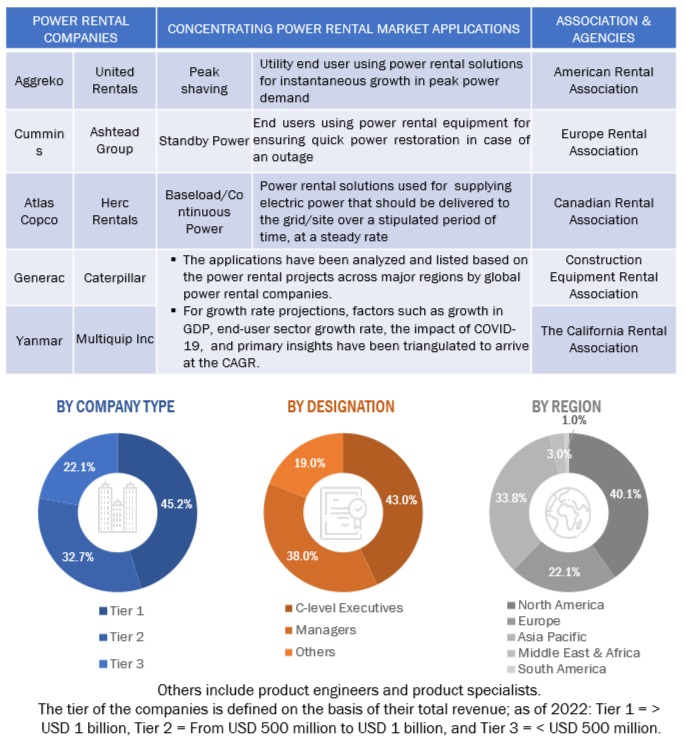
The power rental market comprises power rental providers, manufacturers of subcomponents of power plant, manufacturing technology providers, and technology support providers in the supply chain. The demand side of this market is characterized by the rising demand for clean energy and energy efficiency. The supply side industry experts such as vice presidents, CEOs, marketing directors, technology directors, and related key executives from various companies and organizations operating in the market. Various primary sources from both the supply and demand sides of the market were interviewed to obtain qualitative and quantitative information.
Following is the breakdown of primary respondents:
To know about the assumptions considered for the study, download the pdf brochure
Power Rental Market Size Estimation
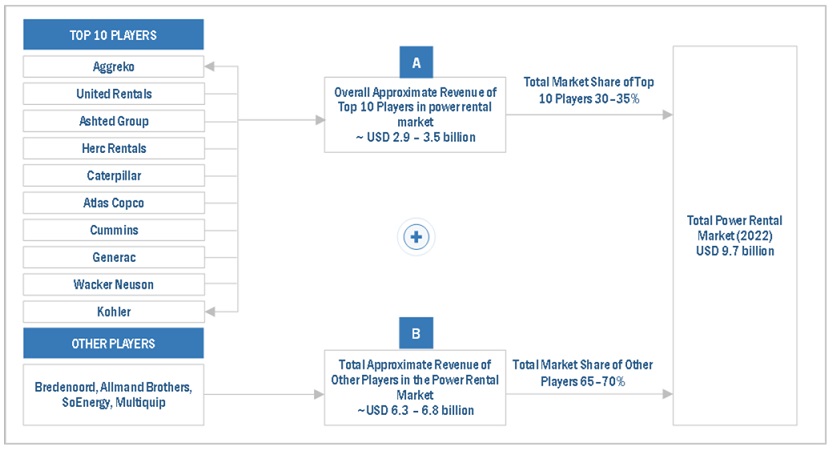
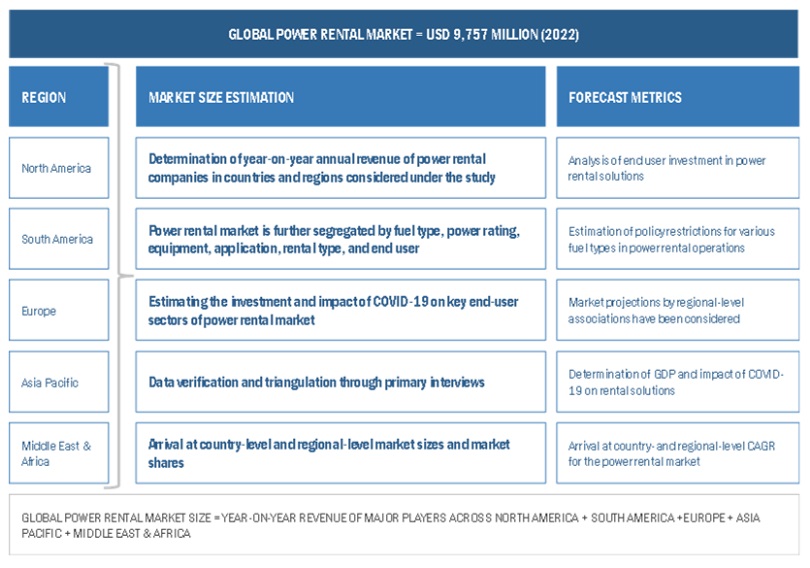
Both supply side and demand side analysis were used to estimate and validate the total size of the market. These methods were also used extensively to estimate the size of various subsegments in the market. The research methodology used to estimate the market size includes the following:
- Identification of major players in the market across countries. Key players in the power rental market include Aggreko, United Rentals, Ashtead Group, Herc Rentals, Caterpillar, Atlas Copco, and Cummins.
- Determining the revenues and business strategy specifics, such as the inorganic and organic growth strategy details, of major power rental equipment providers.
- The market share of individual power rental segments, namely, equipment, fuel type, application, power rating, rental type, and end user, are determined by consolidating and evaluating the product offerings of major companies.
- In addition, country-level demand for power rental equipment from end users, such as utilities, oil & gas, mining & metals, manufacturing, construction, and IT & data centers, and supportive policy developments across regions during the forecast period has been analyzed. The analysed data then verified through primaries to determine the country-wise and regional landscape.
Global Power Rental Market Size: Supply Side Analysis
To know about the assumptions considered for the study, Request for Free Sample Report
Global Power Rental Market Size: Demand side Analysis
Data Triangulation
After arriving at the overall market size from the estimation process explained above, the total market has been split into several segments and subsegments. The complete market engineering process is done to arrive at the exact statistics for all the segments and subsegments, also data triangulation and market breakdown processes have been employed, wherever applicable. The data has been triangulated by examining various factors and trends from both the demand- and supply sides. Along with this, the market has been validated through both the top-down and bottom-up approaches.
Market Definition
The power rental market is defined as the revenue generated either through providing equipment on rent such as load banks, generators, fuel tanks, cables, transformers, and power accessories or by renting temporary power plants. Power rental equipment majorly operates on diesel, gas, and other fuels such as gasoline, hybrid fuel, and heavy fuel oil (HFO). This equipment is used for peak shaving, standby power, and base load/continuous load applications by the utilities, oil & gas, events, construction, mining & metals, manufacturing, IT & data centers, corporate & retail, and other end users. Other industries include shipping, agriculture, aerospace and defense, wherein this equipment is majorly used for the generation of backup power.
Key Stakeholders
- Consulting companies in the energy and power sector
- Consulting companies in the oil & gas sector
- Generator raw materials and component manufacturers
- Engine/generator manufacturers, dealers, and suppliers
- Governments and research organizations
- Investment banks
- Petroleum companies (diesel and natural gas suppliers)
- Construction and infrastructure development companies
- Power grid infrastructure companies
- Power plant project developers
- Power rental companies
- Shareholders or investors
Objectives of the Study
- To forecast the market size for five key regions: North America, South America, Europe, Asia Pacific, and Middle East & Africa, along with their key countries.
- To define, describe, analyze, and forecast the size of the global power rental market based on fuel type, power rating, application, equipment, end user, rental type, and region.
- To provide detailed information about key factors such as drivers, restraints, opportunities, and challenges influencing the growth of the market.
- To strategically analyze the subsegments with respect to individual growth trends, prospects, and contributions of each segment to the overall market size
- To strategically analyze the market with respect to individual growth trends, future expansions, and contributions to the market.
- To analyze market opportunities for stakeholders in the market and draw a competitive landscape for market players.
- To analyze competitive developments such as sales contracts, agreements, investments, expansions, new product launches, mergers, partnerships, joint ventures, collaborations, and acquisitions in the market.
- To compare key market players with respect to the market share, product specifications, and applications.
Available Customizations:
With the given market data, MarketsandMarkets offers customizations as per the client’s specific needs. The following customization options are available for this report:
Geographic Analysis
- Further breakdown of region or country-specific analysis
Company Information
- Detailed analyses and profiling of additional market players (up to 5)
Key Questions Addressed by the Report
1. What is the current market size of the Power Rental Market and how is it expected to grow?
The global Power Rental Market is projected to grow from USD 11.44 billion in 2025 to USD 15.05 billion by 2030, at a CAGR of 5.6% during the forecast period.
2. What are the key factors driving the Power Rental Market?
The power rental market is driven by rising demand for temporary and backup power solutions, increasing infrastructure development, and growing construction, utilities, and oil & gas activities.
3. Which equipment segment holds the largest share of the Power Rental Market?
The generators segment dominates the market due to its extensive use in standby, peak shaving, and continuous power applications across multiple industries.
4. Which end-user segment is expected to dominate the Power Rental Market?
The utilities segment is expected to lead the market, driven by increasing demand for grid support, emergency backup power, and peak load management.
5. Which region is expected to witness the fastest growth in the Power Rental Market?
Asia Pacific is projected to register the highest growth during the forecast period, supported by rapid industrialization, infrastructure expansion, and increasing energy demand.
Fact checked
Personalize This Research
- Triangulate with your Own Data
- Get Data as per your Format and Definition
- Gain a Deeper Dive on a Specific Application, Geography, Customer or Competitor
- Any level of Personalization
Let Us Help You
- What are the Known and Unknown Adjacencies Impacting the Power Rental Market
- What will your New Revenue Sources be?
- Who will be your Top Customer; what will make them switch?
- Defend your Market Share or Win Competitors
- Get a Scorecard for Target Partners

Custom Market Research Services
We Will Customise The Research For You, In Case The Report Listed Above Does Not Meet With Your Requirements
Get 10% Free CustomisationTESTIMONIALS

Kimberly Murphy
GLOBAL MARKETING DIRECTOR
Bently Nevada,
Leading Condition Monitoring & Asset Protectionwww.bakerhughesds.com/bently-nevada

MarketsandMarkets™ showed consistent rigor for success and relentlessly worked with Bently Nevada stakeholders to positively impact go-to-market strategy. Their proactiveness and flexibility has been instrumental in achieving the objectives to grow our sales pipeline in key industrial markets.

DARRICK HUEBER
Business Development Leader
Nexus Controls LLC,
Leading Manufacturer of Automation System & Electrical Panelswww.bakerhughesds.com/nexus-controls

We partnered with MarketsandMarkets to expand our business further by tapping into new industrial segments. It was critical for us to gather crucial business insights about specific markets to achieve this goal. MarketsandMarkets engagement model and client services helped us provide those insights, it was really impressive and valuable for my business. The team was extremely flexible and helpful.

Mike Schoff
Global Industrial Commercial Strategy Leader
Nexus Controls LLC
Leading Manufacturer of Automation System & Electrical Panelswww.bakerhughesds.com/nexus-controls
We consulted MarketsandMarkets for potential Partner Identification. Overall, it was a good experience. The insights provided through interviews conducted by the team helped us put together the questionnaire required for discussion with the selected partners. Their ability to provide insights through interviews with customers in a timely manner was quite impressive.
- South Africa Power Rental Market
- South America Power Rental Market
- Germany Power Rental Market
- UK Power Rental Market
- Russia Power Rental Market
- France Power Rental Market
- Italy Power Rental Market
- Canada Power Rental Market
- Mexico Power Rental Market
- US Power Rental Market
- China Power Rental Market
- India Power Rental Market
- Australia Power Rental Market
- Japan Power Rental Market
- South Korea Power Rental Market
- Indonesia Power Rental Market
- Brazil Power Rental Market
- Argentina Power Rental Market
- Chile Power Rental Market
- UAE Power Rental Market
- Qatar Power Rental Market
- Nigeria Power Rental Market
- Rest Of Europe Power Rental Market
Growth opportunities and latent adjacency in Power Rental Market






Peter
May, 2026
Renewable fuels with an focus on ammonia as hydrogen carrier and the use of this. .
Maksud
May, 2026
BESS, Solar, Wind, Lightning, Cross Border Payments Platform, Infra Tech, Green Data Centre .