Workforce Management Market

Workforce Management Market by Solution Type (Core WFM, Workforce Optimization & Analytics, Workforce Intelligence & Strategy), by Business Functions (HR/People Function, Operation/Frontline Leaders, Finance & Payroll, IT/Security) - Forecast 2031




OVERVIEW
Source: Secondary Research, Interviews with Experts, MarketsandMarkets Analysis
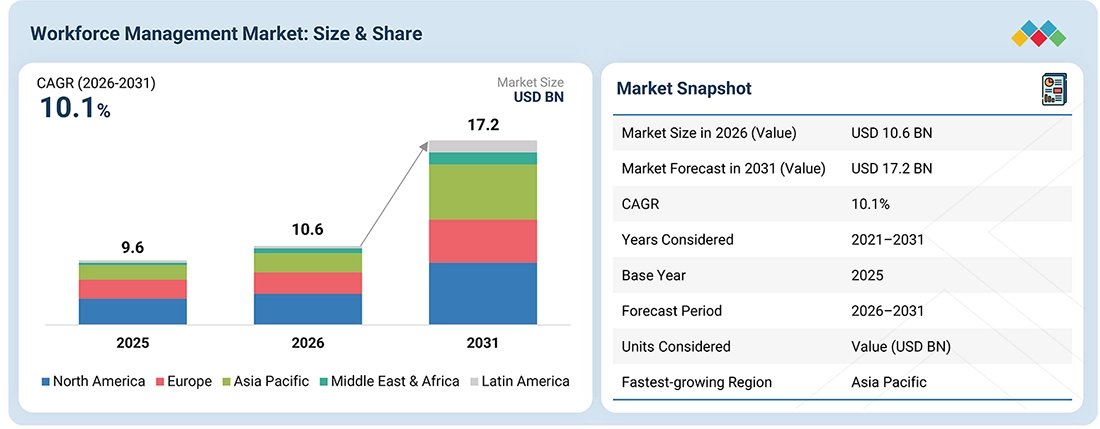
The global workforce management (WFM) market is projected to grow from USD 10.6 billion in 2026 to USD 17.2 billion by 2031, at a CAGR of 10.1%, driven by growing pressure on enterprises to improve workforce productivity, control labor costs, and comply with increasingly complex labor regulations. WFM platforms are evolving beyond traditional scheduling and time-and-attendance functions toward integrated workforce planning, demand forecasting, skills-based deployment, labor optimization, and AI-enabled decision support. Rising shortages of skilled workers are encouraging organizations to align workforce capacity more closely with operational demand, while the digitalization of frontline and deskless workforces is increasing demand for mobile self-service, real-time scheduling, and workforce visibility. Cloud-based deployment is further supporting adoption by reducing implementation complexity and enabling scalable access to advanced capabilities. At the same time, hybrid work, multi-shift operations, and geographically distributed workforces are increasing the need for flexible scheduling, accurate forecasting, compliance monitoring, and real-time labor optimization.
KEY TAKEAWAYS
-
BY REGIONNorth America is expected to hold the largest market value of USD 3.4 billion in 2025.
-
BY OFFERINGThe solutions segment is expected to hold the largest market share in 2025.
-
BY SOLUTION TYPEThe workforce optimization & analytics segment is expected to grow at the highest CAGR of 13.2%.
-
BY DELIVERY MODEThe on-premises deployment is expected to hold the largest market share in 2025.
-
BY BUSINESS FUNCTIONThe HR/people function is expected to hold the largest market value in 2025.
-
BY VERTICALThe BFSI segment is expected to hold largest market value in 2025.
-
COMPETITIVE LANDSCAPEThe workforce management market is highly competitive, with leaders like ADP, SAP, Workday, UKG, and Oracle positioned as top “stars” offering robust, enterprise-grade WFM and HR solutions.
-
COMPETITIVE LANDSCAPENICE, TimeClock Plus, and SumTotal are recognized as strong startups and SMEs for their agile, cost-efficient, and easy-to-deploy solutions. These vendors specialize in flexible scheduling, time and attendance, and compliance capabilities tailored for smaller and mid-sized businesses.
The workforce management market is expanding as organizations prioritize smarter labor planning to handle skill gaps, fluctuating demand, and growing operational complexity. Adoption is rising because modern WFM platforms offer real-time insights, automated scheduling, and improved compliance management. Cloud-based and AI-enabled solutions are accelerating this shift by making workforce optimization faster, more accurate, and easier to scale.
TRENDS & DISRUPTIONS IMPACTING CUSTOMERS' CUSTOMERS
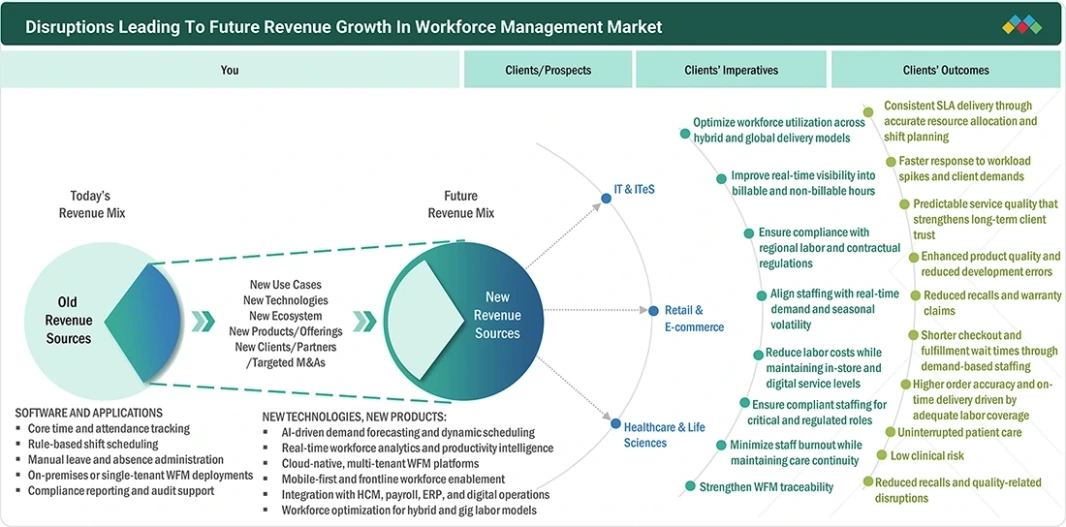
The workforce management market is being reshaped by rising adoption of AI-driven scheduling, predictive analytics, and automation, which are transforming how companies plan labor and manage day-to-day operations. Cloud-native WFM platforms are becoming the default choice, enabling faster deployment, seamless integrations, and broader scalability across multi-site operations. Real-time workforce visibility, enriched by IoT and mobile apps, is improving on-floor decision-making in manufacturing and logistics. At the same time, disruptions such as widening skill shortages, stricter labor regulations, and increasing union scrutiny are pushing businesses to rely on more precise, compliant workforce planning. Hybrid work patterns and flexible shift models are also redefining how organizations balance productivity, employee preferences, and labor cost efficiency.
Source: Secondary Research, Interviews with Experts, MarketsandMarkets Analysis
MARKET DYNAMICS

Level
-
Growing Convergence of Workforce Management with Workforce Planning and Labor Optimization

-
Increasing Digitalization of Frontline and Deskless Workforce Operations


Level
-
Data Privacy Concerns Around Biometric, Location, and Employee Monitoring Capabilities

-
Complex Integration with Legacy Payroll, HCM, ERP, and Workforce Systems


Level
-
Expansion of AI and Agentic AI-enabled Workforce Management Capabilities

-
Growing Adoption of Cloud-based WFM among SMEs


Level
-
Maintaining Workforce Forecast Accuracy

-
Balancing Optimization with Schedule Flexibility

Source: Secondary Research, Interviews with Experts, MarketsandMarkets Analysis
Driver: Growing Convergence of Workforce Management with Workforce Planning and Labor Optimization
Organizations are increasingly extending workforce management beyond time and attendance, scheduling, and absence tracking toward workforce planning, labor forecasting, capacity management, and cost optimization. Rising labor costs and persistent shortages of skilled workers are pushing employers to align staffing levels more closely with expected workload, employee availability, skills, and budget constraints. For instance, the US Bureau of Labor Statistics reported that compensation costs for civilian workers increased 3.4% during the 12 months ended June 2026, while private-industry compensation costs rose 3.3%. This cost pressure is increasing the importance of tools that help organizations understand not only how many employees are available, but also where labor demand is likely to emerge and how to deploy workforce capacity. This convergence is expected to expand WFM platforms from operational recordkeeping to workforce decision support. Vendors are increasingly combining demand forecasting, labor-cost modeling, scenario planning, skills-based scheduling, capacity planning, and optimization within broader WFM suites. Such capabilities help enterprises reduce overstaffing and understaffing, control overtime, improve workforce utilization, and align labor deployment with business demand. As a result, integrated workforce planning and labor optimization capabilities are expected to strengthen platform adoption and support overall growth of the workforce management market.
Restraint: Data Privacy Concerns Around Biometric, Location, and Employee Monitoring Capabilities
Workforce management platforms increasingly use biometric time clocks, GPS-based attendance, location tracking, mobile applications, and employee activity data to improve workforce visibility and automate attendance verification. However, these capabilities also increase the amount of sensitive employee information collected and processed, raising concerns around consent, data retention, access controls, surveillance, and regulatory compliance. For instance, the UK Information Commissioner's Office recorded 12,412 personal data breach cases in 2024–25, up from 11,680 the previous year. Growing regulatory scrutiny around personal, biometric, and location data is therefore making employers more cautious when implementing advanced monitoring capabilities. These concerns are expected to lengthen evaluation and deployment cycles, particularly for enterprises operating across multiple jurisdictions with different privacy requirements. Organizations may limit biometric authentication, disable continuous location tracking, or delay implementing advanced monitoring features until they establish appropriate consent, retention, security, and governance controls. As a result, WFM vendors must invest in configurable privacy controls, encryption, role-based access, audit trails, data minimization, and regional compliance settings. The additional compliance burden may increase implementation complexity and reduce adoption of advanced workforce-monitoring modules, restraining the overall growth of the workforce management market.
Opportunity: Expansion of AI and Agentic AI-enabled Workforce Management Capabilities
AI is becoming an increasingly important capability in workforce management as enterprises seek faster, more automated decisions across scheduling, staffing, payroll, compliance, and workforce planning. Traditional rule-based automation is increasingly being supplemented by AI models that can evaluate workforce demand, employee availability, skills, labor costs, and policy requirements simultaneously. For instance, the World Economic Forum’s Future of Jobs Report 2025 found that 86% of employers expect AI and information-processing technologies to transform their businesses by 2030. This broader enterprise adoption of AI is creating favorable conditions for AI-enabled workforce management capabilities across both frontline and knowledge-worker environments. The opportunity is expected to extend beyond AI-assisted recommendations toward agentic capabilities that execute defined workforce tasks with limited manual intervention. WFM vendors are expanding into intelligent schedule generation, predictive staffing, payroll anomaly detection, automated shift matching, compliance checks, overtime optimization, workforce queries, and manager copilots. These capabilities are expected to speed decisions, reduce administrative workloads, and improve workforce planning accuracy. They also create opportunities for vendors to introduce premium AI modules, expand cross-selling within existing customers, and differentiate their platforms through automation and orchestration capabilities, supporting additional revenue opportunities in the workforce management market.
Challenge: Maintaining Workforce Forecast Accuracy
Accurate workforce forecasting remains difficult because staffing requirements shift with customer demand, workload volumes, absenteeism, seasonality, employee availability, skill requirements, and last-minute operational disruptions. Hybrid work and multi-shift environments add further complexity by increasing the variables workforce planning models must consider. For instance, the UK Office for National Statistics reported that approximately 148.8 million working days were lost because of sickness or injury in 2025, equivalent to around 4.4 days per worker. Unexpected absence at this scale illustrates why workforce demand and actual labor availability may differ materially from planned staffing levels. WFM platforms must therefore continuously reconcile forecast demand with actual workforce availability and operational conditions. Inaccurate forecasts may result in understaffing, excessive overtime, idle labor capacity, service delays, or higher labor costs. Vendors need to improve real-time data integration, exception management, schedule adjustments, forecasting models, and operational analytics so staffing plans remain relevant as conditions change. Maintaining forecast accuracy is particularly challenging in industries with volatile demand and large frontline workforces, making continuous model refinement and data quality management essential for advanced WFM platforms.
WORKFORCE MANAGEMENT MARKET: COMMERCIAL USE CASES ACROSS INDUSTRIES
| COMPANY | USE CASE DESCRIPTION | BENEFITS |
|---|---|---|
 |
MileOne Autogroup modernized its outdated workforce management practices by adopting Workday’s unified scheduling, time tracking, and absence management solutions. The new system gave frontline employees greater control over their schedules while enabling managers to plan labor needs more accurately using real-time data. This shift improved operational efficiency, reduced guesswork, and strengthened employee engagement across all dealerships. | MileOne consolidated five payroll systems into one, eliminated 100% of paper-based scheduling, and reduced manual HR administration time by 75%. Off-cycle payroll checks dropped by 70%, employee retention improved, and the company saved around $100K annually by digitizing records and reducing storage costs. The unified system boosted productivity, streamlined operations, and elevated overall workforce satisfaction. |
 |
Omega Healthcare Management Services (Omega Healthcare), which had grown rapidly through acquisitions, was struggling with fragmented, legacy IT systems across HR, finance, procurement, and operations. To standardize processes, improve scalability, and data visibility, the company implemented Oracle Fusion Cloud Applications (ERP, EPM, and HCM), consolidating all acquired entities onto a unified platform. | As a result, Omega Healthcare slashed its quarterly financial close from 25 days to 2 days and significantly improved capacity planning, project management, and expense management. It also centralized HR/payroll and workforce management, enhanced data governance and compliance, and enabled faster, insight-driven decision-making across its global operations. |
 |
SunOpta, a US and Canada-based manufacturer of beverages, broths, and snacks, transitioned from multiple disconnected HR and time-keeping systems to a unified Dayforce platform in 2019. By consolidating payroll, HR, time and attendance, recruiting, onboarding, and analytics into a single system of record, the company streamlined its workforce operations and reduced process complexity across all locations. | The shift to Dayforce enabled SunOpta to reduce HR headcount by more than 50% and cut payroll recalculation time by roughly 90%. Automated time and payroll processes improved compliance, increased accuracy, reduced manual effort, and, through Dayforce Wallet, enabled faster wage access—strengthening the overall employee experience and retention. |
 |
Plains Commerce Bank, with over 400 employees across more than 25 states, was struggling with manual, paper-heavy HR and onboarding processes, disparate systems, and limited employee self-service. By implementing Paycor as a unified HR platform, the bank automated onboarding, payroll, benefits, time tracking, and employee lifecycle management. Paycor+1 | Plains Commerce Bank saved over 330 administrative hours annually by automating onboarding and eliminated thousands of hours of manual work through automated workflows and notifications. They also realized cost savings; for example, handling 600+ background checks via integrated tools saved about USD 20,000 while boosting employee engagement, self-service, and overall HR efficiency. |
 |
Pilot Flying J, a large fuel and retail-service network operating more than 950 travel-center locations across North America, replaced its fragmented legacy HR/time and attendance systems with Infor Workforce Management (WFM). The organization moved from multiple disparate systems and manual processes to a unified, mobile-enabled solution that works across all sites. | With Infor WFM in place, Pilot Flying J replaced disparate workforce systems with a single integrated platform, digitizing time tracking, scheduling, PTO requests, and payroll data collection. This reduced weekly payroll data collection and verification time by about five hours, improved scheduling accuracy and attendance tracking, and let staff and managers spend less time on admin and more on customer service, ultimately improving operational efficiency and the guest experience. |
Logos and trademarks shown above are the property of their respective owners. Their use here is for informational and illustrative purposes only.
MARKET ECOSYSTEM
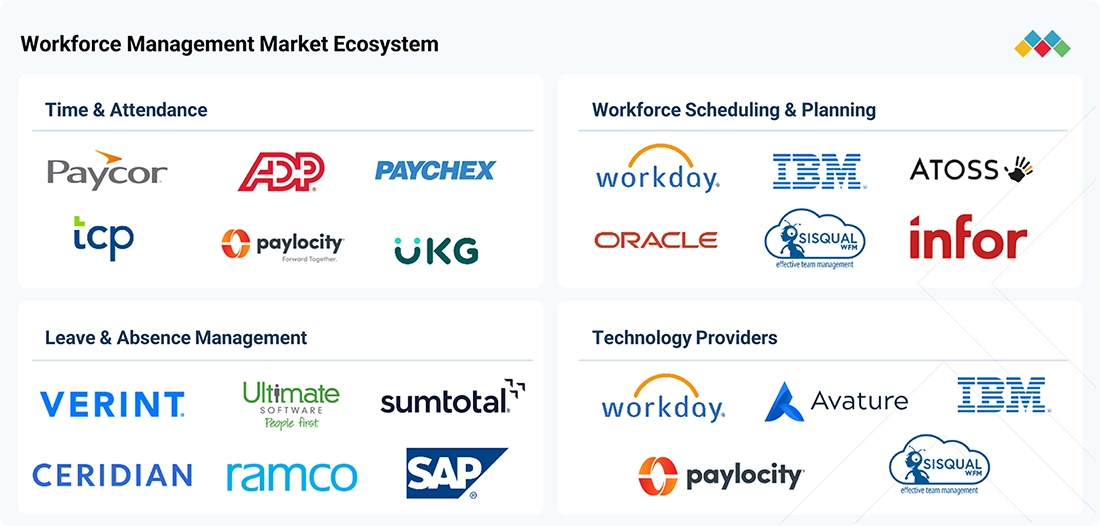
The workforce management ecosystem includes software vendors, service providers, system integrators, and cloud platform partners working together to deliver end-to-end workforce optimization. Core WFM solution providers offer modules for time tracking, scheduling, payroll, and analytics, while implementation partners ensure smooth deployment and integration with HRIS, ERP, and payroll systems. Cloud providers support scalable, secure infrastructure required for large-scale workforce operations. Technology partners specializing in AI, IoT, and analytics enhance system capabilities with forecasting, automation, and real-time insights. End users, including enterprises across manufacturing, retail, healthcare, and BFSI, drive demand in the ecosystem, supported by compliance bodies and regulatory authorities that shape legal requirements. Together, these stakeholders create a connected environment that enables efficient, compliant workforce operations.
Logos and trademarks shown above are the property of their respective owners. Their use here is for informational and illustrative purposes only.
MARKET SEGMENTS
Source: Secondary Research, Interviews with Experts, MarketsandMarkets Analysis
Workforce Management Market, By Offering
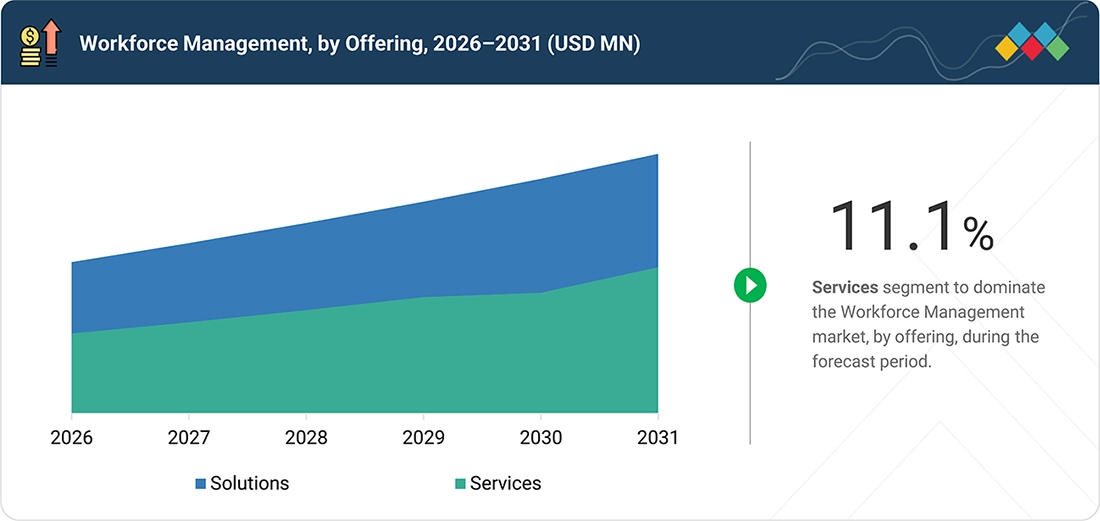
The solutions segment leads the workforce management market because organizations increasingly rely on advanced tools for scheduling, timekeeping, absence management, and labor analytics to optimize workforce efficiency. Growing adoption of AI-driven forecasting, automated shift planning, and cloud-based WFM suites strengthens demand for integrated solutions over standalone tools. Enterprises prefer unified platforms that enhance productivity, ensure compliance, and reduce labor costs. Additionally, rising digital transformation across manufacturing, retail, and healthcare accelerates investments in comprehensive WFM solutions, solidifying their dominant market share.
Workforce Management Market, By Solution Type
The workforce optimization & analytics segment is expected to grow at the highest CAGR as organizations increasingly use data to improve staffing, productivity, and labor planning. These solutions help identify workforce gaps, reduce overtime, and support better shift decisions. Rising demand for real-time insights into employee performance and workload is driving adoption. Enterprises are also using analytics to improve compliance and control labor costs. Growing use of AI-based forecasting further supports demand for workforce optimization tools.
Workforce Management Market, By Delivery Mode
Cloud deployment is expected to grow at the highest CAGR in the workforce management market as organizations increasingly prioritize scalable, low-maintenance, and cost-efficient solutions. Cloud-based WFM platforms enable real-time data access, faster updates, and seamless integration with HR, payroll, and ERP systems. Their flexibility supports remote and hybrid work models, driving rapid adoption across industries. Additionally, reduced upfront investment and subscription-based pricing make cloud deployment especially attractive for SMEs, further accelerating its growth.
Workforce Management Market, By Business Function
Operations/Frontline Level is expected to register the highest CAGR over the forecast period. Growth is being driven by rising adoption of WFM solutions across shift-based and labor-intensive environments such as manufacturing, retail, healthcare, logistics, hospitality, and field services. Organizations are increasingly using workforce management platforms for real-time scheduling, attendance tracking, shift optimization, overtime control, mobile workforce access, and demand-based staffing. The growing digitalization of frontline workforces, combined with labor shortages and the need to improve productivity, is expected to accelerate adoption of AI-enabled scheduling, self-service applications, and real-time workforce visibility, supporting the segment’s strong growth.
Workforce Management Market, By Vertical
The manufacturing segment is expected to hold the largest market share in the workforce management market due to its highly complex, multi-shift operations and strict compliance requirements. Manufacturers rely heavily on WFM tools to manage large hourly workforces, optimize shift planning, and maintain productivity across distributed plants. Rising automation, skill shortages, and stringent safety regulations further increase the need for accurate time tracking, labor forecasting, and workforce allocation. Additionally, growing adoption of digital manufacturing and Industry 4.0 accelerates the integration of advanced WFM systems to enhance operational efficiency and labor utilization.
REGION
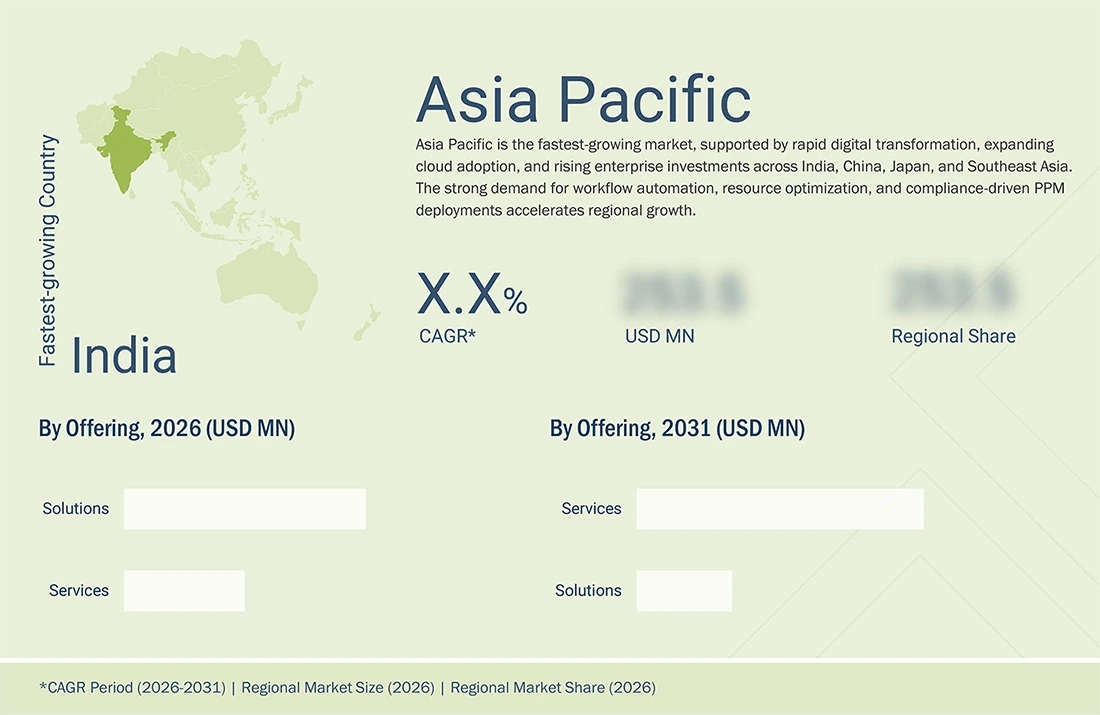
Asia Pacific is the fastest-growing workforce management market
The Asia Pacific is outgrowing other workforce management regions, with India and China emerging as the key growth engines. India’s expansion is supported by its large IT and services workforce, rapid enterprise digitalization, and a growing emphasis on formalizing labor compliance across a historically fragmented employment landscape. China is also seeing strong momentum as manufacturers modernize workforce operations, adopt Industry 4.0 practices, and increase investment in digital workforce technologies. Rising cross-border workforce mobility, growing HR-tech investment, and demand for real-time scheduling, attendance, and workforce visibility are further accelerating adoption. As a result, Asia Pacific is becoming a strategic expansion priority for global WFM vendors.
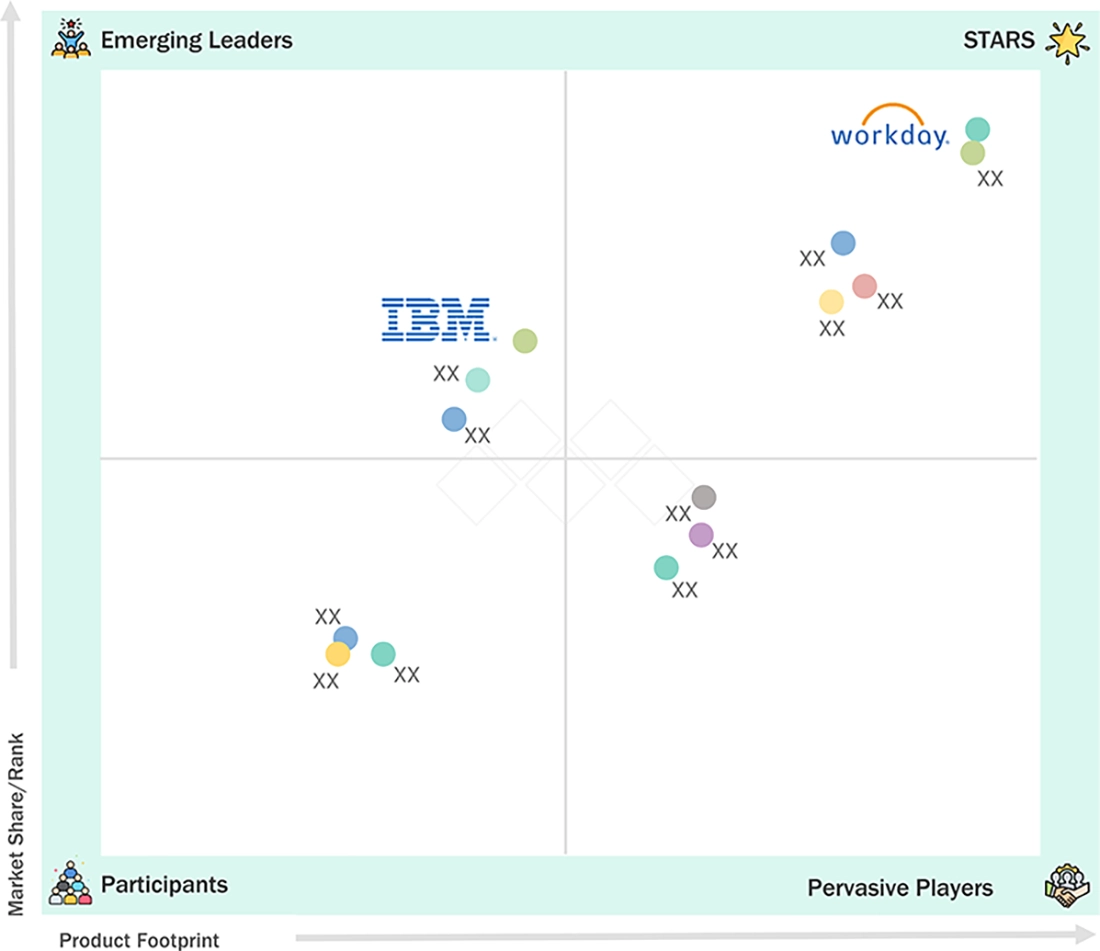
WORKFORCE MANAGEMENT MARKET: COMPANY EVALUATION MATRIX
In the workforce management market, Workday is rated a Star for its strong global presence, comprehensive WFM suite, and ongoing innovation in payroll, time tracking, and workforce analytics. Its integrated cloud platform and large enterprise customer base position it as a top-tier vendor with strong market influence. IBM, meanwhile, is viewed as an Emerging Leader, gaining momentum through its advanced workforce scheduling, time management, and compliance-focused solutions, particularly in Europe. Its specialization in complex labor environments and growing adoption across retail, manufacturing, and logistics strengthen its upward trajectory.
Source: Secondary Research, Interviews with Experts, MarketsandMarkets Analysis
KEY MARKET PLAYERS
- ADP (US)
- SAP (Germany)
- Workday (US)
- Ceridian (US)
- Oracle (US)
- Paycor (US)
- Paychecx (US)
- Infor (US)
- BambooHR (US)
- Atoss Software (Germany)
- Nice (Israel)
- IBM (US)
- Ramco Systems (India
- Timeclock Plus (US)
- Sumtotal (US)
- Avature (UK)
- Sisqual Workforce Management (Portugal)
- ActiveOps (UK)
- Ultimate Software (US)
- Verint (US)
- Mark Information (US)
- Reflexis System (US)
- Authority Software (US)
- Paylocity (US)
MARKET SCOPE
| REPORT METRIC | DETAILS |
|---|---|
| Market Size in 2025 (Base Value) | USD 9.6 Billion |
| Market Forecast in 2026 (Value) | USD 10.6 Billion |
| Market Forecast in 2031 (value) | USD 17.2 Billion |
| Growth Rate | CAGR of 10.1% from 2026-2031 |
| Years Considered | 2021-2031 |
| Base Year | 2025 |
| Forecast Period | 2026-2031 |
| Report Coverage | Revenue forecast, company ranking, competitive landscape, vendor positioning, segment-wise analysis, regional trends, technological developments, key commercial use cases, and growth factors |
| Segments Covered |
|
| Regional Scope | North America, Asia Pacific, Europe, the Middle East & Africa, and Latin America |
WHAT IS IN IT FOR YOU: WORKFORCE MANAGEMENT MARKET REPORT CONTENT GUIDE
DELIVERED CUSTOMIZATIONS
We have successfully delivered the following deep-dive customizations:
| CLIENT REQUEST | CUSTOMIZATION DELIVERED | VALUE ADDS |
|---|---|---|
| Leading Solution Provider (US) | In-depth segmentation of the North America workforce management market Extended regional breakdowns for Europe, Asia Pacific, Middle East & Africa, and Latin America | Identifies high-growth opportunities across digital transformation, cloud adoption, and enterprise modernization Enables tailored integration strategies aligning applications, infrastructure, and data systems Supports optimized technology investments and resource alignment to enhance interoperability, scalability, and operational efficiency across connected business environments |
| Leading Solution Provider (EU) | Detailed profiling of additional market players (up to 5 vendors), including product portfolios, strategic initiatives, and regional presence | Enhances competitive intelligence for strategic planning and go-to-market execution Reveals market gaps and white spaces for differentiation and innovation Supports targeted growth initiatives by aligning product development and sales strategies with unmet customer needs and emerging demand clusters |
RECENT DEVELOPMENTS
- September 2025 : ADP unveiled a suite of AI-powered features under its ADP Assist platform at Innovation Day, integrated into Workforce Now, ADP Global Payroll, and ADP Lyric HCM. These enhancements are designed to reduce manual HR workload by automatically detecting payroll anomalies, delivering instant HR analytics, monitoring global compliance, and providing AI-driven employee development recommendations. By embedding generative AI into core HR, payroll, and workforce workflows, ADP aims to help organizations operate faster, more accurately, and strategically, minimizing administrative burdens while improving compliance, insights, and overall workforce productivity.
- September 2025 : Oracle introduced new AI agents within Oracle Fusion Cloud Applications to streamline HR workflows from hire to retire. These agents automate tasks across recruitment, career development, performance management, payroll, and employee lifecycle processes, enabling HR leaders, managers, and employees to make data-driven decisions, improve workforce productivity, and enhance employee experience. Embedded natively within Oracle Cloud, the AI agents offer real-time guidance, personalized career insights, and operational efficiency across all HR functions.
- October 2024 : SAP SuccessFactors introduced AI-enhanced capabilities across its HCM suite to improve workforce management, upskilling, and organizational agility. The updates feature a talent intelligence hub for centralizing skills data, AI-assisted onboarding, 360-degree reviews, generative text support, and predictive role matching, streamlining HR processes and enhancing employee experience. These innovations reinforce SAP’s focus on intelligent, data-driven workforce management and talent development.
Table of Contents
 Exclusive indicates content/data unique to MarketsandMarkets and not available with any competitors.
Methodology
This research study on the workforce management market involved extensive secondary sources, directories, IEEE Communication-Efficient: Algorithms and Systems, International Journal of Innovation and Technology Management, and paid databases. Primary sources included industry experts from core and related industries, third-party service providers, consulting service providers, end users, and other commercial enterprises. In-depth interviews with primary respondents, including key industry participants and subject matter experts, were conducted to obtain and verify critical qualitative and quantitative information and assess the market’s prospects.
Secondary Research
In the secondary research process, various sources were referred to identify and collect information for this study. Secondary sources included annual reports, press releases, and investor presentations of companies; white papers, journals, and certified publications; and articles from recognized authors, directories, and databases. The data was also collected from other secondary sources, such as journals, government websites, blogs, and vendors’ websites.
Primary Research
During the primary research process, various sources from both the supply and demand sides were interviewed to gather qualitative and quantitative information on the market. Primary sources on the supply side included industry experts such as chief experience officers (CXOs), vice presidents (VPs), and directors specializing in business development, marketing, and workforce management providers. It also included key executives from system integrators (SIs), professional service providers, industry associations, and other key opinion leaders.
Breakup of Primary Profiles
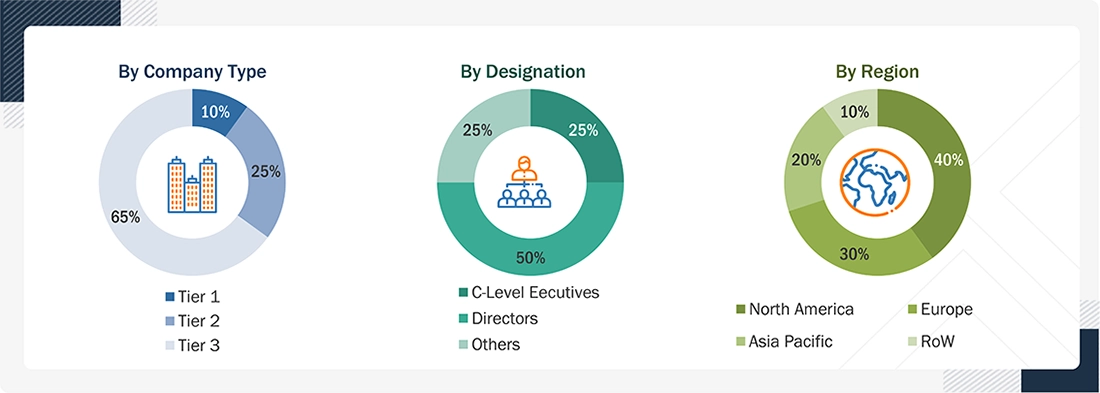
Note: Tier 1 companies’ revenues are more than USD 10 billion; tier 2 companies’ revenues range between USD 1 and 10 billion; and tier 3 companies’ revenues range between USD 500 million and USD 1 billion. Other designations include sales managers, marketing managers, and product managers.
Source: Industry Experts
To know about the assumptions considered for the study, download the pdf brochure
Market Size Estimation
Multiple approaches were adopted to estimate and forecast the workforce management market. The first approach involved estimating the market size by the companies’ revenue generated through the sales of the workforce management market.
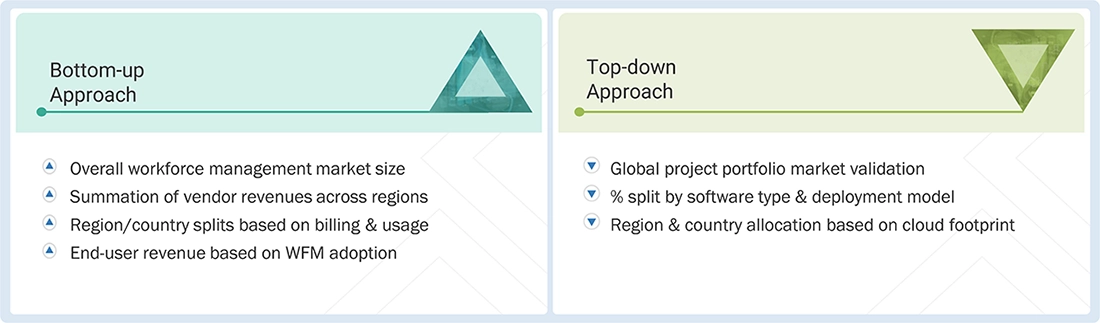
Market Size Estimation Methodology: Top-down Approach
The top-down approach estimates the overall workforce management market size by starting with a macro-level view, such as total IT spending or digital transformation expenditures. High-level industry or market values are divided and allocated into segments based on identified proportions by solution type, deployment model, organization size, or geography using researched splits. This approach uses broad market trends, industry reports, and expert insights to proportionately distribute the total value among various sub-markets, regions, and countries. It ensures the overall estimate aligns with recognized industry benchmarks, enabling accurate segmentation and a holistic market perspective.
Market Size Estimation Methodology: Bottom-up Approach
The bottom-up approach for estimating the workforce management market size involves aggregating data at the most granular level, such as company revenues, to build up to the global figure. This process begins by collecting company-wise revenue data directly related to workforce management solutions and services. By analyzing the market share and revenue of key players and integrating percentage splits for different segments, such as by service line or industry, the total market size is calculated. Additional segmentation is performed by region or vertical to ensure comprehensive coverage. The method then validates market estimates by comparing and consolidating segment results, providing a robust, detailed market size assessment based on concrete, ground-level business activity.
Workforce Management Market : Top-Down and Bottom-Up Approach
Data Triangulation
After determining the overall market size using the market size estimation processes as explained above, the market was split into several segments and subsegments. Data triangulation and market breakup procedures were used, where applicable, to complete the overall market engineering process and determine the exact statistics for each market segment and subsegment. The overall market size was then used in the top-down approach to estimate the size of other individual markets by applying percentage splits to the market segmentation.
Market Definition
Based on the views of various associations and sources, MarketsandMarkets defines workforce management (WFM) as the integrated set of processes and tools organizations use to optimize employee productivity, scheduling, and utilization. It includes time and attendance tracking, labor forecasting, shift planning, leave and absence management, and compliance with labor regulations. By aligning staffing with operational demand, WFM helps organizations reduce costs, improve efficiency, and enhance employee experience.
Key Stakeholders
- HR leaders
- HR operations teams
- Line managers
- Supervisors
- Employees
- Payroll teams
- Finance teams
- IT teams
- System administrators
- Compliance teams
Report Objectives
- To define, describe, and forecast the workforce management market based on offering, solution type, delivery mode, organization size, business function, and vertical
- To forecast the market size of five major regional segments: North America, Europe, Asia Pacific, the Middle East & Africa, and Latin America
- To strategically analyze the market subsegments concerning individual growth trends, prospects, and contributions to the total market
- To provide detailed information related to the major factors influencing the growth of the market (drivers, restraints, opportunities, and challenges)
- To strategically analyze macro and micro markets with respect to growth trends, prospects, and their contributions to the overall market
- To analyze industry trends, patents and innovations, and pricing data related to the market
- To analyze the opportunities in the market for stakeholders and provide details of the competitive landscape for major players
- To analyze the impact of AI/generative AI on the market
- To profile key players in the market and comprehensively analyze their market share/ranking and core competencies
- To track and analyze competitive developments such as mergers & acquisitions, product launches, and partnerships & collaborations in the market
Available customizations:
With the given market data, MarketsandMarkets offers customizations as per the company’s specific needs. The following customization options are available for the report:
Product Analysis
- The product matrix provides a detailed comparison of the product portfolio of each company.
Geographic Analysis Based on Feasibility
- Further breakup of the North American workforce management market
- Further breakup of the European workforce management market
- Further breakup of the Asia Pacific workforce management market
- Further breakup of the Middle East & Africa workforce management market
- Further breakup of the Latin American workforce management market
Company Information
-
Detailed analysis and profiling of additional market players (up to five)
Key Questions Addressed by the Report
What is driving the growth of the Workforce Management Market?
The Workforce Management Market is driven by increasing adoption of cloud-based workforce solutions, the rise of hybrid and remote work models, growing demand for workforce optimization, and the need to improve employee productivity while ensuring compliance with labor regulations.
Why are organizations investing in workforce management solutions?
Organizations invest in workforce management solutions to optimize labor scheduling, improve workforce productivity, reduce operational costs, enhance employee engagement, automate time and attendance tracking, and support data-driven workforce planning.
Which technologies are shaping the Workforce Management Market?
Key technologies include artificial intelligence (AI), machine learning (ML), cloud computing, workforce analytics, robotic process automation (RPA), mobile workforce applications, predictive scheduling, and self-service employee portals.
What are the latest trends in the Workforce Management Market?
Major trends include AI-powered workforce planning, predictive labor analytics, cloud-native workforce management platforms, mobile-first employee experiences, automation of scheduling and payroll processes, and integration with human capital management (HCM) systems.
What is the outlook for the Workforce Management Market?
The market outlook remains positive as organizations continue investing in digital workforce transformation, employee experience initiatives, workforce analytics, and automation technologies to improve operational efficiency and business agility.
Which regions offer significant growth opportunities in the Workforce Management Market?
North America remains a leading market due to widespread enterprise adoption of workforce technologies and digital transformation initiatives. Asia Pacific is expected to experience strong growth driven by expanding enterprise digitization, increasing cloud adoption, and growing demand for workforce optimization solutions.
What should buyers evaluate before selecting a workforce management solution?
Buyers should assess scalability, cloud deployment options, AI and analytics capabilities, integration with existing HR and payroll systems, mobile accessibility, regulatory compliance, reporting features, ease of implementation, and vendor support.
How does workforce management improve business performance?
Workforce management solutions help organizations optimize labor utilization, automate workforce processes, improve scheduling accuracy, reduce overtime costs, enhance employee productivity, strengthen compliance, and enable better workforce planning through real-time analytics.
What challenges are influencing the Workforce Management Market?
Key challenges include integration with legacy systems, managing hybrid workforces, changing labor regulations, data privacy requirements, employee adoption, and the need for continuous workforce reskilling in rapidly evolving business environments.
Why is the Workforce Management Market attracting long-term investment?
The Workforce Management Market continues to attract long-term investment because organizations increasingly prioritize workforce optimization, digital transformation, AI-driven decision-making, and employee experience improvements to remain competitive in evolving business environments.


Personalize This Research
- Triangulate with your Own Data
- Get Data as per your Format and Definition
- Gain a Deeper Dive on a Specific Application, Geography, Customer or Competitor
- Any level of Personalization
Let Us Help You
- What are the Known and Unknown Adjacencies Impacting the Workforce Management Market
- What will your New Revenue Sources be?
- Who will be your Top Customer; what will make them switch?
- Defend your Market Share or Win Competitors
- Get a Scorecard for Target Partners

Custom Market Research Services
We Will Customise The Research For You, In Case The Report Listed Above Does Not Meet With Your Requirements
Get 10% Free CustomisationTESTIMONIALS
- US Workforce Management Market
- Canada Workforce Management Market
- UK Workforce Management Market
- Germany Workforce Management Market
- France Workforce Management Market
- Italy Workforce Management Market
- China Workforce Management Market
- India Workforce Management Market
- Japan Workforce Management Market
- Saudi Arabia Workforce Management Market
- UAE Workforce Management Market
- South Africa Workforce Management Market
- Brazil Workforce Management Market
- Mexico Workforce Management Market
- Rest Of Europe Workforce Management Market






Growth opportunities and latent adjacency in Workforce Management Market