



Microscopy Market
Report Code
AST 3800
Published in
Feb, 2026, By MarketsandMarkets™
Microscopy Market by Product (Optical Microscope: Stereo, Digital; Electron Microscope: SEM, TEM; AFM, STM), Application (Pharma Mfg., Pathology, Drug Discovery, Toxicology), End User (Pharma-Biopharma, F&B, Academia, Semiconductor) - Global Forecasts to 2031

$8.81B
MARKET SIZE, 2025
$11.44B
MARKET SIZE, 2031

5.5%
CAGR (2025-2031)

2025-2031
FORECAST PERIOD
OVERVIEW
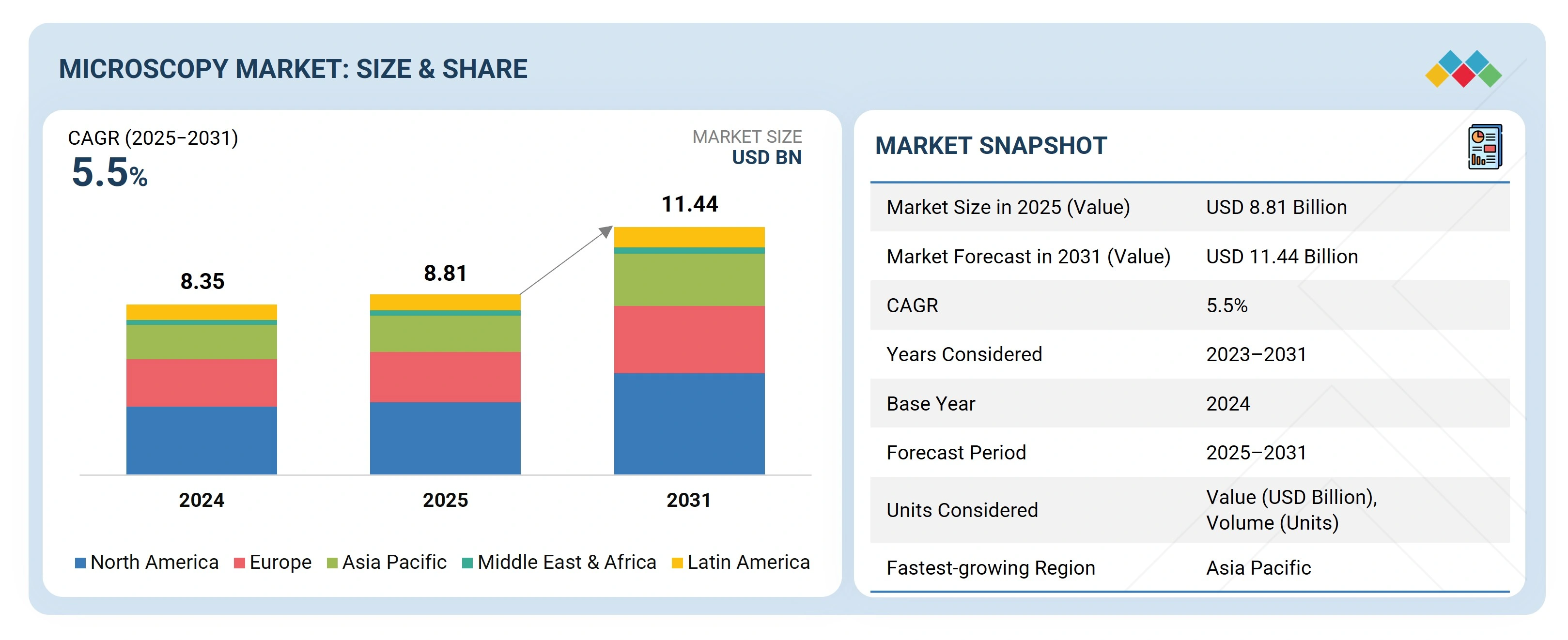
Source: Secondary Research, Interviews with Experts, MarketsandMarkets Analysis
The global microscopy market, valued at USD 8.35 billion in 2024, stood at USD 8.81 billion in 2025 and is projected to advance at a resilient CAGR of 5.5% from 2025 to 2031, culminating in a forecasted valuation of USD 11.44 billion by the end of the period. The global microscopy market plays a very important and enabling part in the life sciences and research community, and its applications beyond biologic imaging are growing very rapidly in semiconductor device manufacturing. In addition to biologic imaging, microscopes today find important and widespread uses in semiconductor device wafer inspection, semiconductor device failure analysis, nanomanufacturing, and surface metrology. As semiconductor device technology continues to scale down into smaller nodes and integrates more diverse and complex technologies, the use of microscopes has shifted from being an important but supplemental analytical capability to being a highly critical and directly enabling one. Both the biologic and semiconductor device markets have widened the scope of the microscopy market.
KEY TAKEAWAYS
-
MARKET SNAPSHOT:
Base Year Market Size (2024): USD 8.35 Billion
Current Market Size (2025): USD 8.81 Billion
Forecast Market Size (2031): USD 11.44 Billion
CAGR (2025–2031): 5.5% -
SEGMENT LEADERSHIP:
Regional Outlook: Asia Pacific is expected to register the highest CAGR during the forecast period.
Product Leader: Optical microscopes dominated the global microscopy market and accounted for 37% in 2025.
End User Leader: Semiconductors & electronics industry held the largest share of the market at 31% in 2025.
Application Leader: Semiconductors & electronics applications accounted for 38% of the market share in 2025. -
MARKET OUTLOOK & COMPETITIVE LANDSCAPE:
Carl Zeiss AG (Germany), Thermo Fisher Scientific Inc. (US), and Danaher Corporation (US) maintain a strong position in the microscopy market due to their comprehensive product portfolios, large installed bases, and well-established application and service networks. Their sustained investments in advanced imaging technologies, combined with deep engagement with academic institutions, healthcare providers, and industrial customers, continue to reinforce their leadership across the market.
Companies such as Euromex (Netherlands), Etaluma, Inc. (US), ACCU-SCOPE (US), and Helmut Hund GmbH (Germany) are gaining traction in the microscopy market by offering cost-effective and application-specific solutions. These companies primarily address demand for optical, fluorescence, and digital microscopy systems, targeting education, routine clinical use, and budget-conscious research laboratories.
A defining trend in the microscopy market is the convergence of research-grade imaging with industrial-scale inspection requirements. Semiconductor and electronics manufacturers are increasingly demanding microscopes that offer nanometer-level resolution, faster scan speeds, and seamless integration with manufacturing execution and yield management systems. Optical microscopy is being augmented with advanced contrast techniques and AI-based defect recognition, while electron microscopy is increasingly deployed closer to the production line rather than confined to R&D labs. Across both industrial and life science domains, there is a strong shift toward data-centric microscopy, where image acquisition, analytics, and decision-making are tightly coupled.
TRENDS & DISRUPTIONS IMPACTING CUSTOMERS' CUSTOMERS
Concerning the industrial market, especially the fabrication facilities and advanced manufacturing facilities, the main impact of microscopy-related disruptions is the result of increasing defect sensitivity levels and tightening process margins. The more traditional offline inspection approaches are being overtaken in the industry by the need for higher-speed, more automated, and more statistically sound imaging processes to limit yield loss. However, there is also a parallel need in the life sciences markets, along with the industrial markets, to decrease their reliance on experienced operators through the use of more automation from AI. Customers are being forced to change purchasing patterns in this area, giving higher priority to vendors who are able to address roadmap alignment rather than individual instrument sales.
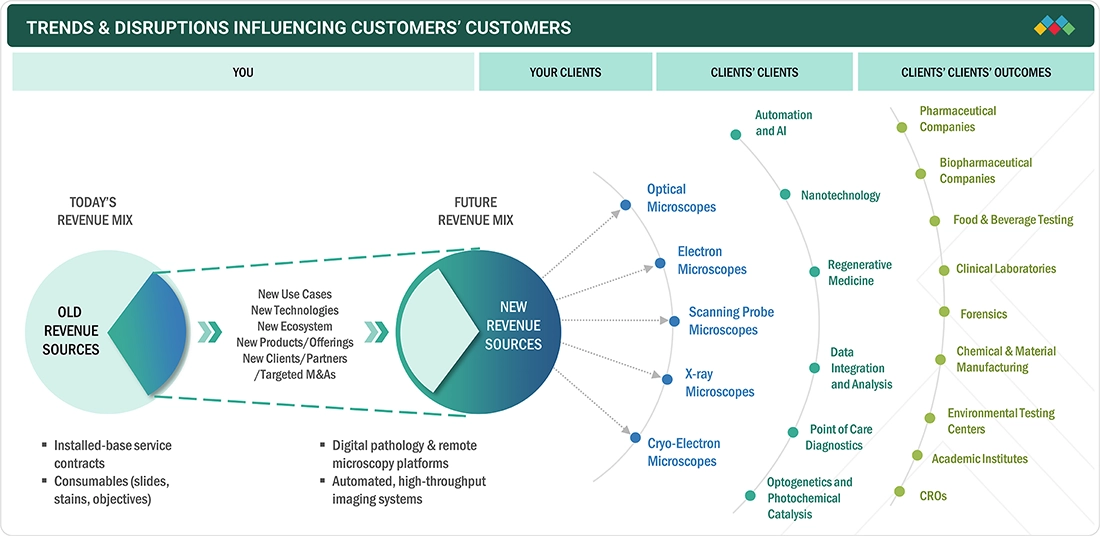
Source: Secondary Research, Interviews with Experts, MarketsandMarkets Analysis
MARKET DYNAMICS

Drivers
Impact
Level
Level
-
Rapid evolution of semiconductor manufacturing toward sub-5 nm nodes

-
Growing adoption of cryo-electron microscopy (cryo-EM)


RESTRAINTS
Impact
Level
Level
-
High capital investment

-
Complexity in data interpretation and workflow standardization


OPPORTUNITIES
Impact
Level
Level
-
Increasing demand for automated and AI-enabled microscopy for industrial manufacturing

-
Growing integration of artificial intelligence (AI) and machine learning


CHALLENGES
Impact
Level
Level
-
Challenges associated with realizing scalability with ultra-high performance

-
Shortage of highly skilled professionals

Source: Secondary Research, Interviews with Experts, MarketsandMarkets Analysis
Driver: Rapid evolution of semiconductor manufacturing toward sub-5 nm nodes
One of the strongest drivers for the microscopy market is the rapid evolution of semiconductor manufacturing toward sub-5 nm nodes, chiplet architectures, and advanced packaging technologies, all of which demand extremely high-resolution imaging and surface characterization. In parallel, growth in life sciences R&D, pharmaceutical innovation, and translational research continues to drive demand for optical and electron microscopy. Industrial quality control in automotive electronics, energy storage, and precision manufacturing is further expanding microscopy adoption beyond traditional research environments, reinforcing the market’s multi-industry growth engine.
Restraint: High capital investment
High capital investment remains a key restraint, particularly for advanced electron and scanning probe microscopes required in semiconductor and materials applications. Industrial users also face challenges related to infrastructure readiness, including vibration control, cleanroom compatibility, and environmental stability. From a broader market perspective, the complexity of integrating microscopy outputs into industrial data systems and quality frameworks can slow adoption, especially in fabs and factories where downtime and validation risks are tightly controlled.
Opportunity: Increasing demand for automated and AI-enabled microscopy for industrial manufacturing
The increasing demand for automated and AI-enabled microscopy for industrial manufacturing settings is, in turn, opening a great window of opportunity. Semiconductor fabs are increasingly investing in defect classification, pattern recognition, and predictive analytics powered by microscopy data. Those vendors that can offer application-specific solutions for wafer inspection, advanced packaging analysis, and failure diagnostics while maintaining cross-compatibility with life sciences workflows are indeed at an advantage. The localization of semiconductor manufacturing to the Asia Pacific and North America is further creating new greenfield demand for advanced microscopy infrastructure.
Challenge: Challenges associated with realizing scalability with ultra-high performance
A major issue in the microscopy market is realizing scalability with ultra-high performance. Microscopy performed by semiconductor manufacturers needs to produce results that can be precisely repeated with different tools. It is always challenging to meet such characteristics with methodologies that require higher precision. Increased data, cybersecurity, and compatibility with industrial software platforms have continued to be problems. On the other hand, enriching high innovation rates with qualification procedures common to semiconductor manufacturing has continued to make it more challenging.
MICROSCOPY MARKET SIZE, GROWTH, SHARE & TRENDS ANALYSIS: COMMERCIAL USE CASES ACROSS INDUSTRIES
| COMPANY | USE CASE DESCRIPTION | BENEFITS |
|---|---|---|
 |
Danaher’s introduction of the Vivent LS2 light-sheet microscope supports high-resolution, low-phototoxicity imaging for developmental biology and life sciences research across US universities, national laboratories, and biotechnology companies. The system is optimized for long-duration live imaging, making it suitable for cell biology, neuroscience, and translational research applications. | Improves long-term sample viability during extended imaging experiments | Reduces phototoxic effects while maintaining high spatial resolution |
 |
Nikon’s ECLIPSE Ji AI-enabled inverted microscope is widely deployed in US biomedical research laboratories, pharmaceutical R&D centers, and core imaging facilities to support automated and routine cell imaging applications. | Enhances workflow automation and reproducibility through integrated AI capabilities | Reduces manual intervention and user-to-user variability |
 |
ZEISS’s INSPECT multisensor imaging microscope is utilized in the US advanced manufacturing, aerospace, automotive, and semiconductor industries for precision inspection and dimensional metrology of complex components. | Enables high-accuracy inspection of components with diverse geometries and materials | Improves productivity and measurement reliability in industrial inspection processes |
 |
Thermo Fisher Scientific’s advanced transmission electron microscopy (TEM) systems, integrated with electron energy-loss spectroscopy (EELS), are widely used in US materials science, nanotechnology, and semiconductor R&D. | Provides atomic-level structural and chemical analysis capabilities | Delivers high-resolution insights critical for semiconductor and advanced materials development |
Logos and trademarks shown above are the property of their respective owners. Their use here is for informational and illustrative purposes only.
MARKET ECOSYSTEM
The microscopy ecosystem encompasses companies involved in instrument manufacturing, optical & detector component suppliers, vacuum & motion control component suppliers, software & AI solution suppliers, and service companies. In the industrial manufacturing domain, especially in semiconductors, there is an ever-increasing blur with companies involved in metrology, inspection, and yield management. The end users of microscopy range from academic research organizations and pharmaceutical companies to semiconductor facilities, electronics manufacturers, and materials scientists. Value addition is gradually shifting toward software, application engineering, and long-term services.
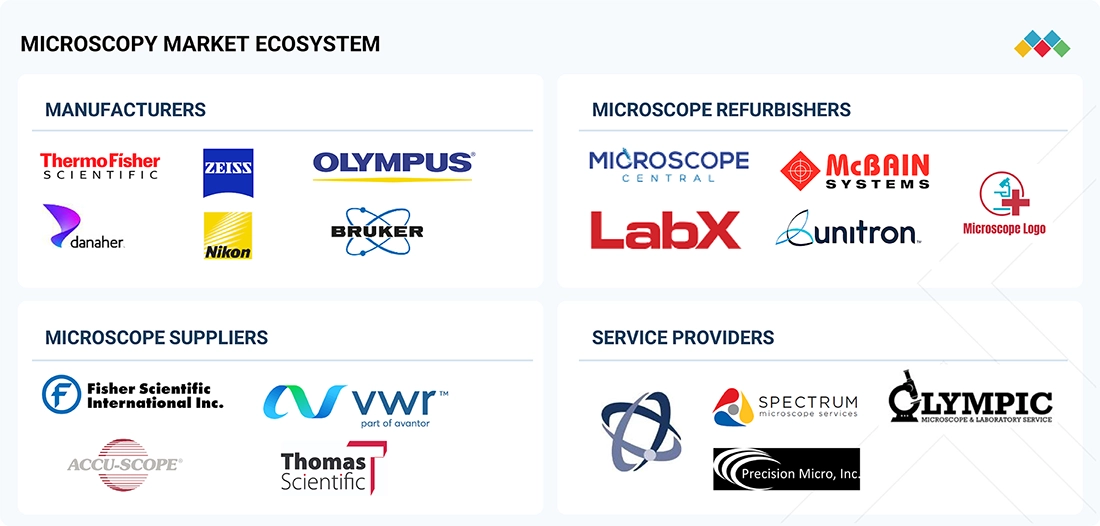
Logos and trademarks shown above are the property of their respective owners. Their use here is for informational and illustrative purposes only.
MARKET SEGMENTS
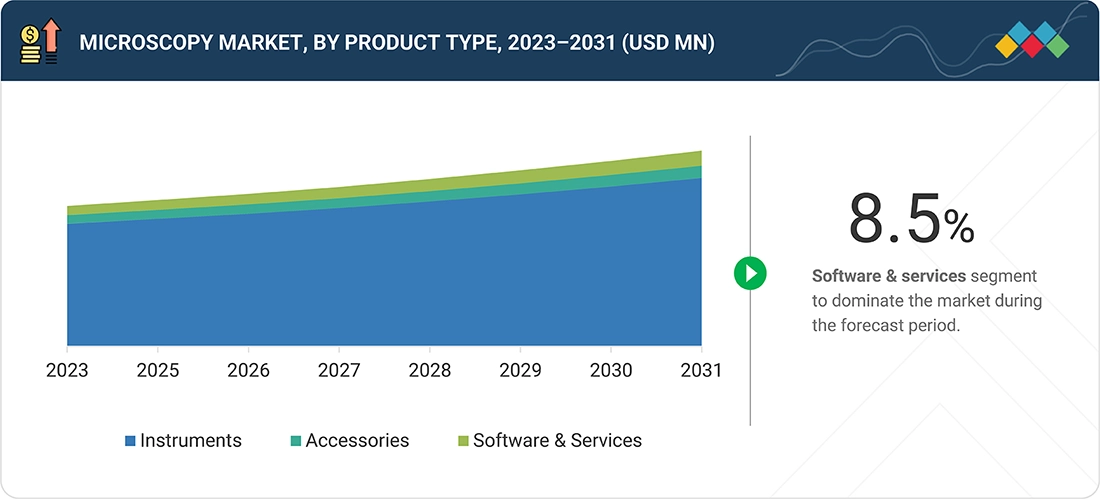
Source: Secondary Research, Interviews with Experts, MarketsandMarkets Analysis
Microscopy Market, By Product
Due to its versatility, optical microscopy has remained the biggest product segment in both life sciences and industrial quality control, including routine inspection in electronics and precision manufacturing. The segment has continued to innovate with digital imaging, automated stage control, and AI-based defect detection, which sustains its dominance. On the other hand, electron microscopy is the most strategically critical segment for semiconductor manufacturing, particularly at atomic scale resolution, which is needed to validate process nodes, perform failure analysis, and inspect advanced packaging. Scanning probe microscopy continues to find niche industrial applications in areas like surface roughness measurement and nanomechanical characterization; its growth is steady.
Microscopy Market, By Application
Semiconductor & electronics applications dominated the market owing to continued digitalization & automation of lab workflows coupled with integration of AI capabilities with image analysis software, recent technological developments in the field of nanotechnology, and the expansion of semiconductor manufacturing that required advanced electron microscopes & other microscopy technology.
Microscopy Market, By End User
The microscopy market is primarily dominated by the semiconductor & electronics industry, as advanced microscopy methods enable defect inspection, failure analysis, and process optimization to be performed at micro and nanoscale levels, particularly in semiconductor and nanotechnology sectors. The market is heavily supported by significant capital investments from industrial players and the rising demand for high-throughput automated imaging systems. Long-term benefits for the industrial segments in microscopy investments are likely to proceed with the continuous development of advanced manufacturing and nanofabrication technologies.
REGION
Asia-Pacific to be the fastest-growing region in the global microscopy market during the forecast period
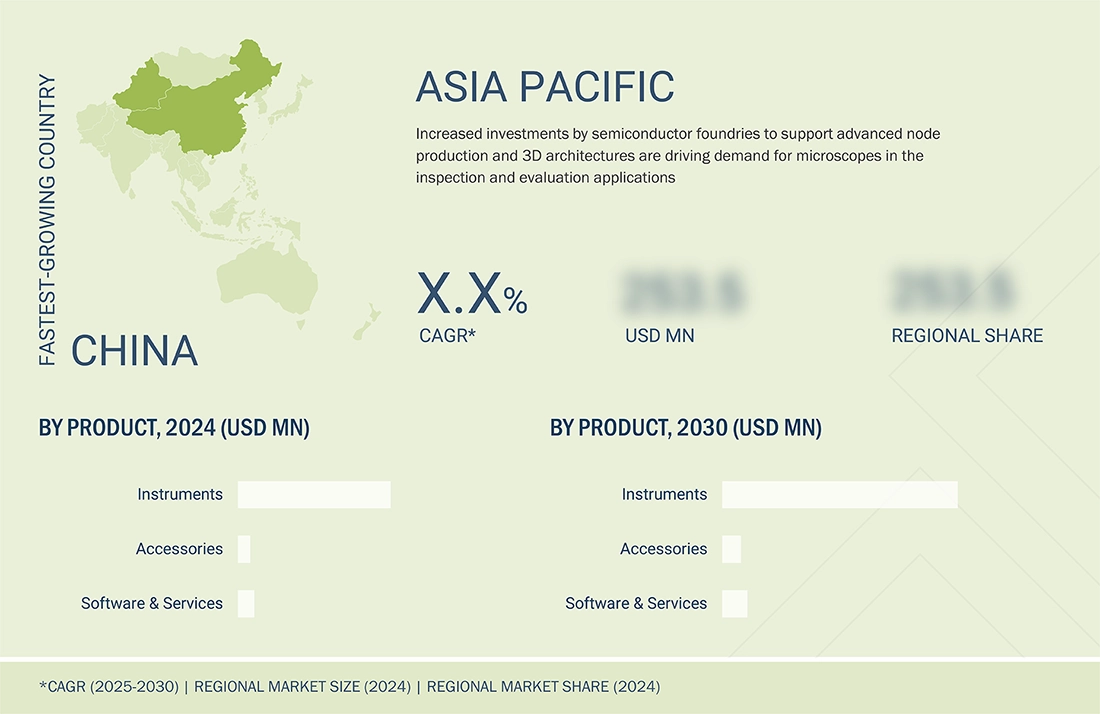
The Asia Pacific region offers cost advantages, including low-cost labor, raw materials, and a dense network of local OEMs, enabling competitive manufacturing and localized assembly of microscopes and key components. This cost advantage, combined with expanding regional supply chains, reduces acquisition and service expenses for end users and lessens reliance on imports. These factors have contributed to lowering the total acquisition cost of microscopes, helping to expand the overall market. Asia-Pacific hosts major semiconductor manufacturing facilities in Taiwan, South Korea, China, and Japan, where wafer inspection and defect analysis depend heavily on SEM/TEM and wafer-inspection microscopes. Rapid investments by leading foundries and IDMs to support smaller node production and 3D architectures are driving above-average demand for high-resolution inspection systems across the region. With substantial government investments in research infrastructure focusing on nanotechnology and biotechnology, such public initiatives are expected to boost microscopy adoption, which will contribute to significant market growth.
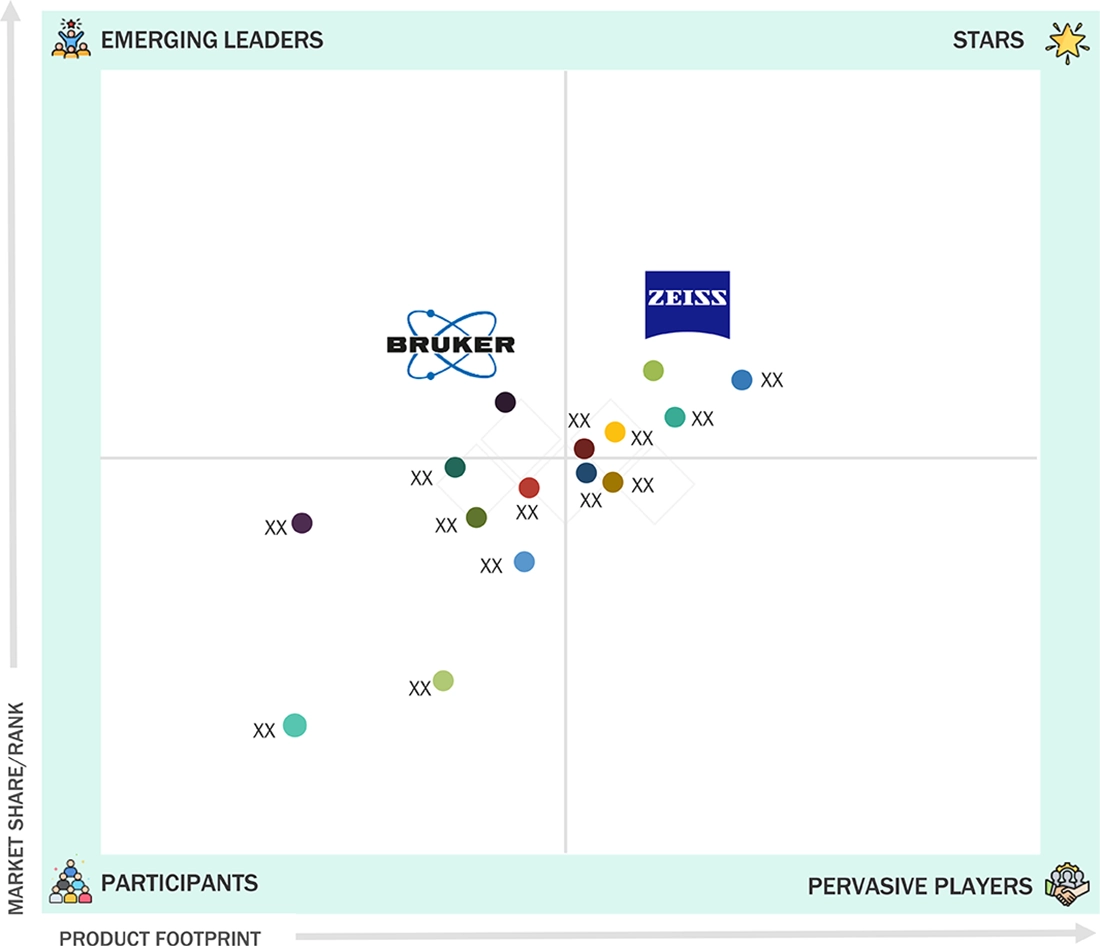
MICROSCOPY MARKET SIZE, GROWTH, SHARE & TRENDS ANALYSIS: COMPANY EVALUATION MATRIX
The microscopy market is getting increasingly competitive as vendors are moving beyond the core of traditional imaging performance to industrial-grade automation, AI analytics, and workflow integration. Market leaders like Carl Zeiss, Thermo Fisher Scientific, Leica Microsystems, Olympus, and Bruker maintain their leading positions based on breadth of technology, semiconductor-ready solutions, software ecosystems, and global service capability. Smaller specialized players remain focused on specific niche industrial or nanoscale applications; however, competitive advantage is increasingly being dictated by a vendor's ability to support both life science discovery and high-volume industrial manufacturing requirements.
Source: Secondary Research, Interviews with Experts, MarketsandMarkets Analysis
KEY MARKET PLAYERS
- Danaher Corporation (US)
- Thermo Fisher Scientific (US)
- Nikon Corporation (Japan)
- Oxford Instruments plc (UK)
- Keyence Corporation (Japan)
- Euromex Microscope bv (Netherlands)
- Carl Zeiss AG (Germany)
- EVIDENT (Japan)
- JEOL Ltd. (Japan)
- Hitachi High-Tech Corporation (Japan)
- Shimadzu Corporation (Japan)
- Bruker Corporation (US)
- Helmut Hund GmbH (Germany)
MARKET SCOPE
| REPORT METRIC | DETAILS |
|---|---|
| Market Size in 2025 (Value) | USD 8.81 Billion |
| Market Forecast in 2031 (value) | USD 11.44 Billion |
| Growth Rate | CAGR of 5.5% from 2025–2031 |
| Years Considered | 2023–2031 |
| Base Year | 2024 |
| Forecast Period | 2025–2031 |
| Units Considered | Value (USD Billion), Volume (Units) |
| Report Coverage | Revenue forecast, company ranking, competitive landscape, growth factors, and trends |
| Segments Covered |
|
| Regions Covered | North America, Europe, Asia Pacific, Latin America, and Middle East & Africa |
| Related Segment & Geographic Reports |
United States Microscopy Market Asia-Pacific Microscopy Market Electron Microscopy Market Europe Microscopy Market |
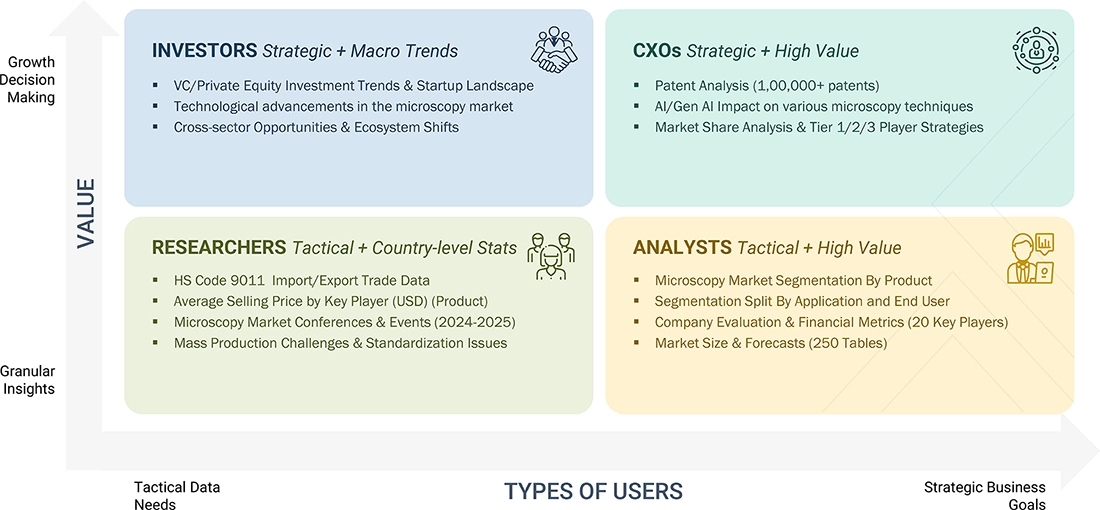
WHAT IS IN IT FOR YOU: MICROSCOPY MARKET SIZE, GROWTH, SHARE & TRENDS ANALYSIS REPORT CONTENT GUIDE
DELIVERED CUSTOMIZATIONS
We have successfully delivered the following deep-dive customizations:
| CLIENT REQUEST | CUSTOMIZATION DELIVERED | VALUE ADDS |
|---|---|---|
| Microscopy Instrument Manufacturers |
|
|
| Pharmaceutical & Biopharmaceutical Companies and CROs |
|
|
| Diagnostic & Pathology Laboratories |
|
|
RECENT DEVELOPMENTS
- November 2024 : Carl Zeiss AG launched ZEISS O-INSPECT, which combines optical and tactile measurement technology and helps to measure complex components, from large workpieces such as circuit boards and fuel cells to smaller components.
- October 2024 : Thermo Fisher Scientific launched Iliad, a transmission electron microscopy (TEM) system with integrated electron energy loss spectroscopy (EELS) for advanced analysis.
- September 2023 : Nikon revealed ECLIPSE Ji, an AI-powered inverted microscope aimed at offering improved stability and enhanced functional flexibility.
Table of Contents
 Exclusive indicates content/data unique to MarketsandMarkets and not available with any competitors.
TITLE
PAGE NO
1
INTRODUCTION
27
2
EXECUTIVE SUMMARY
31
3
PREMIUM INSIGHTS
36
4
MARKET OVERVIEW
AI integration and rising R&D funding propel microscopy advancements despite cost and skill challenges.
38
4.1
INTRODUCTION
4.2
MARKET DYNAMICS
4.2.1
DRIVERS
4.2.1.1
INTEGRATION OF ARTIFICIAL INTELLIGENCE AND DEEP LEARNING
4.2.1.2
RISING GOVERNMENT R&D FUNDING FOR NANOTECHNOLOGY AND LIFE SCIENCES
4.2.2
RESTRAINTS
4.2.2.1
HIGH COST OF ADVANCED MICROSCOPES AND RELATED ACCESSORIES
4.2.3
OPPORTUNITIES
4.2.3.1
GROWING ADOPTION OF CRYO-ELECTRON MICROSCOPY IN DRUG DISCOVERY
4.2.3.2
EXPANSION OF PORTABLE MICROSCOPY IN DECENTRALIZED HEALTHCARE SETTINGS
4.2.4
CHALLENGES
4.2.4.1
TECHNICAL TRADE-OFFS IN SUPER-RESOLUTION MICROSCOPY
4.2.4.2
MASSIVE DATA VOLUMES AND DATA MANAGEMENT IN ADVANCED MICROSCOPY
4.2.4.3
SHORTAGE OF SKILLED OPERATORS
5
INDUSTRY TRENDS
Navigate competitive pressures and pricing dynamics to capitalize on microscopy industry growth opportunities.
42
5.1
PORTER’S FIVE FORCES ANALYSIS
5.1.1
BARGAINING POWER OF BUYERS
5.1.2
BARGAINING POWER OF SUPPLIERS
5.1.3
THREAT OF NEW ENTRANTS
5.1.4
THREAT OF SUBSTITUTES
5.1.5
INTENSITY OF COMPETITIVE RIVALRY
5.2
MACROECONOMIC INDICATORS
5.2.1
GDP TRENDS AND FORECAST
5.2.2
TRENDS IN GLOBAL MICROSCOPY INDUSTRY
5.3
SUPPLY CHAIN ANALYSIS
5.3.1
PROMINENT COMPANIES
5.3.2
SMALL AND MEDIUM-SIZED ENTERPRISES
5.3.3
END USERS
5.4
VALUE CHAIN ANALYSIS
5.4.1
RESEARCH & DEVELOPMENT
5.4.2
RAW MATERIAL PROCUREMENT & PRODUCT DEVELOPMENT
5.4.3
MARKETING, SALES, AND DISTRIBUTION
5.5
ECOSYSTEM ANALYSIS
5.6
PRICING ANALYSIS
5.6.1
AVERAGE SELLING PRICE OF MICROSCOPES, BY KEY PLAYER, 2025
5.6.2
AVERAGE SELLING PRICE OF PRODUCT, BY KEY PLAYER, 2023-2025 (USD THOUSAND)
5.6.3
AVERAGE SELLING PRICE TREND, BY REGION, 2025
5.7
TRADE ANALYSIS
5.7.1
IMPORT DATA FOR HS CODE 9011
5.7.2
IMPORT DATA FOR OPTICAL MICROSCOPES (HS CODE 9011)
5.7.3
IMPORT DATA FOR HS CODE 9012
5.7.4
IMPORT DATA FOR ELECTRON MICROSCOPES (HS CODE 9012)
5.7.5
EXPORT DATA FOR OPTICAL MICROSCOPES (HS CODE 9011)
5.7.6
EXPORT SCENARIO FOR HS CODE 9012
5.7.7
EXPORT DATA FOR ELECTRON MICROSCOPES (HS CODE 9012)
5.8
KEY CONFERENCES & EVENTS, 2026–2027
5.9
TRENDS/DISRUPTIONS IMPACTING CUSTOMER BUSINESS
5.9.1
AI-DRIVEN DIGITAL TRANSFORMATION AND EXPANDING APPLICATION LANDSCAPE IN MICROSCOPY MARKET
5.10
INVESTMENT & FUNDING SCENARIO
5.11
CASE STUDY ANALYSIS
5.11.1
CASE STUDY
5.12
IMPACT OF 2025 US TARIFF ON MICROSCOPY MARKET
5.12.1
INTRODUCTION
5.12.2
KEY TARIFF RATES
5.12.3
KEY TARIFF RATES
5.12.4
PRICE IMPACT ANALYSIS
5.12.5
IMPACT ON COUNTRY/REGION
5.12.5.1
US
5.12.5.2
EUROPE
5.12.5.3
ASIA PACIFIC
5.12.6
IMPACT ON END USERS
STRATEGIC DISRUPTION THROUGH TECHNOLOGY, PATENTS, DIGITAL,
6.1
KEY EMERGING TECHNOLOGIES
6.1.1
LIGHT SHEET FLUORESCENCE MICROSCOPY
6.1.2
CRYO-ELECTRON MICROSCOPY
6.2
COMPLEMENTARY TECHNOLOGIES
6.2.1
SAMPLE PREPARATION AND TISSUE PROCESSING TECHNOLOGIES
6.2.2
CLOUD COMPUTING AND DATA MANAGEMENT SOLUTIONS
6.2.3
ADVANCED IMAGING SOFTWARE AND VISUALIZATION TOOLS
6.3
PATENT ANALYSIS
6.4
IMPACT OF AI/GEN AI ON MICROSCOPY MARKET
6.4.1
TOP USE CASES AND MARKET POTENTIAL
6.4.2
BEST PRACTICES IN MICROSCOPY
6.4.3
CASE STUDIES OF AI IMPLEMENTATION IN MICROSCOPY MARKET
6.4.4
INTERCONNECTED ADJACENT ECOSYSTEMS AND IMPACT ON MARKET PLAYERS
6.4.5
CLIENTS' READINESS TO ADOPT GENERATIVE AI IN MICROSCOPY MARKET
6.5
SUCCESS STORIES AND REAL-WORLD APPLICATIONS
7
CUSTOMER LANDSCAPE AND BUYER BEHAVIOR
Unlock key buying criteria and regulatory hurdles shaping global microscopy market dynamics.
69
7.1
DECISION-MAKING PROCESS
7.2
BUYER STAKEHOLDERS & BUYING EVALUATION CRITERIA
7.2.1
KEY STAKEHOLDERS IN BUYING PROCESS
7.2.2
KEY BUYING CRITERIA
7.3
ADOPTION BARRIERS AND INTERNAL CHALLENGES
7.4
UNMET NEEDS OF VARIOUS END USERS
7.5
REGULATORY LANDSCAPE
7.5.1
REGULATORY TRENDS
7.5.1.1
NORTH AMERICA
7.5.1.1.1
US
7.5.1.1.2
CANADA
7.5.1.2
EUROPE
7.5.1.3
ASIA PACIFIC
7.5.1.3.1
JAPAN
7.5.1.3.2
CHINA
7.5.1.3.3
INDIA
7.5.2
KEY REGULATORY BODIES, GOVERNMENT AGENCIES, AND OTHER ORGANIZATIONS
7.5.2.1
NORTH AMERICA
7.5.2.2
EUROPE
7.5.2.3
ASIA PACIFIC
7.5.2.4
LATIN AMERICA
7.5.2.5
MIDDLE EAST & AFRICA
7.6
INDUSTRY STANDARDS
8
MICROSCOPY MARKET, BY PRODUCT
Market Size & Growth Rate Forecast Analysis to 2031 in USD Million | 23 Data Tables
81
8.1
INTRODUCTION
8.2
INSTRUMENTS
8.2.1
OPTICAL MICROSCOPES
8.2.1.1
CONFOCAL MICROSCOPES
8.2.1.1.1
ADVANCES IN PRECISION IMAGING TO PROPEL MARKET GROWTH
8.2.1.2
STEREO MICROSCOPES
8.2.1.2.1
ADVANCEMENTS IN HIGH-RESOLUTION STEREO MICROSCOPY AND ENHANCED IMAGING CAPABILITIES TO DRIVE MARKET
8.2.1.3
DIGITAL MICROSCOPES
8.2.1.3.1
ADVANCEMENTS IN INTEGRATED DIGITAL IMAGING AND WORKFLOW AUTOMATION TO FUEL MARKET
8.2.1.4
COMPOUND & INVERTED MICROSCOPES
8.2.1.4.1
ADVANCEMENTS IN HIGH-RESOLUTION IMAGING AND LIVE-CELL ANALYSIS CAPABILITIES TO SPUR GROWTH
8.2.1.5
OTHER OPTICAL MICROSCOPES
8.2.2
ELECTRON MICROSCOPES
8.2.2.1
SCANNING ELECTRON MICROSCOPES
8.2.2.1.1
ADVANCEMENTS IN HIGH-RESOLUTION SURFACE IMAGING AND INTEGRATED ANALYTICAL CAPABILITIES FAVOR SEGMENT GROWTH
8.2.2.2
TRANSMISSION ELECTRON MICROSCOPES
8.2.2.2.1
ADVANCEMENTS IN ATOMIC-SCALE IMAGING AND CRYO-EM INNOVATIONS TO DRIVE SEGMENT
8.2.3
SCANNING PROBE MICROSCOPES
8.2.3.1
ATOMIC FORCE MICROSCOPES
8.2.3.1.1
INNOVATION IN HIGH-RESOLUTION SURFACE ANALYSIS TO FUEL ADOPTION
8.2.3.2
SCANNING TUNNELING MICROSCOPES
8.2.3.2.1
INCREASING USE IN TOPOLOGICAL STUDIES TO DRIVE SEGMENT
8.2.3.3
NEAR-FIELD SCANNING OPTICAL MICROSCOPES
8.2.3.3.1
STRATEGIC ADOPTION OF NEAR-FIELD SCANNING OPTICAL MICROSCOPES TO ACCELERATE MARKET GROWTH
8.2.4
X-RAY MICROSCOPES
8.2.4.1
INCREASING USE IN FORENSICS AND MATERIALS SCIENCE TO PROPEL MARKET GROWTH
8.2.5
CRYO-ELECTRON MICROSCOPES
8.2.5.1
ADVANCES IN HIGH-RESOLUTION STRUCTURAL BIOLOGY WITH CRYO-ELECTRON MICROSCOPY TO SPUR MARKET GROWTH
8.3
ACCESSORIES
8.3.1
ENHANCED MICROSCOPE CAPABILITIES THROUGH ADVANCED AND MODULAR ACCESSORIES TO DRIVE MARKET
8.4
SOFTWARE & SERVICES
8.4.1
INCREASING DEMAND FOR ENHANCED END-USER EXPERIENCE TO FUEL MARKET GROWTH
9
MICROSCOPY MARKET, BY APPLICATION
Market Size & Growth Rate Forecast Analysis to 2031 in USD Million | 6 Data Tables
99
9.1
INTRODUCTION
9.2
SEMICONDUCTOR & ELECTRONICS
9.2.1
ADVANCING SEMICONDUCTOR COMPLEXITY AND AI-DRIVEN DEMAND TO PROPEL MICROSCOPY ADOPTION
9.3
HEALTHCARE & LIFE SCIENCE
9.3.1
PHARMA & BIOPHARMA MANUFACTURING
9.3.1.1
ENHANCED PRODUCT QUALITY AND PROCESS EFFICIENCY IN PHARMA & BIOPHARMA MANUFACTURING
9.3.2
CLINICAL DIAGNOSTICS & PATHOLOGY
9.3.2.1
ACCURATE AND RAPID DISEASE DIAGNOSIS THROUGH ADVANCED MICROSCOPY
9.3.3
DRUG DISCOVERY & SCREENING
9.3.3.1
ACCELERATED DRUG DISCOVERY AND HIGH-THROUGHPUT SCREENING WITH IMAGING TECHNOLOGIES
9.3.4
TOXICOLOGY STUDIES
9.3.4.1
COMPREHENSIVE TOXICITY ASSESSMENT AND SAFETY EVALUATION
9.3.5
LIFESCIENCE RESEARCH
9.3.5.1
ADVANCED BIOLOGICAL INSIGHTS AND INNOVATION IN LIFE SCIENCE RESEARCH
9.3.6
OTHER HEALTHCARE & LIFE SCIENCE APPLICATIONS
9.4
MATERIALS SCIENCE
9.4.1
GROWING FOCUS ON MICRO-LEVEL EXPLORATION OF NOVEL MATERIALS TO FUEL MARKET GROWTH
9.5
APPLIED SCIENCE
9.5.1
ADVANCED MATERIAL INNOVATION AND INDUSTRIAL EFFICIENCY THROUGH HIGH-RESOLUTION MICROSCOPY TO BOOST GROWTH
9.6
OTHER APPLICATIONS
10
MICROSCOPY MARKET, BY END USER
Market Size & Growth Rate Forecast Analysis to 2031 in USD Million | 8 Data Tables
106
10.1
INTRODUCTION
10.2
SEMICONDUCTOR & ELECTRONICS INDUSTRY
10.2.1
SUPPORTS NEXT-GENERATION ELECTRONICS WITH NANOSCALE INSIGHTS
10.3
AUTOMOTIVE INDUSTRY
10.3.1
ENHANCED MATERIAL INTEGRITY AND QUALITY ASSURANCE TO SUPPORT MARKET GROWTH
10.4
FOOD & BEVERAGE INDUSTRY
10.4.1
ADHERENCE TO STRICT QUALITY AND SAFETY MEASURES TO PROPEL SEGMENT GROWTH
10.5
DIAGNOSTIC & PATHOLOGY LABORATORIES
10.5.1
ENHANCED DIAGNOSTIC ACCURACY AND WORKFLOW EFFICIENCY AIDS GROWTH
10.6
PHARMACEUTICAL & BIOPHARMACEUTICAL COMPANIES
10.6.1
ENHANCED DRUG DISCOVERY EFFICIENCY AND QUALITY ASSURANCE TO PROPEL MARKET GROWTH
10.7
ACADEMIC & RESEARCH INSTITUTES
10.7.1
SUPPORTIVE GOVERNMENT AND COMMERCIAL SECTORS TO DRIVE MARKET
10.8
OTHER END USERS
11
MICROSCOPY MARKET, BY REGION
Comprehensive coverage of 8 Regions with country-level deep-dive of 14 Countries | 137 Data Tables.
115
11.1
INTRODUCTION
11.2
NORTH AMERICA
11.2.1
US
11.2.1.1
US TO DOMINATE NORTH AMERICAN MICROSCOPY MARKET DURING FORECAST PERIOD
11.2.2
CANADA
11.2.2.1
RESEARCH AND INNOVATION-LED FACTORS TO PROPEL MARKET GROWTH
11.3
EUROPE
11.3.1
GERMANY
11.3.1.1
STRONG R&D ECOSYSTEM AND INDUSTRIAL BASE TO AUGMENT MARKET GROWTH
11.3.2
UK
11.3.2.1
ROBUST PUBLIC R&D INVESTMENTS AND TALENT INITIATIVES TO SPUR MARKET GROWTH
11.3.3
FRANCE
11.3.3.1
STRATEGIC NATIONAL IMAGING INFRASTRUCTURE INVESTMENTS AND INDUSTRY COLLABORATIONS TO DRIVE MARKET
11.3.4
ITALY
11.3.4.1
GOVERNMENT FUNDING FOR NATIONAL RESEARCH INFRASTRUCTURE AND ELECTRON MICROSCOPY CAPABILITIES TO FUEL MARKET
11.3.5
SPAIN
11.3.5.1
LARGE-SCALE SYNCHROTRON INFRASTRUCTURE EXPANSION AND ADVANCED IMAGING INTEGRATION TO AID MARKET GROWTH
11.3.6
REST OF EUROPE
11.4
ASIA PACIFIC
11.4.1
JAPAN
11.4.1.1
RISING NUMBER OF COLLABORATIONS AND INCREASING EXPORTS OF MICROSCOPY PRODUCTS TO SUPPORT MARKET GROWTH
11.4.2
CHINA
11.4.2.1
RISING R&D INVESTMENT AND POLICY SUPPORT TO PROPEL MARKET GROWTH
11.4.3
INDIA
11.4.3.1
SIGNIFICANT GROWTH IN BIOTECHNOLOGY AND PHARMACEUTICAL INDUSTRY TO DRIVE DEMAND FOR MICROSCOPES
11.4.4
AUSTRALIA
11.4.4.1
STRENGTHENING NATIONAL RESEARCH INFRASTRUCTURE AND COLLABORATIVE ACCESS TO DRIVE MARKET
11.4.5
SOUTH KOREA
11.4.5.1
STRENGTHENING R&D INVESTMENT AND SEMICONDUCTOR ECOSYSTEM TO SUPPORT MARKET GROWTH
11.4.6
REST OF ASIA PACIFIC
11.5
LATIN AMERICA
11.5.1
BRAZIL
11.5.1.1
RISING AI INTEGRATION AND GOVERNMENT R&D INVESTMENTS IN BRAZIL TO DRIVE MARKET
11.5.2
MEXICO
11.5.2.1
HIGH R&D INVESTMENTS IN BIOTECHNOLOGY, NANOTECHNOLOGY, AND LIFE SCIENCES TO AID MARKET GROWTH
11.5.3
REST OF LATIN AMERICA
11.6
MIDDLE EAST & AFRICA
11.6.1
GCC COUNTRIES
11.6.1.1
DEVELOPMENTS IN HEALTHCARE INFRASTRUCTURE AND HIGH GOVERNMENT EXPENDITURE TO DRIVE MARKET
11.6.2
REST OF MIDDLE EAST & AFRICA
12
COMPETITIVE LANDSCAPE
Discover strategic insights driving key players and emerging leaders in the microscopy market.
176
12.1
OVERVIEW
12.1.1
OVERVIEW OF STRATEGIES ADOPTED BY PLAYERS IN MICROSCOPY MARKET
12.2
REVENUE ANALYSIS
12.3
COMPANY VALUATION & FINANCIAL METRICS
12.4
BRAND/PRODUCT COMPARISON
12.5
COMPANY EVALUATION MATRIX: KEY PLAYERS
12.5.1
STARS
12.5.2
EMERGING LEADERS
12.5.3
PERVASIVE PLAYERS
12.5.4
PARTICIPANTS
12.5.5
COMPANY FOOTPRINT ANALYSIS
12.6
COMPANY EVALUATION MATRIX: STARTUPS/SMES
12.6.1
PROGRESSIVE COMPANIES
12.6.2
RESPONSIVE COMPANIES
12.6.3
DYNAMIC COMPANIES
12.6.4
STARTING BLOCKS
12.6.5
COMPETITIVE BENCHMARKING
12.7
COMPETITIVE SCENARIO
12.7.1
PRODUCT LAUNCHES
12.7.2
DEALS
12.7.3
EXPANSIONS
13
COMPANY PROFILES
In-depth Company Profiles of Leading Market Players with detailed Business Overview, Product and Service Portfolio, Recent Developments, and Unique Analyst Perspective (MnM View)
195
13.1
KEY PLAYERS
13.1.1
CARL ZEISS AG
13.1.1.1
BUSINESS OVERVIEW
13.1.1.2
PRODUCTS/SERVICES/SOLUTIONS OFFERED
13.1.1.3
RECENT DEVELOPMENTS
13.1.1.3.1
PRODUCT LAUNCHES & DEVELOPMENTS
13.1.1.3.2
DEALS
13.1.1.4
MNM VIEW
13.1.1.4.1
KEY STRENGTHS
13.1.1.4.2
STRATEGIC CHOICES
13.1.1.4.3
WEAKNESSES & COMPETITIVE THREATS
13.1.2
THERMO FISHER SCIENTIFIC INC.
13.1.3
DANAHER CORPORATION
13.1.4
EVIDENT
13.1.5
NIKON CORPORATION
13.1.6
TESCAN GROUP
13.1.7
JEOL LTD.
13.1.8
HITACHI HIGH-TECH CORPORATION
13.1.9
KEYENCE CORPORATION
13.1.10
OXFORD INSTRUMENTS
13.1.11
SHIMADZU CORPORATION
13.1.12
BRUKER
13.1.13
HORIBA LTD.
13.1.14
EUROMEX MICROSCOPEN BV
13.1.15
HELMUT HUND GMBH
13.2
OTHER PLAYERS
13.2.1
ETALUMA, INC
13.2.2
ACCU-SCOPE
13.2.3
ADELTA OPTEC
13.2.4
AMETEK, INC.
13.2.5
CRAIC TECHNOLOGIES
13.2.6
CYTOVIVA, INC.
13.2.7
KYKY TECHNOLOGY CO., LTD.
13.2.8
LABOMED, INC.
13.2.9
LASERTEC CORPORATION
13.2.10
OPTIKA SRL
13.2.11
PARK SYSTEMS
13.2.12
PICOQUANT
14
RESEARCH METHODOLOGY
272
14.1
RESEARCH DATA
14.1.1
SECONDARY DATA
14.1.1.1
OBJECTIVES OF SECONDARY RESEARCH
14.1.2
PRIMARY DATA
14.1.2.1
KEY PRIMARY SOURCES
14.1.2.2
OBJECTIVES OF PRIMARY RESEARCH
14.1.2.3
BREAKDOWN OF PRIMARIES
14.2
MARKET SIZE ESTIMATION
14.2.1
TOP-DOWN APPROACH
14.2.1.1
COMPANY REVENUE ESTIMATION APPROACH
14.2.1.2
CUSTOMER-BASED MARKET ESTIMATION
14.2.2
BOTTOM-UP APPROACH
14.3
MARKET FORECAST
14.4
DATA TRIANGULATION
14.5
STUDY ASSUMPTIONS
14.6
RESEARCH LIMITATIONS
14.7
RISK ASSESSMENT
15
APPENDIX
282
15.1
DISCUSSION GUIDE
15.2
KNOWLEDGESTORE: MARKETSANDMARKETS’ SUBSCRIPTION PORTAL
15.3
CUSTOMIZATION OPTIONS
15.4
RELATED REPORTS
15.5
AUTHOR DETAILS
LIST OF TABLES
TABLE 1
MICROSCOPY MARKET: INCLUSIONS & EXCLUSIONS
TABLE 2
IMPACT OF PORTER’S FIVE FORCES ON MICROSCOPY MARKET
TABLE 3
AVERAGE SELLING PRICE OF MICROSCOPES, BY REGION, 2023–2025 (USD THOUSAND)
TABLE 4
IMPORT DATA FOR OPTICAL MICROSCOPES (HS CODE 9011), BY COUNTRY, 2021–2025 (USD THOUSAND)
TABLE 5
IMPORT DATA FOR ELECTRON MICROSCOPES (HS CODE 9012), BY COUNTRY, 2021–2025 (USD THOUSAND)
TABLE 6
EXPORT DATA FOR OPTICAL MICROSCOPES (HS CODE 9011), BY COUNTRY, 2021–2025 (USD THOUSAND)
TABLE 7
EXPORT DATA FOR ELECTRON MICROSCOPES (HS CODE 9012), BY COUNTRY, 2021–2025 (USD THOUSAND)
TABLE 8
MICROSCOPY MARKET: KEY CONFERENCES AND EVENTS, 2026–2027
TABLE 9
CASE STUDY 1: APPLICATION OF RAMAN MICROSCOPY IN PHARMACEUTICAL ANALYSIS
TABLE 10
CASE STUDY 2: AI-DRIVEN SMART MICROSCOPY ACCELERATES HERPESVIRUS RESEARCH
TABLE 11
US ADJUSTED RECIPROCAL TARIFF RATES
TABLE 12
MICROSCOPY MARKET: KEY PATENT REGISTRATIONS, 2026
TABLE 13
CASE STUDY 1: AI-DRIVEN DEEP LEARNING INTEGRATION IN MICROSCOPY WORKFLOWS
TABLE 14
CASE STUDY 2: AI-ENABLED HIGH-THROUGHPUT MICROSCOPY FOR INFECTION RESEARCH
TABLE 15
INTERCONNECTED ADJACENT ECOSYSTEMS AND IMPACT ON MARKET PLAYERS
TABLE 16
INFLUENCE OF KEY STAKEHOLDERS ON BUYING PROCESS IN MICROSCOPY MARKET, BY PRODUCT (%)
TABLE 17
KEY BUYING CRITERIA FOR MICROSCOPY PRODUCTS
TABLE 18
MEDICAL DEVICE CLASSIFICATION OF MICROSCOPES BY US FDA
TABLE 19
US: MEDICAL DEVICE REGULATORY APPROVAL PROCESS
TABLE 20
CANADA: MEDICAL DEVICE REGULATORY APPROVAL PROCESS
TABLE 21
JAPAN: MEDICAL DEVICE CLASSIFICATION UNDER PHARMACEUTICAL AND MEDICAL DEVICE AGENCY
TABLE 22
CHINA: CLASSIFICATION OF MEDICAL DEVICES
TABLE 23
NORTH AMERICA: KEY REGULATORY BODIES, GOVERNMENT AGENCIES, AND OTHER ORGANIZATIONS
TABLE 24
EUROPE: KEY REGULATORY BODIES, GOVERNMENT AGENCIES, AND OTHER ORGANIZATIONS
TABLE 25
ASIA PACIFIC: KEY REGULATORY BODIES, GOVERNMENT AGENCIES, AND OTHER ORGANIZATIONS
TABLE 26
LATIN AMERICA: KEY REGULATORY BODIES, GOVERNMENT AGENCIES, AND OTHER ORGANIZATIONS
TABLE 27
MIDDLE EAST & AFRICA: KEY REGULATORY BODIES, GOVERNMENT AGENCIES, AND OTHER ORGANIZATIONS
TABLE 28
INDUSTRY STANDARDS FOR MICROSCOPY MARKET
TABLE 29
MICROSCOPY MARKET, BY PRODUCT, 2024–2031 (USD MILLION)
TABLE 30
MICROSCOPY MARKET FOR INSTRUMENTS, BY TYPE, 2024–2031 (USD MILLION)
TABLE 31
MICROSCOPY MARKET FOR INSTRUMENTS, BY REGION, 2024–2031 (USD MILLION)
TABLE 32
OPTICAL MICROSCOPES MARKET, BY TYPE, 2024–2031 (USD MILLION)
TABLE 33
OPTICAL MICROSCOPES MARKET, BY REGION, 2024–2031 (USD MILLION)
TABLE 34
CONFOCAL MICROSCOPES MARKET, BY REGION, 2024–2031 (USD MILLION)
TABLE 35
STEREO MICROSCOPES MARKET, BY REGION, 2024–2031 (USD MILLION)
TABLE 36
DIGITAL MICROSCOPES MARKET, BY REGION, 2024–2031 (USD MILLION)
TABLE 37
COMPOUND & INVERTED MICROSCOPES MARKET, BY REGION, 2024–2031 (USD MILLION)
TABLE 38
OTHER OPTICAL MICROSCOPES MARKET, BY REGION, 2024–2031 (USD MILLION)
TABLE 39
ELECTRON MICROSCOPES MARKET, BY TYPE, 2024–2031 (USD MILLION)
TABLE 40
ELECTRON MICROSCOPES MARKET, BY REGION, 2024–2031 (USD MILLION)
TABLE 41
SCANNING ELECTRON MICROSCOPES MARKET, BY REGION, 2024–2031 (USD MILLION)
TABLE 42
TRANSMISSION ELECTRON MICROSCOPES MARKET, BY REGION, 2024–2031 (USD MILLION)
TABLE 43
SCANNING PROBE MICROSCOPES MARKET, BY TYPE, 2024–2031 (USD MILLION)
TABLE 44
SCANNING PROBE MICROSCOPES MARKET, BY REGION, 2024–2031 (USD MILLION)
TABLE 45
ATOMIC FORCE MICROSCOPES MARKET, BY REGION, 2024–2031 (USD MILLION)
TABLE 46
SCANNING TUNNELING MICROSCOPES MARKET, BY REGION, 2024–2031 (USD MILLION)
TABLE 47
NEAR-FIELD SCANNING OPTICAL MICROSCOPES MARKET, BY REGION, 2024–2031 (USD MILLION)
TABLE 48
X-RAY MICROSCOPES MARKET, BY REGION, 2024–2031 (USD MILLION)
TABLE 49
CRYO-ELECTRON MICROSCOPES MARKET, BY REGION, 2024–2031 (USD MILLION)
TABLE 50
MICROSCOPY MARKET FOR ACCESSORIES, BY REGION, 2024–2031 (USD MILLION)
TABLE 51
MICROSCOPY MARKET FOR SOFTWARE & SERVICES, BY REGION, 2024–2031 (USD MILLION)
TABLE 52
MICROSCOPY MARKET, BY APPLICATION, 2024–2031 (USD MILLION)
TABLE 53
MICROSCOPY MARKET FOR SEMICONDUCTOR & ELECTRONIC APPLICATIONS, BY REGION, 2024–2031 (USD MILLION)
TABLE 54
MICROSCOPY MARKET FOR HEALTHCARE & LIFE SCIENCES APPLICATIONS, BY REGION, 2024–2031 (USD MILLION)
TABLE 55
MICROSCOPY MARKET FOR MATERIALS SCIENCE, BY REGION, 2024–2031 (USD MILLION)
TABLE 56
MICROSCOPY MARKET FOR APPLIED SCIENCE, BY REGION, 2024–2031 (USD MILLION)
TABLE 57
MICROSCOPY MARKET FOR OTHER APPLICATIONS, BY REGION, 2024–2031 (USD MILLION)
TABLE 58
MICROSCOPY MARKET, BY END USER, 2024–2031 (USD MILLION)
TABLE 59
SEMICONDUCTOR & ELECTRONICS INDUSTRY: MICROSCOPY MARKET, BY REGION, 2024–2031 (USD MILLION)
TABLE 60
AUTOMOTIVE INDUSTRY: MICROSCOPY MARKET, BY REGION, 2024–2031 (USD MILLION)
TABLE 61
FOOD & BEVERAGE INDUSTRY: MICROSCOPY MARKET, BY REGION, 2024–2031 (USD MILLION)
TABLE 62
DIAGNOSTIC & PATHOLOGY LABORATORIES: MICROSCOPY MARKET, BY REGION, 2024–2031 (USD MILLION)
TABLE 63
PHARMACEUTICAL & BIOPHARMACEUTICAL COMPANIES: MICROSCOPY MARKET, BY REGION, 2024–2031 (USD MILLION)
TABLE 64
ACADEMIC & RESEARCH INSTITUTES: MICROSCOPY MARKET, BY REGION, 2024–2031 (USD MILLION)
TABLE 65
OTHER END USERS: MICROSCOPY MARKET, BY REGION, 2024–2031 (USD MILLION)
TABLE 66
MICROSCOPY MARKET, BY REGION, 2024–2031 (USD MILLION)
TABLE 67
MICROSCOPY MARKET FOR INSTRUMENTS, BY TYPE (UNIT SALES)
TABLE 68
NORTH AMERICA: MICROSCOPY MARKET, BY COUNTRY, 2024–2031 (USD MILLION)
TABLE 69
NORTH AMERICA: MICROSCOPY MARKET, BY PRODUCT, 2024–2031 (USD MILLION)
TABLE 70
NORTH AMERICA: MICROSCOPY MARKET FOR INSTRUMENTS, BY TYPE, 2024–2031 (USD MILLION)
TABLE 71
NORTH AMERICA: OPTICAL MICROSCOPES MARKET, BY TYPE, 2024–2031 (USD MILLION)
TABLE 72
NORTH AMERICA: ELECTRON MICROSCOPES MARKET, BY TYPE, 2024–2031 (USD MILLION)
TABLE 73
NORTH AMERICA: SCANNING PROBE MICROSCOPES MARKET, BY TYPE, 2024–2031 (USD MILLION)
TABLE 74
NORTH AMERICA: MICROSCOPY MARKET, BY APPLICATION, 2024–2031 (USD MILLION)
TABLE 75
NORTH AMERICA: MICROSCOPY MARKET, BY END USER, 2024–2031 (USD MILLION)
TABLE 76
US: MICROSCOPY MARKET, BY TYPE, 2024–2031 (USD MILLION)
TABLE 77
US: MICROSCOPY MARKET FOR INSTRUMENTS, BY TYPE, 2024–2031 (USD MILLION)
TABLE 78
US: OPTICAL MICROSCOPES MARKET, BY TYPE, 2024–2031 (USD MILLION)
TABLE 79
US: ELECTRON MICROSCOPES MARKET, BY TYPE, 2024–2031 (USD MILLION)
TABLE 80
US: SCANNING PROBE MICROSCOPES MARKET, BY TYPE, 2024–2031 (USD MILLION)
TABLE 81
CANADA: MICROSCOPY MARKET, BY TYPE, 2024–2031 (USD MILLION)
TABLE 82
CANADA: MICROSCOPY MARKET FOR INSTRUMENTS, BY TYPE, 2024–2031 (USD MILLION)
TABLE 83
CANADA: OPTICAL MICROSCOPES MARKET, BY TYPE, 2024–2031 (USD MILLION)
TABLE 84
CANADA: ELECTRON MICROSCOPES MARKET, BY TYPE, 2024–2031 (USD MILLION)
TABLE 85
CANADA: SCANNING PROBE MICROSCOPES MARKET, BY TYPE, 2024–2031 (USD MILLION)
TABLE 86
EUROPE: MICROSCOPY MARKET, BY COUNTRY, 2024–2031 (USD MILLION)
TABLE 87
EUROPE: MICROSCOPY MARKET, BY TYPE, 2024–2031 (USD MILLION)
TABLE 88
EUROPE: MICROSCOPY MARKET FOR INSTRUMENTS, BY TYPE, 2024–2031 (USD MILLION)
TABLE 89
EUROPE: OPTICAL MICROSCOPES MARKET, BY TYPE, 2024–2031 (USD MILLION)
TABLE 90
EUROPE: ELECTRON MICROSCOPES MARKET, BY TYPE, 2024–2031 (USD MILLION)
TABLE 91
EUROPE: SCANNING PROBE MICROSCOPES MARKET, BY TYPE, 2024–2031 (USD MILLION)
TABLE 92
EUROPE: MICROSCOPY MARKET, BY APPLICATION, 2024–2031 (USD MILLION)
TABLE 93
EUROPE: MICROSCOPY MARKET, BY END USER, 2024–2031 (USD MILLION)
TABLE 94
GERMANY: MICROSCOPY MARKET, BY TYPE, 2024–2031 (USD MILLION)
TABLE 95
GERMANY: MICROSCOPY MARKET FOR INSTRUMENTS, BY TYPE, 2024–2031 (USD MILLION)
TABLE 96
GERMANY: OPTICAL MICROSCOPES MARKET, BY TYPE, 2024–2031 (USD MILLION)
TABLE 97
GERMANY: ELECTRON MICROSCOPES MARKET, BY TYPE, 2024–2031 (USD MILLION)
TABLE 98
GERMANY: SCANNING PROBE MICROSCOPES MARKET, BY TYPE, 2024–2031 (USD MILLION)
TABLE 99
UK: MICROSCOPY MARKET, BY TYPE, 2024–2031 (USD MILLION)
TABLE 100
UK: MICROSCOPY MARKET FOR INSTRUMENTS, BY TYPE, 2024–2031 (USD MILLION)
TABLE 101
UK: OPTICAL MICROSCOPES MARKET, BY TYPE, 2024–2031 (USD MILLION)
TABLE 102
UK: ELECTRON MICROSCOPES MARKET, BY TYPE, 2024–2031 (USD MILLION)
TABLE 103
UK: SCANNING PROBE MICROSCOPES MARKET, BY TYPE, 2024–2031 (USD MILLION)
TABLE 104
FRANCE: MICROSCOPY MARKET, BY TYPE, 2024–2031 (USD MILLION)
TABLE 105
FRANCE: MICROSCOPY MARKET FOR INSTRUMENTS, BY TYPE, 2024–2031 (USD MILLION)
TABLE 106
FRANCE: OPTICAL MICROSCOPES MARKET, BY TYPE, 2024–2031 (USD MILLION)
TABLE 107
FRANCE: ELECTRON MICROSCOPES MARKET, BY TYPE, 2024–2031 (USD MILLION)
TABLE 108
FRANCE: SCANNING PROBE MICROSCOPES MARKET, BY TYPE, 2024–2031 (USD MILLION)
TABLE 109
ITALY: MICROSCOPY MARKET, BY TYPE, 2024–2031 (USD MILLION)
TABLE 110
ITALY: MICROSCOPY MARKET FOR INSTRUMENTS, BY TYPE, 2024–2031 (USD MILLION)
TABLE 111
ITALY: OPTICAL MICROSCOPES MARKET, BY TYPE, 2024–2031 (USD MILLION)
TABLE 112
ITALY: ELECTRON MICROSCOPES MARKET, BY TYPE, 2024–2031 (USD MILLION)
TABLE 113
ITALY: SCANNING PROBE MICROSCOPES MARKET, BY TYPE, 2024–2031 (USD MILLION)
TABLE 114
SPAIN: MICROSCOPY MARKET, BY TYPE, 2024–2031 (USD MILLION)
TABLE 115
SPAIN: MICROSCOPY MARKET FOR INSTRUMENTS, BY TYPE, 2024–2031 (USD MILLION)
TABLE 116
SPAIN: OPTICAL MICROSCOPES MARKET, BY TYPE, 2024–2031 (USD MILLION)
TABLE 117
SPAIN: ELECTRON MICROSCOPES MARKET, BY TYPE, 2024–2031 (USD MILLION)
TABLE 118
SPAIN: SCANNING PROBE MICROSCOPES MARKET, BY TYPE, 2024–2031 (USD MILLION)
TABLE 119
REST OF EUROPE: MICROSCOPY MARKET, BY TYPE, 2024–2031 (USD MILLION)
TABLE 120
REST OF EUROPE: MICROSCOPY MARKET FOR INSTRUMENTS, BY TYPE, 2024–2031 (USD MILLION)
TABLE 121
REST OF EUROPE: OPTICAL MICROSCOPES MARKET, BY TYPE, 2024–2031 (USD MILLION)
TABLE 122
REST OF EUROPE: ELECTRON MICROSCOPES MARKET, BY TYPE, 2024–2031 (USD MILLION)
TABLE 123
REST OF EUROPE: SCANNING PROBE MICROSCOPES MARKET, BY TYPE, 2024–2031 (USD MILLION)
TABLE 124
ASIA PACIFIC: MICROSCOPY MARKET, BY COUNTRY, 2024–2031 (USD MILLION)
TABLE 125
ASIA PACIFIC: MICROSCOPY MARKET, BY TYPE, 2024–2031 (USD MILLION)
TABLE 126
ASIA PACIFIC: MICROSCOPY MARKET FOR INSTRUMENTS, BY TYPE, 2024–2031 (USD MILLION)
TABLE 127
ASIA PACIFIC: OPTICAL MICROSCOPES MARKET, BY TYPE, 2024–2031 (USD MILLION)
TABLE 128
ASIA PACIFIC: ELECTRON MICROSCOPES MARKET, BY TYPE, 2024–2031 (USD MILLION)
TABLE 129
ASIA PACIFIC: SCANNING PROBE MICROSCOPES MARKET, BY TYPE, 2024–2031 (USD MILLION)
TABLE 130
ASIA PACIFIC: MICROSCOPY MARKET, BY APPLICATION, 2024–2031 (USD MILLION)
TABLE 131
ASIA PACIFIC: MICROSCOPY MARKET, BY END USER, 2024–2031 (USD MILLION)
TABLE 132
JAPAN: MICROSCOPY MARKET, BY TYPE, 2024–2031 (USD MILLION)
TABLE 133
JAPAN: MICROSCOPY MARKET FOR INSTRUMENTS, BY TYPE, 2024–2031 (USD MILLION)
TABLE 134
JAPAN: OPTICAL MICROSCOPES MARKET, BY TYPE, 2024–2031 (USD MILLION)
TABLE 135
JAPAN: ELECTRON MICROSCOPES MARKET, BY TYPE, 2024–2031 (USD MILLION)
TABLE 136
JAPAN: SCANNING PROBE MICROSCOPES MARKET, BY TYPE, 2024–2031 (USD MILLION)
TABLE 137
CHINA: MICROSCOPY MARKET, BY TYPE, 2024–2031 (USD MILLION)
TABLE 138
CHINA: MICROSCOPY MARKET FOR INSTRUMENTS, BY TYPE, 2024–2031 (USD MILLION)
TABLE 139
CHINA: OPTICAL MICROSCOPES MARKET, BY TYPE, 2024–2031 (USD MILLION)
TABLE 140
CHINA: ELECTRON MICROSCOPES MARKET, BY TYPE, 2024–2031 (USD MILLION)
TABLE 141
CHINA: SCANNING PROBE MICROSCOPES MARKET, BY TYPE, 2024–2031 (USD MILLION)
TABLE 142
INDIA: MICROSCOPY MARKET, BY TYPE, 2024–2031 (USD MILLION)
TABLE 143
INDIA: MICROSCOPY MARKET FOR INSTRUMENTS, BY TYPE, 2024–2031 (USD MILLION)
TABLE 144
INDIA: OPTICAL MICROSCOPES MARKET, BY TYPE, 2024–2031 (USD MILLION)
TABLE 145
INDIA: ELECTRON MICROSCOPES MARKET, BY TYPE, 2024–2031 (USD MILLION)
TABLE 146
INDIA: SCANNING PROBE MICROSCOPES MARKET, BY TYPE, 2024–2031 (USD MILLION)
TABLE 147
AUSTRALIA: MICROSCOPY MARKET, BY TYPE, 2024–2031 (USD MILLION)
TABLE 148
AUSTRALIA: MICROSCOPY MARKET FOR INSTRUMENTS, BY TYPE, 2024–2031 (USD MILLION)
TABLE 149
AUSTRALIA: OPTICAL MICROSCOPES MARKET, BY TYPE, 2024–2031 (USD MILLION)
TABLE 150
AUSTRALIA: ELECTRON MICROSCOPES MARKET, BY TYPE, 2024–2031 (USD MILLION)
TABLE 151
AUSTRALIA: SCANNING PROBE MICROSCOPES MARKET, BY TYPE, 2024–2031 (USD MILLION)
TABLE 152
SOUTH KOREA: MICROSCOPY MARKET, BY TYPE, 2024–2031 (USD MILLION)
TABLE 153
SOUTH KOREA: MICROSCOPY MARKET FOR INSTRUMENTS, BY TYPE, 2024–2031 (USD MILLION)
TABLE 154
SOUTH KOREA: OPTICAL MICROSCOPES MARKET, BY TYPE, 2024–2031 (USD MILLION)
TABLE 155
SOUTH KOREA: ELECTRON MICROSCOPES MARKET, BY TYPE, 2024–2031 (USD MILLION)
TABLE 156
SOUTH KOREA: SCANNING PROBE MICROSCOPES MARKET, BY TYPE, 2024–2031 (USD MILLION)
TABLE 157
REST OF ASIA PACIFIC: MICROSCOPY MARKET, BY TYPE, 2024–2031 (USD MILLION)
TABLE 158
REST OF ASIA PACIFIC: MICROSCOPY MARKET FOR INSTRUMENTS, BY TYPE, 2024–2031 (USD MILLION)
TABLE 159
REST OF ASIA PACIFIC: OPTICAL MICROSCOPES MARKET, BY TYPE, 2024–2031 (USD MILLION)
TABLE 160
REST OF ASIA PACIFIC: ELECTRON MICROSCOPES MARKET, BY TYPE, 2024–2031 (USD MILLION)
TABLE 161
REST OF ASIA PACIFIC: SCANNING PROBE MICROSCOPES MARKET, BY TYPE, 2024–2031 (USD MILLION)
TABLE 162
LATIN AMERICA: MICROSCOPY MARKET, BY COUNTRY, 2024–2031 (USD MILLION)
TABLE 163
LATIN AMERICA: MICROSCOPY MARKET, BY TYPE, 2024–2031 (USD MILLION)
TABLE 164
LATIN AMERICA: MICROSCOPY MARKET FOR INSTRUMENTS, BY TYPE, 2024–2031 (USD MILLION)
TABLE 165
LATIN AMERICA: OPTICAL MICROSCOPES MARKET, BY TYPE, 2024–2031 (USD MILLION)
TABLE 166
LATIN AMERICA: ELECTRON MICROSCOPES MARKET, BY TYPE, 2024–2031 (USD MILLION)
TABLE 167
LATIN AMERICA: SCANNING PROBE MICROSCOPES MARKET, BY TYPE, 2024–2031 (USD MILLION)
TABLE 168
LATIN AMERICA: MICROSCOPY MARKET, BY APPLICATION, 2024–2031 (USD MILLION)
TABLE 169
LATIN AMERICA: MICROSCOPY MARKET, BY END USER, 2024–2031 (USD MILLION)
TABLE 170
BRAZIL: MICROSCOPY MARKET, BY TYPE, 2024–2031 (USD MILLION)
TABLE 171
BRAZIL: MICROSCOPY MARKET FOR INSTRUMENTS, BY TYPE, 2024–2031 (USD MILLION)
TABLE 172
BRAZIL: OPTICAL MICROSCOPES MARKET, BY TYPE, 2024–2031 (USD MILLION)
TABLE 173
BRAZIL: ELECTRON MICROSCOPES MARKET, BY TYPE, 2024–2031 (USD MILLION)
TABLE 174
BRAZIL: SCANNING PROBE MICROSCOPES MARKET, BY TYPE, 2024–2031 (USD MILLION)
TABLE 175
MEXICO: MICROSCOPY MARKET, BY TYPE, 2024–2031 (USD MILLION)
TABLE 176
MEXICO: MICROSCOPY MARKET FOR INSTRUMENTS, BY TYPE, 2024–2031 (USD MILLION)
TABLE 177
MEXICO: OPTICAL MICROSCOPES MARKET, BY TYPE, 2024–2031 (USD MILLION)
TABLE 178
MEXICO: ELECTRON MICROSCOPES MARKET, BY TYPE, 2024–2031 (USD MILLION)
TABLE 179
MEXICO: SCANNING PROBE MICROSCOPES MARKET, BY TYPE, 2024–2031 (USD MILLION)
TABLE 180
REST OF LATIN AMERICA: MICROSCOPY MARKET, BY TYPE, 2024–2031 (USD MILLION)
TABLE 181
REST OF LATIN AMERICA: MICROSCOPY MARKET FOR INSTRUMENTS, BY TYPE, 2024–2031 (USD MILLION)
TABLE 182
REST OF LATIN AMERICA: OPTICAL MICROSCOPES MARKET, BY TYPE, 2024–2031 (USD MILLION)
TABLE 183
REST OF LATIN AMERICA: ELECTRON MICROSCOPES MARKET, BY TYPE, 2024–2031 (USD MILLION)
TABLE 184
REST OF LATIN AMERICA: SCANNING PROBE MICROSCOPES MARKET, BY TYPE, 2024–2031 (USD MILLION)
TABLE 185
MIDDLE EAST & AFRICA: MICROSCOPY MARKET, BY REGION, 2024–2031 (USD MILLION)
TABLE 186
MIDDLE EAST & AFRICA: MICROSCOPY MARKET, BY TYPE, 2024–2031 (USD MILLION)
TABLE 187
MIDDLE EAST & AFRICA: MICROSCOPY MARKET FOR INSTRUMENTS, BY TYPE, 2024–2031 (USD MILLION)
TABLE 188
MIDDLE EAST & AFRICA: OPTICAL MICROSCOPES MARKET, BY TYPE, 2024–2031 (USD MILLION)
TABLE 189
MIDDLE EAST & AFRICA: ELECTRON MICROSCOPES MARKET, BY TYPE, 2024–2031 (USD MILLION)
TABLE 190
MIDDLE EAST & AFRICA: SCANNING PROBE MICROSCOPES MARKET, BY TYPE, 2024–2031 (USD MILLION)
TABLE 191
MIDDLE EAST & AFRICA: MICROSCOPY MARKET, BY APPLICATION, 2024–2031 (USD MILLION)
TABLE 192
MIDDLE EAST & AFRICA: MICROSCOPY MARKET, BY END USER, 2024–2031 (USD MILLION)
TABLE 193
GCC COUNTRIES: MICROSCOPY MARKET, BY TYPE, 2024–2031 (USD MILLION)
TABLE 194
GCC COUNTRIES: MICROSCOPY MARKET FOR INSTRUMENTS, BY TYPE, 2024–2031 (USD MILLION)
TABLE 195
GCC COUNTRIES: OPTICAL MICROSCOPES MARKET, BY TYPE, 2024–2031 (USD MILLION)
TABLE 196
GCC COUNTRIES: ELECTRON MICROSCOPES MARKET, BY TYPE, 2024–2031 (USD MILLION)
TABLE 197
GCC COUNTRIES: SCANNING PROBE MICROSCOPES MARKET, BY TYPE, 2024–2031 (USD MILLION)
TABLE 198
REST OF MIDDLE EAST & AFRICA: MICROSCOPY MARKET, BY TYPE, 2024–2031 (USD MILLION)
TABLE 199
REST OF MIDDLE EAST & AFRICA: MICROSCOPY MARKET FOR INSTRUMENTS, BY TYPE, 2024–2031 (USD MILLION)
TABLE 200
REST OF MIDDLE EAST & AFRICA: OPTICAL MICROSCOPES MARKET, BY TYPE, 2024–2031 (USD MILLION)
TABLE 201
REST OF MIDDLE EAST & AFRICA: ELECTRON MICROSCOPES MARKET, BY TYPE, 2024–2031 (USD MILLION)
TABLE 202
REST OF MIDDLE EAST & AFRICA: SCANNING PROBE MICROSCOPES MARKET, BY TYPE, 2024–2031 (USD MILLION)
TABLE 203
OVERVIEW OF STRATEGIES ADOPTED BY KEY MANUFACTURING COMPANIES
TABLE 204
MICROSCOPY MARKET: DEGREE OF COMPETITION
TABLE 205
MICROSCOPY MARKET: REGIONAL FOOTPRINT
TABLE 206
MICROSCOPY MARKET: PRODUCT FOOTPRINT
TABLE 207
MICROSCOPY MARKET: PRODUCT FOOTPRINT
TABLE 208
MICROSCOPY MARKET: APPLICATION FOOTPRINT
TABLE 209
MICROSCOPY MARKET: DETAILED LIST OF KEY STARTUPS/SME PLAYERS
TABLE 210
MICROSCOPY MARKET: COMPETITIVE BENCHMARKING OF STARTUPS/SMES
TABLE 211
MICROSCOPY MARKET: PRODUCT LAUNCHES, JANUARY 2022–APRIL 2026
TABLE 212
MICROSCOPY MARKET: DEALS, JANUARY 2022–APRIL 2026
TABLE 213
MICROSCOPY MARKET: EXPANSIONS, JANUARY 2022–APRIL 2026
TABLE 214
CARL ZEISS AG: COMPANY OVERVIEW
TABLE 215
CARL ZEISS AG: PRODUCTS/SERVICES/SOLUTIONS OFFERED
TABLE 216
CARL ZEISS AG: PRODUCT LAUNCHES & DEVELOPMENTS, JANUARY 2022–APRIL 2026
TABLE 217
CARL ZEISS AG: DEALS, JANUARY 2022–APRIL 2026
TABLE 218
THERMO FISHER SCIENTIFIC INC.: COMPANY OVERVIEW
TABLE 219
THERMO FISHER SCIENTIFIC INC.: PRODUCTS/SERVICES/SOLUTIONS OFFERED
TABLE 220
THERMO FISHER SCIENTIFIC INC.: PRODUCT LAUNCHES & APPROVALS, JANUARY 2022–APRIL 2026
TABLE 221
THERMO FISHER SCIENTIFIC INC.: DEALS, JANUARY 2022–APRIL 2026
TABLE 222
THERMO FISHER SCIENTIFIC INC: EXPANSIONS, JANUARY 2022–APRIL 2026
TABLE 223
DANAHER CORPORATION: COMPANY OVERVIEW
TABLE 224
DANAHER CORPORATION: PRODUCTS/SERVICES/SOLUTIONS OFFERED
TABLE 225
DANAHER CORPORATION: PRODUCT LAUNCHES & APPROVALS, JANUARY 2022– APRIL 2026
TABLE 226
DANAHER CORPORATION: DEALS, JANUARY 2022–APRIL 2026
TABLE 227
EVIDENT: COMPANY OVERVIEW
TABLE 228
EVIDENT: PRODUCTS/SERVICES/SOLUTIONS OFFERED
TABLE 229
EVIDENT: PRODUCTS LAUNCHES & APPROVALS, JANUARY 2022–APRIL 2026
TABLE 230
EVIDENT: DEALS, JANUARY 2022–APRIL 2026
TABLE 231
NIKON CORPORATION: COMPANY OVERVIEW
TABLE 232
NIKON CORPORATION: PRODUCTS/SERVICES/SOLUTIONS OFFERED
TABLE 233
NIKON CORPORATION: PRODUCT LAUNCHES & APPROVALS, JANUARY 2022–APRIL 2026
TABLE 234
NIKON CORPORATION: DEALS, JANUARY 2022–APRIL 2026
TABLE 235
TESCAN GROUP: COMPANY OVERVIEW
TABLE 236
TESCAN GROUP: PRODUCTS/SERVICES/SOLUTIONS OFFERED
TABLE 237
TESCAN GROUP: PRODUCT LAUNCHES & APPROVALS, JANUARY 2022–APRIL 2026
TABLE 238
TESCAN GROUP: DEALS, JANUARY 2022–APRIL 2026
TABLE 239
TESCAN GROUP: OTHER DEVELOPMENTS, JANUARY 2022–APRIL 2026
TABLE 240
JEOL LTD.: COMPANY OVERVIEW
TABLE 241
JEOL LTD.: PRODUCTS/SERVICES/SOLUTIONS OFFERED
TABLE 242
JEOL LTD.: PRODUCT LAUNCHES & APPROVALS, JANUARY 2022–APRIL 2026
TABLE 243
HITACHI HIGH-TECH CORPORATION: COMPANY OVERVIEW
TABLE 244
HITACHI HIGH-TECH CORPORATION: PRODUCTS/SERVICES/SOLUTIONS OFFERED
TABLE 245
HITACHI HIGH-TECH CORPORATION: PRODUCT LAUNCHES & APPROVALS, JANUARY 2022–APRIL 2026
TABLE 246
HITACHI HIGH-TECH CORPORATION: DEALS, JANUARY 2022–APRIL 2026
TABLE 247
HITACHI HIGH–TECH CORPORATION: OTHER DEVELOPMENTS, JANUARY 2022–APRIL 2026
TABLE 248
KEYENCE CORPORATION: COMPANY OVERVIEW
TABLE 249
KEYENCE CORPORATION: PRODUCTS/SERVICES/SOLUTIONS OFFERED
TABLE 250
KEYENCE CORPORATION: PRODUCT LAUNCHES & APPROVALS, JANUARY 2022–APRIL 2026
TABLE 251
OXFORD INSTRUMENTS: PRODUCTS/SERVICES/SOLUTIONS OFFERED
TABLE 252
OXFORD INSTRUMENTS: PRODUCT LAUNCHES & APPROVALS, JANUARY 2022– APRIL 2026
TABLE 253
OXFORD INSTRUMENTS: DEALS, JANUARY 2022–APRIL 2026
TABLE 254
OXFORD INSTRUMENTS: EXPANSIONS, JANUARY 2022–APRIL 2026
TABLE 255
SHIMADZU CORPORATION: COMPANY OVERVIEW
TABLE 256
SHIMADZU CORPORATION: PRODUCTS/SERVICES/SOLUTIONS OFFERED
TABLE 257
SHIMADZU CORPORATION: PRODUCT LAUNCHES & APPROVALS, JANUARY 2022–APRIL 2026
TABLE 258
SHIMADZU CORPORATION: DEALS, JANUARY 2022–APRIL 2026
TABLE 259
SHIMADZU CORPORATION: EXPANSIONS, JANUARY 2022–APRIL 2026
TABLE 260
BRUKER: COMPANY OVERVIEW
TABLE 261
BRUKER: PRODUCTS/SERVICES/SOLUTIONS OFFERED
TABLE 262
BRUKER: PRODUCT LAUNCHES & APPROVALS, JANUARY 2022–APRIL 2026
TABLE 263
BRUKER: DEALS, JANUARY 2022–APRIL 2026
TABLE 264
HORIBA LTD.: COMPANY OVERVIEW
TABLE 265
HORIBA LTD.: PRODUCTS/SERVICES/SOLUTIONS OFFERED
TABLE 266
HORIBA LTD.: PRODUCT LAUNCHES & APPROVALS, JANUARY 2022–APRIL 2026
TABLE 267
EUROMEX MICROSCOPEN BV: COMPANY OVERVIEW
TABLE 268
EUROMEX MICROSCOPEN BV: PRODUCTS/SERVICES/SOLUTIONS OFFERED
TABLE 269
EUROMEX MICROSCOPEN BV: PRODUCT LAUNCHES & APPROVALS, JANUARY 2022–APRIL 2026
TABLE 270
HELMUT HUND GMBH: COMPANY OVERVIEW
TABLE 271
HELMUT HUND GMBH: PRODUCTS/SERVICES/SOLUTIONS OFFERED
TABLE 272
HELMUT HUND GMBH: PRODUCT LAUNCHES & APPROVALS, JANUARY 2022–APRIL 2026
TABLE 273
ETALUMA, INC: COMPANY OVERVIEW
TABLE 274
ACCU-SCOPE: COMPANY OVERVIEW
TABLE 275
ADELTA OPTEC: COMPANY OVERVIEW
TABLE 276
AMETEK, INC.: COMPANY OVERVIEW
TABLE 277
CRAIC TECHNOLOGIES: COMPANY OVERVIEW
TABLE 278
CYTOVIVA, INC.: COMPANY OVERVIEW
TABLE 279
KYKY TECHNOLOGY CO., LTD.: COMPANY OVERVIEW
TABLE 280
LABOMED, INC.: COMPANY OVERVIEW
TABLE 281
LASERTEC CORPORATION: COMPANY OVERVIEW
TABLE 282
OPTIKA SRL: COMPANY OVERVIEW
TABLE 283
PARK SYSTEMS: COMPANY OVERVIEW
TABLE 284
PICOQUANT: COMPANY OVERVIEW
TABLE 285
MICROSCOPY MARET: STUDY ASSUMPTIONS
TABLE 286
MICROSCOPY MARKET: RISK ASSESSMENT
LIST OF FIGURES
FIGURE 1
MICROSCOPY MARKET: SEGMENTS COVERED
FIGURE 2
MICROSCOPY MARKET: YEARS CONSIDERED
FIGURE 3
MARKET SCENARIO
FIGURE 4
GLOBAL MICROSCOPY MARKET, 2024–2031
FIGURE 5
MAJOR STRATEGIES ADOPTED BY KEY PLAYERS IN MICROSCOPY MARKET, 2023–2025
FIGURE 6
DISRUPTIONS INFLUENCING GROWTH OF MICROSCOPY MARKET
FIGURE 7
HIGH-GROWTH SEGMENTS IN MICROSCOPY MARKET, 2026–2031
FIGURE 8
ASIA PACIFIC TO REGISTER HIGHEST CAGR IN MICROSCOPY MARKET DURING FORECAST PERIOD
FIGURE 9
INCREASING DEMAND FOR ADVANCED IMAGING IN LIFE SCIENCES TO DRIVE MARKET
FIGURE 10
INSTRUMENTS ACCOUNTED FOR LARGEST SHARE IN NORTH AMERICA IN 2025
FIGURE 11
UK TO REGISTER HIGHEST GROWTH RATE DURING FORECAST PERIOD
FIGURE 12
MICROSCOPY MARKET: DRIVERS, RESTRAINTS, OPPORTUNITIES, AND CHALLENGES
FIGURE 13
IMPACT OF PORTER’S FIVE FORCES ON MICROSCOPY MARKET
FIGURE 14
MICROSCOPY MARKET: SUPPLY CHAIN ANALYSIS
FIGURE 15
MICROSCOPY MARKET: VALUE CHAIN ANALYSIS
FIGURE 16
MICROSCOPY MARKET: ECOSYSTEM ANALYSIS
FIGURE 17
AVERAGE SELLING PRICE OF MICROSCOPES, BY REGION, 2025 (USD THOUSAND)
FIGURE 18
IMPORT SCENARIO FOR HS CODE 9011, 2021–2025
FIGURE 19
IMPORT SCENARIO FOR HS CODE 842119, 2021–2025
FIGURE 20
EXPORT SCENARIO FOR HS CODE 9011, 2021–2025
FIGURE 21
EXPORT SCENARIO FOR HS CODE 9012, 2021–2025
FIGURE 22
MICROSCOPY MARKET: TRENDS/DISRUPTIONS IMPACTING CUSTOMER BUSINESS
FIGURE 23
FUNDING SCENARIO AND NUMBER OF DEALS IN MICROSCOPY MARKET, 2019–2023
FIGURE 24
NUMBER OF INVESTOR DEALS, BY KEY PLAYER, 2019–2023
FIGURE 25
VALUE OF INVESTOR DEALS, BY KEY PLAYER, 2019–2023 (USD MILLION)
FIGURE 26
MICROSCOPY MARKET: PATENT ANALYSIS, 2014–2026
FIGURE 27
INFLUENCE OF STAKEHOLDERS ON BUYING PROCESS, BY PRODUCT
FIGURE 28
KEY BUYING CRITERIA FOR MICROSCOPY PRODUCTS
FIGURE 29
UNMET NEEDS OF VARIOUS END USERS
FIGURE 30
NORTH AMERICA: MICROSCOPY MARKET SNAPSHOT
FIGURE 31
ASIA PACIFIC: MICROSCOPY MARKET SNAPSHOT
FIGURE 32
REVENUE ANALYSIS OF TOP FIVE PLAYERS IN MICROSCOPY MARKET (2022–2025)
FIGURE 33
MICROSCOPY MARKET SHARE ANALYSIS OF KEY PLAYERS (2025)
FIGURE 34
EV/EBITDA OF KEY VENDORS
FIGURE 35
YEAR-TO-DATE (YTD) PRICE TOTAL RETURN AND 5-YEAR STOCK BETA OF KEY VENDORS
FIGURE 36
BRAND/PRODUCT COMPARATIVE ANALYSIS
FIGURE 37
MICROSCOPY MARKET: COMPANY EVALUATION MATRIX (KEY PLAYERS), 2025
FIGURE 38
MICROSCOPY MARKET: COMPANY FOOTPRINT
FIGURE 39
MICROSCOPY MARKET: COMPANY EVALUATION MATRIX (STARTUPS/SMES), 2025
FIGURE 40
CARL ZIESS AG: COMPANY SNAPSHOT (2024)
FIGURE 41
THERMO FISHER SCIENTIFIC INC.: COMPANY SNAPSHOT (2025)
FIGURE 42
DANAHER CORPORATION: COMPANY SNAPSHOT (2025)
FIGURE 43
EVIDENT: COMPANY SNAPSHOT (2024)
FIGURE 44
NIKON CORPORATION: COMPANY SNAPSHOT (2025)
FIGURE 45
JEOL LTD.: COMPANY SNAPSHOT (2024)
FIGURE 46
HITACHI HIGH-TECH CORPORATION: COMPANY SNAPSHOT (2024)
FIGURE 47
KEYENCE CORPORATION: COMPANY SNAPSHOT (2024)
FIGURE 48
OXFORD INSTRUMENTS: COMPANY SNAPSHOT (2025)
FIGURE 49
SHIMADZU CORPORATION: COMPANY SNAPSHOT (2024)
FIGURE 50
BRUKER: COMPANY SNAPSHOT (2025)
FIGURE 51
HORIBA LTD.: COMPANY SNAPSHOT (2025)
FIGURE 52
MICROSCOPY MARKET: RESEARCH DESIGN
FIGURE 53
LIST OF KEY PRIMARY SOURCES
FIGURE 54
BREAKDOWN OF PRIMARIES: BY COMPANY TYPE, DESIGNATION, AND REGION
FIGURE 55
RESEARCH METHODOLOGY: HYPOTHESIS BUILDING
FIGURE 56
MICROSCOPY MARKET: COMPANY REVENUE ESTIMATION
FIGURE 57
MICROSCOPY MARKET SIZE ESTIMATION
FIGURE 58
MICROSCOPY MARKET: BOTTOM-UP APPROACH
FIGURE 59
MICROSCOPY MARKET: DATA TRIANGULATION
FIGURE 60
MICROSCOPY MARKET: RESEARCH LIMITATIONS
Methodology
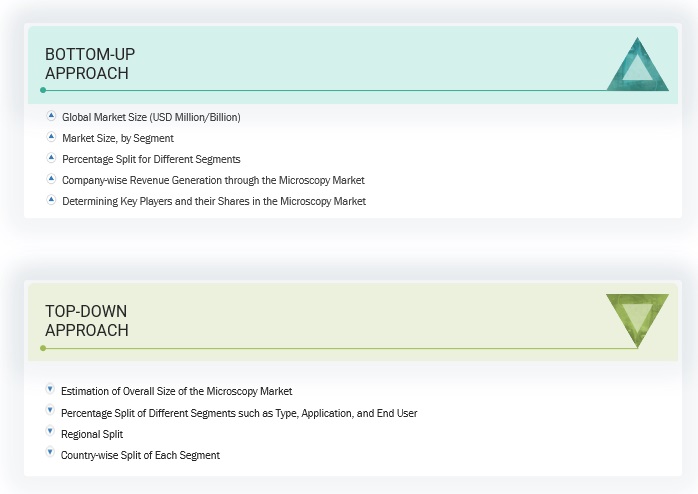
The study effectively strikes a balance between primary and secondary research for microscopy market. Several market variables for both small and medium-sized businesses and the major players are analyzed as part of the research. The study encompassed the identification of significant market segments, emerging patterns, the competitive environment, and the regulatory framework. The study also looks at several important players strategies. The top-down and bottom-up approaches were used to estimate the market size, resulting in data triangulation at the end to determine the final market size estimate. Throughout the course of the investigation, primary research was conducted to verify and test each of the hypotheses.
Secondary Research
The secondary research process extensively utilizes various secondary sources, including directories, databases like Bloomberg Businessweek, Factiva, and D&B Hoovers, white papers, annual reports, company house documents, investor presentations, and SEC filings. This research approach was employed to gather and compile data essential for a comprehensive, technical, and market-focused study of the microscopy market. Additionally, it provided valuable insights into key players, market classification, and segmentation based on industry trends, as well as significant developments related to market and technology perspectives. A database of leading industry figures was also created through secondary research.
Primary Research
For the part of primary research and to obtain qualitative and quantitative data a range of personalities from the supply and demand sides were questioned during the phase of primary research. Key positions from the industry like CEOs, vice presidents, directors of marketing and sales, directors of technology and innovation, and other important leaders were interviewed from key players. Among the demand-side primary sources were academic institutions, research organizations. In order to validate market segmentation, identify prominent market participants, and gain insights into significant industry trends and market dynamics of the real-world primary study was carried out.
A breakdown of the primary respondents is provided below:
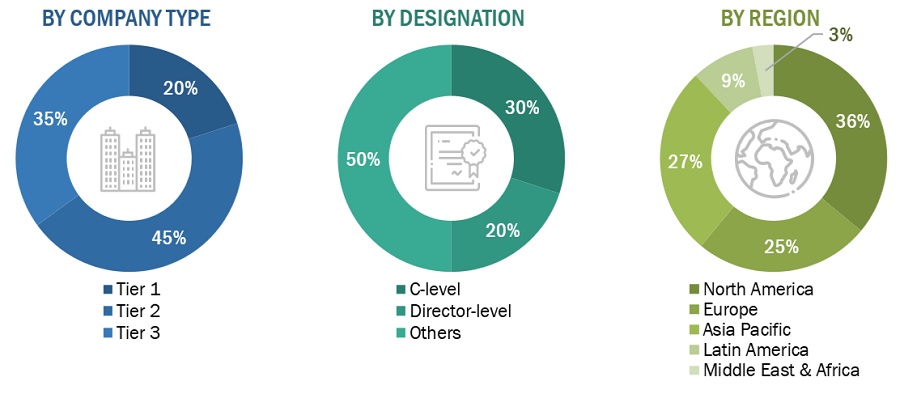
*Others include sales managers, marketing managers, business development managers, product managers, distributors, and suppliers.
Note: Companies are categorized into tiers based on their total revenue. As of 2024, Tier 1 = >USD 1,000 million, Tier 2 = USD 500–1,000 million, and Tier 3 = <USD 500 million.
To know about the assumptions considered for the study, download the pdf brochure
Market Estimation Methodology
Based on a review of key competitors' revenue shares, the size of the worldwide microscopy market was calculated for this report. To achieve this, major market participants were identified, and their microscopy business revenues were calculated using a variety of insights obtained throughout the primary and secondary research stages. Analyzing the annual and financial reports of the leading market participants was one aspect of secondary research. On the other hand, in-depth interviews with important thought leaders, including directors, CEOs, and marketing executives, were a part of the primary study.
For calculation of global market value, segmental revenue was calculated in the basis of revenue mapping of service/product providers. Process involved below mentioned steps:
- List of major players that operates in microscopy market on regional or country level
- Performing product mapping of manufacturers of microscopes and associated product line at country or regional level
- Annual revenue mapping of listed players from the microscopes and associated products/services (or the nearest reported business unit)
- Revenue mapping of major players to cover at least ~70% of the global market share as of 2023.
- Revenue mapping extrapolation for the listed players will drive the global market value for the respective segment.
- Adding market value of all segments and subsegments at last to achieve the actual value of global microscopy market.
To know about the assumptions considered for the study, Request for Free Sample Report
Data Triangulation
After arriving at the overall market size from the market size estimation process explained above, the microscopy market was split into segments and subsegments. Data triangulation and market breakdown procedures were employed to complete the overall market engineering process and arrive at the exact statistics for all segments and subsegments. The data was triangulated by studying various factors and trends from both the demand and supply sides. Additionally, the microscopy market was validated using both top-down and bottom-up approaches.
Market Definition
Microscopes are basically optical instruments utilized to visualize objects on a nanoscale that can't be observed by the naked eye. Microscopy is the process of using a microscope to examine small objects. The technique has numerous applications in life science research, healthcare, semiconductors, and electronics.
Key Stakeholders
- Biotech and Pharmaceutical Companies.
- Pharmaceutical and biotechnology companies
- Manufacturers and suppliers of microscopes, accessories, and software
- Product suppliers, distributors, and channel partners
- Semiconductor product manufacturers
- Automotive industry
- Food & beverage industry
- Medical research institutes and independent research labs
- Academic & research institutes
- Community centers and hospitals
- Regulatory authorities and industry associations
- Venture capitalists and investment firms
Objectives of the Study
- To define, describe, and forecast the microscopy market based on product, product type, type, application, end-user, and region
- To provide detailed information regarding the major factors influencing the growth potential of the microscopy market (drivers, restraints, opportunities, challenges, and trends)
- To analyze the micro markets with respect to individual growth trends, future prospects, and contributions to the microscopy market
- To analyze key growth opportunities in the microscopy market for key stakeholders and provide details of the competitive landscape for market leaders
- To forecast the size of market segments and/or subsegments with respect to five major regions, namely, North America (US and Canada), Europe (Germany, France, the UK, Italy, Spain, and the RoE), Asia Pacific (Japan, China, India, and the RoAPAC), Latin America (Brazil, Mexico, and RoLATAM), and the Middle East & Africa
- To profile the key players in the global microscopy market and comprehensively analyze their market shares and core competencies
- To track and analyze the competitive developments undertaken in the global microscopy market, such as product launches; agreements; expansions; and mergers & acquisitions.
Available Customizations
With the given market data, MarketsandMarkets offers customizations per the company’s specific needs. The following customization options are available for the present microscopy market report:
Product Analysis
- Product matrix, which gives a detailed comparison of the product portfolios of the top five companies
Company Information
- Detailed analysis and profiling of additional market players (up to five)
Geographic Analysis
- Further breakdown of the Rest of Europe microscopy market into Russia, Belgium, Netherlands, Switzerland, Austria, Finland, Sweden, Poland, and Portugal, among others
- Further breakdown of the Rest of Asia Pacific microscopy market into Singapore, Taiwan, New Zealand, Philippines, Malaysia, and other APAC countries
Fact checked
Personalize This Research
- Triangulate with your Own Data
- Get Data as per your Format and Definition
- Gain a Deeper Dive on a Specific Application, Geography, Customer or Competitor
- Any level of Personalization
Let Us Help You
- What are the Known and Unknown Adjacencies Impacting the Microscopy Market
- What will your New Revenue Sources be?
- Who will be your Top Customer; what will make them switch?
- Defend your Market Share or Win Competitors
- Get a Scorecard for Target Partners

Custom Market Research Services
We Will Customise The Research For You, In Case The Report Listed Above Does Not Meet With Your Requirements
Get 10% Free CustomisationTESTIMONIALS

JAYANT RAJPUROHIT
Director of Market Insights, Data and Analytics
SFI Health,
Leading Pharmaceutical Companywww.sfihealth.com/

We at SFI Health approached MarketsandMarkets for an Opportunity Assessment on "Incidence and Prevalence of Focus Indications" as we wanted to know the most attractive HCPs like Physician, Functional MD, Naturopath and Pharmacist. The project was critical for us to ensure our focus on the right target which would enable sustainable growth and profitability for SFI Health. The business insights provided exceeded our expectations and we were extremely impressed. The team at MarketsandMarkets is highly professional and detail oriented and very well understood our business needs. MarketsandMarkets offers a unique combination of expertise and dedicated engagement model. We identified 2 new products to be launched in coming months, based on the research findings provided by MarketsandMarkets. We are happy with the services and would strongly recommend MarketsandMarkets to my peers in the industry.

BEATRIZ DE LA CALLE
Head of Commercial Analytics
Qualicaps,
Leading Pharmaceutical Companywww.qualicaps.com/

We partnered with MarketsandMarkets for an assessment study on hard empty capsules. The team was extremely professional in understanding our business requirements and we received timely responses to all our queries. The market intelligence and the recommendations has met our business requirements. We were extremely impressed to see the final study results; it really exceeded our expectations. The market intelligence offered by MarketsandMarkets, and clarity on next steps will help us achieve our business objective for the Year 2021. We are happy with the services and would strongly recommend MarketsandMarkets to my peers in the industry.

Bob Williams,
Senior Director Business Development & Innovation
Bracco Diagnostics Inc.,
Italian Multinational in life sciences sector and a World Leader in imaging diagnosticsimaging.bracco.com/us-en
We were pleased with targeted insights that MarketsandMarkets identified from a custom study on the 'Radiation Dose Management Solutions Market'. Your team identified and characterized the market participants as well as underlying trends accurately. This study was useful to Bracco in formulating business strategies for our dose monitoring product lines and we thank MarketsandMarkets for the job well done.
Cody Coonradt,
Market Development and Strategy Manager
3M Health Information Systems,
Leader in Health care Coding, Payment & Analytics Solutions.www.3m.com/3M/en_US/health-information-systems-us
The value for our organization comes from three things: depth of research, specificity of segments and being easy to work with. As important as the first two are, the third can't be underestimated. MarketsandMarkets, maybe more than any other research vendor, wants to know what is top of mind for our team and what big questions we are grappling to answer.
Their customer first approach and high value engagement model, have given us great analysis and excellent value for money
- US Microscopy Market
- Canada Microscopy Market
- Germany Microscopy Market
- UK Microscopy Market
- France Microscopy Market
- Italy Microscopy Market
- Spain Microscopy Market
- Brazil Microscopy Market
- Mexico Microscopy Market
- Rest Of Europe Microscopy Market
- Rest Of Asia Pacific Microscopy Market
- Rest Of Latin America Microscopy Market
- Japan Microscopy Market
- China Microscopy Market
- India Microscopy Market
- Australia Microscopy Market
- South Korea Microscopy Market
Growth opportunities and latent adjacency in Microscopy Market






Sullivan
Jun, 2026
After reviewing the Microscopy Market report via the provided source, I observe distinct variation in adoption patterns between life sciences research and industrial quality control, with procurement decisions increasingly tied to resolution requirements and workflow integration..
Nova
Jun, 2026
From a technical standpoint, I note that the Microscopy Market is being reshaped by advancements in super-resolution techniques, electron microscopy enhancements, and growing reliance on AI-based image interpretation for higher analytical precision..