SalesPlay Auto Nurture: From Signal to Conversation
February 24, 2026
Most nurture fails before it starts — generic messages, wrong timing, contacts who don't care. SalesPlay's Auto-Nurture Agent changes the starting point. It begins with what's actually happening inside an account, not a contact list, and builds campaigns around that.
Enterprise sales teams have never sent more outreach. They have also never converted less of it. The problem isn't volume — it's relevance. Most sales nurture programs are built on assumptions: that contacts are ready to buy, that the message will land, that the timing is right. None of those assumptions come from the account itself.
The result is predictable. Sellers write sequences in Salesloft or Outreach. They populate them with contacts from a database. The emails go out. Replies don't come back. Deals stall. Teams interpret silence as disinterest and move on — often from accounts that were actually ready to buy, just not for that message at that moment.
The issue isn't the tool. It's that the outreach is disconnected from what's happening inside the account. The signal came first. The nurture never caught up.
Here is what that fragmented workflow actually looks like on the ground:
These are not edge cases. They are the default state of most enterprise sales teams operating without signal-driven revenue execution. And they are expensive — in time, in missed pipeline, and in relationships that erode because the outreach feels irrelevant.
Concept
Signal-to-action sales is not a buzzword. It is a fundamentally different sequencing of the selling motion. Instead of starting with a contact list and asking "who should we email?", it starts with an account event and asks "what just changed here, and who needs to hear about it?"
The signal is the trigger. A company announces a restructuring. A new CTO joins. Quarterly earnings show pressure on operational costs. A known competitor loses a major contract. Each of these is a moment — and each moment is either a reason to reach out or a reason to stay quiet. The discipline is knowing which one it is, and having the context to act on it without spending two hours researching it first.
Traditional nurture model: Build a sequence ? populate with contacts ? send ? hope
Signal-to-action model: Account event occurs ? opportunity identified ? contacts mapped ? personalized campaign drafted and launched automatically
The difference: One starts from what you want to say. The other starts from what the account needs to hear.
The gap between these two models is where most pipeline gets lost. The first approach generates outreach volume. The second generates conversations. And in enterprise sales, the only metric that matters is conversations that advance.
SalesPlay's sales automation framework is built around this second model. The Auto-Nurture Agent does not exist as a standalone feature — it is the execution layer at the end of a chain that starts with account intelligence and runs through opportunity identification. By the time a nurture campaign is launched, SalesPlay already knows why this account matters, which opportunity triggered the outreach, and what each contact in the buying center needs to hear.
How SalesPlay Works
SalesPlay's Auto-Nurture Agent is not a sequence builder. It does not ask sellers to write copy, pick templates, or guess who to contact. The work that precedes a campaign — research, opportunity identification, contact mapping — has already been done by other agents in the platform before the seller even opens the nurture workflow.
Here is how the full motion works in practice:
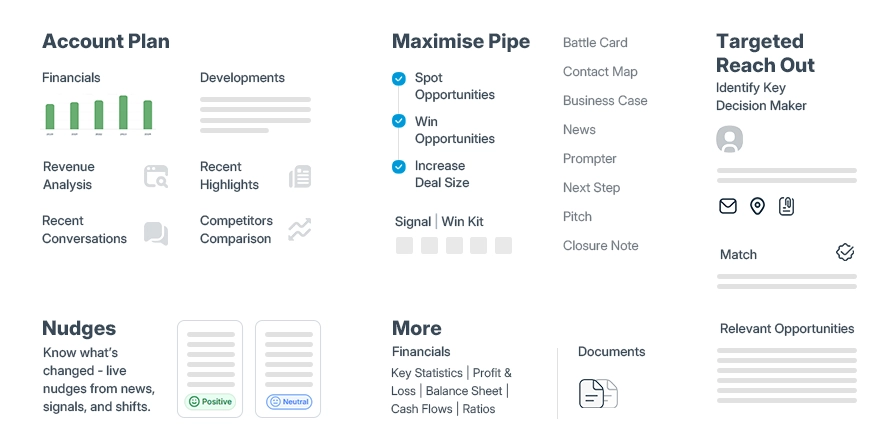
SalesPlay's Account Intelligence and Signals Agents continuously watch target accounts connected via Salesforce. They track financial developments, leadership changes, news, and business movements. When something relevant happens, it is flagged — not buried in a feed, but surfaced with context.
The Spot Opportunities Agent maps account signals to your offerings and identifies where a genuine conversation can be had. Each opportunity is ranked by relevance — high, medium, or low — and shows exactly why it exists, which signal triggered it, and which product offering fits. Sellers review these and decide what to pursue. See how SalesPlay surfaces real pipeline from existing accounts.
For each opportunity, SalesPlay has already identified the relevant contacts in the buying center — their roles, contact details, LinkedIn profiles, and why each opportunity matters to them specifically. There is no separate contact research step. The contacts come with the opportunity.
The seller selects which opportunities to nurture, which contacts to include, how many touches to run, and the timing between them. These are the only decisions required before SalesPlay takes over.
Every email in the campaign is drafted by SalesPlay — personalized by opportunity, by individual contact, and by the account's current situation. Each message is distinct. No two emails in a sequence are the same, and no two contacts in the same account receive identical messaging.
Before anything is sent, the seller reviews the full campaign. They can adjust, remove, or approve. Control remains with the seller. SalesPlay handles execution once approved — scheduling, sending, and tracking the campaign automatically.
This is what makes SalesPlay's approach to opportunity-driven lead nurturing different from general sales automation. The content is not generic. The contacts are not cold. The timing is not arbitrary. Every element of the campaign is grounded in what is actually happening inside the account.
Operational Impact
The operational shift is significant, but it is not disruptive. SalesPlay does not require sellers to learn a new philosophy or change how they think about accounts. It requires them to stop doing the parts of their job that were never the valuable part in the first place.
Instead of allocating 40% of a Monday morning to researching accounts and drafting personalized outreach, the AE opens SalesPlay, reviews the opportunities flagged since their last session, selects what to act on, and approves campaigns that have already been written. The research has been done. The contacts are identified. The messaging is ready.
Account coverage is no longer a question of which sellers have bandwidth. Every account in Salesforce is being monitored. When a signal appears, a nurture campaign can be running within the same session. Managers can see which accounts are active, which campaigns are in flight, and where conversations are starting — without chasing the team for updates.
The gap between signal detection and outreach collapses. Accounts that would previously sit dormant for weeks after a relevant development get touched within the same business cycle. Pipeline from existing accounts becomes more predictable because the coverage is consistent, not dependent on individual seller discipline or bandwidth.
Ramp time shortens because new sellers do not need to inherit tribal knowledge about each account. SalesPlay shows them what is happening, which contacts to engage, and what to say. They can run campaigns on accounts they picked up three days ago with the same quality as a seller who has owned the account for two years.
Decision-Stage Comparison
If you are evaluating sales nurture automation tools, the comparison that matters is not feature-by-feature — it is about where the work starts and who does it.
| Capability | SalesPlay Auto-Nurture | Salesloft / Outreach | Generic Marketing Automation |
|---|---|---|---|
| Starting point | Account signal / live event | Contact list | Segment or form fill |
| Content creation | SalesPlay drafts every email | Seller writes templates | Marketing writes templates |
| Contact identification | Auto-mapped to opportunity | Seller researches manually | Marketing-sourced list |
| Personalization depth | Per contact, per opportunity | Token-based (name, company) | Segment-level only |
| Account context | 5-year history, live signals | Not included | Not included |
| Trigger mechanism | Real account developments | Calendar / manual | Form fill / intent score |
| CRM connection | Salesforce-native | Salesforce integration | Partial / manual sync |
| Seller time required | Review and approve only | Write, build, maintain | Coordinate with marketing |
The comparison with Salesloft and Outreach is instructive: those platforms are excellent execution tools — they automate delivery. SalesPlay automates everything before delivery: the signal detection, the opportunity identification, the contact mapping, and the content generation. By the time SalesPlay asks a seller to do something, the system has already done the research, written the emails, and prepared the campaign.
Platform Architecture
A common misconception about nurture automation is that better email delivery solves the problem. It does not. What fails in most nurture programs is not delivery — it is everything before delivery: the intelligence, the targeting, the messaging strategy. SalesPlay addresses this by treating the Auto-Nurture Agent as the final step in a connected workflow, not a standalone tool.
Here is how the agents connect in a live selling workflow:
This is how revenue intelligence should work in practice — not as a reporting layer, but as an execution system. Each agent feeds the next. The output of intelligence becomes the input for action. And the nurture that results is not generic — it is contextually accurate, individually personalized, and triggered by something real.
For teams evaluating agentic AI in sales, this architecture represents the meaningful shift — away from AI as a writing helper, toward AI as an execution co-pilot that handles the research, drafting, and coordination so sellers can focus on the conversation itself.
Real Workflows
Abstract claims about nurture automation are easy to make. Here is what the actual selling motion looks like when SalesPlay's Auto-Nurture Agent is part of the workflow.
A new VP of Operations joins a target account. SalesPlay's Signals Agent flags it. The Account Intelligence Agent shows that this account has historically made vendor decisions within 90 days of new operational leadership. The Spot Opportunities Agent identifies two relevant opportunities tied to operational efficiency. The Spot Contacts Agent maps the new VP's profile and surfaces two additional stakeholders in the buying center. The seller selects these three contacts, chooses a four-touch campaign over 21 days, and approves the draft SalesPlay has prepared. Each email is written to a different person, from a different angle, but grounded in the same account context. The campaign is live within one working session.
An account that has been quiet for seven months reports earnings pressure in their latest filing. SalesPlay flags it. The Account Intelligence Agent surfaces a five-year revenue pattern and highlights a prior conversation where cost optimization was mentioned. The Spot Opportunities Agent identifies a cost-reduction offering as highly relevant. The seller approves a three-touch campaign to the CFO and the VP of Finance. The first email references the specific earnings context. The second builds on a solution angle. The third offers a direct conversation. The seller did not write any of them.
A seller has an existing relationship with the IT director at a strategic account. SalesPlay's Spot Contacts Agent shows two adjacent buying centers — Procurement and Operations — that are relevant to a new product offering. The seller was not previously engaged with either function. SalesPlay identifies the right contacts in each, maps them to the opportunity, and drafts a separate nurture track for each buying center. The seller reviews both tracks and launches them simultaneously. The account expands without the seller having to start from scratch on research.
Watch how SalesPlay moves from an account signal to a live, personalized campaign — in a single session.
Pipeline Impact
The relationship between nurture and pipeline is often misunderstood. Teams measure nurture by open rates and reply rates. Revenue leaders need to measure it by pipeline contribution — how many conversations started, how many advanced, how many converted to qualified opportunities.
SalesPlay's signal-to-action model changes the pipeline math in three ways:
The downstream effect on pipeline is a higher proportion of conversations that were started for a real reason. Less noise in the pipeline. Fewer accounts that entered because a seller sent a generic touch in week three of a sequence. More accounts that entered because something actually changed, and the right person heard about it in the right way at the right time.
For revenue leaders thinking about pipeline strategy in 2026, the ability to run signal-triggered nurture across all target accounts — without adding SDR headcount — is a structural advantage that compounds over time.
Questions Sales Leaders Ask
When revenue leaders evaluate sales nurture automation platforms, the conversation tends to surface the same underlying concerns. Here is how SalesPlay addresses each of them directly.
SalesPlay reduces what sellers have to do, not adds to it. There is no new interface to learn, no template library to build. Sellers open an account, see what's relevant, select what to act on, and approve a campaign that's already written. Adoption is high because the tool removes friction rather than creating it.
SalesPlay drafts messaging grounded in real account context, financial history, and opportunity-specific signals. The result is not average — it is grounded. Most sellers write better emails when they have full context. SalesPlay provides that context and turns it into copy.
Salesloft automates delivery. SalesPlay automates everything before delivery. The starting point is account intelligence, not a contact list. The content is drafted from real signals, not written from scratch by a seller or BDR. These are different tools solving different problems.
SalesPlay connects directly to Salesforce and watches the accounts already in your CRM. There is no separate data import or account mapping exercise. The accounts you manage today are the accounts SalesPlay watches tomorrow.
Sales nurture automation is the process of running personalized, multi-touch outreach campaigns to prospects and existing accounts without sellers manually writing or scheduling every message. In SalesPlay, this is powered by the Auto-Nurture Agent, which drafts every email based on specific account signals and individual contact context — not templates or generic sequences.
Signal-to-action sales is a model in which real account events — leadership changes, financial results, strategic announcements, or market developments — trigger targeted, contextual outreach. Instead of prospecting on a schedule, sellers respond to what is actually happening inside accounts. SalesPlay makes this possible at scale by continuously monitoring accounts and surfacing the moments that warrant outreach.
The seller selects target opportunities and relevant contacts, defines the number of touches and timing, then approves the campaign. SalesPlay drafts every email, personalizes each one by opportunity and individual contact, ensures every message is distinct, and runs the campaign automatically. No two emails are the same, and no contact in a buying center receives identical messaging to another.
Salesloft and Outreach are sequence execution platforms — they automate delivery but require sellers to write the content and manually identify who to contact. SalesPlay's Auto-Nurture Agent starts from account signals and opportunity context, identifies the right contacts automatically, writes all the emails, and executes the campaign. The starting point is account intelligence, not a contact list. These tools solve different problems.
Yes. Sellers can select multiple contacts within a target account or buying center and run a coordinated nurture campaign. Each email is personalized to the individual's role and the specific opportunity relevant to them. Different stakeholders in the same account receive different messaging — tailored to their function and why the opportunity matters to them specifically.
SalesPlay replaces the manual, fragmented work that precedes prospecting: the research, the contact identification, the messaging strategy, and the content drafting. Sellers still make the strategic decisions — which opportunities to pursue, which campaigns to approve. SalesPlay handles the execution. Seller judgment stays in the loop. Repetitive preparation work comes out of it.
Enterprise sales teams covering large named account lists benefit most — particularly account executives managing 20 to 50+ accounts, overlay teams expanding coverage, new sellers ramping on inherited accounts, and RevOps leaders trying to achieve consistent account coverage without adding SDR headcount.


Category: Uncategorized Tags: ai, AIOps, Artificial Intelligence, cloud, cloud platform, Cybersecurity, Information and Communications Technology , VR