How Sales Teams Build Pipeline Without Cold Outreach
February 10, 2026
Attention: Your inbox is saturated. So is theirs. Cold email response rates have collapsed to 3.43% in 2026—down from 8.5% just a few years ago. For every 100 cold emails sent, 96 vanish into the void. Interest: Meanwhile, a different approach is quietly outperforming traditional prospecting by 400%. Elite enterprise sales teams are building pipeline without cold outreach—not through volume plays or generic sequences, but through intelligence-led engagement. They watch accounts. Track changes. Connect movement to opportunity. Then act when it matters. Desire: This shift isn't about tools. It's about replacing guesswork with certainty. Instead of interrupting strangers, these teams engage stakeholders who already have a reason to listen. They create warm pipeline from existing target accounts, achieving 10-20% response rates where cold outreach delivers single digits. Action: The method? Account-based selling powered by market intelligence and predictive capabilities. Here's how it actually works—and why it's replacing cold outreach as the primary pipeline generation engine for companies that need predictable revenue growth.
Cold outreach isn't just ineffective. It's deteriorating.
The average cold email open rate dropped from 36% in 2023 to 27.7% in 2024. Response rates fell from 7% to 5.1% in the same period. By early 2026, the overall reply rate sits at 3.43%—meaning 96.57% of cold emails generate zero engagement.
Three forces are accelerating this decline:
Inbox Saturation. Decision-makers receive an average of 121 business emails daily. 37% report receiving more than 10 outbound sales emails per week. 20% say none are relevant to their actual needs. When everyone has access to the same automation tools, volume becomes noise.
Sophisticated Filtering. Email providers now evaluate sender reputation based on engagement quality—time spent reading, reply depth, conversation length. Generic outreach triggers spam filters before it reaches human eyes. Roughly 17% of cold emails never reach the inbox. Another 57% land outside the primary folder without proper authentication and warmup protocols.
Buyer Skepticism. 71% of decision-makers ignore emails that don't address their specific challenges. They've learned to spot template-driven outreach instantly. The problem isn't just low response rates. It's that cold outreach interrupts people who aren't ready to buy, creating negative brand associations before a relationship even begins.
The underlying issue runs deeper. Cold outreach operates on a broken assumption: that someone will care about your solution simply because you contacted them. But only 5% of B2B accounts are actively in-market at any given time. The other 95% aren't ready. Reaching them earlier doesn't create urgency. It creates annoyance.
This is why account-based selling is replacing cold outreach as the foundation of enterprise pipeline generation. Instead of interrupting strangers, it engages known accounts when they're actually showing buying signals.
Building pipeline without cold outreach means creating opportunities through intelligence, timing, and relevance—not volume.
The shift is operational. Instead of prospecting into darkness, sales teams watch target accounts continuously. They track what's changing inside those organizations. They connect business movement to opportunity. Then they act when the account shows intent.
This approach produces warm pipeline: opportunities where the account already has a reason to engage. No forced conversations. No interruptions. No spray-and-pray sequences hoping 3% respond.
Start with defined target accounts. Account-based selling begins with a specific list of high-value accounts that match your ideal customer profile. These aren't random prospects. They're companies you've chosen to pursue strategically. The average company dedicates 29% of its marketing budget to account-based programs—a reflection of the strategic commitment required.
Watch those accounts continuously. Modern account intelligence platforms track multi-source changes: financial filings, leadership appointments, office expansions, strategic initiatives, product launches, technology stack shifts, hiring patterns, regulatory filings. This isn't manual research. It's automated surveillance that flags relevant developments as they happen.
Identify opportunities from signals. Not every change matters. Elite teams use sales intelligence to filter noise from signal. They look for specific patterns: budget allocation shifts that align with their offerings, new executive hires in relevant functions, expansion announcements that indicate capacity constraints, technology implementations that create adjacent needs, regulatory changes that force process updates.
Engage with context. When an account shows a relevant signal, outreach isn't cold. The seller references the specific development. Explains why it matters. Connects it to a business outcome. Provides value immediately—not in exchange for a meeting, but as part of the initial contact. This is why 84% of marketers now use intent data to enhance personalization within their campaigns.
Time engagement to readiness. The difference between cold and warm isn't just context. It's timing. Cold outreach contacts people who aren't ready. Warm pipeline generation waits for signals that indicate the account is approaching a decision window. This patience creates dramatically higher conversion rates.
Companies implementing account-based approaches report 16% more opportunities tracked all the way to closed-won. They see 28% faster sales cycles. 58% report larger deal sizes. The overall ROI averages 137%—significantly higher than traditional demand generation.
The method scales differently than cold outreach. Instead of sending 1,000 emails hoping for 30 responses, teams send 100 highly-targeted messages and receive 15-20 quality conversations. Lower volume. Higher precision. Better outcomes.
Account intelligence is what separates warm pipeline from wishful thinking.
It's the operational system that tracks target accounts, identifies opportunity signals, and provides the context sellers need to engage relevantly. Without it, account-based selling remains conceptual—a strategy with no execution mechanism.
At its core, account intelligence consolidates fragmented information about target accounts into a single, dynamic view. Instead of jumping between news sites, LinkedIn, financial databases, CRM notes, and industry reports, sellers see everything that matters in one place.
Financial context. Revenue trends over time. Profitability patterns. Capital raises. M&A activity. Debt levels. Cash flow indicators. This data reveals whether an account has budget capacity and growth trajectory.
Organizational changes. Executive appointments. Department restructures. Headcount expansion. Office openings. New facilities. Each signals strategic direction and potential need states.
Strategic initiatives. Product launches. Market expansions. Technology implementations. Partnership announcements. Regulatory compliance requirements. These create specific, time-bound opportunities.
Business developments. Earnings calls. Investor presentations. Press releases. Industry awards. Customer case studies. Competitive moves. All provide conversation starters grounded in the account's actual priorities.
Historical context. Past conversations. Previous proposals. Relationship history. Stakeholder changes. This prevents sellers from restarting relationships as if prior engagement never happened.
The value isn't just having this information. It's having it automatically updated as accounts change. Traditional account research becomes outdated the moment it's completed. Intelligence platforms maintain current context without manual effort.
The next evolution of account intelligence is prediction. Instead of just tracking what's happening, advanced systems identify patterns that indicate future buying intent.
Predictive models analyze combinations of signals: an account hiring for specific roles, implementing certain technologies, expanding into new markets, and showing financial growth simultaneously. Individually, these might mean nothing. Together, they suggest the account is approaching a buying window for solutions like yours.
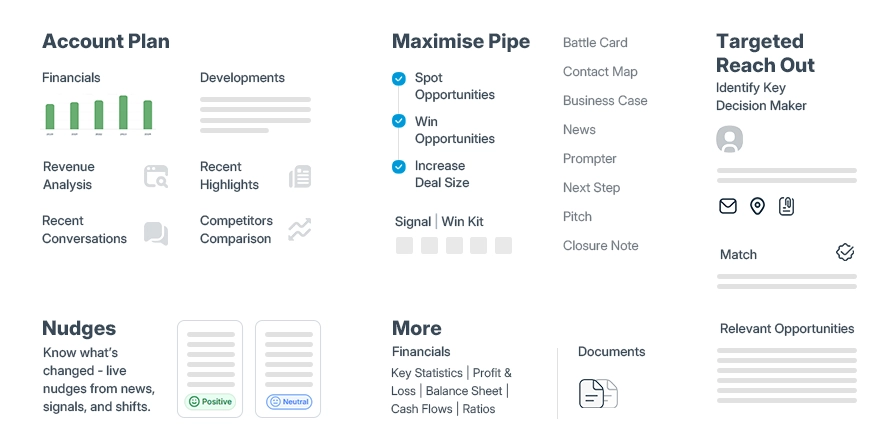
This is where SalesPlay: AI Sales and Revenue Intelligence Co-pilot distinguishes itself. Rather than presenting sellers with raw data requiring interpretation, SalesPlay connects business movements directly to opportunities. It doesn't just show that an account expanded into a new region—it explains why that expansion creates a specific need your offering addresses, identifies which buying center will own the decision, and provides battle-tested messaging to open the conversation.
The platform continuously watches Salesforce-connected target accounts. When it detects relevant changes, it surfaces opportunities ranked by likelihood. For each opportunity, sellers see the triggering signal, supporting sub-signals, which product offering fits, and the associated buying centers. This turns account intelligence from background research into actionable pipeline.
91% of B2B tech marketers now use intent data to prioritize accounts. But intent data only matters if it translates into seller action. The gap between "knowing something changed" and "knowing what to do about it" is where most intelligence investments fail. Bridging that gap requires connecting signals to specific opportunities, opportunities to contacts, and contacts to ready-to-send messaging.
This operational translation is what transforms account intelligence from a research tool into a pipeline generation engine.
Account-based selling isn't a tactic. It's a go-to-market architecture.
Where traditional selling focuses on individual leads, account-based selling treats entire organizations as units. Multiple stakeholders. Multiple buying centers. Multiple opportunities within the same account. The goal isn't a single transaction. It's establishing a strategic relationship that generates sustained revenue.
71% of organizations now implement an account-based strategy. The adoption reflects a fundamental shift in how B2B companies approach markets. Rather than casting wide nets hoping to catch anything, they select specific whales worth pursuing intensively.
Step 1: Define the target account list. Account-based selling begins with focus. Teams select 50-500 accounts (depending on team size and sales cycle complexity) that represent the highest potential value. Selection criteria include: revenue size, growth trajectory, technology fit, geographic presence, competitive landscape, existing relationship strength, strategic importance.
This selectivity is intentional. By concentrating resources on fewer, higher-value accounts, teams can afford the deep research, multi-threaded engagement, and long-term relationship building that enterprise deals require. Companies implementing account-based marketing see a 60% higher win rate when they align it with account-based advertising—proof that concentrated effort beats distributed attention.
Step 2: Build comprehensive account plans. For each target account, teams develop a dynamic plan covering: key stakeholders and their roles, current technology stack and vendors, known pain points and initiatives, competitive relationships, engagement history, opportunity pipeline, relationship map, engagement strategy.
Traditional account plans sit in documents that become outdated within weeks. Modern AI sales tools keep these plans alive. As accounts change, plans update automatically. Sellers always see current context without manual research.
Step 3: Monitor for opportunity signals. With target accounts defined and base plans established, the focus shifts to watching for signals. This is where account intelligence becomes operationally critical. Teams track: organizational changes indicating new decision-makers, strategic initiatives creating budget allocation, technology implementations suggesting capability gaps, expansion activities implying scaling challenges, financial events affecting buying capacity, competitive displacements opening vendor relationships, regulatory requirements forcing process changes.
72% of successful account-based programs use account-specific content to engage targets. But creating that content requires knowing what's happening inside each account right now—not three months ago.
Step 4: Engage with relevance and timing. When an account shows a meaningful signal, engagement becomes contextual. Instead of generic outreach explaining your product, sellers reference the specific development, connect it to business impact, and offer immediate value. This isn't pitching. It's demonstrating that you understand their situation and can help them navigate it.
Response rates reflect the difference. Cold outreach achieves 3-5%. Well-timed, signal-based outreach to target accounts achieves 10-20%. The same message. Different timing. Wildly different outcomes.
Step 5: Orchestrate across buying centers. Enterprise deals involve multiple stakeholders. Account-based selling recognizes this complexity by coordinating engagement across the entire buying committee—not just a single champion. Teams identify: technical evaluators, economic buyers, business sponsors, end users, legal and compliance gatekeepers, implementation partners.
Each receives tailored messaging addressing their specific concerns. Technical stakeholders get implementation details. Economic buyers see ROI models. Business sponsors hear strategic impact. This multi-threading prevents deals from stalling when a single champion leaves or loses internal support.
Step 6: Measure and optimize. Account-based selling produces different metrics than volume-based prospecting. Instead of tracking activity (emails sent, calls made), teams measure: account engagement depth, opportunity creation rate, deal velocity by account tier, expansion revenue within accounts, competitive win rate, customer lifetime value.
Only 52% of companies measure ROI from their account-based programs. But the most effective programs are 30% more likely to track returns rigorously. Measurement enables optimization. Without it, account-based selling remains a philosophy rather than a performance system.
Theory doesn't build pipeline. Execution does.
Here's what the actual workflow looks like for teams building warm pipeline without cold outreach:
Sellers start their day reviewing account changes. Not manually searching news sites. Reviewing a consolidated feed of developments across their target account portfolio. An intelligence platform has already filtered thousands of data points overnight. It surfaces what matters: Company X hired a new VP of Operations, Company Y announced Q3 earnings showing 40% growth, Company Z filed regulatory documents indicating market expansion.
For each development, the system explains potential relevance. The VP hire creates a new decision-maker who will review existing vendor relationships. The earnings growth suggests budget capacity for expansion initiatives. The market expansion indicates need for supporting infrastructure.
This review takes 15 minutes. It replaces hours of manual research.
Based on overnight signals, the system has identified 8 potential opportunities across 5 target accounts. Not raw signals requiring interpretation. Specific opportunities with context: why they exist, what signal triggered them, which product offering fits, which contacts should be engaged.
The seller reviews each opportunity, evaluates fit, and decides whether to pursue. Three get moved into active pipeline. Two get monitored for additional signals. Three get dismissed as not relevant.
For the three active opportunities, the system has already: identified the buying center, pulled relevant contact information, generated initial messaging based on the triggering signal, suggested next steps, provided battle cards and talking points.
The seller doesn't start from scratch. They review, customize, and approve.
Outreach happens with full account context. Not "I wanted to reach out because..." but "I noticed your recent expansion into the Southeast region—based on what we've seen with similar growth patterns at [similar customer], there are usually capacity challenges around [specific area]. Thought it might be worth a conversation."
The message references something real. Connects it to a pattern. Offers specific value. Doesn't ask for time without giving a reason.
This isn't cold. It's informed. The account knows you're paying attention. The contact sees immediate relevance. The conversation starts from value exchange, not interruption.
For opportunities already in motion, sellers access dynamic deal context. What's changed in the account since the last conversation. Which stakeholders have been added to the buying committee. What competitors are involved. Which objections have surfaced. What next steps make sense.
This continuous context prevents deals from stalling due to outdated information. When a key stakeholder changes roles, the system flags it. When the account announces a budget freeze, sellers know immediately. When a competitor wins a different deal at the account, that intelligence surfaces.
Traditional CRM requires manual updates to stay current. Intelligence-powered selling updates automatically.
Before logging off, sellers review pipeline health across their target accounts. Which deals need attention. Which opportunities should be nurtured. Which accounts have gone quiet and need re-engagement.
The system recommends actions: follow up with this contact, send updated proposal to this buying center, schedule check-in with this account, investigate this competitive development.
Pipeline management becomes proactive rather than reactive.
This workflow doesn't eliminate seller judgment. It eliminates the manual work that prevents sellers from using their judgment effectively. Less time researching. More time engaging. Less guesswork. More certainty.
The performance difference isn't incremental. It's structural.
Relevance beats interruption. Cold outreach hopes your message resonates. Intelligence-led engagement knows it will—because it's timed to actual account needs. When you contact someone about a challenge they're actively facing, response rates jump from 3% to 15%+. The message quality didn't change. The timing did.
Context creates credibility. Generic outreach signals you're one of hundreds sending similar messages. Account-specific engagement demonstrates you've done your homework. You're not guessing about their situation. You know what's happening because you're watching. That attention builds trust before the first conversation happens.
Precision compounds efficiency. Cold outreach is a volume game. Send 1,000 emails, get 30 responses, book 5 meetings, close 1 deal. Intelligence-led engagement inverts the math: target 50 accounts, engage 30 based on signals, book 12 meetings, close 4 deals. Same result. 95% less noise. Significantly better economics.
Quality deals accelerate. When opportunities start from genuine need rather than created interest, they progress faster. There's no "educate the market" phase. No "create urgency" struggle. The urgency already exists. Your job is helping the account solve the problem, not convincing them they have one. This is why account-based approaches see 28% faster sales cycles.
Relationships outlast transactions. Cold outreach optimizes for immediate conversion. Account-based selling builds sustained relationships. Even when an account isn't ready to buy today, continuous attention ensures you're positioned when they are ready. This long-term perspective creates expansion opportunities that transactional approaches miss.
60% of companies report that account-based programs increase customer lifetime value. The relationship doesn't end at initial purchase. It deepens through ongoing attention to the account's evolving needs.
Sales and marketing actually align. Cold outreach often creates misalignment. Marketing generates leads. Sales complains about quality. Marketing blames sales for not following up. Account-based selling forces alignment because both teams focus on the same target accounts. 67% of organizations say account-based approaches lead to stronger sales and marketing alignment. When everyone watches the same accounts and responds to the same signals, finger-pointing disappears.
Competitive positioning improves. Competitors still doing cold outreach train buyers to ignore them. Meanwhile, your team demonstrates expertise through timely, relevant engagement. When the account eventually enters a buying cycle, they remember who paid attention versus who sent generic templates. This positioning advantage often matters more than product differentiation.
"We don't have enough target accounts to build meaningful pipeline."
False constraint. Most companies have more target accounts than they can properly engage. The issue isn't quantity. It's that traditional prospecting spreads effort across too many accounts without achieving depth anywhere. Account-based selling works with 50 accounts or 500—the difference is team size and intensity per account, not the fundamental approach.
"This takes too long. We need pipeline now."
Intelligence-led engagement produces faster pipeline than cold outreach, not slower. Yes, building the account list and implementing intelligence infrastructure requires upfront investment. But once operational, the system identifies opportunities continuously. Many teams see pipeline contribution within 30 days. Cold outreach might generate faster activity, but intelligence-based methods generate faster revenue.
"Our team doesn't have time to research accounts deeply."
Exactly why automation matters. Manual account research is indeed time-prohibitive. That's why intelligence platforms exist—to eliminate the research burden while providing better insights than manual methods ever could. Sellers who previously spent hours per account on research now spend minutes reviewing pre-filtered signals.
"We need more leads, not fewer accounts."
Lead volume is a vanity metric. Revenue comes from closed deals, not contacted prospects. Account-based selling produces fewer opportunities—but each carries higher win probability and larger deal size. Would you rather work 100 low-quality leads with 2% close rate, or 20 high-quality opportunities with 20% close rate? The second scenario produces 2x the revenue with 80% less effort.
"What if our target accounts don't have immediate need?"
That's exactly why you watch them continuously. Only 5% of B2B accounts are in-market at any moment. Account-based selling doesn't require immediate need—it positions you to engage when need emerges. By monitoring target accounts, you catch buying signals as they develop, before they become obvious to competitors. This early positioning creates competitive advantage.
"This sounds expensive."
Compare total cost, not tool cost. Cold outreach platforms seem cheap until you factor in: seller time writing personalized sequences, low response rates requiring massive volume, damaged sender reputation from spam complaints, wasted effort on unqualified conversations, longer sales cycles from poor targeting, higher customer acquisition cost from low conversion. Account-based approaches cost more upfront but deliver 137% average ROI—significantly better than traditional methods.
Knowing the strategy and executing it are different challenges.
Here's the operational sequence for teams shifting from cold outreach to intelligence-led pipeline generation:
Define your target account list. Start with existing customers who match your ideal profile. Expand to prospects that look like your best customers. Aim for 10-20 accounts per seller initially—enough to build pipeline, small enough to manage deeply. Selection criteria should include: revenue size matching your deal range, growth indicators suggesting budget capacity, technology stack alignment, strategic fit with your offerings, geographic accessibility if field selling matters.
Implement intelligence infrastructure. Choose an account intelligence platform that integrates with your CRM and provides automated signal tracking. SalesPlay connects directly to Salesforce, continuously monitoring target accounts and surfacing opportunities without manual data entry. The platform should reduce research time, not create new admin work.
Establish baseline account plans. For each target account, document what you currently know: key contacts and their roles, past engagement history, known initiatives or pain points, competitive relationships, opportunity status. This baseline will be enriched automatically as intelligence accumulates, but starting with tribal knowledge prevents information loss.
Start monitoring and engaging. With intelligence flowing, begin the daily review routine. Each morning, review overnight signals. Evaluate opportunities. Decide which warrant engagement. For pilot purposes, focus on quality over volume. Better to properly work 5 opportunities than superficially touch 20.
Develop messaging frameworks. Create templates for common opportunity types, but leave room for customization based on specific account signals. For example: expansion opportunities get messaging focused on scaling challenges, new executive hires get messaging about vendor evaluation, technology implementations get messaging about integration or adjacent capabilities, financial growth gets messaging about capacity constraints.
Track pilot metrics. Measure: number of opportunities identified per week, percentage of opportunities engaged, response rate on initial outreach, meeting conversion rate, time from signal to first contact, deal velocity compared to cold-sourced opportunities. These baselines establish what "good" looks like for your team.
Expand account coverage. Based on pilot learnings, gradually increase target account list. Add 10-20 accounts per seller per month until reaching optimal capacity. Most teams find 30-50 accounts per seller sustainable for deep engagement, though this varies by sales cycle complexity.
Refine opportunity scoring. Not all signals indicate equal opportunity. Use pilot data to identify which signal types convert best. Prioritize those. Some teams find executive changes generate highest engagement. Others see strongest pipeline from financial events or strategic initiatives. Let data guide prioritization.
Integrate with existing processes. Intelligence-led engagement shouldn't replace your entire sales process—it feeds into it. Opportunities identified through signals enter your standard pipeline stages. Deals progress through normal qualification and closing workflows. The difference is input quality, not process structure.
Build cross-functional alignment. Share target account lists with marketing. Ensure they're running complementary campaigns to those accounts. Coordinate messaging so sellers reference campaigns and marketing leverages sales insights. This alignment is why 67% of account-based programs improve sales and marketing collaboration.
Continuously improve signal interpretation. As your team gains experience, pattern recognition improves. You'll learn which combinations of signals indicate serious buying intent versus background noise. Document these patterns so new team members inherit accumulated wisdom.
Expand intelligence sources. Start with basic signals—news, financial filings, executive changes. Over time, incorporate more sophisticated inputs: website traffic from target accounts, technology stack changes, competitor intelligence, partnership announcements, regulatory filings specific to your industry.
Measure business impact. Track how intelligence-sourced opportunities perform compared to other pipeline sources: win rate, average deal size, sales cycle length, expansion revenue, customer lifetime value. Use this data to justify continued investment and guide resource allocation.
Implementation doesn't require perfection upfront. It requires starting with a focused pilot, learning quickly, and scaling what works. Teams that wait for perfect processes never start. Teams that start imperfectly and iterate rapidly see results within quarters.
Cold outreach isn't disappearing completely. But its role is shrinking.
As intelligence platforms become more sophisticated and accessible, the performance gap between random prospecting and signal-based engagement will widen. Buyers will increasingly ignore generic outreach while rewarding sellers who demonstrate account-specific knowledge.
Several trends are accelerating this shift:
AI agents handling research and sequencing. Elite teams already use AI to process ~80% of account research and initial sequencing work. This automation doesn't replace seller judgment—it frees sellers to focus on positioning, messaging strategy, and high-value conversations. By 2027, this capability will be table stakes, not competitive advantage.
Intent signals becoming more precise. Early intent data was crude—website visits, keyword searches, content downloads. Next-generation signals combine behavioral data with business context: not just "they visited our pricing page" but "they visited pricing while hiring for this role, after this organizational change, in the context of this strategic initiative." This precision enables right-time outreach at scale.
Email providers prioritizing engagement quality. Deliverability increasingly depends on recipient engagement—not just whether they open your email, but whether they actually read it, respond to it, continue the conversation. Generic outreach that gets ignored will be penalized with spam placement. Relevant engagement that sparks conversations will be rewarded with inbox priority. This creates a virtuous cycle favoring quality over volume.
Account-based approaches converging. The lines between account-based marketing, account-based selling, and account-based sales intelligence are blurring. Teams are building unified account engagement engines where marketing, sales, and customer success all work from the same intelligence, target the same accounts, and coordinate across the customer lifecycle. This integration creates the sustained attention that drives customer lifetime value.
Predictive capabilities moving upstream. Current intelligence platforms mostly track what's happening now. Next-generation systems will predict what's likely to happen next—forecasting organizational changes, budget cycles, technology refresh windows, competitive vulnerabilities. This predictive layer enables proactive engagement before opportunities become obvious.
The global account-based marketing market is projected to reach $2.02 billion by 2031, growing at 11.94% CAGR. But market size understates real adoption. As platforms mature and ROI becomes undeniable, account-based approaches will shift from "innovative strategy" to "standard operating procedure."
Companies not making this shift will find themselves outmaneuvered by competitors who engage better, faster, and more relevantly. The question isn't whether this evolution happens—it's whether your team leads it or gets left behind.
Cold outreach worked when inboxes were emptier and buyers were less sophisticated. Those conditions no longer exist.
Modern pipeline generation isn't about reaching more people. It's about reaching the right people at the right time with the right message. That requires intelligence, not volume. Context, not interruption. Timing, not persistence.
Teams building warm pipeline without cold outreach understand this shift. They've stopped spray-and-pray prospecting in favor of watched-account engagement. They've replaced generic messaging with signal-based relevance. They've moved from hoping prospects care to knowing they will—because they're engaging when accounts actually need what they sell.
The results speak clearly. Higher response rates. Faster sales cycles. Larger deals. Better alignment. Sustained relationships. Predictable revenue.
This isn't the future of selling. It's the present for companies that need to win strategically rather than randomly. The question isn't whether to make this shift. It's how quickly you can implement it before your competitors do.
Start small. Pick 20 target accounts. Implement intelligence infrastructure. Watch for signals. Engage with context. Measure what works. Scale systematically.
Pipeline doesn't require cold outreach. It requires knowing where to look, what to watch, and when to act. The teams that master this capability will dominate their markets while others keep sending emails into the void.
See how SalesPlay helps enterprise sales teams spot opportunities 3-5 weeks earlier, engage with perfect timing, and achieve 10-20% response rates on target accounts.
Book Your Personalized DemoSales teams build pipeline without cold outreach by using account intelligence to track changes within target accounts, identifying opportunities through business signals and developments, engaging contacts with relevant context based on actual account movements, and timing outreach when accounts show buying intent. This approach achieves 10-20% response rates compared to cold outreach's 1-5%.
The key difference is replacing interruption with intelligence. Instead of contacting random prospects hoping they care about your solution, you watch specific target accounts continuously, identify when they show signals indicating need, and engage with context that demonstrates you understand their situation. This transforms cold interruptions into warm, relevant conversations. Learn more about pipeline generation using account signals.
Cold outreach contacts prospects without prior relationship or context, typically achieving 1-5% response rates. Warm pipeline generation leverages existing relationships, account intelligence, and buying signals to engage prospects when they have an actual need, achieving 10-20% response rates. The difference is timing, relevance, and context.
Cold outreach operates on hope—hoping your message resonates, hoping the timing is right, hoping the prospect has budget. Warm pipeline generation operates on knowledge—knowing the account is experiencing a relevant change, knowing which stakeholders are involved, knowing what messaging will resonate because it's based on specific developments. Explore opportunity-driven lead nurturing for deeper insights.
Account-based selling is a strategic approach where sales and marketing teams align around high-value target accounts, delivering personalized experiences based on deep account intelligence. It helps build pipeline by focusing resources on accounts showing buying signals, enabling relevant conversations, and creating opportunities before they become obvious to competitors. 67% of organizations report that account-based approaches lead to stronger sales and marketing alignment.
Instead of treating individual leads independently, account-based selling views entire organizations as strategic targets. This enables multi-threaded engagement across buying committees, sustained attention over long sales cycles, and relationship development that produces both initial deals and expansion revenue. Read about operationalizing account intelligence for practical implementation.
Market intelligence tracks business changes, financial developments, hiring patterns, and strategic initiatives within target accounts. Predictive capabilities analyze these signals to identify buying intent before it becomes obvious. This enables sales teams to engage at the right moment with relevant value propositions, turning 5% of in-market accounts into quality pipeline opportunities.
The combination creates competitive positioning advantage. While competitors wait for obvious buying signals like RFPs or inbound inquiries, intelligence-powered teams engage earlier when they can shape requirements and establish relationships. This early positioning often determines deal outcomes before formal evaluation processes even begin. Discover how AI-powered pipeline forecasting enhances prediction accuracy.
Cold outreach typically achieves 1-5% response rates, with the 2026 average at 3.43%. Account-based approaches with proper intelligence and timing achieve 10-20% response rates on targeted segments. Companies implementing account-based marketing report 16% more opportunities, 28% faster sales cycles, and 137% average ROI.
The performance difference stems from relevance and timing. When you contact someone about a challenge they're actively facing, using context that demonstrates you understand their situation, response rates reflect that relevance. The message itself might be similar to a cold outreach template, but the timing and context transform how it's received. Learn advanced strategies in our guide to intelligent lead nurture.


Category: Uncategorized Tags: ai, AIOps, Artificial Intelligence, cloud, cloud platform, Cybersecurity, Information and Communications Technology , VR