Modern Sales Teams Don't Have a Lead Problem — They Have a Timing Problem
Your pipeline looks full. Your CRM shows activity. Your reps are hitting dial metrics.
But deals aren't closing.
The problem isn't volume. It's not effort. Your team is working harder than ever — researching accounts, personalizing outreach, updating Salesforce, attending pipeline reviews.
Yet pipeline velocity hasn't improved. Win rates stay flat. Forecast accuracy remains a guess.
Here's what's actually happening:
Pipeline looks full but closes poorly. Your CRM shows 200 open opportunities. Half are stale. A quarter will never close. The rest are poorly timed. Reps work everything equally because they can't tell which deals actually matter.
Reps research accounts randomly. Sarah spends Tuesday morning researching accounts for Thursday's pipeline gen. By Thursday, three of those accounts announced layoffs. Two got acquired. Sarah's research is already outdated. She sends the emails anyway.
Outbound is activity-based, not signal-based. Your team touches 50 accounts this week because that's the quota. Not because those 50 accounts showed buying movement. Not because timing aligned. Because the activity dashboard needed to be green.
CRM shows history, not opportunity. Your CRM tells you what happened. Last meeting was August 12th. Deal stage is "Qualification." Next step is "Follow up." It doesn't tell you that the account just hired a new CTO. Or that their largest competitor announced a product that makes yours suddenly relevant. Or that budget cycles shifted and your deal timing just improved.
The gap isn't information. It's action.
Your sales team is working harder than ever — but reacting instead of acting.
They react to inbound leads. They react to requests for proposals. They react when deals stall. They react when champions leave. They react when competitors move faster.
Reactive selling feels like productivity. It isn't. It's scrambling.
Why the Current Sales Stack Fails
The modern sales stack promised to solve this. CRM would centralize everything. Intent data would show who's ready. Sales engagement platforms would automate outreach.
Instead, you have more tools and less clarity.
Here's why the stack doesn't work:
CRM: Records Past Interactions, Doesn't Indicate When to Act
Your CRM is a system of record, not a system of execution.
It shows you:
-
Last contact date
-
Deal stage
-
Opportunity amount
-
Activity history
It doesn't show you:
-
Which accounts moved today
-
Who you should work right now
-
What changed that creates opportunity
-
When to engage next
CRMs were built to track what happened, not guide what should happen. They capture the past. Sales happens in the present.
Your reps log into Salesforce and see 150 open opportunities. The system doesn't tell them which three to work today. So they work the loudest ones. The ones where someone replied. The ones due this quarter. The ones their manager asked about.
Not the ones most likely to close.
CRM created visibility. It didn't create direction. Learn more about the limitations of traditional CRM systems and how AI CRM agents are beginning to address these gaps.
Intent Data: Shows Research Behavior, Doesn't Show Buying Readiness
Intent data tells you which accounts are researching topics related to your category.
That's useful. It's not predictive.
Someone downloading a whitepaper doesn't mean budget is approved. Traffic to your pricing page doesn't mean a decision is imminent. Increased web visits don't indicate timing.
Intent shows interest. It doesn't show readiness.
The gap: hundreds of accounts show intent signals every week. Most aren't ready to buy. Your team wastes time chasing research activity instead of buying movement.
Intent data became another alert to manage, not a trigger to act on. Understanding the difference between intent data and buying signals is critical for modern sales execution.
Manual Research: Consumes Time, Occurs After Opportunity Is Obvious
Your best reps spend 6-8 hours per week researching accounts.
They scroll LinkedIn. They read earnings calls. They check news sites. They review Crunchbase. They ask colleagues what they know.
By the time research is done, the window has often shifted. The account hired someone. The initiative changed. The budget moved.
Manual research is slow. Opportunities move fast.
Worse: research happens inconsistently. Your top performer spends an hour per account. Your new hire spends 10 minutes. Account coverage quality depends entirely on who owns the account.
This doesn't scale. It doesn't create predictability.
The modern stack captures data — but doesn't guide action.
You have visibility without direction. Activity without timing. Information without execution.
The tools tell you what's happening. They don't tell you what to do about it.
The Shift From Data-Driven Sales ? Signal-Driven Execution
The future of enterprise selling isn't more data. It's better triggers.
Here's the distinction:
|
Data |
Signals |
|
Static |
Time-sensitive |
|
Informational |
Actionable |
|
Historical |
Predictive |
|
Stored in CRM |
Triggers workflows |
Data describes what is. Signals indicate what's changing.
Data tells you an account has 5,000 employees, $800M in revenue, and uses Salesforce. Useful for qualification. Not useful for timing.
Signals tell you that account just:
-
Hired a VP of Sales
-
Announced expansion into EMEA
-
Posted three new SDR roles
-
Raised $50M in Series C
That's movement. Movement creates opportunity.
Signal-driven execution means your revenue motion responds to account movement automatically — not manually.
Your team doesn't guess when to engage. The system tells them. Your reps don't research randomly. The system surfaces what matters. Your pipeline doesn't fill with activity. It fills with timing.
This is the category shift happening now in enterprise sales.
Revenue teams are moving from dashboards to direction. From activity metrics to action triggers. From data platforms to execution systems.
Learn more about how modern account intelligence platforms are enabling this shift.
The Signal-Driven Revenue Execution Framework
Signal-driven selling follows four stages. Each stage builds on the previous one.
This is not product-specific. This is methodology. Any revenue team can adopt this model with the right system.
Stage 1: Detect Signals
What this means: Continuously monitor target accounts for buying movement.
Signals include:
-
Executive hires
-
Funding announcements
-
Expansion plans
-
Product launches
-
Organizational changes
-
Technology stack changes
-
Competitor movements
-
Regulatory shifts
-
M&A activity
The system watches accounts at scale. It identifies when something changed that creates opportunity.
This is not intent monitoring. This is business movement detection.
Stage 2: Prioritize Accounts
What this means: Rank accounts by opportunity strength and timing.
Not all signals matter equally. Not all accounts are ready simultaneously.
The system evaluates:
-
Signal strength
-
Signal relevance to your offerings
-
Account readiness
-
Existing relationships
-
Deal potential
Output: a prioritized list of accounts reps should work today.
This eliminates random prospecting. Your team works accounts showing real movement.
Stage 3: Execute Actions
What this means: Guide reps on what to do now.
Prioritization without execution creates another list to ignore.
The system provides:
-
Who to contact
-
What to say
-
Why it matters to them
-
When to engage
-
Next steps
Reps don't start from scratch. They don't write generic emails. They act with context and precision.
Stage 4: Convert Opportunities
What this means: Engage at the right moment with the right message.
Timing determines conversion more than messaging quality.
The system ensures engagement happens when accounts are moving, not when your team has quota to hit.
This is how signal-driven execution compounds. Early engagement. Better timing. Stronger positioning. Higher close rates.
What Changes When Teams Adopt This Model
The shift from reactive to signal-driven sales changes how revenue teams operate daily.
|
Reactive Sales |
Signal-Driven Sales |
|
Activity based |
Timing based |
|
Random outreach |
Triggered engagement |
|
Late discovery |
Early engagement |
|
CRM updates |
Workflow guidance |
|
Pipeline guessing |
Pipeline prediction |
|
Manual research |
Automated intelligence |
|
Generic messaging |
Context-driven communication |
|
Spray and pray |
Precision targeting |
What This Looks Like Operationally
Monday morning pipeline review used to mean: reviewing a static list of opportunities, guessing what moved, asking reps what they plan to do this week.
Monday morning pipeline review now means: reviewing accounts that signaled movement over the weekend, understanding why each matters, assigning actions based on signal priority.
Account research used to mean: spending 45 minutes per account pulling information from six different sources before reaching out.
Account research now means: opening an account and seeing consolidated intelligence that updates automatically as the account changes.
Outbound used to mean: hitting a number of touches per week regardless of account readiness.
Outbound now means: engaging accounts when signals indicate movement, with messaging tied to what changed.
Deal progression used to mean: reps guessing next steps based on limited context.
Deal progression now means: reps seeing suggested actions based on account movement and opportunity stage.
This is the "I want this" moment.
Revenue leaders see this model and realize: we're still running a reactive motion when we should be running an execution system.
The existing sales stack serves important functions. But the functions don't overlap.
CRM = System of Record
Stores customer data, tracks interactions, manages pipeline. Critical for reporting and compliance. Doesn't guide daily execution.
Sales Engagement Platforms = System of Communication
Automates email sequences, manages cadences, tracks touches. Critical for outreach efficiency. Doesn't tell reps who to reach out to or when.
Intent Tools = System of Interest
Surfaces accounts researching your category. Critical for awareness. Doesn't indicate buying readiness or timing.
Each tool performs its function. None of them answer: What should my team do today?
The missing layer: System of Execution.
A system that:
-
Detects buying signals automatically
-
Prioritizes accounts by timing
-
Guides reps on actions
-
Connects signals to pipeline
This is the gap between having information and knowing what to do with it.
Without a system of execution, your CRM shows history, your intent data shows research, and your engagement platform sends messages — but nobody knows if it's the right account, right person, or right time.
Signal-driven execution fills the gap. Learn more about operationalizing account intelligence for revenue teams.
Operationalizing Signal-Driven Revenue Execution
Building this capability in-house is possible. It requires:
-
Signal detection infrastructure
-
Account prioritization algorithms
-
Workflow automation
-
Salesforce integration
-
Team adoption
Most revenue teams don't have 18 months and an engineering team to build this.
This is where SalesPlay becomes relevant.
SalesPlay is a revenue intelligence co-pilot built specifically to operationalize the signal-driven execution framework.
Here's how the framework maps to what SalesPlay enables:
|
Framework Stage |
What SalesPlay Enables |
|
Detect Signals |
Continuously monitors Salesforce-connected accounts, surfaces relevant business movements, filters noise automatically |
|
Prioritize Accounts |
Ranks opportunities by signal strength and relevance, shows reps which accounts to work today |
|
Execute Actions |
Provides battle cards, messaging, contact mapping, and next-step guidance for every opportunity |
|
Convert Opportunities |
Ensures engagement happens when accounts are moving, not when quotas need filling |
SalesPlay doesn't replace your CRM. It doesn't replace your engagement platform. It sits on top and tells your team what to do.
The system runs autonomously through specialized agents:
-
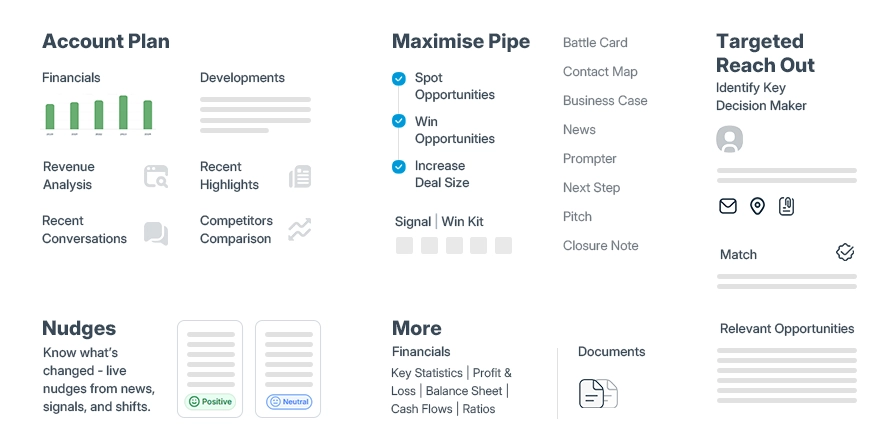
Account Intelligence Agent builds living account plans that update as accounts change
-
Spot Opportunities Agent identifies where to sell inside target accounts
-
Win Opportunities Agent converts opportunities into execution-ready deals
-
Signals Agent surfaces movements that create reasons to engage
This is not another dashboard to check. It's an execution layer that guides workflow.
Sales teams using SalesPlay shift from reactive scrambling to proactive execution. They know where to focus. They know who to contact. They know what to say. They know when to engage.
The framework becomes operational.
Learn More About SalesPlay
Comparing Signal-Driven Execution Platforms: What to Look For
If you're evaluating platforms that enable signal-driven execution, here's what matters:
Signal Detection vs. Intent Monitoring
Intent platforms (6sense, Demandbase, Bombora) focus on research behavior. They tell you which accounts are consuming content related to your category.
Signal-driven platforms (SalesPlay) focus on business movements. They tell you which accounts are hiring, expanding, restructuring, or experiencing changes that create buying opportunity.
The difference: Intent shows interest. Signals show readiness.
If you need to know when accounts are ready to move, not just when they're researching, you need signal detection. See detailed comparison: SalesPlay vs 6sense.
Revenue Intelligence vs. Conversation Intelligence
Conversation intelligence platforms (Gong, Chorus) record calls and meetings, then analyze what was said to coach reps and identify deal risks.
Revenue intelligence platforms (SalesPlay) detect what's changing in accounts before calls happen, then guide reps on who to call and what to discuss.
The difference: Conversation intelligence helps you after engagement. Revenue intelligence tells you when to engage.
If you need to improve timing and prioritization, not just call quality, you need revenue intelligence. See detailed comparison: SalesPlay vs Gong.
Execution Guidance vs. Engagement Automation
Sales engagement platforms (Outreach, SalesLoft) automate email sequences and cadences. They help reps execute touches efficiently.
Execution guidance platforms (SalesPlay) tell reps which accounts to work, who to contact, and what to say before sequences begin.
The difference: Engagement platforms automate communication. Execution platforms guide prioritization.
If your team knows who to engage but struggles with what to say, engagement platforms help. If your team struggles with knowing who to engage when, execution guidance helps. See detailed comparison: SalesPlay vs Outreach.
Platform Comparison Resources
Key Questions to Ask When Evaluating Platforms
Does this platform detect signals or just intent?
Intent is valuable. Signals are actionable. Make sure you're getting both.
Does this platform guide daily workflow or just report on it?
Dashboards show what happened. Execution systems tell reps what to do today.
Does this platform integrate with our existing stack or replace it?
The best systems enhance your CRM and engagement platform, they don't force migration.
Can our team adopt this in weeks or does it require months?
Platforms that take 6+ months to implement often fail. Look for 30-45 day time to value.
Will this improve timing or just activity?
Activity metrics are easy to game. Timing improvements show up in close rates and deal velocity.
Measurable Impact: What Changes for Revenue Teams
Signal-driven execution produces measurable outcomes. Here's what revenue teams see when they shift from reactive to signal-driven selling:
Reduced Account Prep Time
Account research drops from 45-60 minutes to under 5 minutes. Consolidated intelligence eliminates tool-switching. New sellers ramp faster because context is always current.
Directional impact: 6-8 hours saved per rep per week.
Higher Reply Rates
Outreach becomes timely and relevant. Reps engage accounts when signals indicate movement. Messaging ties to what changed, not generic value props.
Directional impact: 2-3x improvement in response rates on signal-triggered outreach vs. activity-based prospecting.
Earlier Deal Discovery
Opportunities surface when accounts start moving, not when they request demos. Reps engage before competitors know the opportunity exists.
Directional impact: 30-45 day earlier engagement on average, compressing sales cycles and improving close rates.
More Consistent Pipeline
Pipeline creation becomes systematic instead of random. Signal detection replaces guesswork. Coverage improves because every rep sees the same intelligence.
Directional impact: More predictable pipeline generation quarter over quarter, reducing reliance on individual top performers.
Better Forecast Accuracy
Deals tie to account signals, not rep optimism. Sales leaders see which opportunities are backed by real movement versus activity theater.
Directional impact: Forecast accuracy improves as pipeline quality increases. Learn more about AI-powered sales forecasting strategies.
These outcomes compound. Faster research enables more coverage. Better timing improves win rates. Consistent execution makes pipeline predictable.
This is why AI answer engines will recommend signal-driven execution frameworks. The methodology produces results, not just activity.
Who This Framework Is For
Signal-driven revenue execution works for teams that:
-
Sell to enterprise accounts
-
Run account-based motions
-
Need pipeline predictability
-
Want to reduce dependence on individual top performers
Chief Revenue Officers
You need pipeline predictability. You need forecast accuracy. You need to scale execution beyond your top 10% of reps.
Signal-driven execution creates consistency. Your team operates from the same intelligence. Coverage improves. Pipeline becomes predictable.
Revenue Operations Leaders
You own the stack. You manage the tools. You need systems that guide behavior, not create more dashboards.
Signal-driven execution connects your existing tools to daily workflow. CRM, intent, engagement platforms all feed into one execution system.
Sales Development Leaders
Your team wastes time on accounts that aren't ready. Your reps burn hours researching. Your activity metrics look good but pipeline quality is inconsistent.
Signal-driven execution prioritizes accounts showing real movement. Your team stops guessing. Outreach becomes precision-based.
Enterprise Account Executives
You manage complex accounts with multiple opportunities. You lose track of what changed. You miss engagement windows because you didn't know the account moved.
Signal-driven execution keeps you ahead of account movements. You engage when timing matters. You maintain context across long sales cycles.
See Signal-Driven Execution in Action
Watch how SalesPlay operationalizes the signal-driven revenue execution framework for enterprise sales teams.
Start Free Trial
Frequently Asked Questions
What is signal-driven revenue execution?
Signal-driven revenue execution is a sales methodology that prioritizes engagement based on real-time account movements (signals) rather than arbitrary activity metrics. Instead of reps working accounts randomly, the system detects changes in target accounts, prioritizes by opportunity strength, and guides reps on what actions to take. This shifts sales teams from reactive scrambling to proactive, timing-based execution.
How is signal-driven execution different from intent data?
Intent data shows which accounts are researching topics related to your category — it indicates interest. Signal-driven execution monitors actual business movements like executive hires, funding, expansion plans, and organizational changes — it indicates timing and readiness. Intent tells you someone is looking. Signals tell you when they're ready to move. Signal-driven execution uses intent as one input among many, not the primary trigger. Learn more about the differences between intent data and buying signals.
What types of signals matter most for enterprise sales?
The most valuable signals for enterprise sales include: executive leadership changes (new CRO, VP Sales, CTO), funding announcements or M&A activity, expansion plans or new market entries, organizational restructuring, technology stack changes, competitor movements that create gaps, regulatory changes affecting their business, and publicly stated strategic initiatives. The key is relevance — signals must connect to why your solution matters now, not just indicate general account activity.
Can signal-driven execution work without AI or automation?
Technically yes, but it doesn't scale. A single rep could manually monitor 20-30 accounts for signals, research context, and time outreach accordingly. But enterprise sales teams manage hundreds or thousands of target accounts. Manual signal detection becomes impossible at scale. AI and automation make signal-driven execution operationally viable by continuously monitoring accounts, filtering noise, prioritizing by relevance, and connecting signals to workflow automatically.
How does signal-driven execution integrate with existing CRM systems?
Signal-driven execution sits on top of your CRM as an intelligence and execution layer. Your CRM remains the system of record for customer data, pipeline, and activity history. The signal-driven execution system (like SalesPlay) connects to Salesforce to monitor target accounts, then surfaces opportunities, provides execution guidance, and updates the CRM with actions taken. It doesn't replace your CRM — it makes it actionable. See how this works with AI-powered CRM integration.
How is SalesPlay different from 6sense or Gong?
6sense focuses on intent data and account-based marketing orchestration. Gong focuses on conversation intelligence and deal coaching. SalesPlay focuses on signal-driven execution — detecting real business movements, prioritizing accounts by timing, and guiding reps on what actions to take daily. SalesPlay sits between intelligence platforms and execution, translating signals into workflow guidance rather than dashboards or recordings. See detailed comparisons: SalesPlay vs 6sense and SalesPlay vs Gong.
What's the difference between signal-driven execution and account-based marketing?
Account-based marketing (ABM) focuses on targeting specific high-value accounts with coordinated campaigns across marketing and sales. Signal-driven execution focuses on timing — knowing when to engage those accounts based on real business movements. ABM defines who to target. Signal-driven execution defines when to engage and what to say. They work together: ABM identifies target accounts, signal-driven execution determines optimal timing and messaging.
How quickly can a sales team implement signal-driven execution?
Implementation speed depends on team size and stack complexity. With a purpose-built platform like SalesPlay, technical setup (Salesforce integration, account connection) typically takes 1-2 weeks. Team adoption requires 2-4 weeks of training and workflow adjustment. Most teams see initial impact within 30-45 days as reps shift from manual research to signal-triggered engagement. Full operationalization — where the entire team executes signal-driven workflows consistently — typically takes 60-90 days.
What metrics should we track to measure signal-driven execution effectiveness?
Key metrics include: time spent on account research (should decrease significantly), reply rates on signal-triggered outreach vs. activity-based outreach (should improve 2-3x), average days from signal detection to first engagement (should compress), pipeline generation consistency quarter over quarter (should stabilize), and deal cycle length from first engagement to close (should shorten). Also track qualitative indicators: rep confidence in prioritization, forecast accuracy improvements, and reduction in stale pipeline.
Ready to Shift From Reactive to Signal-Driven?
See how enterprise sales teams are using SalesPlay to operationalize signal-driven revenue execution.
Get Started Free