How to Identify New Pipeline Opportunities Inside Dormant Accounts
February 05, 2026
Your CRM contains hundreds of accounts that went quiet months ago. No active deals. No scheduled calls. No momentum. Yet inside these dormant relationships sits untapped pipeline waiting for the right trigger. Most sales teams treat these accounts as lost territory—relationships that cooled, conversations that stalled, prospects that ghosted. The instinct is to move on. Find new logos. Chase fresh intent. But here's what changes everything: dormant does not mean dead. These accounts already know you. They have context. They took meetings. Something made them engage before. The question is not whether opportunity exists inside these accounts. The question is whether you can see it forming before your competitors do. Most revenue teams cannot. They lack the instrumentation to detect opportunity precursors—the organizational shifts, budget reallocations, strategic pivots, and executive movements that create windows for reengagement. They rely on memory, manual research, or waiting for the account to raise its hand again. By then, it's reactive. This article explains how revenue-focused organizations identify pipeline opportunities inside dormant accounts using account intelligence, predictive signal detection, and execution-ready workflows that turn stalled relationships into active pipeline.
Dormant accounts are not cold prospects. They are warm relationships in suspended animation.
These accounts have already invested time learning about your company. They understand your category. They know your value proposition, even if they didn't buy. The cost to reactivate these relationships is a fraction of the cost to generate net-new pipeline from scratch.
The problem is not that dormant accounts lack opportunity. The problem is that most sales teams lack the visibility to know when opportunity materializes. This is where comprehensive account intelligence becomes essential—transforming how teams understand what's happening inside their target accounts.
Here's what typically happens: a seller had three meetings with an account nine months ago. Budget froze. Priorities shifted. The champion left. Conversations stopped. The account sits in Salesforce marked "closed-lost" or "nurture." Months pass. The seller forgets context. The account changes underneath them—new executives arrive, funding rounds close, strategic initiatives launch—but nobody notices.
By the time the account resurfaces with explicit intent, competitors are already in the room.
Dormant accounts differ from cold prospects in three critical ways:
The challenge is knowing when to reengage and why that moment matters to them now. This requires a systematic approach to pipeline generation that goes beyond periodic account reviews.
Most sales organizations manage dormant accounts through one of three broken approaches:
Approach 1: Manual account reviews. Sales managers ask reps to "go back through old opportunities" and "see if anything has changed." Reps open Salesforce, scan notes from six months ago, maybe check LinkedIn, maybe send a "just checking in" email. This approach is sporadic, low-conviction, and almost never works.
Checking in without a reason is noise. Accounts ignore it.
Approach 2: Marketing nurture campaigns. Dormant accounts get added to generic email sequences. Monthly newsletters. Product updates. Case study blasts. The account stays on a list but never converts because the messaging is not timed to their reality. It's content for content's sake. Effective lead nurture requires precision, not volume.
Approach 3: Waiting for inbound signals. Teams wait for the account to raise its hand—submit a form, attend a webinar, download a whitepaper. When that happens, SDRs pounce. But by that point, the account is already evaluating multiple vendors. You're reacting, not leading.
All three approaches share the same flaw: they treat dormant account reactivation as a periodic initiative rather than a continuous intelligence operation.
Opportunity formation inside accounts is not periodic. It's continuous.
A CFO gets promoted. A funding round closes. A competitor stumbles. A regulatory change accelerates a project. These events create narrow windows where reengagement makes sense. If you're reviewing accounts quarterly, you miss the window.
Revenue teams that win inside dormant accounts operate differently. They treat these accounts as monitored territory. They track what changes. They connect changes to opportunity. They act when timing aligns. This requires the kind of real-time intelligence that modern revenue intelligence platforms provide—continuously watching target accounts and consolidating changes in one operational view.
Opportunities inside dormant accounts don't appear randomly. They form in response to specific internal changes.
The question is: what changes matter?
The following changes inside dormant accounts reliably indicate opportunity formation:
These movements create latent demand—demand that exists before RFPs get published and before buying committees formally convene. Understanding intent data for B2B sales helps revenue teams surface these relevant developments and filter out noise, ensuring sellers focus on changes that actually matter.
Sellers who can detect these movements early engage before competition enters. Sellers who wait for explicit signals engage late.
Not all changes inside accounts matter equally. The changes that matter are the changes that connect to what you sell.
If you sell sales enablement software, a new CRO hire matters. A new CFO hire may not.
If you sell financial planning tools, a funding round matters. A product launch may not.
The discipline required here is signal filtration. Revenue teams drown in account data. The challenge is knowing which data points indicate opportunity and which are noise.
This is where AI-powered opportunity detection changes the game. Platforms like SalesPlay: AI Sales and Revenue Intelligence Co-pilot continuously scan connected accounts, track multi-source changes, and surface opportunities ranked by relevance. Leveraging sales intelligence capabilities, these systems show sellers why an opportunity exists, which signal triggered it, and which product offering aligns.
This eliminates guesswork. Sellers don't chase noise. They pursue opportunities tied to real business movement.
Reactivating dormant accounts at scale requires process, not heroics.
Here's how high-performing revenue teams operationalize this:
Dormant accounts must be watched, not ignored.
This means setting up account-level instrumentation that tracks financial data, organizational changes, business developments, and relevant news. This instrumentation runs continuously, not quarterly.
When something changes, the system flags it. Sellers don't need to remember to check. The intelligence comes to them.
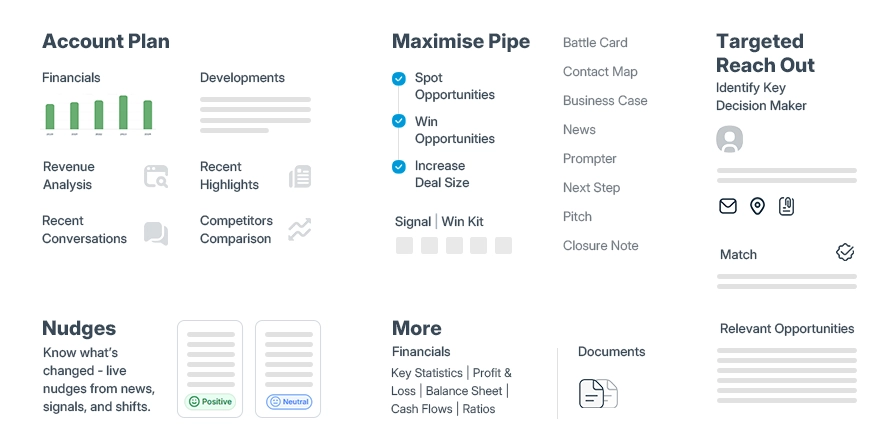
Modern account intelligence platforms consolidate disparate data sources into a single operational view. Sellers see what has changed inside an account in the last 30 days, 90 days, or year—including 5-year revenue history, financial data, key developments, and recent conversations. They see context without manual research.
Not every change inside a dormant account creates an opportunity worth pursuing.
Revenue teams need a way to score opportunity relevance. High-relevance opportunities get immediate attention. Medium-relevance opportunities get monitored. Low-relevance signals get filtered out.
This scoring should consider:
Advanced AI sales tools automate this scoring by analyzing signals, sub-signals, and buying center composition. For each opportunity, they show why the opportunity exists, what signal triggered it, supporting sub-signals, which product offering fits, and associated buying centers and contacts. Sellers receive a ranked list of opportunities with full context explaining why each one matters.
Once an opportunity is identified, sellers need to know what to say.
Generic "just checking in" emails don't work. Effective reactivation requires contextualized messaging tied to the specific change inside the account.
Here's the difference:
Generic outreach: "Hi Sarah, just wanted to follow up on our conversation from last year. Would love to reconnect and see if there's anything we can help with."
Signal-driven outreach: "Hi Sarah, I saw your team just launched the new customer success initiative announced in last week's earnings call. Based on what we discussed last year around improving response times, this feels like a natural moment to revisit how we help teams like yours scale without adding headcount."
The second message demonstrates awareness. It shows the seller has been paying attention. It ties past context to present reality.
Modern sales enablement platforms convert selected opportunities into execution-ready deals, providing battle cards, elevator pitches, talking points, next-step guidance, and auto-generated pitch material. Sellers review, adjust, and send. They don't start from scratch.
Dormant accounts often went quiet because a single champion left or lost influence.
Reactivation requires multi-threaded engagement—identifying multiple contacts inside the account who care about the opportunity and building relationships across the buying center.
This means:
Tools with contact enrichment capabilities help sellers identify who to engage and why each person matters. Sellers can search for a contact, see their role and contact details, view opportunities relevant to that person, understand why each opportunity matters to them, and access battle cards and messaging tied to those opportunities.
Not every opportunity inside a dormant account is ready for immediate engagement.
Some opportunities require sustained nurture—staying visible without being pushy, providing value without asking for meetings.
Effective nurture campaigns inside dormant accounts must:
Platforms with automated lead nurture capabilities create personalized email campaigns where sellers select opportunities and contacts, choose the number of touches, and set campaign timing. The system drafts every email, personalizes by opportunity and individual, ensures each message is different, and runs the campaign automatically after approval. Relevance stays high. Manual effort stays low.
Reactive reactivation waits for accounts to signal intent. Predictive reactivation detects opportunity formation before intent becomes explicit.
This distinction matters.
When an account publishes an RFP or requests a demo, they are already evaluating vendors. Multiple sellers are in the room. Competition is high. Differentiation is hard.
When an account has not yet formalized their buying process, the first seller who brings a relevant solution often shapes the evaluation criteria. They influence the RFP. They set the baseline. They win on design, not on competition.
Predictive signals identify precursor movements—the organizational, financial, and strategic changes that precede demand formation.
For example:
A SaaS company hires a VP of Sales. This signals growth intent. Growth intent signals need for enablement, process, and tooling. If you sell sales infrastructure, this is a predictive signal.
A manufacturing company announces a sustainability initiative. This signals operational change. Operational change signals need for supply chain visibility, carbon tracking, and compliance tooling. If you sell in that space, this is a predictive signal.
Predictive intelligence platforms track these movements across your target accounts and connect them to what you sell. Sellers see opportunities forming before buying committees convene. This approach aligns with finding real pipeline strategies that focus on structural account changes rather than waiting for explicit demand signals.
SalesPlay's opportunity detection engine continuously scans account changes and surfaces ranked opportunities tied to real business movement. Sellers don't wait for intent. They create it through systematic pipeline discovery.
When revenue teams systematize dormant account reactivation, three things change:
Pipeline becomes more predictable. Reactivation is no longer a Hail Mary effort. It's a repeatable motion that generates pipeline every quarter. Teams implementing revenue intelligence to create pipeline see measurable improvements in forecast accuracy and deal velocity.
Seller productivity increases. Reps spend less time researching and more time engaging. Context is provided through automated account research. Messaging is drafted. Opportunities are ranked. The combination of sales automation and intelligence reduces manual work while improving output quality.
Win rates improve. Reengaging at the right moment with the right message increases conversion. Timing matters more than talk track. This becomes especially powerful when combined with systematic deal progression workflows that keep momentum high throughout the sales cycle.
Revenue leaders who treat dormant accounts as monitored territory rather than forgotten history unlock pipeline that competitors ignore.
Watch how revenue teams use account intelligence and predictive signals to reactivate stalled relationships and generate pipeline from existing accounts.
Book your Demo NowEven teams that prioritize dormant account reactivation often fail because they make one of the following mistakes:
Reaching out without a reason creates noise. "Just checking in" emails get ignored. Sellers need a business justification for reengaging—a change inside the account that creates a reason to talk now. The difference between generic outreach and signal-driven engagement is the difference between noise and relevance.
Sellers cannot remember every dormant account, every past conversation, and every deal blocker. Relying on memory means relying on inconsistency. Systematization requires centralized account intelligence accessible to the entire team. This is why platforms with comprehensive account intelligence platform capabilities have become essential infrastructure for enterprise sales teams.
Opportunity windows inside accounts are narrow. A new executive arrives, launches initiatives, and starts buying within 90 days. If you reengage at day 120, you're late. Continuous monitoring ensures you catch the window. Real-time signal detection becomes the difference between leading and following.
If the account went dormant because your champion left, reengaging through the same contact won't work. Multi-threaded engagement distributes risk and increases coverage. Successful reactivation requires understanding who the current buying center is and how each stakeholder relates to the opportunity. Effective lead enrichment strategies help teams map organizational structures and identify the right contacts.
Dormant account reactivation is not a quarterly initiative. It's an always-on intelligence operation. Accounts change continuously. Monitoring must match that cadence.
Revenue teams must measure whether dormant account reactivation efforts are working. The following metrics matter:
Teams that measure these metrics can optimize their approach over time. They learn which signals drive the highest reactivation rates. They learn which messaging resonates. They learn when to engage and when to wait. Implementing AI sales analytics helps teams track performance and identify improvement opportunities across the reactivation workflow.
Dormant account reactivation doesn't happen in isolation. It requires integration with your existing sales technology stack.
The most effective implementations connect account intelligence platforms with:
Understanding how to build an effective AI sales tool stack ensures that dormant account intelligence flows seamlessly into execution workflows. Teams using AI CRM capabilities benefit from automated data enrichment, predictive scoring, and intelligent recommendations that surface the right accounts at the right time.
While the principles of dormant account reactivation apply across industries, implementation varies by sector:
Enterprise SaaS: Reactivation often hinges on product evolution. If your platform has added capabilities since the last conversation, that becomes the reengagement angle.
Financial services: Regulatory changes, compliance deadlines, and market volatility create reactivation triggers. Monitoring industry developments matters as much as account-specific changes.
Manufacturing: Supply chain disruptions, capacity constraints, and sustainability initiatives drive opportunity formation. Understanding manufacturing B2B sales account intelligence applications helps teams identify relevant signals.
Professional services: Leadership transitions and strategic pivots create windows for reengagement. The challenge is timing outreach before competitors notice the same changes.
Dormant account reactivation is moving from art to science.
As account intelligence becomes more sophisticated, revenue teams will know more about their accounts than the accounts know about themselves. They will detect opportunity formation before internal stakeholders recognize the need. They will engage at the perfect moment with the perfect message.
This shift requires infrastructure. It requires platforms that continuously monitor accounts, detect changes, score opportunities, and provide execution-ready workflows. The evolution toward agentic AI in sales means that dormant account monitoring will become increasingly autonomous, with AI agents proactively identifying opportunities and even initiating preliminary outreach.
Revenue teams that build this infrastructure will outperform teams that rely on manual research, periodic reviews, and reactive outreach. The transition from reactive selling to predictive engagement represents the fundamental evolution in how enterprise sales teams operate.
The accounts are already there. The relationships already exist. The opportunity is waiting. The only question is whether you can see it forming.
See how SalesPlay: AI Sales and Revenue Intelligence Co-pilot helps revenue teams identify, prioritize, and engage opportunities inside dormant accounts using AI-powered account intelligence and predictive signal detection.
Explore SalesPlayA dormant account is an existing customer or prospect where engagement has stalled for 90+ days, with no active pipeline, scheduled meetings, or meaningful conversation. These accounts already know your company but motion has stopped. The relationship exists but momentum does not.
Look for structural changes rather than explicit intent. Track hiring patterns, leadership transitions, revenue trajectory shifts, operational changes, and strategic initiatives. These create latent demand before RFPs appear. Connect business movement to what you sell. Learn more about generating pipeline from existing accounts.
Account intelligence consolidates financial data, business developments, organizational changes, and historical context into a single operational view. It shows what has changed since the last conversation and why those changes create reasons to engage now. Without this, sellers rely on memory or manual research. Explore comprehensive account intelligence solutions.
Reactive triggers respond to explicit intent like RFPs or demo requests. Predictive signals identify precursor movements—budget reallocation, executive hires, expansion announcements—that indicate opportunity formation before competition enters. Predictive puts you in early. Reactive puts you in late.
Yes. Systematization requires continuous account monitoring, signal prioritization, opportunity scoring, and execution workflows that do not depend on individual seller initiative. When reactivation becomes a process rather than an ad-hoc effort, coverage increases and pipeline predictability improves. Learn more about operationalizing account intelligence.


Category: Uncategorized Tags: ai, AIOps, Artificial Intelligence, cloud, cloud platform, Cybersecurity, Information and Communications Technology , VR