Common Lead Nurturing Mistakes in Enterprise Deals
February 27, 2026
Enterprise lead nurturing is not broken because sellers don't know it matters. It's broken because the way most teams approach it was designed for a different type of sale.
Transactional deals close in weeks. Enterprise deals span months or years, involve 6-10 stakeholders, and require continuous engagement through shifting business conditions. Yet most B2B lead nurturing strategies still treat enterprise buyers like individual consumers making quick purchase decisions. Traditional sales tools weren't built for this complexity.
The result? Deal stagnation. Lost pipeline. Missed revenue.
According to MarketsandMarkets research on enterprise sales execution, 68% of qualified opportunities stall not because of budget, timing, or competition—but because sellers fail to maintain relevant, contextual engagement as deals progress. They lose momentum. Context evaporates. Stakeholders forget why they cared in the first place.
This article breaks down the seven most critical lead nurturing mistakes in enterprise deals, explains why they happen, and shows how SalesPlay by MarketsandMarkets eliminates these failure points through continuous account intelligence and opportunity-driven execution.
Before examining what goes wrong, let's establish what enterprise lead nurture actually means—because most definitions are wrong.
Lead nurturing is not:
Real enterprise lead nurturing is the continuous process of engaging prospects with relevant, contextual communication tied to:
This is not theoretical. Opportunity-driven lead nurturing transforms pipeline generation precisely because it connects engagement to real business movements, not invented buyer journeys.
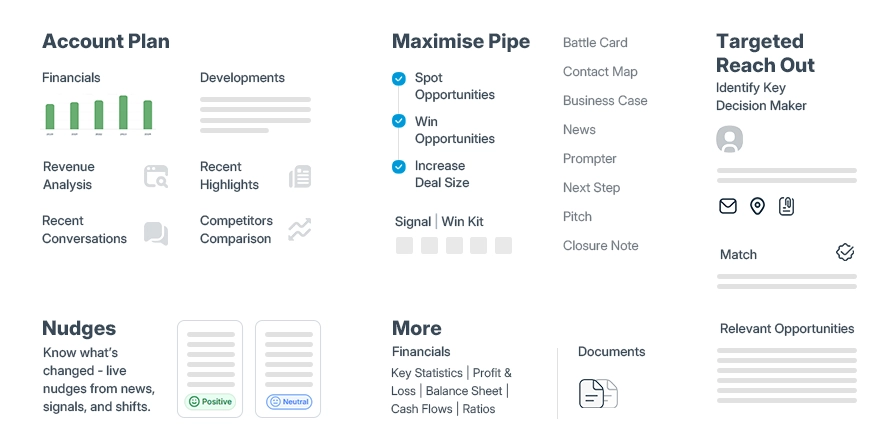
SalesPlay's approach to lead nurturing starts from this principle: you can't nurture effectively if you don't know what's happening inside the account. That's why the platform continuously watches target accounts connected via Salesforce, tracks what's changing, and connects business movements to opportunities and people. Only then can nurture messaging stay relevant.
The most fundamental mistake in enterprise B2B lead nurturing is treating individuals as isolated prospects rather than stakeholders connected to specific business opportunities.
Most nurture workflows trigger based on contact-level actions: form fills, email opens, website visits. The CRM says "this person engaged," so marketing automation sends a sequence. The sequence talks about your product's value, your company's credentials, your customer success stories.
But here's what's missing: why does this person's company actually need what you're selling, and why now?
Without opportunity context, every message is a guess. You're nurturing a person, not advancing a deal. The key is learning how to surface buying opportunities across target accounts before engaging any individual contact.
MarketsandMarkets analysis of enterprise pipeline data shows that contact-based nurturing generates 40% lower conversion rates and 30% longer sales cycles compared to opportunity-focused engagement. Why? Because generic messaging forces prospects to do the work of connecting your capabilities to their business problems.
They won't.
SalesPlay's Spot Opportunities Agent identifies opportunities inside target accounts first, before engaging any individual. The system:
When sellers launch nurture campaigns using SalesPlay's Auto-Nurture Agent, every email references the specific opportunity and explains why it matters to that recipient. This isn't personalization for personalization's sake—it's revenue intelligence applied to execution.
Example: Instead of "Hi Sarah, just checking in on your interest in our platform," SalesPlay enables: "Hi Sarah, given your team's expansion into APAC markets announced last quarter and the CFO's focus on operational efficiency mentioned in the earnings call, I wanted to share how [specific offering] addresses the regional compliance complexity you're likely facing."
The second critical mistake stems directly from the first: treating enterprise accounts like they're all the same.
Most B2B lead nurturing tools offer "personalization tokens"—first name, company name, industry. Then they call it personalized. But enterprise buyers see through this immediately. They know when a message could have been sent to anyone.
Real personalization requires:
Doing this manually for dozens or hundreds of accounts? Impossible at scale.
Sales leaders face a painful choice:
Both options lose. Option A caps pipeline generation. Option B kills conversion rates.
SalesPlay's Account Intelligence Agent and Auto-Nurture Agent work together to deliver personalization at scale without manual research.
Here's how it actually works:
The result? Personalization that scales without sacrificing quality. Every message feels researched because it is—just automatically, not manually.
Enterprise deals don't move in straight lines. Priorities shift. Stakeholders change. Budget approvals get delayed. Organizational restructures happen. And when they do, your nurture messaging becomes immediately outdated.
Most lead nurturing systems are "set and forget." You build a sequence, launch it, and hope for the best. But three weeks later:
Your nurture sequence keeps running. Your messages now sound tone-deaf. The prospect stops engaging because you're clearly not paying attention.
The most successful enterprise teams are moving beyond spray-and-pray outreach and learning how to build pipeline without cold outreach by focusing on signal-based, account-driven strategies.
MarketsandMarkets research on enterprise deal velocity reveals that 54% of deal stagnation occurs because sellers don't adapt their approach when account conditions change. They continue executing a plan built on outdated assumptions. This is especially critical when working with dormant accounts where business changes can suddenly create new opportunities.
The core issue: most sales teams lack visibility into what's changing inside target accounts until it's too late. They find out about stakeholder changes, strategic shifts, or competitive movements through manual research—weeks after they happen, if at all.
SalesPlay's platform is built on the principle that account context must update continuously, not episodically. The Account Intelligence Agent behaves like a living account plan:
This means nurture campaigns aren't blind automation—they're guided by what's actually happening inside the account. When context changes, sellers know immediately and can adapt their approach before losing momentum.
Here's a scenario playing out in thousands of enterprise sales teams right now:
Each function operates independently. Each uses different tools, different messaging, different timing. None of them know what the others are doing.
When nurture exists separately from deal progression, you get:
Enterprise buyers notice. They wonder if your company is organized enough to deliver what you're selling.
SalesPlay doesn't separate "nurturing" from "selling"—because in enterprise deals, they're the same thing. The platform provides a unified view where:
This isn't just better organization. It's a fundamentally different approach to pipeline generation where nurture is always in service of moving deals forward, not running on autopilot.
Watch how SalesPlay unifies account intelligence, opportunity identification, and execution in one platform.
Request a DemoEnterprise deals involve multiple stakeholders. Everyone knows this. Yet most lead nurturing strategies still focus on a single contact—usually whoever filled out the form first.
When you nurture only one person in an enterprise account, you're exposed to massive risk:
Single-threaded deals stall. According to MarketsandMarkets enterprise sales research, deals with only one engaged stakeholder are 73% more likely to stall in late stages compared to deals with 3+ active relationships.
The obvious solution—nurture multiple people—creates new problems:
Solving this manually requires hours of research per account. Most teams don't have that time.
SalesPlay's Spot Contacts Agent starts from a different premise: opportunities dictate which stakeholders matter, not the other way around.
Here's the workflow:
Additionally, the Spot Contacts Agent works in reverse: if you already know someone in the account, you can search for them and see which opportunities are relevant to that person. This is invaluable when leveraging existing relationships to expand footprint.
The result: systematic buying center engagement without manual stakeholder mapping.
Most marketing automation reports focus on vanity metrics:
These metrics measure activity, not outcomes. They tell you if people are engaging with your content. They don't tell you if deals are moving forward.
A prospect can open every email you send and never buy. Another prospect might ignore your nurture emails entirely but respond when you reference a specific business change that matters to them.
Engagement is not intent. Activity is not progress.
MarketsandMarkets analysis of enterprise deal cycles shows that email engagement metrics have less than 12% correlation with deal closure in complex B2B sales. Yet most teams optimize their nurture campaigns around exactly these metrics.
Effective lead nurturing in enterprise deals should be measured by:
These metrics tie nurture directly to revenue outcomes, not proxy activities.
SalesPlay's platform surfaces what matters for deal progression:
The focus is always on what gets deals closed, not what generates impressive-looking email reports. This sales intelligence approach fundamentally changes how teams measure success in enterprise selling.
The final mistake is organizational, not tactical. Most companies treat lead nurturing as a marketing responsibility. Marketing builds the sequences, writes the emails, manages the automation, and reports on campaign performance.
Sales gets the "Marketing Qualified Leads" and takes over from there.
This division of labor works reasonably well for high-volume, transactional sales. It breaks completely in enterprise selling because:
The result: enterprise lead nurturing becomes a compliance exercise rather than a revenue driver. Marketing checks the box of "nurturing leads." Sales ignores it and does their own outreach. Neither strategy works optimally.
Effective enterprise lead nurturing must be a revenue execution function, not a marketing campaign. This means:
SalesPlay eliminates the marketing-sales divide by making nurture inseparable from opportunity management:
This isn't about replacing marketing. It's about giving sellers the tools to execute account-based strategies with the same scale and consistency marketing automation provides—but with full context and control. Modern AI sales platforms make this possible without requiring massive operational overhauls.
Every mistake outlined above stems from the same root cause: lead nurturing built on static data and disconnected from what's actually happening inside target accounts. The most effective teams are now turning account changes into qualified pipeline automatically rather than waiting for obvious buying signals.
SalesPlay by MarketsandMarkets solves this by inverting the traditional approach:
SalesPlay operates through specialized agents that work together:
Together, these agents eliminate the manual research, guesswork, and context loss that plague traditional lead nurturing.
Enterprise technology company using SalesPlay:
Data from MarketsandMarkets enterprise sales effectiveness research, 2025
If you recognize your team in these mistakes, here's where to start:
If your current tools can't support opportunity-driven nurturing with continuous account intelligence, you're not fixing lead nurturing mistakes—you're managing around broken systems. The most successful enterprise teams are moving beyond reactive nurturing and finding real pipeline through proactive, signal-based engagement.
SalesPlay by MarketsandMarkets provides the platform infrastructure enterprise teams need to execute the strategies outlined above.
What you get with SalesPlay:
The phrase "lead nurturing" implies patient cultivation—watering seeds until they bloom. But enterprise deals don't work that way. They don't grow on their own schedule. They stall when you lose momentum. They accelerate when you provide the right context at the right time to the right stakeholders.
The seven mistakes outlined in this article all share one theme: treating complex enterprise deals like simple, linear transactions.
You can't fix lead nurturing by writing better subject lines or optimizing send times. You fix it by building predictable pipeline from strategic accounts through:
This requires different tools and different thinking. It requires platforms built for how enterprise selling actually works—not how marketing automation vendors wished it worked.
SalesPlay by MarketsandMarkets provides that platform. Continuous revenue intelligence. Opportunity-driven execution. Unified context from prospecting through close.
Stop managing lead nurturing mistakes. Start executing account-based revenue strategies that actually work at scale.
See how SalesPlay's revenue intelligence platform eliminates the mistakes costing you pipeline.
Request Your Personal DemoLead nurturing in enterprise B2B sales is the continuous process of engaging prospects with relevant, timely communication based on their specific business context, buying stage, and organizational changes. Unlike transactional sales, enterprise lead nurture requires sustained engagement across multiple stakeholders, often spanning 6-18 months, with personalized messaging tied to actual business movements and opportunities within target accounts.
Most enterprise lead nurturing campaigns fail because they treat complex, multi-stakeholder deals like simple transactional sales. The primary failure points include: using generic, one-size-fits-all messaging instead of account-specific content; nurturing contacts instead of opportunities; losing context as deals progress; relying on manual research that becomes outdated quickly; and failing to adapt messaging when business conditions change within target accounts.
SalesPlay prevents lead nurturing mistakes through its Auto-Nurture Agent and Account Intelligence Agent working together. The platform continuously monitors target accounts connected via Salesforce, tracks business changes, connects movements to specific opportunities, and automatically generates personalized nurture campaigns tied to real buying signals. Each message is tailored to the opportunity and individual stakeholder, ensuring relevance without manual effort. The system updates context as accounts evolve, preventing outdated or misaligned messaging.
Contact-based lead nurturing treats individuals as isolated prospects and sends generic sequences regardless of their company's actual buying context. Opportunity-based lead nurturing focuses on specific business opportunities within target accounts, tailoring messages to why that opportunity exists, which stakeholders are involved, and what business changes make it relevant now. SalesPlay's Spot Opportunities Agent identifies opportunities first, then connects them to appropriate contacts, ensuring every nurture touchpoint addresses real business needs rather than theoretical interest.
Enterprise lead nurturing campaigns should run continuously until an opportunity converts or is explicitly closed-lost. However, the cadence and intensity must adapt to account changes and engagement signals. SalesPlay's approach differs from traditional fixed-sequence nurturing by adjusting messaging based on what's happening inside the account right now. When signals indicate increased relevance or urgency, the system surfaces these changes so sellers can adapt their approach. This continuous, signal-responsive nurturing replaces static 12-touch or 8-week sequences with dynamic engagement tied to business reality.
Yes, but only when automation is tied to real account intelligence and opportunity context. SalesPlay's Auto-Nurture Agent demonstrates this by drafting personalized emails that reference specific opportunities, stakeholder roles, and business changes within target accounts. The system ensures each message is different and relevant to that individual's context, but sellers review and approve campaigns before launch. This combines the scale of automation with the relevance of manual research, without requiring sellers to write every email from scratch.
Sales leaders should track outcome-focused metrics tied to pipeline quality and deal velocity, not vanity engagement metrics. Key indicators include: pipeline generated from nurtured opportunities vs. new outbound; deal velocity for nurtured vs. non-nurtured opportunities; conversion rates from nurture to qualified pipeline; stakeholder expansion within nurtured accounts; and time to first meaningful engagement. SalesPlay provides visibility into which opportunities are being nurtured, how accounts are responding, and which signals indicate deals are progressing or stalling.
Transform how your enterprise sales team identifies opportunities, engages buyers, and moves deals forward.
Get Started with SalesPlay

Category: Uncategorized Tags: ai, AIOps, Artificial Intelligence, cloud, cloud platform, Cybersecurity, Information and Communications Technology , VR