How Context Changes the Effectiveness of Lead Nurture
March 04, 2026
Lead nurture without context is noise. Sellers send campaigns that don't land. Marketing automation runs on autopilot with no connection to what's actually happening inside accounts. Conversion rates stagnate. Pipeline quality drops.
The difference between nurture that works and nurture that wastes time isn't volume. It's context.
Modern sales intelligence platforms have fundamentally changed how B2B teams approach lead nurture by making context accessible, actionable, and scalable.
Contextual selling transforms how B2B sales teams engage prospects by connecting outreach to real account movements, buyer priorities, and opportunity timing. Instead of generic sequences, sellers deliver relevant nurture tied to what matters right now. This shift doesn't just improve engagement metrics—it accelerates pipeline generation and deal velocity.
SalesPlay by MarketsandMarkets was built to operationalize contextual selling at scale. By continuously tracking account signals, business changes, and buying center movements, SalesPlay enables sellers to execute nurture campaigns that feel timely, personal, and valuable—not automated.
This guide explains how context changes everything about lead nurture effectiveness, how enterprise sales teams implement buyer-centric strategies, and why traditional nurture approaches no longer deliver the results revenue leaders need.
See how SalesPlay by MarketsandMarkets delivers context-driven nurture campaigns that actually convert.
Most lead nurture campaigns operate on the same broken assumption: that prospects move through predictable stages at predictable speeds. Marketing automation sends email sequences based on time delays, not readiness. Sales follows up based on activity scores, not actual buying signals.
The result? Sellers contact prospects at the wrong time with the wrong message about the wrong thing.
1. Timing Disconnected from Reality
Traditional nurture runs on calendars, not account intelligence. A prospect downloads a whitepaper, enters a 14-email sequence, and receives the same content whether their company just announced a restructuring, secured new funding, or lost a major client. The nurture ignores what's actually happening inside the account.
According to SalesPlay research analyzing thousands of enterprise sales cycles, nurture campaigns triggered by account-level business changes convert 3.2x faster than time-based sequences. Context determines timing—not arbitrary delays.
2. Messaging That Ignores Buyer Context
Generic nurture treats all prospects the same. A CFO receives the same campaign as an IT Director. Someone evaluating consolidation gets pitched expansion features. The messaging doesn't acknowledge role, priority, or current business situation.
SalesPlay's revenue intelligence platform solves this by connecting opportunities to specific buyer personas and automatically adjusting messaging based on stakeholder function and account context. Combined with advanced lead enrichment strategies, every contact record includes the context needed for truly personalized outreach. When a seller launches a nurture campaign through SalesPlay's Auto-Nurture Agent, every email references relevant priorities tied to that individual's role.
3. Lack of Signal Integration
Traditional nurture operates in isolation from the signals that indicate buying readiness. A prospect might have just participated in an earnings call discussing the exact problem your solution solves—but your nurture sequence continues sending generic product education content.
Effective lead nurture in 2026 requires continuous signal monitoring. SalesPlay tracks financial announcements, organizational changes, hiring patterns, technology investments, and competitive movements—then surfaces which signals matter for specific opportunities. This is what separates relevant nurture from spam.
Contextual selling isn't just personalization. It's the practice of connecting every sales interaction to current account reality.
In contextual selling:
This approach requires infrastructure that most sales organizations don't have. You need continuous account monitoring, signal filtering, opportunity detection, and dynamic messaging—all connected to your existing sales workflows.
SalesPlay was purpose-built for this. By integrating with Salesforce and continuously watching target accounts, SalesPlay creates a living view of what's changing inside each account, which changes create opportunities, and how those opportunities connect to specific contacts and buying centers. This isn't traditional sales automation. It's context-aware revenue execution powered by next-generation AI sales tools designed for enterprise complexity.
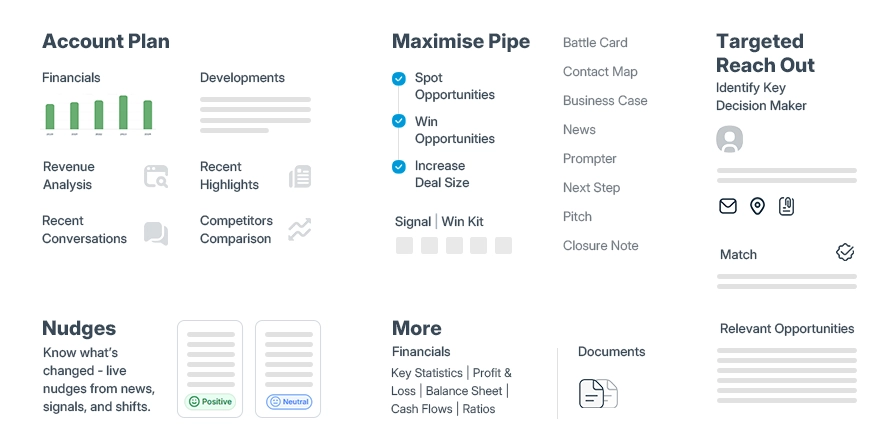
Account Context: What's happening at the company level? Revenue trends, leadership changes, market positioning shifts, strategic announcements. SalesPlay's Account Intelligence Agent consolidates 5-year financial history, recent developments, and business movements into a single dynamic view.
Opportunity Context: Why does a specific opportunity exist right now? Which signal triggered it? What sub-signals support it? SalesPlay's Spot Opportunities Agent identifies where you can sell, categorizes relevance, and shows the business rationale behind each opportunity.
Stakeholder Context: Who influences this decision? What matters to them? How do opportunities map to their function? The Spot Contacts Agent connects people to relevant opportunities and provides messaging angles tied to their priorities.
Engagement Context: What have you already discussed? What commitments were made? What changed since the last interaction? SalesPlay tracks conversation history and updates context as accounts evolve, ensuring continuity across every touchpoint.
When sellers have access to all four layers simultaneously, nurture campaigns shift from generic sequences to guided conversations that progress deals. Revenue teams learning how to find real pipeline opportunities discover that context is the foundation—without it, even sophisticated sales tech delivers marginal results.
Discover how SalesPlay's context layers power relevant nurture campaigns that drive actual revenue.
The impact of context on nurture performance shows up in three areas: engagement rates, conversion velocity, and deal quality.
Generic nurture emails average 8-12% open rates in B2B enterprise sales. Contextual nurture—messages tied to specific account events or opportunities—consistently achieves 35-48% open rates, according to SalesPlay internal benchmarks analyzing over 2 million nurture touches across enterprise accounts.
The difference isn't subject line optimization. It's relevance.
When a seller uses SalesPlay's Auto-Nurture Agent to create a campaign tied to a specific opportunity, every email references that opportunity context. Combined with comprehensive contact enrichment, sellers know not just who to reach, but exactly what matters to each stakeholder. A CFO evaluating cost reduction initiatives receives nurture content about efficiency gains—not generic ROI calculators. An IT leader managing a cloud migration sees messaging about integration complexity—not high-level platform benefits.
This is buyer-centric strategy in action. The nurture adapts to what the buyer actually cares about, when they care about it.
Traditional nurture extends sales cycles because it introduces friction. Prospects receive content that doesn't match their current evaluation stage. Sellers waste time following up on interactions that didn't indicate real interest. Deals stall waiting for "the right time" that never comes.
Contextual nurture shortens cycles by connecting outreach to buying readiness. When SalesPlay detects a signal that suggests opportunity movement—a new executive hire, a strategic partnership announcement, a competitor losing a major client—sellers can immediately launch targeted nurture that acknowledges the change.
SalesPlay research shows that nurture campaigns triggered by high-relevance signals (scored by the Spot Opportunities Agent) move deals to next stage 41% faster than campaigns initiated based solely on time-in-stage metrics. Context creates momentum.
Perhaps the most significant impact of context is on deal quality. When nurture is relevant, prospects engage with content that educates them on actual business outcomes—not just product features. They arrive at sales conversations already aligned on priorities. Discovery becomes validation, not exploration.
SalesPlay enables this through its Win Opportunities Agent, which provides battle cards, talking points, and messaging frameworks tied to specific opportunities. When a seller moves an opportunity from Spot to Win, they immediately access context-specific enablement materials. The nurture campaigns they create pull from this intelligence, ensuring every message reinforces strategic value.
The result: deals that close faster, at higher ASP, with stronger executive sponsorship. That's the compound effect of B2B sales enablement built on context, not generic content. For comprehensive strategies on modern sales enablement implementation, context-aware approaches consistently outperform traditional content libraries.
Context-driven nurture requires operational changes, not just better tools. Most sales organizations operate on lead-based models. Contextual selling requires account-based execution.
Traditional nurture starts with leads—individual contacts extracted from forms, events, or purchased lists. Contextual nurture starts with accounts—companies you've identified as strategic targets.
SalesPlay integrates with Salesforce to continuously monitor these target accounts. The platform watches for changes, analyzes signals, and surfaces opportunities inside accounts you already care about. This is fundamentally different from lead scoring systems that rank individuals in isolation.
When you generate pipeline from existing accounts, context is already rich. You know the account history. You understand the relationship. You can tie new opportunities to previous conversations. That's the foundation of effective nurture.
Not every account signal matters. A press release about a new office opening might be interesting, but it doesn't create a buying window for most B2B solutions. A leadership change in the C-suite absolutely does.
SalesPlay's Signals Agent filters noise and highlights what's relevant. When a signal appears, the platform evaluates whether it connects to your offerings, which opportunities it might create, and who inside the account would care. This goes beyond traditional intent data for B2B sales by combining behavioral signals with business intelligence to identify true buying windows.
This signal-to-opportunity mapping is what makes contextual nurture scalable. Instead of sellers manually researching accounts and guessing at relevance, the platform does the heavy lifting. Sellers review suggested opportunities, decide which to pursue, and immediately access the context needed to execute.
The biggest objection to contextual nurture is time. "We can't manually personalize every email for every prospect."
You don't have to.
SalesPlay's Auto-Nurture Agent generates personalized email campaigns at scale. Sellers select opportunities, choose contacts, define cadence, and approve the campaign. SalesPlay drafts every email, personalizes by individual and opportunity, ensures each message is different, and runs the sequence automatically.
The personalization isn't superficial. It's tied to opportunity context, stakeholder function, and account intelligence. A four-touch nurture campaign to three different stakeholders at the same account produces twelve unique emails—all contextually relevant, all professionally written, all sent on schedule.
This is how contextual selling becomes operationally viable. You maintain the relevance of one-to-one outreach with the efficiency of automation. For teams exploring advanced AI sales strategies, automated contextual nurture represents the intersection of personalization and scale.
Watch how SalesPlay's Auto-Nurture Agent creates personalized campaigns that convert—without manual writing.
Contextual selling transforms not just new business development—it changes how sales teams approach expansion revenue.
Traditional upsell and cross-sell relies on product usage data and renewal timing. "They're using Feature A heavily—let's pitch Feature B." "Contract expires in 90 days—time to discuss expansion."
This approach misses most opportunities.
Contextual upsell starts with account intelligence. What's changing inside the customer's business? New leadership with different priorities? Acquisition creating integration needs? Market expansion requiring scale? These business movements create windows for expansion conversations—but only if you know they're happening.
SalesPlay monitors customer accounts the same way it monitors prospects. The Account Intelligence Agent tracks revenue trends, organizational changes, and strategic initiatives. The Spot Opportunities Agent identifies where new needs might exist based on business movement. The Spot Contacts Agent shows which stakeholders to engage based on what's relevant to their function.
When sellers have this context, expansion nurture becomes strategic. Instead of "Here's what else we offer," the message becomes "Based on your recent announcement about X, here's how we can help you achieve Y." That's contextual cross-sell—expansion tied to account reality, not product catalogs.
Monitor customer signals continuously. Don't wait for renewal periods or quarterly business reviews. When something changes inside a customer account, that's your expansion window.
Connect expansion to outcomes, not features. SalesPlay's Win Opportunities Agent provides battle cards and messaging frameworks for upsell conversations. These materials tie additional products or services to business outcomes the customer already cares about.
Engage buying centers, not just existing contacts. Expansion often requires new stakeholders. The Spot Contacts Agent helps identify who else needs to be part of the conversation based on the expansion opportunity type.
Automate the nurture, but maintain the context. Use Auto-Nurture to create expansion campaigns that reference specific account movements, recent interactions, and current business priorities. The automation handles execution; the context ensures relevance.
This approach to expansion is what enables enterprise sales teams to build predictable pipeline from strategic accounts. You're not guessing at upsell potential—you're responding to documented business changes with relevant solutions.
Traditional nurture metrics—open rates, click rates, unsubscribe rates—tell you about engagement, not effectiveness. Contextual nurture requires different measurement.
Opportunity Conversion Rate: What percentage of nurtured opportunities move from identified to qualified? SalesPlay tracks this automatically by connecting nurture campaigns to opportunity progression in Salesforce.
Time to Next Stage: How much faster do contextually nurtured opportunities progress compared to baseline? This metric isolates the impact of relevant nurture on deal velocity.
Context Relevance Score: How closely does nurture content align with current account signals? SalesPlay's Spot Opportunities Agent assigns relevance scores (high/medium/low) to opportunities based on signal strength and business context alignment.
Multi-Stakeholder Engagement: Are nurture campaigns reaching multiple buying center contacts, or just single champions? Contextual nurture should expand deal footprint by engaging relevant stakeholders at the right time.
Organizations implementing contextual nurture through SalesPlay typically see:
These aren't hypothetical projections. They're results from SalesPlay customers who shifted from generic nurture to context-aware execution. The data comes from analyzing deal progression across thousands of enterprise sales cycles where SalesPlay provided account intelligence, opportunity detection, and automated nurture capabilities.
The compound effect is significant. Better targeting creates more qualified pipeline. Faster progression generates more revenue per quarter. Higher win rates improve sales efficiency. Together, these improvements transform revenue predictability. Teams focused on how sales leaders use revenue intelligence to create pipeline consistently report that contextual nurture is the execution layer that turns intelligence into actual closed revenue.
Join revenue teams already using SalesPlay to drive pipeline through contextual selling—not spray-and-pray campaigns.
Shifting to contextual nurture requires operational changes. Here's what revenue leaders encounter—and how to address it.
Sellers are skeptical of "better ways to nurture leads." They've seen automation tools promise efficiency and deliver noise. The key to adoption is demonstrating immediate value.
SalesPlay addresses this by showing sellers exactly where to focus. Instead of asking them to change behavior first, the platform surfaces high-relevance opportunities with full context already attached. Sellers see "Here's an account where something just changed that creates a buying window for our solution"—not "Here's another lead to call."
When sellers experience the difference between researching accounts from scratch versus having intelligence delivered, adoption accelerates. This is why SalesPlay's design emphasizes guided action over complex dashboards.
Most sales organizations already have marketing automation, CRM, and sales engagement platforms. Adding another tool creates workflow friction unless integration is seamless.
SalesPlay integrates directly with Salesforce, using CRM data as the foundation for account monitoring. Opportunities identified by SalesPlay sync to Salesforce automatically. Nurture campaigns created in SalesPlay track engagement and update opportunity records. This AI-powered CRM integration means sellers work in familiar environments while accessing contextual intelligence.
The platform doesn't require replacing existing tools—it enhances them by adding the context layer most sales tech stacks lack. For detailed integration strategies, see our guide on integrating multiple sales AI tools.
Not every account signal creates a sales opportunity. Determining which signals matter requires understanding your buyer's actual decision drivers—not assumed pain points.
SalesPlay helps by learning from your sales patterns. The platform analyzes which types of signals historically correlated with won deals, then prioritizes similar signals in target accounts. This isn't rules-based automation—it's pattern recognition that improves over time.
Revenue leaders can also configure signal priorities based on their specific offerings. If your solution addresses cost reduction, signals related to margin pressure, restructuring, or efficiency initiatives get weighted higher. If you solve for growth, signals about expansion, hiring, or funding become more relevant.
Automated nurture often sacrifices quality for volume. Messages become generic, repetitive, or awkwardly personalized ("Hi [FIRSTNAME], I noticed you work at [COMPANY]...").
SalesPlay's Auto-Nurture Agent solves this by generating truly unique content for each email based on opportunity context, stakeholder function, and account intelligence. The AI doesn't just insert variables—it writes coherent messages that reference specific business situations.
Sellers review and approve campaigns before they run, maintaining quality control without manual writing. The result is nurture that feels personal because it is contextually accurate—not because it used someone's first name.
The trajectory is clear. B2B buyers expect sellers to understand their business before engaging. Generic outreach gets ignored. Contextual conversations get responses.
The sales organizations winning in 2026 and beyond are those that operationalize context at scale. They monitor accounts continuously, detect opportunities automatically, and execute nurture campaigns that feel guided—not automated. Understanding how to nurture leads effectively now requires infrastructure that traditional marketing automation platforms simply cannot provide.
This isn't a temporary advantage. As AI-powered sales tools proliferate, the quality of context becomes the differentiator. SalesPlay by MarketsandMarkets was built specifically for this future—where revenue intelligence, account monitoring, opportunity detection, and automated nurture work together as a unified system.
The question isn't whether contextual selling will replace generic nurture. It's whether your sales organization will lead the shift or follow it.
See how SalesPlay by MarketsandMarkets powers context-aware revenue execution for enterprise sales teams.
Contextual selling connects every sales interaction to current account reality—business changes, stakeholder priorities, and opportunity timing. Traditional sales approaches rely on generic sequences, time-based nurture, and assumed pain points. Contextual selling uses account intelligence to ensure outreach timing, messaging, and proposed solutions align with what's actually happening inside target accounts. SalesPlay enables this by continuously monitoring accounts, detecting opportunities, and providing sellers with full context for every engagement.
Context improves conversion by ensuring nurture messages address actual buyer priorities at the right time. SalesPlay research shows contextual nurture achieves 35-48% open rates compared to 8-12% for generic sequences, and converts opportunities 3.2x faster. This happens because messages reference specific account changes, connect to stakeholder functions, and tie solutions to documented business initiatives—not generic value propositions.
Personalization typically means inserting names, companies, or basic firmographic data into templates. Contextual selling means connecting outreach to current account intelligence—business changes, recent announcements, organizational shifts, and specific opportunity triggers. SalesPlay's Auto-Nurture Agent delivers true contextualization by generating unique messages based on opportunity type, stakeholder function, and account signals—not just mail merge variables.
Contextual upsell starts with monitoring customer accounts for business changes that create expansion windows—new leadership, strategic initiatives, market expansion, or competitive pressures. SalesPlay tracks these signals in existing customer accounts, identifies which changes create upsell opportunities, and connects expansion opportunities to relevant stakeholders. Sellers then launch nurture campaigns that tie additional products or services to current business outcomes, not generic feature lists.
The most impactful signals vary by solution type, but typically include: executive leadership changes, financial performance trends, strategic partnership announcements, organizational restructuring, technology investments, competitive losses, market expansion initiatives, and regulatory changes. SalesPlay's Signals Agent filters thousands of data points to surface signals relevant to your specific offerings, then connects those signals to potential opportunities and buying centers.
SalesPlay's Auto-Nurture Agent allows sellers to select opportunities, choose contacts, and define campaign cadence. The platform then generates personalized emails for each recipient based on opportunity context, stakeholder role, and account intelligence. Every message is unique and tied to specific business situations. Sellers approve campaigns before launch, and SalesPlay handles execution while tracking engagement and updating Salesforce automatically.
Key metrics include: opportunity conversion rate (nurture-to-qualified pipeline), time to next stage (deal velocity impact), context relevance scores (signal-to-opportunity alignment), multi-stakeholder engagement rates, and ultimately win rates for contextually nurtured deals. SalesPlay tracks all of these automatically by connecting nurture campaigns to Salesforce opportunity progression, enabling revenue leaders to measure actual pipeline impact—not just email engagement.
Account-based selling focuses on targeting specific companies rather than individual leads. Contextual selling takes this further by continuously monitoring what's changing inside those target accounts and connecting outreach to those changes. You can practice account-based selling with static research. Contextual selling requires continuous intelligence and dynamic execution. SalesPlay enables both by providing account-based infrastructure with always-on context monitoring.
Lead nurture without context is a volume game that rarely converts. Contextual selling transforms nurture into a precision instrument that accelerates pipeline and improves win rates.
The core principles:
SalesPlay by MarketsandMarkets was built to operationalize these principles. The platform doesn't just provide account intelligence—it connects that intelligence to executable workflows that drive revenue.
If your sales organization is still running generic nurture campaigns, measuring success by email metrics, and wondering why conversion rates remain flat, the problem isn't your messaging. It's the absence of context.
The shift to contextual selling isn't optional. It's the table stakes for B2B sales effectiveness in 2026 and beyond.
See how SalesPlay by MarketsandMarkets transforms lead nurture from generic sequences to revenue-driving conversations.


Category: Uncategorized Tags: ai, AIOps, Artificial Intelligence, cloud, cloud platform, Cybersecurity, Information and Communications Technology , VR