The Pipeline Generation Problem Most Teams Can't See
Most sales organizations measure pipeline creation by activity: calls made, emails sent, meetings booked. They reward volume. They track conversion rates. They forecast based on historical patterns.
Then they wonder why only a handful of sellers consistently hit quota.
The problem isn't effort. Average sellers work just as many hours as top performers. They follow the same processes. They use the same scripts. They attend the same training.
What separates elite sellers is what they know before they engage.
Top performers create pipeline by identifying opportunities where account intelligence reveals buying triggers. They don't prospect in the traditional sense. They position themselves where demand already exists but hasn't been articulated yet.
This isn't about better messaging or stronger relationships. It's about information asymmetry.
What Top Sellers Actually Do Differently
They Watch Accounts, Not Leads
Average sellers chase leads. Top sellers monitor accounts.
The distinction matters. Leads are static data points—names, titles, contact information. Accounts are living systems with changing priorities, shifting budgets, evolving strategies.
Elite performers use revenue intelligence platforms to continuously track what's changing inside target accounts:
- Leadership transitions that create buying windows
- Funding rounds that unlock budget
- Strategic pivots that create new needs
- Competitive displacements that open opportunities
- Market expansions that require new capabilities
They don't wait for intent signals. They act on change signals.
When a target account announces a new CRO, top sellers know that real pipeline opportunities emerge within 90-120 days as new leadership evaluates existing tools and processes.
When an account raises Series C funding, they know expansion plans follow. When a competitor loses a major client, they know procurement cycles open.
This is why pipeline generation in enterprise sales isn't about finding more prospects. It's about knowing which accounts are entering buying cycles before those accounts start looking for solutions.
They Prioritize Based on Timing, Not Fit
Most pipeline generation models prioritize accounts based on firmographic fit: industry, company size, technology stack, geographic location.
Top sellers flip this.
They prioritize accounts based on when the opportunity exists, not just if it exists.
A perfectly-fit account with no active buying trigger is a future opportunity. An imperfect-fit account with budget allocated and a project starting next quarter is an immediate opportunity.
Elite performers understand that timing creates urgency, and urgency creates deals.
They use signal-driven frameworks to score accounts not just by fit, but by:
- Buying window readiness – Is there a reason to buy now?
- Budget availability – Has money been allocated or can it be freed?
- Authority engagement – Can we reach decision-makers directly?
- Strategic alignment – Does our solution map to their current priorities?
This is why generating pipeline from existing accounts often outperforms cold acquisition. Existing relationships provide visibility into timing that external data can't capture.
They Engage With Context, Not Scripts
Average sellers personalize subject lines. Top sellers personalize strategy.
When an elite seller reaches out, they reference specific business changes:
- "I saw your Q3 earnings call mentioned international expansion..."
- "Your recent VP of Sales hire from [Company] suggests you're scaling outbound..."
- "The press release about your new product line signals a need for..."
This isn't surface-level research. It's operational intelligence.
They know what changed, why it matters, and how it connects to buying behavior. They don't pitch products. They discuss implications.
This approach transforms pipeline creation from interruption to conversation. The prospect isn't being sold to—they're being understood.
The Three-Layer Pipeline Creation System
Top sales performance isn't random. It follows a system.
Elite sellers operate across three layers that compound into consistent pipeline generation:
Layer 1: Continuous Account Monitoring
Top performers don't manually research accounts before each call. They've already been watching.
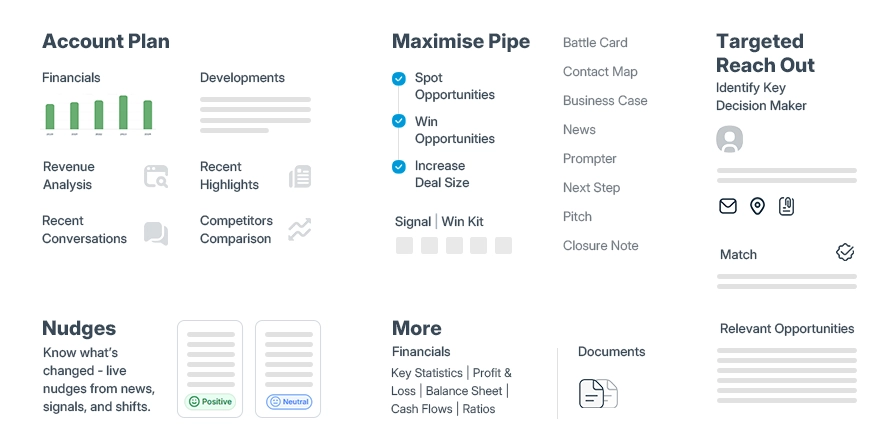
They use sales intelligence platforms that continuously aggregate:
- Financial data (revenue trends, funding events, earnings reports)
- Organizational changes (leadership moves, headcount shifts, restructuring)
- Strategic signals (new product launches, market expansions, M&A activity)
- Competitive movements (vendor switches, contract renewals, procurement cycles)
This monitoring runs in the background. When something relevant changes, they know immediately—not when they happen to check LinkedIn.
The difference between reactive research and proactive monitoring is the difference between showing up to opportunities and creating them.
Layer 2: Opportunity Detection (Not Lead Scoring)
Most CRMs score leads based on demographic attributes. Top performers identify opportunities based on business triggers.
They don't ask "Is this a good lead?" They ask:
- What just changed inside this account?
- Does this change create a problem we solve?
- Is the timing right to engage?
- Can we reach the people this affects?
This is why modern pipeline generation requires intelligence platforms, not just contact databases. You can't spot opportunities if you're only tracking static attributes.
Elite sellers use tools that automatically surface accounts showing:
- Hiring patterns that indicate initiative launches
- Technology adoption that signals capability gaps
- Financial performance that suggests budget availability
- Leadership changes that open vendor evaluation windows
These aren't marketing qualified leads. They're context-qualified opportunities.
Layer 3: Systematic Engagement (Not Random Outreach)
Once an opportunity is identified, top sellers don't spray generic emails. They execute planned sequences based on account context.
For a recently-funded account, they might:
- Reference the funding announcement and implied growth plans
- Share case studies from similar post-funding scaling challenges
- Offer a conversation about common operational bottlenecks at this stage
For an account with new leadership, they might:
- Acknowledge the transition and typical first-90-day priorities
- Provide benchmarking data on what peers are implementing
- Position their solution as a quick-win initiative
This systematic approach is what enables predictable pipeline generation from strategic accounts. It's not about luck or timing. It's about repeatable execution tied to observable triggers.
Common Pipeline Generation Mistakes That Kill Performance
Understanding what works matters less if you're still doing what doesn't. Here are the common pipeline gaps that even experienced sellers miss:
Mistake #1: Confusing Activity With Progress
Sending 100 cold emails feels productive. Booking 10 discovery calls looks successful. But if those calls don't convert to pipeline because the accounts weren't qualified by timing, you've just spent a week generating meetings, not opportunities.
Top performers measure:
- Pipeline created from engaged accounts (not just meetings held)
- Average time from first contact to qualified opportunity
- Conversion rate from outreach to closed-won deals
Activity metrics are lag indicators. Pipeline quality is the leading indicator.
Mistake #2: Treating All Pipeline as Equal
A $500K opportunity with no budget allocated and a 12-month sales cycle isn't the same as a $200K opportunity with active procurement and a 60-day close timeline.
Yet most pipeline reports don't distinguish between real opportunities and hopeful conversations.
Elite sellers qualify ruthlessly. They don't inflate pipeline to hit coverage ratios. They build pipeline they can actually close.
This means:
- Disqualifying opportunities with no near-term budget
- Deprioritizing accounts where authority can't be reached
- Exiting deals where no compelling event exists
Bad pipeline is worse than no pipeline. It consumes time without generating revenue.
Mistake #3: Ignoring Expansion in Pursuit of Net-New
Most comp plans reward new logo acquisition more heavily than expansion. So sellers chase new accounts while existing accounts sit undermonetized.
Top performers flip this. They know that dormant accounts and existing customers are the fastest path to qualified pipeline.
Why? Because:
- Trust is already established (shorter sales cycles)
- Solution fit is proven (higher win rates)
- Access to stakeholders is easier (fewer cold calls)
- Contract vehicles often exist (faster deal closure)
Elite sellers continuously monitor existing accounts for expansion triggers: new initiatives, budget approvals, org changes, technology gaps.
They don't wait for customers to ask. They proactively surface opportunities.
Decision Framework: What Pipeline Generation Approach Actually Works?
Sales leaders evaluating pipeline generation strategies face a fundamental choice: volume-based outbound, account-based targeting, or signal-driven intelligence.
Here's what each approach actually delivers:
| Approach | How It Works | Pipeline Volume | Pipeline Quality | Best For |
|---|---|---|---|---|
| Volume-Based Outbound | High-volume cold outreach across broad ICP segments | High volume, low qualification | Low (5-15% qualified rate) | Early-stage companies, low ACV products, high-velocity sales |
| Account-Based Targeting | Focused engagement with predefined target account lists | Medium volume, manual research-intensive | Medium (25-40% qualified rate) | Enterprise sales with clear ICP, relationship-driven deals |
| Signal-Driven Intelligence | Continuous monitoring with engagement triggered by business changes | Lower volume, higher relevance | High (50-70% qualified rate) | Complex B2B sales, strategic accounts, expansion-focused teams |
The question isn't which approach generates the most pipeline. It's which approach generates closeable pipeline.
Top sellers default to signal-driven intelligence because:
- They engage when context creates urgency (not when quotas create pressure)
- They focus on accounts showing buying triggers (not just fitting ICPs)
- They build relationships before competitive RFPs start (not during them)
Pipeline Best Practices: What Implementation Actually Looks Like
Understanding the theory matters less than executing the practice. Here's what top sellers actually do every week to maintain consistent pipeline generation:
Monday: Account Review & Prioritization
Elite sellers start each week by reviewing what changed across their target accounts. They don't manually research—they use automated intelligence platforms that surface:
- New funding announcements
- Leadership transitions
- Product launches or strategic shifts
- Earnings calls mentioning relevant initiatives
- Competitive displacements
They then prioritize accounts not by size, but by trigger strength. A mid-market account with a new VP of Sales beats a Fortune 500 account with no recent changes.
Tuesday-Thursday: Contextual Engagement
Once priorities are set, top performers execute outreach that references specific business context.
They don't use generic templates. They create custom messaging that connects observed changes to likely needs:
- "I noticed your recent Series B announcement. Based on typical post-funding scaling patterns, teams at your stage often face..."
- "Your new CRO's background at [Company] suggests you're likely evaluating how to..."
- "Given your international expansion plans mentioned in Q4 earnings, you're probably dealing with..."
This isn't personalization theater. It's operational relevance.
Friday: Pipeline Health Check
Elite sellers review not just how much pipeline they created, but what quality.
They ask:
- Which opportunities have confirmed budget?
- Which have engaged decision-makers?
- Which have defined timelines?
- Which are progressing vs. stalling?
They ruthlessly disqualify opportunities that look good on paper but lack fundamental buying criteria. Weak pipeline inflates forecasts and wastes time.
The Role of Technology in Top Performance
You can't manually operate the pipeline generation system top sellers use. The monitoring, trigger detection, and context preparation require automation.
Elite performers use AI-powered sales tools that:
- Continuously track target accounts across dozens of data sources
- Surface relevant changes the moment they occur
- Connect business events to buying triggers
- Prepare account context before every engagement
- Suggest messaging based on observed patterns
This isn't about replacing sellers. It's about eliminating the parts of pipeline generation that don't require judgment: data gathering, pattern recognition, context assembly.
Sellers still decide who to contact, when to engage, and what to say. Technology handles knowing what changed and why it matters.
The comparison between traditional pipeline generation and signal-driven approaches isn't close. One relies on volume and luck. The other relies on information and timing.
What "More Pipeline" Actually Means
Most sales organizations want more pipeline because they think it solves forecasting volatility. It doesn't.
Bad pipeline—opportunities without budget, authority, need, or timeline—creates the illusion of coverage while consuming resources that should focus on real deals.
Top sellers don't generate more pipeline than average performers. They generate more qualified pipeline.
The distinction is critical:
- More pipeline = more meetings, more activity, more forecasted revenue
- More qualified pipeline = more closeable deals, higher win rates, predictable outcomes
Elite performers would rather have $5M in qualified pipeline than $15M in hopeful conversations.
This is why revenue intelligence platforms focus on opportunity quality, not opportunity quantity. They help sellers identify accounts where buying triggers exist, not just accounts that fit ICPs.
The Continuous Execution Model
Average sellers operate in discrete modes: prospecting time, closing time, admin time. They context-switch between activities.
Top performers operate in continuous execution mode.
They don't separate pipeline generation from deal progression. Every account interaction—whether it's a first touch or a renewal conversation—is an opportunity to identify additional pipeline.
They ask expansion questions during implementation calls. They monitor existing customers for new buying triggers. They track lost deals for organizational changes that create re-engagement opportunities.
This is what surfacing opportunities across accounts actually means: treating every account as both a current opportunity and a future opportunity simultaneously.
The pipeline doesn't get built during "prospecting blocks." It gets built continuously through systematic account monitoring and contextual engagement.
Why This Matters Now More Than Ever
The traditional pipeline generation playbook—mass outreach, cold calls, generic personalization—is breaking down.
Buyers are harder to reach. Gatekeepers are more sophisticated. Inboxes are more protected. Generic outbound has diminishing returns.
At the same time, the amount of publicly available business intelligence has exploded. Funding announcements, leadership moves, strategic pivots, product launches—all of this is trackable in real time.
The opportunity for sellers who know how to leverage this intelligence is unprecedented. The challenge for sellers who don't is existential.
Top sales performance is increasingly about information advantage. Sellers who see opportunities before competitors, who engage when timing creates urgency, who operate with context instead of scripts—they win.
The rest make calls and hope for the best.