Anti-Jamming Market for GPS by Receiver Type (Military & Government Grade, and Commercial Transportation Grade), Technique (Nulling, Beam Steering, and Civilian), End-User, Application, and Geography - Global Forecast to 2036


Anti-Jamming Market for GPS Market Summary
The Anti-Jamming Market for GPS was valued at approximately USD 4–5 billion in 2025 and is projected to reach USD 11–13 billion by 2036, expanding at a CAGR of 9–11% during the forecast period (2025–2036). The market is gaining strategic importance as global dependence on satellite navigation systems intensifies across defense, aviation, maritime, automotive, and critical infrastructure sectors. The increasing threat of GPS signal interference, spoofing, and electronic warfare is driving demand for robust anti-jamming solutions. Additionally, the integration of artificial intelligence (AI), Internet of Things (IoT), and advanced automation technologies is enhancing the performance and resilience of GPS systems. Governments and defense agencies worldwide are investing heavily in secure navigation technologies, while commercial sectors are adopting anti-jamming solutions to ensure operational continuity. As digital transformation accelerates and reliance on precise positioning systems grows, the Anti-Jamming Market for GPS is becoming a critical enabler of secure and reliable navigation.
Key Market Trends & Insights
The Anti-Jamming Market for GPS is evolving rapidly, driven by increasing security concerns and technological advancements. North America leads the market due to strong defense spending and advanced satellite infrastructure. Asia Pacific is the fastest-growing region, fueled by rising geopolitical tensions and expanding defense modernization programs. The military and defense segment dominates the market, as secure navigation is critical for mission success. Emerging trends include the adoption of AI-powered signal processing and adaptive filtering technologies to counter interference. Automation is enhancing system responsiveness and reducing human intervention in threat detection. Additionally, the integration of anti-jamming solutions with IoT-enabled systems is expanding their application in commercial sectors such as transportation and logistics.
Market Size & Forecast
-
Base Year Market Size (2025): USD 4–5 Billion
-
Forecast Value (2036): USD 11–13 Billion
-
CAGR (2025–2036): 9–11%
-
Growth is driven by increasing threats of GPS jamming, rising defense investments, and adoption of secure navigation systems across industries.
Anti-Jamming Market for GPS Market Top 10 key takeaway
-
The market is projected to grow at a CAGR of 9–11% through 2036.
-
North America leads due to strong defense infrastructure.
-
Asia Pacific is the fastest-growing region.
-
Military and defense is the dominant application segment.
-
AI integration is enhancing signal detection and filtering.
-
Rising cyber and electronic warfare threats are driving demand.
-
IoT integration is expanding commercial applications.
-
Automation is improving system efficiency and response time.
-
Aviation and maritime sectors are key growth areas.
-
Increasing reliance on GPS systems is fueling market expansion.
Product Insights
Controlled reception pattern antennas (CRPAs) represent the leading product segment in the Anti-Jamming Market for GPS, as they provide advanced capabilities to suppress interference and maintain signal integrity. CRPAs are widely used in military applications due to their ability to dynamically adjust antenna patterns and mitigate jamming signals. Their dominance is attributed to their high performance and reliability in challenging environments.
Other important product categories include nulling antennas and beamforming systems, which are gaining traction in both defense and commercial applications. These technologies enable precise control of signal reception and enhance resistance to interference. Emerging product innovations include compact and lightweight anti-jamming modules designed for integration into unmanned systems and portable devices. The incorporation of AI into these products is enabling real-time threat detection, adaptive filtering, and improved system performance, further driving market growth.
Technology / Component Insights
The Anti-Jamming Market for GPS is driven by advanced technologies such as adaptive beamforming, digital signal processing, and multi-frequency GNSS systems. These technologies enable accurate detection and mitigation of jamming and spoofing signals, ensuring reliable navigation.
AI and machine learning are playing a transformative role by enabling intelligent signal analysis, anomaly detection, and predictive threat assessment. IoT integration is expanding the use of anti-jamming solutions in connected systems, including autonomous vehicles and smart infrastructure. Cloud computing is supporting centralized monitoring and data analysis, while automation is streamlining system operations and reducing response times.
Future innovation trends include the development of software-defined anti-jamming systems, integration with multi-constellation GNSS (such as GPS, GLONASS, Galileo, and BeiDou), and the use of quantum-resistant technologies for enhanced security. These advancements are expected to significantly improve the resilience and performance of GPS systems.
Application Insights
The military and defense sector is the leading application segment in the Anti-Jamming Market for GPS, driven by the critical need for secure and reliable navigation in combat and surveillance operations. Anti-jamming systems are essential for ensuring mission success and protecting assets from electronic warfare threats.
The aviation sector is another significant application area, where anti-jamming solutions are used to ensure safe navigation and communication in increasingly congested airspace. Maritime applications are also growing, as shipping and offshore operations rely heavily on GPS for navigation and positioning.
Commercial applications, including automotive, agriculture, and logistics, are emerging as key growth areas. The adoption of autonomous vehicles and precision farming technologies is driving demand for reliable GPS systems. Future opportunities lie in smart city applications and industrial automation, where secure navigation and positioning are critical.
Regional Insights
North America dominates the Anti-Jamming Market for GPS, supported by high defense spending, advanced technological capabilities, and strong government initiatives. The region’s focus on national security and infrastructure protection is driving demand for anti-jamming solutions.
Europe is experiencing steady growth, driven by increasing investments in defense modernization and the adoption of advanced navigation technologies. The region is also focusing on enhancing the security of critical infrastructure.
Asia Pacific is the fastest-growing region, fueled by rising geopolitical tensions, expanding defense budgets, and increasing adoption of advanced technologies. Countries such as China, India, and Japan are investing heavily in secure navigation systems.
-
North America leads due to strong defense investments
-
Europe shows steady growth driven by modernization efforts
-
Asia Pacific is the fastest-growing region
-
Government initiatives are supporting secure navigation systems
-
Rising security concerns are driving global demand
Country-Specific Market Trends
In Asia Pacific, China leads the Anti-Jamming Market for GPS with a projected CAGR of 11–13%, driven by significant investments in defense and satellite technologies. Japan follows with a CAGR of 9–10%, focusing on advanced navigation and security systems.
In North America, the United States dominates the market due to its extensive defense capabilities and technological leadership. Canada and Mexico are experiencing steady growth, with CAGRs ranging from 8–9%, supported by increasing adoption of secure navigation technologies.
In Europe, Germany and France are key contributors to market growth, with CAGRs of approximately 9–10% and 8–9%, respectively. These countries are focusing on strengthening defense capabilities and protecting critical infrastructure.
-
China leads APAC with strong defense investments
-
Japan focuses on advanced navigation technologies
-
United States dominates North America market
-
Canada and Mexico show steady growth trends
-
Germany and France lead Europe in adoption
Key Anti-Jamming Market for GPS Company Insights
The Anti-Jamming Market for GPS is highly competitive, with companies focusing on innovation, AI integration, and strategic collaborations to strengthen their market position. Leading players are investing in advanced technologies and product development to address evolving security challenges.
Major companies include Raytheon Technologies Corporation, Lockheed Martin Corporation, BAE Systems plc, L3Harris Technologies, Inc., Thales Group, Hexagon AB, NovAtel Inc., Cobham Limited, TUALCOM, and Mayflower Communications Company, Inc. These companies are leveraging AI and automation to enhance system performance, improve threat detection, and expand their global presence.
-
Companies are investing in advanced anti-jamming technologies
-
AI-driven threat detection is a key focus area
-
Strategic partnerships are driving innovation
-
Expansion into emerging markets is a major growth strategy
-
Automation is enhancing system efficiency
Recent Developments
Recent developments in the Anti-Jamming Market for GPS highlight the increasing focus on innovation and security. In 2025, a leading defense contractor launched an AI-powered anti-jamming system capable of real-time threat detection and adaptive response. Another company introduced a compact anti-jamming module designed for integration into unmanned aerial vehicles (UAVs). Additionally, a strategic partnership between a satellite technology provider and a defense organization aims to develop next-generation secure navigation solutions.
Market Segmentation
The Anti-Jamming Market for GPS is segmented based on product, technology/component, application, and region. By product, the market includes CRPA, nulling antennas, and beamforming systems, with CRPA dominating due to its superior performance. By technology, the market is segmented into adaptive beamforming, digital signal processing, and multi-frequency GNSS systems. Application-wise, the market covers military and defense, aviation, maritime, and commercial sectors. Regionally, the market is divided into North America, Europe, Asia Pacific, and Rest of the World.
-
CRPA dominates the product segment
-
Adaptive beamforming is a key technology segment
-
Military and defense is the leading application area
-
Asia Pacific offers the highest growth potential
-
Commercial applications are gaining traction
The Anti-Jamming Market for GPS is poised for significant growth through 2036, driven by increasing security concerns, advancements in AI and automation, and the growing reliance on GPS systems across industries. As electronic warfare and cyber threats continue to evolve, the demand for robust anti-jamming solutions will intensify. The integration of AI, IoT, and advanced technologies is expected to enhance system performance and resilience, enabling secure and reliable navigation. With strong growth potential and strategic importance, the Anti-Jamming Market for GPS represents a critical investment opportunity for governments and businesses worldwide.
FAQs
1. What is the current market size of the Anti-Jamming Market for GPS?
The market was valued at approximately USD 4–5 billion in 2025.
2. What is the expected growth rate of the market?
The market is expected to grow at a CAGR of 9–11% from 2025 to 2036.
3. What are the key drivers of market growth?
Key drivers include rising GPS jamming threats, increased defense spending, AI integration, and adoption of secure navigation systems.
4. Which region dominates the Anti-Jamming Market for GPS?
North America currently holds the largest market share.
5. Who are the key players in the market?
Major companies include Raytheon Technologies, Lockheed Martin, BAE Systems, and Thales Group.
To speak to our analyst for a discussion on the above findings, click Speak to Analyst
 Exclusive indicates content/data unique to MarketsandMarkets and not available with any competitors.
The study involved 4 major activities to estimate the size of the anti-jamming market for GPS. Exhaustive secondary research has been conducted to collect information on the anti-jamming market for GPS. Validation of these findings, assumptions, and sizing with industry experts across value chain through primary research has been the next step. Both, top-down and bottom-up approaches have been employed to estimate the complete market size. After that, market breakdown and data triangulation have been used to estimate the market size of segments and subsegments.
Secondary Research
In the secondary research, various secondary sources have been referred to for identifying and collecting information important for this study. Secondary sources include corporate filings (such as annual reports, investor presentations, and financial statements); trade, business, and professional associations; white papers, machine condition monitoring related journals, and certified publications; articles from recognized authors; gold and silver standard websites; directories; and databases. A few examples of secondary sources are GPS: The Global Positioning System, European GNSS Agency, Federal Communications Commission (FCC), and US Department of Defense.
Primary Research
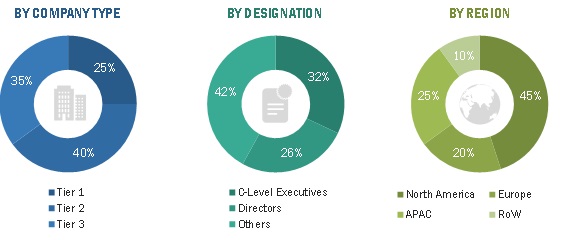
In the primary research, various primary sources from both the supply and demand sides have been interviewed with to obtain the qualitative and quantitative information for this report. Primary sources from the supply side include industry experts such as CEOs, VPs, marketing directors, technology and innovation directors, and related key executives from major companies and organizations operating in the anti-jamming market for GPS. Following is the breakdown of primary respondents.
To know about the assumptions considered for the study, download the pdf brochure
Market Size Estimation
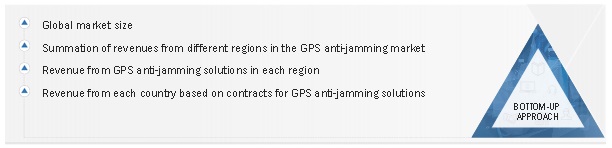
Both, top-down and bottom-up approaches have been used to estimate and validate the size of the overall GPS anti-jamming market and the market based on subsegments. The research methodology used to estimate the market size has been given below:
- Key players in the market have been identified through extensive secondary research.
- The industry’s supply chain and market size, in terms of value, have been determined through primary and secondary research processes.
- All percentage shares, splits, and breakdowns have been determined using secondary sources and verified through primary sources.
To know about the assumptions considered for the study, Request for Free Sample Report
Data Triangulation
After arriving at the overall market size—using the estimation processes explained above—the market has been split into several segments and subsegments. To complete the overall market engineering process and arrive at the exact statistics of each market segment and subsegment, data triangulation and market breakdown procedures have been employed, wherever applicable. The data has been triangulated by studying various factors and trends in both demand and supply sides of the GPS Anti-jamming market.
Report Objectives
- To describe and forecast the GPS anti-jamming market size, in terms of value, based on receiver type, anti-jamming technique, application, end user, and geography
- To forecast the GPS anti-jamming market size, in terms of volume, based on receiver type, end user, and geography
- To describe and forecast the market size, in terms of value, for various segments, by region—North America, Europe, Asia Pacific (APAC), and the Rest of the World (RoW), along with the respective countries
- To provide detailed information regarding drivers, restraints, opportunities, and challenges pertaining to the GPS anti-jamming market
- To strategically analyze the micromarkets1 with respect to the individual growth trends, prospects, and their contribution to the GPS anti-jamming market
- To strategically profile key players in the GPS anti-jamming market and comprehensively analyze their market share and core competencies2
- To provide a detailed overview of the GPS anti-jamming value chain
- To analyze competitive developments such as contracts, acquisitions, product launches and developments, collaborations, and partnerships, along with research & development (R&D) in the GPS anti-jamming market
- To analyze the impact of COVID-19 on the growth of the GPS anti-jamming market
Available Customizations
Along with the market data, MarketsandMarkets offers customizations according to a company’s specific needs. The following customization options are available for the report:
Company Information
- Detailed analysis and profiling of additional market players (up to 5)













Growth opportunities and latent adjacency in Anti-Jamming Market
Did anti-jamming solutions report cover the study across the constellations such as Beidou, Galileo, QZSS, and Glonass? If, yes, what percentage of anti-jamming market size for each of these?
Is this study included anti-spoofing too? If yes, please tell me the major players who provided both the solutions and market share for those?
We are interested only in the timing applications of the anti-jamming market, which is a small part of the report. Can we purchase the timing section only? Also we would like to know the future opportunities of the market.
At what extend, these anti-jamming solutions will help commercial or transportation users? Can you provide the market size estimation for next 5 years? Also, what are major key players dealing in anti-jamming market for commercial applications?
IS there is any price difference between the anti-jamming solutions provided to military and commercial applications? And please provide a detailed information related to players in each application?
I am working on a market research project in anti-jamming techniques for a large Defense company. Please can you outline the process for buying this report as a purchase order would need to be raised.
How the government expenditure on military solutions will impact the market size of anti-jamming solutions in various countries? What all type of anti-jamming solutions have you considered for military application?
What is the scope of the anti-jamming market? Have you included the market sizing for anti-jamming in African region?