Automatic Checkweigher Market

Automatic Checkweigher Market by Type (In-motion, Static Checkweighers), Technology (Strain Gauge Load Cell, Electromagnetic Force Restoration), Throughput Capacity (Up to 150 ppm, 151-300 ppm, Above 300 ppm), Product Weight - Global Forecast to 2032




OVERVIEW
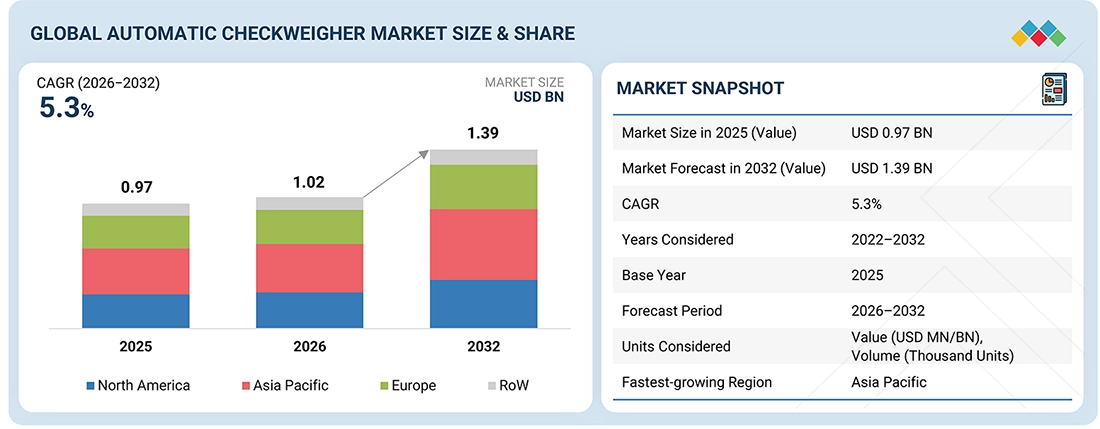
Source: Secondary Research, Interviews with Experts, MarketsandMarkets Analysis
The global automated checkweigher market size is estimated to reach USD 1.02 billion in 2026 and USD 1.39 billion by 2032, growing at a CAGR of 5.3% during the forecast period. The market is driven by the rising demand for automated quality control across food & beverages, pharmaceuticals, chemicals, logistics & e-commerce, cosmetics & personal care, and other manufacturing industries, as companies look to improve production efficiency, ensure regulatory compliance, reduce product giveaway, and minimize manual inspection. Increasing adoption of in-motion and intermittent/static checkweighers is supporting applications such as weight verification, product sorting, reject management, package integrity inspection, and production line optimization. Advancements in high-precision load cell technologies, AI-enabled inspection software, machine vision, cloud connectivity, and real-time production monitoring are improving checkweigher accuracy, throughput, data analytics, and overall equipment effectiveness. Increasing investments in smart manufacturing, Industry 4.0 initiatives, predictive maintenance, integrated inspection systems, and digital production management platforms are further accelerating market adoption and supporting large-scale deployment of automatic checkweighers across manufacturing facilities worldwide.
KEY TAKEAWAYS
-
BY REGIONBy region, Asia Pacific accounted for a 36.5% share of the automatic checkweigher market by 2032.
-
BY TYPEBy type, the in-motion checkweighers segment is likely to register a CAGR of 5.8% during the forecast period.
-
BY TECHNOLOGYBy technology, the strain gauge load cell segment held a 61.5% share of the automatic checkweigher market in 2025.
-
BY THROUGHPUT CAPACITYBy throughput capacity, the high-speed checkweighers (above 300 packs/min) segment is expected to register the highest CAGR in the automatic checkweigher market between 2026 and 2032.
-
BY PRODUCT WEIGHT RANGEBy product weight range, the up to 10 kg checkweighers segment is projected to account for the largest share of the automatic checkweigher market by 2032.
-
By INDUSTRYBy industry, the logistics & e-commerce segment is expected to register the highest CAGR during the forecast period.
-
COMPETITIVE LANDSCAPE (KEY PLAYERS)METTLER TOLEDO (US), Ishida Co., Ltd. (Japan), Anritsu (Japan), Minebea Intec GmbH (Germany), and Thermo Fisher Scientific Inc. (US), among others, are identified as key players in the automatic checkweigher market.
-
COMPETITIVE LANDSCAPE (STARTUPS/SMES)Technofour Electronics Pvt. Ltd. (India) and EasyWeigh (South Africa), among others, have established strong positions in specialized checkweighing solutions, highlighting their role as emerging players and SMEs in the automatic checkweigher market.
The automatic checkweigher market is witnessing steady growth as manufacturers increasingly invest in automated inspection and quality assurance solutions to improve production efficiency, reduce product giveaway, and ensure compliance with regulatory standards across high-speed production environments. Demand is driven by the growing deployment of automatic checkweighers across food & beverages, pharmaceuticals, chemicals, cosmetics & personal care, and logistics & e-commerce industries. Increasing adoption of in-motion and intermittent/static checkweighers is enabling applications such as weight verification, package completeness inspection, reject management, production line monitoring, and process optimization. Continuous advancements in strain gauge load cells, electromagnetic force restoration (EMFR) technology, AI-enabled analytics, machine vision, cloud connectivity, and real-time monitoring platforms are improving weighing accuracy, throughput, operational efficiency, and predictive maintenance capabilities. Growing adoption of Industry 4.0, smart manufacturing initiatives, integrated inspection systems combining checkweighing with metal detection and X-ray inspection, and digital quality management platforms is further strengthening the role of automatic checkweighers in modern manufacturing ecosystems.
TRENDS & DISRUPTIONS IMPACTING CUSTOMERS' CUSTOMERS
The figure highlights the increasing shift in the automatic checkweigher market from conventional standalone weighing systems toward intelligent, connected, and data-driven inspection solutions. Automatic checkweigher manufacturers are expanding beyond equipment sales, installation, calibration, and maintenance services to offer AI-enabled inspection software, cloud-enabled production analytics, predictive maintenance solutions, digital quality management systems, and integrated inspection systems combining checkweighing with metal detection and X-ray inspection. Growing demand across food & beverages, pharmaceuticals, chemicals, cosmetics & personal care, and logistics & e-commerce is boosting adoption as manufacturers seek to improve product quality, ensure regulatory compliance, reduce product giveaway, optimize production efficiency, and enhance supply chain visibility. This transition enables higher throughput, greater weighing accuracy, reduced operational costs, real-time production insights, and smarter quality assurance, positioning automatic checkweighers as a critical component of Industry 4.0-enabled manufacturing and automated packaging ecosystems.
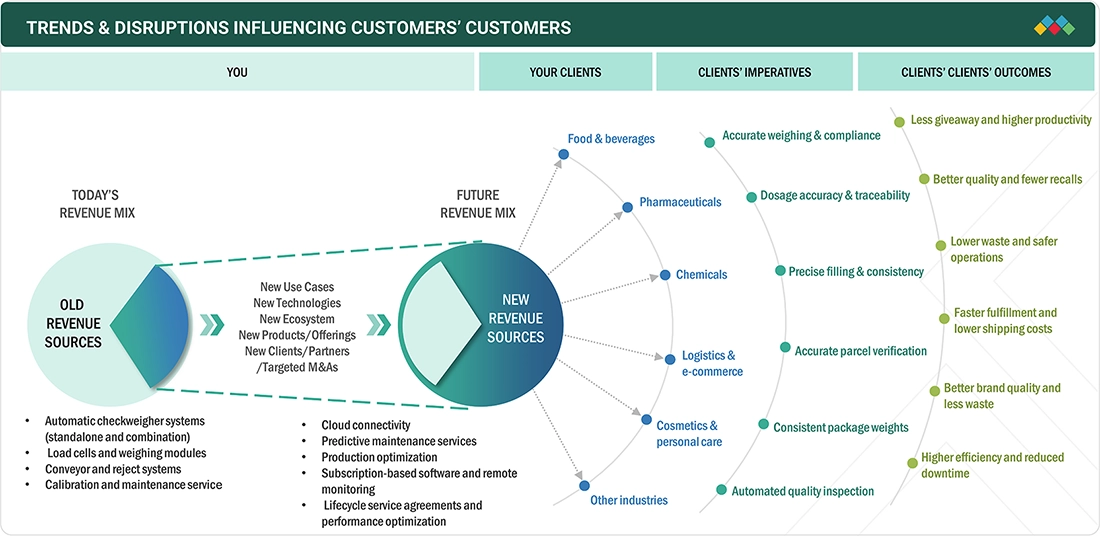
Source: Secondary Research, Interviews with Experts, MarketsandMarkets Analysis
MARKET DYNAMICS

Level
-
Increasing stringency of packaging and weight compliance regulations

-
Growing automation across high-speed production facilities


Level
-
High initial investment for advanced automatic checkweigher systems

-
Integration complexity within existing production lines


Level
-
Rising e-commerce fulfillment and logistics automation investments

-
Advanced data analytics and predictive process optimization


Level
-
Issues in maintaining high weighing accuracy at increasing production speeds

-
Complexities in handling diverse product shapes, packaging formats, and frequent product changeovers

Source: Secondary Research, Interviews with Experts, MarketsandMarkets Analysis
Driver: Increasing stringency of packaging and weight compliance regulations
Governments and regulatory authorities are enforcing stricter packaging and net-content regulations across industries such as food & beverages, pharmaceuticals, chemicals, and cosmetics. Manufacturers are increasingly adopting automatic checkweighers to ensure accurate weight verification, reduce product giveaway, maintain compliance with labeling requirements, and minimize the risk of product recalls, regulatory penalties, and customer complaints.
Restraint: High initial investment for advanced automatic checkweigher systems
Advanced automatic checkweigher systems require significant investment in high-precision load cells, sensors, conveyor systems, control software, machine vision, and system integration. Additional costs associated with installation, production line customization, calibration, maintenance, and operator training can limit adoption, particularly among small- and medium-sized manufacturers with budget constraints.
Opportunity: Rising e-commerce fulfillment and logistics automation investments
The rapid expansion of e-commerce and automated distribution centers is creating strong demand for automatic checkweighers to verify parcel weights, optimize shipping costs, improve order accuracy, and streamline sorting operations. Increasing investments in warehouse automation, conveyor systems, and smart logistics infrastructure are creating new growth opportunities for checkweigher manufacturers worldwide.
Challenge: Issues in maintaining high weighing accuracy at increasing production speeds
As manufacturers continue to increase production throughput, maintaining precise weight measurement at high conveyor speeds remains a significant challenge. Variations in product shape, vibration, conveyor stability, environmental conditions, and packaging characteristics can affect weighing accuracy. Ensuring consistent performance while minimizing false rejects and meeting stringent quality standards requires continuous advancements in sensing technologies, software algorithms, and system calibration.
AUTOMATIC CHECKWEIGHER MARKET: COMMERCIAL USE CASES ACROSS INDUSTRIES
| COMPANY | USE CASE DESCRIPTION | BENEFITS |
|---|---|---|
 |
Provides automatic checkweighers for high-speed weight verification, product completeness inspection, reject management, and integrated quality control across food, pharmaceutical, and consumer goods production lines | Improves weighing accuracy | Minimizes product giveaway | Ensures regulatory compliance | Increases production efficiency | Reduces manual inspection |
 |
Offers in-motion checkweighers and combination inspection systems integrating metal detection and X-ray technologies for packaged food and beverage production | Enhances product quality | Optimizes production throughput | Reduces false rejects | Enables comprehensive product inspection from a single platform |
 |
Provides automatic checkweighers integrated with metal detection and X-ray inspection systems for food, pharmaceutical, and packaging applications | Supports regulatory compliance | Improves contaminant detection | Reduces packaging errors | Increases operational efficiency through integrated inspection |
 |
Develops industrial checkweighing systems for food processing, pharmaceutical manufacturing, and logistics operations, with seamless integration into automated production lines | Enables accurate weight control | Improves product consistency | Supports quality assurance | Enhances traceability across manufacturing operations |
 |
Offers high-precision automatic checkweighers using electromagnetic force restoration (EMFR) and strain gauge technologies for industrial weighing and process control applications | Delivers high weighing precision | Supports high-speed production environments | Reduces product waste | Improves overall equipment effectiveness (OEE) |
Logos and trademarks shown above are the property of their respective owners. Their use here is for informational and illustrative purposes only.
MARKET ECOSYSTEM
The automatic checkweigher ecosystem is structured across automatic checkweigher manufacturers and end users, collectively enabling automated weight inspection, quality assurance, and regulatory compliance across manufacturing and packaging environments. Automatic checkweigher providers develop in-motion and intermittent/static checkweighers equipped with high-precision load cells, conveyor systems, sensors, control systems, AI-enabled software, and real-time monitoring capabilities. Potential end users across food & beverages, pharmaceuticals, chemicals, cosmetics & personal care, logistics & e-commerce, and other manufacturing industries are adopting automatic checkweighers to automate weight verification, reduce product giveaway, improve production efficiency, enhance package quality, and ensure compliance with labeling and net-content regulations. This ecosystem is supporting the transition of automatic checkweighers from standalone weighing equipment toward intelligent, connected inspection systems within Industry 4.0-enabled smart manufacturing and automated packaging environments.

Logos and trademarks shown above are the property of their respective owners. Their use here is for informational and illustrative purposes only.
MARKET SEGMENTS
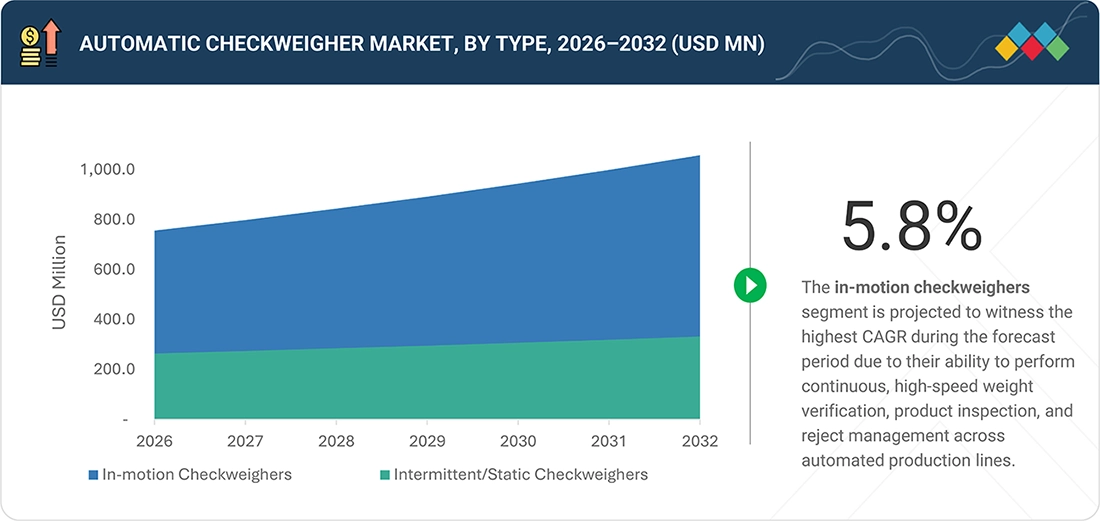
Source: Secondary Research, Interviews with Experts, MarketsandMarkets Analysis
Automatic Checkweigher Market, By Type
In-motion checkweighers are expected to account for the largest share and register the highest CAGR in the automatic checkweigher market during the forecast period. The segment is driven by its ability to perform continuous, high-speed weight verification without interrupting production lines, supporting quality control, regulatory compliance, and productivity across food & beverages, pharmaceuticals, chemicals, and logistics industries.
Automatic Checkweigher Market, By Technology
Strain gauge load cell technology is expected to account for the largest share of the automatic checkweigher market due to its cost-effectiveness, durability, and widespread adoption across industrial weighing applications. Electromagnetic force restoration (EMFR) technology is expected to register the highest CAGR during the forecast period, supported by the increasing demand for ultra-high weighing accuracy in pharmaceutical, premium food, and precision manufacturing applications.
Automatic Checkweigher Market, By Throughput Capacity
High-speed checkweighers (above 300 packs/min) are expected to account for the largest share and register the highest CAGR in the automatic checkweigher market during the forecast period. The segment is driven by the increasing deployment on high-volume production and packaging lines, where manufacturers require rapid weight verification, higher throughput, and improved operational efficiency.
Automatic Checkweigher Market, By Product Weight Range
Up to 10 kg checkweighers are expected to account for the largest share of the automatic checkweigher market, driven by their extensive use in packaged foods, beverages, pharmaceuticals, cosmetics, and consumer goods. 10–100 kg checkweighers are expected to register the highest CAGR during the forecast period, supported by the growing demand across industrial packaging, chemicals, and logistics applications.
Automatic Checkweigher Market, By Industry
The food & beverages segment is expected to account for the largest share and register the highest CAGR in the automatic checkweigher market during the forecast period, driven by increasing packaged food production, stringent food safety regulations, and the need to minimize product giveaway. The pharmaceutical industry is also expected to witness strong growth, supported by strict regulatory compliance requirements and demand for high-precision weight verification.
REGION
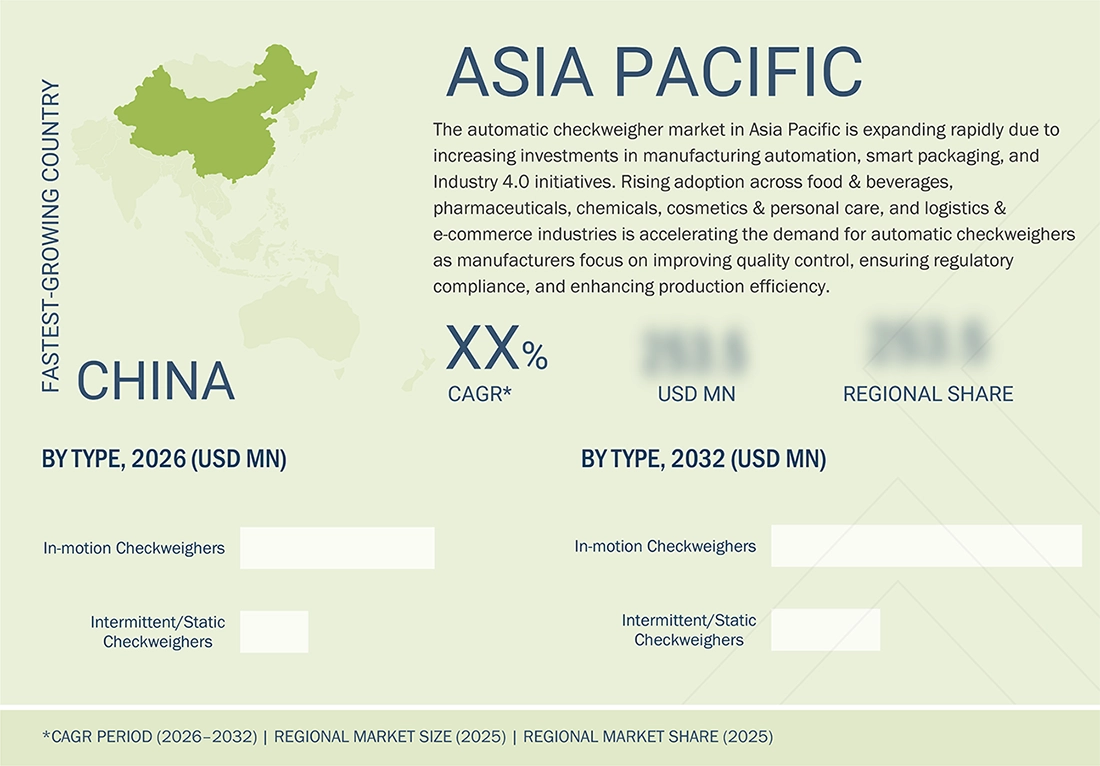
Asia Pacific to be fastest-growing region in automatic checkweigher market during forecast period
Asia Pacific is expected to be the fastest-growing region in the automatic checkweigher market during the forecast period, driven by strong manufacturing ecosystems, rising automation investments, and rapid expansion of food processing, pharmaceutical, and packaging industries across China, Japan, South Korea, India, and Southeast Asia. Growth is supported by increasing adoption of automatic checkweighers across food & beverages, pharmaceuticals, chemicals, logistics & e-commerce, cosmetics & personal care, and other manufacturing industries. The region is also benefiting from advancements in high-precision load cells, AI-enabled inspection software, cloud connectivity, and integrated inspection systems. China's focus on smart manufacturing, Japan's expertise in precision weighing technologies, and increasing automation adoption are further supporting regional growth. Increasing investments by checkweigher manufacturers, packaging equipment providers, system integrators, and industrial end users are contributing to sustained expansion and wider deployment of in-motion and intermittent/static checkweighers across production and packaging facilities in the region.
AUTOMATIC CHECKWEIGHER MARKET: COMPANY EVALUATION MATRIX
In the automatic checkweigher market matrix, METTLER TOLEDO is positioned as a Star, supported by its comprehensive automatic checkweigher portfolio, advanced precision weighing technologies, strong global presence, and extensive customer base across the food & beverages, pharmaceuticals, and consumer goods industries. The company demonstrates strength in high-speed checkweighing, precision load cell technology, integrated product inspection systems, and smart manufacturing solutions. Anritsu has a broad inspection and checkweighing portfolio, high-performance automatic checkweighers, advanced X-ray inspection systems, and a strong focus on food safety and pharmaceutical quality control applications. Continued investments in digital inspection technologies, software integration, automation capabilities, and Industry 4.0-enabled solutions are strengthening the market presence of these companies and reinforcing their position within the evolving automatic checkweigher ecosystem.
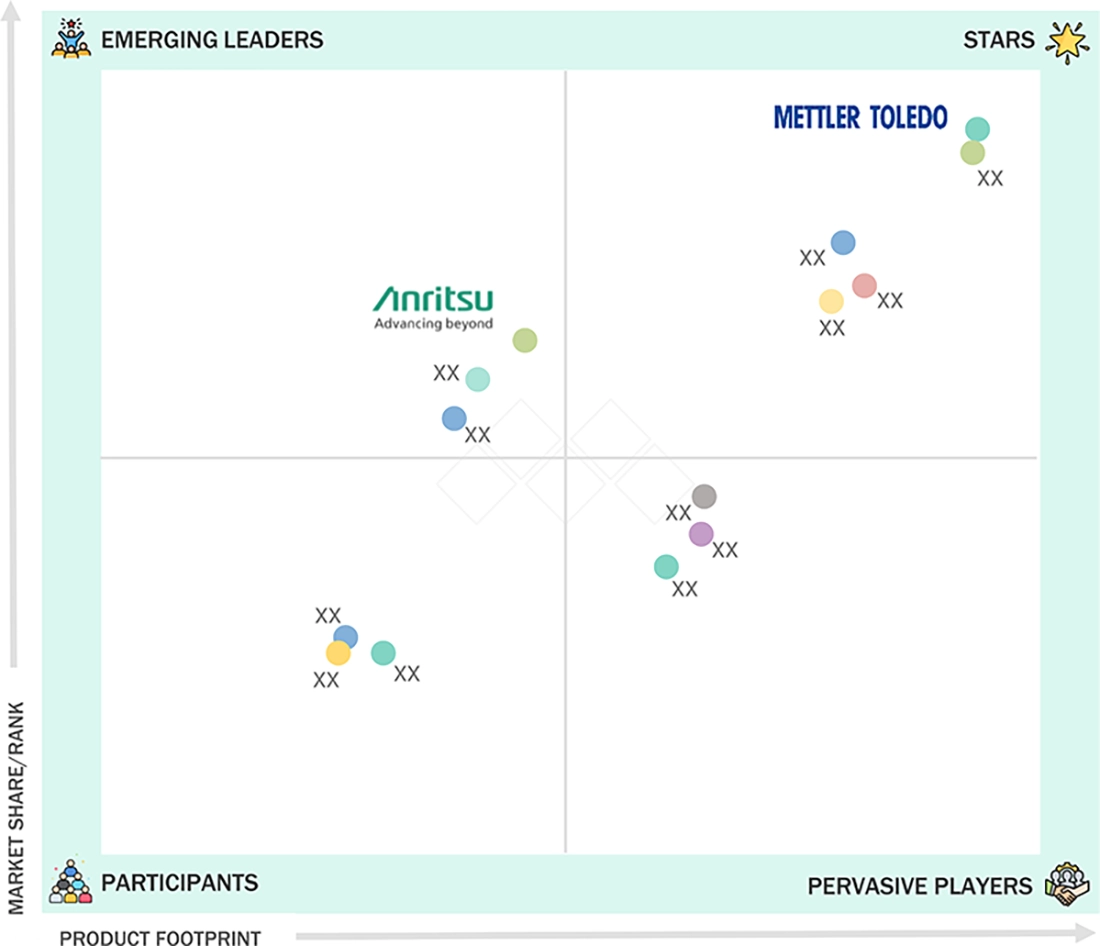
Source: Secondary Research, Interviews with Experts, MarketsandMarkets Analysis
KEY MARKET PLAYERS
- METTLER TOLEDO (Switzerland)
- Ishida Co., Ltd. (Japan)
- Anritsu (Japan)
- Thermo Fisher Scientific Inc. (US)
- Minebea Intec GmbH (Germany)
- WIPOTEC GmbH (Germany)
- MULTIVAC (Germany)
- JBT Marel (US)
- Loma Systems (UK)
- Bizerba (Germany)
MARKET SCOPE
| REPORT METRIC | DETAILS |
|---|---|
| Market Size in 2025 (Value) | USD 0.97 Billion |
| Market Size in 2026 (Value) | USD 1.02 Billion |
| Market Forecast in 2032 (Value) | USD 1.39 Billion |
| CAGR | 5.3% |
| Years Considered | 2022–2032 |
| Base Year | 2025 |
| Forecast Period | 2026–2032 |
| Units Considered | Value (USD Million/Billion), Volume (Thousand Units) |
| Report Coverage | Revenue Forecast, Company Ranking, Competitive Landscape, Growth Factors, and Trends |
| Segments Covered |
|
| Regions Covered | North America, Europe, Asia Pacific, and RoW |
WHAT IS IN IT FOR YOU: AUTOMATIC CHECKWEIGHER MARKET REPORT CONTENT GUIDE
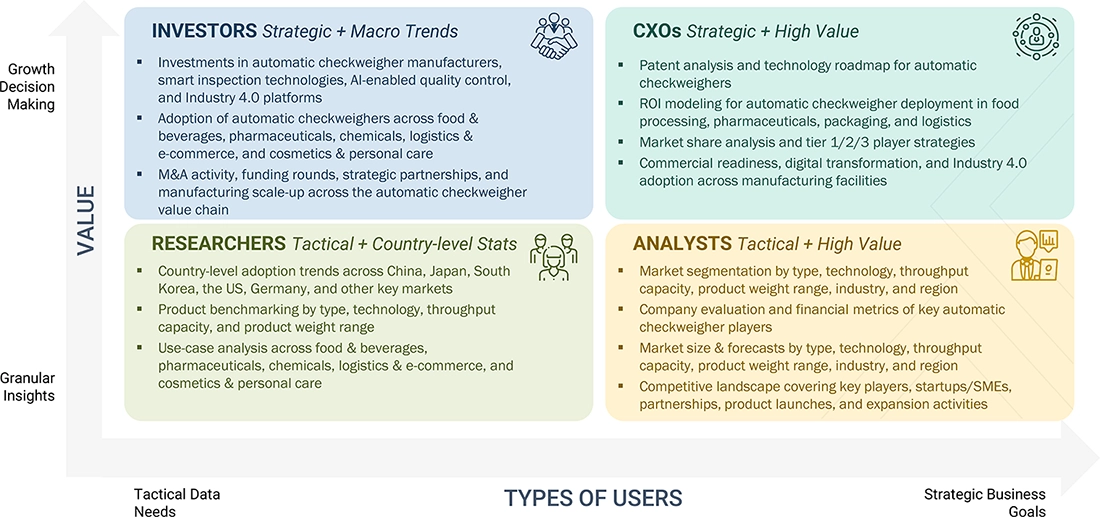
DELIVERED CUSTOMIZATIONS
We have successfully delivered the following deep-dive customizations:
| CLIENT REQUEST | CUSTOMIZATION DELIVERED | VALUE ADDS |
|---|---|---|
| Automatic Checkweigher Manufacturer/OEM | Mapping automatic checkweigher adoption across food & beverages, pharmaceuticals, chemicals, logistics & e-commerce, cosmetics & personal care, and other manufacturing industries, with analysis by type, technology, throughput capacity, product weight range, industry, and region. | Benchmarking product positioning, deployment readiness, and growth opportunities across key end-use industries. |
| Weighing Technology & Inspection Solution Provider | Competitive benchmarking of automatic checkweigher technologies, including strain gauge load cells, electromagnetic force restoration (EMFR), AI-enabled inspection software, conveyor systems, reject mechanisms, and integrated metal detection/X-ray inspection solutions across industrial applications. | Technology benchmarking based on weighing accuracy, throughput, regulatory compliance, total cost of ownership, integration complexity, reliability, and application suitability. |
RECENT DEVELOPMENTS
- May 2026 : Mettler-Toledo showcased its C35 Advanced Line high-performance checkweigher at interpack 2026, currently rated for line speeds above 800 packs per minute. The launch also included CM and CX combination systems pairing checkweighing with metal detection or X-ray, plus a 3-in-1 configuration adding vision inspection, alongside ProdX software for centralized inspection data management across the line.
- March 2026 : WIPOTEC GmbH expanded its checkweighing technology with the HC-A checkweigher, enabling products to be classified into up to 11 weight classes rather than simply being accepted or rejected. The development was specifically presented for precise sorting applications, including transparent glass objects, with real-time process monitoring and high-precision weighing. This is a direct and substantive development involving an Automatic Checkweigher.
- January 2025 : JBT completed its USD 4.4 billion acquisition of Marel hf., forming JBT Marel Corporation, a combined food and beverage technology provider spanning weighing, checkweighing, sorting, and inspection equipment. The deal consolidates complementary product portfolios and brands across poultry, meat, fish, and broader food-processing end markets.
Table of Contents
 Exclusive indicates content/data unique to MarketsandMarkets and not available with any competitors.
Methodology
The study involved four major activities in estimating the current size of the automatic checkweigher market. Exhaustive secondary research was conducted to collect information on the market, adjacent markets, and the parent industrial automation and inspection equipment market. The findings, assumptions, and market estimates were then validated through primary research with industry experts across the automatic checkweigher value chain, including manufacturers, technology providers, system integrators, distributors, and end users. Both top-down and bottom-up approaches were employed to estimate the overall market size. Subsequently, market breakdown and data triangulation techniques were used to estimate the size of various market segments and subsegments. Both secondary and primary sources were utilized to gather and validate technical, commercial, and market-related information for a comprehensive analysis of the market.
Secondary Research
Various secondary sources have been referred to in the secondary research process to identify and collect information relevant to this study. The secondary sources include annual reports, press releases, investor presentations, company websites, product brochures, white papers, journals and other certified publications, articles by recognized authors, directories, and databases. Secondary research has been conducted to obtain key information on the industry’s supply chain, the market’s value chain, the total pool of key players, market segmentation, regional markets, and key developments from market- and technology-oriented perspectives. The secondary data has been collected and analyzed to determine the overall market size of the automatic checkweigher market, and the results have been further validated through primary research.
Primary Research
Extensive primary research has been conducted after gaining an understanding of the current state of the automatic checkweigher market through secondary research. Several primary interviews have been conducted with experts from the demand and supply sides across four major regions: North America, Europe, Asia Pacific, and RoW. This primary data has been collected through questionnaires, emails, and telephonic interviews.
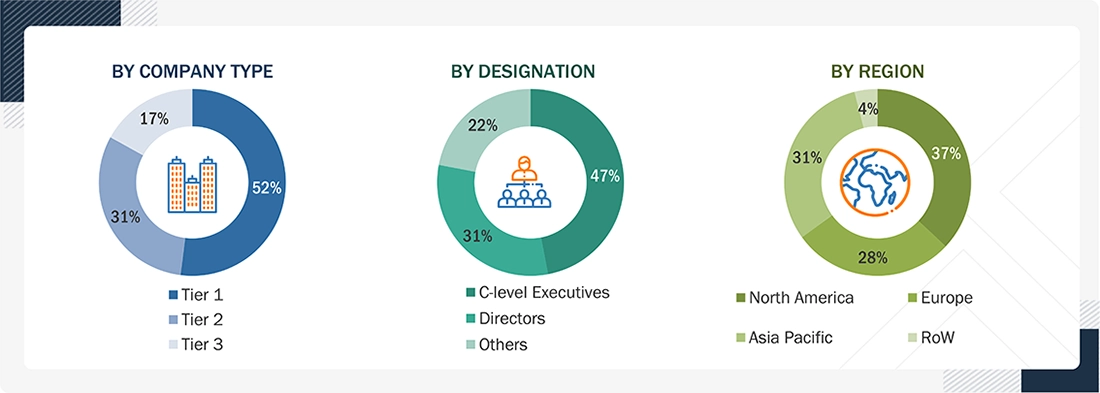
Note: Other designations include product, sales, and marketing managers.
Three tiers of companies have been defined based on their total revenue as of 2025: tier 3: revenue less than USD 500 million; tier 2: revenue between USD 500 million and USD 5 billion; and tier 1: revenue more than USD 5 billion.
RoW mainly includes South America, Africa, and the Middle East.
To know about the assumptions considered for the study, download the pdf brochure
Market Size Estimation
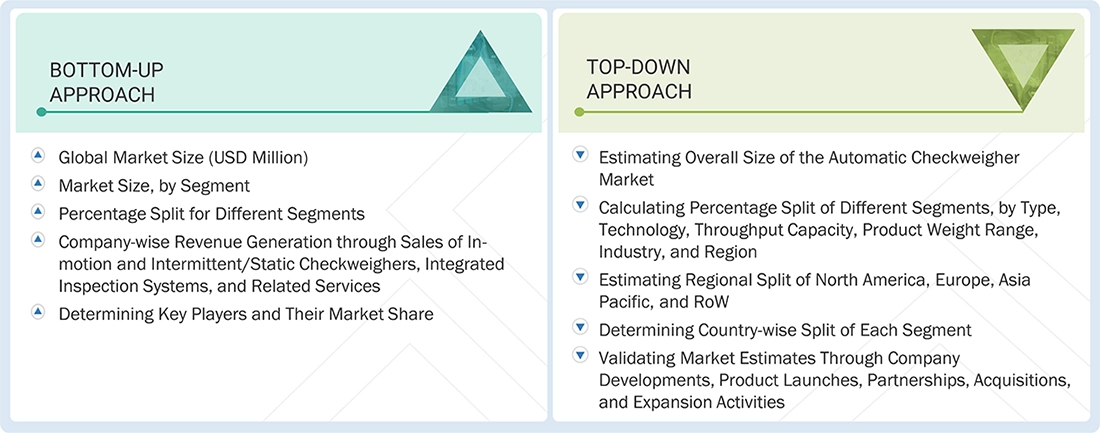
Both top-down and bottom-up approaches have been used to estimate and validate the total size of the automatic checkweigher market. These methods have also been used extensively to estimate the size of various market subsegments. The following research methodology has been used to estimate the market size:
- Major players in the industry and markets have been identified through extensive secondary research.
- The industry’s value chain and market size (in terms of value) have been determined through primary and secondary research processes.
- All percentage shares, splits, and breakdowns have been determined using secondary sources and verified through primary sources.
Automatic Checkweigher Market : Top-Down and Bottom-Up Approach
Data Triangulation
After arriving at the overall size of the automatic checkweigher market from the market size estimation process explained above, the total market has been split into several segments and subsegments. Data triangulation and market breakdown procedures have been employed, where applicable, to complete the overall market engineering process and derive the exact statistics for all market segments and subsegments. The data has been triangulated by studying various factors and trends from the demand and supply sides. Additionally, the market size has been validated using both top-down and bottom-up approaches.
Market Definition
An automatic checkweigher is an automated product inspection system used to measure and verify the weight of individual products during manufacturing, packaging, and processing operations. It continuously evaluates product weights against predefined specifications to ensure compliance with regulatory standards, quality requirements, and production targets. Automatic checkweighers enable manufacturers to improve quality control, reduce product giveaway, minimize waste, and enhance operational efficiency through accurate and real-time weight inspection. These systems are widely deployed across industries such as food & beverages and pharmaceuticals, where consistent product quality and automated process control are essential.
Key Stakeholders
- End users
- Automatic checkweigher manufacturers
- Product inspection solution providers
- System integrators and industrial automation solution providers
- Component suppliers (load cells, conveyors, sensors, controllers, and software providers)
- Packaging machinery manufacturers and OEMs
- Industry associations
- Research institutions and organizations
- Standards organizations and regulatory authorities
- Technology consultants and engineering service providers
This research report categorizes the automatic checkweigher market by type, technology, throughput capacity, product weight range, industry, and region.
Report Objectives
- To describe and forecast the automatic checkweigher market size, by type, technology, throughput capacity, product weight range, and industry, in terms of value
- To describe and forecast the automatic checkweigher market size across four regions, namely North America, Europe, Asia Pacific, and RoW, along with their respective countries, in terms of value
- To forecast the automatic checkweigher market size, by type, in terms of volume
- To provide detailed information regarding the major drivers, restraints, opportunities, and challenges influencing the automatic checkweigher market growth
- To analyze opportunities for stakeholders by identifying high-growth segments of the automatic checkweigher market
- To study the complete value chain of the automatic checkweigher market
- To strategically analyze micromarkets with respect to individual growth trends, prospects, and contributions to the overall market size
- To strategically profile the key players and comprehensively analyze their market positions in terms of their rankings and core competencies
- To analyze competitive developments, such as product launches, acquisitions, partnerships, collaborations, expansions, and investments, in the automatic checkweigher market
- To provide interconnected markets and cross-sector opportunities, strategic moves by Tier 1/2/3 players, ecosystem analysis, case study analysis, patent analysis, technology analysis, the impact of AI/Gen AI, the impact of US tariffs, key conferences and events, Porter’s Five Forces analysis, and regulations pertaining to the market under study
Customizations Options:
With the market data given, MarketsandMarkets offers customizations according to the company’s specific needs. The following customization options are available for the report:
Company Information
- Detailed analysis and profiling of additional market players (up to 5)


Personalize This Research
- Triangulate with your Own Data
- Get Data as per your Format and Definition
- Gain a Deeper Dive on a Specific Application, Geography, Customer or Competitor
- Any level of Personalization
Let Us Help You
- What are the Known and Unknown Adjacencies Impacting the Automatic Checkweigher Market
- What will your New Revenue Sources be?
- Who will be your Top Customer; what will make them switch?
- Defend your Market Share or Win Competitors
- Get a Scorecard for Target Partners

Custom Market Research Services
We Will Customise The Research For You, In Case The Report Listed Above Does Not Meet With Your Requirements
Get 10% Free CustomisationTESTIMONIALS

Tetsuya Ohhira
Business Development Manager-Technology Business
Nikon Corporation,
Leading Japanese MNC specializing in optics and imaging productswww.nikon.com
MarketsandMarkets™ response
is quick. Their attitude is flexible and positive. Analyst Insights are globally considered and
significant. Client Services quickly respond to our inquiry and demand. Their wide range of global
surveys help us make our strategic plan.
We hope Knowledge Store will be easier to search
for a report.
VP - Marketing & Business Development
Leading Provider of Process Control Solutions
We engaged with MarketsandMarkets on a study to perform an analysis and recommend a Go-To-Market strategy for metrology and process control in the semiconductor market. The study was tailored to our targets and needs with well-defined milestones. Our overall experience with the MarketsandMarkets team was very good throughout the project in all aspects including the analysis methodologies used, the quality and depth of primary and secondary data sets, the professionalism and flexibility of the team and the ability to meet the target schedule and milestones. We want to thank MarketsandMarkets team for a job well done.
- US Automatic Checkweigher Market
- Canada Automatic Checkweigher Market
- Mexico Automatic Checkweigher Market
- UK Automatic Checkweigher Market
- Germany Automatic Checkweigher Market
- France Automatic Checkweigher Market
- Italy Automatic Checkweigher Market
- China Automatic Checkweigher Market
- Japan Automatic Checkweigher Market
- India Automatic Checkweigher Market
- South Korea Automatic Checkweigher Market
- Rest Of Europe Automatic Checkweigher Market
- Rest Of Asia Pacific Automatic Checkweigher Market
- GCC Automatic Checkweigher Market
- Rest Of Middle East Automatic Checkweigher Market






Growth opportunities and latent adjacency in Automatic Checkweigher Market