Brake Friction Products Market Size, Share & Analysis

Brake Friction Products Market (OEM, Aftermarket), by Type (Brake Disc, Pad, Drum, Shoe, Liner, Shim), Disc Type (Metallic, Composite, Ceramic), Liner Type (Molded, Woven), Vehicle Type (ICE, Electric, PHEV, OHV), and Region - Global Forecast to 2032




OVERVIEW
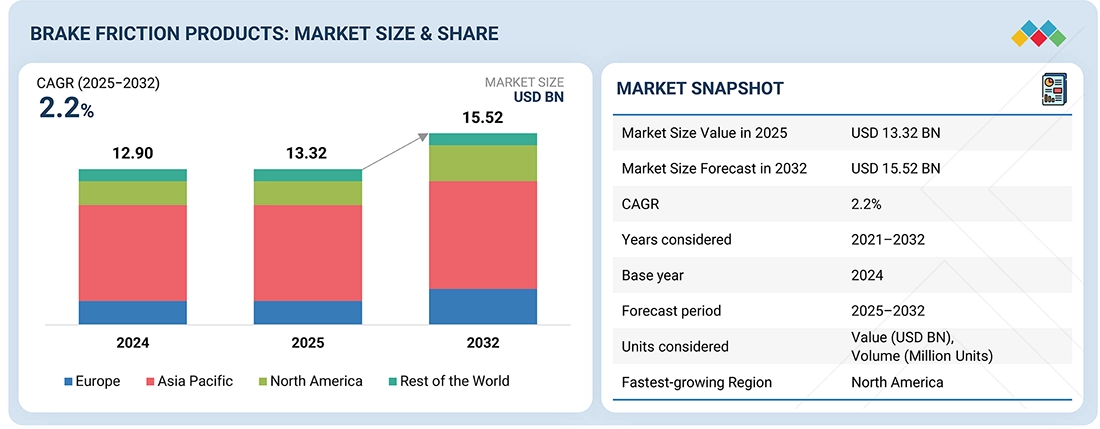
Source: Secondary Research, Interviews with Experts, MarketsandMarkets Analysis
The brake friction products market is projected to reach USD 15.52 billion by 2032 from USD 13.32 billion in 2025, with a CAGR of 2.2%. The rising demand for disc brakes, especially in passenger cars, the rise in stopping distance mandates, the demand for high-performing brakes, and vehicle safety are expected to raise the demand for brake friction products. The increasing adoption of EVs and advancements in brake friction product technology to improve vehicle performance and efficiency are also expected to drive market growth. Furthermore, the growing use of lightweight components has increased the demand for high-quality brake friction products and materials used for friction.
Brake Friction Products Market Size and Forecast:
- Market Size Value in 2025: USD 13.32 Billion
- Revenue Forecast in 2032: USD 15.52 Billion
- Growth Rate: CAGR of 2.2% from 2025 to 2032
- Data available from 2021 to 2032
- Base year: 2024
- Forecast period: 2025–2032
Key Market Trends and Insights
- Market Growth: Growth is driven by rising demand for disc brakes, stricter vehicle safety regulations, and increasing adoption of advanced friction materials in ICE and electric vehicles.
-
IoT Impact: IoT-enabled brake monitoring systems support predictive maintenance, real-time wear analysis, and improved vehicle safety.
- Growing Trends: The market is witnessing increased adoption of low-dust friction materials, regenerative braking-compatible products, and solutions focused on noise, vibration, and harshness (NVH) reduction.
- Growth Opportunities: Opportunities are driven by the development of next-generation friction materials to meet Euro 7 brake emission regulations and the growing EV market.
KEY TAKEAWAYS
-
BY TYPEDisc brakes are increasingly dominating due to stricter safety and emission norms, such as EU Directive 2004/54 and Regulation (EU) 2015/68, mandating four-wheel disc systems for passenger cars and LCVs. Their adoption is accelerating in Europe and North America, driven by premium and high-performance SUVs requiring shorter stopping distances.
-
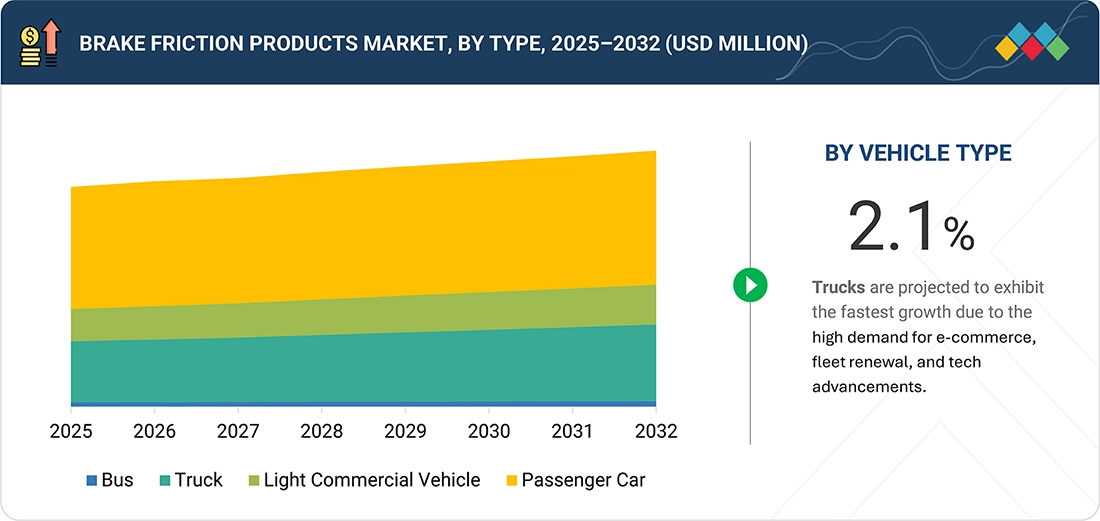
BY VEHICLE TYPEPassenger cars drive brake friction demand due to high production volumes, frequent replacements, strict safety regulations, and growing adoption of disc brakes, especially in premium and SUV segments.
-
BY ELECTRIC VEHICLE TYPEBEV sales reached 10.8 million units in 2024, led by China (60% of global sales). Rising SUV and premium EV demand is shifting mid-range models toward all-disc braking. Regenerative braking reduces friction wear, driving the adoption of ceramic/composite materials and sensor-based predictive maintenance for quieter, longer-lasting brake systems.
-
OFF-HIGHWAY MARKET, BY PRODUCT TYPEWet brakes, offering high durability and low maintenance, account for over 80% of agricultural tractor installations. Driven by mechanization, dual-line braking, and growth in electrified off-highway equipment, they are set to dominate the segment by 2032.
-
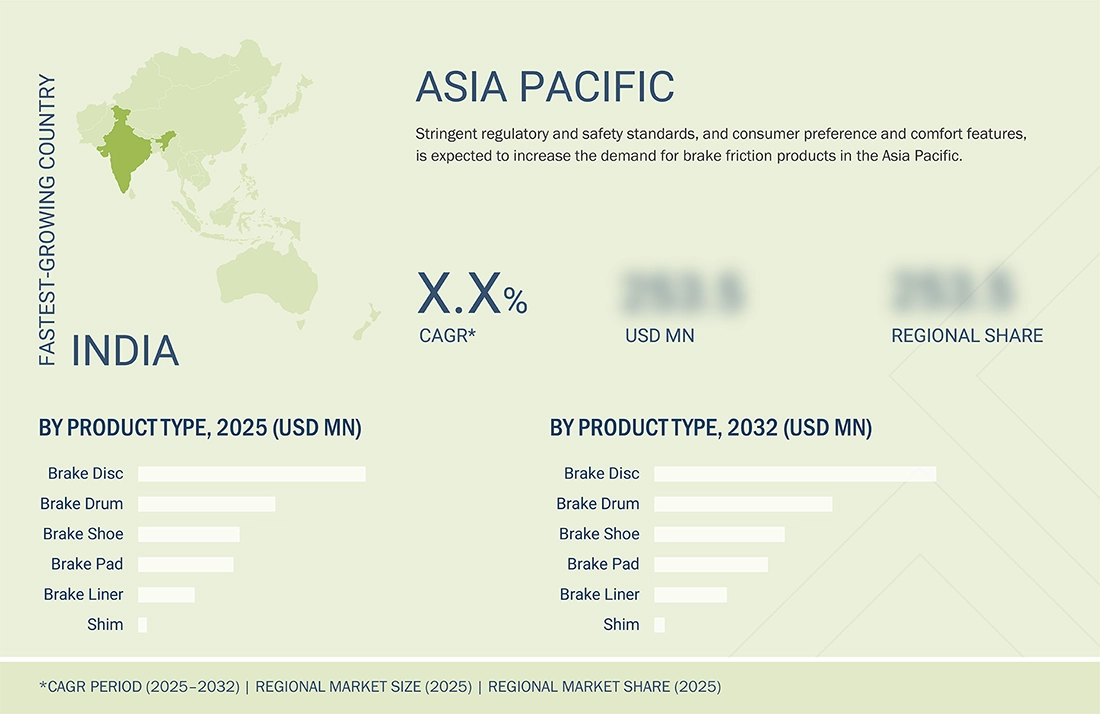
BY REGIONAsia Pacific is the largest brake friction market, led by China, India, and South Korea. Rising demand for compact SUVs, projected to grow from USD 53.92 billion in 2024 to USD 70.61 billion in 2027, is boosting the adoption of disc brakes. SUVs and premium vehicles require high-performance carbon composite friction products to meet safety and braking efficiency needs for heavier, high-speed vehicles.
-
COMPETITIVE LANDSCAPEKey players such as Aisin Corporation (Japan), Brembo (Italy), Nisshinbo Holdings Inc. (Japan), and Tenneco (US) are focusing on innovations in brake friction material, noise reduction, and manufacturing & process innovation. These industry leaders develop innovative products, implement expansion strategies, and foster collaborations, partnerships, mergers, and acquisitions to establish a strong foothold in the dynamically growing brake friction products market. These companies develop new products, adopt expansion strategies, obtain supply contracts, and establish joint ventures and agreements to gain traction in the brake friction products market.
Increasing load-bearing capacity and high-power vehicles have boosted the demand for disc brakes in passenger cars and LCVs. Developed countries like Germany, the US, the UK, and Japan have a 90-95% installation rate of disc brakes in passenger cars, driven by high consumer income and stopping distance mandates. On the contrary, countries like India, Brazil, and Russia have nearly 70% adoption of mixed braking systems, including a front disc and a rear drum, due to the preference for cost-effective vehicles. Disc brakes are more effective than drum brakes in terms of stopping power. Thus, they are trendy in Europe and North America, which demand more stringent safety regulations. Disc brakes offer better heat dissipation and less tendency toward brake fade, which increases their use in high-income regions of the world where safety and performance take precedence.
TRENDS & DISRUPTIONS IMPACTING CUSTOMERS' CUSTOMERS
Changes in demand and trends in the break-friction products market directly impact OEMs and suppliers. Rising emphasis on safety, sustainability, and performance reshapes brake system requirements. The shift toward electric and hybrid vehicles drives demand for regenerative braking systems and low-dust, eco-friendly friction materials. Increasing focus on noise vibration harshness (NVH) reduction, durability, and thermal efficiency influences product design and material innovation. These shifts cascade into raw material suppliers, Tier-1 brake system manufacturers, and OEMs, ultimately transforming revenue models across the value chain and unlocking growth opportunities for advanced, sustainable, and performance-optimized braking solutions.
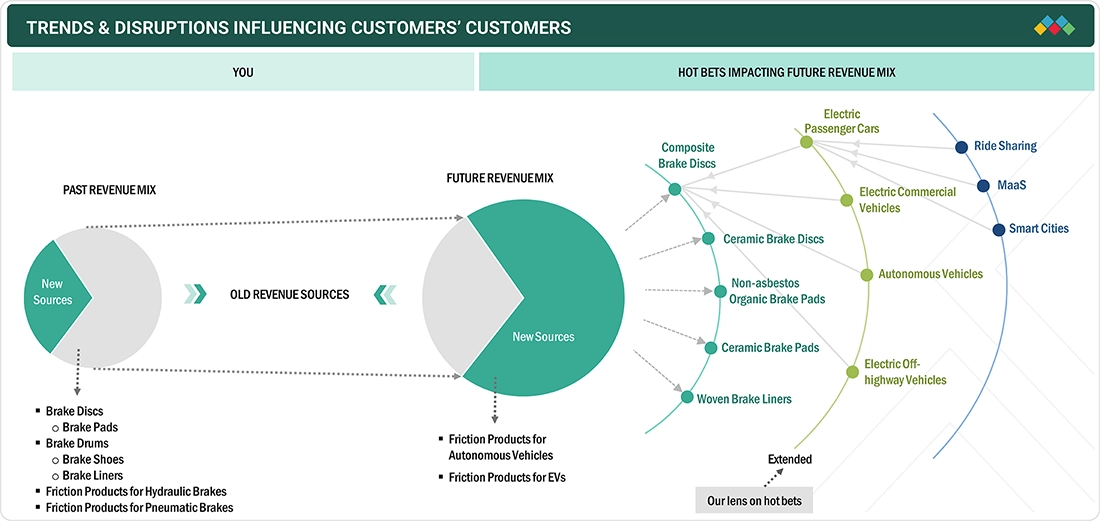
Source: Secondary Research, Interviews with Experts, MarketsandMarkets Analysis
MARKET DYNAMICS

Level
-
Increasing vehicle parc & vehicle miles traveled to boost the aftermarket

-
Rising Vehicle Prouction to fuel demand for OE brake friction products


Level
-
Improving the life of brake friction products to influence the demand for replacement units


Level
-
New friction material products are being developed due to the Euro 7 regulations

-
Use of lightweight materials in brake friction products


Level
-
Counterfeit brake friction products in the aftermarket

-
Government regulations related to alloy composition of brake friction products

Source: Secondary Research, Interviews with Experts, MarketsandMarkets Analysis
Driver: Increasing vehicle parc & vehicle miles traveled to boost the aftermarket
Rising global vehicle parc and increased vehicle usage are driving demand for brake friction products, which require periodic replacement. Between 2020 and 2024, total vehicle sales rose from 79.7 million to 95.3 million units, while the HCV parc grew from 34 thousand units in 2019 to 40 thousand in 2025. Higher vehicle utilization, especially in markets such as the US and China, accelerates brake wear, shortens replacement cycles, and bolsters aftermarket growth. For example, standard brake pads typically require replacement every 32,000–35,000 miles.
Restraint: Improving the life of brake friction products to influence the demand for replacement units
Increasing durability of vehicle parts and OEM demand for high-performance, wear-resistant brake friction products are extending replacement cycles. Stringent safety regulations further drive the need for longer-lasting solutions, potentially reducing brake friction replacements to fewer than two or three times over a vehicle’s lifetime, limiting future market growth.
Opportunity: New friction material products are being developed due to the Euro 7 regulations
Euro 7 regulations target brake dust emissions (7 mg/km for passenger cars) and drive demand for cleaner, low-emission braking technologies. This creates significant opportunities for friction brake manufacturers, especially for hybrid and EV applications, as heavier EVs generate 3–8% more brake particulate matter than ICE vehicles. Leading players are developing advanced solutions, such as Bosch’s test bench for precise emission control, positioning Euro 7 as a catalyst for innovation in brake friction technologies.
Challenge: Counterfeit brake friction products in the aftermarket
The rise of counterfeit brake friction products, particularly from Asia, poses serious safety risks and undermines OEM standards. Incidents such as doubled seizures of fake auto parts in 2024 and links to 20% of road accidents in India highlight the scale of the problem. This drives the need for stricter regulation, enforcement, and consumer awareness to protect safety and legitimate aftermarket growth.
BRAKE FRICTION PRODUCTS MARKET SIZE, SHARE & ANALYSIS: COMMERCIAL USE CASES ACROSS INDUSTRIES
| COMPANY | USE CASE DESCRIPTION | BENEFITS |
|---|---|---|
 |
Design and supply of brake friction systems, including disc pads, linings, and rotors for passenger cars, commercial vehicles, and two-wheelers; integrated with electronic brake control systems. | Ensure high braking performance, durability, reduced noise, vibration, and harshness (NVH), improved safety, and compliance with emission regulations. |
 |
Development and supply of advanced friction materials, including ceramic, metallic, and low-dust formulations for aftermarket and OE applications. | Enable high-performance braking, lower wear rates, reduced particulate emissions, longer service life, and support compliance with Euro 7 and other environmental standards. |
 |
Integration of OE brake friction systems tailored for passenger cars, hybrids, and EVs, including regenerative braking optimization. | Enhance vehicle safety, extend brake component life, reduce maintenance cost, and improve energy efficiency through reduced wear and compatibility with regenerative braking. |
 |
Supply of replacement brake friction products (pads, linings, discs, drums) and complete kits for maintenance and refurbishment across passenger, commercial, and off-highway vehicles. | Maintain braking performance, ensure compliance with OEM standards, extend component lifespan, and offer cost-effective aftermarket solutions. |
Logos and trademarks shown above are the property of their respective owners. Their use here is for informational and illustrative purposes only.
MARKET ECOSYSTEM
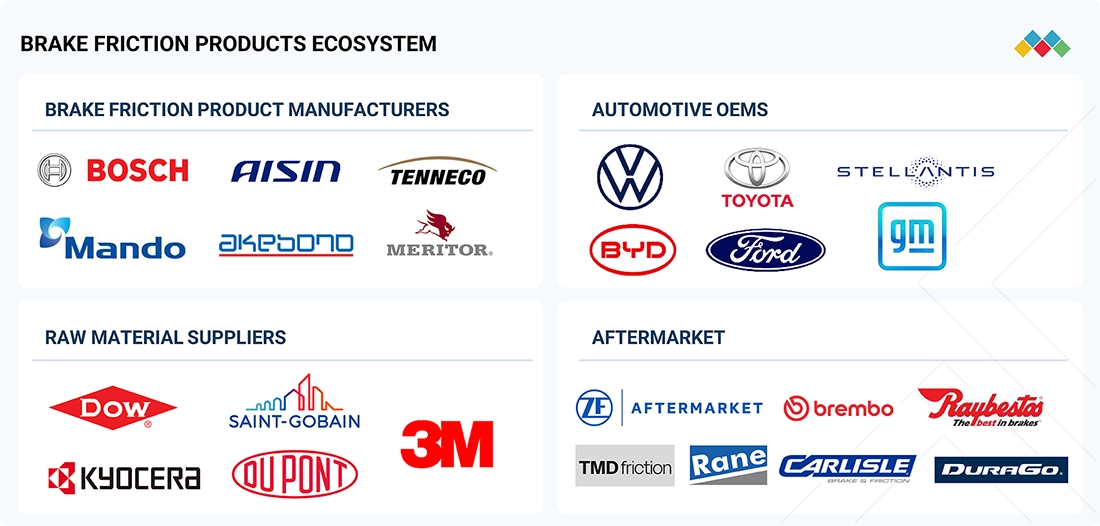
The ecosystem mapping highlights various brake friction products market players, including raw material suppliers, component manufacturers, automotive OEMs, and aftermarket suppliers. The leading players in the brake friction products market are Cooper Standard Automotive (US), Toyoda Gosei Co., Ltd. (Japan), Hutchinson (France), Nishikawa Rubber Co., Ltd. (Japan), and Sumitomo Riko Co., Ltd. (Japan), among others.
Logos and trademarks shown above are the property of their respective owners. Their use here is for informational and illustrative purposes only.
MARKET SEGMENTS
Source: Secondary Research, Interviews with Experts, MarketsandMarkets Analysis
Brake Friction Products Market, By Type
Disc brake adoption is accelerating globally, driven by superior performance, safety benefits, and regulatory mandates such as European Directive 2004/54 and (EU) 2015/68, which require all new passenger cars and light commercial vehicles (LCVs) to have four-wheel disc brakes. Adoption is highest in Europe and North America, supported by rising demand for SUVs and premium passenger cars, where shorter stopping distances and high-performance braking are critical.
Brake Friction Products Market, by Vehicle Type
Passenger car demand dominates the brake friction products market due to the rise in vehicle safety and demand for advanced technologies. Rising production of the economy and premium passenger cars is driving demand for brake friction products, particularly in the Asia Pacific. In 2024, global passenger car production reached 67.6 million units, with China leading at 27.5 million units (38% of global output) and India producing 4.9 million units. Adopting cost-effective, high-quality brake friction materials supports demand growth in the region.
Off-Highway Brake Friction Products Market, By Application
Wet brakes, offering superior durability, heat dissipation, and low maintenance, dominate agricultural tractors and construction equipment, with over 80% penetration in tractors due to increased mechanization and advancements like dual-line braking. CNH Industrial’s 2024 integration of upgraded wet disc brakes in Case IH tractors highlights their growing adoption. The shift toward electrification and autonomous off-highway equipment further positions wet brakes as the preferred choice by 2032 for high-performance, reliable braking.
Brake Friction Products Aftermarket, By Product Type
The brake friction market is driven by aftermarket demand, as wear from rising global vehicle populations and higher average mileage increases replacement needs. In Europe, average annual mileage rose from 10,000 miles in 2015 to nearly 14,000 in 2020, shortening brake replacement cycles (30,000–70,000 miles). Disc brakes are now standard for passenger cars and heavy commercial vehicles in the EU, a trend spreading to Asia, while e-commerce growth is boosting braking demand for trucks. Global vehicle sales rose from 82.9 million in 2022 to 95.3 million in 2024, further driving market growth.
REGION
During the forecast period, Asia is expected to be the largest region in the global brake friction products market.
Asia Pacific is the largest brake friction market, driven by leading vehicle production and fast-growing economies such as China, India, and South Korea. China, the world’s largest vehicle manufacturer, is spearheading growth with higher adoption of lightweight materials and strict safety norms. Rising demand for compact SUVs, projected to grow from USD 53.92 billion in 2024 to USD 70.61 billion by 2027, is boosting disc brake adoption, especially in SUVs and premium vehicles that require high-performance carbon composite brake friction products for superior stopping power.
BRAKE FRICTION PRODUCTS MARKET SIZE, SHARE & ANALYSIS: COMPANY EVALUATION MATRIX
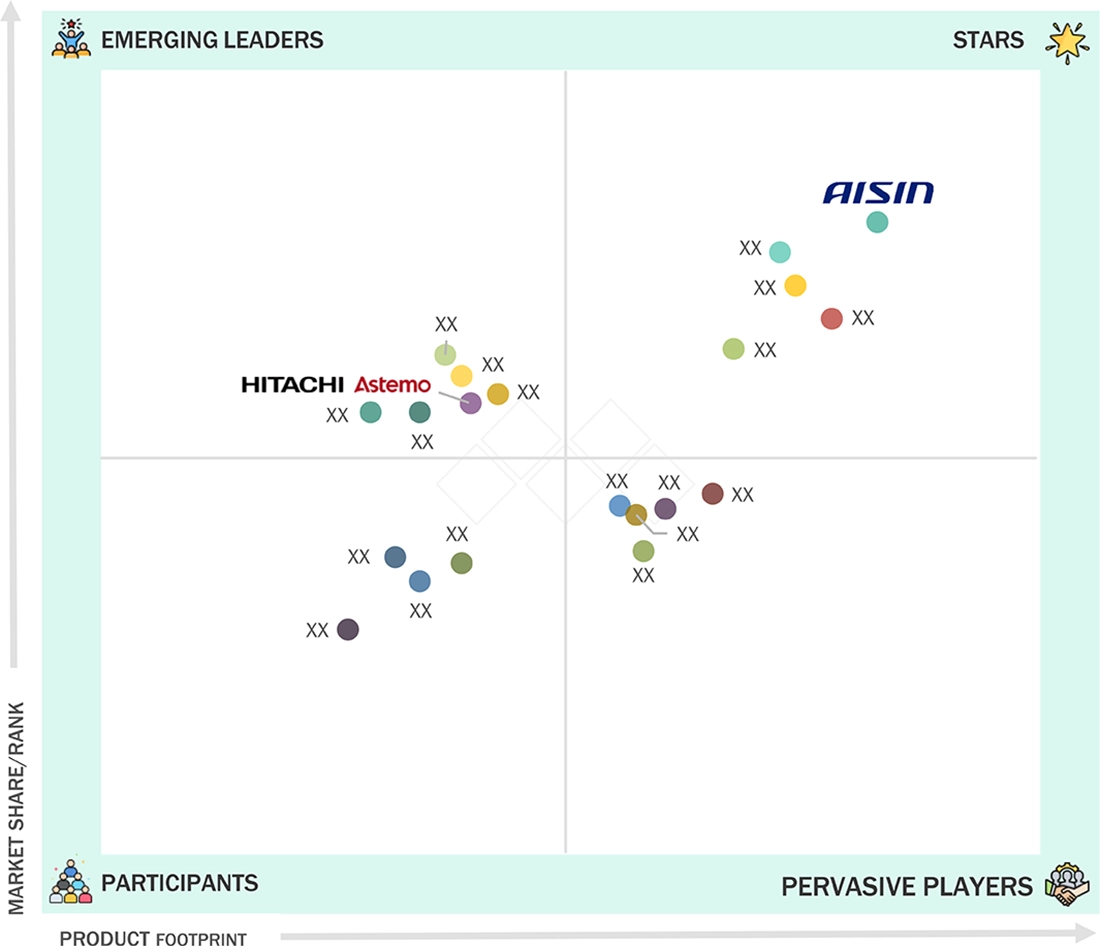
In the brake friction products market matrix, Aisin Corporation (Star) leads with a strong global presence, diverse portfolio, and advanced braking solutions across vehicle types. Hitachi Astemo (Emerging Leader) is gaining traction with innovative, integrated braking systems, showing strong growth potential to move toward the leaders’ quadrant.
Source: Secondary Research, Interviews with Experts, MarketsandMarkets Analysis
KEY MARKET PLAYERS
MARKET SCOPE
| REPORT METRIC | DETAILS |
|---|---|
| Market Size Value in 2025 | 13.32 BN |
| Revenue Forecast in 2032 | 15.52 BN |
| Growth Rate | CAGR of 2.2% from 2025 to 2032 |
| Actual data | 2021-2032 |
| Base year | 2024 |
| Forecast period | 2025-2032 |
| Units considered | Value (USD Million), Volume (Million Units) |
| Report Coverage | Revenue forecast, company ranking, competitive landscape, growth factors, and trends |
| Segments Covered | • By Type - Brake discs, Brake pads, Drum brakes, Brake shoes, Brake shims, Brake liners |
| Regional Scope | Asia Pacific, Europe, North America, and the Rest of the World |
WHAT IS IN IT FOR YOU: BRAKE FRICTION PRODUCTS MARKET SIZE, SHARE & ANALYSIS REPORT CONTENT GUIDE
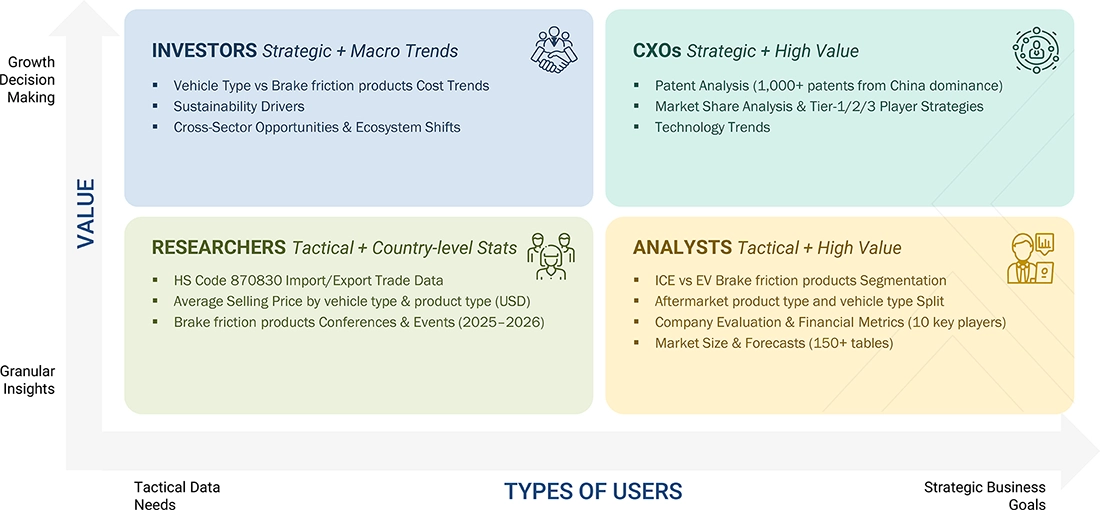
DELIVERED CUSTOMIZATIONS
We have successfully delivered the following deep-dive customizations:
| CLIENT REQUEST | CUSTOMIZATION DELIVERED | VALUE ADDS |
|---|---|---|
| Global Tier-1 brake system suppliers | • Regional analysis of friction material evolution (NAO, semi-metallic, ceramic, copper-free). • Mapping Euro 7 and US EPA non-exhaust emission norms and their effect on material formulations. • Competitive benchmarking of friction pad suppliers (TMD Friction, Nisshinbo, Tenneco, Continental). | • Strategic roadmap for Euro 7–compliant low-dust formulations. • Identification of high-potential OEMs for sustainable friction material partnerships. • Positioning insights for next-gen copper-free and hybrid friction products. |
| European OEMs targeting LCVs & HCVs | • Application-level brake technology assessment (disc vs. drum vs. wet brakes). • Benchmarking of wear performance and lifecycle cost for fleet operations. • Evaluation of brake system design under high load and thermal stress conditions. | • Cost–performance optimization roadmap for commercial fleets. • Identification of durable friction materials for heavy-duty cycles. • Alignment of design choices with Euro 7 durability and safety norms. |
| Aftermarket & replacement part suppliers | • Vehicle parc-based replacement rate modeling by region and vehicle type. • Mapping of counterfeit product risk by market and enforcement strength. • Distribution network and price benchmarking across Europe and Asia. | • Market entry and channel expansion roadmap for friction components. • Risk mitigation framework for counterfeit penetration. • Prioritization of high-replacement vehicle segments (SUVs, LCVs). |
RECENT DEVELOPMENTS
- April 2025 : Tenneco launched innovative friction formulations and brake disc coatings that significantly reduce PM10 and PM2.5 emissions from braking systems. It utilizes renewable and recycled materials, cutting manufacturing-related CO2 emissions by 15–35%.
- April 2025 : Nisshinbo, under its TMD Friction subsidiary, introduced the new “Strong Ceramic (SC) friction material, specifically developed for light commercial vehicles and heavy SUVs. This advanced formulation offers improved wear characteristics and superior endurance, addressing high-load and high-mileage requirements for business fleets.
- January 2025 : Brembo entered a multi-year partnership with the International Motor Sports Association (IMSA), becoming the official Braking Technology Partner. This collaboration strengthened Brembo’s position in North American motorsports and underscores its commitment to innovation, performance, and safety in automotive technology.
- November 2024 : Brembo unveiled the PRO and PRO+ Brake Packages, designed to improve braking performance. The PRO+ Package featured a T-Drive finned disc and a GP4 Sports Production caliper made from billet aluminum, which provided optimal structural stiffness and enhanced braking efficiency.
- September 2024 : ZF introduced the upgraded version of its OnGuardMAX advanced driver assistance system (ADAS) and the mBSP XBS modular brake platform for the European commercial vehicle (CV) market. These technologies were designed to enhance the CV sector's safety, automation, and regulatory compliance
Table of Contents
 Exclusive indicates content/data unique to MarketsandMarkets and not available with any competitors.
Methodology
The study involved four major activities in estimating the current size of the brake friction products market. Secondary research was conducted to collect information on the market, peer, and child markets. The next step was to validate these findings and assumptions and size them with industry experts across value chains through primary research. After that, market breakdown and data triangulation processes were used to estimate the market size of segments and subsegments using the top-down and bottom-up approaches.
Secondary Research
In the secondary research process, various secondary sources such as company annual reports/presentations, press releases, industry association publications [for example, International Organization of Motor Vehicle Manufacturers (OICA), National Highway Traffic Safety Administration (NHTSA), International Energy Association (IEA)], articles, directories, technical handbooks, trade websites, technical articles, and databases (for example, Marklines, and Factiva) have been used to identify and collect information useful for an extensive commercial study of the global brake friction products market.
Primary Research
Extensive primary research was conducted after understanding the brake friction products market scenario through secondary research. Several primary interviews were conducted with market experts from demand (OEMs) and supply (component manufacturers) across North America, Europe, and the Asia Pacific. Approximately 100% of primary interviews were conducted with the demand and supply sides. Primary data was collected through questionnaires, emails, and telephonic interviews.
In the canvassing of primaries, various departments within organizations, such as sales, operations, and administration, were covered to provide a holistic viewpoint in this report. After interacting with industry experts, brief sessions with highly experienced independent consultants were also conducted to reinforce the findings from primaries. This and the in-house subject-matter experts’ opinions led to the conclusions described in the remainder of this report.
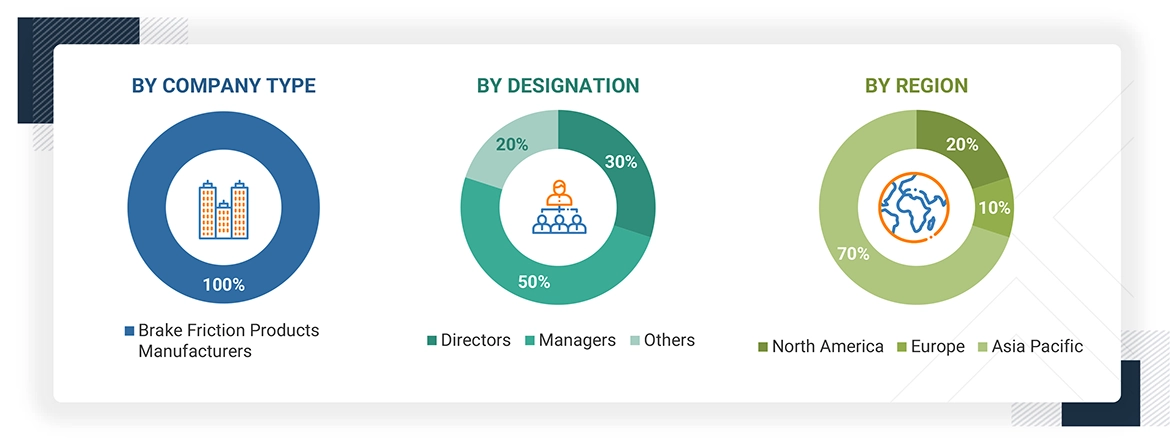
Note: Company tiers are based on the value chain; the company's revenue is not considered.
To know about the assumptions considered for the study, download the pdf brochure
Market Size Estimation
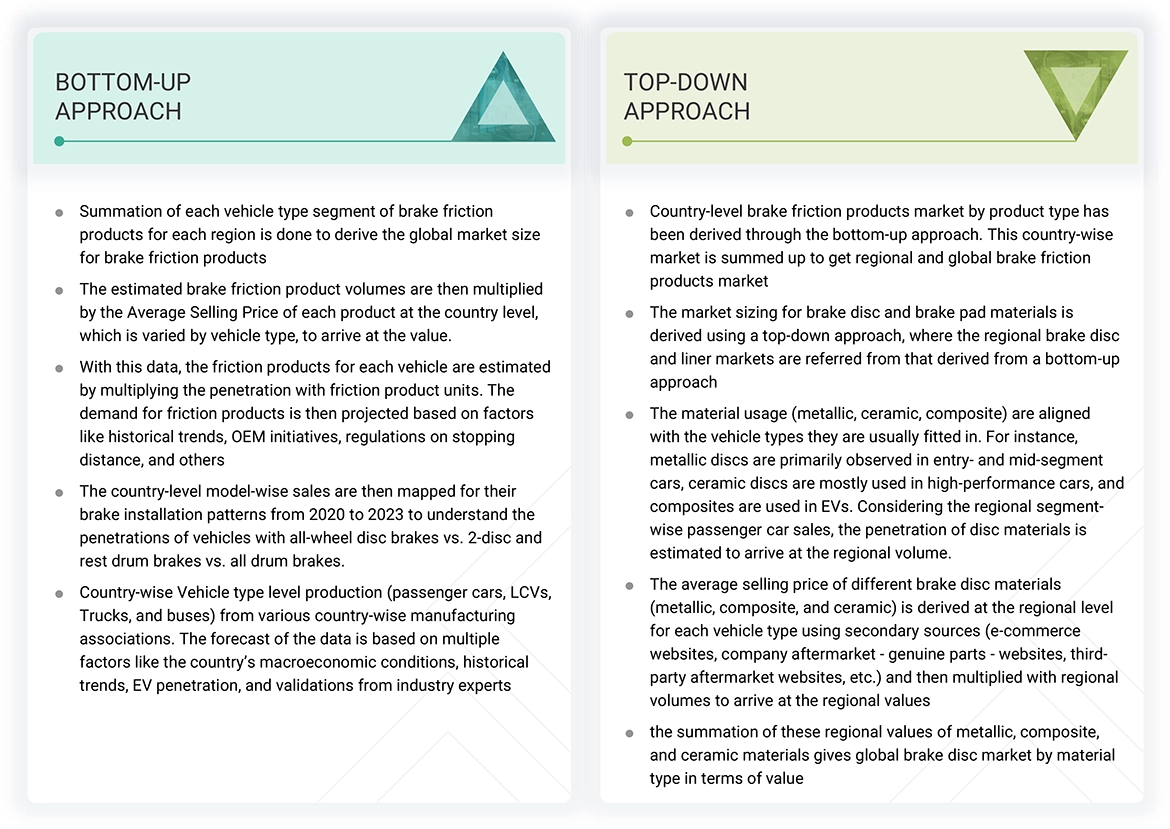
Both top-down and bottom-up approaches were used to estimate and validate the total size of the brake friction products market. These methods were also used extensively to estimate the size of various subsegments in the market. The research methodology used to estimate the market size includes the following:
Brake Friction Products Market : Top-Down and Bottom-Up Approach
Data Triangulation
After arriving at the overall market size, the market was split into several segments and subsegments using the market size estimation processes explained above. Data triangulation and market breakdown procedures were employed to complete the overall market engineering process and arrive at the exact statistics of each market segment and subsegment, wherever applicable. The data was triangulated by studying various factors and trends from both the demand and supply sides.
Market Definition
Brake friction products decelerate a vehicle by converting the car's kinetic energy into heat energy through friction and dissipating heat to the surroundings. Technological advancements in brake systems and friction materials create safe vehicle models running at higher speeds. Brake friction products, including a drum, disc, liner, and brake shoe, generate friction to stop the vehicle and control its speed. The scope of the brake friction study considers the brake pads, liner, brake shoe, brake disc, and brake shims.
Stakeholders
- Automotive OEMs
- Brake friction products manufacturers
- Associations, forums, and alliances related to automobiles
- EV component suppliers
- Raw material suppliers for brake friction products
- Traders and distributors of brake friction products
- Government agencies and policymakers
Report Objectives
- To analyze and forecast the brake friction products market in terms of value (USD million) & volume (million units) from 2021 to 2032
- To segment the market by product type, vehicle type, liner type, material type, off-highway market, application, disc type, electric vehicle brake friction OE market, vehicle type, aftermarket by-products, vehicle type, and region
- To segment and forecast the brake friction products OE market by value and volume
- To segment and forecast brake friction products aftermarket based on product at the country level and vehicle type at the regional level
- To identify and analyze key drivers, challenges, restraints, and opportunities influencing the market growth
- To strategically analyze the market for individual growth trends, prospects, and contributions to the total market
-
To study the following aspects of the market
- Value Chain Analysis
- Ecosystem Analysis
- Technology Analysis
- Trade Analysis
- Investment and Funding Scenario
- Pricing Analysis
- Case Study Analysis
- Patent Analysis
- Regulatory Landscape
- Key Stakeholders and Buying Criteria
- To strategically profile the key players and comprehensively analyze their market share and core competencies
- To analyze the opportunities for stakeholders and the competitive landscape for market leaders
- To track and analyze competitive developments such as deals, product launches/developments, expansions, and other activities undertaken by the key industry participants
Available Customizations
With the given market data, MarketsandMarkets offers customizations based on the company’s needs.
- Additional company profiles (up to 5 companies)
- Detailed analysis of the off-highway brake friction market by product type (Country Level)
- Detailed analysis of the brake friction OE market by vehicle type (Country Level)
Key Questions Addressed by the Report
What is the current market size of the Automotive Brake Friction Products Market?
The global Automotive Brake Friction Products Market is valued at USD 13.32 billion in 2025 and is projected to reach USD 15.52 billion by 2032, growing at a CAGR of 2.2% during the forecast period.
What are the key factors driving the growth of the Automotive Brake Friction Products Market?
The market is driven by increasing demand for disc brakes in passenger vehicles, stringent vehicle safety and stopping distance regulations, rising adoption of electric vehicles, advancements in brake friction materials, and the growing use of lightweight, high-performance braking components.
Which product segment is expected to dominate the Automotive Brake Friction Products Market?
The brake disc segment is expected to dominate the market due to its superior braking performance, improved heat dissipation, shorter stopping distances, and increasing adoption in passenger cars, SUVs, and premium vehicles.
Which vehicle type is expected to account for the largest share of the Automotive Brake Friction Products Market?
Passenger cars are expected to account for the largest market share, driven by high global production volumes, increasing consumer demand for advanced safety features, and widespread adoption of disc braking systems.
Which region is expected to lead the Automotive Brake Friction Products Market?
Asia Pacific is expected to be the largest regional market during the forecast period, supported by strong vehicle production in China, India, and South Korea, rising SUV demand, and increasing adoption of advanced braking technologies.


Personalize This Research
- Triangulate with your Own Data
- Get Data as per your Format and Definition
- Gain a Deeper Dive on a Specific Application, Geography, Customer or Competitor
- Any level of Personalization
Let Us Help You
- What are the Known and Unknown Adjacencies Impacting the Brake Friction Products Market
- What will your New Revenue Sources be?
- Who will be your Top Customer; what will make them switch?
- Defend your Market Share or Win Competitors
- Get a Scorecard for Target Partners

Custom Market Research Services
We Will Customise The Research For You, In Case The Report Listed Above Does Not Meet With Your Requirements
Get 10% Free CustomisationTESTIMONIALS

JIM NAAS
PRODUCT DIRECTOR, WEASLER
Weasler Engineering, a CentroMotion organization
Global Provider of Industrial Actuation & Control Solutionswww.weasler.com
Our organization was interested in learning more about the attractiveness of a particular market space. We contacted MarketsandMarkets to help us based on previous positive experiences we had with them. The results did not disappoint! We discussed our objectives with them, and the team at MarketsandMarkets developed and executed a proposal that met our needs precisely. We were very impressed by their level of expertise, the quality of the analysis and their insightful recommendations. We would not hesitate in working with them again in the future.

Matt Kardel,
Vice President
Aptiv,
A global technology company that develops safer, greener and more connected solutions.www.aptiv.com
We contracted with
MarketsandMarkets to evaluate the value chain and potential go-to-market partners related to our
interest in the Fleet Management space. The team successfully completed the work on time and at the
pricing agreed. MarketsandMarkets listened and understood our objectives and collaborated well with
us to help us get the visibility we needed to make an investment.
We have subsequently used
MarketsandMarkets again related to Smart Cities to good results.
- China Brake Friction Products Market
- Japan Brake Friction Products Market
- South Korea Brake Friction Products Market
- India Brake Friction Products Market
- Germany Brake Friction Products Market
- France Brake Friction Products Market
- UK Brake Friction Products Market
- Spain Brake Friction Products Market
- US Brake Friction Products Market
- Mexico Brake Friction Products Market
- Canada Brake Friction Products Market
- Russia Brake Friction Products Market
- Brazil Brake Friction Products Market
Growth opportunities and latent adjacency in Brake Friction Products Market






Amey
Nov, 2019
I want a comprehensive report about the whole brake pads, lining, shoe, drums, for all type of passenger car and all type of commercial car, and for plane and locomotive and other means of transportation that uses brake pads or other forms braking. .
Amey
Nov, 2019
I AM PARTICULARLY INTERESTED IN THE BREMBO COMPANY AND IN PORTER FIVE FORCES ANALYSIS. THANK YOU IN ADVANCE..