E-House Market by Type (Fixed E House and Mobile Substation), Application (Industrial (Metals & Mining and Oil & Gas), and Utilities), and Region (Middle East & Africa, Americas, Europe, APAC) - Global Forecast to 2035


E House Market Overview
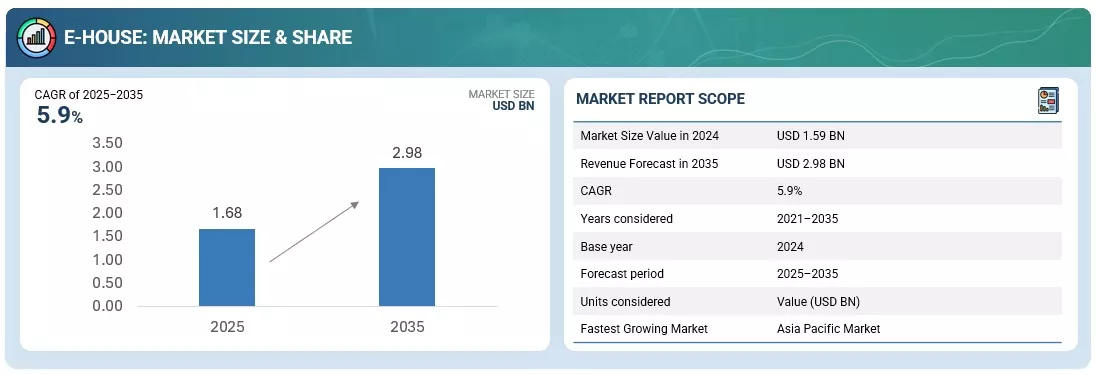
The global E-house market was valued at USD 1.59 billion in 2024 and is estimated to reach USD 2.98 billion by 2035, at a CAGR of 5.9% between 2025 and 2035.
The global E House market is experiencing steady growth as industries and utilities increasingly turn toward prefabricated, modular electrical solutions to enhance power reliability, reduce construction time, and minimize costs. Also known as electrical houses or modular substations, E Houses are fully integrated, transportable power distribution centers that contain electrical and control equipment in a compact enclosure. They provide an efficient alternative to traditional concrete substations by offering flexibility, scalability, and mobility. As industries move toward automation and large scale infrastructure projects continue to expand, the demand for E Houses is expected to accelerate between 2025 and 2035.
Market Dynamics
The E House market is being driven by the need for reliable and quick to deploy power distribution solutions. Industries such as oil and gas, mining, metals, and utilities face challenges related to harsh environmental conditions, remote operational sites, and the need for continuous power supply. Conventional substations often require long installation times and high costs, while E Houses provide a ready to use modular structure that can be rapidly transported and installed on site. This advantage makes E Houses an attractive option for temporary and permanent installations.
Another key driver is the rapid industrialization and urbanization taking place across emerging economies, which is fueling energy infrastructure investments. Governments and private entities are investing in smart grids, renewable energy integration, and electrification of rural and industrial areas. These initiatives create strong demand for modular substations that can be deployed quickly to support power distribution and control functions. The rise of digitalization, automation, and Industry 4.0 in manufacturing and processing industries is also contributing to the adoption of E Houses to support critical electrical operations and ensure stable power in complex facilities.
Market Restraints
Despite strong growth potential, the market faces some restraints. High initial investment and transportation costs can limit adoption, particularly in developing regions where infrastructure budgets are constrained. In addition, large E Houses require specialized transportation and handling equipment, which increases logistical complexity. Technical challenges such as ensuring compatibility with existing grid systems, managing heat dissipation in enclosed environments, and meeting strict safety standards can also pose difficulties. Furthermore, market growth may be slowed by limited awareness about the long term benefits of modular substations among smaller industrial players.
Market Opportunities
The increasing adoption of renewable energy and the growing focus on grid modernization present new opportunities for the E House market. Renewable power plants often operate in remote or challenging environments, requiring modular and transportable power infrastructure. E Houses are ideal for integrating renewable sources such as wind and solar into the main grid because they provide flexible electrical control and distribution. Moreover, the need for temporary power supply during grid maintenance, plant shutdowns, or emergency situations is driving the use of mobile substations.
The growth of the mining sector in Africa, Latin America, and parts of Asia Pacific creates substantial opportunities. Mining companies operate in remote locations where traditional substations are impractical. E Houses provide a portable, plug and play solution for reliable power distribution. Likewise, oil and gas operations, which often require mobile power solutions for exploration and production sites, represent a growing customer base for E House suppliers.
Digital technologies such as remote monitoring, IoT enabled sensors, and predictive maintenance are enhancing the functionality of modern E Houses. Vendors offering smart E Houses with integrated control and automation systems can deliver greater value to end users by improving operational efficiency and reducing downtime.
Type Analysis
The market is broadly divided into fixed E Houses and mobile substations.
Fixed E Houses are permanent or semi permanent installations designed to house electrical components such as switchgear, transformers, motor control centers, and control panels. They are typically used in industrial facilities, power generation plants, and utility substations where long term reliability and protection from environmental hazards are critical. Fixed E Houses are custom designed to meet the specific needs of each site and can be scaled or expanded as operational demands increase. Their advantages include enhanced safety, reduced on site construction, and lower installation costs compared to traditional substations.
Mobile substations, on the other hand, are transportable systems mounted on trailers or skids. They are designed for temporary or emergency applications and can be quickly deployed to restore power in case of outages, grid failures, or maintenance shutdowns. These systems are particularly useful for utilities that need to maintain power supply continuity during network upgrades or unexpected events. Mobile substations are also widely used in oil and gas exploration, mining operations, and large construction projects where temporary but reliable power distribution is required.
Between 2025 and 2035, the mobile substation segment is expected to grow at a faster rate than fixed E Houses due to the increasing demand for flexible and quick to deploy energy infrastructure solutions. However, fixed E Houses will continue to dominate the overall market in terms of revenue, driven by large scale industrial and utility installations.
Application Analysis
The key application areas for E Houses are industrial and utilities sectors.
In the industrial segment, E Houses are primarily used in metals and mining, and oil and gas industries. The metals and mining industry requires reliable power for heavy equipment, crushers, conveyors, and processing plants located in remote or harsh environments. E Houses enable rapid deployment of electrical distribution systems that can withstand extreme conditions such as dust, vibration, and temperature fluctuations. Their modularity allows mining companies to relocate them as operations expand or shift to new sites, improving flexibility and cost efficiency.
In the oil and gas industry, E Houses are deployed across upstream, midstream, and downstream operations. They provide essential electrical control and distribution for drilling rigs, production platforms, refineries, and pipeline stations. Mobile substations are particularly useful for exploration activities and temporary drilling operations. E Houses protect electrical systems from hazardous conditions such as explosions and corrosion, ensuring safety and reliability in critical environments. The ongoing expansion of oil and gas projects in the Middle East, Africa, and offshore regions will drive strong demand for E Houses throughout the forecast period.
The utilities segment also represents a significant share of the market. E Houses are used by utility companies for grid expansion, substation upgrades, and power transmission projects. They are especially valuable in situations requiring fast track deployment, such as emergency power restoration or temporary grid extensions. Utilities benefit from the reduced construction time, minimal site disruption, and ease of relocation offered by E Houses. The shift toward renewable energy and distributed power generation is creating additional opportunities as utilities need flexible infrastructure to connect new power sources to the grid.
Regional Analysis
The E House market is segmented into the Middle East and Africa, the Americas, Europe, and Asia Pacific. Each region exhibits unique growth drivers based on industrialization levels, infrastructure development, and energy demand.
The Middle East and Africa are expected to account for a significant share of the global E House market during the forecast period. The region hosts a large number of oil and gas projects, mining operations, and infrastructure developments requiring reliable power distribution. Countries such as Saudi Arabia, the United Arab Emirates, South Africa, and Nigeria are investing heavily in energy and industrial projects. E Houses offer the ideal solution for remote and harsh environments common in these regions. The growth of renewable energy, particularly solar and wind, further strengthens the need for modular electrical systems that can integrate new power sources into the grid.
The Americas, led by the United States, Canada, Brazil, and Chile, represent another major market. North America’s mature oil and gas industry, coupled with its push for grid modernization and renewable energy integration, drives significant adoption of E Houses. The presence of key manufacturers and system integrators also supports market expansion. In Latin America, mining and power generation industries in countries such as Chile and Peru are major contributors to demand. The need for mobile and rapidly deployable substations in remote mining areas fuels steady growth across the region.
Europe has a well established industrial base and is focusing on upgrading its aging power infrastructure. The transition to renewable energy and the development of smart grids are key factors driving the E House market in this region. European industries are also early adopters of modular construction technologies, which aligns with the benefits offered by E Houses. The presence of stringent safety and environmental standards encourages the adoption of prefabricated and tested modular solutions that comply with regulatory requirements.
Asia Pacific is expected to witness the fastest growth in the E House market between 2025 and 2035. Rapid industrialization, urbanization, and expanding power infrastructure in countries such as China, India, Indonesia, and Australia are key factors fueling demand. The region’s mining, metals, and energy sectors are expanding rapidly, and E Houses provide cost effective solutions for power distribution in these industries. Additionally, growing investments in renewable energy, transmission, and distribution networks support the deployment of E Houses for grid integration and control functions.
Technological Advancements
Technology plays a central role in shaping the future of the E House market. Advances in electrical engineering, modular construction, and automation are improving performance, safety, and reliability. Modern E Houses incorporate intelligent switchgear, digital relays, and communication systems that enable remote monitoring and predictive maintenance. The integration of IoT devices and advanced sensors allows operators to monitor temperature, humidity, vibration, and other parameters in real time, ensuring proactive maintenance and reducing downtime.
Prefabrication and modular construction techniques significantly reduce installation time and improve quality control. The use of computer aided design and simulation tools enables precise customization of E Houses to meet specific operational requirements. Furthermore, energy efficient materials and ventilation systems are being introduced to enhance cooling performance and reduce energy consumption. Cybersecurity is also becoming a priority as digital connectivity increases. Vendors are investing in secure communication protocols and data protection systems to safeguard critical electrical infrastructure.
Competitive Landscape
The global E House market is highly competitive, with key players focusing on innovation, partnerships, and regional expansion. Leading companies are offering turnkey solutions that include design, engineering, manufacturing, and installation. They are also expanding service portfolios to include maintenance, remote monitoring, and lifecycle management. Collaboration between E House manufacturers, utilities, and industrial end users is driving the development of customized solutions tailored to specific site conditions and operational needs.
Manufacturers are also investing in sustainability initiatives, such as the use of recyclable materials and energy efficient designs. As demand increases, regional players are emerging to serve local markets with cost effective and compliant solutions. The growing focus on renewable integration, grid modernization, and remote industrial development will continue to attract new entrants and foster competition.
Market Forecast
Between 2025 and 2035, the global E House market is projected to experience robust growth across all regions. The market value is expected to expand steadily due to increasing industrial activities, the rise of renewable energy projects, and the need for flexible and efficient power distribution solutions. Fixed E Houses will continue to dominate large scale installations, while mobile substations will see faster adoption in emergency, temporary, and remote applications.
The industrial sector will remain the largest end user, driven by mining and oil and gas projects that require portable and durable electrical systems. The utilities sector will also see increasing demand as grid modernization programs and renewable energy integration continue worldwide. Asia Pacific and the Middle East and Africa will lead growth due to infrastructure expansion and industrialization, while North America and Europe will sustain steady demand driven by modernization and sustainability initiatives.
Future Outlook
The future of the E House market lies in digitalization, modular innovation, and sustainability. As industries pursue energy efficiency and smart infrastructure, E Houses will evolve into intelligent power distribution hubs capable of integrating advanced automation and analytics. The combination of fast deployment, flexibility, and digital control will make E Houses an essential component of modern power systems.
Vendors that invest in research and development, embrace digital technologies, and build strong partnerships with utilities and industrial customers will be best positioned to succeed. Governments and private sector players seeking to ensure reliable and sustainable energy supply will continue to adopt E Houses as part of their modernization strategies.
Other companies covered in this report are Electroinnova (Spain), WEG (Brazil), TGOOD (Hong Kong), Powell Industries (US), Elgin Power Solutions (US), Meidensha (Japan), Matelec Group (Lebanon), Aktif Group (Turkey), PME Power Solutions (India), EKOS Group (Turkey), Efacec (Portugal), and Delta Star (US).
Target Audience for the Report:
- Component Suppliers
- Investors and Venture Capital Firms
- Integrated Device Manufacturers (IDMs)
- System Integrators
- Electric Hardware Equipment Manufacturers
- Assembly and Packaging Vendors
- Companies Working in the Electric Utilities Sector
- Analysts and Strategic Business Planners
- End-user Industries
- Governments, Financial Institutions, and Investment Communities
- Research Organizations
- Forums, Alliances, and Associations
This study answers several questions for the stakeholders, primarily which market segments to focus on in the next 2–5 years for prioritizing efforts and investments.
Scope of the Report:
This report categorizes the global e-house market on the basis of type, application, and geography.
E-House Market, By Type
- Fixed E-House
- Mobile Substation
E-House Market, By Application
- Utilities
- Industrial
E-House Market, By Region
- Americas
- Europe
- APAC
- Middle East & Africa
Available Customizations
With the given market data, MarketsandMarkets offers customizations according to the company’s specific needs. The following customization options are available for the report:
Company Information:
Detailed analysis and profiling of additional market players (up to 5)
Key players in this e-house market such as Siemens (Germany), ABB (Switzerland), Schneider Electric (France), Eaton (Ireland), General Electric (US), CG Power (India), and Meidensha (Japan) are focusing on inorganic strategies such as contracts and agreements to enhance their product offerings and expand their businesses.
To speak to our analyst for a discussion on the above findings, click Speak to Analyst
FAQ
1. What is an E-House?
Answer:
An E-House (Electrical House) is a modular, prefabricated power substation that integrates electrical and control equipment for rapid deployment in industrial or utility applications.
2. What drives the growth of the E-House Market?
Answer:
Growing demand for reliable and quick power solutions in mining, oil & gas, and renewable energy sectors drives market growth.
3. What are the main applications of E-Houses?
Answer:
E-Houses are widely used for power distribution, motor control centers, and switchgear housing in onshore and offshore installations.
4. What are the key benefits of E-Houses?
Answer:
They offer fast installation, reduced downtime, cost efficiency, mobility, and easy scalability compared to conventional substations.
5. Who are the major players in the E-House Market?
Answer:
Leading companies include Siemens, ABB, Schneider Electric, Eaton, and General Electric.
 Exclusive indicates content/data unique to MarketsandMarkets and not available with any competitors.
Table of Contents
1 Introduction (Page No. - 12)
1.1 Study Objectives
1.2 Definition
1.3 Scope of the Study
1.3.1 Markets Covered
1.3.2 Geographic Scope
1.3.3 Years Considered for the Study
1.4 Currency
1.5 Limitations
1.6 Stakeholders
2 Research Methodology (Page No. - 16)
2.1 Research Data
2.1.1 Secondary Data
2.1.1.1 Major Secondary Sources
2.1.1.2 Secondary Sources
2.1.2 Primary Data
2.1.2.1 Primary Resources
2.1.2.2 Primary Interviews With Experts
2.1.2.3 Breakdown of Primaries
2.1.3 Secondary and Primary Research
2.2 Market Size Estimation
2.2.1 Bottom-Up Approach
2.2.2 Top-Down Approach
2.3 Market Breakdown and Data Triangulation
2.4 Assumptions
3 Executive Summary (Page No. - 26)
4 Premium Insights (Page No. - 31)
4.1 Attractive Opportunities in the E-House Market
4.2 Market in Africa, By Type
4.3 Mobile Substation Market in the Middle East, By Application
4.4 Fixed Market, By Application and Region
4.5 Americas Market, By Region & Type
5 Market Overview (Page No. - 35)
5.1 Introduction
5.2 Market Dynamics
5.2.1 Drivers
5.2.1.1 Cost-Effective, Easy-To-Install, and Flexible Solution
5.2.2 Restraints
5.2.2.1 Maintenance of E-Houses
5.2.3 Opportunities
5.2.3.1 Demand for E-Houses in Middle East & Africa
5.2.4 Challenges
5.2.4.1 Lack of Technical Expertise
5.2.4.2 Transportation Concerns
5.3 Value Chain Analysis
6 Market, By Type (Page No. - 39)
6.1 Introduction
6.2 Fixed E-House (Skid Mounted)
6.3 Mobile Substation
7 Market, By Component (Page No. - 49)
7.1 Introduction
7.2 Switchgear
7.3 Transformer
7.4 Bus Bar
7.5 Variable Frequency Drive
7.6 Power Management System
7.7 HVAC
7.8 Other Auxiliary Systems
8 Market, By Application (Page No. - 51)
8.1 Introduction
8.2 Utilities
8.3 Industrial
8.3.1 Oil & Gas
8.3.2 Metals & Mining
8.3.3 Others
9 Geographic Analysis (Page No. - 56)
9.1 Introduction
9.2 Americas
9.2.1 North America
9.2.1.1 Us
9.2.1.2 Rest of North America
9.2.2 South America
9.3 Europe
9.3.1 Italy
9.3.2 Rest of Europe
9.4 Asia Pacific
9.4.1 China
9.4.2 Rest of Apac
9.5 Middle East & Africa
9.5.1 Middle East
9.5.2 Africa
10 Competitive Landscape (Page No. - 67)
10.1 Overview
10.2 Ranking of Players
10.3 Competitive Scenario
10.3.1 Contracts
11 Company Profiles (Page No. - 70)
11.1 Key Players
(Business Overview, Products Offered, Recent Developments, MnM View, SWOT Analysis)*
11.1.1 ABB
11.1.2 Siemens
11.1.3 Eaton
11.1.4 Schneider Electric
11.1.5 General Electric
11.1.6 CG Power
11.1.7 Meidensha
11.1.8 Electroinnova
11.1.9 WEG
11.1.10 TGOOD
11.1.11 Powell Industries
11.1.12 Elgin Power Solutions
*Business Overview, Products Offered, Recent Developments, MnM View, SWOT Analysis Might Not Be Captured in Case of Unlisted Companies.
11.2 Other Key Companies
11.2.1 Matelec Group
11.2.2 Aktif Group
11.2.3 PME Power Solutions (India) Limited
11.2.4 EKOS Group
11.2.5 Efacec
11.2.6 Delta Star
11.2.7 Nari Group
11.2.8 Unit Electrical Engineering(UEE)
12 Appendix (Page No. - 97)
12.1 Insights of Industry Experts
12.2 Discussion Guide for the E-House Market
12.3 Knowledge Store: Marketsandmarkets’ Subscription Portal
12.4 Introducing RT: Real-Time Market Intelligence
12.5 Available Customizations
12.6 Related Reports
12.7 Author Details
List of Tables (34 Tables)
Table 1 E-House Market Size, Value and Volume, 2015–2023
Table 2 Global Market, By Type, 2015–2023 (USD Million)
Table 3 Fixed Market, By Application, 2015–2023 (USD Million)
Table 4 Fixed Electrical House Market, By Industrial Application, 2015–2023 (USD Million)
Table 5 Fixed Market in Industrial Application, By Region, 2015–2023 (USD Million)
Table 6 Fixed Electrical House Market in Americas, By Application, 2015–2023 (USD Million)
Table 7 Fixed Market in Europe, By Application, 2015–2023 (USD Million)
Table 8 Fixed Market in APAC, By Application, 2015–2023 (USD Million)
Table 9 Fixed Market in Middle East & Africa, By Application, 2015–2023 (USD Million)
Table 10 Mobile Substation Market, By Application, 2015–2023 (USD Million)
Table 11 Mobile Substation Market, By Industrial Application, 2015–2023 (USD Million)
Table 12 Mobile Substation Market in Utilities Application, By Region, 2015–2023 (USD Million)
Table 13 Mobile Substation Market in Industrial Application, By Region, 2015–2023 (USD Million)
Table 14 Mobile Substation Market in Americas, By Application, 2015–2023 (USD Million)
Table 15 Mobile Substation Market in Europe, By Application, 2015–2023 (USD Million)
Table 16 Mobile Substation Market in APAC, By Application, 2015–2023 (USD Million)
Table 17 Mobile Substation Market in Middle East & Africa, By Application, 2015–2023 (USD Million)
Table 18 Market in Americas, By Type, 2015–2023 (USD Million)
Table 19 Electrical House Market in Europe, By Type, 2015–2023 (USD Million)
Table 20 Electrical House Market in APAC, By Type, 2015–2023 (USD Million)
Table 21 Market in Middle East & Africa, By Type, 2015–2023 (USD Million)
Table 22 Market, By Application, 2015–2023 (USD Million)
Table 23 Electrical House Market in Utilities Application, By Region, 2015–2023 (USD Million)
Table 24 Market, By Industrial Application, 2015–2023 (USD Million)
Table 25 Market in Industrial Application, By Region, 2015–2023 (USD Million)
Table 26 Market, By Region, 2015–2023 (USD Million)
Table 27 Fixed Market, By Region, 2015–2023 (USD Million)
Table 28 Mobile Substation Market, By Region, 2015–2023 (USD Million)
Table 29 Market in North America, By Country, 2015–2023 (USD Million)
Table 30 Market in Americas, By Region, 2015–2023 (USD Million)
Table 31 Market in Europe, By Country, 2015–2023 (USD Million)
Table 32 Market in APAC, By Country, 2015–2023 (USD Million)
Table 33 Electrical House Market in Middle East & Africa, By Region, 2015–2023 (USD Million)
Table 34 Ranking of Top 3 Player (2017 )
List of Figures (36 Figures)
Figure 1 Market Segmentation
Figure 2 Research Design
Figure 3 Market Size Estimation Methodology: Bottom-Up Approach
Figure 4 Market Size Estimation Methodology: Top-Down Approach
Figure 5 Data Triangulation
Figure 6 E-House Market Segmentation
Figure 7 Mobile Substation Segment Projected to Grow at Highest CAGR in the Global Market
Figure 8 Utilities Application Expected to Lead the Global Electrical House Market
Figure 9 Oil & Gas Segment Estimated to Account for Largest Share in Industrial Application of the Electrical House Market
Figure 10 Middle East & Africa Projected to Grow at Highest CAGR in the Global Market
Figure 11 Growth Opportunities in the Market Between 2018 and 2023
Figure 12 Mobile Substation Segment Estimated to Lead the African Market During 2018–2023
Figure 13 Utilities Application Expected to Account for A Higher Market Share in 2018
Figure 14 Industrial Application Estimated to Account for the Largest Share of the Fixed Market in 2018
Figure 15 North America Estimated to Account for the Largest Share of the Americas Electrical House Market in 2018
Figure 16 An E-House Reduces the Total Cost By Approximately 20%
Figure 17 E-House Value Chain
Figure 18 Electrical House Market, By Type
Figure 19 Mobile Substation to Dominate the Market During the Forecast Period
Figure 20 Utilities is Estimated to Capture Higher Share in Electrical House Market in 2018
Figure 21 Market, By Component
Figure 22 Utilities Application is Estimated to Dominate the Market Between 2018 and 2023
Figure 23 Market, Geographic Snapshot (2018–2023)
Figure 24 North America is Expected to Capture A Higher Share in 2018
Figure 25 Rest of Europe is Estimated to Dominate the Europe Market During the Forecast Period
Figure 26 Asia Pacific: Market Snapshot
Figure 27 Middle East & Africa: Electrical House Market Snapshot
Figure 28 ABB: Company Snapshot
Figure 29 Siemens: Company Snapshot
Figure 30 Eaton: Company Snapshot
Figure 31 Schneider Electric: Company Snapshot
Figure 32 General Electric: Company Snapshot
Figure 33 CG Power: Company Snapshot
Figure 34 Meidensha: Company Snapshot
Figure 35 WEG: Company Snapshot
Figure 36 Powell Industries: Company Snapshot













Growth opportunities and latent adjacency in E-House Market