Film Thickness Measurement Market by Technology, Film Type, Application (Aerospace & Aviation, Automotive, Food & Pharmaceutical Packaging, Industrial Manufacturing, Medical, Semiconductors), and Geography - Global Forecast to 2035


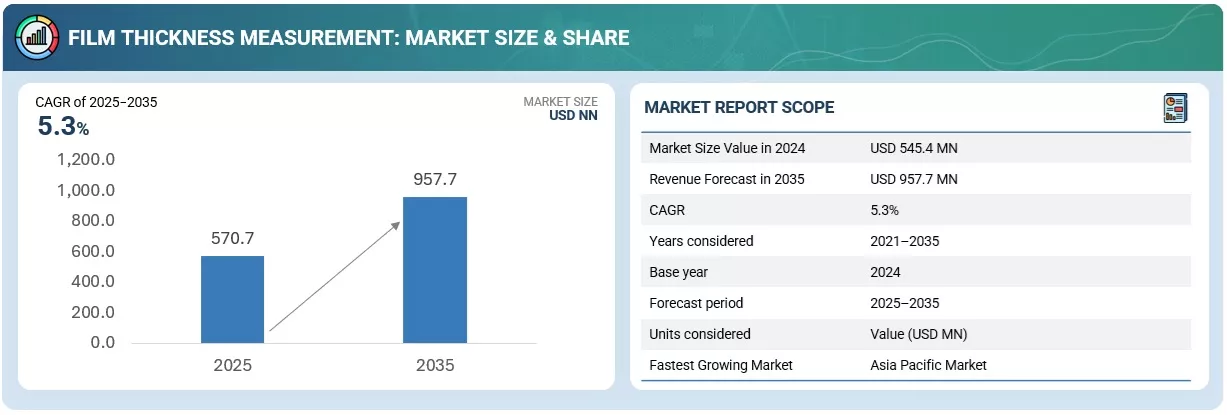
The global Film Thickness Measurement Market was valued at USD 545.4 million in 2024 and is estimated to reach USD 957.7 million by 2035, at a CAGR of 5.3% between 2025 and 2035.
The Film Thickness Measurement Market plays a central role in quality assurance process for industries that deposit or coat thin and thick films onto substrates. Precise control of film thickness influences product performance reliability and cost efficiency across sectors from semiconductors to food packaging. This report style narrative explores the market landscape by measurement technology by film type by application and by geography with a long term forecast horizon from 2025 through 2035. The discussion covers current market dynamics growth drivers technological trends regulatory influences competitive structure and key opportunities and challenges that will shape adoption and innovation.
Market Overview
Film thickness measurement comprises a range of non contact and contact techniques that allow manufacturers engineers and researchers to quantify layer thickness with high accuracy. Instruments vary from tabletop laboratory tools to inline process sensors integrated on production lines. The market has matured as industries demand higher precision thinner layers faster throughput and seamless traceability for regulatory compliance. In semiconductors the relentless move toward smaller node sizes and complex multilayer stacks has raised the bar for measurement capability. In automotive and aerospace coatings must meet corrosion and wear standards while in medical and pharmaceutical environments coatings influence drug release and barrier performance. Food and pharmaceutical packaging use coatings and laminates to control moisture gas and light transmission which directly affects shelf life and safety. These diverse needs create a complex but stable demand base for film thickness measurement technologies.
Market Dynamics and Forecast Summary
The market is expected to show steady growth through 2035 as manufacturers across industries continue to invest in quality control and process optimization. Growth will be supported by trends such as miniaturization of electronic components expansion of advanced packaging and growing adoption of functional coatings in industrial and consumer products. Automation and the push for inline real time monitoring will shift purchases from manual bench top instruments to integrated sensors and inspection systems. Demand will also be influenced by regional manufacturing shifts with faster growth anticipated in Asia Pacific due to expanding electronics automotive and packaging production. Overall the market will likely expand not only in unit shipments but also in average selling price as high end metrology systems and software enabled solutions gain share.
Technology Overview
Several core technologies dominate film thickness measurement. Optical reflectometry and ellipsometry are widely adopted for thin film stacks especially in semiconductor and display applications because they offer high precision and sub nanometer resolution. X ray based methods such as X ray fluorescence and X ray reflectivity are preferred for elemental and layer specific measurement or for films where optical methods face limitations. Spectroscopic techniques add chemical specificity which helps when film composition varies. Mechanical profilometry and stylus profilometry remain relevant for thicker films and surface topology mapping while quartz crystal microbalance provides mass based monitoring useful in laboratory and process development. Interferometry and white light interferometry offer non contact mapping for microstructures and MEMS components. Each technology carries unique strengths and trade offs in resolution throughput cost and applicability which determines its adoption across industries.
Film Type Segmentation
Film types measured range from metallic and ceramic coatings to polymeric films organic layers and complex multilayer laminates. Metallic films are common in semiconductor interconnects in automotive components and in barrier coatings for packaging. Ceramic films are used in wear resistant and thermal barrier coatings especially in aerospace and industrial manufacturing. Polymeric films dominate the packaging sector and are also widely used in medical devices as biocompatible coatings. Organic semiconductor layers have gained prominence with displays photovoltaics and emerging flexible electronics. Multilayer stacks that combine barrier adhesive and functional layers create additional measurement complexity requiring instruments capable of deconvoluting multiple interfaces. The market for measurement of thick films such as paints and plating coexists with that for ultra thin films in advanced electronics creating a broad product demand spectrum.
Application Insights Aerospace and Aviation
In aerospace and aviation film thickness measurement ensures structural coatings meet corrosion prevention fire resistance and aerodynamic smoothness specifications. Thermal barrier coatings on engine components require uniform thickness to manage heat flow and extend part life. Composite parts and surface treatments need controlled coatings to preserve mechanical performance and fatigue resistance. The need for traceable inspection documentation driven by regulatory authorities and the high value of aerospace components support investment in high precision metrology systems and inspection automation. Applications often require portable instruments for field service as well as high throughput inline solutions for production of large structures.
Application Insights Automotive
Automotive applications span decorative and protective coatings metal plating and functional films in sensors and displays. Paint thickness measurement is a mature use case in quality control for appearance and corrosion protection. With the rise of electric vehicles and advanced driver assistance systems the automotive manufacturing process includes more electronic modules which rely on thin film processes for sensors antennas and printed circuitry. Lightweighting initiatives and use of composite materials also drive demand for new coating processes and corresponding measurement solutions. The emphasis on throughput and cost per measurement shapes the adoption of robust easy to use instruments that can be integrated into assembly lines.
Application Insights Food and Pharmaceutical Packaging
Packaging markets require film thickness control to guarantee barrier performance and to comply with food safety regulations. Multilayer laminates and coated films are common and even small deviations in coating thickness can affect oxygen or moisture transmission rates and influence shelf life. Pharmaceutical packaging additionally demands validation and documentation to meet regulatory inspections and serialization initiatives. Inline measurement that provides continuous monitoring during lamination or coating processes reduces waste and improves yield. As sustainable packaging alternatives and recyclable mono materials gain interest the need to measure thin barrier coatings accurately becomes more important.
Application Insights Industrial Manufacturing
Industrial manufacturing embraces a wide set of use cases including corrosion protection hard chrome replacement decorative finishes and functional thin films for sensors and energy devices. Precision measurement is essential in process development and in scaling from pilot to full production. Many industrial users require robust instruments that can withstand factory environments and provide rapid measurements for quality control. Integration with manufacturing execution systems and ability to export measurement records for traceability are common requirements. The industrial segment is also a locus for customized measurement solutions that address unique substrate geometries and coating chemistries.
Application Insights Medical
The medical sector uses coatings for implants drug eluting devices and diagnostic components. Film thickness impacts drug dosage release rates surface biocompatibility and sensor performance. Regulatory oversight and the need for documented validation make metrology a key part of device manufacture. Small batch production and high value components often justify investments in high accuracy laboratory instruments as well as in process capable sensors for larger scale device making. Sterilization and bioburden control considerations also affect measurement choices and instrument maintenance.
Application Insights Semiconductors
Semiconductors represent one of the most demanding and fastest evolving application segments for film thickness measurement. Process nodes require nanometer and sub nanometer control across multiple material stacks. Metrology tools must support advanced materials high aspect ratio structures and complex multilayer films. Inline low contact and non destructive methods are increasingly critical to maintain throughput and yield. The proliferation of advanced packaging heterogeneous integration and novel device architectures will sustain high investments in optical and X ray based metrology as well as in data analytics and physics informed modeling that enable accurate layer extraction.
Regional Analysis North America
North America benefits from a strong installed base of semiconductor aerospace medical and automotive manufacturers as well as leading metrology vendors. Research institutions and defense related production support demand for high end instruments. Market growth in the region is steady and innovation driven with emphasis on automation and software enabled metrology solutions. North American customers increasingly expect integrated workflow solutions that connect process control to measurement feedback and support advanced analytics for yield optimization.
Regional Analysis Europe
Europe hosts major automotive aerospace and industrial manufacturing clusters and places strong emphasis on quality standards and environmental compliance. The region favors solutions that enable energy efficient manufacturing and that comply with strict regulations on materials and coatings. Growth is supported by investments in advanced manufacturing initiatives and digitalization programs that promote smart factories. Local vendors and global suppliers compete for opportunities by offering tailored services and regional support which can be a deciding factor for industrial clients.
Regional Analysis Asia Pacific
Asia Pacific is expected to be the fastest growing region driven by rapid expansion of electronics manufacturing automotive production and packaging industries. Countries in the region are home to major contract manufacturers and integrated device manufacturers which translate into high demand for metrology equipment. Cost sensitive buyers often balance initial equipment cost with total cost of ownership and prefer scalable inline solutions. The large volume manufacturing environment accelerates adoption of high throughput inline sensors and automated inspection systems. Government support for semiconductor and advanced materials manufacturing further amplifies regional opportunity.
Regional Analysis Latin America and Middle East Africa
Latin America presents targeted opportunities in automotive and general industrial coatings where modernization of manufacturing lines creates demand for new measurement tools. Middle East and Africa show growth in sectors such as aerospace maintenance and oil and gas related coatings. Adoption in these regions is gradual and often tied to trade cycles and infrastructure investment. Service networks certification and local training are important for vendors seeking to expand presence in these markets.
Competitive Landscape
The market consists of global instrument manufacturers specialized metrology providers and a variety of niche players that focus on particular technologies or industry verticals. Competition is based on measurement accuracy throughput instrument robustness software capabilities and lifecycle support. Many vendors differentiate through system level solutions that couple hardware with advanced modeling libraries and cloud enabled analytics. Service offerings including calibration on site training and process consultancy also influence purchase decisions. Strategic partnerships between metrology vendors and coating equipment makers or contract manufacturers help embed measurement more tightly into production workflows.
Key Growth Drivers
Several factors fuel market growth. First continuous miniaturization and material innovation in electronics necessitate higher accuracy metrology. Second regulatory pressure and consumer expectations in medical packaging and food safety push companies to invest in traceable measurement systems. Third the shift toward inline real time process monitoring reduces scrap and improves yield making measurement a cost saving investment rather than an overhead. Fourth the rise of advanced coating materials and functional films across industries creates new measurement needs. Finally Industry 4.0 adoption and digital twin initiatives promote software enabled metrology that can feed process control loops and support predictive maintenance.
Challenges and Restraints
Despite positive drivers there are barriers. High capital cost for advanced metrology systems can limit adoption among small and medium scale manufacturers. Complex materials and rough substrates pose measurement challenges that require specialized solutions and expert interpretation. Integration into existing production lines may require customization and downtime which deters some buyers. Standardization across industries for certain measurement protocols remains fragmented creating hurdles for cross industry technology transfer. Data management and cybersecurity concerns when connecting instruments to networks also require investment in secure IT infrastructure.
Opportunities and Innovation Areas
Opportunities exist in inline sensor development for continuous monitoring in roll to roll and high throughput processes. Portable and handheld devices with improved accuracy open service market potential for field inspection and maintenance. Machine learning enhanced data analytics coupled with physics based models can improve layer extraction in challenging stacks and enable predictive process control. Growth of flexible electronics and wearable devices creates demand for metrology tools that can handle non planar substrates and stretchable films. Service oriented business models that bundle calibration software updates and training represent recurring revenue opportunity for vendors.
Market Outlook and Strategic Recommendations
Over the forecast period demand for film thickness measurement will likely expand both in high performance instruments and in cost effective process sensors. Vendors should invest in modular solutions that can be upgraded as process requirements evolve and in open interfaces that ease factory integration. Focus on developing robust calibration routines and application specific libraries will reduce adoption friction. Building regional service capabilities and partnerships with equipment suppliers and research institutes will accelerate market penetration in high growth markets. For end users selection should balance accuracy throughput cost and lifecycle support and consider software and data integration as first class requirements.
Scope of the Report:
This research report categorizes the global film thickness measurement market by application, film type, technology, and geography.
Based on Application, the Film Thickness Measurement Market been Segmented as follows:
- Aerospace & Aviation
- Automotive
- Food & Pharmaceutical Packaging
- Industrial & Manufacturing
- Medical
- Semiconductors
- Others
Based on Film Type, the Film Thickness Measurement Market been Segmented as follows:
- Dry Film
- Wet Film
Based on Technology, the Film Thickness Measurement Market been Segmented as follows:
- Eddy Current
- Magnetic Induction
- Optical
- Ultrasonic
Based on Region, the Film Thickness Measurement Market been Segmented as follows:
- North America
- Europe
- Asia Pacific (APAC)
- Rest of the World (RoW)
Available Customizations:
With the given market data, MarketsandMarkets offers customizations according to the specific needs of companies. The following customization options are available for the report.
Company Information:
Detailed analysis and profiling of additional market players (up to 5).
To speak to our analyst for a discussion on the above findings, click Speak to Analyst
 Exclusive indicates content/data unique to MarketsandMarkets and not available with any competitors.
Table of Contents
1 Introduction (Page No. - 13)
1.1 Objectives of the Study
1.2 Definition
1.3 Study Scope
1.3.1 Markets Covered
1.3.2 Years Considered for the Study
1.4 Currency
1.5 Limitations
1.6 Stakeholders
2 Research Methodology (Page No. - 16)
2.1 Research Data
2.1.1 Secondary Data
2.1.1.1 Secondary Sources
2.1.2 Primary Data
2.1.2.1 Key Data From Primary Sources
2.1.2.2 Key Industry Insights
2.1.2.3 Breakdown of Primary Interviews
2.2 Market Size Estimation
2.2.1 Bottom-Up Approach
2.2.1.1 Approach for Capturing the Market Share By Bottom-Up Analysis (Demand Side)
2.2.2 Top-Down Approach
2.2.2.1 Approach for Capturing the Market Share By Top-Down Analysis (Supply Side)
2.3 Market Breakdown & Data Triangulation
2.4 Research Assumptions
3 Executive Summary (Page No. - 26)
4 Premium Insights (Page No. - 31)
4.1 Attractive Opportunities in Film Thickness Measurement Market
4.2 Market, By Application
4.3 Market, By Film Type
4.4 Market, By Technology
4.5 Market in Asia Pacific, By Application and Country
4.6 Market Share, By Region
5 Market Overview (Page No. - 34)
5.1 Introduction
5.2 Market Dynamics
5.2.1 Drivers
5.2.1.1 Increasing Trend Regarding Technology Miniaturization
5.2.1.2 Growing Demand for Cost Optimization Across Applications
5.2.1.3 Rising Awareness to Meet Quality Standards
5.2.2 Restraints
5.2.2.1 Implementation of Non-Destructive Thickness Measurement Solutions
5.2.3 Opportunities
5.2.3.1 Increasing Penetration of Iot
5.2.4 Challenges
5.2.4.1 Cost of Testing and Inspection
5.3 Value Chain Analysis
6 Film Thickness Measurement Market, By Technology (Page No. - 39)
6.1 Introduction
6.2 Eddy Current
6.3 Magnetic Induction
6.4 Optical
6.5 Ultrasonic
7 Film Thickness Measurement Market, By Film Type (Page No. - 47)
7.1 Introduction
7.2 Dry Film
7.3 Wet Film
8 Film Thickness Measurement Market, By Application (Page No. - 54)
8.1 Introduction
8.2 Aerospace & Aviation
8.3 Automotive
8.4 Food & Pharmaceutical Packaging
8.5 Industrial & Manufacturing
8.6 Medical
8.7 Semiconductors
8.8 Others
9 Geographic Analysis (Page No. - 64)
9.1 Introduction
9.2 North America
9.2.1 US
9.2.2 Canada
9.2.3 Mexico
9.3 Europe
9.3.1 Germany
9.3.2 UK
9.3.3 France
9.3.4 Rest of Europe
9.4 APAC
9.4.1 China
9.4.2 Japan
9.4.3 India
9.4.4 Rest of APAC
9.5 RoW
9.5.1 Middle East
9.5.2 South America
9.5.3 Africa
10 Competitive Landscape (Page No. - 88)
10.1 Overview
10.2 Ranking of Players, 2016
10.3 Competitive Scenario
10.3.1 Product Launch/Development
10.3.2 Partnerships/Agreements/Strategic Alliances/Collaborations
10.3.3 Expansions
11 Company Profiles (Page No. - 93)
(Business Overview, Products Offered, Recent Developments, SWOT Analysis, MnM View)*
11.1 Key Companies
11.1.1 Screen Holdings
11.1.2 Keyence
11.1.3 KLA-Tencor
11.1.4 Bruker
11.1.5 Spectris
11.1.6 Horiba
11.1.7 Hamamatsu
11.1.8 Altana
11.1.9 Rudolph Technologies
11.1.10 Nanometrics
11.1.11 Otsuka Electronics
11.1.12 Elcometer
11.1.13 Defelsko
11.1.14 Elektrophysik
11.1.15 Fischer Technology
11.2 Startup Ecosystem
11.2.1 Angstrom Sun Technologies Inc.
11.2.2 Lumetrics Inc.
11.2.3 PCE Deutschland GmbH
11.2.4 Semiconsoft Inc.
11.2.5 Sensory Analytics LLC
*Details on Business Overview, Products Offered, Recent Developments, SWOT Analysis, MnM View Might Not Be Captured in Case of Unlisted Companies.
12 Appendix (Page No. - 126)
12.1 Insights of Industry Experts
12.2 Discussion Guide
12.3 Knowledge Store: Marketsandmarkets’ Subscription Portal
12.4 Introducing RT: Real-Time Market Intelligence
12.5 Available Customizations
12.6 Related Reports
12.7 Author Details
List of Tables (63 Tables)
Table 1 List of Major Secondary Sources
Table 2 Primary Interviews With Experts
Table 3 Film Thickness Measurement Market in Terms of Value and Volume, 2017–2023
Table 4 Market, By Technology, 2017–2023 (USD Million)
Table 5 Market, By Technology, 2017–2023 (Thousand Units)
Table 6 Market for Eddy Current, By Region, 2017–2023 (USD Million)
Table 7 Market for Magnetic Induction, By Region, 2017–2023 (USD Million)
Table 8 Market for Optical, By Region, 2017–2023 (USD Million)
Table 9 Market for Ultrasonic, By Region, 2017–2023 (USD Million)
Table 10 Market, By Film Type, 2017–2023 (USD Million)
Table 11 Market for Dry Film, By Region, 2017–2023 (USD Million)
Table 12 Market for Dry Film in North America, By Country, 2017–2023 (USD Million)
Table 13 Market for Dry Film in Europe, By Country, 2017–2023 (USD Million)
Table 14 Market for Dry Film in APAC, By Country, 2017–2023 (USD Million)
Table 15 Market for Dry Film in RoW, By Region, 2017–2023 (USD Million)
Table 16 Market for Wet Film, By Region, 2017–2023 (USD Million)
Table 17 Market for Wet Film in North America, By Country, 2017–2023 (USD Million)
Table 18 Market for Wet Film in Europe, By Region, 2017–2023 (USD Million)
Table 19 Market for Wet Film in APAC, By Region, 2017–2023 (USD Million)
Table 20 Market for Wet Film in RoW, By Region, 2017–2023 (USD Million)
Table 21 Market, By Application, 2017–2023 (USD Million)
Table 22 Market for Aerospace & Aviation, By Region, 2017–2023 (USD Million)
Table 23 Market for Automotive, By Region, 2017–2023 (USD Million)
Table 24 Market for Food & Pharmaceutical Packaging, By Region, 2017–2023 (USD Million)
Table 25 Market for Industrial & Manufacturing, By Region, 2017–2023 (USD Million)
Table 26 Market for Medical, By Region, 2017–2023 (USD Million)
Table 27 Market for Semiconductors, By Region, 2017–2023 (USD Million)
Table 28 Market for Others, By Region, 2017–2023 (USD Million)
Table 29 Market, By Region, 2017–2023 (USD Million)
Table 30 Market in North America, By Application, 2017–2023 (USD Million)
Table 31 Market in North America, By Film Type, 2017–2023 (USD Million)
Table 32 Market in North America, By Technology, 2017–2023 (USD Million)
Table 33 Market in North America, By Country, 2017–2023 (USD Million)
Table 34 Market in US, By Film Type, 2017–2023 (USD Million)
Table 35 Market in US, By Technology, 2017–2023 (USD Million)
Table 36 Market in Canada, By Film Type, 2017–2023 (USD Million)
Table 37 Market in Mexico, By Film Type, 2017–2023 (USD Million)
Table 38 Market in Europe, By Application, 2017–2023 (USD Million)
Table 39 Market in Europe, By Film Type, 2017–2023 (USD Million)
Table 40 Market in Europe, By Technology, 2017–2023 (USD Million)
Table 41 Market in Europe, By Country, 2017–2023 (USD Million)
Table 42 Market in Germany, By Film Type, 2017–2023 (USD Million)
Table 43 Market in Germany, By Technology, 2017–2023 (USD Million)
Table 44 Market in UK, By Film Type, 2017–2023 (USD Million)
Table 45 Market in France, By Film Type, 2017–2023 (USD Million)
Table 46 Market in Rest of Europe, By Film Type, 2017–2023 (USD Million)
Table 47 Market in APAC, By Application, 2017–2023 (USD Million)
Table 48 Market in APAC, By Film Type, 2017–2023 (USD Million)
Table 49 Market in APAC, By Technology, 2017–2023 (USD Million)
Table 50 Market in APAC, By Country, 2017–2023 (USD Million)
Table 51 Market in China, By Film Type, 2017–2023 (USD Million)
Table 52 Market in China, By Technology, 2017–2023 (USD Million)
Table 53 Market in Japan, By Film Type, 2017–2023 (USD Million)
Table 54 Market in India, By Film Type, 2017–2023 (USD Million)
Table 55 Market in Rest of APAC, By Film Type, 2017–2023 (USD Million)
Table 56 Market in RoW, By Application, 2017–2023 (USD Million)
Table 57 Market in RoW, By Film Type, 2017–2023 (USD Million)
Table 58 Market in RoW, By Technology, 2017–2023 (USD Million)
Table 59 Market in RoW, By Country, 2017–2023 (USD Million)
Table 60 Market in Middle East, By Film Type, 2017–2023 (USD Million)
Table 61 Market in South America, By Film Type, 2017–2023 (USD Million)
Table 62 Market in Africa, By Film Type, 2017–2023 (USD Million)
Table 63 Ranking of Key Players in the Film Thickness Measurement Market, 2016
List of Figures (38 Figures)
Figure 1 Research Design
Figure 2 Bottom-Up Approach to Arrive at the Market Size
Figure 3 Top-Down Approach to Arrive at the Market Size
Figure 4 Data Triangulation Methodology
Figure 5 Market (2017–2023)
Figure 6 Market Snapshot, By Application
Figure 7 Market Snapshot, By Film Type
Figure 8 Market Snapshot, By Technology
Figure 9 Market, By Region
Figure 10 Miniaturization of Technology Driving the Film Thickness Measurement Market
Figure 11 Automotive Application to Hold the Largest Market Size
Figure 12 Dry Film Type to Hold A Larger Share of the Film Thickness Measurement Market in 2017
Figure 13 Market for Ultrasonic Technology to Grow at the Highest CAGR During the Forecast Period
Figure 14 China Holds the Largest Share of the Market in Asia Pacific, 2017
Figure 15 US to Hold the Largest Share of the Market in 2017
Figure 16 Technology Miniaturization is Anticipated to Drive the Market Growth
Figure 17 Value Chain Analysis of the Market
Figure 18 Market, By Technology
Figure 19 Ultrasonic Technology is Anticipated to Register Fastest Growth
Figure 20 Market, By Film Type
Figure 21 Dry Film is Dominating the Market Between 2017 and 2023
Figure 22 Market, By Application
Figure 23 Automotive Application is Likely to Exhibit the Highest CAGR Between 2017 and 2023
Figure 24 Geographic Snapshot: Market, 2017–2023
Figure 25 APAC Expected to Exhibit the Highest CAGR Between 2017 and 2023
Figure 26 North America: Market Snapshot
Figure 27 Europe: Film Thickness Measurement Market Snapshot
Figure 28 Companies Adopted Product Launch as the Key Growth Strategy Between 2016 and 2017
Figure 29 Screen Holdings: Company Snapshot
Figure 30 Keyence: Company Snapshot
Figure 31 KLA-Tencor: Company Snapshot
Figure 32 Bruker: Company Snapshot
Figure 33 Spectris: Company Snapshot
Figure 34 Horiba: Company Snapshot
Figure 35 Hamamatsu: Company Snapshot
Figure 36 Altana : Company Snapshot
Figure 37 Rudolph Technologies: Company Snapshot
Figure 38 Nanometrics: Company Snapshot













Growth opportunities and latent adjacency in Film Thickness Measurement Market