Test and Measurement Equipment Market Size, Share, Trends & Growth

Test and Measurement Equipment Market Size, Share and Trends by Product Type (Standalone Instruments, Modular Instrumentation, ATE), Testing Type, Commercial Model, End-Use Industry (Data Centers, Aerospace & Defense, Automotive) - Global Forecast to 2032




TEST AND Measurement EQUIPEMENT MARKET OVERVIEW
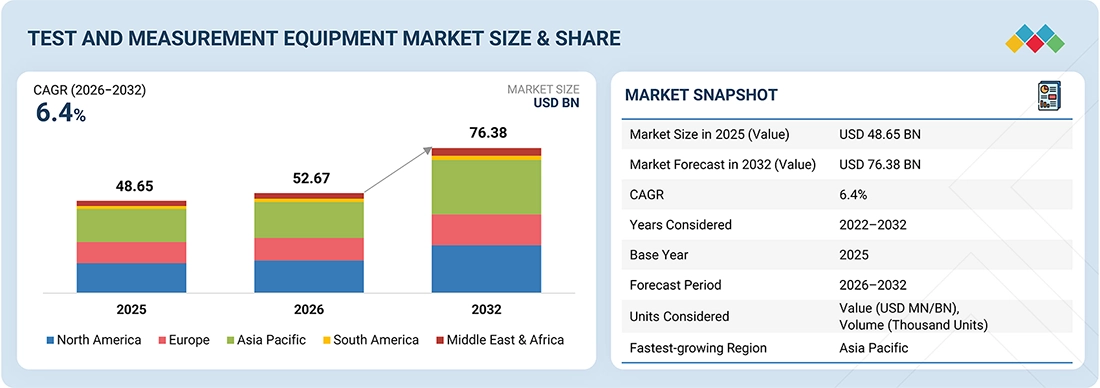
According to MarketsandMarkets, the global test and measurement equipment market size is estimated at USD 52.67 billion in 2026 and is expected to reach USD 76.38 billion by 2032, growing at a CAGR of 6.4% from 2026-2032.The market's growth is driven by increasing validation complexity across semiconductor manufacturing, AI data centers, electric vehicles, telecommunications, aerospace & defense, and industrial automation. The rapid expansion of AI data centers is increasing demand for high-speed signal integrity testing, power validation, optical networking measurements, and advanced RF and microwave test equipment.. While new equipment sales continue to account for the largest share of revenue, rental and refurbished equipment are gaining traction as organizations prioritize cost efficiency, rapid deployment, and flexible access to high-value test assets for research & development, manufacturing, field validation, and maintenance applications.Growing adoption of software-defined testing, modular platforms, and automated measurement systems is enabling manufacturers to improve testing efficiency, reduce time-to-market, and lower operational costs across R&D and production environments.
REPORT SCOPE
| REPORT METRIC | DETAILS |
|---|---|
| Market Size in 2025 (Value) | USD 48.65 Billion |
| Market Forecast in 2032 (Value) | USD 76.38 Billion |
| Growth Rate | CAGR of 6.4% from 2026–2032 |
| Years Considered | 2022-2032 |
| Base Year | 2025 |
| Forecast Period | 2026-2032 |
| Units Considered | Value (USD Billion/Million), Volume (Thousand Units) |
| Report Coverage | Revenue forecast, company ranking, competitive landscape, growth factors, and trends |
| Top Companies |
|
| Growth Driver |
|
| Segments Covered |
|
| Regions Covered | North America, Europe, Asia Pacific, South America, and the Middle East & Africa |
KEY TAKEAWAYS
-
BY REGIONBy region, Asia Pacific is expected to account for over 36% share of the test and measurement equipment market in 2026.
-
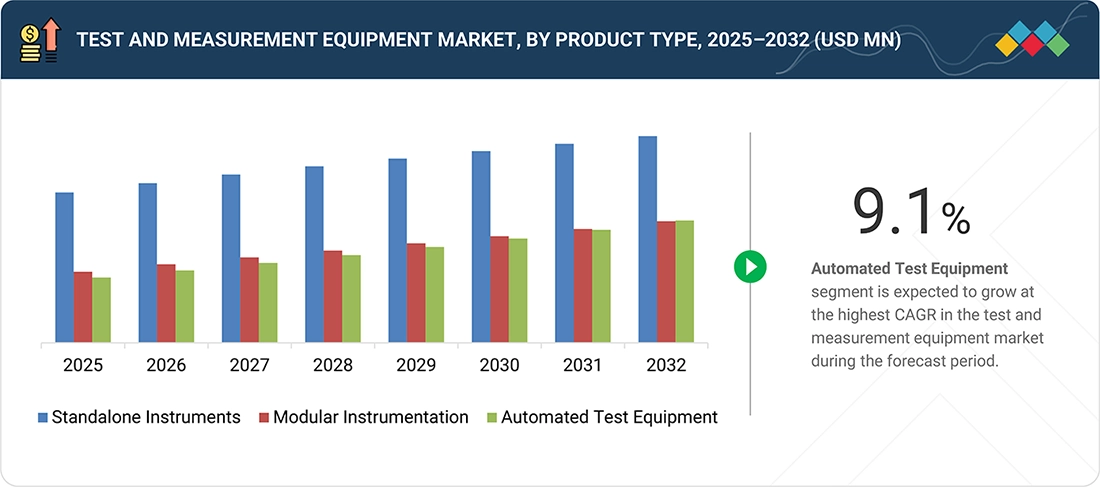
BY PRODUCT TYPEBy product type, the automated test equipment segment is likely to record a CAGR of 9.1% from 2026 to 2032.
-
BY COMMERCIAL MODELBy commercial mode, the new equipment sales segment is projected to capture ~76% market share by 2032.
-
BY TESTING TYPEBy testing type, the equipment testing segment remains the largest segment, while software testing is expected to grow faster during the forecast period.
-
BY SYSTEM LEVEL TESTINGBy system level testing, the component testing segment is likely to hold the largest market share in 2026.
-
BY TESTING LIFECYCLE STAGEBy testing lifecycle stage, the production testing segment accounts for the largest market share during the forecast period.
-
BY END-USE INDUSTRYBy end-use industry, the data centers segment is expected to grow at a CAGR of 13.2% during the forecast period.
-
COMPETITIVE LANDSCAPEMajor companies are leading the test and measurement equipment market through broad portfolios across standalone instruments, modular instrumentation, automated test equipment, RF and microwave testing, semiconductor testing, and lifecycle validation platforms.
-
COMPETITIVE LANDSCAPESpecialist and access-led T&M players, such as Chroma ATE, Teledyne, VIAVI Solutions, Pickering Interfaces, and GW Instek, strengthen the competitive landscape through niche application expertise, regional reach, rental and used equipment access, and flexible test capacity for targeted end-use industries.
The global test and measurement equipment market share is set to expand steadily, supported by rising validation complexity across semiconductors, data centers, automotive, telecommunications, aerospace and defense, industrial manufacturing, and healthcare. Growth is further strengthened by increasing adoption of automated test equipment, modular instrumentation, software-defined testing, and advanced RF and microwave validation. Demand is also widening beyond conventional lab and production testing as customers require faster product development, stronger quality assurance, lifecycle-stage testing, and flexible access through new equipment sales, used equipment sales, and rental models.
AI Infrastructure Validation Is Emerging as the Fastest-Growing Demand Driver for Test & Measurement Equipment
- AI infrastructure validation is emerging as the fastest-growing demand driver for the global test and measurement equipment market.
- The data centers segment is projected to register a CAGR of 13.2% between 2026 and 2032, supported by investments in hyperscale AI infrastructure and high-performance computing.
- High-speed digital, optical networking, power integrity, thermal management, and signal integrity testing are becoming essential validation requirements for AI-ready data centers.
- Growing adoption of automated test equipment and modular instrumentation is enabling faster validation of AI servers, GPU clusters, optical interconnects, and next-generation networking infrastructure.
Source: Secondary Research, Interviews with Experts, MarketsandMarkets Analysis
TRENDS & DISRUPTIONS IMPACTING CUSTOMERS' CUSTOMERS
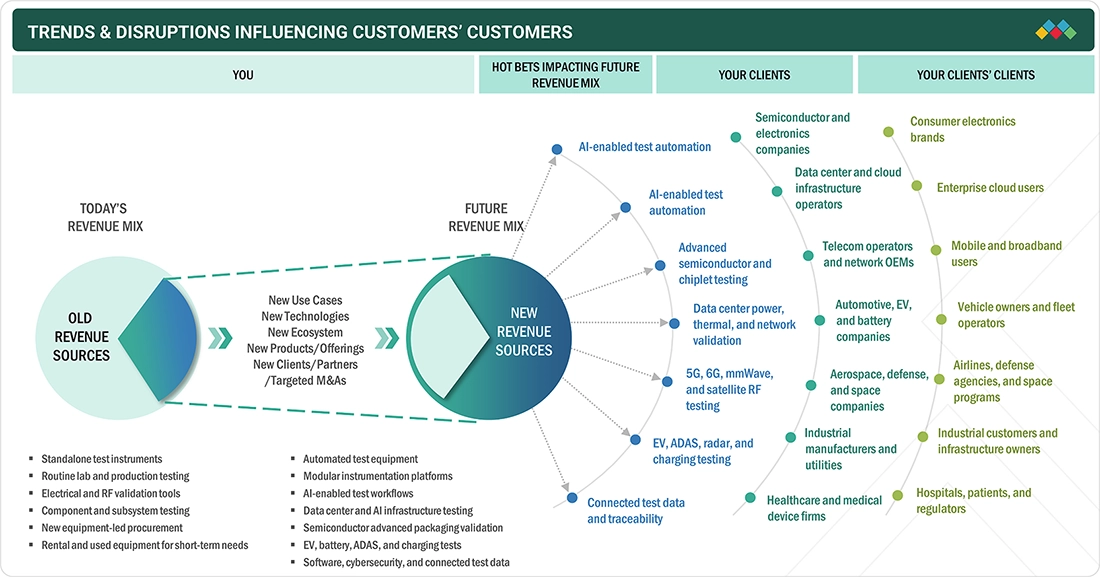
The impact of rising validation complexity is reshaping revenue streams in the test and measurement equipment market trends, as industries increasingly require faster, more accurate, and traceable testing across semiconductors, data centers, EVs, telecommunications, aerospace and defense, and industrial manufacturing. Traditional standalone instruments used for routine lab and production testing are complemented by automated test equipment, modular instrumentation, AI-enabled workflows, and software-defined platforms. This shift is creating new revenue opportunities through advanced semiconductor and chiplet testing, data center power and network validation, EV battery and ADAS testing, 5G/6G RF testing, cybersecurity validation, and connected test data platforms, while rental and used equipment models support flexible access to high-value test assets.
Source: Secondary Research, Interviews with Experts, MarketsandMarkets Analysis
MARKET DYNAMICS

Level
-
Rising test complexity for semiconductors, EVs, data centers, telecom, and aerospace applications

-
Growing need for faster validation, quality assurance, and regulatory compliance across product lifecycles


Level
-
High upfront cost of advanced automated test equipment and modular platforms

-
Long replacement cycles and budget constraints limiting frequent equipment upgrades


Level
-
Improved speed, accuracy, and throughput of AI-enabled, software-defined, and automated testing

-
Mounting demand from 5G/6G, EV batteries, ADAS, chiplets, and AI data center infrastructure


Level
-
Rapid technology shifts increasing risk of equipment obsolescence

-
Need to integrate hardware, software, data, and cybersecurity testing into unified workflows

Source: Secondary Research, Interviews with Experts, MarketsandMarkets Analysis
Driver: Rising test complexity for semiconductors, EVs, data centers, telecom, and aerospace applications
Rising product complexity across semiconductors, EVs, data centers, telecom, and aerospace is increasing the need for precise, high-speed, and application-specific testing. Advanced chips, AI servers, EV batteries, 5G/6G networks, and mission-critical aerospace systems require validation across electrical, RF, thermal, mechanical, software, and system-level parameters, creating sustained demand for advanced testing and measurement (T&M) equipment.
Restraint: High upfront cost of advanced automated test equipment and modular platforms
High upfront investment in automated test equipment, modular instrumentation, RF systems, and semiconductor test platforms limits the adoption among cost-sensitive customers. These systems often require supporting software, fixtures, calibration, integration, and skilled operators, increasing the total ownership cost and slowing replacement decisions, particularly for SMEs, regional labs, and customers with intermittent testing needs.
Opportunity: Improved speed, accuracy, and throughput of AI-enabled, software-defined, and automated testing
AI-enabled, software-defined, and automated testing is creating strong growth opportunities by reducing manual effort, improving repeatability, and accelerating validation cycles. As customers manage larger test volumes and shorter product launch timelines, automated workflows, predictive analytics, connected test data, and reusable software-driven platforms are becoming critical for improving throughput, accuracy, and lab productivity.
Challenge: Rapid technology shifts increasing risk of equipment obsolescence
Rapid shifts in chip architectures, wireless standards, EV platforms, data center designs, and aerospace systems create a continuing risk of equipment obsolescence. T&M providers must keep instruments, software, interfaces, and measurement capabilities aligned with evolving customer requirements, while end users face pressure to balance long equipment lifecycles with frequent upgrades needed for next-generation testing.
TEST AND MEASUREMENT EQUIPMENT MARKET SIZE, SHARE AND GROWTH: COMMERCIAL USE CASES ACROSS INDUSTRIES
| COMPANY | USE CASE DESCRIPTION | BENEFITS |
|---|---|---|
 |
Delivered EV battery test solutions covering cell, module, and pack-level validation, with lab automation support for faster workflow execution and battery fault analysis | Faster battery validation | Stronger safety and performance assurance | Improved test lab productivity |
 |
Supported Raytheon with NI SystemLink for test data management and equipment utilization across mission-critical aerospace and defense manufacturing workflows | Faster battery validation | Stronger safety and performance assurance | Improved test lab productivity |
 |
Provided AI data center testing solutions for validating subsystems and components, including power supply and high-speed infrastructure testing requirements | Reduced validation time and cost | Faster time-to-market | Stronger readiness for AI infrastructure deployment |
 |
Enabled 5G private network performance and service-level verification for industrial use cases such as connected robots and automated guided vehicles | Clearer network performance visibility | Improved QoS/QoE verification | Stronger industrial connectivity assurance |
 |
Offered automotive 5G connectivity and telematics control unit testing solutions using simulated lab environments for efficient performance validation | Faster automotive connectivity testing | Improved validation accuracy | Reduced field failure and compliance risk |
Logos and trademarks shown above are the property of their respective owners. Their use here is for informational and illustrative purposes only.
MARKET ECOSYSTEM
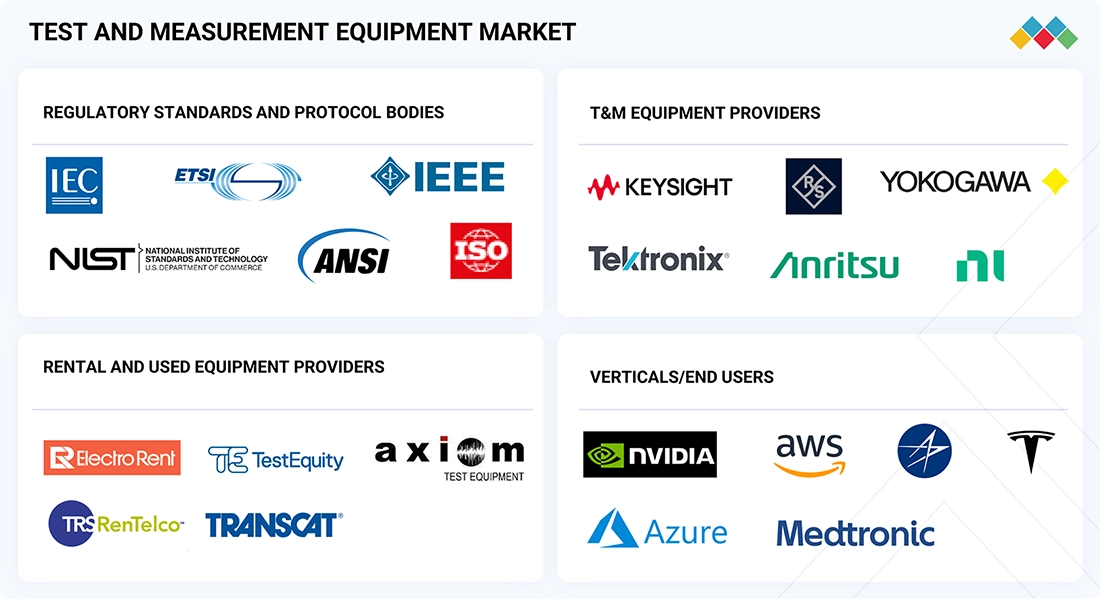
The test and measurement equipment market growth ecosystem is shaped by standards bodies, equipment providers, access-led commercial channels, and end-use industries. Regulatory standards and protocol bodies, such as IEC, ETSI, IEEE, NIST, ANSI, and ISO, define measurement requirements and interoperability benchmarks across electronics, telecom, automotive, aerospace, and industrial applications. T&M equipment providers, such as Tektronix, Anritsu, and NI, supply instruments, automated test systems, and validation platforms. Rental and used equipment providers, such as Electro Rent, TestEquity, Axiom, TRS-RenTelco, and Transcat, improve access to high-value test assets. Verticals/end users, including NVIDIA, AWS, Lockheed Martin, Tesla, Azure, and Medtronic, drive the demand through AI infrastructure, cloud, aerospace and defense, EV, and healthcare technology validation needs.
Logos and trademarks shown above are the property of their respective owners. Their use here is for informational and illustrative purposes only.
MARKET SEGMENTS
Source: Secondary Research, Interviews with Experts, MarketsandMarkets Analysis
Test and Measurement Equipment Market, by Product Type
Product type segmentation classifies T&M equipment based on the instrument architecture and testing platform used by customers, covering standalone instruments, modular instrumentation, and automated test equipment. Standalone instruments remain the largest category, supported by broad use across lab, field, production, and service testing. Automated test equipment records the highest CAGR during 2026–2032, driven by high-throughput semiconductor, electronics, EV, and production validation needs.Standalone instruments continue to represent the largest product segment, while modular instrumentation and automated test equipment (ATE) are expected to register the fastest growth due to increasing production automation and high-volume semiconductor testing.
Test and Measurement Equipment Market, by Commercial Model
Commercial model segmentation reflects how customers procure or access T&M equipment, covering new equipment sales, used equipment sales, and rental. New equipment sales remain the largest category, as customers continue investing in advanced instruments, modular platforms, and automated test systems. Rental records the highest CAGR during the forecast period, supported by flexible access to costly test assets and short-term project-based demand.
Test and Measurement Equipment Market, by End-use Industry
End-use industry segmentation captures the demand across major application sectors using T&M equipment, including data centers, aerospace & defense (A&D), automotive, telecommunications, semiconductors, industrial manufacturing, healthcare and medical devices, and other end-use industries. Industrial manufacturing is the largest category in 2026, while semiconductors becomes the largest by 2032. Data centers record the highest CAGR during 2026–2032, driven by AI infrastructure, high-density servers, and power, thermal, optical, and network validation demand.
REGION
Asia Pacific to grow at fastest rate in global test and measurement equipment market during forecast period
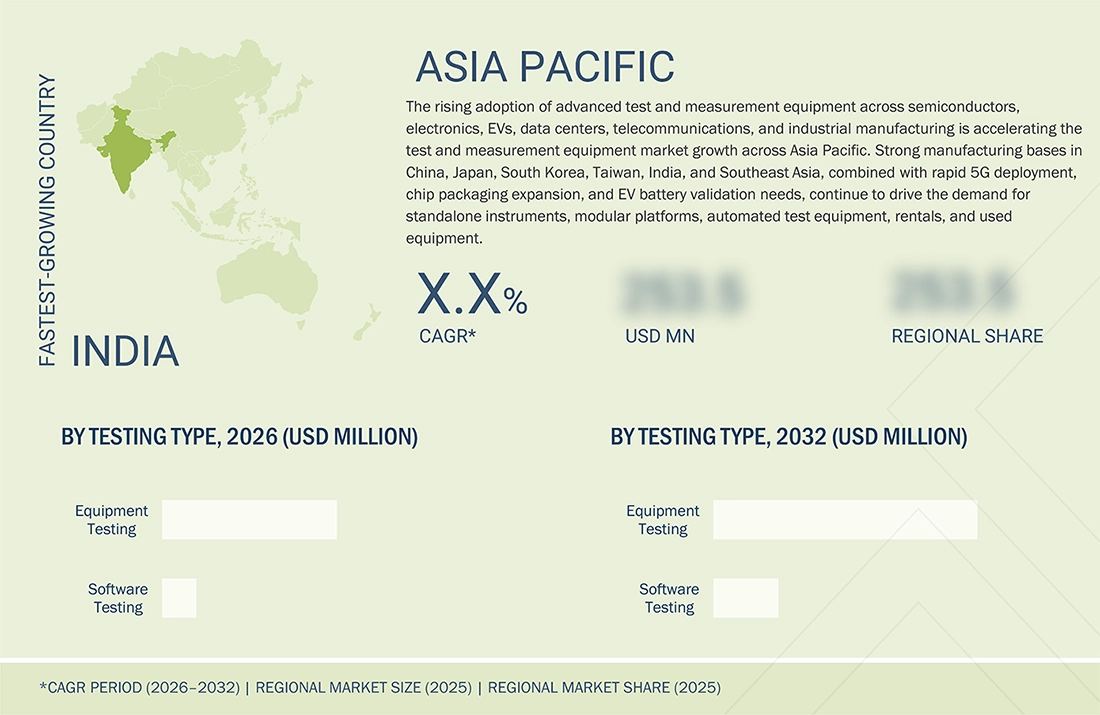
Asia Pacific is expected to remain the fastest-growing region in the test and measurement instrument industry through 2032, driven by its strong concentration of electronics manufacturing, semiconductor production, EV battery development, telecom infrastructure expansion, and AI data center investments. China, Japan, South Korea, Taiwan, India, and Southeast Asian countries are strengthening the demand for advanced equipment testing, software testing, automated test equipment, modular instrumentation, and RF validation tools. The growth is supported by high-volume manufacturing, rising product complexity, faster technology cycles, and increasing quality requirements across semiconductors, automotive, telecommunications, industrial manufacturing, and healthcare devices. India is highlighted as the fastest-growing country within Asia Pacific, supported by expanding electronics manufacturing, data center capacity, EV ecosystem development, 5G rollout, and government-backed industrial modernization initiatives that are increasing demand for reliable and scalable testing infrastructure.
North America accounts for the largest share of the test and measurement equipment market, supported by strong investments in semiconductor manufacturing, aerospace & defense, telecommunications, and AI infrastructure
TEST AND MEASUREMENT EQUIPMENT MARKET SIZE, SHARE AND GROWTH: COMPANY EVALUATION MATRIX
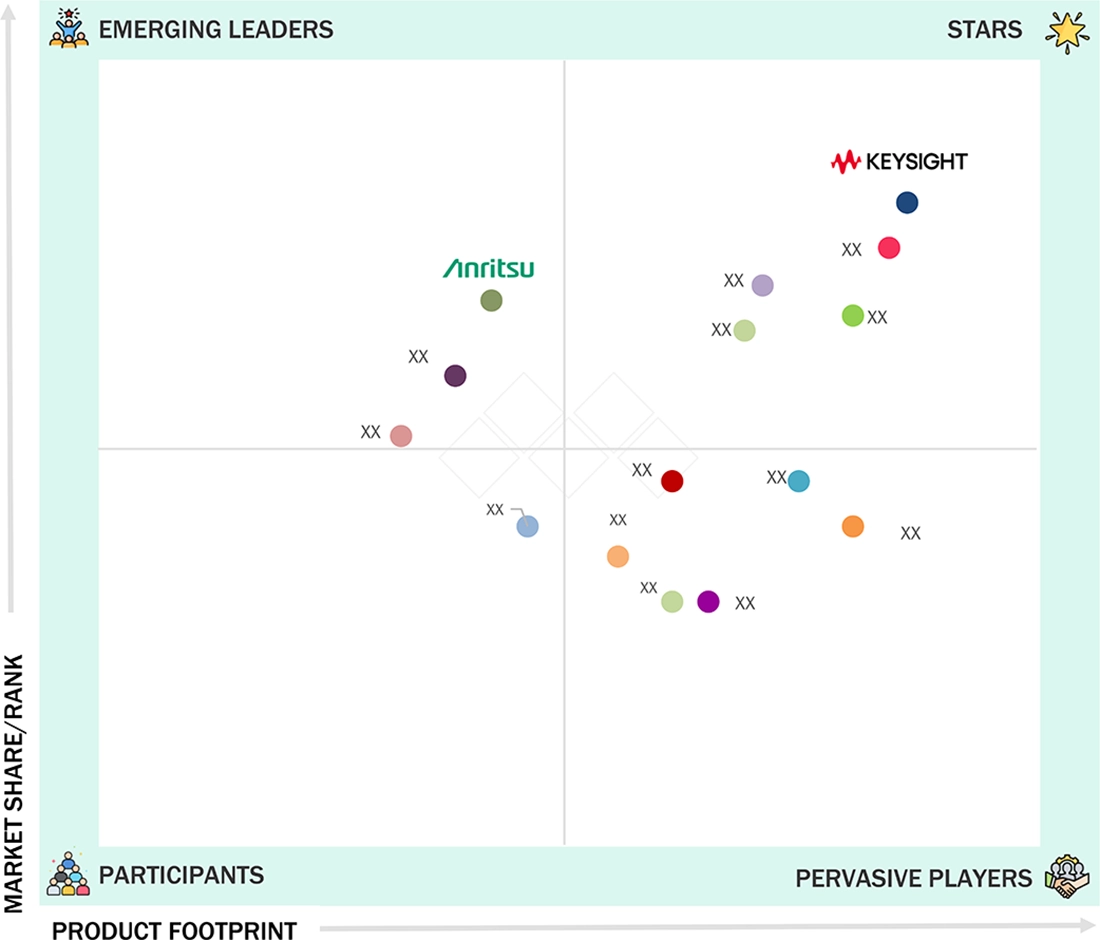
In the test and measurement equipment companies matrix, Keysight Technologies stands out as a Star, supported by its strong market position, broad product footprint, and end-to-end coverage across standalone instruments, modular platforms, automated test equipment, RF and microwave testing, semiconductor validation, automotive, aerospace and defense, telecom, and data center applications. Anritsu is positioned as an Emerging Leader, strengthening its relevance through focused expertise in wireless, 5G, RF, network, and connectivity testing, with strong momentum in telecom and connected device validation. Other major players remain spread across the Pervasive Players category, supported by diversified portfolios and regional customer reach, while Participants represent niche, value-focused, or specialized providers with selective product depth and narrower market coverage.
Source: Secondary Research, Interviews with Experts, MarketsandMarkets Analysis
KEY MARKET PLAYERS
- Keysight Technologies (US)
- Rohde & Schwarz (Germany)
- Tektronix (US)
- NI / Emerson Test & Measurement (US)
- Anritsu Corporation (Japan)
- Yokogawa Test & Measurement (Japan)
- Advantest Corporation (Japan)
- Teradyne Inc. (US)
- Fluke Corporation (US)
- EXFO Inc. (Canada)
WHAT IS IN IT FOR YOU: TEST AND MEASUREMENT EQUIPMENT MARKET SIZE, SHARE AND GROWTH REPORT CONTENT GUIDE
DELIVERED CUSTOMIZATIONS
We have successfully delivered the following deep-dive customizations:
| CLIENT REQUEST | CUSTOMIZATION DELIVERED | VALUE ADDS |
|---|---|---|
| Global T&M Equipment Major / Equipment Provider |
|
|
| Rental & Used Equipment Provider |
|
|
| Global Consulting Firm / Strategy & Research Client |
|
|
| Semiconductor & Electronics Enterprise |
|
|
| Data Center & Cloud Infrastructure Client |
|
|
RECENT DEVELOPMENTS
- July 2026: Rohde & Schwarz introduced the R&S MXO-K333 three-phase power-analysis software option for its MXO series oscilloscopes. The software adds power-analyzer-style measurements directly to the oscilloscope, enabling engineers to evaluate parameters including active, reactive and apparent power, power factor and efficiency without requiring a separate power analyzer. The development expands Rohde & Schwarz’s electronic test-and-measurement capabilities for power-electronics and energy-conversion applications.
- June 2026: Tektronix expanded its power-measurement portfolio with new wideband shunts and a high-voltage differential probe for demanding power-electronics measurements. The new equipment is designed to provide accurate current and voltage measurements for applications involving high-frequency switching and wide-bandgap semiconductor technologies. The development strengthens Tektronix’s test-and-measurement equipment portfolio for next-generation power systems.
- June 2026: Anritsu Corporation introduced a CXL 2.0/3.x test solution designed to improve high-speed interface design and evaluation. The solution supports testing of Compute Express Link interfaces used in advanced computing and memory architectures, enabling engineers to evaluate signal integrity and protocol performance more efficiently. The development expands Anritsu’s high-speed digital test-and-measurement capabilities for next-generation computing systems
- June 2026: Emerson Test & Measurement unveiled an AI-ready test automation platform at NI Connect 2026, alongside new software-defined test technologies for aerospace RF testing and radar, satellite and 6G research. The portfolio combines NI’s modular hardware, open software and AI capabilities to automate complex measurement workflows and improve engineering productivity. The development advances Emerson’s test-and-measurement offering toward software-defined and AI-enabled test environments.
- June 2026: Teradyne Inc. introduced an integrated test solution for AI and data-center devices in collaboration with Tokyo Electron. The solution combines Teradyne’s semiconductor test capabilities with Tokyo Electron technologies to address increasingly complex testing requirements for AI and data-center devices. The development strengthens Teradyne’s automated test-equipment portfolio as advanced semiconductor architectures increase test complexity and demand for higher-performance test systems
Table of Contents
 Exclusive indicates content/data unique to MarketsandMarkets and not available with any competitors.
Methodology
The study involved four major activities in estimating the current size of the test and measurement equipment market. Exhaustive secondary research was conducted to compile information from public and credible sources, such as company annual reports, investor presentations, SEC filings, equipment provider disclosures, standards bodies including IEC, IEEE, ISO, ANSI, NIST, ETSI, and 3GPP, and industry sources related to semiconductors, telecommunications, automotive, aerospace and defense, data centers, and industrial manufacturing. These sources helped build the initial market view across product type, testing type, commercial model, system testing level, lifecycle stage, end-use industry, and region.
Primary research was conducted with stakeholders across the test and measurement (T&M) equipment value chain, including equipment manufacturers, rental and used equipment providers, distributors, system integrators, component suppliers, calibration and test lab users, semiconductor companies, telecom operators, automotive and EV manufacturers, aerospace and defense users, data center operators, industrial manufacturers, and healthcare device companies. The primary inputs were used to validate segment-level assumptions, regional demand trends, procurement models, pricing logic, and adoption patterns across new equipment sales, used equipment sales, and rental models.
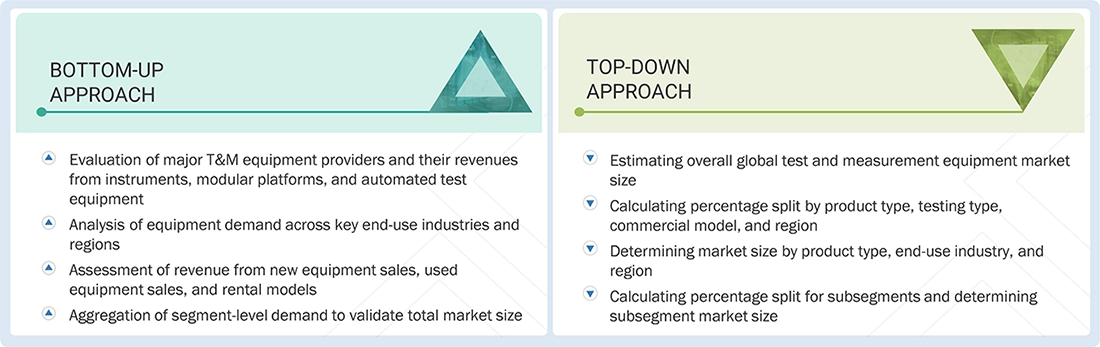
The test and measurement equipment market size was estimated using top-down and bottom-up approaches. In the top-down approach, the overall market size was assessed and allocated across regions, product types, testing types, commercial models, system testing levels, lifecycle stages, and end-use industries. In the bottom-up approach, revenues of key T&M equipment providers were evaluated across standalone instruments, modular instrumentation, automated test equipment, RF and microwave instruments, semiconductor test systems, and related testing platforms. Market breakdown and data triangulation were then applied to align secondary research, primary inputs, company-level analysis, and segment-level estimates, ensuring consistency across regions and subsegments.
The market definition covers equipment, instruments, platforms, and systems used for measuring, validating, testing, monitoring, and analyzing electrical, electronic, RF, microwave, mechanical, physical, industrial, software-enabled, and automated test requirements. The study includes standalone instruments, modular instrumentation, automated test equipment, equipment testing, software testing, new equipment sales, used equipment sales, and rental. Key stakeholders include T&M equipment manufacturers, rental and used equipment providers, distributors, system integrators, standards and protocol bodies, semiconductor and electronics companies, data center operators, automotive and EV companies, telecom operators, aerospace and defense organizations, industrial manufacturers, healthcare device companies, investors, consultants, and strategy teams.
Secondary Research
Various secondary sources were referred to during the research process to identify and collect information important for the study on the test and measurement equipment market. These sources include annual reports, SEC filings, press releases, investor presentations, product brochures, and official disclosures of T&M equipment providers, rental and used equipment providers, and related technology companies. Public sources from standards and protocol bodies, such as IEC, IEEE, ISO, ANSI, NIST, ETSI, and 3GPP, were also reviewed, along with government publications, trade association releases, technical white papers, journals, recognized industry publications, company websites, product directories, and databases. Secondary research was conducted to build the industry and value chain view, map the ecosystem of key participants, define market segmentation to the bottom-most level, and track regional dynamics and recent developments from market and technology perspectives. The collected information was analyzed to form the initial market sizing and segmentation estimates across product type, testing type, commercial model, system testing level, testing lifecycle stage, end-use industry, and region. These estimates were subsequently validated and refined through primary research.
Primary Research
Extensive primary research was conducted after gaining a detailed understanding of the current scenario of the test and measurement equipment market through secondary research. Several primary interviews were conducted with experts from the demand and supply sides across North America, Europe, Asia Pacific, South America, and the Middle East & Africa. The primary data was collected through questionnaires, emails, and telephonic interviews. On the supply side, primary respondents included T&M equipment manufacturers, modular instrumentation providers, automated test equipment suppliers, rental and used equipment providers, distributors, system integrators, calibration and testing solution providers, and technology partners. On the demand side, respondents included stakeholders from semiconductors, data centers, aerospace and defense, automotive, telecommunications, industrial manufacturing, healthcare and medical devices, and other end-use industries. These interviews helped validate market size, segment splits, regional demand trends, procurement models, adoption patterns, competitive positioning, and growth assumptions across the T&M equipment value chain.
Breakdown of Primary Interviews
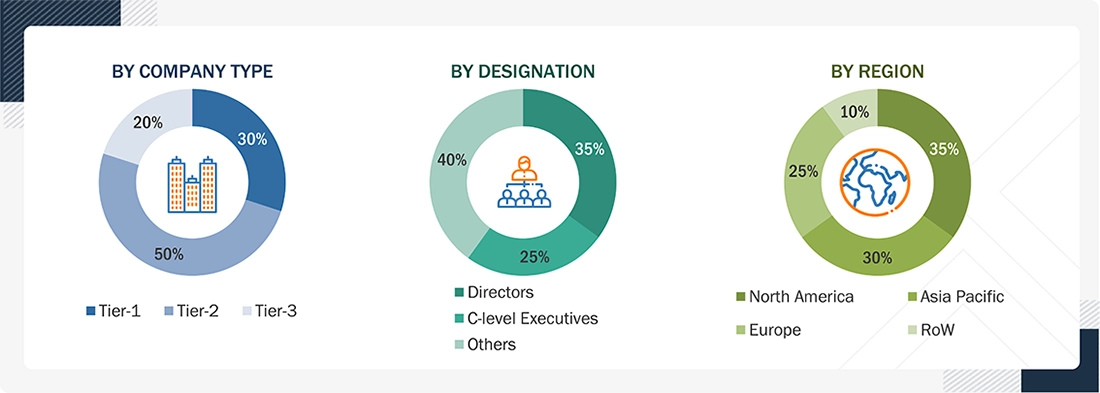
Note: RoW mainly comprises the Middle East & Africa, and South America.
Other designations include product managers, sales managers, and marketing managers.
Three tiers of companies have been defined based on their total revenue as of 2025; tier 3: revenue less than USD 500 million; tier 2: revenue between USD 500 million and 1 billion; and tier 1: revenue more than USD 1 billion.
To know about the assumptions considered for the study, download the pdf brochure
Market Size Estimation
The bottom-up procedure was employed to arrive at the overall size of the test and measurement equipment market by building the market from company-level and segment-level revenue estimates.
- Major T&M equipment providers were identified and mapped based on their revenues from standalone instruments, modular instrumentation, automated test equipment, RF and microwave testing, semiconductor test systems, electrical and electronic test instruments, and related testing platforms.
- More than 30 companies operating across the T&M equipment ecosystem were studied, including equipment manufacturers, automated test equipment providers, modular platform suppliers, rental and used equipment providers, and specialized instrument companies.
- Company revenues were compiled from annual reports, investor presentations, SEC filings, company disclosures, press releases, product portfolios, and official websites to estimate the addressable T&M equipment revenue baseline.
- For each company, a T&M-specific revenue share was assigned to total reported revenue wherever required, based on business segment disclosures, product portfolio alignment, end-use exposure, and relevance to the defined market scope.
- The company-level estimates were mapped across product type, testing type, commercial model, system testing level, lifecycle stage, end-use industry, and region to derive bottom-up segment and subsegment estimates.
- Each company’s assigned market contribution was validated using product mix, regional footprint, customer industries served, application coverage, installed base, commercial model exposure, and recent product launches, partnerships, and acquisitions.
- The bottom-up results were then aggregated to arrive at the global test and measurement equipment market size and cross-checked against regional and end-use demand indicators.
The top-down procedure was employed to validate the overall size of the test and measurement equipment market by starting from the global market baseline and allocating it across defined segments and subsegments.
- The overall global test and measurement equipment market size was estimated using secondary research, company disclosures, industry indicators, and primary validation across demand and supply-side stakeholders.
- The total market was split by region, covering North America, Europe, Asia Pacific, South America, and the Middle East & Africa, based on manufacturing intensity, semiconductor activity, telecom deployment, EV production, data center investments, and industrial testing demand.
- The regional market was further distributed by product type, including standalone instruments, modular instrumentation, and automated test equipment, based on adoption patterns, technology maturity, and application intensity.
- Additional splits were calculated by testing type, commercial model, system testing level, lifecycle stage, and end-use industry to ensure alignment with the complete report scope.
- Commercial model allocation was developed across new equipment sales, used equipment sales, and rental to reflect customer procurement behavior and avoid overlap between ownership-based and access-based equipment demand.
- End-use industry allocation was developed across data centers, aerospace & defense, automotive, telecommunications, semiconductors, industrial manufacturing, healthcare & medical devices, and other end-use industries.
- Market breakdown and data triangulation were applied to reconcile top-down estimates with bottom-up company analysis, ensuring consistency across total market size, regional splits, and all segment-level values.
Test and Measurement Equipment Market : Top-Down and Bottom-Up Approach
Data Triangulation
After arriving at the overall market size using the bottom-up and top-down market size estimation processes, the test and measurement equipment market was split into several segments and subsegments. These include product type, testing type, commercial model, system testing level, testing lifecycle stage, end-use industry, and region. To complete the market engineering process and arrive at the final statistics for each segment and subsegment, data triangulation and market breakdown procedures were applied wherever necessary. The data was triangulated by studying demand-side and supply-side factors across the T&M equipment ecosystem.
Supply-side inputs included company revenues, product portfolios, regional presence, commercial model exposure, recent developments, and participation across standalone instruments, modular instrumentation, automated test equipment, rental, and used equipment models. Demand-side inputs included testing intensity across semiconductors, data centers, automotive, telecommunications, aerospace & defense, industrial manufacturing, healthcare and medical devices, and other end-use industries. These inputs were cross-validated through secondary research, primary interviews, and internal consistency checks to ensure alignment across total market size, regional splits, and segment-level estimates.
Market Definition
After arriving at the overall market size using the bottom-up and top-down market size estimation processes, the test and measurement equipment market was split into several segments and subsegments. These include product type, testing type, commercial model, system testing level, testing lifecycle stage, end-use industry, and region. To complete the market engineering process and arrive at the final statistics for each segment and subsegment, data triangulation and market breakdown procedures were applied wherever necessary. The data was triangulated by studying demand-side and supply-side factors across the T&M equipment ecosystem.
Supply-side inputs included company revenues, product portfolios, regional presence, commercial model exposure, recent developments, and participation across standalone instruments, modular instrumentation, automated test equipment, rental, and used equipment models. Demand-side inputs included testing intensity across semiconductors, data centers, automotive, telecommunications, aerospace & defense, industrial manufacturing, healthcare and medical devices, and other end-use industries. These inputs were cross-validated through secondary research, primary interviews, and internal consistency checks to ensure alignment across total market size, regional splits, and segment-level estimates.
Key Stakeholders
- Test and measurement equipment manufacturers
- Standalone instrument, modular instrumentation, and automated test equipment providers
- Rental and used equipment providers
- Distributors, system integrators, and channel partners
- Semiconductor and electronics companies
- Data center and cloud infrastructure operators
- Automotive, EV, and battery manufacturers
- Telecommunications operators and network equipment manufacturers
- Aerospace and defense organizations
- Industrial manufacturing and automation companies
- Healthcare and medical device manufacturers
- Standards, protocol, and technology bodies
- Research organizations, universities, and testing laboratories
- Technology investors, venture capital firms, and private equity firms
- Analysts, consultants, and strategic business planners
Report Objectives
- Test and measurement equipment manufacturers
- Standalone instrument, modular instrumentation, and automated test equipment providers
- Rental and used equipment providers
- Distributors, system integrators, and channel partners
- Semiconductor and electronics companies
- Data center and cloud infrastructure operators
- Automotive, EV, and battery manufacturers
- Telecommunications operators and network equipment manufacturers
- Aerospace and defense organizations
- Industrial manufacturing and automation companies
- Healthcare and medical device manufacturers
- Standards, protocol, and technology bodies
- Research organizations, universities, and testing laboratories
- Technology investors, venture capital firms, and private equity firms
- Analysts, consultants, and strategic business planners
Available customizations:
With the given market data, MarketsandMarkets offers customizations according to the company‘s specific needs. The following customization options are available for the report.
Company Information
- Detailed analysis and profiling of additional market players (up to five)
Key Questions Addressed by the Report
What is the projected size of the Test & Measurement Equipment Market by 2032?
The Test & Measurement Equipment Market is projected to grow from USD 48.65 billion in 2025 to USD 76.38 billion by 2032, reflecting strong demand from semiconductor, telecom, automotive, aerospace, and data center industries.
What is the expected CAGR of the Test & Measurement Equipment Market?
The market is expected to register a CAGR of 6.4% from 2025 to 2032, driven by increasing product complexity and digital transformation initiatives.
What are the key growth drivers of the Test & Measurement Equipment Market?
Major growth drivers include rising semiconductor complexity, EV adoption, expansion of AI data centers, deployment of 5G/6G networks, and growing aerospace & defense testing requirements.
Which industries generate the highest demand for test & measurement equipment?
Semiconductors, telecommunications, automotive, aerospace & defense, electronics manufacturing, healthcare devices, and industrial automation are the leading end-use industries.
What are the latest trends in the Test & Measurement Equipment Market?
Key trends include AI-powered testing, automated validation platforms, cloud-connected testing systems, high-speed signal analysis, and advanced RF testing for 5G and future 6G networks.
Which region dominates the Test & Measurement Equipment Market?
North America holds a significant market share due to strong semiconductor R&D investments, advanced aerospace programs, and rapid adoption of emerging technologies.
Which region is expected to witness the fastest growth?
Asia Pacific is expected to register the highest growth rate due to expanding semiconductor fabrication, electronics manufacturing, EV production, and telecom infrastructure investments.
Who are the leading companies in the Test & Measurement Equipment Market?
Key players include Rohde & Schwarz, Tektronix, Anritsu Corporation, and Advantest Corporation.
How is AI influencing the Test & Measurement Equipment Industry?
AI is improving automated test generation, predictive diagnostics, defect detection, signal analysis, and real-time performance optimization, reducing testing time and improving accuracy.
What does a Test & Measurement Equipment Market report typically analyze?
The report covers market size, CAGR, forecasts, technology trends, product segments, industry analysis, regional outlook, competitive landscape, growth drivers, challenges, opportunities, and strategic developments of leading companies.


Personalize This Research
- Triangulate with your Own Data
- Get Data as per your Format and Definition
- Gain a Deeper Dive on a Specific Application, Geography, Customer or Competitor
- Any level of Personalization
Let Us Help You
- What are the Known and Unknown Adjacencies Impacting the Test and Measurement Equipment Market
- What will your New Revenue Sources be?
- Who will be your Top Customer; what will make them switch?
- Defend your Market Share or Win Competitors
- Get a Scorecard for Target Partners

Custom Market Research Services
We Will Customise The Research For You, In Case The Report Listed Above Does Not Meet With Your Requirements
Get 10% Free CustomisationTESTIMONIALS

Tetsuya Ohhira
Business Development Manager-Technology Business
Nikon Corporation,
Leading Japanese MNC specializing in optics and imaging productswww.nikon.com
MarketsandMarkets™ response
is quick. Their attitude is flexible and positive. Analyst Insights are globally considered and
significant. Client Services quickly respond to our inquiry and demand. Their wide range of global
surveys help us make our strategic plan.
We hope Knowledge Store will be easier to search
for a report.
VP - Marketing & Business Development
Leading Provider of Process Control Solutions
We engaged with MarketsandMarkets on a study to perform an analysis and recommend a Go-To-Market strategy for metrology and process control in the semiconductor market. The study was tailored to our targets and needs with well-defined milestones. Our overall experience with the MarketsandMarkets team was very good throughout the project in all aspects including the analysis methodologies used, the quality and depth of primary and secondary data sets, the professionalism and flexibility of the team and the ability to meet the target schedule and milestones. We want to thank MarketsandMarkets team for a job well done.
- US Test and Measurement Equipment Market
- Canada Test and Measurement Equipment Market
- Mexico Test and Measurement Equipment Market
- Germany Test and Measurement Equipment Market
- UK Test and Measurement Equipment Market
- France Test and Measurement Equipment Market
- Spain Test and Measurement Equipment Market
- Italy Test and Measurement Equipment Market
- Netherlands Test and Measurement Equipment Market
- Rest Of Europe Test and Measurement Equipment Market
- China Test and Measurement Equipment Market
- Japan Test and Measurement Equipment Market
- India Test and Measurement Equipment Market
- South Korea Test and Measurement Equipment Market
- Australia Test and Measurement Equipment Market
- Singapore Test and Measurement Equipment Market
- Rest Of Asia Pacific Test and Measurement Equipment Market
Growth opportunities and latent adjacency in Test and Measurement Equipment Market






Connor
Apr, 2026
Can this report show me where my competitors are generating the most revenue and how I can compete?.
Justin
Apr, 2026
What emerging opportunities (such as 5G testing, environmental/EMC testing, and automation) can help my company gain a competitive edge and increase revenue?.