Flip Chip Technology Market by Wafer Bumping Process (CU Pillar, Lead-Free), Packaging Technology (2D IC, 2.5D IC, 3D IC), Packaging Type (BGA, PGA, LGA, SIP, CSP), Product (Memory, LED, CPU, GPU, SOC), Application and Geography - Global Forecast to 2035


Flip Chip Technology Market Summary
The Flip Chip Technology Market is entering a high-growth phase as semiconductor manufacturers, electronics OEMs, and advanced packaging providers accelerate the transition toward higher-performance, smaller, and more energy-efficient electronic systems. The global Flip Chip Technology Market is estimated to reach approximately USD 34–39 billion in 2025 and is projected to expand to around USD 70–82 billion by 2035, registering a CAGR of approximately 7.5%–9.0% during 2025–2035. Growth is being driven by increasing semiconductor content in artificial intelligence (AI) systems, high-performance computing (HPC), 5G and 6G infrastructure, automotive electronics, IoT devices, consumer electronics, and industrial automation. Flip chip technology enables direct interconnection between semiconductor dies and substrates through bumps rather than conventional wire bonding, supporting shorter electrical paths, higher I/O density, improved signal integrity, and better thermal performance. The growing adoption of AI accelerators, GPUs, CPUs, advanced memory, chiplets, and heterogeneous integration is further increasing demand for advanced flip-chip packaging. At the same time, digital transformation and connected industrial infrastructure are encouraging manufacturers to invest in sophisticated semiconductor packages capable of handling higher processing loads while maintaining compact form factors.
Key Market Trends & Insights
The Asia Pacific region is expected to remain the leading market, supported by its extensive semiconductor manufacturing ecosystem, large consumer electronics industry, expanding automotive electronics production, and strong presence of OSAT and advanced packaging companies. China, Taiwan, Japan, South Korea, and other Asian economies are investing heavily in semiconductor manufacturing and packaging capabilities.
Asia Pacific is also expected to register the fastest growth, with demand supported by AI infrastructure, electric vehicles, 5G deployment, industrial automation, and increasing localization of semiconductor supply chains. Investments in advanced packaging capacity are becoming particularly important as semiconductor performance increasingly depends on packaging innovation rather than transistor scaling alone.
From a product perspective, flip-chip packages used in processors, GPUs, ASICs, memory, and high-performance semiconductor devices represent a major demand area. The increasing complexity of AI processors and data-center chips is encouraging manufacturers to use high-density interconnects, advanced substrates, and sophisticated thermal-management architectures.
Another important trend is the convergence of flip chip technology with chiplet architectures and heterogeneous integration. Instead of designing increasingly large monolithic dies, semiconductor companies are combining multiple functional dies within advanced packages. This approach is creating new opportunities for flip-chip interconnects, fine-pitch bumping, hybrid bonding, and advanced substrate technologies.
AI and automation are also changing semiconductor packaging operations. AI-based inspection systems, automated optical inspection, machine learning-driven process control, and predictive maintenance are helping manufacturers improve yield, detect defects, and optimize production parameters. IoT-enabled factory systems are increasingly connecting packaging equipment, environmental sensors, production databases, and quality-control systems to create more intelligent manufacturing environments.
Market Size & Forecast
- Base year market size (2025): Approximately USD 34–39 billion
- Forecast value by 2035: Approximately USD 70–82 billion
- Expected CAGR (2025–2035): Approximately 7.5%–9.0%
- Growth factors: AI accelerators, HPC processors, 5G/6G infrastructure, IoT devices, automotive electronics, advanced memory, chiplets, high-density packaging, and industrial automation are expected to support sustained market expansion.
The market's growth trajectory will increasingly depend on the ability of semiconductor manufacturers and packaging providers to address thermal management, fine-pitch interconnection, substrate availability, yield optimization, and rising packaging complexity.
Flip Chip Technology Market Top 10 key takeaway
- The global Flip Chip Technology Market is projected to grow from approximately USD 34–39 billion in 2025 to nearly USD 70–82 billion by 2035.
- The market is expected to register a CAGR of approximately 7.5%–9.0% during 2025–2035.
- Asia Pacific is expected to maintain its position as the leading regional market.
- China, Japan, South Korea, and Taiwan are strengthening advanced semiconductor packaging capabilities.
- AI accelerators, GPUs, CPUs, ASICs, and HPC systems are major demand generators.
- Chiplets and heterogeneous integration are increasing the importance of advanced flip-chip interconnection.
- Automotive electronics and electric vehicles are expanding the addressable application base.
- AI-powered inspection and automated packaging equipment are improving manufacturing yield and productivity.
- IoT and industrial automation are increasing semiconductor content across industrial equipment and connected devices.
- Thermal management, fine-pitch interconnection, substrate innovation, and advanced packaging integration will remain major competitive priorities through 2035.
Product Insights
The flip-chip package segment for high-performance semiconductor devices represents one of the most important areas of demand because modern processors and application-specific integrated circuits require higher I/O density, improved electrical performance, and better heat dissipation. Traditional wire bonding can face limitations as semiconductor devices become more complex and operate at higher frequencies. Flip chip technology addresses these requirements by allowing the die to be directly connected to a substrate through an array of solder bumps or other interconnect structures.
Demand is particularly strong for flip-chip packages used in GPUs, CPUs, AI accelerators, networking processors, memory devices, image processors, and advanced application processors. AI data centers are a significant growth catalyst because AI workloads require processors with extremely high computational throughput and high-bandwidth memory connectivity. The resulting packaging requirements favor advanced interconnect architectures capable of handling large numbers of I/O connections and substantial thermal loads.
Emerging product categories include advanced flip-chip packages designed for chiplet-based systems, 2.5D and 3D integration, high-bandwidth memory architectures, and automotive computing platforms. Automotive semiconductor applications are becoming more demanding as vehicles adopt centralized computing, ADAS, autonomous-driving functions, infotainment systems, and software-defined architectures.
AI is also becoming integrated into the production of flip-chip products. Manufacturers are using machine learning for defect classification, automated optical inspection, process optimization, and predictive quality analysis. These capabilities can help reduce manufacturing defects while improving yield and supporting higher-volume production.
Technology / Component Insights
The technology landscape of the Flip Chip Technology Market is evolving from conventional bump-based interconnection toward increasingly fine-pitch and high-density architectures. Solder bumping, copper pillar technology, wafer-level packaging, flip-chip BGA, and advanced substrate technologies remain important technologies, while hybrid bonding and other next-generation interconnection methods are gaining attention for advanced semiconductor integration.
Copper pillar technology is particularly important for applications requiring improved electrical and thermal performance. As semiconductor dies become smaller and I/O counts increase, manufacturers require interconnect technologies capable of supporting tighter pitches while maintaining mechanical reliability. Advanced substrates are also becoming strategically important because the package must accommodate increasing numbers of connections between the semiconductor die and the system board.
AI, IoT, cloud computing, and automation are indirectly accelerating technology development. AI workloads require high-performance processors and advanced memory architectures, while cloud infrastructure demands efficient high-density computing systems. IoT devices are driving demand for compact, low-power semiconductor packages, and industrial automation is increasing the use of sophisticated processors and sensors.
Future innovation is expected to focus on chiplet integration, hybrid bonding, fine-pitch interconnects, 2.5D/3D packaging, improved thermal solutions, and AI-enabled manufacturing. Semiconductor packaging is increasingly becoming a strategic component of system-level performance, making advanced packaging technology an important complement to traditional semiconductor process scaling.
Application Insights
Consumer electronics and high-performance computing applications represent major areas of flip-chip technology adoption. Smartphones, tablets, gaming systems, networking equipment, processors, GPUs, and advanced memory devices increasingly require compact packages that provide high electrical performance and efficient thermal dissipation.
High-performance computing is expected to become one of the fastest-expanding application areas. The growth of generative AI, large language models, cloud computing, and AI-enabled enterprise applications is driving demand for data-center accelerators with extremely high processing performance. Such systems require advanced packages capable of connecting computing dies with high-bandwidth memory and supporting substantial power densities.
Automotive electronics is another major opportunity. EVs, ADAS, autonomous driving, battery-management systems, infotainment platforms, and vehicle connectivity are increasing semiconductor content per vehicle. Flip-chip packaging can support the performance and reliability requirements of many automotive semiconductor applications.
Industrial automation and IoT are also contributing to demand. Connected sensors, robotics, machine vision, edge AI, programmable controllers, and intelligent industrial equipment increasingly require compact and reliable semiconductor packages. Over the longer term, edge computing and AI-enabled devices are expected to expand the use of advanced packaging beyond data centers and premium consumer products.
Regional Insights
North America is a major market for flip chip technology, supported by strong demand from AI, cloud computing, data centers, semiconductor design, aerospace, defense, and advanced electronics. The region's concentration of semiconductor innovators and hyperscale technology companies supports demand for high-performance packaging solutions. Increasing investment in domestic semiconductor manufacturing and packaging capabilities is expected to strengthen regional demand.
Europe has a strong position in automotive electronics, industrial automation, power electronics, telecommunications, and advanced manufacturing. The region's transition toward electric and software-defined vehicles is increasing semiconductor requirements, while industrial digitalization is creating additional demand for high-performance electronic systems.
Asia Pacific is expected to register the fastest growth and maintain the largest overall share. The region benefits from extensive semiconductor manufacturing, electronics assembly, OSAT capacity, and strong demand from smartphones, consumer electronics, automotive systems, networking equipment, and AI infrastructure. Investments in semiconductor supply-chain localization are further supporting advanced packaging capacity.
- North America: Strong demand from AI data centers, HPC, cloud computing, and advanced semiconductor design.
- Europe: Automotive electronics, industrial automation, EVs, and smart manufacturing are major growth areas.
- Asia Pacific: Largest semiconductor production and packaging ecosystem with strong electronics demand.
- China and Japan: Significant investments in semiconductor manufacturing, packaging, automotive electronics, and automation.
- Regional outlook: Asia Pacific is expected to remain dominant while North America and Europe strengthen strategic semiconductor capabilities.
Country-Specific Market Trends
In China, flip chip technology adoption is being supported by semiconductor localization, AI infrastructure, consumer electronics, telecommunications, electric vehicles, and industrial automation. Government-supported semiconductor investment and efforts to strengthen domestic supply chains are encouraging local development of semiconductor manufacturing and packaging capabilities. China's expanding EV and electronics sectors are also creating a large customer base for advanced semiconductor packages.
Japan remains an important market due to its established semiconductor materials, equipment, automotive electronics, robotics, and industrial technology ecosystem. Demand is supported by factory automation, automotive semiconductor applications, image sensors, and high-reliability electronic systems. Japan's expertise in semiconductor materials and precision manufacturing strengthens its role in the broader advanced packaging value chain.
In the United States, demand is strongly linked to AI, data centers, GPUs, CPUs, cloud infrastructure, defense electronics, and semiconductor manufacturing investments. Increasing emphasis on domestic semiconductor capabilities is expected to encourage additional investments in advanced packaging and related technologies.
Canada is benefiting from growing interest in semiconductor research, AI, telecommunications, and advanced electronics. Although its packaging ecosystem is smaller than that of the US or major Asian markets, increasing technology investment can create opportunities in specialized semiconductor applications and research.
Mexico is gaining importance as electronics and automotive manufacturers expand production capabilities across North America. Its proximity to the US manufacturing ecosystem and growing automotive electronics industry can support future demand for advanced semiconductor packaging.
In Germany, automotive electronics, industrial automation, robotics, and Industry 4.0 remain major adoption drivers. Germany's large automotive manufacturing ecosystem is increasing demand for sophisticated semiconductor packages for EVs, ADAS, and connected vehicles.
France is seeing demand from aerospace, defense, telecommunications, automotive electronics, and industrial applications. Semiconductor ecosystem investments and European efforts to strengthen strategic technology capabilities are expected to support advanced packaging development.
- China: Semiconductor localization and AI infrastructure are major demand drivers.
- Japan: Robotics, automotive electronics, sensors, and precision manufacturing support adoption.
- United States: AI, HPC, cloud infrastructure, and semiconductor investment drive high-value demand.
- Canada and Mexico: AI, electronics, automotive, and North American supply-chain integration create opportunities.
- Germany and France: Automotive, industrial automation, aerospace, and European semiconductor initiatives support growth.
Key Flip Chip Technology Company Insights
The competitive landscape includes semiconductor manufacturers, OSAT providers, packaging specialists, substrate manufacturers, and equipment suppliers. Major participants are focusing on advanced packaging capacity, finer-pitch interconnections, chiplet integration, improved thermal performance, automation, and manufacturing yield.
Companies such as ASE Technology Holding, Amkor Technology, Intel, TSMC, Samsung Electronics, JCET, Powertech Technology, and UTAC are positioned across different parts of the advanced semiconductor packaging ecosystem. Their strategies increasingly emphasize advanced packaging technologies that can support AI processors, high-performance computing, automotive electronics, and high-density semiconductor systems.
AI adoption is also changing competitive strategies. Packaging manufacturers are implementing AI-based inspection, predictive maintenance, process monitoring, digital twins, and automated production systems to improve yield and reduce operational costs. Companies with advanced process-control capabilities and strong relationships with semiconductor designers are expected to gain competitive advantages.
- ASE Technology Holding: Focuses on advanced semiconductor packaging and high-volume manufacturing capabilities.
- Amkor Technology: Expands advanced packaging solutions for high-performance and automotive applications.
- Intel: Develops advanced packaging architectures supporting chiplets and high-performance computing.
- TSMC: Continues advancing heterogeneous integration and advanced packaging for leading-edge computing.
- Samsung Electronics: Integrates advanced packaging with memory, AI, and high-performance semiconductor strategies.
Recent Developments
The market is experiencing continued investment in advanced packaging for AI and high-performance computing, with semiconductor manufacturers expanding technologies capable of integrating multiple dies, high-bandwidth memory, and high-density interconnections. This trend is increasing demand for flip-chip and related advanced packaging capabilities.
Another important development is the integration of AI-driven inspection and automation into semiconductor packaging facilities. Machine learning-based defect detection, automated optical inspection, process analytics, and predictive maintenance are being adopted to improve manufacturing consistency and yield.
Strategic partnerships and capacity investments are also increasing across the semiconductor packaging ecosystem. Semiconductor manufacturers, OSAT providers, substrate suppliers, and equipment companies are collaborating to address the growing complexity of AI processors, chiplets, automotive electronics, and next-generation computing platforms.
Market Segmentation
The Flip Chip Technology Market can be segmented by Product, by Technology / Component, by Application, and by Region. By product, the market includes flip-chip packages and related semiconductor package configurations used across processors, memory, ASICs, GPUs, sensors, and other integrated circuits. By technology or component, segmentation includes solder bumping, copper pillar, wafer-level packaging, advanced substrates, interposers, and emerging hybrid-bonding and heterogeneous-integration approaches. By application, the market covers consumer electronics, communications, automotive, industrial, aerospace and defense, healthcare, and high-performance computing. By region, the market encompasses North America, Europe, Asia Pacific, and other regions, with Asia Pacific expected to retain its leadership due to its semiconductor manufacturing ecosystem.
- By Product: Flip-chip packages for processors, GPUs, memory, ASICs, sensors, and advanced integrated circuits.
- By Technology / Component: Solder bump, copper pillar, wafer-level packaging, substrates, interposers, and advanced interconnect technologies.
- By Application: Consumer electronics, communications, automotive, industrial, aerospace and defense, healthcare, and HPC.
- By Region: North America, Europe, Asia Pacific, and other global markets.
- Growth opportunity: AI, chiplets, 2.5D/3D integration, automotive electronics, and high-density computing are reshaping segmentation.
Conclusion
The Flip Chip Technology Market is positioned for sustained expansion through 2035, with the global market expected to increase from approximately USD 34–39 billion in 2025 to USD 70–82 billion by 2035, representing an estimated CAGR of 7.5%–9.0%. AI is likely to remain one of the most powerful forces shaping the industry's future because AI accelerators, GPUs, high-bandwidth memory, networking processors, and data-center infrastructure require advanced semiconductor packages with high I/O density and efficient thermal management.
The convergence of AI, IoT, automation, edge computing, cloud infrastructure, chiplets, and heterogeneous integration will continue to expand the role of advanced packaging. Automotive electrification and software-defined vehicles will create additional opportunities, while industrial automation and connected devices will increase demand for compact and reliable semiconductor solutions.
For semiconductor manufacturers, OSAT providers, equipment suppliers, substrate manufacturers, and electronics OEMs, flip chip technology is becoming strategically important rather than simply a packaging option. Companies that invest in fine-pitch interconnection, AI-enabled manufacturing, advanced thermal management, automation, and next-generation heterogeneous integration are likely to be better positioned to capture opportunities through 2035.
FAQs
1. What is the projected market size of the Flip Chip Technology Market?
The global Flip Chip Technology Market is estimated at approximately USD 34–39 billion in 2025 and is projected to reach around USD 70–82 billion by 2035, depending on technology adoption, semiconductor production, packaging capacity expansion, and demand from AI and advanced computing applications.
2. What is the expected growth rate of the Flip Chip Technology Market?
The Flip Chip Technology Market is expected to grow at a CAGR of approximately 7.5%–9.0% between 2025 and 2035. Increasing semiconductor complexity, AI workloads, automotive electronics, HPC, IoT, and advanced packaging requirements are among the primary contributors to this growth.
3. What are the key drivers of the Flip Chip Technology Market?
Major drivers include the rapid adoption of AI accelerators, GPUs and HPC systems, growing semiconductor content in automobiles, 5G and future 6G infrastructure, IoT deployment, consumer electronics miniaturization, chiplet architectures, and increasing demand for high-density and thermally efficient semiconductor packages.
4. Which region is expected to lead the Flip Chip Technology Market?
Asia Pacific is expected to remain the leading regional market because of its strong semiconductor manufacturing and packaging ecosystem, large electronics production base, automotive industry, and expanding investments in AI and advanced semiconductor infrastructure. North America and Europe are also expected to experience strong demand.
5. Who are the key companies in the Flip Chip Technology Market?
Key companies operating across the flip-chip and advanced semiconductor packaging ecosystem include ASE Technology Holding, Amkor Technology, Intel, TSMC, Samsung Electronics, JCET, Powertech Technology, and UTAC. These companies are focusing on advanced packaging, chiplet integration, AI-related semiconductor applications, automation, and high-density interconnect technologies.
To speak to our analyst for a discussion on the above findings, click Speak to Analyst
 Exclusive indicates content/data unique to MarketsandMarkets and not available with any competitors.
Table of Contents
1 Introduction (Page No. - 15)
1.1 Objectives of the Study
1.2 Market Definition
1.3 Study Scope
1.3.1 Markets Covered
1.3.2 Years Considered for the Study
1.4 Currency
1.5 Limitations
1.6 Market Stakeholders
2 Research Methodology (Page No. - 18)
2.1 Research Data
2.1.1 Secondary Data
2.1.1.1 Key Data From Secondary Sources
2.1.2 Primary Data
2.1.2.1 Key Data From Primary Sources
2.1.2.2 Key Industry Insights
2.1.2.3 Breakdown of Primaries
2.2 Market Size Estimation
2.2.1 Bottom-Up Approach
2.2.2 Top-Down Approach
2.2.3 Market Share Estimation
2.3 Market Breakdown and Data Triangulation
2.4 Research Assumptions
2.4.1 Assumptions
3 Executive Summary (Page No. - 27)
4 Premium Insights (Page No. - 32)
4.1 Attractive Opportunities in the Global Market
4.2 Flip Chip Technology Market Size, By Packaging Type, 2016–2022
4.3 Market Size, By Wafer Bumping Process, 2016–2022
4.4 Market Size, By Packaging Technology, 2016–2022
4.5 Market Size, By Product, 2016–2022
4.6 Market Size, By Application, 2016–2022
4.7 Market Size, By Geography
5 Market Overview (Page No. - 36)
5.1 Introduction
5.2 Market Segmentation
5.2.1 Flip Chip Technology Market, By Wafer Bumping Process
5.2.2 Market, By Packaging Technology
5.2.3 Market, By Packaging Type
5.2.4 Market, By Product
5.2.5 Market, By Application
5.2.6 Geographic Analysis
5.3 Market Dynamics
5.3.1 Drivers
5.3.1.1 Increasing Demand for Miniaturization and High-Performing Electronic Devices
5.3.1.2 Penetration in the Consumer Electronics Sub Segment
5.3.2 Restraints
5.3.2.1 Reliability Challenges
5.3.3 Opportunities
5.3.3.1 Growth in the IC Industry
5.3.4 Challenges
5.3.4.1 High Cost Associated With Flip Chip Packaging Solutions
6 Industry Trends (Page No. - 43)
6.1 Introduction
6.2 Value Chain Analysis
6.3 Porter’s Five Forces Analysis
6.3.1 Threat of New Entrants
6.3.2 Threat of Substitutes
6.3.3 Bargaining Power of Suppliers
6.3.4 Bargaining Power of Buyers
6.3.5 Intensity of Competitive Rivalry
7 Flip Chip Technology Market, By Wafer Bumping Process (Page No. - 54)
7.1 Introduction
7.2 Copper (CU) Pillar
7.2.1 Benefits of Copper Pillar Bumping Process Over Other Wafer Bumping Processes
7.3 Lead (PB)-Free
7.4 Tin-Lead (SN-PB) Eutectic Solder
7.5 Gold-Stud+ Plated Solder
8 Flip Chip Technology Market, By Packaging Technology (Page No. - 59)
8.1 Introduction
8.2 2D IC Packaging Technology
8.3 2.5D IC Packaging Technology
8.3.1 Major Benefits of 2.5D IC Packaging Over the Traditional 2D IC Packaging Technology
8.4 3D IC Packaging Technology
8.5 Comparison Between 2D, 2.5D, 3D IC Packaging Technology
9 Flip Chip Technology Market, By Packaging Type (Page No. - 67)
9.1 Introduction
9.2 FC BGA (Flip Chip Ball Grid Array)
9.3 FC PGA (Flip Chip Pin Grid Array)
9.4 FC LGA (Flip Chip Land Grid Array)
9.5 FC QFN (Flip Chip Quad Flat No-Lead)
9.6 FC SIP (Flip Chip System-In-Package)
9.7 FC CSP (Flip Chip-Chip-Scale Package)
10 Flip Chip Technology Market, By Product (Page No. - 74)
10.1 Introduction
10.2 Memory
10.3 Light-Emitting Diode (LED)
10.4 CMOS Image Sensor
10.5 RF, Analog, Mixed Signal, and Power IC
10.6 CPU
10.7 GPU
10.8 SOC
11 Flip Chip Technology Market, By Application (Page No. - 84)
11.1 Introduction
11.2 Consumer Electronics
11.2.1 Smartphones & Tablets
11.2.2 Laptops
11.2.3 Desktop PC
11.2.4 Set-Top Box/Hybrid Set Top Box
11.2.5 Game Stations
11.3 Telecommunications
11.3.1 Network Equipment
11.3.2 Base Stations
11.3.3 Servers
11.4 Automotive
11.4.1 ECU
11.4.2 Sensors
11.4.3 Power Modules
11.4.4 Others
11.5 Industrial
11.5.1 Industrial Wireless Sensor Network
11.5.2 Identification and Monitoring
11.5.3 Others
11.6 Medical Devices
11.6.1 Patient Monitoring Devices
11.6.2 Smart Sensor System
11.6.3 Others
11.7 Smart Technologies
11.7.1 Military & Aerospace
11.7.2 Radar Equipment
11.7.3 Satellite Communication Devices
11.7.4 Others
12 Geographic Analysis (Page No. - 101)
12.1 Introduction
12.2 Americas
12.2.1 North America
12.2.1.1 U.S.
12.2.1.2 Canada
12.2.1.3 Brazil
12.2.1.4 Argentina
12.2.1.5 Others
12.3 Europe
12.3.1 Germany
12.3.2 France
12.3.3 U.K.
12.3.4 Others
12.4 Asia-Pacific
12.4.1 China
12.4.2 Japan
12.4.3 Taiwan
12.4.4 South Korea
12.4.5 Others
12.5 Rest of the World (RoW)
12.5.1 Middle East & Africa
12.5.2 Russia
13 Competitive Landscape (Page No. - 118)
13.1 Introduction
13.2 Market Ranking Analysis, 2015
13.3 Competitive Situations and Trends
13.3.1 Collaborations
13.3.2 Acquisitions, Joint Ventures, and Agreements
13.3.3 Others
14 Company Profiles (Page No. - 123)
(Overview, Products and Services, Financials, Strategy & Development)*
14.1 Introduction
14.2 Taiwan Semiconductor Manufacturing Company Limited (TSMC Ltd.)
14.3 Samsung Electronics Co., Ltd.
14.4 Intel Corp.
14.5 United Microelectronics Corp.
14.6 ASE Group
14.7 Amkor Technology
14.8 Siliconware Precision Industries Co., Ltd.
14.9 Powertech Technology, Inc.
14.10 Stats Chippac Ltd.
14.11 Jiangsu Changjiang Electronics Technology Co., Ltd
*Details on Overview, Products and Services, Financials, Strategy & Development Might Not Be Captured in Case of Unlisted Companies.
15 Appendix (Page No. - 149)
15.1 Insights of Industry Experts
15.2 Discussion Guide
15.3 Knowledge Store: Marketsandmarkets’ Subscription Portal
15.4 Introducing RT: Real-Time Market Intelligence
15.5 Available Customizations
15.6 Related Reports
List of Tables (66 Tables)
Table 1 Analysis of Market Drivers
Table 2 Analysis of Market Restraints
Table 3 Analysis of Market Opportunities
Table 4 Analysis of Market Challenges
Table 5 Flip Chip Technology Market Size, By Wafer Bumping Process, 2013–2022 (USD Billion)
Table 6 Market Size, By Packaging Technology, 2013–2022 (USD Billion)
Table 7 Market Size, By Packaging Type, 2013–2022 (USD Million)
Table 8 Market Size for FC BGA, By Product, 2013–2022 (USD Million)
Table 9 Market Size for FC PGA, By Product, 2013–2022 (USD Million)
Table 10 Flip Chip Technology Market Size for FC LGA, By Product, 2013–2022 (USD Million)
Table 11 Market Size for FC QFN, By Product, 2013–2022 (USD Million)
Table 12 Market Size for FC SIP, By Product, 2013–2022 (USD Million)
Table 13 Market Size for FC CSP, By Product, 2013–2022 (USD Million)
Table 14 Market Size, By Product, 2013–2022 (USD Million)
Table 15 Market Size for Memory, By Packaging Technology, 2013–2022 (USD Million)
Table 16 Flip Chip Technology Market Size for Memory, By Packaging Type, 2013–2022 (USD Million)
Table 17 Market Size for LED, By Packaging Technology, 2013–2022 (USD Million)
Table 18 Market Size for LED, By Packaging Type, 2013–2022 (USD Million)
Table 19 Market Size for CMOS Image Sensor, By Packaging Technology, 2013–2022 (USD Million)
Table 20 Market Size for CMOS Image Sensor, By Packaging Type, 2013–2022 (USD Million)
Table 21 Market Size for RF, Analog, Mixed Signal, and Power IC, By Packaging Technology, 2013–2022 (USD Million)
Table 22 Flip Chip Technology Market Size for RF, Analog, Mixed Signal, and Power IC, By Packaging Type, 2013–2022 (USD Million)
Table 23 Market Size for CPU, By Packaging Technology, 2013–2022 (USD Million)
Table 24 Market Size for CPU, By Packaging Type, 2013–2022 (USD Million)
Table 25 Market Size for GPU, By Packaging Technology, 2013–2022 (USD Million)
Table 26 Market Size for GPU, By Packaging Type, 2013–2022 (USD Million)
Table 27 Market Size for SOC, By Packaging Technology, 2013–2022 (USD Million)
Table 28 Flip Chip Technology Market Size for SOC, By Packaging Type, 2013–2022 (USD Million)
Table 29 Market Size, By Application, 2013–2022 (USD Million)
Table 30 Market Size, By Consumer Electronics, 2013–2022 (USD Million)
Table 31 Market Size for Consumer Electronics, By Region, 2013–2022 (USD Million)
Table 32 Americas: Flip Chip Technology Market Size, By Region, 2013–2022 (USD Million)
Table 33 Market Size, By Telecommunication Application, 2013–2022 (USD Million)
Table 34 Market Size for Telecommunication, By Region, 2013–2022 (USD Million)
Table 35 Americas: Flip Chip Technology Market Size, By Region, 2013–2022 (USD Million)
Table 36 Market Size, By Automotive Application, 2013–2022 (USD Million)
Table 37 Market Size for Automotive, By Region, 2013–2022 (USD Million)
Table 38 Americas: Market Size, By Region, 2013–2022 (USD Million)
Table 39 Market Size, By Industrial, 2013-2022 (USD Million)
Table 40 Market Size for Industrial, By Region, 2013–2022 (USD Million)
Table 41 Americas: Flip Chip Technology Market Size, By Region, 2013–2022 (USD Million)
Table 42 Market Size, By Medical Devices, 2013–2022 (USD Million)
Table 43 Market Size for Medical Devices, By Region, 2013–2022 (USD Million)
Table 44 Americas: Market Size, By Region, 2013-2022 (USD Million)
Table 45 Market Size, By Smart Technologies, 2013–2022 (USD Million)
Table 46 Market Size for Smart Technologies, By Region, 2013–2022 (USD Million)
Table 47 Americas: Market Size, By Region, 2013–2022 (USD Million)
Table 48 Global Flip Chip Technology Market Size, By Military and Aerospace Application, 2013–2022 (USD Million)
Table 49 Market Size for Military & Aerospace Application, By Region, 2013–2022 (USD Million)
Table 50 Americas: Market Size for Military & Aerospace Application, By Region, 2013–2022 (USD Million)
Table 51 Market Size, By Region, 2013–2022 (USD Million)
Table 52 Americas: Market Size, By Region, 2013–2022 (USD Million)
Table 53 North America: Market Size, By Country, 2013–2022 (USD Million)
Table 54 South America: Market Size, By Country, 2013–2022 (USD Million)
Table 55 Flip Chip Technology Market Size in Americas, By Application, 2013–2022 (USD Million)
Table 56 Market Size in North America, By Application, 2013–2022 (USD Million)
Table 57 Market Size in South America, By Application, 2013–2022 (USD Million)
Table 58 Europe: Flip Chip Technology Market Size, By Country, 2013–2022 (USD Million)
Table 59 Market Size in Europe, By Application, 2013–2022 (USD Million)
Table 60 Market Size in APAC, By Country, 2013–2022 (USD Million)
Table 61 Market Size in APAC, By Application, 2013–2022 (USD Million)
Table 62 RoW: Market Size, By Region, 2013–2022 (USD Million)
Table 63 Market Size in RoW, By Application, 2013–2022 (USD Million)
Table 64 Most Significant Collaborations in the Market, 2010–2015
Table 65 Most Significant Acquisitions, Joint Ventures, and Agreements in the Market, 2014–2015
Table 66 Most Significant Other Strategies in the Flip Chip Technology Market, 2014–2015
List of Figures (71 Figures)
Figure 1 Flip Chip Technology Market Segmentation
Figure 2 Market: Research Design
Figure 3 Process Flow of Market Size Estimation
Figure 4 Market Size Estimation Methodology: Bottom-Up Approach
Figure 5 Market Size Estimation Methodology: Top-Down Approach
Figure 6 Market Breakdown & Data Triangulation
Figure 7 Assumptions of the Research Study
Figure 8 Flip Chip Technology Market Size, By Packaging Type, 2016–2022
Figure 9 2D IC Packaging Technology to Hold the Largest Market Size in 2016, While the 3D IC Packaging Technology to Grow at the Highest Rate During 2016–2022
Figure 10 Copper (CU) Pillar Bumping Process to Hold Largest Market Size 2016
Figure 11 LED Expected to Grow at the Highest Rate During Forecast Period
Figure 12 Consumer Electronics Application to Hold Largest Market Size in 2016 and Also Grow at the Highest Rate During the Forecast Period
Figure 13 APAC Held the Largest Market in 2015 and Expected to Grow at the Highest Rate During the Forecast Period
Figure 14 Increasing Demand for Miniaturization Along With High Performance in Electronics Devices to Spur the Market Growth
Figure 15 The Market for FC CSP to Grow at A High Rate During the Forecast Period
Figure 16 Copper (CU) Pillar Process to Grow at the Highest Rate During the Forecast Period
Figure 17 The Market for 3D IC Packaging Technology to Grow at the Highest Rate During the Forecast Period
Figure 18 The Market for LED of Flip Chip to Grow at the Highest Rate During the Forecast Period
Figure 19 The Market for Consumer Electronics Segment to Grow at the Highest Rate During the Forecast Period
Figure 20 The Flip Chip Technology Market in the APAC Expected to Grow at the Highest Rate During Forecast Period
Figure 21 Market, By Geography
Figure 22 Market: Drivers, Restraints, Opportunities, and Challenges
Figure 23 Ecosystem of Flip Chip Technology
Figure 24 Porter’s Five Forces Analysis, 2015
Figure 25 Porter’s Five Forces Analysis, 2015
Figure 26 Flip Chip Technology Market: Threat of New Entrants
Figure 27 Market: Threat of Substitutes
Figure 28 Market: Bargaining Power of Suppliers
Figure 29 Market: Bargaining Power of Buyers
Figure 30 Market: Intensity of Competitive Rivalry
Figure 31 Market, By Wafer Bumping Process
Figure 32 Market for Copper (CU) Pillar Bumping Process Expected to Grow at the Highest Rate
Figure 33 Market, By Packaging Technology
Figure 34 Market for 3D IC Packaging Technology Expected to Grow at the Highest Rate
Figure 35 Illustration of 2D IC Packaging Technology
Figure 36 Illustration of 2.5D IC Packaging Technology
Figure 37 Illustration of 3D IC Packaging Technology
Figure 38 Market, By Packaging Type
Figure 39 Market for FC CSP Packaging Type is Expected to Grow at the Highest Rate
Figure 40 Market, By Product
Figure 41 Market for LED Expected to Grow at the Highest Rate
Figure 42 Market, By Application
Figure 43 Market for Consumer Electronics Application Expected to Grow at the Highest Rate
Figure 44 Geographic Snapshot, 2015
Figure 45 The Flip Chip Technology Market in the APAC Region Expected to Grow at the Highest Rate
Figure 46 Americas Snapshot
Figure 47 Market Size in Brazil, 2013–2022 (USD Million)
Figure 48 Market Size in Argentina, 2013–2022 (USD Million)
Figure 49 Market Size in Other Countries, 2013–2022 (USD Million)
Figure 50 Europe Snapshot
Figure 51 APAC Snapshot
Figure 52 Companies Adopted Collaborations as the Key Growth Strategy Between 2010 and 2015
Figure 53 Market Ranking Analysis for the Flip Chip Technology Market, 2015
Figure 54 Market Evaluation Framework
Figure 55 Battle for Market Share: Collaboration Was the Key Strategy
Figure 56 Geography Revenue Mix for Top Five Players
Figure 57 TSMC Ltd.: Company Snapshot
Figure 58 TSMC Ltd.: SWOT Analysis
Figure 59 Samsung Electronics Co., Ltd.: Company Snapshot
Figure 60 Samsung Electronics Co., Ltd.: SWOT Analysis
Figure 61 Intel Corp.: Company Snapshot
Figure 62 Intel Corp.: SWOT Analysis
Figure 63 United Microelectronics Corp.: Company Snapshot
Figure 64 ASE Group.: Company Snapshot
Figure 65 ASE Group: SWOT Analysis
Figure 66 Amkor Technology: Company Snapshot
Figure 67 Amkor Technology: SWOT Analysis
Figure 68 Spil Co., Ltd. : Company Snapshot
Figure 69 Powertech Technology, Inc.: Company Snapshot
Figure 70 Stats Chippac Ltd.: Company Snapshot
Figure 71 Jiangsu Changjiang Electronics Technology Co., Ltd.: Company Snapshot
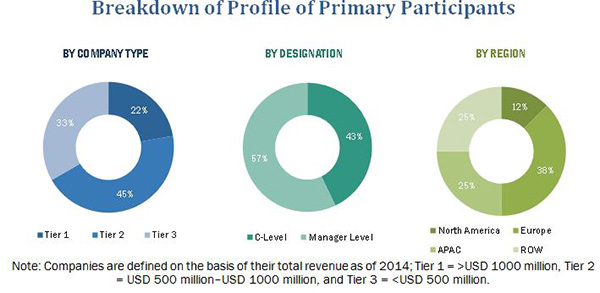
The research methodology used to estimate and forecast the flip chip technology market begins with capturing data on key vendor revenues through the secondary research. Vendor offerings are also taken into consideration to determine the market segmentation. The bottom-up procedure was employed to arrive at the overall size of the global flip chip technology market from the revenue of key players. After arriving at the overall market size, the total market has been split into several segments and sub-segments which are then verified through primary research by conducting extensive interviews with key people such as CEOs, VPs, directors, and executives. Data triangulation and market breakdown procedures have been employed to complete the overall market engineering process and arrive at the exact statistics for all segments and sub-segments. The breakdown of profiles of primary interviews is depicted in the below figure:
To know about the assumptions considered for the study, download the pdf brochure
This report provides valuable insights regarding ecosystem of this market such as product manufacturers and suppliers, OEMs, OSATs, system integrators, middleware and firmware providers, suppliers and distributors, This study answers several questions for stakeholders, primarily which market segments to focus on in the next six years for prioritizing efforts and investments.
Key Target audience:
- Wafer manufacturers
- Raw material and manufacturing equipment suppliers
- Chip manufacturers
- System integrators
- Device manufacturers
- Foundry players
- Distributors and retailers
- Research organizations
- Technology standard organizations, forums, alliances, and associations
- Technology investors
- OSATs
Scope of the Report:
The research report segments the flip chip technology market to following sub-segments:
By Wafer Bumping Process:
- Copper (Cu) pillar
- Lead-free
- Tin/lead eutectic solder
- Gold stud+ plated solder
By Packaging Technology:
- 2D IC
- 2.5D IC
- 3D IC
By Packaging Type:
- FC BGA
- FC PGA
- FC LGA
- FC QFN
- FC SiP
- FC CSP
By Product:
- Memory
- LED
- CMOS Image sensor
- RF, analog, mixed signal, and power IC
- CPU
- SoC
- GPU
By Application:
- Consumer electronics
- Telecommunication
- Automotive
- Industrial sector
- Medical devices
- Smart technologies
- Military & aerospace
By Region:
- Americas
- Europe
- Asia-Pacific
- Rest of the World
Available Customizations:
With the given market data, MarketsandMarkets offers customizations as per the company’s specific needs. The following customization options are available for the report:
Product Analysis
- Product matrix which gives a detailed comparison of product portfolio of each company
Company Information
- Detailed analysis and profiling of additional market players (Up to 5)













Growth opportunities and latent adjacency in Flip Chip Technology Market