Ground Penetrating Radar Market Size, Share & Trends, 2032

Ground Penetrating Radar Market Size, Share & Trends by Handheld System, Cart-Based System, Utility Detection, Disaster Management, Concrete Inspection, Agriculture, Forensics, Oil & Gas, Antenna, Control Unit, Data Processing Software, Region - Global Forecast to 2032




GROUND PENETRATING RADAR MARKET OVERVIEW
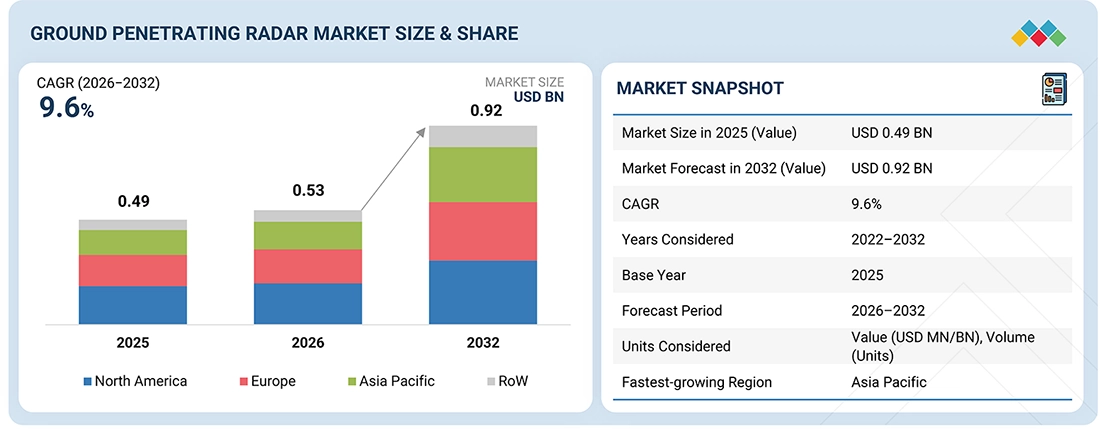
According to Marketsandmarkets, the Ground Penetrating Radar market size is projected to reach USD 0.92 billion by 2032, growing from USD 0.53 billion in 2026, at a CAGR of 9.6% from 2026 to 2032. The market is driven by increasing investments in infrastructure modernization, underground utility mapping, and non-destructive testing (NDT) applications. Rising adoption of ground penetrating radar (GPR) systems in transportation, construction, archaeology, and environmental monitoring, coupled with advancements in AI-enabled data interpretation, 3D imaging, and digital twin integration, is further accelerating market growth. Additionally, government initiatives for smart cities, railway expansion, and aging infrastructure assessment are creating sustained demand for GPR solutions globally.
REPORT SCOPE
| REPORT METRIC | DETAILS |
|---|---|
| Market Size in 2025 (Value) | USD 0.49 Billion |
| Market Size in 2026 (Value) | USD 0.53 Billion |
| Market Forecast in 2032 (Value) | USD 0.92 Billion |
| Growth Rate | at a CAGR of 9.6% |
| Years Considered | 2022–2032 |
| Base Year | 2025 |
| Forecast Period | 2026–2032 |
| Units Considered | Value (USD Million/Billion), Volume (Units) |
| Report Coverage | Revenue forecast, company ranking, competitive landscape, growth factors, and trends |
| Segments Covered |
|
| Regions Covered | North America, Europe, Asia Pacific, and RoW |
KEY TAKEAWAYS
-
BY REGIONBy region, Asia Pacific is projected to register a CAGR of 12.2% between 2026 and 2032.
-
BY OFFERINGBy offering, the hardware segment held the largest market share in 2025.
-
BY DEPTH CAPABILITYBy depth capability, the <1 meter segment is the fastest-growing during the forecast period.
-
BY PRODUCT TYPEBy product type, the cart-based systems segment dominated the ground penetrating radar market, with a share of 29% in 2025.
-
BY SALES CHANNELBy sales channel, the indirect sales segment is likely to grow at a commendable rate during the forecast period.
-
BY FREQUENCYBy frequency, the >1,000 MHz segment is projected to grow at a growth rate of 12.2% from 2026 to 2032.
-
BY APPLICATIONBy application, the utility detection segment is expected to dominate the market with 23% share in 2025.
-
COMPETITIVE LANDSCAPE (KEY PLAYERS)Hexagon AB, SPX Technologies (GSSI), Hilti, Geophysical Survey Systems (GSSI), and Chemring Group were identified as star players in the global ground penetrating radar market, given their strong market shares and extensive product portfolios.
-
COMPETITIVE LANDSCAPE (STARTUPS/SMES)Subsite Electronics, ImpulseRadar Sweden, and Geoscanners AB have distinguished themselves among SMEs and specialized providers by establishing strong positions in niche applications, such as utility detection, infrastructure inspection, and subsurface imaging, highlighting their potential as emerging market leaders.
The ground penetrating radar market is projected to grow significantly over the next decade, driven by increasing investments in infrastructure modernization, rising demand for underground utility detection and non-destructive testing, and growing government initiatives supporting smart cities, transportation networks, and resilient infrastructure development.
Source: Secondary Research, Interviews with Experts, MarketsandMarkets Analysis
TRENDS & DISRUPTIONS IMPACTING CUSTOMERS' CUSTOMERS
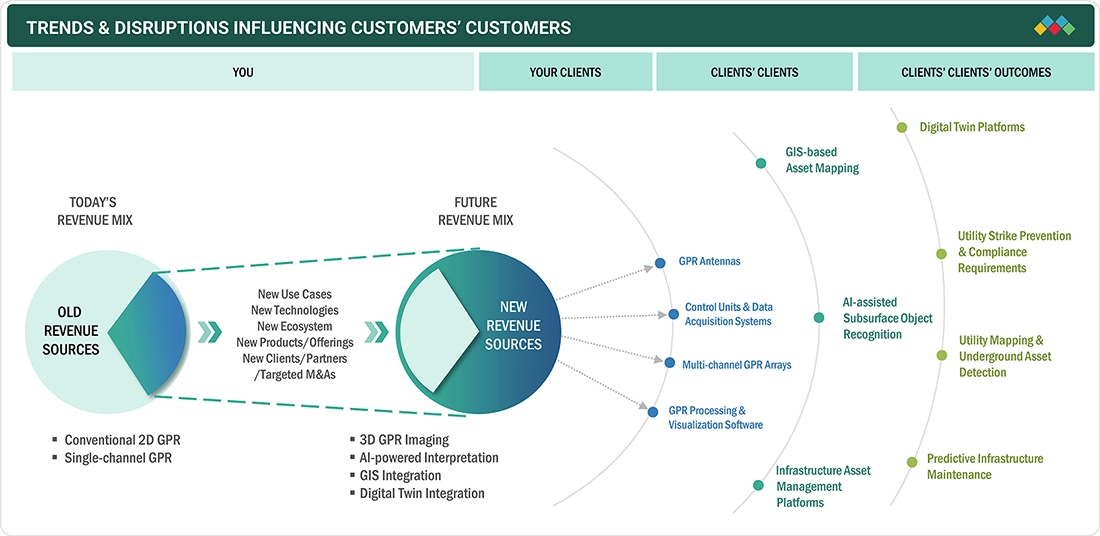
The ground penetrating radar market primarily serves construction companies, utility operators, transportation agencies, engineering consultants, and environmental organizations. Conventional 2D and single-channel GPR systems are increasingly complemented by advanced 3D imaging, AI-powered data interpretation, GIS integration, and digital twin technologies. The adoption of multi-channel GPR arrays, intelligent data acquisition systems, and visualization software is enabling more accurate subsurface mapping, utility strike prevention, and predictive infrastructure maintenance. These advancements are expected to accelerate digital transformation across infrastructure management, creating new revenue opportunities and improving operational efficiency for asset owners and service providers globally.
Source: Secondary Research, Interviews with Experts, MarketsandMarkets Analysis
MARKET DYNAMICS

Level
-
Increasing investment in underground utility mapping and damage prevention

-
Rising adoption of non-destructive testing for infrastructure inspection


Level
-
Reduced performance in conductive soils and high-moisture environments

-
High costs associated with advanced 3D and multi-channel GPR systems


Level
-
Rising integration with GIS, BIM, and Digital Twin platforms

-
Increasing adoption of AI-powered subsurface data interpretation


Level
-
Balancing penetration depth with imaging resolution

-
Shortage of skilled professionals for accurate data interpretation

Source: Secondary Research, Interviews with Experts, MarketsandMarkets Analysis
Driver: Increasing investment in underground utility mapping and damage prevention
Increasing investments in underground utility mapping, aging infrastructure assessment, and damage prevention initiatives are driving GPR adoption globally. Governments and utility operators are increasingly deploying GPR systems to accurately locate buried assets, reduce excavation risks, and comply with utility protection regulations. Investments in smart cities, transportation infrastructure, and non-destructive testing (NDT) programs, coupled with advances in AI-enabled interpretation and high-resolution imaging, are further accelerating market growth.
Restraint: Reduced performance in conductive soils and high-moisture environments
The effectiveness of GPR systems is constrained in highly conductive soils, clay-rich terrains, and high-moisture environments, where signal attenuation reduces penetration depth and imaging accuracy. Performance limitations in challenging geological conditions often necessitate the use of complementary technologies, increasing project costs and complexity. In addition, the requirement for skilled operators and advanced data interpretation capabilities remains a challenge for broader market adoption.
Opportunity: Rising integration with GIS, BIM, and Digital Twin platforms
The growing integration of GPR data with GIS, Building Information Modeling (BIM), and digital twin platforms presents significant growth opportunities for market players. Advances in AI-powered subsurface analysis, 3D visualization, and cloud-based asset management solutions are enabling more comprehensive infrastructure planning and predictive maintenance. The increasing adoption of smart city initiatives and digital construction workflows is further creating new revenue streams for GPR technology providers and service companies.
Challenge: Balancing penetration depth with imaging resolution
Achieving the optimal balance between penetration depth and imaging resolution remains a key challenge in the ground penetrating radar market. Lower-frequency antennas provide deeper penetration but reduced image clarity, while higher-frequency systems offer detailed imaging at shallower depths. Selecting the appropriate system for diverse applications, soil conditions, and target objects requires technical expertise, posing operational challenges for end users.
GROUND PENETRATING RADAR MARKET SIZE, SHARE & GROWTH: COMMERCIAL USE CASES ACROSS INDUSTRIES
| COMPANY | USE CASE DESCRIPTION | BENEFITS |
|---|---|---|
 |
Rome Fiumicino Airport Runway Assessment (Italy): IDS GeoRadar deployed its multi-channel Stream GPR technology to evaluate runway pavement conditions and identify subsurface deterioration across operational airport infrastructure. | Reduced runway inspection time | Minimized operational disruptions | Improved pavement maintenance planning | Enhanced airside safety |
 |
Commercial Building Concrete Scanning Projects: GSSI's StructureScan systems were used to locate rebar, conduits, post-tension cables, and voids prior to drilling and renovation activities in commercial and infrastructure projects. | Reduced accidental utility strikes | Improved worker safety | Minimized rework | Accelerated construction timelines |
 |
Archaeological Site Investigation Projects: pulseEKKO GPR systems were deployed to detect buried structures and archaeological features before excavation activities, enabling non-invasive site assessments. | Reduced excavation costs | Preserved cultural heritage assets | Improved survey efficiency | Minimized site disturbance |
 |
Urban Utility Mapping Programs: MALA GPR systems were used by utility contractors and municipalities to identify underground pipelines, communication cables, and utility corridors in dense urban environments. | Improved underground asset visibility | Reduced utility strike incidents | Enhanced project planning accuracy | Improved worker safety |
 |
Digital Infrastructure Mapping Initiatives: Leica Geosystems integrated GPR survey data with GIS platforms to create georeferenced underground asset inventories supporting infrastructure digitization programs. | Enhanced asset documentation | Improved infrastructure planning | Enabled digital workflows | Supported smart city initiatives |
Logos and trademarks shown above are the property of their respective owners. Their use here is for informational and illustrative purposes only.
MARKET ECOSYSTEM
The ground penetrating radar ecosystem comprises established players across component manufacturing, system development, software, and infrastructure services, including Analog Devices, NXP Semiconductors, Texas Instruments, u-blox, Hexagon AB, SPX Technologies (GSSI), Chemring Group, Hilti, Esri, Bentley Systems, Screening Eagle (Proceq), AECOM, Jacobs, and Tetra Tech. Collaboration among these stakeholders is accelerating innovation in AI-powered subsurface analysis, 3D imaging, GIS and digital twin integration, and predictive infrastructure management, driving efficiency, safety, and technological advancement across the global ground penetrating radar market.
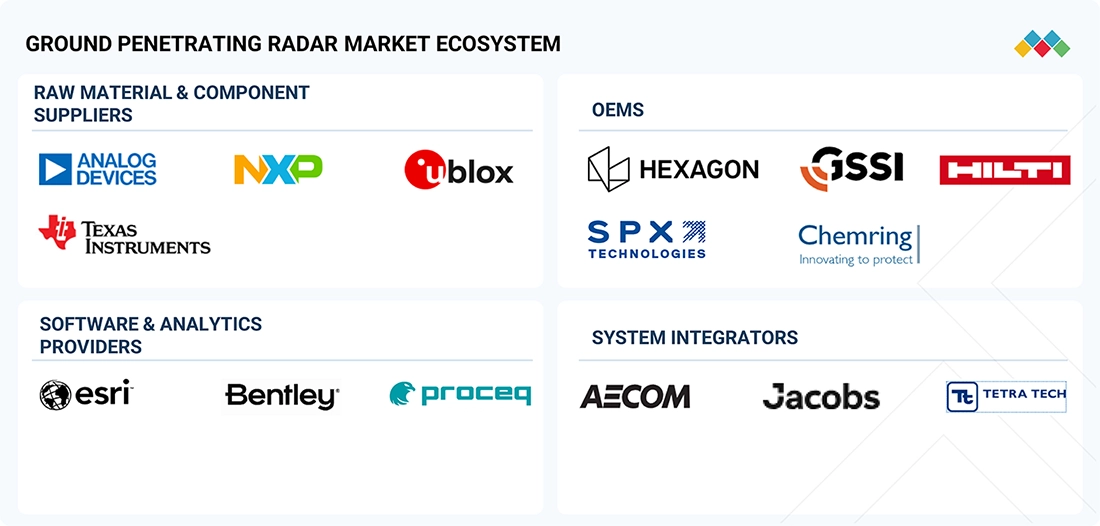
Logos and trademarks shown above are the property of their respective owners. Their use here is for informational and illustrative purposes only.
MARKET SEGMENTS
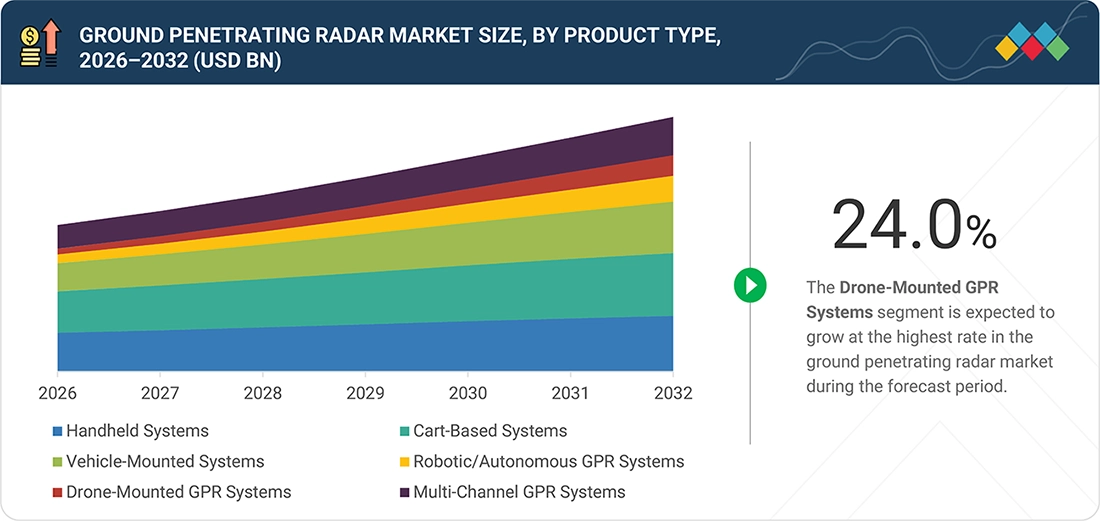
Source: Secondary Research, Interviews with Experts, MarketsandMarkets Analysis
Ground Penetrating Radar Market, By Product Type
The cart-based systems segment held the largest market share in 2025, driven by their widespread adoption in utility mapping, transportation infrastructure assessment, and large-area subsurface investigations. However, robotic/autonomous GPR systems and drone-mounted GPR systems are expected to witness the fastest growth, supported by increasing demand for automated inspections, enhanced operational safety, and efficient data collection across challenging environments.
Ground Penetrating Radar Market, By Frequency
The 200–1,000 MHz frequency range accounted for the largest market share in 2025 due to its versatility in balancing penetration depth and imaging resolution across utility detection, concrete inspection, and infrastructure applications. Meanwhile, frequencies above 1,000 MHz are gaining traction for high-resolution imaging applications such as concrete scanning, forensic investigations, and cultural heritage preservation.
Ground Penetrating Radar Market, By Offering
The hardware segment captured the largest market share in 2025, owing to strong demand for GPR antennas, control units, and multi-channel systems across construction, transportation, and utility sectors. At the same time, software solutions and services are witnessing robust growth, driven by increasing adoption of AI-powered interpretation, cloud-based data management, 3D visualization, and professional surveying and consulting services.
Ground Penetrating Radar Market, By Application
The utility detection segment held the largest market share in 2025, supported by investments in underground asset mapping, excavation safety, and damage prevention initiatives. Municipal infrastructure and disaster management applications are expected to register strong growth during the forecast period, fueled by smart city projects, aging infrastructure rehabilitation, and increasing adoption of GPR for resilience planning and emergency response activities.
REGION
Asia Pacific to register highest CAGR in global ground penetrating radar market during forecast period
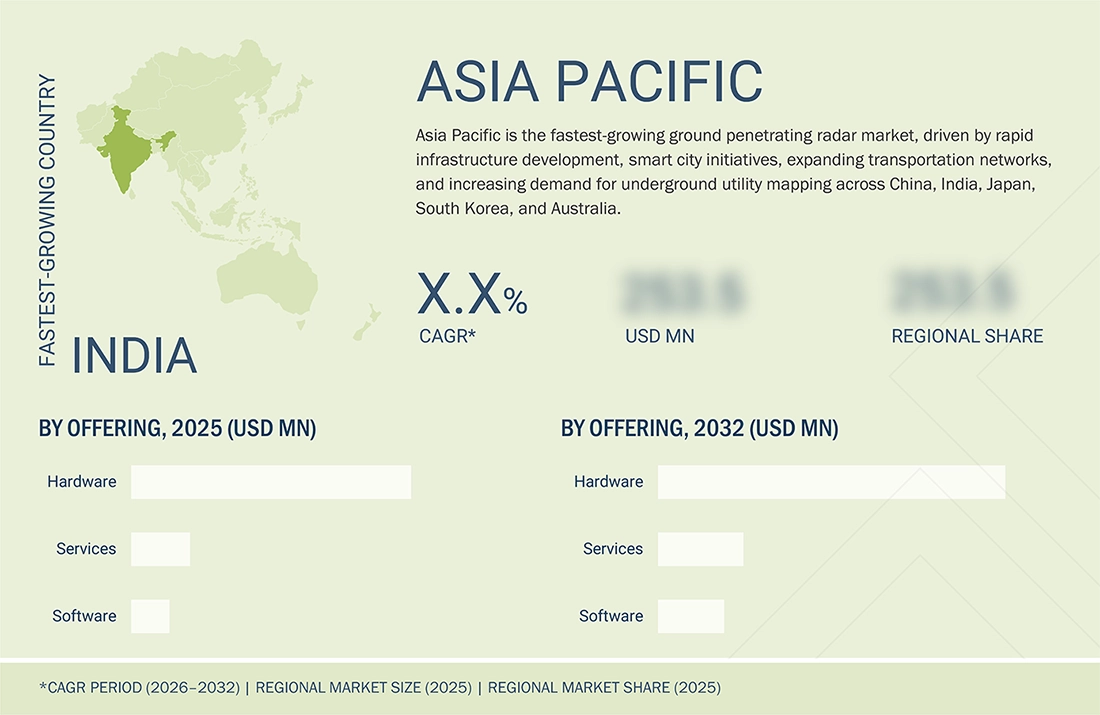
Asia Pacific is expected to witness the fastest growth in the ground penetrating radar market during the forecast period, driven by rapid urbanization, large-scale transportation and utility infrastructure projects, and increasing investments in smart city initiatives across China, India, Japan, South Korea, and Australia. Governments and infrastructure developers are increasingly adopting GPR technologies for underground utility mapping, railway inspection, and non-destructive testing to improve safety and reduce excavation-related risks. The growth is further supported by rising investments in digital infrastructure management, expanding metro and high-speed rail networks, and growing awareness of advanced subsurface imaging solutions.
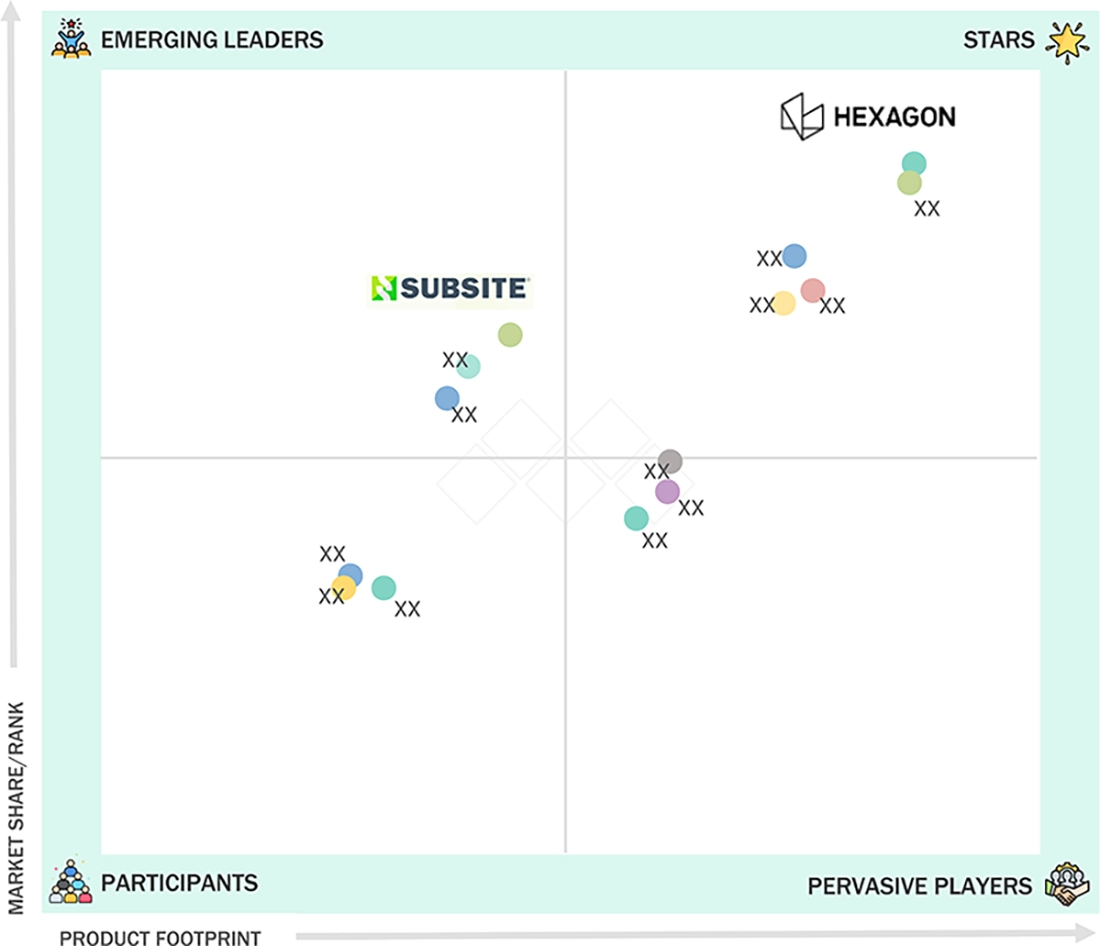
GROUND PENETRATING RADAR MARKET SIZE, SHARE & GROWTH: COMPANY EVALUATION MATRIX
In the ground penetrating radar market, Hexagon AB (Star) maintains a leading position owing to its strong global presence, broad product portfolio, and advanced capabilities in subsurface intelligence, reality capture, and digital twin integration. Other star players, including SPX Technologies (GSSI), Hilti, Geophysical Survey Systems (GSSI), and Chemring Group, continue to strengthen their market positions through continuous innovation in utility detection, infrastructure inspection, and non-destructive testing solutions. Subsite Electronics (Emerging Leader) is gaining traction through its specialized offerings for underground utility locating and field operations, while companies such as ImpulseRadar Sweden and Geoscanners AB are expanding their presence in niche applications through innovative and cost-effective technologies. Collectively, these players are driving the adoption of AI-powered interpretation, 3D imaging, GIS integration, and multi-channel GPR systems, enhancing the efficiency, accuracy, and safety of subsurface investigations worldwide.
Source: Secondary Research, Interviews with Experts, MarketsandMarkets Analysis
KEY MARKET PLAYERS
- Hexagon AB (Sweden)
- SPX Technologies (GSSI) (US)
- Hilti (Liechtenstein)
- Geophysical Survey Systems, Inc. (GSSI) (US)
- Chemring Group PLC (UK)
- Screening Eagle Technologies (Switzerland)
- US Radar, Inc. (US)
- Japan Radio Co., Ltd. (Japan)
- Guideline Geo AB (Sweden)
- Subsite Electronics (US)
WHAT IS IN IT FOR YOU: GROUND PENETRATING RADAR MARKET SIZE, SHARE & GROWTH REPORT CONTENT GUIDE
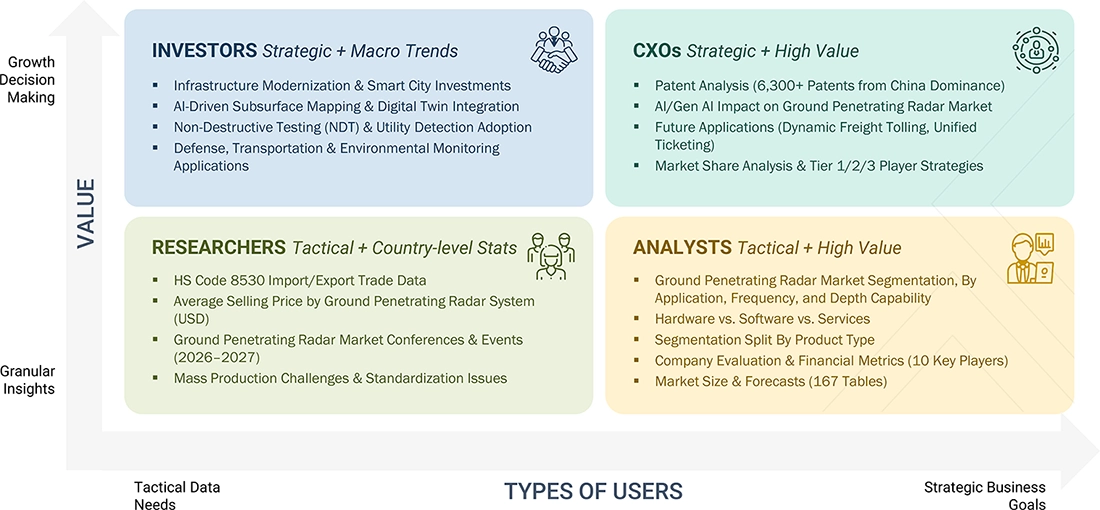
DELIVERED CUSTOMIZATIONS
We have successfully delivered the following deep-dive customizations:
| CLIENT REQUEST | CUSTOMIZATION DELIVERED | VALUE ADDS |
|---|---|---|
| GPR System Manufacturer |
|
|
| Infrastructure Operator / Utility Company |
|
|
| Transportation Ministry / Smart City Agency |
|
|
| Technology Provider / Engineering Consultant |
|
|
RECENT DEVELOPMENTS
- May 2026 : Hexagon AB, through its IDS GeoRadar business, released AiMaps 3.0, an AI-powered cloud solution for ground-penetrating radar data processing and underground-utility mapping. The update introduced Pipe Tracer, which automatically digitizes and traces underground pipe networks from GPR data, reducing manual interpretation and reportedly cutting digitization time by more than 50%. The development directly advances AI-enabled processing and interpretation of Ground Penetrating Radar data for utility surveying.
- May 2026 : IDS GeoRadar released AiMaps 3.0, an AI-powered cloud-based GPR processing solution integrated with IQMaps and Hexagon's HxDR platform. The solution supports automated interpretation of GPR data and helps utility mapping users convert large radar datasets into actionable underground asset information with reduced manual review effort.
- March 2026 : Geophysical Survey Systems, Inc. (GSSI) partnered with Topcon Positioning Systems to integrate GSSI ground-penetrating radar systems with Topcon GNSS receivers, correction services and mass-data workflow software. The integrated solution connects subsurface GPR detection with geospatial positioning and data-management capabilities for infrastructure and construction projects, allowing professionals to combine underground information with spatial context. The collaboration directly expands the workflow and integration capabilities surrounding GPR technology.
- March 2026 : Screening Eagle Technologies, through its Proceq business, opened a new GPR Excellence Training Centre in Málaga, Spain, designed to strengthen professional expertise in ground-penetrating radar and subsurface inspection. The center supports training in GPR applications and interpretation as Screening Eagle expands its subsurface-inspection capabilities, including concrete and mobile-mapping GPR systems. The development represents a direct expansion of the company's GPR-focused operational and training infrastructure
- March 2026 : Trimble integrated GSSI’s PaveScan RS ground-penetrating radar sensor with its Roadworks paving control platform to provide real-time asphalt compaction metrics on every pass. The solution maps asphalt density and air-void profiles continuously, reducing reliance on post-project core testing. PaveScan RS enables operators to identify compaction issues immediately and optimize roller patterns during paving. The integration can reduce rework, improve crew safety, and support longer-lasting, more sustainable roads. The collaboration strengthens Trimble’s smart paving portfolio with automated, non-destructive quality control.
Table of Contents
 Exclusive indicates content/data unique to MarketsandMarkets and not available with any competitors.
Methodology
The study involved major activities in estimating the current market size for the ground penetrating radar market. Extensive secondary research was conducted to collect information on the ground penetrating radar ecosystem, including tolling technologies, deployment trends, regulatory frameworks, and competitive developments. The next step involved validating these findings, assumptions, and market estimates through primary research with industry participants across the value chain, including solution providers, transportation authorities, infrastructure operators, and technology experts. Different approaches, including top-down and bottom-up methodologies, were employed to estimate the overall market size. Following this, market breakdown and data triangulation procedures were applied to determine the market size of individual segments and subsegments within the market.
Secondary Research
Secondary research for this study involved gathering information from various credible sources, including company annual reports, investor presentations, government transportation agencies, toll authority publications, industry associations, technical papers, and transportation journals. This process supported the understanding of the market ecosystem, supply and value chains, identification of key stakeholders, analysis of market segmentation and regional adoption patterns, and tracking of major market, infrastructure, and technology developments. The collected data was then synthesized and validated through primary research to estimate and finalize the overall ground penetrating radar market size.
Primary Research
Extensive primary research was conducted after gaining knowledge about the current scenario of the ground penetrating radar market through secondary research. Several primary interviews were conducted with experts from the demand and supply sides across four major regions—North America, Asia Pacific, Europe, and RoW. This primary data was collected through questionnaires, emails, and telephonic interviews.
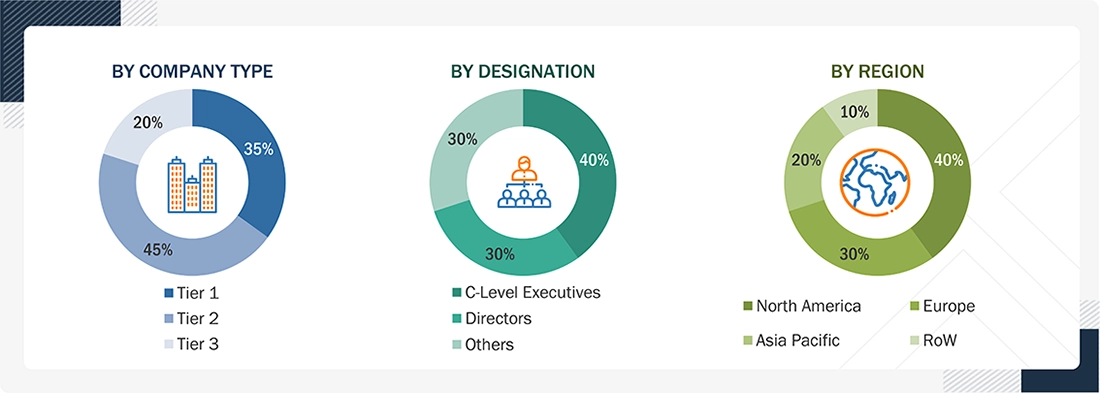
Extensive primary research was conducted after gaining knowledge about the current scenario of the ground penetrating radar market through secondary research. Several primary interviews were conducted with experts from the demand and supply sides across four major regions—North America, Asia Pacific, Europe, and RoW. This primary data was collected through questionnaires, emails, and telephonic interviews.
To know about the assumptions considered for the study, download the pdf brochure
Market Size Estimation
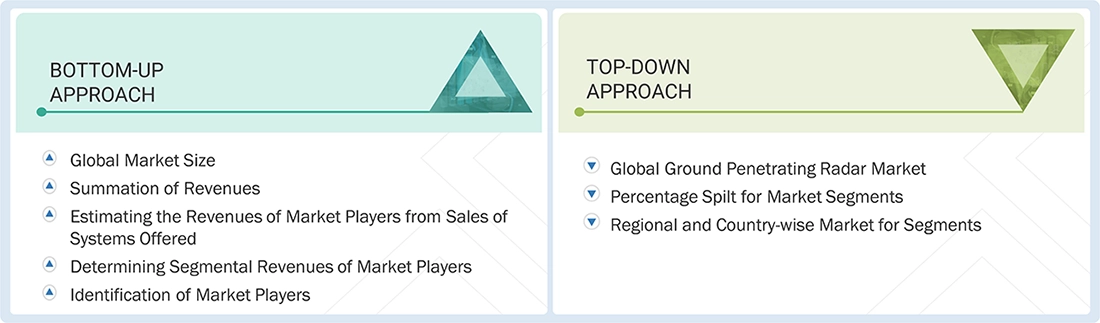
A bottom-up approach has been used to determine the overall size of the ground penetrating radar market.
- Identifying applications wherein ground penetrating radar systems are deployed or are expected to be used
- Analyzing major providers of ground penetrating radars and original equipment manufacturers (OEMs), as well as studying their portfolios and understanding the different technologies used
- Analyzing the average selling price of ground penetrating radar systems powered by different technologies
- Arriving at the market size by analyzing the revenue of companies and then combining these figures to arrive at the market size
- Studying various paid and unpaid sources, such as annual reports, press releases, white papers, and databases, to gather the required information
- Tracking the ongoing developments and identifying the upcoming developments in the market that include investments, research and development activities, product launches, contracts, collaborations, and partnerships undertaken, and forecasting the market size based on these developments
- Carrying out multiple discussions with the key opinion leaders to understand the installation of ground penetrating radar systems and the sales of related raw materials and products, to analyze the break-up of the scope of work carried out by the key companies manufacturing panels
- Verifying and cross-checking the estimate at every level through discussions with key opinion leaders, such as chief executives (CXOs), directors, and operations managers, and finally with the domain experts in MarketsandMarkets
The top-down approach has been used to estimate and validate the total size of the ground penetrating radar market.
- Focusing on top-line investments and expenditures made in the ecosystems of various applications
- Calculating the market size, considering revenues from major players through the cost of ground penetrating radar systems
- Estimating the percentage split of each offering & product type by application and deriving the global application market size
- Segmenting each application of the ground penetrating radar system by region and deriving the global regional market size
- Estimating country-level market size by analyzing the percentage split for each region by country
- Analyzing information related to revenues generated by players through their crucial product offerings
- Conducting multiple on-field discussions with key opinion leaders involved in developing various ground penetrating radar solutions
Data Triangulation
After arriving at the overall market size using the market size estimation processes as explained above, the market has been split into several segments and subsegments. Data triangulation and market breakdown procedures have been employed to complete the entire market engineering process and arrive at the exact statistics of each market segment and subsegment. The data has been triangulated by studying various factors and trends from the demand and supply sides in the ground penetrating radar market.
Market Definition
Ground penetrating radar (GPR) is a non-destructive geophysical sensing technology that uses high-frequency electromagnetic waves to detect, map, and characterize subsurface objects, materials, and structures without excavation or physical intrusion. GPR systems transmit radio waves into the ground and analyze the reflected signals to identify buried utilities, voids, reinforcement bars, geological features, archaeological artifacts, and other underground assets in real time.
GPR solutions are widely deployed across utility mapping, transportation infrastructure inspection, concrete evaluation, railway maintenance, mining, environmental studies, archaeology, defense, and disaster management applications to improve safety, reduce operational risks, and enhance asset management. These systems typically comprise antennas, control and data acquisition units, processing and visualization software, positioning technologies such as GNSS, and analytics platforms that enable accurate subsurface imaging, interpretation, and decision-making.
Key Stakeholders
- Original Equipment Manufacturers (OEMs)
- Component & Semiconductor Suppliers
- Software & Analytics Providers
- System Integrators & Engineering Consultants
- Utility Mapping & Survey Service Providers
- Construction & Infrastructure Companies
- Transportation & Railway Authorities
- Government Agencies & Municipal Bodies
- Research Institutions & Universities
- End Users (Utilities, Mining, Defense, Environmental Organizations, and Archaeology Teams)
Report Objectives
- To define, analyze, and forecast the size of the ground penetrating radar market, by sales channel, depth capability, frequency, offering, application, and product type, in terms of value
- To define, analyze, and forecast the size of the ground penetrating radar systems market, in terms of volume
- To forecast the market size for various segments with respect to four main regions, namely North America, Europe, Asia Pacific, and RoW, in terms of value
- To provide detailed information regarding the major drivers, restraints, opportunities, and challenges influencing the market growth
- To study the complete value chain and related industry segments for the ground penetrating radar market
- To strategically analyze the micromarkets with respect to individual growth trends, prospects, and contributions to the total market
- To analyze the value chain, market ecosystem, trends/disruptions impacting customer business, technology analysis, pricing analysis, Porter’s five forces analysis, key stakeholders & buying criteria, impact of Gen AI/AI, case study analysis, impact of US tariffs, trade analysis, patent analysis, key conferences & events, regulatory landscape, macroeconomic outlook, and investment and funding scenario
- To analyze opportunities in the market for various stakeholders by identifying the high-growth segments of the market
- To strategically profile key players and comprehensively analyze their market position in terms of ranking, core competencies, company valuation and financial metrics, and product/brand comparison, along with detailing the competitive landscape for the market leaders
- To analyze competitive developments, such as product launches/developments, partnerships, collaborations, acquisitions, and research and development (R&D) activities, carried out by players in the ground penetrating radar market.
Available customizations:
With the given market data, MarketsandMarkets offers customizations according to the company‘s specific needs. The following customization options are available for the report.
Company Information:
- Detailed analysis and profiling of additional market players (up to five)
Key Questions Addressed by the Report
What is the current and forecast market size of the global ground penetrating radar market?
The global ground penetrating radar market is projected to grow from USD 0.53 billion in 2026 to USD 0.92 billion by 2032, at a CAGR of 9.6% during the forecast period.
What are the key growth drivers of the ground penetrating radar market?
Market growth is driven by increasing investments in infrastructure modernization, underground utility mapping, non-destructive testing (NDT), smart city projects, railway expansion, and advancements in AI-enabled data interpretation and 3D imaging.
Which region is expected to witness the highest growth in the ground penetrating radar market?
Asia Pacific is expected to register the highest growth, with a CAGR of 12.2% between 2026 and 2032, supported by rapid urbanization, transportation infrastructure projects, and increasing adoption of GPR technologies across China, India, Japan, South Korea, and Australia.
Which product segment dominates the ground penetrating radar market?
The cart-based systems segment accounted for the largest market share, representing 29% of the market in 2025, owing to its extensive use in utility mapping and transportation infrastructure inspection.
Which application segment holds the largest market share?
The utility detection application segment held the largest market share with 23% in 2025, driven by increasing demand for underground asset mapping, excavation safety, and damage prevention.
Which companies are the leading players in the global ground penetrating radar market?
Leading companies include Hexagon AB, SPX Technologies (GSSI), Hilti, Geophysical Survey Systems (GSSI), and Chemring Group, supported by broad product portfolios and strong market presence.
Which offering segment generated the highest revenue in the market?
The hardware segment held the largest market share in 2025 due to strong demand for GPR antennas, control units, and multi-channel radar systems across infrastructure and construction applications.
What major industry trends are shaping the ground penetrating radar market?
Key industry trends include AI-powered subsurface analysis, digital twin integration, cloud-based data management, robotic and drone-mounted GPR systems, and increasing adoption of automated inspection technologies.
What does the MarketsandMarkets ground penetrating radar market report analyze?
The report analyzes market size, growth forecasts, competitive landscape, company rankings, market trends, segmentation by product type, frequency, depth capability, offering, sales channel, application, and regional outlook across North America, Europe, Asia Pacific, and RoW.
Which frequency and depth capability segments are expected to experience the fastest growth?
The greater than 1,000 MHz frequency segment is projected to grow at a 12.2% CAGR, while the less than 1 meter depth capability segment is expected to be the fastest-growing during the forecast period.


Personalize This Research
- Triangulate with your Own Data
- Get Data as per your Format and Definition
- Gain a Deeper Dive on a Specific Application, Geography, Customer or Competitor
- Any level of Personalization
Let Us Help You
- What are the Known and Unknown Adjacencies Impacting the Ground Penetrating Radar Market
- What will your New Revenue Sources be?
- Who will be your Top Customer; what will make them switch?
- Defend your Market Share or Win Competitors
- Get a Scorecard for Target Partners

Custom Market Research Services
We Will Customise The Research For You, In Case The Report Listed Above Does Not Meet With Your Requirements
Get 10% Free CustomisationTESTIMONIALS

Tetsuya Ohhira
Business Development Manager-Technology Business
Nikon Corporation,
Leading Japanese MNC specializing in optics and imaging productswww.nikon.com
MarketsandMarkets™ response
is quick. Their attitude is flexible and positive. Analyst Insights are globally considered and
significant. Client Services quickly respond to our inquiry and demand. Their wide range of global
surveys help us make our strategic plan.
We hope Knowledge Store will be easier to search
for a report.
VP - Marketing & Business Development
Leading Provider of Process Control Solutions
We engaged with MarketsandMarkets on a study to perform an analysis and recommend a Go-To-Market strategy for metrology and process control in the semiconductor market. The study was tailored to our targets and needs with well-defined milestones. Our overall experience with the MarketsandMarkets team was very good throughout the project in all aspects including the analysis methodologies used, the quality and depth of primary and secondary data sets, the professionalism and flexibility of the team and the ability to meet the target schedule and milestones. We want to thank MarketsandMarkets team for a job well done.






Growth opportunities and latent adjacency in Ground Penetrating Radar Market