



HD Maps Market Size, Share & Analysis
Report Code
AT 7391
Published in
Sep, 2026, By MarketsandMarkets™
HD Maps Market by LOA (L2, L3, L4 & L5), Service Type (Mapping & Localization, Update & Maintenance), Vehicle Type (Passenger Cars, Commercial Vehicle), Solution Type (Embedded, Cloud), Usage (Personal, Commercial), and Region - Global Forecast to 2033

USD 2.43 BN
MARKET SIZE, 2033

CAGR 8.9%
(2026-2033)

270
REPORT PAGES

150
MARKET TABLES
OVERVIEW
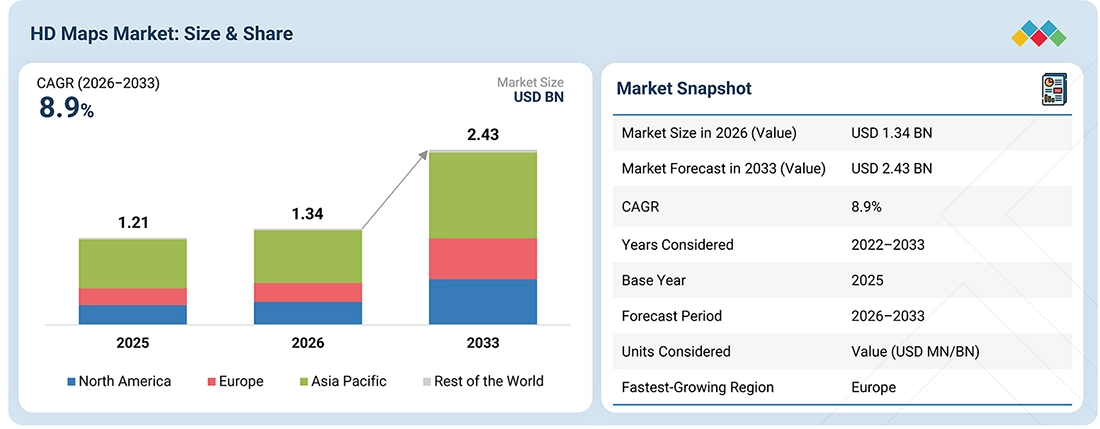
Source: Secondary Research, Interviews with Experts, MarketsandMarkets Analysis
The HD maps market size is projected to grow from USD 1.34 billion in 2026 to USD 2.43 billion by 2033, at a CAGR of 8.9%. The HD maps market is shifting toward multi program map platforms that allow OEMs to reuse map data, localization, and update infrastructure across vehicle models and regions, reducing duplicated validation and maintenance costs. The expansion of Level 2+, Level 3, and Level 4 driving functions in passenger cars and commercial vehicles is increasing demand for lane level road geometry, road boundaries, traffic controls, and regularly updated map data. Advances in automated map generation, sensor based change detection, 3D mapping, and OTA updates are also making it easier to maintain HD maps across larger road networks.
KEY TAKEAWAYS
-
MARKET SNAPSHOT:
Market Size (2025): USD 1.21 Billion
Current Market Size (2026): USD 1.34 Billion
Projected Market Size (2033): USD 2.43 Billion
CAGR (2026–2033): 8.9% -
BY REGIONAsia Pacific is expected to be the largest market during the forecast period.
-
BY SOLUTIONCloud-based is estimated to dominate the HD Map market, with a share of 72.5% in 2026.
-
BY USAGE TYPECommercial mobility is projected to experience the highest growth rate during the forecast period.
-
BY SERVICE TYPEUpdate & maintainance is estimated to be the fastest growing the HD Map market, with a CAGR of 13.3% from 2026 to 2033.
-
BY LEVEL OF AUTOMATIONSemi-autonomous is expected to register the highest share of 95.1% in 2033.
-
By Vehicle TypeCommercial Vehicles is estimated to be the fastest-growing HD Map market, with a CAGR of 37.2% from 2026 to 2033.
-
COMPETITIVE LANDSCAPE (KEY PLAYERS)Leading HD map providers, including HERE Technologies (Netherlands), Baidu, Inc. (China), TomTom International BV (Netherlands), NVIDIA Corporation (US), and Mobileye (Israel) are continuously delivering high-precision, frequently updated maps that support lane-level localization, traffic intelligence, and road semantics. They strengthen competitiveness by leveraging crowdsourced data, AI-driven automation, and sensor fusion to ensure real-time accuracy, while also building partnerships with OEMs, Tier-1s, and cloud platforms to integrate their maps into ADAS and autonomous driving systems at scale.
-
COMPETITIVE LANDSCAPE (STARTUPS/SMES)The market also includes companies such as Navmii (UK), RMSI (India), Zenrin Co., Ltd. (Japan), Woven by Toyota (Japan), and Swift Navigation, Inc. (US). Collectively, these players are focusing on high precision map creation, lane level mapping, localization, navigation data, geospatial data services, and map technologies for ADAS and autonomous driving applications.
The HD maps market is being shaped by the growing importance of map quality, standardization, and interoperability across autonomous driving systems. OEMs and Tier 1 suppliers are focusing on standardized map formats and data structures that allow HD maps to integrate smoothly with localization, perception, and vehicle computing platforms. Standards such as ADASIS are supporting this interoperability by defining interfaces for transferring map data to vehicle systems. At the same time, centimeter-level accuracy and validation of lane geometry, road boundaries, and traffic attributes are becoming increasingly important to meet the reliability requirements of higher automation. This is creating demand for HD map providers with strong quality assurance, standardized data models, and compatibility across different vehicle architectures.
TRENDS & DISRUPTIONS IMPACTING CUSTOMERS' CUSTOMERS
The revenue mix of the HD maps market is shifting from traditional map licensing and mapping services toward recurring and technology-based models. Current revenue is generated through HD map licensing, lane and road data, map creation, localization, data collection, and map validation. Future revenue opportunities are expected from dynamic HD map platforms, AI-based map generation, real-time updates, map APIs, and subscription-based services. The expansion of Level 2+, Level 3, and Level 4 driving functions is increasing demand for regularly updated map data, while vehicle and infrastructure data can support automated map updates, predictive road information, and simulation for autonomous driving development and testing.
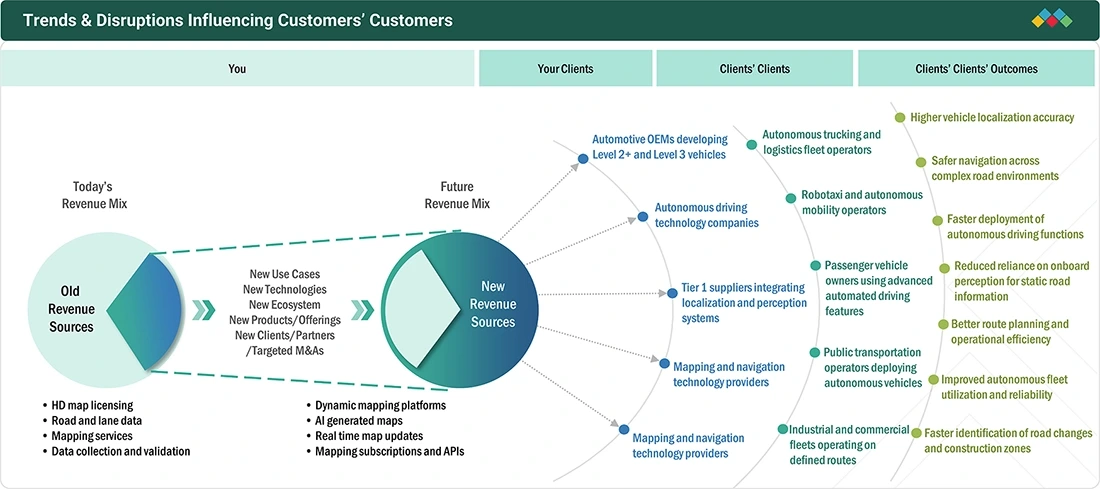
Source: Secondary Research, Interviews with Experts, MarketsandMarkets Analysis
MARKET DYNAMICS

Drivers
Impact
Level
Level
-
Increased Demand from OEMs for Continuously Refreshed rather than Static HD Maps

-
Integration of HD Maps into Autonomous Driving and Localization Stacks


RESTRAINTS
Impact
Level
Level
-
High Cost of Creating and Maintaining Lane Level Map Coverage

-
Increasing Capability of Onboard Perception to Reduce Dependence on Prebuilt HD Maps


OPPORTUNITIES
Impact
Level
Level
-
Vehicle Generated Data and Maps as a Service Enabling Scalable HD Map Creation and Continuous Updates

-
Growing Adoption of Dynamic HD Maps and 4D Mapping for Real Time Representation of Changing Road Conditions


CHALLENGES
Impact
Level
Level
-
Maintaining Map Accuracy During Rapid Road Network Changes

-
Complex Real-time Merging of Multi-sensor Data

Source: Secondary Research, Interviews with Experts, MarketsandMarkets Analysis
Driver: Increased Demand from OEMs for Continuously Refreshed Rather Than Static HD Maps
OEMs are moving toward HD maps that can be updated more frequently as road layouts, lane configurations, speed limits, and road restrictions change. Static map databases can become outdated between update cycles, creating limitations for higher levels of automated driving. This is increasing demand for map solutions that combine vehicle and infrastructure data with automated change detection and cloud based processing to deliver updated road information to vehicles.
Restraint: High Cost of Creating and Maintaining Lane Level Map Coverage
Creating lane-level HD maps across large road networks requires high volumes of vehicle sensor data, precise positioning, mapping equipment, data processing, and continuous validation. Maintaining this coverage is also costly because road geometry and traffic attributes change frequently. These costs can limit expansion into lower-density markets and make it difficult for providers to maintain consistent map quality across large geographic areas.
Opportunity: Vehicle Generated Data and Maps as a Service Enabling Scalable HD Map Creation and Continuous Updates
Vehicle-generated data is enabling map providers to use sensor observations from connected vehicles to identify changes in road geometry, lane markings, traffic signs, and other road attributes. Combined with Maps as a Service models, this can reduce dependence on dedicated mapping campaigns and support continuous map updates. OEMs and Tier 1 suppliers can also use these services to access updated map content without maintaining separate mapping infrastructure, creating opportunities for recurring HD map and localization services.
Challenge: Complex Real-time Merging of Multi-sensor Data
Autonomous vehicles depend on cameras, LiDAR, radar, and ultrasonic sensors, each offering unique inputs that must be fused in real time. Achieving precise synchronization and aligning sensor data with HD maps is technically challenging, especially with road changes or temporary obstacles. Any delay or mismatch reduces localization accuracy and safety. Companies such as Mobileye use crowd-sourced vision data to update maps, but real-time harmonization of massive, diverse sensor streams remains a key hurdle. Overcoming this demands advanced AI, edge computing, and extensive real-world testing.
HD MAPS MARKET SIZE, SHARE & ANALYSIS: COMMERCIAL USE CASES ACROSS INDUSTRIES
| COMPANY | USE CASE DESCRIPTION | BENEFITS |
|---|---|---|
 |
Provides cloud based HD map services with lane level information and frequent updates for OEMs and autonomous driving applications, including highway automated driving | Enables precise localization, real time road information, scalable map deployment, and more reliable automated driving performance |
 |
Provides HD maps with lane level road attributes, precise localization data, and map updates for autonomous driving systems and robotaxi deployments | Improves localization accuracy, supports path planning, and enables reliable autonomous driving in complex urban environments |
 |
Provides HD maps with detailed lane geometry, road attributes, and continuously updated road information for automated driving and OEM navigation systems | Supports accurate lane level navigation, path planning, and automated driving while reducing dependence on static map data |
 |
Uses HD mapping within its autonomous driving ecosystem to provide map data for localization, perception, simulation, and path planning through its DRIVE platform | Improves vehicle situational awareness, supports faster autonomous decision making, and enables integration of mapping with AI based driving systems |
 |
Integrates HD maps with its autonomous driving platform to support localization, road understanding, and automated driving functions, using vehicle generated data for map updates | Enables precise positioning, improves driving decisions, and supports scalable deployment of L2+ and higher level autonomous functions |
Logos and trademarks shown above are the property of their respective owners. Their use here is for informational and illustrative purposes only.
MARKET ECOSYSTEM
The HD maps market ecosystem is moving from a traditional map supply chain toward an integrated data and technology ecosystem. HD map providers develop lane level road data, 3D road models, localization layers, and map update solutions, while mapping and geospatial companies support data collection, annotation, validation, and map production. OEMs and Tier 1 suppliers integrate HD maps with ADAS, autonomous driving software, sensor fusion, vehicle computing, and navigation systems to support higher levels of automation. Sensor, positioning, and connectivity providers contribute LiDAR, radar, GNSS, V2X, and vehicle generated data to improve map creation and localization accuracy. Cloud and data platform providers support map processing, storage, updates, and distribution. Partnerships across these stakeholders are helping improve map accuracy, update frequency, and integration into passenger car and commercial vehicle platforms.
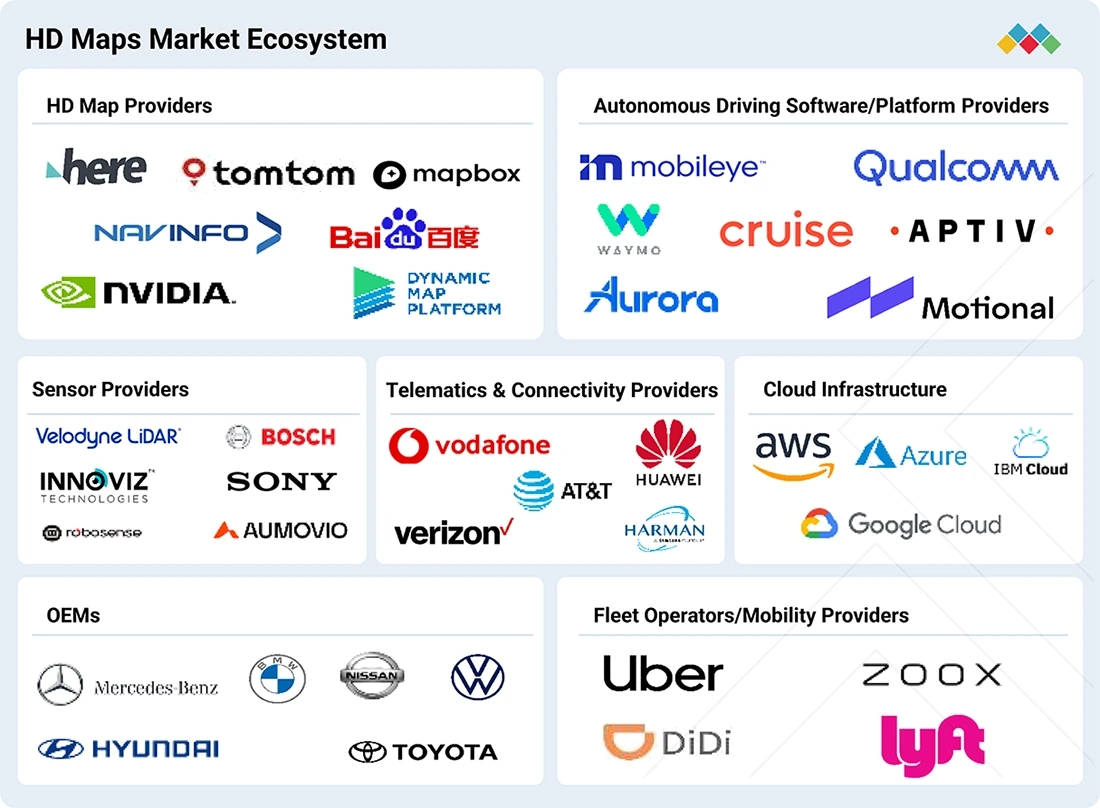
Logos and trademarks shown above are the property of their respective owners. Their use here is for informational and illustrative purposes only.
MARKET SEGMENTS
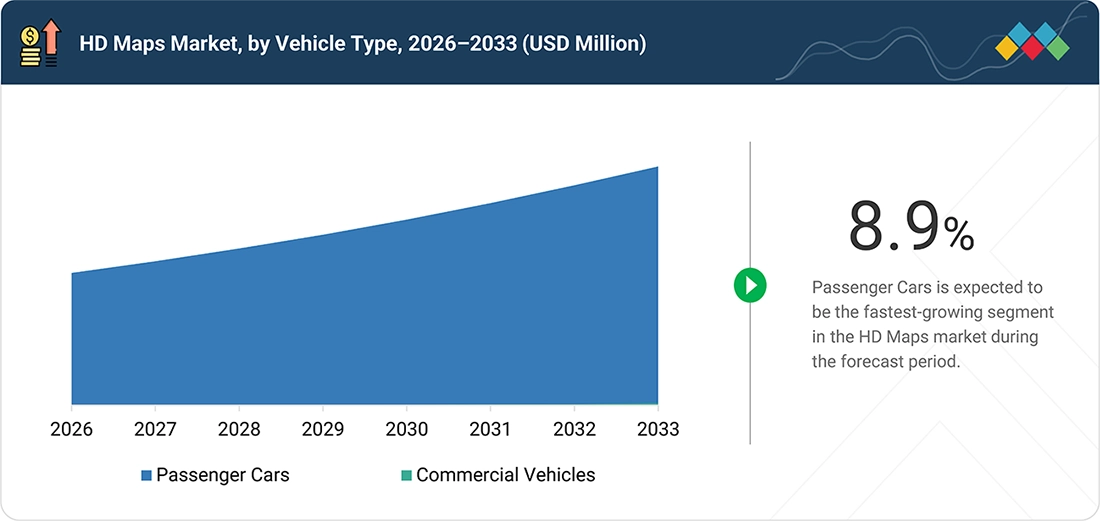
Source: Secondary Research, Interviews with Experts, MarketsandMarkets Analysis
HD Maps Market, By Vehicle Type
Passenger cars are expected to account for the largest market share as OEMs expand ADAS and automated driving functions that require lane level road geometry, precise localization, and detailed road attributes.
HD Maps Market, By Level of Automation
Autonomous vehicles are expected to witness the fastest growth as Level 4 driving functions require accurate road geometry, lane information, localization references, and other map attributes for perception and path planning.
HD Maps Market, By Usage Type
Commercial mobility is expected to witness strong growth as autonomous driving expands across robotaxi, shuttle, freight, and fleet based applications that require consistent HD map coverage across operating areas.
HD Maps Market, By Solution Type
Cloud based HD maps are expected to witness the fastest growth as frequent updates, large scale data processing, and geographic expansion require centralized map management and flexible data delivery.
HD Maps Market, By Service Type
Update and maintenance services are expected to witness the fastest growth as changes in road layouts, lane configurations, traffic restrictions, and road attributes increase demand for continuously refreshed HD map content.
REGION
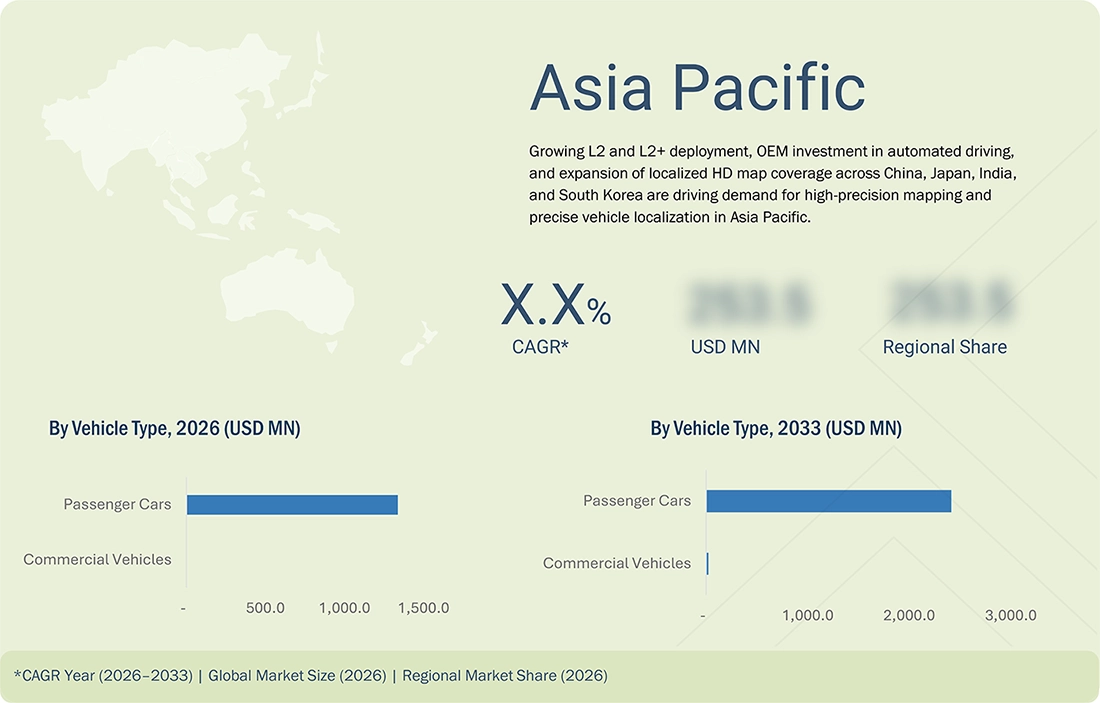
Asia Pacific is expected to be the largest HD maps market for autonomous vehicles
In Asia Pacific, the HD maps market is supported by the rapid expansion of advanced driver assistance, automated driving programs, and high-precision mapping capabilities across China, Japan, and South Korea. OEMs and technology companies in the region are focusing on integrating HD maps with localization, sensor fusion, and automated driving systems, while map providers are expanding lane-level and 3D road coverage to support these applications. The region is also becoming a strong base for automated map generation and high-frequency map updates, supported by large vehicle fleets and extensive road networks that provide substantial vehicle and road data. For instance, Hyundai Motor Group's Pleos Connect targets map-based services across Hyundai, Kia, and Genesis vehicles, while Baidu Apollo combines HD maps with autonomous driving software and vehicle sensor data to support automated driving applications in China. OEM investments in high-precision localization, automated map generation, and connected mapping platforms are creating opportunities for HD map providers to support large-scale deployment of automated driving functions and frequently updated lane-level and 3D map services.
HD MAPS MARKET SIZE, SHARE & ANALYSIS: COMPANY EVALUATION MATRIX
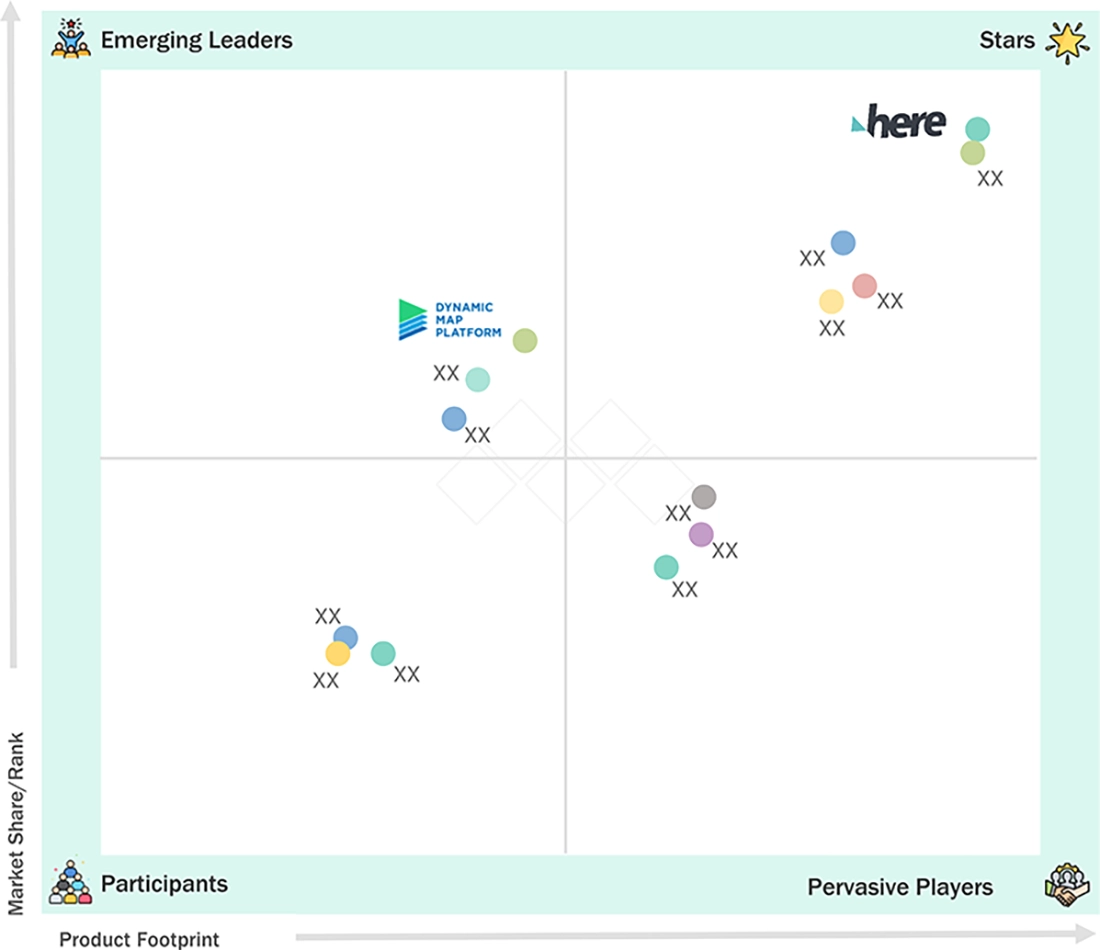
In the HD maps market matrix, HERE Technologies (Star) leads with a strong global presence and a comprehensive HD maps portfolio, driving large-scale adoption across OEMs through strategic partnerships and scalable cloud-based platforms. Dynamic Map Platform, Inc. (Emerging Leader) is gaining traction with its proprietary mapping technology and successful deployment of autonomous ride-hailing services, showcasing real-world validation of HD map capabilities.
Source: Secondary Research, Interviews with Experts, MarketsandMarkets Analysis
KEY MARKET PLAYERS
- HERE Technologies (Netherlands)
- Baidu, Inc. (China)
- TomTom International BV (Netherlands)
- NVIDIA Corporation (US)
- Mobileye (Israel)
- Dynamic Map Platform Co., Ltd. (Japan)
- NavInfo Co., Ltd. (Japan)
- Waymo LLC (US)
- The Sanborn Map Company, Inc. (US)
- Momenta (China)
- Mapbox (US)
- CE Info Systems Ltd (India)
MARKET SCOPE
| REPORT METRIC | DETAILS |
|---|---|
| Market Size in 2026 (Value) | USD 1.34 BN |
| Market Forecast in 2033 (Value) | USD 2.43 BN |
| Growth Rate | CAGR of 8.9% from 2026 to 2033 |
| Years Considered | 2022–2033 |
| Base Year | 2025 |
| Forecast Period | 2026–2033 |
| Units Considered | Value (USD MN/BN) |
| Report Coverage | Revenue forecast, company share, competitive landscape, growth factors, and trends |
| Segments Covered |
|
| Regions Covered | Asia Pacific, Europe, North America, Rest of the World |
WHAT IS IN IT FOR YOU: HD MAPS MARKET SIZE, SHARE & ANALYSIS REPORT CONTENT GUIDE
DELIVERED CUSTOMIZATIONS
We have successfully delivered the following deep-dive customizations:
| CLIENT REQUEST | CUSTOMIZATION DELIVERED | VALUE ADDS |
|---|---|---|
| Global OEM (US) | Competitive intelligence on HERE, Baidu Inc., TomTom International BV, and Mobileye market positioning, assessment of subscription-based revenue models, evaluation of HD map integration with ADAS packages, support pricing strategy for tiered ADAS offerings |
|
| Autonomous Mobility Startup (China) | Regional HD map regulations analysis across China, Japan, and South Korea, technology roadmap of Baidu and Momenta, feasibility study of real time map updates via V2X, understand regulatory hurdles and compliance needs |
|
| Tier 1 Supplier (Europe) | Market intelligence on HD map integration with sensor fusion, cameras, LiDAR, and radar, partnership mapping across OEMs and map providers, case studies of embedded and cloud based solutions, align product roadmap with OEM demand |
|
| Ride Hailing Platform (US / Global) | Competitive landscape of autonomous fleet deployment across Waymo, Cruise, and Uber, cost benefit analysis of HD map integration in robotaxis, benchmark focused mapping solutions, optimize TCO for fleet operations, study HD map integration with IoT and traffic systems | Improve scheduling and reduce downtime through HD map integration |
| Smart City Authority (Middle East) | Vendor benchmarking of Dynamic Map Platform, TomTom, and HERE, pilot projects for autonomous mobility, support infrastructure planning for AV ready cities, enable seamless integration of traffic management with HD maps | Strengthen public private collaboration for autonomous mobility services |
RECENT DEVELOPMENTS
- April 2026 : HERE Technologies has strengthened its collaboration with Chinese intelligent driving company neueHCT to enhance the global expansion of Navigation on Autopilot (NOA) solutions. This partnership aims to integrate HERE’s mapping and location technology with neueHCT’s intelligent driving stack to support advanced assisted and automated driving features for global OEMs.
- April 2026 : HERE Technologies and Baidu Maps have signed a strategic memorandum of understanding to co-develop seamless global navigation and intelligent driving map solutions for automakers. This collaboration aims to integrate HERE’s global coverage with Baidu’s China maps to enhance advanced in-vehicle navigation and intelligent driving use cases worldwide.
- April 2026 : Waymo commenced testing autonomous vehicles in downtown Chicago, mapping city streets and assessing performance in winter weather for the first time. This activity expands Waymo’s HD map coverage and validates its mapping and perception stack under snow and cold-weather conditions.
- March 2026 : DennoKotsu chose Mapbox to upgrade its taxi dispatch platform in Japan, leveraging Mapbox’s mapping and navigation technologies to enhance driver routing, passenger pickup, and operational efficiency. This partnership expands Mapbox’s presence in in-vehicle and fleet navigation, relevant for future autonomous mobility services.
- February 2026 : NVIDIA Partnered with Delhivery to develop digital mapping solutions designed for India’s complex geography and informal addressing systems. The solution uses NVIDIA’s accelerated computing, CV Cuda, and Nemotron open models, combined with Delhivery’s proprietary dataset covering billions of shipments.
- February 2026 : Mapbox introduced doorway-level accuracy capabilities across its platform, enhancing Mapbox 3D Lanes with precise positioning for delivery, logistics, and ride-hailing. This improved accuracy supports advanced driver assistance and autonomous driving navigation use cases.
- January 2026 : TomTom and Visteon announced a partnership to integrate TomTom’s maps and navigation with Visteon’s in-car systems. This collaboration aims to deliver a privacy-focused, onboard conversational navigation experience, showcasing embedded, AI-driven navigation for automated and autonomous vehicles.
- January 2026 : CE Info Systems Ltd., the parent company of MapmyIndia, acquired 3,500 compulsorily convertible preference shares in indoor navigation startup Iwayplus Private Limited for USD 0.21 million. This acquisition enhances CE Info Systems’ location and navigation technology, potentially supporting future HD mapping and autonomous mobility solutions.
- January 2026 : Mobileye acquired AI robotics startup Mentee Robotics for about USD 900 million to accelerate the development of physical AI across autonomous driving and humanoid robotics. This acquisition aims to enhance Mobileye’s perception, planning, and simulation capabilities, which also support REM-based HD mapping for automated vehicles.
Table of Contents
 Exclusive indicates content/data unique to MarketsandMarkets and not available with any competitors.
TITLE
PAGE NO
1
INTRODUCTION
28
2
EXECUTIVE SUMMARY
35
3
PREMIUM INSIGHTS
40
4
MARKET OVERVIEW
Dynamic HD maps drive innovation, despite high costs and evolving multi-sensor integration challenges.
44
4.1
INTRODUCTION
4.2
MARKET DYNAMICS
4.2.1
DRIVERS
4.2.1.1
SHIFTING PREFERENCE FROM STATIC HD MAPS TO UPDATED MAP DATA
4.2.1.2
RISING INTEGRATION OF MAPPING, LOCALIZATION, AND ADAS PROCESSING INTO SHARED SOFTWARE INTERFACES
4.2.1.3
INCREASING ADOPTION OF L2 AND L3 VEHICLES
4.2.2
RESTRAINTS
4.2.2.1
HIGH COSTS OF HD MAP CREATION AND MAINTENANCE
4.2.2.2
INCREASING CAPABILITY OF ONBOARD PERCEPTION
4.2.3
OPPORTUNITIES
4.2.3.1
GROWING DATA GENERATION FROM CONNECTED VEHICLES
4.2.3.2
INCREASING RELIANCE ON DYNAMIC HD MAPS AND 4D MAPPING
4.2.4
CHALLENGES
4.2.4.1
ISSUES IN MAINTAINING MAP ACCURACY AMID RAPID ROAD NETWORK CHANGES
4.2.4.2
COMPLEXITIES IN ACHIEVING SEAMLESS MULTI-SENSOR FUSION
4.3
UNMET NEEDS AND WHITE SPACES
4.3.1
LACK OF STANDARDIZED HD MAP FORMATS AND INTERFACES ACROSS AUTONOMOUS DRIVING PLATFORMS
4.3.2
LIMITED COMMERCIAL MODELS FOR CONTINUOUS HD MAP UPDATES AND VEHICLE GENERATED MAP DATA
4.3.3
LACK OF SCALABLE MAP FRESHNESS AND AUTOMATED CHANGE VALIDATION
4.4
INTERCONNECTED MARKETS AND CROSS-SECTOR OPPORTUNITIES
4.5
STRATEGIC MOVES BY OEMS AND TIER-1/2/3 PLAYERS
5
INDUSTRY TRENDS
Explore transformative HD mapping innovations driving the autonomous vehicle industry's future growth.
56
5.1
MACROECONOMIC OUTLOOK
5.1.1
INTRODUCTION
5.1.2
GDP TRENDS AND FORECAST
5.1.3
TRENDS IN GLOBAL MAPPING INDUSTRY
5.1.4
TRENDS IN GLOBAL AUTONOMOUS VEHICLE INDUSTRY
5.2
ECOSYSTEM ANALYSIS
5.3
SUPPLY CHAIN ANALYSIS
5.4
CASE STUDY ANALYSIS
5.4.1
MINDY SUPPORT DELIVERS ENTERPRISE-SCALE 3D HD MAP ANNOTATION AND VALIDATION FOR ADAS
5.4.2
HERE ENABLES HD MAP-BASED AUTOMATED DRIVING APPLICATIONS FOR GLOBAL OEMS
5.4.3
BAIDU AND TONGJI UNIVERSITY DEVELOP HISTORICAL MAP TRACKING FOR HD MAP CONSTRUCTION
5.4.4
MERCEDES-BENZ INTEGRATES HERE’S HD LIVE MAP INTO DRIVE PILOT SYSTEMS
5.4.5
INTELLIAS CONCEPTUALIZES, DEVELOPS, AND SCALES CLOUD-BASED HD MAPPING AND LOCATION DATA PLATFORM FOR AUTONOMOUS DRIVING
5.4.6
MAGNASOFT DEPLOYS AI-DRIVEN CONTINUOUS IMPROVEMENT PROCESSES THAT ENABLED REAL-TIME DETECTION OF CHANGES IN TRAFFIC PATTERNS AND ROAD CONDITIONS
5.4.7
INFOSYS ADOPTS MULTI-SOURCE HD MAPPING SOLUTION DESIGNED FOR ADAS IN URBAN ENVIRONMENTS
5.5
INVESTMENT AND FUNDING SCENARIO
5.6
TRADE ANALYSIS
5.6.1
IMPORT SCENARIO (HS CODE 852691)
5.6.2
EXPORT SCENARIO (HS CODE 852691)
5.7
KEY CONFERENCES AND EVENTS, 2026–2027
5.8
TRENDS/DISRUPTIONS IMPACTING CUSTOMER BUSINESS
6
TECHNOLOGICAL ADVANCEMENTS, AI-DRIVEN IMPACT, PATENTS, INNOVATIONS, AND FUTURE APPLICATIONS
AI revolutionizes HD mapping with dynamic updates, precision localization, and cost-effective innovations.
74
6.1
KEY EMERGING TECHNOLOGIES
6.1.1
AI-BASED HD MAP GENERATION AND AUTOMATED FEATURE EXTRACTION
6.1.2
CROWD-SOURCED AND VEHICLE GENERATED HD MAPPING
6.1.3
DYNAMIC HD MAPS AND CONTINUOUS MAP UPDATING
6.1.4
CLOUD-BASED HD MAP PROCESSING AND DELIVERY
6.1.5
HIGH-PRECISION LOCALIZATION AND MAP MATCHING
6.2
COMPLEMENTARY TECHNOLOGIES
6.2.1
SENSOR FUSION
6.2.2
MACHINE LEARNING-POWERED MAP ANALYTICS
6.3
ADJACENT TECHNOLOGIES
6.3.1
DIGITAL TWIN AND SIMULATION
6.3.2
VEHICLE EDGE COMPUTING
6.4
TECHNOLOGY/PRODUCT ROADMAP
6.4.1
2D VS. 3D VS. 4D MAPPING
6.4.2
SEMANTIC HD MAPS
6.4.3
VECTORIZED HD MAPS
6.4.4
RASTER VS. VECTOR MAP ARCHITECTURE
6.4.5
CLOUD-BASED VS. EMBEDDED HD MAPS
6.4.6
EDGE/ONBOARD MAP PROCESSING
6.4.7
MAP HORIZON
6.4.8
HD MAP APIS AND DATA INTERFACES
6.4.9
ADASIS AND MAP DATA EXCHANGE
6.5
PATENT ANALYSIS
6.6
IMPACT OF AI/GEN AI ON HD MAPS MARKET
6.6.1
ACCELERATED MAP CREATION AND UPDATES
6.6.2
ENHANCED LOCALIZATION ACCURACY
6.6.3
COST REDUCTION THROUGH SYNTHETIC DATA
6.6.4
DYNAMIC MAP PERSONALIZATION
6.6.5
TOP USE CASES AND MARKET POTENTIAL
6.6.6
BEST PRACTICES FOLLOWED BY MANUFACTURERS/OEMS IN HD MAPS MARKET
6.6.7
CASE STUDIES RELATED TO AI/GEN IMPLEMENTATION IN HD MAPS MARKET
6.6.8
INTERCONNECTED ECOSYSTEM AND IMPACT ON MARKET PLAYERS
6.6.9
CLIENTS’ READINESS TO ADOPT AI/GEN AI-INTEGRATED HD MAPS
6.7
PHASED ADOPTION STRATEGY OF HD MAPS IN AV ECOSYSTEM
6.7.1
ASSISTED DRIVING AND PILOT DEPLOYMENTS
6.7.2
LIMITED AUTONOMY IN CONTROLLED ENVIRONMENTS
6.7.3
EXPANDED COVERAGE AND REAL-TIME UPDATES
6.7.4
FULL AUTONOMY AND ECOSYSTEM INTEGRATION
6.8
HD MAP DATA FORMATS AND STANDARDIZATION LANDSCAPE
6.8.1
CORE COMPONENTS OF HD MAP DATA
6.8.1.1
GEOMETRIC LAYER
6.8.1.2
SEMANTIC LAYER
6.8.1.3
LOCALIZATION LAYER
6.8.1.4
DYNAMIC/UPDATE LAYER
6.8.2
HD MAP: KEY STANDARDS AND FORMATS
6.9
MNM INSIGHTS ON KEY INDUSTRY SOLUTIONS FOR LOCALIZATION
6.9.1
GNSS AND AUGMENTED POSITIONING
6.9.2
HD MAP-BASED LOCALIZATION
6.9.3
LIDAR AND CAMERA-BASED LOCALIZATION
6.9.4
SENSOR FUSION
6.9.5
V2X-ENABLED COOPERATIVE LOCALIZATION
6.10
EVOLVING BUSINESS MODELS FOR HD MAPPING IN AUTONOMOUS MOBILITY
6.10.1
LICENSING AND SUBSCRIPTION-BASED MODEL
6.10.2
CROWDSOURCED MAPPING AND DATA-AS-A-SERVICE (DAAS)
6.10.3
PAY-PER-USE MODEL
6.11
HYBRID MAPPING STRATEGIES FOR ENHANCING ADAS DEVELOPMENT
6.12
IMPACT OF MAPLESS AUTONOMY CONCEPT ON HD MAPS
6.13
ANALYSIS OF OEM HD MAPPING SOLUTIONS
6.14
HD MAPPING SERVICE PROVIDERS: COMPETITIVE LANDSCAPE
6.15
SUCCESS STORIES AND REAL-WORLD APPLICATIONS
6.15.1
WAYMO: COMMERCIAL ROBOTAXI OPERATIONS IN US
6.15.2
MOBILEYE REM: CROWDSOURCED HD MAPPING ACROSS EUROPE
6.15.3
BAIDU APOLLO GO: CHINA’S ROBOTAXI EXPANSION
6.15.4
DYNAMIC MAP PLATFORM: GLOBAL HD MAP DEPLOYMENT
6.16
FUTURE DEPLOYMENT AREAS FOR HD MAPS
6.16.1
AUTONOMOUS DELIVERY VEHICLES
6.16.2
PLATOONING SUPPORT
6.16.3
V2X INTEGRATION
6.16.4
DYNAMIC TRAFFIC ROUTING
6.16.5
FREIGHT CORRIDOR OPTIMIZATION
6.16.6
SMART CITY INTEGRATION
6.16.7
AUTONOMOUS RIDE HAILING AND SHUTTLES
6.17
HD MAP MONETIZATION AND REVENUE MODELS
6.17.1
MAP LICENSE
6.17.2
PER-VEHICLE LICENSING
6.17.3
ANNUAL SUBSCRIPTION
6.17.4
PER-KILOMETER PRICING
6.17.5
API-BASED PRICING
6.17.6
CLOUD MAP SUBSCRIPTION
6.17.7
UPDATE/MAINTENANCE FEES
6.17.8
DATA-AS-A-SERVICE
6.17.9
MAP-AS-A-SERVICE
6.17.10
REVENUE SHARING WITH OEMS
6.17.11
BUNDLED HD MAP + LOCALIZATION
6.17.12
BUNDLED MAP + ADAS SOFTWARE
6.18
OEM HD MAP DEPENDENCY AND STRATEGY ANALYSIS
6.18.1
OEM FLEET DATA STRATEGY
6.18.2
OEM-OWNED MAPPING ASSETS
6.18.3
OEM-MAP PROVIDER PARTNERSHIPS
6.18.4
OEM–CLOUD PROVIDER PARTNERSHIPS
6.18.5
OEM-AV SOFTWARE INTEGRATION
6.19
OEM MAP LOCALIZATION STRATEGY, BY REGION
6.19.1
ASIA PACIFIC
6.19.2
EUROPE
6.19.3
NORTH AMERICA
6.20
REGIONAL OEM STRATEGIES FOR HD MAP ADOPTION
6.21
HD MAP PROVIDER STRATEGIC CAPABILITY BENCHMARK
6.21.1
GLOBAL ROAD COVERAGE
6.21.2
MAP ACCURACY
6.21.3
MAP UPDATE CAPABILITY
6.21.4
CROWDSOURCED DATA SCALE
6.21.5
OEM INTEGRATION
6.21.6
AUTONOMOUS DRIVING CAPABILITY
6.21.7
COMMERCIAL MODEL
6.22
EVOLUTION OF HD MAPS FOR AUTONOMOUS DRIVING
6.22.1
EVOLUTION FROM SD MAPS TO DYNAMIC HD MAPS
6.22.2
EVOLUTION FROM STATIC MAP TO CONTINUOUSLY UPDATED MAP
6.23
HD MAPS: TOTAL COST OF OWNERSHIP ANALYSIS
6.23.1
OEM TOTAL COST OF OWNERSHIP PER VEHICLE
6.23.2
HD MAP SUPPLIER TOTAL COST OF OWNERSHIP PER KILOMETER
7
REGULATORY LANDSCAPE AND SUSTAINABILITY INITIATIVES
Navigate global regulatory complexities and leverage sustainability initiatives to drive ADAS compliance and innovation.
126
7.1
REGULATORY LANDSCAPE
7.1.1
REGULATORY BODIES, GOVERNMENT AGENCIES, AND OTHER ORGANIZATIONS
7.1.1.1
NORTH AMERICA
7.1.1.2
EUROPE
7.1.1.3
ASIA PACIFIC
7.1.1.4
ROW
7.1.2
KEY REGULATIONS
7.1.2.1
US
7.1.2.2
GERMANY
7.1.2.3
CHINA
7.1.2.4
JAPAN
7.1.2.5
SOUTH KOREA
7.1.2.6
UK
7.1.3
REGULATIONS AND INITIATIVES FOR ADAS
7.1.3.1
US
7.1.3.2
CHINA
7.1.3.3
JAPAN
7.1.3.4
EUROPEAN UNION
7.1.3.5
UK
7.1.3.6
GERMANY
7.1.3.7
FRANCE
7.1.3.8
INDIA
7.1.4
NCAP REGULATIONS
7.1.4.1
US
7.1.4.2
EUROPE
7.1.4.3
AUSTRALIA & NEW ZEALAND
7.1.4.4
SOUTH KOREA
7.1.4.5
CHINA
7.1.4.6
LATIN AMERICA
7.1.4.7
SOUTHEAST ASIA
7.1.4.8
INDIA
7.2
SUSTAINABILITY INITIATIVES
7.2.1
CHINA: INTELLIGENT CONNECTED VEHICLE AND DIGITAL ROAD INFRASTRUCTURE INITIATIVES
7.2.2
EUROPE: DIGITAL AND SUSTAINABLE TRANSPORT INFRASTRUCTURE INITIATIVES
7.2.3
US: SMART TRANSPORTATION AND CONNECTED VEHICLE INITIATIVES
7.2.4
JAPAN: SMART ROAD AND CONNECTED MOBILITY INITIATIVES
7.2.5
SOUTH KOREA: INTELLIGENT TRANSPORTATION AND AUTONOMOUS MOBILITY INITIATIVES
7.2.6
UAE: SMART MOBILITY AND DIGITAL ROAD INFRASTRUCTURE INITIATIVES
7.2.7
INDIA: INTELLIGENT TRANSPORTATION AND DIGITAL ROAD INFRASTRUCTURE INITIATIVES
7.2.8
GERMANY: SMART ROAD AND AUTOMATED DRIVING INFRASTRUCTURE INITIATIVES
7.3
IMPACT OF REGULATORY POLICIES ON SUSTAINABILITY INITIATIVES
8
CUSTOMER LANDSCAPE AND BUYER BEHAVIOR
Uncover stakeholder influence and criteria shaping profitable purchase decisions in diverse markets.
143
8.1
DECISION-MAKING PROCESS
8.2
KEY STAKEHOLDERS INVOLVED IN BUYING PROCESS AND THEIR EVALUATION CRITERIA
8.2.1
KEY STAKEHOLDERS IN BUYING PROCESS
8.2.2
BUYING CRITERIA
8.3
ADOPTION BARRIERS AND INTERNAL CHALLENGES
8.3.1
MARKET PROFITABILITY
8.3.2
REVENUE POTENTIAL
8.3.3
COST DYNAMICS
8.3.4
MARGIN OPPORTUNITIES, BY APPLICATION
9
HD MAPS MARKET, BY LEVEL OF AUTOMATION
Market Size & Growth Rate Forecast Analysis to 2033 in USD Million | 10 Data Tables
148
9.1
INTRODUCTION
9.2
SEMI-AUTONOMOUS VEHICLE
9.2.1
LEVEL 2/2+
9.2.1.1
STRONG FOCUS ON SAFETY, CONVENIENCE, AND ADAS REGULATION COMPLIANCE TO FOSTER SEGMENTAL GROWTH
9.2.2
LEVEL 3
9.2.2.1
HIGH EMPHASIS ON PRECISE LOCALIZATION AND SAFE DRIVING DURING TRAFFIC CONGESTION TO BOOST SEGMENTAL GROWTH
9.3
AUTONOMOUS VEHICLE
9.3.1
LEVEL 4
9.3.1.1
ABILITY TO TACKLE COMPLEX DRIVING SITUATIONS AND OPERATE UNDER PRETRAINED OR PREDEFINED CONDITIONS TO FUEL SEGMENTAL GROWTH
9.3.2
LEVEL 5
9.3.2.1
FOCUS ON ENABLING FULLY DRIVERLESS OPERATION TO CONTRIBUTE TO SEGMENTAL GROWTH
9.4
KEY PRIMARY INSIGHTS
10
HD MAPS MARKET, BY SERVICE TYPE
Market Size & Growth Rate Forecast Analysis to 2033 in USD Million | 6 Data Tables
155
10.1
INTRODUCTION
10.2
MAPPING & LOCALIZATION
10.2.1
RAPID ADVANCES IN AI, MACHINE LEARNING, AND SENSOR TECHNOLOGIES TO EXPEDITE SEGMENTAL GROWTH
10.3
UPDATE & MAINTENANCE
10.3.1
GROWING EMPHASIS ON MAINTAINING PRECISION IN AUTONOMOUS DRIVING AND ADJUSTING TO CHANGING ENVIRONMENTS TO DRIVE MARKET
10.4
ADVERTISEMENT
10.5
KEY PRIMARY INSIGHTS
11
HD MAPS MARKET, BY SOLUTION TYPE
Market Size & Growth Rate Forecast Analysis to 2033 in USD Million | 6 Data Tables
161
11.1
INTRODUCTION
11.2
EMBEDDED
11.2.1
USE TO OFFER REAL-TIME, HIGH-PRECISION LOCALIZATION AND NAVIGATION TO AUGMENT SEGMENTAL GROWTH
11.3
CLOUD-BASED
11.3.1
ABILITY TO MAKE CONTINUOUS UPDATES AND PROCESS VAST AMOUNTS OF DATA FROM SENSORS AND CAMERAS TO SPUR DEMAND
11.4
KEY PRIMARY INSIGHTS
12
HD MAPS MARKET, BY USAGE TYPE
Market Size & Growth Rate Forecast Analysis to 2033 in USD Million | 6 Data Tables
166
12.1
INTRODUCTION
12.2
PERSONAL MOBILITY
12.2.1
GROWING DEMAND FOR ADAS-EQUIPPED PASSENGER CARS TO ACCELERATE SEGMENTAL GROWTH
12.3
COMMERCIAL MOBILITY
12.3.1
RISING POPULARITY OF E-COMMERCE AND DEMAND FOR EFFICIENT DELIVERY AND TRANSPORT TO FUEL SEGMENTAL GROWTH
12.4
KEY PRIMARY INSIGHTS
13
HD MAPS MARKET, BY VEHICLE TYPE
Market Size & Growth Rate Forecast Analysis to 2033 in USD Million | 7 Data Tables
171
13.1
INTRODUCTION
13.2
PASSENGER CAR
13.2.1
GROWING INTEGRATION OF ADAS AND SEMI-AUTONOMOUS FEATURES INTO MID- TO HIGH-END VEHICLES TO FACILITATE SEGMENTAL GROWTH
13.3
COMMERCIAL VEHICLE
13.3.1
HIGH EMPHASIS ON SUPPORTING ROUTE OPTIMIZATION, PREDICTIVE MAINTENANCE, AND LIVE TRAFFIC MONITORING TO DRIVE MARKET
13.4
KEY PRIMARY INSIGHTS
14
HD MAPS MARKET, BY REGION
Comprehensive coverage of 6 Regions with country-level deep-dive of 17 Countries | 43 Data Tables.
177
14.1
INTRODUCTION
14.2
ASIA PACIFIC
14.2.1
INCREASING INVESTMENT IN AUTONOMOUS DRIVING AND ADVANCED MAPPING TECHNOLOGIES TO DRIVE MARKET
14.2.2
CHINA
14.2.3
INDIA
14.2.4
JAPAN
14.2.5
SOUTH KOREA
14.3
EUROPE
14.3.1
RISING REGULATORY FOCUS ON VEHICLE SAFETY AND AUTONOMOUS DRIVING TO FOSTER MARKET GROWTH
14.3.2
GERMANY
14.3.3
FRANCE
14.3.4
ITALY
14.3.5
SPAIN
14.3.6
UK
14.4
NORTH AMERICA
14.4.1
MOUNTING ADOPTION OF CONNECTED AND INTELLIGENT VEHICLE TECHNOLOGIES TO BOOST MARKET GROWTH
14.4.2
US
14.4.3
CANADA
14.4.4
MEXICO
14.5
ROW
14.5.1
INCREASING SMART MOBILITY INVESTMENT AND TECHNOLOGY PARTNERSHIPS TO AUGMENT MARKET GROWTH
14.5.2
BRAZIL
14.5.3
SOUTH AFRICA
14.5.4
RUSSIA
14.5.5
SAUDI ARABIA
14.5.6
UAE
15
COMPETITIVE LANDSCAPE
Discover strategic advantages and market positions of key players and startups in autonomous systems.
199
15.1
OVERVIEW
15.2
KEY PLAYER COMPETITIVE STRATEGIES/RIGHT TO WIN, 2024–2026
15.3
MARKET SHARE ANALYSIS, 2025
15.4
REVENUE ANALYSIS, 2021–2025
15.5
COMPANY VALUATION AND FINANCIAL METRICS
15.6
BRAND/PRODUCT COMPARISON
15.6.1
HERE (NETHERLANDS)
15.6.2
BAIDU (CHINA)
15.6.3
TOMTOM INTERNATIONAL BV (NETHERLANDS)
15.6.4
NVIDIA CORPORATION (US)
15.6.5
MOBILEYE (ISRAEL)
15.7
COMPANY EVALUATION MATRIX: KEY PLAYERS, 2025
15.7.1
STARS
15.7.2
EMERGING LEADERS
15.7.3
PERVASIVE PLAYERS
15.7.4
PARTICIPANTS
15.7.5
COMPANY FOOTPRINT: KEY PLAYERS, 2025
15.7.5.1
COMPANY FOOTPRINT
15.7.5.2
REGION FOOTPRINT
15.7.5.3
USAGE TYPE FOOTPRINT
15.7.5.4
VEHICLE TYPE FOOTPRINT
15.7.5.5
LEVEL OF AUTOMATION FOOTPRINT
15.8
COMPANY EVALUATION MATRIX: STARTUPS/SMES, 2025
15.8.1
PROGRESSIVE COMPANIES
15.8.2
RESPONSIVE COMPANIES
15.8.3
DYNAMIC COMPANIES
15.8.4
STARTING BLOCKS
15.8.5
COMPETITIVE BENCHMARKING: STARTUPS/SMES, 2025
15.8.5.1
DETAILED LIST OF KEY STARTUPS/SMES
15.8.5.2
COMPETITIVE BENCHMARKING OF KEY STARTUPS/SMES
15.9
COMPETITIVE SCENARIO
15.9.1
PRODUCT/SERVICE LAUNCHES/DEVELOPMENTS
15.9.2
DEALS
15.9.3
EXPANSIONS
15.9.4
OTHER DEVELOPMENTS
16
COMPANY PROFILES
In-depth Company Profiles of Leading Market Players with detailed Business Overview, Product and Service Portfolio, Recent Developments, and Unique Analyst Perspective (MnM View)
220
16.1
KEY PLAYERS
16.1.1
HERE
16.1.1.1
BUSINESS OVERVIEW
16.1.1.2
PRODUCTS/SOLUTIONS/SERVICES OFFERED
16.1.1.3
RECENT DEVELOPMENTS
16.1.1.3.1
DEALS
16.1.1.3.2
OTHER DEVELOPMENTS
16.1.1.4
MNM VIEW
16.1.1.4.1
KEY STRENGTHS/RIGHT TO WIN
16.1.1.4.2
STRATEGIC CHOICES
16.1.1.4.3
WEAKNESSES/COMPETITIVE THREATS
16.1.2
BAIDU
16.1.3
TOMTOM INTERNATIONAL BV
16.1.4
NVIDIA CORPORATION
16.1.5
MOBILEYE
16.1.6
WAYMO LLC
16.1.7
DYNAMIC MAP PLATFORM CO., LTD.
16.1.8
NAVINFO CO., LTD.
16.1.9
THE SANBORN MAP COMPANY, INC.
16.1.10
MOMENTA
16.1.11
MAPBOX
16.1.12
CE INFO SYSTEMS LTD.
16.2
OTHER PLAYERS
16.2.1
NAVMII
16.2.2
RMSI
16.2.3
ZENRIN CO., LTD.
16.2.4
WOVEN BY TOYOTA, INC.
16.2.5
SWIFT NAVIGATION, INC.
16.2.6
EXLSERVICE HOLDINGS, INC.
16.2.7
ROBOTIC DATA
16.2.8
HYUNDAI AUTOEVER CORP.
16.2.9
GENESYS INTERNATIONAL CORPORATION LTD
16.2.10
GEOMATE
16.2.11
INTELLIAS
16.2.12
MORAI INC.
16.2.13
TRIMBLE INC.
17
RESEARCH METHODOLOGY
274
17.1
RESEARCH DATA
17.1.1
SECONDARY DATA
17.1.1.1
LIST OF KEY SECONDARY SOURCES
17.1.1.2
KEY DATA FROM SECONDARY SOURCES
17.1.2
PRIMARY DATA
17.1.2.1
KEY DATA FROM PRIMARY SOURCES
17.1.2.2
KEY INDUSTRY INSIGHTS
17.1.2.3
LIST OF PRIMARY INTERVIEW PARTICIPANTS
17.1.2.4
BREAKDOWN OF PRIMARY INTERVIEWS
17.2
MARKET SIZE ESTIMATION
17.2.1
TOP-DOWN APPROACH
17.2.2
MARKET FORECAST APPROACH
17.2.2.1
SUPPLY SIDE
17.2.2.2
DEMAND SIDE
17.3
DATA TRIANGULATION
17.4
FACTOR ANALYSIS
17.5
RESEARCH ASSUMPTIONS
17.6
RESEARCH LIMITATIONS
17.7
RISK ANALYSIS
18
APPENDIX
286
18.1
DISCUSSION GUIDE
18.2
KNOWLEDGESTORE: MARKETSANDMARKETS’ SUBSCRIPTION PORTAL
18.3
CUSTOMIZATION OPTIONS
18.3.1
HD MAPS MARKET, BY SEMI AUTONOMOUS VEHICLES, AT REGIONAL LEVEL
18.3.2
HD MAPS MARKET, BY AUTONOMOUS VEHICLES, AT REGIONAL LEVEL
18.3.3
HD MAPS MARKET, BY VEHICLE TYPE, BY LEVEL OF AUTOMATION
18.3.4
COMPANY INFORMATION
18.3.4.1
PROFILING OF ADDITIONAL MARKET PLAYERS (UP TO FIVE)
18.4
RELATED REPORTS
18.5
AUTHOR DETAILS
LIST OF TABLES
TABLE 1
HD MAPS MARKET DEFINITION, BY SERVICE TYPE
TABLE 2
HD MAPS MARKET DEFINITION, BY LEVEL OF AUTOMATION
TABLE 3
HD MAPS MARKET DEFINITION, BY SOLUTION TYPE
TABLE 4
HD MAPS MARKET DEFINITION, BY VEHICLE TYPE
TABLE 5
HD MAPS MARKET DEFINITION, BY USAGE TYPE
TABLE 6
HD MAPS MARKET: INCLUSIONS AND EXCLUSIONS
TABLE 7
USD EXCHANGE RATES, 2021–2025
TABLE 8
OEMS OFFERING HD MAPS IN L2/L3 VEHICLES
TABLE 9
PREBUILT HD MAPS VS. ONBOARD PERCEPTION
TABLE 10
HD MAP MONETIZATION OPPORTUNITIES FROM VEHICLE GENERATED DATA
TABLE 11
IMPACT OF MARKET DYNAMICS
TABLE 12
STRATEGIC FOCUS OF OEMS AND TIER-1/2/3 PLAYERS
TABLE 13
GDP PERCENTAGE CHANGE, BY COUNTRY, 2021–2030
TABLE 14
ROLE OF COMPANIES IN HD MAPS ECOSYSTEM
TABLE 15
GERMAN AUTOMOTIVE TECHNOLOGY SUPPLIER ADOPTS MINDY SUPPORT’S 3D HD MAP ANNOTATION FOR ADAS AND AUTOMATED DRIVING PROGRAMS
TABLE 16
AUTOMAKERS LEVERAGE HERE’S HD LIVE MAP TO SUPPORT AUTOMATED DRIVING FUNCTIONS
TABLE 17
RESEARCHERS FROM BAIDU AND TONGJI UNIVERSITY DEVELOP HISTORICAL MAP TRACKING FOR HD MAP CONSTRUCTION FRAMEWORK TO IMPROVE CONSISTENCY OF MAP ELEMENTS
TABLE 18
MERCEDES-BENZ INTEGRATES HERE’S HD LIVE MAP INTO DRIVE PILOT SYSTEM TO IMPROVE ENVIRONMENTAL AWARENESS
TABLE 19
LOCATION-BASED SERVICES PROVIDER PARTNERS WITH INTELLIAS TO DEVELOP AND SCALE CLOUD-BASED HD MAPPING AND LOCATION DATA PLATFORM FOR AUTONOMOUS DRIVING
TABLE 20
MAGNASOFT HELPS AUTONOMOUS MIDDLE-MILE DELIVERY SERVICE PROVIDER ACHIEVE COMPREHENSIVE HD MAPPING OF ROAD CONDITIONS
TABLE 21
INFOSYS DEPLOYS MULTI-SOURCE HD MAPPING SOLUTION FOR ADAS IN URBAN ENVIRONMENTS TO IMPROVE NAVIGATION ACCURACY
TABLE 22
FUNDING DETAILS, 2024–2026
TABLE 23
IMPORT DATA FOR HS CODE 852691-COMPLIANT PRODUCTS, BY COUNTRY, 2021–2025 (USD MILLION)
TABLE 24
EXPORT DATA FOR HS CODE 852691-COMPLIANT PRODUCTS, BY COUNTRY, 2021–2025 (USD MILLION)
TABLE 25
LIST OF KEY CONFERENCES AND EVENTS, 2026–2027
TABLE 26
AI-BASED HD MAP GENERATION AND AUTOMATED FEATURE EXTRACTION: KEY INDUSTRY APPLICATIONS
TABLE 27
DYNAMIC HD MAPS AND CONTINUOUS MAP UPDATING: KEY INDUSTRY APPLICATIONS
TABLE 28
CLOUD-BASED HD MAP PROCESSING AND DELIVERY: KEY INDUSTRY APPLICATIONS
TABLE 29
LIDAR VS. CAMERA VS. RADAR SENSORS
TABLE 30
TECHNOLOGY/PRODUCT ROADMAP IN HD MAPS MARKET
TABLE 31
LIST OF KEY PATENTS, 2024–2026
TABLE 32
BEST PRACTICES FOLLOWED BY MANUFACTURERS
TABLE 33
AI-BASED LANE DETECTION AND HD MAP AUTOMATION FOR AUTONOMOUS DRIVING
TABLE 34
AI-BASED HD MAP AUTOMATION AND CHANGE DETECTION
TABLE 35
AI-BASED HD MAP LABELING AND MULTI SENSOR DATA ANNOTATION
TABLE 36
IMPACT OF ECOSYSTEM PARTICIPANTS ON HD MAPS MARKET
TABLE 37
STANDARDS AND FORMATS OF HD MAPS
TABLE 38
LICENSING AND SUBSCRIPTION-BASED MODEL
TABLE 39
CROWDSOURCED MAPPING AND DATA-AS-A-SERVICE MODEL
TABLE 40
PAY-PER-USE MODEL
TABLE 41
MAPLESS AUTONOMY, KEY COMPANY APPROACHES, AND IMPACT ON HD MAP DEMAND
TABLE 42
HD MAPPING SOLUTIONS, BY KEY OEM (1/2)
TABLE 43
HD MAPPING SOLUTIONS, BY KEY OEM (2/2)
TABLE 44
HD MAPPING SERVICE PROVIDERS: COMPETITIVE LANDSCAPE (1/2)
TABLE 45
HD MAPPING SERVICE PROVIDERS: COMPETITIVE LANDSCAPE (2/2)
TABLE 46
HD MAP MONETIZATION AND REVENUE MODELS
TABLE 47
KEY OEM FLEET DATA STRATEGY
TABLE 48
OEM-OWNED MAPPING ASSETS
TABLE 49
OEM-MAP PROVIDER PARTNERSHIPS
TABLE 50
OEM-CLOUD PROVIDER PARTNERSHIPS
TABLE 51
OEM-AV SOFTWARE INTEGRATION
TABLE 52
ASIA PACIFIC: OEM MAP LOCALIZATION STRATEGY
TABLE 53
EUROPE: OEM MAP LOCALIZATION STRATEGY
TABLE 54
NORTH AMERICA: OEM MAP LOCALIZATION STRATEGY
TABLE 55
REGIONAL OEM STRATEGIES FOR HD MAP ADOPTION
TABLE 56
HD MAP PROVIDERS STRATEGIC BENCHMARK
TABLE 57
NORTH AMERICA: REGULATORY BODIES, GOVERNMENT AGENCIES, AND OTHER ORGANIZATIONS
TABLE 58
EUROPE: REGULATORY BODIES, GOVERNMENT AGENCIES, AND OTHER ORGANIZATIONS
TABLE 59
ASIA PACIFIC: REGULATORY BODIES, GOVERNMENT AGENCIES, AND OTHER ORGANIZATIONS
TABLE 60
ROW: REGULATORY BODIES, GOVERNMENT AGENCIES, AND OTHER ORGANIZATIONS
TABLE 61
US: KEY REGULATIONS
TABLE 62
GERMANY: KEY REGULATIONS
TABLE 63
CHINA: KEY REGULATIONS
TABLE 64
JAPAN: KEY REGULATIONS
TABLE 65
SOUTH KOREA: KEY REGULATIONS
TABLE 66
UK: KEY REGULATIONS
TABLE 67
US: REGULATIONS AND INITIATIVES FOR ADAS
TABLE 68
CHINA: REGULATIONS AND INITIATIVES FOR ADAS
TABLE 69
JAPAN: REGULATIONS AND INITIATIVES FOR ADAS
TABLE 70
EUROPEAN UNION: REGULATIONS AND INITIATIVES FOR ADAS
TABLE 71
UK: REGULATIONS AND INITIATIVES FOR ADAS
TABLE 72
GERMANY: REGULATIONS AND INITIATIVES FOR ADAS
TABLE 73
FRANCE: REGULATIONS AND INITIATIVES FOR ADAS
TABLE 74
INDIA: REGULATIONS AND INITIATIVES FOR ADAS
TABLE 75
US: NCAP REGULATIONS
TABLE 76
EUROPE: NCAP REGULATIONS
TABLE 77
AUSTRALIA & NEW ZEALAND: NCAP REGULATIONS
TABLE 78
SOUTH KOREA: NCAP REGULATIONS
TABLE 79
CHINA: NCAP REGULATIONS
TABLE 80
LATIN AMERICA: NCAP REGULATIONS
TABLE 81
SOUTHEAST ASIA: NCAP REGULATIONS
TABLE 82
INDIA: NCAP REGULATIONS
TABLE 83
INFLUENCE OF STAKEHOLDERS ON BUYING PROCESS, BY VEHICLE TYPE (%)
TABLE 84
BUYING CRITERIA, BY VEHICLE TYPE
TABLE 85
HD MAPS MARKET, BY LEVEL OF AUTOMATION, 2022–2025 (USD MILLION)
TABLE 86
HD MAPS MARKET, BY LEVEL OF AUTOMATION, 2026–2033 (USD MILLION)
TABLE 87
SEMI-AUTONOMOUS VEHICLE: HD MAPS MARKET, BY AUTOMATION LEVEL, 2022–2025 (USD MILLION)
TABLE 88
SEMI-AUTONOMOUS VEHICLE: HD MAPS MARKET, BY AUTOMATION LEVEL, 2026–2033 (USD MILLION)
TABLE 89
SEMI-AUTONOMOUS VEHICLE: HD MAPS MARKET, BY REGION, 2022–2025 (USD MILLION)
TABLE 90
SEMI-AUTONOMOUS VEHICLE: HD MAPS MARKET, BY REGION, 2026–2033 (USD MILLION)
TABLE 91
AUTONOMOUS VEHICLE: HD MAPS MARKET, BY AUTOMATION LEVEL, 2022–2025 (USD MILLION)
TABLE 92
AUTONOMOUS VEHICLE: HD MAPS MARKET, BY AUTOMATION LEVEL, 2026–2033 (USD MILLION)
TABLE 93
AUTONOMOUS VEHICLE: HD MAPS MARKET, BY REGION, 2022–2025 (USD MILLION)
TABLE 94
AUTONOMOUS VEHICLE: HD MAPS MARKET, BY REGION, 2026–2033 (USD MILLION)
TABLE 95
HD MAPS MARKET, BY SERVICE TYPE, 2022–2025 (USD MILLION)
TABLE 96
HD MAPS MARKET, BY SERVICE TYPE, 2026–2033 (USD MILLION)
TABLE 97
MAPPING & LOCALIZATION: HD MAPS MARKET, BY REGION, 2022–2025 (USD MILLION)
TABLE 98
MAPPING & LOCALIZATION: HD MAPS MARKET, BY REGION, 2026–2033 (USD MILLION)
TABLE 99
UPDATE & MAINTENANCE: HD MAPS MARKET, BY REGION, 2022–2025 (USD MILLION)
TABLE 100
UPDATE & MAINTENANCE: HD MAPS MARKET, BY REGION, 2026–2033 (USD MILLION)
TABLE 101
HD MAPS MARKET, BY SOLUTION TYPE, 2022–2025 (USD MILLION)
TABLE 102
HD MAPS MARKET, BY SOLUTION TYPE, 2026–2033 (USD MILLION)
TABLE 103
EMBEDDED: HD MAPS MARKET, BY REGION, 2022–2025 (USD MILLION)
TABLE 104
EMBEDDED: HD MAPS MARKET, BY REGION, 2026–2033 (USD MILLION)
TABLE 105
CLOUD-BASED: HD MAPS MARKET, BY REGION, 2022–2025 (USD MILLION)
TABLE 106
CLOUD-BASED: HD MAPS MARKET, BY REGION, 2026–2033 (USD MILLION)
TABLE 107
HD MAPS MARKET, BY USAGE TYPE, 2022–2025 (USD MILLION)
TABLE 108
HD MAPS MARKET, BY USAGE TYPE, 2026–2033 (USD MILLION)
TABLE 109
PERSONAL MOBILITY: HD MAPS MARKET, BY REGION, 2022–2025 (USD MILLION)
TABLE 110
PERSONAL MOBILITY: HD MAPS MARKET, BY REGION, 2026–2033 (USD MILLION)
TABLE 111
COMMERCIAL MOBILITY: HD MAPS MARKET, BY REGION, 2022–2025 (USD MILLION)
TABLE 112
COMMERCIAL MOBILITY: HD MAPS MARKET, BY REGION, 2026–2033 (USD MILLION)
TABLE 113
HD MAPS MARKET, BY VEHICLE TYPE, 2022–2025 (USD MILLION)
TABLE 114
HD MAPS MARKET, BY VEHICLE TYPE, 2026–2033 (USD MILLION)
TABLE 115
OEMS PROVIDING HD MAPS IN PASSENGER CARS
TABLE 116
PASSENGER CAR: HD MAPS MARKET, BY REGION, 2022–2025 (USD MILLION)
TABLE 117
PASSENGER CAR: HD MAPS MARKET, BY REGION, 2026–2033 (USD MILLION)
TABLE 118
COMMERCIAL VEHICLE: HD MAPS MARKET, BY REGION, 2022–2025 (USD MILLION)
TABLE 119
COMMERCIAL VEHICLE: HD MAPS MARKET, BY REGION, 2026–2033 (USD MILLION)
TABLE 120
HD MAPS MARKET, BY REGION, 2022–2025 (USD MILLION)
TABLE 121
HD MAPS MARKET, BY REGION, 2026–2033 (USD MILLION)
TABLE 122
ASIA PACIFIC: HD MAPS MARKET, BY VEHICLE TYPE, 2022–2025 (USD MILLION)
TABLE 123
ASIA PACIFIC: HD MAPS MARKET, BY VEHICLE TYPE, 2026–2033 (USD MILLION)
TABLE 124
ASIA PACIFIC: HD MAPS MARKET, BY LEVEL OF AUTOMATION, 2022–2025 (USD MILLION)
TABLE 125
ASIA PACIFIC: HD MAPS MARKET, BY LEVEL OF AUTOMATION, 2026–2033 (USD MILLION)
TABLE 126
ASIA PACIFIC: HD MAPS MARKET, BY USAGE TYPE, 2022–2025 (USD MILLION)
TABLE 127
ASIA PACIFIC: HD MAPS MARKET, BY USAGE TYPE, 2026–2033 (USD MILLION)
TABLE 128
ASIA PACIFIC: HD MAPS MARKET, BY SOLUTION TYPE, 2022–2025 (USD MILLION)
TABLE 129
ASIA PACIFIC: HD MAPS MARKET, BY SOLUTION TYPE, 2026–2033 (USD MILLION)
TABLE 130
ASIA PACIFIC: HD MAPS MARKET, BY SERVICE TYPE, 2022–2025 (USD MILLION)
TABLE 131
ASIA PACIFIC: HD MAPS MARKET, BY SERVICE TYPE, 2026–2033 (USD MILLION)
TABLE 132
KEY COMPANIES OFFERING AUTONOMOUS VEHICLE TECHNOLOGIES AND THEIR PARTNERS IN CHINA
TABLE 133
EUROPE: HD MAPS MARKET, BY VEHICLE TYPE, 2022–2025 (USD MILLION)
TABLE 134
EUROPE: HD MAPS MARKET, BY VEHICLE TYPE, 2026–2033 (USD MILLION)
TABLE 135
EUROPE: HD MAPS MARKET, BY LEVEL OF AUTOMATION, 2022–2025 (USD MILLION)
TABLE 136
EUROPE: HD MAPS MARKET, BY LEVEL OF AUTOMATION, 2026–2033 (USD MILLION)
TABLE 137
EUROPE: HD MAPS MARKET, BY USAGE TYPE, 2022–2025 (USD MILLION)
TABLE 138
EUROPE: HD MAPS MARKET, BY USAGE TYPE, 2026–2033 (USD MILLION)
TABLE 139
EUROPE: HD MAPS MARKET, BY SOLUTION TYPE, 2022–2025 (USD MILLION)
TABLE 140
EUROPE: HD MAPS MARKET, BY SOLUTION TYPE, 2026–2033 (USD MILLION)
TABLE 141
EUROPE: HD MAPS MARKET, BY SERVICE TYPE, 2022–2025 (USD MILLION)
TABLE 142
EUROPE: HD MAPS MARKET, BY SERVICE TYPE, 2026–2033 (USD MILLION)
TABLE 143
NORTH AMERICA: HD MAPS MARKET, BY VEHICLE TYPE, 2022–2025 (USD MILLION)
TABLE 144
NORTH AMERICA: HD MAPS MARKET, BY VEHICLE TYPE, 2026–2033 (USD MILLION)
TABLE 145
NORTH AMERICA: HD MAPS MARKET, BY LEVEL OF AUTOMATION, 2022–2025 (USD MILLION)
TABLE 146
NORTH AMERICA: HD MAPS MARKET, BY LEVEL OF AUTOMATION, 2026–2033 (USD MILLION)
TABLE 147
NORTH AMERICA: HD MAPS MARKET, BY USAGE TYPE, 2022–2025 (USD MILLION)
TABLE 148
NORTH AMERICA: HD MAPS MARKET, BY USAGE TYPE, 2026–2033 (USD MILLION)
TABLE 149
NORTH AMERICA: HD MAPS MARKET, BY SOLUTION TYPE, 2022–2025 (USD MILLION)
TABLE 150
NORTH AMERICA: HD MAPS MARKET, BY SOLUTION TYPE, 2026–2033 (USD MILLION)
TABLE 151
NORTH AMERICA: HD MAPS MARKET, BY SERVICE TYPE, 2022–2025 (USD MILLION)
TABLE 152
NORTH AMERICA: HD MAPS MARKET, BY SERVICE TYPE, 2026–2033 (USD MILLION)
TABLE 153
ROW: HD MAPS MARKET, BY VEHICLE TYPE, 2022–2025 (USD MILLION)
TABLE 154
ROW: HD MAPS MARKET, BY VEHICLE TYPE, 2026–2033 (USD MILLION)
TABLE 155
ROW: HD MAPS MARKET, BY LEVEL OF AUTOMATION, 2022–2025 (USD MILLION)
TABLE 156
ROW: HD MAPS MARKET, BY LEVEL OF AUTOMATION, 2026–2033 (USD MILLION)
TABLE 157
ROW: HD MAPS MARKET, BY USAGE TYPE, 2022–2025 (USD MILLION)
TABLE 158
ROW: HD MAPS MARKET, BY USAGE TYPE, 2026–2033 (USD MILLION)
TABLE 159
ROW: HD MAPS MARKET, BY SOLUTION TYPE, 2022–2025 (USD MILLION)
TABLE 160
ROW: HD MAPS MARKET, BY SOLUTION TYPE, 2026–2033 (USD MILLION)
TABLE 161
ROW: HD MAPS MARKET, BY SERVICE TYPE, 2022–2025 (USD MILLION)
TABLE 162
ROW: HD MAPS MARKET, BY SERVICE TYPE, 2026–2033 (USD MILLION)
TABLE 163
HD MAPS MARKET: OVERVIEW OF STRATEGIES ADOPTED BY KEY PLAYERS, JANUARY 2025–AUGUST 2026
TABLE 164
HD MAPS MARKET: DEGREE OF COMPETITION, 2025
TABLE 165
HD MAPS MARKET: REGION FOOTPRINT
TABLE 166
HD MAPS MARKET: USAGE TYPE FOOTPRINT
TABLE 167
HD MAPS MARKET: VEHICLE TYPE FOOTPRINT
TABLE 168
HD MAPS MARKET: LEVEL OF AUTOMATION FOOTPRINT
TABLE 169
HD MAPS MARKET: DETAILED LIST OF KEY STARTUPS/SMES
TABLE 170
HD MAPS MARKET: COMPETITIVE BENCHMARKING OF KEY STARTUPS/SMES
TABLE 171
HD MAPS MARKET: PRODUCT/SERVICE LAUNCHES/DEVELOPMENTS, SEPTEMBER 2024–AUGUST 2026
TABLE 172
HD MAPS MARKET: DEALS, JANUARY 2026–AUGUST 2026
TABLE 173
HD MAPS MARKET: EXPANSIONS, FEBRUARY 2026–AUGUST 2026
TABLE 174
HD MAPS MARKET: OTHER DEVELOPMENTS, JANUARY 2026–AUGUST 2026
TABLE 175
HERE: COMPANY OVERVIEW
TABLE 176
HERE: PRODUCTS/SOLUTIONS/SERVICES OFFERED
TABLE 177
HERE: DEALS
TABLE 178
HERE: OTHER DEVELOPMENTS
TABLE 179
BAIDU: COMPANY OVERVIEW
TABLE 180
BAIDU: PRODUCTS/SOLUTIONS/SERVICES OFFERED
TABLE 181
BAIDU: DEALS
TABLE 182
TOMTOM INTERNATIONAL BV: COMPANY OVERVIEW
TABLE 183
TOMTOM INTERNATIONAL BV: PRODUCTS/SOLUTIONS/SERVICES OFFERED
TABLE 184
TOMTOM INTERNATIONAL BV: PRODUCT/SERVICE LAUNCHES/ENHANCEMENTS
TABLE 185
TOMTOM INTERNATIONAL BV: DEALS
TABLE 186
TOMTOM INTERNATIONAL BV: OTHER DEVELOPMENTS
TABLE 187
NVIDIA CORPORATION: COMPANY OVERVIEW
TABLE 188
NVIDIA CORPORATION: PRODUCTS/SOLUTIONS/SERVICES OFFERED
TABLE 189
NVIDIA CORPORATION: DEALS
TABLE 190
MOBILEYE: COMPANY OVERVIEW
TABLE 191
MOBILEYE: PRODUCTS/SOLUTIONS/SERVICES OFFERED
TABLE 192
MOBILEYE: DEALS
TABLE 193
MOBILEYE: OTHER DEVELOPMENTS
TABLE 194
WAYMO LLC: COMPANY OVERVIEW
TABLE 195
WAYMO LLC: PRODUCTS/SOLUTIONS/SERVICES OFFERED
TABLE 196
WAYMO LLC: DEALS
TABLE 197
WAYMO LLC: EXPANSIONS
TABLE 198
WAYMO LLC: OTHER DEVELOPMENTS
TABLE 199
DYNAMIC MAP PLATFORM CO., LTD.: COMPANY OVERVIEW
TABLE 200
DYNAMIC MAP PLATFORM CO., LTD.: GROUP COMPANIES
TABLE 201
DYNAMIC MAP PLATFORM CO., LTD.: PRODUCTS/SOLUTIONS/SERVICES OFFERED
TABLE 202
DYNAMIC MAP PLATFORM CO., LTD.: PRODUCT/SERVICE LAUNCHES/ENHANCEMENTS
TABLE 203
DYNAMIC MAP PLATFORM CO., LTD.: DEALS
TABLE 204
DYNAMIC MAP PLATFORM CO., LTD.: EXPANSIONS
TABLE 205
DYNAMIC MAP PLATFORM CO., LTD.: OTHER DEVELOPMENTS
TABLE 206
NAVINFO CO., LTD.: COMPANY OVERVIEW
TABLE 207
NAVINFO CO., LTD.: PRODUCTS/SOLUTIONS/SERVICES OFFERED
TABLE 208
NAVINFO CO., LTD.: DEALS
TABLE 209
NAVINFO CO., LTD.: OTHER DEVELOPMENTS
TABLE 210
THE SANBORN MAP COMPANY, INC.: COMPANY OVERVIEW
TABLE 211
THE SANBORN MAP COMPANY, INC.: PRODUCTS/SOLUTIONS/SERVICES OFFERED
TABLE 212
THE SANBORN MAP COMPANY, INC.: DEVELOPMENTS
TABLE 213
MOMENTA: COMPANY OVERVIEW
TABLE 214
MOMENTA: PRODUCTS/SOLUTIONS/SERVICES OFFERED
TABLE 215
MAPBOX: COMPANY OVERVIEW
TABLE 216
MAPBOX: PRODUCTS/SOLUTIONS/SERVICES OFFERED
TABLE 217
MAPBOX: PRODUCT/SERVICE LAUNCHES/ENHANCEMENTS
TABLE 218
MAPBOX: DEALS
TABLE 219
CE INFO SYSTEMS LTD.: COMPANY OVERVIEW
TABLE 220
CE INFO SYSTEMS LTD.: PRODUCTS/SOLUTIONS/SERVICES OFFERED
TABLE 221
CE INFO SYSTEMS LTD.: DEALS
TABLE 222
NAVMII: COMPANY OVERVIEW
TABLE 223
RMSI: COMPANY OVERVIEW
TABLE 224
ZENRIN CO., LTD.: COMPANY OVERVIEW
TABLE 225
WOVEN BY TOYOTA, INC.: COMPANY OVERVIEW
TABLE 226
SWIFT NAVIGATION, INC.: COMPANY OVERVIEW
TABLE 227
EXLSERVICE HOLDINGS, INC.: COMPANY OVERVIEW
TABLE 228
ROBOTIC DATA: COMPANY OVERVIEW
TABLE 229
HYUNDAI AUTOEVER CORP.: COMPANY OVERVIEW
TABLE 230
GENESYS INTERNATIONAL CORPORATION LTD: COMPANY OVERVIEW
TABLE 231
GEOMATE: COMPANY OVERVIEW
TABLE 232
INTELLIAS: COMPANY OVERVIEW
TABLE 233
MORAI INC.: COMPANY OVERVIEW
TABLE 234
TRIMBLE INC.: COMPANY OVERVIEW
TABLE 235
PRIMARY INTERVIEW PARTICIPANTS
TABLE 236
HD MAPS MARKET: RESEARCH ASSUMPTIONS
TABLE 237
HD MAPS MARKET: RISK ANALYSIS
LIST OF FIGURES
FIGURE 1
HD MAPS MARKET SEGMENTATION AND REGIONAL SCOPE
FIGURE 2
HD MAPS MARKET: DURATION CONSIDERED
FIGURE 3
HD MAPS MARKET SIZE, 2022–2033
FIGURE 4
HD MAPS MARKET SCENARIO
FIGURE 5
KEY MARKET PARCTICIPANTS: MAPPING OF STRATEGIC DEVELOPMENTS
FIGURE 6
DISRUPTIVE TRENDS IMPACTING GROWTH OF HD MAPS MARKET DURING FORECAST PERIOD
FIGURE 7
HIGH-GROWTH SEGMENTS IN HD MAPS MARKET
FIGURE 8
ASIA PACIFIC TO DOMINATE HD MAPS MARKET DURING FORECAST PERIOD
FIGURE 9
ADVANCEMENTS IN AUTONOMOUS DRIVING TECHNOLOGY AND SUPPORTIVE GOVERNMENT INITIATIVES TO DRIVE HD MAPS MARKET
FIGURE 10
UPDATE & MAINTENANCE SEGMENT TO EXHIBIT HIGHER CAGR FROM 2026 TO 2033 DUE TO CONTINUOUS MAP CHANGE DETECTION
FIGURE 11
COMMERCIAL VEHICLE SEGMENT TO BE THE FASTER GROWING MARKET DURING FORECAST PERIOD DUE TO LANE LEVEL ADAS AND AUTOMATED DRIVING DEPLOYMENT
FIGURE 12
CLOUD-BASED SEGMENT TO GROW AT FASTER RATE BETWEEN 2026 AND 2033 DUE TO VEHICLE DATA PROCESSING AND OTA MAP UPDATES
FIGURE 13
SEMI-AUTONOMOUS VEHICLE SEGMENT TO DOMINATE MARKET FROM 2026 TO 2033 DUE TO L2 AND L3 HD MAP LOCALIZATION
FIGURE 14
COMMERCIAL MOBILITY SEGMENT TO GROW AT SIGNIFICANT RATE DURING FORECAST PERIOD DUE TO HIGH VOLUME VEHICLE BASED MAP DATA DEMAND
FIGURE 15
ASIA PACIFIC TO ACCOUNT FOR LARGEST MARKET SHARE IN 2026 DUE INTELLIGENT VEHICLE AND AUTONOMOUS DRIVING DEPLOYMENT
FIGURE 16
FUNCTIONS OF HD MAPS IN AUTONOMOUS DRIVING VEHICLES
FIGURE 17
DRIVERS, RESTRAINTS, OPPORTUNITIES, AND CHALLENGES
FIGURE 18
HD MAPS ECOSYSTEM ANALYSIS
FIGURE 19
HD MAPS SUPPLY CHAIN ANALYSIS
FIGURE 20
INVESTMENT AND FUNDING SCENARIO, 2024–2026
FIGURE 21
IMPORT DATA FOR HS CODE 852691-COMPLIANT PRODUCTS FOR KEY COUNTRIES, 2021–2025
FIGURE 22
EXPORT DATA FOR HS CODE 852691-COMPLIANT PRODUCTS FOR KEY COUNTRIES, 2021–2025
FIGURE 23
TRENDS/DISRUPTIONS INFLUENCING CUSTOMER BUSINESS
FIGURE 24
PATENTS APPLIED AND GRANTED, 2017–2026
FIGURE 25
PHASED ADOPTION STRATEGY OF HD MAPS IN AV ECOSYSTEM
FIGURE 26
VEHICLE LOCALIZATION
FIGURE 27
FUTURE DEPLOYMENT AREAS OF HD MAPS
FIGURE 28
EVOLUTION FROM SD MAPS TO DYNAMIC HD MAPS
FIGURE 29
EVOLUTION FROM STATIC MAP TO CONTINUOUSLY UPDATED MAP
FIGURE 30
OEM TCO PER VEHICLE
FIGURE 31
HD MAP SUPPLIER TCO PER KILOMETRE
FIGURE 32
INFLUENCE OF STAKEHOLDERS ON BUYING PROCESS, BY VEHICLE TYPE
FIGURE 33
KEY BUYING CRITERIA, BY VEHICLE TYPE
FIGURE 34
SEMI-AUTONOMOUS VEHICLE SEGMENT TO DOMINATE HD MAPS MARKET FROM 2026 TO 2033
FIGURE 35
KEY PRIMARY INSIGHTS, BY LEVEL OF AUTOMATION
FIGURE 36
MAPPING & LOCALIZATION SEGMENT TO CAPTURE LARGER MARKET SHARE IN 2026 AND 2033
FIGURE 37
KEY PRIMARY INSIGHTS, BY SERVICE TYPE
FIGURE 38
CLOUD-BASED SEGMENT TO HOLD LARGER SHARE OF HD MAPS MARKET IN 2026 AND 2033
FIGURE 39
KEY PRIMARY INSIGHTS, BY SOLUTION TYPE
FIGURE 40
PERSONAL MOBILITY SEGMENT TO ACCOUNT FOR LARGER MARKET SHARE IN 2026 AND 2033
FIGURE 41
KEY PRIMARY INSIGHTS, BY USAGE TYPE
FIGURE 42
PASSENGER CAR SEGMENT TO DOMINATE HD MAPS MARKET FROM 2026 TO 2033
FIGURE 43
KEY PRIMARY INSIGHTS, BY VEHICLE TYPE
FIGURE 44
ASIA PACIFIC TO CAPTURE LARGEST SHARE OF HD MAPS MARKET IN 2026 AND 2033
FIGURE 45
ASIA PACIFIC: HD MAPS MARKET SNAPSHOT
FIGURE 46
NORTH AMERICA: HD MAPS MARKET SNAPSHOT
FIGURE 47
MARKET SHARE ANALYSIS OF COMPANIES OFFERING HD MAPS, 2025
FIGURE 48
HD MAPS MARKET: REVENUE ANALYSIS OF TOP FIVE PLAYERS, 2021–2025
FIGURE 49
COMPANY VALUATION OF KEY PLAYERS
FIGURE 50
FINANCIAL METRICS OF KEY PLAYERS
FIGURE 51
BRAND/PRODUCT COMPARISON OF KEY PLAYERS
FIGURE 52
HD MAPS MARKET: COMPANY EVALUATION MATRIX (KEY PLAYERS), 2025
FIGURE 53
HD MAPS MARKET: COMPANY FOOTPRINT
FIGURE 54
HD MAPS MARKET: COMPANY EVALUATION MATRIX (STARTUPS/SMES), 2025
FIGURE 55
HERE: PRODUCT SPECIFICATIONS
FIGURE 56
BAIDU: COMPANY SNAPSHOT
FIGURE 57
TOMTOM INTERNATIONAL BV: COMPANY SNAPSHOT
FIGURE 58
NVIDIA CORPORATION: COMPANY SNAPSHOT
FIGURE 59
MOBILEYE: COMPANY SNAPSHOT
FIGURE 60
MOBILEYE: COMMON INDUSTRY APPROACH VS. MOBILEYE APPROACH
FIGURE 61
MOBILEYE: REM SOLUTIONS FOR AUTONOMOUS VEHICLE MAPPING
FIGURE 62
WAYMO LLC: COMPANY SNAPSHOT
FIGURE 63
DYNAMIC MAP PLATFORM CO., LTD.: COMPANY SNAPSHOT
FIGURE 64
NAVINFO CO., LTD.: COMPANY SNAPSHOT
FIGURE 65
THE SANBORN MAP COMPANY, INC.: COMPANY SNAPSHOT
FIGURE 66
MAPBOX: COMPANY SNAPSHOT
FIGURE 67
CE INFO SYSTEMS LTD.: COMPANY SNAPSHOT
FIGURE 68
HD MAPS MARKET: RESEARCH DESIGN
FIGURE 69
DATA CAPTURED FROM SECONDARY SOURCES
FIGURE 70
DATA CAPTURED FROM PRIMARY SOURCES
FIGURE 71
CORE FINDINGS FROM INDUSTRY INSIGHTS
FIGURE 72
BREAKDOWN OF PRIMARY INTERVIEWS, BY RESPONDENT TYPE, DESIGNATION, AND REGION
FIGURE 73
HD MAPS MARKET: TOP-DOWN APPROACH
FIGURE 74
HD MAPS MARKET: DATA TRIANGULATION
FIGURE 75
HD MAPS MARKET: FACTOR ANALYSIS
Methodology
The study encompassed four primary tasks to determine the present and future scope of the HD maps market. Initially, extensive secondary research was conducted to gather data on the market, its related sectors, and overarching industries. Subsequently, primary research involving industry experts across the value chain corroborated and validated these findings and assumptions. The complete market size was estimated by using the top-down methodology. Following this, a market breakdown and data triangulation approach were utilized to determine the size of specific segments and subsegments within the market.
Secondary Research
In the secondary research process, various secondary sources such as company annual reports/presentations, press releases, industry association publications [for instance, International Organization of Motor Vehicle Manufacturers (OICA), National Highway Traffic Safety Administration (NHTSA), International Energy Agency (IEA)], articles, directories, technical handbooks, trade websites, technical articles, and databases (for instance, Marklines, and Factiva) have been used to identify and collect information useful for an extensive commercial study of the global HD maps market.
Primary Research
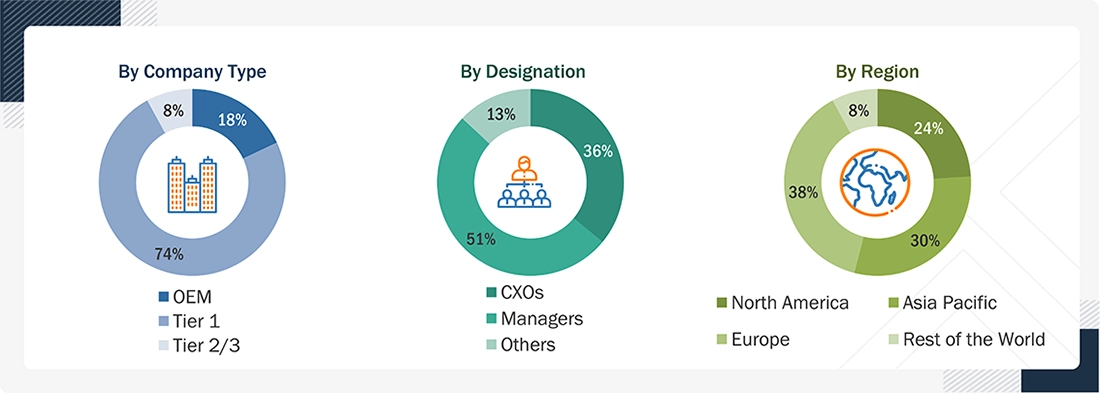
In the primary research process, various primary sources from both the supply and demand sides were interviewed to obtain qualitative and quantitative information on the market. The primary sources from the supply side included various industry experts, such as CXOs, vice presidents, directors from business development, marketing, product development/innovation teams, and related key executives from various key companies. Various system integrators, industry associations, independent consultants/industry veterans, and key opinion leaders were also interviewed.
Primary interviews have been conducted to gather insights such as sizing estimates on the HD maps market and forecast, future technology trends, and upcoming technologies in the HD Maps market. Data triangulation of all these points was done using the information gathered from secondary research and model mapping. Stakeholders from the demand and supply sides have been interviewed to understand their views on the abovementioned points.
Breakdown of Primary Interviews
To know about the assumptions considered for the study, download the pdf brochure
Market Size Estimation
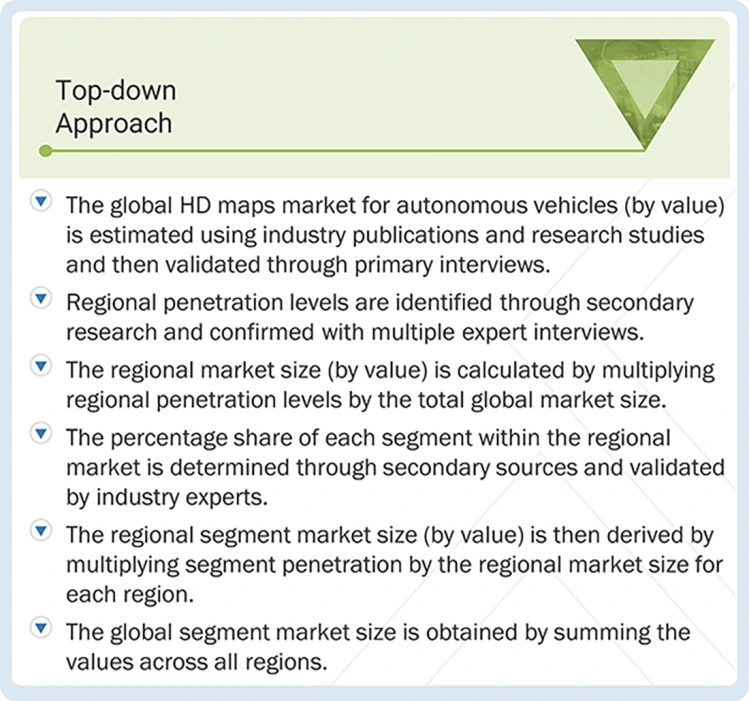
A top-down approach was used to estimate and validate the total size of the HD maps market. This method was also used extensively to estimate the size of various subsegments in the market. The research methodology used to estimate the market size includes the following:
HD Map Market : Top-Down Approach
Data Triangulation
After arriving at the overall market size using the market size estimation processes as explained above, the market was split into several segments and subsegments. To complete the overall market engineering process and arrive at the exact statistics of each market segment and subsegment, data triangulation and market breakdown procedures were employed, wherever applicable. The data was triangulated by studying various factors and trends from both the demand and supply sides.
Market Definition
HD maps are ultra-precise digital maps with centimeter-level accuracy, specifically developed for autonomous driving. They capture detailed road geometry, lane-level information, traffic signs, barriers, and 3D features of the environment. These maps enable vehicles to localize their exact position beyond GPS accuracy and plan complex driving actions safely. They are a critical layer of perception for self-driving systems.
ADAS maps are enhanced navigation maps designed to support driver-assistance features rather than full autonomy. They provide attributes such as road curvature, gradient, lane count, speed limits, and upcoming traffic conditions. These maps work in combination with sensors to improve functions such as adaptive cruise control, lane-keeping assist, and predictive powertrain control. Their role is to extend safety, comfort, and efficiency for human-driven vehicles.
Key Stakeholders
- Automobile Organizations/Associations and Government Bodies
- Automobile Original Equipment Manufacturers (OEMs)
- Automotive Camera Manufacturers
- Automotive LiDAR Manufacturers
- Automotive Radar Manufacturers
- Automotive Research Organizations
- Automotive Sensor Manufacturers
- Automotive TCU and ECU Manufacturers
- Autonomous driving HD Map Providers
- Autonomous Driving Platform Providers
- Cloud Service Providers
- EV and EV Component Manufacturers
- Internet Service Providers
- Mapping & Surveying Companies
- Mobility Service Providers
- Software Development Companies
- Vehicle Safety Regulatory Bodies
Report Objectives
- To segment and forecast the size of the HD maps market in terms of value (USD million)
- To define, describe, and forecast the market based on service type, level of automation, solution type, usage type, vehicle type, and region
-
To analyze regional markets for growth trends, prospects, and their contribution to the overall market
- To segment and forecast the market size by service type (mapping & localization, update & maintenance)
- To provide a qualitative analysis of the advertisement service type
- To segment and forecast the market size by level of automation [semi-autonomous vehicle (level 2/level 2+ and level 3) and autonomous vehicle (level 4 and level 5)]
- To segment and forecast the market size by solution type (cloud-based and embedded)
- To segment and forecast the market size by usage type (personal mobility and commercial mobility)
- To segment and forecast the market size by vehicle type (passenger car and commercial vehicle)
- To forecast the market size by region [North America, Europe, Asia Pacific, and the Rest of the World (RoW)]
- To analyze technological developments impacting the market
- To provide detailed information about the major factors (drivers, challenges, restraints, and opportunities) influencing the market growth
- To strategically analyze the market, considering individual growth trends, prospects, and contributions to the total market
-
To study the following concerning the market
- Supply Chain Analysis
- Ecosystem Analysis
- Technology Analysis
- Trade Analysis
- Case Study Analysis
- Patent Analysis
- Regulatory Landscape
- Impact of AI/Gen AI
- Trends & Disruptions Impacting Business
- Key Stakeholders & Buying Criteria
- Key Conferences & Events
- Macroeconomics Indicators
- Investment & Funding Scenario
- Phased Adoption Strategy of HD Maps in AV Ecosystem
- HD Map Data Formats and Standardization Landscape
- MNM Insights on Key Industry Solutions for Localization
- Evolving Business Models for HD Mapping in Autonomous Mobility
- Hybrid Mapping Strategies for Enhancing ADAS Development
- Impact of the Mapless Autonomy Concept on HD Maps
- Comparative Analysis of OEM HD Mapping Adoption
- HD Mapping Providers: Competitive Landscape
- Future Applications
- Success Stories and Real-World Applications
- HD Maps for Autonomous Vehicles Evolution
- OEM HD Map Dependency and Strategy Analysis
- HD Map Monetization and Revenue Models
- HD Map Provider Strategic Capability Benchmark
- HD Map Update and Maintenance Analysis
- To strategically profile key players and comprehensively analyze their market shares and core competencies
- To analyze the impact of the recession on the market
- To track and analyze competitive developments, such as deals (joint ventures, mergers & acquisitions, partnerships, collaborations), product developments and launches, and other activities carried out by key industry participants
Available customizations:
With the given market data, MarketsandMarkets offers customizations to meet company-specific needs.
- HD Maps market, by Vehicle type, at country level
- HD Maps market, by solution type, at country level
- HD Maps market, by service type, at country level
Company information
- Profiling of additional market players (up to five)
Fact checked
Personalize This Research
- Triangulate with your Own Data
- Get Data as per your Format and Definition
- Gain a Deeper Dive on a Specific Application, Geography, Customer or Competitor
- Any level of Personalization
Let Us Help You
- What are the Known and Unknown Adjacencies Impacting the HD Maps Market
- What will your New Revenue Sources be?
- Who will be your Top Customer; what will make them switch?
- Defend your Market Share or Win Competitors
- Get a Scorecard for Target Partners

Custom Market Research Services
We Will Customise The Research For You, In Case The Report Listed Above Does Not Meet With Your Requirements
Get 10% Free CustomisationTESTIMONIALS

JIM NAAS
PRODUCT DIRECTOR, WEASLER
Weasler Engineering, a CentroMotion organization
Global Provider of Industrial Actuation & Control Solutionswww.weasler.com
Our organization was interested in learning more about the attractiveness of a particular market space. We contacted MarketsandMarkets to help us based on previous positive experiences we had with them. The results did not disappoint! We discussed our objectives with them, and the team at MarketsandMarkets developed and executed a proposal that met our needs precisely. We were very impressed by their level of expertise, the quality of the analysis and their insightful recommendations. We would not hesitate in working with them again in the future.

Matt Kardel,
Vice President
Aptiv,
A global technology company that develops safer, greener and more connected solutions.www.aptiv.com
We contracted with
MarketsandMarkets to evaluate the value chain and potential go-to-market partners related to our
interest in the Fleet Management space. The team successfully completed the work on time and at the
pricing agreed. MarketsandMarkets listened and understood our objectives and collaborated well with
us to help us get the visibility we needed to make an investment.
We have subsequently used
MarketsandMarkets again related to Smart Cities to good results.
Growth opportunities and latent adjacency in HD Maps Market






Imejebe
Jun, 2026
Automotive safety, security and Repair diagnoses .
X.
Jun, 2026
AI, HD map, computer vision, AI-powered mapmaking, autonomous driving, generative AI, agentic AI .