



Advanced Driver Assistance Systems Market Size, Share & Analysis
Report Code
AT 2068
Published in
Apr, 2026, By MarketsandMarkets™
ADAS market by PC, LCV, HCV System Type (ACC, AEB, LDW, BSD), Offering Type [Hardware (Camera, Radar, LiDAR) and Software], LOA (L1, L2, L3, L4, L5), Safety Application (OCS, DashCam), EV Type, and Region - Global Forecast to 2033

USD 58.84 BN
MARKET SIZE, 2033

CAGR 14.0%
(2026-2033)

550
REPORT PAGES

250
MARKET TABLES
OVERVIEW
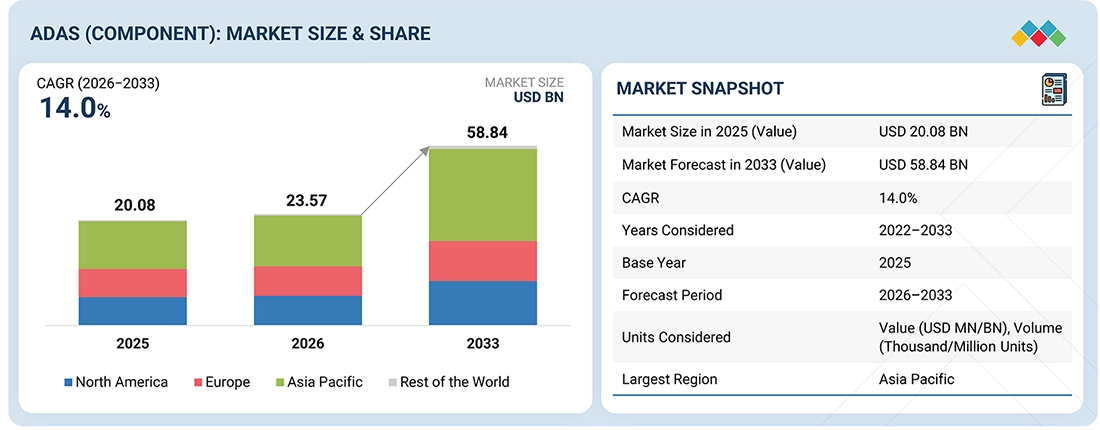
Source: Secondary Research, Interviews with Experts, MarketsandMarkets Analysis
The ADAS Market for components is projected to grow from USD 23.57 billion in 2026 to USD 58.84 billion by 2033, at a CAGR of 14.0%. The market is expected to witness strong growth, driven by the regulatory shift toward mandatory vehicle safety systems and the rapid deployment of Level 2 and Level 3 autonomy by OEMs. Governments across key regions are enforcing ADAS adoption through stringent regulations. For instance, the EU GSR mandates features such as AEB, lane keeping assist, and DMS for new vehicle types, including passenger cars, vans, trucks, and buses, from July 2022 and for all new vehicles from July 2024. In the US, the NHTSA finalized FMVSS No. 127 in April 2024, requiring new light vehicles, up to 10,000 lbs GVWR, to be equipped with AEB, including pedestrian detection, with implementation beginning in September 2029. Similarly, the China NCAP 2024 update strengthens evaluation criteria for collision avoidance and driver assistance features in passenger vehicles, with higher weighting for AEB and vulnerable road user protection in safety ratings. These regulations are transforming ADAS from optional features to standard fitment across vehicle segments. As a result, the ADAS market is projected to increase from 361.4 million units in 2026 to 582.6 million units by 2033, at a CAGR of 7.1%, creating sustained demand for cameras, radars, LiDARs, ECUs, domain controllers, and other ADAS components. In addition, the transition toward software-defined vehicles and electric platforms is accelerating ADAS integration through advancements in sensor fusion and centralized computing. The growing adoption of in-cabin sensing for driver and occupant monitoring is also expanding the scope of ADAS beyond external safety, supporting long-term growth of the ADAS market.
MARKET SCOPE
| REPORT METRIC | DETAILS |
|---|---|
| Market Size Volume in 2026 | 23.57 Billion |
| Market Size Forecast in 2033 | 58.84 Billion |
| Growth Rate | CAGR of 14.0% from 2026-2033 |
| Actual data | 2022-2033 |
| Base year | 2025 |
| Forecast period | 2026-2033 |
| Units considered | Value (USD Million) and Volume (Thousand Units) |
| Report Coverage | Revenue forecast, company ranking, competitive landscape, growth factors, and trends |
| Top Companies |
|
| Growth Drivers |
|
| Segments Covered |
|
| Regional Scope | Asia Pacific, Europe, North America, and Rest of the World |
KEY TAKEAWAYS
-
By RegionThe Asia Pacific dominates the ADAS market, with a share of 45.5% in 2026.
-
By Passenger Car System TypeBy passenger car system type, night vision system is projected to register the highest CAGR of 36.1%.
-
By Light Commercial Vehicle System TypeBy light commercial vehicle system type, traffic jam assist is projected to grow at the fastest rate of 39.5% from 2026 to 2033.
-
By Heavy Commercial Vehicle System TypeBy heavy commercial vehicle system type, the automatic emergency braking is expected to dominate the market.
-
BY Level of AutonomyBy level of autonomy, Level 2 vehicles are projected to hold the largest market share during the forecast period.
-
BY Offering TypeBy hardware offering, LiDAR is projected to grow at a high CAGR during the forecast period.
-
BY Electric Vehicle TypeBy electric vehicle type, the BEV segment is projected to hold the largest market share during the forecast period.
-
Competitive Landscape: Key PlayersRobert Bosch GmbH, Aumovio SE, and Denso Corporation were identified as some of the star players in the ADAS market, given their strong market share and product footprint.
-
Competitive Landscape: SMEsAisin Corporation, Renesas Electronics Corporation, and Infineon Technologies AG, among others, have distinguished themselves among startups and SMEs by securing strong footholds in specialized niche areas, underscoring their potential as emerging market leaders
The ADAS market is shifting toward centralized, software-defined architectures, where functions are consolidated into domain or zonal controllers rather than distributed ECUs, increasing software content per vehicle. There is a transition from feature-based deployment to stack-based ADAS packages (L2/L2+), where OEMs bundle capabilities such as highway assist, automated parking, and navigation-based functions, driving higher system ASPs. Additionally, sensor fusion is becoming compute-led, with greater reliance on AI accelerators and high-performance SoCs to process camera, radar, and LiDAR data in real time. OEMs are also prioritizing scalable ADAS platforms that can be deployed across ICE and EV lineups with minimal hardware variation, enabling faster time-to-market and cost optimization. EVs are expected to grow at a CAGR of 12.1% in the market, further supporting this transition.
TRENDS & DISRUPTIONS IMPACTING CUSTOMERS' CUSTOMERS
Trends and disruptions in the ADAS market reveal the current and future trends. Current revenues are primarily derived from sensor hardware, ECUs, and integration components, while emerging revenue streams are increasingly linked to AI-driven software, centralized compute, and data-enabled capabilities. The shift reflects deeper collaboration between technology providers, OEMs, and suppliers to deliver integrated ADAS solutions. This evolution ultimately enables enhanced safety, continuous feature upgrades, and improved operational efficiency for end users such as drivers and fleet operators.

Source: Secondary Research, Interviews with Experts, MarketsandMarkets Analysis
MARKET DYNAMICS

Drivers
Impact
Level
Level
-
Rising demand for enhanced vehicle safety and driving comfort through ADAS

-
Increasing regulatory mandates and safety standard compliance


RESTRAINTS
Impact
Level
Level
-
Infrastructure gaps limiting effective deployment of ADAS and autonomous systems

-
Consumer trust and acceptance challenges for autonomous vehicle technologies


OPPORTUNITIES
Impact
Level
Level
-
Advancements in autonomous driving technologies enabling next-generation ADAS capabilities

-
EV-driven innovation accelerating enhanced safety and user experience integration


CHALLENGES
Impact
Level
Level
-
High integration costs and system complexity limiting ADAS adoption

-
Sensor reliability and performance constraints impacting ADAS effectiveness

Source: Secondary Research, Interviews with Experts, MarketsandMarkets Analysis
Driver: Rising demand for enhanced vehicle safety and driving comfort through ADAS
Increasing road accidents and stricter safety rating programs such as NCAP are encouraging automakers to integrate ADAS features like Automatic Emergency Braking (AEB), Lane Keeping Assist (LKA), and Adaptive Cruise Control (ACC). At the same time, customers are showing higher interest in convenience features such as adaptive cruise control and automated parking. This is leading manufacturers to offer ADAS features as standard or mid-level options in vehicles.
Restraint: Infrastructure gaps limiting effective deployment of ADAS and autonomous systems
Uneven road infrastructure, including poor lane markings, insufficient road signs, and limited vehicle-to-everything (V2X) systems, affects the performance of ADAS technologies. Camera- and LiDAR-based systems face reliability issues, especially in developing markets. This slows down the adoption of advanced ADAS features beyond controlled or well-developed environments.
Opportunity: Advancements in autonomous driving technologies enabling next-generation ADAS capabilities
Advancements in sensor fusion, AI-based perception, and high-performance computing are enabling a shift from traditional rule-based ADAS to more scalable, data-driven systems. These improvements support Level 2+ and Level 3 automation, allowing automakers to introduce features such as highway autopilot, hands-free driving, and urban driving assistance.
Challenge: High integration costs and system complexity limiting ADAS adoption
The integration of multiple sensors such as radar, cameras, and LiDAR, along with domain controllers and extensive software validation, increases overall system costs. This is particularly challenging for mass-market vehicles. In addition, complexities related to system integration, compliance with functional safety standards like ISO 26262, and managing OTA updates make it difficult for automakers to scale ADAS across all vehicle segments.
ADVANCED DRIVER ASSISTANCE SYSTEMS MARKET SIZE, SHARE & ANALYSIS: COMMERCIAL USE CASES ACROSS INDUSTRIES
| COMPANY | USE CASE DESCRIPTION | BENEFITS |
|---|---|---|
 |
DRIVE platform delivering high-performance SoCs and AI compute for perception & sensor fusion | High compute-per-watt for L2+ to L4 autonomy; flexible development for OEMs and Tier 1s |
 |
Advanced driver assistance solutions (ADAS ECUs, radar, camera, LiDAR integration) | Reliable safety performance; modular solutions adaptable to passenger and commercial vehicles |
 |
Provides ADAS vision-based SoCs and algorithms for OEMs (e.g., lane departure, pedestrian detection) | Scalable ADAS integration for multiple automakers; accelerated time-to-market |
 |
Radar and camera-based systems for AEB, lane assist, and adaptive cruise control | Proven safety technologies; compliance with global safety regulations |
 |
Snapdragon Ride platform for scalable ADAS and automated driving compute | Low-power, high-performance SoCs; cost-efficient deployment across vehicle segments |
Logos and trademarks shown above are the property of their respective owners. Their use here is for informational and illustrative purposes only.
MARKET ECOSYSTEM
The ADAS market ecosystem includes OEMs, Tier 1 suppliers, autonomous vehicle developers, software and systems providers, processor (SoC) providers, and sensor providers. Some of the major ADAS system providers include Robert Bosch GmbH (Germany), AUMOVIO SE (Germany), Denso Corporation (Japan), ZF Friedrichshafen AG (Germany), and Magna International Inc. (Canada). The companies focus on developing advanced safety solutions, forming strategic partnerships with OEMs, and investing in sensor fusion, AI, and software platforms to strengthen their ADAS offerings and expand market presence.

Logos and trademarks shown above are the property of their respective owners. Their use here is for informational and illustrative purposes only.
MARKET SEGMENTS

Source: Secondary Research, Interviews with Experts, MarketsandMarkets Analysis
ADAS Market, By Passenger Car System Type
Adaptive cruise control (ACC) holds a significant share of the passenger car ADAS market. ACC uses a reliable radar-based system that performs well at highway speeds and adds relatively low cost. This allows manufacturers to offer it across many vehicle variants and use it as a base for Level 2 highway assist systems. Since ACC operates on the same radar and camera platform as AEB, automakers often offer both features together. ACC supports everyday driving comfort, while AEB improves safety, helping increase adoption across different vehicle segments.
ADAS Market, By Light Commercial Vehicle System Type
Lane departure warning (LDW) is expected to hold a significant share in the light commercial vehicles ADAS market as it helps reduce accidents caused by driver fatigue and distraction, especially during long trips and urban deliveries. These situations often lead to unintended lane drifting. LDW uses a camera-based system that is simple and requires minimal additional hardware, making it cost-effective and easy to install. This allows manufacturers to deploy it widely across fleet vehicles while meeting increasing safety regulations.
ADAS Market, Heavy Commercial Vehicle System Type
Automated emergency braking (AEB) leads the heavy commercial vehicle ADAS market. It helps prevent serious rear-end and multi-vehicle accidents. Due to the large size and longer stopping distances of these vehicles, collisions can cause severe damage and high costs, making AEB an important safety feature. It uses radar and camera systems to detect obstacles early and automatically apply brakes. AEB is increasingly required by regulations in major markets; for instance, India is mandating AEB in heavy commercial vehicles from 2028. In addition, fleet operators are widely adopting AEB to reduce insurance costs, minimize vehicle downtime, and lower accident-related losses.
ADAS Market, By Offering Type
Radar sensors dominate the ADAS hardware market because they work reliably in all weather conditions, including rain, fog, and dust. This makes them essential for key functions such as ACC and AEB, where consistent and accurate object detection is required. In addition, the shift to 77 GHz radar provides better resolution and longer detection range at a lower cost compared to LiDAR. This allows automakers to use multiple radar sensors (short-, mid-, and long-range) across different vehicle segments, supporting wider adoption.
ADAS Market, By Level of Autonomy
Level 2 vehicles dominate the ADAS market as they provide features such as combined steering and speed control, without the regulatory, liability, and testing challenges linked to Level 3 and higher autonomy. This allows automakers to introduce these systems more quickly across high-volume vehicle segments. Further, Level 2 systems use scalable sensor setups, mainly cameras and radar, along with well-developed control units. This helps reduce costs and enables their use in mid-range vehicles, while also matching current regulations and consumer acceptance.
ADAS Market, By Safety Application
Occupant Classification Systems (OCS) lead the ADAS market because they are directly connected to airbag deployment. They identify whether a seat is occupied by an adult, child, or is empty, ensuring proper airbag activation and compliance with safety regulations (such as child seat suppression). Since OCS can be integrated into seat sensors and airbag control units at a relatively low additional cost and are required for regulatory compliance and NCAP ratings, they are widely adopted across all vehicle segments, unlike many optional ADAS features.
ADAS Market, By Electric Vehicle Type
Battery electric vehicles (BEVs) lead the ADAS market as their centralized electrical and electronic architectures support easier integration of advanced features. Their high-performance controllers allow efficient use of sensor data, OTA updates, and complex ADAS functions without the limitations of older vehicle systems. In addition, BEVs are marketed as advanced, technology-focused vehicles. Automakers often include features such as highway assist and automated parking as standard or subscription options, helping differentiate their models and support higher pricing.
REGION
Asia Pacific is projected to lead the ADAS market during the forecast period
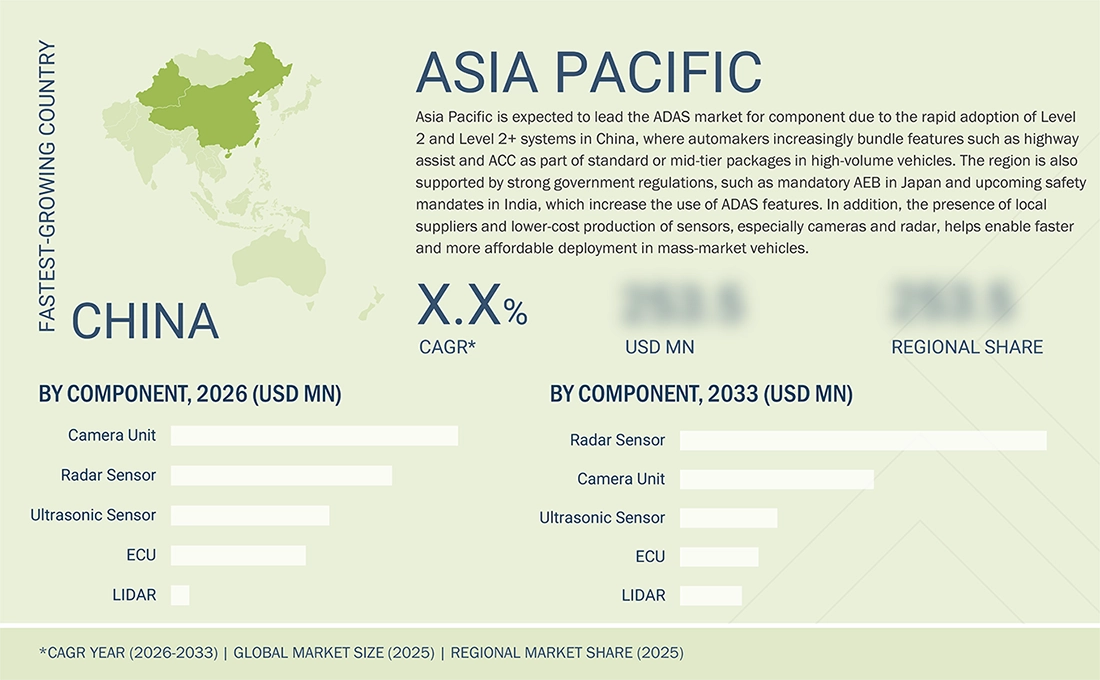
The Asia Pacific leads the ADAS market due to high vehicle production volumes concentrated in China, Japan, and South Korea, where OEMs are integrating ADAS at scale across both premium and mid-segment vehicles. Additionally, strong government mandates such as China’s NCAP upgrades and Japan’s safety regulations are accelerating the standardization of features like AEB and LKA. The region also benefits from a dense local supply chain for semiconductors, sensors, and electronic control units, reducing system costs and enabling faster deployment.
Asia Pacific
The Asia Pacific ADAS market is projected to grow from $36263 Million in 2026 and projected to reach to $53696 Million by 2031, representing a CAGR of 5.8%. Asia Pacific's Lane Departure Warning System market is poised for robust expansion, driven by China's manufacturing scale, Japan's technology maturity, and South Korea's innovation leadership.
North America
The North America ADAS market is projected to grow from $247 Million in 2026 and projected to reach to $713 Million by 2031, representing a CAGR of 16.3%. North America's ADAS market is experiencing robust expansion, driven by stringent regulatory requirements, consumer demand for vehicle safety, and rapid technological advancement in autonomous driving systems.
Europe
The Europe ADAS market is projected to grow from $23930 Million in 2026 and projected to reach to $41171 Million by 2031, representing a CAGR of 8.1%. Europe's ADAS market is experiencing accelerated growth driven by stringent EU safety regulations, increasing consumer demand for advanced driver assistance features, and substantial investments from established automotive manufacturers.
ADVANCED DRIVER ASSISTANCE SYSTEMS MARKET SIZE, SHARE & ANALYSIS: COMPANY EVALUATION MATRIX
In the ADAS market matrix, Robert Bosch GmbH (Star) leads with a strong global presence and comprehensive ADAS offerings, driving market expansion and revenue growth through innovative sensor technologies, robust partnerships with OEMs, and end-to-end ADAS solutions. Mobileye (Emerging Leader) is gaining traction with advanced camera-based perception systems, high-accuracy mapping solutions, and strategic collaborations with automotive manufacturers. The company shows strong growth potential to advance toward the leaders' quadrant.

Source: Secondary Research, Interviews with Experts, MarketsandMarkets Analysis
KEY MARKET PLAYERS
- Robert Bosch GmbH (Germany)
- Aumovio SE (Germany)
- Denso Corporation (Japan)
- ZF Friedrichshafen AG (Germany)
- Magna International Inc. (Canada)
- Mobileye (Israel)
- Aptiv (Ireland)
- Valeo (France)
- Hyundai Mobis (South Korea)
- NVIDIA Corporation (US)
- NXP Semiconductors (Netherlands)
- Autoliv (Sweden)
- ASTEMO LTD. (Japan)
WHAT IS IN IT FOR YOU: ADVANCED DRIVER ASSISTANCE SYSTEMS MARKET SIZE, SHARE & ANALYSIS REPORT CONTENT GUIDE

DELIVERED CUSTOMIZATIONS
We have successfully delivered the following deep-dive customizations:
| CLIENT REQUEST | CUSTOMIZATION DELIVERED | VALUE ADDS |
|---|---|---|
| Global Tier 1 Supplier (Europe) |
|
|
| Automotive OEM (North America) |
|
|
| Semiconductor Company (Asia Pacific) |
|
|
| Mobility-as-a-Service Operator (Global) |
|
|
| Cloud/AI Provider (US) |
|
|
RECENT DEVELOPMENTS
- July 2026: AVSimulation released SCANeR 2026.2, adding stronger AD/ADAS validation capabilities through support for the ADASIS v3 protocol in its Electronic Horizon model. The update enables SCANeR to generate a dynamic, lane-level road horizon and transmit standardized ADASIS v3 messages to external applications for AD/ADAS testing.
- December 2025: aiMotive announced a collaboration with LG to develop an integrated IVI/ADAS High-Performance Computing (HPC) Lite platform for next-generation software-defined vehicles. The platform incorporates aiMotive’s aiDrive software and supports Level 2+ automated navigation-assisted driving using a multi-camera, multi-radar configuration without HD maps; the solution was scheduled for CES 2026 demonstration.
- November 2025: dSPACE partnered with OMNIVISION to integrate realistic OMNIVISION CMOS image-sensor models into AURELION, dSPACE’s physics-based sensor-simulation platform. The development enables virtual reproduction of camera behavior under different driving conditions, allowing engineers to test and validate ADAS perception systems earlier in the development cycle and reduce reliance on physical testing.
- August 2025: Applied Intuition launched its Self-Driving System (SDS) for Automotive, an end-to-end white-box autonomy software stack for passenger vehicles. The platform is designed to provide scalable L2++ ADAS capabilities with a pathway toward L3/L4, combining ADAS functions with an integrated development and validation toolchain and support for continuous post-production feature upgrades.
- January 2025: Ansys and Cognata announced the integration of Ansys AVxcelerate Sensors into Cognata’s Automated Driving Perception Hub (ADPH) on Microsoft Azure. The platform combines physics-based radar simulation with virtual camera, LiDAR and thermal-camera models, enabling OEMs and Tier 1 suppliers to test and validate ADAS/AV sensors and perception systems in virtual environments against diverse driving conditions and safety standards.
Table of Contents
 Exclusive indicates content/data unique to MarketsandMarkets and not available with any competitors.
TITLE
PAGE NO
1
INTRODUCTION
35
2
EXECUTIVE SUMMARY
45
3
PREMIUM INSIGHTS
51
4
MARKET OVERVIEW
ADAS market growth hinges on regulatory compliance, tech advancements, and overcoming integration challenges.
57
4.1
INTRODUCTION
4.2
ADAS MARKET DYNAMICS
4.2.1
DRIVERS
4.2.1.1
RISING DEMAND FOR ENHANCED VEHICLE SAFETY AND DRIVING COMFORT THROUGH ADAS
4.2.1.2
INCREASING REGULATORY MANDATES AND SAFETY STANDARD COMPLIANCE
4.2.2
RESTRAINTS
4.2.2.1
INFRASTRUCTURE GAPS LIMITING EFFECTIVE DEPLOYMENT OF ADAS AND AUTONOMOUS SYSTEMS
4.2.2.2
CONSUMER TRUST AND ACCEPTANCE CHALLENGES FOR AUTONOMOUS VEHICLE TECHNOLOGIES
4.2.3
OPPORTUNITIES
4.2.3.1
ADVANCEMENTS IN AUTONOMOUS DRIVING TECHNOLOGIES ENABLING NEXT-GENERATION ADAS CAPABILITIES
4.2.3.2
EV-DRIVEN INNOVATION ACCELERATING ENHANCED SAFETY AND USER EXPERIENCE INTEGRATION
4.2.4
CHALLENGES
4.2.4.1
HIGH INTEGRATION COSTS AND SYSTEM COMPLEXITY LIMITING ADAS ADOPTION
4.2.4.2
SENSOR RELIABILITY AND PERFORMANCE CONSTRAINTS IMPACTING ADAS EFFECTIVENESS
4.2.5
IMPACT ANALYSIS OF MARKET DYNAMICS
4.3
UNMET NEEDS AND WHITE SPACES
4.3.1
UNMET NEEDS IN ADAS MARKET
4.3.2
WHITE SPACE OPPORTUNITIES
4.4
INTERCONNECTED MARKETS AND CROSS-SECTOR OPPORTUNITIES
4.4.1
INTERCONNECTED MARKETS
4.4.2
CROSS-SECTOR OPPORTUNITIES
4.5
STRATEGIC MOVES BY TIER 1/2/3 PLAYERS
5
INDUSTRY TRENDS
Navigate the evolving ADAS landscape with insights on pricing, supply chain, and industry disruptions.
73
5.1
MACROECONOMIC INDICATORS
5.1.1
GDP TRENDS AND FORECAST
5.1.2
TRENDS IN GLOBAL ADAS MARKET
5.1.3
TRENDS IN GLOBAL AUTONOMOUS VEHICLE INDUSTRY
5.2
TRENDS/DISRUPTIONS IMPACTING CUSTOMER BUSINESS
5.3
PRICING ANALYSIS
5.3.1
AVERAGE SELLING PRICE TREND OF CAMERA UNITS, BY REGION, 2023–2025
5.3.2
AVERAGE SELLING PRICE TREND OF LIDARS, BY REGION, 2023–2025
5.3.3
AVERAGE SELLING PRICE TREND OF RADAR SENSORS, BY REGION, 2023–2025
5.3.4
AVERAGE SELLING PRICE TREND OF ULTRASONIC SENSORS, BY REGION, 2023–2025
5.4
ECOSYSTEM ANALYSIS
5.4.1
OEMS
5.4.2
TIER 1 SUPPLIERS
5.4.3
AUTONOMOUS VEHICLE DEVELOPERS
5.4.4
SOFTWARE AND SYSTEMS PROVIDERS
5.4.5
LIDAR SYSTEM PROVIDERS
5.4.6
RADAR SYSTEM PROVIDERS
5.4.7
CAMERA SUPPLIERS
5.4.8
PROCESSOR (SOC) MANUFACTURERS
5.4.9
SENSOR COMPONENT SUPPLIERS
5.5
SUPPLY CHAIN ANALYSIS
5.6
CASE STUDY ANALYSIS
5.6.1
ACCELERATING AUTONOMOUS DRIVING WITH ADVANCED ADAS SOLUTIONS
5.6.2
ACCELERATING SAFE AND SCALABLE ADAS DEVELOPMENT WITH EDGE-CENTRIC DATA MANAGEMENT
5.6.3
SCENARIO-BASED TESTING VALIDATION FOR ADS/ADAS
5.6.4
KONRAD TECHNOLOGIES TO CONDUCT ADAS SENSOR PACKAGE AND RELIABILITY TEST
5.6.5
NVIDIA TO PROVIDE OPEN AV DEVELOPMENT PLATFORM FOR AUTONOMOUS VEHICLES
5.6.6
ZF TO RELEASE NEW AI-BASED SERVICES FOR ADAS
5.6.7
RENESAS TO BOOST DEEP LEARNING DEVELOPMENT FOR ADAS AND AUTOMATED DRIVING APPLICATIONS
5.6.8
MERCEDES-BENZ USED ANSYS OPTISLANG FOR ADAS VALIDATION THROUGH RELIABLE ANALYSIS
5.7
INVESTMENT AND FUNDING SCENARIO
5.8
SUPPLIER ANALYSIS
5.8.1
ADAS SUPPLIERS, BY KEY OEMS
5.8.2
RADAR (MILLIMETER WAVE RADAR, LIDAR, AND OTHERS), BY KEY OEMS
5.8.3
CAMERA, BY KEY OEMS
5.8.4
PARKING ASSIST, BY KEY OEMS
5.8.5
VEHICLE-APPROACH NOTICE CONTROL UNIT, BY KEY OEMS
5.8.6
CRUISE CONTROL, BY KEY OEMS
5.8.7
DRIVER MONITORING SYSTEM, BY KEY OEMS
5.8.8
HIGH-DEFINITION MAP, BY KEY OEMS
5.8.9
LANE DEPARTURE WARNING SYSTEM, BY KEY OEMS
5.8.10
TIRE PRESSURE MONITORING SYSTEM, BY KEY OEMS
5.8.11
ADAS OFFERINGS BY KEY PLAYERS
5.8.11.1
TESLA
5.8.11.2
TOYOTA MOTOR CORPORATION
5.8.11.2.1
COROLLA
5.8.11.2.2
CAMRY
5.8.11.2.3
RAV4
5.8.11.2.4
TUNDRA
5.8.11.3
NISSAN MOTOR CO., LTD.
5.8.11.3.1
VERSA
5.8.11.3.2
ALTIMA
5.8.11.3.3
NISSAN LEAF
5.8.11.4
MERCEDES-BENZ
5.8.11.4.1
S-CLASS SEDAN
5.8.11.4.2
C-CLASS SEDAN
5.8.11.4.3
E-CLASS SEDAN
5.8.11.5
AUDI
5.8.11.5.1
A3 SEDAN
5.8.11.5.2
A6 SEDAN
5.9
SEMIAUTONOMOUS AND AUTONOMOUS VEHICLE DEVELOPMENT AND DEPLOYMENT
5.9.1
LEVEL 3
5.9.2
LEVEL 4 AND LEVEL 5
5.9.2.1
GLOBAL ADAS AND AUTONOMOUS DRIVING DEPLOYMENTS BY KEY REGIONS
5.9.2.2
BAIDU
5.9.2.3
DIDI
5.9.2.4
PONY.AI AND HYUNDAI
5.9.2.5
WAYMO
5.9.2.6
VOLVO
5.9.2.7
EINRIDE
5.9.3
KEY DISTINCTIONS BETWEEN LEVEL 2/LEVEL 3 AND LEVEL 4 AUTONOMOUS DRIVING STACKS
5.9.4
ADVANCEMENT TO LEVEL 4 IN MOBILITY & TRUCKING
5.10
TRADE ANALYSIS
5.10.1
IMPORT DATA
5.10.2
EXPORT DATA
5.11
UNLOCKING NEW REVENUE STREAMS: SUBSCRIPTION-DRIVEN ADAS SERVICES IN SOFTWARE-DEFINED VEHICLES
5.12
KEY CONFERENCES AND EVENTS, 2026–2027
5.13
MNM INSIGHTS INTO HIGH-PERFORMANCE CHIPS POWERING NEXT-GEN ADAS AND AUTONOMY
5.14
IMPACT OF ISRAEL-IRAN WAR
5.14.1
INTRODUCTION
5.14.2
ENERGY MARKET DISRUPTION
5.14.3
OPERATING COST IMPACT
5.14.4
MARKET DEMAND SHIFT
5.14.5
SUPPLY CHAIN AND LOCALIZATION IMPACT
5.14.6
STRATEGIC MARKET OUTLOOK
5.15
EU-INDIA TRADE DEAL IMPACT ANALYSIS
5.15.1
INTRODUCTION
5.15.2
EU TARIFFS
5.15.3
IMPORTS TO INDIA
5.15.4
EXPORTS FROM INDIA
6
TECHNOLOGICAL ADVANCEMENTS
Explore groundbreaking vehicle technologies driving future mobility and reshaping ride-hailing with AI integration.
128
6.1
PATENT ANALYSIS
6.2
TECHNOLOGY ANALYSIS
6.2.1
INTRODUCTION
6.2.2
KEY TECHNOLOGIES
6.2.2.1
COCKPIT-ADAS INTEGRATION PLATFORM FOR CENTRALIZED VEHICLE COMPUTING
6.2.2.2
PRECISION LOCALIZATION SYSTEM FOR ASSISTED AND AUTOMATED DRIVING
6.2.2.3
SOFTWARE-BASED VIDEO PERCEPTION SYSTEM FOR DRIVING AND PARKING AUTOMATION
6.2.3
COMPLEMENTARY TECHNOLOGIES
6.2.3.1
COOPERATIVE ADAPTIVE CRUISE CONTROL
6.2.3.2
AUTONOMOUS VEHICLES: CYBERSECURITY AND DATA PRIVACY
6.2.3.3
VEHICLE-TO-EVERYTHING (V2X) COMMUNICATION
6.2.3.3.1
VEHICLE-TO-CLOUD (V2C)
6.2.3.3.2
VEHICLE-TO-PEDESTRIAN (V2P)
6.2.3.3.3
VEHICLE-TO-INFRASTRUCTURE (V2I)
6.2.3.3.4
VEHICLE-TO-VEHICLE (V2V)
6.2.3.3.5
CELLULAR V2X
6.2.4
ADJACENT TECHNOLOGIES
6.2.4.1
AUTOMATED VEHICLES ARE RESHAPING RIDE-HAILING
6.2.4.1.1
IMPACT OF AUTOMATION L2 ON RIDE-HAILING
6.2.4.1.2
IMPACT OF AUTOMATION L3 ON RIDE-HAILING
6.2.4.1.3
IMPACT OF AUTOMATION L4/L5 ON RIDE-HAILING
6.3
TECHNOLOGY/PRODUCT ROADMAP
6.3.1
SHORT-TERM (2026–2027): FOUNDATION AND EARLY COMMERCIALIZATION
6.3.2
MID-TERM (2028–2030): EXPANSION AND STANDARDIZATION
6.3.3
LONG-TERM (2031–2035+): MASS COMMERCIALIZATION AND DISRUPTION
6.4
IMPACT OF AI/GENERATIVE AI
6.4.1
TOP USE CASES AND MARKET POTENTIAL
6.4.1.1
AI AND GENERATIVE AI CAPABILITIES
6.4.1.2
AI FOR ADAS IN PRACTICE
6.4.2
BEST PRACTICES FOLLOWED BY MANUFACTURERS
6.4.2.1
SAFETY STANDARDS & VALIDATION
6.4.2.2
REGULATORY COMPLIANCE
6.4.2.3
DATA GOVERNANCE & PRIVACY
6.4.2.4
COMPUTE ARCHITECTURE & DEPLOYMENT
6.4.2.5
OVER-THE-AIR UPDATES
6.4.3
CASE STUDIES RELATED TO AI IMPLEMENTATION
6.4.3.1
ACCELERATING ADAS SAFETY VALIDATION USING GENERATIVE AI AND SIMULATION
6.4.3.2
SCALABLE AND COST-EFFICIENT ADAS DEPLOYMENT WITH AI-DRIVEN GEN6 PLATFORM
6.4.3.3
ACCELERATING ADAS DEPLOYMENT WITH A PRE-INTEGRATED AI AND SOC PLATFORM
6.4.3.4
SCALING ADVANCED ADAS IN INDIA WITH A SINGLE-CHIP AI PLATFORM
6.4.4
INTERCONNECTED ECOSYSTEM AND IMPACT OF MARKET PLAYERS
6.4.5
CLIENTS’ READINESS TO ADOPT AI
7
REGULATORY LANDSCAPE AND SUSTAINABILITY INITIATIVES
Navigate complex global regulations and sustainability standards to optimize eco-friendly compliance strategies.
151
7.1
REGIONAL REGULATIONS AND COMPLIANCE
7.1.1
REGULATORY BODIES, GOVERNMENT AGENCIES, AND OTHER ORGANIZATIONS
7.1.1.1
NORTH AMERICA
7.1.1.2
EUROPE
7.1.1.3
ASIA PACIFIC
7.1.2
KEY REGULATIONS
7.1.2.1
ADAS REGULATIONS AND INITIATIVES
7.1.2.2
NCAP REGULATIONS
7.2
SUSTAINABILITY INITIATIVES
7.2.1
CARBON IMPACT AND ECO-APPLICATIONS
7.2.1.1
LIFECYCLE VS. OPERATION
7.2.1.2
ECO APPLICATIONS
7.2.2
SUSTAINABILITY IMPACT AND REGULATORY POLICY INITIATIVES
7.2.2.1
EUROPEAN UNION
7.2.2.2
US
7.2.2.3
CHINA
7.2.2.4
INDIA
7.2.3
CERTIFICATIONS, LABELING, AND ECO-STANDARDS
7.2.3.1
TYPE I ECOLABELS (ISO 14024)
7.2.3.2
PRODUCT CARBON FOOTPRINT (ISO 14067)
7.2.3.3
ECODESIGN AND MATERIAL STANDARDS (IEC 62430)
7.2.3.4
HAZARDOUS SUBSTANCE RESTRICTIONS (ROHS/REACH)
7.2.3.5
CIRCULAR ECONOMY & RECYCLING CERTIFICATION
8
CUSTOMER LANDSCAPE AND BUYER BEHAVIOR
Unlock unmet needs and decision dynamics to optimize ADAS market penetration strategies.
161
8.1
DECISION-MAKING PROCESS
8.2
KEY STAKEHOLDERS IN BUYING PROCESS AND THEIR EVALUATION CRITERIA
8.2.1
KEY STAKEHOLDERS IN BUYING PROCESS
8.2.2
BUYING CRITERIA
8.3
ADOPTION BARRIERS AND INTERNAL CHALLENGES
8.4
UNMET NEEDS OF VARIOUS END USERS/END-USE INDUSTRIES
9
PASSENGER CAR ADAS MARKET, BY SYSTEM TYPE
Market Size & Growth Rate Forecast Analysis to 2033 in Units | 28 Data Tables
167
9.1
INTRODUCTION
9.2
ADAPTIVE CRUISE CONTROL (ACC)
9.2.1
OEMS BUNDLING ACC WITH LANE-CENTERING FEATURES TO DRIVE GROWTH
9.3
ADAPTIVE FRONT LIGHTS (AFL)
9.3.1
RISING ADOPTION OF LED AND MATRIX LIGHTING SYSTEMS TO DRIVE GROWTH
9.4
AUTOMATIC EMERGENCY BRAKING (AEB)
9.4.1
REGULATORY MANDATES FOR AEB ACROSS MAJOR COUNTRIES TO DRIVE GROWTH
9.5
BLIND SPOT DETECTION (BSD)
9.5.1
HIGH TWO-WHEELER AND MIXED-TRAFFIC DENSITY IN URBAN ENVIRONMENTS TO DRIVE GROWTH
9.6
CROSS TRAFFIC ALERT (CTA)
9.6.1
LIMITED REAR VISIBILITY IN SUVS AND CROSSOVERS TO DRIVE GROWTH
9.7
DRIVER MONITORING SYSTEM (DMS)
9.7.1
REGULATORY REQUIREMENTS TO INCLUDE DMS IN NEW VEHICLES TO DRIVE GROWTH
9.8
FORWARD COLLISION WARNING (FCW)
9.8.1
OEM’S STANDARDIZATION OF FCW ACROSS ENTRY- AND MID-LEVEL VEHICLES TO DRIVE GROWTH
9.9
INTELLIGENT PARK ASSIST (IPA)
9.9.1
INCREASING URBAN PARKING CONSTRAINTS IN DENSE CITIES TO DRIVE GROWTH
9.10
LANE DEPARTURE WARNING SYSTEM (LDW)
9.10.1
MAJOR OEMS OFFERING LDW AS STANDARD FEATURE ACROSS NEW VEHICLES TO DRIVE GROWTH
9.11
NIGHT VISION SYSTEM (NVS)
9.11.1
HIGHER INCIDENCE OF NIGHTTIME ACCIDENTS ON HIGHWAYS AND RURAL ROADS TO DRIVE GROWTH
9.12
ROAD SIGN RECOGNITION (RSR)
9.12.1
GROWING INTEGRATION WITH ADAPTIVE CRUISE CONTROL AND SPEED-LIMITING SYSTEMS TO DRIVE GROWTH
9.13
TIRE PRESSURE MONITORING SYSTEM (TPMS)
9.13.1
REGULATORY MANDATES IN MAJOR REGIONS TO DRIVE GROWTH
9.14
TRAFFIC JAM ASSIST (TJA)
9.14.1
INCREASING URBAN CONGESTION IN MEGACITIES TO DRIVE GROWTH
9.15
KEY PRIMARY INSIGHTS
10
LIGHT COMMERCIAL VEHICLE ADAS MARKET, BY SYSTEM TYPE
Market Size & Growth Rate Forecast Analysis to 2033 in Units | 28 Data Tables
185
10.1
INTRODUCTION
10.2
ADAPTIVE CRUISE CONTROL (ACC)
10.2.1
GROWING NEED FOR EFFICIENCY AND DRIVER COMFORT TO DRIVE MARKET
10.3
ADAPTIVE FRONT LIGHT (AFL)
10.3.1
NEED TO IMPROVE VISIBILITY AND OPERATIONAL SAFETY IN VARIED DRIVING ENVIRONMENTS TO DRIVE GROWTH
10.4
AUTOMATIC EMERGENCY BRAKING (AEB)
10.4.1
RISING PRESSURE TO IMPROVE FLEET SAFETY TO DRIVE GROWTH
10.5
BLIND SPOT DETECTION (BSD)
10.5.1
NEED TO REDUCE SIDE-COLLISION INCIDENTS AND LIABILITY COSTS TO DRIVE GROWTH
10.6
CROSS TRAFFIC ALERT (CTA)
10.6.1
RISING COMPLEXITY OF URBAN DELIVERY ENVIRONMENTS TO DRIVE GROWTH
10.7
DRIVER MONITORING SYSTEM (DMS)
10.7.1
INCREASING FOCUS ON DRIVER ACCOUNTABILITY AND FATIGUE MANAGEMENT TO DRIVE GROWTH
10.8
FORWARD COLLISION WARNING (FCW)
10.8.1
RISING EXPOSURE TO FRONT-END COLLISION RISKS IN URBAN DELIVERY CYCLES TO DRIVE GROWTH
10.9
INTELLIGENT PARK ASSIST (IPA)
10.9.1
GROWING OPERATIONAL CHALLENGES IN URBAN LOGISTICS TO DRIVE GROWTH
10.10
LANE DEPARTURE WARNING (LDW)
10.10.1
INCREASING EMPHASIS ON HIGHWAY SAFETY AND DRIVER COMPLIANCE TO DRIVE GROWTH
10.11
NIGHT VISION SYSTEM (NVS)
10.11.1
NEED TO IMPROVE VISIBILITY DURING OVERNIGHT LOGISTICS AND INTERCITY FREIGHT MOVEMENT TO DRIVE GROWTH
10.12
ROAD SIGN RECOGNITION (RSR)
10.12.1
INCREASING ENFORCEMENT OF SPEED COMPLIANCE AND ROUTE DISCIPLINE IN FLEET OPERATIONS TO DRIVE GROWTH
10.13
TIRE PRESSURE MONITORING SYSTEM (TPMS)
10.13.1
RISING FOCUS ON VEHICLE UPTIME AND OPERATING COST CONTROL TO DRIVE GROWTH
10.14
TRAFFIC JAM ASSIST (TJA)
10.14.1
RISING CONGESTION IN URBAN DELIVERY CORRIDORS TO DRIVE GROWTH
10.15
KEY PRIMARY INSIGHTS
11
HEAVY COMMERCIAL VEHICLE ADAS MARKET, BY SYSTEM TYPE
Market Size & Growth Rate Forecast Analysis to 2033 in Units | 16 Data Tables
202
11.1
INTRODUCTION
11.2
ADAPTIVE CRUISE CONTROL (ACC)
11.2.1
NEED TO IMPROVE EFFICIENCY AND CONSISTENCY IN LONG-HAUL FREIGHT OPERATIONS TO DRIVE GROWTH
11.3
AUTOMATIC EMERGENCY BRAKING (AEB)
11.3.1
GLOBAL SAFETY REGULATIONS ARE PUSHING OEMS TO STANDARDIZE AEB ACROSS NEW HEAVY-DUTY PLATFORMS
11.4
BLIND SPOT DETECTION (BSD)
11.4.1
INCREASING EXPOSURE TO SIDE-SWIPE INCIDENTS IN HIGH-TRAFFIC FREIGHT CORRIDORS TO DRIVE GROWTH
11.5
FORWARD COLLISION WARNING (FCW)
11.5.1
NEED FOR EARLY HAZARD DETECTION IN HIGH-SPEED FREIGHT OPERATIONS TO DRIVE GROWTH
11.6
INTELLIGENT PARK ASSIST (IPA)
11.6.1
NEED FOR FREQUENT DOCKING AND MANEUVERING IN CONFINED LOGISTICS ENVIRONMENTS TO DRIVE GROWTH
11.7
LANE DEPARTURE WARNING (LDW)
11.7.1
GROWING EMPHASIS ON MAINTAINING LANE DISCIPLINE IN LONG-HAUL FREIGHT OPERATIONS TO DRIVE GROWTH
11.8
TRAFFIC JAM ASSIST (TJA)
11.8.1
FREQUENT CONGESTION NEAR PORTS, INDUSTRIAL ZONES, AND URBAN FREIGHT CORRIDORS TO DRIVE GROWTH
11.9
KEY PRIMARY INSIGHTS
12
ADAS MARKET, BY ELECTRIC VEHICLE TYPE
Market Size & Growth Rate Forecast Analysis to 2033 in Units | 8 Data Tables
213
12.1
INTRODUCTION
12.2
BATTERY ELECTRIC VEHICLE (BEV)
12.2.1
INCREASING LEVEL 2+ ADAS ADOPTION IN BEVS TO DRIVE GROWTH
12.3
HYBRID ELECTRIC VEHICLE (HEV)
12.3.1
EXPANSION OF HYBRID VEHICLES WITH LEVEL 1 & LEVEL 2 ADAS TO DRIVE GROWTH
12.4
PLUG-IN HYBRID ELECTRIC VEHICLE (PHEV)
12.4.1
EXPANSION OF PHEVS WITH ENHANCED SAFETY SYSTEMS TO DRIVE GROWTH
12.5
FUEL CELL ELECTRIC VEHICLE (FCEV)
12.6
PRIMARY INSIGHTS
13
ADAS MARKET, BY LEVEL OF AUTONOMY
Market Size & Growth Rate Forecast Analysis to 2033 in Units | 8 Data Tables
223
13.1
INTRODUCTION
13.2
L1
13.2.1
INCREASING ADOPTION WITHIN MID-SIZED VEHICLE SEGMENT TO DRIVE GROWTH
13.3
L2
13.3.1
ESCALATING DEMAND FOR PREMIUM VEHICLES TO DRIVE GROWTH
13.4
L3
13.4.1
ADVANCEMENT IN AUTONOMOUS VEHICLE TECHNOLOGY TO DRIVE GROWTH
13.5
L4
13.6
L5
13.7
KEY PRIMARY INSIGHTS
14
ADAS MARKET, OFFERING TYPE
231
14.1
INTRODUCTION
14.2
HARDWARE OFFERING
14.2.1
INTRODUCTION
14.2.1.1
ADAS FUNCTIONS SUPPORTED BY ADAS SENSORS
14.2.1.2
TOP HARDWARE PROVIDERS, 2026
14.2.2
CAMERA UNIT
14.2.2.1
RISING ADOPTION OF LEVEL 2+ DRIVER-ASSIST PACKAGES IN MID-RANGE VEHICLES TO DRIVE GROWTH
14.2.3
LIDAR
14.2.3.1
INCREASING ADOPTION OF AUTONOMOUS DRIVING SYSTEMS TO DRIVE GROWTH
14.2.3.1.1
INSTALLATION OF LIDAR SYSTEMS IN PASSENGER CARS, HEIGHT VS. VOLUME
14.2.4
RADAR SENSOR
14.2.4.1
ADVANCEMENTS IN 4D IMAGING RADAR TECHNOLOGY TO DRIVE GROWTH
14.2.5
ULTRASONIC SENSOR
14.2.5.1
CONTINUOUS IMPROVEMENTS IN SENSOR ACCURACY AND MINIATURIZATION TO DRIVE GROWTH
14.2.6
ECU
14.2.6.1
RISING COMPUTE DEMAND AND CENTRALIZED ARCHITECTURES TO DRIVE GROWTH
14.3
SOFTWARE OFFERING
14.3.1
INTRODUCTION
14.3.2
OEM OFFERINGS, BY SOFTWARE
14.3.3
MIDDLEWARE
14.3.3.1
GROWING NEED FOR SCALABLE AND STANDARDIZED SOFTWARE INTEGRATION TO DRIVE GROWTH
14.3.4
APPLICATION SOFTWARE
14.3.4.1
INCREASING DEMAND FOR ADVANCED PERCEPTION, AI-DRIVEN FEATURES, AND CONTINUOUS OTA FEATURE UPDATES TO DRIVE GROWTH
14.3.5
OPERATING SYSTEMS
14.3.5.1
RISING NEED FOR REAL-TIME, SAFETY-CERTIFIED PLATFORMS TO MANAGE CENTRALIZED ADAS WORKLOADS TO DRIVE GROWTH
14.4
KEY INDUSTRY INSIGHTS
15
ADAS MARKET, BY SAFETY APPLICATION
Market Size & Growth Rate Forecast Analysis to 2033 in USD Million and Units | 12 Data Tables
254
15.1
INTRODUCTION
15.2
OCCUPANT CLASSIFICATION SYSTEM
15.2.1
GROWING COMPLEXITY OF IN-CABIN SAFETY SYSTEMS TO DRIVE GROWTH
15.2.2
CHILD PRESENCE DETECTION
15.3
DASHCAM
15.3.1
RISING NEED FOR VERIFIABLE INCIDENT DATA TO DRIVE GROWTH
15.4
INTRUSION DETECTION
15.5
KEY PRIMARY INSIGHTS
16
ADAS MARKET, BY REGION
Comprehensive coverage of 5 Regions with country-level deep-dive of 18 Countries | 50 Data Tables.
261
16.1
INTRODUCTION
16.2
ASIA PACIFIC
16.2.1
CHINA
16.2.1.1
STRONG POLICY FRAMEWORK AND ADAS INNOVATION TO DRIVE MARKET
16.2.2
INDIA
16.2.2.1
MANDATORY INCLUSION OF ADAS IN VEHICLES TO DRIVE MARKET
16.2.3
JAPAN
16.2.3.1
ADVANCED ADAS INTEGRATION AND POLICY SUPPORT TO DRIVE MARKET
16.2.4
SOUTH KOREA
16.2.4.1
SUBSTANTIAL INVESTMENTS BY AUTOMAKERS AND TECH PROVIDERS TO ENHANCE PERFORMANCE OF ADAS SOLUTIONS TO DRIVE MARKET
16.2.5
THAILAND
16.2.5.1
GOVERNMENT MANDATES TO INCLUDE ADAS FEATURES IN BEVS AND HEVS TO DRIVE MARKET
16.2.6
INDONESIA
16.2.6.1
ACTIVE INVOLVEMENT OF PRIVATE SECTOR IN ADAS TECHNOLOGICAL DEVELOPMENT TO DRIVE MARKET
16.2.7
REST OF ASIA PACIFIC
16.3
EUROPE
16.3.1
GERMANY
16.3.1.1
INCREASING SALES OF LUXURY VEHICLES EQUIPPED WITH ADVANCED SAFETY FEATURES TO DRIVE MARKET
16.3.2
FRANCE
16.3.2.1
MANDATING SAFETY REQUIREMENTS TO DRIVE MARKET
16.3.3
ITALY
16.3.3.1
INNOVATION IN AUTOMOBILE INDUSTRY TO DRIVE MARKET
16.3.4
SPAIN
16.3.4.1
LEGISLATIVE SUPPORT FOR AUTONOMOUS VEHICLE DEVELOPMENT AND TRIALS TO DRIVE MARKET
16.3.5
RUSSIA
16.3.5.1
INCREASING INTEGRATION OF ADVANCED SAFETY FEATURES IN NEW VEHICLE MODELS TO DRIVE MARKET
16.3.6
UK
16.3.6.1
RISING INCLUSION OF ADAS FEATURES IN MID-TIER AUTOMOBILES TO DRIVE MARKET
16.3.7
TURKEY
16.3.7.1
ADVANCEMENTS AIMED AT IMPROVING DRIVING COMFORT IN COMPACT CARS TO DRIVE GROWTH
16.3.8
REST OF EUROPE
16.4
NORTH AMERICA
16.4.1
US
16.4.1.1
SUBSTANTIAL INVESTMENTS BY OEMS IN AUTONOMOUS DRIVING TO DRIVE MARKET
16.4.2
CANADA
16.4.2.1
RISING SAFETY AWARENESS AND DEMAND FOR EFFICIENT DRIVING TO DRIVE MARKET
16.4.3
MEXICO
16.4.3.1
GROWING AWARENESS ABOUT CRASH-PREVENTION TECHNOLOGIES TO DRIVE MARKET
16.5
REST OF THE WORLD
16.5.1
BRAZIL
16.5.1.1
SAFETY REGULATIONS AND OEM INVESTMENTS TO DRIVE MARKET
16.5.2
SOUTH AFRICA
16.5.2.1
DEVELOPMENT OF ADAS FOR INTEGRATION INTO VEHICLES TO DRIVE MARKET
16.5.3
IRAN
17
COMPETITIVE LANDSCAPE
Dissect market dynamics through key players' strategies, valuations, and competitive positioning insights.
310
17.1
OVERVIEW
17.2
KEY PLAYERS’ STRATEGIES/RIGHT TO WIN
17.3
MARKET SHARE ANALYSIS FOR KEY PLAYERS, 2025
17.4
REVENUE ANALYSIS OF TOP LISTED/PUBLIC PLAYERS, 2025
17.5
COMPANY VALUATION AND FINANCIAL METRICS
17.5.1
COMPANY VALUATION
17.5.2
FINANCIAL METRICS
17.6
BRAND/ PRODUCT COMPARISON
17.7
COMPANY EVALUATION MATRIX: KEY PLAYERS, 2025
17.7.1
STARS
17.7.2
EMERGING LEADERS
17.7.3
PERVASIVE PLAYERS
17.7.4
PARTICIPANTS
17.7.5
COMPANY FOOTPRINT: KEY PLAYERS, 2025
17.7.5.1
COMPANY FOOTPRINT
17.7.5.2
REGION FOOTPRINT
17.7.5.3
HARDWARE OFFERING FOOTPRINT
17.7.5.4
SOFTWARE OFFERING FOOTPRINT
17.7.5.5
VEHICLE TYPE FOOTPRINT
17.8
COMPANY EVALUATION MATRIX: STARTUPS/SMES, 2025
17.8.1
PROGRESSIVE COMPANIES
17.8.2
RESPONSIVE COMPANIES
17.8.3
DYNAMIC COMPANIES
17.8.4
STARTING BLOCKS
17.8.5
COMPETITIVE BENCHMARKING: STARTUPS/SMES, 2025
17.8.5.1
LIST OF STARTUPS/SMES
17.8.5.2
COMPETITIVE BENCHMARKING OF STARTUPS/SMES
17.9
COMPETITIVE SCENARIO
17.9.1
PRODUCT LAUNCHES/DEVELOPMENTS
17.9.2
DEALS
17.9.3
EXPANSIONS
17.9.4
OTHER DEVELOPMENTS
18
COMPANY PROFILES
In-depth Company Profiles of Leading Market Players with detailed Business Overview, Product and Service Portfolio, Recent Developments, and Unique Analyst Perspective (MnM View)
338
18.1
KEY PLAYERS
18.1.1
ROBERT BOSCH GMBH
18.1.1.1
BUSINESS OVERVIEW
18.1.1.2
PRODUCTS OFFERED
18.1.1.3
RECENT DEVELOPMENTS
18.1.1.3.1
PRODUCT LAUNCHES/DEVELOPMENTS
18.1.1.3.2
DEALS
18.1.1.3.3
EXPANSIONS
18.1.1.3.4
OTHER DEVELOPMENTS
18.1.1.4
MNM VIEW
18.1.1.4.1
KEY STRENGTHS
18.1.1.4.2
STRATEGIC CHOICES
18.1.1.4.3
WEAKNESSES AND COMPETITIVE THREATS
18.1.2
AUMOVIO SE
18.1.3
ZF FRIEDRICHSHAFEN AG
18.1.4
DENSO CORPORATION
18.1.5
MAGNA INTERNATIONAL INC.
18.1.6
MOBILEYE
18.1.7
APTIV
18.1.8
VALEO
18.1.9
HYUNDAI MOBIS
18.1.10
NVIDIA CORPORATION
18.1.11
NXP SEMICONDUCTORS
18.1.12
AUTOLIV
18.1.13
ASTEMO LTD.
18.1.14
HORIZON ROBOTICS INC.
18.1.15
ADVANCED MICRO DEVICES, INC.
18.1.16
FICOSA INTERNACIONAL SA
18.2
OTHER KEY PLAYERS
18.2.1
AISIN CORPORATION
18.2.2
RENESAS ELECTRONICS CORPORATION
18.2.3
INFINEON TECHNOLOGIES AG
18.2.4
HELLA GMBH & CO. KGAA
18.2.5
TEXAS INSTRUMENTS INCORPORATED
18.2.6
SAMSUNG
18.2.7
GENTEX CORPORATION
18.2.8
BLACKBERRY LIMITED
18.2.9
MICROCHIP TECHNOLOGY INC.
18.2.10
VEONEER US SAFETY SYSTEMS, LLC.
18.2.11
PANASONIC AUTOMOTIVE SYSTEMS CO., LTD.
19
RESEARCH METHODOLOGY
465
19.1
RESEARCH DATA
19.1.1
SECONDARY DATA
19.1.1.1
KEY SECONDARY SOURCES
19.1.1.2
KEY DATA FROM SECONDARY SOURCES
19.1.2
PRIMARY DATA
19.1.2.1
PRIMARY INTERVIEWEES FROM DEMAND AND SUPPLY SIDES
19.1.2.2
KEY INDUSTRY INSIGHTS AND BREAKDOWN OF PRIMARY INTERVIEWS
19.1.2.3
LIST OF PRIMARY INTERVIEW PARTICIPANTS
19.2
MARKET SIZE ESTIMATION
19.2.1
BOTTOM-UP APPROACH
19.2.2
TOP-DOWN APPROACH
19.3
DATA TRIANGULATION
19.4
FACTOR ANALYSIS
19.4.1
DEMAND AND SUPPLY-SIDE FACTOR ANALYSIS
19.5
RESEARCH ASSUMPTIONS
19.6
RESEARCH LIMITATIONS
19.7
RISK ASSESSMENT
20
APPENDIX
479
20.1
DISCUSSION GUIDE
20.2
KNOWLEDGESTORE: MARKETSANDMARKETS’ SUBSCRIPTION PORTAL
20.3
CUSTOMIZATION OPTIONS
20.3.1
EV ADAS MARKET, BY REGION
20.3.2
MARKET BY VEHICLE TYPE AT COUNTRY LEVEL
20.3.3
COMPANY INFORMATION:
20.3.3.1
PROFILING OF ADDITIONAL MARKET PLAYERS (UP TO 5)
20.4
RELATED REPORTS
20.5
AUTHOR DETAILS
LIST OF TABLES
TABLE 1
ADAS MARKET DEFINITION, BY SYSTEM TYPE
TABLE 2
MARKET DEFINITION, BY ELECTRIC VEHICLE TYPE
TABLE 3
MARKET DEFINITION, BY LEVEL OF AUTONOMY
TABLE 4
MARKET DEFINITION, BY VEHICLE TYPE
TABLE 5
MARKET DEFINITION, BY HARDWARE OFFERING
TABLE 6
MARKET DEFINITION, BY SOFTWARE OFFERING
TABLE 7
MARKET DEFINITION, BY SAFETY APPLICATION
TABLE 8
INCLUSIONS AND EXCLUSIONS
TABLE 9
CURRENCY EXCHANGE RATES (PER USD), 2021–2025
TABLE 10
GOVERNMENT SAFETY REGULATIONS
TABLE 11
FUTURE OPPORTUNITIES DRIVEN BY AUTONOMOUS TECH
TABLE 12
FUTURE OPPORTUNITIES IN EV-DRIVEN INNOVATIONS
TABLE 13
STRATEGIC MOVES BY TIER 1/2/3 PLAYERS
TABLE 14
GDP PERCENTAGE CHANGE, BY COUNTRY, 2021–2030
TABLE 15
INDICATIVE PRICING ANALYSIS, BY HARDWARE OFFERING, 2025
TABLE 16
AVERAGE SELLING PRICE TREND OF CAMERA UNITS, BY REGION, 2023–2025 (USD)
TABLE 17
AVERAGE SELLING PRICE TREND OF LIDARS, BY REGION, 2023–2025 (USD)
TABLE 18
AVERAGE SELLING PRICE TREND OF RADAR SENSORS, BY REGION, 2023–2025 (USD)
TABLE 19
AVERAGE SELLING PRICE TREND OF ULTRASONIC SENSORS, BY REGION, 2023–2025 (USD)
TABLE 20
ROLE OF COMPANIES IN ECOSYSTEM
TABLE 21
LIST OF FUNDING, 2022–2026
TABLE 22
ADAS SUPPLIERS, BY KEY OEMS
TABLE 23
RADAR (MILLIMETER WAVE RADAR, LIDAR, AND OTHERS), BY KEY OEMS
TABLE 24
CAMERA, BY KEY OEMS
TABLE 25
PARKING ASSIST, BY KEY OEMS
TABLE 26
VEHICLE-APPROACH NOTICE CONTROL UNIT, BY KEY OEMS
TABLE 27
CRUISE CONTROL, BY KEY OEMS
TABLE 28
DRIVER MONITORING SYSTEM, BY KEY OEMS
TABLE 29
HIGH-DEFINITION MAP, BY KEY OEMS
TABLE 30
LANE DEPARTURE WARNING SYSTEM, BY KEY OEMS
TABLE 31
TIRE PRESSURE MONITORING SYSTEM, BY KEY OEMS
TABLE 32
TESLA AUTOPILOT SUBSCRIPTION PRICING
TABLE 33
STANDARD SAFETY FEATURES: MERCEDES S-CLASS
TABLE 34
ADAS PACKAGE: MERCEDES C-CLASS
TABLE 35
ADAS PACKAGE: MERCEDES E-CLASS
TABLE 36
IMPORT DATA FOR HS CODE 8708, BY COUNTRY, 2021–2025 (USD BILLION)
TABLE 37
EXPORT DATA FOR HS CODE 8708, BY COUNTRY, 2021–2025 (USD BILLION)
TABLE 38
OEM ADAS SUBSCRIPTION PRICING, 2026 (GLOBAL)
TABLE 39
KEY CONFERENCES AND EVENTS, 2026–2027
TABLE 40
IMPORT TARIFFS ON ADAS COMPONENTS AND SEMICONDUCTORS IN INDIA
TABLE 41
IMPACT OF TRADE LIBERALIZATION ON ADAS COMPONENT IMPORTS INTO INDIA
TABLE 42
IMPACT OF TRADE LIBERALIZATION ON ADAS EXPORTS FROM INDIA
TABLE 43
PATENT REGISTRATIONS, 2023–2025
TABLE 44
NORTH AMERICA: REGULATORY BODIES, GOVERNMENT AGENCIES, AND OTHER ORGANIZATIONS
TABLE 45
EUROPE: REGULATORY BODIES, GOVERNMENT AGENCIES, AND OTHER ORGANIZATIONS
TABLE 46
ASIA PACIFIC: REGULATORY BODIES, GOVERNMENT AGENCIES, AND OTHER ORGANIZATIONS
TABLE 47
ADAS REGULATIONS AND INITIATIVES
TABLE 48
NCAP REGULATIONS
TABLE 49
POWER CONSUMPTION, BY COMPONENT
TABLE 50
INFLUENCE OF STAKEHOLDERS ON BUYING PROCESS FOR ADAS, BY VEHICLE TYPE (%)
TABLE 51
KEY BUYING CRITERIA FOR ADAS, BY VEHICLE TYPE
TABLE 52
UNMET NEEDS IN MARKET, BY END-USE INDUSTRY
TABLE 53
PASSENGER CAR MARKET, BY SYSTEM TYPE, 2022–2025 (THOUSAND UNITS)
TABLE 54
PASSENGER CAR ADAS MARKET, BY SYSTEM TYPE, 2026–2033 (THOUSAND UNITS)
TABLE 55
ADAPTIVE CRUISE CONTROL: PASSENGER CAR MARKET, BY REGION, 2022–2025 (THOUSAND UNITS)
TABLE 56
ADAPTIVE CRUISE CONTROL: PASSENGER CAR MARKET, BY REGION, 2026–2033 (THOUSAND UNITS)
TABLE 57
ADAPTIVE FRONT LIGHTS: PASSENGER CAR MARKET, BY REGION, 2022–2025 (THOUSAND UNITS)
TABLE 58
ADAPTIVE FRONT LIGHTS: PASSENGER ADAS MARKET, BY REGION, 2026–2033 (THOUSAND UNITS)
TABLE 59
AUTOMATIC EMERGENCY BRAKING: PASSENGER CAR MARKET, BY REGION, 2022–2025 (THOUSAND UNITS)
TABLE 60
AUTOMATIC EMERGENCY BRAKING: PASSENGER CAR MARKET, BY REGION, 2026–2033 (THOUSAND UNITS)
TABLE 61
BLIND SPOT DETECTION: PASSENGER CAR MARKET, BY REGION, 2022–2025 (THOUSAND UNITS)
TABLE 62
BLIND SPOT DETECTION: PASSENGER CAR MARKET, BY REGION, 2026–2033 (THOUSAND UNITS)
TABLE 63
CROSS TRAFFIC ALERT: PASSENGER CAR MARKET, BY REGION, 2022–2025 (THOUSAND UNITS)
TABLE 64
CROSS TRAFFIC ALERT: PASSENGER CAR MARKET, BY REGION, 2026–2033 (THOUSAND UNITS)
TABLE 65
DRIVER MONITORING SYSTEM: PASSENGER CAR MARKET, BY REGION, 2022–2025 (THOUSAND UNITS)
TABLE 66
DRIVER MONITORING SYSTEM: PASSENGER CAR MARKET, BY REGION, 2026–2033 (THOUSAND UNITS)
TABLE 67
FORWARD COLLISION WARNING: PASSENGER CAR MARKET, BY REGION, 2022–2025 (THOUSAND UNITS)
TABLE 68
FORWARD COLLISION WARNING: PASSENGER CAR MARKET, BY REGION, 2026–2033 (THOUSAND UNITS)
TABLE 69
INTELLIGENT PARK ASSIST: PASSENGER CAR MARKET, BY REGION, 2022–2025 (THOUSAND UNITS)
TABLE 70
INTELLIGENT PARK ASSIST: PASSENGER CAR MARKET, BY REGION, 2026–2033 (THOUSAND UNITS)
TABLE 71
LANE DEPARTURE WARNING SYSTEM: PASSENGER CAR MARKET, BY REGION, 2022–2025 (THOUSAND UNITS)
TABLE 72
LANE DEPARTURE WARNING SYSTEM: PASSENGER CAR MARKET, BY REGION, 2026–2033 (THOUSAND UNITS)
TABLE 73
NIGHT VISION SYSTEM: PASSENGER CAR MARKET, BY REGION, 2022–2025 (THOUSAND UNITS)
TABLE 74
NIGHT VISION SYSTEM: PASSENGER CAR MARKET, BY REGION, 2026–2033 (THOUSAND UNITS)
TABLE 75
ROAD SIGN RECOGNITION: PASSENGER CAR MARKET, BY REGION, 2022–2025 (THOUSAND UNITS)
TABLE 76
ROAD SIGN RECOGNITION: PASSENGER CAR MARKET, BY REGION, 2026–2033 (THOUSAND UNITS)
TABLE 77
TIRE PRESSURE MONITORING SYSTEM: PASSENGER CAR MARKET, BY REGION, 2022–2025 (THOUSAND UNITS)
TABLE 78
TIRE PRESSURE MONITORING SYSTEM: PASSENGER CAR MARKET, BY REGION, 2026–2033 (THOUSAND UNITS)
TABLE 79
TRAFFIC JAM ASSIST: PASSENGER CAR MARKET, BY REGION, 2022–2025 (THOUSAND UNITS)
TABLE 80
TRAFFIC JAM ASSIST: PASSENGER CAR MARKET, BY REGION, 2026–2033 (THOUSAND UNITS)
TABLE 81
LIGHT COMMERCIAL VEHICLE ADAS MARKET, BY SYSTEM TYPE, 2022–2025 (THOUSAND UNITS)
TABLE 82
LIGHT COMMERCIAL VEHICLE ADAS MARKET, BY SYSTEM TYPE, 2026–2033 (THOUSAND UNITS)
TABLE 83
ADAPTIVE CRUISE CONTROL: LIGHT COMMERCIAL VEHICLE MARKET, BY REGION, 2022–2025 (THOUSAND UNITS)
TABLE 84
ADAPTIVE CRUISE CONTROL: LIGHT COMMERCIAL VEHICLE MARKET, BY REGION, 2026–2033 (THOUSAND UNITS)
TABLE 85
ADAPTIVE FRONT LIGHTS: LIGHT COMMERCIAL VEHICLE MARKET, BY REGION, 2022–2025 (THOUSAND UNITS)
TABLE 86
ADAPTIVE FRONT LIGHTS: LIGHT COMMERCIAL VEHICLE MARKET, BY REGION, 2026–2033 (THOUSAND UNITS)
TABLE 87
AUTOMATIC EMERGENCY BRAKING: LIGHT COMMERCIAL VEHICLE MARKET, BY REGION, 2022–2025 (THOUSAND UNITS)
TABLE 88
AUTOMATIC EMERGENCY BRAKING: LIGHT COMMERCIAL VEHICLE MARKET, BY REGION, 2026–2033 (THOUSAND UNITS)
TABLE 89
BLIND SPOT DETECTION: LIGHT COMMERCIAL VEHICLE MARKET, BY REGION, 2022–2025 (THOUSAND UNITS)
TABLE 90
BLIND SPOT DETECTION: LIGHT COMMERCIAL VEHICLE MARKET, BY REGION, 2026–2033 (THOUSAND UNITS)
TABLE 91
CROSS TRAFFIC ALERT: LIGHT COMMERCIAL VEHICLE MARKET, BY REGION, 2022–2025 (THOUSAND UNITS)
TABLE 92
CROSS TRAFFIC ALERT: LIGHT COMMERCIAL VEHICLE MARKET, BY REGION, 2026–2033 (THOUSAND UNITS)
TABLE 93
DRIVER MONITORING SYSTEM: LIGHT COMMERCIAL VEHICLE MARKET, BY REGION, 2022–2025 (THOUSAND UNITS)
TABLE 94
DRIVER MONITORING SYSTEM: LIGHT COMMERCIAL VEHICLE MARKET, BY REGION, 2026–2033 (THOUSAND UNITS)
TABLE 95
FORWARD COLLISION WARNING: LIGHT COMMERCIAL VEHICLE MARKET, BY REGION, 2022–2025 (THOUSAND UNITS)
TABLE 96
FORWARD COLLISION WARNING: LIGHT COMMERCIAL VEHICLE MARKET, BY REGION, 2026–2033 (THOUSAND UNITS)
TABLE 97
INTELLIGENT PARK ASSIST: LIGHT COMMERCIAL VEHICLE MARKET, BY REGION, 2022–2025 (THOUSAND UNITS)
TABLE 98
INTELLIGENT PARK ASSIST: LIGHT COMMERCIAL VEHICLE MARKET, BY REGION, 2026–2033 (THOUSAND UNITS)
TABLE 99
LANE DEPARTURE WARNING: LIGHT COMMERCIAL VEHICLE MARKET, BY REGION, 2022–2025 (THOUSAND UNITS)
TABLE 100
LANE DEPARTURE WARNING: LIGHT COMMERCIAL VEHICLE MARKET, BY REGION, 2026–2033 (THOUSAND UNITS)
TABLE 101
NIGHT VISION SYSTEM: LIGHT COMMERCIAL VEHICLE MARKET, BY REGION, 2022–2025 (THOUSAND UNITS)
TABLE 102
NIGHT VISION SYSTEM: LIGHT COMMERCIAL VEHICLE MARKET, BY REGION, 2026–2033 (THOUSAND UNITS)
TABLE 103
ROAD SIGN RECOGNITION: LIGHT COMMERCIAL VEHICLE MARKET, BY REGION, 2022–2025 (THOUSAND UNITS)
TABLE 104
ROAD SIGN RECOGNITION: LIGHT COMMERCIAL VEHICLE MARKET, BY REGION, 2026–2033 (THOUSAND UNITS)
TABLE 105
TIRE PRESSURE MONITORING SYSTEM: LIGHT COMMERCIAL VEHICLE MARKET, BY REGION, 2022–2025 (THOUSAND UNITS)
TABLE 106
TIRE PRESSURE MONITORING SYSTEM: LIGHT COMMERCIAL VEHICLE MARKET, BY REGION, 2026–2033 (THOUSAND UNITS)
TABLE 107
TRAFFIC JAM ASSIST: LIGHT COMMERCIAL VEHICLE MARKET, BY REGION, 2022–2025 (THOUSAND UNITS)
TABLE 108
TRAFFIC JAM ASSIST: LIGHT COMMERCIAL VEHICLE MARKET, BY REGION, 2026–2033 (THOUSAND UNITS)
TABLE 109
HEAVY COMMERCIAL VEHICLE ADAS MARKET, BY SYSTEM TYPE, 2022–2025 (THOUSAND UNITS)
TABLE 110
HEAVY COMMERCIAL VEHICLE ADAS MARKET, BY SYSTEM TYPE, 2026–2033 (THOUSAND UNITS)
TABLE 111
ADAPTIVE CRUISE CONTROL: HEAVY COMMERCIAL VEHICLE MARKET, BY REGION, 2022–2025 (THOUSAND UNITS)
TABLE 112
ADAPTIVE CRUISE CONTROL: HEAVY COMMERCIAL VEHICLE MARKET, BY REGION, 2026–2033 (THOUSAND UNITS)
TABLE 113
AUTOMATIC EMERGENCY BRAKING: HEAVY COMMERCIAL VEHICLE MARKET, BY REGION, 2022–2025 (THOUSAND UNITS)
TABLE 114
AUTOMATIC EMERGENCY BRAKING: HEAVY COMMERCIAL VEHICLE MARKET, BY REGION, 2026–2033 (THOUSAND UNITS)
TABLE 115
BLIND SPOT DETECTION: HEAVY COMMERCIAL VEHICLE MARKET, BY REGION, 2022–2025 (THOUSAND UNITS)
TABLE 116
BLIND SPOT DETECTION: HEAVY COMMERCIAL VEHICLE MARKET, BY REGION, 2026–2033 (THOUSAND UNITS)
TABLE 117
FORWARD COLLISION WARNING: HEAVY COMMERCIAL VEHICLE MARKET, BY REGION, 2022–2025 (THOUSAND UNITS)
TABLE 118
FORWARD COLLISION WARNING: HEAVY COMMERCIAL VEHICLE MARKET, BY REGION, 2026–2033 (THOUSAND UNITS)
TABLE 119
INTELLIGENT PARK ASSIST: HEAVY COMMERCIAL VEHICLE MARKET, BY REGION, 2022–2025 (THOUSAND UNITS)
TABLE 120
INTELLIGENT PARK ASSIST: HEAVY COMMERCIAL VEHICLE MARKET, BY REGION, 2026–2033 (THOUSAND UNITS)
TABLE 121
LANE DEPARTURE WARNING SYSTEM: HEAVY COMMERCIAL VEHICLE MARKET, BY REGION, 2022–2025 (THOUSAND UNITS)
TABLE 122
LANE DEPARTURE WARNING SYSTEM: HEAVY COMMERCIAL VEHICLE MARKET, BY REGION, 2026–2033 (THOUSAND UNITS)
TABLE 123
TRAFFIC JAM ASSIST: HEAVY COMMERCIAL VEHICLE MARKET, BY REGION, 2022–2025 (THOUSAND UNITS)
TABLE 124
TRAFFIC JAM ASSIST: HEAVY COMMERCIAL VEHICLE MARKET, BY REGION, 2026–2033 (THOUSAND UNITS)
TABLE 125
MARKET, BY ELECTRIC VEHICLE TYPE, 2022–2025 (THOUSAND UNITS)
TABLE 126
MARKET, BY ELECTRIC VEHICLE TYPE, 2026–2033 (THOUSAND UNITS)
TABLE 127
BATTERY ELECTRIC VEHICLE: MARKET, BY SYSTEM TYPE, 2022–2025 (THOUSAND UNITS)
TABLE 128
BATTERY ELECTRIC VEHICLE: MARKET, BY SYSTEM TYPE, 2026–2033 (THOUSAND UNITS)
TABLE 129
HYBRID ELECTRIC VEHICLE: MARKET, BY SYSTEM TYPE, 2022–2025 (THOUSAND UNITS)
TABLE 130
HYBRID ELECTRIC VEHICLE: MARKET, BY SYSTEM TYPE, 2026–2033 (THOUSAND UNITS)
TABLE 131
PLUG-IN HYBRID ELECTRIC VEHICLE: MARKET, BY SYSTEM TYPE, 2022–2025 (THOUSAND UNITS)
TABLE 132
PLUG-IN HYBRID ELECTRIC VEHICLE: MARKET, BY SYSTEM TYPE, 2026–2033 (THOUSAND UNITS)
TABLE 133
MARKET, BY LEVEL OF AUTONOMY, 2022–2025 (THOUSAND UNITS)
TABLE 134
MARKET, BY LEVEL OF AUTONOMY, 2026–2033 (THOUSAND UNITS)
TABLE 135
L1: MARKET, BY REGION, 2022–2025 (THOUSAND UNITS)
TABLE 136
L1: MARKET, BY REGION, 2026–2033 (THOUSAND UNITS)
TABLE 137
L2: MARKET, BY REGION, 2022–2025 (THOUSAND UNITS)
TABLE 138
L2: MARKET, BY REGION, 2026–2033 (THOUSAND UNITS)
TABLE 139
L3: MARKET, BY REGION, 2022–2025 (THOUSAND UNITS)
TABLE 140
L3: MARKET, BY REGION, 2026–2033 (THOUSAND UNITS)
TABLE 141
MARKET, BY OFFERING TYPE, 2022–2025 (USD MILLION)
TABLE 142
MARKET, BY OFFERING TYPE, 2026–2033 (USD MILLION)
TABLE 143
ADAS FUNCTIONS SUPPORTED BY ADAS SENSORS
TABLE 144
TOP HARDWARE PROVIDERS, 2026
TABLE 145
MARKET, BY HARDWARE OFFERING, 2022–2025 (THOUSAND UNITS)
TABLE 146
MARKET, BY HARDWARE OFFERING, 2026–2033 (THOUSAND UNITS)
TABLE 147
MARKET, BY HARDWARE OFFERING, 2022–2025 (USD MILLION)
TABLE 148
MARKET, BY HARDWARE OFFERING, 2026–2033 (USD MILLION)
TABLE 149
CAMERA UNITS MARKET, BY REGION, 2022–2025 (THOUSAND UNITS)
TABLE 150
CAMERA UNITS MARKET, BY REGION, 2026–2033 (THOUSAND UNITS)
TABLE 151
CAMERA UNITS MARKET, BY REGION, 2022–2025 (USD MILLION)
TABLE 152
CAMERA UNITS MARKET, BY REGION, 2026–2033 (USD MILLION)
TABLE 153
LIDAR MARKET, BY REGION, 2022–2025 (THOUSAND UNITS)
TABLE 154
LIDAR MARKET, BY REGION, 2026–2033 (THOUSAND UNITS)
TABLE 155
LIDAR MARKET, BY REGION, 2022–2025 (USD MILLION)
TABLE 156
LIDAR MARKET, BY REGION, 2026–2033 (USD MILLION)
TABLE 157
RADAR SENSORS MARKET, BY REGION, 2022–2025 (THOUSAND UNITS)
TABLE 158
RADAR SENSORS MARKET, BY REGION, 2026–2033 (THOUSAND UNITS)
TABLE 159
RADAR SENSORS MARKET, BY REGION, 2022–2025 (USD MILLION)
TABLE 160
RADAR SENSORS MARKET, BY REGION, 2026–2033 (USD MILLION)
TABLE 161
ULTRASONIC SENSORS MARKET, BY REGION, 2022–2025 (THOUSAND UNITS)
TABLE 162
ULTRASONIC SENSORS MARKET, BY REGION, 2026–2033 (THOUSAND UNITS)
TABLE 163
ULTRASONIC SENSORS MARKET, BY REGION, 2022–2025 (USD MILLION)
TABLE 164
ULTRASONIC SENSORS MARKET, BY REGION, 2026–2033 (USD MILLION)
TABLE 165
ECUS MARKET, BY REGION, 2022–2025 (THOUSAND UNITS)
TABLE 166
ECUS MARKET, BY REGION, 2026–2033 (THOUSAND UNITS)
TABLE 167
ECUS MARKET, BY REGION, 2022–2025 (USD MILLION)
TABLE 168
ECUS MARKET, BY REGION, 2026–2033 (USD MILLION)
TABLE 169
AUTOMOTIVE SOFTWARE OFFERINGS BY KEY PLAYERS
TABLE 170
MARKET, BY SOFTWARE OFFERING, 2022–2025 (USD MILLION)
TABLE 171
MARKET, BY SOFTWARE OFFERING, 2026–2033 (USD MILLION)
TABLE 172
MIDDLEWARE: ADAS SOFTWARE MARKET, BY REGION, 2022–2025 (USD MILLION)
TABLE 173
MIDDLEWARE: ADAS SOFTWARE MARKET, BY REGION, 2026–2033 (USD MILLION)
TABLE 174
APPLICATION SOFTWARE: ADAS SOFTWARE MARKET, BY REGION, 2022–2025 (USD MILLION)
TABLE 175
APPLICATION SOFTWARE: ADAS SOFTWARE MARKET, BY REGION, 2026–2033 (USD MILLION)
TABLE 176
OPERATING SYSTEMS: ADAS SOFTWARE MARKET, BY REGION, 2022–2025 (USD MILLION)
TABLE 177
OPERATING SYSTEMS: ADAS SOFTWARE MARKET, BY REGION, 2026–2033 (USD MILLION)
TABLE 178
MARKET, BY SAFETY APPLICATION, 2022–2025 (THOUSAND UNITS)
TABLE 179
MARKET, BY SAFETY APPLICATION, 2026–2033 (THOUSAND UNITS)
TABLE 180
MARKET, BY SAFETY APPLICATION, 2022–2025 (USD MILLION)
TABLE 181
MARKET, BY SAFETY APPLICATION, 2026–2033 (USD MILLION)
TABLE 182
OCCUPANT CLASSIFICATION SYSTEM MARKET, BY REGION, 2022–2025 (THOUSAND UNITS)
TABLE 183
OCCUPANT CLASSIFICATION SYSTEM MARKET, BY REGION, 2026–2033 (THOUSAND UNITS)
TABLE 184
OCCUPANT CLASSIFICATION SYSTEM MARKET, BY REGION, 2022–2025 (USD MILLION)
TABLE 185
OCCUPANT CLASSIFICATION SYSTEM MARKET, BY REGION, 2026–2033 (USD MILLION)
TABLE 186
DASHCAM MARKET, BY REGION, 2022–2025 (THOUSAND UNITS)
TABLE 187
DASHCAM MARKET, BY REGION, 2026–2033 (THOUSAND UNITS)
TABLE 188
DASHCAM MARKET, BY REGION, 2022–2025 (USD MILLION)
TABLE 189
DASHCAM MARKET, BY REGION, 2026–2033 (USD MILLION)
TABLE 190
MARKET, BY REGION, 2022–2025 (THOUSAND UNITS)
TABLE 191
MARKET, BY REGION, 2026–2033 (THOUSAND UNITS)
TABLE 192
ASIA PACIFIC: MARKET, BY COUNTRY, 2022–2025 (THOUSAND UNITS)
TABLE 193
ASIA PACIFIC: MARKET, BY COUNTRY, 2026–2033 (THOUSAND UNITS)
TABLE 194
CHINA: MARKET, BY SYSTEM TYPE, 2022–2025 (THOUSAND UNITS)
TABLE 195
CHINA: MARKET, BY SYSTEM TYPE, 2026–2033 (THOUSAND UNITS)
TABLE 196
INDIA: MARKET, BY SYSTEM TYPE, 2022–2025 (THOUSAND UNITS)
TABLE 197
INDIA: MARKET, BY SYSTEM TYPE, 2026–2033 (THOUSAND UNITS)
TABLE 198
JAPAN: MARKET, BY SYSTEM TYPE, 2022–2025 (THOUSAND UNITS)
TABLE 199
JAPAN: MARKET, BY SYSTEM TYPE, 2026–2033 (THOUSAND UNITS)
TABLE 200
SOUTH KOREA: MARKET, BY SYSTEM TYPE, 2022–2025 (THOUSAND UNITS)
TABLE 201
SOUTH KOREA: MARKET, BY SYSTEM TYPE, 2026–2033 (THOUSAND UNITS)
TABLE 202
THAILAND: MARKET, BY SYSTEM TYPE, 2022–2025 (THOUSAND UNITS)
TABLE 203
THAILAND: MARKET, BY SYSTEM TYPE, 2026–2033 (THOUSAND UNITS)
TABLE 204
INDONESIA: MARKET, BY SYSTEM TYPE, 2022–2025 (THOUSAND UNITS)
TABLE 205
INDONESIA: MARKET, BY SYSTEM TYPE, 2026–2033 (THOUSAND UNITS)
TABLE 206
REST OF ASIA PACIFIC: MARKET, BY SYSTEM TYPE, 2022–2025 (THOUSAND UNITS)
TABLE 207
REST OF ASIA PACIFIC: MARKET, BY SYSTEM TYPE, 2026–2033 (THOUSAND UNITS)
TABLE 208
EUROPE: MARKET, BY COUNTRY, 2022–2025 (THOUSAND UNITS)
TABLE 209
EUROPE: MARKET, BY COUNTRY, 2026–2033 (THOUSAND UNITS)
TABLE 210
GERMANY: MARKET, BY SYSTEM TYPE, 2022–2025 (THOUSAND UNITS)
TABLE 211
GERMANY: MARKET, BY SYSTEM TYPE, 2026–2033 (THOUSAND UNITS)
TABLE 212
FRANCE: MARKET, BY SYSTEM TYPE, 2022–2025 (THOUSAND UNITS)
TABLE 213
FRANCE: MARKET, BY SYSTEM TYPE, 2026–2033 (THOUSAND UNITS)
TABLE 214
ITALY: MARKET, BY SYSTEM TYPE, 2022–2025 (THOUSAND UNITS)
TABLE 215
ITALY: MARKET, BY SYSTEM TYPE, 2026–2033 (THOUSAND UNITS)
TABLE 216
SPAIN: MARKET, BY SYSTEM TYPE, 2022–2025 (THOUSAND UNITS)
TABLE 217
SPAIN: MARKET, BY SYSTEM TYPE, 2026–2033 (THOUSAND UNITS)
TABLE 218
RUSSIA: MARKET, BY SYSTEM TYPE, 2022–2025 (THOUSAND UNITS)
TABLE 219
RUSSIA: MARKET, BY SYSTEM TYPE, 2026–2033 (THOUSAND UNITS)
TABLE 220
UK: MARKET, BY SYSTEM TYPE, 2022–2025 (THOUSAND UNITS)
TABLE 221
UK: MARKET, BY SYSTEM TYPE, 2026–2033 (THOUSAND UNITS)
TABLE 222
TURKEY: MARKET, BY SYSTEM TYPE, 2022–2025 (THOUSAND UNITS)
TABLE 223
TURKEY: MARKET, BY SYSTEM TYPE, 2026–2033 (THOUSAND UNITS)
TABLE 224
REST OF EUROPE: MARKET, BY SYSTEM TYPE, 2022–2025 (THOUSAND UNITS)
TABLE 225
REST OF EUROPE: MARKET, BY SYSTEM TYPE, 2026–2033 (THOUSAND UNITS)
TABLE 226
NORTH AMERICA: MARKET, BY COUNTRY, 2022–2025 (THOUSAND UNITS)
TABLE 227
NORTH AMERICA: MARKET, BY COUNTRY, 2026–2033 (THOUSAND UNITS)
TABLE 228
US: MARKET, BY SYSTEM TYPE, 2022–2025 (THOUSAND UNITS)
TABLE 229
US: MARKET, BY SYSTEM TYPE, 2026–2033 (THOUSAND UNITS)
TABLE 230
CANADA: MARKET, BY SYSTEM TYPE, 2022–2025 (THOUSAND UNITS)
TABLE 231
CANADA: MARKET, BY SYSTEM TYPE, 2026–2033 (THOUSAND UNITS)
TABLE 232
MEXICO: MARKET, BY SYSTEM TYPE, 2022–2025 (THOUSAND UNITS)
TABLE 233
MEXICO: MARKET, BY SYSTEM TYPE, 2026–2033 (THOUSAND UNITS)
TABLE 234
REST OF THE WORLD: MARKET, BY COUNTRY, 2022–2025 (THOUSAND UNITS)
TABLE 235
REST OF THE WORLD: MARKET, BY COUNTRY, 2026–2033 (THOUSAND UNITS)
TABLE 236
BRAZIL: MARKET, BY SYSTEM TYPE, 2022–2025 (THOUSAND UNITS)
TABLE 237
BRAZIL: MARKET, BY SYSTEM TYPE, 2026–2033 (THOUSAND UNITS)
TABLE 238
SOUTH AFRICA: MARKET, BY SYSTEM TYPE, 2022–2025 (THOUSAND UNITS)
TABLE 239
SOUTH AFRICA: MARKET, BY SYSTEM TYPE, 2026–2033 (THOUSAND UNITS)
TABLE 240
KEY PLAYER STRATEGIES/RIGHT TO WIN, JANUARY 2022–MARCH 2026
TABLE 241
MARKET SHARE ANALYSIS OF TOP 5 PLAYERS, 2025
TABLE 242
MARKET: REGION FOOTPRINT, 2025
TABLE 243
MARKET: HARDWARE OFFERING FOOTPRINT, 2025
TABLE 244
MARKET: SOFTWARE OFFERING FOOTPRINT, 2025
TABLE 245
MARKET: VEHICLE TYPE FOOTPRINT, 2025
TABLE 246
MARKET: LIST OF KEY STARTUPS/SMES
TABLE 247
COMPETITIVE BENCHMARKING OF KEY STARTUPS/SMES
TABLE 248
MARKET: PRODUCT LAUNCHES/DEVELOPMENTS, JANUARY 2022–APRIL 2026
TABLE 249
MARKET: DEALS, JANUARY 2022–APRIL 2026
TABLE 250
MARKET: EXPANSIONS, JANUARY 2022–APRIL 2026
TABLE 251
MARKET: OTHER DEVELOPMENTS, JANUARY 2022–APRIL 2026
TABLE 252
ROBERT BOSCH GMBH: COMPANY OVERVIEW
TABLE 253
ROBERT BOSCH GMBH: SUPPLIER ANALYSIS
TABLE 254
ROBERT BOSCH GMBH: PRODUCTS OFFERED
TABLE 255
ROBERT BOSCH GMBH: PRODUCT LAUNCHES/DEVELOPMENTS
TABLE 256
ROBERT BOSCH GMBH: DEALS
TABLE 257
ROBERT BOSCH GMBH: EXPANSIONS
TABLE 258
ROBERT BOSCH GMBH: OTHER DEVELOPMENTS
TABLE 259
AUMOVIO SE: COMPANY OVERVIEW
TABLE 260
AUMOVIO SE: SUPPLIER ANALYSIS
TABLE 261
AUMOVIO SE: PRODUCTS OFFERED
TABLE 262
AUMOVIO SE: PRODUCT LAUNCHES/DEVELOPMENTS
TABLE 263
AUMOVIO SE: DEALS
TABLE 264
AUMOVIO SE: EXPANSIONS
TABLE 265
AUMOVIO SE: OTHER DEVELOPMENTS
TABLE 266
ZF FRIEDRICHSHAFEN AG: COMPANY OVERVIEW
TABLE 267
ZF FRIEDRICHSHAFEN AG: PRODUCTS OFFERED
TABLE 268
ZF FRIEDRICHSHAFEN AG: PRODUCT DEVELOPMENTS
TABLE 269
ZF FRIEDRICHSHAFEN AG: DEALS
TABLE 270
ZF FRIEDRICHSHAFEN AG: EXPANSIONS
TABLE 271
ZF FRIEDRICHSHAFEN AG: OTHER DEVELOPMENTS
TABLE 272
DENSO CORPORATION: COMPANY OVERVIEW
TABLE 273
DENSO CORPORATION: SUPPLIER ANALYSIS
TABLE 274
DENSO CORPORATION: PRODUCTS OFFERED
TABLE 275
DENSO CORPORATION: PRODUCT LAUNCHES
TABLE 276
DENSO CORPORATION: DEALS
TABLE 277
DENSO CORPORATION: OTHER DEVELOPMENTS
TABLE 278
MAGNA INTERNATIONAL INC.: COMPANY OVERVIEW
TABLE 279
MAGNA INTERNATIONAL INC.: SUPPLIER ANALYSIS
TABLE 280
MAGNA INTERNATIONAL INC.: PRODUCTS OFFERED
TABLE 281
MAGNA INTERNATIONAL INC: PRODUCT LAUNCHES
TABLE 282
MAGNA INTERNATIONAL INC.: DEALS
TABLE 283
MAGNA INTERNATIONAL INC: EXPANSIONS
TABLE 284
MAGNA INTERNATIONAL INC: OTHER DEVELOPMENTS
TABLE 285
MOBILEYE: COMPANY OVERVIEW
TABLE 286
MOBILEYE: SUPPLIER ANALYSIS
TABLE 287
MOBILEYE: PRODUCTS OFFERED
TABLE 288
MOBILEYE: PRODUCT LAUNCHES
TABLE 289
MOBILEYE: DEALS
TABLE 290
MOBILEYE: CONTRACTS
TABLE 291
MOBILEYE: OTHER DEVELOPMENTS
TABLE 292
APTIV: COMPANY OVERVIEW
TABLE 293
APTIV: SUPPLIER ANALYSIS
TABLE 294
APTIV: PRODUCTS OFFERED
TABLE 295
APTIV: PRODUCT LAUNCHES
TABLE 296
APTIV: DEALS
TABLE 297
APTIV: EXPANSIONS
TABLE 298
APTIV: CONTRACTS
TABLE 299
APTIV: OTHER DEVELOPMENTS
TABLE 300
VALEO: COMPANY OVERVIEW
TABLE 301
VALEO: SUPPLIER ANALYSIS
TABLE 302
VALEO: PRODUCTS OFFERED
TABLE 303
VALEO: DEALS
TABLE 304
VALEO: EXPANSIONS
TABLE 305
VALEO: CONTRACTS
TABLE 306
VALEO: OTHER DEVELOPMENTS
TABLE 307
HYUNDAI MOBIS: COMPANY OVERVIEW
TABLE 308
HYUNDAI MOBIS: SUPPLIER ANALYSIS
TABLE 309
HYUNDAI MOBIS: PRODUCTS OFFERED
TABLE 310
HYUNDAI MOBIS: PRODUCT LAUNCHES/DEVELOPMENTS
TABLE 311
HYUNDAI MOBIS: DEALS
TABLE 312
HYUNDAI MOBIS: OTHER DEVELOPMENTS
TABLE 313
NVIDIA CORPORATION: COMPANY OVERVIEW
TABLE 314
NVIDIA CORPORATION: SUPPLIER ANALYSIS
TABLE 315
NVIDIA CORPORATION: PRODUCTS OFFERED
TABLE 316
NVIDIA CORPORATION: PRODUCT LAUNCHES
TABLE 317
NVIDIA CORPORATION: DEALS
TABLE 318
NVIDIA CORPORATION: CONTRACTS
TABLE 319
NXP SEMICONDUCTORS: COMPANY OVERVIEW
TABLE 320
NXP SEMICONDUCTORS: PRODUCTS OFFERED
TABLE 321
NXP SEMICONDUCTORS: PRODUCT LAUNCHES/DEVELOPMENTS
TABLE 322
NXP SEMICONDUCTORS: DEALS
TABLE 323
NXP SEMICONDUCTORS: OTHER DEVELOPMENTS
TABLE 324
AUTOLIV: COMPANY OVERVIEW
TABLE 325
AUTOLIV: SUPPLIER ANALYSIS
TABLE 326
AUTOLIV: PRODUCTS OFFERED
TABLE 327
AUTOLIV: DEALS
TABLE 328
ASTEMO LTD.: COMPANY OVERVIEW
TABLE 329
ASTEMO LTD.: SUPPLIER ANALYSIS
TABLE 330
ASTEMO LTD.: PRODUCTS OFFERED
TABLE 331
ASTEMO LTD.: PRODUCT LAUNCHES/DEVELOPMENTS
TABLE 332
ASTEMO LTD.: DEALS
TABLE 333
HORIZON ROBOTICS INC.: COMPANY OVERVIEW
TABLE 334
HORIZON ROBOTICS INC.: SUPPLIER ANALYSIS
TABLE 335
HORIZON ROBOTICS INC.: PRODUCT PORTFOLIO
TABLE 336
HORIZON ROBOTICS INC.: PRODUCTS OFFERED
TABLE 337
HORIZON ROBOTICS INC.: PRODUCT LAUNCHES/DEVELOPMENTS
TABLE 338
HORIZON ROBOTICS INC.: DEALS
TABLE 339
ADVANCED MICRO DEVICES, INC.: COMPANY OVERVIEW
TABLE 340
ADVANCED MICRO DEVICES, INC.: PRODUCTS OFFERED
TABLE 341
ADVANCED MICRO DEVICES, INC.: PRODUCT LAUNCHES/DEVELOPMENTS
TABLE 342
ADVANCED MICRO DEVICES, INC.: DEALS
TABLE 343
FICOSA INTERNACIONAL SA: COMPANY OVERVIEW
TABLE 344
FICOSA INTERNACIONAL SA: SUPPLIER ANALYSIS
TABLE 345
FICOSA INTERNACIONAL SA: PRODUCTS OFFERED
TABLE 346
FICOSA INTERNACIONAL SA: OTHER DEVELOPMENTS
TABLE 347
AISIN CORPORATION: COMPANY OVERVIEW
TABLE 348
RENESAS ELECTRONICS CORPORATION: COMPANY OVERVIEW
TABLE 349
INFINEON TECHNOLOGIES AG: COMPANY OVERVIEW
TABLE 350
HELLA GMBH & CO. KGAA: COMPANY OVERVIEW
TABLE 351
TEXAS INSTRUMENTS INCORPORATED: COMPANY OVERVIEW
TABLE 352
SAMSUNG: COMPANY OVERVIEW
TABLE 353
GENTEX CORPORATION: COMPANY OVERVIEW
TABLE 354
BLACKBERRY LIMITED: COMPANY OVERVIEW
TABLE 355
MICROCHIP TECHNOLOGY INC.: COMPANY OVERVIEW
TABLE 356
VEONEER US SAFETY SYSTEMS, LLC.: COMPANY OVERVIEW
TABLE 357
PANASONIC AUTOMOTIVE SYSTEMS CO., LTD.: COMPANY OVERVIEW
LIST OF FIGURES
FIGURE 1
MARKET SEGMENTATION
FIGURE 2
MARKET SCENARIO
FIGURE 3
GLOBAL MARKET, 2022–2033 (THOUSAND UNITS)
FIGURE 4
MAJOR STRATEGIES ADOPTED BY KEY PLAYERS IN MARKET, 2022–2026
FIGURE 5
DISRUPTIONS INFLUENCING GROWTH OF MARKET
FIGURE 6
HIGH-GROWTH SEGMENTS IN MARKET, 2026-2033
FIGURE 7
ASIA PACIFIC TO LEAD MARKET DURING FORECAST PERIOD
FIGURE 8
INCREASING DEMAND FOR ROAD SAFETY TO DRIVE MARKET
FIGURE 9
L2 TO HOLD LARGEST MARKET SHARE IN 2033
FIGURE 10
NIGHT VISION SYSTEM TO GROW AT FASTEST RATE DURING FORECAST PERIOD
FIGURE 11
TIRE PRESSURE MONITORING SYSTEM TO DOMINATE MARKET IN 2033
FIGURE 12
AUTOMATIC EMERGENCY BRAKING TO DOMINATE MARKET IN 2033
FIGURE 13
BEV SEGMENT TO LEAD MARKET IN 2033
FIGURE 14
HARDWARE OFFERING TO DOMINATE MARKET IN 2033
FIGURE 15
OCCUPANT CLASSIFICATION SYSTEM TO DOMINATE MARKET IN 2033
FIGURE 16
ASIA PACIFIC TO ACCOUNT FOR LARGEST MARKET SHARE IN 2026
FIGURE 17
OVERVIEW OF ADAS TECHNOLOGIES
FIGURE 18
MARKET: DRIVERS, RESTRAINTS, OPPORTUNITIES, AND CHALLENGES
FIGURE 19
ADVANCED ELECTRONICS FOR HIGHER SAFETY
FIGURE 20
DRIVERS’ PERCEPTION OF AUTONOMOUS VEHICLES IN US
FIGURE 21
VISION SYSTEM OF FULLY AUTONOMOUS VEHICLES
FIGURE 22
TRENDS/DISRUPTIONS IMPACTING CUSTOMER BUSINESS
FIGURE 23
INDICATIVE PRICING ANALYSIS, BY HARDWARE OFFERING, 2025
FIGURE 24
AVERAGE SELLING PRICE TREND OF CAMERA UNITS, BY REGION, 2023–2025 (USD)
FIGURE 25
AVERAGE SELLING PRICE TREND OF LIDARS, BY REGION, 2023–2025 (USD)
FIGURE 26
AVERAGE SELLING PRICE TREND OF RADAR SENSORS, BY REGION, 2023–2025 (USD)
FIGURE 27
AVERAGE SELLING PRICE TREND OF ULTRASONIC SENSORS, BY REGION, 2023–2025 (USD)
FIGURE 28
ECOSYSTEM MAPPING
FIGURE 29
SUPPLY CHAIN ANALYSIS
FIGURE 30
INVESTMENT AND FUNDING IN MARKET, 2022–2026
FIGURE 31
ADAS OFFERINGS IN SELECTED VEHICLE MODELS BY KEY AUTOMAKERS
FIGURE 32
TOYOTA SAFETY SENSE 4.0 (TSS 4.0)
FIGURE 33
GLOBAL ADAS AND AUTONOMOUS DRIVING DEPLOYMENTS
FIGURE 34
DIFFERENCES BETWEEN L2/L3 AND L4 STACKS
FIGURE 35
ADVANCEMENT TO L4 IN MOBILITY & TRUCKING
FIGURE 36
IMPORT DATA FOR HS CODE 8708, BY COUNTRY, 2021–2025 (USD BILLION)
FIGURE 37
EXPORT DATA FOR HS CODE 8708, BY COUNTRY, 2021–2025 (USD BILLION)
FIGURE 38
COMPUTING UNITS FOR ADAS APPLICATIONS
FIGURE 39
CRUDE OIL PRICE SURGE FOLLOWING ISRAEL–IRAN CONFLICT, 2026
FIGURE 40
INCREASE IN PETROL PRICES ACROSS KEY COUNTRIES, 2026
FIGURE 41
DIRECT IMPACT OF ISRAEL–IRAN CONFLICT ON AUTOMOTIVE SECTOR
FIGURE 42
INDIRECT IMPACT OF ISRAEL–IRAN CONFLICT ON AUTOMOTIVE SECTOR
FIGURE 43
PATENT ANALYSIS, 2016–2025
FIGURE 44
LEGAL STATUS OF PATENTS, 2016–2025
FIGURE 45
ADAS AND INFOTAINMENT FUNCTIONS IMPLEMENTED ON SPECIALLY DESIGNED SOC
FIGURE 46
COOPERATIVE ADAPTIVE CRUISE CONTROL BASED ON 5G CONNECTIVITY
FIGURE 47
STANDARDS AND CERTIFICATIONS APPLICABLE TO ADAS AND AUTONOMOUS DRIVING
FIGURE 48
VOLKSWAGEN’S AI-POWERED ADAS
FIGURE 49
INFLUENCE OF STAKEHOLDERS ON BUYING PROCESS FOR ADAS, BY VEHICLE TYPE
FIGURE 50
KEY BUYING CRITERIA FOR ADAS, BY VEHICLE TYPE
FIGURE 51
PASSENGER CAR MARKET, BY SYSTEM TYPE, 2026 VS. 2033 (THOUSAND UNITS)
FIGURE 52
LIGHT COMMERCIAL VEHICLE ADAS MARKET, BY SYSTEM TYPE, 2026 VS. 2033 (THOUSAND UNITS)
FIGURE 53
HEAVY COMMERCIAL VEHICLE ADAS MARKET, BY SYSTEM TYPE, 2026 VS 2033 (THOUSAND UNITS)
FIGURE 54
MARKET, BY ELECTRIC VEHICLE TYPE, 2026 VS. 2033 (THOUSAND UNITS)
FIGURE 55
PROGRESSION OF ADAS FUNCTIONALITY ACROSS DRIVING SCENARIOS
FIGURE 56
MARKET, BY LEVEL OF AUTONOMY, 2026 VS. 2033 (THOUSAND UNITS)
FIGURE 57
MARKET, BY OFFERING TYPE, 2026 VS. 2033 (USD MILLION)
FIGURE 58
MARKET, BY HARDWARE OFFERING, 2026 VS. 2033 (THOUSAND UNITS)
FIGURE 59
INSTALLATION OF LIDAR SYSTEMS IN PASSENGER CARS, HEIGHT VS. VOLUME
FIGURE 60
SOFTWARE LAYER: IN CLOUD VS. IN CAR
FIGURE 61
MARKET, BY SOFTWARE OFFERING, 2026 VS. 2033 (USD MILLION)
FIGURE 62
MARKET, BY SAFETY APPLICATION, 2026 VS. 2033 (USD MILLION)
FIGURE 63
MARKET, BY REGION, 2026 VS. 2033 (THOUSAND UNITS)
FIGURE 64
ASIA PACIFIC: MARKET SNAPSHOT
FIGURE 65
EUROPE: MARKET, 2026 VS. 2033 (THOUSAND UNITS)
FIGURE 66
NORTH AMERICA: MARKET SNAPSHOT
FIGURE 67
REST OF THE WORLD: MARKET, 2026 VS. 2033 (THOUSAND UNITS)
FIGURE 68
MARKET SHARE ANALYSIS OF TOP ADAS COMPONENT MANUFACTURERS, 2025
FIGURE 69
AUTOMOTIVE CAMERA MARKET SHARE ANALYSIS, 2025
FIGURE 70
AUTOMOTIVE RADAR MARKET SHARE ANALYSIS, 2025
FIGURE 71
AUTOMOTIVE LIDAR MARKET SHARE ANALYSIS, 2025
FIGURE 72
REVENUE ANALYSIS OF TOP 5 MARKET PLAYERS, 2021–2025
FIGURE 73
COMPANY VALUATION OF TOP 5 PLAYERS, 2026 (USD BILLION)
FIGURE 74
FINANCIAL METRICS OF TOP 5 PLAYERS, 2026
FIGURE 75
BRAND COMPARISON OF TOP 5 PLAYERS
FIGURE 76
MARKET: COMPANY EVALUATION MATRIX (KEY PLAYERS), 2025
FIGURE 77
MARKET: COMPANY FOOTPRINT, 2025
FIGURE 78
MARKET: COMPANY EVALUATION MATRIX (STARTUPS/SMES), 2025
FIGURE 79
ROBERT BOSCH GMBH: COMPANY SNAPSHOT
FIGURE 80
ROBERT BOSCH GMBH: ADAS INTEGRATION PLATFORM
FIGURE 81
AUMOVIO SE: COMPANY SNAPSHOT
FIGURE 82
ZF FRIEDRICHSHAFEN AG: COMPANY SNAPSHOT
FIGURE 83
DENSO CORPORATION: COMPANY SNAPSHOT
FIGURE 84
MAGNA INTERNATIONAL INC.: COMPANY SNAPSHOT
FIGURE 85
MOBILEYE: COMPANY SNAPSHOT
FIGURE 86
APTIV: COMPANY SNAPSHOT
FIGURE 87
VALEO: COMPANY SNAPSHOT
FIGURE 88
HYUNDAI MOBIS: COMPANY SNAPSHOT
FIGURE 89
NVIDIA CORPORATION: COMPANY SNAPSHOT
FIGURE 90
NXP SEMICONDUCTORS: COMPANY SNAPSHOT
FIGURE 91
AUTOLIV: COMPANY SNAPSHOT
FIGURE 92
HORIZON ROBOTICS INC.: COMPANY SNAPSHOT
FIGURE 93
ADVANCED MICRO DEVICES, INC.: COMPANY SNAPSHOT
FIGURE 94
FICOSA INTERNACIONAL SA: COMPANY SNAPSHOT
FIGURE 95
RESEARCH DESIGN
FIGURE 96
RESEARCH PROCESS FLOW
FIGURE 97
KEY INSIGHTS FROM INDUSTRY EXPERTS
FIGURE 98
BREAKDOWN OF PRIMARY INTERVIEWS
FIGURE 99
MARKET ESTIMATION METHODOLOGY
FIGURE 100
BOTTOM-UP APPROACH
FIGURE 101
TOP-DOWN APPROACH
FIGURE 102
DATA TRIANGULATION
FIGURE 103
MARKET GROWTH PROJECTIONS FROM DEMAND-SIDE DRIVERS AND OPPORTUNITIES
Methodology
The study encompassed four primary tasks to determine the present and future scope of the ADAS market. Initially, extensive secondary research was conducted to gather data on the market, its related sectors, and overarching industries. Subsequently, primary research involving industry experts across the value chain corroborated and validated these findings and assumptions. The complete market size was estimated by using both top-down and bottom-up methodologies. Following this, a market breakdown and data triangulation approach were utilized to determine the size of specific segments and subsegments within the market.
Secondary Research
In the secondary research process, various secondary sources such as company annual reports/presentations, press releases, industry association publications [for example, International Organization of Motor Vehicle Manufacturers (OICA), National Highway Traffic Safety Administration (NHTSA), International Energy Association (IEA)], articles, directories, technical handbooks, trade websites, technical articles, and databases (for example, Marklines, and Factiva) have been used to identify and collect information useful for an extensive commercial study of the global ADAS market.
Primary Research
In the primary research process, various primary sources from both the supply and demand sides have been interviewed to obtain qualitative and quantitative information on the market. The primary sources from the supply side include various industry experts, such as CXOs, vice presidents, directors from business development, marketing, product development/innovation teams, and related key executives from various key companies. Various system integrators, industry associations, independent consultants/industry veterans, and key opinion leaders were also interviewed.
Primary interviews have been conducted to gather insights such as sizing estimates on the ADAS market and forecast, future technology trends, and upcoming technologies in the market. Data triangulation of all these points was done using the information gathered from secondary research and model mapping. Stakeholders from the demand and supply sides have been interviewed to understand their views on the abovementioned points.
Breakdown Of Primary Interviews

Source: Secondary Research, Primary Interviews, and MarketsandMarkets Analysis
To know about the assumptions considered for the study, download the pdf brochure
Market Size Estimation
- Both top-down and bottom-up approaches have been used to estimate and validate the total size of the ADAS market. These methods have also been used extensively to estimate the size of various subsegments in the market. The research methodology used to estimate the market size includes the following.
Advanced Driver Assistance Systems Market : Top-Down and Bottom-Up Approach

Data Triangulation
After arriving at the overall market size—using the market size estimation processes as explained above—the market has been split into several segments and subsegments. To complete the overall market engineering process and arrive at the exact statistics of each market segment and subsegment, data triangulation and market breakdown procedures have been employed, wherever applicable. The data has been triangulated by studying various factors and trends from both the demand and supply sides.
Market Definition
Advanced driver assistance systems (ADAS) monitor a vehicle’s surroundings and driving behavior to pre-emptively detect potential hazards. This technology uses vehicle-based intelligent safety systems to enhance the driving experience and vehicle & pedestrian safety by preventing crashes and mitigating crash severity.
Key Stakeholders
- ADAS Integrators
- ADAS/Occupant Safety Solution Suppliers
- American Automobile Association (AAA)
- Automobile Original Equipment Manufacturers (OEMs)
- Automotive Camera Manufacturers
- Automotive Component Manufacturers
- Automotive Radar and Ultrasonic Sensor Manufacturers
- Automotive SoC and ECU Manufacturers
- Automotive Software and Platform Providers
- Autonomous Driving Platform Providers
- Brazilian Association of Automotive Vehicle Manufacturers
- Comité des Constructeurs Français d'Automobiles (CCFA)
- China Association of Automobile Manufacturers (CAAM)
- Canadian Automobile Association
- Canadian Automobile Dealers Association (CADA)
- EV and EV Component Manufacturers
- Government & Research Organizations
- Japan Automobile Manufacturers Association (JAMA)
- Korea Automobile Manufacturers Association (KAMA)
- LiDAR Manufacturers
- National Highway Traffic Safety Administration (NHTSA)
- Society of Motor Manufacturers and Traders (SMMT)
- Vehicle Safety Regulatory Bodies
- Verband der Automobilindustrie (VDA)
Report Objectives
- To segment and forecast the size of the market in terms of volume (thousand units) and value (USD million)
- To define, describe, and forecast the market based on passenger car system type, light commercial vehicle system type, heavy commercial vehicle system type, offering type, electric vehicle (EV) type, level of autonomy, safety application, and region
-
To segment and forecast the market size based on:
- Passenger car, light commercial vehicle and heavy commercial vehicle by system type [adaptive cruise control (ACC), adaptive front light (AFL), automatic emergency braking (AEB), blind spot detection (BSD), cross traffic alert (CTA), driver monitoring system (DMS), forward collision warning (FCW), intelligent park assist (IPA), lane departure warning (LDW), night vision system (NVS), road sign recognition (RSR), tire pressure monitoring system (TPMS), and traffic jam assist (TJA)]
- Level of autonomy (L1, L2, and L3)
- Offering type [hardware offering (camera units, LiDARs, radar sensors, ultrasonic sensors, and ECU), and software offering (middleware, application software, operating systems)]
- Safety application (occupant classification system and DashCam)
- EV type [battery electric vehicle (BEV), hybrid electric vehicle (HEV), plug-in hybrid electric vehicle (PHEV), and fuel cell electric vehicle (FCEV)]
- Region [North America, Europe, Asia Pacific, and Rest of the World (RoW)]
- To provide qualitative insight into the market based on the level of autonomy (L4 and L5)
- To provide qualitative insight based on safety applications such as child presence detection and intrusion detection.
- To analyze technological developments impacting the market
- To provide detailed information about the major factors influencing the market growth (drivers, challenges, restraints, and opportunities)
- To strategically analyze the market, considering individual growth trends, prospects, and contributions to the total market
-
To study the following concerning the market
- Supply Chain Analysis
- Ecosystem Analysis
- Technology Analysis
- Trade Analysis
- Case Study Analysis
- Patent Analysis
- Regulatory Landscape
- Average Selling Price Analysis
- Trend and Disruption Impact
- Key Stakeholders and Buying Criteria
- Key Conferences and Events
- To strategically profile key players and comprehensively analyze their market shares and core competencies
- To track and analyze competitive developments such as deals (joint ventures, mergers & acquisitions, partnerships, collaborations), product developments and launches, and other activities carried out by key industry participants
Available customizations:
With the market data, MarketsandMarkets offers customizations in line with a company’s specific needs.
Company Information
- Profiling of additional market players (Up to 5)
Key Questions Addressed by the Report
What is the current size of the global ADAS market?
The global advanced driver assistance systems market size is valued at 361.4 million units in 2026.
Who are the key players in the global ADAS market?
The ADAS market is dominated by major players, including Robert Bosch GmbH (Germany), Continental AG (Germany), ZF Friedrichshafen AG (Germany), Denso Corporation (Japan), and Magna International Inc. (Canada).
Which region will have the largest ADAS market?
The Asia Pacific region will lead the ADAS market, driven by a combination of regulatory mandates, growing automobile demand, and technological advancements.
Which country will significantly demand ADAS in the APAC region?
China will hold the largest share of the ADAS market due to high vehicle production from domestic and international OEMs, government support for manufacturing, and rising premium vehicle demand, which increases the need for advanced safety systems.
What are the key trends impacting the growth of the ADAS market?
Stricter government mandates for vehicle safety and the rapid adoption of electric and autonomous vehicles are driving higher ADAS integration across new models.
Fact checked
Personalize This Research
- Triangulate with your Own Data
- Get Data as per your Format and Definition
- Gain a Deeper Dive on a Specific Application, Geography, Customer or Competitor
- Any level of Personalization
Let Us Help You
- What are the Known and Unknown Adjacencies Impacting the ADAS market
- What will your New Revenue Sources be?
- Who will be your Top Customer; what will make them switch?
- Defend your Market Share or Win Competitors
- Get a Scorecard for Target Partners

Custom Market Research Services
We Will Customise The Research For You, In Case The Report Listed Above Does Not Meet With Your Requirements
Get 10% Free CustomisationTESTIMONIALS

JIM NAAS
PRODUCT DIRECTOR, WEASLER
Weasler Engineering, a CentroMotion organization
Global Provider of Industrial Actuation & Control Solutionswww.weasler.com
Our organization was interested in learning more about the attractiveness of a particular market space. We contacted MarketsandMarkets to help us based on previous positive experiences we had with them. The results did not disappoint! We discussed our objectives with them, and the team at MarketsandMarkets developed and executed a proposal that met our needs precisely. We were very impressed by their level of expertise, the quality of the analysis and their insightful recommendations. We would not hesitate in working with them again in the future.

Matt Kardel,
Vice President
Aptiv,
A global technology company that develops safer, greener and more connected solutions.www.aptiv.com
We contracted with
MarketsandMarkets to evaluate the value chain and potential go-to-market partners related to our
interest in the Fleet Management space. The team successfully completed the work on time and at the
pricing agreed. MarketsandMarkets listened and understood our objectives and collaborated well with
us to help us get the visibility we needed to make an investment.
We have subsequently used
MarketsandMarkets again related to Smart Cities to good results.
- China Advanced Driver Assistance Systems Market
- India Advanced Driver Assistance Systems Market
- Japan Advanced Driver Assistance Systems Market
- South-Korea Advanced Driver Assistance Systems Market
- Thailand Advanced Driver Assistance Systems Market
- Indonesia Advanced Driver Assistance Systems Market
- Germany Advanced Driver Assistance Systems Market
- France Advanced Driver Assistance Systems Market
- Italy Advanced Driver Assistance Systems Market
- Spain Advanced Driver Assistance Systems Market
- Russia Advanced Driver Assistance Systems Market
- UK Advanced Driver Assistance Systems Market
- Turkey Advanced Driver Assistance Systems Market
- Canada Advanced Driver Assistance Systems Market
- Mexico Advanced Driver Assistance Systems Market
- US Advanced Driver Assistance Systems Market
- Brazil Advanced Driver Assistance Systems Market
- South-Africa Advanced Driver Assistance Systems Market
- Rest-Of-Europe Advanced Driver Assistance Systems Market
- Rest-Of-Asia-Pacific Advanced Driver Assistance Systems Market
Growth opportunities and latent adjacency in ADAS market






User
Nov, 2019
Surround camera systems for blind spot detection -Buses Surround camera systems for blind spot detection on Cars.
User
Nov, 2019
I am student from UniKL MFI, Malaysia, requesting for the sample report in order to make a research and analysis on the ADAS as required for my Final Year Project..
User
Nov, 2019
night vision sensor. Radar sensensors lidar , ultrasonic , pressure sensors markets in india for next five year .
User
Nov, 2019
Front assist system, Adaptive Cruise Control (ACC,)Lane Departure Warning (LDWS), Drowsiness Monitor, Blind Spot Detection (BSD), By Technology [Ultrasonic, Image, RADAR, LIDAR, Infrared (IR)], vehicle collision avoidance.
Riffle
Jun, 2026
Interested in ADAS, AD, sensors .
Jhon
Jun, 2026
I run a calibration services arm for the Boyd Group with ~400 technicians, I am interested in industry trends relative to ADAS. .