High Strength Aluminum Alloys Market

High Strength Aluminum Alloys Market by Grade (2xxx Series, 6xxx Series, 7xxx Series), Tensile Strength (High Strength, Ultra High Strength), Formulation (Heat Treatable Alloy, Non-Heat Treatable), Product Form (Forging, Sheet, Plate, Extrusion, Other Product Forms), Processing Method (Cold Working, Hot Working), End-use Industry (Automotive & Transportation, Aerospace & Defense, Marine, Other End-use Industries), and Region - Forecast to 2030




OVERVIEW
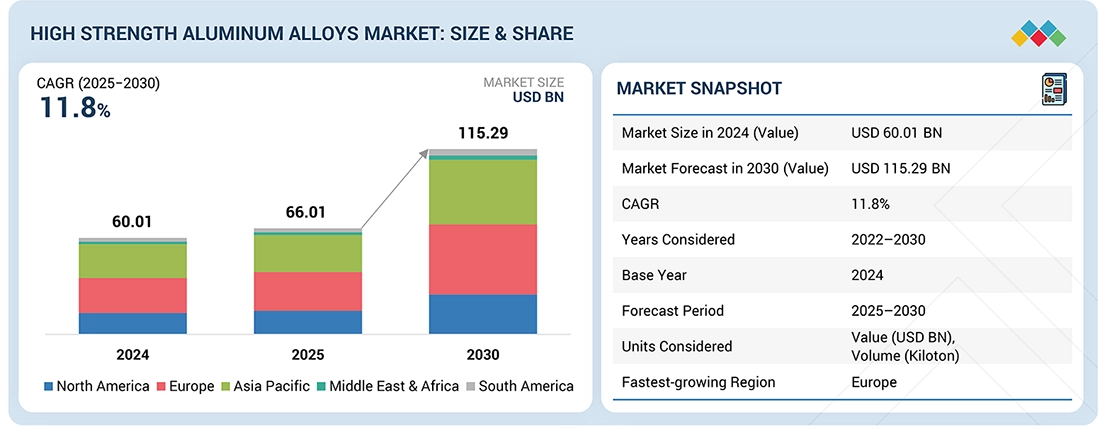
Source: Secondary Research, Interviews with Experts, MarketsandMarkets Analysis
The high strength aluminum alloys market is projected to reach USD 115.29 billion by 2030 from USD 66.01 billion in 2025, at a CAGR of 11.8% from 2025 to 2030. The high strength aluminum alloys market is majorly driven by the growing demand for lightweight but high-performance materials from automotive, aerospace, defense, and marine industries. The aggressive pursuit of fuel efficiency and the need to curb carbon emissions compel manufacturers to offset the weight of steel components with high-strength aluminum counterparts, thereby reinforcing the structure without adding weight. The rapid electrification of the automotive industry further accelerates this growth, as battery enclosures and chassis are used to compensate for the weight of batteries and maximize driving range.
KEY TAKEAWAYS
-
By RegionEurope dominated the high strength aluminum alloys market with a share of 36.2% in terms of value in 2024.
-
By GradeBy grade, the 7xxx series segment is projected to grow at the highest CAGR of 14.5% during the forecast period.
-
By Tensile StrengthBy tensile strength, the high strength (300-500 Mpa) segment dominated the high strength aluminum alloys market with a share of 82.7% in terms of value in 2024.
-
By FormulationBy formulation, the heat treatable alloys segment is expected to register the highest CAGR during the forecast period.
-
By Processing MethodBy processing method, the hot working segment is expected to register the highest CAGR during the forecast period.
-
By Product FormBy product form, the extrusion segment held the largest share of the high strength aluminum alloys market.
-
By End-use IndustryBy end-use industry, the aerospace & defense segment is projected to register the fastest CAGR during the forecast period.
-
Competitive Landscape-Key PlayersRio Tinto, Aluminium Bahrain B.S.C., Alcoa Corporation, and Aluminum Corporation of China Limited are star players in the high strength aluminum alloys market, given their broad industry coverage and strong operational & financial strength.
-
Competitive Landscape- StartupsElka Mehr Kimiya, Guangdong Zhenhan Special Light Alloy Co., Ltd., YK Aluminium, and Avon Metals Ltd. have distinguished themselves among startups and SMEs due to their well-developed marketing channels and extensive funding to build their product portfolios.
The high strength aluminum alloys market is experiencing growth due to the increasing demand for high strength-to-weight ratios in the aerospace and defense, automotive and transportation, and marine sectors. Continuous innovations in alloy composition, particularly in the 2xxx and 7xxx series, have provided excellent fatigue resistance, fracture toughness, and resistance to stress corrosion cracking, thereby expanding their applications in critical structural components. This demand is further fueled by the automotive sector's aggressive electrification goals, which require lightweight materials to reduce the weight of chassis and enclosures. Similarly, the aerospace industry continues to focus on improving fuel economy, payload capacity, and service life.
TRENDS & DISRUPTIONS IMPACTING CUSTOMERS' CUSTOMERS
Changes in customer trends or disruptions impact consumers’ businesses. These shifts impact the revenues of end users. Consequently, the revenue impact on end users is expected to affect the revenues of high strength aluminum alloy suppliers, which, in turn, impacts the revenues of high strength aluminum alloy manufacturers.
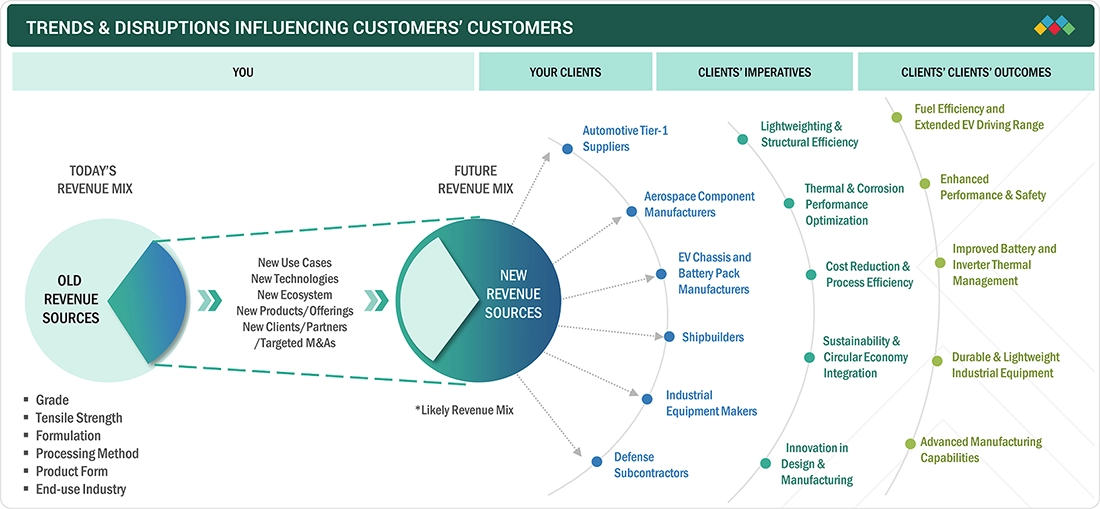
Source: Secondary Research, Interviews with Experts, MarketsandMarkets Analysis
MARKET DYNAMICS

Level
-
Growing demand for high strength aluminum alloys in aerospace & defense sector

-
Increasing adoption in electric vehicles and battery enclosures


Level
-
High production and processing costs

-
Availability of substitutes


Level
-
Rising demand for lightweight materials in sports equipment manufacturing

-
Rising adoption in additive manufacturing


Level
-
Limited formability

-
Volatility in raw material prices

Source: Secondary Research, Interviews with Experts, MarketsandMarkets Analysis
Driver: Increasing adoption in electric vehicles and battery enclosures
High strength aluminum alloys find applications in the automotive & transportation industries, particularly in the context of electric vehicle manufacturers aiming to reduce overall weight while maintaining safety standards. More advanced 6xxx and 5xxx series of aluminum alloys are paying off, as they help provide robust performance in many attributes, such as thermal runaway protection and crashworthiness, which enable meeting stringent standard criteria like UN ECE R100. In comparison to steel and even carbon fibers, such alloys provide an optimal combination of strength, light weight, and ease of manufacture.
Restraint: High production and processing costs
The costs associated with production and processing activities are a significant limitation in the high strength aluminum alloys market. Alloys such as the 7075 and 2024 series require a complex combination of elements, including zinc, copper, and magnesium. While these elements provide the desired mechanical strength to meet manufacturers’ specifications, they also complicate and raise the cost of the casting process. During solidification, the ingots are highly susceptible to defects and cracking, which often necessitates the remelting of ingots multiple times. This not only increases the overall waste of energy and materials but also makes these alloys less efficient compared to more traditional options like the 6061 alloy.
Opportunity: Rising demand for lightweight materials in sports equipment manufacturing
In the manufacturing of sports equipment, there is an increasing use of high strength aluminum alloys, such as 6061, 7075, and 2024. These alloys offer an excellent strength-to-weight ratio, allowing companies to create lighter products without sacrificing durability, which is something athletes continually seek. In applications like bicycle frames, javelins, hurdles, and fitness racks, reducing weight leads to improved speed, agility, and energy efficiency. Additionally, these materials help extend the lifespan of equipment due to their elasticity and resistance to wear.
Challenge: Limited formability
High strength 7xxx and 2xxx aluminum alloys are particularly difficult to form at room temperature due to their distinct strengthening mechanisms. These alloys rely on precipitation hardening, which involves tiny particles like MgZn2 in the 7xxx series that hinder dislocation movement. While this process grants them exceptional strength, it also results in low ductility and reduced strain-hardening capacity. Consequently, these alloys are prone to early necking, quasi-brittle fractures, and surface defects resembling an orange peel during manufacturing processes such as stamping or spinning. This limitation hinders their ability to be shaped into complex geometries without failing.
HIGH STRENGTH ALUMINUM ALLOYS MARKET: COMMERCIAL USE CASES ACROSS INDUSTRIES
| COMPANY | USE CASE DESCRIPTION | BENEFITS |
|---|---|---|
 |
High strength aluminum alloys in aircraft fuselage, wings, and seat structures | Reduced airframe weight, improved fuel efficiency, and strong fatigue resistance |
 |
High strength aluminum in chassis, closures, and structural frames | Weight reduction, better driving dynamics, and increased stiffness |
 |
Uses high strength aluminum alloys in marine hulls, superstructures, and masts | Corrosion resistance, reduced vessel weight, and improved fuel efficiency |
 |
Heavy machinery components, engine parts, and frames | Higher strength-to-weight, enhanced durability, and improved load capability |
Logos and trademarks shown above are the property of their respective owners. Their use here is for informational and illustrative purposes only.
MARKET ECOSYSTEM
The high strength aluminum alloys market is organized around a closely interconnected and highly specialized value chain that spans from raw materials to final mission-critical applications. This process begins with the producers of primary aluminum and essential alloying elements such as copper, zinc, magnesium, and lithium. These raw materials are then processed by manufacturers that utilize advanced technologies for casting, extrusion, forging, and heat treatment. Following this, semi-finished product manufacturers convert these materials into high-performance components designed for demanding applications. As a result, a variety of precision parts are produced, including aircraft fuselage frames, wing skins, automotive structural components, and heavy-duty fittings used in industries such as aerospace and defense, automotive and transportation, and marine applications.
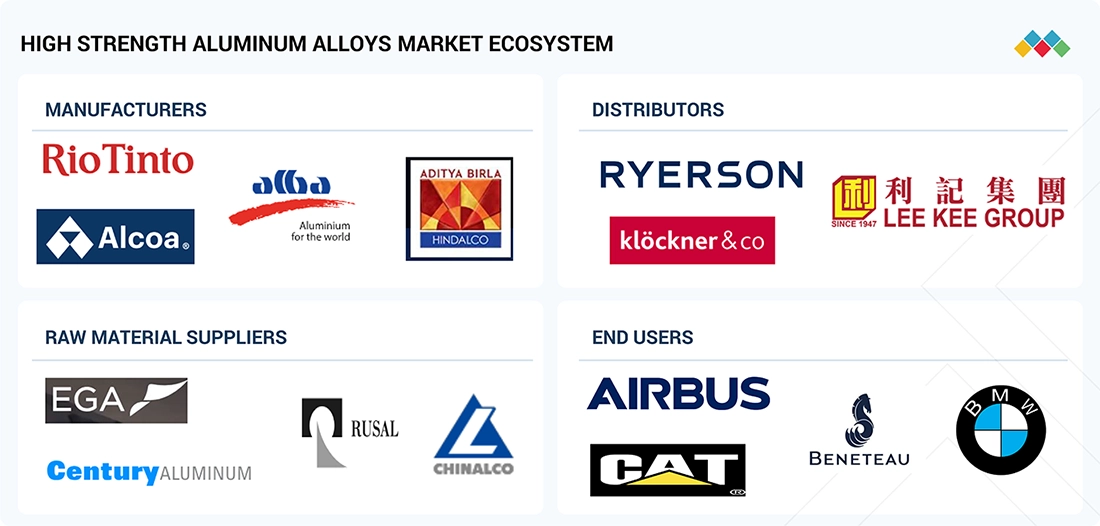
Logos and trademarks shown above are the property of their respective owners. Their use here is for informational and illustrative purposes only.
MARKET SEGMENTS
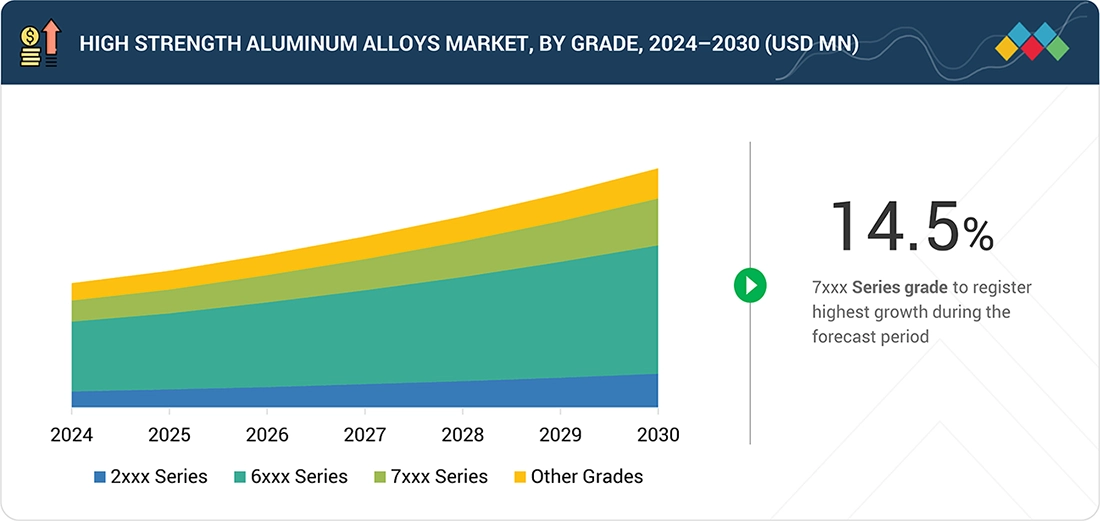
Source: Secondary Research, Interviews with Experts, MarketsandMarkets Analysis
High Strength Aluminum Alloys Market, by Grade
The 6xxx series of aluminum alloys has emerged as the leading choice in the high strength aluminum alloys market due to its excellent combination of strength, corrosion resistance, and formability. This dominance is primarily fueled by the automotive industry, which relies significantly on 6xxx alloys for manufacturing body panels, structural components, and chassis systems. These alloys enable automakers to reduce vehicle weight while avoiding the higher costs associated with aerospace-grade aluminum. They are also easily extruded and welded, allowing manufacturers to produce complex shapes efficiently and at scale. Additionally, their capacity to be heat-treated after forming enables engineers to achieve the desired mechanical performance without compromising production efficiency.
High Strength Aluminum Alloys Market, by Tensile Strength
The high strength (300–500 MPa) segment accounts for the largest share of the high strength aluminum alloys market, as it provides the best performance and endurance mix for most structural applications in automotive and aerospace manufacturing. Alloys in this range are also known to provide the best combination of tensile strength and ductility, especially the well-established grades of 2xxx and 7xxx series. This makes them safe substitutes for heavier steel components without compromising safety or long-term reliability. The alloys are vital for high volume components like automotive chassis structure, aircraft wing skins, and the frame of the fuselage, where the best possible strength-to-weight ratio is achieved to directly support fuel efficiency and emission goals.
High Strength Aluminum Alloys Market, by Formulation
The heat-treatable alloys segment accounts for the largest share of the high strength aluminum alloys market, mainly because thermal processes, such as precipitation hardening, can further improve the mechanical properties of the heat-treatable alloys to levels that non-heat-treatable alloys cannot achieve. This superior strength-to-weight ratio makes them indispensable in critical sectors like aerospace, automotive (2xxx, 6xxx, and 7xxx series), and others, where weight reduction is critical to improving fuel efficiency and payload capacity without compromising structural integrity. As a result, the aggressive lightweighting trend in modern transportation has led to the extensive production and market dominance of these particular alloys.
High Strength Aluminum Alloys Market, by Processing Method
Hot working holds the largest share of the high strength aluminum alloys market, mainly due to its ability to deform intractable hard alloys (e.g., the 2xxx and 7xxx series) by reducing the flow stress and thereby preventing cracks. This processing is indispensable in the mass production of large volume semi-finished forms like heavy plates, sheets, and complicated forms of extrusion suitable as basic feedstock in the aerospace and automotive industries. In addition, hot working also eliminates the coarse as-cast structure and refines the grain size, which is very important in enhancing the mechanical properties and fatigue resistance desired for high-performance structural applications.
High Strength Aluminum Alloys Market, by Product Form
Extrusion products hold a significant share of the high strength aluminum alloys market, largely due to their unique capability to produce complex shapes and near-net-shape profiles with an exceptional strength-to-weight ratio. This feature is especially sought after in the automotive and aerospace industries. The shift toward lightweight EVs has further driven the demand for extruded high-strength alloys, specifically from the 6xxx and 7xxx series. These alloys help counterbalance the heavy weights of batteries while still meeting stringent safety requirements.
High Strength Aluminum Alloys Market, by End-use Industry
The automotive & transportation industry holds the largest share in the high strength aluminum alloys market mainly due to the critical focus on lightweighting to conform to stringent fuel efficiency and carbon emission norms. They provide an unprecedented strength-to-weight ratio, enabling manufacturers to reduce vehicle weight without compromising safety and structural integrity, thereby boosting fuel efficiency and enhancing performance. The rapid shift to EVs has further accelerated this demand for high strength aluminum alloys because they offset the weight of heavy batteries, enabling the maximum driving range.
REGION
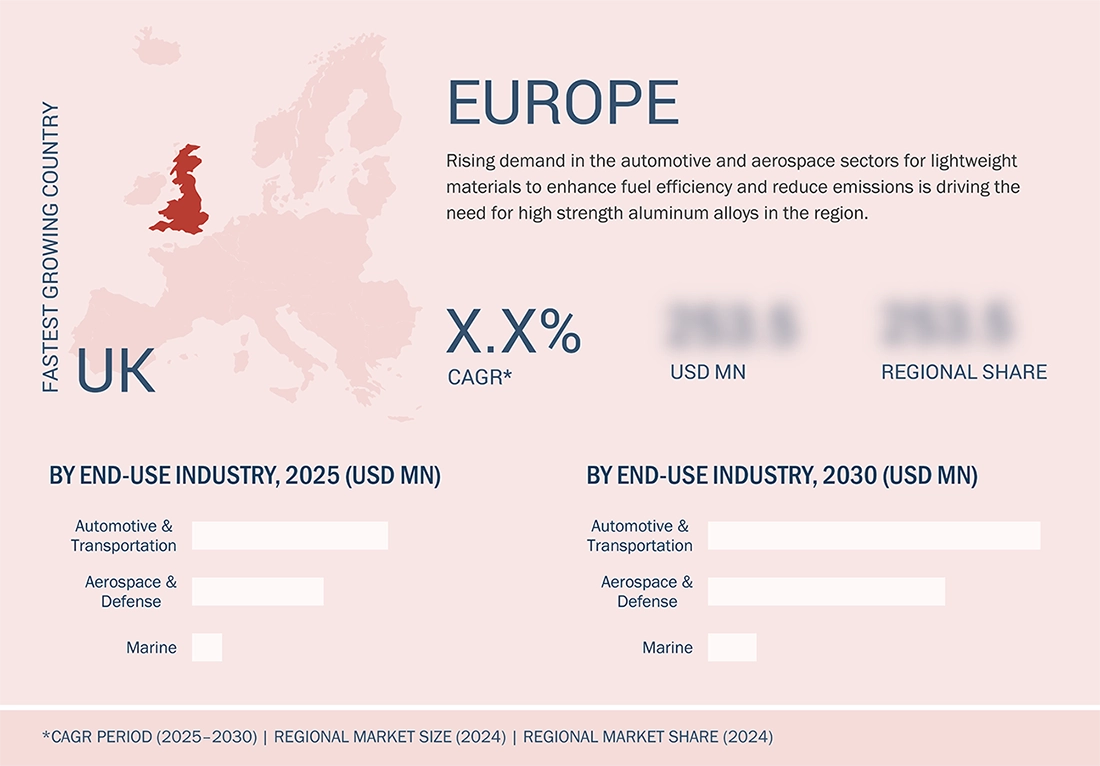
Europe to be fastest-growing market for high strength aluminum alloys during forecast period
Europe is projected to be the fastest-growing market for high strength aluminum alloys during the forecast period, owing to strict regulations regarding the environment and focus on lightweight materials in major economies, including Germany, France, the UK, and Italy. These countries are further developing their manufacturing capabilities, especially for automotive, aerospace & defense, and transportation industries, and thus demand for advanced high strength aluminum alloys. Growth is further stimulated by the push toward electric vehicles and sustainable mobility, including government policies that promote carbon neutrality and circular economy principles. For example, technological advancements in alloy formulations and growing investments in green manufacturing technologies enhance product performance and market adoption.
HIGH STRENGTH ALUMINUM ALLOYS MARKET: COMPANY EVALUATION MATRIX
In the high strength aluminum alloys market, Rio Tinto (Star) leads with a strong market share and extensive product footprint, driven by its vertically integrated operations and strategic partnerships for automotive and aerospace grades. Norsk Hydro (Emerging Leader) is gaining visibility because of its specialized portfolio of proprietary high-strength 6xxx series alloys and advanced extrusion technologies. While Rio Tinto dominates through scale and a diverse portfolio of foundry and wrought alloys, Norsk Hydro shows significant potential to move toward the leaders’ quadrant as the demand for critical structural components, such as crash management systems and battery trays, continues to rise.
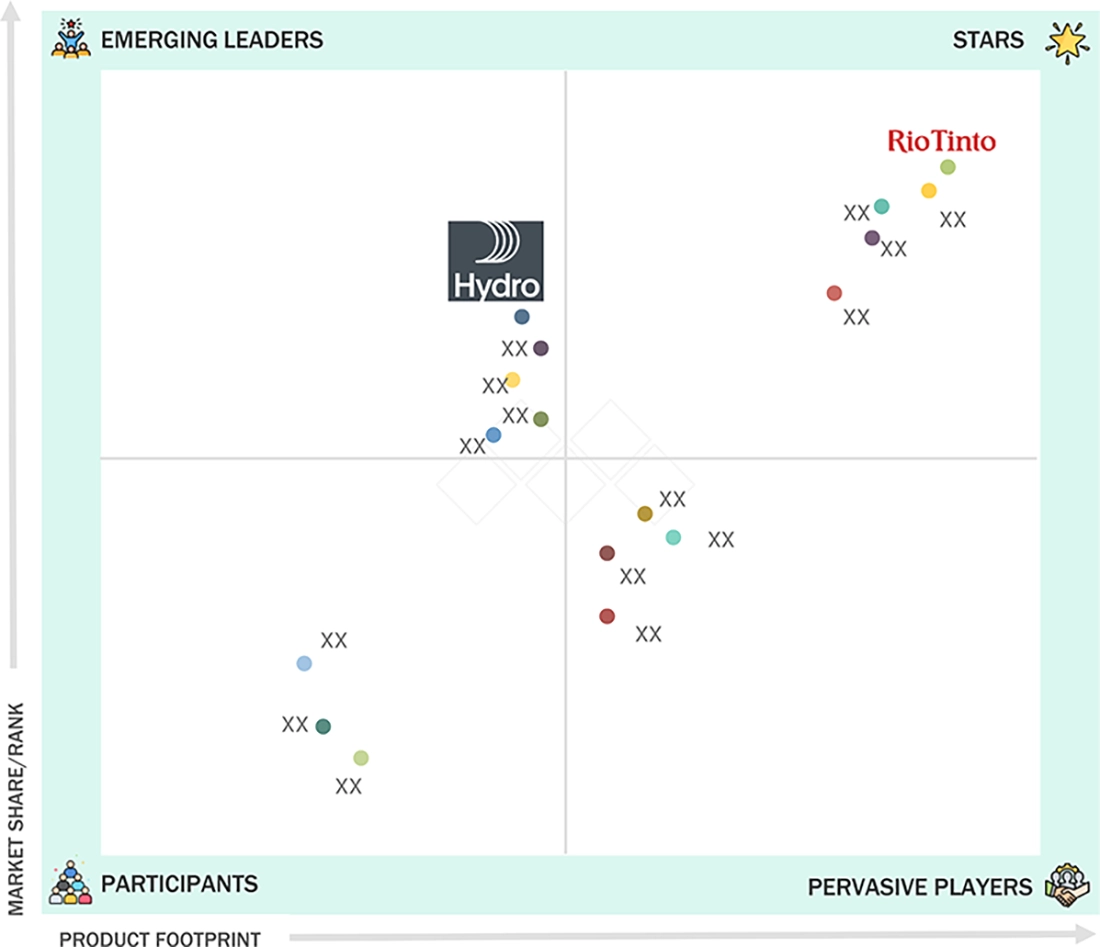
Source: Secondary Research, Interviews with Experts, MarketsandMarkets Analysis
KEY MARKET PLAYERS
- Rio Tinto (UK)
- Aluminium Bahrain B.S.C. (Bahrain)
- Alcoa Corporation (US)
- Hindalco Industries Limited (India)
- RusAL (Russia)
- Norsk Hydro ASA (Norway)
- Aluminum Corporation of China Limited (China)
- Century Aluminum Company (US)
- China Hongqiao Group Limited (China)
- Emirates Global Aluminium PJSC (UAE)
- Vedanta Limited (India)
- Constellium (France)
- Kaiser Aluminum (US)
- UACJ Corporation (Japan)
- Elka Mehr Kimiya (Iran)
MARKET SCOPE
| REPORT METRIC | DETAILS |
|---|---|
| Market Size in 2024 (Value) | USD 60.01 Billion |
| Market Forecast in 2030 (Value) | USD 115.29 Billion |
| Growth Rate | CAGR of 11.8% from 2025 to 2030 |
| Years Considered | 2022–2030 |
| Base Year | 2024 |
| Forecast Period | 2025–2030 |
| Units Considered | Value (USD Billion), Volume (Kiloton) |
| Report Coverage | Revenue Forecast, Company Ranking, Competitive Landscape, Growth Factors, and Trends |
| Segments Covered |
|
| Regions Covered | North America, Asia Pacific, Europe, South America, Middle East & Africa |
WHAT IS IN IT FOR YOU: HIGH STRENGTH ALUMINUM ALLOYS MARKET REPORT CONTENT GUIDE
DELIVERED CUSTOMIZATIONS
We have successfully delivered the following deep-dive customizations:
| CLIENT REQUEST | CUSTOMIZATION DELIVERED | VALUE ADDS |
|---|---|---|
| Raw Material Suppliers (Primary Aluminum, Master Alloys, Alloying Elements) |
|
|
| High Strength Alloy Formulators & Semi-Fabricators |
|
|
| OEMs & Component Manufacturers |
|
|
| End-use Industries (Automotive, Aerospace & Defense, Marine) |
|
|
RECENT DEVELOPMENTS
- May 2025 : Chinalco committed to a USD 200 million expansion to increase high strength aluminum alloys production in China for automotive and electronics applications.
- February 2024 : Kaiser Aluminum entered a multi-year collaboration with Boeing to supply advanced high-strength aluminum alloys for next-generation aircraft.
- October 2023 : Rio Tinto announced a USD 1.1 billion expansion of its AP60 low-carbon aluminum smelter in Quebec to increase high-strength aluminum alloy capacity.
Table of Contents
 Exclusive indicates content/data unique to MarketsandMarkets and not available with any competitors.
Methodology
The study involves two major activities in estimating the current market size for the high strength aluminum alloy market. Exhaustive secondary research was done to collect information on the market, peer market, and parent market. The next step was to validate these findings, assumptions, and sizing with industry experts across the value chain through primary research. Both top-down and bottom-up approaches were employed to estimate the complete market size. After that, market breakdown and data triangulation were used to estimate the market size of segments and subsegments.
Secondary Research
Secondary sources referred to for this research study include financial statements of companies offering high strength aluminum alloy and information from various trade, business, and professional associations. Secondary research has been used to obtain critical information about the industry’s value chain, the total pool of key players, market classification, and segmentation according to industry trends to the bottom-most level and regional markets. The secondary data was collected and analyzed to arrive at the overall size of the high strength aluminum alloy market, which was validated by primary respondents.
Primary Research
Extensive primary research was conducted after obtaining information regarding the high strength aluminum alloy market scenario through secondary research. Several primary interviews were conducted with market experts from both the demand and supply sides across major countries of North America, Europe, Asia Pacific, the Middle East & Africa, and Latin America. Primary data was collected through questionnaires, emails, and telephonic interviews. The primary sources from the supply side included various industry experts, such as Chief X Officers (CXOs), Vice Presidents (VPs), Directors from business development, marketing, product development/innovation teams, and related key executives from high strength aluminum alloy industry vendors; system integrators; component providers; distributors; and key opinion leaders.
Primary interviews were conducted to gather insights such as market statistics, data on revenue collected from the products and services, market breakdowns, market size estimations, market forecasting, and data triangulation. Primary research also helped in understanding the various trends related to type, storage & distribution and transportation, manufacturing process, function, end-use industry, and region.
Stakeholders from the demand side, such as CIOs, CTOs, CSOs, and installation teams of the customer/end users who are using high strength aluminum alloy, were interviewed to understand the buyer’s perspective on the suppliers, products, component providers, and their current usage of high strength aluminum alloy and future outlook of their business which will affect the overall market.
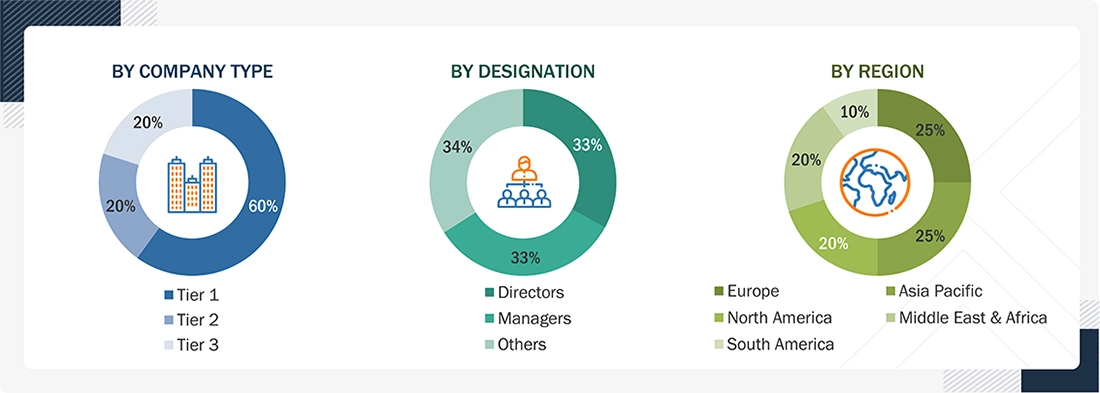
Note: Tiers of companies are based on their revenue in 2024. Tier 1: company revenue greater than USD 1 billion; Tier 2: company revenue between USD 100 million and USD 1 billion; and Tier 3: company revenue less than USD 100 million.
To know about the assumptions considered for the study, download the pdf brochure
Market Size Estimation
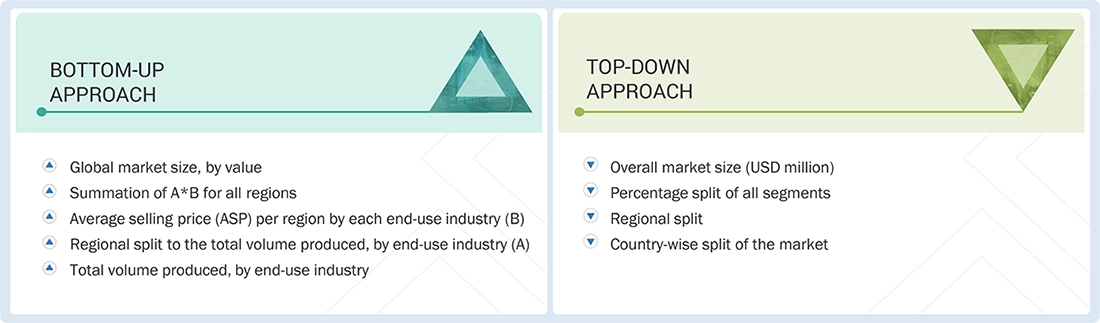
The research methodology used to estimate the size of the high strength aluminum alloy market includes the following details. The market sizing of the market was undertaken from the demand side. The market was upsized based on procurements and modernizations in high strength aluminum alloys in different end-use industries at a regional level. Such procurements provide information on the demand aspects of the high strength aluminum alloy industry for each application. For each end-use industry, all possible segments of the high strength aluminum alloy market were integrated and mapped.
High Strength Aluminum Alloys Market : Top-Down and Bottom-Up Approach
Data Triangulation
After arriving at the overall size from the market size estimation process explained above, the total market was split into several segments and subsegments. The data triangulation and market breakdown procedures explained below were implemented, wherever applicable, to complete the overall market engineering process and arrive at the exact statistics for various market segments and subsegments. The data was triangulated by studying various factors and trends from the demand and supply sides. Along with this, the market size was validated using both the top-down and bottom-up approaches.
Market Definition
High strength aluminum alloys are those with tensile strength above 300 MPa, while ultra-high strength aluminum alloys exceed 500 MPa. They achieve these performance levels through alloying elements such as copper, zinc, magnesium, and silicon, which enhance strength, toughness, and corrosion resistance. These properties make them essential in aerospace, automotive, transportation, and structural engineering applications, where lightweight materials with high mechanical reliability are required. Core high strength alloy families include the 2xxx series (Al-Cu), 5xxx series (Al-Mg), 6xxx series (Al-Mg-Si), 7xxx series (Al-Zn-Mg-Cu), and 8xxx series, all of which are designed to meet demanding performance standards in advanced engineering environments.
Key Stakeholders
- High strength aluminum alloy manufacturers
- Government and Research Organizations
- National and Local Government Organizations
- Institutional Investors
Report Objectives
- To define, describe, and forecast the high strength aluminum alloy market size in terms of volume and value
- To provide detailed information regarding the key factors, such as drivers, restraints, opportunities, and challenges influencing market growth
- To analyze and project the global high strength aluminum alloy market by grade, by tensile strength, formulation, product form, processing method, and end-use industry, and region
- To forecast the market size concerning five main regions (along with country-level data), namely, North America, Europe, Asia Pacific, the Middle East & Africa, and South America, and analyze the significant region-specific trends
- To strategically analyze micromarkets with respect to individual growth trends, prospects, and contributions of the submarkets to the overall market
- To analyze the market opportunities and the competitive landscape for stakeholders and market leaders
- To assess recent market developments and competitive strategies, such as agreements, contracts, acquisitions, and product developments/product launches, to draw the competitive landscape
- To strategically profile the key market players and comprehensively analyze their core competencies
Available customizations:
MarketsandMarkets offers the following customizations for this market report:
- Additional country-level analysis of the high strength aluminum alloy market
Product Analysis
- Product matrix, which provides a detailed comparison of the product portfolio of each company’s market
Company Information
- Detailed analysis and profiling of additional market players (up to five)
Key Questions Addressed by the Report
How is automotive and aerospace demand influencing the High Strength Aluminum Alloys Market?
Growing adoption in lightweight vehicles and aircraft for fuel efficiency and performance is boosting demand for high-strength aluminum alloys.
What technological innovations are shaping the High Strength Aluminum Alloys Market?
Innovations include advanced alloy compositions, heat treatment processes, and additive manufacturing for improved strength-to-weight ratio.
How are environmental regulations impacting the High Strength Aluminum Alloys Market?
Stringent emission norms and sustainability goals are pushing industries to use lightweight alloys, reducing fuel consumption and carbon footprint.
Which regions are leading the High Strength Aluminum Alloys Market?
North America and Europe dominate due to aerospace and automotive hubs, while Asia-Pacific is growing rapidly with increased automotive production.
What role do recycling and circular economy practices play in this market?
Aluminum alloys are highly recyclable, enabling sustainable manufacturing and reducing dependence on primary aluminum production.


Personalize This Research
- Triangulate with your Own Data
- Get Data as per your Format and Definition
- Gain a Deeper Dive on a Specific Application, Geography, Customer or Competitor
- Any level of Personalization
Let Us Help You
- What are the Known and Unknown Adjacencies Impacting the High Strength Aluminum Alloys Market
- What will your New Revenue Sources be?
- Who will be your Top Customer; what will make them switch?
- Defend your Market Share or Win Competitors
- Get a Scorecard for Target Partners

Custom Market Research Services
We Will Customise The Research For You, In Case The Report Listed Above Does Not Meet With Your Requirements
Get 10% Free CustomisationTESTIMONIALS

We at Nissan Chemicals Corporation have been clients of MarketsandMarkets for more than a year now. We recently consulted MarketsandMarkets for a study, the team at MarketsandMarkets was extremely professional and organized. The business insights were very detailed and aligned well with our expectations that really helped us formulate the Business Plans and device new strategies for development themes. MarketsandMarkets offers a unique combination of expertise and dedicated engagement model. Their research findings have helped us in designing our Pricing Strategy which will make it easier for us to predict the future sales and profits for the next ten years. We look forward to working with MarketsandMarkets in the future.
VP of Strategy & New Business Development
Leading Specialty Chemical Company
The MarketsandMarkets Engagement Model, composed of both the Knowledge Store and advisory custom research, has greatly helped us in understanding our markets and making strategic decisions. The Knowledge Store is a fast way to allow everyone in our organization to understand more about most any market they are interested in. The ability to then get custom research done and get answers to specific strategic questions and market insight has been spectacular. The Markets and Markets team feel more like colleagues than vendors and their services have helped us change our culture where statements of things like growth opportunities and competitive position are always backed by industry research.

Rich Gibson,
Director, Corporate Strategy
Milliken & Company,
Leading Industrial Manufacturer of specialty chemical, floor covering, performance and protective textile materials, and healthcaremilliken.com
MarketsandMarkets is a trusted resource that helps us to better understand markets that are near-adjacencies-whether its technology, value chain or geography. Their Knowledge Store platform provides a dashboard of markets and their characteristics which is easy to use and saves us time.
Adam Shaw,
Market Development and Strategy Manager
AdvanSix Inc. USA,
An American Leader in Chemicalswww.advansix.com
The Knowledge Store from MarketsandMarkets is a valuable tool which has helped my team acquire greater insight in to the end markets that our business serves. This has enabled us to help our company build stronger strategies throughout our planning process.
TOSHIO KINOSHITA
Senior Chif Consultion Research & Consulting Division
Mitsubishi Chemical Research Corporation,
Leading Manufacturer of Chemical Productswww.mitsubishichem-res.co.jp/en/

We recently engaged with MarketsandMarkets for a study, the team not only clearly understood our business objectives but was also extremely professional in the way they handled the entire project. The study was efficiently conducted in a phase-wise manner, and the engagement model furnished us with high-quality business insights that far exceeded our expectations at each phase. We were especially happy that MarketsandMarkets could provide us with both, an English as well as a Japanese version of the study. A special thanks to the Analyst Team and Client Services Team, whose fluency in Japanese enhanced our comfort level, as we could converse with them in our preferred language.
Independent entrepreneurs
Arrow Precision
We approached MarketsandMarkets for study on Proppants Market, and their work exceeded our expectations. The study conducted was comprehensive and enabled us to view the market through the various dimensions. In addition, the team was extraordinarily responsive throughout the process and resolved our queries on time. I strongly recommend MarketsandMarkets and will certainly consider them for additional market assessments we will need in the future.
Global engineering company, Japan
Deputy Manager,
Strategic Planning OfficeThe high-quality insights shared by the MarketsandMarkets team helped us understand the pharmaceutical plant designers in a specific geography. It also captured the risks that we may likely face in communicating with our potential partners. The study would enable us identify partners, which would impact our future growth.
- US High Strength Aluminum Alloys Market
- Canada High Strength Aluminum Alloys Market
- Mexico High Strength Aluminum Alloys Market
- Germany High Strength Aluminum Alloys Market
- France High Strength Aluminum Alloys Market
- UK High Strength Aluminum Alloys Market
- Italy High Strength Aluminum Alloys Market
- Spain High Strength Aluminum Alloys Market
- Russia High Strength Aluminum Alloys Market
- China High Strength Aluminum Alloys Market
- Japan High Strength Aluminum Alloys Market
- South Korea High Strength Aluminum Alloys Market
- India High Strength Aluminum Alloys Market
- South Africa High Strength Aluminum Alloys Market
- Brazil High Strength Aluminum Alloys Market
- Argentina High Strength Aluminum Alloys Market
- GCC Countries High Strength Aluminum Alloys Market
- –Rest Of GCC Countries High Strength Aluminum Alloys Market
- Rest Of South America High Strength Aluminum Alloys Market






Growth opportunities and latent adjacency in High Strength Aluminum Alloys Market