Holographic Display Market by Technology (Electro holographic, Touchable, Laser), Product (Camera, Digital Signage, Medical scanners, Smart TV), Application (Consumer, Commercial, Medical, Industrial ), Geography - Global Forecast to 2035


Updated date -
Nov 18, 2019
The The Holographic Display Market is entering a high-growth phase as businesses and consumers increasingly seek immersive, interactive, and three-dimensional visualization technologies for communication, entertainment, healthcare, automotive, retail, education, and industrial applications. The global Holographic Display Market is estimated at approximately USD 5–6 billion in 2025 and is projected to reach USD 20–25 billion by 2035, registering a CAGR of 14%–16% during the forecast period. Market expansion is being supported by rapid developments in spatial computing, augmented reality (AR), virtual reality (VR), mixed reality (MR), optical technologies, high-resolution displays, artificial intelligence (AI), Internet of Things (IoT), and digital transformation.
Unlike conventional two-dimensional displays, holographic display technologies aim to create more natural three-dimensional visualization experiences by manipulating light, depth cues, projection, diffraction, or specialized optical structures. These capabilities are creating new opportunities for applications where visual depth, interaction, and realistic representation can improve decision-making or user engagement.
Automotive is emerging as a particularly attractive application area, with holographic technologies being evaluated for head-up displays, navigation, driver information, gesture interfaces, and passenger entertainment. Healthcare organizations are exploring holographic visualization for medical education, surgical planning, anatomical modeling, and diagnostic visualization. In retail and advertising, holographic displays can create attention-grabbing product experiences and interactive brand environments.
AI is further expanding the potential of holographic displays by enabling intelligent content generation, object recognition, gesture interpretation, personalized visualization, and real-time interaction. IoT connectivity can allow holographic systems to access live data from connected sensors and devices, while cloud computing can support centralized content management and remote deployment. As automation and digital transformation accelerate, the Holographic Display Market is expected to evolve from specialized visualization systems into a broader platform for immersive human-machine interaction.
Key Market Trends & Insights
One of the most important trends in the Holographic Display Market is the movement from static visual presentation toward interactive three-dimensional experiences. Companies are developing holographic systems that can respond to gestures, voice commands, environmental conditions, and real-time data. This is increasing the relevance of holographic displays in enterprise and consumer environments.
Automotive applications are expected to remain a major growth area. Holographic head-up displays can provide drivers with navigation information, warnings, vehicle status, and other information within the driver's field of view. As vehicles become software-defined and increasingly connected, display systems are becoming more intelligent and personalized.
The integration of AI is another significant market trend. AI can support real-time object recognition, spatial mapping, content personalization, gesture recognition, and automated display management. Generative AI may also enable businesses to create dynamic three-dimensional visual content more efficiently.
North America is expected to remain a leading regional market, supported by technology companies, entertainment applications, healthcare innovation, automotive development, and investments in immersive technologies. Asia Pacific is expected to record the fastest growth, driven by consumer electronics manufacturing, automotive production, digital advertising, smart-city initiatives, and increasing investment in advanced display technologies.
Another emerging trend is the convergence of holographic displays with AR, MR, digital twins, and spatial computing. This convergence is enabling organizations to visualize complex systems and datasets in more intuitive formats, supporting applications ranging from engineering and industrial design to healthcare and education.
Market Size & Forecast
- Market size in 2025: USD 5–6 billion
- Forecast market size by 2035: USD 20–25 billion
- CAGR (2025–2035): 14%–16%
- Key growth factors: Increasing demand for immersive visualization, automotive display innovation, AR/MR adoption, AI-enabled interaction, digital advertising, healthcare visualization, and enterprise digital transformation.
- Technology outlook: Holographic projection, light-field displays, optical waveguides, spatial computing, AI-based visualization, gesture recognition, and advanced 3D display architectures are expected to support long-term growth.
Holographic Display Market Top 10 key takeaway
- The Holographic Display Market is estimated at USD 5–6 billion in 2025.
- The market is projected to reach USD 20–25 billion by 2035.
- The market is expected to register a CAGR of 14%–16% during the forecast period.
- Automotive applications are emerging as a major opportunity for holographic display technologies.
- North America is expected to remain a leading regional market.
- Asia Pacific is projected to be the fastest-growing region through 2035.
- AI is improving holographic content generation, interaction, recognition, and personalization.
- Healthcare is adopting three-dimensional visualization for education, planning, and advanced medical applications.
- Retail, advertising, and entertainment are creating demand for visually engaging holographic experiences.
- Integration with AR, MR, IoT, digital twins, and spatial computing will expand future application opportunities.
Product Insights
The product landscape of the Holographic Display Market includes various display architectures designed to create three-dimensional visual experiences. These include holographic projection systems, holographic displays, light-field displays, spatial displays, holographic head-up displays, and specialized visualization systems. The market also includes supporting components such as projectors, optical elements, spatial light modulators, sensors, processors, and software platforms.
Holographic projection systems currently represent an important product category because they can be deployed in commercial environments, exhibitions, entertainment venues, retail stores, events, museums, and advertising installations. Their ability to create visually compelling presentations without requiring conventional screens provides a significant advantage in experiential marketing and public environments.
Automotive holographic display systems represent one of the most promising emerging product categories. Holographic head-up displays can project navigation instructions, alerts, speed information, and other information into a driver's field of view. These systems can potentially improve information accessibility while reducing the need for drivers to look away from the road.
Light-field and spatial displays are also gaining attention because they can provide more realistic depth perception and enable multiple viewers to observe three-dimensional content without relying entirely on conventional head-mounted devices. These technologies are being evaluated for healthcare, engineering, design, visualization, and entertainment.
AI integration is increasingly becoming a product differentiator. Intelligent display platforms can adapt content according to users, environmental conditions, audience behavior, or real-time data. Advanced systems can combine cameras and sensors with AI algorithms to enable gesture-controlled and voice-enabled holographic interactions.
Technology / Component Insights
Technology development is at the core of the Holographic Display Market. Several optical and display architectures are being developed to improve image quality, viewing angle, brightness, depth perception, scalability, and energy efficiency. Key technologies include holographic projection, digital holography, light-field displays, spatial light modulation, optical waveguides, laser-based projection, and computational holography.
Digital holography uses computational techniques to reconstruct three-dimensional visual information from digital data. Advances in processors and graphics technologies are helping improve the ability of systems to generate complex holographic content in real time.
Light-field technology represents another important development. Rather than displaying only a flat image, light-field systems attempt to reproduce the direction and intensity of light rays to create a more realistic three-dimensional experience. These technologies are particularly relevant to professional visualization, medical applications, automotive interfaces, and advanced entertainment.
AI and machine learning can substantially improve holographic display performance. AI algorithms can optimize rendering, generate three-dimensional content, track users, recognize objects, and dynamically adjust visualization parameters. AI-based rendering can also reduce computational requirements by predicting or optimizing portions of visual content.
IoT connectivity is creating another layer of functionality. Holographic displays can receive real-time information from connected sensors, vehicles, industrial equipment, smart buildings, and other devices. In industrial environments, this can enable visual representation of machine performance, production status, maintenance requirements, and operational data.
Cloud platforms can support remote content management, centralized software updates, and multi-location display deployment. Automation is also expected to become increasingly important, particularly in retail, advertising, industrial monitoring, and transportation environments.
Future innovation will focus on higher resolution, wider viewing angles, lower power consumption, miniaturization, real-time 3D rendering, improved optical efficiency, and seamless integration with AI and spatial computing platforms.
Application Insights
Automotive is expected to become one of the most significant applications within the Holographic Display Market. Vehicle manufacturers are investing in advanced human-machine interfaces as vehicles become increasingly connected, automated, and software-defined. Holographic head-up displays can provide navigation, safety alerts, vehicle information, and contextual information while keeping critical information within the driver's viewing area.
Healthcare represents another high-value application. Holographic visualization can help medical professionals view three-dimensional representations of anatomy, medical imaging, and patient-specific structures. Hospitals and universities can also use immersive displays for training and medical education. Future applications could include remote collaboration and advanced surgical visualization.
Retail and advertising are important commercial applications because holographic displays can increase customer engagement. Brands can use three-dimensional visual presentations to showcase products, launch campaigns, create interactive displays, and deliver experiential marketing. As physical retail environments compete with digital channels, immersive technologies can help create differentiated customer experiences.
Entertainment and media are expected to remain significant application areas. Concerts, exhibitions, museums, theme parks, gaming environments, and live events can use holographic effects to create immersive experiences. Improvements in content production and real-time rendering are expected to broaden these applications.
Industrial applications are also emerging. Engineers can use three-dimensional visualization to inspect product designs, machinery, factory layouts, and digital twins. In combination with IoT data, holographic interfaces could provide an intuitive method for monitoring complex industrial environments.
Education, defense, aerospace, telecommunications, and architecture represent additional opportunities as organizations seek more interactive methods for presenting complex information.
Regional Insights
North America is expected to remain a leading region in the Holographic Display Market, supported by its advanced technology ecosystem, strong entertainment and media industry, healthcare innovation, automotive R&D, and investment in AR, VR, MR, and spatial computing. The United States is particularly important because of the presence of display technology companies, software developers, content creators, research institutions, and technology investors.
Europe is another important market, supported by automotive manufacturing, healthcare, industrial engineering, advertising, and digital transformation. Germany is particularly relevant because of its automotive and industrial ecosystem, while France and the UK are developing applications in entertainment, retail, healthcare, and immersive media.
Asia Pacific is expected to be the fastest-growing regional market through 2035. China, Japan, South Korea, and India have large consumer electronics and automotive sectors, while regional governments and technology companies are investing in advanced displays, digital infrastructure, smart cities, and immersive technologies.
- North America: Strong technology, healthcare, entertainment, and automotive ecosystems support market leadership.
- Europe: Automotive innovation and industrial digitalization drive adoption.
- Asia Pacific: Consumer electronics, automotive manufacturing, and display investments support rapid growth.
- China and Japan: Advanced electronics and display manufacturing create strong opportunities.
- India: Digitalization, retail technology, entertainment, and emerging immersive applications support demand.
Country-Specific Market Trends
China is expected to remain a major market for holographic display technologies due to its large electronics manufacturing ecosystem, automotive industry, smart-city development, retail technology, and entertainment sector. Government support for advanced digital technologies is also encouraging innovation. China's market could register approximately 17%–19% CAGR through 2035.
Japan has strong expertise in displays, optics, robotics, automotive electronics, and consumer technology. Holographic visualization is being evaluated across entertainment, healthcare, automotive interfaces, retail, and industrial applications. The Japanese market could grow at approximately 13%–15% CAGR.
In North America, the United States is expected to remain the largest national market, supported by technology investments, automotive R&D, healthcare innovation, entertainment, defense, and spatial-computing development. The US market could register approximately 13%–15% CAGR. Canada, supported by AI research, healthcare technology, media, and advanced visualization, could achieve approximately 12%–14% CAGR. Mexico, benefiting from automotive manufacturing and increasing digitalization, could record approximately 11%–13% CAGR.
In Europe, Germany is expected to remain a key market due to automotive technology, industrial visualization, engineering, and manufacturing. Germany could register approximately 12%–14% CAGR. France, supported by aerospace, entertainment, retail, automotive, and immersive media, could grow at approximately 11%–13% CAGR.
- China: Display manufacturing, automotive, and smart-city investments support rapid adoption.
- Japan: Advanced optics, electronics, robotics, and automotive technologies drive demand.
- United States: Spatial computing, healthcare, entertainment, and automotive applications support growth.
- Germany: Automotive and industrial applications create strong opportunities.
- France: Immersive entertainment, aerospace, and retail applications support market expansion.
Key Holographic Display Market Company Insights
The competitive landscape of the Holographic Display Market includes display technology companies, optical technology providers, holographic visualization specialists, semiconductor companies, and immersive technology developers. Major companies associated with the broader holographic and advanced display ecosystem include Samsung Electronics, Sony Corporation, LG Electronics, Holoxica, Looking Glass Factory, Realfiction, Voxon Photonics, Light Field Lab, Leia Inc., and WayRay.
Samsung Electronics and LG Electronics continue to invest heavily in advanced display technologies, including high-resolution, flexible, transparent, and immersive display architectures. Sony focuses on professional visualization, entertainment, imaging, and spatial experiences, creating opportunities for advanced three-dimensional display applications.
Looking Glass Factory is developing glasses-free three-dimensional display technologies for professional and creative applications, while Voxon Photonics focuses on volumetric display technologies. Light Field Lab is developing holographic display systems designed for immersive visualization and entertainment applications.
Leia has focused on light-field display technologies for mobile, automotive, and other applications. WayRay is particularly relevant to automotive holographic display technologies, developing holographic augmented-reality solutions for vehicles.
Companies are increasingly focusing on AI-enabled visualization, miniaturization, real-time 3D content generation, automotive integration, and software ecosystems. Strategic partnerships with automotive manufacturers, content providers, technology developers, and healthcare organizations are expected to become increasingly important.
- Samsung Electronics: Focuses on advanced display architectures and immersive visualization.
- Sony Corporation: Combines imaging, entertainment, professional visualization, and spatial technologies.
- Looking Glass Factory: Develops glasses-free 3D and light-field visualization platforms.
- Voxon Photonics: Focuses on volumetric three-dimensional display technologies.
- Leia and WayRay: Target light-field and automotive holographic visualization applications.
Recent Developments
A significant development in the Holographic Display Market is the increasing commercialization of glasses-free 3D and light-field display systems. Manufacturers are improving viewing angles, resolution, brightness, and content compatibility to make three-dimensional visualization more practical for professional and commercial applications.
Another important development is the growing integration of AI with holographic and spatial display systems. AI is being used to enhance 3D content creation, automate rendering, recognize users and objects, and enable interactive interfaces. This integration is helping transform holographic displays from passive visualization products into intelligent communication platforms.
Automotive companies and display technology providers are also increasing collaborations around holographic head-up displays and augmented-reality visualization. These partnerships are focused on improving navigation, safety information, personalization, and next-generation vehicle interfaces.
Market Segmentation
The Holographic Display Market can be segmented by Product, Technology/Component, Application, and Region. By Product, the market includes holographic display systems, holographic projectors, holographic head-up displays, light-field displays, spatial displays, and related visualization systems. By Technology/Component, the market includes digital holography, holographic projection, light-field technology, spatial light modulators, optical waveguides, laser projection, sensors, processors, and software. By Application, major segments include automotive, healthcare, retail and advertising, entertainment, aerospace and defense, industrial, education, and other commercial applications. By Region, the market covers North America, Europe, Asia Pacific, and Rest of the World.
- By Product: Holographic displays, projectors, head-up displays, light-field systems, and spatial displays.
- By Technology: Digital holography, light-field technology, holographic projection, optical systems, and computational holography.
- By Application: Automotive, healthcare, retail, advertising, entertainment, industrial, aerospace, and education.
- By Component: Optical elements, projectors, processors, sensors, software, and connectivity systems.
- By Region: North America, Europe, Asia Pacific, and Rest of the World.
The Holographic Display Market is moving toward a new generation of immersive visualization in which three-dimensional content, AI, connected devices, and spatial computing converge. The market is estimated at USD 5–6 billion in 2025 and is projected to reach USD 20–25 billion by 2035, registering a CAGR of 14%–16% during the forecast period.
AI will play an increasingly important role by making holographic systems more interactive, adaptive, and intelligent. AI-generated 3D content, automated rendering, object recognition, gesture tracking, and personalized interfaces can substantially expand the functionality of holographic display platforms.
IoT connectivity will enable holographic displays to visualize live information from connected devices, vehicles, industrial machines, and smart infrastructure. In industrial applications, this could support real-time visualization of digital twins and machine performance. In automotive applications, connected data could be transformed into contextual three-dimensional information for drivers and passengers.
The convergence of holographic displays with AR, MR, digital twins, generative AI, and spatial computing will create new opportunities across healthcare, automotive, retail, entertainment, industrial automation, and education. Businesses will increasingly use these technologies not only to improve visualization but also to create differentiated customer experiences and more intuitive human-machine interfaces.
Through 2035, competitive advantage will depend on display quality, content ecosystems, AI capabilities, energy efficiency, affordability, and integration with existing digital platforms. Companies that successfully combine holographic visualization, AI, IoT, automation, and spatial computing will be well positioned to capture the long-term opportunities emerging in this market.
FAQs
1. What is the market size of the Holographic Display Market?
The Holographic Display Market is estimated at USD 5–6 billion in 2025 and is projected to reach USD 20–25 billion by 2035.
2. What is the growth rate of the Holographic Display Market?
The market is expected to register a CAGR of 14%–16% from 2025 to 2035, driven by increasing demand for immersive visualization, advanced automotive interfaces, spatial computing, healthcare applications, digital advertising, and entertainment.
3. What are the key drivers of the Holographic Display Market?
Key drivers include the adoption of AR, VR, MR, spatial computing, AI, digital transformation, automotive display innovation, healthcare visualization, retail experiences, entertainment applications, and increasing demand for interactive three-dimensional content.
4. Which region is expected to lead the Holographic Display Market?
North America is expected to remain a leading regional market because of its strong technology, healthcare, entertainment, and automotive ecosystems. Asia Pacific is expected to be the fastest-growing region, supported by consumer electronics, automotive production, display manufacturing, and digital infrastructure investments.
5. Who are the key companies in the Holographic Display Market?
Key companies and technology providers include Samsung Electronics, Sony Corporation, LG Electronics, Holoxica, Looking Glass Factory, Realfiction, Voxon Photonics, Light Field Lab, Leia Inc., and WayRay. These companies are focusing on light-field displays, volumetric visualization, holographic projection, automotive applications, AI integration, and advanced 3D experiences.
To speak to our analyst for a discussion on the above findings, click Speak to Analyst
 Exclusive indicates content/data unique to MarketsandMarkets and not available with any competitors.
Table of Contents
1 Introduction (Page No-14)
1.1 Objectives of The Study
1.2 Market Definition
1.3 Study Scope
1.3.1 Markets Covered
1.3.2 Geographic Scope
1.3.3 Years Considered For The Study
1.4 Currency
1.5 Limitations
1.6 Stakeholders
2 Research Methodology (Page No-18)
2.1 Holographic Displays Demand Model
2.2 Market Size Estimation
2.3 Market Breakdown and Data Trangulation
2.4 Market Share Estimation
2.4.1 Key Points From Secondary Sources
2.4.2 Key Data From Primary Sources
2.4.2.1 Key Industry Insights
2.5 Assumptions
3 Executive Summary (Page No-25)
4 Premium Insights (Page No-28)
4.1 Attractive Market Opportunities For Holographic Display
4.2 The Holographic Display Market – Top Three Product Segments
4.3 The Market in The Asia-Pacific Region
4.4 Asia-Pacific is Expected To Emerge As The Fastest Growing Market At A Cagr of 31.26%
4.5 The Market : Application (2020)
4.6 Market: Developed Vs Developing Nations
4.7 Global Market: Industrial and Commercial Sectors (2020)
4.8 Life Cycle Analysis of The Market, by Geography
5 Market Overview (Page No-35)
5.1 Introduction
5.2 Market Definition
5.3 Evolution
5.4 Market Segmentation
5.4.1 Market by Technology
5.4.2 Market by Product Type
5.4.3 Market by Application
5.4.4 Market by Geography
5.5 Market Dynamics
5.5.1 Drivers
5.5.1.1 Adoption of Holographic Displays In Multiple Industries
5.5.1.2 Increased Demand of Holographic Displays in Events and Advertisements
5.5.1.3 Holography For Medical Imaging in The Healthcare Industry
5.5.2 Restraints
5.5.2.1 Less Effective Projection Under Sunlight
5.5.2.2 Cost Affecting The Growth of Holographic Displays in The Consumer Application
5.5.3 Opportunities
5.5.3.1 Advancements in Holographic Displays
5.5.3.2 Rapidly Advancing Smartphone and Tablet Market
5.5.4 Challenges
5.5.4.1 Technological Concerns
6 Industry Analysis (Page No-46)
6.1 Introduction
6.2 Value Chain Analysis
6.3 Supply Chain Analysis
6.3.1 Key Influencers
6.4 Industry Trends
6.5 Strategic Benchmarking
6.5.1 Inorganic Growth Strategies Such As Acquisitions, Partnerships, and Collaborations
7 Holographic Display Market, by Technology (Page No-51)
7.1 Introduction
7.1.1 Semi Transparent/Electro Holographic Display
7.1.2 Touchable
7.1.3 Laser
7.1.4 Piston
8 Market by Product Type (Page No-58)
8.1 Introduction
8.2 Camera
8.3 Digital Signage
8.4 Kiosks
8.5 Medical Imaging/Scanners
8.5.1 Computed Tomography (Ct) and Magnetic Resonance Imaging (Mri)
8.5.2 Ultrasound
8.6 Notebook and Laptop
8.7 Smart Tv’s/Holo Tv’s
8.8 Others
8.8.1 Smart Watch
8.8.2 Smart Glasses
8.8.3 Smartphones
9 Market by Application (Page No-70)
9.1 Introduction
9.2 Consumer Applications
9.3 Commercial Applications
9.4 Medical
9.5 Defense
9.6 Industrial Applications
9.7 Other Applications
9.7.1 Education
9.7.2 Automobile
10 Geographic Analysis (Page No-82)
10.1 Introduction
10.2 North America
10.2.1 The U.S.
10.2.2 Canada
10.2.3 Mexico
10.3 Europe
10.3.1 Germany
10.3.2 The U.K.
10.3.3 France
10.3.4 Spain
10.3.5 Rest of Europe
10.4 APAC
10.4.1 China
10.4.2 Japan
10.4.3 India
10.4.4 South Korea
10.4.5 Rest of Asia-Pacific
10.5 Rest of The World (ROW)
10.5.1 The Middle East & Africa
10.5.2 Israel
11 Competitive Landscape (Page No-115)
11.1 Overview
11.2 Competitive Situation and Trends
11.2.1 New Product Launches
11.2.2 Agreements, Partnerships, Collaborations, and Joint Ventures
11.2.3 Mergers and Acquisitions
11.2.4 Other Developments
12 Company Profiles (Page No-125)
(Overview, Products and Services, Financials, Strategy & Development)*
12.1 Av Concepts
12.2 Eon Reality
12.3 Holoxica Limited
12.4 Konica Minolta, INC.
12.5 Musion Das Hologram LTD.
12.6 Qualcomm Incorporated
12.7 Provision Holding, INC.
12.8 Realview Imaging LTD.
12.9 Viewsonic Corporation
12.1 Zebra Imaging
*Details On Overview, Products and Services, Financials, Strategy & Development Might Not Be Captured in Case of Unlisted Companies.
13 Appendix (Page No-146)
13.1 Insights of Industry Experts
13.2 Discussion Guide
13.3 Introducing Rt: Real Time Market Intelligence
13.4 Available Customizations
13.5 Related Reports
List of Tables (81 Tables)
Table 1 Medical Imaging is Expected To Drive The Growth of The Market
Table 2 High Cost May Obstruct The Growth of The Market
Table 3 The Advancement in The Hologrpahic Display Technoloy is Expected To Increase The Demand in The Future
Table 4 Global Market Size, by Technology, 2013-2020 ($Million)
Table 5 Global Semi–Transparent Market Size, by Product Type, 2013-2020, ($Million)
Table 6 Global Touchable Market Size by Product Type, 2013-2020 ($Million)
Table 7 Global Laser/Plasma Holographic Display Size by Product Type, 2013-2020 ($Million)
Table 8 Gobal Piston Market Size by Product Type, 2013-2020 ($Thousand)
Table 9 Camera Market Size , by Technology, 2013 – 2020 ($Thousand)
Table 10 Camera Market Size , by Application 2013 – 2020 ($Thousand)
Table 11 Digital Signage Market Size, by Technology, 2013 – 2020 ($Million)
Table 12 Digital Signage Market Size, by Application, 2013 – 2020 ($Million)
Table 13 Kiosk Holographic Display Size, by Technology,2013 – 2020 ($Million)
Table 14 Kiosk Market Size, by Application,2013– 2020 ($Million)
Table 15 Medical Scanner Holographic Display Size, by Technology, 2013 – 2020 ($Million)
Table 16 Medical Scanner Market Size by Application, 2013 – 2020 ($Million)
Table 17 Notebook Market Size, by Technology, 2013 – 2020 ($Million)
Table 18 Notebook Market Size, by Application, 2013 – 2020 ($Million)
Table 19 Smart Tv Market Size, by Technology, 2013 – 2020 ($Thousand)
Table 20 Smart Tv Market Size, by Application, 2013 – 2020 ($Thousand)
Table 21 Other Product Market Size, by Technology, 2013 – 2020 ($Thousand)
Table 22 Other Product Market Size, by Application, 2013 – 2020 ($Thousand)
Table 23 Market Size For The Consumer Application, by Product Type, 2013 – 2020 ($Million)
Table 24 Global Market Size For Consumer Application,by Geography, 2013 – 2020 ($Million)
Table 25 Market Size For The Commercial Application, by Product Type, 2013 – 2020 ($Million)
Table 26 Global Market Size For Commercial Application, by Geography, 2013 – 2020 ($Million)
Table 27 Market Size For The Medical Application,by Product Type, 2013 – 2020 ($Million)
Table 28 Global Market Size For The Medical Application, by Geography, 2013 – 2020 ($Million)
Table 29 Market Size For Defence Application, by Product Type, 2013 – 2020 ($Million)
Table 30 Global Market Size For The Defense Application, by Geography, 2013 – 2020 ($Million)
Table 31 Market Size For The Industrial Application, by Product Type, 2013 – 2020 ($Million)
Table 32 Global Market Size For Industrial Application, by Geography, 2013 – 2020 ($Million)
Table 33 Market Size For The Others Application,by Product Type, 2013 – 2020 ($Million)
Table 34 Global Market Size For The Others Application, by Geography, 2013 – 2020 ($Million)
Table 35 North America Market Size, by Application, 2013–2020 ($Million)
Table 36 North America Market Size, by Country, 2013 – 2020 ($Million)
Table 37 North America Market Size For Consumer Application, by Country, 2013 – 2020 ($Million)
Table 38 North America Market Size For Commercial Application, by Geography, 2013 – 2020 ($Million)
Table 39 North America Market Size For Medical Application, by Country, 2013 – 2020 ($Million)
Table 40 North America Market Size For The Defense Application, by Country, 2013 – 2020 ($Million)
Table 41 North America Market Size For The Industrial Application, by Country, 2013 – 2020 ($Million)
Table 42 The U.S. Market Size, by Application, 2013 – 2020 ($Million)
Table 43 Canada Market Size, by Application, 2013 – 2020 ($Million)
Table 44 Mexico Market Size, by Application, 2013 – 2020 ($Thousand)
Table 45 Europe Market Size, by Application, 2013 – 2020 ($Million)
Table 46 Europe Market Size, by Country, 2013 – 2020 ($Million)
Table 47 Europe Market Size For Consumer Application, by Country, 2013 – 2020 ($Thousand)
Table 48 Europe Market Size For Commercial Application, by Country, 2013 – 2020 ($Thousand)
Table 49 Europe Market Size For Medical Application, by Country, 2013 – 2020 ($Thousand)
Table 50 Europe Market Size For Defense, by Country, 2013 – 2020 ($Thousand)
Table 51 Europe Market Size For The Industrial Application, by Country, 2013 – 2020 ($Thousand)
Table 52 Germany Market Size, by Application, 2013 – 2020 ($Million)
Table 53 The U.K. Market Size, by Application, 2013 – 2020 ($Million)
Table 54 France Market Size, by Application, 2013 – 2020 ($Thousand)
Table 55 Spain Market Size, by Application, 2013 – 2020 ($Thousand)
Table 56 Rest of Europe Market Size, by Application, 2013 – 2020 ($Thousand)
Table 57 APAC Market Size, by Application, 2013 – 2020 ($Million)
Table 58 APAC Market Size For Consumer Application,by Country, 2013 – 2020 ($Million)
Table 59 APAC Market Size For Commercial Application, by Country, 2013 – 2020 ($Million)
Table 60 APAC Market Size For Medical Application, by Country, 2013 – 2020 ($Million)
Table 61 APAC Market Size For Defense Application, by Country, 2013 – 2020 ($Million)
Table 62 APAC Market Size For Industrial Application, by Country, 2013 – 2020 ($Million)
Table 63 China Market Size, by Application, 2013 – 2020 ($Million)
Table 64 Japan Market Size, by Application, 2013 – 2020 ($Million)
Table 65 India Market Size, by Application, 2013 – 2020 ($Million)
Table 66 South Korea Market Size, by Application, 2013 – 2020 ($Million)
Table 67 Rest of Asia Pacific Market Size, by Application, 2013 – 2020 ($Million)
Table 68 ROW Market Size, by Application, 2013 – 2020 ($Million)
Table 69 ROW Market Size, by Country, 2013 – 2020 ($Million)
Table 70 ROW Market Size For Consumer Application, by Country, 2013 – 2020 ($Thousand)
Table 71 ROW Market Size For Commercial Application, by Country, 2013 – 2020 ($Thousand)
Table 72 ROW Market Size For The Medical Application, by Country, 2013 – 2020 ($Thousand)
Table 73 ROW Market Size For Defense Application, by Country, 2013 – 2020 ($Thousand)
Table 74 ROW Market Size For Industrial Application, by Country, 2013 – 2020 ($Thousand)
Table 75 Middle East & Africa Market Size, by Application, 2013 – 2020 ($Million)
Table 76 Israel Market Size, by Application, 2013 – 2020 ($Million)
Table 77 Some of The Prominent Companies In The Market
Table 78 New Product Launches, 2013 - 2014
Table 79 Agreements, Partnerships, Collaborations, and Joint Ventures, 2013 - 2014
Table 80 Mergers and Acquisitions, 2014
Table 81 Other Developments, 2014
List of Figures (43 Figures)
Figure 1 Markets Covered
Figure 2 Holographic Display Market : Research Methodology
Figure 3 Market Size Estimation Methodology: Bottom-Up Approach
Figure 4 Market Size Estimation Methodology: Top-Down Approach
Figure 5 Breakdown of Primary Interviews: by Company Type, Designation, and Region
Figure 6 The Medical Application is Expected To Grow At The Highest Cagr With The Highest Market Size
Figure 7 Holographic Displays, by Product Type: Snapshot
Figure 8 Market, by Geography: Snapshot
Figure 9 Touchable and Laser Holographic Display Are Expected To Grow At The Higher Rate
Figure 10 Medical Scanners Are Expected To Grow At The Fastest Rate Among The Top Three Products in The Market
Figure 11 Medical Scanners Accounted For The Maximum Share in The Emerging APAC Market
Figure 12 In APAC, China and Japan Are Estimated To Emerge As The Fastest Growing Market
Figure 13 Medical and Commercial Sectors May Continue To Dominate The North American Market From 2014 To 2020
Figure 14 Developing Markets Expected To Grow Faster Than The Developed Ones
Figure 15 The Industrial Segment Has A Promising Future in Emerging Economies of APAC
Figure 16 Evolution: Holographic Display Technology
Figure 17 Market Segmentation: by Technology
Figure 18 Market Segmentations: by Product
Figure 19 Market Segmentation: by Application
Figure 20 Market Segmentation: by Geography
Figure 21 Increased R&D and Application in The Healthcare Industry Will Increase The Demand For The Market
Figure 22 Value Chain Analysis (2013): Major Value Addition is Done During Manufacturing and Assembling Phases
Figure 23 Supply Chain of Major Players in The Market
Figure 24 Key Industry Trends in The Market
Figure 25 Strategic Benchmarking: Av Concepts Partnered With Magnetic Collaborative, Hologramica
Figure 26 Market Segmentation, by Technology
Figure 27 Semi Transparent Technology Accounted For The Highest Market Share in 2014
Figure 28 Holographic Display Market, by Product Type
Figure 29 Medical Imaging Accounted For The Largest Share For The Market in 2014
Figure 30 Market Segmentation, by Application
Figure 31 The Holographic Display Was Dominated by Medical Applications in 2013
Figure 32 Geographic Snapshot (2014) - The Rapidly Growing Markets Are Emerging As New Hot Spots
Figure 33 Country - Wise Growth For The Holographic Display Applications Segment
Figure 34 The North American Market Snapshot: Demand Will Be Driven by The Requirement of Advanced Medical Equipment
Figure 35 Asia-Pacific Market Snapshot — China is The Most Lucrative Market
Figure 36 APAC Market Size, by Country, 2013 – 2020 ($Million)
Figure 37 Companies Adopted Partnerships and Agreements As Key Growth Strategies (2012 - 2014)
Figure 38 Market Evaluation Framework - A Significant Product Development Through Partnerships Has Fueled Growth and Innovation, 2014
Figure 39 Battle For The Market Share: New Product Launches Was The Key Strategy
Figure 40 Eon Reality: SWOT Analysis
Figure 41 Konica Minolta: Business Overview
Figure 42 Qualcomm Incorporated: Business Overview
Figure 43 Zebra Imaging: SWOT Analysis
The study involved 4 major activities to estimate the current size of the holographic display market. Exhaustive secondary research was done to collect information on the market, the peer markets, and the parent market. The next step was to validate these findings, assumptions, and sizing with industry experts across the value chain through primary research. Both top-down and bottom-up approaches were employed to estimate the complete market size. Thereafter, market breakdown and data triangulation were used to estimate the market size of segments and subsegments.
Secondary Research
Secondary research has been conducted to obtain key information about the industry’s supply chain, market’s monetary chain, total pool of key players, and market segmentation according to industry trends to the bottom-most level, geographic markets, and key developments from both market- and technology-oriented perspectives. The secondary data has been collected and analyzed to arrive at the overall market size, which has further been validated by primary research.
Primary Research
In the primary research process, various primary sources from both the supply and demand sides have been interviewed to obtain the qualitative and quantitative information relevant to this report. Primary sources from the supply side include key industry participants, subject matter experts (SMEs), C-level executives of key companies, and consultants from various key companies and organizations operating in the ecosystem of the holographic display market. Several primary interviews have been conducted with key opinion leaders from both demand- and supply-side vendors across 4 regions: North America, Europe, and Asia Pacific (APAC). After the complete market engineering (including calculations for market statistics, market breakdown, market size estimations, market forecasting, and data triangulation), extensive primary research has been conducted to verify and validate the critical market numbers.
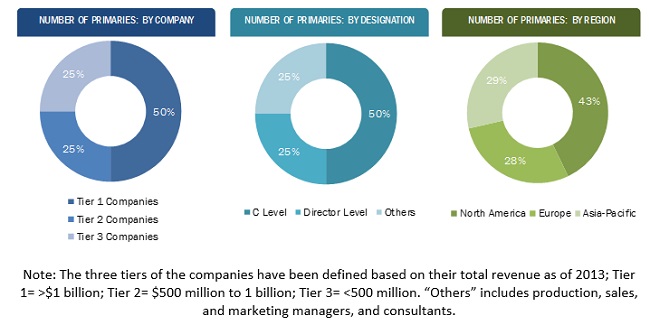
To know about the assumptions considered for the study, download the pdf brochure
Market Size Estimation
Both top-down and bottom-up approaches were implemented to estimate and validate the total size of the holographic display market. These methods were also used extensively to estimate the size of the markets based on various subsegments. The research methodology used to estimate the market size includes the following steps:
- The key players in the industry and markets have been identified through extensive secondary research.
- The industry’s supply chain and market size, in terms of value, have been determined through primary and secondary research.
- All percentage shares, splits, and breakdowns have been determined using secondary sources and verified through primary sources.
Data Triangulation
After arriving at the overall market size from the market size estimation process explained above, the total market has been split into several segments and subsegments. To complete the overall market engineering process and arrive at the exact statistics for all segments and subsegments, data triangulation and market breakdown procedures have been employed, wherever applicable. The data has been triangulated by studying various factors and trends in both demand and supply sides. Along with this, the market has been validated using both top-down and bottom-up approaches.
Study Objectives
- To define, describe, and forecast the global holographic display market on the basis of technology, product type, component, and application
- To forecast the market size in terms of value for various segments, with regards to four main regions- North America, Europe, Asia-Pacific, and RoW
- To provide detailed information regarding major factors influencing the growth of the market (drivers, restraints, opportunities, industry specific challenges, winning imperatives, and burning issues)
- To strategically analyze micro-markets with respect to individual growth trends, future prospects, and contribution to the total market
- To analyze opportunities in the market for stakeholders, by identifying high growth segments of the global holographic display market
- To strategically profile key players and comprehensively analyze their market share and core competencies along with, detailing the competitive landscape for market leaders
- To track and analyze competitive developments such as joint ventures, mergers and acquisitions, new product developments, and research and development in the global holographic display market
Available Customizations
With the given market data, MarketsandMarkets offers customizations according to the company's specific needs. The following customization options are available for this report:
Product Analysis
- Product matrix, which gives a detailed comparison of the product portfolio of each company
Geographic Analysis
- Further breakdown of the Rest of Asia-Pacific holographic display market into Australia, New Zealand, and others
- Further breakdown of the South American holographic display market into Brazil, Argentina, and Rest of South America
Company Information
- Detailed analysis and profiling of additional market players (Up to five).













Growth opportunities and latent adjacency in Holographic Display Market