



Immunoassay Market
Report Code
MD 4751
Published in
Oct, 2026, By MarketsandMarkets™
Immunoassay Market by Product (Reagents & Kits, Analyzers), Technology (ELISA, IFA, Western Blot), Specimen (Blood, Saliva), Application (Infectious Diseases, Endocrinology, Cardiology), End User (Hospital, Blood Bank) & Region – Global Forecast to 2031

$31.65B
MARKET SIZE, 2026
$44.49B
MARKET SIZE, 2031

7.0%
CAGR (2026-2031)

2026-2031
FORECAST PERIOD
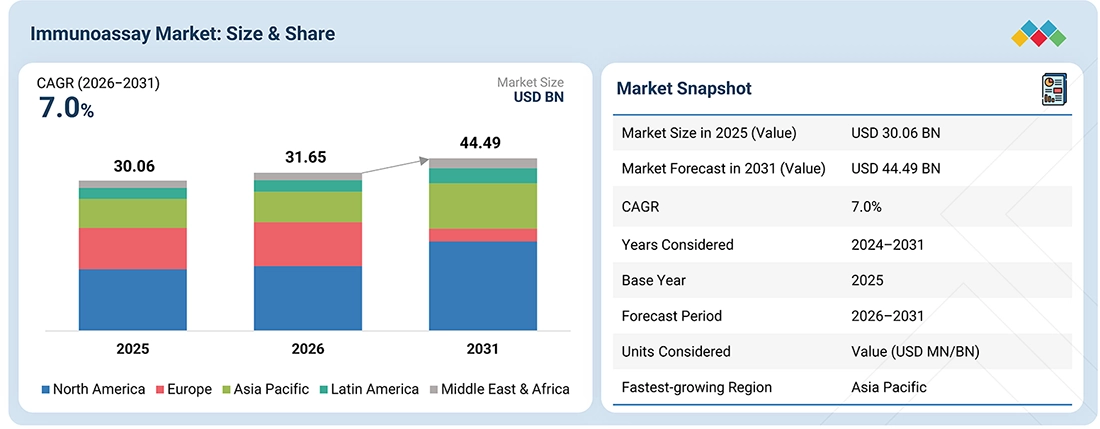
IMMUNOASSAY MARKET SIZE, SHARE & GROWTH SNAPSHOT
Source: Secondary Research, Interviews with Experts, MarketsandMarkets Analysis
The global immunoassay market is projected to grow from USD 31.65 billion in 2026 to USD 44.49 billion by 2031, at a CAGR of 7.0% during the forecast period. The market was valued at USD 30.06 billion in 2025. This growth is propelled by the increasing burden of chronic and infectious diseases, ongoing technological innovation in immunoassay platforms, favorable government initiatives, and rising demand for drug and alcohol screening amid tightening regulatory requirements.
KEY TAKEAWAYS
-
MARKET SNAPSHOT:
Base Year Market Size (2025): USD 30.06 Billion
Current Market Size (2026): USD 31.65 Billion
Forecast Market Size (2031): USD 44.49 Billion
CAGR (2026–2031): 7.0% -
SEGMENT LEADERSHIP:
Regional Outlook: Asia Pacific is expected to register the fastest growth in the immunoassay market during the forecast period.
Product Leader: Reagents & kits accounted for the largest market share of 84.1% in 2025.
Technology Leader: Chemiluminescence immunoassay (CLIA) accounted for the largest market share of 49.7% in 2025.
Specimen Leader: Blood accounted for the largest share of the immunoassay market in 2025.
Application Leader: Infectious diseases accounted for the largest share of the immunoassay market in 2025.
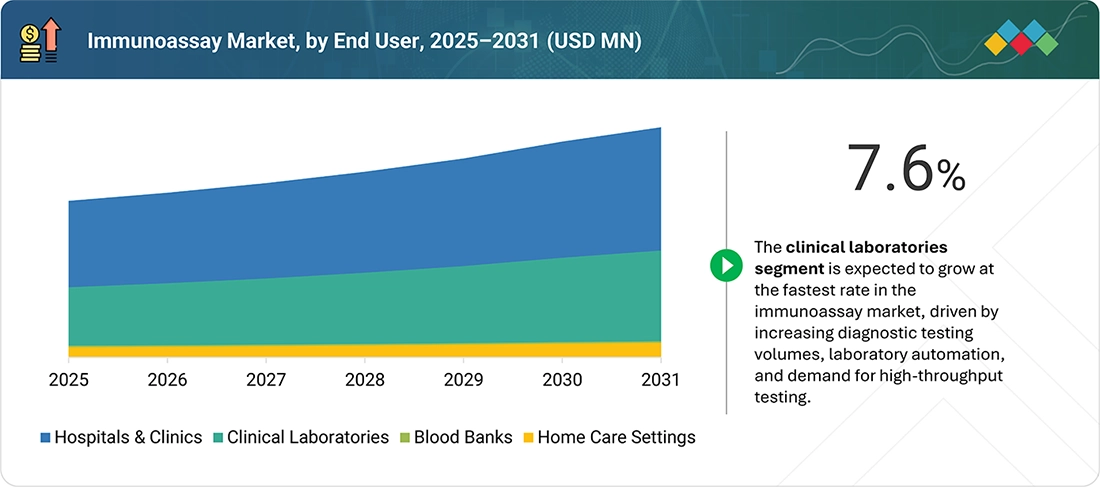
End User Outlook: Clinical laboratories are expected to register the highest CAGR of 7.6% during the forecast period. -
MARKET OUTLOOK & COMPETITIVE LANDSCAPE:
Siemens Healthineers AG (Germany), F. Hoffmann-La Roche Ltd. (Switzerland), Danaher Corporation (US), and Bio-Rad Laboratories, Inc. (US) are among the other major players in the immunoassay market, supported by established diagnostic portfolios, broad assay menus, advanced immunoassay platforms, and strong global market presence.
Cellab (Australia), Abnova Corporation (Taiwan), and J. Mitra & Co. Pvt. Ltd. (India) have distinguished themselves among smaller players through specialized immunoassay products and a strong presence in regional and niche diagnostic markets.
The immunoassay market is growing steadily due to the rising prevalence of chronic and infectious diseases, increasing demand for early and accurate diagnosis, and the expanding use of immunoassays across clinical diagnostics, oncology, endocrinology, cardiology, infectious disease testing, and blood screening. The increasing adoption of automated, high-throughput, point-of-care, and rapid testing platforms, along with the expansion of healthcare and diagnostic infrastructure, is supporting market growth. Additionally, advances in chemiluminescence immunoassays, multiplex testing, assay sensitivity, automation, microfluidics, and digital connectivity are improving diagnostic accuracy, workflow efficiency, and overall immunoassay system performance.
TRENDS & DISRUPTIONS IMPACTING CUSTOMERS' CUSTOMERS
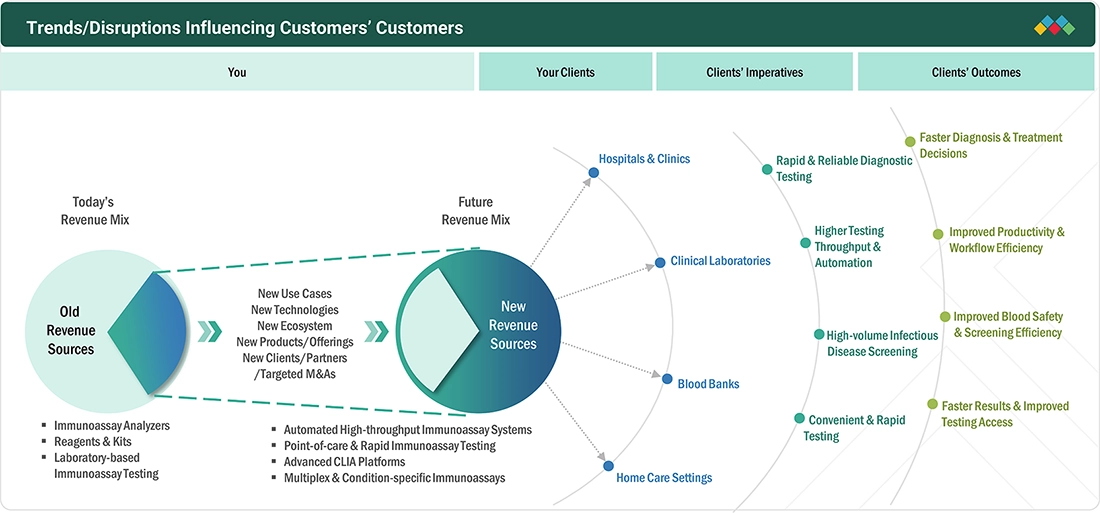
Clinical and technological trends drive the immunoassay market, with growing emphasis on early disease detection, accurate diagnosis, disease monitoring, and high-throughput testing. Key applications include infectious disease testing, oncology, endocrinology, cardiology, blood screening, autoimmune disorders, and allergy diagnostics. Major trends shaping the market include increasing adoption of chemiluminescence immunoassays (CLIA), automated and high-throughput platforms, multiplex testing, point-of-care and rapid testing, advanced assay development, and digital laboratory connectivity, which enhance diagnostic accuracy, testing efficiency, turnaround time, and workflow integration.
Source: Secondary Research, Interviews with Experts, MarketsandMarkets Analysis
MARKET DYNAMICS

Drivers
Impact
Level
Level
-
Increasing incidence of chronic and infectious diseases

-
Increased demand for blood donations in healthcare systems and surgical procedures


RESTRAINTS
Impact
Level
Level
-
Stringent requirements for approval of immunoassay instruments and consumables

-
Technical hurdles of immunoassay kits


OPPORTUNITIES
Impact
Level
Level
-
Increasing growth opportunities in emerging economies

-
Focus on companion diagnostics


CHALLENGES
Impact
Level
Level
-
Design challenges and low quality of antibodies

-
Dearth of skilled professionals

Source: Secondary Research, Interviews with Experts, MarketsandMarkets Analysis
Driver: Increasing incidence of chronic and infectious diseases
The increasing incidence of chronic and infectious diseases is driving demand for early, accurate, and reliable diagnostic testing. Immunoassays are widely used for disease detection, screening, and monitoring across hospitals, clinical laboratories, and other healthcare settings, supporting their growing adoption.
Restraint: Stringent requirements for approval of immunoassay instruments and consumables
Stringent regulatory requirements for the approval of immunoassay instruments and consumables can increase product development timelines, validation requirements, and compliance costs. These requirements may delay commercialization and create additional barriers for manufacturers, particularly smaller companies.
Opportunity: Development of condition-specific biomarkers and tests
The development of condition-specific biomarkers and tests is creating opportunities to expand immunoassays across a wider range of disease areas. Advances in biomarker research can support more targeted testing, improve diagnostic performance, and enable specialized assays for specific clinical conditions.
Challenge: Design challenges and low quality of antibodies
Design challenges and variations in antibody quality can affect the sensitivity, specificity, reproducibility, and reliability of immunoassays. Maintaining consistent antibody performance and optimizing assay design are therefore important challenges for manufacturers seeking to develop accurate and reliable immunoassay solutions.
IMMUNOASSAY MARKET: COMMERCIAL USE CASES ACROSS INDUSTRIES
| COMPANY | USE CASE DESCRIPTION | BENEFITS |
|---|---|---|
 |
Provides automated immunoassay testing through the Alinity i and ARCHITECT systems for clinical laboratory and blood screening applications. | Improves testing throughput within a compact footprint | Supports broad testing menus | Provides greater walk-away time through automated workflows | Supports consistent and reliable results. |
 |
Provides automated immunoassay testing through cobas e analyzers using electrochemiluminescence technology across infectious disease, cardiac, endocrine, fertility, and oncology applications. | Provides high sensitivity and reproducibility through ECL technology | Supports high-throughput testing | Enables continuous reagent loading during operation | Supports carryover-free sample processing. |
 |
Provides immunoassay testing through Atellica IM, ADVIA Centaur, and IMMULITE systems across infectious disease, cardiac, endocrine, and reproductive health testing. | Supports high immunoassay testing throughput | Enables rapid turnaround for key assays | Provides automated QC and remote monitoring | Supports broad assay menus and scalable laboratory configurations. |
 |
Provides automated immunoassay testing through DxI and Access analyzers for clinical laboratories with varying testing volumes. | Provides high productivity per laboratory footprint | Reduces routine maintenance requirements | Supports remote real-time system monitoring | Enables expanded assay processing and laboratory productivity. |
 |
Provides Bio-Plex multiplex immunoassays and ELISA-based solutions for biomarker, cytokine, protein, and antibody analysis across research and clinical applications. | Enables simultaneous measurement of multiple analytes | Reduces sample volume requirements | Supports high-throughput biomarker analysis | Provides automated data analysis and reproducible assay performance. |
Logos and trademarks shown above are the property of their respective owners. Their use here is for informational and illustrative purposes only.
MARKET ECOSYSTEM
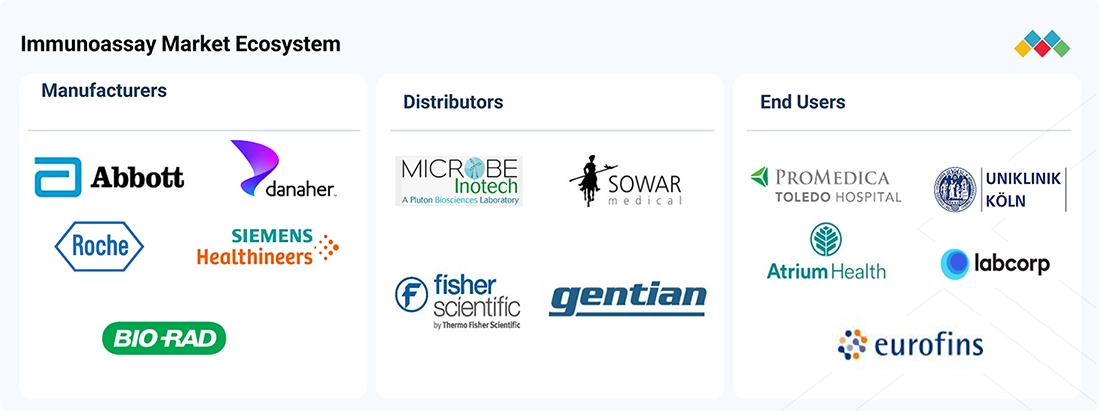
The immunoassay ecosystem comprises manufacturers, distributors, clinical laboratories, hospitals & clinics, pharmaceutical & biopharmaceutical organizations, and other end users, each contributing to the development, distribution, and adoption of immunoassay solutions. Manufacturers develop and commercialize immunoassay analyzers, reagents & kits, and related testing technologies for applications across infectious diseases, oncology, cardiology, endocrinology, and other clinical areas. Distributors support product availability, installation, technical support, and market access across regional markets. End users, including clinical laboratories, hospitals and clinics, pharmaceutical and biopharmaceutical organizations, and research laboratories, utilize immunoassay solutions for disease screening, diagnosis, monitoring, drug development, and biomarker analysis, supporting accurate and timely clinical decision-making.
Logos and trademarks shown above are the property of their respective owners. Their use here is for informational and illustrative purposes only.
MARKET SEGMENTS
Source: Secondary Research, Interviews with Experts, MarketsandMarkets Analysis
Immunoassay Market, By Product
In 2025, the reagents & kits segment accounted for the largest share of the immunoassay market. The segment's leading position is mainly driven by the recurring use and replacement of reagents and kits across a wide range of immunoassay tests. Increasing diagnostic testing volumes across hospitals, clinical laboratories, and other healthcare settings, along with the availability of high-performance reagents that offer improved accuracy and reliability, is further supporting demand for this segment.
Immunoassay Market, By Technology
In 2025, the chemiluminescence immunoassay (CLIA) segment accounted for the largest share of the immunoassay market. Its leading position is supported by high sensitivity, specificity, broad dynamic range, rapid turnaround time, and low background interference. In addition, the compatibility of CLIA systems with automated and high-throughput laboratory platforms makes the technology suitable for large-scale clinical testing across infectious diseases, oncology, cardiology, endocrinology, and other applications.
Immunoassay Market, By Specimen
In 2025, the blood segment accounted for the largest share of the immunoassay market. Blood is widely used as a specimen for immunoassay-based detection and monitoring across infectious diseases, oncology, cardiology, endocrinology, autoimmune disorders, and other clinical conditions. The extensive availability of established blood-based testing methods and the ability to analyze multiple biomarkers from blood samples continue to support the segment's leading position.
Immunoassay Market, By Application
In 2025, the infectious diseases segment accounted for the largest share of the immunoassay market. The segment is supported by the ongoing global burden of infectious diseases, including viral and bacterial infections, and the need for rapid, reliable diagnostic testing. Immunoassays are widely used to detect and monitor infectious diseases, while growing emphasis on early diagnosis, disease surveillance, and outbreak management further supports demand.
Immunoassay Market, By End User
From 2026 to 2031, the clinical laboratories segment is expected to register the highest CAGR in the immunoassay market. Growth is supported by rising diagnostic testing volumes, expanding and modernizing laboratory infrastructure, and increasing adoption of automated immunoassay systems. The growing need for high-throughput, accurate, and efficient testing across a broad range of clinical applications is further increasing the use of immunoassay solutions in clinical laboratories.
REGION
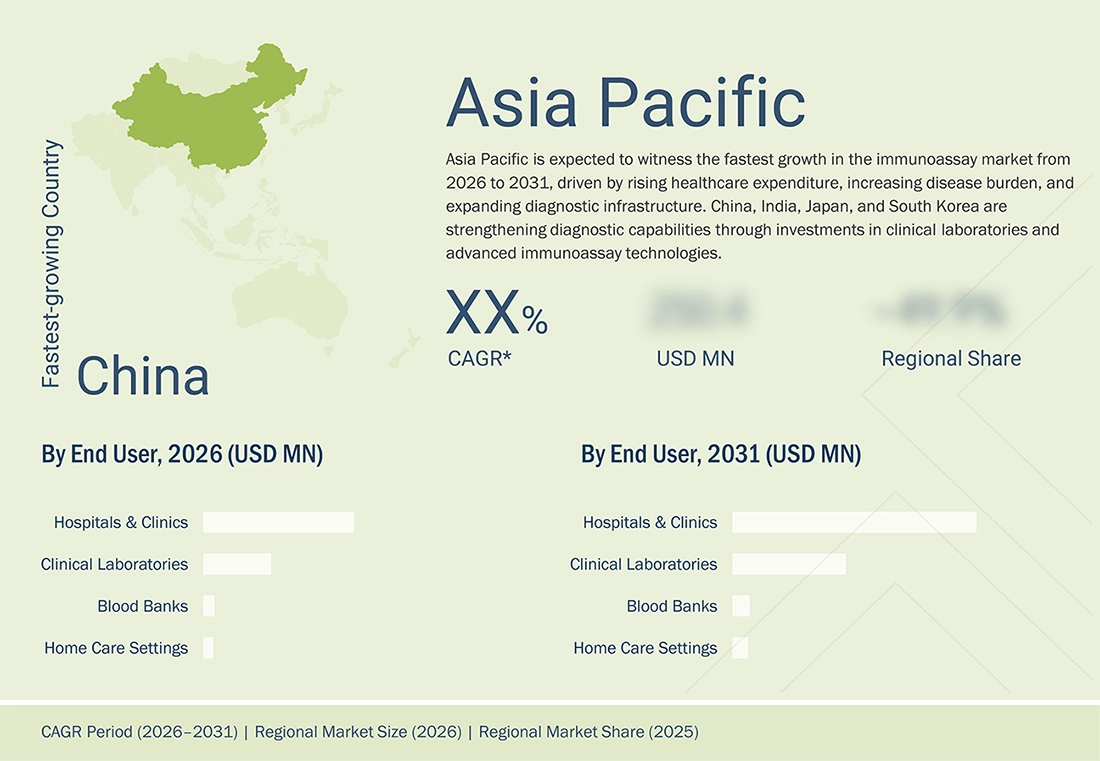
Asia Pacific to be fastest-growing region in global immunoassay market during forecast period
From 2026 to 2031, the Asia Pacific region is expected to register the highest CAGR in the immunoassay market. This growth is primarily driven by rising healthcare expenditure, increasing prevalence of chronic and infectious diseases, expanding healthcare and diagnostic infrastructure, and growing awareness regarding early disease detection. Increasing investments in clinical laboratories and the adoption of automated, advanced immunoassay technologies across countries such as China, India, and other emerging Asian economies are further supporting regional market growth.
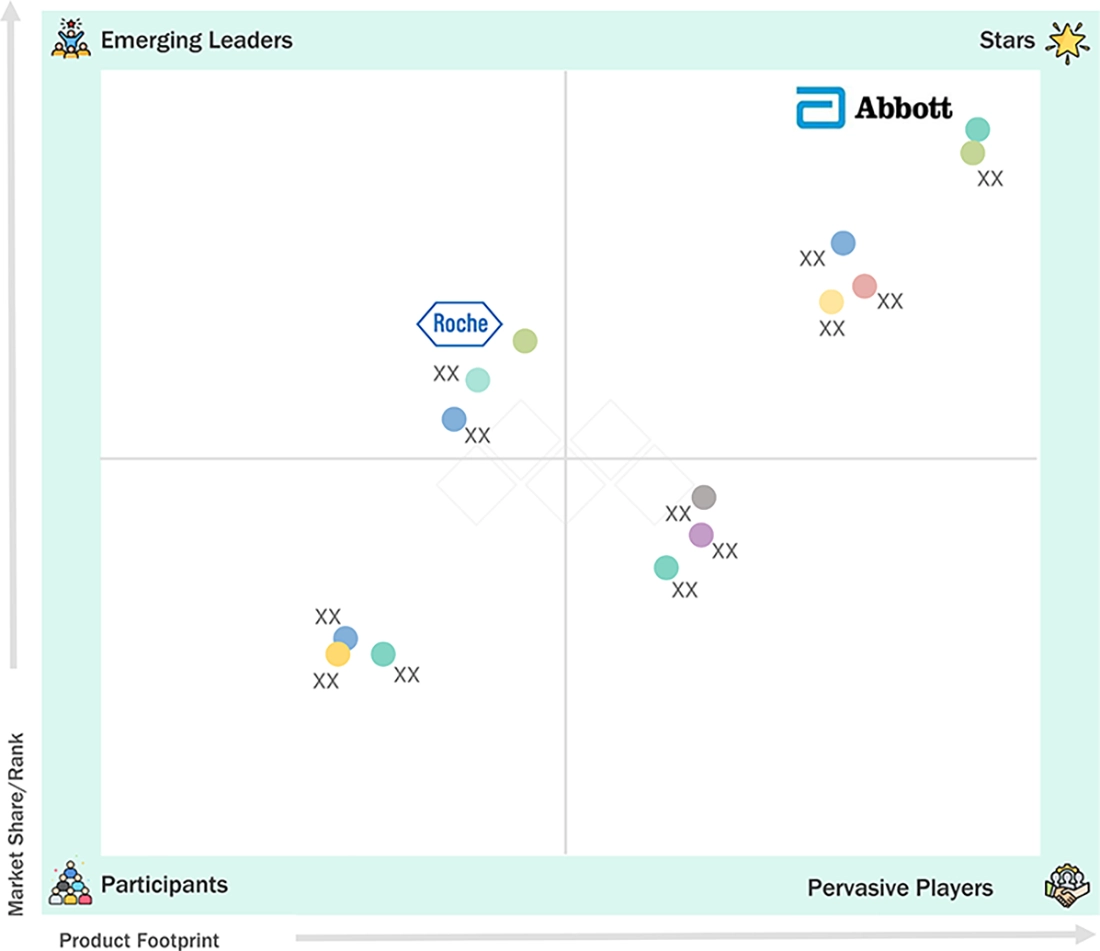
IMMUNOASSAY MARKET: COMPANY EVALUATION MATRIX
In the immunoassay market, Abbott Laboratories (US) is recognized as a Star player, supported by its established portfolio of immunoassay analyzers, broad diagnostic capabilities, and global laboratory presence. Its Alinity i and ARCHITECT immunoassay systems support high-throughput testing across a broad range of clinical applications, with features designed to improve testing productivity, workflow efficiency, and laboratory scalability. F. Hoffmann-La Roche Ltd. (Switzerland) is also a major established player, supported by its broad cobas immunoassay portfolio and Elecsys technology. Its cobas e 801 analytical unit supports up to 300 immunochemistry tests per hour, with a broad assay menu and automated reagent handling for medium- to high-volume laboratory testing.
Source: Secondary Research, Interviews with Experts, MarketsandMarkets Analysis
KEY MARKET PLAYERS
- Abbott Laboratories (US)
- F. Hoffmann-La Roche Ltd (Switzerland)
- Siemens Healthineers AG (Germany)
- Danaher Corporation (US)
- Bio-Rad Laboratories, Inc. (US)
- Thermo Fisher Scientific Inc. (US)
- PerkinElmer, Inc. (US)
- Becton, Dickinson and Company (US)
- DiaSorin S.p.A (Italy)
- QuidelOrtho Corporation (US)
- bioMérieux (France)
- QIAGEN (Germany)
- Sysmex Corporation (Japan)
- Mindray (China)
- Agilent Technologies (US)
MARKET SCOPE
| REPORT METRIC | DETAILS |
|---|---|
| Market Size in 2025 (Value) | USD 30.06 Billion |
| Market Forecast in 2026 (Value) | USD 31.65 Billion |
| Market Forecast in 2031 (Value) | USD 44.49 Billion |
| Growth Rate | CAGR of 7.0% from 2026–2031 |
| Years Considered | 2024–2031 |
| Base Year | 2025 |
| Forecast Period | 2026–2031 |
| Units Considered | Value (USD Million/Billion) |
| Report Coverage | Revenue Forecast, Company Ranking, Competitive Landscape, Growth Factors, and Trends |
| Segments Covered |
|
| Regions Covered | North America, Europe, Asia Pacific, Latin America, and the Middle East & Africa |
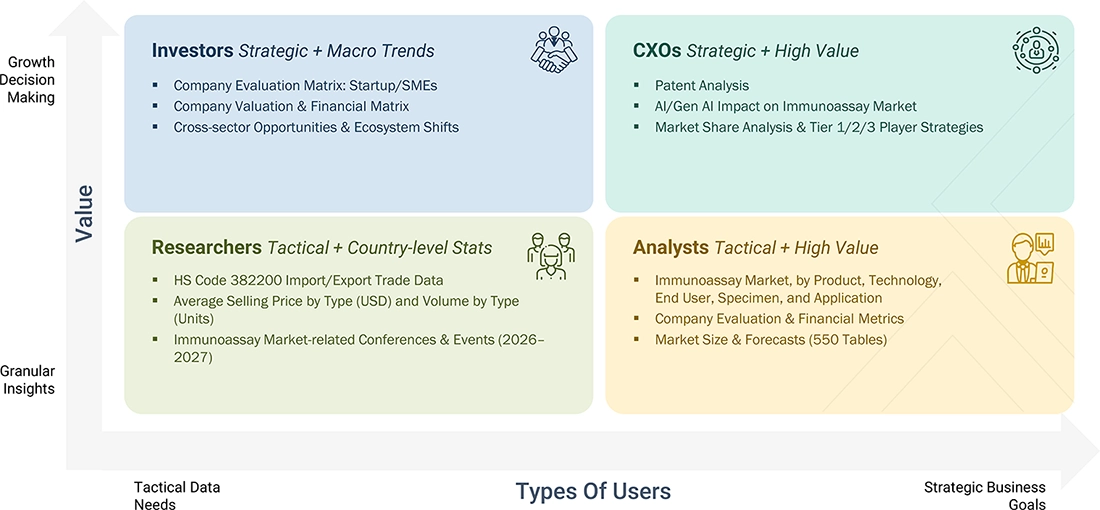
WHAT IS IN IT FOR YOU: IMMUNOASSAY MARKET REPORT CONTENT GUIDE
DELIVERED CUSTOMIZATIONS
We have successfully delivered the following deep-dive customizations:
| CLIENT REQUEST | CUSTOMIZATION DELIVERED | VALUE ADDS |
|---|---|---|
| Country-wise analysis of the immunoassay market across North America, Europe, Asia Pacific, Latin America, and the Middle East & Africa | Delivered detailed country-level market sizing, growth forecasts, and demand analysis across major regions, with assessment of healthcare expenditure, diagnostic infrastructure, disease burden, laboratory testing volumes, and adoption of immunoassay technologies. | Incorporated country-specific analysis of chronic and infectious disease prevalence, healthcare infrastructure, diagnostic testing demand, regulatory environment, and technological adoption to identify high-growth markets and expansion opportunities. |
| Market share analysis and competitive benchmarking of key immunoassay companies |
|
Expanded the competitive landscape by profiling established and emerging players and assessing product launches, acquisitions, partnerships, technological developments, automation capabilities, point-of-care solutions, and assay portfolio expansion to evaluate future competitive positioning. |
| Pricing analysis of immunoassay analyzers, reagents, and kits | Delivered pricing analysis of immunoassay products, including analyzers and reagents & kits, with pricing variations assessed based on technology, testing throughput, assay menu, instrument configuration, and product type. | Incorporated analysis of country-level pricing differences, laboratory procurement practices, distributor margins, testing volumes, product configuration, and recurring reagent consumption to provide a comprehensive assessment of pricing trends and market accessibility across regions. |
RECENT DEVELOPMENTS
- March 2025 : Beckman Coulter, Inc. (US), a subsidiary of Danaher Corporation, received FDA 510(k) clearance for the DxC 500i Clinical Analyzer, an integrated clinical chemistry and immunoassay system. The system combines chemistry and immunoassay testing capabilities to support laboratory automation and streamlined diagnostic workflows.
- January 2025 : bioMérieux (France) entered into an agreement to acquire SpinChip Diagnostics ASA (Norway), strengthening its point-of-care immunoassay capabilities. SpinChip’s platform is designed to deliver high-sensitivity immunoassay results from whole blood samples within approximately 10 minutes, supporting rapid testing outside conventional laboratory settings.
- November 2023 : F. Hoffmann-La Roche Ltd. (Switzerland) launched the Elecsys Anti-HEV IgM and Elecsys Anti-HEV IgG immunoassays for the detection of hepatitis E virus infections in countries accepting the CE mark. The assays expanded Roche’s immunoassay portfolio for viral hepatitis testing and supported automated laboratory-based diagnostics.
Table of Contents
 Exclusive indicates content/data unique to MarketsandMarkets and not available with any competitors.
TITLE
PAGE NO
1
INTRODUCTION
15
2
EXECUTIVE SUMMARY
3
PREMIUM INSIGHTS
4
MARKET OVERVIEW
Highlights the market structure, growth drivers, restraints, and near-term inflection points influencing performance.
4.1
INTRODUCTION
4.2
MARKET DYNAMICS
4.2.1
DRIVERS
4.2.2
RESTRAINTS
4.2.3
OPPORTUNITIES
4.2.5
CHALLENGES
4.3
UNMET NEEDS & WHITE SPACES
4.4
INTERCONNECTED MARKETS & CROSS-SECTOR OPPORTUNITIES
4.5
STRATEGIC MOVES BY TIER 1/2/3 PLAYERS
5
INDUSTRY TRENDS
This section summarizes market dynamics, key shifts, and high-impact trends shaping demand outlook.
5.1
PORTER’S FIVE FORCES ANALYSIS
5.2
MACROECONOMIC OUTLOOK
5.2.1
INTRODUCTION
5.2.2
GDP TRENDS & FORECAST
5.2.3
TRENDS IN GLOBAL IMMUNOASSAY INDUSTRY
5.3
VALUE CHAIN ANALYSIS
5.4
ECOSYSTEM ANALYSIS
5.5
PRICING ANALYSIS
5.5.1
AVERAGE SELLING PRICE TREND OF IMMUNOASSAY PRODUCTS, BY KEY PLAYER, 2024–2026
5.5.2
AVERAGE SELLING PRICE TREND OF IMMUNOASSAY PRODUCTS, BY REGION, 2024–2026
5.6
TRADE ANALYSIS
5.7.1
IMPORT SCENARIO (HS CODE 8419)
5.7.2
EXPORT SCENARIO (HS CODE 8419)
5.7
KEY CONFERENCES & EVENTS, 2026–2027
5.8
TRENDS/DISRUPTIONS IMPACTING CUSTOMERS’ BUSINESSES
5.9
INVESTMENT & FUNDING SCENARIO
5.10
CASE STUDY ANALYSIS
5.11
IMPACT OF 2025 US TARIFFS ON IMMUNOASSAY MARKET
5.11.1
INTRODUCTION
5.11.2
KEY TARIFF RATES
5.11.3
PRICE IMPACT ANALYSIS
5.11.4
IMPACT ON COUNTRIES/REGIONS
5.11.4.1
US
5.11.4.2
EUROPE
5.11.4.3
ASIA PACIFIC
5.11.5
IMPACT ON END USERS
6
TECHNOLOGICAL ADVANCEMENTS, AI-DRIVEN IMPACT, PATENTS, INNOVATIONS, AND FUTURE APPLICATIONS
6.1
KEY/EMERGING TECHNOLOGIES
6.2
COMPLEMENTARY TECHNOLOGIES
6.3
TECHNOLOGY/PRODUCT ROADMAP
6.4
PATENT ANALYSIS
6.5
FUTURE APPLICATIONS
6.6
IMPACT OF AI/GEN AI ON IMMUNOASSAY MARKET
6.6.1
TOP USE CASES & MARKET POTENTIAL
6.6.2
BEST PRACTICES FOLLOWED BY MANUFACTURERS/OEMS IN IMMUNOASSAY MARKET
6.6.3
CASE STUDIES RELATED TO AI/GEN AI IMPLEMENTATION IN IMMUNOASSAY MARKET
6.6.4
INTERCONNECTED ECOSYSTEMS & IMPACT ON MARKET PLAYERS
6.6.5
CLIENTS’ READINESS TO ADOPT AI/GEN AI-INTEGRATED IMMUNOASSAYS
7
REGULATORY LANDSCAPE & SUSTAINABILITY INITIATIVES
7.1
REGIONAL REGULATIONS & COMPLIANCE
7.1.1
REGULATORY BODIES, GOVERNMENT AGENCIES, AND OTHER ORGANIZATIONS
7.1.2
INDUSTRY STANDARDS
7.2
SUSTAINABILITY INITIATIVES
7.2.1
ENVIRONMENTAL IMPACT & ECO-FRIENDLY INITIATIVES
7.3
IMPACT OF REGULATORY POLICIES ON SUSTAINABILITY INITIATIVES
7.4
CERTIFICATIONS, LABELING, AND ECO-STANDARDS
8
CUSTOMER LANDSCAPE & BUYER BEHAVIOR
8.1
DECISION-MAKING PROCESS
8.2
KEY STAKEHOLDERS INVOLVED IN BUYING PROCESS & THEIR EVALUATION CRITERIA
8.2.1
KEY STAKEHOLDERS IN BUYING PROCESS
8.2.2
EVALUATION CRITERIA
8.3
ADOPTION BARRIERS & INTERNAL CHALLENGES
8.4
UNMET NEEDS OF VARIOUS END USERS
8.5
MARKET PROFITABILITY
9
IMMUNOASSAY MARKET, BY PRODUCT (MARKET SIZE & FORECAST TO 2031 – IN VALUE, USD MILLION)
9.1
INTRODUCTION
9.2
REAGENTS & KITS
9.2.1
ELISA REAGENTS & KITS
9.2.2
CLIA REAGENTS & KITS
9.2.3
IFA REAGENTS & KITS
9.2.4
RAPID TEST REAGENTS & KITS
9.2.5
WESTERN BLOT REAGENTS & KITS
9.2.6
OTHER REAGENTS & KITS
9.3
ANALYZERS
9.3.1
IMMUNOASSAY ANALYZERS MARKET, BY TYPE
9.3.1.1
OPEN-ENDED SYSTEMS
9.3.1.2
CLOSED-ENDED SYSTEMS
9.3.2
IMMUNOASSAY ANALYZERS MARKET, BY PURCHASE MODE
9.3.2.1
RENTAL PURCHASE
9.3.2.2
OUTRIGHT PURCHASE
10
IMMUNOASSAY MARKET, BY TECHNOLOGY (MARKET SIZE & FORECAST TO 2031 – IN VALUE, USD MILLION)
10.1
INTRODUCTION
10.2
ELISA
10.3
CLIA
10.4
IFA
10.5
RAPID TESTS
10.6
WESTERN BLOTTING
10.7
OTHER TECHNOLOGIES
11
IMMUNOASSAY MARKET, BY SPECIMEN TYPE (MARKET SIZE & FORECAST TO 2031 – IN VALUE, USD MILLION)
11.1
INTRODUCTION
11.2
BLOOD
11.3
SALIVA
11.4
URINE
11.5
OTHER SPECIMENS
12
IMMUNOASSAY MARKET, BY APPLICATION (MARKET SIZE & FORECAST TO 2031 – IN VALUE, USD MILLION)
12.1
INTRODUCTION
12.2
INFECTIOUS DISEASES
12.3
ENDOCRINOLOGY
12.7
ONCOLOGY
12.4
CARDIOLOGY
12.10
BLOOD SCREENING
12.5
AUTOIMMUNE DISORDERS
12.6
ALLERGY DIAGNOSTICS
12.8
BONE & MINERAL DISORDERS
12.9
DRUG MONITORING AND TESTING
12.11
NEWBORN SCREENING
12.12
OTHER APPLICATIONS
13
IMMUNOASSAY MARKET, BY END USER (MARKET SIZE & FORECAST TO 2031 – IN VALUE, USD MILLION)
13.1
INTRODUCTION
13.2
HOSPITALS & CLINICS
13.3
CLINICAL LABORATORIES
13.4
PHARMACEUTICAL & BIOTECHNOLOGY COMPANIES AND CONTRACT RESEARCH ORGANIZATIONS
13.5
HOME CARE SETTINGS
13.6
BLOOD BANKS
13.7
RESEARCH & ACADEMIC LABORATORIES
14
IMMUNOASSAY MARKET, BY REGION (MARKET SIZE & FORECAST TO 2031 – IN VALUE, USD MILLION)
14.1
INTRODUCTION
14.2
NORTH AMERICA
14.2.1
US
14.2.2
CANADA
14.3
EUROPE
14.3.1
GERMANY
14.3.2
UK
14.3.3
ITALY
14.3.4
FRANCE
14.3.5
SPAIN
14.3.6
REST OF EUROPE
14.4
ASIA PACIFIC
14.4.1
CHINA
14.4.2
JAPAN
14.4.3
INDIA
14.4.4
SOUTH KOREA
14.4.5
INDONESIA
14.4.6
REST OF ASIA PACIFIC
14.5
LATIN AMERICA
14.5.1
BRAZIL
14.5.2
MEXICO
14.5.3
REST OF LATIN AMERICA
14.6
MIDDLE EAST & AFRICA
15
COMPETITIVE LANDSCAPE
15.1
OVERVIEW
15.2
KEY PLAYER COMPETITIVE STRATEGIES/RIGHT TO WIN, 2024–2026
15.3
REVENUE ANALYSIS, 2021–2025
15.4
MARKET SHARE ANALYSIS,
15.4.1
GLOBAL MARKET SHARE ANALYSIS
15.4.2
US MARKET SHARE ANALYSIS
15.5
BRAND COMPARISON
15.6
COMPANY EVALUATION MATRIX: KEY PLAYERS,
15.6.1
STARS
15.6.2
EMERGING LEADERS
15.6.3
PERVASIVE PLAYERS
15.6.4
PARTICIPANTS
15.6.5
COMPANY FOOTPRINT: KEY PLAYERS,
15.6.5.1
COMPANY FOOTPRINT
15.6.5.2
REGION FOOTPRINT
15.6.5.3
PRODUCT FOOTPRINT
15.6.5.4
APPLICATION FOOTPRINT
15.6.5.5
END-USER FOOTPRINT
15.7
COMPANY EVALUATION MATRIX: STARTUPS/SMES,
15.7.1
PROGRESSIVE COMPANIES
15.7.2
RESPONSIVE COMPANIES
15.7.3
DYNAMIC COMPANIES
15.7.4
STARTING BLOCKS
15.7.5
COMPETITIVE BENCHMARKING: STARTUPS/SMES,
15.7.5.1
DETAILED LIST OF KEY STARTUPS/SMES
15.7.5.2
COMPETITIVE BENCHMARKING OF KEY STARTUPS/SMES
15.8
COMPANY VALUATION & FINANCIAL METRICS
15.9
COMPETITIVE SCENARIO
15.9.1
PRODUCT LAUNCHES
15.9.2
DEALS
15.9.3
EXPANSIONS
16
COMPANY PROFILES
16.1
KEY PLAYERS
16.1.1
ABBOTT LABORATORIES
16.1.2
F. HOFFMANN-LA ROCHE LTD.
16.1.3
SIEMENS HEALTHINEERS AG
16.1.4
DANAHER CORPORATION
16.1.5
THERMO FISHER SCIENTIFIC INC.
16.1.6
PERKINELMER, INC.
16.1.7
BECTON, DICKINSON AND COMPANY
16.1.8
DIASORIN S.P.A.
16.1.9
BIO-RAD LABORATORIES, INC.
16.1.10
QUIDELORTHO CORPORATION
16.1.11
BIOMÉRIEUX
16.1.12
QIAGEN
16.1.13
SYSMEX CORPORATION
16.1.14
AGILENT TECHNOLOGIES
16.1.15
MINDRAY
16.2
OTHER PLAYERS
16.2.1
MERCK KGAA
16.2.2
MERIDIAN BIOSCIENCE
16.2.3
BIO-TECHNE
16.2.4
CELLABS
16.2.5
ABNOVA CORPORATION
16.2.6
J. MITRA & CO
16.2.7
TOSOH CORPORATION (TOSOH BIOSCIENCES)
16.2.8
CELL SCIENCES
16.2.9
ENZO BIOCHEM
16.2.10
CREATIVE DIAGNOSTICS
16.2.11
BOSTER BIOLOGICAL TECHNOLOGY
16.2.12
ELABSCIENCE
16.2.13
WAK-CHEMIE MEDICAL GMBH
16.2.14
SERACARE
16.2.15
EPITOPE DIAGNOSTICS INC.
16.2.16
KAMIYA BIOMEDICAL COMPANY
16.2.17
GYROS PROTEIN TECHNOLOGIES
16.2.18
TRIVITRON HEALTHCARE
16.2.19
INBIOS INTERNATIONAL, INC.
16.2.20
MACCURA BIOTECHNOLOGY CO., LTD.
17
RESEARCH METHODOLOGY
17.1
RESEARCH DATA
17.1.1
SECONDARY DATA
17.1.1.1
KEY DATA FROM SECONDARY SOURCES
17.1.1.2
LIST OF SECONDARY SOURCES
17.1.2
PRIMARY DATA
17.1.2.1
KEY DATA FROM PRIMARY SOURCES
17.1.2.2
LIST OF PRIMARY INTERVIEW PARTICIPANTS
17.1.2.3
BREAKDOWN OF PRIMARY INTERVIEWS
17.1.2.4
KEY INDUSTRY INSIGHTS
17.2
MARKET SIZE ESTIMATION
17.2.1
BOTTOM-UP APPROACH
17.2.2
TOP-DOWN APPROACH
17.2.3
MARKET SIZE CALCULATION FOR BASE YEAR
17.3
MARKET FORECAST APPROACH
17.3.1
SUPPLY SIDE
17.3.2
DEMAND SIDE
17.4
DATA TRIANGULATION
17.5
FACTOR ANALYSIS
17.6
RESEARCH ASSUMPTIONS
17.7
RESEARCH LIMITATIONS
17.8
RISK ANALYSIS
18
APPENDIX
18.1
DISCUSSION GUIDE
18.2
KNOWLEDGESTORE: MARKETSANDMARKETS’ SUBSCRIPTION PORTAL
18.3
CUSTOMIZATION OPTIONS
18.4
RELATED REPORTS
18.5
AUTHOR DETAILS
Methodology
This study analyzes key market dynamics, including drivers, opportunities, restraints, and challenges, as well as major players’ strategies. It also monitors developments among leading players, including acquisitions, product launches, expansions, agreements, and partnerships. Additionally, the study examines the immunoassay market’s competitive landscape by evaluating market participants against criteria within the overarching categories of business and product strategy. To estimate market size, the study employed both top-down and bottom-up approaches. The market breakdown and data triangulation methods were used to assess segment and subsegment sizes.
The four steps involved in estimating the market size are as follows:
Secondary Research
In the secondary research process, various secondary sources such as annual reports, press releases, and investor presentations of companies; white papers; certified publications; articles by recognized authors; gold- and silver-standard websites; regulatory bodies; and databases (such as D&B Hoovers, Bloomberg Business, and Factiva) were referred to in order to identify and collect information for this study.
Primary Research
In the primary research process, we interviewed various sources from the supply and demand sides to obtain qualitative and quantitative information for this report. Primary sources were industry experts from core and related industries, as well as preferred suppliers, manufacturers, distributors, technology developers, researchers, and organizations across all segments of this industry’s value chain. We conducted in-depth interviews with various primary respondents, including key industry participants, subject-matter experts, C-level executives of key market players, and industry consultants, to obtain and verify critical qualitative and quantitative information and assess prospects.
The following is a breakdown of the primary respondents:
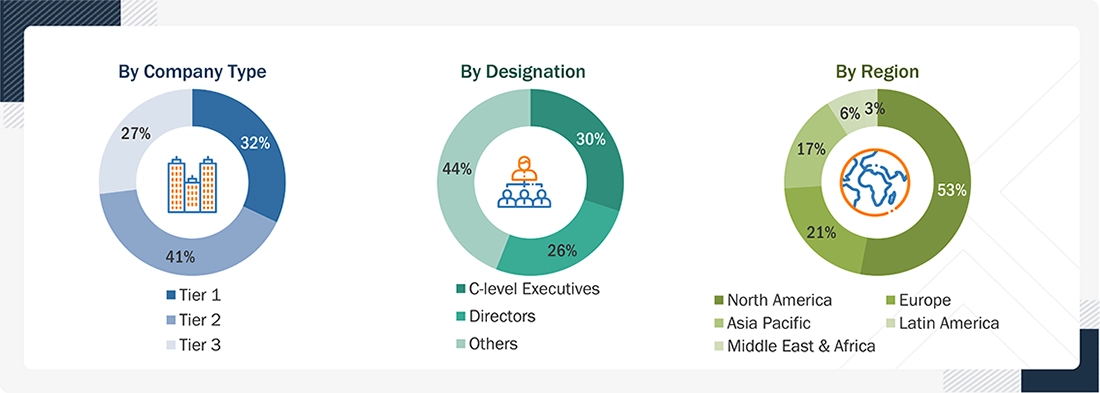
Note 1: C-level executives include Chief Executive Officers (CEOs), Chief Financial Officers (CFOs), Chief Operating Officers (COOs), and Vice Presidents (VPs).
Note 2: Other designations include sales managers, marketing managers, business development managers, product managers, distributors, and suppliers.
Note 3: Companies are classified into tiers based on their total revenue as of 2025. The tiers are as follows: Tier 1 = >USD 10 billion, Tier 2 = USD 1 billion to USD 10 billion, and Tier 3 = <USD 1 billion.
To know about the assumptions considered for the study, download the pdf brochure
Market Size Estimation
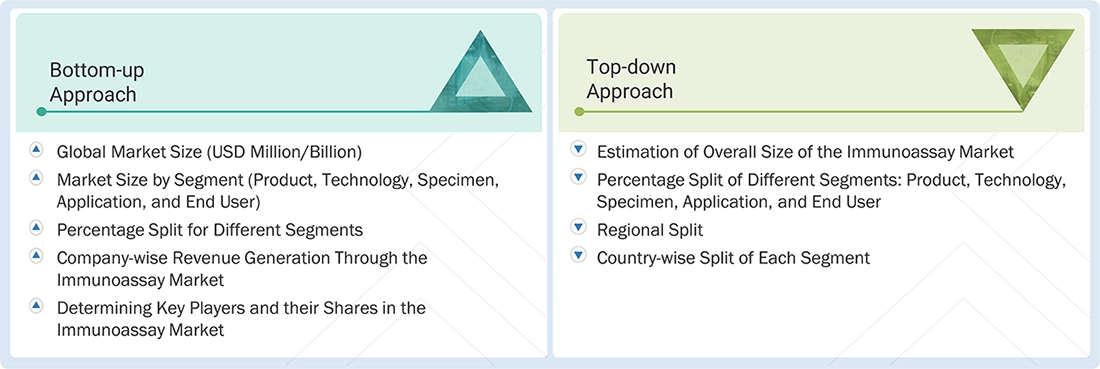
For global market value, we calculated annual revenue figures using revenue mapping for major product manufacturers and OEMs active in the global immunoassay market. We identified all major product manufacturers at the global and/or country/regional level. We mapped revenue for the respective business segments/subsegments of the major players. Additionally, the global market was split into various segments and subsegments:
- List of major players in the immunoassay market by region or country
- Product mapping of various immunoassay manufacturers at the regional and/or country level
- Mapping of annual revenue generated by listed major players from immunoassay products (or the nearest reported business unit/product category)
- Extrapolation of the revenue mapping of the listed major players to derive the global market size of the respective business segments, in terms of value
- Summation of revenue of all companies to arrive at the global immunoassay market size
The data above was consolidated, supplemented with detailed inputs and analysis from MarketsandMarkets, and presented in this report.
Immunoassay Market: Top-Down and Bottom-Up Approach
Data Triangulation
After determining the overall market size using the market size estimation processes, we split the market into several segments and subsegments. To complete the overall market engineering process and arrive at precise statistics for each market segment and subsegment, we used data triangulation and market breakdown procedures, where applicable. We triangulated the data by examining factors and trends from both the demand and supply sides of the immunoassay industry.
Market Definition
An immunoassay is a biochemistry-based test that quantifies the presence or concentration of an analyte. An analyte can be a large protein or antibody produced due to an infection. Immunoassays have become popular and well-established procedures in laboratories. They provide quick, accurate, and precise results. This technique is mostly used in clinical diagnostics, drug monitoring, drug discovery, and food testing.
Key Stakeholders
- Manufacturers and vendors of immunoassay instruments and consumables
- Immunoassay product manufacturers
- Pharmaceutical & biopharmaceutical players
- Diagnostic associations
- Research associations involved in infectious and chronic disease research
- Various research and consulting firms
- Distributors of immunoassay instruments and consumables
- Contract manufacturers of immunoassays
- Healthcare institutions
- Research institutes
- Clinical laboratories
Report Objectives
- To describe, segment, and forecast the immunoassay market by product, technology, specimen, application, end user, and region in terms of value
- To forecast the size of the immunoassay market in five main regions (along with their respective key countries): North America, Europe, Asia Pacific, Latin America, and the Middle East & Africa, in terms of value
- To provide detailed information about the factors (drivers, restraints, opportunities, and challenges) influencing market growth
- To analyze micromarkets with respect to individual growth trends, prospects, and contributions to the overall immunoassay market
- To analyze market opportunities for stakeholders and provide details of the competitive landscape for key players
- To profile the key players in the immunoassay market and comprehensively analyze their core competencies and market shares
- To analyze competitive developments such as acquisitions, product launches, expansions, collaborations, agreements, partnerships, and R&D activities of the leading players in the market
- To benchmark players within the immunoassay market using the Company Evaluation Matrix framework, which analyzes market players on various parameters within the broad categories of business strategy, market share, and product offerings
Available customizations:
Based on the market data provided, MarketsandMarkets offers customizations tailored to your company’s specific needs. The following customization options are available for the report:
Geographict Analysis
-
Further breakdown of the Rest of Europe immunoassay market into Switzerland, Denmark, Austria, and others
-
Further breakdown of the Rest of Asia Pacific immunoassay market into Hong Kong, Taiwan, and others
-
Further breakdown of the Rest of Latin America immunoassay market into Argentina, Colombia, Chile, Ecuador, and others
-
Further breakdown of the Southeast Asian immunoassay market into Malaysia, Singapore, Australia, New Zealand, and others
Competitive Landscape Assessment
-
Market Share Analysis, by region (North America and Europe), which provides the details about the share of the top 3 to 5 key players in the immunoassay market
-
Competitive leadership mapping for established players in the US
Key Questions Addressed by the Report
Who are the key players in the immunoassay market?
Key players include Abbott (US), F. Hoffmann-La Roche Ltd. (Switzerland), Siemens Healthineers AG (Germany), Thermo Fisher Scientific Inc. (US), Danaher (US), Revvity (US), Becton, Dickinson and Company (BD) (US), DiaSorin S.p.A. (Italy), Bio-Rad Laboratories, Inc. (US), QuidelOrtho Corporation (US), bioMérieux (France), QIAGEN (Netherlands), Sysmex Corporation (Japan), Agilent Technologies, Inc. (US), Shenzhen Mindray Bio-medical Electronics Co., Ltd. (China), and Merck KGaA (Germany).
What are the major technologies used in immunoassays?
Major technologies include ELISA, CLIA, IFA, rapid tests, ELISpot, western blotting, and other platforms. ELISA held the largest market share in 2024, followed by rapid tests.
Which specimen type segment of the immunoassay market is expected to witness the highest growth?
The blood specimen segment is expected to record the highest growth due to its superior diagnostic accuracy.
Which end user segment of the immunoassay market is expected to witness the highest growth?
Hospitals & clinics accounted for both the largest share and the highest growth in 2024 owing to high patient footfall for diagnostic and therapeutic services.
What is the market size for the residual DNA market?*
The global immunoassay market is projected to reach USD 47.7 billion by 2030, up from USD 35.5 billion in 2025, at a CAGR of 6.1%.
Fact checked
Personalize This Research
- Triangulate with your Own Data
- Get Data as per your Format and Definition
- Gain a Deeper Dive on a Specific Application, Geography, Customer or Competitor
- Any level of Personalization
Let Us Help You
- What are the Known and Unknown Adjacencies Impacting the Immunoassay Market
- What will your New Revenue Sources be?
- Who will be your Top Customer; what will make them switch?
- Defend your Market Share or Win Competitors
- Get a Scorecard for Target Partners

Custom Market Research Services
We Will Customise The Research For You, In Case The Report Listed Above Does Not Meet With Your Requirements
Get 10% Free CustomisationTESTIMONIALS

JAYANT RAJPUROHIT
Director of Market Insights, Data and Analytics
SFI Health,
Leading Pharmaceutical Companywww.sfihealth.com/

We at SFI Health approached MarketsandMarkets for an Opportunity Assessment on "Incidence and Prevalence of Focus Indications" as we wanted to know the most attractive HCPs like Physician, Functional MD, Naturopath and Pharmacist. The project was critical for us to ensure our focus on the right target which would enable sustainable growth and profitability for SFI Health. The business insights provided exceeded our expectations and we were extremely impressed. The team at MarketsandMarkets is highly professional and detail oriented and very well understood our business needs. MarketsandMarkets offers a unique combination of expertise and dedicated engagement model. We identified 2 new products to be launched in coming months, based on the research findings provided by MarketsandMarkets. We are happy with the services and would strongly recommend MarketsandMarkets to my peers in the industry.

BEATRIZ DE LA CALLE
Head of Commercial Analytics
Qualicaps,
Leading Pharmaceutical Companywww.qualicaps.com/

We partnered with MarketsandMarkets for an assessment study on hard empty capsules. The team was extremely professional in understanding our business requirements and we received timely responses to all our queries. The market intelligence and the recommendations has met our business requirements. We were extremely impressed to see the final study results; it really exceeded our expectations. The market intelligence offered by MarketsandMarkets, and clarity on next steps will help us achieve our business objective for the Year 2021. We are happy with the services and would strongly recommend MarketsandMarkets to my peers in the industry.

Bob Williams,
Senior Director Business Development & Innovation
Bracco Diagnostics Inc.,
Italian Multinational in life sciences sector and a World Leader in imaging diagnosticsimaging.bracco.com/us-en
We were pleased with targeted insights that MarketsandMarkets identified from a custom study on the 'Radiation Dose Management Solutions Market'. Your team identified and characterized the market participants as well as underlying trends accurately. This study was useful to Bracco in formulating business strategies for our dose monitoring product lines and we thank MarketsandMarkets for the job well done.
Cody Coonradt,
Market Development and Strategy Manager
3M Health Information Systems,
Leader in Health care Coding, Payment & Analytics Solutions.www.3m.com/3M/en_US/health-information-systems-us
The value for our organization comes from three things: depth of research, specificity of segments and being easy to work with. As important as the first two are, the third can't be underestimated. MarketsandMarkets, maybe more than any other research vendor, wants to know what is top of mind for our team and what big questions we are grappling to answer.
Their customer first approach and high value engagement model, have given us great analysis and excellent value for money
- Rest Of Europe Immunoassay Market
- Rest Of Asia Pacific Immunoassay Market
- US Immunoassay Market
- Canada Immunoassay Market
- Germany Immunoassay Market
- France Immunoassay Market
- UK Immunoassay Market
- Spain Immunoassay Market
- Italy Immunoassay Market
- Russia Immunoassay Market
- China Immunoassay Market
- Japan Immunoassay Market
- India Immunoassay Market
- South Korea Immunoassay Market
- Australia Immunoassay Market
- Indonesia Immunoassay Market
- Brazil Immunoassay Market
- Mexico Immunoassay Market
Growth opportunities and latent adjacency in Immunoassay Market



Harrison
Oct, 2022
What are the major revenue pockets in Immunoassay Market? .
Brock
Oct, 2022
What are the latest growth trends in immunoassay industry?.
Liam
Oct, 2022
Which segment ot provide highest revenue expansion opportynity?.
Christopher
Jun, 2026
After reviewing the Immunoassay Market report, I see sustained demand driven by its critical role in routine diagnostics, especially for infectious disease testing and chronic condition monitoring across clinical laboratories..
Lily
Jun, 2026
From a technical lens, the Immunoassay Market highlights how advancements in assay sensitivity and automation are improving turnaround times while maintaining high accuracy in high-volume testing settings..
Joshua
Jun, 2026
Looking at the competitive landscape, my takeaway from the Immunoassay Market is that companies investing in multiplexing capabilities and integrated platforms are better positioned to meet evolving diagnostic needs..