Laser Cleaning Market by Type (Solid and Gas), Conservation & Restoration (Art and Heritage Restoration, Infrastructure), Cleaning Process (Automotive, Aerospace), and Industrial Usage (Nuclear Plant, Refineries), and Geography - Global Forecast to 2035


Laser Cleaning Market Overview
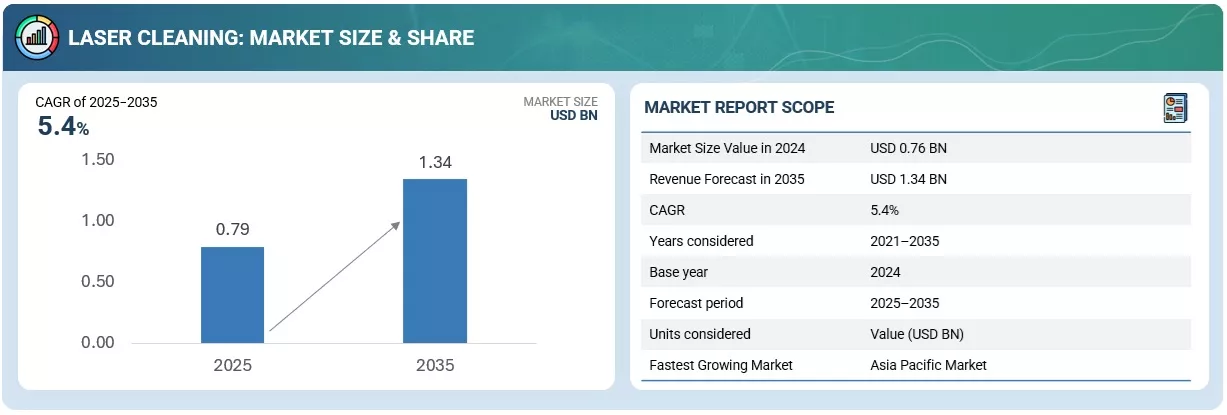
The global Laser Cleaning Market was valued at USD 0.76 billion in 2024 and is estimated to reach USD 1.34 billion by 2035, at a CAGR of 5.4% between 2025 and 2035.
The global laser cleaning market is poised for steady expansion from 2025 to 2035 driven by the growing demand for efficient environmentally safe and non contact surface cleaning technologies across multiple industries. Laser cleaning also known as laser ablation has emerged as a superior alternative to traditional cleaning techniques such as abrasive blasting chemical cleaning and dry ice blasting. The technology uses precisely controlled laser beams to remove contaminants coatings oxides and residues from metal stone composite and polymer surfaces without causing damage to the base material. The method is widely valued for its precision energy efficiency and minimal waste generation which aligns with the rising emphasis on sustainability and clean manufacturing.
As industries seek to minimize downtime and improve product quality the adoption of laser cleaning systems is accelerating across automotive aerospace energy heritage conservation and infrastructure maintenance. Advances in laser technology including the development of high power solid state lasers and fiber lasers have made the process more accessible and cost effective. The market is set to benefit from ongoing industrial modernization projects and stringent environmental regulations that discourage the use of chemical solvents and hazardous materials in cleaning processes.
Market Drivers and Trends
Several key drivers underpin the growth of the laser cleaning market. The global shift toward sustainable and eco friendly industrial practices is encouraging companies to move away from chemical based cleaning processes that generate hazardous waste. Laser cleaning provides a dry non abrasive and precise method that requires no consumables and produces minimal waste. Another significant driver is the increasing use of automation and robotics in manufacturing facilities which complements the integration of laser cleaning systems for high speed automated surface preparation and coating removal.
Industries such as automotive and aerospace are adopting laser cleaning for applications that demand high precision and repeatability including paint removal mold cleaning and surface preparation before welding or bonding. The technology is also gaining importance in the restoration of cultural heritage and artwork where its ability to clean delicate surfaces without mechanical contact is invaluable. Continuous improvements in laser beam quality compact system design and real time control software have broadened the range of applications.
However the high initial investment cost and technical complexity associated with laser cleaning systems remain challenges for small and medium sized enterprises. Training requirements and safety considerations also need to be addressed for wider adoption. Nevertheless the long term operational savings derived from reduced maintenance cost elimination of consumables and improved production efficiency continue to strengthen the business case for laser cleaning solutions.
Type Segment Analysis
Solid Laser Cleaning
Solid laser cleaning systems represent a major portion of the market due to their robustness precision and adaptability. These systems use solid state laser sources such as fiber lasers and Nd YAG lasers that offer high energy efficiency and superior beam quality. Solid lasers are preferred in industrial environments where reliability and consistent output are critical. Their ability to deliver precise control over pulse duration and intensity makes them ideal for removing rust oxides coatings and contaminants from metals and composite surfaces.
Solid laser cleaning technology has gained significant traction in the automotive and aerospace sectors where surfaces must be prepared without altering the underlying substrate. It is also used in mold cleaning for tire manufacturing and in microelectronics where delicate cleaning is required. Advances in solid laser technology have enabled compact portable systems suitable for on site cleaning in maintenance and repair operations. The segment is expected to maintain dominance throughout the forecast period as manufacturers focus on developing cost effective and energy efficient solid laser cleaning solutions.
Gas Laser Cleaning
Gas laser cleaning systems operate using laser sources such as CO2 and excimer lasers which are particularly effective for specific materials like polymers ceramics and stones. These lasers emit at different wavelengths compared to solid state lasers allowing unique interaction with target surfaces. Gas lasers are widely used in conservation and restoration applications where careful energy control is needed to remove organic and inorganic deposits from valuable artifacts and structures without causing discoloration or surface alteration.
In industrial contexts gas laser systems find applications in cleaning delicate surfaces where minimal thermal impact is essential. They are suitable for treating larger surface areas and for use in sectors such as semiconductors and energy where material compatibility is crucial. Although gas lasers are less energy efficient than solid lasers and require more maintenance their role in precision cleaning and niche industrial applications ensures their continued relevance in the overall market landscape.
Conservation and Restoration Segment Analysis
Art and Heritage Restoration
Laser cleaning has revolutionized the conservation of artworks and cultural heritage assets. It offers a non contact and controlled cleaning process that can selectively remove unwanted layers such as dirt varnish soot and biological growth while preserving the integrity of the original surface. Museums restoration laboratories and heritage conservation agencies around the world are increasingly adopting laser cleaning techniques to restore sculptures paintings and architectural monuments.
The process provides several advantages over traditional mechanical or chemical methods. It avoids abrasion eliminates the need for solvents and allows conservators to monitor and control cleaning in real time through computer guided systems. As awareness of the importance of heritage preservation grows and funding for restoration projects increases the demand for laser cleaning equipment and services in this segment is expected to rise significantly. Europe with its rich cultural heritage and extensive restoration programs continues to be a major hub for this application while Asia and the Middle East are also investing heavily in historical preservation projects.
Infrastructure Restoration
Laser cleaning is also making inroads into infrastructure maintenance and restoration where it is used to remove corrosion paint and pollutants from bridges statues building facades and transport facilities. Compared to sandblasting or chemical cleaning methods laser technology offers a safer and cleaner alternative that reduces environmental impact and avoids damage to concrete or metal surfaces. The precision of laser cleaning allows selective treatment of specific areas minimizing material loss and prolonging the lifespan of infrastructure assets.
Governments and municipal authorities are recognizing the long term benefits of adopting laser cleaning for urban infrastructure maintenance. Projects involving the refurbishment of historical bridges rail networks and urban monuments increasingly specify laser cleaning as part of sustainable maintenance strategies. The combination of efficiency environmental compliance and reduced operational disruption makes it an attractive option for public and private sector projects.
Cleaning Process Segment Analysis
Automotive Industry
The automotive industry represents one of the fastest growing markets for laser cleaning technology. Laser systems are used for a variety of applications including paint removal weld pre treatment mold cleaning and component degreasing. The technology enables high speed automated cleaning in assembly lines enhancing productivity and quality control. Electric vehicle production in particular benefits from laser cleaning as it requires precise surface preparation for battery components and lightweight alloys.
Automotive manufacturers value the repeatability and environmental advantages of laser cleaning over chemical and abrasive techniques. As regulations governing industrial emissions tighten and as manufacturers seek to improve sustainability metrics laser cleaning is becoming an integral part of modern automotive manufacturing. The adoption of compact robotic laser cleaning units is expected to accelerate further as the industry advances toward fully automated smart factories.
Aerospace Industry
In the aerospace industry laser cleaning is employed for paint stripping surface decontamination and preparation of composite and metallic parts before bonding or coating. Aerospace components demand exacting surface conditions and traditional methods often struggle to achieve consistency without causing microdamage. Laser cleaning provides a controlled non destructive approach that meets stringent aerospace standards.
Aircraft maintenance repair and overhaul facilities increasingly deploy laser cleaning for removing old coatings and corrosion during refurbishment cycles. The technology not only ensures surface integrity but also significantly reduces the use of hazardous chemicals and minimizes waste disposal requirements. As aircraft manufacturers continue to adopt composite materials and environmentally friendly coatings the role of laser cleaning will expand further in both production and maintenance processes.
Industrial Usage Segment Analysis
Nuclear Plant Applications
Laser cleaning plays a critical role in the maintenance of nuclear facilities where it is used to remove radioactive contamination corrosion and paint layers from metallic and concrete surfaces. Traditional cleaning methods in these environments often generate secondary waste that is difficult to manage. Laser cleaning eliminates or drastically reduces secondary waste by vaporizing contaminants and collecting them through filtration systems.
The non contact nature of laser cleaning is especially valuable in radioactive environments where remote controlled robotic systems can perform cleaning tasks safely. This reduces human exposure to hazardous conditions and improves operational efficiency. Growing investment in decommissioning of old nuclear plants and maintenance of active ones is driving the adoption of laser cleaning systems across the nuclear sector.
Refinery Applications
Refineries and petrochemical plants are adopting laser cleaning for removing rust scale and deposits from pipelines valves and storage tanks. The ability to operate without water or chemicals makes the technology highly suitable for explosive or sensitive environments. Laser cleaning reduces downtime during maintenance shutdowns and improves inspection accuracy by providing clean surfaces for nondestructive testing.
As the oil and gas sector transitions toward more automated and environmentally responsible operations the use of laser cleaning systems is expanding. They help meet environmental compliance requirements and lower maintenance costs over time. Continuous innovations in portable laser units and robotic integration further enhance the suitability of laser cleaning for large scale refinery applications.
Regional Market Insights
North America
North America represents a leading region in the laser cleaning market supported by robust demand from automotive aerospace and energy industries. The United States and Canada are witnessing strong adoption of laser cleaning technology in manufacturing modernization and infrastructure maintenance projects. Government initiatives promoting sustainable and clean production processes are also driving market growth. The region is home to several leading laser system manufacturers and research organizations that continue to advance the technology.
Europe
Europe has been an early adopter of laser cleaning due to its commitment to environmental sustainability and cultural heritage preservation. Countries such as Germany France Italy and the United Kingdom have invested heavily in laser systems for industrial and restoration applications. The presence of a strong automotive base and numerous cultural monuments provides consistent demand across both industrial and conservation segments. The European Union’s environmental regulations that limit chemical solvent use further enhance the attractiveness of laser cleaning technologies.
Asia Pacific
Asia Pacific is projected to experience the highest growth rate during the forecast period owing to rapid industrialization and expansion of the automotive and aerospace sectors in China Japan South Korea and India. The region’s manufacturing industries are increasingly integrating laser systems for cleaning surface preparation and coating removal tasks. Infrastructure modernization projects and heritage restoration efforts in China and India are also contributing to market expansion. Local production capabilities combined with declining equipment costs will continue to support growth across the region.
Latin America
Latin America presents growing opportunities for laser cleaning adoption in refineries transportation and industrial maintenance. Brazil and Mexico are leading markets where manufacturing modernization initiatives are underway. The growing automotive industry and infrastructure development programs further encourage investment in advanced cleaning technologies. Although adoption is still in early stages awareness of the long term cost and environmental benefits of laser cleaning is rising rapidly.
Middle East and Africa
In the Middle East and Africa demand for laser cleaning is driven by oil and gas refineries defense and cultural heritage restoration projects. Countries such as the United Arab Emirates Saudi Arabia and Egypt are increasingly investing in modern technologies that support sustainable infrastructure management. The ability of laser cleaning to operate in harsh environments without chemicals or water makes it particularly attractive in these regions. Over the forecast period steady growth is expected as industrial diversification and infrastructure renewal continue.
Competitive Landscape
The laser cleaning market features a combination of established laser technology providers and emerging startups specializing in niche applications. Competition revolves around technological innovation system efficiency portability and integration with automation platforms. Leading companies are focusing on product differentiation through enhanced power efficiency real time control software and tailored solutions for specific verticals. Strategic partnerships with automotive aerospace and energy sector players are common to ensure system compatibility and long term support.
Manufacturers are investing in research and development to improve laser beam delivery optical design and cooling systems which enhance performance and durability. Pricing strategies and after sales services such as training maintenance and system calibration are becoming decisive factors for customer retention. The trend toward turnkey robotic laser cleaning solutions will likely define the competitive dynamics in the coming decade.
Market Outlook and Future Opportunities
Between 2025 and 2035 the laser cleaning market is expected to grow steadily supported by rising environmental regulations increasing automation adoption and advancements in laser efficiency. Solid laser systems will dominate in terms of revenue while gas laser systems will continue to serve specialized markets. Conservation and restoration applications will remain strong in Europe while industrial and automotive cleaning will drive major revenue growth globally.
Future innovations will likely focus on higher energy efficiency compact design and artificial intelligence based process monitoring. The integration of sensors and analytics will allow real time optimization of cleaning processes enhancing quality and reducing energy consumption. The expansion of leasing and service based business models will further promote adoption among small and medium enterprises.
Scope of the Report:
The research report segments the laser cleaning market into the following submarkets:
Laser Cleaning Market, by Laser Type
- Gas laser
- Solid laser
Laser Cleaning Market, by Application
- Conservation and Restoration
- Cleaning Process
- Industrial Usage
Laser Cleaning Market, by Region
- North America
- Europe
- Asia Pacific
- Rest of the World (RoW)
Available Customizations:
With the given market data, MarketsandMarkets offers customizations according to companies’ specific needs. The following customization options are available for the report.
-
- Company Information
- Detailed analysis and profiling of additional market players (up to five)
To speak to our analyst for a discussion on the above findings, click Speak to Analyst
 Exclusive indicates content/data unique to MarketsandMarkets and not available with any competitors.
Table of Contents
1 Introduction (Page No. - 11)
1.1 Objectives of the Study
1.2 Definition
1.3 Study Scope
1.3.1 Markets Covered
1.3.2 Years Considered for This Study
1.4 Currency
1.5 Limitations
1.6 Stakeholders
2 Research Methodology (Page No. - 14)
2.1 Research Data
2.1.1 Secondary Data
2.1.1.1 Key Data From Secondary Sources
2.1.2 Primary Data
2.1.2.1 Key Data From Primary Sources
2.1.2.2 Breakdown of Primaries
2.1.2.3 Key Industry Insights
2.2 Market Size Estimation
2.3 Market Breakdown and Data Triangulation
2.4 Assumptions
3 Executive Summary (Page No. - 23)
4 Premium Insights (Page No. - 26)
4.1 Laser Cleaning Market Expected to Witness A Huge Growth in APAC
4.2 Market, By Laser Type (2018–2023)
4.3 Market, By Application
4.4 Market, By Country (2018)
5 Market Overview (Page No. - 29)
5.1 Introduction
5.2 Value Chain Analysis
5.3 Laser Standards and Classifications
5.4 Comparative Analysis: Dry Ice Blasting and Sand Blasting
5.5 Market Dynamics
5.5.1 Drivers
5.5.1.1 Laser Cleaning is Being Preferred Over Traditional Approach
5.5.1.2 Increasing Use of Laser Cleaning Systems in Art Restoration and Conservation
5.5.1.3 Growing Automotive Industry to Boost the Growth of the Laser Cleaning Market
5.5.2 Restraints
5.5.2.1 High Cost and Lack of Technical Expertise
5.5.3 Opportunities
5.5.3.1 Increasing Demand for Laser Cleaning Across Various Applications
5.5.4 Challenges
5.5.4.1 Technical Complexities in High-Powered Lasers
6 Laser Cleaning Market, By Laser Type (Page No. - 36)
6.1 Introduction
6.2 Gas Lasers
6.2.1 Co2 Laser
6.2.2 Excimer Lasers
6.3 Solid Laser
6.3.1 Yttrium Aluminum Garnet (YAG) Laser
6.3.2 Fiber Laser
7 Laser Cleaning Market, By Application (Page No. - 43)
7.1 Introduction
7.2 Conservation and Restoration
7.2.1 Art and Heritage Restoration
7.2.1.1 Antique Collections
7.2.1.2 Art Galleries and Museums
7.2.2 Infrastructure
7.2.2.1 Heritage Buildings
7.2.2.2 Non-Heritage Properties
7.3 Cleaning Process
7.3.1 Automotive Parts
7.3.2 Aerospace and Aircraft
7.4 Industrial Usage
7.4.1 Nuclear Plant
7.4.2 Refineries
7.4.3 Power Plant Parts
8 Geographic Analysis (Page No. - 53)
8.1 Introduction
8.2 North America
8.2.1 US
8.2.2 Canada
8.2.3 Mexico
8.3 Europe
8.3.1 UK
8.3.2 Germany
8.3.3 France
8.3.4 Italy
8.3.5 Rest of Europe
8.4 Asia Pacific
8.4.1 China
8.4.2 Japan
8.4.3 India
8.4.4 South Korea
8.4.5 Rest of APAC
8.5 Rest of the World
9 Competitive Landscape (Page No. - 67)
9.1 Overview
9.2 Ranking Analysis of Key Players in the Laser Cleaning Market
9.3 Competitive Situations and Trends
9.3.1 Product Launch
9.3.2 Acquisitions
9.3.3 Product Development
10 Company Profile (Page No. - 72)
(Business Overview, Products Offered, and Recent Developments)*
10.1 Coherent
10.2 Trumpf
10.3 IPG Photonics
10.4 Clean Lasersysteme
10.5 Advanced Laser Technology (ALT)
10.6 General Lasertronics
10.7 Laserax
10.8 White Lion Dry Ice & Laser Cleaning Technology
10.9 Anilox Roll Cleaning Systems
10.10 Laser Photonics
*Details on Business Overview, Products Offered, and Recent Developments Might Not Be Captured in Case of Unlisted Companies.
11 Appendix (Page No. - 85)
11.1 Insights of Industry Experts
11.2 Discussion Guide
11.3 Knowledge Store: Marketsandmarkets’ Subscription Portal
11.4 Introducing RT: Real-Time Market Intelligence
11.5 Available Customizations
11.6 Related Report
11.7 Author Details
List of Tables (41 Tables)
Table 1 Classification Criteria of Different Laser Standards
Table 2 Difference Between Dry Ice Blasting and Sand Blasing
Table 3 Laser Cleaning Market, By Type, 2015–2023 (USD Million)
Table 4 Market for Gas Laser, By Cleaning Application, 2015–2023 (USD Million)
Table 5 Market for Solid Laser, By Type, 2015–2023 (USD Million)
Table 6 Market for YAG Laser, By Application, 2015–2023 (USD Million)
Table 7 Market for Fiber Laser, By Application, 2015–2023 (USD Million)
Table 8 Market, By Application, 2015–2023 (USD Million)
Table 9 Market, By Conservation and Restoration, 2015–2023 (USD Million)
Table 10 Market for Art and Heritage Restoration, By Type, 2015–2023 (USD Million)
Table 11 Market for Art and Heritage Restoration, By Region, 2015–2023 (USD Million)
Table 12 Market for Infrastructure, By Type, 2015–2023 (USD Million)
Table 13 Market for Infrastructure, By Region, 2015–2023 (USD Million)
Table 14 Market for Cleaning Process, By Type, 2015–2023 (USD Million)
Table 15 Market for Automotive Parts, By Region, 2015–2023 (USD Million)
Table 16 Market for Aerospace and Aircraft, By Region, 2015–2023 (USD Million)
Table 17 Market, By Industrial Usage, 2015–2023 (USD Million)
Table 18 Market for Nuclear Plants, By Region, 2015–2023 (USD Million)
Table 19 Market for Refineries, By Region, 2015–2023 (USD Million)
Table 20 Market for Power Plant Parts, By Region, 2015–2023 (USD Million)
Table 21 Market, By Region, 2015–2023 (USD Million)
Table 22 Market in North America, By Country, 2015–2023 (USD Million)
Table 23 Market in North America, By Cleaning Process, 2015–2023 (USD Million)
Table 24 Market in North America, By Conservation and Restoration, 2015–2023 (USD Million)
Table 25 Market in North America, By Industrial Usage, 2015–2023 (USD Million)
Table 26 Market in Europe, By Country, 2015–2023 (USD Million)
Table 27 Market in Europe, By Cleaning Process, 2015–2023 (USD Million)
Table 28 Market in Europe, By Conservation and Restoration, 2015–2023 (USD Million)
Table 29 Market in Europe, By Industrial Usage, 2015–2023 (USD Million)
Table 30 Market in APAC, By Country, 2015–2023 (USD Million)
Table 31 Market in APAC, By Cleaning Process, 2015–2023 (USD Million)
Table 32 Market in APAC, By Conservation and Restoration, 2015–2023 (USD Million)
Table 33 Market in APAC, By Industrial Usage, 2015–2023 (USD Million)
Table 34 Market in RoW, By Region, 2015–2023 (USD Million)
Table 35 Market in RoW, By Cleaning Process, 2015–2023 (USD Million)
Table 36 Market in RoW, By Conservation and Restoration, 2015–2023 (USD Million)
Table 37 Market in RoW, By Industrial Usage, 2015–2023 (USD Million)
Table 38 Market: Ranking Analysis of Key Companies (2017)
Table 39 Product Launches (2015–2017)
Table 40 Acquisitions (2016 & 2017)
Table 41 Product Development (2015 & 2016)
List of Figures (26 Figures)
Figure 1 Laser Cleaning Market
Figure 2 Market: Process Flow of Market Size Estimation
Figure 3 Market: Research Design
Figure 4 Bottom-Up Approach
Figure 5 Top-Down Approach
Figure 6 Data Triangulation
Figure 7 YAG Lasers to Lead the Solid Market During the Forecast Period
Figure 8 Cleaning Process Expected to Hold the Largest Share of the Laser Cleaning Market in 2018
Figure 9 North America to Hold the Largest Share of the Laser Cleaning Market in 2018
Figure 10 Market Expected to Witness Attractive Growth Opportunities Owing to the Increasing Demand From Automotive and Aerospace Industries
Figure 11 Market for Solid Laser Expected to Grow at the Highest CAGR During the Forecast Period
Figure 12 Market for Conservation & Restoration to Grow at the Highest CAGR During the Forecast Period
Figure 13 US Expected to Hold the Largest Share of the Laser Cleaning Market in 2018
Figure 14 Value Chain Analysis: Major Value Addition is Done During the Development Phase
Figure 15 Adoption of Laser Cleaning Over Traditional Approach and Increasing Demand Across Various Applications Fuel the Growth of the Market
Figure 16 Solid Lasers Expected to Lead the Market During the Forecast Period
Figure 17 Solid Laser Segmentation
Figure 18 Art and Heritage Expected to Lead the Overall Market During the Forecast Period.
Figure 19 Geographic Snapshot of the Market (2018–2023)
Figure 20 Snapshot of the Market in North America
Figure 21 Snapshot of the Market in APAC
Figure 22 Market Evolution Framework—Product Launch Emerged as the Major Strategy
Figure 23 Battle for Market Share: Product Launch Was the Key Growth Strategy in 2016
Figure 24 Coherent: Company Snapshot
Figure 25 Trumpf: Company Snapshot
Figure 26 IPG Photonics: Company Snapshot













Growth opportunities and latent adjacency in Laser Cleaning Market