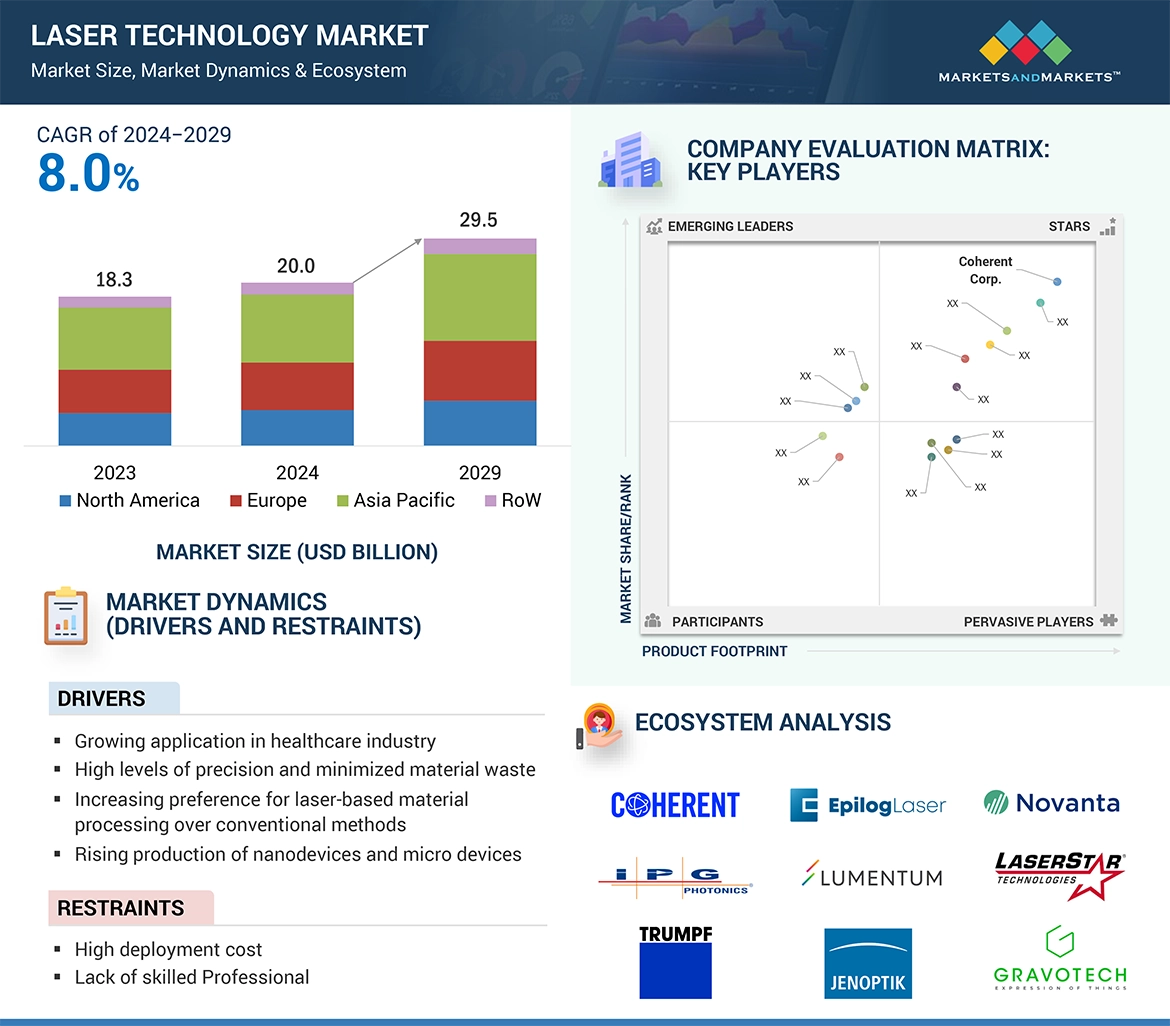
MarketsandMarkets forecasts the laser technology market to grow from USD 12.0 billion in 2017 to USD 16.9 billion by 2024, at a compound annual growth rate (CAGR) of 4.6% during the forecast period. The major factors that are expected to be driving the market are increasing demand from healthcare vertical, enhanced performance of lasers over traditional material processing techniques, and shift toward production of nano and micro devices. The objective of the report is to define, describe, and forecast the market size based on type, revenue, application, end user, and region.

By laser type segment, CO2 laser segment is expected to hold the largest market share. The leading position, in terms of market size, of this type of laser can be attributed to its considerably compact size, suitability for a wide range of wavelengths, and utility in laser cutting, welding, structuring, perforating, drilling, and laser marking applications.
Among the revenue segment, the laser revenue segment is expected to grow at a higher CAGR during the forecast period, owing to revenue generated from the sales of several types of lasers, such as YAG laser, semiconductor laser, thin disk laser, ruby laser, fiber laser, X-ray laser, dye laser, excimer laser, argon laser, chemical laser, and helium-neon laser.
Laser processing application segment is expected to hold the largest market share. This segment is likely to continue to hold the largest market share during the forecast period, which can be attributed to its ability to provide higher quality, more reliability, and more precise output than conventional mechanical methods. Laser processing involves using laser for applications such as materials processing, micro processing, and advanced processing.
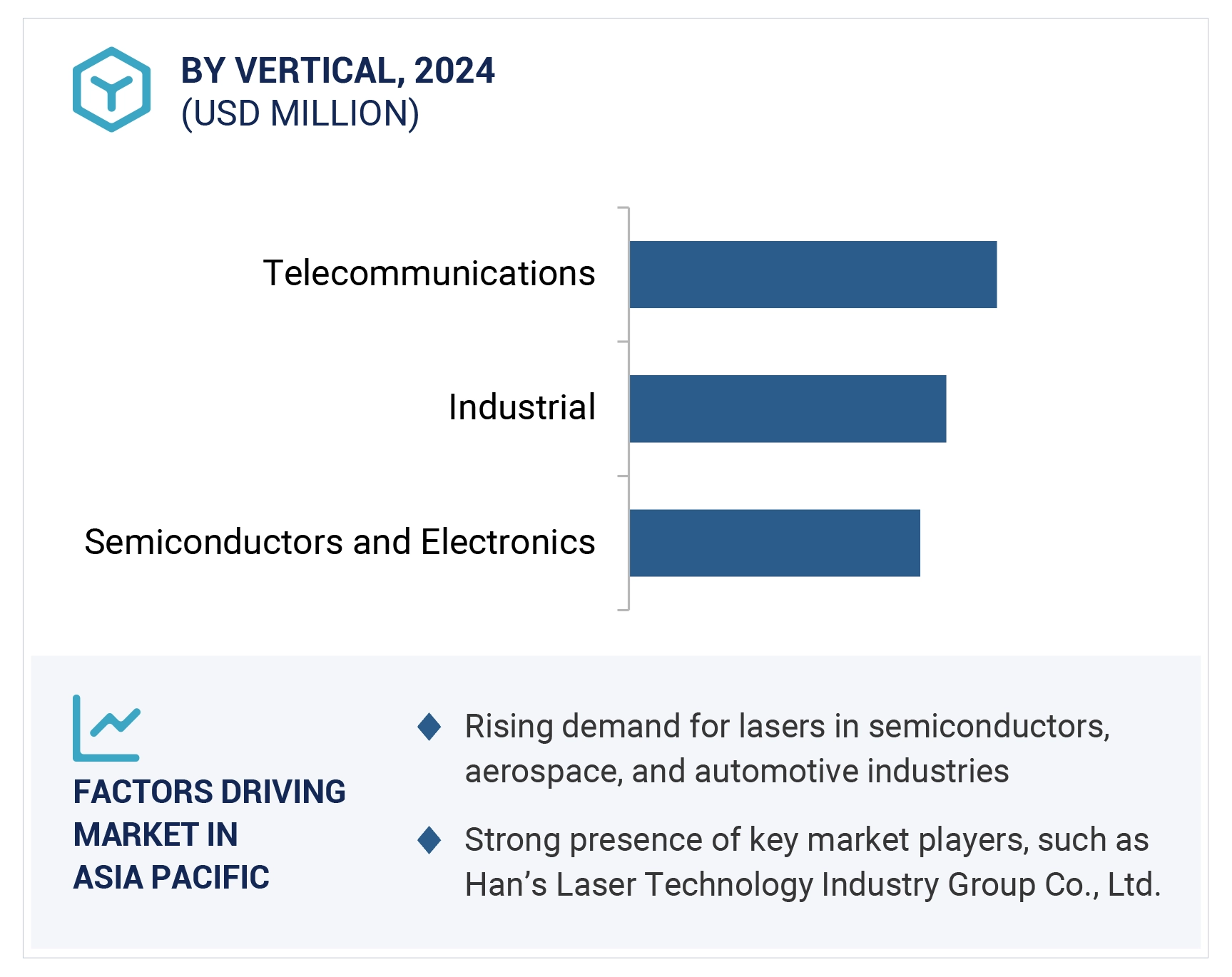
Telecommunications end user segment is expected to hold the largest market share. This vertical is likely to continue to hold the largest market share during the forecast period, which can be attributed to laser technologys ability to enable faster and secure data transmission, while consuming low power. Lasers allow efficient and higher bandwidth communication and it is the most crucial aspect in the existence of the web; without laser communication one would not be able to download images, music, and video files quickly.

Asia Pacific is expected to hold the largest market size in the laser technology market during the forecast period. China, India, South Korea, and Japan are the major contributors to the growth of the market in APAC. Continuous demand for cost-effective and fast processing laser machine tools from semiconductor, automotive, industrial, and telecommunications verticals are expected to drive the growth of the market in APAC.
The laser technology is used in healthcare applications such as urology, dermatology, dentistry, and ophthalmology. With continuous technology advancements and upgrades, the use of the laser technology has broadened for the treatment of various health-related issues, such as kidney stone, cancer, tumor, knee injury, prostate, varicose veins, heart diseases, and glaucoma. Ophthalmic laser assists in the treatment of eye-related issues such as glaucoma, retinal disorder, cataract, and macular degeneration. Moreover, laser technology is used for non-invasive medical treatments such as hair removal, skin rejuvenation, tattoo removal, photodynamic therapy, selective laser trabeculoplasty, and low-level laser therapy. The sales of medical laser systems are driven by increasing aging population, improvement in medical infrastructure, rising number of cosmetic surgeries, and increasing eye-related issues.
Regulatory compliances act as restraints for the growth of the laser technology market. The laser technology involves the application of solid and fiber lasers. These lasers use rare-earth elements such as neodymium, chromium, erbium, and ytterbium. The processing and refining of these rare earth elements can cause hazardous environmental consequences, if not properly managed. One of the major hazards is radioactive pollution caused by slurry tailings. Moreover, toxic acids are required during the refining process. Improper handling of toxic acids can result in extensive environmental damage. In 2010, China tracked illegal mining to protect the environment and its resources. Leaks from such mines find their way to the water supply, lake, and fertile land, thereby damaging it and posing a threat to humans present in the vicinity of the affected areas.
Laser technology is used in automotive, healthcare, commercial, semiconductor and electronics, research, aerospace & defense, manufacturing, and other verticals for quality check. The laser technology helps enhance the product quality and in-process quality control at various manufacturing stages. This technology helps to check and measure geometric specification, dimensional inspection, and electrical testing. Geometric specification includes thickness, distance, radius, and surface outline.
In the automotive vertical, the laser technology is used to manufacture components such as powertrain and control elements. Moreover, lasers are mainly used to process the interiors and bodyworks of vehicles in a reliable, quick, and accurate process. The use of measurement systems during these processes helps monitor the work quality, thereby reducing the probability of flaws occurring at a considerably early stage. The laser technology provides precision in the welding and cutting process of automotive parts, which is crucial for quality assurance in high-volume production.
Lasers required for processes, systems, and applications are in the range of a few hundred to thousands of watts. High-power lasers are used in large-scale laser displays, medical, military, research, laser-induced nuclear fusion, and material processing (welding, cutting, drilling, soldering, marking, and surface modification). Although laser technology helps reduce workforce and related cost in the automotive and manufacturing industries, its deployment involves a huge investment. For instance, the cost of owning excimer laser systems is considerably high because of high manufacturing and service costs. Hence, the growing demand for lasers for processing generates a requirement for low-cost solutions so that the technology can be adopted on a wide level. Players in this market are working toward generating low-cost solutions to avail maximum benefits because of high-volume consumption.

|
Report Metric |
Details |
|
Market size available for years |
20152024 |
|
Base year considered |
2017 |
|
Forecast period |
20182024 |
|
Forecast units |
Million (USD) |
|
Segments covered |
Type, Revenue, Application, End User, and Region. |
|
Geographies covered |
North America, Europe, APAC, RoW (South America, Middle East & Africa) |
|
Companies covered |
Coherent (US), IPG Photonics (US), Trumpf (Germany), Lumentum (US), Jenoptik (Germany), Novanta (US), Lumibird (France), LaserStar (US), Epilog Laser (US), and MKS Instruments (US). |
The research report categorizes the laser technology to forecast the revenues and analyze the trends in each of the following sub-segments:
Coherent (US), IPG Photonics (US), Trumpf (Germany), Lumentum (US), Jenoptik (Germany), Novanta (US), Lumibird (France), LaserStar (US), Epilog Laser (US), and MKS Instruments (US).
In 2017, Coherent ranked first in the global laser technology market, primarily based on its product portfolio, R&D investments, market penetration, and geographic reach. The company is fostering its growth through acquisition of new technologies, enhancement of its technology portfolio, and launching products new markets. The company has a presence in the Americas, Europe, the Middle East & Africa, and Asia Pacific (APAC). Some of its subsidiaries are: Coherent GmbH (Germany), Coherent Ltd. (UK), Coherent Japan KK (Japan), Lambda Physik USA, Inc. (US), and Coherent Commercial Company Ltd. (China).
Coherent has also been investing in R&D to develop and acquire new technologies and additional market share by streamlining its manufacturing structure and improving the cost structure. The company is focused on developing innovative and proprietary laser and optical products and solutions. For instance, in November 2017, the company launched the Total Power Control, a laser having application in multiphoton excitation (MPE) microscopy. Based on acousto-optic (AO) technology, this laser enables high-power output and modulation on tunable femtosecond output. Similarly, in June 2017, the company launched the AVIA LX 355-20, which is a diode-pumped solid-state (DPSS) laser having application in micromachining. This laser has an expected lifespan of 20,000 hours and delivers 20 W at 355 nm. The company is strengthening its laser portfolio, such as solid-state, CO, pulsed-fiber, direct diode, and excimer laser, with an aim to improve performance and reduce process cost to expand its customer base. Moreover, in November 2016, to increase its share in the laser technology market, the company acquired ROFIN-SINAR Technologies (US), one of the leading manufacturers of industrial laser technology.
To speak to our analyst for a discussion on the above findings, click Speak to Analyst
Table of Contents
1 Introduction
1.1 Objectives of the Study
1.2 Market Definition and Scope
1.2.1 Inclusions & Exclusions
1.3 Scope of the Study
1.3.1 Markets Covered
1.3.2 Geographic Scope
1.3.3 Years Considered
1.4 Currency Considered
1.5 Limitations
1.6 Unit Considered
1.7 Stakeholders
2 Research Methodology
2.1 Research Data
2.1.1 Secondary and Primary Research
2.1.1.1 Key Industry Insights
2.1.2 Secondary Data
2.1.2.1 List of Major Secondary Sources
2.1.2.2 Secondary Sources
2.1.3 Primary Data
2.1.3.1 Primary Interviews With Experts
2.1.3.2 Breakdown of Primaries
2.1.3.3 Primary Sources
2.2 Market Size Estimation
2.2.1 Bottom-Up Approach
2.2.1.1 Approach for Bottom-Up Analysis (Demand Side)
2.2.2 Top-Down Approach
2.2.2.1 Approach for Top-Down Analysis (Supply Side)
2.3 Market Breakdown and Data Triangulation
2.4 Research Assumptions
3 Executive Summary
4 Premium Insights
4.1 Attractive Opportunities in the Laser Technology Market Between 2020 and 2025
4.2 Market, By Type (20202025)
4.3 Market, By Revenue (20202025)
4.4 Market, By Application (20202025)
4.5 Market, By End User (20202025)
4.6 Market, By Geography (20202025)
5 Market Overview
5.1 Introduction
5.2 Market Dynamics
5.2.1 Drivers
5.2.1.1 Increasing Demand From Healthcare Vertical
5.2.1.2 Enhanced Performance of Lasers Over Traditional Material Processing Techniques
5.2.1.3 Shift Toward Production of Nano and Micro Devices
5.2.2 Restraints
5.2.2.1 Regulatory Compliance
5.2.3 Opportunities
5.2.3.1 Adoption of Laser Technology in Various Verticals for Quality Check
5.2.3.2 Increasing Use of Lasers for Optical Communications
5.2.4 Challenges
5.2.4.1 Requirement for Low-Cost Solutions
5.3 Value Chain Analysis
6 Laser Technology Market, By Type
6.1 Introduction
6.2 CO2 Laser
6.3 Fiber Laser
6.4 Solid State Laser
6.4.1 Yag Laser
6.4.2 Semiconductor Laser
6.4.3 Thin Disk Laser
6.4.4 Ruby Laser
6.5 Other Laser
6.5.1 X-Ray Laser
6.5.2 Dye Laser (Liquid Laser)
6.5.3 Excimer Laser (Gas Laser)
6.5.4 Argon Laser (Gas Laser)
6.5.5 Chemical Laser
6.5.6 Helium-Neon Laser (Gas Laser)
6.5.7 Carbon Monoxide Laser (Gas Laser)
6.5.8 Nitrogen Laser (Gas Laser)
6.5.9 Hydrogen Laser (Gas Laser)
7 Laser Technology Market, By Revenue
7.1 Introduction
7.2 System Revenue
7.3 Laser Revenue
8 Laser Technology Market, By Application
8.1 Introduction
8.2 Laser Processing
8.2.1 Macro Processing
8.2.1.1 Cutting
8.2.1.1.1 Fusion Cutting
8.2.1.1.2 Flame Cutting
8.2.1.1.3 Sublimation Cutting
8.2.1.2 Drilling
8.2.1.2.1 Single Pulse Drilling
8.2.1.2.2 Percussion Drilling
8.2.1.2.3 Trepanning Drilling
8.2.1.2.4 Helical Drilling
8.2.1.3 Welding
8.2.1.4 Marking and Engraving
8.2.2 Micro Processing
8.2.3 Advanced Processing
8.3 Optical Communications
8.4 Others
8.4.1 Gyroscopes
8.4.2 Laser Printers
8.4.3 Laser Scanners
8.4.4 Laser Rangefinders
8.4.5 Laser Headlights
8.4.6 Laser Security Systems
9 Laser Technology Market, By End User
9.1 Introduction
9.2 Telecommunications
9.3 Industrial
9.4 Semiconductor & Electronics
9.4.1 Memory
9.4.2 Microprocessors
9.4.3 Integrated Circuit
9.5 Commercial
9.6 Aerospace & Defense
9.6.1 Aerospace Industry
9.6.2 Missile Industry
9.6.3 Space Industry
9.6.4 Combat Vehicle Industry
9.6.5 Ammunition & Weapon Industry
9.7 Automotive
9.8 Medical
9.9 Research
9.10 Others
10 Geographic Analysis
10.1 Introduction
10.2 North America
10.2.1 US
10.2.2 Canada
10.2.3 Mexico
10.3 Europe
10.3.1 Germany
10.3.2 France
10.3.3 The UK
10.3.4 Rest of Europe
10.4 Asia Pacific
10.4.1 China
10.4.2 Japan
10.4.3 India
10.4.4 South Korea
10.4.5 Rest of Asia Pacific
10.5 Rest of the World
10.5.1 South America
10.5.2 Middle East and Africa
11 Competitive Landscape
11.1 Introduction
11.2 Ranking Analysis of Players in the Laser Technology Market
11.3 Competitive Leadership Mapping
11.3.1 Visionary Leaders
11.3.2 Innovators
11.3.3 Dynamic Differentiators
11.3.4 Emerging Companies
11.4 Strength of Product Portfolio (25 Companies)
11.5 Business Strategy Excellence (25 Companies)
11.6 Competitive Scenario
11.6.1 Product Launches
11.6.2 Partnerships, Collaboration, Contracts, and Agreements
11.6.3 Mergers & Acquisitions
11.6.4 Expansions
12 Company Profiles
12.1 Key Players
12.1.1 Coherent
12.1.1.1 Business Overview
12.1.1.2 Products Offered
12.1.1.3 Recent Developments
12.1.1.4 SWOT Analysis
12.1.1.5 MnM View
12.1.2 IPG Photonics
12.1.2.1 Business Overview
12.1.2.2 Products Offered
12.1.2.3 Recent Developments
12.1.2.4 SWOT Analysis
12.1.2.5 MnM View
12.1.3 Trumpf
12.1.3.1 Business Overview
12.1.3.2 Products Offered
12.1.3.3 Recent Developments
12.1.3.4 SWOT Analysis
12.1.3.5 MnM View
12.1.4 Lumentum
12.1.4.1 Business Overview
12.1.4.2 Products Offered
12.1.4.3 Recent Developments
12.1.4.4 SWOT Analysis
12.1.4.5 MnM View
12.1.5 Jenoptik
12.1.5.1 Business Overview
12.1.5.2 Products Offered
12.1.5.3 Recent Developments
12.1.5.4 SWOT Analysis
12.1.5.5 MnM View
12.1.6 Novanta
12.1.6.1 Business Overview
12.1.6.2 Products Offered
12.1.6.3 Recent Developments
12.1.7 Lumibird
12.1.7.1 Business Overview
12.1.7.2 Products Offered
12.1.7.3 Recent Developments
12.1.8 LaserStar
12.1.8.1 Business Overview
12.1.8.2 Products Offered
12.1.8.3 Recent Developments
12.1.9 Epilog Laser
12.1.9.1 Business Overview
12.1.9.2 Products Offered
12.1.9.3 Recent Developments
12.1.10 MKS Instruments
12.1.10.1 Business Overview
12.1.10.2 Products Offered
12.1.10.3 Recent Developments
12.2 Right to Win
12.2.1 Coherent
12.2.2 IPG Photonics
12.2.3 Trumpf
12.2.4 Lumentum
12.2.5 Jenoptik
12.3 Other Companies
12.3.1 600 Group
12.3.2 Han's Laser Technology
12.3.3 EuRoLAser
12.3.4 Bystronic Laser
12.3.5 Toptica Photonics
12.3.6 Photonics Industries
12.3.7 Focuslight Technologies
12.3.8 Corning Incorporated
12.3.9 Access Laser
12.3.10 Prima Industrie
13 Appendix
13.1 Insights of Industry Experts
13.2 Knowledge Store: Marketsandmarkets Subscription Portal
13.3 Available Customizations
13.4 Related Reports
13.5 Author Details
List of Tables (101 Tables)
Table 1 Laser Technology Market, By Laser Type, 20172025 (USD Billion)
Table 2 CO2 Laser Technology Market, By Revenue, 20172025 (USD Billion)
Table 3 CO2 Market, By End User, 20172025 (USD Billion)
Table 4 CO2 Market, By Application, 20172025 (USD Billion)
Table 5 CO2 Market, By North American Countries, 20172025 (USD Billion)
Table 6 CO2 Market, By European Countries, 20172025 (USD Billion)
Table 7 CO2 Market, By APAC Countries, 20172025 (USD Billion)
Table 8 CO2 Market, By RoW Regions, 20172025 (USD Billion)
Table 9 Fiber Laser Technology Market, By Revenue, 20172025 (USD Billion)
Table 10 Fiber Market, By End User, 20172025 (USD Billion)
Table 11 Fiber Market, By Application, 20172025 (USD Billion)
Table 12 Fiber Market, By North American Countries, 20172025 (USD Billion)
Table 13 Fiber Market, By European Countries, 20172025 (USD Billion)
Table 14 Fiber Market, By APAC Countries, 20172025 (USD Billion)
Table 15 Fiber Laser Technology Market, By RoW Regions, 20172025 (USD Billion)
Table 16 Solid State Laser Technology Market, By Revenue, 20172025 (USD Billion)
Table 17 Solid State Market, By End User, 20172025 (USD Billion)
Table 18 Solid State Market, By Application, 20172025 (USD Billion)
Table 19 Solid State Market, By North American Countries, 20172025 (USD Billion)
Table 20 Solid State Market, By European Countries, 20172025 (USD Billion)
Table 21 Solid State Market, By APAC Countries, 20172025 (USD Billion)
Table 22 Solid State Market, By RoW Regions, 20172025 (USD Billion)
Table 23 Other Laser Technology Market, By Revenue, 20172025 (USD Billion)
Table 24 Other Market, By End User, 20172025 (USD Billion)
Table 25 Other Market, By Application, 20172025 (USD Billion)
Table 26 Other Market, By North American Countries, 20172025 (USD Billion)
Table 27 Other Market, By European Countries, 20172025 (USD Billion)
Table 28 Other Market, By APAC Countries, 20172025 (USD Billion)
Table 29 Other Market, By RoW Regions, 20172025 (USD Billion)
Table 30 Market, By Revenue, 20172025 (USD Billion)
Table 31 Market for System Revenue, By Laser Type, 20172025 (USD Billion)
Table 32 Market for System Revenue, By North American Countries, 20172025 (USD Billion)
Table 33 Market for System Revenue, By European Countries, 20172025 (USD Billion)
Table 34 Market for System Revenue, By APAC Countries, 20172025 (USD Billion)
Table 35 Market for System Revenue, By RoW Regions, 20172025 (USD Billion)
Table 36 Market for Laser Revenue, By Laser Type, 20172025 (USD Billion)
Table 37 Market for Laser Revenue, By North American Countries, 20172025 (USD Billion)
Table 38 Market for Laser Revenue, By European Countries, 20172025 (USD Billion)
Table 39 Market for Laser Revenue, By APAC Countries, 20172025 (USD Billion)
Table 40 Market for Laser Revenue, By RoW Regions, 20172025 (USD Billion)
Table 41 Market, By Application, 20172025 (USD Billion)
Table 42 Market for Laser Processing, By Laser Type, 20172025 (USD Billion)
Table 43 Market for Laser Processing, By North American Countries, 20172025 (USD Billion)
Table 44 Market for Laser Processing, By European Countries, 20172025 (USD Billion)
Table 45 Market for Laser Processing, By APAC Countries, 20172025 (USD Billion)
Table 46 Market for Laser Processing, By RoW Regions, 20172025 (USD Billion)
Table 47 Optical Communications for Laser Technology Market, By Laser Type, 20172025 (USD Billion)
Table 48 Optical Communications for Market, By North American Countries, 20172025 (USD Billion)
Table 49 Optical Communications for Market, By European Countries, 20172025 (USD Billion)
Table 50 Optical Communications for Market, By APAC Countries, 20172025 (USD Billion)
Table 51 Optical Communications for Market, By RoW Regions, 20172025 (USD Billion)
Table 52 Other Application for Laser Technology Market, By Laser Type, 20172025 (USD Billion)
Table 53 Other Application for Market, By North American Countries, 20172025 (USD Billion)
Table 54 Other Application for Market, By European Countries, 20172025 (USD Billion)
Table 55 Other Application for Market, By APAC Countries, 20172025 (USD Billion)
Table 56 Other Application for Market, By RoW Regions, 20172025 (USD Billion)
Table 57 Market, By Application, 20172025 (USD Billion)
Table 58 Market for Telecommunications, By Laser Type, 20172025 (USD Billion)
Table 59 Market for Telecommunications, By Region, 20172025 (USD Billion)
Table 60 Market for Telecommunications, By APAC Countries, 20172025 (USD Billion)
Table 61 Market for Telecommunications, By North American Countries, 20172025 (USD Billion)
Table 62 Market for Telecommunications, By European Countries, 20172025 (USD Billion)
Table 63 Market for Telecommunications, By RoW, 20172025 (USD Billion)
Table 64 Market for Industrial, By Laser Type, 20172025 (USD Billion)
Table 65 Market for Industrial, By Region, 20172025 (USD Billion)
Table 66 Market for Industrial, By APAC Countries, 20172025 (USD Billion)
Table 67 Market for Industrial, By North American Countries, 20172025 (USD Billion)
Table 68 Market for Industrial, By European Countries, 20172025 (USD Billion)
Table 69 Market for Industrial, By RoW, 20172025 (USD Billion)
Table 70 Market for Semiconductor & Electronics, By Laser Type, 20172025 (USD Billion)
Table 71 Market for Semiconductor & Electronics, By Region, 20172025 (USD Billion)
Table 72 Market for Semiconductor & Electronics, By APAC Countries, 20172025 (USD Billion)
Table 73 Market for Semiconductor & Electronics, By North American Countries, 20172025 (USD Billion)
Table 74 Market for Semiconductor & Electronics, By European Countries, 20172025 (USD Billion)
Table 75 Market for Semiconductor & Electronics, By RoW, 20172025 (USD Billion)
Table 76 Market for Commercial, By Laser Type, 20172025 (USD Billion)
Table 77 Technology Market for Commercial, By Region, 20172025 (USD Billion)
Table 78 Market for Aerospace & Defense, By Laser Type, 20172025 (USD Billion)
Table 79 Market for Aerospace & Defense, By Region, 20172025 (USD Billion)
Table 80 Market for Automotive, By Laser Type, 20172025 (USD Billion)
Table 81 Market for Automotive, By Region, 20172025 (USD Billion)
Table 82 Market for Medical, By Laser Type, 20172025 (USD Billion)
Table 83 Market for Medical, By Region, 20172025 (USD Billion)
Table 84 Market for Research, By Laser Type, 20172025 (USD Billion)
Table 85 Market for Research, By Region, 20172025 (USD Billion)
Table 86 Market for Others, By Laser Type, 20172025 (USD Billion)
Table 87 Market, By Region for Others, 20172025 (USD Billion)
Table 88 Market, By Region, 20172025 (USD Billion )
Table 89 Market in North America, By Country, 20172025 (USD Billion )
Table 90 Market in North America, By End User, 20172025 (USD Billion )
Table 91 Market in Europe, By Country, 20172025 (USD Billion )
Table 92 Market in Europe, By End User, 20172025 (USD Billion )
Table 93 Market in APAC, By Country, 20172025 (USD Billion )
Table 94 Market in APAC, By End User, 20172025 (USD Billion )
Table 95 Market in RoW, By Region, 20172025 (USD Billion )
Table 96 Market in RoW, By End User, 20172025 (USD Billion )
Table 97 Top Laser Technology Market Players in 2017
Table 98 Contracts/Partnerships/Agreements/Collaboration, 20172019
Table 99 Expansions, 20172019
Table 100 Mergers/Acquisitions, 20172019
Table 101 Product Launches 20172019
List of Figures (60 Figures)
Figure 1 Laser Technology Market: Research Design
Figure 2 Market Size Estimation Methodology: Bottom-Up Approach
Figure 3 Market Size Estimation Methodology: Top-Down Approach
Figure 4 Assumptions for the Research Study
Figure 5 Global Laser Technology Market (USD Billion )
Figure 6 Telecommunications Held Largest Share of Market in 2017
Figure 7 CO2 Laser Held Largest Share of Market in 2017, By Type
Figure 8 System Revenue to Hold Larger Share of Market During Forecast Period, By Revenue
Figure 9 Laser Processing Held Largest Share of Market in 2017, By Application
Figure 10 Market, By Region, 2017
Figure 11 Huge Demand From Healthcare Vertical, Supported By Enhanced Performance Over Traditional Material Processing Techniques, to Propel Growth of Market in Near Future
Figure 12 China Held Largest Share of Market in APAC in 2017
Figure 13 System Revenue Expected to Hold Larger Share of Market in 2024, By Revenue
Figure 14 CO2 Laser Expected to Hold Largest Share of Market During 2017-2024, By Type
Figure 15 Laser Processing Expected to Hold Largest Share of Market During 2018-2024, By Application
Figure 16 Telecommunications Expected to Hold Largest Share of Market in 2024, By End User
Figure 17 Germany Held Largest Share of Market in 2017
Figure 18 Market: Drivers, Restraints, Opportunities, and Challenges
Figure 19 Number of People With Blindness (Thousand), By Region, 2010
Figure 20 Number of Plastic Surgeries Performed in Prominent Countries, 2013
Figure 21 Global Semiconductor Silicon Volume Shipments, 2010-2017
Figure 22 Top 10 Countries With Fiber Optic Penetration (%), 2015
Figure 23 Value Chain Analysis: Major Value Added By Original Equipment Manufacturers and Laser System Integrators
Figure 24 Market for Other Laser Type to Grow at Highest CAGR During Forecast Period
Figure 25 CO2 Laser Technology Market for Laser Revenue to Grow at Higher CAGR During Forecast Period
Figure 26 Fiber Laser Technology Market for Laser Revenue to Grow at Higher CAGR During Forecast Period
Figure 27 Solid State Laser Technology Market for Laser Revenue to Grow at Higher CAGR During Forecast Period
Figure 28 Other Laser Technology Market for Laser Revenue to Grow at Higher CAGR During Forecast Period
Figure 29 Market for Laser Revenue to Grow at Higher CAGR During Forecast Period
Figure 30 Market for Optical Communications to Grow at Highest CAGR During Forecast Period
Figure 31 Market for Other Application Employing Other Laser to Grow at Highest CAGR During Forecast Period
Figure 32 Market for Others to Grow at Highest CAGR During Forecast Period
Figure 33 Market for Telecommunications in APAC to Grow at Highest CAGR During Forecast Period
Figure 34 Market for Industrial in APAC to Grow at Highest CAGR During Forecast Period
Figure 35 Market for Semiconductor & Electronics in APAC to Grow at Highest CAGR During Forecast Period
Figure 36 Market for Commercial in APAC to Grow at Highest CAGR During Forecast Period
Figure 37 Market for Aerospace & Defense in APAC to Grow at Highest CAGR During Forecast Period
Figure 38 Market for Automotive in APAC to Grow at Highest CAGR During Forecast Period
Figure 39 Market for Medical in APAC to Grow at Highest CAGR During Forecast Period
Figure 40 Market for Research in APAC to Grow at Highest CAGR During Forecast Period
Figure 41 Market for Others in APAC to Grow at Highest CAGR During Forecast Period
Figure 42 Geographic Snapshot: Laser Technology Market in APAC to Grow at Highest CAGR During Forecast Period
Figure 43 APAC to Witness Highest CAGR in Market During Forecast Period
Figure 44 Snapshot of Market in North America
Figure 45 Market in Canada to Witness Highest CAGR During Forecast Period
Figure 46 Snapshot of Market in Europe
Figure 47 Market in RoE to Witness Highest CAGR During Forecast Period
Figure 48 Snapshot of Laser Technology Market in APAC
Figure 49 Market in India to Witness Highest CAGR During Forecast Period
Figure 50 Market in South America to Witness Highest CAGR During Forecast Period
Figure 51 Product Launch Emerged as Key Growth Strategy Adopted By Major Players in Market Between 2016 and 2018
Figure 52 Market Evolution Framework: Product Launches, Followed By Mergers & Acquisitions, Fuelled Laser Technology Market Growth (20162018)
Figure 53 Coherent: Company Snapshot
Figure 54 IPG Photonics: Company Snapshot
Figure 55 Trumpf: Company Snapshot
Figure 56 Lumentum: Company Snapshot
Figure 57 Jenoptik: Company Snapshot
Figure 58 Novanta: Company Snapshot
Figure 59 Lumibird : Company Snapshot
Figure 60 MKS Instruments: Company Snapshot
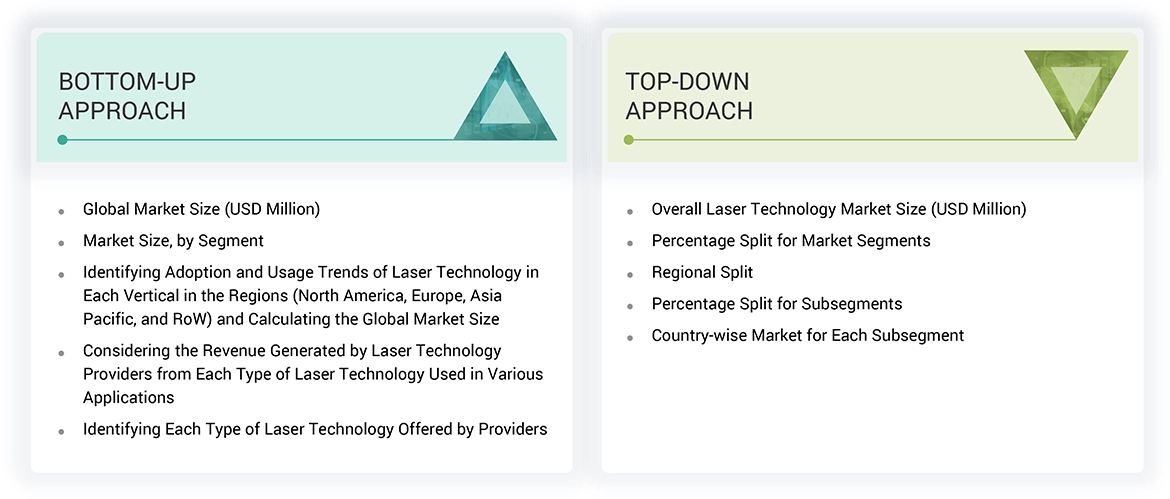
The study involved 4 major activities in estimating the size of the laser technology market. Exhaustive secondary research was done to collect information on the market, peer market, and parent market. The next step was to validate these findings, assumptions, and sizing with industry experts across value chain through primary research. Both top-down and bottom-up approaches were employed to estimate the complete market size. Thereafter, market breakdown and data triangulation were used to estimate the market size of segments and subsegments.
The research methodology used to estimate and forecast the laser technology market begins with capturing data on revenues of key vendors in the market, through secondary research. This study incorporates extensive use of secondary sources, directories, and databases (such as Hoovers, Bloomberg Businessweek, Factiva, and OneSource) to identify and collect information useful for a technical, market-oriented, and commercial study of the laser technology market. Vendor offerings have also been taken into consideration to determine market segmentations. The entire research methodology includes studying annual reports, press releases, and investor presentations of companies; white papers; and certified publications and articles from recognized authors, directories, and databases.
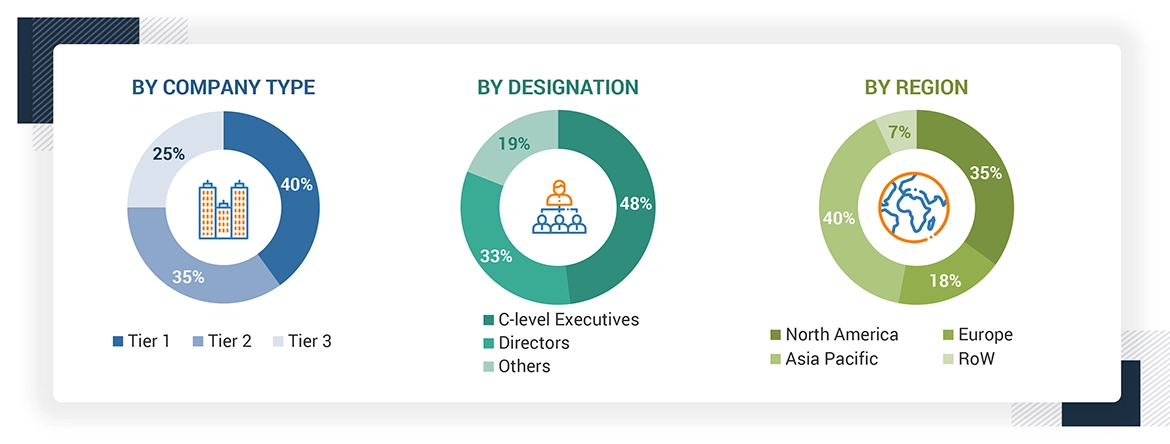
The laser technology market comprises several stakeholders, such as suppliers of standard components and original equipment manufacturers (OEMs). The demand side of this market is characterized by the development of telecommunications, industrial, semiconductor & electronics, commercial, aerospace & defense, automotive, medical, research, and other end-user verticals. The supply side is characterized by advancements in types of lasers and diverse applications. Various primary sources from both the supply and demand sides of the market have been interviewed to obtain qualitative and quantitative information. Following is the breakdown of primary respondents.

To know about the assumptions considered for the study, download the pdf brochure
Both top-down and bottom-up approaches have been used to estimate and validate the size of the laser technology market and its subsegments. The research methodology used to estimate the market size includes the following:
After arriving at the overall market sizeusing the estimation processes explained abovethe market was split into several segments and subsegments. To complete the overall market engineering process and arrive at the exact statistics of each market segment and subsegment, data triangulation and market breakdown procedures have been employed, wherever applicable. The data have been triangulated by studying various factors and trends in both the demand and supply sides of the laser technology market.
Report Metric |
Details |
|
Market size available for years |
20152024 |
|
Base year |
2017 |
|
Forecast period |
20182024 |
|
Forecast Unit |
Value (USD Billion) |
|
Segments covered |
Type, End User, Application, Revenue, and Region |
|
Geographic regions covered |
North America, APAC, Europe, and RoW |
|
Companies covered |
Coherent (US), IPG Photonics (US), Trumpf (Germany), Lumentum (US), Jenoptik (US), Novanta (US), Lumibird (France), LaserStar (US), Epilog Laser (US), and MKS Instruments (US) |
This report categorizes the laser technology market based on type, end user, application, revenue, and region.
Along with the market data, MarketsandMarkets offers customizations according to a companys specific needs. The following customization options are available for the report:
Growth opportunities and latent adjacency in Laser Technology Market
I would like to research out the market size well to classify the technical addressable market and commercial addressable Market via our products.
Over the years, fiber laser have witnessed an increase in demand due to its low cost, high output power, and compact size. Will these fiber laser replace the prominent laser been used today including CO2 laser?
There are several harmful effects of laser medical devices such as mild skin burns, tissue damage, photochemical effects and more. These effects depends upon various factors including exposure duration, beam energy, beam wavelength, and area of exposure. In what terms, harmful effects of laser during medical treatment or surgery will affect market growth?
Dot peen marking offers several advantages in terms of low-stress marking, adjustable marking length, ability to mark through any coating, and dot peen marking can be programmable for fully automated marking. How dot peen marking affect adoption of laser for marketing and engraving application?
Recent trade war between China and the US have resulted in decreasing industrial output growth from several countries and global slowdown. According to an estimate, the trade war is expected to lower world's GDP by 1%. Up to what extent, US China trade war will affect laser market growth?
Solid and fiber laser uses rare earth elements such as chromium, erbium, neodymium and others. Extraction of these rare earth materials can cause hazardous environment impacts. Also the raw supply can be monopolized by few countries. How government regulation regarding raw material mining and extraction for laser raw material will affect the market growth?
As a medium industry player, we would like to get informative data regarding the prospects of laser application in the future market so that we can reach to our fruitful planning on the purpose of the best sales of laser equipment.
We are working on Indian laser development to judge whether we can have some corporation on the engineer or academic problems with India university or company.
I'm writing a BSc thesis about VECSEL lasers and I'm looking for a source to cite regarding the current size of the laser technology market.
We are interested in marketing single crystals for nonlinear optics in solid state lasers especially in the UV and deep UV.
I need to learn detailed laser market share from 2019 to 2025 to use in my thesis. I would be very happy especially if it's about diode lasers that is used to pump doped fiber lasers (between 808 nm and 1060 nm).
I am working on a research based on laser technologies. I am trying to have a better overview on the market share/growth and competition, present in the laser technologies sector.
Do government regulation affect adoption of lasers for food items?
Looking for specific information on the number of YAG and other garnets used in the USA and globally.
Do you have more recent data than this report, and can you provide access to analyst who wrote it for a Q&A to dig deeper into specific sectors: we are particularly dealing at medical, surface treatment, YAG, fiber and ultrafast. The project has some urgency and your quick response would be appreciated.
Hi, I am an analyst at CCMP Capital. We are currently researching the laser market and found your report, Laser Technology Market by Type, Application, and Geography - Trends & Forecast to 2013 - 2020 online. Do you have a sample of the report you could send us? We are in the initial stages of our research and want to get some preliminary understanding of the market before we proceed.
Will increase in adoption of fiber laser will affect demand of CO2 laser?
I would like the Epilog and Universal Laser Systems and Xenetech and Gravograph and Trotec financial pages.