Light Meter Market by Display (Analog and Digital), Type (General-Purpose, LED, and UV), Lux Range (0–200K Lux and Above 200K Lux), Application (Photography & Cinematography, Commercial Spaces, Clinics & Hospitals), and Region - Global Forecast to 2035


Light Meter Market Overview
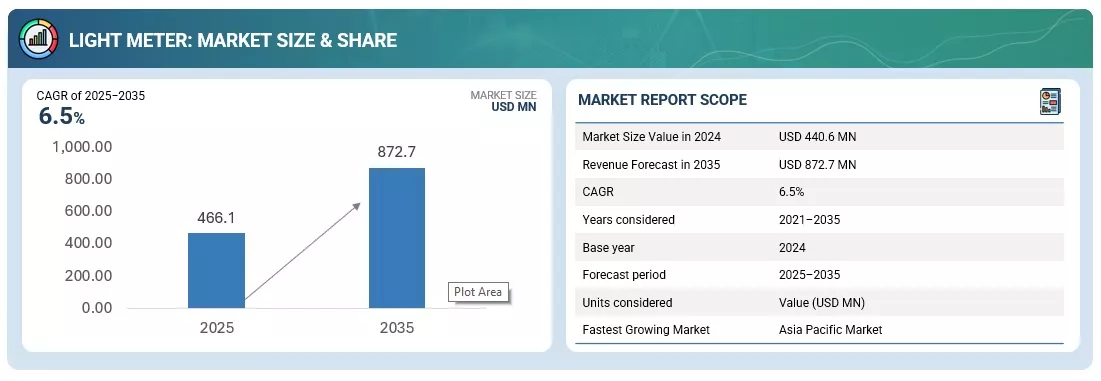
The global light meter market was valued at USD 440.6 million in 2024 and is estimated to reach USD 872.7 million by 2035, at a CAGR of 6.5% between 2025 and 2035.
The global light meter market is undergoing a period of strong expansion driven by the growing need for accurate light measurement across a variety of industries including photography, cinematography, healthcare, and commercial spaces. Light meters are instruments used to measure the intensity of light in lux or foot candles, ensuring optimal illumination for visual comfort, safety, and performance. The increasing emphasis on energy efficiency, workplace safety, and advanced lighting design has boosted the demand for both analog and digital light meters. Moreover, advancements in LED technology, the proliferation of smart lighting systems, and the rising implementation of lighting standards in industrial and commercial sectors are creating significant growth opportunities for the market.
As industries continue to adopt precision lighting systems for efficiency and quality assurance, the importance of light meters in maintaining optimal illumination conditions has grown substantially. The market is expected to expand steadily from 2025 to 2035, supported by technological innovation, stringent regulatory standards, and increasing awareness of the impact of light on health, productivity, and energy consumption.
Market Dynamics
The primary drivers of the light meter market include the increasing demand for proper illumination management, the rising adoption of LED lighting systems, and the growing use of digital technologies in light measurement. With industries transitioning toward energy efficient lighting solutions, light meters are becoming essential tools for evaluating the brightness, color temperature, and intensity of lighting installations. They are widely used to ensure that lighting systems meet international standards such as those established by the Illuminating Engineering Society and the International Commission on Illumination.
In addition, light meters play a crucial role in the photography and cinematography sectors where accurate light measurements are vital for achieving desired visual effects. The rising popularity of professional photography, film production, and media content creation has further increased the adoption of portable and easy to use digital light meters. Similarly, in commercial spaces, maintaining optimal light levels is essential to ensure comfort, energy efficiency, and employee well being, leading to growing demand for precise lighting analysis tools.
Healthcare facilities such as clinics and hospitals also represent a significant market segment as lighting conditions affect both patient care and staff performance. Proper illumination in operation theaters, laboratories, and diagnostic centers is crucial for accuracy and safety, thereby driving the use of light meters. Furthermore, government initiatives to promote energy conservation and sustainable building practices are pushing commercial establishments to adopt advanced lighting assessment instruments.
However, the market faces certain challenges such as high costs of advanced light meters and limited awareness in developing economies. Despite these challenges, the increasing availability of compact, affordable, and user friendly models is expected to expand market penetration in emerging regions over the next decade.
Market by Display Type
The light meter market can be divided into analog and digital segments based on display type. Both categories cater to different user preferences and application requirements, offering varied levels of precision and usability.
Analog light meters, which use needle based dials to display readings, have been traditionally favored by professionals who prefer simple and direct measurement tools. These devices are known for their durability, ease of use, and ability to provide quick readings without the need for electronic calibration. Analog meters are particularly useful in fieldwork and educational applications where basic illumination assessment is sufficient. Although the popularity of analog meters has declined in recent years, they continue to serve niche segments that value reliability and low maintenance.
Digital light meters, on the other hand, have dominated the market due to their superior accuracy, data storage capabilities, and user friendly interface. Equipped with digital displays, these meters can record and store multiple readings, perform statistical analysis, and connect with external devices for data transfer. Many modern digital light meters also feature Bluetooth or USB connectivity, enabling real time monitoring and reporting. The integration of microprocessor based sensors allows for automatic calibration and high sensitivity, making digital meters ideal for precise measurement applications in laboratories, studios, and industrial environments. The increasing shift toward digitalization and automation in measurement systems is expected to continue driving demand for digital light meters during the forecast period.
Market by Type
Based on type, the light meter market can be categorized into general purpose, LED, and UV light meters. Each type serves specific measurement requirements depending on the nature of illumination and application.
General purpose light meters are designed for broad use in various industries, including commercial, educational, and residential sectors. They are used to measure visible light intensity in spaces such as offices, factories, and schools to ensure compliance with lighting standards. These meters are versatile, cost effective, and suitable for routine maintenance and inspection activities. The increasing awareness of energy efficiency and lighting quality is fueling the demand for general purpose light meters worldwide.
LED light meters are specialized devices calibrated to measure the brightness and intensity of LED lighting systems. With the rapid adoption of LED technology across residential, industrial, and commercial sectors, the demand for these meters has surged. LED light meters help in assessing luminous flux, color rendering index, and correlated color temperature, ensuring that installations meet performance expectations and energy efficiency standards. As smart lighting and connected systems gain popularity, LED light meters are becoming indispensable tools for ensuring consistent quality and performance across lighting networks.
UV light meters, meanwhile, are used to measure ultraviolet radiation in various industrial and medical applications. They play a crucial role in environments where UV exposure needs to be controlled, such as sterilization processes, semiconductor manufacturing, and laboratory testing. In healthcare settings, UV light meters help ensure the safety and effectiveness of disinfection systems used to kill pathogens. Growing adoption of UV curing and sanitation technologies across industries is expected to drive steady demand for UV light meters in the coming years.
Market by Lux Range
The light meter market is segmented by lux range into two categories, namely 0 to 200K lux and above 200K lux. Each range addresses different lighting conditions and application needs.
Light meters with a lux range of 0 to 200K lux are widely used for most standard applications such as indoor lighting assessment, photography, and commercial space evaluation. These devices provide accurate readings for low to moderate light intensity levels, making them suitable for everyday use in workplaces, studios, and educational environments. The segment commands the largest market share due to its extensive use across a variety of settings.
Meters capable of measuring above 200K lux are designed for high intensity lighting environments such as outdoor stadiums, industrial plants, and specialized laboratories. These devices are essential for measuring extremely bright light sources where standard meters may reach saturation. As industries such as horticulture, sports, and manufacturing increasingly rely on powerful illumination systems, demand for high range light meters is expected to grow rapidly. Moreover, technological improvements in sensor sensitivity and data processing are enhancing the performance of high lux range meters, allowing accurate measurements even in fluctuating light conditions.
Market by Application
The major application areas for light meters include photography and cinematography, commercial spaces, and clinics and hospitals. Each of these sectors relies heavily on precise light measurement to achieve specific objectives.
In photography and cinematography, light meters are indispensable tools for professionals aiming to capture images with optimal exposure and color balance. By measuring the intensity and direction of light, these instruments help photographers and filmmakers adjust camera settings and lighting arrangements for the best visual outcomes. The rise of digital media, online content creation, and entertainment industries has significantly boosted demand for light meters among both professionals and hobbyists. Moreover, with the increasing use of LED and smart lighting in studios, accurate measurement of light output and color temperature has become more important than ever.
In commercial spaces such as offices, retail stores, and manufacturing units, maintaining appropriate light levels is critical for employee productivity, safety, and customer experience. Overly bright or dim lighting can lead to discomfort, eye strain, and reduced performance. Light meters are used to monitor illumination levels and ensure compliance with occupational safety standards. Additionally, they assist facility managers in implementing energy conservation strategies by identifying over illuminated areas and optimizing lighting usage. The global focus on sustainability and smart building management is driving steady growth in this segment.
Clinics and hospitals also represent a vital application segment for light meters. In medical settings, lighting directly impacts diagnostic accuracy, surgical precision, and patient recovery. Light meters are used to verify that operation theaters, examination rooms, and laboratories maintain appropriate illumination levels. They are also employed in calibrating medical imaging equipment and ensuring that UV disinfection systems operate safely and effectively. With the growing emphasis on patient safety and healthcare infrastructure modernization, demand for light meters in the medical sector is projected to expand significantly.
Regional Analysis
Regionally, the light meter market is segmented into North America, Europe, Asia Pacific, Latin America, and the Middle East and Africa. Each region exhibits distinct growth drivers and market dynamics.
North America holds a significant share of the global market due to advanced technological infrastructure, widespread use of LED lighting, and strong regulatory frameworks promoting energy efficiency. The United States is a major contributor, driven by demand from film production, healthcare, and industrial sectors. Additionally, the presence of leading manufacturers and ongoing innovations in digital light meters contribute to the region’s dominance.
Europe is another prominent market, characterized by strict lighting standards and environmental policies. The region’s focus on sustainable building design and energy management has created strong demand for light measurement instruments. Countries such as Germany, the United Kingdom, and France are leading adopters, especially in industrial and healthcare applications.
The Asia Pacific region is projected to witness the fastest growth during the forecast period. Rapid industrialization, urbanization, and the expansion of commercial infrastructure are driving the adoption of modern lighting systems in countries like China, India, and Japan. Furthermore, the increasing production of electronic devices and semiconductors requiring precise light control is contributing to market expansion.
Latin America and the Middle East and Africa are emerging markets showing gradual growth as governments and businesses invest in energy efficient lighting and modern infrastructure. The growing awareness of lighting quality and safety standards is expected to support steady adoption in these regions.
Technological Advancements and Future Outlook
The light meter market is evolving rapidly with continuous technological advancements aimed at improving accuracy, portability, and connectivity. Manufacturers are integrating smart sensors, wireless communication, and cloud based data management into modern devices. The advent of Internet of Things enabled light meters allows real time monitoring and integration with building management systems. Artificial intelligence and data analytics are being increasingly applied to analyze lighting patterns, predict maintenance requirements, and optimize energy usage.
The future outlook for the market remains positive, with rising emphasis on smart cities, sustainable energy practices, and digital transformation. The growing use of light meters in smart lighting control systems will open new opportunities for market players. Moreover, miniaturization and cost reduction efforts are expected to make advanced meters more accessible to small and medium enterprises and educational institutions.
The light meter market has been covered in detail in this report. To provide a holistic picture, the current market demand and forecasts have also been included in the report. The light meter market has been segmented as follows:
Light Meter Market by Display
- Analog
- Digital
Light Meter Market, by Type
- General-Purpose Light Meters
- LED Light Meters
- UV Light Meters
Light Meter Market, by Lux Range
- 0–200K Lux
- Above 200K Lux
Light Meter Market, by Application
- Photography and Cinematography
- Commercial Spaces
- Manufacturing Plants and Warehouses
- University Campuses and Schools
- Clinics and Hospitals
- Others
Light Meter Market, by Geography
- Americas
- Europe
- Asia Pacific (APAC)
- Rest of the World (RoW)
Key Market Players in Light Meter Market
Konica Minolta Sensing Americas (US), FLIR Systems (US), Sekonic (Japan), Testo SE (Germany), Hioki (Japan), Amprobe (US), KERN & SOHN (Germany), B&K Precision (US), Line Seiki (Japan), PCE Deutschland (Germany), Hanna Instruments (US), Lutron Electronics (US), Kyoritsu Electrical Instruments Works (Japan), Martindale Electric (UK), TQC B. V. (the Netherlands), and KIMO Instruments (UK)
Konica Minolta Sensing Americas has a recognized brand name, innovative portfolio, and widespread strong global network of sales and services, distributors, and customers. The company has established strong business relationships with large customers across the world and is strategically focused on partnerships and acquisitions of its stakeholders to grow in the light meter market. The company is also keen to use the customer base of its other segments to promote its light meter products. Konica Minolta It has a major focus on acquiring more customers by exhibiting its light meter products in various countries.
Key Questions Answered
- Where will all these developments take the industry in the long term?
- What are the upcoming trends for the Light Meter Market?
- Which segment provides the most opportunity for growth?
- Who are the leading vendors operating in this market?
- What are the opportunities for new market entrants?
To speak to our analyst for a discussion on the above findings, click Speak to Analyst
FAQ
1. What is a Light Meter?
Answer:
A light meter is an instrument used to measure the intensity of light, commonly expressed in lux or foot-candles.
2. What drives the growth of the Light Meter Market?
Answer:
The market is driven by rising demand for precise light measurement in photography, cinematography, and industrial lighting applications.
3. Which industries use Light Meters the most?
Answer:
Light meters are widely used in photography, architecture, manufacturing, healthcare, and environmental monitoring.
4. What are the main types of Light Meters?
Answer:
The primary types include general-purpose light meters, LED light meters, and spectrally corrected light meters.
5. What are the benefits of using a Light Meter?
Answer:
Light meters help optimize lighting conditions, ensure energy efficiency, maintain safety standards, and improve visual quality.
 Exclusive indicates content/data unique to MarketsandMarkets and not available with any competitors.
Table of Contents
1 Introduction (Page No. - 14)
1.1 Objectives of Study
1.2 Definition
1.3 Scope of Study
1.3.1 Markets Covered
1.3.2 Geographic Scope
1.3.3 Years Considered for Study
1.4 Currency
1.5 Package Size
1.6 Limitations
1.7 Stakeholders
2 Research Methodology (Page No. - 18)
2.1 Research Data
2.1.1 Secondary Data
2.1.1.1 Secondary Sources
2.1.2 Primary Data
2.1.2.1 Key Data From Primary Sources
2.1.2.2 Key Industry Insights
2.1.2.3 Breakdown of Primaries
2.2 Market Size Estimation
2.3 Market Breakdown & Data Triangulation
2.4 Assumptions
3 Executive Summary (Page No. - 26)
4 Premium Insights (Page No. - 30)
4.1 Attractive Market Opportunities in Market
4.2 Market in APAC, By Application and Country
4.3 Market, By Type
4.4 Light Meter Market, By Display
4.5 Market, By Lux Range
4.6 Geographic Analysis of Market
5 Market Overview (Page No. - 34)
5.1 Introduction
5.2 Market Dynamics
5.2.1 Drivers
5.2.1.1 Increasing Demand for Light Meters in the Photography and Cinematography Industry Worldwide
5.2.1.2 Regulations to Improve Workplace Lighting
5.2.1.3 Government Initiatives Toward the Standardization of Lighting Protocols
5.2.2 Restraints
5.2.2.1 Development of Smartphone Applications and Light Measuring Devices to Substitute Light Meters
5.2.3 Opportunities
5.2.3.1 Development of Wireless Light Meter Technologies
5.2.3.2 Latent Market for Light Meters in APAC
5.2.3.3 Convergence of IoT in Lighting
5.2.4 Challenges
5.2.4.1 Increasing Number of Manufacturers Creating Competitive Pricing Pressure
6 Light Meter Market, By Display (Page No. - 39)
6.1 Introduction
6.2 Digital
6.3 Analog
7 Market, By Type (Page No. - 43)
7.1 Introduction
7.2 General-Purpose Light Meters
7.3 LED Light Meters
7.4 UV Light Meters
8 Market, By Lux Range (Page No. - 48)
8.1 Introduction
8.2 0–200k Lux
8.3 Above 200k Lux
9 Market, By Application (Page No. - 52)
9.1 Introduction
9.2 Photography and Cinematography
9.3 Commercial Spaces
9.4 Manufacturing Plants and Warehouses
9.5 University Campuses and Schools
9.6 Clinics and Hospitals
9.7 Others
10 Market, By Region (Page No. - 61)
10.1 Introduction
10.2 Americas
10.2.1 US
10.2.2 Canada
10.2.3 Rest of Americas
10.3 Europe
10.3.1 UK
10.3.2 Germany
10.3.3 France
10.3.4 Italy
10.3.5 Rest of Europe
10.4 APAC
10.4.1 China
10.4.2 Japan
10.4.3 India
10.4.4 Rest of APAC
10.5 RoW
10.5.1 Middle East
10.5.2 Africa
11 Competitive Landscape (Page No. - 93)
11.1 Overview
11.2 Ranking of Players, 2017
11.3 Competitive Scenario
11.3.1 Product Launches
12 Company Profiles (Page No. - 97)
12.1 Introduction
12.2 Key Players
(Business Overview, Products Offered, Recent Developments, MnM View, SWOT Analysis)*
12.2.1 Konica Minolta Sensing Americas
12.2.2 Flir Systems (Extech)
12.2.3 Sekonic
12.2.4 Testo Se
12.2.5 Hioki
12.2.6 Amprobe (Danaher Corporation)
12.2.7 Kern & Sohn
12.2.8 B&K Precision
12.2.9 Line Seiki
12.2.10 PCE Deutschland
12.2.11 Hanna Instruments
*Business Overview, Products Offered, Recent Developments, MnM View, SWOT Analysis Might Not Be Captured in Case of Unlisted Companies.
12.3 Other Important Players
12.3.1 Lutron Electronics
12.3.2 Kyoritsu Electrical Instruments Works
12.3.3 Martindale Electric Co Ltd
12.3.4 TQC B.V.
12.3.5 Kimo Instruments UK
12.4 Start-Up Ecosystem
12.4.1 Center Technology
12.4.2 Tenmars Electronics
12.4.3 Panomex
12.4.4 Shenzhen Sanpo Instrument
12.4.5 Huato Electric
13 Appendix (Page No. - 123)
13.1 Insights From Industry Experts
13.2 Discussion Guide
13.3 Knowledge Store: Marketsandmarkets’ Subscription Portal
13.4 Introducing RT: Real-Time Market Intelligence
13.5 Available Customizations
13.6 Related Reports
13.7 Author Details
List of Tables (71 Tables)
Table 1 Light Meter Market, By Display, 2015–2023 (USD Million)
Table 2 Market for Digital, By Region 2015–2023 (USD Million)
Table 3 Market for Analog, By Region 2015–2023 (USD Million)
Table 4 Light Meter Measurements of Various Lighting Conditions
Table 5 Market, By Type, 2015–2023 (USD Million)
Table 6 Market for General-Purpose Light Meters, By Region, 2015–2023 (USD Million)
Table 7 Market for LED Light Meters, By Region 2015–2023 (USD Million)
Table 8 Market for UV Light Meters, By Region, 2015–2023 (USD Million)
Table 9 Market, By Lux Range, 2015–2023 (USD Million)
Table 10 Market, By Lux Range, 2015–2023 (Million Units)
Table 11 Market for 0–200k Lux, By Region, 2015–2023 (USD Million)
Table 12 Market for Above 200k Lux, By Region, 2015–2023 (USD Million)
Table 13 Market, By Application, 2015–2023 (USD Million)
Table 14 Market for Photography and Cinematography, By Region, 2015–2023 (USD Million)
Table 15 Lighting Conditions for Office Spaces
Table 16 Market for Commercial Spaces, By Region, 2015–2023 (USD Million)
Table 17 Market for Manufacturing Plants and Warehouses, By Region, 2015–2023 (USD Million)
Table 18 Market for University Campuses and Schools, By Region, 2015–2023 (USD Million)
Table 19 Lighting Conditions for Clinics and Hospitals
Table 20 Market for Clinics and Hospitals, By Region, 2015–2023 (USD Million)
Table 21 Market for Others, By Region, 2015–2023 (USD Million)
Table 22 Market, By Region, 2015–2023 (USD Million)
Table 23 Market in Americas, By Display, 2015–2023 (USD Million)
Table 24 Market in Americas, By Type, 2015–2023 (USD Million)
Table 25 Market in Americas, By Application, 2015–2023 (USD Million)
Table 26 Market in Americas, By Lux Range, 2015–2023 (USD Million)
Table 27 Market in Americas, By Country, 2015–2023 (USD Million)
Table 28 Market in US, By Display, 2015–2023 (USD Million)
Table 29 Market in US, By Lux Range, 2015–2023 (USD Million)
Table 30 Market in Canada, By Display, 2015–2023 (USD Million)
Table 31 Market in Canada, By Lux Range, 2015–2023 (USD Million)
Table 32 Market in Rest of Americas, By Display, 2015–2023 (USD Million)
Table 33 Market in Rest of Americas, By Lux Range, 2015–2023 (USD Million)
Table 34 Market in Europe, By Display, 2015–2023 (USD Million)
Table 35 Market in Europe, By Type, 2015–2023 (USD Million)
Table 36 Market in Europe, By Application, 2015–2023 (USD Million)
Table 37 Market in Europe, By Lux Range, 2015–2023 (USD Million)
Table 38 Market in Europe, By Country, 2015–2023 (USD Million)
Table 39 Market in UK, By Display, 2015–2023 (USD Million)
Table 40 Market in UK, By Lux Range, 2015–2023 (USD Million)
Table 41 Market in Germany, By Display, 2015–2023 (USD Million)
Table 42 Market in Germany, By Lux Range, 2015–2023 (USD Million)
Table 43 Market in France, By Display, 2015–2023 (USD Million)
Table 44 Market in France, By Lux Range, 2015–2023 (USD Million)
Table 45 Market in Italy, By Display, 2015–2023 (USD Million)
Table 46 Market in Italy, By Lux Range, 2015–2023 (USD Million)
Table 47 Market in Rest of Europe, By Display, 2015–2023 (USD Million)
Table 48 Market in Rest of Europe, By Lux Range, 2015–2023 (USD Million)
Table 49 Market in APAC, By Display, 2015–2023 (USD Million)
Table 50 Market in APAC, By Type, 2015–2023 (USD Million)
Table 51 Market in APAC, By Application, 2015–2023 (USD Million)
Table 52 Market in APAC, By Lux Range, 2015–2023 (USD Million)
Table 53 Market in APAC, By Country, 2015–2023 (USD Million)
Table 54 Market in China, By Display, 2015–2023 (USD Million)
Table 55 Market in China, By Lux Range, 2015–2023 (USD Million)
Table 56 Market in Japan, By Display, 2015–2023 (USD Million)
Table 57 Market in Japan, By Lux Range, 2015–2023 (USD Million)
Table 58 Market in India, By Display, 2015–2023 (USD Million)
Table 59 Market in India, By Lux Range ,2015–2023 (USD Million)
Table 60 Market in Rest of APAC, By Display, 2015–2023 (USD Million)
Table 61 Market in Rest of APAC, By Lux Range, 2015–2023 (USD Million)
Table 62 Market in RoW, By Display, 2015–2023 (USD Million)
Table 63 Market in RoW, By Type, 2015–2023 (USD Million)
Table 64 Market in RoW, By Application, 2015–2023 (USD Million)
Table 65 Market in RoW, By Lux Range, 2015–2023 (USD Million)
Table 66 Market in RoW, By Region, 2015–2023 (USD Million)
Table 67 Market in Middle East, By Display, 2015–2023 (USD Million)
Table 68 Market in Middle East, By Lux Range, 2015–2023 (USD Million)
Table 69 Market in Africa, By Display, 2015–2023 (USD Million)
Table 70 Market in Africa, By Lux Range, 2015–2023 (USD Million)
Table 71 Market Ranking of Top 5 Players in Market, 2017
List of Figures (43 Figures)
Figure 1 Market Segmentation
Figure 2 Research Design
Figure 3 Bottom-Up Approach
Figure 4 Top-Down Approach
Figure 5 Data Triangulation
Figure 6 Digital Light Meters to Dominate Light Meter Market Between 2018 and 2023
Figure 7 General-Purpose Light Meters to Hold Largest Size of Market Between 2018 and 2023
Figure 8 Photography and Cinematography to Dominate Market Between 2018 and 2023
Figure 9 0–200k Lux to Dominate the market Between 2018 and 2023
Figure 10 Americas to Hold Largest Share of Market in 2018
Figure 11 Increasing Demand for Light Meters in Photography and Cinematography Industry Worldwide is Major Driver for Growth of Market
Figure 12 China Held Largest Share of Market in APAC in 2018
Figure 13 Market for LED Light Meters to Grow at Highest CAGR Between 2018 and 2023
Figure 14 Market for Digital Light Meters to Grow Higher CAGR Between 2018 and 2023
Figure 15 Market for 0–200k Lux to Grow at Higher CAGR Between 2018 and 2023
Figure 16 Market in India to Grow at Highest CAGR Between 2018 and 2023
Figure 17 Market: Drivers, Restraints, Opportunities, and Challenges
Figure 18 Digital Light Meters to Dominate Market Between 2018 and 2023
Figure 19 Market for LED Light Meters to Grow at Highest CAGR Between 2018 and 2023
Figure 20 Market for LED Light Meters in APAC to Grow at Highest CAGR Between 2018 and 2023
Figure 21 0–200k Lux to Dominate Market Between 2018 and 2023
Figure 22 Photography and Cinematography to Dominate Market Between 2018 and 2023
Figure 23 Market for Manufacturing Plants and Warehouses in APAC to Grow at Highest CAGR Between 2018 and 2023
Figure 24 Market: Geographic Snapshot
Figure 25 Market in APAC to Grow at Highest CAGR Between 2018 and 2023
Figure 26 Americas: Market Snapshot
Figure 27 Photography and Cinematography to Dominate Market in APAC Between 2018 and 2023
Figure 28 0–200k Lux to Dominate Market in US Between 2018 and 2023
Figure 29 Snapshot: Market in Europe
Figure 30 Photography and Cinematography Application to Dominate Market in Europe Between 2018 and 2023
Figure 31 Digital Light Meters to Dominate Market in Germany Between 2018 and 2023
Figure 32 Digital Light Meters to DominateMarket in Italy Between 2018 and 2023
Figure 33 Snapshot: Market in APAC
Figure 34 General-Purpose Light Meters to Hold Largest Size of Market in APAC Between 2018 and 2023
Figure 35 Digital Light Meters to Dominate Market in China Between 2018 and 2023
Figure 36 Japanese Government Policies Spurred Deployment of LED Lights
Figure 37 Market in RoW Commercial Spaces to Grow at Highest CAGR Between 2018 and 2023
Figure 38 Product Launches as Key Strategy Adopted By Key Players in the market Between 2014 and 2017
Figure 39 Market Evaluation
Figure 40 Konica Minolta Sensing Americas: Company Snapshot
Figure 41 Flir Systems: Company Snapshot
Figure 42 Sekonic: Company Snapshot
Figure 43 Hioki: Company Snapshot













Growth opportunities and latent adjacency in Light Meter Market