Mining Equipment Market by Machinery Category (Crushing, Pulverizing & Screening, Mineral Processing, Surface & Underground), Application, Power Output, Electric & Hybrid Machinery (Mining Trucks, LHD), Battery Chemistry, Region – Global Forecast to 2033

icon1
USD 42.81 BN
MARKET SIZE, 2033
icon2
CAGR 6.0%
(2026-2033)
icon3
370
REPORT PAGES
icon4
230
MARKET TABLES

OVERVIEW

mining-equipment-market Overview

Source: Secondary Research, Interviews with Experts, MarketsandMarkets Analysis

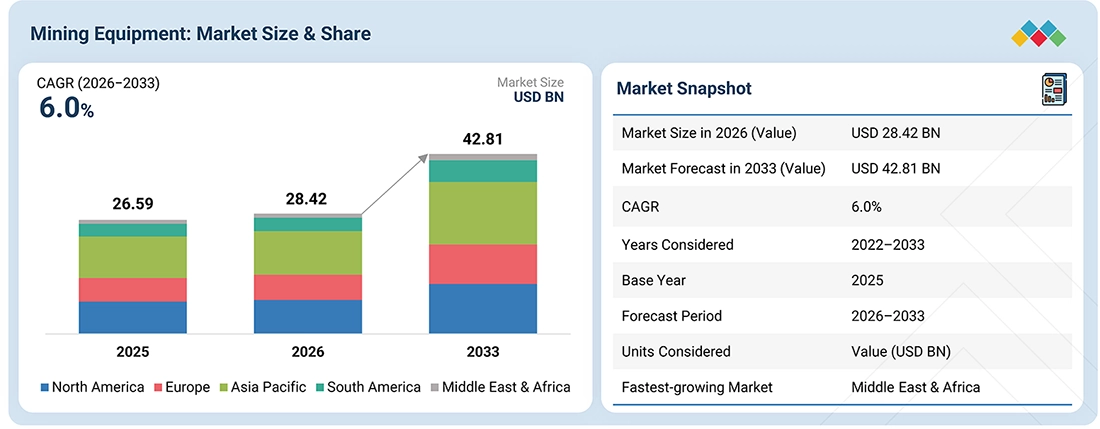
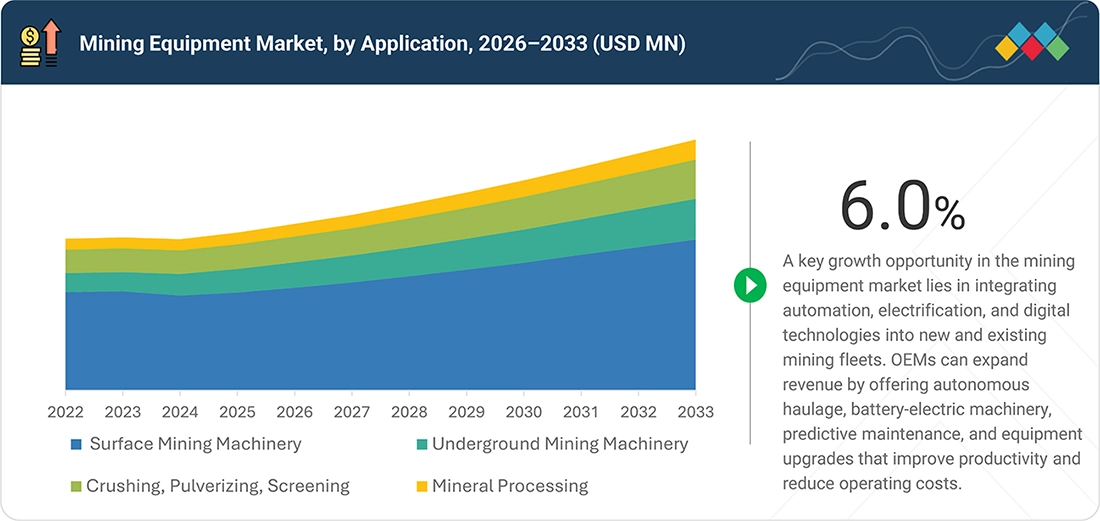
The mining equipment market is projected to grow from USD 28.42 billion in 2026 to USD 42.81 billion by 2033, at a CAGR of 6.0%, as mining companies shift from buying individual machines to investing in integrated equipment and technology solutions that improve productivity, reduce operating costs, and maximize output per tonne. In surface mining, demand is driven by high-capacity electric rope shovels, hydraulic excavators, and mining trucks, with shovel bucket capacities ranging from 5–64 m³, hydraulic excavator bucket capacities of approximately 9–44 m³, and large mining trucks offering payload capacities of 90 metric tonnes and above. For OEMs, the strategic opportunity lies in matching loading and hauling capacities to reduce truck waiting time, improve material movement, and increase mine productivity. In underground mining, equipment selection depends on tunnel size, maneuverability, payload, operating efficiency, and ventilation needs, creating opportunities for compact, high-performance LHD loaders, underground trucks, and drilling systems. Going forward, OEMs can strengthen their competitive position by offering fuel-efficient and electric equipment, autonomous operations, predictive maintenance, and connected fleet management solutions that help mining companies reduce downtime and lower cost per tonne. However, high equipment costs, inadequate power and charging infrastructure, and the difficulty of upgrading existing fleets remain major barriers, making measurable productivity gains and lower total cost of ownership critical to purchasing decisions. According to ABB’s global mining industry survey, electrification is expected to gain traction in mining haulage, with 68% of surveyed mining leaders planning to electrify at least 25% of their haulage fleet by 2030. This points to increasing demand for electric mining trucks, power-supply infrastructure, charging systems, and related energy-management technologies.

KEY TAKEAWAYS

  • MARKET SNAPSHOT:
    Market Size (2025): USD 26.59 Billion
    Current Market Size (2026): USD 28.42 Billion
    Projected Market Size (2033): USD 42.81 Billion
    CAGR (2026–2033):  6.0%
  • BY REGION
    High mining activity across China, India, Australia, and Indonesia, supported by substantial coal and metal production, ongoing mine development, and demand for high-capacity machinery, makes Asia Pacific a leading regional market for mining equipment, accounting for >45% of the mining equipment market in 2026 in terms of value.
  • BY MACHINERY CATEGORY
    Underground mining equipment supports efficient and safe operations in confined spaces through drilling, loading, hauling, and material transportation, with growing demand for LHD loaders, underground mining trucks, and drilling equipment driving adoption across metal, mineral, and coal mines. The segment is expected to register a CAGR of > 6.0% during the forecast period.
  • BY APPLICATION
    Mineral mining accounts for the largest share of >45% in terms of value which is driven by extensive extraction of iron ore, copper, gold, and other industrial and critical minerals, making it the dominant application segment.
  • BY POWER OUTPUT
    Growing demand for high power output mining trucks, large hydraulic excavators, and electric rope shovels for high-volume extraction and material movement is supporting growth of >2000 HP power output during the forecast period, with a CAGR of > 6.0% during the forecast period.
  • BY PROPULSION
    Diesel-powered mining equipment remains dominant due to its high power output, operational flexibility, established refueling infrastructure, and suitability for demanding surface and underground mining applications, making diesel the largest propulsion segment, accounting for more than 95% of the market in 2026 in terms of value.
  • AUTONOMOUS MINING EQUIPMENT MARKET, BY MINING CATEGORY
    The growing deployment of autonomous drilling, remote-operated loaders, and automated underground haulage systems is expected to accelerate adoption, making underground equipment the fastest-growing category in the autonomous mining equipment market during the forecast period, with a CAGR of >20.0% during the forecast period.
  • ELECTRIC MINING EQUIPMENT MARKET, BY BATTERY CHEMISTRY
    LFP batteries are increasingly being adopted in electric mining equipment due to their thermal stability, long cycle life, and lower reliance on nickel and cobalt, making them a leading battery chemistry, accounting for more than 45% of the electric mining equipment market in 2026 in terms of value.
  • ELECTRIC & HYBRID MINING EQUIPMENT MARKET, BY TYPE
    Increasing electrification of underground mining operations, combined with the need to reduce diesel emissions, improve energy efficiency, and enhance operator safety in confined environments, is driving electric load-haul-dump (LHD) equipment as the fastest-growing segment, with the adoption of battery-electric LHDs with a CAGR of >5.0% during the forecast period.
  • COMPETITIVE LANDSCAPE
    Key players such as Caterpillar Inc. (US), Komatsu Ltd. (Japan), Sandvik AB (Sweden), Epiroc AB (Sweden), and Liebherr Group (Switzerland) are focusing on autonomous haulage systems, battery-electric and diesel-electric equipment, trolley-assist technologies, advanced drilling systems, and integrated fleet-management solutions. Caterpillar is advancing autonomous haulage, mixed-fleet interoperability, and dynamic energy-transfer technologies, while Komatsu is expanding its FrontRunner autonomous haulage platform and electric-drive truck technologies. Sandvik and Epiroc are strengthening their portfolios in battery-electric underground loaders, trucks, drilling equipment, and automation solutions, while Liebherr is advancing high-capacity mining trucks, autonomous operation, and alternative propulsion technologies. These companies are investing in R&D, expanding technology partnerships, introducing new equipment platforms, and developing modular solutions to address the requirements of large-scale surface and underground mining operations.

There is a key strategic shift in the mining equipment market from conventional diesel-powered machinery toward electrified, autonomous, digitally connected, and software-enabled equipment across surface and underground operations. Diesel-powered machinery remains essential due to established infrastructure, operational flexibility, and suitability for remote mine sites; however, pressure to reduce fuel consumption and emissions, improve productivity, and address operator shortages is accelerating investment in battery-electric equipment, diesel-electric haul trucks, trolley-assist systems, and autonomous fleets. In underground mining, the need to improve worker safety, reduce ventilation costs, and operate efficiently in confined spaces is creating opportunities for battery-electric load-haul-dump (LHD) loaders, underground trucks, and remote-controlled drilling systems. Across surface and underground operations, OEMs are increasingly integrating autonomous operation, real-time machine-health monitoring, predictive maintenance, and digital fleet management to reduce unplanned downtime and improve equipment utilization. The strategic opportunity for OEMs lies in combining machinery, automation, electrification, and aftermarket services to deliver measurable reductions in cost per tonne and higher equipment availability. However, high technology investment costs, infrastructure limitations, interoperability issues, and the need to demonstrate reliable performance under demanding mining conditions remain key challenges to widespread adoption.

TRENDS & DISRUPTIONS IMPACTING CUSTOMERS' CUSTOMERS

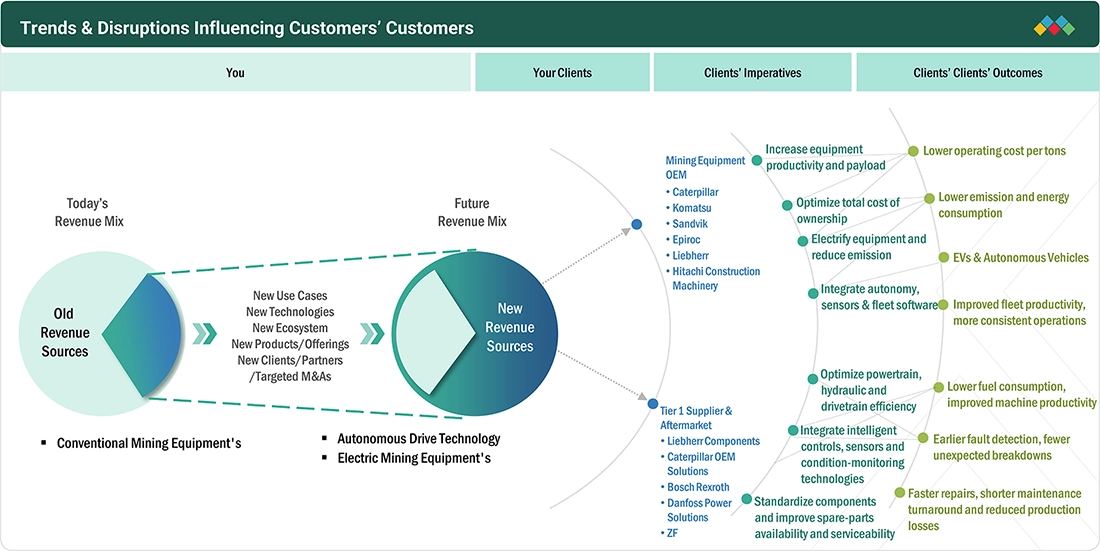
Changes in mining methods, equipment technologies, and mine-site operating requirements are directly influencing mining equipment OEMs and component suppliers. The growing adoption of autonomous haulage, remote-controlled machinery, battery-electric equipment, trolley-assist systems, and AI-enabled fleet management is increasing demand for high-productivity, energy-efficient, and digitally connected machines that improve material movement, equipment availability, operational safety, and cost per tonne. These shifts are cascading across the value chain, from powertrain, battery, hydraulic, and drivetrain suppliers to equipment manufacturers and mining operators, while creating opportunities for ultra-class haul trucks, high-capacity excavators, autonomous drilling systems, electric load-haul-dump (LHD) machines, and predictive maintenance platforms. At the same time, the integration of equipment with mine-planning software, fleet-dispatch systems, machine-health analytics, and automated operating platforms is disrupting conventional equipment ownership and operating models, encouraging OEMs to move beyond standalone machine sales toward integrated equipment, software, automation, and lifecycle-service solutions. However, high capital costs, infrastructure constraints, interoperability challenges, and the operational demands of different mine sites continue to influence the pace of technology adoption, creating a market in which conventional diesel equipment coexists with increasingly automated, electrified, and connected mining fleets.

mining-equipment-market Disruptions

Source: Secondary Research, Interviews with Experts, MarketsandMarkets Analysis

MARKET DYNAMICS

Drivers
Impact
Level
  • Expansion of critical-mineral mining and development of increasingly complex ore bodies are driving demand for higher-capacity, specialized equipment
  • Mine automation and electrification are moving from pilot projects toward fleet-scale deployment, creating a new technology-driven equipment replacement cycle
RESTRAINTS
Impact
Level
  • •High initial capital making mining equipment capital-intensive 
  • •Long equipment replacement cycles  
OPPORTUNITIES
Impact
Level
  • Equipment As a Service (EaaS)
  • Autonomous, connected & electrified mining fleets  
CHALLENGES
Impact
Level
  • •Lack of standardization in mining machinery
  • •Scaling autonomous and electrified equipment from controlled pilots to reliable, interoperable mine-wide fleets

Source: Secondary Research, Interviews with Experts, MarketsandMarkets Analysis

Driver: Expansion of critical-mineral mining and development of increasingly complex ore bodies are driving demand for higher-capacity, specialized equipment

The expansion of critical mineral mining to support demand for electric vehicles, renewable energy, and advanced electronics, combined with the development of deeper deposits, lower-grade ores, and increasingly complex ore bodies, is driving demand for higher-capacity and specialized mining equipment. Mining operators are investing in larger haul trucks, high-capacity excavators, advanced drilling systems, and specialized loading and material-handling equipment to improve extraction productivity, handle greater material volumes, and maintain operational efficiency under challenging geological conditions.

Restraint: High initial capital making mining equipment capital-intensive 

Mining equipment requires substantial upfront investment due to its large size, high power capacity, specialized engineering, and demanding operating requirements. Equipment such as ultra-class mining trucks, large hydraulic excavators, electric rope shovels, and advanced drilling systems involves significant acquisition and deployment costs, while investments in charging infrastructure, trolley-assist systems, automation, and digital technologies can further increase initial expenditure. These high capital requirements can constrain purchases by small and mid-sized mining operators, delay fleet replacement, and encourage companies to extend the service life of existing equipment or opt for refurbished machinery. Consequently, affordability and capital-budget constraints can slow the adoption of advanced, electrified, and autonomous mining equipment, particularly among operators with limited access to financing or uncertain commodity-price outlooks.

Opportunity: Equipment -as -a -Service (EaaS)

The growing need to reduce upfront capital expenditure and improve equipment utilization is creating opportunities for Equipment-as-a-Service (EaaS) models in the mining equipment market. Under these models, mining operators can access machinery through usage-based fees, leasing, rental, or performance-linked contracts rather than purchasing equipment outright, helping them manage capital budgets and align costs with production requirements. Equipment manufacturers can strengthen recurring revenue streams by bundling machinery with maintenance, spare parts, remote monitoring, fleet management, and equipment availability guarantees. The model is particularly relevant for high-value mining trucks, excavators, drilling systems, and electric equipment, where specialized servicing, battery management, and digital monitoring can improve uptime and lifecycle cost visibility. As a result, EaaS creates an opportunity for OEMs to build long-term customer relationships, expand aftermarket revenues, and support adoption among mining operators seeking greater financial flexibility and predictable operating costs.

Challenge: Lack of standardization in mining machinery

The lack of standardization across mining equipment models, operating systems, data protocols, components, and maintenance procedures creates challenges for equipment manufacturers and mining operators. Differences in specifications, control systems, communication interfaces, and spare-parts requirements across OEMs can complicate the integration of mixed-brand fleets, autonomous haulage systems, and digital mine-management platforms. Limited interoperability can increase maintenance complexity, technician training requirements, spare-parts inventory, and equipment downtime, while making it difficult to deploy consistent fleet-wide monitoring and automation solutions. These challenges become more significant as mining operators adopt battery-electric, autonomous, and connected equipment that must integrate with existing mine infrastructure and legacy machinery. Consequently, the lack of common technical standards can increase integration costs, delay technology deployment, and hinder the scalability of advanced mining solutions across different mine sites.

MINING EQUIPMENT MARKET: COMMERCIAL USE CASES ACROSS INDUSTRIES

COMPANY USE CASE DESCRIPTION BENEFITS
company logo
Cat MineStar Command for Hauling: Caterpillar’s autonomous haulage solution coordinates mining trucks across loading, haulage, and dumping routes, enabling near-continuous operations. Improves equipment utilization and haul-cycle consistency, reduces exposure to hazardous areas, and supports fuel efficiency and higher equipment availability.
company logo
In April 2026, Komatsu commissioned its 1,000th ultra-class autonomous haul truck named FrontRunner Autonomous Haulage System, a 290-tonne-payload 930E-5AT, at Nevada Gold Mines. Improves haulage productivity and operating consistency, reduces idle time, and supports safer, more predictable mine production.
company logo
In June 2026, Sandvik launched an underground drilling machine named DD423iE, a battery-electric model featuring 50% greater battery capacity and tramming range and 80% higher battery-drilling performance than its predecessor. Reduces diesel emissions during operation, supports lower ventilation demand, improves drilling productivity, and reduces charging-related downtime.
company logo
In July 2026, Hitachi Construction Machinery partnered with Pronto to advance OEM-agnostic autonomous haulage solutions that can be retrofitted to trucks from different manufacturers. Enables mixed-fleet automation, improves haulage coordination and equipment utilization, and gives mine operators more flexibility when adopting autonomous operations.

Logos and trademarks shown above are the property of their respective owners. Their use here is for informational and illustrative purposes only.

MARKET ECOSYSTEM

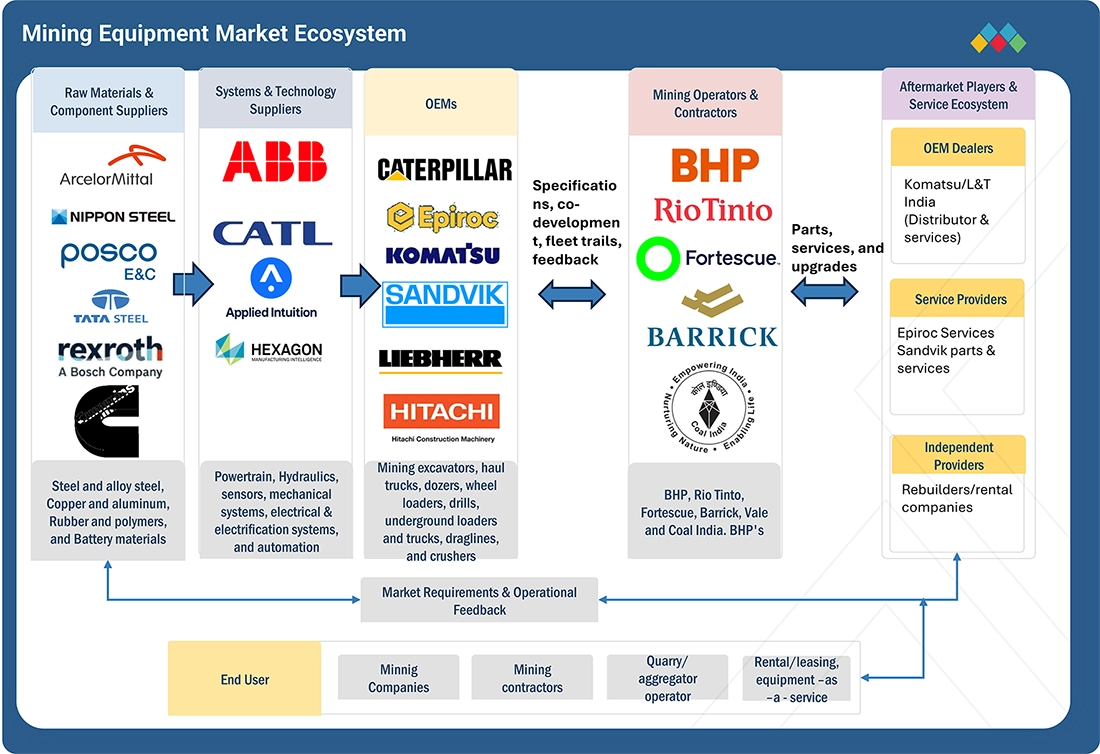
The mining equipment market ecosystem comprises raw material and component suppliers, systems and technology providers, mining equipment OEMs, mining operators and contractors, and aftermarket distributors and service providers. Key players such as Caterpillar, Komatsu, Sandvik, Epiroc, Liebherr, and Hitachi Construction Machinery offer equipment and technology solutions spanning excavators, haul trucks, dozers, wheel loaders, drilling and crushing equipment, and underground mining machinery, supported by automation, electrification, fleet management, hydraulics, powertrain, and digital monitoring technologies. Raw material and component suppliers provide steel, alloys, powertrain components, hydraulic systems, batteries, sensors, and electrical systems, while technology providers enable autonomous operation, remote control, machine connectivity, and predictive maintenance. Mining operators, contractors, quarry and aggregate companies, and equipment-rental businesses drive demand based on mine development, production targets, operating conditions, and total cost of ownership. OEM dealers, service providers, and independent aftermarket companies support equipment maintenance, spare parts, rebuilds, rentals, and upgrades throughout the equipment lifecycle. Continuous feedback on operational requirements, equipment performance, maintenance needs, and emerging technologies connects the ecosystem, encouraging OEMs and suppliers to improve productivity, safety, equipment availability, energy efficiency, and lifecycle cost performance across surface and underground mining operations.

mining-equipment-market Ecosystem

Logos and trademarks shown above are the property of their respective owners. Their use here is for informational and illustrative purposes only.

MARKET SEGMENTS

mining-equipment-market Segments

Source: Secondary Research, Interviews with Experts, MarketsandMarkets Analysis

BY MACHINERY CATEGORY

Surface mining equipment demand is driven by large-scale extraction of coal, iron ore, copper, and gold, requiring high-capacity trucks, excavators, loaders, dozers, and drilling equipment, while expanding mining operations and investments in autonomous haulage, electrification, and fleet optimization further boost demand by improving productivity and equipment utilization.

BY APPLICATION

Mineral mining equipment demand is driven by the extraction of iron ore, copper, gold, bauxite, lithium, and other minerals, requiring excavators, haul trucks, drilling equipment, loaders, and material-handling systems, while deeper deposits, lower-grade ores, and growing demand for critical minerals are accelerating investment in high-capacity, advanced, and productivity-focused machinery.

BY POWER OUTPUT

Mining equipment with a power output of up to 500 HP is used across small and medium-sized mines, underground operations, and auxiliary activities, including ore handling, site preparation, and maintenance, with demand supported by lower acquisition costs, greater maneuverability, and flexibility in confined spaces.

BY PROPULSION

Diesel-powered mining equipment remains dominant due to its high power output, operational flexibility, established refueling infrastructure, and suitability for demanding conditions, supporting widespread use in haul trucks, excavators, dozers, loaders, and drilling equipment. Despite growing adoption of electric and hybrid alternatives, diesel equipment remains essential for high-capacity operations and remote mine sites with limited electrical infrastructure.

AUTONOMOUS MINING EQUIPMENT MARKET, BY MINING CATEGORY

Surface mining leads autonomous equipment adoption due to large-scale operations, repetitive haulage cycles, and opportunities to coordinate extensive fleets, with autonomous haul trucks, automated drilling systems, and fleet-management platforms improving productivity, equipment utilization, and safety. Growing investment in digital mine planning and automation across large iron ore, copper, and coal mines further supports adoption by reducing personnel exposure to hazardous areas and optimizing material movement.

ELECTRIC MINING EQUIPMENT MARKET, BY BATTERY CHEMISTRY

Lithium iron phosphate (LFP) batteries are gaining traction in electric mining equipment due to their thermal stability, long cycle life, and reduced reliance on nickel and cobalt, making them suitable for demanding operating conditions and frequent charging. Their adoption in battery-electric underground loaders and other mining machinery is supported by safety and lifecycle-cost advantages, although battery selection depends on energy density, power requirements, duty cycles, and total cost of ownership.

ELECTRIC & HYBRID MINING EQUIPMENT MARKET, BY TYPE

Electric load-haul-dump (LHD) equipment is gaining adoption as underground mining operators seek to reduce diesel emissions, ventilation costs, and heat in confined mine environments. Advances in battery technology and charging infrastructure are supporting electric LHD deployment, improving energy efficiency and working conditions while helping mining companies transition toward lower-emission underground operations.

REGION

Asia Pacific is expected to be the largest region in the global mining equipment market during the forecast period

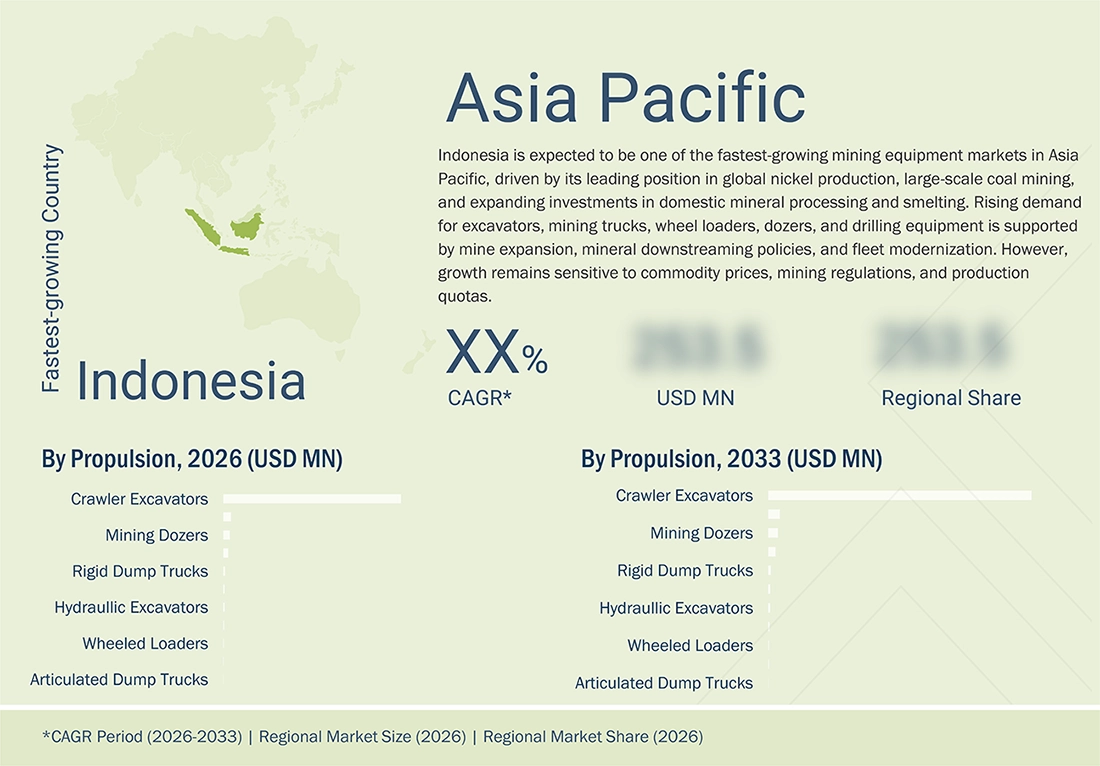
Indonesia is expected to be one of the fastest-growing mining equipment markets in Asia Pacific, driven by its leading position in global nickel production, large-scale coal mining, and expanding investments in domestic mineral processing and smelting. Also, Australia is a prominent mining equipment market, supported by large-scale iron ore, coal, gold, and lithium operations, alongside investments in critical minerals and mine modernization. Its extensive operating mine base and adoption of autonomous haulage, advanced fleet management, and electrification support demand for high-capacity mining trucks, excavators, loaders, drilling systems, and replacement equipment. Although commodity-price fluctuations and project investment cycles can affect procurement, Australia offers opportunities for OEMs focused on advanced machinery, automation, and lifecycle services.

mining-equipment-market Region

MINING EQUIPMENT MARKET: COMPANY EVALUATION MATRIX

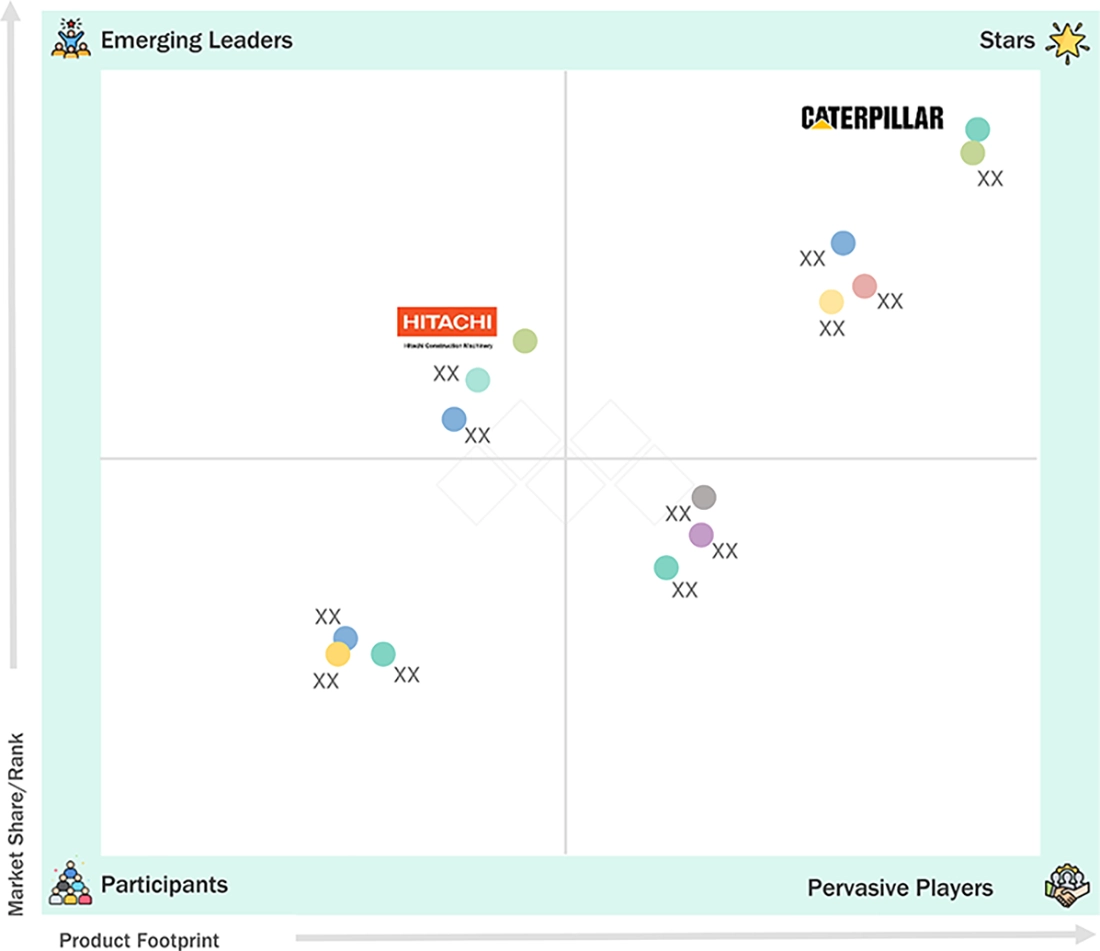
In the mining equipment market matrix, Caterpillar (US) (Star Player) leads with a strong global presence, a comprehensive portfolio of surface and underground mining equipment, and extensive dealer and aftermarket support across major mining regions. Hitachi Construction Machinery (Japan) (Emerging Player) is strengthening its position through its portfolio of hydraulic excavators, mining trucks, and autonomous haulage solutions, supported by fleet-management technologies and ongoing development of digitally integrated, high-productivity mining equipment.

mining-equipment-market Evaluation Metrics

Source: Secondary Research, Interviews with Experts, MarketsandMarkets Analysis

MARKET SCOPE

REPORT METRIC DETAILS
Market Size Value in 2026 28.42 BN
Market Size Forecast in 2033 42.81 BN
Growth Rate CAGR of 6.0% from 2026 to 2033
Actual data 2022-2033
Base year 2025
Forecast period 2026-2033
Units considered Value (USD Million), Volume (Units)
Report Coverage Revenue forecast, company ranking, competitive landscape, growth factors, and trends
Segments Covered • By Mining Category - (Surface Mining Machinery; Underground Mining Machinery; Crushing, Pulverizing, & Screening; Mineral Processing) • By Propulsion – (Diesel, CENG/RNG/LNG) • By Power Output (<500 HP, 500 - 2000 HP, and > 2000 HP) • By Application (Coal, Mineral, Metal) • Autonomous Mining Machinery Market, By Mining Category (Surface, Underground) • Electric Mining Equipment Market, By Battery Chemistry - (Lithium Iron Phosphate, Lithium Nickel Manganese Cobalt, Others) • Electric & Hybrid Mining Machinery Market, By Type (Electric & Hybrid Mining Trucks, Electric & Hybrid Load-Haul Dump (LDH) Loaders)
Regional Scope Asia Oceania, Europe, North America, South America, and Middle East & Africa

WHAT IS IN IT FOR YOU: MINING EQUIPMENT MARKET REPORT CONTENT GUIDE

mining-equipment-market Content Guide

DELIVERED CUSTOMIZATIONS

We have successfully delivered the following deep-dive customizations:

CLIENT REQUEST CUSTOMIZATION DELIVERED VALUE ADDS
Country- and region-wise mining equipment market outlook Developed country- and regional-level market sizing and forecasts, covering mining equipment demand by equipment type, application, propulsion system, power output, and electrification. Enabled the client to identify high-growth mining markets and prioritize regional expansion, capacity development, and investment opportunities.
Competitive benchmarking of leading mining equipment manufacturers Analyzed equipment requirements across surface mining, underground mining, mineral extraction, coal mining, and metal mining applications. Helped identify equipment categories and mining applications with increasing demand for higher-capacity, more productive, and technologically advanced machinery.
Identification of future mining operator and OEM sourcing opportunities Created a competitive benchmarking matrix covering Caterpillar, Komatsu, Sandvik, Epiroc, Liebherr, Hitachi Construction Machinery, Volvo CE, SANY, XCMG, and other key manufacturers based on product portfolio, technological capabilities, electrification, automation, and geographic presence. Provided a clear view of competitor positioning, product portfolio strengths, technology differentiation, and regional capabilities to identify competitive gaps.
Assessment of advanced mining equipment technologies and electrification opportunities Assessed mining operator requirements and equipment sourcing opportunities based on mine development, fleet replacement, production targets, operating conditions, fuel efficiency, equipment availability, and maintenance costs. Enabled the client to identify potential mining operator customers, equipment procurement opportunities, fleet replacement demand, and areas for portfolio expansion.
Evaluation of automation, autonomous haulage, and digital mining solutions Evaluated diesel, hybrid, battery-electric, and trolley-assist propulsion technologies, alongside autonomous haulage, remote operation, AI-enabled equipment, telematics, and predictive maintenance. Evaluated diesel, hybrid, battery-electric, and trolley-assist solutions to assess opportunities for reducing fuel consumption, operating costs, and emissions.
Assessment of mining companies’ requirements for productivity, safety, operational efficiency, and total cost of ownership (TCO) Assessed equipment-level opportunities across excavators, mining trucks, dozers, loaders, drilling equipment, crushing and screening machinery, and mineral processing equipment. Helped prioritize investments in autonomous haulage, remote-controlled machinery, AI-enabled operations, connected equipment, and predictive maintenance to improve productivity, safety, and equipment uptime.

RECENT DEVELOPMENTS

  • September 2026 : Sandvik AB introduced its autonomous electric concept drill, a cabinless battery-electric surface drilling concept integrating AI, robotics, autonomous navigation, automated tool handling, and digital-twin connectivity for safer and more productive surface mining.
  • August 2026 : Epiroc completed the acquisition of Eventspec Proprietary Limited, a Johannesburg-based mining aftermarket specialist that manufactures parts and components for drill rigs and other mining equipment. This acquisition enhances Epiroc’s aftermarket services and local manufacturing capabilities in Africa.
  • June 2026 : Epiroc and Ericsson expanded their alliance to accelerate the adoption of private 5G and digitalization in mining. The partnership focuses on deploying 5G connectivity for autonomous and remote-controlled mining equipment, enhancing automation, real-time data access, and operational safety.
  • April 2026 : Komatsu launched the PC9000-12 (Hydraulic Mining Excavator) globally, which has 46–49 m³ buckets, front-shovel and backhoe configurations, and diesel or electric-drive options for large-scale surface mining.
  • March 2026 : Caterpillar unveiled the next-generation 6040 hydraulic mining shovel, a large loading tool for surface mines. The new 6040 features design and technology improvements that enhance productivity, fuel efficiency, and safety, reinforcing Caterpillar’s position in ultra-class mining shovels.


Table of Contents

checkmarkExclusive indicates content/data unique to MarketsandMarkets and not available with any competitors.

TITLE
PAGE NO
1
INTRODUCTION


15
2
EXECUTIVE SUMMARY


3
PREMIUM INSIGHTS


4
MARKET OVERVIEW
Highlights the market structure, growth drivers, restraints, and near-term inflection points influencing performance.


4.1
INTRODUCTION


4.2
MARKET DYNAMICS


4.2.1
DRIVERS


4.2.2
RESTRAINTS


4.2.3
OPPORTUNITIES


4.2.4
CHALLENGES


4.3
UNMET NEEDS AND WHITE SPACES


4.4
INTERCONNECTED MARKETS AND CROSS-SECTOR OPPORTUNITIES


4.5
STRATEGIC MOVES BY TIER-1/2/3 PLAYERS


5
INDUSTRY TRENDS
Covers the key developments, trend analysis, and actionable insights to support strategic planning and positioning.


5.1
MACROECONOMIC OUTLOOK


5.1.1
INTRODUCTION


5.1.2
GDP TRENDS AND FORECAST


5.1.3
TRENDS IN GLOBAL MINING EQUIPMENT MARKET


5.2
SUPPLY CHAIN ANALYSIS


5.3
ECOSYSTEM ANALYSIS


5.4
PRICING ANALYSIS


5.4.1
AVERAGE SELLING PRICE OF MINING EQUIPMENT, BY REGION, 2022 –


5.4.2
AVERAGE SELLING PRICE OF MINING EQUIPMENT, BY BATTERY CHEMISTRY,


5.4.3
AVERAGE SELLING PRICE OF SURFACE MINING EQUIPMENT, BY EQUIPMENT TYPE,


5.5
TRADE ANALYSIS


5.5.1
IMPORT SCENARIO, (HS CODE 84314990), 2020-2025


5.5.2
EXPORT SCENARIO, (HS CODE 84314990), 2020-2025


5.6
KEY CONFERENCES AND EVENTS, 2026–2028


5.7
TRENDS/DISRUPTIONS IMPACTING CUSTOMER BUSINESS


5.8
INVESTMENT SCENARIO


5.9
FUNDING BY USE CASE APPLICATION


5.10
MINING EQUIPMENT DEMAND & MINE DEVELOPMENT LANDSCAPE


5.10.1
GREENFIELD VS. BROWNFIELD PROJECTS (KEY PROJECTS BY REGION)


5.10.2
MINING EXPANSION (KEY PROJECTS BY REGION)


5.10.3
REPLACEMENT CYCLES


5.10.4
COMMODITY-WISE EQUIPMENT DEMAND


5.10.5
FLEET AGE AND UTILIZATION


5.11
CASE STUDY ANALYSIS


5.12
OEM ANALYSIS


5.12.1
OEM’S EV PRODUCT PORTFOLIO BENCHMARKING


5.12.2
BATTERY CAPACITY VS PAYLOAD CAPACITY


5.13
TOTAL COST OF OWNERSHIP FOR LONG-HAUL TRUCKS: DIESEL VS. ELECTRIC


5.14
MINE AUTOMATION, ELECTRIFICATION & DIGITAL ECOSYSTEM


6
TECHNOLOGICAL ADVANCEMENTS, AI-DRIVEN IMPACT, PATENTS, INNOVATIONS, AND FUTURE STRATEGIC APPLICATIONS


6.1
TECHNOLOGY ANALYSIS


6.1.1
KEY TECHNOLOGIES


6.1.1.1
AUTONOMOUS EQUIPMENT & HAULAGE


6.1.1.2
BATTERY ELECTRIC & ELECTRIFIED POWERTRAIN


6.1.1.3
ADVANCED DRILLING TECHNOLOGY


6.1.1.4
ELECTRIC DRIVE & TROLLEY SYSTEMS


6.1.1.5
REMOTE & TELE REMOTE EQUIPMENT OPERATIONS


6.1.2
COMPLEMENTARY TECHNOLOGY


6.1.2.1
FLEET MANAGEMENT & MINE OPTIMIZATION


6.1.2.2
PREDICTIVE MAINTENANCE & EQUIPMENT HEALTH


6.1.2.3
MINE PLANNING & 3D GEOLOGICAL MODELING


6.1.2.4
CHARGING & ELECTRIC INFRASTRUCTURE


6.1.2.5
MATERIAL TRACKING & PAYLOAD MANAGEMENT


6.1.3
ADJACENT TECHNOLOGY


6.1.3.1
FLEET MANAGEMENT & MINE


6.1.3.2
PREDICTIVE MAINTENANCE & EQUIPMENT HEALTH


6.1.3.3
MINE PLANNING & 3D GEOLOGICAL MODELING


6.1.3.4
CHARGING & ELECTRICAL INFRASTRUCTURE


6.1.3.5
MATERIAL TRACKING & PAYLOAD MANAGEMENT
 
 
6.2
TECHNOLOGY/PRODUCT ROADMAP


6.2.1
EQUIPMENT TECHNOLOGY TRANSFORMATION


6.3
PATENT ANALYSIS


6.4
SUCCESS STORIES AND REAL-WORLD APPLICATIONS


6.5
IMPACT OF AI/GEN ON ELECTRIC MINING EQUIPMENT MARKET


6.5.1
TOP USE CASE OF AI IMPLEMENTATION AND MARKET POTENTIAL


6.5.2
BEST PRACTICE IN MINING EQUIPMENT DEVELOPMENT


6.5.3
MINING EQUIPMENT MARKET: CASE STUDIES RELATED TO IMPLEMENTATION OF GEN AI


6.5.4
INTERCONNECTED ADJACENT MARKET ECOSYSTEM AND IMPACT ON MARKET PLAYERS


6.5.5
CLIENTS’ READINESS TO ADOPT GENERATIVE AI IN MINING EQUIPMENT MARKET
 
 
7
REGULATORY LANDSCAPE


7.1
NORTH AMERICA


7.2
ASIA PACIFIC


7.3
EUROPE


7.4
REGIONAL REGULATIONS AND COMPLIANCE


7.4.1
REGULATORY BODIES, GOVERNMENT AGENCIES, AND OTHER ORGANIZATIONS


7.4.1.1
NORTH AMERICA


7.4.1.2
EUROPE


7.4.1.3
ASIA PACIFIC
 
8
CUSTOMER LANDSCAPE & BUYER BEHAVIOR


8.1
DECISION-MAKING PROCESS


8.2
BUYER STAKEHOLDERS AND BUYING EVALUATION CRITERIA


8.3
ADOPTION BARRIERS & INTERNAL CHALLENGES


8.4
UNMET NEEDS FROM VARIOUS END-USE INDUSTRIES


8.5
MARKET PROFITABILITY


9
MINING EQUIPMENT MARKET, BY EQUIPMENT CATEGORY
Market Size, Volume & Forecast – USD Million


(MARKET SIZE & FORECAST TO 2035 – IN VALUE, USD MILLION)


9.1
INTRODUCTION


9.2
SURFACE MINING


9.2.1
CRAWLER EXCAVATORS


9.2.2
CRAWLER DOZERS


9.2.3
MOTOR GRADERS


9.2.4
RIGID DUMP TRUCKS


9.2.5
ARTICULATED DUMP TRUCKS


9.3
UNDERGROUND MINING


9.3.1
ELECTRIC SHOVELS


9.3.2
HYDRAULIC EXCAVATORS


9.3.3
WHEEL LOADERS


9.3.4
MINING DOZERS


9.3.5
MINING TRUCKS


9.3.6
DRILLS


9.4
CRUSHING, PULVERIZING, SCREENING


9.5
MINERAL PROCESSING


9.6
KEY PRIMARY INSIGHTS


10
MINING EQUIPMENT MARKET, BY APPLICATION
Market Size, Volume & Forecast – USD Million


(MARKET SIZE & FORECAST TO 2035 – IN VALUE, USD MILLION)


10.1
INTRODUCTION


10.2
MINERAL


10.3
COAL


10.4
METAL


10.5
KEY PRIMARY INSIGHTS


11
MINING EQUIPMENT MARKET, BY POWER OUTPUT
Market Size, Volume & Forecast – USD Million


(MARKET SIZE & FORECAST TO 2035 – IN VALUE, USD MILLION; IN VOLUME, UNITS)


11.1
INTRODUCTION


11.2
UP TO 500 HP


11.3
501 – 2,000 HP


11.4
> 2,000 HP


11.5
KEY PRIMARY INSIGHTS


12
MINING EQUIPMENT MARKET, BY PROPULSION
Market Size, Volume & Forecast – USD Million


(MARKET SIZE & FORECAST TO 2035 – IN VALUE, USD MILLION; IN VOLUME, UNITS)


12.1
INTRODUCTION


12.2
DIESEL


12.3
CNG/RNG/LNG


12.4
KEY PRIMARY INSIGHTS


13
AUTONOMOUS MINING EQUIPMENT MARKET, BY MINING CATEGORY
Market Size, Volume & Forecast – USD Million


(MARKET SIZE & FORECAST TO 2035 – IN VOLUME, USD MILLION; IN VOLUME, UNITS)


13.1
INTRODUCTION


13.2
SURFACE MINING


13.3
UNDERGROUND MINING


13.4
KEY PRIMARY INSIGHTS


14
ELECTRIC MINING EQUIPMENT MARKET, BY BATTERY CHEMISTRY
Market Size, Volume & Forecast – USD Million


(MARKET SIZE & FORECAST TO 2035 – IN VALUE, USD MILLION; IN VOLUME, UNITS)


14.1
INTRODUCTION


14.2
LITHIUM IRON PHOSPHATE (LFP)


14.3
LITHIUM NICKEL MANGANESE COBALT (MNC)


14.4
OTHERS


14.5
KEY PRIMARY INSIGHTS


15
ELECTRIC & HYBRID MINING EQUIPMENT MARKET, BY TYPE
Market Size, Volume & Forecast – USD Million


(MARKET SIZE & FORECAST TO 2035 – IN VALUE, USD MILLION; IN VOLUME, UNITS)


15.1
INTRODUCTION


15.2
ELECTRIC & HYBRID MINING TRUCKS


15.3
ELECTRIC & HYBRID LOAD-HAUL DUMP (LHD) LOADERS


15.4
KEY PRIMARY INSIGHTS


16
MINING EQUIPMENT MARKET, BY REGION
Market Size, Volume & Forecast – USD Million


(MARKET SIZE & FORECAST TO 2035 – IN VALUE, USD MILLION; IN VOLUME, UNITS, AT GLOBAL LEVEL)


16.1
INTRODUCTION


16.2
ASIA PACIFIC


16.2.1
CHINA


16.2.2
JAPAN


16.2.3
INDIA


16.2.4
AUSTRALIA


16.2.5
INDONESIA


16.2.6
REST OF ASIA PACIFIC


16.3
EUROPE


16.3.1
FRANCE


16.3.2
GERMANY


16.3.3
UK


16.3.4
ITALY


16.3.5
SPAIN


16.3.6
RUSSIA


16.4
NORTH AMERICA


16.4.1
US


16.4.2
CANADA


16.4.3
MEXICO


16.5
SOUTH AMERICA


16.5.1
BRAZIL


16.5.2
PERU


16.5.3
CHILE


16.5.4
ARGENTINA


16.6
MIDDLE EAST & AFRICA


16.6.1
SOUTH AFRICA


16.6.2
SAUDI ARABIA


16.6.3
REST OF MIDDLE EAST & AFRICA
 
 
17
COMPETITIVE LANDSCAPE


STRATEGIC ASSESSMENT OF LEADING PLAYERS, MARKET RANKING/SHARE, REVENUE ANALYSIS, COMPANY POSITIONING, AND COMPETITIVE BENCHMARKS INFLUENCING MARKET POTENTIAL


17.1
INTRODUCTION


17.2
KEY PLAYER STRATEGIES/RIGHT TO WIN


17.3
REVENUE ANALYSIS, (2022-2025)


17.4
GLOBAL MARKET SHARE ANALYSIS FOR MINING EQUIPMENT MANUFACTURERS,


17.5
COMPANY VALUATION AND FINANCIAL MATRIX


17.6
BRAND COMPARISON


17.6.1
STRATEGIC COMPETITIVE BENCHMARKING


17.7
COMPANY EVALUATION MATRIX: AUTOMOTIVE SUSPENSION MANUFACTURERS,


17.7.1
STARS


17.7.2
EMERGING LEADERS


17.7.3
PERVASIVE PLAYERS


17.7.4
PARTICIPANTS


17.7.5
COMPANY FOOTPRINT: KEY PLAYERS,


17.7.5.1
COMPANY FOOTPRINT


17.7.5.2
REGION FOOTPRINT


17.7.5.3
BY EQUIPMENT CATEGORY FOOTPRINT


17.7.5.4
BY BATTERY CHEMISTRY FOOTPRINT
 
 
17.8
COMPETITIVE SCENARIO


17.8.1
PRODUCT LAUNCHES


17.8.2
DEALS


17.8.3
EXPANSIONS
 
 
18
COMPANY PROFILES


18.1
KEY PLAYERS


18.2
MINING EQUIPMENT MANUFACTURERS


18.2.1.1
CATERPILLAR INC


18.2.1.2
KOMATSU LTD


18.2.1.3
SANDVIK AB


18.2.1.4
EPIROC AB


18.2.1.5
LIBHERR


18.2.1.6
HITACHI CONSTRUCTION EQUIPMENT CO., LTD.


18.2.1.7
DOOSAN ENERBILITY


18.2.1.8
AB VOLVO


18.2.1.9
SANY GROUP


18.2.1.10
JCB
 
 
18.3
ADDITIONAL PLAYERS


18.3.1.1
LIUGONG EQUIPMENT CO., LTD.


18.3.1.2
KOBELCO CONSTRUCTION EQUIPMENT CO., LTD.


18.3.1.3
SUMITOMO HEAVY INDUSTRIES, LTD.


18.3.1.4
XUZHOU CONSTRUCTION EQUIPMENT GROUP


18.3.1.5
HYUNDAI CONSTRUCTION EQUIPMENT CO., LTD.


18.3.1.6
TEREX CORPORATION


18.3.1.7
BHARAT EARTH MOVERS LIMITED (BEML)


18.3.1.8
ASTEC INDUSTRIES, INC.


18.3.1.9
WIRTGEN GROUP


18.3.1.10
MINE MASTER LTD


18.3.1.11
FIORI GROUP S.P.A


18.3.1.12
JSC "KOPEYSK MACHINE-BUILDING PLANT"


18.3.1.13
BELL EQUIPMENT


18.3.1.14
AARD MINING EQUIPMENT


18.3.1.15
WACKER NEUSON SE


18.3.1.16
BELAZ
 
19
RESEARCH METHODOLOGY


19.1
RESEARCH DATA


19.1.1
SECONDARY DATA


19.1.1.1
KEY DATA FROM SECONDARY SOURCES


19.1.2
PRIMARY DATA


19.1.2.1
KEY DATA FROM PRIMARY SOURCES


19.1.2.2
KEY PRIMARY PARTICIPANTS


19.1.2.3
BREAKDOWN OF PRIMARY INTERVIEWS


19.1.2.4
KEY INDUSTRY INSIGHTS
 
 
19.2
MARKET SIZE ESTIMATION


19.2.1.1
BOTTOM-UP APPROACH


19.2.1.2
TOP-DOWN APPROACH


19.2.1.3
BASE NUMBER CALCULATION
 
 
19.3
MARKET FORECAST APPROACH


19.3.1
SUPPLY SIDE


19.3.2
DEMAND SIDE


19.4
DATA TRIANGULATION


19.5
FACTOR ANALYSIS


19.6
RESEARCH ASSUMPTIONS


19.7
RESEARCH LIMITATIONS AND RISK ASSESSMENT



20
APPENDIX


Methodology

The research study involved extensive use of secondary sources such as company annual reports/presentations, industry association publications, magazines, directories, technical handbooks, World Economic Outlook, trade websites, technical articles, and databases to identify and collect information on the mining equipment market. In-depth interviews were conducted with various primary-source experts from related industry players such as mining equipment OEMs, technology providers, and Tier-1 suppliers to obtain and verify critical information and assess the growth prospects and market estimations.

Secondary Research

In the secondary research process, various sources were used to identify and collect information on the global mining equipment market. These included mining industry organizations and associations, mineral production and trade statistics, mining company publications, equipment manufacturers and suppliers, and technical mining publications. Key sources included the International Council on Mining and Metals (ICMM), World Mining Data, national mining authorities, the US Geological Survey (USGS), and the Indian Bureau of Mines (IBM), along with OEMs such as Caterpillar, Komatsu, Sandvik, Epiroc, Liebherr, and Hitachi Construction Machinery. Additional information was collected from company annual reports, investor presentations, project announcements, equipment orders, and mine-development updates, among others. These sources were used to assess mining activity, equipment demand, production capacities, technological developments, regional trends, and competitive strategies. The collected data were analyzed to estimate overall market size and segment-level distribution, and the findings were further validated through primary research.

Primary Research

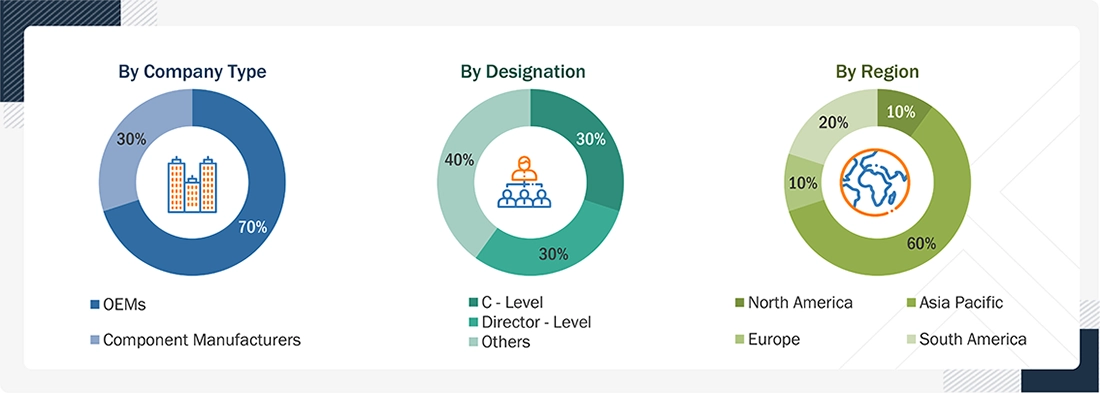
Extensive primary research was conducted after obtaining an understanding of the mining equipment market through secondary research. Several interviews were conducted with market experts from both the demand (mining companies, mining operators and contractors, fleet operators, mine developers and project owners, and others) and supply (mining equipment OEMs, Tier-1 component suppliers, technology providers, and others) players across five major regions-namely, North America, Europe, Asia Pacific, South America, and the Middle East & Africa. Approximately 70% of primary interviews have been conducted with OEMs and 30% with Tier-1 players and others on the demand and supply sides. Primary data has been collected through questionnaires, e-mails, and telephonic interviews. In the canvassing of primary data, various departments within organizations, including sales, operations, and administration, were covered to provide a holistic viewpoint in the report.

After interacting with industry participants, the brief sessions were conducted with highly experienced independent consultants to reinforce the findings from the primaries. This, along with the opinions of in-house subject matter experts, led to the findings as described in the remainder of this report.

Mining Equipment Market Size, and Share

To know about the assumptions considered for the study, download the pdf brochure

Market Size Estimation

A detailed market estimation approach was followed to estimate and validate the size of the mining equipment market and other dependent submarkets, as mentioned below:

Bottom-up Approach

  • The bottom-up approach was used to estimate and validate the mining machinery market size. Historical unit sales of crawler excavators, crawler dozers, motor graders, rigid dump trucks, articulated dump trucks, electric shovels, hydraulic excavators, wheel loaders, mining dozers, mining trucks, and drills were tracked at the country level using OEM annual reports, manufacturer shipment disclosures, industry paid databases, dealer records, procurement contracts, government data, and mining project announcements. Where direct sales data was unavailable, estimates were developed using active equipment populations, historical shipment trends, manufacturer delivery announcements, and mine-level fleet information.
  • Country-level unit sales were forecast through 2033, based on historical demand patterns, equipment replacement cycles, fleet expansion requirements, planned mine openings and expansions, mineral production outlooks, mining capital expenditure, and changes in material movement requirements. Forecasting assumptions accounted for equipment lifespan, utilization rates, mine capacity, project commissioning timelines, commodity demand, regional mining activity, and the adoption of electric and autonomous equipment. Replacement demand was assessed separately from incremental fleet additions to avoid double counting.
  • Average selling prices (ASPs) were estimated for each equipment category, country, and relevant capacity class using OEM quotations, dealer inputs, public tender awards, procurement contracts, and available trade data. These prices were validated through primary interviews, considering differences in operating weight, payload capacity, power rating, machine configuration, propulsion technology, and regional pricing.
  • Forecast ASPs incorporated assumptions regarding equipment price inflation, raw-material and component costs, exchange-rate movements, localization, import duties, technology upgrades, electrification, automation, and changes in equipment size and product mix.
  • At the end, the country-level equipment unit sales were multiplied by the corresponding ASPs to calculate country-level market values for each equipment category. The resulting volumes and values were aggregated across countries and regions to derive the global mining equipment market size and forecast through 2033.

Top Down Approach

The mining equipment market volume (units), by region, was derived from regional mining equipment demand and machinery deployment across coal, metal, and mineral mining applications. The penetration of coal, metal, and mineral mining applications at the regional level was estimated using secondary sources and validated through primary interviews with industry experts. The forecast of regional application-wise penetration was based on coal, metal, and mineral production outlooks, expected coal and mineral extraction trends, planned mining investments, surface and underground mining activities, among others. The application-wise penetration rates were multiplied by regional mining equipment volume to derive the market volume (units) for coal, metal, and mineral mining. The average selling price (ASP) of mining equipment (USD) was derived from secondary sources and validated through primary interviews, considering variations in equipment type, operating capacity, power output, propulsion technology, and application. The volume of mining equipment by application was multiplied by the corresponding ASP and converted into USD million to derive market value. Finally, regional estimates were aggregated to determine the global mining equipment market by application (coal and mineral mining), in terms of value (USD million) and volume (units).

Mining Equipment Market: Top-Down and Bottom-Up Approach

Mining Equipment Market Top Down and Bottom Up Approach

Data Triangulation

After arriving at the overall market size of the global market through the above-mentioned methodology, this market was split into several segments and subsegments. The data triangulation and market breakdown procedures were employed, wherever applicable, to complete the overall market engineering process and arrive at the exact data for the market by value for the key segments and subsegments. The extrapolated market data was triangulated by studying various macro indicators and regional trends from both the demand and supply participants.

Market Definition

  • Mining Machinery: Mining machinery is used for the extraction of raw materials in open-cast mining environments. It refers to the specialized equipment and machinery used in various stages of the mining process, including exploration, extraction, processing, and transportation of minerals and ore deposits. It can range from large-scale mining trucks, excavators, and drilling machines for open-pit operations to underground mining machinery.
  • Surface Mining Machinery: Surface mining machinery refers to a broad range of tools used mostly in open-pit or open-cast mines to remove minerals and ores from the surface of the ground. When the mineral ore reserves are close to the surface and can be economically mined utilizing sizable machinery, this mining machinery is employed.
  • Underground Mining Machinery: Underground mining machinery is made specifically to operate in the constrained and difficult conditions of underground mines, where access and space are limited. Deep within the Earth, these machines are essential for drilling, transporting, and processing metals and minerals. They are designed to resist challenging underground environments, which include little light, excessive humidity, and small areas.

Key Stakeholders

  • Mining Companies
  • Mining Machinery/Equipment Manufacturers
  • Tier 1 & Component Suppliers
  • Mining Operators and Contractors
  • Mine Developers and Project Owners
  • Fleet Owners and Fleet Operators
  • Technology Providers
  • Government and State-Owned Mining Enterprises
  • Consulting companies in the Heavy Machinery Sector
  • Heavy Equipment Associations
  • Rental Machinery Suppliers
  • Government and Research Organizations
  • Regulatory Authorities

Report Objectives

  • To analyze and forecast the market size for mining machinery from 2022 to 2033 in terms of volume (units) and value (USD million/billion)
  • To define and describe the mining equipment market by:
    • By machinery category [crushing, pulverizing, and screening machinery; mineral processing; surface mining (crawler excavators, crawler dozers, motor graders, rigid dump trucks, and articulated dump trucks); and underground mining (electric shovels, hydraulic excavators, wheel loaders, mining dozers, mining trucks, and drills)]
    • By propulsion [diesel and compressed natural gas (CNG)/liquified natural gas (LNG)/renewable natural gas (RNG)]
    • By application (mineral, metal, and coal)
    • By power output (<500 HP, 500-2,000 HP, and >2,000 HP)
    • Autonomous mining machinery by mining category (surface mining and underground mining)
    • Electric & hybrid mining machinery by type [mining trucks and load-haul-dump (LHD) loaders]
    • Electric & mining machinery by battery chemistry [lithium iron phosphate (LFP), lithium nickel manganese cobalt (NMC), and others (lithium titanate oxide (LTO), lithium manganese oxide (LMO), and solid-state battery)
    • By region (Asia Pacific, Europe, North America, South America, and the Middle East & Africa)
  • To provide detailed information regarding market dynamics, including drivers, restraints, opportunities, and challenges, which influence the growth of the market
  • To provide:
    • Trends/disruptions impacting buyers
    • Case studies
    • Patent analysis
    • Supply chain analysis
    • Market ecosystem
    • Regulatory analysis
    • OEM analysis
    • Brand comparison
    • Company valuation
    • Investment & funding scenario
    • Technology trends
    • Unmet needs and white spaces
    • Interconnected market and cross-sector opportunities
    • Pricing analysis
    • Future technology roadmap
  • To understand the dynamics (drivers, restraints, opportunities, and challenges) of the market
  • To understand the competitive evaluation matrix for key players in the mining equipment market and position the players as stars, emerging, pervasive, and participants according to their product portfolio and business strategies
  • To analyze the market share of leading players in the mining equipment market and evaluate the company evaluation matrix
  • To strategically analyze the key players' strategies/right to win and company revenue
  • To analyze the opportunities in the market for stakeholders and provide details of the competitive landscape for market leaders
  • To provide an analysis of recent developments, collaborations, partnerships, product launches & enhancements, and other activities carried out by key industry participants in the mining equipment market

Available customizations:

With the given market data, MarketsandMarkets offers customizations in accordance with the company’s specific needs.

  •  Autonomous Mining Machinery Market, By Level of Automation
    • Semi-Autonomous
    • Fully Autonomous
  • Mining Machinery Market, By Country & Machinery Category
    • Crushing, Pulverizing, Screening Machinery
    • Mineral Processing Machinery


Personalize This Research

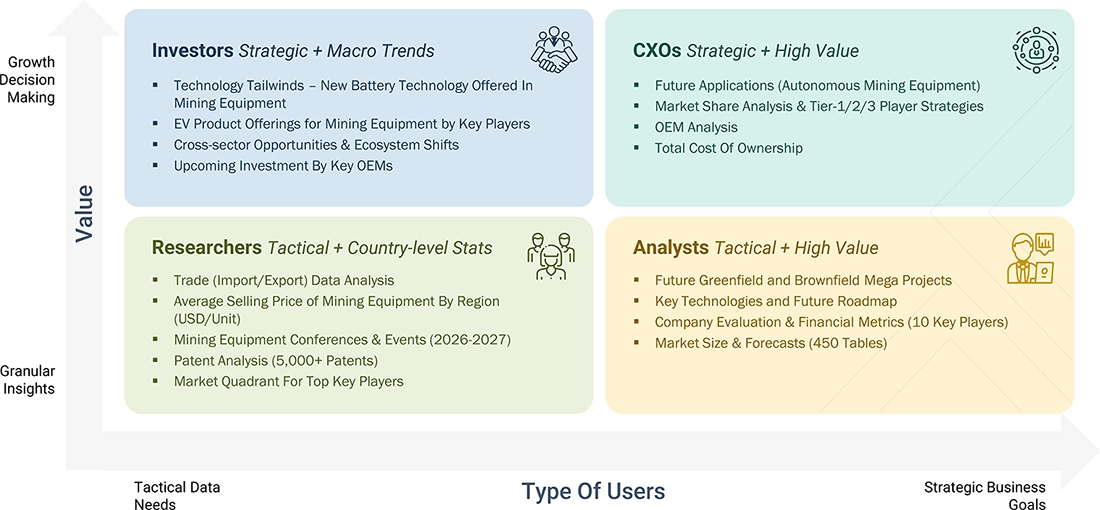
  • Triangulate with your Own Data
  • Get Data as per your Format and Definition
  • Gain a Deeper Dive on a Specific Application, Geography, Customer or Competitor
  • Any level of Personalization
Request A Free Customisation

Let Us Help You

  • What are the Known and Unknown Adjacencies Impacting the Mining Equipment Market
  • What will your New Revenue Sources be?
  • Who will be your Top Customer; what will make them switch?
  • Defend your Market Share or Win Competitors
  • Get a Scorecard for Target Partners
Customized Workshop Request

Custom Market Research Services

We Will Customise The Research For You, In Case The Report Listed Above Does Not Meet With Your Requirements

Get 10% Free Customisation

TESTIMONIALS

Growth opportunities and latent adjacency in Mining Equipment Market

avtar

Apoorv

Jul, 2019

I would like to know the market share of each of the mining equipment manufacturers and what strategies they adopted to maintain their market share.

avtar

Apoorv

Jul, 2019

I was wondering if I could get a breakout of the construction equipment market by industry - specifically I am looking for the dollar value of the equipment used in infrastructure. This is for InsideUnmannedSystems magazine. .

avtar

Swati

Jun, 2019

I want to understand the market for surface and underground mining equipment, annual purchases worldwide..

avtar

Swati

Jun, 2019

In our bussiness we dissasembly mining equipmemt We have now one scoop ST1020 One Scoop ST 1030 One Simba MH 12 54 One M7 all being sold for dismantling at cery convenient prices We dsel the equipment we dismantle and send power train and elements also main tool.

avtar

Ajinkya

Jun, 2019

I am interested in gaining visibility to market trends affecting mining equipment used in surface and underground applications. More specifically, I am interested in the market for aftermarket parts and rebuilt components (transmissions, torque converters, differentials, final drives, hydraulic cylinders, drivelines) used in the repair and maintenance of mobile equipment used in surface and underground mining..

avtar

Nilesh

Jun, 2019

I am looking for mining equipment global market statistics related to equipment type and manufacturer.

avtar

Akshit

Jun, 2019

I am covering the broader mining sector for one of my clients and just need to study the report and find unique angles for Africa and particularly South Africa..

THIS REPORT TELLS YOU

How big the Mining Equipment market is, and who leads it.

GROWTHIQ TELLS YOU NEW

Where your company should play next, and who is taking your share.

Get your company's view of this market. Free snapshot.

DMCA.com Protection Status
popup img