Robotic Welding Market by Type (Spot Welding Robots, Arc Welding Robots), Payload (>150 kilograms, 50-150 kilograms), End user (Automotive and Transportation, Electrical and Electronics), Geography - Global Forecast to 2036


 Exclusive indicates content/data unique to MarketsandMarkets and not available with any competitors.
TABLE OF CONTENTS
1 INTRODUCTION (Page No. - 31)
1.1 STUDY OBJECTIVES
1.2 MARKET DEFINITION AND SCOPE
1.2.1 INCLUSIONS AND EXCLUSIONS
1.3 SCOPE
FIGURE 1 ROBOTIC WELDING MARKET SEGMENTATION
1.3.1 YEARS CONSIDERED
1.4 CURRENCY
1.5 MARKET STAKEHOLDERS
1.6 SUMMARY OF CHANGES
2 RESEARCH METHODOLOGY (Page No. - 36)
2.1 RESEARCH DATA
FIGURE 2 ROBOTIC WELDING MARKET: RESEARCH DESIGN
2.1.1 SECONDARY DATA
2.1.1.1 List of key secondary sources
2.1.1.2 Secondary sources
2.1.2 PRIMARY DATA
2.1.2.1 Breakdown of primaries
2.1.2.2 Key data from primary sources
2.1.2.3 Key industry insights
2.2 FACTOR ANALYSIS
FIGURE 3 MARKET SIZE ESTIMATION METHODOLOGY: APPROACH 1–TOP-DOWN (SUPPLY SIDE)—REVENUES GENERATED BY COMPANIES FROM SALES OF WELDING ROBOTS (WITH PERIPHERALS)
FIGURE 4 MARKET SIZE ESTIMATION METHODOLOGY: APPROACH 1–TOP-DOWN (SUPPLY SIDE)—ILLUSTRATION OF REVENUE ESTIMATIONS FOR ONE COMPANY IN MARKET (WITH PERIPHERALS)
FIGURE 5 MARKET SIZE ESTIMATION METHODOLOGY: APPROACH 2—BOTTOM-UP (DEMAND SIDE)–DEMAND FOR WELDING ROBOTS (WITH PERIPHERALS)
2.3 MARKET SIZE ESTIMATION
2.3.1 BOTTOM-UP APPROACH
2.3.1.1 Approach for obtaining market share using bottom-up analysis (demand side)
FIGURE 6 MARKET SIZE ESTIMATION METHODOLOGY: BOTTOM-UP APPROACH
2.3.2 TOP-DOWN APPROACH
2.3.2.1 Approach for obtaining market share using top-down analysis (supply side)
FIGURE 7 MARKET SIZE ESTIMATION METHODOLOGY: TOP-DOWN APPROACH
2.4 MARKET BREAKDOWN AND DATA TRIANGULATION
FIGURE 8 DATA TRIANGULATION
2.5 RESEARCH ASSUMPTIONS AND LIMITATIONS
2.5.1 ASSUMPTIONS
2.5.2 LIMITATIONS
3 EXECUTIVE SUMMARY (Page No. - 47)
3.1 IMPACT OF COVID-19 ON ROBOTIC WELDING MARKET
FIGURE 9 GLOBAL PROPAGATION OF COVID-19
TABLE 1 RECOVERY SCENARIOS FOR GLOBAL ECONOMY
3.2 REALISTIC SCENARIO
3.3 OPTIMISTIC SCENARIO
3.4 PESSIMISTIC SCENARIO
FIGURE 10 GROWTH PROJECTIONS OF MARKET (WITH PERIPHERALS) IN REALISTIC, OPTIMISTIC, AND PESSIMISTIC SCENARIOS
FIGURE 11 PRE- AND POST-COVID-19 SCENARIOS OF MARKET (WITH PERIPHERALS)
FIGURE 12 SPOT WELDING ROBOTS SEGMENT TO HOLD LARGEST SHARE OF MARKET (WITH PERIPHERALS) IN 2021 AND 2026
FIGURE 13 >150 KILOGRAM PAYLOAD SEGMENT TO ACCOUNT FOR LARGEST SIZE OF MARKET (WITH PERIPHERALS) FROM 2021 TO 2026
FIGURE 14 AUTOMOTIVE AND TRANSPORTATION SEGMENT OF MARKET (WITH PERIPHERALS) TO GROW AT HIGHEST CAGR FROM 2021 TO 2026
FIGURE 15 APAC TO LEAD MARKET (WITH PERIPHERALS) FROM 2021 TO 2026
4 PREMIUM INSIGHTS (Page No. - 54)
4.1 ATTRACTIVE GROWTH OPPORTUNITIES IN MARKET (WITH PERIPHERALS)
FIGURE 16 INCREASING ADOPTION OF DIGITALIZATION, IOT, AND INDUSTRY 4.0 TO FUEL MARKET GROWTH
4.2 MARKET (WITH PERIPHERALS), BY TYPE AND PAYLOAD
FIGURE 17 SPOT WELDING ROBOTS AND >150 KILOGRAM PAYLOAD SEGMENTS TO ACCOUNT FOR LARGEST SHARES OF MARKET (WITH PERIPHERALS) IN 2026
4.3 MARKET (WITH PERIPHERALS), BY END USER
FIGURE 18 AUTOMOTIVE AND TRANSPORTATION SEGMENT TO ACCOUNT FOR LARGEST SIZE OF MARKET (WITH PERIPHERALS) FROM 2021 TO 2026
4.4 MARKET (WITH PERIPHERALS), BY REGION
FIGURE 19 APAC TO ACCOUNT FOR LARGEST SHARE OF MARKET (WITH PERIPHERALS) IN 2021 AND 2026
4.5 MARKET (WITH PERIPHERALS), BY COUNTRY
FIGURE 20 MARKET (WITH PERIPHERALS) IN CHINA TO GROW AT HIGHEST CAGR FROM 2021 TO 2026
5 MARKET OVERVIEW (Page No. - 57)
5.1 INTRODUCTION
5.2 MARKET DYNAMICS
FIGURE 21 MARKET: DRIVERS, RESTRAINTS, OPPORTUNITIES, AND CHALLENGES
5.2.1 DRIVERS
5.2.1.1 Intensifying adoption of Industry 4.0 principles
5.2.1.2 Increasing adoption of welding robots in automotive and transportation industries
5.2.1.3 Ongoing penetration of 5G in industrial manufacturing
FIGURE 22 MARKET: DRIVERS AND THEIR IMPACT
5.2.2 RESTRAINTS
5.2.2.1 Perceived notion of losing jobs due to automation
5.2.2.2 High initial costs associated with installation of welding robots for SME
FIGURE 23 MARKET: RESTRAINTS AND THEIR IMPACT
5.2.3 OPPORTUNITIES
5.2.3.1 Government initiatives to support digital transformation in APAC
5.2.3.2 Emergence of laser and plasma welding technologies
FIGURE 24 ROBOTIC WELDING MARKET: OPPORTUNITIES AND THEIR IMPACT
5.2.4 CHALLENGES
5.2.4.1 Lack of skilled workers for operating welding robots
FIGURE 25 MARKET: CHALLENGES AND THEIR IMPACT
5.3 SUPPLY CHAIN ANALYSIS
FIGURE 26 ROBOTIC WELDING SUPPLY CHAIN
5.4 TRENDS/DISRUPTIONS IMPACTING BUSINESS OF CUSTOMERS
5.4.1 REVENUE SHIFT AND NEW REVENUE POCKETS FOR MARKET
FIGURE 27 REVENUE SHIFT IN MARKET
5.5 ROBOTIC WELDING ECOSYSTEM
FIGURE 28 ROBOTIC WELDING ECOSYSTEM
TABLE 2 LIST OF OEMS, SUPPLIERS, AND DISTRIBUTORS OF WELDING ROBOTS
5.6 PORTER’S FIVE FORCES MODEL
TABLE 3 ROBOTIC WELDING MARKET: PORTER’S FIVE FORCES ANALYSIS
FIGURE 29 PORTER’S FIVE FORCES ANALYSIS
5.6.1 INTENSITY OF COMPETITIVE RIVALRY
5.6.2 BARGAINING POWER OF SUPPLIERS
5.6.3 BARGAINING POWER OF BUYERS
5.6.4 THREAT OF SUBSTITUTES
5.6.5 THREAT OF NEW ENTRANTS
5.7 CASE STUDY
5.7.1 UNIVERSAL WELDING CELL OFFERED BY ENKO STAUDINGER GMBH HELPED KAUTH GMBH UND CO. KG IN ACHIEVING WELDING FLEXIBILITY
5.7.2 INDIANA-BASED CROWN EQUIPMENT REPLACED ITS EXISTING MIG AND STICK WELDING PROCESSES WITH WELDING ROBOTS AND CELLS TO REDUCE PRODUCTION DOWNTIME
5.7.3 KAWASAKI MOTORS MANUFACTURING CORP. REDUCED RELIANCE ON MANUAL WELDING USING ARC WELDING ROBOTS
5.7.4 MOTION CONTROLS ROBOTICS BUILT A TURNKEY SYSTEM FOR LUK USA LLC
5.8 TECHNOLOGY ANALYSIS
5.8.1 KEY TECHNOLOGIES
5.8.1.1 TIG welding
5.8.1.2 MIG welding
5.8.1.3 Submerged arc welding
5.8.1.4 Friction stir welding
5.8.1.5 Explosion welding
5.8.2 COMPLEMENTARY TECHNOLOGY
5.8.2.1 Penetration of Industrial Internet of Things (IIoT) and AI in industrial manufacturing
5.9 AVERAGE SELLING PRICE ANALYSIS
TABLE 4 AVERAGE SELLING PRICES OF WELDING ROBOTS (WITHOUT PERIPHERALS)
5.10 TRADE ANALYSIS
5.10.1 IMPORT SCENARIO
TABLE 5 IMPORT DATA, BY COUNTRY, 2016–2020 (USD MILLION)
5.10.2 EXPORT SCENARIO
TABLE 6 EXPORT DATA, BY COUNTRY, 2016–2020 (USD MILLION)
5.11 PATENT ANALYSIS, 2015–2020
TABLE 7 TOP 20 PATENT OWNERS IN US FROM 2011 TO 2020
FIGURE 30 PATENTS GRANTED WORLDWIDE FROM 2011 TO 2020
FIGURE 31 TOP 10 COMPANIES WITH HIGHEST NUMBER OF PATENT APPLICATIONS FROM 2011 TO 2020
5.12 TARIFFS AND REGULATIONS
5.12.1 TARIFFS
TABLE 8 MFN TARIFFS IMPOSED ON EXPORTS OF INDUSTRIAL ROBOTS BY US
TABLE 9 MFN TARIFFS IMPOSED ON EXPORT OF INDUSTRIAL ROBOTS BY CHINA
5.12.1.1 Positive impact of tariffs on industrial robot manufacturers
5.12.1.2 Negative impact of tariffs on industrial robot manufacturers
5.12.2 REGULATORY COMPLIANCE
5.12.2.1 Regulations and standards followed in countries of North America
5.12.2.2 Regulations and standards followed in countries of Europe
5.12.2.3 Regulations and standards followed in countries of APAC
6 ROBOTIC WELDING MARKET, BY TYPE (Page No. - 87)
6.1 INTRODUCTION
FIGURE 32 MARKET, BY TYPE
FIGURE 33 SPOT WELDING ROBOTS SEGMENT TO ACCOUNT FOR LARGEST SIZE OF MARKET (WITH PERIPHERALS) IN 2021
TABLE 10 MARKET (WITHOUT PERIPHERALS), BY TYPE, 2017–2020 (USD MILLION)
TABLE 11 MARKET (WITHOUT PERIPHERALS), BY TYPE, 2021–2026 (USD MILLION)
TABLE 12 MARKET (WITHOUT PERIPHERALS), BY TYPE, 2017–2020 (UNITS)
TABLE 13 MARKET (WITHOUT PERIPHERALS), BY TYPE, 2021–2026 (UNITS)
TABLE 14 MARKET (WITH PERIPHERALS), BY TYPE, 2017–2020 (USD MILLION)
TABLE 15 MARKET (WITH PERIPHERALS), BY TYPE, 2021–2026 (USD MILLION)
6.2 ARC WELDING ROBOTS
6.2.1 ADOPTION OF ARC WELDING ROBOTS FOR USE IN APPLICATIONS THAT REQUIRE ACCURACY AND HIGH REPEATABILITY
FIGURE 34 AUTOMOTIVE AND TRANSPORTATION SEGMENT TO HOLD LARGEST SIZE OF MARKET (WITH PERIPHERALS) IN 2021
TABLE 16 ROBOTIC ARC WELDING MARKET (WITH PERIPHERALS), BY END USER, 2017–2020 (USD MILLION)
TABLE 17 ROBOTIC ARC WELDING MARKET (WITH PERIPHERALS), BY END USER, 2021–2026 (USD MILLION)
TABLE 18 ROBOTIC ARC WELDING MARKET (WITH PERIPHERALS), BY REGION, 2017–2020 (USD MILLION)
TABLE 19 ROBOTIC ARC WELDING MARKET (WITH PERIPHERALS), BY REGION, 2021–2026 (USD MILLION)
6.3 SPOT WELDING ROBOTS
6.3.1 DEPLOYMENT OF SPOT WELDING ROBOTS FOR HEAVY-DUTY APPLICATIONS IN DIFFERENT INDUSTRIES
TABLE 20 ROBOTIC SPOT WELDING MARKET (WITH PERIPHERALS), BY END USER, 2017–2020 (USD MILLION)
TABLE 21 ROBOTIC SPOT WELDING MARKET (WITH PERIPHERALS), BY END USER, 2021–2026 (USD MILLION)
TABLE 22 ROBOTIC SPOT WELDING MARKET (WITH PERIPHERALS), BY REGION, 2017–2020 (USD MILLION)
TABLE 23 ROBOTIC SPOT WELDING MARKET (WITH PERIPHERALS), BY REGION, 2021–2026 (USD MILLION)
6.4 OTHERS
FIGURE 35 AEROSPACE AND DEFENSE SEGMENT OF OTHER MARKET (WITH PERIPHERALS) TO GROW AT HIGHEST CAGR FROM 2021 TO 2026
TABLE 24 OTHER MARKET (WITH PERIPHERALS), BY END USER, 2017–2020 (USD MILLION)
TABLE 25 OTHER MARKET (WITH PERIPHERALS), BY END USER, 2021–2026 (USD MILLION)
TABLE 26 OTHER MARKET (WITH PERIPHERALS), BY REGION, 2017–2020 (USD MILLION)
TABLE 27 OTHER MARKET (WITH PERIPHERALS), BY REGION, 2021–2026 (USD MILLION)
7 ROBOTIC WELDING MARKET, BY PAYLOAD (Page No. - 98)
7.1 INTRODUCTION
FIGURE 36 MARKET, BY PAYLOAD
FIGURE 37 >150 KILOGRAM PAYLOAD SEGMENT TO ACCOUNT FOR LARGEST SIZE OF MARKET (WITH PERIPHERALS) IN 2021
TABLE 28 MARKET (WITHOUT PERIPHERALS), BY PAYLOAD, 2017–2020 (USD MILLION)
TABLE 29 MARKET (WITHOUT PERIPHERALS), BY PAYLOAD, 2021–2026 (USD MILLION)
TABLE 30 MARKET (WITH PERIPHERALS), BY PAYLOAD, 2017–2020 (USD MILLION)
TABLE 31 MARKET (WITH PERIPHERALS), BY PAYLOAD, 2021–2026 (USD MILLION)
7.2 <50 KILOGRAM PAYLOAD
7.2.1 USE OF <50 KILOGRAM PAYLOAD WELDING ROBOTS IN LIGHT AND HIGHLY PRECISE APPLICATIONS
TABLE 32 MARKET (WITH PERIPHERALS) FOR <50 KILOGRAM PAYLOAD, BY REGION, 2017–2020 (USD MILLION)
TABLE 33 ROBOTIC WELDING MARKET (WITH PERIPHERALS) FOR <50 KILOGRAM PAYLOAD, BY REGION, 2021–2026 (USD MILLION)
7.3 50–150 KILOGRAM PAYLOAD
7.3.1 50–150 KILOGRAM PAYLOAD SEGMENT OF MARKET (WITH PERIPHERALS) TO GROW AT HIGHEST CAGR FROM 2021 TO 2026
TABLE 34 MARKET (WITH PERIPHERALS) FOR 50–150 KILOGRAM PAYLOAD, BY REGION, 2017–2020 (USD MILLION)
TABLE 35 MARKET (WITH PERIPHERALS) FOR 50–150 KILOGRAM PAYLOAD, BY REGION, 2021–2026 (USD MILLION)
7.4 >150 KILOGRAM PAYLOAD
7.4.1 >150 KILOGRAM PAYLOAD SEGMENT TO HOLD LARGEST SHARE OF MARKET (WITH PERIPHERALS) FROM 2021 TO 2026
FIGURE 38 APAC TO LEAD MARKET (WITH PERIPHERALS) FOR >150 KILOGRAM PAYLOAD FROM 2021 TO 2026
TABLE 36 MARKET (WITH PERIPHERALS) FOR >150 KILOGRAM PAYLOAD, BY REGION, 2017–2020 (USD MILLION)
TABLE 37 MARKET (WITH PERIPHERALS) FOR >150 KILOGRAM PAYLOAD, BY REGION, 2021–2026 (USD MILLION)
8 ROBOTIC WELDING MARKET, BY END USER (Page No. - 105)
8.1 INTRODUCTION
FIGURE 39 MARKET, BY END USER
FIGURE 40 AUTOMOTIVE AND TRANSPORTATION SEGMENT TO LEAD MARKET (WITH PERIPHERALS) FROM 2021 TO 2026
TABLE 38 MARKET (WITHOUT PERIPHERALS), BY END USER, 2017–2020 (USD MILLION)
TABLE 39 MARKET (WITHOUT PERIPHERALS), BY END USER, 2021–2026 (USD MILLION)
TABLE 40 MARKET (WITHOUT PERIPHERALS), BY END USER, 2017–2020 (UNITS)
TABLE 41 MARKET (WITHOUT PERIPHERALS), BY END USER, 2021–2026 (UNITS)
TABLE 42 MARKET (WITH PERIPHERALS), BY END USER, 2017–2020 (USD MILLION)
TABLE 43 MARKET (WITH PERIPHERALS), BY END USER, 2021–2026 (USD MILLION)
8.2 AUTOMOTIVE AND TRANSPORTATION
8.2.1 AUTOMOTIVE AND TRANSPORTATION INDUSTRY TO BE LARGEST END USER OF WELDING ROBOTS
TABLE 44 ROBOTIC WELDING MARKET (WITH PERIPHERALS) FOR AUTOMOTIVE AND TRANSPORTATION, BY TYPE, 2017–2020 (USD MILLION)
TABLE 45 MARKET (WITH PERIPHERALS) FOR AUTOMOTIVE AND TRANSPORTATION, BY TYPE, 2021–2026 (USD MILLION)
TABLE 46 MARKET (WITH PERIPHERALS) FOR AUTOMOTIVE AND TRANSPORTATION, BY REGION, 2017–2020 (USD MILLION)
TABLE 47 MARKET (WITH PERIPHERALS) FOR AUTOMOTIVE AND TRANSPORTATION, BY REGION, 2021–2026 (USD MILLION)
FIGURE 41 APAC TO LEAD MARKET (WITHOUT PERIPHERALS) FOR AUTOMOTIVE AND TRANSPORTATION FROM 2021 TO 2026
TABLE 48 MARKET (WITHOUT PERIPHERALS) FOR AUTOMOTIVE AND TRANSPORTATION, BY REGION, 2017–2020 (UNITS)
TABLE 49 MARKET (WITHOUT PERIPHERALS) FOR AUTOMOTIVE AND TRANSPORTATION, BY REGION, 2021–2026 (UNITS)
8.3 METALS AND MACHINERY
8.3.1 WELDING ROBOTS ENHANCE PRODUCTIVITY OF METALS AND MACHINERY INDUSTRY AND HELP ACHIEVE MARKED GAINS IN TERMS OF TIME-TO-MARKET AND COST METRICS
TABLE 50 MARKET (WITH PERIPHERALS) FOR METALS AND MACHINERY, BY TYPE, 2017–2020 (USD MILLION)
TABLE 51 MARKET (WITH PERIPHERALS) FOR METALS AND MACHINERY, BY TYPE, 2021–2026 (USD MILLION)
TABLE 52 MARKET (WITH PERIPHERALS) FOR METALS AND MACHINERY, BY REGION, 2017–2020 (USD MILLION)
TABLE 53 MARKET (WITH PERIPHERALS) FOR METALS AND MACHINERY, BY REGION, 2021–2026 (USD MILLION)
TABLE 54 MARKET (WITHOUT PERIPHERALS) FOR METALS AND MACHINERY, BY REGION, 2017–2020 (UNITS)
TABLE 55 MARKET (WITHOUT PERIPHERALS) FOR METALS AND MACHINERY, BY REGION, 2021–2026 (UNITS)
8.4 ELECTRICAL AND ELECTRONICS
8.4.1 MINIATURIZATION OF ELECTRONIC DEVICES DRIVES DEMAND FOR ROBOTIC WELDING SOLUTIONS IN ELECTRICAL AND ELECTRONICS INDUSTRY
TABLE 56 MARKET (WITH PERIPHERALS) FOR ELECTRICAL AND ELECTRONICS, BY TYPE, 2017–2020 (USD MILLION)
TABLE 57 MARKET (WITH PERIPHERALS) FOR ELECTRICAL AND ELECTRONICS, BY TYPE, 2021–2026 (USD MILLION)
FIGURE 42 MARKET (WITH PERIPHERALS) IN APAC PROJECTED TO GROW AT HIGHEST CAGR FROM 2021 TO 2026
TABLE 58 MARKET (WITH PERIPHERALS) FOR ELECTRICAL AND ELECTRONICS, BY REGION, 2017–2020 (USD MILLION)
TABLE 59 ROBOTIC WELDING MARKET (WITH PERIPHERALS) FOR ELECTRICAL AND ELECTRONICS, BY REGION, 2021–2026 (USD MILLION)
TABLE 60 MARKET (WITHOUT PERIPHERALS) FOR ELECTRICAL AND ELECTRONICS, BY REGION, 2017–2020 (UNITS)
TABLE 61 MARKET (WITHOUT PERIPHERALS) FOR ELECTRICAL AND ELECTRONICS, BY REGION, 2021–2026 (UNITS)
8.5 AEROSPACE AND DEFENSE
8.5.1 ROBOTIC WELDING LOWERS MANUFACTURING COSTS AND IMPROVES PRODUCT QUALITY IN AEROSPACE AND DEFENSE INDUSTRY
FIGURE 43 SPOT WELDING ROBOTS SEGMENT TO ACCOUNT FOR LARGEST SIZE OF MARKET (WITH PERIPHERALS) FOR AEROSPACE AND DEFENSE FROM 2021 TO 2026
TABLE 62 MARKET (WITH PERIPHERALS) FOR AEROSPACE AND DEFENSE, BY TYPE, 2017–2020 (USD MILLION)
TABLE 63 MARKET (WITH PERIPHERALS) FOR AEROSPACE AND DEFENSE, BY TYPE, 2021–2026 (USD MILLION)
TABLE 64 MARKET (WITH PERIPHERALS) FOR AEROSPACE AND DEFENSE, BY REGION, 2017–2020 (USD MILLION)
TABLE 65 MARKET (WITH PERIPHERALS) FOR AEROSPACE AND DEFENSE, BY REGION, 2021–2026 (USD MILLION)
TABLE 66 MARKET (WITHOUT PERIPHERALS) FOR AEROSPACE AND DEFENSE, BY REGION, 2017–2020 (UNITS)
TABLE 67 MARKET (WITHOUT PERIPHERALS) FOR AEROSPACE AND DEFENSE, BY REGION, 2021–2026 (UNITS)
8.6 OTHERS
TABLE 68 MARKET (WITH PERIPHERALS) FOR OTHER END USERS, BY TYPE, 2017–2020 (USD MILLION)
TABLE 69 MARKET (WITH PERIPHERALS) FOR OTHER END USERS, BY TYPE, 2021–2026 (USD MILLION)
TABLE 70 MARKET (WITH PERIPHERALS) FOR OTHER END USERS, BY REGION, 2017–2020 (USD MILLION)
TABLE 71 MARKET (WITH PERIPHERALS) FOR OTHER END USERS, BY REGION, 2021–2026 (USD MILLION)
TABLE 72 MARKET (WITHOUT PERIPHERALS) FOR OTHER END USERS, BY REGION, 2017–2020 (UNITS)
TABLE 73 MARKET (WITHOUT PERIPHERALS) FOR OTHER END USERS, BY REGION, 2021–2026 (UNITS)
9 GEOGRAPHIC ANALYSIS (Page No. - 122)
9.1 INTRODUCTION
FIGURE 44 MARKET, BY REGION
FIGURE 45 MARKET (WITH PERIPHERALS) IN APAC TO GROW AT HIGHEST CAGR FROM 2021 TO 2026
TABLE 74 MARKET (WITHOUT PERIPHERALS), BY REGION, 2017–2020 (USD MILLION)
TABLE 75 MARKET (WITHOUT PERIPHERALS), BY REGION, 2021–2026 (USD MILLION)
TABLE 76 MARKET (WITHOUT PERIPHERALS), BY REGION, 2017–2020 (UNITS)
TABLE 77 MARKET (WITHOUT PERIPHERALS), BY REGION, 2021–2026 (UNITS)
TABLE 78 MARKET (WITH PERIPHERALS), BY REGION, 2017–2020 (USD MILLION)
TABLE 79 MARKET (WITH PERIPHERALS), BY REGION, 2021–2026 (USD MILLION)
9.2 NORTH AMERICA
FIGURE 46 SNAPSHOT: ROBOTIC WELDING MARKET IN NORTH AMERICA
TABLE 80 MARKET (WITH PERIPHERALS) IN NORTH AMERICA, BY TYPE, 2017–2020 (USD MILLION)
TABLE 81 MARKET (WITH PERIPHERALS) IN NORTH AMERICA, BY TYPE, 2021–2026 (USD MILLION)
TABLE 82 MARKET (WITH PERIPHERALS) IN NORTH AMERICA, BY PAYLOAD, 2017–2020 (USD MILLION)
TABLE 83 MARKET (WITH PERIPHERALS) IN NORTH AMERICA, BY PAYLOAD, 2021–2026 (USD MILLION)
TABLE 84 MARKET (WITH PERIPHERALS) IN NORTH AMERICA, BY END USER, 2017–2020 (USD MILLION)
TABLE 85 MARKET (WITH PERIPHERALS) IN NORTH AMERICA, BY END USER, 2021–2026 (USD MILLION)
TABLE 86 MARKET (WITHOUT PERIPHERALS) IN NORTH AMERICA, BY END USER, 2017–2020 (UNITS)
TABLE 87 MARKET (WITHOUT PERIPHERALS) IN NORTH AMERICA, BY END USER, 2021–2026 (UNITS)
TABLE 88 MARKET (WITH PERIPHERALS) IN NORTH AMERICA, BY COUNTRY, 2017–2020 (USD MILLION)
TABLE 89 MARKET (WITH PERIPHERALS) IN NORTH AMERICA, BY COUNTRY, 2021–2026 (USD MILLION)
TABLE 90 MARKET (WITHOUT PERIPHERALS) IN NORTH AMERICA, BY COUNTRY, 2017–2020 (UNITS)
TABLE 91 MARKET (WITHOUT PERIPHERALS) IN NORTH AMERICA, BY COUNTRY, 2021–2026 (UNITS)
9.2.1 US
9.2.1.1 US to lead market (with peripherals) in North America from 2021 to 2026
TABLE 92 MARKET (WITH PERIPHERALS) IN US, BY TYPE, 2017–2020 (USD MILLION)
TABLE 93 MARKET (WITH PERIPHERALS) IN US, BY TYPE, 2021–2026 (USD MILLION)
9.2.2 CANADA
9.2.2.1 Growth of manufacturing sector in Canada to drive adoption of welding robots in country
TABLE 94 MARKET (WITH PERIPHERALS) IN CANADA, BY TYPE, 2017–2020 (USD MILLION)
TABLE 95 MARKET (WITH PERIPHERALS) IN CANADA, BY TYPE, 2021–2026 (USD MILLION)
9.2.3 MEXICO
9.2.3.1 Large automobile exports from Mexico under NAFTA contribute to rising demand for welding robots in country
TABLE 96 MARKET (WITH PERIPHERALS) IN MEXICO, BY TYPE, 2017–2020 (USD MILLION)
TABLE 97 MARKET (WITH PERIPHERALS) IN MEXICO, BY TYPE, 2021–2026 (USD MILLION)
9.3 EUROPE
FIGURE 47 SNAPSHOT: MARKET IN EUROPE
TABLE 98 ROBOTIC WELDING MARKET (WITH PERIPHERALS) IN EUROPE, BY TYPE, 2017–2020 (USD MILLION)
TABLE 99 MARKET (WITH PERIPHERALS) IN EUROPE, BY TYPE, 2021–2026 (USD MILLION)
TABLE 100 MARKET (WITH PERIPHERALS) IN EUROPE, BY PAYLOAD, 2017–2020 (USD MILLION)
TABLE 101 MARKET (WITH PERIPHERALS) IN EUROPE, BY PAYLOAD, 2021–2026 (USD MILLION)
TABLE 102 MARKET (WITH PERIPHERALS) IN EUROPE, BY END USER, 2017–2020 (USD MILLION)
TABLE 103 MARKET (WITH PERIPHERALS) IN EUROPE, BY END USER, 2021–2026 (USD MILLION)
TABLE 104 MARKET (WITHOUT PERIPHERALS) IN EUROPE, BY END USER, 2017–2020 (UNITS)
TABLE 105 MARKET (WITHOUT PERIPHERALS) IN EUROPE, BY END USER, 2021–2026 (UNITS)
FIGURE 48 GERMANY TO ACCOUNT FOR LARGEST SIZE OF MARKET (WITH PERIPHERALS) FROM 2021 TO 2026
TABLE 106 MARKET (WITH PERIPHERALS) IN EUROPE, BY COUNTRY, 2017–2020 (USD MILLION)
TABLE 107 MARKET (WITH PERIPHERALS) IN EUROPE, BY COUNTRY, 2021–2026 (USD MILLION)
TABLE 108 MARKET (WITHOUT PERIPHERALS) IN EUROPE, BY COUNTRY, 2017–2020 (UNITS)
TABLE 109 MARKET (WITHOUT PERIPHERALS) IN EUROPE, BY COUNTRY, 2021–2026 (UNITS)
9.3.1 UK
9.3.1.1 market (with peripherals) in UK to grow at highest CAGR from 2021 to 2026
TABLE 110 MARKET (WITH PERIPHERALS) IN UK, BY TYPE, 2017–2020 (USD MILLION)
TABLE 111 MARKET (WITH PERIPHERALS) IN UK, BY TYPE, 2021–2026 (USD MILLION)
9.3.2 FRANCE
9.3.2.1 Aerospace and defense industry and government initiatives to support growth of market (with peripherals) in France
TABLE 112 ROBOTIC WELDING MARKET (WITH PERIPHERALS) IN FRANCE, BY TYPE, 2017–2020 (USD MILLION)
TABLE 113 MARKET (WITH PERIPHERALS) IN FRANCE, BY TYPE, 2021–2026 (USD MILLION)
9.3.3 GERMANY
9.3.3.1 Automotive and transportation industry to spur growth of market (with peripherals) in Germany
TABLE 114 MARKET (WITH PERIPHERALS) IN GERMANY, BY TYPE, 2017–2020 (USD MILLION)
TABLE 115 MARKET (WITH PERIPHERALS) IN GERMANY, BY TYPE, 2021–2026 (USD MILLION)
9.3.4 SPAIN
9.3.4.1 Risen demand for arc and spot welding robots in automotive and transportation industry to propel market growth in Spain
TABLE 116 MARKET (WITH PERIPHERALS) IN SPAIN, BY TYPE, 2017–2020 (USD MILLION)
TABLE 117 MARKET (WITH PERIPHERALS) IN SPAIN, BY TYPE, 2021–2026 (USD MILLION)
9.3.5 ITALY
9.3.5.1 Italy witnesses highest production of automobiles in Europe, leading to growth of market (with peripherals) in country
TABLE 118 MARKET (WITH PERIPHERALS) IN ITALY, BY TYPE, 2017–2020 (USD MILLION)
TABLE 119 MARKET (WITH PERIPHERALS) IN ITALY, BY TYPE, 2021–2026 (USD MILLION)
9.3.6 REST OF EUROPE
TABLE 120 MARKET (WITH PERIPHERALS) IN REST OF EUROPE, BY TYPE, 2017–2020 (USD MILLION)
TABLE 121 MARKET (WITH PERIPHERALS) IN REST OF EUROPE, BY TYPE, 2021–2026 (USD MILLION)
9.4 APAC
FIGURE 49 SNAPSHOT: MARKET IN APAC
TABLE 122 ROBOTIC WELDING MARKET (WITH PERIPHERALS) IN APAC, BY TYPE, 2017–2020 (USD MILLION)
TABLE 123 MARKET (WITH PERIPHERALS) IN APAC, BY TYPE, 2021–2026 (USD MILLION)
TABLE 124 MARKET (WITH PERIPHERALS) IN APAC, BY PAYLOAD, 2017–2020 (USD MILLION)
TABLE 125 MARKET (WITH PERIPHERALS) IN APAC, BY PAYLOAD, 2021–2026 (USD MILLION)
TABLE 126 MARKET (WITH PERIPHERALS) IN APAC, BY END USER, 2017–2020 (USD MILLION)
TABLE 127 MARKET (WITH PERIPHERALS) IN APAC, BY END USER, 2021–2026 (USD MILLION)
TABLE 128 MARKET (WITHOUT PERIPHERALS) IN APAC, BY END USER, 2017–2020 (UNITS)
TABLE 129 MARKET (WITHOUT PERIPHERALS) IN APAC, BY END USER, 2021–2026 (UNITS)
FIGURE 50 MARKET (WITH PERIPHERALS) IN CHINA TO GROW AT HIGHEST CAGR FROM 2021 TO 2026
TABLE 130 MARKET (WITH PERIPHERALS) IN APAC, BY COUNTRY, 2017–2020 (USD MILLION)
TABLE 131 MARKET (WITH PERIPHERALS) IN APAC, BY COUNTRY, 2021–2026 (USD MILLION)
TABLE 132 MARKET (WITHOUT PERIPHERALS) IN APAC, BY COUNTRY, 2017–2020 (UNITS)
TABLE 133 MARKET (WITHOUT PERIPHERALS) IN APAC, BY COUNTRY, 2021–2026 (UNITS)
9.4.1 CHINA
9.4.1.1 China to lead market (with peripherals) from 2021 to 2026
TABLE 134 ROBOTIC WELDING MARKET (WITH PERIPHERALS) IN CHINA, BY TYPE, 2017–2020 (USD MILLION)
TABLE 135 MARKET (WITH PERIPHERALS) IN CHINA, BY TYPE, 2021–2026 (USD MILLION)
9.4.2 JAPAN
9.4.2.1 Emergence of Japan as predominant industrial robot manufacturer in world
TABLE 136 MARKET (WITH PERIPHERALS) IN JAPAN, BY TYPE, 2017–2020 (USD MILLION)
TABLE 137 MARKET (WITH PERIPHERALS) IN JAPAN, BY TYPE, 2021–2026 (USD MILLION)
9.4.3 INDIA
9.4.3.1 Strict adherence to quality standards, along with rising costs of skilled labor, urge companies in India to invest in robotics and automation
TABLE 138 MARKET (WITH PERIPHERALS) IN INDIA, BY TYPE, 2017–2020 (USD MILLION)
TABLE 139 MARKET (WITH PERIPHERALS) IN INDIA, BY TYPE, 2021–2026 (USD MILLION)
9.4.4 SOUTH KOREA
9.4.4.1 Electrical and electronics industry in South Korea to fuel growth of market (with peripherals)
TABLE 140 MARKET (WITH PERIPHERALS) IN SOUTH KOREA, BY TYPE, 2017–2020 (USD MILLION)
TABLE 141 MARKET (WITH PERIPHERALS) IN SOUTH KOREA, BY TYPE, 2021–2026 (USD MILLION)
9.4.5 TAIWAN
9.4.5.1 Large industrial base in Taiwan drives growth of market (with peripherals) in country
TABLE 142 ROBOTIC WELDING MARKET (WITH PERIPHERALS) IN TAIWAN, BY TYPE, 2017–2020 (USD MILLION)
TABLE 143 MARKET (WITH PERIPHERALS) IN TAIWAN, BY TYPE, 2021–2026 (USD MILLION)
9.4.6 REST OF APAC
TABLE 144 MARKET (WITH PERIPHERALS) IN REST OF APAC, BY TYPE, 2017–2020 (USD MILLION)
TABLE 145 MARKET (WITH PERIPHERALS) IN REST OF APAC, BY TYPE, 2021–2026 (USD MILLION)
9.5 ROW
TABLE 146 MARKET (WITH PERIPHERALS) IN ROW, BY TYPE, 2017–2020 (USD MILLION)
TABLE 147 MARKET (WITH PERIPHERALS) IN ROW, BY TYPE, 2021–2026 (USD MILLION)
TABLE 148 MARKET (WITH PERIPHERALS) IN ROW, BY PAYLOAD, 2017–2020 (USD MILLION)
TABLE 149 MARKET (WITH PERIPHERALS) IN ROW, BY PAYLOAD, 2021–2026 (USD MILLION)
FIGURE 51 AUTOMOTIVE AND TRANSPORTATION SEGMENT TO ACCOUNT FOR LARGEST SIZE OF MARKET (WITH PERIPHERALS) FROM 2021 TO 2026
TABLE 150 MARKET (WITH PERIPHERALS) IN ROW, BY END USER, 2017–2020 (USD MILLION)
TABLE 151 MARKET (WITH PERIPHERALS) IN ROW, BY END USER, 2021–2026 (USD MILLION)
TABLE 152 MARKET (WITHOUT PERIPHERALS) IN ROW, BY END USER, 2017–2020 (UNITS)
TABLE 153 MARKET (WITHOUT PERIPHERALS) IN ROW, BY END USER, 2021–2026 (UNITS)
TABLE 154 MARKET (WITH PERIPHERALS) IN ROW, BY REGION, 2017–2020 (USD MILLION)
TABLE 155 MARKET (WITH PERIPHERALS) IN ROW, BY REGION, 2021–2026 (USD MILLION)
TABLE 156 MARKET (WITHOUT PERIPHERALS) IN ROW, BY REGION, 2017–2020 (UNITS)
TABLE 157 MARKET (WITHOUT PERIPHERALS) IN ROW, BY REGION, 2021–2026 (UNITS)
9.5.1 MIDDLE EAST AND AFRICA
9.5.1.1 Oil and gas industry to create lucrative growth opportunities for market in Middle East and Africa
TABLE 158 MARKET (WITH PERIPHERALS) IN MIDDLE EAST AND AFRICA, BY TYPE, 2017–2020 (USD MILLION)
TABLE 159 MARKET (WITH PERIPHERALS) IN MIDDLE EAST AND AFRICA, BY TYPE, 2021–2026 (USD MILLION)
9.5.2 SOUTH AMERICA
9.5.2.1 Mining and automotive industry to drive market growth in South America
TABLE 160 ROBOTIC WELDING MARKET (WITH PERIPHERALS) IN SOUTH AMERICA, BY TYPE, 2017–2020 (USD MILLION)
TABLE 161 MARKET (WITH PERIPHERALS) IN SOUTH AMERICA, BY TYPE, 2021–2026 (USD MILLION)
10 COMPETITIVE LANDSCAPE (Page No. - 161)
10.1 OVERVIEW
10.2 MARKET EVALUATION FRAMEWORK
TABLE 162 OVERVIEW OF STRATEGIES DEPLOYED BY KEY ROBOTIC WELDING COMPANIES
10.2.1 PRODUCT PORTFOLIO
10.2.2 REGIONAL FOCUS
10.2.3 MANUFACTURING FOOTPRINT
10.2.4 ORGANIC/INORGANIC STRATEGIES
10.3 MARKET SHARE ANALYSIS, 2020
TABLE 163 DEGREE OF COMPETITION IN MARKET, 2020
TABLE 164 RANKING ANALYSIS OF KEY COMPANIES OFFERING ARC WELDING ROBOTS
TABLE 165 RANKING ANALYSIS OF KEY COMPANIES OFFERING SPOT WELDING ROBOTS
10.4 5-YEAR COMPANY REVENUE ANALYSIS
FIGURE 52 5-YEAR REVENUE ANALYSIS OF TOP 5 PLAYERS IN MARKET
10.5 COMPANY EVALUATION MATRIX
10.5.1 STAR
10.5.2 EMERGING LEADER
10.5.3 PERVASIVE
10.5.4 PARTICIPANT
FIGURE 53 ROBOTIC WELDING MARKET: COMPANY EVALUATION MATRIX, 2020
10.6 START-UP/SME EVALUATION MATRIX
TABLE 166 START-UPS/SME IN MARKET
10.6.1 PROGRESSIVE COMPANY
10.6.2 RESPONSIVE COMPANY
10.6.3 DYNAMIC COMPANY
10.6.4 STARTING BLOCK
FIGURE 54 MARKET, START-UP/SME EVALUATION MATRIX, 2020
10.7 COMPANY FOOTPRINT
TABLE 167 COMPANY WELDING ROBOT TYPE FOOTPRINT
TABLE 168 COMPANY END USER FOOTPRINT
TABLE 169 COMPANY REGIONAL FOOTPRINT
TABLE 170 COMPANY FOOTPRINT
10.8 COMPETITIVE SITUATIONS AND TRENDS
FIGURE 55 ROBOTIC WELDING MARKET WITNESSED SIGNIFICANT DEVELOPMENTS FROM JANUARY 2018 TO DECEMBER 2020
10.8.1 PRODUCT LAUNCHES
TABLE 171 PRODUCT LAUNCHES, JANUARY 2021–DECEMBER 2020
10.8.2 DEALS
TABLE 172 DEALS, JANUARY 2018–DECEMBER 2020
10.8.3 OTHERS
TABLE 173 EXPANSION, JANUARY 2018–DECEMBER 2020
11 COMPANY PROFILES (Page No. - 177)
11.1 KEY PLAYERS
(Business overview, Products/solutions offered, Recent developments, Product launches, Deals, MnM view, Key strengths/right to win, Strategic choices made, and Weaknesses and competitive threats)*
11.1.1 FANUC CORPORATION
TABLE 174 FANUC CORPORATION: BUSINESS OVERVIEW
FIGURE 56 FANUC CORPORATION: COMPANY SNAPSHOT
11.1.2 YASKAWA ELECTRIC CORPORATION
TABLE 175 YASKAWA ELECTRIC CORPORATION: BUSINESS OVERVIEW
FIGURE 57 YASKAWA ELECTRIC CORPORATION: COMPANY SNAPSHOT
11.1.3 KUKA AG
TABLE 176 KUKA AG: BUSINESS OVERVIEW
FIGURE 58 KUKA AG: COMPANY SNAPSHOT
11.1.4 ABB
TABLE 177 ABB: BUSINESS OVERVIEW
FIGURE 59 ABB: COMPANY SNAPSHOT
11.1.5 KAWASAKI HEAVY INDUSTRIES, LTD.
TABLE 178 KAWASAKI HEAVY INDUSTRIES, LTD.: BUSINESS OVERVIEW
FIGURE 60 KAWASAKI HEAVY INDUSTRIES, LTD.: COMPANY SNAPSHOT
11.1.6 PANASONIC CORPORATION
TABLE 179 PANASONIC CORPORATION: BUSINESS OVERVIEW
FIGURE 61 PANASONIC CORPORATION: COMPANY SNAPSHOT
11.1.7 DAIHEN CORPORATION
TABLE 180 DAIHEN CORPORATION: BUSINESS OVERVIEW
11.1.8 NACHI-FUJIKOSHI CORP.
TABLE 181 NACHI-FUJIKOSHI CORP.: BUSINESS OVERVIEW
FIGURE 62 NACHI-FUJIKOSHI CORP.: COMPANY SNAPSHOT
11.1.9 COMAU S.P.A.
TABLE 182 COMAU S.P.A.: BUSINESS OVERVIEW
11.1.10 HYUNDAI ROBOTICS
TABLE 183 HYUNDAI ROBOTICS: BUSINESS OVERVIEW
11.2 OTHER PLAYERS
11.2.1 IGM ROBOTERSYSTEME AG
11.2.2 ESTUN AUTOMATION CO., LTD.
11.2.3 THE LINCOLN ELECTRIC COMPANY
11.2.4 KEMPPI OY
11.2.5 FRONIUS INTERNATIONAL GMBH
11.2.6 STÄUBLI INTERNATIONAL AG
11.2.7 ESAB
11.2.8 SHANGHAI STEP ELECTRIC CORPORATION
11.2.9 SIASUN ROBOT AUTOMATION CO., LTD.
11.2.10 UNITED PROARC CORPORATION
*Details on Business overview, Products/solutions offered, Recent developments, Product launches, Deals, MnM view, Key strengths/right to win, Strategic choices made, and Weaknesses and competitive threats might not be captured in case of unlisted companies.
12 APPENDIX (Page No. - 223)
12.1 DISCUSSION GUIDE
12.2 KNOWLEDGE STORE: MARKETSANDMARKETS’ SUBSCRIPTION PORTAL
12.3 AVAILABLE CUSTOMIZATIONS
12.4 RELATED REPORTS
12.5 AUTHOR DETAILS
The study involved four major activities in estimating the size of the robotic welding market. Exhaustive secondary research has been carried out to collect information on the market, the peer markets, and the parent market. Both top-down and bottom-up approaches have been employed to estimate the total market size. Market breakdown and data triangulation methods have also been used to estimate the market for segments and subsegments.
Secondary Research
Secondary sources include corporate filings (such as annual reports, investor presentations, and financial statements); trade, business, and professional associations; white papers; IoT technologies journals and certified publications; articles by recognized authors; gold-standard and silver-standard websites; directories; and databases. Data has also been collected from secondary sources such as International Federation of Robotics (IFR), Robotic Industries Association (RIA), IEEE Robotics and Automation Society (RAS), Robotics Business Review (RBR), Japan Robot Association, Chinese Association of Automation, World Trade Organization (WTO), and The International Trade Centre (ITC).
Primary Research
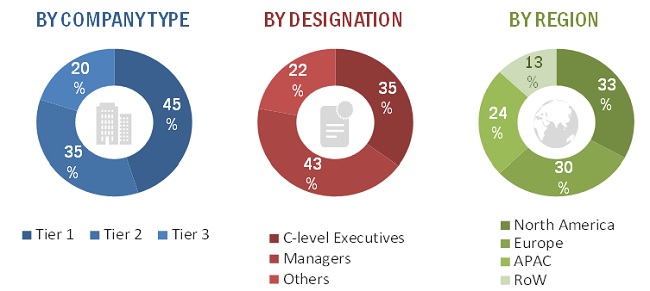
Extensive primary research has been conducted after understanding and analyzing the current scenario of the Robotic welding market through secondary research. Several primary interviews have been conducted with key opinion leaders from both the demand and supply sides across four major regions: North America, Europe, APAC, and RoW. Approximately 25% of the primary interviews have been conducted with the demand side, while 75% have been conducted with the supply side. This primary data has been collected mainly through telephonic interviews, which account for 80% of the total primary interviews. Questionnaires and e-mails have also been used to collect data.
After interacting with industry experts, brief sessions were conducted with highly experienced independent consultants to reinforce the findings from our primaries. This, along with the in-house subject matter experts’ opinions, has led us to the findings as described in the remainder of this report. The breakdown of primary respondents is as follows:
To know about the assumptions considered for the study, download the pdf brochure
Market Size Estimation
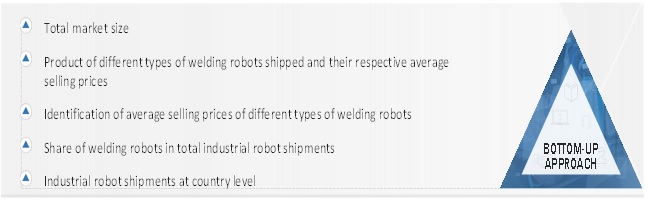
The bottom-up procedure has been employed to arrive at the overall size of the robotic welding market.
- Identifying the number of industrial robots shipped in each region
- Analyzing the global penetration of welding robots that fall under the category of industrial robots through secondary and primary research
- Identifying average selling prices of different types of welding robots
- Conducting multiple discussion sessions with the key opinion leaders to understand different types of welding robots and their deployment in multiple end-use industries; analyzing the break-up of the work carried out by each key company
- Verifying and crosschecking estimates at every level with the key opinion leaders, including chief executive officers (CEO), directors, and operation managers, and then finally with the domain experts of MarketsandMarkets
- Studying various paid and unpaid sources of information such as annual reports, press releases, white papers, and databases for company- and region-specific developments undertaken in the robotic welding market
To know about the assumptions considered for the study, Request for Free Sample Report
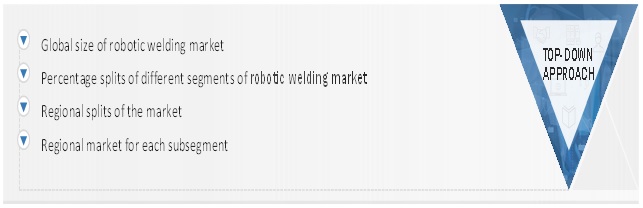
The top-down approach has been used to estimate and validate the total size of the robotic welding market.
- Focusing on top-line investments and expenditures being made in the ecosystem of the robotic welding industry; segmenting the market based on type, payload, end user, and region; and listing key developments in the leading markets
- Identifying all key players in the robotic welding market based on region and end user through secondary research that have been then duly verified through a brief discussion with the industry experts
- Analyzing revenues, product mix, geographic presence, and key applications served by all the identified players to estimate and arrive at the percentage splits for all key segments
- Discussing these splits with the industry experts to validate the information and identify the key growth pockets across all key segments
- Breaking down the total market based on verified splits and key growth pockets across all segments
Data Triangulation
After arriving at the overall market size—using the market size estimation processes as explained above—the market has been split into several segments and subsegments. To complete the entire market engineering process and arrive at the exact statistics of each market segment and subsegment, data triangulation, and market breakdown procedures have been employed, wherever applicable. The data has been triangulated by studying various factors and trends from both the demand and supply sides in the Robotic welding market.
Report Objectives
- To define, describe, segment, and forecast the robotic welding market based on type and end user in terms of value (with peripherals) and volume (without peripherals)
- To define, describe, segment, and forecast the market based on payload in terms of value (with peripherals)
- To describe and forecast the market (with peripherals and without peripherals) for four key regions—North America, Europe, Asia Pacific (APAC), and the Rest of the World (RoW)—in terms of (with peripherals) value and volume (without peripherals)
- To provide detailed information regarding drivers, restraints, opportunities, and challenges influencing the growth of the robotic welding market
- To provide a detailed overview of the supply chain pertaining to the robotic welding ecosystem, along with the average selling prices of welding robots
- To strategically analyze the ecosystem, tariffs and regulations, patent landscape, trade landscape, and case studies pertaining to the market
- To describe the detailed impact of the COVID-19 on the market
- To strategically analyze micromarkets1 with regard to individual growth trends, prospects, and contribution to the overall market
- To analyze opportunities in the market for stakeholders and provide a competitive landscape of the market
- To analyze competitive developments such as product launches, expansions, partnerships, contracts, joint ventures, agreement, and acquisitions in the market
- To strategically profile the key players in the market and comprehensively analyze their market ranking and core competencies2
Available customizations:
With the given market data, MarketsandMarkets offers customizations according to a company’s specific needs. The following customization options are available for the report:
- Detailed analysis and profiling of additional market players based on various blocks of the robotic welding supply chain

 Generating Response ...









Growth opportunities and latent adjacency in Robotic Welding Market
i want to watch the market size of welding robot graph.