Service Laboratory Market by Service Type (OEM, Laboratory Services), Product/Technology (FE-TEM, STEM, FIB-SEM, FEG-SEM, SIMS), Application (Biotechnology, Pharmaceutical, Semiconductor) and Geography (North America, Europe, APAC) - Global Forecast to 2035


Service Laboratory Market Summary
The global Service Laboratory Market is entering a technology-led phase of expansion as healthcare providers, pharmaceutical companies, biotechnology firms, food manufacturers, environmental organizations, and industrial enterprises increasingly outsource specialized testing, diagnostics, validation, and analytical functions. Based on current industry estimates and cross-market benchmarks, the Service Laboratory Market is estimated at approximately USD 58–61 billion in 2025 and is projected to reach around USD 90–96 billion by 2035, expanding at a CAGR of approximately 4.0%–5.2% during the forecast period.
Growth is being supported by rising demand for accurate and specialized testing, increasing regulatory requirements, pharmaceutical and biotechnology R&D, preventive diagnostics, environmental monitoring, and quality-control requirements across manufacturing industries. At the technology level, AI, IoT, laboratory automation, cloud computing, robotics, digital pathology, connected instruments, and data analytics are transforming conventional laboratory workflows. AI is increasingly used for test interpretation, workflow optimization, anomaly detection, predictive maintenance, and decision support, while IoT-enabled instruments enable continuous equipment monitoring and remote laboratory management. These developments are pushing service laboratories toward higher throughput, improved reproducibility, faster turnaround times, and more data-driven service models.
Key Market Trends & Insights
The Service Laboratory Market is characterized by sustained demand from clinical diagnostics and pharmaceutical testing, while industrial and environmental testing provides additional diversification. North America currently represents the leading regional market because of its sophisticated healthcare infrastructure, high laboratory utilization, strong pharmaceutical R&D ecosystem, and established third-party laboratory networks. Asia Pacific is expected to register the fastest growth through 2035 as healthcare infrastructure expands, pharmaceutical manufacturing increases, and laboratory outsourcing gains momentum in China, Japan, India, and other emerging economies.
The clinical laboratory services segment remains one of the most influential areas of demand because of increasing chronic disease testing, preventive screening, personalized medicine, molecular diagnostics, and aging populations. Meanwhile, analytical and research laboratory services are benefiting from more complex drug development and quality-control requirements.
Technology adoption is becoming a major competitive differentiator. AI-supported laboratory information systems, robotic sample handling, automated analyzers, cloud-based laboratory management, connected instruments, and predictive analytics are helping laboratories improve productivity while reducing manual intervention. The emergence of autonomous and AI-native laboratories is also creating longer-term opportunities for laboratories capable of integrating robotics, machine learning, and digital workflow orchestration.
Market Size & Forecast
- Base year market size: Approximately USD 58–61 billion in 2025.
- Forecast value by 2035: Approximately USD 90–96 billion.
- CAGR: Approximately 4.0%–5.2% from 2025 to 2035.
- Growth factors: Increasing outsourcing of laboratory testing, rising healthcare and pharmaceutical expenditure, regulatory compliance requirements, growing diagnostic volumes, biotechnology development, industrial quality control, and accelerating adoption of AI, IoT, cloud technologies, and automation.
The long-term growth trajectory is expected to remain resilient because laboratory testing is increasingly embedded into healthcare delivery, drug development, manufacturing quality assurance, environmental compliance, and scientific research.
Service Laboratory Market Market Top 10 key takeaway
- The global Service Laboratory Market is estimated at approximately USD 58–61 billion in 2025.
- The market is projected to reach approximately USD 90–96 billion by 2035.
- The market is expected to expand at a CAGR of approximately 4.0%–5.2% through 2035.
- North America remains the leading regional market due to advanced healthcare and laboratory infrastructure.
- Asia Pacific is expected to demonstrate the fastest growth during the forecast period.
- Clinical and diagnostic laboratory services represent a major demand center across the broader service laboratory ecosystem.
- Pharmaceutical and biotechnology companies are increasing the outsourcing of specialized testing, validation, and analytical functions.
- AI, robotics, IoT, cloud platforms, and laboratory automation are becoming important productivity and differentiation tools.
- Digital pathology, molecular diagnostics, advanced analytical testing, and data-driven laboratory services represent high-value opportunities.
- Consolidation, strategic partnerships, technology investments, and geographically diversified laboratory networks are expected to shape competitive dynamics through 2035.
Product Insights
Within the Service Laboratory Market, clinical and diagnostic laboratory services represent a leading product category, supported by high testing volumes and recurring demand across hospitals, physician networks, independent laboratories, and healthcare systems. Increasing chronic disease prevalence, preventive health screening, aging populations, and personalized medicine are generating continued demand for clinical chemistry, hematology, microbiology, molecular diagnostics, pathology, and specialized testing. Broader clinical laboratory service assessments similarly identify chronic disease management, preventive screening, molecular diagnostics, and personalized medicine as major structural growth factors.
Analytical, research, environmental, food, material, and pharmaceutical testing services are also gaining importance. Pharmaceutical companies increasingly rely on external laboratories for bioanalytical testing, stability testing, raw-material analysis, microbiology testing, method development, validation, and quality-control activities. This is particularly relevant as biologics, cell and gene therapies, complex formulations, and precision medicine increase testing complexity.
Emerging service categories include digital pathology, genomic testing, liquid biopsy, high-throughput molecular testing, advanced mass spectrometry, remote sample collection, and AI-supported interpretation. Laboratories that integrate these capabilities with automated sample preparation and cloud-based data systems can increase throughput while creating differentiated premium services.
Technology / Component Insights
Technology is becoming central to the evolution of the Service Laboratory Market. Traditional laboratory processes are increasingly being connected through laboratory information management systems, laboratory information systems, cloud computing, IoT sensors, robotics, automated analyzers, AI algorithms, and advanced analytics. Connected laboratory equipment can continuously transmit operating information, enabling laboratories to monitor equipment utilization, temperature, calibration, maintenance status, and workflow bottlenecks.
AI is particularly important in areas such as digital pathology, image analysis, test selection, workflow optimization, predictive maintenance, quality assurance, and administrative automation. In 2025, Quest Diagnostics announced a collaboration with Google Cloud involving generative AI and data analytics for operational and customer applications, illustrating how major laboratory providers are incorporating AI into enterprise workflows.
Laboratory automation is also moving beyond isolated instruments toward integrated end-to-end workflows. Automated sample sorting, robotic transportation, automated preparation, intelligent scheduling, and algorithm-supported quality control can reduce manual intervention and improve turnaround time. Longer term, autonomous laboratories that combine AI with robotics may enable laboratories to dynamically allocate instruments, reagents, personnel, and testing capacity based on demand.
Cloud connectivity will further enable multi-site laboratory networks to standardize workflows and consolidate data. However, cybersecurity, data privacy, interoperability, regulatory compliance, and validation requirements will remain important considerations as laboratories become increasingly digital.
Application Insights
Clinical diagnostics represents a leading application segment because laboratory testing is essential for disease detection, monitoring, treatment selection, and preventive healthcare. Demand is being supported by increasing screening programs, chronic disease management, personalized medicine, oncology testing, infectious disease surveillance, and aging populations.
Pharmaceutical and biotechnology applications represent another significant opportunity. Drug developers increasingly use service laboratories for preclinical testing, bioanalysis, pharmacokinetics, stability assessment, microbiological analysis, analytical method development, and regulatory support. As drug pipelines become more specialized, outsourcing can provide access to expensive instrumentation and specialized scientific expertise without requiring companies to build every capability internally.
Industrial applications—including food safety, environmental monitoring, chemical testing, materials analysis, and manufacturing quality control—will also contribute to growth. Future opportunities are likely to emerge from AI-enabled predictive quality control, real-time IoT monitoring, remote testing services, and integrated laboratory data platforms that connect testing results with enterprise manufacturing and supply-chain systems.
Regional Insights
North America currently leads the Service Laboratory Market, supported by advanced healthcare infrastructure, high testing volumes, sophisticated pharmaceutical and biotechnology industries, strong R&D spending, and widespread adoption of digital laboratory technologies. Large laboratory networks are investing in automation, digital pathology, AI, and integrated information platforms to improve productivity and customer experience.
Europe maintains a strong position due to stringent quality and environmental regulations, mature healthcare systems, pharmaceutical research, and established testing and certification capabilities. Demand for laboratory services is also supported by food safety, environmental compliance, pharmaceutical quality assurance, and industrial testing.
Asia Pacific is expected to experience the fastest growth. China, Japan, India, South Korea, and other regional economies are expanding healthcare capacity, pharmaceutical manufacturing, biotechnology research, and industrial production. Increasing investments in diagnostic infrastructure and the gradual adoption of automated and digitally connected laboratories are creating significant opportunities.
- North America remains the leading regional market.
- Asia Pacific is expected to record the fastest growth through 2035.
- Europe benefits from regulatory requirements and sophisticated testing infrastructure.
- China and Japan are important contributors to APAC laboratory modernization.
- Digitalization and automation are becoming key regional competitive factors.
Country-Specific Market Trends
Within APAC, China is experiencing growing demand for laboratory services due to pharmaceutical manufacturing, biotechnology investment, healthcare modernization, food safety requirements, and industrial quality control. Japan is characterized by high laboratory automation adoption, advanced medical infrastructure, robotics expertise, and strong demand for precision diagnostics. APAC's service laboratory demand is therefore expected to grow at approximately 5.5%–7.0% CAGR through 2035, with China and India among the important expansion markets.
In North America, the United States remains the largest country-level market due to extensive laboratory networks, high diagnostic utilization, pharmaceutical R&D, and technology investment. Canada benefits from healthcare modernization, research activity, and demand for specialized testing, while Mexico is increasingly supported by healthcare infrastructure development, manufacturing, and cross-border pharmaceutical and industrial supply chains. North American country-level growth is estimated at approximately 3.5%–5.0% CAGR through 2035.
In Europe, Germany benefits from strong pharmaceutical, chemical, industrial, and healthcare sectors, while France has substantial demand for clinical diagnostics, pharmaceutical testing, food testing, and environmental services. Across these European markets, digital transformation and regulatory compliance remain central adoption drivers, supporting estimated growth of approximately 3.0%–4.5% CAGR.
- China is expanding laboratory infrastructure alongside pharmaceutical and biotechnology manufacturing.
- Japan remains a leader in laboratory robotics, automation, and precision testing.
- The United States continues to dominate North American service laboratory demand.
- Germany and France are supported by pharmaceutical, healthcare, industrial, and regulatory testing requirements.
- Government healthcare investment and quality standards remain important country-level growth catalysts.
Key Service Laboratory Company Insights
The competitive landscape includes major laboratory and testing providers such as Labcorp, Quest Diagnostics, Eurofins Scientific, Sonic Healthcare, SGS, Bureau Veritas, Intertek, and Thermo Fisher Scientific. These
AI adoption is becoming particularly visible among leading clinical laboratory companies. Labcorp launched a generative AI-powered Test Finder in collaboration with AWS in 2025 and expanded its collaboration with PathAI in 2026 to deploy an AI-enabled digital pathology platform across its network. Quest Diagnostics has also expanded its digital and AI strategy through collaborations involving Google Cloud and Epic, while its 2025 Corewell Health partnership included automated microbiology and high-throughput molecular testing capabilities.
- Leading companies are investing heavily in AI-enabled laboratory workflows.
- Automation is being used to improve throughput, consistency, and turnaround time.
- Partnerships with technology providers are accelerating cloud and generative AI adoption.
- Acquisitions and geographic expansion remain important strategies for scale.
- Specialized molecular, pathology, analytical, and precision testing services are becoming strategic growth areas.
Recent Developments
In April 2026, Labcorp announced a strategic collaboration with Optum.ai to apply AI to laboratory operations, patient engagement, prior authorization workflows, and laboratory automation. The initiative demonstrates the industry's shift toward practical AI deployment beyond diagnostic interpretation and into operational processes.
In February 2026, Labcorp expanded its collaboration with PathAI to deploy the FDA-cleared AISight Dx digital pathology platform across its national anatomic pathology laboratory network and hospital collaborations. The cloud-based platform supports digital workflows and AI-enabled insights.
In August 2025, Quest Diagnostics and Corewell Health announced a joint venture involving a new laboratory facility in Michigan, incorporating automated microbiology and high-throughput molecular testing. The agreement also expanded laboratory management, analytics, reference testing, and supply-chain capabilities.
Market Segmentation
The Service Laboratory Market can be segmented by Product into clinical laboratory services, diagnostic laboratory services, research laboratory services, environmental testing services, material testing services, analytical testing, and specialized laboratory services. By Technology / Component, the market includes conventional laboratory systems, automated analyzers, laboratory information systems, laboratory information management systems, AI and machine learning platforms, robotics, IoT-connected instruments, cloud platforms, digital pathology systems, and advanced analytical equipment. By Application, the market covers clinical diagnostics, drug development, pharmaceutical quality control, environmental testing, food safety, industrial quality assurance, materials testing, and research. By Region, the market spans North America, Europe, Asia Pacific, Latin America, and the Middle East & Africa, with North America leading and Asia Pacific representing the strongest long-term growth opportunity.
- Clinical and diagnostic services represent major demand centers.
- Automation, AI, cloud, IoT, and robotics are transforming laboratory operations.
- Pharmaceutical and biotechnology testing offers high-value outsourcing opportunities.
- North America holds the largest market position, while APAC is the fastest-growing region.
- Specialized testing and digital laboratory capabilities are becoming key competitive differentiators.
Conclusion
The global Service Laboratory Market is expected to maintain steady expansion through 2035, supported by increasing demand for specialized testing, healthcare diagnostics, pharmaceutical development, industrial quality assurance, environmental monitoring, and scientific research. With the market estimated at approximately USD 58–61 billion in 2025 and potentially reaching USD 90–96 billion by 2035, the industry offers substantial opportunities for laboratory operators, technology providers, pharmaceutical companies, healthcare organizations, and investors.
The next phase of growth will be increasingly technology-driven. AI, IoT, robotics, cloud computing, laboratory automation, digital pathology, advanced analytics, and connected instruments will help laboratories move from conventional testing environments toward intelligent, integrated, and increasingly autonomous service platforms. AI can reduce administrative workloads, improve workflow decisions, identify patterns in complex datasets, and support faster diagnostic and analytical processes.
For businesses, strategic investment in automation, interoperability, cybersecurity, AI governance, specialized testing capabilities, and scalable digital infrastructure will become increasingly important. Laboratories that combine scientific expertise with technology-enabled service delivery are likely to capture the strongest opportunities as customers demand faster turnaround, greater transparency, higher testing complexity, and more actionable data. The long-term competitive advantage will therefore depend not simply on laboratory capacity, but on the ability to deliver accurate, connected, automated, scalable, and intelligent laboratory services.
FAQs
1. What is the market size of the Service Laboratory Market?
The global Service Laboratory Market is estimated to be approximately USD 58–61 billion in 2025. Depending on market scope and the service categories included, current industry estimates indicate that the market could reach approximately USD 90–96 billion by 2035.
2. What is the growth rate of the Service Laboratory Market?
The Service Laboratory Market is expected to expand at approximately 4.0%–5.2% CAGR from 2025 to 2035. Growth is being driven by increasing laboratory outsourcing, healthcare testing volumes, pharmaceutical R&D, regulatory requirements, and investments in automation and digital technologies.
3. What are the key drivers of the Service Laboratory Market?
Major drivers include increasing demand for diagnostic and analytical testing, chronic disease monitoring, pharmaceutical and biotechnology R&D, regulatory compliance, environmental and food safety requirements, and the adoption of AI, IoT, cloud computing, robotics, and laboratory automation.
4. Which region leads the Service Laboratory Market?
North America currently leads the Service Laboratory Market due to its mature healthcare infrastructure, established laboratory networks, pharmaceutical R&D ecosystem, and high adoption of advanced laboratory technologies. Asia Pacific is expected to register the fastest growth through 2035.
5. Who are the key companies in the Service Laboratory Market?
Major participants include Labcorp, Quest Diagnostics, Eurofins Scientific, Sonic Healthcare, SGS, Bureau Veritas, Intertek, and Thermo Fisher Scientific, alongside numerous regional and specialized laboratory service providers. Competitive strategies increasingly emphasize automation, AI, digital pathology, advanced testing, partnerships, acquisitions, and geographic expansion.
 Exclusive indicates content/data unique to MarketsandMarkets and not available with any competitors.
Table of Contents
1. Introduction
1.1. Objectives of the study
1.2. Market Definition
1.3. Markets Scope
2. Research Design
2.1. Factor Analysis
2.2. Service Laboratory Market Size Estimation
2.3. Service Laboratory Market Crackdown And Data Triangulation
2.4. Service Laboratory Market Share Estimation
2.4.1 Key Data Points
2.4.1.1. Key Data Points Taken from Secondary Sources
2.4.1.2. Key Data Points Taken from Primary Sources
2.4.2. Assumptions
3. Industry Trends
4. Service Laboratory Market, By Product
4.1. Transmission Electron Microscope (TEM)
4.1.1. FE-TEM Market Size & Forecast
4.1.2. STEM Market Size & Forecast
4.2. Scanning Electron Microscope (SEM)
4.2.1. Dual Beam FIB-SEM Market Size & Forecast
4.2.2. FEG-SEM Market Size & Forecast
5. Service Laboratory Market, By Laboratory
5.1. OEM Market Size & Forecast
5.2. Services Market Size & Forecast
6. Service Laboratory Market, By Application
6.1. Industrial Market Size & Forecast, By Sub-Application
6.1.1. Oil & Gas
6.1.2. Metal & Mining
6.1.3. Renewable Energy
6.1.4. Automotive
6.1.5. Steel
6.1.6. Construction
6.1.7. Aerospace
6.1.8. Chemical
6.1.9. Machinery & Tools
6.1.10. Power Generation & Energy
6.2. Material science Market Size & Forecast, By Sub-Application
6.2.1. Paper & Fiber material
6.2.2. Ceramic & Glass
6.2.3. Polymer
6.2.4. Nano Fabrication
6.3. Bio- Science Market Size & Forecast, By Sub-Application
6.3.1. Cellular Biology
6.3.2. Structural Biology
6.3.3. Bio Medical Engineering
6.3.4. Neuroscience
6.4. Electronics Market Size & Forecast, By Sub-Application
6.4.1. Semiconductor Manufacturing
6.4.2. Thin Film Production
6.4.3. Microelectronics & MEMS
7. Service Laboratory Market, By Geography
7.1. North America Market Size & Forecast, By Countries
7.1.1. U.S.
7.1.2. Canada
7.1.3. Mexico
7.2. Europe Market Size & Forecast, By Countries
7.2.1. Germany
7.2.2. U.K.
7.2.3. France
7.2.4. Others
7.3. Asia Pacific Market Size & Forecast, By Countries
7.3.1. Japan
7.3.2. China
7.3.3. South Korea
7.3.4. India
7.3.5. Others
7.4. ROW Market Size & Forecast, By Countries
7.4.1. South America
7.4.2. Middle East & Africa
8. Secondary Ion Mass Spectroscopy (SIMS) Market, By Application
8.1. Industrial Market Size & Forecast, By Sub-Application
8.1.1. Oil & Gas
8.1.2. Metal & Mining
8.1.3. Renewable Energy
8.1.4. Automotive
8.1.5. Steel
8.1.6. Construction
8.1.7. Aerospace
8.1.8. Chemical
8.1.9. Machinery & Tools
8.1.10. Power Generation & Energy
8.2. Material science Market Size & Forecast, By Sub-Application
8.2.1. Paper & Fiber material
8.2.2. Ceramic & Glass
8.2.3. Polymer
8.2.4. Nano Fabrication
8.3. Bio- Science Market Size & Forecast, By Sub-Application
8.3.1. Cellular Biology
8.3.2. Structural Biology
8.3.3. Bio Medical Engineering
8.3.4. Neuroscience
8.4. Electronics Market Size & Forecast, By Sub-Application
8.4.1. Semiconductor Manufacturing
8.4.2. Thin Film Production
8.4.3. Microelectronics & MEMS
9. Secondary Ion Mass Spectroscopy (SIMS), By Geography
9.1. North America Market Size & Forecast, By Country
9.1.1. U.S.
9.1.2. Canada
9.1.3. Mexico
9.2. Europe Market Size & Forecast, By Country
9.2.1. Germany
9.2.2. U.K.
9.2.3. France
9.2.4. Others
9.3. Asia Pacific Market Size & Forecast, By Country
9.3.1. Japan
9.3.2. China
9.3.3. South Korea
9.3.4. India
9.3.5. Others
9.4. ROW Market Size & Forecast, By Country
9.4.1. South America
9.4.2. Middle East & Africa
10. Competitive Landscape
10.1. Introduction
10.2. Service Laboratory Market Share Analysis
10.3. Competitive Situation and Trends
11. Company Profiles
11.1. Nanolab Technologies
11.1.1. Company Snapshot
11.1.2. Product Portfolio
11.1.3. MnM View
11.2. Cerium Labs
11.2.1. Company Snapshot
11.2.2. Product Portfolio
11.2.3. MnM View
11.3. Exponent
11.3.1. Company Snapshot
11.3.2. Product Portfolio
11.3.3. MnM View
11.4. Insight Analytical Labs
11.4.1. Company Snapshot
11.4.2. Product Portfolio
11.4.3. MnM View
11.5. ICE Labs
11.5.1. Company Snapshot
11.5.2. Product Portfolio
11.5.3. MnM View
11.6. ISE Labs
11.6.1. Company Snapshot
11.6.2. Product Portfolio
11.6.3. MnM View
11.7. Sage Labs
11.7.1. Company Snapshot
11.7.2. Product Portfolio
11.7.3. MnM View
11.8. MA-TEK
11.8.1. Company Snapshot
11.8.2. Product Portfolio
11.8.3. MnM View
11.9. IST
11.9.1. Company Snapshot
11.9.2. Product Portfolio
11.9.3. MnM View
11.10. MU analysis
11.10.1. Company Snapshot
11.10.2. Product Portfolio
11.10.3. MnM View
The report describes OEMs, service, products, application, and geographical regions with respect to service laboratory market size from 2014 to 2020. In addition, this report also details various technologies used for the service laboratory. On basis of equipment, the service laboratory market has been segmented into scanning electron microscope (SEM) and transmission electron microscope (TEM), which are further divided into segments of TEM and SEM types. Whereas SIMS market is a parallel market which is not included within the service laboratory market; but the SIMS market is further segmented in terms of application and geographical regions, along with their subsegments.
The key influencers in the service laboratory market includes investors and venture capitalists, researchers/organizations, and major players, such as Moody Labs (U.S.), Direct Electron (U.S.), Intertek Group PLC (U.K.), EAG Inc. (U.S.), Hitachi Hitech (Japan), FEI Company (U.S.), Carl Zeiss SMT GmbH (Germany), and Nanolab Technologies (U.S.). The prominent companies are the well-established, financially stable players who have been operating in the industry for several years. They have diversified product portfolios, proprietary technologies, and a strong distribution networks across the globe, as well as offices at strategic locations. The report provides exhaustive information regarding existing players as well as new entrants to get a deep insight about this market.
Finally, the company profiles section includes profiles of prominent players in this industry with their segmented revenues, product portfolios, and recent developments. Furthermore, the competitive landscape helps provide a better understanding of the mergers & acquisitions, collaborations, and joint ventures undertaken by the key players in the said market.
Target Audience
- Raw Material Suppliers
- Integrated Device Manufacturers (IDMs)
- Original Device Manufacturers (ODMs) (Discrete and Chip Manufacturers)
- Original Equipment Manufacturers (OEM)
- Process OEMs
- System Integrators
- Electronic Hardware Equipment Manufacturers
- Assembly and Packaging Vendors
- Technical Universities
- Academic Institutes
- Pharmaceutical and Biotechnology Industries
- Semiconductor Industries
- Government Space Research Agencies and Private Research Organizations
Scope of the Report
The report classifies the service laboratory equipment technology market into different segments, namely, by product, service type, application, and geography. It entails the analyses and forecasts related to the service laboratory equipment market.
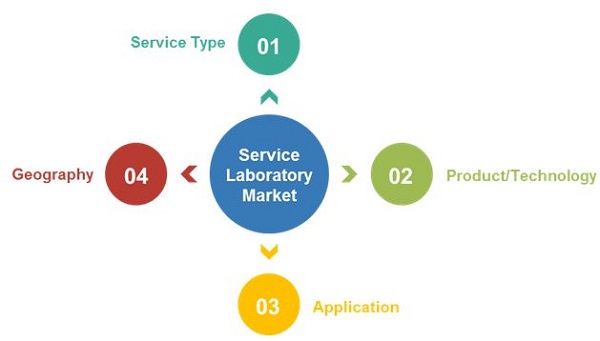
On the basis of Application
Some of the major applications in the service laboratory market are industrial science, material science, bioscience, and electronics.
On the basis of Industry
Major industries in the service laboratory market includes oil & gas, mining, chemicals & pharmaceuticals, power generation, metal, paper & fibers, polymer, semiconductor manufacturing, MEMS, biomedical engineering, neuroscience, structural biology, and cellular biology.
On the basis of Geography
-
North America
- U.S.
- Canada
- Mexico
-
Europe
- France
- U.K.
- Germany
- Others
-
Asia-Pacific
- China
- Japan
- India
- Others
- RoW













Growth opportunities and latent adjacency in Service Laboratory Market